EP0167946A2 - Verfahren zur Herstellung aromatischer Phosphorverbindungen - Google Patents
Verfahren zur Herstellung aromatischer Phosphorverbindungen Download PDFInfo
- Publication number
- EP0167946A2 EP0167946A2 EP85108064A EP85108064A EP0167946A2 EP 0167946 A2 EP0167946 A2 EP 0167946A2 EP 85108064 A EP85108064 A EP 85108064A EP 85108064 A EP85108064 A EP 85108064A EP 0167946 A2 EP0167946 A2 EP 0167946A2
- Authority
- EP
- European Patent Office
- Prior art keywords
- compound
- arx
- compounds
- mole
- formula
- Prior art date
- Legal status (The legal status is an assumption and is not a legal conclusion. Google has not performed a legal analysis and makes no representation as to the accuracy of the status listed.)
- Granted
Links
- -1 aromatic phosphorous compounds Chemical class 0.000 title abstract description 16
- 238000004519 manufacturing process Methods 0.000 title abstract description 7
- 150000001875 compounds Chemical class 0.000 claims abstract description 48
- 238000005727 Friedel-Crafts reaction Methods 0.000 claims abstract description 15
- 229910052717 sulfur Inorganic materials 0.000 claims abstract description 15
- NINIDFKCEFEMDL-UHFFFAOYSA-N Sulfur Chemical compound [S] NINIDFKCEFEMDL-UHFFFAOYSA-N 0.000 claims abstract description 14
- 239000011593 sulfur Substances 0.000 claims abstract description 10
- 239000003054 catalyst Substances 0.000 claims abstract description 9
- 125000002496 methyl group Chemical group [H]C([H])([H])* 0.000 claims abstract description 7
- 229910052760 oxygen Inorganic materials 0.000 claims abstract description 7
- 239000001301 oxygen Substances 0.000 claims abstract description 7
- 229920000642 polymer Polymers 0.000 claims abstract description 6
- 125000001424 substituent group Chemical group 0.000 claims abstract description 6
- 150000005840 aryl radicals Chemical class 0.000 claims abstract description 5
- 125000004104 aryloxy group Chemical group 0.000 claims abstract description 5
- 229910052736 halogen Inorganic materials 0.000 claims abstract description 5
- 150000002367 halogens Chemical class 0.000 claims abstract description 5
- 125000004434 sulfur atom Chemical group 0.000 claims abstract description 5
- MYMOFIZGZYHOMD-UHFFFAOYSA-N Dioxygen Chemical compound O=O MYMOFIZGZYHOMD-UHFFFAOYSA-N 0.000 claims abstract description 4
- 125000000217 alkyl group Chemical group 0.000 claims abstract description 4
- 125000000956 methoxy group Chemical group [H]C([H])([H])O* 0.000 claims abstract description 4
- 238000000034 method Methods 0.000 claims description 21
- 238000006243 chemical reaction Methods 0.000 claims description 15
- 230000008569 process Effects 0.000 claims description 13
- QAOWNCQODCNURD-UHFFFAOYSA-N Sulfuric acid Chemical compound OS(O)(=O)=O QAOWNCQODCNURD-UHFFFAOYSA-N 0.000 claims description 3
- CIUQDSCDWFSTQR-UHFFFAOYSA-N [C]1=CC=CC=C1 Chemical class [C]1=CC=CC=C1 CIUQDSCDWFSTQR-UHFFFAOYSA-N 0.000 claims description 3
- 125000000654 isopropylidene group Chemical group C(C)(C)=* 0.000 claims description 3
- 125000000325 methylidene group Chemical group [H]C([H])=* 0.000 claims description 3
- 125000001997 phenyl group Chemical group [H]C1=C([H])C([H])=C(*)C([H])=C1[H] 0.000 claims description 3
- 238000002360 preparation method Methods 0.000 claims description 3
- 125000000732 arylene group Chemical group 0.000 claims description 2
- QVGXLLKOCUKJST-UHFFFAOYSA-N atomic oxygen Chemical compound [O] QVGXLLKOCUKJST-UHFFFAOYSA-N 0.000 claims description 2
- 125000002915 carbonyl group Chemical group [*:2]C([*:1])=O 0.000 claims description 2
- 230000007062 hydrolysis Effects 0.000 claims description 2
- 238000006460 hydrolysis reaction Methods 0.000 claims description 2
- 125000000472 sulfonyl group Chemical group *S(*)(=O)=O 0.000 claims description 2
- 229910052698 phosphorus Inorganic materials 0.000 abstract description 18
- 229920000412 polyarylene Polymers 0.000 abstract description 17
- 150000002170 ethers Chemical class 0.000 abstract description 16
- 125000003118 aryl group Chemical group 0.000 abstract description 15
- 239000011574 phosphorus Substances 0.000 abstract description 15
- OAICVXFJPJFONN-UHFFFAOYSA-N Phosphorus Chemical compound [P] OAICVXFJPJFONN-UHFFFAOYSA-N 0.000 abstract description 14
- 125000004430 oxygen atom Chemical group O* 0.000 abstract description 2
- VSCWAEJMTAWNJL-UHFFFAOYSA-K aluminium trichloride Chemical compound Cl[Al](Cl)Cl VSCWAEJMTAWNJL-UHFFFAOYSA-K 0.000 description 20
- YXFVVABEGXRONW-UHFFFAOYSA-N Toluene Chemical compound CC1=CC=CC=C1 YXFVVABEGXRONW-UHFFFAOYSA-N 0.000 description 18
- 239000000203 mixture Substances 0.000 description 18
- XLYOFNOQVPJJNP-UHFFFAOYSA-N water Chemical compound O XLYOFNOQVPJJNP-UHFFFAOYSA-N 0.000 description 16
- USIUVYZYUHIAEV-UHFFFAOYSA-N diphenyl ether Chemical compound C=1C=CC=CC=1OC1=CC=CC=C1 USIUVYZYUHIAEV-UHFFFAOYSA-N 0.000 description 12
- 239000000047 product Substances 0.000 description 12
- VEXZGXHMUGYJMC-UHFFFAOYSA-N Hydrochloric acid Chemical compound Cl VEXZGXHMUGYJMC-UHFFFAOYSA-N 0.000 description 10
- MVPPADPHJFYWMZ-UHFFFAOYSA-N chlorobenzene Chemical compound ClC1=CC=CC=C1 MVPPADPHJFYWMZ-UHFFFAOYSA-N 0.000 description 8
- 239000012074 organic phase Substances 0.000 description 8
- 239000011541 reaction mixture Substances 0.000 description 8
- ZMXDDKWLCZADIW-UHFFFAOYSA-N N,N-Dimethylformamide Chemical compound CN(C)C=O ZMXDDKWLCZADIW-UHFFFAOYSA-N 0.000 description 7
- 239000007858 starting material Substances 0.000 description 7
- HIXDQWDOVZUNNA-UHFFFAOYSA-N 2-(3,4-dimethoxyphenyl)-5-hydroxy-7-methoxychromen-4-one Chemical compound C=1C(OC)=CC(O)=C(C(C=2)=O)C=1OC=2C1=CC=C(OC)C(OC)=C1 HIXDQWDOVZUNNA-UHFFFAOYSA-N 0.000 description 6
- HEDRZPFGACZZDS-UHFFFAOYSA-N Chloroform Chemical compound ClC(Cl)Cl HEDRZPFGACZZDS-UHFFFAOYSA-N 0.000 description 6
- YMWUJEATGCHHMB-UHFFFAOYSA-N Dichloromethane Chemical compound ClCCl YMWUJEATGCHHMB-UHFFFAOYSA-N 0.000 description 6
- XYFCBTPGUUZFHI-UHFFFAOYSA-N Phosphine Chemical compound P XYFCBTPGUUZFHI-UHFFFAOYSA-N 0.000 description 6
- LWNLXVXSCCLRRZ-UHFFFAOYSA-N dichlorophosphane Chemical compound ClPCl LWNLXVXSCCLRRZ-UHFFFAOYSA-N 0.000 description 6
- RTZKZFJDLAIYFH-UHFFFAOYSA-N ether Substances CCOCC RTZKZFJDLAIYFH-UHFFFAOYSA-N 0.000 description 6
- 238000010992 reflux Methods 0.000 description 6
- 239000000126 substance Substances 0.000 description 6
- VPWNQTHUCYMVMZ-UHFFFAOYSA-N 4,4'-sulfonyldiphenol Chemical class C1=CC(O)=CC=C1S(=O)(=O)C1=CC=C(O)C=C1 VPWNQTHUCYMVMZ-UHFFFAOYSA-N 0.000 description 5
- 229930185605 Bisphenol Natural products 0.000 description 5
- NJLHHACGWKAWKL-UHFFFAOYSA-N ClP(Cl)=O Chemical compound ClP(Cl)=O NJLHHACGWKAWKL-UHFFFAOYSA-N 0.000 description 5
- UTPMVYCOQRFMMG-UHFFFAOYSA-N ClP(Cl)=S Chemical compound ClP(Cl)=S UTPMVYCOQRFMMG-UHFFFAOYSA-N 0.000 description 5
- KFZMGEQAYNKOFK-UHFFFAOYSA-N Isopropanol Chemical compound CC(C)O KFZMGEQAYNKOFK-UHFFFAOYSA-N 0.000 description 5
- PYLWMHQQBFSUBP-UHFFFAOYSA-N monofluorobenzene Chemical compound FC1=CC=CC=C1 PYLWMHQQBFSUBP-UHFFFAOYSA-N 0.000 description 5
- XKRFYHLGVUSROY-UHFFFAOYSA-N Argon Chemical compound [Ar] XKRFYHLGVUSROY-UHFFFAOYSA-N 0.000 description 4
- IJGRMHOSHXDMSA-UHFFFAOYSA-N Atomic nitrogen Chemical compound N#N IJGRMHOSHXDMSA-UHFFFAOYSA-N 0.000 description 4
- WCUXLLCKKVVCTQ-UHFFFAOYSA-M Potassium chloride Chemical compound [Cl-].[K+] WCUXLLCKKVVCTQ-UHFFFAOYSA-M 0.000 description 4
- 239000008346 aqueous phase Substances 0.000 description 4
- 150000001491 aromatic compounds Chemical class 0.000 description 4
- 125000001309 chloro group Chemical group Cl* 0.000 description 4
- 238000001816 cooling Methods 0.000 description 4
- IMDXZWRLUZPMDH-UHFFFAOYSA-N dichlorophenylphosphine Chemical compound ClP(Cl)C1=CC=CC=C1 IMDXZWRLUZPMDH-UHFFFAOYSA-N 0.000 description 4
- 150000002148 esters Chemical class 0.000 description 4
- LQNUZADURLCDLV-UHFFFAOYSA-N nitrobenzene Chemical compound [O-][N+](=O)C1=CC=CC=C1 LQNUZADURLCDLV-UHFFFAOYSA-N 0.000 description 4
- 230000009257 reactivity Effects 0.000 description 4
- 0 C*(C*)C(*)N=*C Chemical compound C*(C*)C(*)N=*C 0.000 description 3
- 239000000460 chlorine Substances 0.000 description 3
- SXIWNIQDOJKDGB-UHFFFAOYSA-N dichloro-phenyl-sulfanylidene-$l^{5}-phosphane Chemical compound ClP(Cl)(=S)C1=CC=CC=C1 SXIWNIQDOJKDGB-UHFFFAOYSA-N 0.000 description 3
- 239000012153 distilled water Substances 0.000 description 3
- VLKZOEOYAKHREP-UHFFFAOYSA-N n-Hexane Chemical compound CCCCCC VLKZOEOYAKHREP-UHFFFAOYSA-N 0.000 description 3
- AUONHKJOIZSQGR-UHFFFAOYSA-N oxophosphane Chemical compound P=O AUONHKJOIZSQGR-UHFFFAOYSA-N 0.000 description 3
- 125000004437 phosphorous atom Chemical group 0.000 description 3
- 229910000073 phosphorus hydride Inorganic materials 0.000 description 3
- 229920000570 polyether Polymers 0.000 description 3
- 239000002243 precursor Substances 0.000 description 3
- 150000003254 radicals Chemical class 0.000 description 3
- 239000007787 solid Substances 0.000 description 3
- 239000002904 solvent Substances 0.000 description 3
- OKQKDCXVLPGWPO-UHFFFAOYSA-N sulfanylidenephosphane Chemical compound S=P OKQKDCXVLPGWPO-UHFFFAOYSA-N 0.000 description 3
- JAPZQMHGKQRTPH-UHFFFAOYSA-N 1-fluoro-2-[(2-fluorophenyl)-phenylphosphoryl]benzene Chemical compound FC1=CC=CC=C1P(=O)(C=1C(=CC=CC=1)F)C1=CC=CC=C1 JAPZQMHGKQRTPH-UHFFFAOYSA-N 0.000 description 2
- PXGOKWXKJXAPGV-UHFFFAOYSA-N Fluorine Chemical compound FF PXGOKWXKJXAPGV-UHFFFAOYSA-N 0.000 description 2
- XEEYBQQBJWHFJM-UHFFFAOYSA-N Iron Chemical compound [Fe] XEEYBQQBJWHFJM-UHFFFAOYSA-N 0.000 description 2
- PMZURENOXWZQFD-UHFFFAOYSA-L Sodium Sulfate Chemical compound [Na+].[Na+].[O-]S([O-])(=O)=O PMZURENOXWZQFD-UHFFFAOYSA-L 0.000 description 2
- WYURNTSHIVDZCO-UHFFFAOYSA-N Tetrahydrofuran Chemical compound C1CCOC1 WYURNTSHIVDZCO-UHFFFAOYSA-N 0.000 description 2
- 239000002253 acid Substances 0.000 description 2
- RDOXTESZEPMUJZ-UHFFFAOYSA-N anisole Chemical compound COC1=CC=CC=C1 RDOXTESZEPMUJZ-UHFFFAOYSA-N 0.000 description 2
- 229910052786 argon Inorganic materials 0.000 description 2
- 230000015572 biosynthetic process Effects 0.000 description 2
- 239000007795 chemical reaction product Substances 0.000 description 2
- 239000000706 filtrate Substances 0.000 description 2
- 239000011737 fluorine Substances 0.000 description 2
- 229910052731 fluorine Inorganic materials 0.000 description 2
- 239000007789 gas Substances 0.000 description 2
- 239000005457 ice water Substances 0.000 description 2
- FBAFATDZDUQKNH-UHFFFAOYSA-M iron chloride Chemical compound [Cl-].[Fe] FBAFATDZDUQKNH-UHFFFAOYSA-M 0.000 description 2
- 229910052751 metal Inorganic materials 0.000 description 2
- 239000002184 metal Substances 0.000 description 2
- 229910052757 nitrogen Inorganic materials 0.000 description 2
- 239000004033 plastic Substances 0.000 description 2
- 229920003023 plastic Polymers 0.000 description 2
- 239000001103 potassium chloride Substances 0.000 description 2
- 235000011164 potassium chloride Nutrition 0.000 description 2
- 239000002244 precipitate Substances 0.000 description 2
- 230000035484 reaction time Effects 0.000 description 2
- 239000011734 sodium Substances 0.000 description 2
- 229910052938 sodium sulfate Inorganic materials 0.000 description 2
- 235000011152 sodium sulphate Nutrition 0.000 description 2
- 238000003756 stirring Methods 0.000 description 2
- 150000004763 sulfides Chemical class 0.000 description 2
- VYNGFCUGSYEOOZ-UHFFFAOYSA-N triphenylphosphine sulfide Chemical class C=1C=CC=CC=1P(C=1C=CC=CC=1)(=S)C1=CC=CC=C1 VYNGFCUGSYEOOZ-UHFFFAOYSA-N 0.000 description 2
- QWUWMCYKGHVNAV-UHFFFAOYSA-N 1,2-dihydrostilbene Chemical group C=1C=CC=CC=1CCC1=CC=CC=C1 QWUWMCYKGHVNAV-UHFFFAOYSA-N 0.000 description 1
- AOUFNFSQKTZWRG-UHFFFAOYSA-N 1-diphenylphosphoryl-2,3-difluorobenzene Chemical class FC1=C(C=CC=C1F)P(C1=CC=CC=C1)(C1=CC=CC=C1)=O AOUFNFSQKTZWRG-UHFFFAOYSA-N 0.000 description 1
- JSZOAYXJRCEYSX-UHFFFAOYSA-N 1-nitropropane Chemical compound CCC[N+]([O-])=O JSZOAYXJRCEYSX-UHFFFAOYSA-N 0.000 description 1
- WKBOTKDWSSQWDR-UHFFFAOYSA-N Bromine atom Chemical class [Br] WKBOTKDWSSQWDR-UHFFFAOYSA-N 0.000 description 1
- ZAMOUSCENKQFHK-UHFFFAOYSA-N Chlorine atom Chemical compound [Cl] ZAMOUSCENKQFHK-UHFFFAOYSA-N 0.000 description 1
- KRHYYFGTRYWZRS-UHFFFAOYSA-N Fluorane Chemical compound F KRHYYFGTRYWZRS-UHFFFAOYSA-N 0.000 description 1
- 238000003747 Grignard reaction Methods 0.000 description 1
- UFHFLCQGNIYNRP-UHFFFAOYSA-N Hydrogen Chemical compound [H][H] UFHFLCQGNIYNRP-UHFFFAOYSA-N 0.000 description 1
- 229910021578 Iron(III) chloride Inorganic materials 0.000 description 1
- 239000002841 Lewis acid Substances 0.000 description 1
- FYYHWMGAXLPEAU-UHFFFAOYSA-N Magnesium Chemical compound [Mg] FYYHWMGAXLPEAU-UHFFFAOYSA-N 0.000 description 1
- 239000004721 Polyphenylene oxide Substances 0.000 description 1
- UCKMPCXJQFINFW-UHFFFAOYSA-N Sulphide Chemical compound [S-2] UCKMPCXJQFINFW-UHFFFAOYSA-N 0.000 description 1
- 229910021627 Tin(IV) chloride Inorganic materials 0.000 description 1
- 238000006887 Ullmann reaction Methods 0.000 description 1
- WAIPAZQMEIHHTJ-UHFFFAOYSA-N [Cr].[Co] Chemical compound [Cr].[Co] WAIPAZQMEIHHTJ-UHFFFAOYSA-N 0.000 description 1
- 150000007513 acids Chemical class 0.000 description 1
- 230000009471 action Effects 0.000 description 1
- 125000003545 alkoxy group Chemical group 0.000 description 1
- 150000001350 alkyl halides Chemical class 0.000 description 1
- 238000006254 arylation reaction Methods 0.000 description 1
- 125000004429 atom Chemical group 0.000 description 1
- 239000002585 base Substances 0.000 description 1
- 230000001588 bifunctional effect Effects 0.000 description 1
- 125000004432 carbon atom Chemical group C* 0.000 description 1
- QGJOPFRUJISHPQ-NJFSPNSNSA-N carbon disulfide-14c Chemical compound S=[14C]=S QGJOPFRUJISHPQ-NJFSPNSNSA-N 0.000 description 1
- 150000001735 carboxylic acids Chemical class 0.000 description 1
- 239000003638 chemical reducing agent Substances 0.000 description 1
- 229910052801 chlorine Inorganic materials 0.000 description 1
- 150000001805 chlorine compounds Chemical class 0.000 description 1
- 239000007859 condensation product Substances 0.000 description 1
- 239000013078 crystal Substances 0.000 description 1
- 238000005661 deetherification reaction Methods 0.000 description 1
- DZOPBRSPKCADEN-UHFFFAOYSA-N dichloro-(4-chlorophenyl)phosphane Chemical compound ClP(Cl)C1=CC=C(Cl)C=C1 DZOPBRSPKCADEN-UHFFFAOYSA-N 0.000 description 1
- IBDMRHDXAQZJAP-UHFFFAOYSA-N dichlorophosphorylbenzene Chemical compound ClP(Cl)(=O)C1=CC=CC=C1 IBDMRHDXAQZJAP-UHFFFAOYSA-N 0.000 description 1
- 238000004821 distillation Methods 0.000 description 1
- 238000001035 drying Methods 0.000 description 1
- 238000005485 electric heating Methods 0.000 description 1
- 239000002360 explosive Substances 0.000 description 1
- 125000005843 halogen group Chemical group 0.000 description 1
- 229920006158 high molecular weight polymer Polymers 0.000 description 1
- 239000001257 hydrogen Substances 0.000 description 1
- 229910052739 hydrogen Inorganic materials 0.000 description 1
- 229910000040 hydrogen fluoride Inorganic materials 0.000 description 1
- 239000000543 intermediate Substances 0.000 description 1
- 229910052742 iron Inorganic materials 0.000 description 1
- RBTARNINKXHZNM-UHFFFAOYSA-K iron trichloride Chemical compound Cl[Fe](Cl)Cl RBTARNINKXHZNM-UHFFFAOYSA-K 0.000 description 1
- 150000007517 lewis acids Chemical class 0.000 description 1
- 239000011777 magnesium Substances 0.000 description 1
- 229910052749 magnesium Inorganic materials 0.000 description 1
- 229910001507 metal halide Inorganic materials 0.000 description 1
- 150000005309 metal halides Chemical class 0.000 description 1
- 150000002739 metals Chemical class 0.000 description 1
- UZKWTJUDCOPSNM-UHFFFAOYSA-N methoxybenzene Substances CCCCOC=C UZKWTJUDCOPSNM-UHFFFAOYSA-N 0.000 description 1
- SCLFRABIDYGTAZ-UHFFFAOYSA-N methylphosphonic acid dichloride Chemical compound CP(Cl)(Cl)=O SCLFRABIDYGTAZ-UHFFFAOYSA-N 0.000 description 1
- SYSQUGFVNFXIIT-UHFFFAOYSA-N n-[4-(1,3-benzoxazol-2-yl)phenyl]-4-nitrobenzenesulfonamide Chemical class C1=CC([N+](=O)[O-])=CC=C1S(=O)(=O)NC1=CC=C(C=2OC3=CC=CC=C3N=2)C=C1 SYSQUGFVNFXIIT-UHFFFAOYSA-N 0.000 description 1
- 125000004957 naphthylene group Chemical group 0.000 description 1
- 125000000449 nitro group Chemical group [O-][N+](*)=O 0.000 description 1
- 239000007800 oxidant agent Substances 0.000 description 1
- 230000003647 oxidation Effects 0.000 description 1
- 238000007254 oxidation reaction Methods 0.000 description 1
- MPQXHAGKBWFSNV-UHFFFAOYSA-N oxidophosphanium Chemical group [PH3]=O MPQXHAGKBWFSNV-UHFFFAOYSA-N 0.000 description 1
- 150000002978 peroxides Chemical class 0.000 description 1
- 239000003208 petroleum Substances 0.000 description 1
- 125000000951 phenoxy group Chemical group [H]C1=C([H])C([H])=C(O*)C([H])=C1[H] 0.000 description 1
- REJGOFYVRVIODZ-UHFFFAOYSA-N phosphanium;chloride Chemical compound P.Cl REJGOFYVRVIODZ-UHFFFAOYSA-N 0.000 description 1
- 150000003003 phosphines Chemical class 0.000 description 1
- FAIAAWCVCHQXDN-UHFFFAOYSA-N phosphorus trichloride Chemical compound ClP(Cl)Cl FAIAAWCVCHQXDN-UHFFFAOYSA-N 0.000 description 1
- 229920000137 polyphosphoric acid Polymers 0.000 description 1
- 239000000376 reactant Substances 0.000 description 1
- 239000012429 reaction media Substances 0.000 description 1
- 230000004044 response Effects 0.000 description 1
- 230000035945 sensitivity Effects 0.000 description 1
- 238000007086 side reaction Methods 0.000 description 1
- 239000012265 solid product Substances 0.000 description 1
- WSANLGASBHUYGD-UHFFFAOYSA-N sulfidophosphanium Chemical class S=[PH3] WSANLGASBHUYGD-UHFFFAOYSA-N 0.000 description 1
- 238000005987 sulfurization reaction Methods 0.000 description 1
- YLQBMQCUIZJEEH-UHFFFAOYSA-N tetrahydrofuran Natural products C=1C=COC=1 YLQBMQCUIZJEEH-UHFFFAOYSA-N 0.000 description 1
- WQYSXVGEZYESBR-UHFFFAOYSA-N thiophosphoryl chloride Chemical compound ClP(Cl)(Cl)=S WQYSXVGEZYESBR-UHFFFAOYSA-N 0.000 description 1
- HPGGPRDJHPYFRM-UHFFFAOYSA-J tin(iv) chloride Chemical compound Cl[Sn](Cl)(Cl)Cl HPGGPRDJHPYFRM-UHFFFAOYSA-J 0.000 description 1
- 238000005406 washing Methods 0.000 description 1
Classifications
-
- C—CHEMISTRY; METALLURGY
- C08—ORGANIC MACROMOLECULAR COMPOUNDS; THEIR PREPARATION OR CHEMICAL WORKING-UP; COMPOSITIONS BASED THEREON
- C08G—MACROMOLECULAR COMPOUNDS OBTAINED OTHERWISE THAN BY REACTIONS ONLY INVOLVING UNSATURATED CARBON-TO-CARBON BONDS
- C08G79/00—Macromolecular compounds obtained by reactions forming a linkage containing atoms other than silicon, sulfur, nitrogen, oxygen, and carbon with or without the latter elements in the main chain of the macromolecule
- C08G79/02—Macromolecular compounds obtained by reactions forming a linkage containing atoms other than silicon, sulfur, nitrogen, oxygen, and carbon with or without the latter elements in the main chain of the macromolecule a linkage containing phosphorus
- C08G79/06—Phosphorus linked to carbon only
-
- C—CHEMISTRY; METALLURGY
- C07—ORGANIC CHEMISTRY
- C07F—ACYCLIC, CARBOCYCLIC OR HETEROCYCLIC COMPOUNDS CONTAINING ELEMENTS OTHER THAN CARBON, HYDROGEN, HALOGEN, OXYGEN, NITROGEN, SULFUR, SELENIUM OR TELLURIUM
- C07F9/00—Compounds containing elements of Groups 5 or 15 of the Periodic Table
- C07F9/02—Phosphorus compounds
- C07F9/28—Phosphorus compounds with one or more P—C bonds
- C07F9/50—Organo-phosphines
- C07F9/505—Preparation; Separation; Purification; Stabilisation
- C07F9/5063—Preparation; Separation; Purification; Stabilisation from compounds having the structure P-H or P-Heteroatom, in which one or more of such bonds are converted into P-C bonds
- C07F9/5068—Preparation; Separation; Purification; Stabilisation from compounds having the structure P-H or P-Heteroatom, in which one or more of such bonds are converted into P-C bonds from starting materials having the structure >P-Hal
-
- C—CHEMISTRY; METALLURGY
- C07—ORGANIC CHEMISTRY
- C07F—ACYCLIC, CARBOCYCLIC OR HETEROCYCLIC COMPOUNDS CONTAINING ELEMENTS OTHER THAN CARBON, HYDROGEN, HALOGEN, OXYGEN, NITROGEN, SULFUR, SELENIUM OR TELLURIUM
- C07F9/00—Compounds containing elements of Groups 5 or 15 of the Periodic Table
- C07F9/02—Phosphorus compounds
- C07F9/28—Phosphorus compounds with one or more P—C bonds
- C07F9/50—Organo-phosphines
- C07F9/53—Organo-phosphine oxides; Organo-phosphine thioxides
- C07F9/5325—Aromatic phosphine oxides or thioxides (P-C aromatic linkage)
-
- C—CHEMISTRY; METALLURGY
- C08—ORGANIC MACROMOLECULAR COMPOUNDS; THEIR PREPARATION OR CHEMICAL WORKING-UP; COMPOSITIONS BASED THEREON
- C08G—MACROMOLECULAR COMPOUNDS OBTAINED OTHERWISE THAN BY REACTIONS ONLY INVOLVING UNSATURATED CARBON-TO-CARBON BONDS
- C08G79/00—Macromolecular compounds obtained by reactions forming a linkage containing atoms other than silicon, sulfur, nitrogen, oxygen, and carbon with or without the latter elements in the main chain of the macromolecule
- C08G79/02—Macromolecular compounds obtained by reactions forming a linkage containing atoms other than silicon, sulfur, nitrogen, oxygen, and carbon with or without the latter elements in the main chain of the macromolecule a linkage containing phosphorus
- C08G79/04—Phosphorus linked to oxygen or to oxygen and carbon
Definitions
- the present invention relates to a new process for the preparation of such polyarylene ethers or to monomeric starting compounds for these polyarylene ethers. It is a so-called Friedel-Crafts reaction.
- the polyarylene ethers mentioned there are e.g. by the reaction of equimolar amounts of di (fluorophenyl) phenylphosphine oxide and an aromatic diol.
- di (fluorophenyl) phenylphosphine oxide or analogous starting compounds are prepared by reacting a brominated aromatic via its Grignard compound with dichlorophenylphosphine or phosphine oxide in ether as a solvent, e.g. according to the scheme
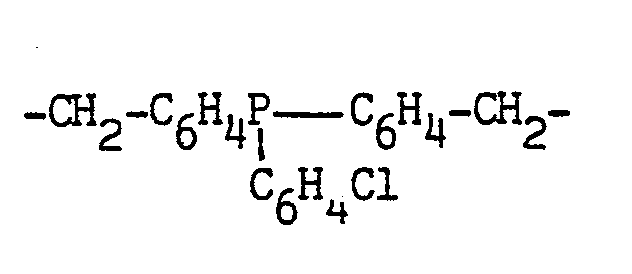
- VV Korschak (Isvestija Akademi Nauk SSSR, Otdel. Chim. 1958, 6. 595 - 601) converted p-chlorophenyl dichlorophosphine with dibenzyl in the presence of aluminum chloride to oligomeric compounds with repeating units of the structure around. These oligomers do not have the desired polyether structure, as described at the beginning, nor are they suitable as precursors for the production of such polyethers.
- the inventors have set themselves the task of producing phosphorus-containing polyarylene ethers of the structure mentioned at the outset or precursors for their preparation which contain a phosphorus atom bonded to two aromatic nuclei and can be converted into known phosphorus-containing polyarylene ethers in a good yield from inexpensive starting materials in one technical step to produce well controllable processes.
- aryl symbolizes a bifunctional aromatic radical which can be different from the radical represented by Ar. It can be, for example, a phenyl radical or a polynuclear aromatic radical of the structure act, where R "is a covalent single bond, an oxygen or sulfur atom, a carbonyl, sulfonyl, methylene or isopropylidene group or the group represents.
- the hydrogen-free bridge members R are preferred.
- N is a number of at least 1 and generally not greater than 10, preferably 1-5. If n> 1, the groups R" can be different.
- the terminal phenyl radicals are preferably bonded to an oxygen or sulfur atom or to a methylene or isopropylidene group.
- p is 0 or 1.
- the radical R can be a lower alkyl radical, which generally contains no more than 4 carbon atoms. Methyl groups are preferred. R is more advantageously an aryl radical, in particular an unsubstituted phenyl radical.
- the phosphine compounds of types A. B and C are known and can be prepared by Friedel-Crafts arylation of the corresponding phosphorus * trichlorides or their reaction.
- phenyl group which is unsubstituted in the ortho or preferably para position. Although they have other substituents, such as alkyl radicals, alkoxy groups. Halogen atoms or nitro groups can carry. unsubstituted phenyl groups are preferred. Polynuclear aromatic residues. such as naphthylene groups. are also considered.
- Chlorine and fluorine are preferred among the substituents X.
- the most important representatives of the compounds H-ArX are fluorobenzene and chlorobenzene. Other examples are toluene. Anisole and diphenyl ether. Although these compounds have multiple hydrogen * alkyl halides In the Friedel-Crafts reaction, only one of them is usually replaced by a PC bond.
- H-ArX is a compound with at least two aromatic nuclei and at least one aromatic ether bond.
- Diphenyl ether is the simplest representative of this group of substances.
- Other representatives are polyethers of the structure C 6 H 5 -OC 6 H 4 -OC 6 H 5 and bisphenyl ethers of bisphenols with the structure where R "and n can have the meanings mentioned above.
- the bisphenyl ethers can be obtained, for example, from the corresponding bisphenols by Ullmann coupling according to US 3,450,772 (Mobil Oil Corp.).
- Friedel-Crafts catalysts which are known as such, see Houben-Weyl, Vol. 7/20, pp. 15-19 and the literature cited therein. They are primarily certain anhydrous metal halides, such as tin tetrachloride, aluminum chloride or iron chloride. Characteristic is an electron gap at the metal atom, which is the prerequisite for the high reactivity towards the chlorine atoms of the dichlorophosphine compound. In addition, Friedel-Crafts catalysts also include acids such as polyphosphoric acid or sulfuric acid or metals such as iron. Anhydrous aluminum chloride is preferred.
- Friedel-Crafts catalysts Like most other Friedel-Crafts catalysts, it is metric ratio 1: 1 or in excess up to 10: 1 to the chlorine atoms of the phosphine chloride to be converted. There are also Friedel-Crafts catalysts. which are effective in substoichiometric amounts.
- the reaction takes place in an anhydrous polar medium.
- the following are suitable Carbon disulfide, nitrobenzene and nitropropane.
- Chlorobenzene or fluorobenzene can serve simultaneously as a reactant and - used in excess - as a reaction medium.
- the quantitative ratio of the compounds RP (Y) m Cl 2 and H-ARX depends on the desired end product.
- a molar ratio of exactly 1: 1 is theoretically required.
- per mole of the dichlorophosphine compound less than one mole of the aromatic compound H-ArX. for example, use 0.9 to 0.95 mol. If more than 1 mole of this compound is used. this way, oligomers that become shorter become more and more with increasing quantity.
- a stoichiometric molar ratio of 1: 2 is required to form monomeric compounds of the formula I. but that. in order to achieve complete conversion of the dichlorophosphine compound, it can be exceeded in favor of the aromatic compound. Molar ratios between 1: 2 and 1: 4 are advantageous.
- the reaction takes place at temperatures between 20 and 300. Preferably 30 and 250 ° C in 0.5 to 120 hours.
- temperatures or reaction times in the lower part of the ranges indicated are sufficient.
- the sulfur is advantageously used in an amount of 1 to 1.5 per mole of the dichlorophosphine compound. Under the conditions mentioned, yields of 50 to about 90%, based on the dichlorophosphine compound used, can be achieved.
- the reaction mixture becomes, as is usual in Friedel-Crafts processes. worked up by pouring it into ice water or concentrated hydrochloric acid, the condensation product formed separating out as an insoluble mass.
- the preferred phosphorus-containing polyarylene ethers according to DE-OS 32 03 186 contain the phosphorus in the form of phosphine oxide groups. In the process of the invention, these arise directly only in the less preferred embodiment in which a dichlorophosphine oxide compound is used. The same applies to the monomeric reaction products of the formula I.
- the reaction mixture was then heated to reflux. (See table for response times).
- the mixture was then poured into 500 ml of a hydrochloric acid / ice mixture and stirred at room temperature for 1.5 h.
- the mixture was filtered off with suction and the organic phase was separated off.
- the remaining aqueous phase was extracted 5 times with 200 ml of toluene.
- the organic phases were dried with Na 2 SO 4 and the solvents as far as possible in a water jet vacuum distilled off at about 70 ° C.
- the residue was fractionally distilled at about 0.2 mbar.
- the product went over at about 240-290 ° C.
- reaction solution was rinsed with 250 ml of toluene in a flask, mixed with 26 g of KC1 and stirred at 90 ° C. for 30 min. After cooling to room temperature, the batch was entered with ice-water cooling in 250 ml of 10% hydrochloric acid. washed with a little water and stirred for 60 min at room temperature. It was then filtered and the remaining solid substance was washed with a total of 800 ml of dichloromethane.
- the product could be dissolved in dimethylformamide and reprecipitated in water. This gave 12.9 g of a polycondensate, from the solution of which in chloroform a cast film can be produced.
- the reduced viscosity sp / C of a chloroform solution of the product was about 0.2 dl / g.
- the mixture was kept at 150 ° C. for a total of 6 h. Then 37.2 g of potassium chloride were added and the mixture was stirred at 120 ° C. for another 15 minutes.
- the product obtained was poured into 3 l distilled water and suctioned off the resulting precipitate. After washing the filter residue with water, the product was dissolved in DMF and reprecipitated in water. After drying at 60 ° C. in vacuo to constant weight, 10 g of a polycondensate were obtained, from the solution of which in chloroform a cast film can be produced.
Landscapes
- Chemical & Material Sciences (AREA)
- Organic Chemistry (AREA)
- Health & Medical Sciences (AREA)
- Life Sciences & Earth Sciences (AREA)
- Polymers & Plastics (AREA)
- Medicinal Chemistry (AREA)
- Chemical Kinetics & Catalysis (AREA)
- Biochemistry (AREA)
- General Health & Medical Sciences (AREA)
- Molecular Biology (AREA)
- Crystallography & Structural Chemistry (AREA)
- Organic Low-Molecular-Weight Compounds And Preparation Thereof (AREA)
- Low-Molecular Organic Synthesis Reactions Using Catalysts (AREA)
- Polymers With Sulfur, Phosphorus Or Metals In The Main Chain (AREA)
Abstract

worin R ein niederer Alkyl- oder Arylrest, Y ein Sauerstoff-oder Schwefelatom, m die Zahl 0 oder 1, Ar ein Arylenrest, X ein Substituent aus der Gruppe Halogen, Methyl, Methoxy, Aryloxy ist, werden aus einer Verbindung R-P(Y)mCl2 und zwei bzw. ein Mol einer Verbindung H ArX in Gegenwart eines Friedel-Craft-Katalysators hergestellt. Verbindungen mit m=1 und Y=5 sind aus R-PCI2 und H ArX in Gegenwart von Schwefel herstellbar. Zur Herstellung phosphorhaltiger Polyarylenäther der Struktur

werden als H ArX vorzugsweise Verbindungen mit zwei oder mehr durch Sauerstoffatome und gegebenenfalls durch weitere geeignete Brückenglieder verbundenen Arylgruppen eingesetzt.
Description
- Phosphorhaltige Polyarylenäther mit wiederkehrenden Einheiten der Struktur

worin R' z.B. Alkyl- oder Arylreste. Ar' eine zweiwertige aromatische Gruppe und q = 0 oder 1 ist, sind aus der DE-OS 32 03 186 als schwer- oder unbrennbare. hochtemperaturbeständige Kunststoffe von hoher Erweichungstemperatur bekannt. - Die vorliegende Erfindung betrifft ein neues Verfahren zur Herstellung derartiger Polyarylenäther oder zu monomeren Ausgangsverbindungen zu diesen Polyarylenäthern. Es handelt sich um eine sogenannte Friedel-Crafts-Reaktion.
- Nach der schon erwähnten DE-OS 32 03 186 sind die dort genannten Polyarylenäther z.B. durch die Umsetzung äquimolarer Mengen Di(fluorphenyl)-phenylphosphinoxid und eines aromatischen Diols.
- wie Dioxydiphenyläther, durch Abspaltung von Fluorwasserstoff in Gegenwart einer Base zugänglich. Die Herstellung des Di(fluorphenyl)-phenylphosphinoxids oder analoger Ausgangsverbindungen erfolgt durch Umsetzung eines bromierten Aromaten über dessen Grignardverbindung mit Dichlorphenylphosphin oder -phosphinoxid in Äther als Lösungsmittel, z.B. nach dem Schema
-

- Es ist auch bekannt, eine Arcmaten-Phosphor-Bindung durch eine Friedel-Crafts-Reaktion zu erzeugen. V.V. Korschak (Isvestija Akademi Nauk SSSR, Otdel. Chim. 1958, 6. 595 - 601) setzte p-Chlorphenyl-dichlorphosphin mit Dibenzyl in Gegenwart von Aluminiumchlorid zu oligcmeren Verbindungen mit wiederkehrenden Einheiten der Struktur
um. Diese Oligomeren haben nicht die erwünschte Polyätherstruktur, wie eingangs dargestellt, noch eignen sie sich als Vorprodukte zur Herstellung solcher Polyäther. - Nach DE-AS 1 238 024 werden arylierte Phosphorthioverbindungen aus Trichlorphosphinsulfid oder dessen Abkömmlingen, in denen ein oder zwei Chloratome durch organische Reste ersetzt sind, und Aromaten in Gegenwart von Aluminiumchlorid oder anderen Friedel-Crafts-Katalysatoren hergestellt, wobei die in dem eingesetzten chlorierten Phosphinsulfid enthaltenen Chloratome durch aromatische Kerne ersetzt werden. Auf diesem Wege wurden weder Polymere hergestellt noch die Ausgangsstoffe, aus denen gemäß DE-0S 32 03 186 phosphorhaltige Polyarylenäther herstellbar sind.
- G. Olah und D. Hehemann (J.Org.Chem.. Vol. 42. 1977. S. 2190) haben gefunden, daß sich Phosphortrichlorid in Gegenwart von Schwefel und Friedel-Crafts-Katalysatoren mit Aromaten in guter Ausbeute zu Triarylphosphinsulfiden umsetzen läßt. welche mit Reduktionsmitteln in die entsprechenden Triarylphosphine umsetzbar sind.
- Die Erfinder haben sich die Aufgabe gestellt, phosphorhaltige Polyarylenäther der eingangs angegebenen Struktur oder Vorprodukte zu ihrer Herstellung, die ein an zwei aromatische Kerne gebundenes Phosphoratom enthalten und nach bekannten Verfahren zu den phosphorhaltigen Polyarylenäthern umsetzbar sind, in guter Ausbeute aus preisgünstigen Ausgangsstoffen in einem technisch gut beherrschbaren Verfahren herzustellen.
- Im engeren Sinne bestand die Aufgabe darin, Verbindungen der Formel I

worin R ein niederer Alkyl- oder Arylrest - Y ein Sauerstoff- oder Schwefelatom
- m die Zahl 0 oder 1
- Ar ein Arylenrest
- X ein Substituent aus der Gruppe Halogen. Methyl, Methoxy, Aryloxy ist
- "Aryl" symbolisiert in diesem Falle einen bifunktionellen aromatischen Rest, der von dem durch Ar dargestellten Rest verschieden sein kann. Es kann sich beispielsweise um einen Phenylrest oder um einen mehrkernigen aromatischen Rest der Struktur

handeln, wobei R" eine kovalente Einfachbindung, ein Sauerstoff-oder Schwefelatom, eine Carbonyl-, Sulfonyl-, Methylen- oder Isopropylidengruppe oder die Gruppe
darstellt. Bevorzugt sind die wasserstofffreien Brückenglieder R". n ist eine Zahl von wenigstens 1 und im allgemeinen nicht größer als 10, vorzugsweise 1 - 5. Wenn n > 1 ist, können die Gruppen R" unterschiedlich sein. Vorzugsweise sind die endständigen Phenylreste an ein Sauerstoff- oder Schwefelatom oder an eine Methylen- oder Isopropylidengruppe gebunden. p ist 0 oder 1. - Die Formel I kann jedoch auch Vorprodukte repräsentieren, die unmittelbar - oder gegebenenfalls nach einer weiteren Umsetzung - zu phosphorhaltigen Polyarylenäthern umgesetzt werden können. Weiterhin kann ein Teil der so herstellbaren Produkte auch zu phosphorhaltigen Polyarylenestern umgesetzt werden, z.B. gemäß DE-OS 32 31 331 oder 32 22 571. Wenn X ein Halogen, z.B. Fluor ist, so lassen sich die Verbindungen

mit Bisphenolen zu Polyarylenäthern kondensieren. Verbindungen der Formel I mit X = OCH3 lassen sich durch Ätherspaltung in Bisphenole überführen:
die sich als Zwischenprodukte für phosphorhaltige Polyarylenäther und -ester eignen. Verbindungen der Formel I mit X = CH3 gehen durch Oxydation der Methylgruppe in die entsprechenden Carbonsäuren über
- Diese können als solche oder in Form ihrer Säurechloride gemäß DE-OS 32 31 331 mit Bisphenolen zu phosphorhaltigen Polyarylenestern umgesetzt werden.
- Es wurde nun gefunden, daß sich Verbindungen der Formel I aus einer Verbindung R - P(Y)mCl2 durch Umsetzung mit Aromaten der Formel H-ArX in Gegenwart eines Friedel-Crafts-Katalysators auf einfache Weise in einer sicher beherrschbaren Reaktion in guter Ausbeute herstellen lassen. Die Verbindungen der Formel I. in denen m = 1 und Y = Schwefel ist, sind neue Stoffe, die in Form polymerer Stoffe wertvolle Kunststoffeigenschaften besitzen.
- kann je nach Anwesenheit und Art des Restes Y
- A) ein Dichlorphosphin R-PC12
- B) ein Dichlorphosphinoxid R-POC12
- C) ein Dichlorphosphinsulfid R-PSC12
- Der Rest R kann ein niederer Alkylrest sein, der in der Regel nicht mehr als 4 C-Atome enthält. Methylgruppen sind bevorzugt. Vorteilhafter ist R ein Arylrest, insbesondere ein unsubstituierter Phenylrest.
- Die Phosphinverbindungen der Typen A. B und C sind bekannt und durch Friedel-Crafts-Arylierung der entsprechenden Phosphor- * trichloride oder deren Umsetzung mit herstellbar.
- enthält in der Regel eine in ortho- oder bevorzugt para-Stellung unsubstituierte Phenylgruppe. Obwohl sie weitere Substituenten, wie Alkylreste, Alkoxygruppen. Halogenatome oder Nitrogruppen tragen kann. sind unsubstituierte Phenylgruppen bevorzugt. Mehrkernige aromatische Reste. wie Naphthylengruppen. kommen ebenfalls in Betracht.
- Unter den Substituenten X sind Chlor und Fluor bevorzugt. Die wichtigsten Vertreter der Verbindungen H-ArX sind Fluorbenzol und Chlorbenzol. Weitere Beispiele sind Toluol. Anisol und Diphenyläther. Obwohl diese Verbindungen mehrere Wasserstoff- * Alkylhalogeniden atome an aromatischen Kern tragen, wird bei der Friedel-Crafts-Reaktion in der Regel nur eines davon durch eine P-C-Bindung ersetzt.
- Wenn das Verfahren der Erfindung unmittelbar zur Bildung von aromatischen Polyarylenäthern führen soll. ist als H-ArX eine Verbindung mit wenigstens zwei aromatischen Kernen und mindestens einer aromatischen Ätherbindung einzusetzen. Diphenyläther ist der einfachste Vertreter dieser Stoffgruppe. Weitere Vertreter sind Polyäther der Struktur C6H5-O-C6H4-O-C6H5 sowie Bisphenyläther von Bisphenolen mit der Struktur

wobei R" und n die zuvor genannten Bedeutungen haben kann. Die Bisphenyläther sind z.B. aus den entsprechenden Bisphenolen durch Ullmann-Kupplung nach US 3 450 772 (Mobil Oil Corp.) zugänglich. - wird mit sog. Friedel-Crafts-Katalysatoren durchgeführt, die als solche bekannt sind, vgl Houben-Weyl, Bd. 7/20, S. 15 - 19 und die dort zitierte Literatur. Es handelt sich vor allem um bestimmte wasserfreie Metallhalogenide, wie beispielsweise Zinntetrachlorid, Aluminiumchlorid oder Eisenchlorid. Charakteristisch ist eine Elektronenlücke am Metallatom, welche die Voraussetzung für die hohe Reaktionsfähigkeit gegenüber den Chloratomen der Dichlorphosphinverbindung ist. Daneben zählen zu den Friedel-Crafts-Katalysatoren jedoch auch Säuren, wie Polyphosphorsäure oder Schwefelsäure oder Metalle wie Eisen. Wasserfreies Aluminiumchlorid ist bevorzugt. Es wird, ebenso wie die meisten anderen Friedel-Crafts-Katalysatoren im stöchio - metrischen Verhältnis 1 : 1 oder im Überschuß bis zu 10 : 1 zu den umzusetzenden Chloratomen des Phosphinchlorids eingesetzt. Es gibt auch Friedel-Crafts-Katalysatoren. die in unterstöchiometrischer Menge wirksam sind.
- Die Umsetzung findet in einem wasserfreien polaren Medium statt. Geeignet sind u.a. Schwefelkohlenstoff, Nitrobenzol und Nitropropan. Chlorbenzol oder Fluorbenzol können gleichzeitig als Reaktionspartner und - im Überschuß eingesetzt - als Reaktionsmedium dienen.
- Das Mengenverhältnis der Verbindungen R-P(Y)mCl2 und H-ARX richtet sich nach dem gewünschten Endprodukt. Zur Bildung eines hochmolekularen Polymeren unter Einsatz einer Verbindung H-ArX, die wenigstens zwei aromatische Kerne enthält, ist theoretisch ein Molverhältnis von genau 1 : 1 erforderlich. Da jedoch ein Teil der Dichlorphosphinverbindung durch Nebenreaktionen verbraucht wird, ist es vorteilhaft. je Mol der Dichlorphosphinverbindung weniger als ein Mol der aromatischen Verbindung H-ArX. beispielsweise 0.9 bis 0.95 Mol einzusetzen. Wird mehr als 1 Mol dieser Verbindung eingesetzt. so entstehen mit steigender Menge kürzer werdende Oligomere.
- Zur Bildung monomerer Verbindungen der Formel I ist stöchiometrisch ein Molverhältnis 1 : 2 erforderlich. das aber. um eine vollständige Umsetzung der Dichlorphosphinverbindung zu erreichen, zugunsten der aromatischen Verbindung überschritten werden kann. Vorteilhaft sind Molverhältnisse zwischen 1 : 2 und 1 : 4.
- Die Reaktion läuft bei Temperaturen zwischen 20 und 300. vorzugsweise 30 und 250°C in 0.5 bis 120 Stunden ab. Beim Einsatz von Dichlorphosphinsulfiden oder von Dichlorphosphinen in Gegenwart von elementarem Schwefel reichen Temperaturen bzw. Reaktionszeiten im unteren Teil der angegebenen Bereiche aus. Der Schwefel wird zweckmäßig in einer Menge von 1 bis 1,5 pro Mol der Dichlorphosphinverbindung eingesetzt. Unter den genannten Bedingungen sind Ausbeuten von 50 bis etwa 90 %, bezogen auf die eingesetzte Dichlorphosphinverbindung erreichbar. Das Reaktionsgemisch wird, wie bei Friedel-Crafts-Verfahren üblich. durch Eingießen in Eiswasser oder konzentrierte Salzsäure aufgearbeitet, wobei sich das gebildete Kondensationsprodukt als unlösliche Masse abscheidet.
- Die bevorzugten phosphorhaltigen Polyarylenäther gemäß DE-OS 32 03 186 enthalten den Phosphor in Form von Phosphinoxid-Gruppen. Diese entstehen beim Verfahren der Erfindung unmittelbar nur bei der weniger bevorzugten Ausführungsform, bei der eine Dichlorphosphinoxidverbindung eingesetzt wird. Das gleiche gilt für die monomeren Reaktionsprodukte der Formel I. Die Verbindungen von Phosphin- und Phosphinsulfidtyp sind zwar beim Verfahren der Erfindung leichter herstellbar als die Verbindungen von Phosphinoxydtyp. in ihren technischen Eigenschaften, insbesondere in Form der Polyarylenester oder -äther, weniger vorteilhaft. Es wird daher bevorzugt, die beim Verfahren der Erfindung entstehenden Verbindungen vom Phosphintyp (m = 0) oder vom Phosphinsulfidtyp (m = 1. Y = S), die aus den entsprechenden Ausgangsverbindungen oder in Gegenwart von Schwefel entstehen, nachträglich zu den besonders stabilen Verbindungen vom Phosphinoxidtyp (m = 1. Y = Sauerstoff) umzusetzen. Das geschieht bei den Verbindungen vom Phosphintyp durch Einwirkung von Oxidationsmitteln nach bekannten Verfahren und bei den Verbindungen vom Phosphinsulfidtyp durch Hydrolyse bevorzugt unter basischen Bedingungen.
- 63,3 g (0,3 Mol) Phenylthiophosphonsäuredichlorid, 213.6 g (1,6 Mol) wasserfreies Aluminiumchlorid und 2 Mol Chlorbenzol oder Fluorbenzol wurden 8 h in einem 1 1-4Hals-Kolben mit Rührer, Rückflußkühler und Innenthermometer zum Rückfluß erhitzt. Nach Beendigung der Umsetzung wurde der Reaktionsansatz auf 500 ml einer Mischung aus Eis und konzentrierter Salzsäure gegossen. Die organische Phase wurde abgetrennt. Die wäßrige Phase wurde 4 mal mit je 300 ml Toluol extrahiert. Die vereinigten organischen Phasen wurden mit Natriumsulfat getrocknet und im Rotationsverdampfer bei 80°C im Vakuum eingedampft. Der gewonnene bräunliche Rückstand wurde im Ölpumpenvakuum destilliert. Nach einem Vorlauf ging bei etwa 260 - 300°C ein Isomerengemisch von stellungsisomeren disubstituierten Triphenylphosphinsulfiden über, das zu mindestens 80 % aus dem p,p'-disubstituierten Produkt bestand.

*) in CDC13 mit H3P04-Kapillare - Man verfuhr wie in den Beispielen 1 und 2, setzte jedoch anstelle des Halogenbenzols Toluol als reaktionsfähigen Aromaten ein. Darüber hinaus wurden der Reaktionsmischung 100 ml Hexan zugesetzt und die Aluminiumchloridmenge auf 1 Mol herabgesetzt. Als Produkt gewann man nach der Destillation 8,1 g Kristalle, die ein Isomerengemisch von stellungsisomeren Ditoluyl-phenylphosphinsulfiden darstellen. 31P-NMR-Verschiebung der Hauptkomponente in CDC13 mit H3PO4-Kapillare: 5 = 43,20 ppm.
- 17,9 g (0,1 Mol) Phenylphosphindichlorid, 3,2 g (0,1 Mol) Schwefel, 0,2 g wasserfreies Aluminiumchlorid und 0.67 Mol Chlorbenzol oder Fluorbenzol wurden in einem 250 ml-4-Halskolben mit Rührer, Rückflußkühler, Innenthermcmeter und Abgasleitung so lange gerührt, bis der Schwefel in Lösung gegangen war. Anschlieβend gab man 70,9 g (etwa 0,5 Mol) wasserfreies Aluminiumchlorid dazu. Die Reaktionsmischung wurde nun 8 h zum Rückfluß erhitzt. - Nach dem Abkühlen trug man den Ansatz langsam in 500 ml eines Gemisches aus konzentrierter Salzsäure und Eis ein und rührte anschließend 1,5 h bei Raumtemperatur. Anschließend filtrierte man von ausgefallenen Festprodukten ab, trennte die organische Phase des Filtrats ab und extrahierte die wäßrige Phase 5 mal mit je 200 ml Toluol. Die vereinigten organischen Phasen wurden mit Natriumsulfat getrocknet und im Wasserstrahlvolumen bei 70°C eingeengt. Der zähe Rückstand wurde im Ölpumpenvakuum fraktioniert destilliert. Bei etwa 260 - 300°C ging ein Isomerengemisch von disubstituierten Triphenylphosphinsulfiden über.
-

- 3,2 g (0,1 Mol) Schwefel, 71,1 g (0,5 Mol) Aluminiumchlorid, wasserfrei und 0,5 Mol des in der Tabelle angegebenen Aromaten wurden in einem 250 ml-4-Halskolben mit Rührer, Rückflußkühler, Tropftrichter und Innenthermcmeter vorgelegt. Hinzu tropfte man langsam unter Kühlung eine Lösung aus 11,7 g (0,1 Mol) Methylphosphonsäurechlorid in 0.4 Mol des Aromaten.
- Danach wurde die Reaktionsmischung zum Rückfluß erhitzt. (Reaktionszeiten siehe Tabelle). Der Ansatz wurde anschließend in 500 ml eines Salzsäure/Eis-Gemisches gegeben und 1,5 h bei Raumtemperatur gerührt. Das Gemisch wurde abgesaugt und die organische Phase abgetrennt. Die zurückbleibende wäßrige Phase wurde 5 mal mit je 200 ml Toluol extrahiert. Nach der Vereinigung wurden die organischen Phasen mit Na2s04 getrocknet und die Lösungsmittel soweit wie möglich im Wasserstrahlvakuum bei etwa 70°C abdestilliert. Der Rückstand wurde bei etwa 0,2 mbar fraktioniert destilliert. Das Produkt ging bei etwa 240 - 290°C über.

- 57,4 g (0,6 Mol) Fluorbenzol und 17,9 g (0,1 Mol) Dichlorphenylphosphin, 43,9 g wasserfreies Aluminiumchlorid (0,33 Mol) und 32 mg Schwefel wurden in einem 0,35 1 Roth-Autoklav mit Hastelloy C-Auskleidung, Magnetführung und Elektroheizung auf ca. 200°C erhitzt. Die Innentemperatur stieg aufgrund der zunächst offensichtlich stark exothermen Reaktion kurzzeitig auf 220°C. Der Reaktionsansatz wurde 2 h bei 200°C gehalten. Danach wurde auf Raumtemperatur abgekühlt und der Autoklav entspannt. Die Reaktionslösung wurde mit 250 ml Toluol in einem Kolben gespült, mit 26 g KC1 versetzt und 30 min bei 90°C gerührt. Nach dem Abkühlen auf Raumtemperatur wurde der Ansatz unter Eiswasserkühlung in 250 ml 10 %ige Salzsäure eingetragen. mit wenig Wasser nachgewaschen und 60 min bei Raumtemperatur gerührt. Anschließend wurde filtriert und die zurückbleibende Festsubstanz mit insgesamt 800 ml Dichlormethan gewaschen.
- Die organische Phase des Filtrats wurde abgetrennt, die wäßrige Phase 4 mal mit je 300 ml Methylenchlorid ausgewaschen. Die vereinigten organischen Phasen wurden mit Na2SO4 getrocknet. das Lösungsmittel soweit wie möglich am Rotationsverdampfer bei 60°C abgezogen und der Rückstand im ölpumpenvakuum fraktioniert destilliert. Man erhielt 12 g eines bräunlichen hochviskosen Destillats, das größtenteils aus Difluortriphenylphosphinoxiden besteht.

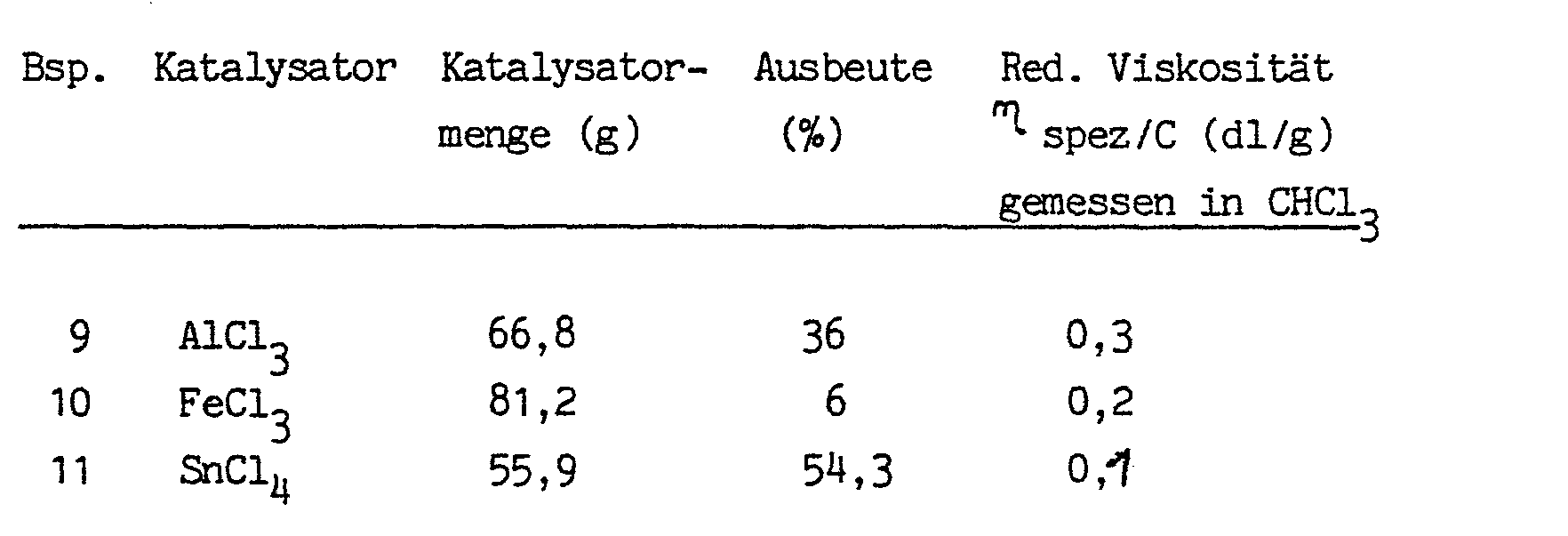
- 35,2 g (0,1 Mol) 4.4'-Di(phenoxy)-diphenylether. C6H5OC6H4OC6H4OC6H5, 21,1 g (0,1 Mol) Phenylthiophosphonsäuredichlorid und 0,5 Mol eines der unten genannten Lewis-Säuren (siehe Tabelle) wurden in einem 250 ml-Vierhalskolben mit KPG-Rührer, Thermometer, Kühler, Gaseinleitrohr und Abgasleitung vorgelegt. Unter Einleiten von Stickstoff wurde das Gemisch auf 150°C erhitzt, wobei der Kolbeninhalt zunehmend viskoser wurde. Der Ansatz wurde insgesamt 6 h bei 150°C gehalten, danach wurden 37,2 g Kaliumchlorid zugesetzt und das Gemisch nochmals 15 min bei 120°C gerührt. Anschließend goß man den Kolbeninhalt in 3 1 destilliertes Wasser. Das teilweise flockige Produkt wurde abgesaugt und in ca. 300 ml Tetrahydrofuran unter Rühren soweit wie möglich gelöst. Diese Lösung wurde filtriert und in 3 1 destilliertes Wasser langsam eingetropft. Die dabei gewonnene Fällung wurde abgesaugt und auf der Nutsche mit Wasser gewaschen. Bei 60°C wurde das entstandene Polymerprodukt im Vakuum bis zur Gewichtskonstanz getrocknet.
- In einem 100 ml 4-Hals-Rundkolben mit KPG Säbelrührer, Thermometer, Kühler und Argonanschluß wurden 17 g (0,1 Mol) Diphenylether, 19,5 g (0,1 Mol) Phenylphosphonsäuredichlorid C6H5-POCl2 und 5,4 g (0,033 Mol) wasserfreies Eisen-III-chlorid unter Rühren unter schwachem Argonstrom auf 215°C erwärmt. Nach 15 h Reaktionszeit bei 215 - 220°C wurde die Reaktionsmischung abgekühlt und in ein. Gemisch aus 700 ml Propanol-2 und 200 ml Wasser eingerührt, die Festsubstanz abgesaugt und 3 mal mit je 100 ml Petrolether gewaschen. Man erhielt 18,9 g in DMF lösliches Polykondensat, das in Wasser wieder ausgefällt werden konnte.
- P-Gehalt: theor.: 10,6 gef. 10,1
- In einem 250 ml 4-Hals-Rundkolben mit KPG-Säbelrührer, Thermometer, Kühler und Argonanschluß wurden 17 g (0,1 Mol) Diphenylether, 17,9 g Phenylphosphonigsäuredichlorid, C6H5PC12 und 10 Mol-% wasserfreies Eisenchlorid (bez. auf C6H5PCl2) in 100 ml Nitrobenzol 2 h auf 200°C erhitzt. Die abgekühlte Reaktionsmischung wurde in ein Gemisch aus 1,4 1 Isopropanol und 500 ml Wasser eingerührt, die Festsubstanz abgesaugt und 3 mal mit je 100 ml Isopropanol gewaschen. Das Produkt konnte in Dimethylformamid gelöst und in Wasser wieder ausgefällt werden. Man erhielt 12,9 g eines Polykondensats, aus dessen Lösung in Chloroform sich eine Gießfolie herstellen läßt. Die reduzierte Viskosität sp/C einer Chloroform-Lösung des Produkts betrug etwa 0,2 dl/g.
- 17 g (0,1 Mol) Diphenylether, 21,1 g (0,1 Mol) Phenylthiophosphonsäuredichlorid und 0,25 Mol A1C13 (wasserfrei) wurden in einem 250 ml-Vierhalskolben mit KPG-Rührer, Thermometer. Kühler, Gaseinleitrohr und Abgasleitung vorgelegt. Das Gemisch wurde unter Einleiten von Stickstoff auf 150°C erhitzt.
- Der Ansatz wurde insgesamt 6 h bei 150°C gehalten. Anschließend gab man 37,2 g Kaliumchlorid zu und rührte das Gemisch nochmals 15 min bei 120°C. Das erhaltene Produkt goß man in 3 1 destilliertes Wasser und saugte die entstandene Fällung ab. Nach dem Waschen des Filterrückstandes mit Wasser wurde das Produkt in DMF gelöst und in Wasser erneut ausgefällt. Nach dem Trocknen bei 60°C im Vakuum bis zur Gewichtskonstanz erhielt man 10 g eines Polykondensats, aus dessen Lösung in Chloroform sich eine Gießfolie herstellen läßt.
- P-Gehalt: theor.: 10,0 gef.: 10,5
in der erwähnten vorteilhaften Weise herzustellen. Bei den Verbindungen der Formel I handelt es sich um phosphorhaltige Polyarylenäther, wenn X ein Aryloxyrest ist, der seinerseits mit dem Phosphoratom einer weiteren Einheit der in Formel I dargestellten Struktur verbunden ist, wie in Polymeren mit wiederkehrenden Einheiten der Struktur

sein. Die Reaktionsfähigkeit und damit die Bevorzugung im Verfahren der Erfindung nimmt vom Dichlorphosphinoxid über das Dichlorphosphin zum Dichlorphosphinsulfid zu. Die Reaktionsfähigkeit des Dichlorphosphins (A) entspricht der des -sulfids (C), wenn die Unsetzung in Gegenwart von elementarem Schwefel durchgeführt wird. wobei durch Sulfurierung ein Produkt I mit einer P=S-Bindung (m = 1. Y = S) entsteht. Die Reaktionsfähigkeit des Dichlorphosphinoxids ist deutlich geringer und nur bei der Umsetzung mit Aromaten der Form H-Ar-0 Aryl zu polymeren Produkten I zufriedenstellend. so daß für die Umsetzung mit den anderen Aromaten H-ArX die Verbindungen vom Typ A und C stark bevorzugt sind.
Claims (12)

worin R ein niederer Alkyl- oder Arylrest
dadurch gekennzeichnet.
daß man eine Verbindung R-P(Y)mCl2 mit einer Verbindung HArX in Gegenwart eines Friedel-Crafts-Katalysators unsetzt.

umsetzt.

worin R" eine kovalente Einfachbindung. ein Sauerstoff-oder Schwefelatan. eine Carbonyl-. Sulfonyl-. Methylen-oder Isopropylidengruppe oder die Gruppe

und n eine Zahl von wenigstens 1 bedeuten. einsetzt.

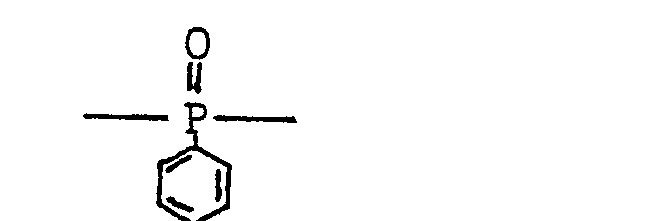
eine Verbindung aus der Gruppe


darstellt, eingesetzt wird.
Applications Claiming Priority (2)
| Application Number | Priority Date | Filing Date | Title |
|---|---|---|---|
| DE3425282 | 1984-07-10 | ||
| DE19843425282 DE3425282A1 (de) | 1984-07-10 | 1984-07-10 | Verfahren zur herstellung aromatischer phosphorverbindungen |
Publications (3)
| Publication Number | Publication Date |
|---|---|
| EP0167946A2 true EP0167946A2 (de) | 1986-01-15 |
| EP0167946A3 EP0167946A3 (en) | 1986-06-11 |
| EP0167946B1 EP0167946B1 (de) | 1989-06-07 |
Family
ID=6240215
Family Applications (1)
| Application Number | Title | Priority Date | Filing Date |
|---|---|---|---|
| EP85108064A Expired EP0167946B1 (de) | 1984-07-10 | 1985-06-28 | Verfahren zur Herstellung aromatischer Phosphorverbindungen |
Country Status (4)
| Country | Link |
|---|---|
| US (1) | US4698448A (de) |
| EP (1) | EP0167946B1 (de) |
| JP (1) | JPS6136290A (de) |
| DE (2) | DE3425282A1 (de) |
Families Citing this family (1)
| Publication number | Priority date | Publication date | Assignee | Title |
|---|---|---|---|---|
| ATE389694T1 (de) * | 2003-03-24 | 2008-04-15 | Essilor Int | Thiophosphinverbindungen und verfahren zur herstellung diese erhaltende polymerisierbare zusammensetzungen und ihre verwendung zur herstellung von kontaktlinsen |
Family Cites Families (13)
| Publication number | Priority date | Publication date | Assignee | Title |
|---|---|---|---|---|
| US2138835A (en) * | 1936-06-01 | 1938-12-06 | Atlantic Refining Co | Lubricant |
| US2902517A (en) * | 1955-06-22 | 1959-09-01 | Universal Oil Prod Co | Preparation of mono- and diarylphosphines |
| US3032589A (en) * | 1959-08-04 | 1962-05-01 | American Cyanamid Co | Method of preparing organophosphorus oxides |
| CA801785A (en) * | 1960-08-11 | 1968-12-17 | M. Priestley Hill | Detergents |
| DE1238024B (de) * | 1964-06-16 | 1967-04-06 | Monsanto Co | Verfahren zur Herstellung von arylierten Phosphorthioverbindungen |
| US3450772A (en) * | 1964-12-04 | 1969-06-17 | Mobil Oil Corp | Polyphenyl ethers |
| US4052463A (en) * | 1975-10-06 | 1977-10-04 | Stauffer Chemical Company | Process for preparing tertiary phosphine sulfides and oxides |
| IL52889A0 (en) * | 1976-10-04 | 1977-11-30 | M & T Chemicals Inc | Insecticidal and ovicidal compositions comprising a phosphorous compound and method for using same |
| US4087408A (en) * | 1976-12-15 | 1978-05-02 | Monsanto Company | Bromine and phosphorus containing polyester |
| FR2498191B1 (fr) * | 1981-01-19 | 1986-01-17 | Poudres & Explosifs Ste Nale | Procede de synthese d'oxydes et de sulfures de phosphines tertiaires et nouveaux oxydes et sulfures de phosphines tertiaires |
| DE3203186A1 (de) * | 1982-01-30 | 1983-08-11 | Röhm GmbH, 6100 Darmstadt | Phosphorhaltige polyarylenaether |
| DE3222571A1 (de) * | 1982-06-16 | 1983-12-22 | Röhm GmbH, 6100 Darmstadt | Phosphorhaltige polyarylenester und verfahren zu ihrer herstellung |
| DE3231331A1 (de) * | 1982-08-24 | 1984-03-01 | Röhm GmbH, 6100 Darmstadt | Phosphorhaltige polyarylenester und verfahren zu ihrer herstellung |
-
1984
- 1984-07-10 DE DE19843425282 patent/DE3425282A1/de not_active Withdrawn
-
1985
- 1985-06-28 EP EP85108064A patent/EP0167946B1/de not_active Expired
- 1985-06-28 DE DE8585108064T patent/DE3570881D1/de not_active Expired
- 1985-07-02 US US06/751,625 patent/US4698448A/en not_active Expired - Fee Related
- 1985-07-10 JP JP15034585A patent/JPS6136290A/ja active Pending
Also Published As
| Publication number | Publication date |
|---|---|
| EP0167946A3 (en) | 1986-06-11 |
| DE3570881D1 (en) | 1989-07-13 |
| DE3425282A1 (de) | 1986-01-16 |
| EP0167946B1 (de) | 1989-06-07 |
| JPS6136290A (ja) | 1986-02-20 |
| US4698448A (en) | 1987-10-06 |
Similar Documents
| Publication | Publication Date | Title |
|---|---|---|
| DE69902485T2 (de) | Verfahren zur herstellung von acylphosphinen und derivaten | |
| DE19620023C2 (de) | Verfahren zur Herstellung von Phosphinat- oder Phosphonatgruppen enthaltenden tertiären Phosphanen und neue Phosphinatgruppen enthaltende tertiäre Phosphane | |
| EP0008648B1 (de) | Verfahren zur Herstellung von Phosphorsäure-triestern und nach diesem Verfahren hergestellte Verbindungen | |
| EP0001215A1 (de) | Verfahren zur Herstellung von höhermolekularen Phosphorsäure-bzw. Phosphonsäurearylestern | |
| EP0167946A2 (de) | Verfahren zur Herstellung aromatischer Phosphorverbindungen | |
| EP0638578B1 (de) | Sekundäre und tertiäre Phosphane und Verfahren zu ihrer Herstellung | |
| EP0008366B1 (de) | Verfahren zur Herstellung neutraler Phosphorsäureester nach dem Phasengrenzflächenverfahren und nach diesem Verfahren hergestellte Verbindungen | |
| DE3134363C2 (de) | ||
| DE2643442C2 (de) | Verfahren zur Herstellung von Phosphitchloriden | |
| EP0170102B1 (de) | Verfahren zur Herstellung bifunktioneller tertiärer aromatischer Phosphinsulfide | |
| DE3521123A1 (de) | Phosphorhaltige polyarylenaether und verfahren zu ihrer herstellung | |
| DE3510416C2 (de) | ||
| DD234274A1 (de) | Verfahren zur herstellung nichtionischer und anionischer grenzflaechenaktiver ferrocenderivate | |
| EP0049911A2 (de) | Verfahren zur Herstellung von alpha-Hydroxybenzylphosphonsäureestern | |
| EP0130439B1 (de) | Verfahren zur Herstellung von Derivaten der Vinylphosphon-, oder Vinylpyrophosphonsäure | |
| EP0122587B1 (de) | Verfahren zur Herstellung organischer Chlorphosphane | |
| US4889661A (en) | Process for the preparation of aromatic phosphorus-chlorine compounds | |
| US4708824A (en) | Process for the preparation of chloro(phenyl)phospines | |
| EP0271695B1 (de) | Verfahren zur Herstellung von Phosphin- oder Phosphonsäurechloriden | |
| EP0159656B1 (de) | Verfahren zur Herstellung der Alkali- und Erdalkali-Salze von Diarylphosphinsäuren | |
| EP0161503B1 (de) | Bis-Phosphoniumsalze und Verfahren zu ihrer Herstellung | |
| EP0230243B1 (de) | Verfahren zur Herstellung bifunktioneller tertiärer aromatischer Phosphansulfide | |
| AT227718B (de) | Verfahren zur Herstellung von neuen Thiophosphorsäureestern | |
| EP0748812A1 (de) | Neue Oxaphosphorine und Verfahren zu ihrer Herstellung | |
| DE4020184A1 (de) | Teilfluorierte biphenyle, verfahren zu ihrer herstellung und ihre verwendung |
Legal Events
| Date | Code | Title | Description |
|---|---|---|---|
| PUAI | Public reference made under article 153(3) epc to a published international application that has entered the european phase |
Free format text: ORIGINAL CODE: 0009012 |
|
| AK | Designated contracting states |
Designated state(s): DE FR GB IT NL |
|
| PUAL | Search report despatched |
Free format text: ORIGINAL CODE: 0009013 |
|
| AK | Designated contracting states |
Kind code of ref document: A3 Designated state(s): DE FR GB IT NL |
|
| 17P | Request for examination filed |
Effective date: 19860626 |
|
| 17Q | First examination report despatched |
Effective date: 19871005 |
|
| GRAA | (expected) grant |
Free format text: ORIGINAL CODE: 0009210 |
|
| AK | Designated contracting states |
Kind code of ref document: B1 Designated state(s): DE FR GB IT NL |
|
| ITF | It: translation for a ep patent filed | ||
| REF | Corresponds to: |
Ref document number: 3570881 Country of ref document: DE Date of ref document: 19890713 |
|
| ET | Fr: translation filed | ||
| GBT | Gb: translation of ep patent filed (gb section 77(6)(a)/1977) | ||
| PLBE | No opposition filed within time limit |
Free format text: ORIGINAL CODE: 0009261 |
|
| STAA | Information on the status of an ep patent application or granted ep patent |
Free format text: STATUS: NO OPPOSITION FILED WITHIN TIME LIMIT |
|
| 26N | No opposition filed | ||
| PGFP | Annual fee paid to national office [announced via postgrant information from national office to epo] |
Ref country code: FR Payment date: 19930614 Year of fee payment: 9 |
|
| PGFP | Annual fee paid to national office [announced via postgrant information from national office to epo] |
Ref country code: GB Payment date: 19930618 Year of fee payment: 9 |
|
| PGFP | Annual fee paid to national office [announced via postgrant information from national office to epo] |
Ref country code: DE Payment date: 19930624 Year of fee payment: 9 |
|
| ITTA | It: last paid annual fee | ||
| PGFP | Annual fee paid to national office [announced via postgrant information from national office to epo] |
Ref country code: NL Payment date: 19930630 Year of fee payment: 9 |
|
| PG25 | Lapsed in a contracting state [announced via postgrant information from national office to epo] |
Ref country code: GB Effective date: 19940628 |
|
| PG25 | Lapsed in a contracting state [announced via postgrant information from national office to epo] |
Ref country code: NL Effective date: 19950101 |
|
| NLV4 | Nl: lapsed or anulled due to non-payment of the annual fee | ||
| GBPC | Gb: european patent ceased through non-payment of renewal fee |
Effective date: 19940628 |
|
| PG25 | Lapsed in a contracting state [announced via postgrant information from national office to epo] |
Ref country code: FR Effective date: 19950228 |
|
| PG25 | Lapsed in a contracting state [announced via postgrant information from national office to epo] |
Ref country code: DE Effective date: 19950301 |
|
| REG | Reference to a national code |
Ref country code: FR Ref legal event code: ST |