EP0165645A2 - Capteur d'oxygène - Google Patents
Capteur d'oxygène Download PDFInfo
- Publication number
- EP0165645A2 EP0165645A2 EP85200996A EP85200996A EP0165645A2 EP 0165645 A2 EP0165645 A2 EP 0165645A2 EP 85200996 A EP85200996 A EP 85200996A EP 85200996 A EP85200996 A EP 85200996A EP 0165645 A2 EP0165645 A2 EP 0165645A2
- Authority
- EP
- European Patent Office
- Prior art keywords
- oxygen
- cathode
- electrolyte
- oxygen sensor
- anaesthetic
- Prior art date
- Legal status (The legal status is an assumption and is not a legal conclusion. Google has not performed a legal analysis and makes no representation as to the accuracy of the status listed.)
- Withdrawn
Links
- QVGXLLKOCUKJST-UHFFFAOYSA-N atomic oxygen Chemical compound [O] QVGXLLKOCUKJST-UHFFFAOYSA-N 0.000 title claims abstract description 65
- 239000001301 oxygen Substances 0.000 title claims abstract description 65
- 229910052760 oxygen Inorganic materials 0.000 title claims abstract description 65
- 238000001179 sorption measurement Methods 0.000 claims abstract description 36
- 230000003444 anaesthetic effect Effects 0.000 claims abstract description 33
- 239000003792 electrolyte Substances 0.000 claims abstract description 24
- 239000012530 fluid Substances 0.000 claims abstract description 18
- 238000000034 method Methods 0.000 claims abstract description 15
- 239000008280 blood Substances 0.000 claims abstract description 8
- 210000004369 blood Anatomy 0.000 claims abstract description 8
- 210000001124 body fluid Anatomy 0.000 claims abstract description 6
- 239000010839 body fluid Substances 0.000 claims abstract description 6
- NLKNQRATVPKPDG-UHFFFAOYSA-M potassium iodide Chemical compound [K+].[I-] NLKNQRATVPKPDG-UHFFFAOYSA-M 0.000 claims description 15
- FVAUCKIRQBBSSJ-UHFFFAOYSA-M sodium iodide Chemical compound [Na+].[I-] FVAUCKIRQBBSSJ-UHFFFAOYSA-M 0.000 claims description 12
- 230000000694 effects Effects 0.000 claims description 11
- 238000005259 measurement Methods 0.000 claims description 10
- KWGKDLIKAYFUFQ-UHFFFAOYSA-M lithium chloride Chemical group [Li+].[Cl-] KWGKDLIKAYFUFQ-UHFFFAOYSA-M 0.000 claims description 6
- 239000012528 membrane Substances 0.000 claims description 6
- 229910001507 metal halide Inorganic materials 0.000 claims description 5
- 150000005309 metal halides Chemical class 0.000 claims description 5
- 235000009518 sodium iodide Nutrition 0.000 claims description 4
- 229910017053 inorganic salt Inorganic materials 0.000 claims 1
- 238000007789 sealing Methods 0.000 claims 1
- 238000012544 monitoring process Methods 0.000 abstract description 4
- BCQZXOMGPXTTIC-UHFFFAOYSA-N halothane Chemical compound FC(F)(F)C(Cl)Br BCQZXOMGPXTTIC-UHFFFAOYSA-N 0.000 description 18
- 229960003132 halothane Drugs 0.000 description 18
- 238000006722 reduction reaction Methods 0.000 description 10
- 230000009467 reduction Effects 0.000 description 9
- 229940124326 anaesthetic agent Drugs 0.000 description 8
- 239000000203 mixture Substances 0.000 description 5
- IJGRMHOSHXDMSA-UHFFFAOYSA-N Atomic nitrogen Chemical compound N#N IJGRMHOSHXDMSA-UHFFFAOYSA-N 0.000 description 4
- FAPWRFPIFSIZLT-UHFFFAOYSA-M Sodium chloride Chemical compound [Na+].[Cl-] FAPWRFPIFSIZLT-UHFFFAOYSA-M 0.000 description 4
- 230000008859 change Effects 0.000 description 3
- 230000008569 process Effects 0.000 description 3
- BVKZGUZCCUSVTD-UHFFFAOYSA-M Bicarbonate Chemical compound OC([O-])=O BVKZGUZCCUSVTD-UHFFFAOYSA-M 0.000 description 2
- GQPLMRYTRLFLPF-UHFFFAOYSA-N Nitrous Oxide Chemical compound [O-][N+]#N GQPLMRYTRLFLPF-UHFFFAOYSA-N 0.000 description 2
- BQCADISMDOOEFD-UHFFFAOYSA-N Silver Chemical compound [Ag] BQCADISMDOOEFD-UHFFFAOYSA-N 0.000 description 2
- 230000002411 adverse Effects 0.000 description 2
- 238000004891 communication Methods 0.000 description 2
- 239000004020 conductor Substances 0.000 description 2
- 230000007423 decrease Effects 0.000 description 2
- 238000010586 diagram Methods 0.000 description 2
- JPGQOUSTVILISH-UHFFFAOYSA-N enflurane Chemical compound FC(F)OC(F)(F)C(F)Cl JPGQOUSTVILISH-UHFFFAOYSA-N 0.000 description 2
- 238000001727 in vivo Methods 0.000 description 2
- 239000000463 material Substances 0.000 description 2
- 229910052757 nitrogen Inorganic materials 0.000 description 2
- 238000011946 reduction process Methods 0.000 description 2
- 229910052709 silver Inorganic materials 0.000 description 2
- 239000004332 silver Substances 0.000 description 2
- 239000011780 sodium chloride Substances 0.000 description 2
- 229910021607 Silver chloride Inorganic materials 0.000 description 1
- 238000006243 chemical reaction Methods 0.000 description 1
- 238000009792 diffusion process Methods 0.000 description 1
- 229960000305 enflurane Drugs 0.000 description 1
- 238000000338 in vitro Methods 0.000 description 1
- 238000012623 in vivo measurement Methods 0.000 description 1
- 150000002484 inorganic compounds Chemical class 0.000 description 1
- 229910010272 inorganic material Inorganic materials 0.000 description 1
- 230000007246 mechanism Effects 0.000 description 1
- 238000012986 modification Methods 0.000 description 1
- 230000004048 modification Effects 0.000 description 1
- 239000001272 nitrous oxide Substances 0.000 description 1
- 231100000252 nontoxic Toxicity 0.000 description 1
- 230000003000 nontoxic effect Effects 0.000 description 1
- 150000002894 organic compounds Chemical class 0.000 description 1
- 229920000515 polycarbonate Polymers 0.000 description 1
- 239000004417 polycarbonate Substances 0.000 description 1
- 230000003449 preventive effect Effects 0.000 description 1
- 150000003839 salts Chemical class 0.000 description 1
- 229920002379 silicone rubber Polymers 0.000 description 1
- 239000004945 silicone rubber Substances 0.000 description 1
- HKZLPVFGJNLROG-UHFFFAOYSA-M silver monochloride Chemical compound [Cl-].[Ag+] HKZLPVFGJNLROG-UHFFFAOYSA-M 0.000 description 1
- 239000000126 substance Substances 0.000 description 1
Images

Classifications
-
- A—HUMAN NECESSITIES
- A61—MEDICAL OR VETERINARY SCIENCE; HYGIENE
- A61B—DIAGNOSIS; SURGERY; IDENTIFICATION
- A61B5/00—Measuring for diagnostic purposes; Identification of persons
- A61B5/145—Measuring characteristics of blood in vivo, e.g. gas concentration or pH-value ; Measuring characteristics of body fluids or tissues, e.g. interstitial fluid or cerebral tissue
- A61B5/14542—Measuring characteristics of blood in vivo, e.g. gas concentration or pH-value ; Measuring characteristics of body fluids or tissues, e.g. interstitial fluid or cerebral tissue for measuring blood gases
-
- A—HUMAN NECESSITIES
- A61—MEDICAL OR VETERINARY SCIENCE; HYGIENE
- A61B—DIAGNOSIS; SURGERY; IDENTIFICATION
- A61B5/00—Measuring for diagnostic purposes; Identification of persons
- A61B5/145—Measuring characteristics of blood in vivo, e.g. gas concentration or pH-value ; Measuring characteristics of body fluids or tissues, e.g. interstitial fluid or cerebral tissue
- A61B5/1468—Measuring characteristics of blood in vivo, e.g. gas concentration or pH-value ; Measuring characteristics of body fluids or tissues, e.g. interstitial fluid or cerebral tissue using chemical or electrochemical methods, e.g. by polarographic means
- A61B5/1473—Measuring characteristics of blood in vivo, e.g. gas concentration or pH-value ; Measuring characteristics of body fluids or tissues, e.g. interstitial fluid or cerebral tissue using chemical or electrochemical methods, e.g. by polarographic means invasive, e.g. introduced into the body by a catheter
-
- G—PHYSICS
- G01—MEASURING; TESTING
- G01N—INVESTIGATING OR ANALYSING MATERIALS BY DETERMINING THEIR CHEMICAL OR PHYSICAL PROPERTIES
- G01N27/00—Investigating or analysing materials by the use of electric, electrochemical, or magnetic means
- G01N27/26—Investigating or analysing materials by the use of electric, electrochemical, or magnetic means by investigating electrochemical variables; by using electrolysis or electrophoresis
- G01N27/403—Cells and electrode assemblies
- G01N27/404—Cells with anode, cathode and cell electrolyte on the same side of a permeable membrane which separates them from the sample fluid, e.g. Clark-type oxygen sensors
Definitions
- the present invention generally relates to an oxygen sensor that is of the membrane-covered bipolar type, more particularly an oxygen sensor that is suitable for in vivo as wel as in vitro measurement of the p0 2 of blood or other fluids when administering an anaesthetic and to the method of using same.
- Sensors of this invention are particularly useful when they are designed so as to be incorporated within a catheter whereby the portion of the device for contacting the fluid to be measured may be maneuvered to a desired location within the body of the patient to whom an anaesthetic had been administered.
- the oxygen sensor is capable of measuring the oxygen content at such a location in a manner that achieves enhanced accuracy by substantially eliminating the interference effects of the anaesthetic with the oxygen measurement mechanism.
- Membrane-covered bipolar oxygen sensors which are generally known as sensors of the Clark-cell type, are known to be suitable for the determination of the oxygen - content of blood and the like, including in vivo applications by which the cell is inserted into the patient by means of a catheter. Determining the oxygen content of blood or other body fluids is of great importance when, for example, monitoring the condition of a patient who is being treated while being anaesthesized.
- anaesthetic used in this regard is one of the common inhallation anaesthetics such as Halothane (2-bromo-2-chloro-1,1,1,-trifluoroethane), Enflurane (2-chloro-1-difluoromethoxy-1,1,2-trifluoroethane), nitrous oxide and the like, such anaesthetics enter the blood stream of the patient and almost inevitably find their way to the location at which the oxygen concentration is being measured by the device, which creates a problem since these anaesthetics typically affect the determination of the oxygen content of the fluid.
- Oxygen is reduced at the cathode of a Clark-cell type of sensor, and this problem arises primarily because anaesthetics such as Halothane are likewise reduced at the cathode of a Clark-cell type of sensor, the problem being particularly difficult since the electrode potential range of electroreduction of anaesthetics such as Halothane overlaps the electrode potential range of electroreduction of oxygen.
- the current that is measured at a fixed electrode potential by a Clark-cell type of sensor is not defined unambiguously, but the current measured at that fixed electrode potential is the sum of the currents generated by the. reduction of oxygen and by the reduction of Halothane or the like.
- this measurement of the oxygen content is further adversely affected by the fact that, due to the low rate of diffusion of anaesthetics such as Halothane through a membrane-covered bipolar oxygen sensor of the Clark-cell type, a trailing effect occurs in the sense that a Halothane reduction current is still being measured long after the administration of Halothane to the patient has been terminated.
- the present invention substantially eliminates or significantly decreases this type of interference with oxygen concentration measurement that is encountered by a membrane-covered bipolar oxygen sensor, which interference is generated by the presence of an anaesthetic within the body fluid being monitored.
- This decrease in interference is accomplished primarily by utilizing a cell electrolyte composition that includes a component which exhibits adsorption to the cathode in preference to adsorption of the anaesthetic to the cathode.
- the invention is based primarily upon the discovery that, for anaesthetics such as Halothane, the first stage in their electroreduction process concerns the adsorption thereof to the cathode surface of a membrane-covered bipolar oxygen sensor of the Clark-cell type. This is illustrated by the following reaction equations:
- the adsorption illustrated above is substantially prevented in accordance with the present invention. It is surprising that a solution to this problem of anaesthetic interference with oxygen concentration measurement is solved by including a substance within the electrolyte that absorbs to the cathode and in preference to this adsorption of an anaesthetic such as Halothane to the cathode surface.
- This preferential adsorption of the electrolyte component results in a change in the properties of the cathode surface , which change typically has an effect only on the activity of the anaesthetic but does not have a substantial effect on the oxygen-reduction process.
- Another object of the present invention is to provide an improved membrane-covered bipolar oxygen sensor and method of its use that completely or substantially eliminate adverse effects on the measurement of the oxygen content within a body fluid that are caused by the occurrence of a cathodic reduction that fully or partially coincides with that of oxygen.
- Another object of the present invention is to provide an improved membrane-covered bipolar oxygen sensor and method which rely upon the adsorption of an electrolyte component to the cathode, which component adsorption is in preference to that of an anaesthetic that may be present within the fluid being measured.
- Another object of this invention is to provide an improved membrane-covered bipolar oxygen sensor and method that substantially prevent the reduction of an anaesthetic such as Halothane at the electrode surface while avoiding any significant effect on the reduction of oxygen at the electrode surface.
- Another object of the present invention is to provide an improved membrane-covered bipolar oxygen sensor and method that exploit the discovery that the adsorption of an anaesthetic such as Halothane is the first step in the electroreduction process of the anaesthetic.
- Another object of the present invention is to provide an improved membrane-covered bipolar oxygen sensor and method that exhibit preventive adsorption of an electrolyte component to its cathode in order to change the properties of the cathode surface without significantly affecting the oxygen reduction process.
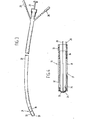
- FIG. 3 and Figure 4 generally depict, by reference numeral 21, a membrane-covered bipolar oxygen sensor of the Clark-cell type, such sensor cell 21 being mounted at the distal end portion of a catheter 22, which may be maneuverable by means of a stylet 23 in accordance with generally known procedures.
- such includes a cathode 24 which is in electrical communication with a terminal assembly 25 through an electrical conductor 26.
- An anode assembly, generally designated as 27, is in electrical communication with another terminal assembly 28 through an electrical conductor 29.
- the illustrated anode assembly 27 includes a tube portion 31 and a cap portion 32.
- a membrane 33 seals the distal end of the bipolar oxygen sensor cell 21.
- Membrane 33 is oxygen-permeable and is made of a material such as Copel, which is a mixture of silicone rubber and a polycarbonate.
- An enclosure 34 is provided, and an electrolyte 35 contacts both the cathode 24 and the anode assembly 27. The oxygen-permeable membrane 33 contacts the fluid to be measured when the device is in use.
- Electrolyte 35 such is of a composition generally suitable for its intended use, typically including organic and/or inorganic compounds that are non-toxic and are suitable and safe for biomedical uses, including those that are acceptable for conducting in vivo measurements of the oxygen contents of blood.
- Electrolyte 35 also contains a preferential adsorption component that is adsorbed to the cathode 24 in preference to adsorption to the cathode 24 of an anaesthetic such as Halothane, which preferential adsorption component does not substantially affect the electroreduction process that occurs with respect to oxygen within the fluid being monitored.
- Preferred preferential adsorption components are inorganic salts, especially metal halides such as lithium chloride, sodium iodide, potassium iodide, and the like. Sodium iodide or potassium iodide are preferred.
- the concentration of the preferential adsorption component in the electrolyte 35 is one that is sufficient to substantially prevent adsorption in the electrolyte 35 of the particular anaesthetic administered to the patient or present in the fluid being monitored. Generally, the concentration of such preferential adsorption component is on the order of about 0.01 M to about 0.0001 M, based on the total volume of the electrolyte 35.
- each curve plots such respective current strengths and cathode potentials as they are measured for different fluids monitored by the respective oxygen sensors.
- each of the "a" curves reports data generated when the medium being measured was air
- each "b” curve reports data generated when the medium measured was a mixture of 2 % Halothane in nitrogen
- each of the "c" curves reports data generated when the medium measured was a mixture of 2 % Halothane in air.
Landscapes
- Life Sciences & Earth Sciences (AREA)
- Health & Medical Sciences (AREA)
- Physics & Mathematics (AREA)
- Pathology (AREA)
- General Health & Medical Sciences (AREA)
- Molecular Biology (AREA)
- Chemical & Material Sciences (AREA)
- Optics & Photonics (AREA)
- Surgery (AREA)
- Veterinary Medicine (AREA)
- Public Health (AREA)
- Animal Behavior & Ethology (AREA)
- Medical Informatics (AREA)
- Heart & Thoracic Surgery (AREA)
- Chemical Kinetics & Catalysis (AREA)
- Biophysics (AREA)
- Engineering & Computer Science (AREA)
- Biomedical Technology (AREA)
- General Chemical & Material Sciences (AREA)
- Electrochemistry (AREA)
- Biochemistry (AREA)
- Immunology (AREA)
- General Physics & Mathematics (AREA)
- Analytical Chemistry (AREA)
- Pharmaceuticals Containing Other Organic And Inorganic Compounds (AREA)
- Measurement Of The Respiration, Hearing Ability, Form, And Blood Characteristics Of Living Organisms (AREA)
- Measuring Oxygen Concentration In Cells (AREA)
Applications Claiming Priority (2)
| Application Number | Priority Date | Filing Date | Title |
|---|---|---|---|
| NL8401966 | 1984-06-21 | ||
| NL8401966A NL8401966A (nl) | 1984-06-21 | 1984-06-21 | Zuurstofsensor van het type clark cel. |
Publications (2)
| Publication Number | Publication Date |
|---|---|
| EP0165645A2 true EP0165645A2 (fr) | 1985-12-27 |
| EP0165645A3 EP0165645A3 (en) | 1990-04-25 |
Family
ID=19844111
Family Applications (1)
| Application Number | Title | Priority Date | Filing Date |
|---|---|---|---|
| EP85200996A Withdrawn EP0165645A3 (en) | 1984-06-21 | 1985-06-20 | Oxygen sensor |
Country Status (5)
| Country | Link |
|---|---|
| US (1) | US4672971A (fr) |
| EP (1) | EP0165645A3 (fr) |
| JP (1) | JPS6182736A (fr) |
| CA (1) | CA1232322A (fr) |
| NL (1) | NL8401966A (fr) |
Families Citing this family (7)
| Publication number | Priority date | Publication date | Assignee | Title |
|---|---|---|---|---|
| US5329922A (en) * | 1992-10-19 | 1994-07-19 | Atlee Iii John L | Oximetric esophageal probe |
| US5715816A (en) * | 1993-12-06 | 1998-02-10 | Sensor Devices, Inc. | Oximeter probes and methods for the invasive use thereof |
| US6080294A (en) * | 1998-07-15 | 2000-06-27 | Atwood Industries, Inc. | Gas sensor with dual electrolytes |
| US7611621B2 (en) * | 2005-06-13 | 2009-11-03 | Nova Biomedical Corporation | Disposable oxygen sensor and method for correcting oxygen effect on oxidase-based analytical devices |
| US7648624B2 (en) * | 2005-07-26 | 2010-01-19 | Nova Biomedical Corporation | Oxygen sensor |
| CN113784663A (zh) * | 2019-05-01 | 2021-12-10 | 巴德阿克塞斯系统股份有限公司 | 穿刺装置、包括该穿刺装置的穿刺系统及其方法 |
| JP2025523692A (ja) * | 2022-07-15 | 2025-07-23 | センテック アーゲー | 電気化学ガスセンサ用電解質および血液ガスモニタリング |
Family Cites Families (7)
| Publication number | Priority date | Publication date | Assignee | Title |
|---|---|---|---|---|
| US3259124A (en) * | 1963-07-19 | 1966-07-05 | Beckman Instruments Inc | Catheter transducer for in vivo measurements |
| US3314864A (en) * | 1964-06-11 | 1967-04-18 | Beckman Instruments Inc | Gas analysis |
| DK141766B (da) * | 1975-02-13 | 1980-06-09 | Radiometer As | Elektrokemisk måleelektrode. |
| DE2624266A1 (de) * | 1976-05-29 | 1977-12-08 | Hartmann & Braun Ag | Elektrochemische messzellen fuer gasanalytische messungen im immissions- und emissionsbereich |
| US4183791A (en) * | 1978-04-20 | 1980-01-15 | Huber Calvin O | Method of forming amperometric sensor with transition metal oxide/hydroxide electrodes |
| US4268370A (en) * | 1980-01-11 | 1981-05-19 | Beckman Instruments, Inc. | High temperature, CO2 interference free, electrochemical O2 sensor |
| US4445999A (en) * | 1982-03-01 | 1984-05-01 | General Motors Corporation | Method of manufacturing gel electrode for early detection of metal fatigue |
-
1984
- 1984-06-21 NL NL8401966A patent/NL8401966A/nl not_active Application Discontinuation
-
1985
- 1985-06-14 US US06/745,271 patent/US4672971A/en not_active Expired - Lifetime
- 1985-06-19 CA CA000484552A patent/CA1232322A/fr not_active Expired
- 1985-06-20 EP EP85200996A patent/EP0165645A3/en not_active Withdrawn
- 1985-06-21 JP JP60134470A patent/JPS6182736A/ja active Pending
Also Published As
| Publication number | Publication date |
|---|---|
| US4672971A (en) | 1987-06-16 |
| EP0165645A3 (en) | 1990-04-25 |
| CA1232322A (fr) | 1988-02-02 |
| NL8401966A (nl) | 1986-01-16 |
| JPS6182736A (ja) | 1986-04-26 |
Similar Documents
| Publication | Publication Date | Title |
|---|---|---|
| US4176659A (en) | Catheter with measurement electrodes | |
| EP0235016B1 (fr) | Capteur d'oxygène | |
| CA1258496A (fr) | Fil de metal noble isole, et membrane poreuse faisant office de bioelectrode po.sub.2 | |
| EP0167126B1 (fr) | Capteur de pH | |
| US3930493A (en) | Intravascular liquid velocity sensing method using a polarographic electrode | |
| US5030333A (en) | Polarographic method for measuring both analyte and oxygen with the same detecting electrode of an electroenzymatic sensor | |
| US4120292A (en) | Implantable electrochemical sensor having an external reference electrode | |
| US4808292A (en) | Arrangement for stabilizing a gas-reference electrode | |
| EP3015857B1 (fr) | Capteurs de gaz électrochimiques à systèmes d'électrolyte liquide ionique | |
| LeBlanc et al. | Polymer membrane sensors for continuous intravascular monitoring of blood pH | |
| US4672971A (en) | Oxygen sensor | |
| Rogers | On the relative importance of aerobic metabolism in small nematode parasites of the alimentary tract I. Oxygen tensions in the normal environment of the parasites | |
| DE2203942A1 (de) | Elektrode für die Messung des Kohlendioxyd-Druckes | |
| US3259124A (en) | Catheter transducer for in vivo measurements | |
| Oberleithner et al. | Effect of luminal potassium on cellular sodium activity in the early distal tubule of Amphiuma kidney | |
| O'Neill et al. | Anomalously high concentrations of brain extracellular uric acid detected with chronically implanted probes: implications for in vivo sampling techniques | |
| Ksenzhek et al. | 452—Redox properties of ubiquinones in aqueous solutions | |
| Meyer et al. | Continuous recording of arterial pO2, pCO2, pH, and O2 saturation in vivo | |
| JPH08511625A (ja) | ガス濃度の測定 | |
| CA1222795A (fr) | Electrode-temoin electrochimique | |
| EP0102033B2 (fr) | Capteur électrochimique pour la mesure de la pression partielle du gaz carbonique d'un être vivant | |
| Coetzee et al. | Teflon double-junction reference electrode for use in organic solvents | |
| Nielson et al. | Calcium increases in pulmonary alveolar fluid in lambs at birth | |
| Albery et al. | The polarographic measurement of halothane | |
| Naneva et al. | Adsorption of ClO4−, NO2− and NO3− on the (0001) face of a cadmium single crystal |
Legal Events
| Date | Code | Title | Description |
|---|---|---|---|
| PUAI | Public reference made under article 153(3) epc to a published international application that has entered the european phase |
Free format text: ORIGINAL CODE: 0009012 |
|
| AK | Designated contracting states |
Designated state(s): DE FR GB IT NL |
|
| PUAL | Search report despatched |
Free format text: ORIGINAL CODE: 0009013 |
|
| PUAF | Information related to the publication of a search report (a3 document) modified or deleted |
Free format text: ORIGINAL CODE: 0009199SEPU |
|
| AK | Designated contracting states |
Kind code of ref document: A3 Designated state(s): DE FR GB IT NL |
|
| D17D | Deferred search report published (deleted) | ||
| STAA | Information on the status of an ep patent application or granted ep patent |
Free format text: STATUS: THE APPLICATION IS DEEMED TO BE WITHDRAWN |
|
| 18D | Application deemed to be withdrawn |
Effective date: 19891231 |
|
| RIN1 | Information on inventor provided before grant (corrected) |
Inventor name: OTTEN, JOSEPHUS MARINUS |