EP0163264A2 - Digitale Subtraktionsangiographie im Gebiet von Interesse - Google Patents
Digitale Subtraktionsangiographie im Gebiet von Interesse Download PDFInfo
- Publication number
- EP0163264A2 EP0163264A2 EP85106356A EP85106356A EP0163264A2 EP 0163264 A2 EP0163264 A2 EP 0163264A2 EP 85106356 A EP85106356 A EP 85106356A EP 85106356 A EP85106356 A EP 85106356A EP 0163264 A2 EP0163264 A2 EP 0163264A2
- Authority
- EP
- European Patent Office
- Prior art keywords
- image
- hybrid
- temporal
- region
- pixel
- Prior art date
- Legal status (The legal status is an assumption and is not a legal conclusion. Google has not performed a legal analysis and makes no representation as to the accuracy of the status listed.)
- Withdrawn
Links
Images


Classifications
-
- G—PHYSICS
- G06—COMPUTING OR CALCULATING; COUNTING
- G06F—ELECTRIC DIGITAL DATA PROCESSING
- G06F17/00—Digital computing or data processing equipment or methods, specially adapted for specific functions
-
- A—HUMAN NECESSITIES
- A61—MEDICAL OR VETERINARY SCIENCE; HYGIENE
- A61B—DIAGNOSIS; SURGERY; IDENTIFICATION
- A61B6/00—Apparatus or devices for radiation diagnosis; Apparatus or devices for radiation diagnosis combined with radiation therapy equipment
- A61B6/48—Diagnostic techniques
- A61B6/482—Diagnostic techniques involving multiple energy imaging
-
- A—HUMAN NECESSITIES
- A61—MEDICAL OR VETERINARY SCIENCE; HYGIENE
- A61B—DIAGNOSIS; SURGERY; IDENTIFICATION
- A61B6/00—Apparatus or devices for radiation diagnosis; Apparatus or devices for radiation diagnosis combined with radiation therapy equipment
- A61B6/40—Arrangements for generating radiation specially adapted for radiation diagnosis
- A61B6/4035—Arrangements for generating radiation specially adapted for radiation diagnosis the source being combined with a filter or grating
- A61B6/4042—K-edge filters
-
- A—HUMAN NECESSITIES
- A61—MEDICAL OR VETERINARY SCIENCE; HYGIENE
- A61B—DIAGNOSIS; SURGERY; IDENTIFICATION
- A61B6/00—Apparatus or devices for radiation diagnosis; Apparatus or devices for radiation diagnosis combined with radiation therapy equipment
- A61B6/48—Diagnostic techniques
- A61B6/481—Diagnostic techniques involving the use of contrast agents
-
- A—HUMAN NECESSITIES
- A61—MEDICAL OR VETERINARY SCIENCE; HYGIENE
- A61B—DIAGNOSIS; SURGERY; IDENTIFICATION
- A61B6/00—Apparatus or devices for radiation diagnosis; Apparatus or devices for radiation diagnosis combined with radiation therapy equipment
- A61B6/50—Apparatus or devices for radiation diagnosis; Apparatus or devices for radiation diagnosis combined with radiation therapy equipment specially adapted for specific body parts; specially adapted for specific clinical applications
- A61B6/504—Apparatus or devices for radiation diagnosis; Apparatus or devices for radiation diagnosis combined with radiation therapy equipment specially adapted for specific body parts; specially adapted for specific clinical applications for diagnosis of blood vessels, e.g. by angiography
-
- G—PHYSICS
- G06—COMPUTING OR CALCULATING; COUNTING
- G06T—IMAGE DATA PROCESSING OR GENERATION, IN GENERAL
- G06T5/00—Image enhancement or restoration
- G06T5/50—Image enhancement or restoration using two or more images, e.g. averaging or subtraction
-
- A—HUMAN NECESSITIES
- A61—MEDICAL OR VETERINARY SCIENCE; HYGIENE
- A61B—DIAGNOSIS; SURGERY; IDENTIFICATION
- A61B6/00—Apparatus or devices for radiation diagnosis; Apparatus or devices for radiation diagnosis combined with radiation therapy equipment
- A61B6/40—Arrangements for generating radiation specially adapted for radiation diagnosis
- A61B6/4035—Arrangements for generating radiation specially adapted for radiation diagnosis the source being combined with a filter or grating
Definitions
- This invention pertains to x-ray image subtraction method and apparatus for performing such methods, more commonly called digital subtraction angiography (DSA).
- DSA digital subtraction angiography
- Digital subtraction angiography is an x-ray procedure for visualizing blood vessels in the body.
- the procedure involves making an x-ray image, called a mask image, of an anatomical region containing blood vessels of interest.
- the mask image is digitized and the digital data representative of the picture elements (pixels) in the mask image are placed in a digital frame memory.
- an x-ray contrast medium such as an iodinated compound, is injected into the blood circulation system.
- a series of x-ray images are made and they are converted to digital data.
- the mask or pre-contrast image data are then subtracted from the post-contrast image data to cancel or subtract out all soft tissue and bone structure common to both images in which case data representative of the contrast medium filled blood vessel remains.
- the method just outlined is commonly called temporal subtraction imaging because of the substantial time lapse between acquisition of the pre-contrast image or a series of them and the post-contrast image or a series of them.
- One of the problems associated with temporal subtraction techniques is that there may be a substantial loss of registration between the pre-contrast mask and post-contrast images due, primarily, to movement of soft tissue. Movement of soft tissue or anything else during acquisition of the pre-contrast and post-contrast images will result in artifacts appearing in the display of the subtracted or difference image data and these artifacts obliterate the desired image of the blood vessel whose interior walls are defined by the contrast medium.
- Energy subtraction is based on the fact that x-ray attenuation by a body or any material is an x-ray energy dependent phenomenon and that the energy dependence is. different for materials having different atomic number averages.
- energy subtraction an x-ray image of an anatomical region containing a blood vessel is obtained with a nominally low kilovoltage (kV) applied to the x-ray tube so the beam projected through the body has an energy spectral distribution within a band having low average energy.-After the relatively-low energy image is obtained, another image is obtained with a comparatively higher kV applied to the x-ray tube so the spectral band has a higher average energy.
- kV kilovoltage
- the two images in a pair can also be made in the opposite order, that is, the high energy exposure can precede the low energy exposure.
- the low energy exposure is the first one in a pair.
- the low and high energy images are acquired in a very short time interval, typically within 33 milliseconds, compared to a comparatively long time interval, typically 10 seconds between pre-contrast and post-contrast in temporal subtraction.
- the possibility of artifacts caused by patient motion is greatly reduced with energy subtraction.
- the two images may be made in the absence of any contrast medium.
- the two images are obtained when there is an x-ray contrast medium such as an iodinated compound present in the blood vessels.
- the high average energy image pixel data are subtracted from the low average image data and data representative of the difference between the two images remains:
- the data Prior to subtraction, the data are variously weighted or scaled to bring about cancellation of soft tissue by subtraction.
- the data could be weighted to bring about cancellation of bone also.
- hybrid subtraction uses a combination of energy and temporal subtraction techniques.
- x-ray images are obtained at two different average x-ray energies, that is, with two different kilovoltages applied to the x-ray tube and the images are combined in a manner to suppress signals due to soft tissue.
- Methods for obtaining x-ray beams having low and high average energies for energy spectral bands are well known.
- One way is to apply a constant kilovoltage (kV) to the x-ray tube anode and interpose two different filters alternatingly in the beam.
- One filter is for softening the x-ray beam, that is, for removing high energy spectra above a low average energy band.
- One filter should have relatively low attenuation for x-ray photons having energies below the k-edge and high attenuation for energies above the k-edge to thereby -remove high energy spectra.
- the other filter hardens the high energy beam and is composed of a material that attenuates or absorbs the low energy spectra intensely.
- Low and high average energy x-ray beams can also be obtained by applying low kV and alternately, high kV to the x - ray tube anode.
- a preferred way for generating low and high energy x-ray beams is to switch the x-ray tube applied voltage and filters correspondingly.
- a mask is obtained first by projecting a low average energy x-ray beam (hereafter called low energy beam or low energy spectral band) through the body followed by a higher averager energy x-ray beam (hereafter called high energy beam or high energy spectral band) when x-ray contrast medium injected into the blood circulation system has not yet entered the blood vessels in the anatomical region being examined.
- the signals corresponding to the pixel intensities composing the image which consist primarily of bone and soft tissue acquired at the two energies, are scaled or weighted using appropriate constants (k), and then the images are subtracted to produce a mask image in which signals due to soft tissue variations are suppressed and boney structures remain.
- the data for a pair of high and low energy x-ray images are next obtained when the injected iodinated compound constituting the contrast medium reaches the vessels in the examination region.
- the data for this pair of images are acted upon by the same constant weighting factors that were used with the first pair of images and one image in this pair is subtracted from the other such that the resulting .ppst-contrast image contains data representative of bone plus vessels containing contrast medium.
- the final step in hybrid subtraction is equivalent to temporal subtraction and involves subtracting the dual energy post-contrast image from the dual energy pre-contrast mask image to thereby suppress or cancel the bone and isolate the contrast medium containing vessels.
- a major advantage of hybrid subtraction over temporal subtraction alone is the reduced sensitivity to soft tissue motion artifacts because the soft tissue is suppressed or cancelled in both dual energy images.
- Hybrid subtraction is a good technique for eliminating anything that may have moved during the time between obtaining the mask image and the post-contrast image or images.
- temporal subtraction images can be used because they generally have a better signal-to-noise ratio (SNR) than hybrid subtraction images.
- SNR signal-to-noise ratio
- noise in the hybrid subtracted image makes diagnosis for x-ray image interpretation more difficult, heretofore it has been the practice to provide for displaying a temporally subtracted image and the hybrid subtracted image separately and simultaneously.
- a temporal subtracted image provides the best overall image quality except where motion artifacts are present.
- a hybrid subtracted image has the motion artifacts eliminated but this image has more noise or a different noise texture than the temporal subtracted image.
- a second problem with hybrid DSA results from having the technician make a judgment as to a proper weighting coefficient or constant, k, to bring about elimination of motion artifacts when the images are subtracted. This is done empirically while viewing the result on a video monitor and often adds significantly to the total examination time. Moreover, an unskilled technician could fail to select the optimal weighting factors and thus not realize the full benefit of the hybrid subtraction technique.
- An objective of the invention is to provide a method and apparatus for generating and displaying a temporal subtraction image such that, if significant motion artifacts are present in said image, at least the areas containing the artifacts in the region-of-interest can be subjected to hybrid imaging procedures and after some corrective processing is carried out, these areas can be patched into the temporal difference image with the result that the whole image has the diagnostic information substantially equivalent to a temporal image minus the artifacts.
- Another objective of a preferred embodiment of the invention is to provide for automatic determination of the coefficients or constants, k, by which the low and high energy difference images data must be multiplied to obtain optimal subtracting out or cancellation of motion artifacts.
- low and high energy temporal difference images are acquired and the digital data representative of these images are stored on magnetic disk, for example.
- the image acquisition procedure is described in detail in Keyes, et al. patent application Serial No. 371,683, filed April 26, 1982, now U.S. patent No.. This patent is assigned to the assignee of the present application and is incorporated herein by reference.
- Image acquisition involves exposing an anatomical region containing the blood vessel of interest to a sequence of closely successive pairs of high and low average energy x-ray beams.
- the sequence begins when the contrast medium that has been injected in the blood circulation system has not yet reached the vessel of interest.
- the low and high energy exposure pairs are obtained continuously right through the time when the contrast medium arrives in and departs from the vessel of interest. The latter is called the post-contrast interval.
- the low energy pre-contrast images are usually then summed and so are the low energy post-contrast images.
- the summed images are then weighted and one is subtracted from the other to yield data representative of a single low energy temporal difference image which is the best image if no motion artifacts are present.
- the high energy pre-contrast and post-contrast images can also be summed, weighted and subtracted to yield a high energy temporal difference image although it does not ordinarily have the contrast of the low energy temporal difference image.
- Any good low energy pre-contrast image could be combined with any good post-contrast low energy image to produce a low energy temporal difference image but the summation or integrating process described in the preceding paragraph produces the best image ordinarily.
- Hybrid images result from multiplying low and high energy temporal difference images by suitable weighting constants or coefficients, k, so that when the weighted images are subtracted, that is, combined, bone and soft tissue will cancel out and the iodine compound containing vessel will remain for visualization.
- the hybrid image will contain substantial noise ordinarily.
- the best temporal difference image is displayed on a video monitor and the digital pixel data representing this image are stored in the memory of a display controller.
- the artifacts will be manifested by black or nearly black irregularly defined areas and by adjacent bright areas in the image that will obscure and blank out the true configuration of the tissue or iodine contrast medium that is present and should be visible in the area.
- the video signal has the opposite polarity, the artifacts will appear white.
- a video signal polarity that causes motion artifacts to appear black is assumed herein.
- most of the image is clear and diagnosable although islands of motion artifacts exist in it..
- the new method makes it possible to produce a hybrid image of a predetermined area for it to be substituted or patched into the temporal difference image in areas where bothersome motion artifacts exist.
- the invention involves defining four regions in the displayed temporal difference image that contains the motion artifacts. These regions are outlined by a cursor controlled by a trackball for instance.
- the first region is one or more that contains artifacts caused by patient motion. Any selected first region is designated R a where the subscript "a" indicates artifact.
- a second region, designated R contains predominantly good iodine contrast medium signal where "s" indicates signal.
- the second region can be chosen within the boundaries of the vessel where nothing but iodine compound, appearing white, is present.
- a third region is one where hybrid subtraction is to be performed to bring out the vessel details that were obscured by motion artifacts.
- the third region is designated R h where "h" indicates hybrid. More than one of the so called third regions in the temporal subtraction image may be designated for hybrid image replacement.
- the fourth region is used to measure offset, otherwise called background, R b , where "b" indicates background.
- Background or offset is present everywhere in an image but it is discernible in areas that are relatively light or gray and lie outside of the high contrast areas.
- a constant amount of offset is purposely added to each digital pixel value after image acquisition. This is done to avoid production of negative numbers when corresponding pixels in low and - high energy images are subtracted from each other.
- the image gray scale may range from zero to 255. Introducing an offset of about 100, for example, brings the lightest or lowest intensity range and this assures that the results of subtractions will always be positive. Negative pixel values would be meaningless in an image. Calculating time can be reduced if the computer is only required to handle positive numbers.
- the data encompassed in the four regions R a , R s , R b and R h are used by the computer processor to develop data representative of a hybrid image that will be substituted or patched into the temporal difference image in place of the artifact containing areas to thereby permit visualization of the blood vessels that are actually in the area R h .
- the computer is programmed to calculate the weighting factor "k" that results in optimal cancellation of any anatomy that experienced motion during image acquisition.
- the digital pixel data representative of each of the resulting image frames is in storage.
- the low energy pre-contrast mask image (comprised of one or the sum of several such images) is subtracted correspondingly from one or the sum, respectively, of post-contrast images to thereby yield the digital data representative of a temporally subtracted image.
- the temporal image data are stored in the memory of a video display controller which effects display, of the image on the screen of the cathode ray tube of a video monitor.
- the displayed temporal image is generally of good diagnostic quality but it contains areas exhibiting no detail such as black regions constituting motion artifacts and that the artifacts obscure the blood vessel in a critical area.
- replacement of only the areas containing the artifacts with a hybrid image is indicated and can be achieved using the method constituting the present invention.
- the high energy temporal subtraction image is also produced and stored in a frame memory for subsequent production. of a hybrid subtraction image.
- the high energy temporal subtraction image need not be displayed but it could be if desired.
- the high energy temporal subtraction image is no better than the low energy temporal subtraction image so the high energy image will not be processed for hybrid image replacement in any region-of-interest.
- the images are acquired through a video camera that views the optical image version of the x-ray image which appears on the output phosphor of an x-ray image intensifier.
- the offset can be added to the analog video signals which are output from the camera.
- the actual offsets in the resulting low and high kV images after they are converted to digitized pixels may differ.
- the video camera and its electronic chain may respond non-linearly to the different brightness levels in the images.
- the analog-to-digital converter responds differently to signals at different levels or to images acquired at different times.
- the actual offsets O 1 and O h in the low and high temporal difference images can be determined for use in forming the hybrid image H * that will be patched into the displayed low kV temporal difference image.
- the data representative of the best temporal difference image obtainable by subtracting a low energy pre-contrast or mask image from a low energy post-contrast image has been acquired.
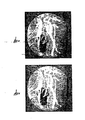
- the pixel data for this image frame are in the memory of a video display controller and the image generated from these data is being displayed on the cathode ray tube screen of a video monitor as in FIGURE 2.
- the blood vessel is considered to be filled with and delineated by x-ray contrast medium.
- a typical artifact due to tissue motion during image acquisition appears as a black island in the lower left quadrant of the circular temporal difference image in FIGURE 2. It is, thus, impossible to determine what the blood vessel looks like in-the area obliterated by motion artifact although details everywhere else in the image may be clear. Supplanting only the artifact area with a hybrid image is required.
- the apparatus comprises a computer and suitable memories for processing image data. It also includes a trackball which can be rotated by the user in any direction to develop and move a cursor on the monitor screen for pointing to or tracing around any regular or irregular region in the temporal image being displayed. For the time being accept the fact that the computer system has the capability of determining the coordinates of all pixels encompassed by a cursor trace that is written over the displayed temporal subtraction image.
- the operator is required to select or define four regions-of-interest in the displayed temporal subtraction image.
- the first region, R is a sample of the region containing the larger artifact. This region is defined by the white outline rectangle in the lower left quadrant of the circular image area in FIGURE 3.
- the defined region is written on the display screen by using a cursor writing trackball as will be elaborated later.
- the coordinates of the pixels in the defined region are held in computer memory.
- the defined region can have any shape required to encompass a region representative of a parameter such as R a .
- the region might be circular, square or pear shaped for example.
- a second region-of-interest, R s that must be selected and defined is one that exhibits the density of the x-ray opaque medium in the blood vessel.
- This region happens to be defined by the white outlined rectangle that appears in the lower right quadrant of the image in FIGURE 5.
- the region is defined in what is obviously a contrast medium filled vessel because of its uniform density. An ellipse with its long axis vertical or a parallelogram shaped region might have been used in this case.
- the coordinates of the pixels in the defined region, R s are determined and stored in computer memory.
- R s is the good signal that represents the blood vessel which is to be visualized with the greatest clarity.
- a third region-of-interest is one that reveals the background or offset density, R b , and is shown by the white rectangle in FIGURE 4.
- Offset, R b can be picked out by a relatively inexperienced operator by looking for an area in the temporal subtraction image over which there is substantially no density change and that lacks any perceptible anatomical structure changes. Offset is essentially background and can be determined much as anyone would perceive background or large areas of uniformity in a painted scene.
- the coordinates of the pixels in the region-of-interest, R b are computed and stored in computer memory.
- a fourth region-of-interest, R h is one in which the hybrid subtraction image has been substituted for the corresponding region in the displayed temporal subtraction image.
- Two cursor defined rectangles outlined in white in FIGURE 6 illustrates that the operator decided that two contiguous regions of different shapes could profit by having a modified hybrid subtraction image substituted. The regions, of course, do not have to be contiguous and more than two which might benefit by hybrid image replacement might be defined.
- the region, R h was defined by the operator to include the obvious artifact containing area plus areas where there could be uncertainty.
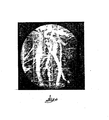
- the coordinates of the pixels in the R h regions were determined from the temporal subtraction image. Note that FIGURE 6 is the finished product.
- the modified hybrid subtraction image has been inserted already by the method to be further explained.
- the motion artifacts, R a exhibited in the basic FIGURE 2 temporal subtraction image are reduced. Blood vessel configurations formerly obscured by the artifacts are now visible for diagnosis. Of course, when the image is displayed for diagnosis the cursor could be turned off so as to not distract the diagnostician.
- R b Within the cursor defined background region, R b , form the sum of all the pixel intensity values separately for the low kV and high kV temporal difference images. Identical regions, R b , are used in the low and high kV images.
- the sums define the offsets, 0 1 and O h , and are given by: - L simply implies that it is the total number of pixels in the define region R b , that it determined. "I" represents image intensity only in the background region.
- FIGURE 1 The part of FIGURE 1 involved in acquiring alternate closely successive high and low energy (high and low kV) is known. It comprises an x-ray tube 10 having an anode 11, a cathode 12 and a control grid 13.
- the x-ray power supply is designated by the block marked 14.
- the supply contains the customary high voltage step-up transformer, rectifier and switching circuits, none of which are shown. It is sufficient for present purposes to recognize that the power supply can apply low kilovoltage (kV), on the order of 70 kV for example, between the anode 11 and cathode 12 alternatingly with applying high kV, on the order of 130 kV, in quick succession to cause emission of x-ray beams having low average photon energy and high average photon energy, respectively.
- Movable x-ray filters 15 can be inserted in the beam synchronously with the low and high kV beams. Suitable filters for narrowing the x-ray photon energy spectrum of the low and high kV beam
- a bias voltage supply is symbolized by block 16.
- the bias supply is controlled to apply zero bias voltage to the control grid 13 in which case the x-ray tube current will be higher compared to the current when the high kV is applied to the anode and a negative bias voltage is applied to the grid.
- the timing and_synchronization of the low and high energy x-ray pulses is accomplished with a known x-ray system controller which governs power supply 14.
- a suitable x-ray power supply for generating high and low energy beams is described in Daniels, et al. U. S. patent No. 4,361,901 which is assigned to the assignee of this application.
- a sequence of pairs of low and high energy x-ray beams are projected through a body, represented by ellipse. 18, which exhibits a bifurcated, blood vessel, 19 for example, whose condition is to be determined by way of the digital subtraction angiography procedure.
- the x-ray images containing the soft tissue, bone and vessel in the anatomical region through which the x-ray beams project, fall on the input phosphor 20 of an image intensffier 21.
- Corresponding optical images appear on the output phosphor 22 of the intensifier.
- a video camera 23 views the optical images and converts them to analog video signals which are output on line 24.
- the analog signals are converted to digital signals with an analog-to-digital converter (ADC) 25.
- ADC analog-to-digital converter
- the digital signal values correspond to the intensities of the picture elements (pixels) of which each image frame is composed.
- the digital values are typically 12-bits deep. They are inputted to a system component called memory control which is represented by the block marked 27.
- the structure and functions thus far described in reference to FIGURE 1 are generally known to those involved in digital fluoro- graphy technology.
- the system in FIGURE 1 is governed by a host central processing unit (CPU) which is called the system controller and is symbolized by the block marked 35.
- the CPU block 35 represents a complete. computer processing system including the memories for program instructions and the operating system and the arithmetic logic circuits and so forth which are customarily parts of a host CPU.
- the operator interface with the system is represented by the block marked user terminal and the numeral 36. It is coupled to CPU 35 for bidirectional communication with the system by way of multiple digital signal lines 37.
- the operator selects x-ray image acquisition procedures and image data processing procedures by using the keyboard 3& that is. associated with the terminal.
- a hand operated switch 39 is shown next to CPU 35.
- Such operations would include among others measuring the time from the closing of switch 39 to the start of the low and high energy pre-contrast exposure pairs are to start, and the time at which the x-ray opaque or contrast medium is to be injected, so as the sequence proceeds, the post-contrast images will be acquired too.
- FIGURE 1 the raw low and high energy images data are fed through memory control 27 during original image acquisition and they output on multiple digital lines 40 and 41 to two similar image data channels both of which lead to a digital processor 42.
- the first channel includes write address control 43, memory A or 44, read address control 45 and a buffer 46.
- the second channel includes write address control 47, memory B or 48, read address control 49 and buffer 50.
- the components just listed, the memory control 27 and the digital processor 42 are all coupled to timing and control bus 51 which runs out of system control CPU 35 so all components in the system can be controlled by the CPU to perform specified functions and to do so at the proper times during original image data acquisition and during image data reprocessing.
- the data output lines or bus 52 from processor 42 are input to a block called storage processor which is marked 53.
- the storage processor 53 is basically a device for interfacing with a digital disk recorder marked 54.
- Processor 53 contains a digital memory, not shown, for holding the data representative of at least four image frames at one time.
- Image data can be outputted from processor 42 to bus 52 and then back to the memory control 27 by way of a feed back or wrap around bus 55.
- Image data can also be accessed from disk recorder 54 through storage processor 53 and fed by way of wrap-around bus 55 to memory control 27. This would be done in connection with forming a region-of-interest hybrid subtraction image for substitution in the region in a motion artifact exhibiting temporal difference image, for example, as has been described earlier..
- the digital data for the low and high energy images may be fed right through from one of the output buses 40 or 41 directly to storage processor 53 and then to digital disk 54 for storage.
- the components in the channels are set up by the CPU control signals to simply pass acquired images.
- the raw data that is, the data for each low and high energy exposure is stored on disk 54 so the data is always available for processing in any desired way without requiring further x-ray exposures.
- any low energy (low kV) or high energy (high kV) pre-contrast or post-contrast image obtained during an exposure sequence and any generated temporal difference or energy difference image can be displayed with the system at any time.
- the digital pixel data that represents it is accessed from disk recorder 54 and stored in the full frame memory of a video display controller represented by the block marked 56. These digital data are transmitted by either bus 57 or 58.
- the video display controller can store the digital pixel data for an image frame and output the pixel signals essentially in a raster scan format.
- the digital signal values that are output from video display controller 56 are converted to analog video signals in a digital to analog converter (DAC) 59.
- DAC digital to analog converter
- the analog video signals drive a raster scanned video monitor 60 on whose cathode ray tube screen the image of the blood vessels 19a is displayed.
- Image data processing, manipulation of image data and arithmetic operations are carried out in digital video processor 42.
- a suitable DVP is described in the application of Andrews, et al., Serial No. 321,307, filed November 13, 1981, now patent No. 4,449,195 which is assigned to the assignee of this application and is incorporated herein by reference.
- This patent shows that the DVP is comprised of arithmetic logic units, multiplexers and memories interconnected by buses.
- the DVP provides the timing signals to the video camera 23 by way of line 34. This assures that certain operations will be carried out during vertical blanking without interrupting image data acquisition.
- the host CPU has the program governing image acquisition and image data processing.
- the CPU sends a small number of appropriate digital instruction words called a recipe, to the processor controller.
- the processor translates the instructions into a series of command words which variously activate or deactivate selected components and data paths in the DVP so that the components will perform the desired operations on the image data such as summing or integrating low and high kV image pixels, multiplying image data by coefficients, converting raw pixel data to natural logarithm values, and combining or subtracting images.
- the patented DVP control method lacked some features which, according to the present invention, are provided for. For instance, in the prior system when one digital memory was read out for the purpose of operating on its data and writing the result in another memory, all locations in the other memory were written into.
- a mode is described which permits reading out and writing pixels within selected parts of an image frame such as in the regions R a , R b" R s and R h .
- the CPU must sum the pixels in a few of these regions or transfer part of a hybrid image to the display controller containing the temporal image data, only the pixels of interest need to be handled.
- a block marked 70 represents the processor controller. It is coupled to CPU 35 by way of a control and timing bus 71 and a data bus 72.
- a bidirectional bus 73 couples processor controller 70 to the DVP 42.
- the host CPU has stored the locations of the image pixels that are identified by the cursor fields.
- the full hybrid image is formed in response to the operator providing the command to form this image by using the user terminal 36.
- the hybrid image is formed, based on data accessed from digital disk 54, and stored in one of several full frame memories in DVP 42.
- the new or modified hybrid image H * is then formed by having the arithmetic logic units in the DVP execute Eq. 6a. The result is stored in a memory in the DVP.
- the CPU has previously calculated the gain G and O * which is sent to the arithmetic units in the DVP by way of processor controller 70. Now what remains to be done is substitute only that region, R h , of the modified hybrid image which was defined by the cursor for replacing:the corresponding region in the displayed temporal difference image.
- the modified hybrid image is written into the selected region R h in the temporal image in minimum time because, in accordance with the invention, only the pixels within the defined boundaries of R h are extracted from the modified hybrid image which has been formed and stored in a DVP memory.
- the special write address control and read address controls 43 and 45 are provided. These controls permit writing into and reading from a digital memory in an unconventional way.
- random access memories RAM
- RAM random access memories
- data transfer time begins and does not end until all locations in the memory are sequenced. In other words, writing into and reading out of a memory is an all or none situation. Writing in all of a memory, even writing mostly zeros takes considerable time.
- the full low energy temporal subtraction image frame is loaded into memory A which is also marked 44.
- the raw pixel data are transferred from the digital disk 54 to the digital processor 42 wherein the individual digital pixel values are converted to natural logarithm values.
- the operator has the option of integrating or summing several or all of the low energy pre-contrast and the same number of post-contrast images data before one integrated data set is subtracted from the other to get the low energy temporal subtraction image or the operator can just choose one good pre-contrast and one good post-contrast image for subtraction.
- the low energy temporal subtraction image is loaded from digital processor 42 to memory A or 44 by way of wrap-around bus 55.
- the full modified hybrid image H * is similarly formed in digital processor 42 with appropriate gain, G, and offset 0 * applied as previously described and this image is loaded into memory B or 48.
- the region R . in the modified hybrid image, H * , that is to be substituted in the temporal subtraction image is read out of memory B, (using read address control 49) passed through digital video processor 42, wrap-around bus 55 and write address control 43, thereby overwriting the corresonding pixel values in memory A defined by R h .
- the temporal image has the modified hybrid image region-of-interest inserted in it.
- the entire combined temporal and modified hybrid image data are then read out of memory A through digital video processor 42 and into the memory of display controller 56.
- the temporal image with a modified hybrid image replacing part of it, as in FIGURE 6, is then displayed as image 19a on video monitor 60.
- the image 19a is essentially the contrast medium filled blood vessel of interest.
- the motion artifact is eliminated but the parts of the vessel formerly obscured in the preferred temporal difference image by the artifact become visible and well defined so an accurate assessment of the blood vessel's condition can be made by the diagnostician.
- the preferred method of replacing a hybrid image in motion artifact containing regions of a temporal image has just been described.
- the weighting coefficient is determined without operator involvement and time for developing the modified and exact replacement hybrid image is rapid.
- the new concept of inserting a modified hybrid image in temporal subtraction image regions that contain motion artifacts can be performed in other ways.
- the most basic approach is to simply display the temporal subtraction image and define the regions, R h , using the cursor, which contain artifacts.
- the temporal subtraction image frame is stored in memory A and, of course, the display controller 56 memory.
- An ordinary hybrid subtraction image can be developed and stored in memory B.
- the pixel values in the region, R h , in the temporal subtraction image in memory A can then be replaced with the pixels in the corresponding region in the hybrid subtraction image as previously described. Then the temporal image with the unmodified hybrid region can be displayed.
- This approach improves diagnostic efficiency as a result of reducing the motion artifacts with the hybrid subtraction step although the hybrid image will not ordinarily have the same brightness level or offset nor the same contrast as the temporal image.
- the method described in the preceding paragraph can be still further improved by providing for matching the offsets or background level in the temporal and substituted hybrid subtraction image as well as matching the contrast.
- the system is provided with means that lets the operator try different offset values (O b ) that can be added to the pixels until one is found that results in the brightness levels of the temporal and contrast corrected hybrid replacement images matching. This is expressed as:
Landscapes
- Health & Medical Sciences (AREA)
- Life Sciences & Earth Sciences (AREA)
- Engineering & Computer Science (AREA)
- Medical Informatics (AREA)
- Physics & Mathematics (AREA)
- Surgery (AREA)
- Veterinary Medicine (AREA)
- Nuclear Medicine, Radiotherapy & Molecular Imaging (AREA)
- Optics & Photonics (AREA)
- Pathology (AREA)
- Radiology & Medical Imaging (AREA)
- Biomedical Technology (AREA)
- Heart & Thoracic Surgery (AREA)
- Molecular Biology (AREA)
- Biophysics (AREA)
- Animal Behavior & Ethology (AREA)
- General Health & Medical Sciences (AREA)
- Public Health (AREA)
- High Energy & Nuclear Physics (AREA)
- Theoretical Computer Science (AREA)
- General Physics & Mathematics (AREA)
- Vascular Medicine (AREA)
- Dentistry (AREA)
- Oral & Maxillofacial Surgery (AREA)
- Data Mining & Analysis (AREA)
- Databases & Information Systems (AREA)
- Mathematical Physics (AREA)
- Software Systems (AREA)
- General Engineering & Computer Science (AREA)
- Apparatus For Radiation Diagnosis (AREA)
Applications Claiming Priority (2)
| Application Number | Priority Date | Filing Date | Title |
|---|---|---|---|
| US616206 | 1984-06-01 | ||
| US06/616,206 US4559557A (en) | 1984-06-01 | 1984-06-01 | Region-of-interest digital subtraction angiography |
Publications (2)
| Publication Number | Publication Date |
|---|---|
| EP0163264A2 true EP0163264A2 (de) | 1985-12-04 |
| EP0163264A3 EP0163264A3 (de) | 1989-02-08 |
Family
ID=24468457
Family Applications (1)
| Application Number | Title | Priority Date | Filing Date |
|---|---|---|---|
| EP85106356A Withdrawn EP0163264A3 (de) | 1984-06-01 | 1985-05-23 | Digitale Subtraktionsangiographie im Gebiet von Interesse |
Country Status (5)
| Country | Link |
|---|---|
| US (1) | US4559557A (de) |
| EP (1) | EP0163264A3 (de) |
| JP (1) | JPS6150554A (de) |
| KR (1) | KR900005434B1 (de) |
| IL (1) | IL75106A (de) |
Cited By (5)
| Publication number | Priority date | Publication date | Assignee | Title |
|---|---|---|---|---|
| FR2682511A1 (fr) * | 1991-10-14 | 1993-04-16 | Commissariat Energie Atomique | Procede de realisation d'une image de reference synthetisee pour le controle d'objets, et son dispositif de mise en óoeuvre. |
| US5307421A (en) * | 1992-10-14 | 1994-04-26 | Commissariat A L'energie Atomique | Process for producing a synthesized reference image for the inspection of objects and apparatus for performing the same |
| FR2765012A1 (fr) * | 1997-06-24 | 1998-12-24 | Ge Medical Syst Sa | Procede de traitement d'une sequence d'images angiocardiographiques |
| FR2885717A1 (fr) * | 2005-05-16 | 2006-11-17 | Gen Electric | Procede d'estimation de correction d'une image et dispositif d'angiographie le mettant en oeuvre |
| WO2009044669A1 (ja) | 2007-09-29 | 2009-04-09 | Honda Motor Co., Ltd. | 小型車両用パワーユニット |
Families Citing this family (69)
| Publication number | Priority date | Publication date | Assignee | Title |
|---|---|---|---|---|
| IL70214A (en) * | 1983-11-13 | 1987-10-20 | Elscint Ltd | Image contrast enhancement arrangement |
| US4839805A (en) * | 1983-11-17 | 1989-06-13 | General Electric Company | Dual control of image level and window parameters of a display and the like |
| IL71878A (en) * | 1984-05-21 | 1987-11-30 | Elscint Ltd | Intensity level windowing system for image displays |
| US4816681A (en) * | 1984-10-02 | 1989-03-28 | Fuji Photo Film Co., Ltd. | Method and apparatus for improving quality of energy subtraction image |
| US4709332A (en) * | 1984-10-05 | 1987-11-24 | North Shore University Hospital | High speed image data processing |
| US4712178A (en) * | 1984-11-28 | 1987-12-08 | Picker International Inc. | Malfunctioning computed tomography detector correction method |
| US4752879A (en) * | 1985-01-30 | 1988-06-21 | Picker International, Inc. | Method and apparatus for medical imaging |
| GB8507449D0 (en) * | 1985-03-22 | 1985-05-01 | Quantel Ltd | Video image processing systems |
| JPS61244184A (ja) * | 1985-04-23 | 1986-10-30 | Hitachi Ltd | ディジタルデータ変換システム |
| US4903205A (en) * | 1985-10-15 | 1990-02-20 | Fuji Photo Film Co. Ltd. | Method and apparatus for displaying radiation image, and method and apparatus for calculating unsharp mask signal used for the same |
| DE3545348A1 (de) * | 1985-12-20 | 1987-06-25 | Siemens Ag | Roentgendiagnostikeinrichtung mit ortsfrequenter hochpassfilterung |
| US4916722A (en) * | 1986-06-26 | 1990-04-10 | Kabushiki Kaisha Toshiba | X-ray image processing apparatus |
| JPS6340533A (ja) * | 1986-08-05 | 1988-02-20 | 株式会社東芝 | X線診断装置 |
| DE3826550C2 (de) * | 1987-08-07 | 1994-01-13 | Toshiba Kawasaki Kk | Einrichtung zum Darstellen von Röntgenbildern |
| US5049748A (en) * | 1989-10-19 | 1991-09-17 | Fuji Photo Film Co. Ltd. | Method and apparatus for forming energy subtraction images |
| JPH03132748A (ja) * | 1989-10-19 | 1991-06-06 | Fuji Photo Film Co Ltd | X線断層撮影装置 |
| US5384861A (en) * | 1991-06-24 | 1995-01-24 | Picker International, Inc. | Multi-parameter image display with real time interpolation |
| US5408521B1 (en) * | 1992-04-14 | 1997-08-26 | Xre Corp | Angiographic x-ray system wih 360 degree scanning |
| US5293574A (en) * | 1992-10-23 | 1994-03-08 | General Electric Company | Digital x-ray imaging system with automatic tracking |
| US5690106A (en) * | 1995-06-30 | 1997-11-25 | Siemens Corporate Research, Inc. | Flexible image registration for rotational angiography |
| US5647360A (en) * | 1995-06-30 | 1997-07-15 | Siemens Corporate Research, Inc. | Digital subtraction angiography for 3D diagnostic imaging |
| JPH09122128A (ja) | 1995-10-31 | 1997-05-13 | Kdk Corp | 測定条件再現具ならびに測定条件再現方法およびそれ を利用した生体情報測定装置 |
| JP3654458B2 (ja) | 1995-10-31 | 2005-06-02 | アークレイ株式会社 | 光源装置 |
| JPH09133629A (ja) * | 1995-11-08 | 1997-05-20 | Kdk Corp | 分光測定におけるスペクトルの処理方法およびそれを 用いた定量方法 |
| DE10106740A1 (de) * | 2001-02-14 | 2002-08-22 | Philips Corp Intellectual Pty | Röntgenstrahler mit einem Target aus einem flüssigen Metall |
| FR2829268A1 (fr) * | 2001-09-04 | 2003-03-07 | Koninkl Philips Electronics Nv | Procede de traitement d'images pour angiographie soustractiv e numerisee |
| US6636582B2 (en) * | 2001-11-08 | 2003-10-21 | Ge Medical Systems Global Technology Co., Llc | Multiple energy x-ray imaging techniques |
| US6990368B2 (en) | 2002-04-04 | 2006-01-24 | Surgical Navigation Technologies, Inc. | Method and apparatus for virtual digital subtraction angiography |
| US6922462B2 (en) * | 2002-07-31 | 2005-07-26 | Ge Medical Systems Global Technology Company, Llc | Method, system and computer product for plaque characterization |
| US7120282B2 (en) * | 2003-01-29 | 2006-10-10 | General Electric Company | Method and apparatus for correcting digital X-ray images |
| FR2884340B1 (fr) * | 2005-04-11 | 2012-03-02 | Gen Electric | Procede et dispositif de traitement d'images en angiographie soustraite |
| US20070122344A1 (en) | 2005-09-02 | 2007-05-31 | University Of Rochester Medical Center Office Of Technology Transfer | Intraoperative determination of nerve location |
| WO2013078476A1 (en) | 2011-11-27 | 2013-05-30 | Hologic, Inc. | System and method for generating a 2d image using mammography and/or tomosynthesis image data |
| EP1980207A4 (de) * | 2006-01-24 | 2010-01-20 | Shimadzu Corp | Röntgendarstellungsgerät |
| WO2007095330A2 (en) | 2006-02-15 | 2007-08-23 | Hologic Inc | Breast biopsy and needle localization using tomosynthesis systems |
| EP2005389B1 (de) * | 2006-03-30 | 2013-05-15 | Koninklijke Philips Electronics N.V. | Automatische herzbanderkennung bei mamma-mri |
| US8077952B2 (en) * | 2006-08-14 | 2011-12-13 | Siemens Medical Solutions Usa, Inc. | Precomputed automatic pixel shift for review of digital subtracted angiography |
| US20080161744A1 (en) | 2006-09-07 | 2008-07-03 | University Of Rochester Medical Center | Pre-And Intra-Operative Localization of Penile Sentinel Nodes |
| US8111895B2 (en) * | 2006-12-06 | 2012-02-07 | Siemens Medical Solutions Usa, Inc. | Locally adaptive image enhancement for digital subtraction X-ray imaging |
| JP2009022450A (ja) * | 2007-07-18 | 2009-02-05 | Ge Medical Systems Global Technology Co Llc | X線ct装置および画像作成方法 |
| JP5274812B2 (ja) * | 2007-11-12 | 2013-08-28 | ジーイー・メディカル・システムズ・グローバル・テクノロジー・カンパニー・エルエルシー | X線ct装置及び画像処理装置 |
| US8406860B2 (en) | 2008-01-25 | 2013-03-26 | Novadaq Technologies Inc. | Method for evaluating blush in myocardial tissue |
| US8019044B2 (en) * | 2008-02-15 | 2011-09-13 | Shkumat Nick A | Image acquisition for dual energy imaging |
| US10219742B2 (en) | 2008-04-14 | 2019-03-05 | Novadaq Technologies ULC | Locating and analyzing perforator flaps for plastic and reconstructive surgery |
| ES2671710T3 (es) | 2008-05-02 | 2018-06-08 | Novadaq Technologies ULC | Métodos para la producción y uso de eritrocitos cargados con sustancias para la observación y el tratamiento de la hemodinámica microvascular |
| US8290234B2 (en) * | 2008-09-10 | 2012-10-16 | Siemens Medical Solutions Usa, Inc. | System for removing static background detail from medical image sequences |
| US10492671B2 (en) | 2009-05-08 | 2019-12-03 | Novadaq Technologies ULC | Near infra red fluorescence imaging for visualization of blood vessels during endoscopic harvest |
| CN102481146B (zh) | 2009-10-08 | 2016-08-17 | 霍罗吉克公司 | 乳房的穿刺活检系统及其使用方法 |
| JP6057922B2 (ja) * | 2011-03-08 | 2017-01-11 | ホロジック, インコーポレイテッドHologic, Inc. | スクリーニング、診断及び生検のための二重エネルギー及び/又は造影強化乳房撮像のためのシステム及び方法 |
| WO2013123091A1 (en) | 2012-02-13 | 2013-08-22 | Hologic, Inc. | System and method for navigating a tomosynthesis stack using synthesized image data |
| JP6028096B2 (ja) | 2012-06-21 | 2016-11-16 | ノバダック テクノロジーズ インコーポレイテッド | 血管造影及びかん流の定量化並びに解析手法 |
| US10624598B2 (en) | 2013-03-15 | 2020-04-21 | Hologic, Inc. | System and method for navigating a tomosynthesis stack including automatic focusing |
| WO2014151646A1 (en) | 2013-03-15 | 2014-09-25 | Hologic Inc. | Tomosynthesis-guided biopsy in prone |
| JP6371515B2 (ja) * | 2013-11-13 | 2018-08-08 | キヤノン株式会社 | X線画像処理装置、x線画像処理方法、及びプログラム |
| US10111631B2 (en) | 2014-02-28 | 2018-10-30 | Hologic, Inc. | System and method for generating and displaying tomosynthesis image slabs |
| KR20170067803A (ko) | 2014-09-29 | 2017-06-16 | 노바다크 테크놀러지즈 인코포레이티드 | 자가형광이 존재하는 생물학적 물질에서 타겟 형광체의 이미징 |
| EP3203902B1 (de) | 2014-10-09 | 2021-07-07 | Novadaq Technologies ULC | Quantifizierung des absoluten blutströmung in gewebe mittels fluoreszenzvermittelter photoplethysmographie |
| US10147171B2 (en) * | 2016-09-21 | 2018-12-04 | General Electric Company | Systems and methods for generating subtracted images |
| EP4242743A3 (de) | 2017-02-10 | 2023-10-18 | Stryker European Operations Limited | Handhaltbare offenfeld-fluoreszenzbildgebungssysteme und verfahren |
| EP3600047A1 (de) | 2017-03-30 | 2020-02-05 | Hologic, Inc. | System und verfahren zur hierarchischen mehrstufigen merkmalsbildsynthese und -darstellung |
| CN110621233B (zh) | 2017-03-30 | 2023-12-12 | 豪洛捷公司 | 用于处理乳房组织图像数据的方法 |
| CN110662489B (zh) | 2017-03-30 | 2024-08-02 | 豪洛捷公司 | 用于靶向对象增强以生成合成乳房组织图像的系统和方法 |
| EP3441003B1 (de) * | 2017-08-08 | 2020-07-22 | Siemens Healthcare GmbH | Verfahren zur ausführung einer digitalen substraktionsangiographie, hybridbildgebungsvorrichtung, computerprogramm und elektronisch lesbares speichermedium |
| CN112804944B (zh) | 2018-09-24 | 2024-07-23 | 豪洛捷公司 | 乳房映射和异常定位 |
| WO2021186803A1 (ja) * | 2020-03-19 | 2021-09-23 | ソニー・オリンパスメディカルソリューションズ株式会社 | 医療用観察システム、制御装置および制御方法 |
| JP2023519878A (ja) | 2020-03-27 | 2023-05-15 | ホロジック, インコーポレイテッド | 複数のイメージングモダリティにおける関心領域を相関させるためのシステムおよび方法 |
| AU2021241536A1 (en) | 2020-03-27 | 2022-08-18 | Hologic, Inc. | Systems and methods for identifying regions of interest in multiple imaging modalities |
| US12254586B2 (en) | 2021-10-25 | 2025-03-18 | Hologic, Inc. | Auto-focus tool for multimodality image review |
| IL313196A (en) | 2021-11-29 | 2024-07-01 | Hologic Inc | Systems and methods for correlating objects of interest |
Family Cites Families (10)
| Publication number | Priority date | Publication date | Assignee | Title |
|---|---|---|---|---|
| AT303141B (de) * | 1970-01-20 | 1972-11-10 | Siemens Ag | Anordnung zum Auswerten bestimmter Bildteile |
| US4245244A (en) * | 1978-09-01 | 1981-01-13 | General Electric Company | Device for delineating zones in a video image display |
| US4323973A (en) * | 1979-12-20 | 1982-04-06 | Greenfield George B | Apparatus and method for enhancing radiographs |
| US4335427A (en) * | 1980-04-21 | 1982-06-15 | Technicare Corporation | Method of selecting a preferred difference image |
| US4361901A (en) * | 1980-11-18 | 1982-11-30 | General Electric Company | Multiple voltage x-ray switching system |
| US4367490A (en) * | 1981-04-24 | 1983-01-04 | General Electric Company | Noise reduction in digital fluoroscopy systems |
| US4445226A (en) * | 1981-05-05 | 1984-04-24 | The Board Of Trustees Of The Leland Stanford Junior University | Multiple-energy X-ray subtraction imaging system |
| US4449195A (en) * | 1981-11-13 | 1984-05-15 | General Electric Company | Digital fluorographic processor control |
| US4454507A (en) * | 1982-01-04 | 1984-06-12 | General Electric Company | Real-time cursor generator |
| US4482918A (en) * | 1982-04-26 | 1984-11-13 | General Electric Company | Method and apparatus for X-ray image subtraction |
-
1984
- 1984-06-01 US US06/616,206 patent/US4559557A/en not_active Expired - Fee Related
-
1985
- 1985-05-06 IL IL75106A patent/IL75106A/xx unknown
- 1985-05-23 EP EP85106356A patent/EP0163264A3/de not_active Withdrawn
- 1985-05-29 JP JP60114428A patent/JPS6150554A/ja active Granted
- 1985-05-29 KR KR1019850003705A patent/KR900005434B1/ko not_active Expired
Cited By (7)
| Publication number | Priority date | Publication date | Assignee | Title |
|---|---|---|---|---|
| FR2682511A1 (fr) * | 1991-10-14 | 1993-04-16 | Commissariat Energie Atomique | Procede de realisation d'une image de reference synthetisee pour le controle d'objets, et son dispositif de mise en óoeuvre. |
| EP0538111A1 (de) * | 1991-10-14 | 1993-04-21 | Commissariat A L'energie Atomique | Verfahren zur Durchführung eines synthesierten Referenzbildes und Vorrichtung zur Ausführung des Verfahrens |
| US5307421A (en) * | 1992-10-14 | 1994-04-26 | Commissariat A L'energie Atomique | Process for producing a synthesized reference image for the inspection of objects and apparatus for performing the same |
| FR2765012A1 (fr) * | 1997-06-24 | 1998-12-24 | Ge Medical Syst Sa | Procede de traitement d'une sequence d'images angiocardiographiques |
| FR2885717A1 (fr) * | 2005-05-16 | 2006-11-17 | Gen Electric | Procede d'estimation de correction d'une image et dispositif d'angiographie le mettant en oeuvre |
| US7792346B2 (en) | 2005-05-16 | 2010-09-07 | General Electric Company | Method and apparatus for correction of an image |
| WO2009044669A1 (ja) | 2007-09-29 | 2009-04-09 | Honda Motor Co., Ltd. | 小型車両用パワーユニット |
Also Published As
| Publication number | Publication date |
|---|---|
| KR860000057A (ko) | 1986-01-25 |
| IL75106A (en) | 1988-12-30 |
| EP0163264A3 (de) | 1989-02-08 |
| JPS6150554A (ja) | 1986-03-12 |
| JPH0511471B2 (de) | 1993-02-15 |
| IL75106A0 (en) | 1985-09-29 |
| US4559557A (en) | 1985-12-17 |
| KR900005434B1 (ko) | 1990-07-30 |
Similar Documents
| Publication | Publication Date | Title |
|---|---|---|
| US4559557A (en) | Region-of-interest digital subtraction angiography | |
| EP0092767B1 (de) | Röntgenabbildungs-Subtraktionsverfahren und -vorrichtung | |
| US5809105A (en) | Noise filter for digital x-ray imaging system | |
| US5357549A (en) | Method of dynamic range compression of an X-ray image and apparatus effectuating the method | |
| US5878108A (en) | Method for generating X-ray image and apparatus therefor | |
| US4736399A (en) | X-ray imaging apparatus | |
| US4633307A (en) | Digital subtraction fluorographic method and apparatus | |
| US4355331A (en) | X-ray image subtracting system | |
| US4551800A (en) | Integrated hybrid image remasking in a subtraction angiography method | |
| EP0112487A1 (de) | Adaptives Filter für hybridische Röntgenstrahlen-Subtraktion | |
| GB1599484A (en) | Computed tomography system | |
| US4449195A (en) | Digital fluorographic processor control | |
| EP0136652B1 (de) | Bildverarbeitungsgerät mit automatischer Fensterverarbeitungsfunktion | |
| JP3662283B2 (ja) | ラジオグラフィー像の表示において診断上無関係な領域の可視化 | |
| JPH11501195A (ja) | 画像内のノイズ減少方法 | |
| KR100949225B1 (ko) | x-선 시스템 및 자동 대비 제어 유닛 및 진단 영상 대비강화 방법 | |
| EP0244111B1 (de) | Abbildungsverfahren | |
| EP0098633B1 (de) | Anordnung und Verfahren zur Röntgenbildverarbeitung | |
| JPH05161633A (ja) | 放射線診断装置 | |
| US4479231A (en) | Method for the production of X-ray images and X-ray television apparatus for carrying out said method | |
| EP0105126B1 (de) | Röntgenbildverbesserungsgerät | |
| US4698671A (en) | Process and apparatus for generating a tomographic image of a three dimensional object | |
| EP0102592B1 (de) | Vorrichtung zur Erzeugung von Röntgenbildern | |
| EP0654762B1 (de) | Darstellung von diagnostisch irrelevanten Gebieten in radiographischen Bildern | |
| JPH05161632A (ja) | 放射線診断装置 |
Legal Events
| Date | Code | Title | Description |
|---|---|---|---|
| PUAI | Public reference made under article 153(3) epc to a published international application that has entered the european phase |
Free format text: ORIGINAL CODE: 0009012 |
|
| AK | Designated contracting states |
Designated state(s): DE FR GB NL |
|
| PUAL | Search report despatched |
Free format text: ORIGINAL CODE: 0009013 |
|
| AK | Designated contracting states |
Kind code of ref document: A3 Designated state(s): DE FR GB NL |
|
| 17P | Request for examination filed |
Effective date: 19890802 |
|
| 17Q | First examination report despatched |
Effective date: 19901119 |
|
| STAA | Information on the status of an ep patent application or granted ep patent |
Free format text: STATUS: THE APPLICATION IS DEEMED TO BE WITHDRAWN |
|
| 18D | Application deemed to be withdrawn |
Effective date: 19930122 |
|
| RIN1 | Information on inventor provided before grant (corrected) |
Inventor name: BELANGER, BARRY FREDRIC Inventor name: HALL, ANNE LINDSAY Inventor name: KEYES, GARY SYLVESTER |