EP0157617B1 - Reifen für Motorräder - Google Patents
Reifen für Motorräder Download PDFInfo
- Publication number
- EP0157617B1 EP0157617B1 EP85302230A EP85302230A EP0157617B1 EP 0157617 B1 EP0157617 B1 EP 0157617B1 EP 85302230 A EP85302230 A EP 85302230A EP 85302230 A EP85302230 A EP 85302230A EP 0157617 B1 EP0157617 B1 EP 0157617B1
- Authority
- EP
- European Patent Office
- Prior art keywords
- carcass
- tyre
- cords
- breaker
- bead
- Prior art date
- Legal status (The legal status is an assumption and is not a legal conclusion. Google has not performed a legal analysis and makes no representation as to the accuracy of the status listed.)
- Expired
Links
- 239000011324 bead Substances 0.000 claims description 39
- 230000002787 reinforcement Effects 0.000 claims description 18
- 239000000463 material Substances 0.000 claims description 12
- 239000004760 aramid Substances 0.000 claims description 9
- 229920003235 aromatic polyamide Polymers 0.000 claims description 9
- 230000003014 reinforcing effect Effects 0.000 claims description 9
- 239000004677 Nylon Substances 0.000 claims description 5
- 229920000297 Rayon Polymers 0.000 claims description 5
- 229920001778 nylon Polymers 0.000 claims description 5
- 229920000728 polyester Polymers 0.000 claims description 5
- 239000002964 rayon Substances 0.000 claims description 5
- 229920001875 Ebonite Polymers 0.000 claims description 3
- 238000012360 testing method Methods 0.000 description 5
- 238000010276 construction Methods 0.000 description 4
- 239000004744 fabric Substances 0.000 description 2
- 238000000926 separation method Methods 0.000 description 2
- 239000004753 textile Substances 0.000 description 2
- 229910000831 Steel Inorganic materials 0.000 description 1
- 230000007423 decrease Effects 0.000 description 1
- 230000003247 decreasing effect Effects 0.000 description 1
- 230000000694 effects Effects 0.000 description 1
- 238000011156 evaluation Methods 0.000 description 1
- 239000000835 fiber Substances 0.000 description 1
- 239000011368 organic material Substances 0.000 description 1
- 238000005096 rolling process Methods 0.000 description 1
- 238000010008 shearing Methods 0.000 description 1
- 239000010959 steel Substances 0.000 description 1
- 238000010998 test method Methods 0.000 description 1
- 230000000007 visual effect Effects 0.000 description 1
Images
Classifications
-
- B—PERFORMING OPERATIONS; TRANSPORTING
- B60—VEHICLES IN GENERAL
- B60C—VEHICLE TYRES; TYRE INFLATION; TYRE CHANGING; CONNECTING VALVES TO INFLATABLE ELASTIC BODIES IN GENERAL; DEVICES OR ARRANGEMENTS RELATED TO TYRES
- B60C9/00—Reinforcements or ply arrangement of pneumatic tyres
- B60C9/02—Carcasses
- B60C9/04—Carcasses the reinforcing cords of each carcass ply arranged in a substantially parallel relationship
- B60C9/08—Carcasses the reinforcing cords of each carcass ply arranged in a substantially parallel relationship the cords extend transversely from bead to bead, i.e. radial ply
-
- B—PERFORMING OPERATIONS; TRANSPORTING
- B60—VEHICLES IN GENERAL
- B60C—VEHICLE TYRES; TYRE INFLATION; TYRE CHANGING; CONNECTING VALVES TO INFLATABLE ELASTIC BODIES IN GENERAL; DEVICES OR ARRANGEMENTS RELATED TO TYRES
- B60C15/00—Tyre beads, e.g. ply turn-up or overlap
- B60C15/0009—Tyre beads, e.g. ply turn-up or overlap features of the carcass terminal portion
- B60C15/0036—Tyre beads, e.g. ply turn-up or overlap features of the carcass terminal portion with high ply turn-up, i.e. folded around the bead core and terminating radially above the point of maximum section width
-
- B—PERFORMING OPERATIONS; TRANSPORTING
- B60—VEHICLES IN GENERAL
- B60C—VEHICLE TYRES; TYRE INFLATION; TYRE CHANGING; CONNECTING VALVES TO INFLATABLE ELASTIC BODIES IN GENERAL; DEVICES OR ARRANGEMENTS RELATED TO TYRES
- B60C9/00—Reinforcements or ply arrangement of pneumatic tyres
- B60C9/18—Structure or arrangement of belts or breakers, crown-reinforcing or cushioning layers
- B60C9/20—Structure or arrangement of belts or breakers, crown-reinforcing or cushioning layers built-up from rubberised plies each having all cords arranged substantially parallel
-
- Y—GENERAL TAGGING OF NEW TECHNOLOGICAL DEVELOPMENTS; GENERAL TAGGING OF CROSS-SECTIONAL TECHNOLOGIES SPANNING OVER SEVERAL SECTIONS OF THE IPC; TECHNICAL SUBJECTS COVERED BY FORMER USPC CROSS-REFERENCE ART COLLECTIONS [XRACs] AND DIGESTS
- Y10—TECHNICAL SUBJECTS COVERED BY FORMER USPC
- Y10T—TECHNICAL SUBJECTS COVERED BY FORMER US CLASSIFICATION
- Y10T152/00—Resilient tires and wheels
- Y10T152/10—Tires, resilient
- Y10T152/10495—Pneumatic tire or inner tube
- Y10T152/10855—Characterized by the carcass, carcass material, or physical arrangement of the carcass materials
- Y10T152/10864—Sidewall stiffening or reinforcing means other than main carcass plies or foldups thereof about beads
Definitions
- the present invention relates to a tyre for a motor-cycle and, in particular, to a radial tyre for a motor-cycle having improved durability when subjected to high speed running of the motor cycle.
- a crossply structure is employed, that is, a structure in which there are two sheets of ply cords in the carcass intersecting each other and each laid at angles ranging from 30 to 60 degrees with respect to the circumferential direction of the tyre.
- the reason is that the requirements for motor-cycle tyres are radically different from those for four wheel vehicles such as passenger cars, particularly, in respect of deflection during cornering. Furthermore, it is necessary to have these characteristics to provide stable and consistent running while also withstanding the centrifugal force acting upon the motor-cycle.
- the centrifugal force is resisted by a force (camber thrust) generated at the tyre road contact zone when the motor-cycle is tilted during cornering at a large degree of bank angle (measured in respect to a plane perpendicular to the road surface) acting horizontally inwards in the direction of the camber angle.
- the motor-cycle tyre must be transversely stiffened and this is done at present in the art by employing a carcass of the crossply type as described above so as to provide and sustain the above said chamber thrust, radial tyre structures because of greatly inferior transverse stiffness being unusable.
- the crossply tyre has drawbacks in that transverse vibration known as weave phenomenon of the motor-cycle frame resulting from the transverse stiffness utilised occurs during high speed straight running and resistance to wear is low.
- the inventors examined the tyre of basic radial structure which has not been successfully used for motor-cycle and in particular the structural arrangements, and materials of the carcass reinforcing layers and breakers, and, as a result, have proposed a novel radial structure after discovering that camber thrust properties can be improved to a level as high as that of the cross-ply tyre whilst maintaining the other advantages of the radial structure such as resistance to wear, good grip and stable high speed running properties.
- a motor-cycle tyre comprising a tread, sidewalls extending radially inwardly from each tread edge to bead regions and a reinforcement carcass wrapped at each edge around bead reinforcement cords, said carcass comprising parallel reinforcement cords, said tread being reinforced by a breaker radially outside the carcass, the breaker comprising high modulus reinforcement tyre cords, particularly composed of aromatic polyamide, whose tensile strength is not less than 7 grams per denier and whose initial modulus is not less than 200 grams per denier laid at angles from 10 to 45 degrees to the circumferential direction and an additional band over that breaker said additional band comprising parallel reinforcement cords laid at angles from 10 to 25 degrees to the circumferential direction, said band said breaker and said tread having substantially the same width, characterised in that the reinforcement cords of the carcass are laid in the radial direction, that said additional band covers at least both ends of said breaker and in that said reinforcement cords of that additional band are selected from the low modulus materials nylon
- the carcass reinforcement cords are embedded in rubber having the 300% modulus in the range of 120 to 240 kg/cm 2 .
- the reinforcement cords may be aromatic polyamide material.
- the cords of the breaker may be laid at angles of 20 to 35 degrees to the circumferential direction.
- the cords of the band are preferably embedded in rubber at a cord density of 30 to 60 cords per 5 cm the band may comprise two layers wrapped twice from a single sheet around the tyre circumference.
- Each bead region of the tyre may include mounted upon the bead core a triangular section bead apex of hard rubber material which extends radially outwards substantially to the height of the widest part of the tyre carcass.
- the tyre may also include over the carcass an additional reinforcing ply which is underneath the breaker.
- the additional reinforcing ply preferably has its cords at between 45 and 80 degrees to the radial direction and extends around the carcass to points in the bead region radially outside the bead cores without wrapping around the bead cores.
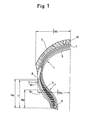
- the motor-cycle tyre 1 comprises a convex tread 2, sidewalls 3 extending radially inwardly from both ends of the tread and bead regions 4 positioned at the radially inward ends of the sidewalls.
- the tread 2 as stated is sharply convex and is reinforced by a carcass parallel to the arcuate configuration of the tread.
- the tread has a width W, which is larger than the maximum main carcass width W s measured at the widest point of the sidewalls. This allows the camber thrust generated when the tyre is tilted to be taken by the tyre even when steeply banked over.
- the carcass 5 is composed of two plies and both edges of each are folded or wrapped from inside to outside around the bead core 6 and terminated above the bead core 6 in the upper bead region or in the sidewall 3. It is desirable that the end 5a of the folded edge portion of the outer ply edge lies outside the bead region and extends to a higher position than that of the folded edge 5b of the inner ply edge which lies inside the bead region and so that the abovesaid inner folded edge is covered. This mitigates stress concentrations at the edge portion.
- the ply turn up heights Hb and Ha between the bead base and the two folded ply edges, that is, the inner edge 5b and the outer edge 5a, respectively are within the ranges of 55 to 65% and 70 to 150% of the height H from the bead base to the point of maximum carcass width as shown.
- Cords in the carcass 5 are arranged parallel or approximately parallel to the radial direction of the tyre. To be approximately parallel means that cords are arranged transversely at 10 degrees or less to the radial direction of the tyre. If the cords were to be arranged at an angle larger than 10 degrees, excellent characteristics of radial tyre exhibited during high speed running would not be obtained.
- Textile fibres in cord form are used for the carcass fabric being organic materials such as nylon, polyester, rayon or aromatic polyamide.
- One or more plies may be used for the carcass, and, as an alternative to the structure in which the carcass is folded or wrapped from inside to the outside around the bead core 6 as shown in the drawing, a construction in which the carcass is folded from the outside to the inside may be used or a construction in which the former two are combined.
- the structure shown in the drawing is, however, the preferred optimum construction wherein the carcass is folded from the inside to the outside.
- the breaker 7 is arranged to cover substantially the full width of the tread to increase the hoop effect.
- the cords of the breaker are arranged at an angle in the range of 10 to 45 degrees, or more preferably from 20 to 35 degrees to the circumferential direction of the tyre.
- the angle of the cord arrangements is smaller than this range the tread stiffness is increased and impact caused by small pebbles scattered on the road or by roughness of the road is felt excessively by the driver and stability as well as comfort during running of the motor-cycle is hampered.
- too large an angle impedes operational stability at the time of high speed running.
- the breaker 7 is composed of two plies and the width of at least one of the two is substantially equal to the width W t of the tread.
- Textile materials used for the cords of the breaker which is weftless tyre cord fabric may be the same as those used for the carcass reinforcing layer but preferably are aromatic polyamide material cords whose tensile strength is not less than 7 g/d and initial modulus is not less than 200 g/d, embedded in rubber whose 300% modulus ranges from 120 to 240 Kg/cm 2 .
- a band 10 outside the breaker so as to cover at least both ends of the breaker.
- the cords of the breaker and those of the carcass intersect each other at a large angle and, therefore, the shearing strain is large at the interface of the breaker and the carcass, particularly, at positions near both edges of the breaker.
- the band 10 functions to resist this and also to prevent separation of the carcass ply from the breaker ply in the edge regions of the breaker arising from centrifugal force generated at high rotational speeds of the tyre.
- the band 10 comprises ply material composed of cords of organic fibres such as nylon, polyester or rayon arranged at an angle ranging from 10 to 25 degrees respect to the circumferential direction of the tyre and embedded in rubber at a density ranging from 30 to 60 cords/5 cm, preferably from 40 to 50 cords/5 cm.
- the band 10 may be one or two plies or layers wrapped in the circumferential direction of the tyre and in width within plus or minus 10 mm of the width of the breaker. Further, according to the present invention, by providing upon the bead core 6 a triangular bead apex 9 made of hard rubber and extending from the bead core 6 into the sidewall the transverse stiffness of the tyre is increased.
- the bead apex 9 decreases in thickness from the bead core 6 and the upper end of the bead apex 9 is preferably extended to a position near to the widest sectional width of the tyre carcass.
- the hardness of the bead apex 9 is within the range of 65 to 95 degrees SHORE.
- An additional reinforcing ply may be provided over the carcass ply composed of fibre cords and extending from one bead region on one side of the tyre to the other bead region on the other side with both edges short of the bead core 6 and not wrapped around the bead core.
- the additional reinforcing ply is laid so its cords intersect the carcass cords at a fixed angle to reinforce the sidewall and, to even further improve the cornering characteristics and it does this without impeding ride comfort by utilising a cord angle of 45 degrees to 80 degrees and more preferably 60 to 80 degrees which increases the transverse resilience coefficient without increasing the vertical resilience coefficient.
- Each or both edges of the reinforcing ply is/are preferably positioned between the folded edges 5a and 5b of the carcass to lessen stress concentration in the bead region.
- the additional reinforcing ply may be positioned between the outer surface of the bead apex 9 and the folded ends 5a and 5b as well as between the inner surface of the bead apex 9 and the carcass ply.
- the suitability for high speed running that is, the speed usable without exceeding the critical speed for generation of standing wave, is increased and also the resistance to rolling is decreased.
- low transverse stiffness as an intrinsic drawback of the known radial tyre is improved and camber thrust is increased to enable very much improved stable running, and the so-called "wobbling phenomenon" is effectively prevented, also separation of plies from each other at both edges of the breaker is prevented by the provision of the bands outside the breaker.
- Motor-cycle rear wheel tyres were made of the size 130/180-18 with the structure as shown in Fig. 1 and with some modified structures.
- a crossply tyre and a radial one of conventional structure and the same sizes and materials were used.
- Detailed specification of these tyres are shown in Table 1, in which values of camber thrust are shown relative to the value of the crossply tyre (Control No 2) being set as 100. The higher the value, the better the tyre.
- High speed performance testing was begun at 150 km/h and the speed was raised at intervals of 10 km/h and 10 minutes until by visual observation a speed at which standing wave is generated was reached.
- the durability test was performed by running the tyre on a 60 inches dia. drum with the application of a load equivalent to 150% of the maximum value (405 kg) specified by the JATMA test procedure with the tyre inflated to the maximum pressure (2.90 kg ⁇ cm 2 ) specified by JATMA, and at a speed of 65 km/h.
- the motor-cycle used was a YAMAHA XJ 1750, in which a crossply tyre of 100.90V19 and the other tyre under test as specified in Table 1 were used for the front wheel and the rear wheel, respectively.
Landscapes
- Engineering & Computer Science (AREA)
- Mechanical Engineering (AREA)
- Tires In General (AREA)
Claims (8)
Applications Claiming Priority (2)
| Application Number | Priority Date | Filing Date | Title |
|---|---|---|---|
| JP69550/84 | 1984-04-06 | ||
| JP59069550A JPS60213503A (ja) | 1984-04-06 | 1984-04-06 | 自動二輪車用タイヤ |
Publications (3)
| Publication Number | Publication Date |
|---|---|
| EP0157617A2 EP0157617A2 (de) | 1985-10-09 |
| EP0157617A3 EP0157617A3 (en) | 1986-04-23 |
| EP0157617B1 true EP0157617B1 (de) | 1989-05-31 |
Family
ID=13405939
Family Applications (1)
| Application Number | Title | Priority Date | Filing Date |
|---|---|---|---|
| EP85302230A Expired EP0157617B1 (de) | 1984-04-06 | 1985-03-29 | Reifen für Motorräder |
Country Status (4)
| Country | Link |
|---|---|
| US (1) | US5069262A (de) |
| EP (1) | EP0157617B1 (de) |
| JP (1) | JPS60213503A (de) |
| DE (1) | DE3570626D1 (de) |
Families Citing this family (9)
| Publication number | Priority date | Publication date | Assignee | Title |
|---|---|---|---|---|
| GB8530213D0 (en) * | 1985-12-07 | 1986-01-15 | Sp Tyres Uk Ltd | Radial motorcycle tyres |
| GB8607889D0 (en) * | 1986-04-01 | 1986-05-08 | Sp Tyres Uk Ltd | Radial tyre for vehicles |
| JPS63305007A (ja) * | 1987-06-05 | 1988-12-13 | Sumitomo Rubber Ind Ltd | 自動二輪車用タイヤ |
| DE3865892D1 (de) * | 1987-06-19 | 1991-12-05 | Sumitomo Rubber Ind | Motorradreifen. |
| JPH01317805A (ja) * | 1988-03-15 | 1989-12-22 | Sumitomo Rubber Ind Ltd | 自動二輪車用ラジアルタイヤ |
| JPH0655561B2 (ja) * | 1988-03-18 | 1994-07-27 | 株式会社ブリヂストン | 二輪車用タイヤ組立体 |
| GB2283215B (en) * | 1993-10-29 | 1997-07-23 | Sumitomo Rubber Ind | Motor-cycle radial tyre |
| GB9714609D0 (en) * | 1997-07-12 | 1997-09-17 | Sumitomo Rubber Ind | Improvements to tyres |
| DE602008001328D1 (de) * | 2007-05-14 | 2010-07-08 | Sumitomo Rubber Ind | Geländegängiger Motorradreifen |
Family Cites Families (13)
| Publication number | Priority date | Publication date | Assignee | Title |
|---|---|---|---|---|
| JPS4944123B1 (de) * | 1968-06-25 | 1974-11-26 | ||
| FR2082137A5 (de) * | 1970-03-04 | 1971-12-10 | Englebert | |
| IT961632B (it) * | 1971-07-23 | 1973-12-10 | Toyo Tire & Rubber Co | Pneumatico a tele radiali |
| JPS5546883B2 (de) * | 1973-03-28 | 1980-11-27 | ||
| IT1059291B (it) * | 1976-04-06 | 1982-05-31 | Pirelli | Perfezionamento ai pneumatici ra iali provvisti di struttura di irrigidimento dei fianchi |
| US4086949A (en) * | 1977-02-25 | 1978-05-02 | E. I. Du Pont De Nemours And Company | Filaments coated with a fatigue reducing finish comprising a poly(vinyl alkyl ether) used as reinforcements in rubber articles |
| IT1075633B (it) * | 1977-04-07 | 1985-04-22 | Pirelli | Perfezionamento ai pneumatici radiali provvisti di struttura di rinforzo nei fianchi |
| FR2409871A1 (fr) * | 1977-11-25 | 1979-06-22 | Uniroyal | Ceinture de renforcement d'enveloppe et de bandage pneumatique pour roue de vehicule automobile et enveloppe comportant ladite ceinture |
| FR2446193A1 (fr) * | 1979-01-11 | 1980-08-08 | Kleber Colombes | Pneumatique, notamment pour avions |
| JPS584642B2 (ja) * | 1979-03-23 | 1983-01-27 | 横浜ゴム株式会社 | ラジアルタイヤ |
| JPS58185304A (ja) * | 1982-04-23 | 1983-10-29 | Bridgestone Corp | モ−タ−サイクル用空気入りタイヤ |
| JPS5973307A (ja) * | 1982-10-18 | 1984-04-25 | Bridgestone Corp | 二輪車用空気入りベルテツドタイヤ対 |
| IT1163837B (it) * | 1983-07-22 | 1987-04-08 | Pirelli | Pneumatico per motocicli |
-
1984
- 1984-04-06 JP JP59069550A patent/JPS60213503A/ja active Pending
-
1985
- 1985-03-29 EP EP85302230A patent/EP0157617B1/de not_active Expired
- 1985-03-29 DE DE8585302230T patent/DE3570626D1/de not_active Expired
-
1989
- 1989-08-07 US US07/391,702 patent/US5069262A/en not_active Expired - Fee Related
Also Published As
| Publication number | Publication date |
|---|---|
| DE3570626D1 (en) | 1989-07-06 |
| EP0157617A3 (en) | 1986-04-23 |
| JPS60213503A (ja) | 1985-10-25 |
| EP0157617A2 (de) | 1985-10-09 |
| US5069262A (en) | 1991-12-03 |
Similar Documents
| Publication | Publication Date | Title |
|---|---|---|
| EP0988159B1 (de) | Kostengünstiger, leichter, radialer reifen | |
| US4706725A (en) | Pneumatic semi-radial tires for motorcycles | |
| US4640329A (en) | Radial tire for motorcycles | |
| EP1019257B1 (de) | Leichter radialer reifen mit aramid-gürtel | |
| EP0994783B1 (de) | Leichter radialer reifen mit glasfaserngürtel | |
| JPH09277803A (ja) | 空気入りラジアルタイヤ | |
| GB2128556A (en) | Pneumatic tires for motorcycles | |
| EP0333434B1 (de) | Radialer Luftreifen für Motorräder | |
| JP4502418B2 (ja) | 2輪車用の横断曲率の大きいタイヤ | |
| EP0219311B1 (de) | Motorradreifen | |
| EP0157617B1 (de) | Reifen für Motorräder | |
| EP0294153B1 (de) | Motorradreifen | |
| EP0950546B1 (de) | Reifen mit hoher Querkrümmung, insbesondere für Zweirad-Fahrzeug | |
| US20070131334A1 (en) | Pneumatic Tire | |
| US4757850A (en) | Tire for motorcycles | |
| EP0976584A2 (de) | Motorradreifen | |
| EP0465188B2 (de) | Radialluftreifen für PKW | |
| EP1182060A2 (de) | Luftreifen | |
| JP3108531B2 (ja) | 自動二輪車用タイヤ | |
| JP3490838B2 (ja) | 自動二輪車用タイヤ | |
| JP4368968B2 (ja) | 空気入りタイヤ | |
| JPH10109503A (ja) | 空気入りラジアルタイヤ | |
| EP0060210A1 (de) | Reifen mit Gürteleinlage | |
| JP5020589B2 (ja) | 自動二輪車用タイヤ | |
| EP0301778B1 (de) | Motorradreifen |
Legal Events
| Date | Code | Title | Description |
|---|---|---|---|
| PUAI | Public reference made under article 153(3) epc to a published international application that has entered the european phase |
Free format text: ORIGINAL CODE: 0009012 |
|
| AK | Designated contracting states |
Designated state(s): DE FR GB IT |
|
| PUAL | Search report despatched |
Free format text: ORIGINAL CODE: 0009013 |
|
| AK | Designated contracting states |
Kind code of ref document: A3 Designated state(s): DE FR GB IT |
|
| 17P | Request for examination filed |
Effective date: 19860818 |
|
| 17Q | First examination report despatched |
Effective date: 19870806 |
|
| GRAA | (expected) grant |
Free format text: ORIGINAL CODE: 0009210 |
|
| AK | Designated contracting states |
Kind code of ref document: B1 Designated state(s): DE FR GB IT |
|
| ITF | It: translation for a ep patent filed | ||
| REF | Corresponds to: |
Ref document number: 3570626 Country of ref document: DE Date of ref document: 19890706 |
|
| ET | Fr: translation filed | ||
| PLBE | No opposition filed within time limit |
Free format text: ORIGINAL CODE: 0009261 |
|
| STAA | Information on the status of an ep patent application or granted ep patent |
Free format text: STATUS: NO OPPOSITION FILED WITHIN TIME LIMIT |
|
| 26N | No opposition filed | ||
| ITTA | It: last paid annual fee | ||
| PGFP | Annual fee paid to national office [announced via postgrant information from national office to epo] |
Ref country code: FR Payment date: 19990309 Year of fee payment: 15 |
|
| PGFP | Annual fee paid to national office [announced via postgrant information from national office to epo] |
Ref country code: GB Payment date: 19990401 Year of fee payment: 15 |
|
| PGFP | Annual fee paid to national office [announced via postgrant information from national office to epo] |
Ref country code: DE Payment date: 19990406 Year of fee payment: 15 |
|
| PG25 | Lapsed in a contracting state [announced via postgrant information from national office to epo] |
Ref country code: GB Free format text: LAPSE BECAUSE OF NON-PAYMENT OF DUE FEES Effective date: 20000329 |
|
| GBPC | Gb: european patent ceased through non-payment of renewal fee |
Effective date: 20000329 |
|
| PG25 | Lapsed in a contracting state [announced via postgrant information from national office to epo] |
Ref country code: FR Free format text: LAPSE BECAUSE OF NON-PAYMENT OF DUE FEES Effective date: 20001130 |
|
| REG | Reference to a national code |
Ref country code: FR Ref legal event code: ST |
|
| PG25 | Lapsed in a contracting state [announced via postgrant information from national office to epo] |
Ref country code: DE Free format text: LAPSE BECAUSE OF NON-PAYMENT OF DUE FEES Effective date: 20010103 |