EP0155697A2 - Aerosoltreibmittel-Zusammensetzungen - Google Patents
Aerosoltreibmittel-Zusammensetzungen Download PDFInfo
- Publication number
- EP0155697A2 EP0155697A2 EP85103363A EP85103363A EP0155697A2 EP 0155697 A2 EP0155697 A2 EP 0155697A2 EP 85103363 A EP85103363 A EP 85103363A EP 85103363 A EP85103363 A EP 85103363A EP 0155697 A2 EP0155697 A2 EP 0155697A2
- Authority
- EP
- European Patent Office
- Prior art keywords
- vapor pressure
- aerosol
- azeotrope
- psig
- propellant
- Prior art date
- Legal status (The legal status is an assumption and is not a legal conclusion. Google has not performed a legal analysis and makes no representation as to the accuracy of the status listed.)
- Ceased
Links
- 239000000203 mixture Substances 0.000 title claims abstract description 45
- 239000003380 propellant Substances 0.000 title claims abstract description 32
- LCGLNKUTAGEVQW-UHFFFAOYSA-N Dimethyl ether Chemical compound COC LCGLNKUTAGEVQW-UHFFFAOYSA-N 0.000 claims abstract description 44
- BHNZEZWIUMJCGF-UHFFFAOYSA-N 1-chloro-1,1-difluoroethane Chemical compound CC(F)(F)Cl BHNZEZWIUMJCGF-UHFFFAOYSA-N 0.000 claims abstract description 27
- VOPWNXZWBYDODV-UHFFFAOYSA-N Chlorodifluoromethane Chemical compound FC(F)Cl VOPWNXZWBYDODV-UHFFFAOYSA-N 0.000 claims abstract description 24
- 239000000443 aerosol Substances 0.000 abstract description 22
- 239000007789 gas Substances 0.000 description 12
- 239000007788 liquid Substances 0.000 description 6
- 239000004480 active ingredient Substances 0.000 description 4
- 238000009472 formulation Methods 0.000 description 4
- 239000003205 fragrance Substances 0.000 description 4
- 239000008266 hair spray Substances 0.000 description 3
- 238000000034 method Methods 0.000 description 3
- 239000007921 spray Substances 0.000 description 3
- 239000004215 Carbon black (E152) Substances 0.000 description 2
- ATUOYWHBWRKTHZ-UHFFFAOYSA-N Propane Chemical compound CCC ATUOYWHBWRKTHZ-UHFFFAOYSA-N 0.000 description 2
- 238000010586 diagram Methods 0.000 description 2
- PXBRQCKWGAHEHS-UHFFFAOYSA-N dichlorodifluoromethane Chemical compound FC(F)(Cl)Cl PXBRQCKWGAHEHS-UHFFFAOYSA-N 0.000 description 2
- 239000011521 glass Substances 0.000 description 2
- 229930195733 hydrocarbon Natural products 0.000 description 2
- 150000002430 hydrocarbons Chemical class 0.000 description 2
- NNPPMTNAJDCUHE-UHFFFAOYSA-N isobutane Chemical compound CC(C)C NNPPMTNAJDCUHE-UHFFFAOYSA-N 0.000 description 2
- 238000012360 testing method Methods 0.000 description 2
- IJGRMHOSHXDMSA-UHFFFAOYSA-N Atomic nitrogen Chemical compound N#N IJGRMHOSHXDMSA-UHFFFAOYSA-N 0.000 description 1
- 239000004338 Dichlorodifluoromethane Substances 0.000 description 1
- 238000009835 boiling Methods 0.000 description 1
- 239000001273 butane Substances 0.000 description 1
- 150000001875 compounds Chemical class 0.000 description 1
- 235000019404 dichlorodifluoromethane Nutrition 0.000 description 1
- 229910001873 dinitrogen Inorganic materials 0.000 description 1
- 239000000383 hazardous chemical Substances 0.000 description 1
- 238000010348 incorporation Methods 0.000 description 1
- 239000004615 ingredient Substances 0.000 description 1
- 239000002917 insecticide Substances 0.000 description 1
- 239000001282 iso-butane Substances 0.000 description 1
- 238000002372 labelling Methods 0.000 description 1
- 239000000314 lubricant Substances 0.000 description 1
- 238000005259 measurement Methods 0.000 description 1
- 239000006082 mold release agent Substances 0.000 description 1
- IJDNQMDRQITEOD-UHFFFAOYSA-N n-butane Chemical compound CCCC IJDNQMDRQITEOD-UHFFFAOYSA-N 0.000 description 1
- OFBQJSOFQDEBGM-UHFFFAOYSA-N n-pentane Natural products CCCCC OFBQJSOFQDEBGM-UHFFFAOYSA-N 0.000 description 1
- 239000003921 oil Substances 0.000 description 1
- 230000000704 physical effect Effects 0.000 description 1
- 239000004033 plastic Substances 0.000 description 1
- 238000002360 preparation method Methods 0.000 description 1
- 239000001294 propane Substances 0.000 description 1
- 230000035807 sensation Effects 0.000 description 1
- 238000005507 spraying Methods 0.000 description 1
- 231100000041 toxicology testing Toxicity 0.000 description 1
- 238000012546 transfer Methods 0.000 description 1
- XLYOFNOQVPJJNP-UHFFFAOYSA-N water Substances O XLYOFNOQVPJJNP-UHFFFAOYSA-N 0.000 description 1
- 239000001993 wax Substances 0.000 description 1
Images
Classifications
-
- A—HUMAN NECESSITIES
- A61—MEDICAL OR VETERINARY SCIENCE; HYGIENE
- A61K—PREPARATIONS FOR MEDICAL, DENTAL OR TOILETRY PURPOSES
- A61K8/00—Cosmetics or similar toiletry preparations
- A61K8/18—Cosmetics or similar toiletry preparations characterised by the composition
- A61K8/30—Cosmetics or similar toiletry preparations characterised by the composition containing organic compounds
- A61K8/33—Cosmetics or similar toiletry preparations characterised by the composition containing organic compounds containing oxygen
-
- A—HUMAN NECESSITIES
- A61—MEDICAL OR VETERINARY SCIENCE; HYGIENE
- A61K—PREPARATIONS FOR MEDICAL, DENTAL OR TOILETRY PURPOSES
- A61K8/00—Cosmetics or similar toiletry preparations
- A61K8/02—Cosmetics or similar toiletry preparations characterised by special physical form
- A61K8/04—Dispersions; Emulsions
- A61K8/046—Aerosols; Foams
-
- A—HUMAN NECESSITIES
- A61—MEDICAL OR VETERINARY SCIENCE; HYGIENE
- A61K—PREPARATIONS FOR MEDICAL, DENTAL OR TOILETRY PURPOSES
- A61K8/00—Cosmetics or similar toiletry preparations
- A61K8/18—Cosmetics or similar toiletry preparations characterised by the composition
- A61K8/30—Cosmetics or similar toiletry preparations characterised by the composition containing organic compounds
- A61K8/31—Hydrocarbons
- A61K8/315—Halogenated hydrocarbons
-
- A—HUMAN NECESSITIES
- A61—MEDICAL OR VETERINARY SCIENCE; HYGIENE
- A61Q—SPECIFIC USE OF COSMETICS OR SIMILAR TOILETRY PREPARATIONS
- A61Q13/00—Formulations or additives for perfume preparations
-
- A—HUMAN NECESSITIES
- A61—MEDICAL OR VETERINARY SCIENCE; HYGIENE
- A61Q—SPECIFIC USE OF COSMETICS OR SIMILAR TOILETRY PREPARATIONS
- A61Q5/00—Preparations for care of the hair
- A61Q5/06—Preparations for styling the hair, e.g. by temporary shaping or colouring
-
- C—CHEMISTRY; METALLURGY
- C09—DYES; PAINTS; POLISHES; NATURAL RESINS; ADHESIVES; COMPOSITIONS NOT OTHERWISE PROVIDED FOR; APPLICATIONS OF MATERIALS NOT OTHERWISE PROVIDED FOR
- C09K—MATERIALS FOR MISCELLANEOUS APPLICATIONS, NOT PROVIDED FOR ELSEWHERE
- C09K3/00—Materials not provided for elsewhere
- C09K3/30—Materials not provided for elsewhere for aerosols
-
- A—HUMAN NECESSITIES
- A61—MEDICAL OR VETERINARY SCIENCE; HYGIENE
- A61K—PREPARATIONS FOR MEDICAL, DENTAL OR TOILETRY PURPOSES
- A61K2800/00—Properties of cosmetic compositions or active ingredients thereof or formulation aids used therein and process related aspects
- A61K2800/40—Chemical, physico-chemical or functional or structural properties of particular ingredients
- A61K2800/59—Mixtures
-
- Y—GENERAL TAGGING OF NEW TECHNOLOGICAL DEVELOPMENTS; GENERAL TAGGING OF CROSS-SECTIONAL TECHNOLOGIES SPANNING OVER SEVERAL SECTIONS OF THE IPC; TECHNICAL SUBJECTS COVERED BY FORMER USPC CROSS-REFERENCE ART COLLECTIONS [XRACs] AND DIGESTS
- Y10—TECHNICAL SUBJECTS COVERED BY FORMER USPC
- Y10S—TECHNICAL SUBJECTS COVERED BY FORMER USPC CROSS-REFERENCE ART COLLECTIONS [XRACs] AND DIGESTS
- Y10S424/00—Drug, bio-affecting and body treating compositions
- Y10S424/01—Aerosol hair preparation
-
- Y—GENERAL TAGGING OF NEW TECHNOLOGICAL DEVELOPMENTS; GENERAL TAGGING OF CROSS-SECTIONAL TECHNOLOGIES SPANNING OVER SEVERAL SECTIONS OF THE IPC; TECHNICAL SUBJECTS COVERED BY FORMER USPC CROSS-REFERENCE ART COLLECTIONS [XRACs] AND DIGESTS
- Y10—TECHNICAL SUBJECTS COVERED BY FORMER USPC
- Y10S—TECHNICAL SUBJECTS COVERED BY FORMER USPC CROSS-REFERENCE ART COLLECTIONS [XRACs] AND DIGESTS
- Y10S426/00—Food or edible material: processes, compositions, and products
- Y10S426/811—Utilizing surface parting, antistick or release agent
Definitions
- This invention relates to propelling gas systems for aerosol products.
- aerosol products Many products designed for household. personal or industrial use are available as aerosol products. Typical examples of such products and ones in which the propellant system of the present invention can be used include household products such as waxes, polishes, pan sprays, room fresheners and household insecticides: industrial products such as cleaners, lubricants, and mold release agents; and automotive products such as cleaners and polishes. All such products utilize the pressure of a propellant gas or a mixture of propellant gases (i.e., a propellant gas system) to expel the active ingredients from the container. For this purpose, most aerosols employ liquified gases which vaporize and provide the pressure to propel the active ingredients when the valve on the aerosol container is pressed open.
- a propellant gas system i.e., a propellant gas system
- Vapor pressure from the viewpoint of this invention is the pressure exerted when a liquified propellant gas is in equilibrium with its vapor in a closed container, such as an aerosol can. Vapor pressure can be measured by connecting a pressure gauge to the valve on an aerosol can or gas cylinder containing the vapor/liquid mixture.
- a standard of measurement of vapor pressure in the U.S. aerosol industry is pounds per square inch gauge (psig) with the gas/liquid mixture at constant temperature, most commonly at 70°F. When vapor pressure is mentioned in the ensuing specification without reference to temperature, it can be assumed that the pressure is determined at 70°F.
- vapor pressures of liquified gases most widely employed as aerosol propellants will vary over the range of about 20 to 90 psig at 70°F. However, for a great many aerosol products, propellants with a vapor pressure in the range of about 50 to 60 psig are most desirable.
- the propellant systems of the present invention have vapor pressures in this latter range.
- the present invention pertains to aerosol propellant compositions containing the azeotrope of monochlorodifluoromethane.and dimethyl ether (DME).
- This azeotrope which consists of 40% by weight of monochlorodifluoromethane (more commonly referred to in the industry as fluorocarbon 22 or FC-22) and 60% by weight of dimethyl ether is a maximum boiling (-9°F) minimum vapor pressure (55 psig at 70°F) azeotrope.
- FC-142b (1-chloro-I,1-difluoroethane -- vp 29 psig at 70°F) produces useful aerosol propellants with a vapor pressure in the range of about 50 to 60 psig over a relatively wide range of proportions with respect to the amount of FC-142b present.
- FC-142b can be used with the azeotrope in amounts of about 1-37% by weight, based on the total propellant composition, and the vapor pressure of the propellant gas mixture is still within the desired range of about 50 to 60 psig.
- a preferred range for FC-142b content is 20-30% by weight of the total propellant gas composition.
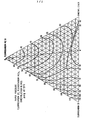
- the diagram shown is a triangular coordinate chart of the type commonly used in the aerosol industry to illustrate the relationship of concentration and vapor pressure for 3-component systems.
- a concentration of 100% by weight of a particular component is at the vertex of the triangle where the name of the component appears.
- a concentration of zero percent of this same component is on the side of the triangle opposite this vertex.
- a composition representing 33 1/3% by weight of each component is at the center of the triangle.
- the parallel lines leading away from each vertex are spaced at 5 weight percent intervals.
- the curved lines within the triangle with the same number appearing at each end of the line indicate the makeup of formulations of the three components that exert a vapor pressure designated by the number at the end of the line.
- the vapor pressure line in closest proximity to this point enables one to closely estimate the vapor pressure of the given composition. Further, it will be apparent from looking at the vapor pressure lines that cross line AB. that about 1 to 37% FC-142b can be mixed with the azeotrope to produce compositions with vapor pressures that stay within the range of about 50 to 60 psig.
- FC-22 dimethyl ether and FC-142b are those in which the ratio of FC-22 to dimethyl ether corresponds to the azeotrope of these two components (i.e.. a 40:60 ratio of FC-22 to DME), it can be seen from the triangular coordinate chart that vapor pressures within the range of about 50 to 60 psig can also be obtained in three-component mixtures where the ratio of FC-22 to DME falls on either side of the azeotrope.
- 1-37% FC-142b can be added to a 50/50 mixture of FC-22 and DME and to a 30/70 mixture of FC-22 and DME without substantially modifying the vapor pressure of the propellant.
- the broad embodiment of this invention comprises three-component compositions of FC-22, dimethylether and FC-142b in which the vapor pressure is in the range of about 50 to 60 psig.
- the tendency for little variation in vapor pressure over a wide range of compositions is considered to be unexpected.
- the present invention involves, in essence, the incorporation of an additional component (FC-142b) with the FC-22/dimethyl ether azeotrope. Since an azeotrope behaves in liquid/vapor equilibrium as if it were a single compound, it might be expected that with the addition of appreciable quantities of a third component, the vapor pressure of the admixture would be somewhere in the middle area between that of the azeotrope and the third component.
- FC-142b vp 29 psig
- FC-22/DME azeotrope vp 55 psig
- FC-22/DME azeotrope is in a desirable range for aerosol propellants, and there is substantially little change in such pressures as the amount of FC-142b is varied within the limits set forth herein.
- FC-22 is nonflammable and DME and FC-142b are less flammable than typical hydrocarbon propellants such as propane, butane, and isobutane.
- typical hydrocarbon propellants such as propane, butane, and isobutane.
- gas mixtures of the present invention are themselves flammable and explosion-proof equipment should be used in the loading of aerosol cans, the presence of FC-22 and FC-142b in the mixture will reduce the flammability of many aerosol products to such a degree that special labeling is not required under the Federal Hazardous Substances Act.
- FC-142b In addition to its low flammability, FC-142b possesses an additional important characteristic. FC-142b is known to enhance the fragrance of aerosol colognes. Thus, a propellant mixture containing as little as 10 wt. % FC-142b will produce a more powerful odor sensation than that experienced without FC-142b. This fragrance enhancement allows a formulator to use less amounts of expensive fragrance oils in his formulation without sacrificing quality of product.
- mixtures of FC-22. DME and FC-142b can be varied in composition over a wide range to produce changes in such important properties as flammability and fragrance enhancement without essentially changing vapor pressure of the propellant blend.
- Examples 1-5 were prepared according to the following procedure.
- the active ingredients were weighed into a six-ounce three-piece aerosol can 2 1/8" in diameter and 4 3/8" long.
- the can was purged with dichlorodifluoromethane (FC-12) vapor to displace the air in the container.
- FC-12 dichlorodifluoromethane
- the aerosol can valve was then placed into the can and crimped.
- the propellants were introduced into the can as liquids through the aerosol valve. Volume amounts corresponding to the weights of the propellants were calculated prior to loading, and a glass, calibrated.
- pressure buret was used to measure and transfer the liquids from storage cylinders to the can.
- a nitrogen gas pressure of loo psig was applied to the buret to aid in transferring the liquids from the buret to the can.
- the can was weighed, and the weight of propellant recorded.
- the loaded can was placed in a 70°F water bath for 30 minutes and the pressure was then measured with a pressure gauge.
- the vapor pressure for the propellant mixtures without active ingredients were obtained from the triangular chart in the drawing.
- the flame extension and flashback tests were conducted by spraying the samples across a candle flame from a distance of six inches and recording how far the flame extended beyond the candle and how far it flashed back towards the can.
- the preparation and testing of the sample of Examples 6 and 7 also used the procedures described above, except that the aerosol ingredients were loaded into clear, plastic-coated, four-ounce, glass aerosol bottles instead of aerosol cans.
Landscapes
- Health & Medical Sciences (AREA)
- Life Sciences & Earth Sciences (AREA)
- Public Health (AREA)
- Animal Behavior & Ethology (AREA)
- General Health & Medical Sciences (AREA)
- Veterinary Medicine (AREA)
- Chemical & Material Sciences (AREA)
- Birds (AREA)
- Epidemiology (AREA)
- Dispersion Chemistry (AREA)
- Materials Engineering (AREA)
- Engineering & Computer Science (AREA)
- Organic Chemistry (AREA)
- Emergency Medicine (AREA)
- Cosmetics (AREA)
- Medicinal Preparation (AREA)
- Agricultural Chemicals And Associated Chemicals (AREA)
- Fats And Perfumes (AREA)
- Organic Low-Molecular-Weight Compounds And Preparation Thereof (AREA)
Applications Claiming Priority (2)
| Application Number | Priority Date | Filing Date | Title |
|---|---|---|---|
| US592881 | 1984-03-23 | ||
| US06/592,881 US4543202A (en) | 1984-03-23 | 1984-03-23 | Aerosol propellant compositions |
Publications (2)
| Publication Number | Publication Date |
|---|---|
| EP0155697A2 true EP0155697A2 (de) | 1985-09-25 |
| EP0155697A3 EP0155697A3 (de) | 1988-03-16 |
Family
ID=24372420
Family Applications (1)
| Application Number | Title | Priority Date | Filing Date |
|---|---|---|---|
| EP85103363A Ceased EP0155697A3 (de) | 1984-03-23 | 1985-03-22 | Aerosoltreibmittel-Zusammensetzungen |
Country Status (5)
| Country | Link |
|---|---|
| US (1) | US4543202A (de) |
| EP (1) | EP0155697A3 (de) |
| JP (1) | JPS60212479A (de) |
| BR (1) | BR8501256A (de) |
| CA (1) | CA1247806A (de) |
Families Citing this family (8)
| Publication number | Priority date | Publication date | Assignee | Title |
|---|---|---|---|---|
| US5409962A (en) * | 1990-03-12 | 1995-04-25 | E. I. Du Pont De Nemours And Company | Substantially constant boiling blowing agent compositions of 1,1,1,2-tetrafluoroethane and dimethyl ether |
| JP3040465B2 (ja) * | 1990-03-12 | 2000-05-15 | イー・アイ・デュポン・ドウ・ヌムール・アンド・カンパニー | 1,1,1,2−テトラフルオロエタン及びジメチルエーテル混合物を用いたエアゾール組成物 |
| US5061394A (en) * | 1990-03-13 | 1991-10-29 | E. I. Du Pont De Nemours And Company | Azeotropic composition of 1-chloro-1,2,2,2-tetrafluoroethane and dimethyl ether |
| US5470885A (en) * | 1993-09-29 | 1995-11-28 | The Research Foundation Of The State University Of New York | Fluorocarbons as anti-inflammatory agents |
| US6403144B1 (en) | 1999-04-30 | 2002-06-11 | The Procter & Gamble Co. | Food preparation compositions |
| US7214400B1 (en) | 1999-04-30 | 2007-05-08 | Smucker Fruit Processing Company | Flavor enhancing oils |
| US6365211B1 (en) | 1999-06-18 | 2002-04-02 | The Procter & Gamble Co. | Cooking aid with reduced foaming |
| US20070134595A1 (en) * | 2005-12-08 | 2007-06-14 | Microchem Corp. | Pressurized aerosol formulation for use in radiation sensitive coatings |
Family Cites Families (2)
| Publication number | Priority date | Publication date | Assignee | Title |
|---|---|---|---|---|
| US3207386A (en) * | 1962-06-01 | 1965-09-21 | Aerosol Tech Inc | Aerosol dispenser producing non-flammable spray with fluid system having a flammable propellant |
| NL7708731A (nl) * | 1976-08-13 | 1978-02-15 | Montedison Spa | Werkwijze voor de bereiding van nieuwe drijf- middelsamenstellingen voor aerosolen. |
-
1984
- 1984-03-23 US US06/592,881 patent/US4543202A/en not_active Expired - Fee Related
-
1985
- 1985-03-20 BR BR8501256A patent/BR8501256A/pt unknown
- 1985-03-20 JP JP60054691A patent/JPS60212479A/ja active Pending
- 1985-03-21 CA CA000477167A patent/CA1247806A/en not_active Expired
- 1985-03-22 EP EP85103363A patent/EP0155697A3/de not_active Ceased
Also Published As
| Publication number | Publication date |
|---|---|
| EP0155697A3 (de) | 1988-03-16 |
| JPS60212479A (ja) | 1985-10-24 |
| CA1247806A (en) | 1989-01-03 |
| US4543202A (en) | 1985-09-24 |
| BR8501256A (pt) | 1985-11-19 |
Similar Documents
| Publication | Publication Date | Title |
|---|---|---|
| EP0145008B1 (de) | Aerosoltreibmittel-Zusammensetzung | |
| US4265797A (en) | Aerosol water-based paint composition | |
| US3723318A (en) | Propellants and refrigerants based on trifluoropropene | |
| US4134968A (en) | Single phase water containing aerosol compositions | |
| Galicia-Luna et al. | New loading technique for a vibrating tube densimeter and measurements of liquid densities up to 39.5 MPa for binary and ternary mixtures of the carbon dioxide-methanol-propane system | |
| US3131154A (en) | Foam producing compositions | |
| US5607979A (en) | Topical skin protectants | |
| EP0155697A2 (de) | Aerosoltreibmittel-Zusammensetzungen | |
| JPS6254838B2 (de) | ||
| CA2271666C (en) | Hydrofluorocarbon compositions | |
| US4585577A (en) | Aerosol propellants of monochlorodifluoromethane, dimethylether and methylene chloride | |
| JPS6219473B2 (de) | ||
| Augsburger et al. | Bubble size analysis of high consistency aerosol foams and its relationship to foam rheology effects of container emptying, propellent type, and time | |
| US3583921A (en) | Aerosol shaving creams pressurized with mixtures of water-soluble and water-insoluble halogenated hydrocarbon propellants | |
| US5766511A (en) | Near-azeotropic compositions constituted by hydrogenated fluorocarbons and hydrocarbons, suitable as propellant fluids for aerosol | |
| US3694546A (en) | Two-phase aerosol spraying system | |
| CN114870022A (zh) | 一种混合型烷烃类抛射剂、制备方法以及应用 | |
| Buchheit et al. | Growth responses of Neurospora crassa to increased partial pressures of the noble gases and nitrogen | |
| Boned et al. | Viscosity and density at high pressures in an associative ternary | |
| Takagi et al. | Ultrasonic speeds and thermodynamic properties of (benzene+ chlorobenzene) and (benzene+ bromobenzene) under high pressures | |
| JP2657387B2 (ja) | 泡沫状頭髪化粧料 | |
| JPH02294382A (ja) | エアゾール製品 | |
| GB1587074A (en) | Propellants for aerosol sprays | |
| Letcher et al. | Excess molar volumes and enthalpies of (1-hexyne, or 1-heptyne, or 1-octyne+ sulfolane) at the temperature 303.15 K | |
| de Oliveira et al. | Solubility of pure 1, 3 butadiene and methyl propene and their mixtures in pure n-methyl-2-pyrrolidone and in its aqueous solutions |
Legal Events
| Date | Code | Title | Description |
|---|---|---|---|
| PUAI | Public reference made under article 153(3) epc to a published international application that has entered the european phase |
Free format text: ORIGINAL CODE: 0009012 |
|
| AK | Designated contracting states |
Designated state(s): DE FR GB IT NL |
|
| PUAL | Search report despatched |
Free format text: ORIGINAL CODE: 0009013 |
|
| AK | Designated contracting states |
Kind code of ref document: A3 Designated state(s): DE FR GB IT NL |
|
| 17P | Request for examination filed |
Effective date: 19880601 |
|
| 17Q | First examination report despatched |
Effective date: 19891117 |
|
| STAA | Information on the status of an ep patent application or granted ep patent |
Free format text: STATUS: THE APPLICATION HAS BEEN REFUSED |
|
| 18R | Application refused |
Effective date: 19910815 |