EP0154886A2 - Carboxyalkyldipeptidderivate, Verfahren zu deren Herstellung, diese enthaltende Mittel und deren Verwendung - Google Patents
Carboxyalkyldipeptidderivate, Verfahren zu deren Herstellung, diese enthaltende Mittel und deren Verwendung Download PDFInfo
- Publication number
- EP0154886A2 EP0154886A2 EP85102134A EP85102134A EP0154886A2 EP 0154886 A2 EP0154886 A2 EP 0154886A2 EP 85102134 A EP85102134 A EP 85102134A EP 85102134 A EP85102134 A EP 85102134A EP 0154886 A2 EP0154886 A2 EP 0154886A2
- Authority
- EP
- European Patent Office
- Prior art keywords
- formula
- compounds
- compound
- preparation
- split
- Prior art date
- Legal status (The legal status is an assumption and is not a legal conclusion. Google has not performed a legal analysis and makes no representation as to the accuracy of the status listed.)
- Withdrawn
Links
- 238000000034 method Methods 0.000 title claims description 17
- 238000002360 preparation method Methods 0.000 title claims description 13
- 108010016626 Dipeptides Proteins 0.000 title description 2
- 125000004181 carboxyalkyl group Chemical group 0.000 title description 2
- 150000003839 salts Chemical group 0.000 claims abstract description 20
- 229910052739 hydrogen Inorganic materials 0.000 claims abstract description 10
- 239000001257 hydrogen Substances 0.000 claims abstract description 10
- 125000004435 hydrogen atom Chemical group [H]* 0.000 claims abstract description 8
- 125000004169 (C1-C6) alkyl group Chemical group 0.000 claims abstract description 6
- 150000001875 compounds Chemical class 0.000 claims description 61
- 239000000203 mixture Substances 0.000 claims description 15
- 125000006239 protecting group Chemical group 0.000 claims description 7
- 125000001797 benzyl group Chemical group [H]C1=C([H])C([H])=C(C([H])=C1[H])C([H])([H])* 0.000 claims description 5
- 230000032050 esterification Effects 0.000 claims description 5
- 238000005886 esterification reaction Methods 0.000 claims description 5
- 125000001495 ethyl group Chemical group [H]C([H])([H])C([H])([H])* 0.000 claims description 5
- 108090000765 processed proteins & peptides Proteins 0.000 claims description 4
- 239000002552 dosage form Substances 0.000 claims description 2
- HCUARRIEZVDMPT-UHFFFAOYSA-N Indole-2-carboxylic acid Chemical compound C1=CC=C2NC(C(=O)O)=CC2=C1 HCUARRIEZVDMPT-UHFFFAOYSA-N 0.000 claims 5
- 230000007062 hydrolysis Effects 0.000 claims 4
- 238000006460 hydrolysis reaction Methods 0.000 claims 4
- 239000003795 chemical substances by application Substances 0.000 claims 3
- YMWUJEATGCHHMB-UHFFFAOYSA-N Dichloromethane Chemical compound ClCCl YMWUJEATGCHHMB-UHFFFAOYSA-N 0.000 description 38
- ZMANZCXQSJIPKH-UHFFFAOYSA-N Triethylamine Chemical compound CCN(CC)CC ZMANZCXQSJIPKH-UHFFFAOYSA-N 0.000 description 19
- XEKOWRVHYACXOJ-UHFFFAOYSA-N Ethyl acetate Chemical compound CCOC(C)=O XEKOWRVHYACXOJ-UHFFFAOYSA-N 0.000 description 18
- OKKJLVBELUTLKV-UHFFFAOYSA-N Methanol Chemical compound OC OKKJLVBELUTLKV-UHFFFAOYSA-N 0.000 description 15
- XLYOFNOQVPJJNP-UHFFFAOYSA-N water Substances O XLYOFNOQVPJJNP-UHFFFAOYSA-N 0.000 description 15
- LFQSCWFLJHTTHZ-UHFFFAOYSA-N Ethanol Chemical compound CCO LFQSCWFLJHTTHZ-UHFFFAOYSA-N 0.000 description 12
- RTZKZFJDLAIYFH-UHFFFAOYSA-N Diethyl ether Chemical compound CCOCC RTZKZFJDLAIYFH-UHFFFAOYSA-N 0.000 description 11
- 238000005481 NMR spectroscopy Methods 0.000 description 11
- YXFVVABEGXRONW-UHFFFAOYSA-N Toluene Chemical compound CC1=CC=CC=C1 YXFVVABEGXRONW-UHFFFAOYSA-N 0.000 description 9
- PMZURENOXWZQFD-UHFFFAOYSA-L Sodium Sulfate Chemical compound [Na+].[Na+].[O-]S([O-])(=O)=O PMZURENOXWZQFD-UHFFFAOYSA-L 0.000 description 8
- DTQVDTLACAAQTR-UHFFFAOYSA-N Trifluoroacetic acid Chemical compound OC(=O)C(F)(F)F DTQVDTLACAAQTR-UHFFFAOYSA-N 0.000 description 8
- 239000002253 acid Substances 0.000 description 8
- 229910052938 sodium sulfate Inorganic materials 0.000 description 8
- 235000011152 sodium sulphate Nutrition 0.000 description 8
- 239000002585 base Substances 0.000 description 7
- 238000006243 chemical reaction Methods 0.000 description 7
- VEXZGXHMUGYJMC-UHFFFAOYSA-N Hydrochloric acid Chemical compound Cl VEXZGXHMUGYJMC-UHFFFAOYSA-N 0.000 description 6
- VYPSYNLAJGMNEJ-UHFFFAOYSA-N Silicium dioxide Chemical compound O=[Si]=O VYPSYNLAJGMNEJ-UHFFFAOYSA-N 0.000 description 6
- HEMHJVSKTPXQMS-UHFFFAOYSA-M Sodium hydroxide Chemical compound [OH-].[Na+] HEMHJVSKTPXQMS-UHFFFAOYSA-M 0.000 description 6
- KRKNYBCHXYNGOX-UHFFFAOYSA-N citric acid Chemical compound OC(=O)CC(O)(C(O)=O)CC(O)=O KRKNYBCHXYNGOX-UHFFFAOYSA-N 0.000 description 6
- 239000003480 eluent Substances 0.000 description 6
- 239000000741 silica gel Substances 0.000 description 6
- 229910002027 silica gel Inorganic materials 0.000 description 6
- 239000002904 solvent Substances 0.000 description 6
- QOSSAOTZNIDXMA-UHFFFAOYSA-N Dicylcohexylcarbodiimide Chemical compound C1CCCCC1N=C=NC1CCCCC1 QOSSAOTZNIDXMA-UHFFFAOYSA-N 0.000 description 5
- 239000012230 colorless oil Substances 0.000 description 5
- 239000000047 product Substances 0.000 description 5
- 0 *C(CCC1CCCCC1)O Chemical compound *C(CCC1CCCCC1)O 0.000 description 4
- ASOKPJOREAFHNY-UHFFFAOYSA-N 1-Hydroxybenzotriazole Chemical compound C1=CC=C2N(O)N=NC2=C1 ASOKPJOREAFHNY-UHFFFAOYSA-N 0.000 description 4
- RKFNAZGRJVNWEW-UHFFFAOYSA-N 3-cyclohexylpropanal Chemical compound O=CCCC1CCCCC1 RKFNAZGRJVNWEW-UHFFFAOYSA-N 0.000 description 4
- HVCNXQOWACZAFN-UHFFFAOYSA-N 4-ethylmorpholine Chemical compound CCN1CCOCC1 HVCNXQOWACZAFN-UHFFFAOYSA-N 0.000 description 4
- XDTMQSROBMDMFD-UHFFFAOYSA-N Cyclohexane Chemical compound C1CCCCC1 XDTMQSROBMDMFD-UHFFFAOYSA-N 0.000 description 4
- IAZDPXIOMUYVGZ-UHFFFAOYSA-N Dimethylsulphoxide Chemical compound CS(C)=O IAZDPXIOMUYVGZ-UHFFFAOYSA-N 0.000 description 4
- 239000004472 Lysine Substances 0.000 description 4
- KDLHZDBZIXYQEI-UHFFFAOYSA-N Palladium Chemical compound [Pd] KDLHZDBZIXYQEI-UHFFFAOYSA-N 0.000 description 4
- JUJWROOIHBZHMG-UHFFFAOYSA-N Pyridine Chemical compound C1=CC=NC=C1 JUJWROOIHBZHMG-UHFFFAOYSA-N 0.000 description 4
- UIIMBOGNXHQVGW-UHFFFAOYSA-M Sodium bicarbonate Chemical compound [Na+].OC([O-])=O UIIMBOGNXHQVGW-UHFFFAOYSA-M 0.000 description 4
- QAOWNCQODCNURD-UHFFFAOYSA-N Sulfuric acid Chemical compound OS(O)(=O)=O QAOWNCQODCNURD-UHFFFAOYSA-N 0.000 description 4
- -1 alkaline earth metal salts Chemical class 0.000 description 4
- 239000012043 crude product Substances 0.000 description 4
- IIEWJVIFRVWJOD-UHFFFAOYSA-N ethyl cyclohexane Natural products CCC1CCCCC1 IIEWJVIFRVWJOD-UHFFFAOYSA-N 0.000 description 4
- CTSLXHKWHWQRSH-UHFFFAOYSA-N oxalyl chloride Chemical compound ClC(=O)C(Cl)=O CTSLXHKWHWQRSH-UHFFFAOYSA-N 0.000 description 4
- 238000003756 stirring Methods 0.000 description 4
- WJKHJLXJJJATHN-UHFFFAOYSA-N triflic anhydride Chemical compound FC(F)(F)S(=O)(=O)OS(=O)(=O)C(F)(F)F WJKHJLXJJJATHN-UHFFFAOYSA-N 0.000 description 4
- UUUHXMGGBIUAPW-UHFFFAOYSA-N 1-[1-[2-[[5-amino-2-[[1-[5-(diaminomethylideneamino)-2-[[1-[3-(1h-indol-3-yl)-2-[(5-oxopyrrolidine-2-carbonyl)amino]propanoyl]pyrrolidine-2-carbonyl]amino]pentanoyl]pyrrolidine-2-carbonyl]amino]-5-oxopentanoyl]amino]-3-methylpentanoyl]pyrrolidine-2-carbon Chemical compound C1CCC(C(=O)N2C(CCC2)C(O)=O)N1C(=O)C(C(C)CC)NC(=O)C(CCC(N)=O)NC(=O)C1CCCN1C(=O)C(CCCN=C(N)N)NC(=O)C1CCCN1C(=O)C(CC=1C2=CC=CC=C2NC=1)NC(=O)C1CCC(=O)N1 UUUHXMGGBIUAPW-UHFFFAOYSA-N 0.000 description 3
- 102000004270 Peptidyl-Dipeptidase A Human genes 0.000 description 3
- 108090000882 Peptidyl-Dipeptidase A Proteins 0.000 description 3
- FAPWRFPIFSIZLT-UHFFFAOYSA-M Sodium chloride Chemical class [Na+].[Cl-] FAPWRFPIFSIZLT-UHFFFAOYSA-M 0.000 description 3
- 230000002378 acidificating effect Effects 0.000 description 3
- 125000000484 butyl group Chemical group [H]C([*])([H])C([H])([H])C([H])([H])C([H])([H])[H] 0.000 description 3
- 239000000969 carrier Substances 0.000 description 3
- 239000003054 catalyst Substances 0.000 description 3
- 229920001429 chelating resin Polymers 0.000 description 3
- FSQMKIAGQSCPJA-UHFFFAOYSA-N ethyl 4-cyclohexyl-2-(trifluoromethylsulfonyloxy)butanoate Chemical compound CCOC(=O)C(OS(=O)(=O)C(F)(F)F)CCC1CCCCC1 FSQMKIAGQSCPJA-UHFFFAOYSA-N 0.000 description 3
- 239000012442 inert solvent Substances 0.000 description 3
- 238000001990 intravenous administration Methods 0.000 description 3
- CLYAQFSQLQTVNO-UHFFFAOYSA-N 3-cyclohexylpropan-1-ol Chemical compound OCCCC1CCCCC1 CLYAQFSQLQTVNO-UHFFFAOYSA-N 0.000 description 2
- SNIMEBMKKIYEAI-UHFFFAOYSA-N 4-cyclohexyl-2-hydroxybutanoic acid Chemical compound OC(=O)C(O)CCC1CCCCC1 SNIMEBMKKIYEAI-UHFFFAOYSA-N 0.000 description 2
- QTBSBXVTEAMEQO-UHFFFAOYSA-M Acetate Chemical group CC([O-])=O QTBSBXVTEAMEQO-UHFFFAOYSA-M 0.000 description 2
- 108010064733 Angiotensins Proteins 0.000 description 2
- 102000015427 Angiotensins Human genes 0.000 description 2
- LSNNMFCWUKXFEE-UHFFFAOYSA-M Bisulfite Chemical compound OS([O-])=O LSNNMFCWUKXFEE-UHFFFAOYSA-M 0.000 description 2
- VZCYOOQTPOCHFL-OWOJBTEDSA-N Fumaric acid Chemical compound OC(=O)\C=C\C(O)=O VZCYOOQTPOCHFL-OWOJBTEDSA-N 0.000 description 2
- WQZGKKKJIJFFOK-GASJEMHNSA-N Glucose Natural products OC[C@H]1OC(O)[C@H](O)[C@@H](O)[C@@H]1O WQZGKKKJIJFFOK-GASJEMHNSA-N 0.000 description 2
- PEDCQBHIVMGVHV-UHFFFAOYSA-N Glycerine Chemical compound OCC(O)CO PEDCQBHIVMGVHV-UHFFFAOYSA-N 0.000 description 2
- UFHFLCQGNIYNRP-UHFFFAOYSA-N Hydrogen Chemical compound [H][H] UFHFLCQGNIYNRP-UHFFFAOYSA-N 0.000 description 2
- GUBGYTABKSRVRQ-QKKXKWKRSA-N Lactose Chemical compound OC[C@H]1O[C@@H](O[C@H]2[C@H](O)[C@@H](O)C(O)O[C@@H]2CO)[C@H](O)[C@@H](O)[C@H]1O GUBGYTABKSRVRQ-QKKXKWKRSA-N 0.000 description 2
- CDBYLPFSWZWCQE-UHFFFAOYSA-L Sodium Carbonate Chemical compound [Na+].[Na+].[O-]C([O-])=O CDBYLPFSWZWCQE-UHFFFAOYSA-L 0.000 description 2
- 150000007513 acids Chemical class 0.000 description 2
- WQZGKKKJIJFFOK-VFUOTHLCSA-N beta-D-glucose Chemical compound OC[C@H]1O[C@@H](O)[C@H](O)[C@@H](O)[C@@H]1O WQZGKKKJIJFFOK-VFUOTHLCSA-N 0.000 description 2
- 238000009835 boiling Methods 0.000 description 2
- 238000004587 chromatography analysis Methods 0.000 description 2
- 239000002934 diuretic Substances 0.000 description 2
- 125000003754 ethoxycarbonyl group Chemical group C(=O)(OCC)* 0.000 description 2
- QBVDXURIWZBADP-UHFFFAOYSA-N ethyl 4-cyclohexyl-2-hydroxybutanoate Chemical compound CCOC(=O)C(O)CCC1CCCCC1 QBVDXURIWZBADP-UHFFFAOYSA-N 0.000 description 2
- 239000000706 filtrate Substances 0.000 description 2
- 238000001914 filtration Methods 0.000 description 2
- 239000008103 glucose Substances 0.000 description 2
- 235000001727 glucose Nutrition 0.000 description 2
- 239000003112 inhibitor Substances 0.000 description 2
- VLKZOEOYAKHREP-UHFFFAOYSA-N n-Hexane Chemical compound CCCCCC VLKZOEOYAKHREP-UHFFFAOYSA-N 0.000 description 2
- 239000002244 precipitate Substances 0.000 description 2
- UMJSCPRVCHMLSP-UHFFFAOYSA-N pyridine Natural products COC1=CC=CN=C1 UMJSCPRVCHMLSP-UHFFFAOYSA-N 0.000 description 2
- 229920005989 resin Polymers 0.000 description 2
- 239000011347 resin Substances 0.000 description 2
- 229910000030 sodium bicarbonate Inorganic materials 0.000 description 2
- 235000017557 sodium bicarbonate Nutrition 0.000 description 2
- 238000007920 subcutaneous administration Methods 0.000 description 2
- 239000000725 suspension Substances 0.000 description 2
- VZCYOOQTPOCHFL-UHFFFAOYSA-N trans-butenedioic acid Natural products OC(=O)C=CC(O)=O VZCYOOQTPOCHFL-UHFFFAOYSA-N 0.000 description 2
- LWIHDJKSTIGBAC-UHFFFAOYSA-K tripotassium phosphate Chemical compound [K+].[K+].[K+].[O-]P([O-])([O-])=O LWIHDJKSTIGBAC-UHFFFAOYSA-K 0.000 description 2
- 238000005160 1H NMR spectroscopy Methods 0.000 description 1
- BMYNFMYTOJXKLE-UHFFFAOYSA-N 3-azaniumyl-2-hydroxypropanoate Chemical compound NCC(O)C(O)=O BMYNFMYTOJXKLE-UHFFFAOYSA-N 0.000 description 1
- XVMSFILGAMDHEY-UHFFFAOYSA-N 6-(4-aminophenyl)sulfonylpyridin-3-amine Chemical compound C1=CC(N)=CC=C1S(=O)(=O)C1=CC=C(N)C=N1 XVMSFILGAMDHEY-UHFFFAOYSA-N 0.000 description 1
- 102000005862 Angiotensin II Human genes 0.000 description 1
- 101800000734 Angiotensin-1 Proteins 0.000 description 1
- 102400000344 Angiotensin-1 Human genes 0.000 description 1
- 101800000733 Angiotensin-2 Proteins 0.000 description 1
- 229920002261 Corn starch Polymers 0.000 description 1
- FBPFZTCFMRRESA-KVTDHHQDSA-N D-Mannitol Chemical compound OC[C@@H](O)[C@@H](O)[C@H](O)[C@H](O)CO FBPFZTCFMRRESA-KVTDHHQDSA-N 0.000 description 1
- 102000004190 Enzymes Human genes 0.000 description 1
- 108090000790 Enzymes Proteins 0.000 description 1
- 244000165918 Eucalyptus papuana Species 0.000 description 1
- 229920000084 Gum arabic Polymers 0.000 description 1
- 206010020772 Hypertension Diseases 0.000 description 1
- CZGUSIXMZVURDU-JZXHSEFVSA-N Ile(5)-angiotensin II Chemical compound C([C@@H](C(=O)N[C@@H]([C@@H](C)CC)C(=O)N[C@@H](CC=1NC=NC=1)C(=O)N1[C@@H](CCC1)C(=O)N[C@@H](CC=1C=CC=CC=1)C([O-])=O)NC(=O)[C@@H](NC(=O)[C@H](CCCNC(N)=[NH2+])NC(=O)[C@@H]([NH3+])CC([O-])=O)C(C)C)C1=CC=C(O)C=C1 CZGUSIXMZVURDU-JZXHSEFVSA-N 0.000 description 1
- 229930195725 Mannitol Natural products 0.000 description 1
- 206010067482 No adverse event Diseases 0.000 description 1
- OFOBLEOULBTSOW-UHFFFAOYSA-N Propanedioic acid Natural products OC(=O)CC(O)=O OFOBLEOULBTSOW-UHFFFAOYSA-N 0.000 description 1
- DWAQJAXMDSEUJJ-UHFFFAOYSA-M Sodium bisulfite Chemical class [Na+].OS([O-])=O DWAQJAXMDSEUJJ-UHFFFAOYSA-M 0.000 description 1
- 229920002472 Starch Polymers 0.000 description 1
- 235000019486 Sunflower oil Nutrition 0.000 description 1
- 235000010489 acacia gum Nutrition 0.000 description 1
- 239000000205 acacia gum Substances 0.000 description 1
- 239000004480 active ingredient Substances 0.000 description 1
- 239000000654 additive Substances 0.000 description 1
- 230000001476 alcoholic effect Effects 0.000 description 1
- 150000001299 aldehydes Chemical class 0.000 description 1
- 229910052783 alkali metal Inorganic materials 0.000 description 1
- 150000001340 alkali metals Chemical class 0.000 description 1
- 229910052784 alkaline earth metal Inorganic materials 0.000 description 1
- 150000001412 amines Chemical class 0.000 description 1
- ORWYRWWVDCYOMK-HBZPZAIKSA-N angiotensin I Chemical compound C([C@@H](C(=O)N[C@@H]([C@@H](C)CC)C(=O)N[C@@H](CC=1NC=NC=1)C(=O)N1[C@@H](CCC1)C(=O)N[C@@H](CC=1C=CC=CC=1)C(=O)N[C@@H](CC=1NC=NC=1)C(=O)N[C@@H](CC(C)C)C(O)=O)NC(=O)[C@@H](NC(=O)[C@H](CCCN=C(N)N)NC(=O)[C@@H](N)CC(O)=O)C(C)C)C1=CC=C(O)C=C1 ORWYRWWVDCYOMK-HBZPZAIKSA-N 0.000 description 1
- 229950006323 angiotensin ii Drugs 0.000 description 1
- 150000008064 anhydrides Chemical class 0.000 description 1
- 239000010775 animal oil Substances 0.000 description 1
- 230000003276 anti-hypertensive effect Effects 0.000 description 1
- 239000008346 aqueous phase Substances 0.000 description 1
- 230000015572 biosynthetic process Effects 0.000 description 1
- 230000037396 body weight Effects 0.000 description 1
- 239000002775 capsule Substances 0.000 description 1
- 125000004432 carbon atom Chemical group C* 0.000 description 1
- 150000001732 carboxylic acid derivatives Chemical class 0.000 description 1
- 150000001768 cations Chemical class 0.000 description 1
- 238000003776 cleavage reaction Methods 0.000 description 1
- 239000003026 cod liver oil Substances 0.000 description 1
- 235000012716 cod liver oil Nutrition 0.000 description 1
- 238000006482 condensation reaction Methods 0.000 description 1
- 238000007796 conventional method Methods 0.000 description 1
- 239000008120 corn starch Substances 0.000 description 1
- 125000004122 cyclic group Chemical class 0.000 description 1
- 238000000354 decomposition reaction Methods 0.000 description 1
- 238000010511 deprotection reaction Methods 0.000 description 1
- 230000001882 diuretic effect Effects 0.000 description 1
- 229940030606 diuretics Drugs 0.000 description 1
- 239000008298 dragée Substances 0.000 description 1
- 229940079593 drug Drugs 0.000 description 1
- 230000000694 effects Effects 0.000 description 1
- 239000000839 emulsion Substances 0.000 description 1
- 125000004185 ester group Chemical group 0.000 description 1
- 150000002148 esters Chemical class 0.000 description 1
- 239000006260 foam Substances 0.000 description 1
- 239000001530 fumaric acid Substances 0.000 description 1
- 235000011187 glycerol Nutrition 0.000 description 1
- 239000008187 granular material Substances 0.000 description 1
- IXCSERBJSXMMFS-UHFFFAOYSA-N hydrogen chloride Substances Cl.Cl IXCSERBJSXMMFS-UHFFFAOYSA-N 0.000 description 1
- 229910000041 hydrogen chloride Inorganic materials 0.000 description 1
- 150000001261 hydroxy acids Chemical class 0.000 description 1
- NPZTUJOABDZTLV-UHFFFAOYSA-N hydroxybenzotriazole Substances O=C1C=CC=C2NNN=C12 NPZTUJOABDZTLV-UHFFFAOYSA-N 0.000 description 1
- 230000001077 hypotensive effect Effects 0.000 description 1
- 238000000099 in vitro assay Methods 0.000 description 1
- 239000003701 inert diluent Substances 0.000 description 1
- 230000002401 inhibitory effect Effects 0.000 description 1
- 230000005764 inhibitory process Effects 0.000 description 1
- 229910052500 inorganic mineral Inorganic materials 0.000 description 1
- 230000005923 long-lasting effect Effects 0.000 description 1
- 150000002668 lysine derivatives Chemical class 0.000 description 1
- ZLNQQNXFFQJAID-UHFFFAOYSA-L magnesium carbonate Chemical compound [Mg+2].[O-]C([O-])=O ZLNQQNXFFQJAID-UHFFFAOYSA-L 0.000 description 1
- 239000001095 magnesium carbonate Substances 0.000 description 1
- 229910000021 magnesium carbonate Inorganic materials 0.000 description 1
- 235000014380 magnesium carbonate Nutrition 0.000 description 1
- VZCYOOQTPOCHFL-UPHRSURJSA-N maleic acid Chemical compound OC(=O)\C=C/C(O)=O VZCYOOQTPOCHFL-UPHRSURJSA-N 0.000 description 1
- 239000011976 maleic acid Substances 0.000 description 1
- 239000000594 mannitol Substances 0.000 description 1
- 235000010355 mannitol Nutrition 0.000 description 1
- 238000002844 melting Methods 0.000 description 1
- 230000008018 melting Effects 0.000 description 1
- 235000010755 mineral Nutrition 0.000 description 1
- 239000011707 mineral Substances 0.000 description 1
- 150000007522 mineralic acids Chemical class 0.000 description 1
- 230000007935 neutral effect Effects 0.000 description 1
- 150000002825 nitriles Chemical class 0.000 description 1
- 231100000252 nontoxic Toxicity 0.000 description 1
- 239000003921 oil Substances 0.000 description 1
- 235000019198 oils Nutrition 0.000 description 1
- 150000007524 organic acids Chemical class 0.000 description 1
- 235000005985 organic acids Nutrition 0.000 description 1
- 239000012074 organic phase Substances 0.000 description 1
- 230000001590 oxidative effect Effects 0.000 description 1
- 229910052763 palladium Inorganic materials 0.000 description 1
- 239000003208 petroleum Substances 0.000 description 1
- 239000000825 pharmaceutical preparation Substances 0.000 description 1
- 239000012071 phase Substances 0.000 description 1
- NNFCIKHAZHQZJG-UHFFFAOYSA-N potassium cyanide Chemical compound [K+].N#[C-] NNFCIKHAZHQZJG-UHFFFAOYSA-N 0.000 description 1
- 229910000160 potassium phosphate Inorganic materials 0.000 description 1
- 235000011009 potassium phosphates Nutrition 0.000 description 1
- 230000036584 pressor response Effects 0.000 description 1
- ULWHHBHJGPPBCO-UHFFFAOYSA-N propane-1,1-diol Chemical compound CCC(O)O ULWHHBHJGPPBCO-UHFFFAOYSA-N 0.000 description 1
- PAQZWJGSJMLPMG-UHFFFAOYSA-N propylphosphonic anhydride Substances CCCP1(=O)OP(=O)(CCC)OP(=O)(CCC)O1 PAQZWJGSJMLPMG-UHFFFAOYSA-N 0.000 description 1
- 239000002516 radical scavenger Substances 0.000 description 1
- 150000003254 radicals Chemical class 0.000 description 1
- 239000011541 reaction mixture Substances 0.000 description 1
- 230000007017 scission Effects 0.000 description 1
- DCKVNWZUADLDEH-UHFFFAOYSA-N sec-butyl acetate Chemical compound CCC(C)OC(C)=O DCKVNWZUADLDEH-UHFFFAOYSA-N 0.000 description 1
- 239000011734 sodium Substances 0.000 description 1
- 229910000029 sodium carbonate Inorganic materials 0.000 description 1
- 239000000243 solution Substances 0.000 description 1
- 239000003381 stabilizer Substances 0.000 description 1
- 235000019698 starch Nutrition 0.000 description 1
- 239000008107 starch Substances 0.000 description 1
- 239000000126 substance Substances 0.000 description 1
- 235000000346 sugar Nutrition 0.000 description 1
- 239000002600 sunflower oil Substances 0.000 description 1
- 238000003786 synthesis reaction Methods 0.000 description 1
- 150000008648 triflates Chemical class 0.000 description 1
- 230000000304 vasodilatating effect Effects 0.000 description 1
- 239000008158 vegetable oil Substances 0.000 description 1
- 235000013311 vegetables Nutrition 0.000 description 1
Classifications
-
- C—CHEMISTRY; METALLURGY
- C07—ORGANIC CHEMISTRY
- C07K—PEPTIDES
- C07K5/00—Peptides containing up to four amino acids in a fully defined sequence; Derivatives thereof
- C07K5/02—Peptides containing up to four amino acids in a fully defined sequence; Derivatives thereof containing at least one abnormal peptide link
- C07K5/022—Peptides containing up to four amino acids in a fully defined sequence; Derivatives thereof containing at least one abnormal peptide link containing the structure -X-C(=O)-(C)n-N-C-C(=O)-Y-; X and Y being heteroatoms; n being 1 or 2
- C07K5/0222—Peptides containing up to four amino acids in a fully defined sequence; Derivatives thereof containing at least one abnormal peptide link containing the structure -X-C(=O)-(C)n-N-C-C(=O)-Y-; X and Y being heteroatoms; n being 1 or 2 with the first amino acid being heterocyclic, e.g. Pro, Trp
-
- A—HUMAN NECESSITIES
- A61—MEDICAL OR VETERINARY SCIENCE; HYGIENE
- A61P—SPECIFIC THERAPEUTIC ACTIVITY OF CHEMICAL COMPOUNDS OR MEDICINAL PREPARATIONS
- A61P43/00—Drugs for specific purposes, not provided for in groups A61P1/00-A61P41/00
-
- A—HUMAN NECESSITIES
- A61—MEDICAL OR VETERINARY SCIENCE; HYGIENE
- A61P—SPECIFIC THERAPEUTIC ACTIVITY OF CHEMICAL COMPOUNDS OR MEDICINAL PREPARATIONS
- A61P9/00—Drugs for disorders of the cardiovascular system
- A61P9/12—Antihypertensives
-
- A—HUMAN NECESSITIES
- A61—MEDICAL OR VETERINARY SCIENCE; HYGIENE
- A61K—PREPARATIONS FOR MEDICAL, DENTAL OR TOILETRY PURPOSES
- A61K38/00—Medicinal preparations containing peptides
Definitions
- EP-A-46953 describes carboxyalkyl dipeptide derivatives as inhibitors of angiotensin converting enzymes. It has now surprisingly been found that certain compounds from the series of compounds generally described there have particularly advantageous properties.
- the invention therefore relates to compounds of the formula I in which R is hydrogen or (C 1 -C 6 ) alkyl and their physiologically tolerable salts.
- R is preferably hydrogen or ethyl.
- Particularly suitable salts are alkali metal and alkaline earth metal salts, salts with physiologically compatible amines and salts with inorganic or organic acids such as, for example, hydrochloric acid, hydrobromic acid, sulfuric acid, maleic acid or fumaric acid.
- the compounds according to the invention preferably have the S configuration at all five asymmetry centers occurring in the molecule.
- reaction of a compound of the formula II with a compound of the formula III to produce a compound of the formula I is carried out in accordance with a condensation reaction known in peptide chemistry, with, for example, dicyclohexylcarbodiimide and 1-hydroxybenzotriazole (inert solvent such as DMF, addition of a base such as N- Ethylmorpholine, reaction temperature between -20 ° C and the boiling point of the solvent, preferably 0 to + 50 ° C) or N-alkylphosphonic anhydride (inert solvent such as methylene chloride, optionally adding a base such as N-ethylmorpholine, reaction temperature -10 to + 50 ° C, preferably between 0 ° C and room temperature) are added.
- a condensation reaction known in peptide chemistry
- reaction of a compound of formula IV with a compound of formula V to produce a compound of the formula I is advantageously carried out in an inert solvent such as methylene chloride in the presence of an acid scavenger such as triethylamine or Na 2 CO 3 between -80 ° C and + 150 ° C, preferably between -20 ° C and + 80 ° C.
- an acid scavenger such as triethylamine or Na 2 CO 3 between -80 ° C and + 150 ° C, preferably between -20 ° C and + 80 ° C.
- palladium is preferably used as the catalyst, while in the acidic removal of the protective group (s), preference is given to using trifluoroacetic acid or hydrogen chloride as acids.
- esterification for the preparation of compounds of the formula I with R * hydrogen can be carried out, for example, by reacting the corresponding carboxylic acid with an excess of an alcohol in the presence of an acidic catalyst (for example a mineral acid such as H 2 SO 4 , an arylsulfonic acid or an acidic cation exchanger) ° C and the boiling point of the reaction mixture.
- an acidic catalyst for example a mineral acid such as H 2 SO 4 , an arylsulfonic acid or an acidic cation exchanger
- Compounds of formula II are known for example from EP-A-46953.
- the compounds of the formula I according to the invention are present as the inner salt.
- amphoteric compounds they can form salts with acids and bases. These salts are prepared in the usual way by reaction with one or two equivalents of acid or base.
- the compounds of the formula I according to the invention are inhibitors of angiotensin converting enzyme (ACE), which catalyzes the conversion of angiotensin I into the pressorally active angiotensin II.
- ACE angiotensin converting enzyme
- intraduodenal administration A strong inhibitory effect on the pressor response caused by intravenous administration of 310 ng angiotensin is observed in the anesthetized rat.
- the slow onset of action and the long duration of action of the connection are particularly interesting.
- An inhibition of 15% after 10 min, 30% after 20 min, 60% after 30 min and 70% after 45 min is observed with intraduodenal administration of 0.3 mg / kg body weight; the effect lasts longer than 6 hours.
- the compounds of formula I and their salts have a long-lasting, intensively hypotensive effect. You can fight various types of hypertension Genesis can be used. They can also be combined with other antihypertensive, vasodilating or diuretic compounds. Typical representatives of these classes of active ingredients are described, for example, in Erhardt-Ruschig, Arzneistoff, 2nd edition, Weinheim 1972.
- the application can be intravenous, subcutaneous or oral.
- the dosage for oral administration is 0.01 - 7 mg / kg / day, especially 0.07 - 0.5 mg / kg / day. It can also be increased in severe cases, as no toxic effects have been observed to date. A lowering of the dose is also possible and is particularly advisable if diuretics are administered at the same time.
- the compounds according to the invention can be administered orally or parenterally in a corresponding pharmaceutical preparation.
- the active compounds are mixed with the additives customary for this, such as carriers, stabilizers or inert diluents, and brought into suitable dosage forms by conventional methods, such as tablets, dragées, push-fit capsules, aqueous-alcoholic or oily suspensions or aqueous, alcoholic or oily solutions.
- Inert carriers come e.g. Gum arabic, magnesium carbonate, potassium phosphate, milk sugar, glucose or starch, especially corn starch.
- the preparation can take place both as dry and as wet granules.
- Vegetable or animal oils, such as sunflower oil or cod liver oil are suitable as oily carriers or solvents.
- the active compounds or their physiologically tolerable salts are, if desired, brought into solution, suspension or emulsion with the customary substances such as solubilizers or other auxiliaries.
- solvents for the new active compounds and their salts are in question: water, propanediol or glycerin, also sugar solutions such as glucose or mannitol solutions or a mixture of the solvents mentioned.
- Example 1b The nitrile from Example 1b) is refluxed with 100 ml of concentrated hydrochloric acid for 2.5 hours, the solution is diluted with 300 ml of water, extracted with ether, dried with sodium sulfate and concentrated. The waxy residue is triturated with petroleum ether and suction filtered. 6.9 g of product are obtained.
- the base is released from 2.8 mmol of 2S, 3aS, 7aS-octahydroindole-2-carboxylic acid benzyl ester with NaOH and with 2.7 mmol of N ⁇ -tert.Butoxycarbonyl-N ⁇ -benzyloxycarbonyl-S-lysine, 2.7 mmol of 1- Hydroxybenztriazole and 2.7 mmol N-ethylmorpholine dissolved in absolute DMF (20 ml).
Landscapes
- Health & Medical Sciences (AREA)
- Chemical & Material Sciences (AREA)
- Organic Chemistry (AREA)
- General Health & Medical Sciences (AREA)
- Medicinal Chemistry (AREA)
- Life Sciences & Earth Sciences (AREA)
- Veterinary Medicine (AREA)
- Nuclear Medicine, Radiotherapy & Molecular Imaging (AREA)
- Bioinformatics & Cheminformatics (AREA)
- Pharmacology & Pharmacy (AREA)
- General Chemical & Material Sciences (AREA)
- Animal Behavior & Ethology (AREA)
- Engineering & Computer Science (AREA)
- Public Health (AREA)
- Chemical Kinetics & Catalysis (AREA)
- Biochemistry (AREA)
- Biophysics (AREA)
- Genetics & Genomics (AREA)
- Molecular Biology (AREA)
- Proteomics, Peptides & Aminoacids (AREA)
- Cardiology (AREA)
- Heart & Thoracic Surgery (AREA)
- Peptides Or Proteins (AREA)
- Medicines That Contain Protein Lipid Enzymes And Other Medicines (AREA)
Abstract

Description
- In der europäischen Patentanmeldung EP-A-46953 werden Carboxyalkyldipeptidderivate als Hemmstoffe des Angiotensin-Converting-Enzyme beschrieben. Es wurde nun überraschenderweise gefunden, daß bestimmte Verbindungen aus der Reihe der dort allgemein beschriebenen Verbindungen besonders vorteilhafte Eigenschaften aufweisen.
- Die Erfindung betrifft daher Verbindungen der Formel I,

- Bevorzugt ist R= Wasserstoff oder Ethyl.
- Als Salze kommen insbesondere Alkali- und Erdalkalisalze, Salze mit physiologisch verträglichen Aminen und Salze mit anorganischen oder organischen Säuren wie beispielsweise Salzsäure, Bromwasserstoffsäure, Schwefelsäure, Maleinsäure oder Fumarsäure in Betracht.
- Die erfindungsgemäßen Verbindungen weisen an allen fünf im Molekül vorkommenden Asymmetriezentren vorzugsweise die S-Konfiguration auf.
- Die Erfindung betrifft weiterhin ein Verfahren zur Herstellung von Verbindungen der Formel I, das dadurch gekennzeichnet ist, daß man
- a) Verbindungen der Formel II,


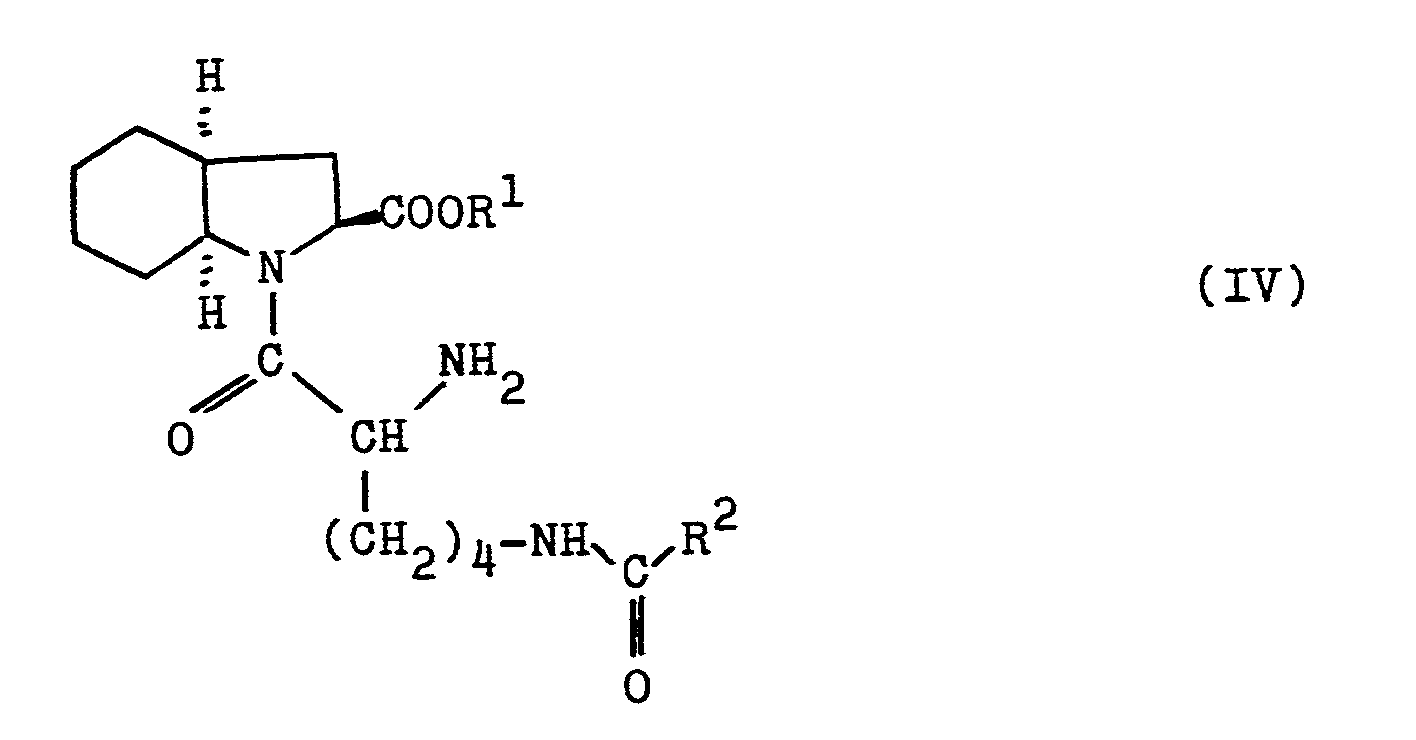
- b) Verbindungen der Formel IV,


- Die Umsetzung einer Verbindung der Formel II mit einer Verbindung der Formel III zur Herstellung einer Verbindung der Formel I erfolgt gemäß einer in der Peptidchemie bekannten Kondensationsreaktion, wobei als Kondensationsmittel beispielsweise Dicyclohexylcarbodiimid und 1-Hydroxybenztriazol (inertes Lösungsmittel wie DMF, Zusatz einer Base wie N-Ethylmorpholin, Reaktionstemperatur zwischen -20°C und dem Siedepunkt des Lösungsmittels, vorzugsweise 0 bis +50°C) oder N-Alkylphosphonsäureanhydrid (inertes Lösungsmittel wie Methylenchlorid, gegebenenfalls Zusatz einer Base wie N-Ethylmorpholin, Reaktionstemperatur -10 bis +50°C, vorzugsweise zwischen 0°C und Raumtemperatur) zugesetzt werden.
- Die Umsetzung einer Verbindung der Formel IV mit einer Verbindung der Formel V zur Herstellung einer Verbindung der Formel I erfolgt zweckmäßig in einem inerten Lösungsmittel wie Methylenchlorid in Gegenwart eines Säurefängers wie Triethylamin oder Na2CO3 zwischen -80°C und +150°C, vorzugsweise zwischen -20°C und +80°C.
- Bei der nachfolgenden hydrogenolytischen Abspaltung der Schutzgruppe(n) wird als Katalysator bevorzugt Palladium verwendet, während bei der sauren Abspaltung der Schutzgruppe(n) als Säuren bevorzugt Trifluoressigsäure oder Chlorwasserstoff eingesetzt werden.
- Die Veresterung zur Herstellung von Verbindungen der Formel I mit R * Wasserstoff kann beispielsweise durch Umsetzung der entsprechenden Carbonsäure mit einem Überschuß eines Alkohols in Gegenwart eines sauren Katalysators (z.B. einer Mineralsäure, wie H2S04, einer Arylsulfonsäure oder eines sauren Kationenaustauschers) zwischen 0°C und dem Siedepunkt des Reaktionsgemisches erfolgen.
- Verbindungen der Formel II sind beispielsweise aus der EP-A-46953 bekannt. Verbindungen der Formel III erhält man, indem man 3-Cyclohexylpropanol zum entsprechenden Aldehyd oxydiert, vorzugsweise mittels Oxalylchlorid/ Dimethylsulfoxid/Triethylamin (Synthesis 1981, 165), diesen über das Bisulfitaddukt in das Cyanhydrin überführt und zur Hydroxysäure der Formel VI (R3= H) verseift;

- Veresterung mit einem entsprechenden Alkohol führt zu den Estern der Formel VI (R3 * H), deren Umsetzung mit Trifluormethansulfonsäureanhydrid in Gegenwart von Pyridin die Triflate der Formel V ergibt. Aus diesen werden mit einem geeignet geschützten Lysin-Derivat, vorzugsweise dem N -Benzyloxycarbonyl-tert.butylester und nachfolgender Abspaltung der Estergruppe, vorzugsweise mittels Trifluoressigsäure die Verbindungen der Formel III erhalten. Verfahren zur Herstellung von Verbindungen der Formel IV sind beispielsweise aus der EP-A-46953 bekannt. Es sind solche Verbindungen der Formeln II bzw. IV bevorzugt, in welchen das C-Atom 2 des bicyclischen Ringsystems S-konfiguriert ist und in welchen dieses Ringsystem in der cis,endo-Konfiguration vorliegt.
- Die erfindungsgemäßen Verbindungen der Formel I liegen als Inneres Salz vor. Als amphotere Verbindungen können sie Salze mit Säuren und Basen bilden. Diese Salze werden in üblicher Weise durch Umsetzung mit einem oder zwei Äquivalenten Säure bzw. Base hergestellt.
- Die erfindungsgemäßen Verbindungen der Formel I sind Hemmer des Angiotensin-Converting-Enzyme (ACE), das die Umwandlung von Angiotensin I in das pressorisch wirksame Angiotensin II katalysiert. Z.B. hemmt die Verbindung der Formel I mit R= Wasserstoff beim in vitro-Assay (Biochem. Biophys. Acta, 206, 136 (1970))das ACE mit einer IC50 von 3,4 · 10-9 M. Nach intraduodenaler Gabe an der narkotisierten Ratte wird eine starke Hemmwirkung auf die durch intravenöse Gabe von 310 ng Angiotensin hervorgerufene Pressorreaktion beobachtet. Besonders interessant ist hierbei der langsame Wirkungseintritt und die lange Wirkdauer der Verbindung. So beobachtet man bei intraduodenaler Gabe von 0,3 mg/kg Körpergewicht eine Hemmung um 15 % nach 10 min, 30 % nach 20 min, 60 % nach 30 min und 70 % nach 45 min; die Wirkung hält länger als 6 Stunden an.
- Die Verbindungen der Formel I und ihre Salze besitzen lang anhaltende, intensiv blutdrucksenkende Wirkung. Sie können zur Bekämpfung des Bluthochdrucks verschiedener Genese eingesetzt werden. Auch ihre Kombination mit anderen blutdrucksenkenden, gefäßerweiternden oder diuretisch wirkenden Verbindungen ist möglich. Typische Vertreter dieser Wirkstoffklassen sind z.B. in Erhardt-Ruschig, Arzneimittel, 2. Auflage, Weinheim 1972 beschrieben. Die Anwendung kann intravenös, subcutan oder peroral erfolgen.
- Die Dosierung liegt bei peroraler Gabe bei 0,01 - 7 mg/kg/ Tag, insbesondere bei 0,07 - 0,5 mg/kg/Tag. Sie kann in schweren Fällen auch erhöht werden, da toxische Effekte bisher nicht beobachtet wurden. Auch eine Herabsetzung der Dosis ist möglich und vor allem dann angebracht, wenn gleichzeitig Diuretika verabreicht werden.
- Die erfindungsgemäßen Verbindungen können oral oder parenteral in entsprechender pharmazeutischer Zubereitung verabreicht werden. Für eine orale Anwendungsform werden die aktiven Verbindungen mit den dafür üblichen Zusatzstoffen wie Trägerstoffen, Stabilisatoren oder inerten Verdünnungsmitteln vermischt und durch übliche Methoden in geeignete Darreichungsform gebracht, wie Tabletten, Dragees, Steckkapseln, wäßrigeralkoholische oder ölige Suspensionen oder wäßrige, alkoholische oder ölige Lösungen. Als inerte Träger kommen z.B. Gummi arabicum, Magnesiumcarbonat, Kaliumphosphat, Milchzucker, Glucose oder Stärke, insbesondere Maisstärke in Betracht. Dabei kann die Zubereitung sowohl als Trocken- als auch als Feuchtgranulat erfolgen. Als ölige Trägerstoffe oder Lösungsmittel kommen beispielsweise pflanzliche oder tierische öle in Betracht, wie Sonnenblumenöl oder Lebertran.
- Zur subcutanen oder intravenösen Applikation werden die aktiven Verbindungen oder deren physiologisch verträglichen Salze, gewünschtenfalls mit den dafür üblichen Substanzen wie Lösungsvermittler oder weiteren Hilfsstoffen in Lösung, Suspension oder Emulsion gebracht.
- Als Lösungsmittel für die neuen aktiven Verbindungen und deren Salze kommen z.B. in Frage: Wasser, Propandiol oder Glycerin, daneben auch Zuckerlösungen wie Glucose- oder Mannitlösungen oder auch eine Mischung aus den genannten Lösungsmitteln.
- Die nachfolgenden Beispiele dienen der Erläuterung der Erfindung.
- 14,8 ml frisch destilliertes Oxalylchlorid werden in 370 ml Methylenchlorid gelöst und auf -78°C gekühlt. 25,2 ml (0,33 Mol) Dimethylsulfoxid in 740 ml Methylenchlorid werden zugetropft und nach 5 Minuten 21 g (0,148 Mol) 3-Cyclohexylpropanol in 150 ml Methylenchlorid hinzugefügt. Nach weiteren 30 min tropft man 103,6 ml Triethylamin zu, rührt noch 10 min nach und wärmt dann auf Raumtemperatur auf. Nach Wasserzusatz werden die Phasen getrennt, die wäßrige Phase nochmals mit Methylenchlorid extrahiert, die vereinigten organischen Phasen mit gesättigter Kochsalz-Lösung gewaschen, über Natriumsulfat getrocknet und eingeengt. Das Rohprodukt wird über Kieselgel mit Essigester/Cyclohexan (1 : 2) als Laufmittel filtriert. Man erhält 19,7 g farbloses öl.
- 1H-NMR (CDCl3) : 6= 9,55 (br. s, 1H); 2,37 (t, 2H); 2,0 - 0,8 (m, 13H) ppm.
- 19,7 g (0,15 Mol) 3-Cyclohexylpropanal werden unter Rühren mit gesättigter Natriumbisulfitlösung versetzt, bis sich kein Niederschlag mehr bildet (ca. 100 ml). Nach 10 min wird mit 50 ml Ethanol verdünnt und 30 min gerührt, der Niederschlag abgesaugt und mit Ethanol und Ether gewaschen. Das rohe Bisulfit-Addukt (43,25 g) wird in 600 ml Wasser bei 40°C gelöst, 7,8 g (0,12 Mol) Kaliumcyanid in 30 ml Wasser werden zugesetzt. Nach 45 min wird mit Ether extrahiert, mit Natriumsulfat getrocknet und eingeengt. Das Rohprodukt wird direkt weiterverwendet.
- Das Nitril aus Beispiel lb) wird mit 100 ml konzentrierter Salzsäure 2,5 Stunden am Rückfluß erhitzt, die Lösung wird mit 300 ml Wasser verdünnt, mit Ether extrahiert, mit Natriumsulfat getrocknet und eingeengt. Der wachsartige Rückstand wird mit Petrolether verrieben und abgesaugt. Man erhält 6,9 g Produkt.
- 1H-NMR (CDCl3) δ = 4,26 (t, 1H) 2,1 - 0,8 (m, 15H) ppm.
- 6,9 g (0,037 Mol) 4-Cyclohexyl-2-hydroxybuttersäure werden in 300 ml absolutem Ethanol gelöst. Nach Zugabe von 0,3 ml konz. Schwefelsäure wird 3,5 Stunden am Rückfluß erhitzt, dann eingeengt, in Ether aufgenommen, je 1 mal mit Wasser und 10 %iger Natriumcarbonat-Lösung gewaschen, über Natriumsulfat getrocknet und eingeengt; 7,7 g farbloses öl.
- 1H-NMR (CDCl3) : δ = 4,23 (q, 2H); 4,17 (t, 1H); 2,45 (br. s, 1H); 2,0 - 0,9 (m, 1 5H); 1,3 (t, 3H) ppm
- Zu einer Lösung von 0,6 ml Pyridin (75 mmol) und 1,45 g (7,1 mmol) 4-Cyclohexyl-2-hydroxybuttersäureethylester in 40 ml trockenem Methylenchlorid werden bei -10°C 2,1 g (1,25 ml, 7,5 mmol) Trifluormethansulfonsäureanhydrid getropft. Nach 10 min wird auf Raumtemperatur erwärmt und 30 min nachgerührt. Nach Einengen wird durch wenig Kieselgel mit n-Hexan als Laufmittel filtriert. Man erhält 2 g farbloses öl.
- 1H-NMR (CDCl3) : δ = 5,07 (t, 1H); 4,30 (q, 2H); 2,2 - 0,9 (m, 15H); 1,32 (t, 3H) ppm.
- 4,84 g (14,4 mmol) N-Benzyloxycarbonyl-S-lysin-tert. butylester und 1,99 ml Triethylamin werden in 50 ml absolutem Methylenchlorid gelöst. Bei Raumtemperatur tropft man eine Lösung von 4 g 4-Cyclohexyl-2-trifluor- methansulfonyloxy-buttersäureethyleester in 20 ml Methylenchlorid zu. Nach 20 Stunden Rühren bei Raumtemperatur wird-mit Wasser gewaschen, mit Natriumsulfat getrocknet und eingeengt. Das Rohprodukt (9,3 g) wird an 220 g Kieselgel mit Essigester/Cyclohexan (1 : 2) als Laufmittel chromatographiert, wodurch die zwei Isomeren getrennt werden:
- 20 Isomer 1 (R,S-Konfiguration): 3,6 g; [α]D = -1,750 (c= 0,4; Methanol)
- 1H-NMR (CDCl3) :δ = 7,34 (s, 5H); 5,10 (s, 2H); 5,0 - 4,6 (m, 1H); 4,17 (q, 2H); 3,4 - 3,0 (m, 4H); 2,0 - 0,9 (m, 18H); 1,43 (s, 9H); 1,27 (t, 3H) ppm.
- Isomer 2 (S,S-Konfiguration): 3,8 g; [α]D 20 = -10,5° (c= 0,4; Methanol)
- 1H-NMR (CDCl3) : δ = 7,33 (s, 5H); 5,07 (s, 2H); 5,1 - 4,7 (m, 1H); 4,17 (q,2H); 3,4 - 3,0 (m, 4H); 1,46 (s, 9H); 1,27 (t, 3H); 2,0 - 0,9 (m, 18H) ppm.
- 3,8 g des Isomers 2 aus Beispiel 1 f) werden in 20 ml Trifluoressigsäure 2 Stunden gerührt. Die Säure wird im Vakuum entfernt, der Rückstand dreimal mit Toluol eingeengt. Der Rückstand wird in Wasser/Methanol aufgenommen und unter Rühren mit Amberlite® IRA 93 (Acetatform) bis zu einem pH-Wert von 4,2 versetzt, filtriert und eingeengt. Das Rohprodukt wird an 30 g Kieselgel mit Methanol/ Methylenchlorid (1 : 4) als Laufmittel gereinigt. Man erhält 2,7 g farbloses Harz.
- 1H-NMR (CDCl3) : δ = 7,3 (s, 5H); 6,1 (br.s, 3H); 5,07 (s, 2H); 4,25 (q, 2H); 3,5 - 3,0 (m, 4H); 2,0 - 0,9 (m, l8H); 1,27 (t, 3H) ppm.
- Aus 1,52 g 2S, 3aS, 7aS-Octahydroindol-2-carbonsäurebenzylester. Hydrochlorid wird mit NaOH die Base freigesetzt und mit 1,35 g der Verbindung aus Beispiel 1 g), 0,34 g 1-Hydroxybenztriazol und 0,38 ml N-Ethylmorpholin in 20 ml DMF gelöst. Bei 0°C werden 0,63 g Dicyclohexylcarbodiimid zugesetzt, 2,5 Std. bei Raumtemperatur gerührt, mit Essigester verdünnt, filtriert und das Filtrat je 1 mal mit 10 %iger Citronensäure, 1N Natriumbicarbonatlösung, Wasser und gesättigter Kochsalzlösung gewaschen, über Natriumsulfat getrocknet und eingeengt. Chromatographie an Kieselgel mit Essigester/Cyclohexan (1 : 2) als Laufmittel ergibt 1,3 g Produkt als farbloses öl.
- 1H-NMR (CDCl3) : δ = 7,3 (s, 10H), 5,06 (s, 4H); 4,18 (q, 2H); 5,0 - 3,6 (m, 4H); 3,6 - 3,0 (m, 4H); 2,5 - 0,9 (m, 32H); 1,27 (t, 3H) ppm.
- 1,3 g der Verbindung aus Beispiel 1 h) werden in 50 ml Ethanol mit 0,4 g Palladium auf Kohle (10 %) bei 1 bar Wasserstoff-Druck hydriert (ca. 1 Std.). Nach Abfiltrieren des Katalysators wird eingeengt. Man erhält 750 mg farblosen Schaum.
- 1H-NMR (CDCl3) : δ = 4,2 (q, 2H); 5,0 - 2,6 (m, 8H); 2,5 - 0,9 (m, 32H); 1,25 (t, 3H) ppm.
- 410 mg (0,83 mmol) der Verbindung aus Beispiel l i) werden in 5 ml Wasser gelöst, 0,62 ml 4 N KOH werden zugesetzt und 5 Stunden bei Raumtemperatur gerührt. Mit konzentrierter HC1 wird auf einen pH-Wert von 5 gestellt, die Lösung auf eine Amberlite® IR 120-Säule (H+-Form) gegeben, mit Wasser neutral gewaschen und mit 2 % Pyridin in Wasser eluiert. Das Lösungsmittel wird entfernt, der Rückstand dreimal mit Toluol eingeengt und mit Methylenchlorid/Isopropylether verrieben. Man erhält 285 mg Produkt vom Schmp. 171°C (Zersetzung).
- Aus 2,8 mmol 2S,3aS,7aS-Octahydroindol-2-carbonsäurebenzylester wird mit NaOH die Base freigesetzt und mit 2,7 mmol Nα-tert.Butoxycarbonyl-Nε-benzyloxycarbonyl-S-lysin, 2,7 mmol 1-Hydroxybenztriazol und 2,7 mmol N-Ethylmorpholin in absolutem DMF (20 ml) gelöst. Bei 0°C werden 2,7 mmol Dicyclohexylcarbodiimid zugesetzt, 2,5 Stunden bei Raumtemperatur gerührt, mit Essigester verdünnt, filtriert und das Filtrat je einmal mit 10 %iger Citronensäurelösung, 1 N Natriumbicarbonatlösung, Wasser und gesättigter Kochsalzlösung gewaschen, über Natriumsulfat getrocknet und eingeengt. Das Rohprodukt wird durch Filtration über eine kurze Kieselgelsäule mit Essigester/Cyclohexan (1 : 2) als Laufmittel gereinigt; farbloses viskoses öl.
- 1H-NMR (CDCl3) : δ = 7,3 + 7,2 (2s, lOH); 5,0 (2s, 4H); 5,0 - 3,6 (m, 3H); 3,6 - 3,0 (m, 2H); 2,5 - 0,9 (m, 17H); 1,43 (s, 9H) ppm.
- 1,4 g der Verbindung aus Beispiel 2 a) werden mit 10 ml Trifluoressigsäure 3 Stunden bei Raumtemperatur gerührt. Die überschüssige Säure wird mit Toluol im Vakuum azeotrop entfernt, der Rückstand in Wasser/Methanol aufgenommen und unter Rühren mittels Amberlite® IRA 93 (AcetatForm) auf einen pH-Wert von 4,4 eingestellt, filtriert und eingeengt; 1,1 g farbloses Harz.
- 1H-NMR (CDCl3) : δ = 7,3 + 7,2 (2s, 10H); 5,1 (2s, 4H); 5,1 - 3,5 (m, 3H); 3,4 - 2,8 (m, 2H); 2,5 - 0,9 (m, 17H);
- Eine Lösung von 2 g (7,1 mmol) 4-Cyclohexyl-2-trifluor- methansulfonyloxybuttersäureethylester in 10 ml trockenem Methylenchlorid wird zu einer Mischung aus 7,0 mmol der Verbindung aus Beispiel 2 b) und 0,95 ml Triethylamin in 30 ml Methylenchlorid getropft. Nach 12 Stunden Rühren bei Raumtemperatur wird mit Wasser gewaschen mit Natriumsulfat getrocknet und eingeengt. Chromatographie wie bei 1 h) ergibt 3,2 g Produkt als farbloses öl. Die 1H-NMR-Daten stimmen mit den für 1 h) angegebenen überein.
aus gegebenenfalls gebildeten Isomerengemischen die gewünschten Isomeren, vorzugsweise diejenigen Verbindungen mit all-S-Konfiguration abtrennt, die Schutzgruppen R 1 und R2 abspaltet und R3 gegebenenfalls abspaltet, was in einem Schritt oder in mehreren Schritten erfolgen kann, erhaltene Verbindungen der Formel I gegebenenfalls verestert und gegebenenfalls in physiologisch verträgliche Salze überführt, wobei bei einer Schutzgruppenabspaltung in mehreren Schritten die Veresterung auch auf einer früheren Verfahrensstufe erfolgen kann.
Claims (18)



aus gegebenenfalls gebildeten Isomergemischen die gewünschten Isomeren abtrennt, die Schutzgruppen R1 und R2 abspaltet und R3 gegebenenfalls abspaltet, was in einem Schritt oder in mehreren Schritten erfolgen kann, erhaltene Verbindungen der Formel I gegebenenfalls verestert und gegebenenfalls in physiologisch verträgliche Salze überführt, wobei bei einer Schutzgruppenabspaltung in mehreren Schritten die Veresterung auch auf einer früheren Verfahrensstufe erfolgen kann.


aus gegebenenfalls gebildeten Isomergemischen die gewünschten Isomeren abtrennt, die Schutzgruppen R1 und R 2 abspaltet und R3 gegebenenfalls abspaltet, was in einem Schritt oder in mehreren Schritten erfolgen kann, erhaltene Verbindungen der Formel I gegebenenfalls verestert und gegebenenfalls in physiologisch verträgliche Salze überführt, wobei bei einer Schutzgruppenabspaltung in mehreren Schritten die Veresterung auch auf einer früheren Verfahrensstufe erfolgen kann.
Applications Claiming Priority (2)
| Application Number | Priority Date | Filing Date | Title |
|---|---|---|---|
| DE19843408923 DE3408923A1 (de) | 1984-03-12 | 1984-03-12 | Carboxyalkyldipeptidderivate, verfahren zu deren herstellung, diese enthaltende mittel und deren verwendung |
| DE3408923 | 1984-03-12 |
Publications (2)
| Publication Number | Publication Date |
|---|---|
| EP0154886A2 true EP0154886A2 (de) | 1985-09-18 |
| EP0154886A3 EP0154886A3 (de) | 1988-07-20 |
Family
ID=6230179
Family Applications (1)
| Application Number | Title | Priority Date | Filing Date |
|---|---|---|---|
| EP85102134A Withdrawn EP0154886A3 (de) | 1984-03-12 | 1985-02-27 | Carboxyalkyldipeptidderivate, Verfahren zu deren Herstellung, diese enthaltende Mittel und deren Verwendung |
Country Status (10)
| Country | Link |
|---|---|
| EP (1) | EP0154886A3 (de) |
| JP (1) | JPS60204799A (de) |
| AU (1) | AU3977285A (de) |
| DE (1) | DE3408923A1 (de) |
| DK (1) | DK110785A (de) |
| ES (1) | ES8606272A1 (de) |
| GR (1) | GR850609B (de) |
| IL (1) | IL74555A0 (de) |
| PT (1) | PT80091B (de) |
| ZA (1) | ZA851793B (de) |
Cited By (3)
| Publication number | Priority date | Publication date | Assignee | Title |
|---|---|---|---|---|
| EP0308339A1 (de) * | 1987-09-17 | 1989-03-22 | Adir Et Compagnie | Verfahren zur industriellen Herstellung von Perhydroindol Carboxy-2(2S,3aS,7aS)-Säure, Anwendung zur Herstellung von Carboxyalkyldipeptiden |
| EP0284510A3 (de) * | 1987-03-24 | 1990-08-22 | Asahi Breweries, Ltd. | N-[N-alpha-(1(S)-carboxy-3-cyclohexylpropyl)-L-lysyl]-N-cyclopentylglycin als antihypertensives Mittel |
| EP0338508A3 (de) * | 1988-04-22 | 1991-03-13 | Hoechst Aktiengesellschaft | Aminosäureester, Verfahren zu ihrer Herstellung, sie enthaltende Arzneimittel und deren Verwendung |
Family Cites Families (8)
| Publication number | Priority date | Publication date | Assignee | Title |
|---|---|---|---|---|
| FR2503155A2 (fr) * | 1980-10-02 | 1982-10-08 | Science Union & Cie | Nouveaux imino diacides substitues, leurs procedes de preparation et leur emploi comme inhibiteur d'enzyme |
| EP0278530A3 (de) * | 1980-08-30 | 1989-08-02 | Hoechst Aktiengesellschaft | Aminosäurederivate, Verfahren zu ihrer Herstellung, diese enthaltende Mittel und deren Verwendung |
| DE19575012I2 (de) * | 1980-10-23 | 2002-01-24 | Schering Corp | Carboxyalkyl-Dipeptide Verfahren zu ihrer Herstellung und diese enthaltende Arzneimittel |
| DE3271043D1 (en) * | 1981-11-09 | 1986-06-12 | Merck & Co Inc | N-carboxymethyl(amidino)lysyl-proline antihypertensive agents |
| EP0081094A1 (de) * | 1981-11-12 | 1983-06-15 | Merck & Co. Inc. | Omega-aminocarboxymethyldipeptidische antihypertensive Mittel |
| DE3315464A1 (de) * | 1983-04-28 | 1984-10-31 | Hoechst Ag, 6230 Frankfurt | Verfahren zur herstellung von n-alkylierten dipeptiden und deren estern |
| DE3333454A1 (de) * | 1983-09-16 | 1985-04-11 | Hoechst Ag, 6230 Frankfurt | Verfahren zur herstellung von n-alkylierten dipeptiden und deren estern |
| DE3333455A1 (de) * | 1983-09-16 | 1985-04-11 | Hoechst Ag, 6230 Frankfurt | Verfahren zur herstellung n-alkylierter dipeptide und deren estern |
-
1984
- 1984-03-12 DE DE19843408923 patent/DE3408923A1/de not_active Withdrawn
-
1985
- 1985-02-27 EP EP85102134A patent/EP0154886A3/de not_active Withdrawn
- 1985-03-11 DK DK110785A patent/DK110785A/da not_active Application Discontinuation
- 1985-03-11 ES ES541140A patent/ES8606272A1/es not_active Expired
- 1985-03-11 ZA ZA851793A patent/ZA851793B/xx unknown
- 1985-03-11 IL IL74555A patent/IL74555A0/xx unknown
- 1985-03-11 JP JP60046696A patent/JPS60204799A/ja active Pending
- 1985-03-11 GR GR850609A patent/GR850609B/el unknown
- 1985-03-12 AU AU39772/85A patent/AU3977285A/en not_active Abandoned
- 1985-03-12 PT PT80091A patent/PT80091B/de unknown
Cited By (4)
| Publication number | Priority date | Publication date | Assignee | Title |
|---|---|---|---|---|
| EP0284510A3 (de) * | 1987-03-24 | 1990-08-22 | Asahi Breweries, Ltd. | N-[N-alpha-(1(S)-carboxy-3-cyclohexylpropyl)-L-lysyl]-N-cyclopentylglycin als antihypertensives Mittel |
| EP0308339A1 (de) * | 1987-09-17 | 1989-03-22 | Adir Et Compagnie | Verfahren zur industriellen Herstellung von Perhydroindol Carboxy-2(2S,3aS,7aS)-Säure, Anwendung zur Herstellung von Carboxyalkyldipeptiden |
| FR2620703A1 (fr) * | 1987-09-17 | 1989-03-24 | Adir | Procede de synthese industrielle de l'acide perhydroindole carboxylique - 2(2s, 3as, 7as). application a la synthese de carboxyalkyl dipeptides |
| EP0338508A3 (de) * | 1988-04-22 | 1991-03-13 | Hoechst Aktiengesellschaft | Aminosäureester, Verfahren zu ihrer Herstellung, sie enthaltende Arzneimittel und deren Verwendung |
Also Published As
| Publication number | Publication date |
|---|---|
| ES8606272A1 (es) | 1986-04-01 |
| PT80091B (de) | 1987-01-05 |
| DE3408923A1 (de) | 1985-09-26 |
| DK110785A (da) | 1985-09-13 |
| GR850609B (de) | 1985-07-09 |
| IL74555A0 (en) | 1985-06-30 |
| PT80091A (de) | 1985-04-01 |
| JPS60204799A (ja) | 1985-10-16 |
| DK110785D0 (da) | 1985-03-11 |
| ES541140A0 (es) | 1986-04-01 |
| AU3977285A (en) | 1985-09-19 |
| ZA851793B (en) | 1985-11-27 |
| EP0154886A3 (de) | 1988-07-20 |
Similar Documents
| Publication | Publication Date | Title |
|---|---|---|
| EP0084164B1 (de) | Neue Derivate bicyclischer Aminosäuren, Verfahren zu ihrer Herstellung, diese enthaltende Mittel und deren Verwendung sowie neue bicyclische Aminosäuren als Zwischenstufen und Verfahren zu deren Herstellung | |
| EP0089637B1 (de) | Neue Derivate bicyclischer Aminosäuren, Verfahren zu ihrer Herstellung, diese enthaltende Mittel und deren Verwendung sowie neue bicyclische Aminosäuren als Zwischenstufen und Verfahren zu deren Herstellung | |
| EP0150263B1 (de) | Derivate der cis, endo-2-Azabicyclo-[3.3.0]-octan-3-carbonsäure, Verfahren zu ihrer Herstellung, diese enthaltende Mittel und deren Verwendung | |
| EP0111873B1 (de) | Derivate der cis, endo-2-Azabicyclo-(5.3.0)-decan-3-carbonsäure, Verfahren zu ihrer Herstellung, diese enthaltende Mittel und deren Verwendung | |
| EP0109020B1 (de) | Neue Derivate tricyclischer Aminosäuren, Verfahren zu ihrer Herstellung, diese enthaltende Mittel und deren Verwendung, sowie neue bicyclische Aminosäuren als Zwischenstufen und Verfahren zu deren Herstellung | |
| EP0090362A2 (de) | Neue Derivate von Cycloalka(c)pyrrol-carbonsäuren, Verfahren zu ihrer Herstellung, diese enthaltende Mittel und deren Verwendung sowie neue Cycloalka(c)pyrrol-carbonsäuren als Zwischenstufen und Verfahren zu deren Herstellung | |
| EP0116276B1 (de) | Neue spirocyclische Aminosäurederivate, Verfahren zu ihrer Herstellung, diese enthaltende Mittel und deren Verwendung sowie neue spirocyclische Aminosäuren als Zwischenprodukte und Verfahren zu deren Herstellung | |
| EP0105102A1 (de) | Neue Derivate der 2-Aza-bicyclo(2.2.2)octan-3-carbonsäure, Verfahren zu ihrer Herstellung, diese enthaltende Mittel und deren Verwendung sowie 2-Aza-bicyclo(2.2.2)octan-3-carbonsäure als Zwischenstufe und Verfahren zu deren Herstellung | |
| EP0051301A1 (de) | 1-Carboxy-azaalkanoylindolin-2-carbonsäuren, Verfahren zu ihrer Herstellung, pharmazeutische Präparate enthaltend diese Verbindungen, sowie ihre therapeutische Verwendung | |
| EP0146080A2 (de) | Verfahren zur Racematspaltung bicyclischer Imino-alpha-carbonsäureester | |
| DE1795022C3 (de) | Lysergsäurederivate | |
| EP0206993A1 (de) | Neue Sulfonsäureester | |
| DE69130605T2 (de) | Antihypertensive N-(alpha-substituiertes Pyridyl)-carbonyldipeptide | |
| CH639639A5 (en) | Alpha-fluoromethyl-alpha-amino-alkanoic acids and their esters | |
| DE3020695C2 (de) | ||
| EP0154886A2 (de) | Carboxyalkyldipeptidderivate, Verfahren zu deren Herstellung, diese enthaltende Mittel und deren Verwendung | |
| EP0113880A2 (de) | Neue 2-Azabicyclo(2.2.1)heptan-Derivate, Verfahren zu ihrer Herstellung, diese enthaltende Mittel und deren Verwendung sowie 2-Azabicyclo(2.2.1)heptan-Derivate als Zwischenprodukte und Verfahren zu deren Herstellung | |
| CH653996A5 (de) | Tryptaminderivate und verfahren zu deren herstellung. | |
| EP0271099A2 (de) | Substituierte Aminopropionsäureamide, Verfahren zu ihrer Herstellung, diese enthaltende Mittel und ihre Verwendung sowie die bei der Herstellung anfallenden neuen Zwischenprodukte | |
| DE2431963C2 (de) | Verfahren zur Herstellung heterocyclischer Verbindungen | |
| CH610330A5 (en) | Process for the preparation of novel ergopeptins | |
| EP0266308A1 (de) | Indolo-pyrazino-benzodiazepin-Derivate | |
| EP0203450B1 (de) | Neue Derivate bicyclischer Aminosäuren, Verfahren zu ihrer Herstellung, diese enthaltende Mittel und deren Verwendung | |
| CH619468A5 (de) | ||
| EP0170775B1 (de) | Derivate bicyclischer Aminosäuren, Verfahren zu ihrer Herstellung, diese enthaltende Mittel und deren Verwendung sowie neue bicyclische Aminosäuren als Zwischenstufen und Verfahren zu deren Herstellung |
Legal Events
| Date | Code | Title | Description |
|---|---|---|---|
| PUAI | Public reference made under article 153(3) epc to a published international application that has entered the european phase |
Free format text: ORIGINAL CODE: 0009012 |
|
| AK | Designated contracting states |
Designated state(s): AT BE CH DE FR GB IT LI LU NL SE |
|
| PUAL | Search report despatched |
Free format text: ORIGINAL CODE: 0009013 |
|
| AK | Designated contracting states |
Kind code of ref document: A3 Designated state(s): AT BE CH DE FR GB IT LI LU NL SE |
|
| STAA | Information on the status of an ep patent application or granted ep patent |
Free format text: STATUS: THE APPLICATION HAS BEEN WITHDRAWN |
|
| 18W | Application withdrawn |
Withdrawal date: 19881012 |
|
| RIN1 | Information on inventor provided before grant (corrected) |
Inventor name: TEETZ, VOLKER, DR. Inventor name: URBACH, HANSJOERG, DR. Inventor name: BECKER, REINHARD, DR. Inventor name: HENNING, RAINER, DR. |