EP0154589A2 - Complexes de platine (IV) antinéoplastiques - Google Patents
Complexes de platine (IV) antinéoplastiques Download PDFInfo
- Publication number
- EP0154589A2 EP0154589A2 EP85400372A EP85400372A EP0154589A2 EP 0154589 A2 EP0154589 A2 EP 0154589A2 EP 85400372 A EP85400372 A EP 85400372A EP 85400372 A EP85400372 A EP 85400372A EP 0154589 A2 EP0154589 A2 EP 0154589A2
- Authority
- EP
- European Patent Office
- Prior art keywords
- trans
- platinum
- complex
- cis
- complexes
- Prior art date
- Legal status (The legal status is an assumption and is not a legal conclusion. Google has not performed a legal analysis and makes no representation as to the accuracy of the status listed.)
- Granted
Links
Images
Classifications
-
- C—CHEMISTRY; METALLURGY
- C07—ORGANIC CHEMISTRY
- C07F—ACYCLIC, CARBOCYCLIC OR HETEROCYCLIC COMPOUNDS CONTAINING ELEMENTS OTHER THAN CARBON, HYDROGEN, HALOGEN, OXYGEN, NITROGEN, SULFUR, SELENIUM OR TELLURIUM
- C07F15/00—Compounds containing elements of Groups 8, 9, 10 or 18 of the Periodic Table
- C07F15/0006—Compounds containing elements of Groups 8, 9, 10 or 18 of the Periodic Table compounds of the platinum group
- C07F15/0086—Platinum compounds
- C07F15/0093—Platinum compounds without a metal-carbon linkage
-
- A—HUMAN NECESSITIES
- A61—MEDICAL OR VETERINARY SCIENCE; HYGIENE
- A61P—SPECIFIC THERAPEUTIC ACTIVITY OF CHEMICAL COMPOUNDS OR MEDICINAL PREPARATIONS
- A61P35/00—Antineoplastic agents
Definitions
- the present invention is directed to novel platinum (IV) complexes having antitumor or antineoplastic activity. More particularly, the present invention relates to substantially isomerically pure tetrahalo, preferably tetrachloro, (1,2-diaminocyclohexane) platinum (IV) compounds and their use as effective antitumor agents.
- DE 3,207,472 discloses cis-dichloro trans-dihydroxy [1-amino-2-(aminomethyl)-3,3,5-trimethylcyclopentane] platinum (IV) and related structures for the treatment of cancer.
- U.S. Patent 360,424 and German Patent 158,777 describe organoplatinum complexes and their preparation.
- U.S. Patent 4,200,583 discloses cis- plantinum (II) coordinates 1,2-diamino-cyclohexane (cis-, trans-1 and trans-d) exhibiting antitumor activity. Hill et al, Anticancer Research 2, 173, (1982), presents a recent review of organoplatinum complexes as antitumor agents.
- platinum (IV) compounds were, in general, less active than the corresponding platinum (II) species. since Hall et al, supra, clearly states that "All diamines are in the 'trans' configuration", it is clear that the compounds tested by Hall et al, supra, are not isomerically pure complexes but a mixture of optical isomers, possibly cis.
- platinum complexes I generally having the following properties: comparable or superior activity to cisplatin in a variety of experimental tumor models, lack of cross-resistance with cisplatin, lesser toxicity than cisplatin, good water solubility, good stability in aqueous solution, good purity and chemical homogeneity.
- substantially pure designates that the compound has less than 10% impurity, preferably less than 5% impurity and more preferably less than 1% impurity.
- the Inventors are the first to discover the compounds disclosed by the present invention which possess an aggregate of such novel, useful and superior properties as enumerated herein above.
- the platinum (IV) complexes of the present invention can be prepared by a number of classical methods which should be well known to those skilled in the art to which it pertains.
- One of the methods is to react a substantially isomerically pure 1,2-diaminocyclohexane with K 2 Ptc1 4 to obtain an analogous intermediate Pt(II) complex and then react resulting Pt(II) complex with a halogen to obtain the Pt(IV) compound of formula 1.
- the parameters of the synthetic processes which can be utilized to obtain the compound of the present invention have been described, inter alia, by Kidani et al, Chem. Letter, 123: (1976) and in Tumori, 69:31, (1983) both of which are incorporated herein by reference.
- the violet-blue filtrate obtained above is acidified with 6N HC1 (60 ml) then the pH is adjusted to 4.2-4.5 with 20% aqueous NaOH. Violet crystals of the trans-1,2-diaminocyclohexane complex are deposited overnight. The crystals are filtered, washed with water and dried in a vacuum desiccator (P205) to give 29.0 g of a violet solid.
- the yellow cis-1,2-diaminocyclohexanedichloro- nickel(II) (20g) is added portionwise to stirred 6N H 2 SO 4 (250 ml) over a period of 20 min. After 1 hour, the water is removed in vacuo to leave a viscous green oil. Absolute ethanol (160 ml) is added to the oil to produce a white solid. The solid is vacuum filtered, washed with absolute ethanol and dried in vacuum desiccator (P 2 0 5 ) to give 20.0 g of white solid cis-1,2-diaminocyclohexane hydro-sulfate.
- cis-1,2-diaminocyclohexane hydrosulfate (8.0 g; 0.033 mol) is added to 15% aqueous NaOH (60 ml) and continuously extracted with benzene for 8 h.
- the benzene is dried (K 2 CO 3 ), filtered and evaporated in vacuo to leave 3.44 g (92%) of cis-1,2-diaminocyclohexane as a colorless oil:
- This diamine is prepared in 76% yield by the same procedure used for the cis-diamine except. the violet trans-(d,1)-1,2-diaminocyclohexane-dichloronickel (II) is used.
- IR (neat) 3355(s), 3282 (s), 2942 (s), 1585 (s), 1445 (s), 953 (s), 893 (s), 866 (s), and 680 (s) cm -1 1 H-nmr (CDCl 3 /TMS) 2.45-2.10 (2H, br), 2.1.0-1.50 (4H br), and 1.30 (4H, s).
- This optically active diamine is prepared in 70% yield by the method described for the synthesis of the trans-(d)-isomer except that trans-(1)-1, 2-diaminocyclohexane tartrate is used.
- the compound has very low solubility in water and methanol; it dissolves 50 mg/ml in DMF.
- This compound is prepared in 95% yield with the same procedure used for the synthesis of cis-dichloro-cis-1, 2-cyclohexanediamine platinum (11) except that trans- (d,1)-1,2-cyclohexanediamine is used lr (KBr) 3274 (s), 3193 (s), 2934 (s), 2866 (s), 1564 (s), 1160 (s), and 756 cm -1 ( s ).
- the compound has very low solubility in water and methanol; it dissolves in DMF 50 mg/ml.
- This compound is prepared by the same method used to synthesize the racemic (d.l)-mixture except that trans-(lR, 2R)-1,2-cyclohexanediamine is used.
- This compound is prepared by the same method used to synthesize the racemic (d.l)-mixture except that trans-(1S, 2S)-1,2-cyclohexanediamine is used. Tetrachloro-cis-1,2-cyclohexanediamine platinum (IV)
- This compound is prepared by the same procedure used for the synthesis of the trans-(d,l) complex except that cis-dichloro-cis-1, 2-cyclohexanediamine platinum (11) is used.
- Ir (KBr) 3185 (s), 3090 (s), 2938 (s), 2865 (m), 1560 (s), 1451 (m), 1202 (s), 1131 (m), 976 (m), and 583 (m) cm -1 ; 13 C-nmr (d 7 -DMF/TMS) 60.90, 26.30, and 21.72.
- the compound is soluble ⁇ 10 mg/ml in water; 50 mg/ml in methanol, 200 mg/ml methanol-acetone (1:1), and 250 mg/ml in DMF.
- Chlorine gas is bubbled at a rate of 2 bubbles per second under the liquid surface of a stirred suspension of cis-dichloro-trans-(d,l)-1,2-cyclohexanediamine platinum (11) (2.10 g; 5.5 mmol) in 0.5N HC1 (40 ml) at 60°C. The temperature is raised to 100°C as soon as the chlorine is introduced. The solid turns red-orange in -color then to a bright yellow with a portion dissolving. Chlorine is bubbled into the mixture for 2.5 h then air is rapidly bubbled through the mixture to displace unreacted chlorine.
- the compound is soluble ⁇ 10 mg/ml in water, 100 mg/ml in methanol, and 250 mg/ml in DMF.
- This compound is prepared by the procedure used to prepare the (d,l)-complex except (1S, 2S)-cis-dichloro- trans-l,2-cyclohexanediamine platinum (11) is used.
- This compound is prepared by the procedure used to prepare the (d,l)-complex except (lR, 2R)-cis-dichloro- trans-1,2-cyclohexanediamine platinum (11) is used.
- HPLC High Pressure Liquid Chromatography
- the HPLC studies are carried out using a Spectra Physics SP8000 equipped with a Varian Varichrome variable wavelength detector.
- the injection volumes are 10 ⁇ L, injection concentrations are 1-2 mg/ml, flow rates are 1-2 ml/min.
- the UV detector is set to monitor 300 nm.
- Two different systems are used. These are a C8, reversed phase (25 cm x 4.6 mm) column eluted with either DMF or methanol and, second, cation-anion exchange columns (each 25 cm x 4.6 mm) connected in tandem and eluted with a DMF-aqueous acetate buffer (9:1).
- the platinum complexes are tested using the BIA quantitative tube assay for dose-dependent induction of bacteriophage lambda according to a previously published procedure of Sarma, D. et al. Chem. Biol. Interactions, 46:219-232 (1983), which is incorporated herein by reference.
- a permeable strain of E. coli (BR 513) containing lambda phage is used to test all samples. Expression time for the assay is 5 hours at 38°C.
- Fresh dilutions of test samples are made in saline (0.85%) on the day of the experiment. Samples are made at 10 X final concentration and dispensed according to assay procedure. Final concentrations are 300 ⁇ g/ml, 200 ⁇ g/ml, 100 ⁇ g/ml, 60 ⁇ g/ml, 25 pg/ml, 10 ⁇ g/ml and a zero control.
- This strain of bacteria contains a chromosomally integrated lambda-lac Z fusion phage under control of the lambda repressor.
- Treatment with DNA-damaging agents leads to derepression of prophage and synthesis of 8-galactosidase, product of the lac Z gene.
- ⁇ -galactosidase is detected by reaction with a substrate (o-nitrophenyl- -D-galactopyranoside (ONPG) to give a yellow-colored product. Tubes are incubated at 28°C (a few minutes to several hours to an A 420 ⁇ 0.5 - 1.0). Color development is stopped by the addition of base (1M Na 2 CO 3 ), and the yellow color is measured by absorbance at 420 nm.
- One enzyme unit is the approximate value of an uninduced control tube at zero time.
- the isomers of tetrachloro-l,2-cyclohexanediamine platinum (IV), namely trans (1), trans (d, 1), trans (d), and cis, are the first to display the desired biological property including activity against a subline of L1210 with acquired resistance to cisplatin and the desired chemical properties including defined chemical structure, adequate solubility, stability, and purity. Also, these are the first complexes with the desired biological property which are also amenable to analyses by several techniques:
- the Pt (IV) compounds of the present invention could be administered in any form, e.g., solid, liquid, paste, suspension, solution and the like and in any type of formulation suitable for use in a mammalian host including humans, e.g., tablets, injectable liquids, capsules, granules, oral suspensions and the like. It may also be used in a graft or graft-like form. Any suitable vehicle or carrier may also be employed in the preparation or administering of the formulation of these Pt (IV) compounds. Other additives, agents or adjuvants compatible and/or physiologically acceptable could also be admixed with the Pt (IV) compounds in devising or preparing useful formulations thereof.
- Some examples of such vehicles, carriers, additives, agents and adjuvants which are otherwise commonly known in the art are saline or buffered solutions; aqueous or non-aqueous dispersions, emulsions or suspensions; fillers; preservatives; stabilizers; emolients and the like.
- Table 1 shows the water solubility and purity of the resolved isomers of Pt ((V) complex of the present invention.
- the isomers of tetrachloro-1,2-cyclohexanediamine platinum (IV) are the first to display the desired biological property (activity against a subline of L1210 with acquired resistance to cisplatin and the desired chemical properties, i.e., defined chemical structure and adequate solubility, stability and purity for pharmaceutical development.
- Table 2 shows a typical dose- response study in the intraperitoneally (lP) implanted L1210 leukemia model. The four isomers are directly compared, i.e., in the same experiment under the same experimental conditions with cisplatin and carboxyphthalato- cyclohexanediamine platinum (II) as positive control reference compounds.
- the weight difference between cisplatin-treated animals at the dose producing the best therapeutic response (20 mg/kg/injection on a day 1, 5 and 9 schedule) and control animals average -5.0 grams.
- the corresponding data for the isomers average a weight difference of less than -4 grams at their optimal doses (8 mg/kg/injection for trans 1, trans dl, and trans d, and 16 mg/kg/injection for cis).
- carboxyphthalato cyclohexanediamine platinum (II) produces a -5.7 lo9 10 reduction in tumor cell burden at three doses (50, 25, and 12.5 mg/kg/injection); however, the weight difference averages more than -4 grams at the top dose.
- Table 3 shows a comparative study of the same six complexes against the parent line of L1210 and a subline L1210/cisplatin (3DP31) with acquired resistance to cisplatin.
- the mechanism of the resistance has yet to be elucidated; however, it has been suggested that it may be an uptake mutant or have a different DNA repair mechanism.
- the experiments summarized in Table 3 were conducted at the same time against both sublines using the same drug preparations.
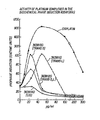
- the complexes are compared in vitro by the biochemical phage induction assay of Sarma, supra.
- This assay detects a wide variety of compounds which interact with DNA. According to the results presented in Fig. 1, all of the isomers are less effective than cisplatin in inducing prophage. This finding may support the hypothesis that platinum IV complexes are chemically less reactive. However, in vivo there is evidence that platinum IV complexes may be reduced to platinum (II) complexes [Pendyala, L. Procedings 13th International Cancer Congress, Seattle, Washington, #3034, page 531, (1982).
- the demonstrated in vivo antitumor response illustrated in Tables 2-5 may be a result of the compounds acting either as Platinum II or platinum (IV) complexes or as both types. It is noted that the four isomers are not equal in their ability to induce the prophage.
- the cis isomer is practically inert and the trans dl isomer is intermediate in effectiveness (about 68 enzyme units).
- the purified trans d and trans 1 isomers are the most effective inducers among the four (about 104 enzyme units each); however, the trans d isomer is more potent (optimal effect at 25 ug/ml for the trans d isomer and at 50 pg/ml for the trans 1 isomer).
- the isomers possess different water solubilities as well as biological activity as shown in two types of assays; prophage induction assay, and the antitumor experiments. If one summarizes the data in Tables 2-4 by totalling the number of long-term survivors, unexpected differences among the isomers become apparent. For example, the trans 1 compound produced 30 long-term survivors.
- Comparative data for the others are as follows: 27 for trans d, 27 for trans d 1 and 13 for cis. 11 one compares the number of long-term survivors and the weight differences observed in treating the lP- implanted L1210/cisplatin, the trans 1 isomer appears to produce more long-term survivors and also to be the least toxid (Table 6). All of the evidence taken together indicates that the cis isomer, a component of the mixture prepared by Schwartz et al, supra, has relatively lower biological activity. Therefore, the effort to prepare purified isomers has produced unexpected results, i.e., products with superior biological and chemical properties when compared with the material prepared by Schwartz et al. (NSC-276017).
- Table 6 further shows that by preparing the four isomers and comparing their optimal doses and solubilities, compounds with vastly better dose to solubility ratios are produced as compared to the cis isomer, which is similar to the material prepared by Schwartz et al. This ratio is important in determining the dosage volume required for both conventional and high dose therapy in patients. The higher the ratio the more convenient it is to prepare a formulation for intravenous administration to patients which is shown in Table 7.
Landscapes
- Organic Chemistry (AREA)
- Chemical & Material Sciences (AREA)
- Health & Medical Sciences (AREA)
- Life Sciences & Earth Sciences (AREA)
- Medicinal Chemistry (AREA)
- Nuclear Medicine, Radiotherapy & Molecular Imaging (AREA)
- General Chemical & Material Sciences (AREA)
- Pharmacology & Pharmacy (AREA)
- Chemical Kinetics & Catalysis (AREA)
- Animal Behavior & Ethology (AREA)
- General Health & Medical Sciences (AREA)
- Public Health (AREA)
- Veterinary Medicine (AREA)
- Acyclic And Carbocyclic Compounds In Medicinal Compositions (AREA)
- Pharmaceuticals Containing Other Organic And Inorganic Compounds (AREA)
- Medicines That Contain Protein Lipid Enzymes And Other Medicines (AREA)
Priority Applications (1)
| Application Number | Priority Date | Filing Date | Title |
|---|---|---|---|
| AT85400372T ATE45361T1 (de) | 1984-03-01 | 1985-02-27 | Antineoplastische platinum(iv)-komplexe. |
Applications Claiming Priority (2)
| Application Number | Priority Date | Filing Date | Title |
|---|---|---|---|
| US585111 | 1984-03-01 | ||
| US06/585,111 US4599352A (en) | 1984-03-01 | 1984-03-01 | Antineoplastic platinum (IV) complexes and compositions |
Publications (3)
| Publication Number | Publication Date |
|---|---|
| EP0154589A2 true EP0154589A2 (fr) | 1985-09-11 |
| EP0154589A3 EP0154589A3 (en) | 1986-01-15 |
| EP0154589B1 EP0154589B1 (fr) | 1989-08-09 |
Family
ID=24340085
Family Applications (1)
| Application Number | Title | Priority Date | Filing Date |
|---|---|---|---|
| EP85400372A Expired EP0154589B1 (fr) | 1984-03-01 | 1985-02-27 | Complexes de platine (IV) antinéoplastiques |
Country Status (10)
| Country | Link |
|---|---|
| US (1) | US4599352A (fr) |
| EP (1) | EP0154589B1 (fr) |
| JP (1) | JPS6133192A (fr) |
| AT (1) | ATE45361T1 (fr) |
| AU (1) | AU575913B2 (fr) |
| CA (1) | CA1251457A (fr) |
| DE (1) | DE3572175D1 (fr) |
| DK (1) | DK97085A (fr) |
| IL (2) | IL74449A (fr) |
| IT (1) | IT1200393B (fr) |
Cited By (5)
| Publication number | Priority date | Publication date | Assignee | Title |
|---|---|---|---|---|
| EP0237450A3 (en) * | 1986-03-07 | 1988-01-07 | Yoshinori Kidani | Platinum (iv) complexes |
| EP0567438A1 (fr) * | 1992-04-22 | 1993-10-27 | Tanaka Kikinzoku Kogyo K.K. | Cis-oxalato(trans-l-1,2-cyclohexanediamine)Pt(II) optiquement pure et procédé de résolution d'isoméres optiques d'un complexe de platine |
| EP0625523A1 (fr) * | 1993-05-21 | 1994-11-23 | Tanaka Kikinzoku Kogyo K.K. | Cis-oxalato (trans-L-1,2-cyclohexanediamine) Pt(II)-complex ayant une purété optique élevée et procédé pour le préparer |
| EP0646589A3 (fr) * | 1993-10-04 | 1995-06-28 | Tanaka Precious Metal Ind | Complexes du platine (IV) anti-tumoraux. |
| WO2001022915A3 (fr) * | 1999-09-29 | 2001-10-25 | Pliva Lachema As | Procede de production de cis-dichloro-(trans-1-1,2-cyclohexanediamine)platine(ii) |
Families Citing this family (12)
| Publication number | Priority date | Publication date | Assignee | Title |
|---|---|---|---|---|
| IL74449A (en) * | 1984-03-01 | 1988-07-31 | Us Commerce | Tetrahalo-1,2-cyclohexane-diamino platinum complexes and anti-neoplastic compositions comprising them |
| US4658047A (en) * | 1985-09-27 | 1987-04-14 | The United States Of America As Represented By The Department Of Health And Human Services | Method of preparing 1,2-diaminocyclohexane tetrachloro platinum (IV) isomers |
| US5011959A (en) * | 1986-11-17 | 1991-04-30 | The Board Of Regents, The University Of Texas System | 1,2-diaminocyclohexane-platinum complexes with antitumor activity |
| GB8806224D0 (en) * | 1988-03-16 | 1988-04-13 | Johnson Matthey Plc | Platinum chemotherapeutic product |
| US5393909A (en) * | 1988-11-22 | 1995-02-28 | Board Of Regents, The University Of Texas System | Diamine platinum complexes as antitumor agents |
| JP3154399B2 (ja) * | 1996-07-04 | 2001-04-09 | デビオファーム エス.アー. | 白金化合物の製造方法 |
| US5659868A (en) * | 1995-12-11 | 1997-08-19 | Xerox Corporation | Pressure roll having a flat shaft for use in a heat and pressure fuser apparatus |
| ES2235499T3 (es) * | 1998-07-30 | 2005-07-01 | Sigma-Tau Industrie Farmaceutiche Riunite S.P.A. | Uso de derivados de propionil l-carnitina y de acetil l-carnitina en la preparacion de medicamentos con actividad anticancerigena. |
| US20030199535A1 (en) * | 1998-07-30 | 2003-10-23 | Claudio Cavazza | Method for preventing and/or treating peripheral neuropathies induced by the administration of an anticancer agent |
| AU775373B2 (en) | 1999-10-01 | 2004-07-29 | Immunogen, Inc. | Compositions and methods for treating cancer using immunoconjugates and chemotherapeutic agents |
| WO2011031839A2 (fr) * | 2009-09-10 | 2011-03-17 | International Maritime Security Corporation | Embarcation, déflecteur d'eau, système d'enchevêtrement et système de défense pour embarcation |
| US10183027B2 (en) * | 2016-09-21 | 2019-01-22 | Hong Kong Baptist University | Lanthanide toolbox for multi-modal, non-invasive tumor specific theranostic prodrugs |
Family Cites Families (8)
| Publication number | Priority date | Publication date | Assignee | Title |
|---|---|---|---|---|
| US4177263A (en) * | 1972-02-28 | 1979-12-04 | Research Corporation | Anti-animal tumor method |
| JPS5829957B2 (ja) * | 1977-09-12 | 1983-06-25 | 喜徳 喜谷 | 新規な白金錯体 |
| US4329299A (en) * | 1979-08-23 | 1982-05-11 | Johnson, Matthey & Co., Limited | Composition of matter containing platinum |
| NL181434C (nl) * | 1980-01-03 | 1987-08-17 | Tno | Platina(iv)-diamine-complexen, alsmede hun bereiding en toepassing. |
| NL8101026A (nl) * | 1981-03-03 | 1982-10-01 | Tno | Platinadiamine-complexen, werkwijze voor het bereiden daarvan, werkwijze voor het bereiden van een geneesmiddel met toepassing van een dergelijk platinadiamine-complex voor de behandeling van kanker alsmede aldus verkregen gevormd geneesmiddel. |
| AU3409884A (en) * | 1983-10-19 | 1985-04-26 | Nippon Kayaku Kabushiki Kaisha | Platinum complexes |
| GB8328218D0 (en) * | 1983-10-21 | 1983-11-23 | Johnson Matthey Plc | Oral compositions |
| IL74449A (en) * | 1984-03-01 | 1988-07-31 | Us Commerce | Tetrahalo-1,2-cyclohexane-diamino platinum complexes and anti-neoplastic compositions comprising them |
-
1984
- 1984-03-01 IL IL74449A patent/IL74449A/xx not_active IP Right Cessation
- 1984-03-01 US US06/585,111 patent/US4599352A/en not_active Expired - Lifetime
-
1985
- 1985-02-27 DE DE8585400372T patent/DE3572175D1/de not_active Expired
- 1985-02-27 EP EP85400372A patent/EP0154589B1/fr not_active Expired
- 1985-02-27 IL IL74449A patent/IL74449A0/xx unknown
- 1985-02-27 AT AT85400372T patent/ATE45361T1/de not_active IP Right Cessation
- 1985-02-28 AU AU39269/85A patent/AU575913B2/en not_active Ceased
- 1985-03-01 IT IT8519727A patent/IT1200393B/it active
- 1985-03-01 JP JP4097585A patent/JPS6133192A/ja active Granted
- 1985-03-01 CA CA000475564A patent/CA1251457A/fr not_active Expired
- 1985-03-01 DK DK97085A patent/DK97085A/da not_active Application Discontinuation
Cited By (5)
| Publication number | Priority date | Publication date | Assignee | Title |
|---|---|---|---|---|
| EP0237450A3 (en) * | 1986-03-07 | 1988-01-07 | Yoshinori Kidani | Platinum (iv) complexes |
| EP0567438A1 (fr) * | 1992-04-22 | 1993-10-27 | Tanaka Kikinzoku Kogyo K.K. | Cis-oxalato(trans-l-1,2-cyclohexanediamine)Pt(II) optiquement pure et procédé de résolution d'isoméres optiques d'un complexe de platine |
| EP0625523A1 (fr) * | 1993-05-21 | 1994-11-23 | Tanaka Kikinzoku Kogyo K.K. | Cis-oxalato (trans-L-1,2-cyclohexanediamine) Pt(II)-complex ayant une purété optique élevée et procédé pour le préparer |
| EP0646589A3 (fr) * | 1993-10-04 | 1995-06-28 | Tanaka Precious Metal Ind | Complexes du platine (IV) anti-tumoraux. |
| WO2001022915A3 (fr) * | 1999-09-29 | 2001-10-25 | Pliva Lachema As | Procede de production de cis-dichloro-(trans-1-1,2-cyclohexanediamine)platine(ii) |
Also Published As
| Publication number | Publication date |
|---|---|
| IL74449A (en) | 1988-07-31 |
| IT8519727A0 (it) | 1985-03-01 |
| DK97085A (da) | 1985-09-02 |
| JPS6133192A (ja) | 1986-02-17 |
| AU3926985A (en) | 1985-09-05 |
| DK97085D0 (da) | 1985-03-01 |
| DE3572175D1 (en) | 1989-09-14 |
| EP0154589A3 (en) | 1986-01-15 |
| CA1251457A (fr) | 1989-03-21 |
| IT1200393B (it) | 1989-01-18 |
| JPH0449560B2 (fr) | 1992-08-11 |
| ATE45361T1 (de) | 1989-08-15 |
| IL74449A0 (en) | 1985-05-31 |
| EP0154589B1 (fr) | 1989-08-09 |
| US4599352A (en) | 1986-07-08 |
| AU575913B2 (en) | 1988-08-11 |
Similar Documents
| Publication | Publication Date | Title |
|---|---|---|
| EP0154589B1 (fr) | Complexes de platine (IV) antinéoplastiques | |
| US4410544A (en) | Platinum-diamine complexes, a method for the preparation of a medicine using such a platinum-diamine complex for the treatment of malignant tumor in mice | |
| US4137248A (en) | Compound, 4-carboxyphthalato(1,2-diaminocyclohexane)-platinum(II) and alkali metal salts thereof | |
| US5194645A (en) | Trans-pt (iv) compounds | |
| IE50653B1 (en) | Platinum(iv)-diamine-complexes,a process for the preparation thereof,a process for the preparation of a medicine using such a platinum(iv)-diamine-complex for the treatment of cancer as well as the shaped medicine thus obtained | |
| HU224716B1 (en) | Platinum complex, its preparation and therapeutic application | |
| EP0231847B1 (fr) | Complexes de [2,2-bis(aminomethyl)-1,3-propanediol-N,N']platine | |
| US4206226A (en) | Use of 4-carboxy-phthalato-(1,2-diaminocyclohexane)-platinum(II) and alkali metal salts thereof in alleviating L1210 murine leukemia | |
| HU188035B (en) | Process for producing new plantinum-diamine complex | |
| US5132323A (en) | 1,2-diaminocyclohexane-platinum complexes with antitumor activity | |
| Giraldi et al. | Antitumour action of planar, organometallic rhodium (I) complexes | |
| US20040097423A1 (en) | Platinum complexes as antitumor agents in combination with biochemical modulation | |
| Nikolić et al. | New mixed-ligand Ni (II) and Zn (II) macrocyclic complexes with bridged (endo, endo)-bicyclo [2.2. 1] hept-5-ene-2, 3-dicarboxylate: Synthesis, characterization, antimicrobial and cytotoxic activity | |
| US7129368B2 (en) | Platinum carboxylate anticancer compounds | |
| US7692002B2 (en) | Metal complexes having vitamin B12 as a ligand | |
| EP0170290A2 (fr) | Complexes d'aminoanthracènediones-platine utiles comme composés anticancéreux | |
| US4206208A (en) | Use of 4-carboxy-phthalato(1,2-diaminocyclohexane)-platinum(II) and alkali metal salts thereof with cyclophosphamide and 5-fluorouracil in alleviating L1210 murine leukemia | |
| Noji et al. | Preparation of antitumor platinum (II) complexes of 1, 2-diphenylethylenediamine isomers and their interactions with DNA and its purine moieties | |
| US4202890A (en) | 4-Carboxy-phthalato(1,2-diaminocyclohexane)-platinum(II) and alkali metal salts thereof with cyclophosphamide and hydroxyurea in alleviating L1210 murine leukemia | |
| US6281365B1 (en) | (Gem-heterocyclodimethanamine-n,n′)platinum complexes | |
| CA1196004A (fr) | Complexes de platine-diammine, methode pour les preparer, methode de preparation d'un medicament a base de tels complexes pour le traitement du cancer, et le medicament ainsi forme | |
| US4206207A (en) | Use of 4-carboxy-phthalato(1,2-diaminocyclohexane)-platinum (II) and alkali metal salts thereof with cyclophosphamide in alleviating L1210 murine leukemia | |
| KR840000800B1 (ko) | 백금 디아민 착염의 제조방법 | |
| Craciunescu et al. | On the synthesis, cytostatic and antitumor properties of new Pt (II) and Pt (IV) complexes with chloroanilines | |
| US5049686A (en) | Novel large-ring diamine platinum(II) and platinum(IV) chelates |
Legal Events
| Date | Code | Title | Description |
|---|---|---|---|
| PUAI | Public reference made under article 153(3) epc to a published international application that has entered the european phase |
Free format text: ORIGINAL CODE: 0009012 |
|
| AK | Designated contracting states |
Designated state(s): AT CH DE FR GB LI NL SE |
|
| PUAL | Search report despatched |
Free format text: ORIGINAL CODE: 0009013 |
|
| AK | Designated contracting states |
Designated state(s): AT CH DE FR GB LI NL SE |
|
| 17P | Request for examination filed |
Effective date: 19851125 |
|
| 17Q | First examination report despatched |
Effective date: 19870602 |
|
| GRAA | (expected) grant |
Free format text: ORIGINAL CODE: 0009210 |
|
| AK | Designated contracting states |
Kind code of ref document: B1 Designated state(s): AT CH DE FR GB LI NL SE |
|
| REF | Corresponds to: |
Ref document number: 45361 Country of ref document: AT Date of ref document: 19890815 Kind code of ref document: T |
|
| REF | Corresponds to: |
Ref document number: 3572175 Country of ref document: DE Date of ref document: 19890914 |
|
| ET | Fr: translation filed | ||
| PLBE | No opposition filed within time limit |
Free format text: ORIGINAL CODE: 0009261 |
|
| STAA | Information on the status of an ep patent application or granted ep patent |
Free format text: STATUS: NO OPPOSITION FILED WITHIN TIME LIMIT |
|
| 26N | No opposition filed | ||
| EAL | Se: european patent in force in sweden |
Ref document number: 85400372.0 |
|
| REG | Reference to a national code |
Ref country code: GB Ref legal event code: IF02 |
|
| PGFP | Annual fee paid to national office [announced via postgrant information from national office to epo] |
Ref country code: FR Payment date: 20020130 Year of fee payment: 18 |
|
| PGFP | Annual fee paid to national office [announced via postgrant information from national office to epo] |
Ref country code: SE Payment date: 20020131 Year of fee payment: 18 Ref country code: DE Payment date: 20020131 Year of fee payment: 18 Ref country code: AT Payment date: 20020131 Year of fee payment: 18 |
|
| PGFP | Annual fee paid to national office [announced via postgrant information from national office to epo] |
Ref country code: GB Payment date: 20020201 Year of fee payment: 18 Ref country code: CH Payment date: 20020201 Year of fee payment: 18 |
|
| PGFP | Annual fee paid to national office [announced via postgrant information from national office to epo] |
Ref country code: NL Payment date: 20020207 Year of fee payment: 18 |
|
| PG25 | Lapsed in a contracting state [announced via postgrant information from national office to epo] |
Ref country code: GB Free format text: LAPSE BECAUSE OF NON-PAYMENT OF DUE FEES Effective date: 20030227 Ref country code: AT Free format text: LAPSE BECAUSE OF NON-PAYMENT OF DUE FEES Effective date: 20030227 |
|
| PG25 | Lapsed in a contracting state [announced via postgrant information from national office to epo] |
Ref country code: SE Free format text: LAPSE BECAUSE OF NON-PAYMENT OF DUE FEES Effective date: 20030228 Ref country code: LI Free format text: LAPSE BECAUSE OF NON-PAYMENT OF DUE FEES Effective date: 20030228 Ref country code: CH Free format text: LAPSE BECAUSE OF NON-PAYMENT OF DUE FEES Effective date: 20030228 |
|
| PG25 | Lapsed in a contracting state [announced via postgrant information from national office to epo] |
Ref country code: NL Free format text: LAPSE BECAUSE OF NON-PAYMENT OF DUE FEES Effective date: 20030901 |
|
| PG25 | Lapsed in a contracting state [announced via postgrant information from national office to epo] |
Ref country code: DE Free format text: LAPSE BECAUSE OF NON-PAYMENT OF DUE FEES Effective date: 20030902 |
|
| EUG | Se: european patent has lapsed | ||
| GBPC | Gb: european patent ceased through non-payment of renewal fee | ||
| REG | Reference to a national code |
Ref country code: CH Ref legal event code: PL |
|
| PG25 | Lapsed in a contracting state [announced via postgrant information from national office to epo] |
Ref country code: FR Free format text: LAPSE BECAUSE OF NON-PAYMENT OF DUE FEES Effective date: 20031031 |
|
| NLV4 | Nl: lapsed or anulled due to non-payment of the annual fee |
Effective date: 20030901 |
|
| REG | Reference to a national code |
Ref country code: FR Ref legal event code: ST |