EP0149693B1 - Method of forming an antithrombogenic layer on medical devices - Google Patents
Method of forming an antithrombogenic layer on medical devices Download PDFInfo
- Publication number
- EP0149693B1 EP0149693B1 EP84100574A EP84100574A EP0149693B1 EP 0149693 B1 EP0149693 B1 EP 0149693B1 EP 84100574 A EP84100574 A EP 84100574A EP 84100574 A EP84100574 A EP 84100574A EP 0149693 B1 EP0149693 B1 EP 0149693B1
- Authority
- EP
- European Patent Office
- Prior art keywords
- layer
- heparin
- forming
- antithrombogenic
- sensor
- Prior art date
- Legal status (The legal status is an assumption and is not a legal conclusion. Google has not performed a legal analysis and makes no representation as to the accuracy of the status listed.)
- Expired
Links
Images
Classifications
-
- A—HUMAN NECESSITIES
- A61—MEDICAL OR VETERINARY SCIENCE; HYGIENE
- A61L—METHODS OR APPARATUS FOR STERILISING MATERIALS OR OBJECTS IN GENERAL; DISINFECTION, STERILISATION OR DEODORISATION OF AIR; CHEMICAL ASPECTS OF BANDAGES, DRESSINGS, ABSORBENT PADS OR SURGICAL ARTICLES; MATERIALS FOR BANDAGES, DRESSINGS, ABSORBENT PADS OR SURGICAL ARTICLES
- A61L33/00—Antithrombogenic treatment of surgical articles, e.g. sutures, catheters, prostheses, or of articles for the manipulation or conditioning of blood; Materials for such treatment
- A61L33/0005—Use of materials characterised by their function or physical properties
- A61L33/0011—Anticoagulant, e.g. heparin, platelet aggregation inhibitor, fibrinolytic agent, other than enzymes, attached to the substrate
- A61L33/0029—Anticoagulant, e.g. heparin, platelet aggregation inhibitor, fibrinolytic agent, other than enzymes, attached to the substrate using an intermediate layer of polymer
Definitions
- the invention relates to a method of forming on medical devices an antithrombogenic layer comprising polyvinyl alcohol and heparin.
- Sensor catheter used as an indwelling catheter can monitor physiological values such as pressure, oxygen, pH etc. over some period of time.
- the blood can clot on the surfaces of the sensor-catheter. This clotting is caused by the cascadic biochemical mechanism of the blood, forming deposits called thrombus.
- This thrombogeneration can be initiated by the bio-incompatibility of a foreign surface in respect to the chemical, physical and mechanical properties of the surface.
- the thrombus- forming is not only limited to the foreign surface, but the collision of a blood platelet with the foreign surface can irritate the biochemical behaviour of that platelet which can result in thrombus forming in a remote part of the blood circulating system.
- thrombogeneration can dramatically generate embolism or can at least impair the functionality of the sensor-catheter.
- the monitoring with a sensor-catheter will be done during a short time, e.g. during catheterisation for diagnostical purposes.
- the thrombogenic processes can be controlled by the administration of anti-coagulantia, of which heparin is the most widely used.
- heparin administration during a longer period of time can lead to adverse effects, e.g. to osteoporosis (softening of the bony tissue) and to the so-called "heparin rebound effect" in which heparin activity returns somewhere in the bloodstream some hours after its neutralisation.
- the heparin can initiate even more problems in the instable metabolism of the baby.
- the antithrombogenity may be caused by the leaching of heparin from the polymer.
- the micro- atmosphere of the dissolved heparin around the device causes the antithrombogenity.
- the binding of heparin to the polymer results in a decrease of its activity.
- US-A 3 677 800 describes forming a thin continuous adherent coating on a substrate by ultraviolet surface photo polymerization of sodium heparin in the gaseous phase.
- the resulting coated article exhibits an antithrombogenic behaviour and is suitable for prosthetic use.
- photopolymerization a former monomer is converted into a polymer.
- a similar process is described in US-A 3 625 745 where a synthetic organic antithrombogenic compound is photopolymerized.
- This object is achieved by the new method of forming on medical devices an antithrombogenic layer comprising a hydrogen forming polymer, e.g. polyvinyl alcohol, and heparin, characterized by the steps of:
- the new method is easy to perform and in general relies on the well-known principles of lithography.
- Lithographic masking of parts of a semiconductor or electrically conducting surface is known for generating a fluid-tight cover of those portions to which during a subsequent etching process the etching fluid should not have access.
- this type of process is used for generating an antithrombogenic layer which is permeable at leastforthatfluid such as an electrolyte or blood which needs to pass into the interior of the sensor for reacting at its electrodes.
- the method is not only applicable for covering such active surfaces of a sensor but also for coating inactive or passive surface portions of the sensor, a catheter or a medical instrument.
- a particular advantage of applying this method to sensors is the fact that the same method can be used for depositing other layers and coatings of the sensor such as hydrophylic layers and electrical connections in the form of printed circuits. In this way the same type of manufacturing equipment can be used for depositing different kinds of coatings and layers.
- the lithographic method and several modifications thereof are described in detail in the book "Photoresist: Materials and Processes" by William S. DeForest, published by McGraw-Hill, Inc. in 1975.
- a photosensitive cross-linking agent is used.
- the invention also extends to medical devices provided with an antithrombogenic coating or layer deposited by performing the method as claimed.
- the cross-linking agent will also react with some of these groups resulting in an adhering P.V.A.-heparin coating. The heparin is firmly bound to the P.V.A. matrix.
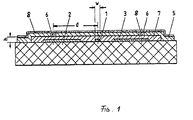
- the single drawing shows an oxygen sensor of the Clark type manufactured in accordance with lithographic methods.
- a silicon substrate 2 supports a cathode 1 and an anode 3 which are deposited on the substrate in the known manner of printed or integrated circuits. Both electrodes are covered by a layer 7 of hydrophylic polymer which is protected on the outside by means of a membrane 5.
- the electrolyte can be deposited as a salt underneath the membrane 5 during the lithographic preparation of the cell, or the electrolyte is derived from the biological fluid surrounding the sensor during its application and then has to be brought into contact with the electrodes and the space between them.
- holes 6 within membrane 5 permit access of the electrolyte to the hydrophylic polymer layer 7 so that the electrolyte can pass along this layer to cathode 1 for activating the cell.
- Oxygen or any other constituent of the fluid under examination diffuses through membrane 5 and layer 7 to cathode 1, therewith influencing the electrochemical process between electrodes 1 and 3.
- These electrodes are connected to a source of DC, and the amount of current induced by the reduction and oxidation process at the cathode and the anode, respectively, is a measure for determining the content of oxygen within the biological medium into which the sensor is inserted.
- silicon another insulating substrate such as glass or ceramics may be used.
- the distance d of holes 6 from the cathode 1 is by far larger, e.g. five times larger than the width w of the active front surface area of cathode 1.
- the thickness h of the hydrophylic polymer layer 7 is very small, preferably less than 4 pm.
- This layer may be made of hydrogel such as polyvinyl alcohol, polyvinyl pyrrolidon, polyacrylamide, hydroxyethylmethacrylate or derivates of these compounds.
- the cathode preferably is made of noble metal such as gold and the anode may consist of silver.
- the hydrophylic polymer may act as a sieve which is permeable for the electrolyte, oxygen, carbon dioxide and relatively small biological organic molecules such as glucose, but it is impermeable for large biological molecules such as proteins.
- an antithrombogenic layer 8 is deposited on the outside surface of membrane 5 covering also the walls of holes 6 and those surface portions of layer 7 which form the bottom of those holes.
- This layer 8 in accordance with the invention is essentially deposited by the same lithographic method as is used for depositing the hydrophylic layer 7.
- the hydrophylic-polymer layer 8 containing heparin may be of a structure which is permeable for the electrolyte, oxygen, carbon dioxide and relatively small biological organic molecules such as glucose, but it is impermeable for large biological molecules such as proteins.
- layer 8 in addition to its antithrombogenic function at least partially provides the sieve function of layer 7.
Landscapes
- Health & Medical Sciences (AREA)
- Epidemiology (AREA)
- Materials Engineering (AREA)
- Engineering & Computer Science (AREA)
- Hematology (AREA)
- Surgery (AREA)
- Chemical & Material Sciences (AREA)
- Life Sciences & Earth Sciences (AREA)
- Animal Behavior & Ethology (AREA)
- General Health & Medical Sciences (AREA)
- Public Health (AREA)
- Veterinary Medicine (AREA)
- Materials For Medical Uses (AREA)
Priority Applications (4)
| Application Number | Priority Date | Filing Date | Title |
|---|---|---|---|
| EP84100574A EP0149693B1 (en) | 1984-01-20 | 1984-01-20 | Method of forming an antithrombogenic layer on medical devices |
| DE8484100574T DE3472370D1 (en) | 1984-01-20 | 1984-01-20 | Method of forming an antithrombogenic layer on medical devices |
| CA000472376A CA1257561A (en) | 1984-01-20 | 1985-01-18 | Method of forming an antithrombogenic layer and a medical device utilizing the same |
| JP60006059A JPS60160965A (ja) | 1984-01-20 | 1985-01-18 | 血栓形成阻止層を医療用装置上に形成する方法 |
Applications Claiming Priority (1)
| Application Number | Priority Date | Filing Date | Title |
|---|---|---|---|
| EP84100574A EP0149693B1 (en) | 1984-01-20 | 1984-01-20 | Method of forming an antithrombogenic layer on medical devices |
Publications (2)
| Publication Number | Publication Date |
|---|---|
| EP0149693A1 EP0149693A1 (en) | 1985-07-31 |
| EP0149693B1 true EP0149693B1 (en) | 1988-06-29 |
Family
ID=8191710
Family Applications (1)
| Application Number | Title | Priority Date | Filing Date |
|---|---|---|---|
| EP84100574A Expired EP0149693B1 (en) | 1984-01-20 | 1984-01-20 | Method of forming an antithrombogenic layer on medical devices |
Country Status (4)
| Country | Link |
|---|---|
| EP (1) | EP0149693B1 (enExample) |
| JP (1) | JPS60160965A (enExample) |
| CA (1) | CA1257561A (enExample) |
| DE (1) | DE3472370D1 (enExample) |
Cited By (3)
| Publication number | Priority date | Publication date | Assignee | Title |
|---|---|---|---|---|
| US5634946A (en) | 1988-08-24 | 1997-06-03 | Focal, Inc. | Polymeric endoluminal paving process |
| US5674287A (en) | 1988-08-24 | 1997-10-07 | Endoluminal Therapeutics, Inc. | Biodegradable polymeric endoluminal sealing process, apparatus and polymeric product for use therein |
| US7371257B2 (en) | 1989-12-15 | 2008-05-13 | Boston Scientific Scimed, Inc. | Stent lining |
Families Citing this family (11)
| Publication number | Priority date | Publication date | Assignee | Title |
|---|---|---|---|---|
| DE3735137A1 (de) * | 1987-10-16 | 1989-05-03 | Siemens Ag | Anordnung zum abgeben von medikamenten bei einem implantierbaren medizinischen geraet |
| US4934367A (en) * | 1988-04-22 | 1990-06-19 | Medtronic, Inc. | In-line pacemaker connector system |
| EP0363504A1 (en) * | 1988-10-10 | 1990-04-18 | Dräger Nederland B.V. | Method of providing a substrate with a layer comprising a polyvinylbased hydrogel and a biochemically active material |
| US5135516A (en) * | 1989-12-15 | 1992-08-04 | Boston Scientific Corporation | Lubricious antithrombogenic catheters, guidewires and coatings |
| WO1993005825A1 (en) * | 1991-09-20 | 1993-04-01 | Baxter International Inc. | Processes for reducing the thrombogenicity of biomaterials |
| JP4505871B2 (ja) * | 1999-04-07 | 2010-07-21 | 株式会社ジェイ・エム・エス | 抗血栓性ムコ多糖処理した血流接触医療用部材、および該血流接触医療用部材の製造法 |
| US8101196B2 (en) | 2001-06-26 | 2012-01-24 | Biointeractions, Ltd. | Polysaccharide biomaterials and methods of use thereof |
| US7261733B1 (en) * | 2002-06-07 | 2007-08-28 | Endovascular Technologies, Inc. | Endovascular graft with sensors design and attachment methods |
| JP5152212B2 (ja) * | 2010-01-30 | 2013-02-27 | 株式会社ジェイ・エム・エス | 血流接触医療用部材、および該血流接触医療用部材の製造法 |
| US9299476B2 (en) * | 2010-10-22 | 2016-03-29 | Newsouth Innovations Pty Limited | Polymeric material |
| EP3496776A1 (en) | 2016-08-09 | 2019-06-19 | Jozef Stefan Institute | Method for coating a medical device, especially a vascular stent |
Family Cites Families (2)
| Publication number | Priority date | Publication date | Assignee | Title |
|---|---|---|---|---|
| US3677800A (en) * | 1970-03-18 | 1972-07-18 | Gen Electric | Anti-thrombogenic coatings and products |
| FR2142277A5 (en) * | 1971-06-18 | 1973-01-26 | Gen Electric | Antithrombogenic surfaces |
-
1984
- 1984-01-20 DE DE8484100574T patent/DE3472370D1/de not_active Expired
- 1984-01-20 EP EP84100574A patent/EP0149693B1/en not_active Expired
-
1985
- 1985-01-18 JP JP60006059A patent/JPS60160965A/ja active Pending
- 1985-01-18 CA CA000472376A patent/CA1257561A/en not_active Expired
Cited By (8)
| Publication number | Priority date | Publication date | Assignee | Title |
|---|---|---|---|---|
| US5634946A (en) | 1988-08-24 | 1997-06-03 | Focal, Inc. | Polymeric endoluminal paving process |
| US5674287A (en) | 1988-08-24 | 1997-10-07 | Endoluminal Therapeutics, Inc. | Biodegradable polymeric endoluminal sealing process, apparatus and polymeric product for use therein |
| US5749915A (en) | 1988-08-24 | 1998-05-12 | Focal, Inc. | Polymeric endoluminal paving process |
| US5749922A (en) | 1988-08-24 | 1998-05-12 | Endoluminal Therapeutics, Inc. | Biodegradable polymeric endoluminal sealing process, apparatus and polymeric products for use therein |
| US5800538A (en) | 1988-08-24 | 1998-09-01 | Endoluminal Therapeutics, Inc. | Biodegradable polymeric endoluminal sealing process |
| US6443941B1 (en) | 1988-08-24 | 2002-09-03 | Endoluminal Therapeutics, Inc. | Biodegradable polymeric endoluminal sealing process, apparatus and polymeric products for use therein |
| US6699272B2 (en) | 1988-08-24 | 2004-03-02 | Endoluminal Therapeutics, Inc. | Biodegradable polymeric endoluminal sealing process, apparatus and polymeric products for use therein |
| US7371257B2 (en) | 1989-12-15 | 2008-05-13 | Boston Scientific Scimed, Inc. | Stent lining |
Also Published As
| Publication number | Publication date |
|---|---|
| CA1257561A (en) | 1989-07-18 |
| DE3472370D1 (en) | 1988-08-04 |
| EP0149693A1 (en) | 1985-07-31 |
| JPS60160965A (ja) | 1985-08-22 |
Similar Documents
| Publication | Publication Date | Title |
|---|---|---|
| US5134057A (en) | Method of providing a substrate with a layer comprising a polyvinyl based hydrogel and a biochemically active material | |
| EP0149693A1 (en) | Method of forming an antithrombogenic layer on medical devices | |
| JP5647621B2 (ja) | 電気化学バイオセンサのための膜層 | |
| US5067491A (en) | Barrier coating on blood contacting devices | |
| US9541519B2 (en) | Amperometric sensor electrodes | |
| US4442841A (en) | Electrode for living bodies | |
| EP1991113B1 (en) | Flux limiting membrane for intravenous amperometric biosensor | |
| US5985129A (en) | Method for increasing the service life of an implantable sensor | |
| Hsu et al. | Encapsulation of an integrated neural interface device with Parylene C | |
| US4366033A (en) | Method for determining the concentration of sugar using an electrocatalytic sugar sensor | |
| JP2012507371A (ja) | 非作用電極層を伴った分析物センサー | |
| JP2018088937A (ja) | 連続センサー用双性イオン表面修飾 | |
| AU6915691A (en) | Method for increasing the service life of an implantable sensor | |
| CN211179623U (zh) | 植入式生物传感器 | |
| JP2001508176A (ja) | グルコースセンサー | |
| JPH0328752A (ja) | 酵素固定化電極およびその製造方法 | |
| US5230786A (en) | Silver-chloride reference electrode | |
| WO2010075043A2 (en) | Polyelectrolytes as sublayers on electrochemical sensors | |
| EP0056178B1 (en) | Electrode for living bodies | |
| JPS6133644A (ja) | 生体用電極 | |
| EP4316372A1 (en) | Electrochemical analyte sensor having improved reproducibility and associated fabrication process | |
| JP3686114B2 (ja) | 固定化酵素膜の部分的失活方法 | |
| JPH05253289A (ja) | 生体適合膜及びその製造方法 | |
| JP2655727B2 (ja) | 酵素センサー | |
| JPH0315692B2 (enExample) |
Legal Events
| Date | Code | Title | Description |
|---|---|---|---|
| PUAI | Public reference made under article 153(3) epc to a published international application that has entered the european phase |
Free format text: ORIGINAL CODE: 0009012 |
|
| 17P | Request for examination filed |
Effective date: 19841211 |
|
| AK | Designated contracting states |
Designated state(s): BE CH DE FR GB IT LI NL SE |
|
| RIN1 | Information on inventor provided before grant (corrected) |
Inventor name: KUYPERS, MARTINUS HENRICUS |
|
| 17Q | First examination report despatched |
Effective date: 19870407 |
|
| D17Q | First examination report despatched (deleted) | ||
| RAP1 | Party data changed (applicant data changed or rights of an application transferred) |
Owner name: PPG HELLIGE B.V. |
|
| GRAA | (expected) grant |
Free format text: ORIGINAL CODE: 0009210 |
|
| AK | Designated contracting states |
Kind code of ref document: B1 Designated state(s): BE CH DE FR GB IT LI NL SE |
|
| PG25 | Lapsed in a contracting state [announced via postgrant information from national office to epo] |
Ref country code: IT Free format text: LAPSE BECAUSE OF FAILURE TO SUBMIT A TRANSLATION OF THE DESCRIPTION OR TO PAY THE FEE WITHIN THE PRESCRIBED TIME-LIMIT;WARNING: LAPSES OF ITALIAN PATENTS WITH EFFECTIVE DATE BEFORE 2007 MAY HAVE OCCURRED AT ANY TIME BEFORE 2007. THE CORRECT EFFECTIVE DATE MAY BE DIFFERENT FROM THE ONE RECORDED. Effective date: 19880629 |
|
| PG25 | Lapsed in a contracting state [announced via postgrant information from national office to epo] |
Ref country code: SE Effective date: 19880630 |
|
| REF | Corresponds to: |
Ref document number: 3472370 Country of ref document: DE Date of ref document: 19880804 |
|
| ET | Fr: translation filed | ||
| PLBE | No opposition filed within time limit |
Free format text: ORIGINAL CODE: 0009261 |
|
| STAA | Information on the status of an ep patent application or granted ep patent |
Free format text: STATUS: NO OPPOSITION FILED WITHIN TIME LIMIT |
|
| 26N | No opposition filed | ||
| REG | Reference to a national code |
Ref country code: CH Ref legal event code: PFA Free format text: DRAEGER NEDERLAND B.V. |
|
| REG | Reference to a national code |
Ref country code: FR Ref legal event code: CD |
|
| BECN | Be: change of holder's name |
Effective date: 19910612 |
|
| NLT1 | Nl: modifications of names registered in virtue of documents presented to the patent office pursuant to art. 16 a, paragraph 1 |
Owner name: DRAEGER MEDICAL ELECTRONICS B.V. TE BEST. |
|
| NLT1 | Nl: modifications of names registered in virtue of documents presented to the patent office pursuant to art. 16 a, paragraph 1 |
Owner name: DRAEGER NEDERLAND B.V. TE BEST. |
|
| PGFP | Annual fee paid to national office [announced via postgrant information from national office to epo] |
Ref country code: FR Payment date: 19921221 Year of fee payment: 10 |
|
| PGFP | Annual fee paid to national office [announced via postgrant information from national office to epo] |
Ref country code: GB Payment date: 19930112 Year of fee payment: 10 |
|
| PGFP | Annual fee paid to national office [announced via postgrant information from national office to epo] |
Ref country code: BE Payment date: 19930113 Year of fee payment: 10 |
|
| PGFP | Annual fee paid to national office [announced via postgrant information from national office to epo] |
Ref country code: DE Payment date: 19930128 Year of fee payment: 10 |
|
| PGFP | Annual fee paid to national office [announced via postgrant information from national office to epo] |
Ref country code: CH Payment date: 19930129 Year of fee payment: 10 |
|
| PGFP | Annual fee paid to national office [announced via postgrant information from national office to epo] |
Ref country code: NL Payment date: 19930131 Year of fee payment: 10 |
|
| PG25 | Lapsed in a contracting state [announced via postgrant information from national office to epo] |
Ref country code: GB Effective date: 19940120 |
|
| PG25 | Lapsed in a contracting state [announced via postgrant information from national office to epo] |
Ref country code: LI Effective date: 19940131 Ref country code: CH Effective date: 19940131 Ref country code: BE Effective date: 19940131 |
|
| BERE | Be: lapsed |
Owner name: DRAGER NEDERLAND B.V. Effective date: 19940131 |
|
| PG25 | Lapsed in a contracting state [announced via postgrant information from national office to epo] |
Ref country code: NL Effective date: 19940801 |
|
| GBPC | Gb: european patent ceased through non-payment of renewal fee |
Effective date: 19940120 |
|
| NLV4 | Nl: lapsed or anulled due to non-payment of the annual fee | ||
| PG25 | Lapsed in a contracting state [announced via postgrant information from national office to epo] |
Ref country code: FR Effective date: 19940930 |
|
| REG | Reference to a national code |
Ref country code: CH Ref legal event code: PL |
|
| PG25 | Lapsed in a contracting state [announced via postgrant information from national office to epo] |
Ref country code: DE Effective date: 19941001 |
|
| REG | Reference to a national code |
Ref country code: FR Ref legal event code: ST |