EP0130245B1 - Method of storing characters in a display system - Google Patents
Method of storing characters in a display system Download PDFInfo
- Publication number
- EP0130245B1 EP0130245B1 EP83303790A EP83303790A EP0130245B1 EP 0130245 B1 EP0130245 B1 EP 0130245B1 EP 83303790 A EP83303790 A EP 83303790A EP 83303790 A EP83303790 A EP 83303790A EP 0130245 B1 EP0130245 B1 EP 0130245B1
- Authority
- EP
- European Patent Office
- Prior art keywords
- stroke
- character
- binary
- strokes
- binary number
- Prior art date
- Legal status (The legal status is an assumption and is not a legal conclusion. Google has not performed a legal analysis and makes no representation as to the accuracy of the status listed.)
- Expired
Links
- 238000000034 method Methods 0.000 title claims description 25
- 239000011159 matrix material Substances 0.000 claims description 36
- 238000012360 testing method Methods 0.000 claims description 3
- 238000010586 diagram Methods 0.000 description 4
- 230000008901 benefit Effects 0.000 description 3
- 230000007246 mechanism Effects 0.000 description 3
- 238000006243 chemical reaction Methods 0.000 description 2
- 238000013461 design Methods 0.000 description 2
- 230000008859 change Effects 0.000 description 1
- 230000003247 decreasing effect Effects 0.000 description 1
- 230000001419 dependent effect Effects 0.000 description 1
- 238000001514 detection method Methods 0.000 description 1
- 238000010894 electron beam technology Methods 0.000 description 1
- 230000002452 interceptive effect Effects 0.000 description 1
- 230000003340 mental effect Effects 0.000 description 1
- 230000004048 modification Effects 0.000 description 1
- 238000012986 modification Methods 0.000 description 1
- 238000012545 processing Methods 0.000 description 1
- 230000004044 response Effects 0.000 description 1
Images




Classifications
-
- G—PHYSICS
- G09—EDUCATION; CRYPTOGRAPHY; DISPLAY; ADVERTISING; SEALS
- G09G—ARRANGEMENTS OR CIRCUITS FOR CONTROL OF INDICATING DEVICES USING STATIC MEANS TO PRESENT VARIABLE INFORMATION
- G09G5/00—Control arrangements or circuits for visual indicators common to cathode-ray tube indicators and other visual indicators
- G09G5/22—Control arrangements or circuits for visual indicators common to cathode-ray tube indicators and other visual indicators characterised by the display of characters or indicia using display control signals derived from coded signals representing the characters or indicia, e.g. with a character-code memory
- G09G5/24—Generation of individual character patterns
-
- G—PHYSICS
- G09—EDUCATION; CRYPTOGRAPHY; DISPLAY; ADVERTISING; SEALS
- G09G—ARRANGEMENTS OR CIRCUITS FOR CONTROL OF INDICATING DEVICES USING STATIC MEANS TO PRESENT VARIABLE INFORMATION
- G09G1/00—Control arrangements or circuits, of interest only in connection with cathode-ray tube indicators; General aspects or details, e.g. selection emphasis on particular characters, dashed line or dotted line generation; Preprocessing of data
- G09G1/06—Control arrangements or circuits, of interest only in connection with cathode-ray tube indicators; General aspects or details, e.g. selection emphasis on particular characters, dashed line or dotted line generation; Preprocessing of data using single beam tubes, e.g. three-dimensional or perspective representation, rotation or translation of display pattern, hidden lines, shadows
- G09G1/08—Control arrangements or circuits, of interest only in connection with cathode-ray tube indicators; General aspects or details, e.g. selection emphasis on particular characters, dashed line or dotted line generation; Preprocessing of data using single beam tubes, e.g. three-dimensional or perspective representation, rotation or translation of display pattern, hidden lines, shadows the beam directly tracing characters, the information to be displayed controlling the deflection and the intensity as a function of time in two spatial co-ordinates, e.g. according to a cartesian co-ordinate system
- G09G1/10—Control arrangements or circuits, of interest only in connection with cathode-ray tube indicators; General aspects or details, e.g. selection emphasis on particular characters, dashed line or dotted line generation; Preprocessing of data using single beam tubes, e.g. three-dimensional or perspective representation, rotation or translation of display pattern, hidden lines, shadows the beam directly tracing characters, the information to be displayed controlling the deflection and the intensity as a function of time in two spatial co-ordinates, e.g. according to a cartesian co-ordinate system the deflection signals being produced by essentially digital means, e.g. incrementally
Definitions
- This invention relates to a method of generating a character on a display device of a display system, the display device having an orthogonal matrix of addressable points.
- the invention is particularly, but not exclusively, applicable to the storage of characters in systems having a raster display device such as a gas panel or raster scan CRT, in which case the matrix of addressable points corresponds to the discrete addressable pel positions of the display device.
- a raster display device such as a gas panel or raster scan CRT
- the matrix of addressable points corresponds to the discrete addressable pel positions of the display device.
- the method may also be used in systems having a digitally-controlled vector (calligraphic) display device such as a plotter or random scan CRT, in which case the matrix of addressable points corresponds to the addressable points on the display surface.
- each character in a ready-rastered dot matrix format which explicitly defines the ON and OFF pels for the character and maps one-to-one to the display surface (such as a CRT screen) in the region of the surface where the character is to be positioned; see, for example, page 115 of the book "Funda- mentals of Interactive Computer Graphics" by Foley and Van Dam, published 1982 by the Addi- son-Wesley Publishing Company.
- the advantage of characters defined in dot matrix format is that they do not require vector-to-raster conversion and are therefore speedily made available to the display device when specified for display.
- the dot matrix format is highly inefficient as regards storage space since each bit of the matrix is stored irrespective of whether this represents a visible part of the character (e.g. an ON pel for a light on dark image) or a part ofthe background (an OFF pel). For example, for characters defined in a 14 by 20 matrix, at least 280 bits are required to define each character regardless of the complexity of the character.
- a further disadvantage of the dot matrix technique of character definition is that it is not easy to provide the characters rotated on the display surface relative to the orientation defined by the dot matrix. While such a limitation may be accept able for predominantly alphanumeric displays it is often undesirable for mixed displays with a high graphical content where drawing legends may be required at angles other than the horizontal.
- the present invention provides a method of generating a character on a display device of a display system, the display device having an orthogonal matrix of addressable points and the method comprising the steps of: storing in the display system, a representation of each character in a set of characters as a succession of strokes each constrained to lie in one of the eight fundamental directions of the matrix and, except for the first stroke, each starting at the end of the previous stroke, each such stroke being stored in a binary coded form which includes a first binary number defining the angular direction of the stroke, a second binary number defining a number of matrix steps from one pointtothe next along the stroke in that direction, and a third binary number defining the visibility of the stroke, and selecting a stored character for display and reading out the coded strokes, adding a common rotational constant representative of a desired rotation of 45° or an integral multiple thereof to the first binary number of each stroke and scaling by a factor of two the number of steps defined by the second binary number in respect of selected strokes when the rotational constant is representative
- the eight fundamental directions referred to above are the positive and negative directions of the X and Y axes of the matrix and the positive and negative directions of the two diagonals which bisect these axes. Alternatively, they may be considered as the directions of the eight possible moves from one matrix point to any immediately adjacent matrix point, axially or diagonally.
- the present invention recognises that rotation through 45° or an odd multiple thereof will in general produce distortion of the displayed characters, since after such rotation axial strokes will become diagonal strokes with their actual (displayed) length increased by a factor of V2, and diagonal strokes will become axial strokes with their actual length decreased by a factor of 1/ V2.
- This distortion might perhaps be reduced to some extent by careful design of the characters, but in accordance with the method according to the present invention it is fully compensated by scaling by two the number of steps defined by the length code in respect of selected strokes in the initial character definition, i.e. before rotation.
- the method according to the invention requires substantially less data to define each character than does the dot matrix technique, since the amount of data will be proportional to the number of strokes representing the character.
- a conventional character set can be stored using only about 25% of the storage space needed for the dot matrix format.
- the need for complex incremental vector-to-raster conversion algorithms for characters is avoided in accordance with the invention by constraining the strokes of each character to lie along one of the eight fundamental 45° directions of the matrix. As is well known, lines lying along these particular directions constitute special cases which can be rapidly "drawn" without the need for such algorithms.
- Another advantage is that for characters stored in the above manner only those pels which form a visible part of the character (e.g. the ON pels for a light on dark display) have to be addressed and written to the display device or, in the case of a refresh raster display device such as a conventional CRT, to the raster bit planes (refresh buffer).
- a refresh raster display device such as a conventional CRT
- proportional spacing of characters can be readily achieved by including in each character definition one or more final non- visible strokes to position the starting point of the first stroke of the next character.
- the scaling by a factor of two when the rotational constant is representative of 45° or an odd multiple thereof comprises doubling the number of steps defined by the second binary number in respect of each stroke which initially lies along any diagonal fundamental direction.
- the scaling by a factor of two when the rotational constant is representative of 45° or an odd multiple thereof comprises halving the number of steps defined by the second binary number in respect of each stroke which initially lies along any axial fundamental direction.
- the first binary number defining each fundamental direction is a binary direction code which corresponds to the addition modulo 2" of a binary constant m to the binary code for the fundamental direction at 45° thereto in a given direction of rotation, where n is the number of bits in first binary number.
- the common rotational constant added to the first binary number of each stroke is equal to m or to an integral multiple thereof and the common rotational constant is added modulo 2" to the first binary number of each stroke.
- the selection of the strokes to be scaled when the rotational constant is representative of a rotation of 45° or an odd multiple thereof is performed by testing (33) the value of the least significant bit of the individual direction codes before the addition of the common rotational constant.
- the terms "first”, “second” and “third” as applied to the binary numbers defining each character are not intended to imply any particular order or priority among these numbers, but are merely convenient labels used to distinguish between them forthe purposes of the present specification.
- the first binary number (direction code) consists of three bits (000, 001, 010 .... to 111 respectively corresponding to the angles 0°, 45°, 90°....
- the second binary number (length code) consists of four bits which can define strokes up to 15 matrix steps long and which we have found to be adequate for providing characters of reasonable resolution
- the third binary number (move/draw code) consists of a single bit whose value determines whether the stroke is a "move'.' or "draw” (i.e. whether the stroke is visible or not with respect to the background).
- characters are represented by a succession of "nose-to-tail" strokes each constrained to lie in one of the eight fundamental directions of the orthogonal matrix of addressable pel positions of a raster display device, and each stroke is coded in one byte of binary information with a one bit draw/move code, a three bit direction code, and a four bit length code.
- the direction codes are as follows:
- the draw/move code is one bit: and the length code is four bits giving a maximum length of 15 matrix steps in the stroke direction. For strokes which exceed this length, multiple bytes with the same direction code can be used. A length code of zero (0000) is used to terminate the character definition.
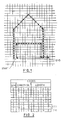
- Figure 1 is a schematic diagram of a capital "A" as it might appear on a raster display device, each small square in the diagram representing one addressable pel position of the device and each dot representing one active pel (i.e. a pel distinguished from the background).
- Figure 2 is a table illustrating how the above character could be coded according to the coding method described above.
- the character is assumed to lie within a 14 by 20 character box (indicated in bold lines at its four corners), and it will be seen that the character is represented by a succession of move and draw strokes indicated by the arrows which trace round the character beginning at the lower left pel position which is the start position for the character.
- the actual physical location of the start position on the display device is defined by a "DRAW CHARACTERS" command as will be described, the location of the start position of each succeeding character in the string thereafter being defined by the end position of the preceding character.
- the two bytes labelled (i) in figure 2 are positioning moves which bring the end of the character to the start position (lower left pel position) of the next character box.
- the final all zero byte (ii) is the character definition terminator.
- Rotation of the character through 90° or any multiple thereof may be readily achieved by the addition modulo 8 of a common character rotation factor of 010 or a corresponding multiple thereof to the direction code of each stroke, prior .to decoding and drawing the character.
- the character rotation factors to be added are as follows:
- rotation through 45° or any thereof may be effected by the addition modulo 8 of a common character rotation factor of 001 or a corresponding multiple thereof to the direction code of each stroke:
- character proportions can alternatively be preserved by halving the number of matrix steps in respect of strokes which initially lie in an axial direction, i.e. shift the length code right by one bit position.
- precision is lost unless the length code of every axial stroke defines an even number of steps (least significant bit of length code is 0).
- the resulting character will be 1/V2 smaller.
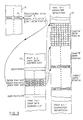
- the graphics system includes a display list buffer 10 containing a computer-produced display list comprising a sequence of commands for execution by a display processor (not shown) in conventional manner.
- the commands will generally include point and line drawing commands, as well as character string drawing commands such as that shown at 11.
- the DRAW CHARACTERS command typically contains the following information:
- Display device coordinates Xs Y for the first character in string.
- the DRAW CHARACTERS command will also contain the character rotation factor.
- the characters are assumed to be available in several fonts, the coded character definitions for each font being stored in a font character data (FCD) table 12.
- FCD font character data
- the character definitions in the FCD table 12 are not accessed directly but via a font, index (FI) table 13.
- the FI table contains, for each font, the addresses in the FCD table 12 of each character definition in that font, the addresses of the character definitions in the FI table 13 being listed in the same order for each font.
- any character in any font can be uniquely specified in the DRAW CHARACTERS command by a font address defining the start of the character address list for that font in the FI table 13, together with an offset which is the distance down the FI table 13 to the address of the desired character relative to the start of the font list.
- font N is chosen by the DRAW CHARACTERS command by specifying ADDR FONT N which is the start of the character address list in the FI table 13 for font N, and that the selected character string is ABC whose individual offset addresses in the FI table 13 are hexadecimal C1, C2 and C3 respectively.
- the addresses present as data in the storage locations pointed to by (ADDR FONT N + C1), (ADDR FONT N + C2) and (ADDR FONT N + C3) point in turn to the first coded stroke of the respective character definitions in the FCD table 12.
- each font contains 256 entries in the FI table 13 (FONT ADDR N to FONT ADDR N + FF) so that an alphanumeric and symbol set of up to 256 characters can be accommodated in each font.
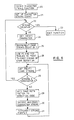
- the character string function is invoked, step 20, by. the display processor in response to a DRAW CHARACTER command.
- a character string count is set up, step 21, using the value COUNT in the DRAW CHARACTER command, and the count is tested for zero.
- the result will be NO so the system is directed to obtain the first character, step 24, and the character string count is decremented by 1, step 25.
- the FI and FCD tables are now used to point to the first stroke of the character definition, step 26, and the stroke is read out of the FCD table, step 27.
- the stroke is examined for being a terminator step 28.
- the result will be NO for the first stroke so the character rotation factor, if any, is added to the stroke direction code, step 29.
- the decode and draw step 30 transforms the 8- bit coded stroke information into a form usable by a conventional point plotting mechanism which, beginning at the start position for the first stroke of a character and at the final pel position of the previous stroke for the second and subsequent strokes, first plots or does not plot a visible point at the current pel position as determined by the draw/move code and then generates the address of the next adjacent pel position in the direction defined by the direction code, this being repeated for the number of matrix steps defined by the length code.
- the decision to plot/not plot for each matrix step is determined at the current pel position prior to the generation of the next pel position address, the decision to plot/not plot for the first pel position of a move stroke which follows a draw stroke is determined by the draw/ move code of the previous draw stroke rather than that of the current move stroke. This ensures that the full visible length of the draw stroke is displayed, since otherwise the visibility of the pel at the final pel position of a draw stroke, being also the first pel position of the move stroke, would be determined by the draw/move code of the move stroke, i.e. it would not be visible.
- the START COORDINATES X s Y s define the location of the start position of the first character on the display device.
- step 31 the stroke pointer is incremented by 1, step 31, and steps 27 to 31 are repeated for each stroke in the character definition.
- the cycle is terminated by the detection of a terminator at step 28, whereupon the sequence from step 22 is repeated for each character in the string.
- the character string function is finally terminated by the exit function, step 23, which is invoked when the character string count becomes zero.
- Figure 6 assumes that only rotation through 90° or a multiple thereof is required, and therefore no compensation for character distortion is included.
- Figure 7 shows the additional steps which are used for rotation through 45° or a multiple thereof.
- steps 28 and 29 of figure 6 the least significant bits of both the character rotation factor and direction code are tested for being a 1, steps 32 and 33.
- the length code is doubled at step 34.
- the length code of each visible stroke is not necessarily equal to the actual number of matrix steps between the visible endpoints of the stroke as in the embodiment shown in figures 1 and 2, but is dependent upon the characteristics of the point plotting mechanism.
- the above embodiment illustrates the storage method applied to a raster display system, it is also applicable to a vector or calligraphic system.
- the coded character strokes can be converted to the endpoints of visible and invisible lines and used to directly drive the pen of a plotter or the electron beam of a random scan CRT.
Landscapes
- Engineering & Computer Science (AREA)
- Physics & Mathematics (AREA)
- Computer Hardware Design (AREA)
- General Physics & Mathematics (AREA)
- Theoretical Computer Science (AREA)
- Radar, Positioning & Navigation (AREA)
- Remote Sensing (AREA)
- Controls And Circuits For Display Device (AREA)
Priority Applications (5)
| Application Number | Priority Date | Filing Date | Title |
|---|---|---|---|
| EP83303790A EP0130245B1 (en) | 1983-06-30 | 1983-06-30 | Method of storing characters in a display system |
| DE8383303790T DE3379004D1 (en) | 1983-06-30 | 1983-06-30 | Method of storing characters in a display system |
| US06/592,675 US4633243A (en) | 1983-06-30 | 1984-03-23 | Method of storing characters in a display system |
| JP59095793A JPS6015686A (ja) | 1983-06-30 | 1984-05-15 | キヤラクタ表示方法 |
| CA000455228A CA1224290A (en) | 1983-06-30 | 1984-05-25 | Method of storing character in a display system |
Applications Claiming Priority (1)
| Application Number | Priority Date | Filing Date | Title |
|---|---|---|---|
| EP83303790A EP0130245B1 (en) | 1983-06-30 | 1983-06-30 | Method of storing characters in a display system |
Publications (2)
| Publication Number | Publication Date |
|---|---|
| EP0130245A1 EP0130245A1 (en) | 1985-01-09 |
| EP0130245B1 true EP0130245B1 (en) | 1989-01-18 |
Family
ID=8191199
Family Applications (1)
| Application Number | Title | Priority Date | Filing Date |
|---|---|---|---|
| EP83303790A Expired EP0130245B1 (en) | 1983-06-30 | 1983-06-30 | Method of storing characters in a display system |
Country Status (5)
| Country | Link |
|---|---|
| US (1) | US4633243A (enExample) |
| EP (1) | EP0130245B1 (enExample) |
| JP (1) | JPS6015686A (enExample) |
| CA (1) | CA1224290A (enExample) |
| DE (1) | DE3379004D1 (enExample) |
Cited By (1)
| Publication number | Priority date | Publication date | Assignee | Title |
|---|---|---|---|---|
| US7084873B2 (en) | 2001-08-01 | 2006-08-01 | Agere Systems Inc. | System, method and computer program product for displaying and/or compressing digital data |
Families Citing this family (15)
| Publication number | Priority date | Publication date | Assignee | Title |
|---|---|---|---|---|
| FR2574575B1 (fr) * | 1984-12-11 | 1987-02-06 | O Donnell Ciaran | Processeur de trace de vecteur |
| US5562350A (en) * | 1988-04-18 | 1996-10-08 | Canon Kabushiki Kaisha | Output apparatus that selects a vector font based on character size |
| JPH066386B2 (ja) * | 1988-04-18 | 1994-01-26 | キヤノン株式会社 | 出力装置 |
| JPH01275056A (ja) * | 1988-04-27 | 1989-11-02 | Tokyo Electric Co Ltd | ページプリンタ |
| US5028848A (en) * | 1988-06-27 | 1991-07-02 | Hewlett-Packard Company | Tile vector to raster conversion method |
| JP2883633B2 (ja) * | 1989-05-29 | 1999-04-19 | ブラザー工業 株式会社 | データ変換装置 |
| US6496160B1 (en) * | 1999-04-29 | 2002-12-17 | Evans & Sutherland Computer Corporation | Stroke to raster converter system |
| JP3556163B2 (ja) * | 2000-09-25 | 2004-08-18 | 富士通日立プラズマディスプレイ株式会社 | 表示装置 |
| US7729542B2 (en) * | 2003-04-04 | 2010-06-01 | Carnegie Mellon University | Using edges and corners for character input |
| DE10347753A1 (de) * | 2003-10-14 | 2005-05-25 | Siemens Ag | Adaptive Beleuchtung bei Mobiltelefonen |
| US7891818B2 (en) | 2006-12-12 | 2011-02-22 | Evans & Sutherland Computer Corporation | System and method for aligning RGB light in a single modulator projector |
| US8358317B2 (en) | 2008-05-23 | 2013-01-22 | Evans & Sutherland Computer Corporation | System and method for displaying a planar image on a curved surface |
| US8702248B1 (en) | 2008-06-11 | 2014-04-22 | Evans & Sutherland Computer Corporation | Projection method for reducing interpixel gaps on a viewing surface |
| US8077378B1 (en) | 2008-11-12 | 2011-12-13 | Evans & Sutherland Computer Corporation | Calibration system and method for light modulation device |
| US9641826B1 (en) | 2011-10-06 | 2017-05-02 | Evans & Sutherland Computer Corporation | System and method for displaying distant 3-D stereo on a dome surface |
Family Cites Families (11)
| Publication number | Priority date | Publication date | Assignee | Title |
|---|---|---|---|---|
| FR1573168A (enExample) * | 1968-04-05 | 1969-07-04 | ||
| FR2029264A5 (enExample) * | 1969-01-22 | 1970-10-16 | Vincent Carrefour Jacque | |
| FR2044615A5 (enExample) * | 1970-03-05 | 1971-02-19 | Philips Ind Commerciale | |
| JPS4844015A (enExample) * | 1971-10-08 | 1973-06-25 | ||
| US3938130A (en) * | 1972-02-23 | 1976-02-10 | Hughes Aircraft Company | Direction coded digital stroke generator providing a plurality of symbols |
| DE2214585C3 (de) * | 1972-03-24 | 1975-05-28 | Siemens Ag, 1000 Berlin Und 8000 Muenchen | Anordnung zur Darstellung von Zeichensegmenten |
| JPS5148930A (ja) * | 1974-10-25 | 1976-04-27 | Hitachi Ltd | Mojipatansakuseisochi |
| JPS5162940A (ja) * | 1974-11-29 | 1976-05-31 | Kokusai Denshin Denwa Co Ltd | Bekutoruhyojishikipataankirokujohono henkanhoshiki |
| US4228510A (en) * | 1978-03-01 | 1980-10-14 | The Boeing Company | Character generator |
| US4529978A (en) * | 1980-10-27 | 1985-07-16 | Digital Equipment Corporation | Method and apparatus for generating graphic and textual images on a raster scan display |
| US4507656A (en) * | 1982-09-13 | 1985-03-26 | Rockwell International Corporation | Character/vector controller for stroke written CRT displays |
-
1983
- 1983-06-30 DE DE8383303790T patent/DE3379004D1/de not_active Expired
- 1983-06-30 EP EP83303790A patent/EP0130245B1/en not_active Expired
-
1984
- 1984-03-23 US US06/592,675 patent/US4633243A/en not_active Expired - Fee Related
- 1984-05-15 JP JP59095793A patent/JPS6015686A/ja active Granted
- 1984-05-25 CA CA000455228A patent/CA1224290A/en not_active Expired
Cited By (1)
| Publication number | Priority date | Publication date | Assignee | Title |
|---|---|---|---|---|
| US7084873B2 (en) | 2001-08-01 | 2006-08-01 | Agere Systems Inc. | System, method and computer program product for displaying and/or compressing digital data |
Also Published As
| Publication number | Publication date |
|---|---|
| US4633243A (en) | 1986-12-30 |
| JPS6015686A (ja) | 1985-01-26 |
| DE3379004D1 (en) | 1989-02-23 |
| EP0130245A1 (en) | 1985-01-09 |
| JPH0418315B2 (enExample) | 1992-03-27 |
| CA1224290A (en) | 1987-07-14 |
Similar Documents
| Publication | Publication Date | Title |
|---|---|---|
| US4633243A (en) | Method of storing characters in a display system | |
| US7912322B2 (en) | Method and apparatus for magnifying computer screen display | |
| US4555802A (en) | Compaction and decompaction of non-coded information bearing signals | |
| US5021974A (en) | Method for updating a display bitmap with a character string or the like | |
| EP0438038B1 (en) | Graphics processor | |
| JPH0631937B2 (ja) | 表示装置 | |
| US6232987B1 (en) | Progressively renderable outline font and methods of generating, transmitting and rendering the same | |
| GB2229337A (en) | Image coding method | |
| US4811241A (en) | Clipping of fixed character strings in a graphics system | |
| US5489920A (en) | Method for determining the optimum angle for displaying a line on raster output devices | |
| JPH0613224B2 (ja) | フォントの含蓄方法 | |
| KR940006918B1 (ko) | 디지탈 활자체의 문자윤곽을 채우는 방법 및 시스템 | |
| JPH0562348B2 (enExample) | ||
| JPH05120441A (ja) | ベクトル画像描画装置 | |
| EP0197907B1 (en) | Display device | |
| JP3085175B2 (ja) | 描画装置 | |
| US5923321A (en) | Structural graph display system | |
| JPS61107384A (ja) | 表示装置 | |
| JP2835056B2 (ja) | 高品質文字パターン発生方式 | |
| JPS58154885A (ja) | 文字パタ−ン発生装置 | |
| EP0163872A2 (en) | Method of correlating on straight lines in an interactive display system | |
| EP1282106A1 (en) | System, method and computer program product for displaying and/or compressing digital data | |
| JPH09265345A (ja) | ストローク情報符号化方式 | |
| JPS60126688A (ja) | 任意パタ−ン入力表示装置 | |
| JPS63132281A (ja) | 文字サイズ拡大変換表示制御方式 |
Legal Events
| Date | Code | Title | Description |
|---|---|---|---|
| PUAI | Public reference made under article 153(3) epc to a published international application that has entered the european phase |
Free format text: ORIGINAL CODE: 0009012 |
|
| AK | Designated contracting states |
Designated state(s): DE FR GB |
|
| 17P | Request for examination filed |
Effective date: 19841123 |
|
| 17Q | First examination report despatched |
Effective date: 19860313 |
|
| GRAA | (expected) grant |
Free format text: ORIGINAL CODE: 0009210 |
|
| AK | Designated contracting states |
Kind code of ref document: B1 Designated state(s): DE FR GB |
|
| REF | Corresponds to: |
Ref document number: 3379004 Country of ref document: DE Date of ref document: 19890223 |
|
| ET | Fr: translation filed | ||
| PLBE | No opposition filed within time limit |
Free format text: ORIGINAL CODE: 0009261 |
|
| STAA | Information on the status of an ep patent application or granted ep patent |
Free format text: STATUS: NO OPPOSITION FILED WITHIN TIME LIMIT |
|
| 26N | No opposition filed | ||
| PGFP | Annual fee paid to national office [announced via postgrant information from national office to epo] |
Ref country code: GB Payment date: 19940511 Year of fee payment: 12 |
|
| PGFP | Annual fee paid to national office [announced via postgrant information from national office to epo] |
Ref country code: FR Payment date: 19940531 Year of fee payment: 12 |
|
| PGFP | Annual fee paid to national office [announced via postgrant information from national office to epo] |
Ref country code: DE Payment date: 19940629 Year of fee payment: 12 |
|
| PG25 | Lapsed in a contracting state [announced via postgrant information from national office to epo] |
Ref country code: GB Effective date: 19950630 |
|
| GBPC | Gb: european patent ceased through non-payment of renewal fee |
Effective date: 19950630 |
|
| PG25 | Lapsed in a contracting state [announced via postgrant information from national office to epo] |
Ref country code: FR Effective date: 19960229 |
|
| PG25 | Lapsed in a contracting state [announced via postgrant information from national office to epo] |
Ref country code: DE Effective date: 19960301 |
|
| REG | Reference to a national code |
Ref country code: FR Ref legal event code: ST |