EP0126257A1 - Einrichtung zum Begrenzen der Fahrgeschwindigkeit - Google Patents
Einrichtung zum Begrenzen der Fahrgeschwindigkeit Download PDFInfo
- Publication number
- EP0126257A1 EP0126257A1 EP84103887A EP84103887A EP0126257A1 EP 0126257 A1 EP0126257 A1 EP 0126257A1 EP 84103887 A EP84103887 A EP 84103887A EP 84103887 A EP84103887 A EP 84103887A EP 0126257 A1 EP0126257 A1 EP 0126257A1
- Authority
- EP
- European Patent Office
- Prior art keywords
- actuator
- speed
- engine
- normal
- normal position
- Prior art date
- Legal status (The legal status is an assumption and is not a legal conclusion. Google has not performed a legal analysis and makes no representation as to the accuracy of the status listed.)
- Granted
Links
Images

Classifications
-
- B—PERFORMING OPERATIONS; TRANSPORTING
- B60—VEHICLES IN GENERAL
- B60K—ARRANGEMENT OR MOUNTING OF PROPULSION UNITS OR OF TRANSMISSIONS IN VEHICLES; ARRANGEMENT OR MOUNTING OF PLURAL DIVERSE PRIME-MOVERS IN VEHICLES; AUXILIARY DRIVES FOR VEHICLES; INSTRUMENTATION OR DASHBOARDS FOR VEHICLES; ARRANGEMENTS IN CONNECTION WITH COOLING, AIR INTAKE, GAS EXHAUST OR FUEL SUPPLY OF PROPULSION UNITS IN VEHICLES
- B60K26/00—Arrangement or mounting of propulsion-unit control devices in vehicles
- B60K26/04—Arrangement or mounting of propulsion-unit control devices in vehicles of means connecting initiating means or elements to propulsion unit
-
- B—PERFORMING OPERATIONS; TRANSPORTING
- B60—VEHICLES IN GENERAL
- B60K—ARRANGEMENT OR MOUNTING OF PROPULSION UNITS OR OF TRANSMISSIONS IN VEHICLES; ARRANGEMENT OR MOUNTING OF PLURAL DIVERSE PRIME-MOVERS IN VEHICLES; AUXILIARY DRIVES FOR VEHICLES; INSTRUMENTATION OR DASHBOARDS FOR VEHICLES; ARRANGEMENTS IN CONNECTION WITH COOLING, AIR INTAKE, GAS EXHAUST OR FUEL SUPPLY OF PROPULSION UNITS IN VEHICLES
- B60K31/00—Vehicle fittings, acting on a single sub-unit only, for automatically controlling vehicle speed, i.e. preventing speed from exceeding an arbitrarily established velocity or maintaining speed at a particular velocity, as selected by the vehicle operator
- B60K31/02—Vehicle fittings, acting on a single sub-unit only, for automatically controlling vehicle speed, i.e. preventing speed from exceeding an arbitrarily established velocity or maintaining speed at a particular velocity, as selected by the vehicle operator including electrically actuated servomechanism
- B60K31/04—Vehicle fittings, acting on a single sub-unit only, for automatically controlling vehicle speed, i.e. preventing speed from exceeding an arbitrarily established velocity or maintaining speed at a particular velocity, as selected by the vehicle operator including electrically actuated servomechanism and means for comparing one electrical quantity, e.g. voltage, pulse, waveform, flux, or the like, with another quantity of a like kind, which comparison means is involved in the development of an electrical signal which is fed into the controlling means
- B60K31/042—Vehicle fittings, acting on a single sub-unit only, for automatically controlling vehicle speed, i.e. preventing speed from exceeding an arbitrarily established velocity or maintaining speed at a particular velocity, as selected by the vehicle operator including electrically actuated servomechanism and means for comparing one electrical quantity, e.g. voltage, pulse, waveform, flux, or the like, with another quantity of a like kind, which comparison means is involved in the development of an electrical signal which is fed into the controlling means where at least one electrical quantity is set by the vehicle operator
Definitions
- the invention relates to a device for limiting the driving speed or the engine speed of a motor vehicle, with a setpoint generator, a speed or speed actual value transmitter and a control unit processing the signals of the two transmitters, which forms a control signal from the signal difference, by the an actuator can be actuated, which is assigned to a transmission device that serves to transmit the movement of an accelerator pedal to the fuel metering device, wherein when a limit speed or limit speed set on the setpoint generator is exceeded, the actuator moves the effective length of the transmission device from a normal position towards a reduced position is changeably movable to reduce the amount of fuel.
- a pneumatic stop cylinder which is also arranged in the transmission device, is pressurized when the engine stops so that the effective length of the transmission device is changed in the direction of a reduction in the amount of fuel.
- This stop cylinder with its pressure supply and pressure control is both component and space-consuming, which is particularly disadvantageous in a motor vehicle that has only a small space.
- the object of the invention is therefore to provide a device according to the preamble which brings about a reduction in the amount of fuel when the engine is stopped with a few simple means.
- the actuator can be moved into the normal position when the engine is started and into the reduced position when the engine is not in operation and can be blocked outside the set limit speed in the normal position or reduced position assumed.
- an additional component such as a stop cylinder is no longer required, since in addition to its normal speed or speed limitation function, the actuator also takes over the fuel-reducing stop function when the engine is switched off. Since the fuel reduction of the stop function is so great that the diesel engine of a parked vehicle cannot self-ignite if it is parked on a slope, for example, and starts to roll independently, this also results in the third function, a roll lock. This third function too takes place without additional effort by the actuator, since this not only moves to the reduced position when the engine is stopped, but is also held there during the entire engine stop.
- Another advantage that results from the combination of the limiting function and the stop function performed by the actuator is that if the manipulation to switch off the limiter function, the stop function is switched off at the same time, so that the motor could no longer be switched off. The risk of an impermissible deactivation of the limiter function is thus considerably reduced.
- An electrical drive which can be controlled by a contact of the travel switch, is preferably used as the simple drive means for the actuator. As a result, no additional switches that the driver deliberately needs to operate are required, since the correct switching function is automatically carried out by actuating the ignition key.
- the actuator can either be non-positively by e.g. Spring loading or positively by e.g. a self-locking transmission between the drive motor and actuator can be blocked in the normal and / or reduced position. Blockability can be achieved with simple components of small size.
- a simple reduction in the effective length of the transmission device is achieved if a translation in the effective movement course of the transmission device can be changed by the actuator. Only a small amount of space is required if the transmission is a lever transmission, the joint of which is through the actuator is movable.
- the actuator can have a pivotable lever between the normal position and the reduced position in a simple manner. If the swivel lever can be acted upon by a snap spring in its normal position or reduction position, this simple and inexpensive component achieves lockability both in the normal and in the reduced position.
- the device shown in Figures 1-3 has an accelerator pedal 1 to which one end of a regulating rod 2 of a transmission device 3 is articulated approximately axially movable.
- the other end of the regulating rod 2 is articulated on an arm 6 of a two-armed lever 5 pivotable about an axis of rotation 4.
- On the other arm 7 of the lever 5 is articulated with its one end an axially movable to the regulating rod 2 limiter rod 8, the other end of which is pivotable about a fixed pivot point 9 pivot lever 10 of an actuator.
- the pivot lever 10 can be pivoted between a normal position (FIGS. 1 and 2) and a reduced position (FIG. 3) and is loaded by a snap spring 11 either in the normal position or in the reduced position.
- the snap spring 11 is a tension spring engaging at one end on the swivel lever, which is attached at its other end at a point on the normal to the longitudinal extension of the limiter rod intersecting the pivot point 9.
- An overtravel element 12 formed by a spring cylinder is arranged in the limiter rod 8.
- the axis of rotation 4 is not stationary, but is articulated on one end of an actuating lever 13.
- the other end of the actuating lever 13 is pivotable about the axis of a shaft 14 to which the actuating lever is rigidly connected.
- An injection pump lever (not shown) can be pivoted from the pivoting movement of the shaft 14.
- a throttle valve can also be pivoted from the shaft 14.
- the actuating lever Via a stop 15 of the actuating lever 13, against which the arm 7 can be placed in the full load direction when the lever 5 is actuated, the actuating lever can also be moved in the full load direction when the accelerator pedal 1 is moved in the full load direction.
- the pivot lever 10 By pivoting the pivot lever 10 from the normal position into the reduced position, the lever 5 and with it its axis of rotation 4 are moved to the right.
- the actuating lever 13 pivots to the right about the axis of the shaft 14 and takes the shaft 14 with it in a direction reducing the amount of fuel.
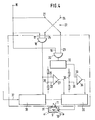
- the control of the movement of the pivot lever 10 can be seen from Figure 4.
- the pole 16 is connected to a voltage source, not shown.
- a connection leads from the pole 16 to an input 17 of a first AND gate 18, to an input 19 of a second AND gate 20, and to an OFF contact 21 of a travel switch 22.
- the travel switch 22 connects the OFF in its one switching position -Contact 21 with the second input 23 of the AND gate 20 and, in its other switching position, an ON contact 24 with the second input 25 of the AND gate 18.
- the output signal of the AND gate 18, which indicates that the vehicle engine is in operation, is fed to both a limiter unit 38 and the one input 26 of an amplifier 27.
- the second input 28 is connected to a voltage divider 29.
- the output signal of the amplifier 27 is fed to a driver stage 30 for the electromotive drive 31 of the swivel lever 10.
- the output of the AND gate 20 leads to a timing element 32 which, when actuated for a certain time (for example 10 seconds), supplies an output signal to an input 33 of an amplifier 34.
- the other input 35 of the amplifier 34 is connected to a voltage divider 36.
- the output of amplifier 34 leads to driver stage 30.
- the limiter unit 38 receives a speed or speed signal at an input 37.
- the travel switch -22 In the position shown, the travel switch -22 is in its OFF position. If it is switched to the ON position, the AND gate 18 receives a signal at its two inputs 17 and 25, so that it outputs an output signal both to the limiter unit 38 and via the amplifier 27 to the driver stage 30.
- the limiter unit 38 Since the speed or speed signal is below a setpoint set on a setpoint generator (not shown) of the limiter unit 38 and at the same time the limiter unit 38 receives an ON signal, it drives the driver stage 3D in the normal position, so that the pivot lever 10 is out of its solid line shown reduction position swings into its normal position drawn with a broken line and is held there by the snap spring 11.
- the latter controls the driver stage 30 in such a way that the pivot lever 10 is pivoted by a corresponding amount in the direction of the reduced position.
- the force of the snap spring 11 is overcome. If, after a driving operation, the travel switch 22 is switched from the ON position to the OFF position, the AND gate 18 no longer emits a signal to the limiter unit 38. This means that it is deactivated.
- the AND gate 20 now receives a signal at both inputs 19 and 23, so that the timing element 32 receives an input signal.
- the timer 32 sends a signal to the driver stage 30 via the amplifier 34, by means of which the driver stage 30 is driven into the reduced position and moves the swivel lever 10 into this position.
- the time period of the timing element 32 is dimensioned such that the pivot lever 10 moves safely into its reduced position. There it is then held by the snap spring 11.
- the voltage dividers 29 and 36 present at the second inputs 29 and 35 of the amplifiers 27 and 37 serve as fuse elements so that interference signals cannot trigger a control of the driver stage.
Landscapes
- Engineering & Computer Science (AREA)
- Chemical & Material Sciences (AREA)
- Combustion & Propulsion (AREA)
- Transportation (AREA)
- Mechanical Engineering (AREA)
- High-Pressure Fuel Injection Pump Control (AREA)
- Control Of Throttle Valves Provided In The Intake System Or In The Exhaust System (AREA)
Abstract
Description
- Die Erfindung bezieht sich auf eine Einrichtung zur Begrenzung der Fahrgeschwindigkeit bzw. der Motordrehzahl eines Kraftfahrzeuges, mit einem Sollwertgeber, einem Geschwindigkeits- bzw. Drehzahl- Istwertgeber und einem die Signale der beiden Geber verarbeitenden Steuergerät, das aus der Signaldifferenz ein Steuersignal bildet, durch das ein Stellglied betätigbar ist, das einerÜbertragungsvorrichtung zugeordnet ist, die der Übertragung der Bewegung eines Gaspedals auf die Brennstoffzumeßvorrichtung dient, wobei bei Überschreitung einer am Sollwertgeber eingestellten Grenzgeschwindigkeit bzw. Grenzdrehzahl das Stellglied aus einer Normalstellung in Richtung auf eine Reduzierstellung die wirksame Länge der Übertragungsvorrichtung in Richtung auf eine Reduzierung der Brennstoffmenge änderbar bewegbar ist.
- Bei derartigen Einrichtungen ist es bekannt, daß das Stellglied innerhalb der eingestellten Grenzgeschwindigkeit sowie bei nicht laufendem Motor durch eine Feder in der Normalstellung gehalten ist. Nur bei Überschreitung der Grenzgeschwindigkeit erfolgt eine Ansteuerung des Stellglieds derart, daß dieses sich in Richtung zur Reduzierstellung bewegt.
- Ein weiterhin in der Übertragungsvorrichtung angeordneter pneumatischer Stoppzylinder wird bei einem Motorstopp derart druckbeaufschlagt, daß die wirksame Länge der Übertragungsvorrichtung in Richtung auf eine Reduzierung der Brennstoffmenge verändert wird.
- Dieser Stoppzylinder mit seiner Druckversorgung sowie Druckansteuerung ist sowohl bauteil- als auch bauraumaufwendig, was insbesondere bei einem nur wenig Bauraum aufweisenden Kraftfahrzeug von Nachteil ist.
- Aufgabe der Erfindung ist es daher, eine Einrichtung nach dem Oberbegriff zu schaffen, die mit wenigen einfachen Mitteln bei einem Motorstopp eine Reduzierung der Brennstoffmenge bewirkt.
- Diese Aufgabe wird erfindungsgemäß dadurch gelöst, daß das Stellglied bei Motorinbetriebnahme in die Normalstellung und bei Motoraußerbetriebnahme in die Reduzierstellung bewegbar und auBerhalb der eingestellten Grenzgeschwindigkeit in der eingenommenen Normalstellung bzw. Reduzierstellung blockierbar ist. Durch diese Ausbildung ist kein zusätzliches Bauteil wie ein Stoppzylinder mehr erforderlich, da das Stellglied neben seiner normalen Geschwindigkeits- bzw. Drehzahlbegrenzungsfunktion auch noch die brennstoffreduzierende Stoppfunktion beim Ausschalten des Motors übernimmt. Da die Brennstoffreduzierung der Stoppfunktion so groß ist, daß es nicht zu einer Selbstzündung des Dieselmotors eines abgestellten Fahrzeuges kommen kann, wenn dieses zum Beispiel an einem Hang abgestellt ist, und selbständig ins Rollen kommt, ergibt sich zusätzlich die dritte Funktion, einer Anrollsperre. Auch diese dritte Funktion erfolgt ohne zusätzlichen Beuteilaufwand durch das Stellglied, da dieses bei einem Motorstopp nicht nur in die Reduzierstellung bewegt, sondern dort auch während des gesamten Motorstopps gehalten wird.
- Ein weiterer Vorteil der sich aus der Verknüpfung der vom Stellglied durchgeführten Begrenzungsfunktion und Stoppfunktion ergibt, liegt darin, daß bei einer Manipulation zum Ausschalten der Begrenzerfunktion gleichzeitig die Stoppfunktion ausgeschaltet wird, so daß der Motor nicht mehr ausschaltbar wäre. Die Gefahr einer unzulässigen Ausschaltung der Begrenzerfunktion ist somit erheblich gemindert.
- Als einfaches Antriebsmittel für das Stellglied dient vorzugsweise ein elektrischer Antrieb,der durch einen Kontakt des Fahrtschalters ansteuerbar sein kann. Dadurch sind keine bewußt zusätzlich vom Fahrer zu bedienenden Schalter erforderlich, da durch die Betätigung des Zündschlüssels automatisch die richtige Schaltfunktion durchgeführt wird.
- Das Stellglied kann entweder kraftschlüssig durch z.B. Federbeaufschlagung oder formschlüssig durch z.B. ein selbsthemmendes Getriebe zwischen Antriebsmotor und Stellglied in der Normal-und/oder Reduzierstellung blockierbar sein. Damit kann mit einfachen Bauteilen geringer Baugröße die Blockierbarkeit erreicht werden.
- Eine einfache Reduzierung der wirksamen Länge der Übertragungsvorrichtung wird erreicht, wenn durch das Stellglied eine Übersetzung im wirksamen Bewegungsverlauf der Übertragungsvorrichtung veränderbar ist. Dabei ist ein nur geringer Bauraum nötig, wenn die Übersetzung eine Hebelübersetzung ist, deren Gelenk durch das Stellglied verschiebbar ist.
- Das Stellglied kann in einfacher Weise dabei einen zwischen der Normalstellung und der Reduzierstellung schwenkbaren Schwenkhebel aufweisen. Ist dabei der Schwenkhebel von einer Schnappfeder in seine Normalstellung bzw. Reduzierstellung beaufschlagbar, so wird durch dieses eine einfache und billige Bauteil die Blockierbarkeit sowohl in der Normal- als auch in der Reduzierstellung erreicht.
- Ein Ausführungsbeispiel der Erfindung ist in der Zeichnung dargestellt und wird im folgenden näher beschrieben. Es zeigen
- Figur 1 eine erfindungsgemäße Einrichtung in der Leerlaufstellung bei Motorbetrieb
- Figur 2 die Einrichtung nach Figur 1 in der Vollaststellung bei Motorbetrieb
- Figur 3 die Einrichtung nach Figur 1 in der Begrenzungsstellung bei Motorbetrieb
- Figur 4 ein Blockschaltbild zur Einrichtung nach Figur 1
- Die in den Figuren 1 - 3 dargestellte Einrichtung besitzt ein Gaspedal 1, an das das eine Ende einer Regulierstange 2 einer Übertragungsvorrichtung 3 etwa axial bewegbar angelenkt ist. Das andere Ende der Regulierstange 2 ist an einem Arm 6 eines zweiarmigen um eine Drehachse 4 schwenkbaren Hebel 5 angelenkt. An dem anderen Arm 7 des Hebels 5 ist mit ihrem einen Ende eine etwa axial zur Regulierstange 2 bewegbare Begrenzerstange 8 angelenkt, deren anderes Ende mit einem um einen festen Drehpunkt 9 schwenkbaren Schwenkhebel 10 eines Stellgliedes schwenkbar ist.
- Der Schwenkhebel 10 ist zwischen einer Normalstellung (Figuren 1 und 2) und einer Reduzierstellung (Figur 3) schwenkbar antreibbar und wird von einer Schnappfeder 11 entweder in die Normalstellung oder die Reduzierstellung belastet.
- Die Schnappfeder 11 ist eine mit einem Ende am Schwenkhebel angreifende Zugfeder, die mit ihrem anderen Ende an einem Punkt auf der den Drehpunkt 9 schneidenden normalen zur Längserstreckung der Begrenzerstange befestigt ist. Dadurch wird bei Überschreitung des Totpunkts von der Normal- zur Reduzierstellung und umgekehrt die Beaufschlagungsrichtung gewechselt.
- In der Begrenzerstange 8 ist ein durch einen Federzylinder gebildetes Überhubelement 12 angeordnet.
- Die Drehachse 4 ist nicht ortsfest, sondern an dem einen Ende eines Betätigungshebels 13 angelenkt. Das andere Ende des Betätigungshebels 13 ist um die Achse einer Welle 14 schwenkbar, mit der der Betätigungshebel starr verbunden ist. Von der Schwenkbewegung der Welle 14 ist ein nicht dargestellter Einspritzpumpenhebel schwenkbar. Es kann aber auch eine Drosselklappe von der Welle 14 geschwenkt werden.
- Über einen Anschlag 15 des Betätigungshebels 13,an den der Arm 7 bei Betätigung des Hebels 5 in Vollastrichtung anlegbar ist, ist der Betätigungshebel bei Bewegung des Gaspedals 1 in Uollastrichtung ebenfalls in Vollastrichtung bewegbar. Durch Uerschwenken des Schwenkhebels 10 aus der Normalstellung in die Reduzierstellung wird der Hebel 5 und mit ihm seine Drehachse 4 nach rechts bewegt.
- Gleichzeitig schwenkt dabei der Betätigungshebel 13 um die Achse der Welle 14 nach rechts und nimmt die Welle 14 in eine die Brennstoffmenge reduzierende Richtung mit.
- Die Ansteuerung der Bewegung des Schwenkhebels 10 ist aus Figur 4 zu erkennen. Der Pol 16 ist mit einer nicht dargestellten Spannungsquelle verbunden. Von dem Pol 16 führt eine Verbindung zu einem Eingang 17 eines ersten UND-Gliedes 18, zu einem Eingang 19 eines zweiten UND-Gliedes 20, sowie zu einem AUS-Kontakt 21 eines Fahrtschalters 22. Der Fahrtschalter 22 verbindet in seiner einen Schaltstellung den AUS-Kontakt 21 mit dem zweiten Eingang 23 des UND-Glieds 20 und in seiner anderen Schaltstellung einen EIN-Kontakt 24 mit dem zweiten Eingang 25 des UND-Gliedes 18.
- Das Ausgangssignal des UND-Gliedes 18 welches angibt, daß der Fahrzeugmotor in Betrieb ist, wird sowohl einer Begrenzereinheit 38 als auch dem einen Eingang 26 eines Verstärkers 27 zugeleitet. Der zweite Eingang 28 ist mit einem Spannungsteiler 29 verbunden.
- Das Ausgangssignal des Verstärkers 27 wird einer Treiberstufe 30 für den elektromotorischen Antrieb 31 des Schwenkhebels 10 zugeleitet.
- Der Ausgang des UND-Glieds 20 führt zu einem Zeitglied 32, das bei Ansteuerung für eine bestimmte Zeit (z.B. 10 Sekunden) ein Ausgangssignal einem Eingang 33 eines Verstärkers 34 zuleitet. Der andere Eingang 35 des Verstärkers 34 ist mit einem Spannungsteiler 36 verbunden.
- Der Ausgang des Verstärkers 34 führt zu der Treiberstufe 30.
- Die Begrenzereinheit 38 erhält an einem Eingang 37 ein Geschwindigkeits- bzw. Drehzahlsignal zugeführt.
- In der dargestellten Position befindet sich der Fahrtschalter -22 in seiner AUS-Stellung. Wird er in die EIN-Stellung umgeschaltet, so erhält das UND-Glied 18 an seinen beiden Eingängen 17 und 25 ein Signal, so daß es ein Ausgangssignal sowohl an die Begrenzereinheit 38 als auch über den Verstärker 27 an die Treiberstufe 30 abgibt.
- Da das Geschwindigkeits- bzw. Drehzahlsignal unterhalb eines an einem nicht dargestellten Sollwertgebers der Begrenzereinheit 38 eingestellten Sollwert liegt und gleichzeitig die Begrenzereinheit 38 ein EIN-Signal erhält, steuert sie die Treiberstufe 3D in Normalstellung an, so daß der Schwenkhebel 10 aus seiner mit durchgezogener Linie dargestellten Reduzierstellung in seine mit unterbrochener Linie gezeichneten Normalstellung schwenkt und dort durch die Schnappfeder 11 gehalten wird.
- Überschreitet nun das Geschwindigkeits- bzw. Drehzahlsignal den der Begrenzereinheit 38 eingestellten Sollwert, so steuert diese die Treiberstufe 30 derart an, daß der Schwenkhebel 10 um ein entsprechendes Maß in Richtung zur Reduzierstellung geschwenkt wird. Dabei wird die Kraft der Schnappfeder 11 überwunden. Erfolgt nach einem Fahrbetrieb ein Umschalten des Fahrtschalters 22 aus der EIN-Stellung in die AUS-Stellung, so gibt nun das UND-Glied 18 kein Signal mehr an die Begrenzereinheit 38 ab. Damit ist diese unwirksam geschaltet.
- Dafür erhält jetzt das UND-Glied 20 an beiden Eingängen 19 und 23 ein Signal, so daß das Zeitglied 32 ein Eingangssignal zugeleitet bekommt. Für die an dem Zeitglied 32 eingestellte Zeitspanne gibt das Zeitglied 32 über den Verstärker 34 ein Signal an die Treiberstufe 30, durch welches diese in die Reduzierstellung angesteuert wird und den Schwenkhebel 10 in diese Stellung bewegt.
- Die Zeitspanne des Zeitgliedes 32 ist so bemessen, daß der Schwenkhebel 10 mit Sicherheit bis in seine Reduzierstellung fährt. Dort wird er dann durch die Schnappfeder 11 gehalten.
- Die an den zweiten Eingängen 29 und 35 der Verstärker 27 und 37 anliegenden Spannungsteiler 29 und 36 dienen als Sicherungselemente damit nicht Störsignale eine Ansteuerung der Treiberstufe auslösen können.
Claims (9)
Applications Claiming Priority (2)
| Application Number | Priority Date | Filing Date | Title |
|---|---|---|---|
| DE3318430 | 1983-05-20 | ||
| DE19833318430 DE3318430A1 (de) | 1983-05-20 | 1983-05-20 | Einrichtung zum begrenzen der fahrgeschwindigkeit |
Publications (2)
| Publication Number | Publication Date |
|---|---|
| EP0126257A1 true EP0126257A1 (de) | 1984-11-28 |
| EP0126257B1 EP0126257B1 (de) | 1986-06-18 |
Family
ID=6199508
Family Applications (1)
| Application Number | Title | Priority Date | Filing Date |
|---|---|---|---|
| EP84103887A Expired EP0126257B1 (de) | 1983-05-20 | 1984-04-07 | Einrichtung zum Begrenzen der Fahrgeschwindigkeit |
Country Status (2)
| Country | Link |
|---|---|
| EP (1) | EP0126257B1 (de) |
| DE (2) | DE3318430A1 (de) |
Citations (5)
| Publication number | Priority date | Publication date | Assignee | Title |
|---|---|---|---|---|
| GB937629A (en) * | 1960-08-26 | 1963-09-25 | Daimler Benz Ag | Improvements relating to the automatic regulation of the speed of vehicles |
| US3708031A (en) * | 1970-12-31 | 1973-01-02 | Ford Motor Co | Maximum vehicle speed limiter |
| DE2200371A1 (de) * | 1972-01-05 | 1973-07-12 | Leonhard Holzberger | Geraet zum einbau in kraftfahrzeuge jeglicher art, zur zwanglaeufigen einhaltung der jeweiligen vorgeschriebenen geschwindigkeit |
| US4140202A (en) * | 1976-06-24 | 1979-02-20 | Associated Engineering Limited | Speed responsive systems |
| EP0043709A2 (de) * | 1980-07-03 | 1982-01-13 | Kiloking (Proprietary) Limited | Fahrzeug und Anlage zum Steuern der Wirkung eines Fahrzeugs |
-
1983
- 1983-05-20 DE DE19833318430 patent/DE3318430A1/de not_active Withdrawn
-
1984
- 1984-04-07 EP EP84103887A patent/EP0126257B1/de not_active Expired
- 1984-04-07 DE DE8484103887T patent/DE3460242D1/de not_active Expired
Patent Citations (5)
| Publication number | Priority date | Publication date | Assignee | Title |
|---|---|---|---|---|
| GB937629A (en) * | 1960-08-26 | 1963-09-25 | Daimler Benz Ag | Improvements relating to the automatic regulation of the speed of vehicles |
| US3708031A (en) * | 1970-12-31 | 1973-01-02 | Ford Motor Co | Maximum vehicle speed limiter |
| DE2200371A1 (de) * | 1972-01-05 | 1973-07-12 | Leonhard Holzberger | Geraet zum einbau in kraftfahrzeuge jeglicher art, zur zwanglaeufigen einhaltung der jeweiligen vorgeschriebenen geschwindigkeit |
| US4140202A (en) * | 1976-06-24 | 1979-02-20 | Associated Engineering Limited | Speed responsive systems |
| EP0043709A2 (de) * | 1980-07-03 | 1982-01-13 | Kiloking (Proprietary) Limited | Fahrzeug und Anlage zum Steuern der Wirkung eines Fahrzeugs |
Also Published As
| Publication number | Publication date |
|---|---|
| EP0126257B1 (de) | 1986-06-18 |
| DE3460242D1 (en) | 1986-07-24 |
| DE3318430A1 (de) | 1984-11-22 |
Similar Documents
| Publication | Publication Date | Title |
|---|---|---|
| EP0081630B1 (de) | Elektrisches Gaspedal | |
| EP0960276B1 (de) | Schaltungsanordnung für ein einrückrelais | |
| EP0326553B1 (de) | Einrichtung zur gesteuerten zumessung von verbrennungsluft in eine brennkraftmaschine | |
| DE3641244C3 (de) | Anordnung für ein Kraftfahrzeug | |
| EP0464041B1 (de) | Verfahren zur bestimmung wenigstens einer endstellung einer verstelleinrichtung in einem kraftfahrzeug | |
| DE4239687A1 (de) | Lineare Stellvorrichtung zur Betätigung einer Maschinensteuerung | |
| DE3109780A1 (de) | Steuergeraet, insbesondere schubbedarfs-steuergeraet fuer flugzeuge | |
| EP0072395A2 (de) | Einrichtung zum Steuern der Stellung eines ein Kraftstoff-Luft-Gemisch beeinflussenden Elements | |
| DE2534565B2 (de) | Automatische elektrisch geteuerte Schaltvorricthung für ein Zahnradwechselgetriebe für Fahrzeuge | |
| DE2923276A1 (de) | Kraftstoffeinspritzvorrichtung | |
| WO1988001334A1 (fr) | Systeme de positionnement, notamment de verrouillage des portes de voitures | |
| EP0126257B1 (de) | Einrichtung zum Begrenzen der Fahrgeschwindigkeit | |
| EP0250873B1 (de) | Vorrichtung zum Einstellen der Fahrgeschwindigkeit eines Kraftfahrzeugs | |
| EP0260372B1 (de) | Einrichtung zur Begrenzung der Geschwindigkeit eines Kraftfahrzeugs | |
| DE3907193C2 (de) | Fahrgeschwindigkeitsregler für ein Kraftfahrzeug | |
| DE1576305C3 (de) | Auf die Drosselklappe einer Brennkraftmaschine wirkender Geschwindigkeitsregler für Kraftfahrzeuge | |
| DE3809910A1 (de) | Vorrichtung zur leistungsbeeinflussung von brennkraftmaschinen | |
| EP0222126B1 (de) | Elektrisches Stellglied für eine Kraftfahrzeuggeschwindigkeitssteuer- oder -regelanlage | |
| DE1214103B (de) | Einrichtung zum Regeln und Begrenzen der Fahrgeschwindigkeit von Kraftfahrzeugen | |
| DE2935321A1 (de) | Steuereinrichtung fuer die einspritzmenge einer einspritzpumpe bei einem dieselmotor | |
| DE3436245C2 (de) | Geschwindigkeitsbegrenzer für ein Kraftfahrzeug | |
| DE60008611T2 (de) | Anlasser für Kraftfahrzeuge mit geringerem Verschleiss | |
| DE3619642C2 (de) | ||
| DE4213980A1 (de) | Hydraulische servolenkung mit geschwindigkeitsabhaengiger ventilkennlinie | |
| DE844863C (de) | Von der Fahrgeschwindigkeit und von der Energiezufuhr beeinflusste Getriebeschaltung fuer Kraftfahrzeuge |
Legal Events
| Date | Code | Title | Description |
|---|---|---|---|
| PUAI | Public reference made under article 153(3) epc to a published international application that has entered the european phase |
Free format text: ORIGINAL CODE: 0009012 |
|
| AK | Designated contracting states |
Designated state(s): DE FR GB IT SE |
|
| 17P | Request for examination filed |
Effective date: 19840928 |
|
| ITF | It: translation for a ep patent filed | ||
| GRAA | (expected) grant |
Free format text: ORIGINAL CODE: 0009210 |
|
| AK | Designated contracting states |
Kind code of ref document: B1 Designated state(s): DE FR GB IT SE |
|
| REF | Corresponds to: |
Ref document number: 3460242 Country of ref document: DE Date of ref document: 19860724 |
|
| ET | Fr: translation filed | ||
| PLBE | No opposition filed within time limit |
Free format text: ORIGINAL CODE: 0009261 |
|
| STAA | Information on the status of an ep patent application or granted ep patent |
Free format text: STATUS: NO OPPOSITION FILED WITHIN TIME LIMIT |
|
| 26N | No opposition filed | ||
| ITTA | It: last paid annual fee | ||
| PGFP | Annual fee paid to national office [announced via postgrant information from national office to epo] |
Ref country code: SE Payment date: 19940329 Year of fee payment: 11 |
|
| EAL | Se: european patent in force in sweden |
Ref document number: 84103887.0 |
|
| PG25 | Lapsed in a contracting state [announced via postgrant information from national office to epo] |
Ref country code: SE Effective date: 19950408 |
|
| EUG | Se: european patent has lapsed |
Ref document number: 84103887.0 |
|
| PGFP | Annual fee paid to national office [announced via postgrant information from national office to epo] |
Ref country code: DE Payment date: 19960304 Year of fee payment: 13 |
|
| PGFP | Annual fee paid to national office [announced via postgrant information from national office to epo] |
Ref country code: GB Payment date: 19970314 Year of fee payment: 14 Ref country code: FR Payment date: 19970314 Year of fee payment: 14 |
|
| PG25 | Lapsed in a contracting state [announced via postgrant information from national office to epo] |
Ref country code: DE Free format text: LAPSE BECAUSE OF NON-PAYMENT OF DUE FEES Effective date: 19980101 |
|
| PG25 | Lapsed in a contracting state [announced via postgrant information from national office to epo] |
Ref country code: GB Free format text: LAPSE BECAUSE OF NON-PAYMENT OF DUE FEES Effective date: 19980407 |
|
| PG25 | Lapsed in a contracting state [announced via postgrant information from national office to epo] |
Ref country code: FR Free format text: THE PATENT HAS BEEN ANNULLED BY A DECISION OF A NATIONAL AUTHORITY Effective date: 19980430 |
|
| GBPC | Gb: european patent ceased through non-payment of renewal fee |
Effective date: 19980407 |
|
| REG | Reference to a national code |
Ref country code: FR Ref legal event code: ST |