EP0124367B1 - Detergent compositions - Google Patents
Detergent compositions Download PDFInfo
- Publication number
- EP0124367B1 EP0124367B1 EP84302854A EP84302854A EP0124367B1 EP 0124367 B1 EP0124367 B1 EP 0124367B1 EP 84302854 A EP84302854 A EP 84302854A EP 84302854 A EP84302854 A EP 84302854A EP 0124367 B1 EP0124367 B1 EP 0124367B1
- Authority
- EP
- European Patent Office
- Prior art keywords
- composition according
- detergent composition
- polymer
- detergent
- weight
- Prior art date
- Legal status (The legal status is an assumption and is not a legal conclusion. Google has not performed a legal analysis and makes no representation as to the accuracy of the status listed.)
- Expired
Links
- 239000003599 detergent Substances 0.000 title claims abstract description 58
- 239000000203 mixture Substances 0.000 title claims description 85
- -1 hydroxypropyl Chemical group 0.000 claims abstract description 72
- 229920000642 polymer Polymers 0.000 claims abstract description 61
- ULUAUXLGCMPNKK-UHFFFAOYSA-N Sulfobutanedioic acid Chemical class OC(=O)CC(C(O)=O)S(O)(=O)=O ULUAUXLGCMPNKK-UHFFFAOYSA-N 0.000 claims abstract description 42
- 235000019447 hydroxyethyl cellulose Nutrition 0.000 claims abstract description 16
- 229920000663 Hydroxyethyl cellulose Polymers 0.000 claims abstract description 15
- 239000007788 liquid Substances 0.000 claims abstract description 12
- GAWIXWVDTYZWAW-UHFFFAOYSA-N C[CH]O Chemical group C[CH]O GAWIXWVDTYZWAW-UHFFFAOYSA-N 0.000 claims abstract description 7
- 229920002153 Hydroxypropyl cellulose Polymers 0.000 claims abstract description 6
- 235000010977 hydroxypropyl cellulose Nutrition 0.000 claims abstract description 6
- 229920001285 xanthan gum Polymers 0.000 claims abstract description 6
- 239000004354 Hydroxyethyl cellulose Substances 0.000 claims abstract description 5
- 239000001863 hydroxypropyl cellulose Substances 0.000 claims abstract description 3
- 244000007835 Cyamopsis tetragonoloba Species 0.000 claims abstract 3
- 229910021653 sulphate ion Inorganic materials 0.000 claims description 21
- 238000006467 substitution reaction Methods 0.000 claims description 18
- 150000003839 salts Chemical class 0.000 claims description 15
- 238000005187 foaming Methods 0.000 claims description 11
- 125000000217 alkyl group Chemical group 0.000 claims description 10
- 125000001424 substituent group Chemical group 0.000 claims description 8
- 229920002125 Sokalan® Polymers 0.000 claims description 6
- 229920002678 cellulose Polymers 0.000 claims description 6
- 235000010980 cellulose Nutrition 0.000 claims description 6
- 229920001577 copolymer Polymers 0.000 claims description 6
- 229920001282 polysaccharide Polymers 0.000 claims description 6
- 239000005017 polysaccharide Substances 0.000 claims description 6
- XLYOFNOQVPJJNP-UHFFFAOYSA-N water Substances O XLYOFNOQVPJJNP-UHFFFAOYSA-N 0.000 claims description 6
- 150000004676 glycans Chemical class 0.000 claims description 5
- 229920002401 polyacrylamide Polymers 0.000 claims description 4
- 239000004584 polyacrylic acid Substances 0.000 claims description 4
- 150000003242 quaternary ammonium salts Chemical class 0.000 claims description 4
- 229920003169 water-soluble polymer Polymers 0.000 claims description 4
- 150000001408 amides Chemical group 0.000 claims description 3
- 239000007864 aqueous solution Substances 0.000 claims description 3
- 150000002148 esters Chemical class 0.000 claims description 3
- 229920001059 synthetic polymer Polymers 0.000 claims description 3
- SMZOUWXMTYCWNB-UHFFFAOYSA-N 2-(2-methoxy-5-methylphenyl)ethanamine Chemical compound COC1=CC=C(C)C=C1CCN SMZOUWXMTYCWNB-UHFFFAOYSA-N 0.000 claims description 2
- HRPVXLWXLXDGHG-UHFFFAOYSA-N Acrylamide Chemical compound NC(=O)C=C HRPVXLWXLXDGHG-UHFFFAOYSA-N 0.000 claims description 2
- CERQOIWHTDAKMF-UHFFFAOYSA-N Methacrylic acid Chemical class CC(=C)C(O)=O CERQOIWHTDAKMF-UHFFFAOYSA-N 0.000 claims description 2
- 229920002845 Poly(methacrylic acid) Polymers 0.000 claims description 2
- 239000006260 foam Substances 0.000 abstract description 18
- 229920000058 polyacrylate Polymers 0.000 abstract description 4
- 239000000463 material Substances 0.000 description 20
- 230000000694 effects Effects 0.000 description 12
- 244000303965 Cyamopsis psoralioides Species 0.000 description 10
- 229920003091 Methocel™ Polymers 0.000 description 10
- 239000000243 solution Substances 0.000 description 9
- 239000004615 ingredient Substances 0.000 description 8
- 238000000034 method Methods 0.000 description 8
- 239000000047 product Substances 0.000 description 8
- XSQUKJJJFZCRTK-UHFFFAOYSA-N Urea Chemical compound NC(N)=O XSQUKJJJFZCRTK-UHFFFAOYSA-N 0.000 description 7
- 239000004202 carbamide Substances 0.000 description 7
- 150000003863 ammonium salts Chemical class 0.000 description 6
- 239000002585 base Substances 0.000 description 6
- 238000004851 dishwashing Methods 0.000 description 6
- 159000000000 sodium salts Chemical class 0.000 description 6
- 239000011149 active material Substances 0.000 description 5
- 150000001768 cations Chemical class 0.000 description 5
- LZZYPRNAOMGNLH-UHFFFAOYSA-M Cetrimonium bromide Chemical compound [Br-].CCCCCCCCCCCCCCCC[N+](C)(C)C LZZYPRNAOMGNLH-UHFFFAOYSA-M 0.000 description 4
- WSFSSNUMVMOOMR-UHFFFAOYSA-N Formaldehyde Chemical compound O=C WSFSSNUMVMOOMR-UHFFFAOYSA-N 0.000 description 4
- 241000282372 Panthera onca Species 0.000 description 4
- 125000004432 carbon atom Chemical group C* 0.000 description 4
- RTZKZFJDLAIYFH-UHFFFAOYSA-N ether Substances CCOCC RTZKZFJDLAIYFH-UHFFFAOYSA-N 0.000 description 4
- 125000002496 methyl group Chemical group [H]C([H])([H])* 0.000 description 4
- 239000002304 perfume Substances 0.000 description 4
- LFQSCWFLJHTTHZ-UHFFFAOYSA-N Ethanol Chemical compound CCO LFQSCWFLJHTTHZ-UHFFFAOYSA-N 0.000 description 3
- JXLHNMVSKXFWAO-UHFFFAOYSA-N azane;7-fluoro-2,1,3-benzoxadiazole-4-sulfonic acid Chemical compound N.OS(=O)(=O)C1=CC=C(F)C2=NON=C12 JXLHNMVSKXFWAO-UHFFFAOYSA-N 0.000 description 3
- 125000002091 cationic group Chemical group 0.000 description 3
- 235000014113 dietary fatty acids Nutrition 0.000 description 3
- 238000007046 ethoxylation reaction Methods 0.000 description 3
- 239000000194 fatty acid Substances 0.000 description 3
- 229930195729 fatty acid Natural products 0.000 description 3
- 239000002736 nonionic surfactant Substances 0.000 description 3
- 150000003138 primary alcohols Chemical class 0.000 description 3
- 239000002689 soil Substances 0.000 description 3
- 239000000230 xanthan gum Substances 0.000 description 3
- 235000010493 xanthan gum Nutrition 0.000 description 3
- 229940082509 xanthan gum Drugs 0.000 description 3
- OXLXSOPFNVKUMU-UHFFFAOYSA-N 1,4-dioctoxy-1,4-dioxobutane-2-sulfonic acid Chemical compound CCCCCCCCOC(=O)CC(S(O)(=O)=O)C(=O)OCCCCCCCC OXLXSOPFNVKUMU-UHFFFAOYSA-N 0.000 description 2
- HZAXFHJVJLSVMW-UHFFFAOYSA-N 2-Aminoethan-1-ol Chemical compound NCCO HZAXFHJVJLSVMW-UHFFFAOYSA-N 0.000 description 2
- JVTIXNMXDLQEJE-UHFFFAOYSA-N 2-decanoyloxypropyl decanoate 2-octanoyloxypropyl octanoate Chemical compound C(CCCCCCC)(=O)OCC(C)OC(CCCCCCC)=O.C(=O)(CCCCCCCCC)OCC(C)OC(=O)CCCCCCCCC JVTIXNMXDLQEJE-UHFFFAOYSA-N 0.000 description 2
- PTHBKNSHSCMKBV-UHFFFAOYSA-N 4,6,8-trihydroxy-3-(2-hydroxyethyl)-2,3-dihydronaphtho[2,3-f][1]benzofuran-5,10-dione Chemical compound O=C1C2=CC(O)=CC(O)=C2C(=O)C2=C1C=C1OCC(CCO)C1=C2O PTHBKNSHSCMKBV-UHFFFAOYSA-N 0.000 description 2
- 229920000926 Galactomannan Polymers 0.000 description 2
- DGAQECJNVWCQMB-PUAWFVPOSA-M Ilexoside XXIX Chemical compound C[C@@H]1CC[C@@]2(CC[C@@]3(C(=CC[C@H]4[C@]3(CC[C@@H]5[C@@]4(CC[C@@H](C5(C)C)OS(=O)(=O)[O-])C)C)[C@@H]2[C@]1(C)O)C)C(=O)O[C@H]6[C@@H]([C@H]([C@@H]([C@H](O6)CO)O)O)O.[Na+] DGAQECJNVWCQMB-PUAWFVPOSA-M 0.000 description 2
- 229920002472 Starch Polymers 0.000 description 2
- 239000004480 active ingredient Substances 0.000 description 2
- BBEAQIROQSPTKN-UHFFFAOYSA-N antipyrene Natural products C1=CC=C2C=CC3=CC=CC4=CC=C1C2=C43 BBEAQIROQSPTKN-UHFFFAOYSA-N 0.000 description 2
- 239000001913 cellulose Substances 0.000 description 2
- 239000000084 colloidal system Substances 0.000 description 2
- 230000001627 detrimental effect Effects 0.000 description 2
- 150000004665 fatty acids Chemical class 0.000 description 2
- GVEPBJHOBDJJJI-UHFFFAOYSA-N fluoranthrene Natural products C1=CC(C2=CC=CC=C22)=C3C2=CC=CC3=C1 GVEPBJHOBDJJJI-UHFFFAOYSA-N 0.000 description 2
- 235000013305 food Nutrition 0.000 description 2
- 238000009472 formulation Methods 0.000 description 2
- 239000003752 hydrotrope Substances 0.000 description 2
- 229920013818 hydroxypropyl guar gum Polymers 0.000 description 2
- 229920003088 hydroxypropyl methyl cellulose Polymers 0.000 description 2
- 235000010979 hydroxypropyl methyl cellulose Nutrition 0.000 description 2
- 229910052708 sodium Inorganic materials 0.000 description 2
- 239000011734 sodium Substances 0.000 description 2
- 239000004094 surface-active agent Substances 0.000 description 2
- 238000012360 testing method Methods 0.000 description 2
- PTHBKNSHSCMKBV-ZETCQYMHSA-N versicol Natural products OCC[C@H]1COc2cc3C(=O)c4cc(O)cc(O)c4C(=O)c3c(O)c12 PTHBKNSHSCMKBV-ZETCQYMHSA-N 0.000 description 2
- WRIDQFICGBMAFQ-UHFFFAOYSA-N (E)-8-Octadecenoic acid Natural products CCCCCCCCCC=CCCCCCCC(O)=O WRIDQFICGBMAFQ-UHFFFAOYSA-N 0.000 description 1
- SOSQXPIKTBUEKF-UHFFFAOYSA-N 1,4-dihexoxy-1,4-dioxobutane-2-sulfonic acid Chemical compound CCCCCCOC(=O)CC(S(O)(=O)=O)C(=O)OCCCCCC SOSQXPIKTBUEKF-UHFFFAOYSA-N 0.000 description 1
- FOLBXKQOEFPNMK-UHFFFAOYSA-N 1-hexoxy-4-octoxy-1,4-dioxobutane-2-sulfonic acid Chemical class CCCCCCCCOC(=O)CC(S(O)(=O)=O)C(=O)OCCCCCC FOLBXKQOEFPNMK-UHFFFAOYSA-N 0.000 description 1
- NIXOWILDQLNWCW-UHFFFAOYSA-N 2-Propenoic acid Natural products OC(=O)C=C NIXOWILDQLNWCW-UHFFFAOYSA-N 0.000 description 1
- LQJBNNIYVWPHFW-UHFFFAOYSA-N 20:1omega9c fatty acid Natural products CCCCCCCCCCC=CCCCCCCCC(O)=O LQJBNNIYVWPHFW-UHFFFAOYSA-N 0.000 description 1
- RFRMMZAKBNXNHE-UHFFFAOYSA-N 6-[4,6-dihydroxy-5-(2-hydroxyethoxy)-2-(hydroxymethyl)oxan-3-yl]oxy-2-(hydroxymethyl)-5-(2-hydroxypropoxy)oxane-3,4-diol Chemical compound CC(O)COC1C(O)C(O)C(CO)OC1OC1C(O)C(OCCO)C(O)OC1CO RFRMMZAKBNXNHE-UHFFFAOYSA-N 0.000 description 1
- QSBYPNXLFMSGKH-UHFFFAOYSA-N 9-Heptadecensaeure Natural products CCCCCCCC=CCCCCCCCC(O)=O QSBYPNXLFMSGKH-UHFFFAOYSA-N 0.000 description 1
- QGZKDVFQNNGYKY-UHFFFAOYSA-O Ammonium Chemical compound [NH4+] QGZKDVFQNNGYKY-UHFFFAOYSA-O 0.000 description 1
- KWIUHFFTVRNATP-UHFFFAOYSA-N Betaine Natural products C[N+](C)(C)CC([O-])=O KWIUHFFTVRNATP-UHFFFAOYSA-N 0.000 description 1
- 244000060011 Cocos nucifera Species 0.000 description 1
- 235000013162 Cocos nucifera Nutrition 0.000 description 1
- 229920002907 Guar gum Polymers 0.000 description 1
- 229920000569 Gum karaya Polymers 0.000 description 1
- 102220549062 Low molecular weight phosphotyrosine protein phosphatase_C13S_mutation Human genes 0.000 description 1
- FYYHWMGAXLPEAU-UHFFFAOYSA-N Magnesium Chemical compound [Mg] FYYHWMGAXLPEAU-UHFFFAOYSA-N 0.000 description 1
- 229920003108 Methocel™ A4M Polymers 0.000 description 1
- KWIUHFFTVRNATP-UHFFFAOYSA-O N,N,N-trimethylglycinium Chemical compound C[N+](C)(C)CC(O)=O KWIUHFFTVRNATP-UHFFFAOYSA-O 0.000 description 1
- ZQPPMHVWECSIRJ-UHFFFAOYSA-N Oleic acid Natural products CCCCCCCCC=CCCCCCCCC(O)=O ZQPPMHVWECSIRJ-UHFFFAOYSA-N 0.000 description 1
- 239000005642 Oleic acid Substances 0.000 description 1
- 235000021355 Stearic acid Nutrition 0.000 description 1
- 241000934878 Sterculia Species 0.000 description 1
- QAOWNCQODCNURD-UHFFFAOYSA-L Sulfate Chemical compound [O-]S([O-])(=O)=O QAOWNCQODCNURD-UHFFFAOYSA-L 0.000 description 1
- 229920001938 Vegetable gum Polymers 0.000 description 1
- DPXJVFZANSGRMM-UHFFFAOYSA-N acetic acid;2,3,4,5,6-pentahydroxyhexanal;sodium Chemical compound [Na].CC(O)=O.OCC(O)C(O)C(O)C(O)C=O DPXJVFZANSGRMM-UHFFFAOYSA-N 0.000 description 1
- 229920006322 acrylamide copolymer Polymers 0.000 description 1
- 239000013543 active substance Substances 0.000 description 1
- 230000002411 adverse Effects 0.000 description 1
- 238000013019 agitation Methods 0.000 description 1
- 229910052783 alkali metal Inorganic materials 0.000 description 1
- 150000001340 alkali metals Chemical class 0.000 description 1
- 150000001412 amines Chemical class 0.000 description 1
- 229920006318 anionic polymer Polymers 0.000 description 1
- 239000003945 anionic surfactant Substances 0.000 description 1
- 229960003237 betaine Drugs 0.000 description 1
- 239000001768 carboxy methyl cellulose Substances 0.000 description 1
- 230000000052 comparative effect Effects 0.000 description 1
- 150000001875 compounds Chemical class 0.000 description 1
- 235000014541 cooking fats Nutrition 0.000 description 1
- YHAIUSTWZPMYGG-UHFFFAOYSA-L disodium;2,2-dioctyl-3-sulfobutanedioate Chemical compound [Na+].[Na+].CCCCCCCCC(C([O-])=O)(C(C([O-])=O)S(O)(=O)=O)CCCCCCCC YHAIUSTWZPMYGG-UHFFFAOYSA-L 0.000 description 1
- 238000009826 distribution Methods 0.000 description 1
- 239000000975 dye Substances 0.000 description 1
- 229920001249 ethyl cellulose Polymers 0.000 description 1
- 235000019325 ethyl cellulose Nutrition 0.000 description 1
- 235000019326 ethyl hydroxyethyl cellulose Nutrition 0.000 description 1
- 229920003089 ethylhydroxy ethyl cellulose Polymers 0.000 description 1
- 230000001747 exhibiting effect Effects 0.000 description 1
- 238000002474 experimental method Methods 0.000 description 1
- 239000010794 food waste Substances 0.000 description 1
- 230000002070 germicidal effect Effects 0.000 description 1
- 239000004519 grease Substances 0.000 description 1
- 239000000665 guar gum Substances 0.000 description 1
- 235000010417 guar gum Nutrition 0.000 description 1
- 229960002154 guar gum Drugs 0.000 description 1
- 239000008233 hard water Substances 0.000 description 1
- 239000001866 hydroxypropyl methyl cellulose Substances 0.000 description 1
- UFVKGYZPFZQRLF-UHFFFAOYSA-N hydroxypropyl methyl cellulose Chemical compound OC1C(O)C(OC)OC(CO)C1OC1C(O)C(O)C(OC2C(C(O)C(OC3C(C(O)C(O)C(CO)O3)O)C(CO)O2)O)C(CO)O1 UFVKGYZPFZQRLF-UHFFFAOYSA-N 0.000 description 1
- QXJSBBXBKPUZAA-UHFFFAOYSA-N isooleic acid Natural products CCCCCCCC=CCCCCCCCCC(O)=O QXJSBBXBKPUZAA-UHFFFAOYSA-N 0.000 description 1
- 235000010494 karaya gum Nutrition 0.000 description 1
- 239000000231 karaya gum Substances 0.000 description 1
- 229940039371 karaya gum Drugs 0.000 description 1
- 239000012263 liquid product Substances 0.000 description 1
- 229910052749 magnesium Inorganic materials 0.000 description 1
- 239000011777 magnesium Substances 0.000 description 1
- 238000004519 manufacturing process Methods 0.000 description 1
- 238000005259 measurement Methods 0.000 description 1
- 229920000609 methyl cellulose Polymers 0.000 description 1
- 235000010981 methylcellulose Nutrition 0.000 description 1
- ZBJVLWIYKOAYQH-UHFFFAOYSA-N naphthalen-2-yl 2-hydroxybenzoate Chemical compound OC1=CC=CC=C1C(=O)OC1=CC=C(C=CC=C2)C2=C1 ZBJVLWIYKOAYQH-UHFFFAOYSA-N 0.000 description 1
- QIQXTHQIDYTFRH-UHFFFAOYSA-N octadecanoic acid Chemical compound CCCCCCCCCCCCCCCCCC(O)=O QIQXTHQIDYTFRH-UHFFFAOYSA-N 0.000 description 1
- OQCDKBAXFALNLD-UHFFFAOYSA-N octadecanoic acid Natural products CCCCCCCC(C)CCCCCCCCC(O)=O OQCDKBAXFALNLD-UHFFFAOYSA-N 0.000 description 1
- ZQPPMHVWECSIRJ-KTKRTIGZSA-N oleic acid Chemical compound CCCCCCCC\C=C/CCCCCCCC(O)=O ZQPPMHVWECSIRJ-KTKRTIGZSA-N 0.000 description 1
- 239000002245 particle Substances 0.000 description 1
- 229920001495 poly(sodium acrylate) polymer Polymers 0.000 description 1
- 229920000570 polyether Polymers 0.000 description 1
- 230000003389 potentiating effect Effects 0.000 description 1
- 238000002360 preparation method Methods 0.000 description 1
- 239000003755 preservative agent Substances 0.000 description 1
- 238000012545 processing Methods 0.000 description 1
- ZMRUPTIKESYGQW-UHFFFAOYSA-N propranolol hydrochloride Chemical compound [H+].[Cl-].C1=CC=C2C(OCC(O)CNC(C)C)=CC=CC2=C1 ZMRUPTIKESYGQW-UHFFFAOYSA-N 0.000 description 1
- 102000004169 proteins and genes Human genes 0.000 description 1
- 108090000623 proteins and genes Proteins 0.000 description 1
- 239000002453 shampoo Substances 0.000 description 1
- 235000019812 sodium carboxymethyl cellulose Nutrition 0.000 description 1
- 229920001027 sodium carboxymethylcellulose Polymers 0.000 description 1
- NNMHYFLPFNGQFZ-UHFFFAOYSA-M sodium polyacrylate Chemical compound [Na+].[O-]C(=O)C=C NNMHYFLPFNGQFZ-UHFFFAOYSA-M 0.000 description 1
- QUCDWLYKDRVKMI-UHFFFAOYSA-M sodium;3,4-dimethylbenzenesulfonate Chemical compound [Na+].CC1=CC=C(S([O-])(=O)=O)C=C1C QUCDWLYKDRVKMI-UHFFFAOYSA-M 0.000 description 1
- 239000008234 soft water Substances 0.000 description 1
- 239000002904 solvent Substances 0.000 description 1
- 230000003019 stabilising effect Effects 0.000 description 1
- 235000019698 starch Nutrition 0.000 description 1
- 239000008117 stearic acid Substances 0.000 description 1
- 125000001273 sulfonato group Chemical group [O-]S(*)(=O)=O 0.000 description 1
- 150000003467 sulfuric acid derivatives Chemical class 0.000 description 1
- 229940100445 wheat starch Drugs 0.000 description 1
- 239000004711 α-olefin Substances 0.000 description 1
Classifications
-
- C—CHEMISTRY; METALLURGY
- C11—ANIMAL OR VEGETABLE OILS, FATS, FATTY SUBSTANCES OR WAXES; FATTY ACIDS THEREFROM; DETERGENTS; CANDLES
- C11D—DETERGENT COMPOSITIONS; USE OF SINGLE SUBSTANCES AS DETERGENTS; SOAP OR SOAP-MAKING; RESIN SOAPS; RECOVERY OF GLYCEROL
- C11D3/00—Other compounding ingredients of detergent compositions covered in group C11D1/00
- C11D3/0005—Other compounding ingredients characterised by their effect
- C11D3/0094—High foaming compositions
-
- C—CHEMISTRY; METALLURGY
- C11—ANIMAL OR VEGETABLE OILS, FATS, FATTY SUBSTANCES OR WAXES; FATTY ACIDS THEREFROM; DETERGENTS; CANDLES
- C11D—DETERGENT COMPOSITIONS; USE OF SINGLE SUBSTANCES AS DETERGENTS; SOAP OR SOAP-MAKING; RESIN SOAPS; RECOVERY OF GLYCEROL
- C11D1/00—Detergent compositions based essentially on surface-active compounds; Use of these compounds as a detergent
- C11D1/02—Anionic compounds
- C11D1/12—Sulfonic acids or sulfuric acid esters; Salts thereof
- C11D1/123—Sulfonic acids or sulfuric acid esters; Salts thereof derived from carboxylic acids, e.g. sulfosuccinates
-
- C—CHEMISTRY; METALLURGY
- C11—ANIMAL OR VEGETABLE OILS, FATS, FATTY SUBSTANCES OR WAXES; FATTY ACIDS THEREFROM; DETERGENTS; CANDLES
- C11D—DETERGENT COMPOSITIONS; USE OF SINGLE SUBSTANCES AS DETERGENTS; SOAP OR SOAP-MAKING; RESIN SOAPS; RECOVERY OF GLYCEROL
- C11D3/00—Other compounding ingredients of detergent compositions covered in group C11D1/00
- C11D3/16—Organic compounds
- C11D3/20—Organic compounds containing oxygen
- C11D3/22—Carbohydrates or derivatives thereof
- C11D3/222—Natural or synthetic polysaccharides, e.g. cellulose, starch, gum, alginic acid or cyclodextrin
-
- C—CHEMISTRY; METALLURGY
- C11—ANIMAL OR VEGETABLE OILS, FATS, FATTY SUBSTANCES OR WAXES; FATTY ACIDS THEREFROM; DETERGENTS; CANDLES
- C11D—DETERGENT COMPOSITIONS; USE OF SINGLE SUBSTANCES AS DETERGENTS; SOAP OR SOAP-MAKING; RESIN SOAPS; RECOVERY OF GLYCEROL
- C11D3/00—Other compounding ingredients of detergent compositions covered in group C11D1/00
- C11D3/16—Organic compounds
- C11D3/20—Organic compounds containing oxygen
- C11D3/22—Carbohydrates or derivatives thereof
- C11D3/222—Natural or synthetic polysaccharides, e.g. cellulose, starch, gum, alginic acid or cyclodextrin
- C11D3/225—Natural or synthetic polysaccharides, e.g. cellulose, starch, gum, alginic acid or cyclodextrin etherified, e.g. CMC
-
- C—CHEMISTRY; METALLURGY
- C11—ANIMAL OR VEGETABLE OILS, FATS, FATTY SUBSTANCES OR WAXES; FATTY ACIDS THEREFROM; DETERGENTS; CANDLES
- C11D—DETERGENT COMPOSITIONS; USE OF SINGLE SUBSTANCES AS DETERGENTS; SOAP OR SOAP-MAKING; RESIN SOAPS; RECOVERY OF GLYCEROL
- C11D3/00—Other compounding ingredients of detergent compositions covered in group C11D1/00
- C11D3/16—Organic compounds
- C11D3/37—Polymers
- C11D3/3746—Macromolecular compounds obtained by reactions only involving carbon-to-carbon unsaturated bonds
- C11D3/3757—(Co)polymerised carboxylic acids, -anhydrides, -esters in solid and liquid compositions
- C11D3/3765—(Co)polymerised carboxylic acids, -anhydrides, -esters in solid and liquid compositions in liquid compositions
-
- C—CHEMISTRY; METALLURGY
- C11—ANIMAL OR VEGETABLE OILS, FATS, FATTY SUBSTANCES OR WAXES; FATTY ACIDS THEREFROM; DETERGENTS; CANDLES
- C11D—DETERGENT COMPOSITIONS; USE OF SINGLE SUBSTANCES AS DETERGENTS; SOAP OR SOAP-MAKING; RESIN SOAPS; RECOVERY OF GLYCEROL
- C11D3/00—Other compounding ingredients of detergent compositions covered in group C11D1/00
- C11D3/16—Organic compounds
- C11D3/37—Polymers
- C11D3/3746—Macromolecular compounds obtained by reactions only involving carbon-to-carbon unsaturated bonds
- C11D3/3769—(Co)polymerised monomers containing nitrogen, e.g. carbonamides, nitriles or amines
- C11D3/3773—(Co)polymerised monomers containing nitrogen, e.g. carbonamides, nitriles or amines in liquid compositions
Definitions
- the present invention relates to an aqueous liquid detergent compositions containing one or more dialkyl sulphosuccinates.
- the compositions of the invention are especially, but not exclusively, useful for manual dishwashing in both hard and soft water.
- dialkyl sulphosuccinates as active ingredients in liquid detergent compositions suitable inter alia for manual dishwashing is disclosed in GB-A-1 429 639, GB-A-2 108 520, GB-A-2 104 913, GB-A-2 105 325, EP-A-71413 and EP-A-71414 (Unilever).
- US-A-3 503 895 discloses readily dispersible, water-soluble gum compositions in finely divided form containing from 0.001 to 1.0% by weight of sodium dioctyl sulphosuccinate.
- the gum is a naturally-occurring vegetable gum such as guar or karaya gum, or a synthetic cellulosic polymer such as hydroxypropyl methyl cellulose or hydroxyethyl cellulose.
- GB-A-1 071 669 discloses foam compositions for extinguishing fires. These compositions contain a quaternary ammonium salt containing a C 12 -C 18 aliphatic radical, a further surface-active agent, and a polymer which can be a cellulosic material (for example, hydroxyethyl cellulose), a carboxy vinyl polymer or a polyacrylamide.
- the additional surfactant is preferably cationic or nonionic but anionic surfactants, for example, sodium dialkyl sulphosuccinate, may also be used.
- GB-A-2 103 236 discloses light-duty liquid detergents containing hydroxypropyl guar gum which improves the grease soil foam stability as well as increasing the viscosity of the compositions.
- the active detergent system is a combination of alkyl ether sulphate, alkyl sulphate and betaine; the hydroxypropyl guar gum is said to have no foam stabilising effect on other active detergent systems, such as alkylbenzene sulphonate/alkyl ether sulphate or alkylbenzene sulphonate/alkyl ether sulphate/lauric-myristic monoethanolamide.
- GB-A-2,126,243 (Colgate-Palmolive Co.), published on 21 March 1984, discloses a method for incorporating hydroxypropyl methyl celluloses into liquid detergent products.
- the present invention provides a foaming aqueous liquid detergent composition having a viscosity of at least 60 mPa - s at 25°C as measured at a shear rate of 26.5 s -1 and comprising
- the total active detergent level is at least 2% by weight and generally in the 2 to 60% by weight range.
- the invention is of especial interest for compositions in which the active detergent level is 30% or below, and more particularly from 2 to 20% by weight. At these lower concentrations the benefit of higher viscosity conferred by the inclusion of a polymer is especially important.
- compositions of the invention contain as a first essential ingredient a detergent active salt of a dialkyl ester of sulphosuccinic acid, hereinafter referred to as a dialkyl sulphosuccinate.
- This component constitutes at least 2% by weight of the whole composition, and preferably the active detergent system consists either wholly or predominantly of dialkyl sulphosuccinate.
- the dialkyl sulphosuccinate may if desired be constituted by a mixture of materials of different chain lengths, of which the individual dialkyl sulphosuccinates themselves may be either symmetrical (both alkyl groups the same) or unsymmetrical (with two different alkyl groups).
- the detergent-active dialkyl sulphosuccinates are compounds of the formula I: wherein each of R 1 and R 2 , which may be the same or different, represents a straight-chain or branched-chain alkyl group having from 3 to 12 carbon atoms, preferably from 4 to 10 carbon atoms and especially from 6 to 8 carbon atoms, and X 1 represents a solubilising cation, that is to say, any cation yielding a salt of the formula I sufficiently soluble to be detergent-active.
- the solubilising cation X 1 will generally be monovalent, for example, alkali metal, especially sodium; ammonium; or substituted ammonium, for example, ethanolamine. Certain divalent cations, notably magnesium, are however also
- the alkyl groups R 1 and R 2 are preferably straight-chain or (in mixtures) predominantly straight-chain.
- dialkyl sulphosuccinates that may advantageously be used in the composition of the invention are the C 6 /C 8 unsymmetrical materials described and claimed in GB-A-2 105 325 (Unilever); the dioctyl sulphosuccinate/dihexyl sulphosuccinate mixtures described and claimed in GB-A-2 104 913 (Unilever); and the mixtures of symmetrical and unsymmetrical dialkyl sulphosuccinates described and claimed in 3B-A-2 108 520 (Unilever).
- the second essential ingredient of the compositions of the invention is a water-soluble polymer selected from one of the three classes defined previously.
- the polymer is preferably nonionic in character, although some anionic polymers are effective; the polymer must not be cationic.
- compositions of the invention are non-Newtonian liquids the viscosities of which vary with applied shear.
- an applied shear of 26.5 s -1 ias been chosen.
- the compositions of the invention have viscosities at 25°C of at least 60 cp, preferably from 70 to 2000 mPa . s, more preferably from 100 to 1500 mPa . s.
- the lower end of this ange is determined by consumer acceptability, while the upper end is limited only by processing ;onsiderations.
- the viscosity range of from 200 to 500 mPa . s is of aspecial interest, while for other products such as shampoos the preferred viscosity region may be higher.
- the level of polymer present in the compositions of the invention should be chosen so as to be sufficient to give both a foam stability enhancement effect and a viscosity of at least 60 mPa - s.
- a level of at least 2% by weight of the active detergent present appears to be necessary, that is to say, at least 0.04% by weight of the whole composition, and there appears to be no inherent upper limit.
- from 0.05 to 5% by weight of polymer appears to be appropriate. Too high a level of polymer will give too viscous a product, and at high levels the polymer may be incompatible with other ingredients of the composition. The optimum level of any particular polymer in any particular composition may very easily be determined by routine experiment.
- the preferred level appears to be from 0.1 to 1.5% by weight, based on the whole composition.
- the polymer must be compatible with the other ingredients of the formulation and must itself be soluble enough not to precipitate out in the presence of those other ingredients.
- the polymer dissolves to give a clear solution and does not cloud or opacify the composition, although this is not essential if the product is to be packed in an opaque bottle.
- the compositions are preferably substantially free of other insoluble ingredients, and the preferred form of the composition of the invention is a clear homogeneous aqueous solution containing at least 40% by weight of water, preferably at least 50% by weight of water.
- the first class of polymers the hydrophilically substituted polysaccharides, is preferred, and two subclasses of these materials are of special interest:
- the preferred hydrophilic substituents are hydroxyethyl and hydroxypropyl groups, the latter being especially effective.
- Suitable commercially available hydroxyethyl and hydroxypropyl celluloses are the Methocel (Trade Mark) Series ex Dow, the Natrosol (Trade Mark) Series ex Hercules, the Klucel (Trade Mark) series ex Hercules and the Bermocoll (Trade Mark) Series ex Berol Kemi.
- the Methocels which are methyl hydroxypropyl celluloses, are available at a number of different levels of hydroxypropyl substitution and it has been found that the higher this level, the greater the foam stability enhancement effect.
- the level of hydroxypropyl molar substitution is greater than 0.15, more preferably at least 0.18.
- the preferred grade of Methocel is Methocel J (level of hydroxypropyl molar substitution 0.75-1.00), and Methocel E (0.22-0.25) and K (0.18-0.23) are also effective. Levels of methyl and hydroxypropyl substitution may be determined by the method of ASTM D 2363-72.
- cellulose derivatives of interest for use in the present invention are the Natrosols, mentioned above, which are hydroxyethyl celluloses.
- the grades available include Natrosol 180, 250 and 300, which differ as to level of substitution (180 ⁇ 250 ⁇ 300; about 2.5 for the 250 types).
- the Bermocolls, also mentioned above, are ethyl hydroxyethyl celluloses available at different levels of substitution.
- guars galactomannans
- hydrophilic substituents in particular hydroxypropyl groups.
- the Jaguar Trade Mark
- hydroxypropyl guars ex Meyhall, which have molar levels of hydroxypropyl substitution of about 0.35-0.60, exemplify this class of polymers and give good results in the context of the present invention.
- the second type of polymer of interest in the context of the present invention is xanthan gum.
- An example of a suitable material is Kelzan (Trade Mark) S ex Kelco.
- the third general class (iii) of polymers that may be used in the invention is constituted by synthetic polymers in which the polymer backbone carries carboxyl substituents in salt or amide form. These polymers, which may be linear or crosslinked, fall into two preferred subgroups:
- acrylic polymers suitable for use in the invention are as follows:
- linear acrylic acid salt/acrylamide copolymers for example, the Crosfloc (Trade Mark) series ex Joseph Crosfield & Sons Ltd; and
- salts of crosslinked polyacrylic acid for example, the Carbopol (Trade Mark) series ex B. F. Goodrich (crosslinked with polyalkenyl polyethers).
- EMA Trade Mark
- Monsanto An example of an ethylene-maleic anhydride copolymer for use in the invention is EMA (Trade Mark) 91 ex Monsanto.
- compositions of the invention advantageously contain urea.
- the level of urea chosen depends primarily on the total level of active detergent present, and the proportion of that constituted by dialkyl sulphosuccinate.
- the urea level is suitably from 1 to 30% by weight, preferably from 2 to 20% by weight.
- urea as a hydrotrope or solubiliser is well-known in the liquid detergent art; its presence enables single-phase compositions to be prepared that contain higher levels of active ingredients than would otherwise be possible.
- Dialkyl sulphosuccinates may, however, contain a certain amount of ethanol as a result of their method of manufacture, and in these circumstances a higher level of polymer may be required for viscosity control than if alcohol-free material were used.
- compositions of the invention may be advantageous to include in the compositions of the invention one or more other detergent-active materials in addition to dialkyl sulphosuccinate, provided that the level of this material is at least 2% by weight, and provided that no quaternary.ammonium salts containing C 12 -C 18 aliphatic radicals are present. These cationic materials are highly detrimental to foaming.
- composition of the invention may additionally include one or more of the sulphonate-type detergents conventionally used as the main detergent-active agent in liquid compositions, for example, alkylbenzene sulphonates (especially C 9 -C 15 linear alkylbenzene sulphonates), secondary alkane sulphonates, alpha-olefin sulphonates, alkyl glyceryl ether sulphonates, and fatty acid ester sulphonates.
- dialkyl sulphosuccinates are themselves sulphonate-type detergents. If such additional sulphonate-type materials are present, the total sulphonate preferably predominates in the active detergent mixture of the composition of the invention. If no such additional sulphonate-type materials are present, the sulphosuccinate alone preferably predominates.
- alkylbenzene sulphonates are of especial interest. Mixtures of dialkyl sulphosuccinate and alkylbenzene sulphonate in ratios of 0.5:1 to 2:1 have been found to give stable products according to the invention exhibiting excellent foaming and detergency.
- one or more primary or secondary alkyl sulphates may also be present. If desired, these, together with any sulphonate material as mentioned above, including the dialkyl sulphosuccinate, preferably predominate in the active detergent mixture of the composition of the invention.
- composition of the invention advantageously contains one or more further detergent-active materials in addition to the dialkyl sulphosuccinate, optional additional sulphonate and/or alkyl sulphate already mentioned.
- alkyl polyethoxy sulphates ether sulphates. It has been found that the foam stability enhancement characteristic of the invention is especially marked if the alkyl ether sulphates are present.
- the ratio of the total main detergent-active material (dialkyl sulphosuccinate, plus optional sulphonate-type detergent and/or alkyl sulphate) to the ether sulphate is advantageously at least 1:1, ranges of 1.5:1 to 10:1 and 1.5:1 to 5:1 being especially preferred.
- Preferred alkyl ether sulphates are materials of the general formula: wherein R 3 is a C 10 to C 18 alkyl group, X 2 is a solubilising cation, and n, the average degree of ethoxylation, is from 1 to 12, preferably 1 to 8. R 3 is preferably a C11 to C 15 alkyl group.
- R 3 is preferably a C11 to C 15 alkyl group.
- a range of differently ethoxylated materials, and some unethoxylated material will be present and the value of n represents an average.
- the unethoxylated material is, of course, alkyl sulphate.
- additional alkyl sulphate may be admixed with the alkyl ether sulphate, to give a mixture in which the ethoxylated distribution is more weighted towards lower values.
- alkyl ether sulphates containing less than 20% by weight of C 14 and above material, as described and claimed in GB-A-2 130 238 (Unilever).
- Examples of preferred ether sulphates for use in the present invention are Dobanol (Trade Mark) 23-3 and Dobanol 23-2 ex Shell, both based on C 12 -C 13 (50% of each) primary alcohol (about 75% straight chain, 25% 2-methyl branched), and having average degrees of ethoxylation n of 3 and 2 respectively.
- Nonionic detergents are also of interest for use in the compositions of the present invention, although less so than the alkyl ether sulphates.
- R 4 is an alkyl group, preferably straight-chain having from 8 to 12 carbon atoms, and the average degree of ethoxylation m is from 5 to 12.
- An especially preferred nonionic detergent is Dobanol 91-8 ex Shell, in which R 4 is Cg-Cn (predominantly straight-chain) and m is 8.
- compositions of the invention may also, if desired, contain fatty acid dialkanolamides, as described and claimed in GB-A-2 130 236 (Unilever).
- detergent-active materials of lesser interest include alcohol propoxylates, alkylphenol ethoxylates and propoxylates, ethoxylated and propoxylated fatty acid amides, amine oxides, betaines and sulphobetaines.
- compositions of the invention may also contain the usual minor ingredients such as perfume, colour, preservatives and germicides.
- dialkyl sulphosuccinate used was a statistical Cg/C s mixture as described in Example 1 of GB-A-2 108 520 (Unilever). This consisted approximately of 25 mole % of di-n-hexyl sulphosuccinate, 25 mole % of di-n-octyl sulphosuccinate and 50 mole % of n-hexyl n-octyl sulphosuccinates (all sodium salts).
- the alkyl ether sulphate used in some Examples was Dobanol (Trade Mark) 23-3A ex Shell, a sulphated C 12 -C 13 primary alcohol 3EO ethoxylate (ammonium salt), of Dobanol 23-2S, the corresponding 2EO ethoxylate (sodium salt).
- the nonionic surfactant used in Examples 4 and 13 was Dobanol (Trade Mark) 91-8 ex Shell, a C 9 -C 11 primary alcohol 8EO ethoxylate.
- alkylbenzene sulphonate used in Examples 1 and 36-38 was Dobane (Trade Mark) 102 ex Shell, a linear C 10 -C 12 alkylbenzene sulphonate (sodium salt).
- compositions 1 and 2 according to the invention each contained 0.24 g/litre of the dialkyl sulphosuccinate mix, and Comparative Compositions A and B each contained 0.24 g/litre of alkylbenzene sulphonate.
- the polymers used were Natrosol 250 HBR, a hydroxyethyl cellulose identified previously, and Methocel J75 MS, a methyl hydroxypropyl cellulose having, as previously indicated, degrees of substitution of 0.93-1.15 (methyl, degree of substitution) and 0.75-1.00 (hydroxypropyl, molar substitution).
- the polymers, where present, were used at a level of 0.1 g/litre.
- This example shows the detrimental effect on foaming of the presence of a C 12 -C 18 quaternary ammonium salt, cetyl trimethyl ammonium bromide (CTAB) as used in Example XV of GB-A-1 071 660 (The Pyrene Co.).
- C 12 -C 18 quaternary ammonium salt cetyl trimethyl ammonium bromide (CTAB) as used in Example XV of GB-A-1 071 660 (The Pyrene Co.).
- the active detergent level was 0.24 g/litre (0.16 g/litre dialkyl sulphosuccinate; 0.08 g/litre alkyl ether sulphate, 3EO, ammonium salt), and the polymer level in each case was 0.1 g/litre.
- the Table shows the difference in NSI score in each case as compared with a control composition containing no polymer.
- the NSI score of a composition containing dialkyl sulphosuccinate (0.15 g/litre) and nonionic surfactant (Dobanol 91-8, 0.08 g/litre) was measured in the presence and absence of the polymer Methocel J75 MS (0.1 g/litre). The polymer gave an improvement of 2.0 units of NSI score.
- Example 3 the foam enhancement properties of three hydroxypropyl guars, Jaguar HP8, HP11, and HP60 ex Meyhall, was compared with that of an unsubstituted guar, Meyproguar (Trade Mark) also ex Meyhall.
- the active detergent level was 0.24 g/litre (0.16 g/litre dialkyl sulphosuccinate; 0.08 g/litre alkyl ether sulphonate, 3EO, ammonium salt, and the polymer level was 0.1 g/litre.
- Example 3 the foam enhancement benefits of various acrylic polymers were investigated.
- the polymer level was 0.1 g/litre in each case, and the active detergents and their levels were as in Example 3.
- the results were as follows:
- Example 7 The procedure of Example 7 was repeated using an ethylene-maleic anhydride copolymer, EMA 91 ex Monsanto; the NSI score difference was +5.0.
- Example 7 The procedure of Example 7 was repeated using xanthan gum, Kelzan S. The NSI score difference was +4.0.
- a base solution was prepared containing 5.5% dialkyl sulphosuccinate, 11.5% urea, 0.15% perfume and 0.2% formalin.
- the polymer was added to the base solution at levels of 0.3, 0.5 and 0.75% by weight, and the viscosity at each level, at 25°C and 26.5 s-' applied shear, was measured using a Haake viscometer. The results were as follows:
- Example 10 The procedure of Example 10 was repeated using the polymers Kelzan S (xanthan gum) and Carbopol 941 (crosslinked sodium polyacrylate) identified previously.
- Example 10 The procedure of Example 10 was repeated using a more concentrated base solution containing 10% by weight of the dialkyl sulphosuccinate mixture, 5% by weight of alkyl ether sulphate (2EO, sodium salt) and 8% by weight of urea.
- a polymer level of 0.4% gave an excellent viscosity value of 232 mPa . s, while the value of 896 mPa . s obtained using 0.8% polymer was higher than optimum for a dishwashing liquid although possibly appropriate for other types of product.
- the low temperature stability of the composition was not adversely affected by polymer at either level.
- Example 12 The procedure of Example 12 was repeated using a slightly different base solution. This contained 7.5% by weight of dialkyl sulphosuccinate, 3.75% by weight of alkyl ether sulphate (2EO, sodium salt), 3.75% by weight of coconut diethanolamide (Empilan (Trade Mark) CDE ex Albright & Wilson), 4.6% by weight of urea and 0.15% by weight of perfume.
- the polymer was again Natrosol 250 HBR. The results were as follows:
- Each solution contained 2% formalin and 0.15% perfume.
- compositions were in the form of clear, homogeneous solutions of low viscosity, and all could be satisfactorily thickened using 0.2-0.45% by weight of the polymer Natrosol 250 HBR.
Landscapes
- Chemical & Material Sciences (AREA)
- Life Sciences & Earth Sciences (AREA)
- Engineering & Computer Science (AREA)
- Chemical Kinetics & Catalysis (AREA)
- Oil, Petroleum & Natural Gas (AREA)
- Wood Science & Technology (AREA)
- Organic Chemistry (AREA)
- Health & Medical Sciences (AREA)
- Molecular Biology (AREA)
- Emergency Medicine (AREA)
- Detergent Compositions (AREA)
Abstract
Description
- The present invention relates to an aqueous liquid detergent compositions containing one or more dialkyl sulphosuccinates. The compositions of the invention are especially, but not exclusively, useful for manual dishwashing in both hard and soft water.
- The term "dishes" as used herein means any utensils involved in food preparation or consumption which may be required to be washed to free them from food particles and other food residues, greases, proteins, starches, gums, dyes and burnt organic residues.
- The use of dialkyl sulphosuccinates as active ingredients in liquid detergent compositions suitable inter alia for manual dishwashing is disclosed in GB-A-1 429 639, GB-A-2 108 520, GB-A-2 104 913, GB-A-2 105 325, EP-A-71413 and EP-A-71414 (Unilever).
- It has now been discovered that the viscosity of these liquid products can be increased by the inclusion of relatively low levels of certain water-soluble polymers, and that, surprisingly, the presence of these polymers gives enhanced foaming and detergency.
- US-A-3 503 895 (Whelan, American Cyanamid Co.) discloses readily dispersible, water-soluble gum compositions in finely divided form containing from 0.001 to 1.0% by weight of sodium dioctyl sulphosuccinate. The gum is a naturally-occurring vegetable gum such as guar or karaya gum, or a synthetic cellulosic polymer such as hydroxypropyl methyl cellulose or hydroxyethyl cellulose.
- GB-A-1 071 669 (The Pyrene Co. Ltd) discloses foam compositions for extinguishing fires. These compositions contain a quaternary ammonium salt containing a C12-C18 aliphatic radical, a further surface-active agent, and a polymer which can be a cellulosic material (for example, hydroxyethyl cellulose), a carboxy vinyl polymer or a polyacrylamide. The additional surfactant is preferably cationic or nonionic but anionic surfactants, for example, sodium dialkyl sulphosuccinate, may also be used.
- GB-A-2 103 236 (Colgate-Palmolive Co.) discloses light-duty liquid detergents containing hydroxypropyl guar gum which improves the grease soil foam stability as well as increasing the viscosity of the compositions. The active detergent system is a combination of alkyl ether sulphate, alkyl sulphate and betaine; the hydroxypropyl guar gum is said to have no foam stabilising effect on other active detergent systems, such as alkylbenzene sulphonate/alkyl ether sulphate or alkylbenzene sulphonate/alkyl ether sulphate/lauric-myristic monoethanolamide.
- GB-A-2,126,243 (Colgate-Palmolive Co.), published on 21 March 1984, discloses a method for incorporating hydroxypropyl methyl celluloses into liquid detergent products.
- The present invention provides a foaming aqueous liquid detergent composition having a viscosity of at least 60 mPa - s at 25°C as measured at a shear rate of 26.5 s-1 and comprising
- a) at least 2% by weight of an active detergent system comprising a water-soluble salt of a dialkyl ester of sulphosuccinic acid in which the alkyl groups may be the same or different, said salt constituting at least 2% by weight of the whole composition, and
- b) from 0.05 to 5% by weight of a water-soluble polymer selected from
- i) polysaccharides having hydrophilic substituents,
- ii) xanthan gums, and
- iii) synthetic polymers carrying carboxyl substituents in salt or amide form, said composition being free of quaternary ammonium salts containing C12-C18 aliphatic radicals.
- The total active detergent level is at least 2% by weight and generally in the 2 to 60% by weight range. The invention is of especial interest for compositions in which the active detergent level is 30% or below, and more particularly from 2 to 20% by weight. At these lower concentrations the benefit of higher viscosity conferred by the inclusion of a polymer is especially important.
- The compositions of the invention contain as a first essential ingredient a detergent active salt of a dialkyl ester of sulphosuccinic acid, hereinafter referred to as a dialkyl sulphosuccinate. This component constitutes at least 2% by weight of the whole composition, and preferably the active detergent system consists either wholly or predominantly of dialkyl sulphosuccinate. The dialkyl sulphosuccinate may if desired be constituted by a mixture of materials of different chain lengths, of which the individual dialkyl sulphosuccinates themselves may be either symmetrical (both alkyl groups the same) or unsymmetrical (with two different alkyl groups).
- The detergent-active dialkyl sulphosuccinates are compounds of the formula I:

- The alkyl groups R1 and R2 are preferably straight-chain or (in mixtures) predominantly straight-chain.
- Among dialkyl sulphosuccinates that may advantageously be used in the composition of the invention are the C6/C8 unsymmetrical materials described and claimed in GB-A-2 105 325 (Unilever); the dioctyl sulphosuccinate/dihexyl sulphosuccinate mixtures described and claimed in GB-A-2 104 913 (Unilever); and the mixtures of symmetrical and unsymmetrical dialkyl sulphosuccinates described and claimed in 3B-A-2 108 520 (Unilever).
- Other detergent-active materials may if desired be present in addition to the dialkyl sulphosuccinate, but preferably in lesser amounts. This will be discussed in more detail below.
- The second essential ingredient of the compositions of the invention is a water-soluble polymer selected from one of the three classes defined previously. The polymer is preferably nonionic in character, although some anionic polymers are effective; the polymer must not be cationic.
- The compositions of the invention are non-Newtonian liquids the viscosities of which vary with applied shear. As an arbitrary reference point for the purposes of the present invention an applied shear of 26.5 s-1 ias been chosen. At this shear rate the compositions of the invention have viscosities at 25°C of at least 60 cp, preferably from 70 to 2000 mPa . s, more preferably from 100 to 1500 mPa . s. The lower end of this ange is determined by consumer acceptability, while the upper end is limited only by processing ;onsiderations. For hand dishwashing compositions the viscosity range of from 200 to 500 mPa . s is of aspecial interest, while for other products such as shampoos the preferred viscosity region may be higher.
- The level of polymer present in the compositions of the invention should be chosen so as to be sufficient to give both a foam stability enhancement effect and a viscosity of at least 60 mPa - s. For the first requirement a level of at least 2% by weight of the active detergent present appears to be necessary, that is to say, at least 0.04% by weight of the whole composition, and there appears to be no inherent upper limit. For the second requirement, from 0.05 to 5% by weight of polymer appears to be appropriate. Too high a level of polymer will give too viscous a product, and at high levels the polymer may be incompatible with other ingredients of the composition. The optimum level of any particular polymer in any particular composition may very easily be determined by routine experiment.
- The preferred level, taking into account these various criteria, appears to be from 0.1 to 1.5% by weight, based on the whole composition.
- At the levels appropriate for foam stability enhancement and viscosity, the polymer must be compatible with the other ingredients of the formulation and must itself be soluble enough not to precipitate out in the presence of those other ingredients. Preferably the polymer dissolves to give a clear solution and does not cloud or opacify the composition, although this is not essential if the product is to be packed in an opaque bottle. The compositions are preferably substantially free of other insoluble ingredients, and the preferred form of the composition of the invention is a clear homogeneous aqueous solution containing at least 40% by weight of water, preferably at least 50% by weight of water.
- The first class of polymers, the hydrophilically substituted polysaccharides, is preferred, and two subclasses of these materials are of special interest:
- (i) (a) celluloses having hydrophilic substituents, and
- (ii) (b) guars (galactomannans) having hydrophilic substituents.
- The preferred hydrophilic substituents are hydroxyethyl and hydroxypropyl groups, the latter being especially effective.
- Examples of suitable commercially available hydroxyethyl and hydroxypropyl celluloses are the Methocel (Trade Mark) Series ex Dow, the Natrosol (Trade Mark) Series ex Hercules, the Klucel (Trade Mark) series ex Hercules and the Bermocoll (Trade Mark) Series ex Berol Kemi.
- The Methocels, which are methyl hydroxypropyl celluloses, are available at a number of different levels of hydroxypropyl substitution and it has been found that the higher this level, the greater the foam stability enhancement effect. Preferably the level of hydroxypropyl molar substitution is greater than 0.15, more preferably at least 0.18. The preferred grade of Methocel is Methocel J (level of hydroxypropyl molar substitution 0.75-1.00), and Methocel E (0.22-0.25) and K (0.18-0.23) are also effective. Levels of methyl and hydroxypropyl substitution may be determined by the method of ASTM D 2363-72.
- Another preferred group of cellulose derivatives of interest for use in the present invention are the Natrosols, mentioned above, which are hydroxyethyl celluloses. The grades available include Natrosol 180, 250 and 300, which differ as to level of substitution (180 <250 <300; about 2.5 for the 250 types). The Bermocolls, also mentioned above, are ethyl hydroxyethyl celluloses available at different levels of substitution.
- Celluloses carrying only alkyl substituents, such as methyl and ethyl celluloses, do not exhibit the foam stability enhancement effect characteristic of the invention. Hydroxybutyl celluloses also appear to be ineffective.
- As indicated previously, a second group of polysaccharides that may advantageously be used in the invention is constituted by the guars (galactomannans) having hydrophilic substituents, in particular hydroxypropyl groups. The Jaguar (Trade Mark) range of hydroxypropyl guars, ex Meyhall, which have molar levels of hydroxypropyl substitution of about 0.35-0.60, exemplify this class of polymers and give good results in the context of the present invention.
- The second type of polymer of interest in the context of the present invention is xanthan gum. An example of a suitable material is Kelzan (Trade Mark) S ex Kelco.
- The third general class (iii) of polymers that may be used in the invention is constituted by synthetic polymers in which the polymer backbone carries carboxyl substituents in salt or amide form. These polymers, which may be linear or crosslinked, fall into two preferred subgroups:
- (iii) (a) acrylic polymers, namely, salts of polyacrylic acid, salts of polymethacrylic acid, polyacrylamides, and copolymers of acrylic and/or methacrylic acid salts with acrylamide; and
- (iii) (b) ethylene-maleic anhydride copolymers.
- Some examples of acrylic polymers suitable for use in the invention are as follows:
- linear salts of polyacrylic acid, for example, the Versicol (Trade Mark) S series ex Allied Colloids;
- linear polyacrylamides, for example, the Versicol (Trade Mark) W series ex Allied Colloids;
- linear acrylic acid salt/acrylamide copolymers, for example, the Crosfloc (Trade Mark) series ex Joseph Crosfield & Sons Ltd; and
- salts of crosslinked polyacrylic acid, for example, the Carbopol (Trade Mark) series ex B. F. Goodrich (crosslinked with polyalkenyl polyethers).
- An example of an ethylene-maleic anhydride copolymer for use in the invention is EMA (Trade Mark) 91 ex Monsanto.
- In order to optimise formulation and compatibility of ingredients, the compositions of the invention advantageously contain urea. The level of urea chosen depends primarily on the total level of active detergent present, and the proportion of that constituted by dialkyl sulphosuccinate. The urea level is suitably from 1 to 30% by weight, preferably from 2 to 20% by weight. The use of urea as a hydrotrope or solubiliser is well-known in the liquid detergent art; its presence enables single-phase compositions to be prepared that contain higher levels of active ingredients than would otherwise be possible.
- Some other materials well-known as hydrotropes, notably the lower aliphatic alcohols, tend to reduce viscosity, and when the total active detergent level is 20% or less the compositions of the invention are preferably substantially free of these materials. Dialkyl sulphosuccinates may, however, contain a certain amount of ethanol as a result of their method of manufacture, and in these circumstances a higher level of polymer may be required for viscosity control than if alcohol-free material were used.
- As previously indicated, it may be advantageous to include in the compositions of the invention one or more other detergent-active materials in addition to dialkyl sulphosuccinate, provided that the level of this material is at least 2% by weight, and provided that no quaternary.ammonium salts containing C12-C18 aliphatic radicals are present. These cationic materials are highly detrimental to foaming.
- If desired the composition of the invention may additionally include one or more of the sulphonate-type detergents conventionally used as the main detergent-active agent in liquid compositions, for example, alkylbenzene sulphonates (especially C9-C15 linear alkylbenzene sulphonates), secondary alkane sulphonates, alpha-olefin sulphonates, alkyl glyceryl ether sulphonates, and fatty acid ester sulphonates. Of course dialkyl sulphosuccinates are themselves sulphonate-type detergents. If such additional sulphonate-type materials are present, the total sulphonate preferably predominates in the active detergent mixture of the composition of the invention. If no such additional sulphonate-type materials are present, the sulphosuccinate alone preferably predominates.
- Of these materials, alkylbenzene sulphonates are of especial interest. Mixtures of dialkyl sulphosuccinate and alkylbenzene sulphonate in ratios of 0.5:1 to 2:1 have been found to give stable products according to the invention exhibiting excellent foaming and detergency.
- If desired there may also be present one or more primary or secondary alkyl sulphates. If present, these, together with any sulphonate material as mentioned above, including the dialkyl sulphosuccinate, preferably predominate in the active detergent mixture of the composition of the invention.
- The composition of the invention advantageously contains one or more further detergent-active materials in addition to the dialkyl sulphosuccinate, optional additional sulphonate and/or alkyl sulphate already mentioned. Of especial interest in this connexion are alkyl polyethoxy sulphates (ether sulphates). It has been found that the foam stability enhancement characteristic of the invention is especially marked if the alkyl ether sulphates are present. The ratio of the total main detergent-active material (dialkyl sulphosuccinate, plus optional sulphonate-type detergent and/or alkyl sulphate) to the ether sulphate is advantageously at least 1:1, ranges of 1.5:1 to 10:1 and 1.5:1 to 5:1 being especially preferred.
- Preferred alkyl ether sulphates are materials of the general formula:

- It is especially preferred, according to the present invention, to use alkyl ether sulphates containing less than 20% by weight of C14 and above material, as described and claimed in GB-A-2 130 238 (Unilever).
- Examples of preferred ether sulphates for use in the present invention are Dobanol (Trade Mark) 23-3 and Dobanol 23-2 ex Shell, both based on C12-C13 (50% of each) primary alcohol (about 75% straight chain, 25% 2-methyl branched), and having average degrees of ethoxylation n of 3 and 2 respectively.
- Nonionic detergents are also of interest for use in the compositions of the present invention, although less so than the alkyl ether sulphates.
- These may advantageously be short-chain high-foaming nonionic detergents of the general formula:

- The compositions of the invention may also, if desired, contain fatty acid dialkanolamides, as described and claimed in GB-A-2 130 236 (Unilever).
- Other detergent-active materials of lesser interest that may nevertheless be included in minor amounts in the compositions of the invention include alcohol propoxylates, alkylphenol ethoxylates and propoxylates, ethoxylated and propoxylated fatty acid amides, amine oxides, betaines and sulphobetaines.
- The compositions of the invention may also contain the usual minor ingredients such as perfume, colour, preservatives and germicides.
- The following Examples illustrate the invention.
- In the Examples, the dialkyl sulphosuccinate used was a statistical Cg/Cs mixture as described in Example 1 of GB-A-2 108 520 (Unilever). This consisted approximately of 25 mole % of di-n-hexyl sulphosuccinate, 25 mole % of di-n-octyl sulphosuccinate and 50 mole % of n-hexyl n-octyl sulphosuccinates (all sodium salts).
- The alkyl ether sulphate used in some Examples was Dobanol (Trade Mark) 23-3A ex Shell, a sulphated C12-C13 primary alcohol 3EO ethoxylate (ammonium salt), of Dobanol 23-2S, the corresponding 2EO ethoxylate (sodium salt).
- The nonionic surfactant used in Examples 4 and 13 was Dobanol (Trade Mark) 91-8 ex Shell, a C9-C11 primary alcohol 8EO ethoxylate.
- The alkylbenzene sulphonate used in Examples 1 and 36-38 was Dobane (Trade Mark) 102 ex Shell, a linear C10-C12 alkylbenzene sulphonate (sodium salt).
- Foaming and dishwashing performances were compared using a modified Schlachter-Dierkes test based on the principle described in Fette und Seifen 1951, 53, 207. A 100 ml aqueous solution of each test system, generally having a concentration of about 0.2 g/litre of total detergent active matter, in 24°H water at 45°C, was rapidly agitated using a vertically oscillating perforated disc within a graduated cylinder. After the initial generation of foam, increments (0.2 g) of soil (9.5 parts commercial cooking fat, 0.25 parts oleic acid, 0.25 parts stearic acid, 10 parts wheat starch and 120 parts water) were added at 15-second intervals (10 seconds' mild agitation and 5 seconds' rest) until the foam collapsed. The result was recorded as the number of soil increments (NSI score). Each result was typically the average of three or four runs.
- In this Example the effect of two polymers on the foaming of dialkyl sulphosuccinate was compared with the effect of the same polymers, at the same level, on alkylbenzene sulphonate. Compositions 1 and 2 according to the invention each contained 0.24 g/litre of the dialkyl sulphosuccinate mix, and Comparative Compositions A and B each contained 0.24 g/litre of alkylbenzene sulphonate.
- The polymers used were Natrosol 250 HBR, a hydroxyethyl cellulose identified previously, and Methocel J75 MS, a methyl hydroxypropyl cellulose having, as previously indicated, degrees of substitution of 0.93-1.15 (methyl, degree of substitution) and 0.75-1.00 (hydroxypropyl, molar substitution). The polymers, where present, were used at a level of 0.1 g/litre.
- The results, expressed as the difference in NSI score between compositions containing the polymers and corresponding controls containing no polymer, were as follows:

- It will be seen that both polymers enhanced the foam stability of both compositions, but the effect on the dialkyl sulphosuccinate was nearly twice the absolute magnitude of the effect on the alkylbenzene sulphonate. Of the two polymers, Methocel J75 MS had the larger effect.
- This example shows the detrimental effect on foaming of the presence of a C12-C18 quaternary ammonium salt, cetyl trimethyl ammonium bromide (CTAB) as used in Example XV of GB-A-1 071 660 (The Pyrene Co.).
-

- The results, shown relative to dialkyl sulphosuccinate alone as control, show that the foaming performance of that material fell dramatically in the presence of CTAB, and the presence of the polymers did not significantly improve matters. When alkyl ether sulphate (3EO, ammonium salt) was present instead of CTAB, foam stability was improved by the polymers.
- In this Example, the foam stability enhancement of a mixed detergent system, dialkyl sulphosuccinate/ alkyl ether sulphate, was investigated using a number of cellulosic polymers having different levels of substitution by hydrophilic (hydroxyethyl or hydroxypropyl) groups was investigated.
- The active detergent level was 0.24 g/litre (0.16 g/litre dialkyl sulphosuccinate; 0.08 g/litre alkyl ether sulphate, 3EO, ammonium salt), and the polymer level in each case was 0.1 g/litre. The Table shows the difference in NSI score in each case as compared with a control composition containing no polymer.
- The results for the different Methocels show clearly the correlation between level of hydroxypropyl substitution and foam stability enhancement of dialkyl sulphosuccinate. The negative result obtained with Methocel A4M shows that the level of methyl substitution is unimportant. A similar correlation with hydroxyethyl substitution is shown by the Bermocolls and Natrosol 250HBR, and it is evident that hydroxyethyl substitution is less potent than hydroxypropyl substitution.
- A hydroxybutyl cellulose, Methocel HB, and a sodium carboxymethyl cellulose, Blanose (Trade Mark) 9HFD ex Hercules, were found to give no foam stability enhancement.
-

- The NSI score of a composition containing dialkyl sulphosuccinate (0.15 g/litre) and nonionic surfactant (Dobanol 91-8, 0.08 g/litre) was measured in the presence and absence of the polymer Methocel J75 MS (0.1 g/litre). The polymer gave an improvement of 2.0 units of NSI score.
- In this Example the foam enhancement properties of three hydroxypropyl guars, Jaguar HP8, HP11, and HP60 ex Meyhall, was compared with that of an unsubstituted guar, Meyproguar (Trade Mark) also ex Meyhall. As in Example 3, the active detergent level was 0.24 g/litre (0.16 g/litre dialkyl sulphosuccinate; 0.08 g/litre alkyl ether sulphonate, 3EO, ammonium salt, and the polymer level was 0.1 g/litre.

- It will be seen that the hydroxypropyl guars all gave a substantial improvement, while the unsubstituted guar had little effect. Jaguar HP60 was the most effective polymer, possibly owing to a higher level of hydroxypropyl substitution.
- A cationically substituted guar, Jaguar C13S, was found to have a negative effect on foaming performance.
- The effect of using different polymer levels was investigated using two different hydroxypropyl celluloses and a hydroxypropyl guar. The active detergents and their levels were as in Example 3.

- It will be seen that all three polymers gave significant benefits even at 0.01 g/litre.
- In this Example the foam enhancement benefits of various acrylic polymers were investigated. The polymer level was 0.1 g/litre in each case, and the active detergents and their levels were as in Example 3. The results were as follows:

- The procedure of Example 7 was repeated using an ethylene-maleic anhydride copolymer, EMA 91 ex Monsanto; the NSI score difference was +5.0.
- The procedure of Example 7 was repeated using xanthan gum, Kelzan S. The NSI score difference was +4.0.
- In this Example the viscosity-increasing effect of the cellulosic polymer Natrosol 250 HBR on a liquid detergent composition containing dialkyl sulphosuccinate was investigated.
- A base solution was prepared containing 5.5% dialkyl sulphosuccinate, 11.5% urea, 0.15% perfume and 0.2% formalin. The polymer was added to the base solution at levels of 0.3, 0.5 and 0.75% by weight, and the viscosity at each level, at 25°C and 26.5 s-' applied shear, was measured using a Haake viscometer. The results were as follows:

- It will be seen that for this polymer a level of 0.5% gave excellent results while a level of 0.3% was inadequate. For a hand dishwashing product the level of 0.75% would be high, although this might be appropriate for other types of product. The viscosity in the absence of polymer was too low for accurate measurement.
- The procedure of Example 10 was repeated using the polymers Kelzan S (xanthan gum) and Carbopol 941 (crosslinked sodium polyacrylate) identified previously.
- The results were as follows:

- For Carbopol 941 the 0.3% level was too low, but for Kelzan S this level gave a good result.
- The procedure of Example 10 was repeated using a more concentrated base solution containing 10% by weight of the dialkyl sulphosuccinate mixture, 5% by weight of alkyl ether sulphate (2EO, sodium salt) and 8% by weight of urea. The polymer, Natrosol 250 HBR, was used at levels of 0.4 and 0.8% by weight. The results were as follows:

- A polymer level of 0.4% gave an excellent viscosity value of 232 mPa . s, while the value of 896 mPa . s obtained using 0.8% polymer was higher than optimum for a dishwashing liquid although possibly appropriate for other types of product. The low temperature stability of the composition was not adversely affected by polymer at either level.
- The procedure of Example 12 was repeated using a slightly different base solution. This contained 7.5% by weight of dialkyl sulphosuccinate, 3.75% by weight of alkyl ether sulphate (2EO, sodium salt), 3.75% by weight of coconut diethanolamide (Empilan (Trade Mark) CDE ex Albright & Wilson), 4.6% by weight of urea and 0.15% by weight of perfume. The polymer was again Natrosol 250 HBR. The results were as follows:
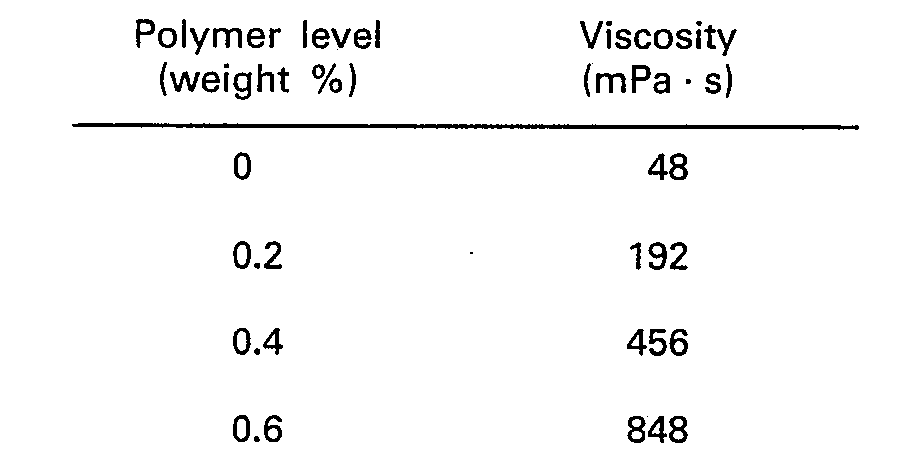
- With this inherently more viscous base solution, a level of 0.2% by weight of polymer was sufficient to bring the viscosity at 26.5 S-1 up to the preferred level of 200 mPa - s.
- A number of different base solutions was prepared as shown in the Table below, in which "SS" indicates dialkyl sulphosuccinate, "AES" indicates alkyl ether sulphate (2EO, sodium salt), "ABS" indicates alkylbenzene sulphonate and "NI" indicates nonionic surfactant.
- Each solution contained 2% formalin and 0.15% perfume.

- All of these compositions were in the form of clear, homogeneous solutions of low viscosity, and all could be satisfactorily thickened using 0.2-0.45% by weight of the polymer Natrosol 250 HBR.
Claims (20)
Priority Applications (1)
| Application Number | Priority Date | Filing Date | Title |
|---|---|---|---|
| AT84302854T ATE31939T1 (en) | 1983-04-29 | 1984-04-27 | DETERGENT COMPOSITIONS. |
Applications Claiming Priority (2)
| Application Number | Priority Date | Filing Date | Title |
|---|---|---|---|
| GB838311854A GB8311854D0 (en) | 1983-04-29 | 1983-04-29 | Detergent compositions |
| GB8311854 | 1983-04-29 |
Publications (3)
| Publication Number | Publication Date |
|---|---|
| EP0124367A2 EP0124367A2 (en) | 1984-11-07 |
| EP0124367A3 EP0124367A3 (en) | 1986-07-30 |
| EP0124367B1 true EP0124367B1 (en) | 1988-01-13 |
Family
ID=10541953
Family Applications (1)
| Application Number | Title | Priority Date | Filing Date |
|---|---|---|---|
| EP84302854A Expired EP0124367B1 (en) | 1983-04-29 | 1984-04-27 | Detergent compositions |
Country Status (17)
| Country | Link |
|---|---|
| US (1) | US4576744A (en) |
| EP (1) | EP0124367B1 (en) |
| JP (1) | JPS59207995A (en) |
| AT (1) | ATE31939T1 (en) |
| AU (1) | AU552499B2 (en) |
| BR (1) | BR8401935A (en) |
| CA (1) | CA1224107A (en) |
| DE (1) | DE3468697D1 (en) |
| DK (1) | DK212584A (en) |
| GB (2) | GB8311854D0 (en) |
| GR (1) | GR81900B (en) |
| IN (1) | IN159974B (en) |
| NO (1) | NO841612L (en) |
| NZ (1) | NZ207944A (en) |
| PH (1) | PH19177A (en) |
| PT (1) | PT78501B (en) |
| ZA (1) | ZA843161B (en) |
Families Citing this family (39)
| Publication number | Priority date | Publication date | Assignee | Title |
|---|---|---|---|---|
| AU573338B2 (en) * | 1984-05-11 | 1988-06-02 | Unilever Plc | Homogenous foaming liquid composition |
| GB8416884D0 (en) * | 1984-07-03 | 1984-08-08 | Procter & Gamble | Liquid cleansing composition |
| GB8420945D0 (en) * | 1984-08-17 | 1984-09-19 | Unilever Plc | Detergents compositions |
| DE3545990A1 (en) * | 1985-12-23 | 1987-06-25 | Henkel Kgaa | NEW DIRT COLLECTING CLEANING AMPLIFIERS IN AQUEOUS WASHING AND CLEANING SOLUTIONS |
| DE3605716A1 (en) * | 1986-02-22 | 1987-09-03 | Henkel Kgaa | USE OF INSOLUBLE DIRT COLLECTORS FOR REGENERATING WASHING AND CLEANING SOLUTIONS |
| US4830774A (en) * | 1986-06-16 | 1989-05-16 | Helene Curtis, Inc. | Antidandruff shampoo composition having improved suspension properties |
| DE3706015A1 (en) * | 1987-02-25 | 1988-11-17 | Henkel Kgaa | LIQUID DETERGENT |
| DE3726912A1 (en) * | 1987-08-13 | 1989-02-23 | Henkel Kgaa | LIQUID MEDIUM TO CLEAN HARD SURFACES |
| JPH01120267A (en) * | 1987-11-05 | 1989-05-12 | Saraya Kk | Germicidal and detergent composition for food |
| JPH0721154B2 (en) * | 1988-10-15 | 1995-03-08 | 三洋化成工業株式会社 | Cleaning composition |
| GB8824599D0 (en) * | 1988-10-20 | 1988-11-23 | Unilever Plc | Detergent composition |
| US5057241A (en) * | 1988-11-16 | 1991-10-15 | S. C. Johnson & Son, Inc. | Dual polymer self-sealing detergent compositions and methods |
| US5372462A (en) * | 1993-01-07 | 1994-12-13 | Marathon Oil Company | Polymer enhanced foam for blocking fluid flow in soil |
| CA2137636A1 (en) * | 1993-12-22 | 1995-06-23 | Manilal Dahanayake | Surfactant compositions characterized by improved foam height |
| FR2721533B1 (en) * | 1994-06-22 | 1996-09-27 | Rhone Poulenc Chimie | Concentrated system based on a thickening agent, said system being dispersible and thickenable by dilution in an aqueous medium. |
| US6077317A (en) * | 1996-01-25 | 2000-06-20 | Lever Brothers Company, Division Of Conopco, Inc. | Prewash stain remover composition with siloxane based surfactant |
| US5747442A (en) * | 1996-01-25 | 1998-05-05 | Lever Brothers Company, Division Of Conopco, Inc. | Stick pretreater compositions containing hydrophobically modified polar polymers |
| US5820637A (en) * | 1996-01-25 | 1998-10-13 | Lever Brothers Company, Division Of Conopco, Inc. | Method of pretreating stained fabrics with pretreater or laundry additive compositions containing hydrophobically modified polar polymers |
| GB2309974A (en) * | 1996-02-08 | 1997-08-13 | Procter & Gamble | Use of cellulose ethers for soil removal |
| GB2309975A (en) * | 1996-02-08 | 1997-08-13 | Procter & Gamble | Use of cellulose ethers in dishwashing |
| DE19607799A1 (en) * | 1996-03-01 | 1997-09-04 | Henkel Kgaa | Hard surface cleaner with improved grease-dissolving power |
| US5798324A (en) * | 1996-04-05 | 1998-08-25 | S.C. Johnson & Son, Inc. | Glass cleaner with adjustable rheology |
| US5827808A (en) * | 1997-01-31 | 1998-10-27 | The Procter & Gamble Company | Dishwashing method |
| US5968493A (en) * | 1997-10-28 | 1999-10-19 | Amway Corportion | Hair care composition |
| GB9900957D0 (en) * | 1999-01-15 | 1999-03-10 | Unilever Plc | Improved detergent composition for washing fabric and hard surfaces |
| US8460790B2 (en) * | 2002-10-23 | 2013-06-11 | Toray Industries, Inc. | Nanofiber aggregate, polymer alloy fiber, hybrid fiber, fibrous structures, and processes for production of them |
| US6903062B2 (en) * | 2002-12-19 | 2005-06-07 | Ecolab, Inc. | Rheology modifier concentrate |
| US7049281B2 (en) * | 2003-11-06 | 2006-05-23 | Colgate-Palmolive Company | Liquid cleaning composition containing an anionic polyacrylamide copolymer |
| EP1997874A1 (en) * | 2007-05-25 | 2008-12-03 | JohnsonDiversey, Inc. | Ware washing system containing polysaccharide |
| EP2014757A1 (en) * | 2007-07-05 | 2009-01-14 | JohnsonDiversey, Inc. | Rinse aid |
| US20090258810A1 (en) * | 2008-04-01 | 2009-10-15 | Brian Xiaoqing Song | Gel automatic dishwashing detergent composition |
| US9376648B2 (en) * | 2008-04-07 | 2016-06-28 | The Procter & Gamble Company | Foam manipulation compositions containing fine particles |
| AR072859A1 (en) | 2008-05-23 | 2010-09-29 | Colgate Palmolive Co | CLEANING LIQUID METHODS AND COMPOSITIONS |
| KR101723248B1 (en) * | 2008-12-02 | 2017-04-04 | 디버세이, 인크 | Ware washing system containing cationic starch |
| CA2741269A1 (en) | 2010-06-11 | 2011-12-11 | The Dow Chemical Company Llc | Improved cleaning formulations |
| US20110315384A1 (en) * | 2010-06-25 | 2011-12-29 | Emilio Miquilena | Gelled foam compositions and methods |
| JP6910190B2 (en) * | 2017-04-25 | 2021-07-28 | ライオン株式会社 | Liquid detergent composition |
| PL4298192T3 (en) * | 2021-02-25 | 2025-03-31 | Dow Silicones Corporation | Aqueous light duty liquid detergent formulation |
| EP4089159B1 (en) * | 2021-05-10 | 2024-09-18 | The Procter & Gamble Company | Liquid hand dishwashing detergent composition |
Family Cites Families (41)
| Publication number | Priority date | Publication date | Assignee | Title |
|---|---|---|---|---|
| GB1054244A (en) * | 1900-01-01 | |||
| US3480546A (en) * | 1964-02-28 | 1969-11-25 | Dow Chemical Co | Aqueous foam containing a waterswellable polymer flameproofing composition and process of making same |
| GB1071660A (en) * | 1964-06-15 | 1967-06-07 | Pyrene Co Ltd | Foam compositions |
| NL6512328A (en) * | 1964-10-08 | 1966-06-06 | ||
| AT291414B (en) * | 1967-01-27 | 1971-07-12 | Unilever Nv | Detergents and cleaning agents |
| US3950260A (en) * | 1968-01-16 | 1976-04-13 | Ibrahim Andrew Eldib | Polyacrylates of selective viscosity as detergent builders |
| GB1250614A (en) * | 1968-03-29 | 1971-10-20 | ||
| US3910880A (en) * | 1970-09-30 | 1975-10-07 | Lever Brothers Ltd | Sulfosuccinate derivatives of carbohydrates |
| BE786954A (en) * | 1971-07-30 | 1973-01-29 | Unilever Nv | PRODUCTION OF DETERGENTS |
| NL7115726A (en) * | 1971-11-15 | 1973-05-17 | ||
| US3969500A (en) * | 1972-03-03 | 1976-07-13 | Lever Brothers Company | Shampoo containing a water-soluble linear carboxylic polymer |
| GB1429637A (en) * | 1972-04-06 | 1976-03-24 | Unilever Ltd | Dishwashing compositions |
| GB1429639A (en) * | 1972-04-18 | 1976-03-24 | Sovex Ltd | Endless conveyors |
| LU65997A1 (en) * | 1972-09-05 | 1974-03-14 | ||
| GB1460893A (en) * | 1973-01-31 | 1977-01-06 | Unilever Ltd | Fabric washing powder |
| GB1411463A (en) * | 1973-03-01 | 1975-10-22 | Citrex Sa | Detergent compositions |
| JPS5087102A (en) * | 1973-12-06 | 1975-07-14 | ||
| GB1471406A (en) * | 1974-05-21 | 1977-04-27 | Unilever Ltd | Detergent composition |
| US4013595A (en) * | 1975-05-23 | 1977-03-22 | S. C. Johnson & Son, Inc. | Non-flammable rug cleaning composition |
| US4022731A (en) * | 1975-10-24 | 1977-05-10 | American Cyanamid Company | Freeze-thaw stable, self-inverting, water-in-oil emulsion |
| DE2727463A1 (en) * | 1976-06-24 | 1978-01-05 | Procter & Gamble | DETERGENT PARTICULARLY SUITABLE FOR USE IN DISHWASHING MACHINES |
| GB1584127A (en) * | 1977-09-14 | 1981-02-04 | Nat Starch Chem Corp | Shampoo compositions |
| CA1188043A (en) * | 1978-12-29 | 1985-05-28 | Ching-Jen Chang | Methacrylic acid emulsion copolymers for thickening purposes |
| US4284534A (en) * | 1979-04-03 | 1981-08-18 | Jack S. Wachtel | Aqueous bubble blowing composition |
| US4228048A (en) * | 1979-05-25 | 1980-10-14 | Chemed Corporation | Foam cleaner for food plants |
| US4260528A (en) * | 1979-06-18 | 1981-04-07 | Lever Brothers Company | Aqueous high viscosity liquid dishwasher compositions |
| PH18436A (en) * | 1980-11-07 | 1985-07-08 | Unilever Nv | A fabric softening composition and a process for preparing it |
| GB2095276B (en) * | 1981-03-23 | 1985-10-23 | Unilever Plc | Fabric washing compositions |
| JPS57162799A (en) * | 1981-03-31 | 1982-10-06 | Fumakilla Ltd | Water-soluble fragrant detergent gel composition |
| NZ201307A (en) * | 1981-07-24 | 1985-08-16 | Unilever Plc | Detergent compositions containing dialkyl sulphosuccinates |
| NZ201306A (en) * | 1981-07-24 | 1985-08-16 | Unilever Plc | Detergent compositions containing dialkyl sulphosuccinates |
| AU549874B2 (en) * | 1981-07-24 | 1986-02-20 | Unilever Plc | Sulphosuccinates |
| NZ201310A (en) * | 1981-07-24 | 1985-08-16 | Unilever Plc | Detergent compositions containing dialkyl sulphosuccinates and water-soluble proteins |
| GR77266B (en) * | 1981-08-06 | 1984-09-11 | Colgate Palmolive Co | |
| JPS6022117B2 (en) * | 1981-10-15 | 1985-05-31 | 花王株式会社 | Felt cleaning agent for papermaking |
| US4414144A (en) * | 1981-12-30 | 1983-11-08 | Colgate-Palmolive Co. | Aqueous skin cleaner containing hydroxypropylated guar gum and paraffin sulfonate/alkyl sulfate detergent mixture |
| US4472297A (en) * | 1982-03-01 | 1984-09-18 | The Procter & Gamble Company | Shampoo compositions containing hydroxypropyl guar gum |
| US4529773A (en) * | 1982-03-17 | 1985-07-16 | David Witiak | Alkali-soluble emulsion polymers in acidic surfactant compositions |
| CA1206391A (en) * | 1982-04-15 | 1986-06-24 | American Home Products Corporation | Pourable gel dishwasher compositions |
| GB2126243B (en) * | 1982-08-30 | 1986-08-06 | Colgate Palmolive Co | Process for dispersing hydroxypropyl methyl cellulose |
| NZ206211A (en) * | 1982-11-16 | 1986-04-11 | Unilever Plc | Foaming liquid detergent compositions containing sulphosuccinic acid esters |
-
1983
- 1983-04-29 GB GB838311854A patent/GB8311854D0/en active Pending
-
1984
- 1984-04-20 US US06/602,575 patent/US4576744A/en not_active Expired - Fee Related
- 1984-04-24 NO NO841612A patent/NO841612L/en unknown
- 1984-04-24 PH PH30596A patent/PH19177A/en unknown
- 1984-04-24 AU AU27210/84A patent/AU552499B2/en not_active Ceased
- 1984-04-25 IN IN122/BOM/84A patent/IN159974B/en unknown
- 1984-04-25 BR BR8401935A patent/BR8401935A/en unknown
- 1984-04-25 GR GR74500A patent/GR81900B/el unknown
- 1984-04-26 NZ NZ207944A patent/NZ207944A/en unknown
- 1984-04-27 CA CA000453066A patent/CA1224107A/en not_active Expired
- 1984-04-27 DE DE8484302854T patent/DE3468697D1/en not_active Expired
- 1984-04-27 EP EP84302854A patent/EP0124367B1/en not_active Expired
- 1984-04-27 DK DK212584A patent/DK212584A/en not_active Application Discontinuation
- 1984-04-27 ZA ZA843161A patent/ZA843161B/en unknown
- 1984-04-27 GB GB08410825A patent/GB2140024B/en not_active Expired
- 1984-04-27 AT AT84302854T patent/ATE31939T1/en not_active IP Right Cessation
- 1984-04-27 PT PT78501A patent/PT78501B/en unknown
- 1984-05-01 JP JP59088220A patent/JPS59207995A/en active Pending
Also Published As
| Publication number | Publication date |
|---|---|
| PT78501B (en) | 1987-01-05 |
| GB8311854D0 (en) | 1983-06-02 |
| GB2140024B (en) | 1986-09-03 |
| ZA843161B (en) | 1985-12-24 |
| GB8410825D0 (en) | 1984-06-06 |
| DK212584D0 (en) | 1984-04-27 |
| AU552499B2 (en) | 1986-06-05 |
| DE3468697D1 (en) | 1988-02-18 |
| EP0124367A2 (en) | 1984-11-07 |
| IN159974B (en) | 1987-06-13 |
| ATE31939T1 (en) | 1988-01-15 |
| JPS59207995A (en) | 1984-11-26 |
| NZ207944A (en) | 1986-11-12 |
| GR81900B (en) | 1984-12-12 |
| PT78501A (en) | 1984-05-01 |
| US4576744A (en) | 1986-03-18 |
| AU2721084A (en) | 1984-11-01 |
| BR8401935A (en) | 1984-12-04 |
| GB2140024A (en) | 1984-11-21 |
| CA1224107A (en) | 1987-07-14 |
| PH19177A (en) | 1986-01-23 |
| DK212584A (en) | 1984-10-30 |
| NO841612L (en) | 1984-10-30 |
| EP0124367A3 (en) | 1986-07-30 |
Similar Documents
| Publication | Publication Date | Title |
|---|---|---|
| EP0124367B1 (en) | Detergent compositions | |
| AU664023B2 (en) | Liquid detergent compositions | |
| EP0509608B1 (en) | Light duty liquid detergent compositions | |
| CA1220110A (en) | Detergent compositions | |
| US4596672A (en) | Detergent compositions | |
| US4556510A (en) | Transparent liquid shower soap | |
| KR960015369B1 (en) | Washing and cleaning agent in paste form and process for producing it | |
| US5480586A (en) | Light duty liquid detergent compostion comprising a sulfosuccinamate-containing surfactant blend | |
| IE863011L (en) | Liquid detergent compositions | |
| US5565146A (en) | Light duty liquid detergent compositions | |
| AU654508B2 (en) | Concentrated liquid detergent composition containing alkyl benzene sulfonate and magnesium | |
| WO1991013959A1 (en) | Light-duty liquid dishwashing detergent compositions | |
| EP0157443B1 (en) | Detergent composition containing semi-polar nonionic detergent, alkaline earth metal anionic detergent, and amidoalkylbetaine detergent | |
| GB2103236A (en) | Foam enhancing agent for light duty liquid detergent | |
| US4434088A (en) | Detergent compositions containing sulphosuccinates and high bloom gel strength protein | |
| CA1234325A (en) | Detergent compositions | |
| WO1990002164A1 (en) | Light duty liquid detergent compositions | |
| CA2111548C (en) | Amide thickening agent and thickened cleaner compositions | |
| US5780411A (en) | High foaming nonionic surfactant based liquid detergent | |
| EP0112044B1 (en) | Detergent compositions | |
| EP0197649A2 (en) | Liquid cleansing composition | |
| US5451342A (en) | Waterwhite clear liquid detergent compositions | |
| GB2166149A (en) | Thickened liquid detergent compositions | |
| JPS59117594A (en) | Liquid detergent composition |
Legal Events
| Date | Code | Title | Description |
|---|---|---|---|
| PUAI | Public reference made under article 153(3) epc to a published international application that has entered the european phase |
Free format text: ORIGINAL CODE: 0009012 |
|
| AK | Designated contracting states |
Designated state(s): AT BE CH DE FR IT LI NL SE |
|
| PUAL | Search report despatched |
Free format text: ORIGINAL CODE: 0009013 |
|
| AK | Designated contracting states |
Kind code of ref document: A3 Designated state(s): AT BE CH DE FR IT LI NL SE |
|
| 17P | Request for examination filed |
Effective date: 19860911 |
|
| 17Q | First examination report despatched |
Effective date: 19870330 |
|
| GRAA | (expected) grant |
Free format text: ORIGINAL CODE: 0009210 |
|
| AK | Designated contracting states |
Kind code of ref document: B1 Designated state(s): AT BE CH DE FR IT LI NL SE |
|
| PG25 | Lapsed in a contracting state [announced via postgrant information from national office to epo] |
Ref country code: NL Effective date: 19880113 Ref country code: IT Free format text: LAPSE BECAUSE OF FAILURE TO SUBMIT A TRANSLATION OF THE DESCRIPTION OR TO PAY THE FEE WITHIN THE PRESCRIBED TIME-LIMIT;WARNING: LAPSES OF ITALIAN PATENTS WITH EFFECTIVE DATE BEFORE 2007 MAY HAVE OCCURRED AT ANY TIME BEFORE 2007. THE CORRECT EFFECTIVE DATE MAY BE DIFFERENT FROM THE ONE RECORDED. Effective date: 19880113 Ref country code: FR Free format text: THE PATENT HAS BEEN ANNULLED BY A DECISION OF A NATIONAL AUTHORITY Effective date: 19880113 Ref country code: BE Effective date: 19880113 Ref country code: AT Effective date: 19880113 |
|
| REF | Corresponds to: |
Ref document number: 31939 Country of ref document: AT Date of ref document: 19880115 Kind code of ref document: T |
|
| REF | Corresponds to: |
Ref document number: 3468697 Country of ref document: DE Date of ref document: 19880218 |
|
| PG25 | Lapsed in a contracting state [announced via postgrant information from national office to epo] |
Ref country code: SE Effective date: 19880428 |
|
| PG25 | Lapsed in a contracting state [announced via postgrant information from national office to epo] |
Ref country code: LI Effective date: 19880430 Ref country code: CH Effective date: 19880430 |
|
| EN | Fr: translation not filed | ||
| NLV1 | Nl: lapsed or annulled due to failure to fulfill the requirements of art. 29p and 29m of the patents act | ||
| PLBE | No opposition filed within time limit |
Free format text: ORIGINAL CODE: 0009261 |
|
| STAA | Information on the status of an ep patent application or granted ep patent |
Free format text: STATUS: NO OPPOSITION FILED WITHIN TIME LIMIT |
|
| REG | Reference to a national code |
Ref country code: CH Ref legal event code: PL |
|
| PG25 | Lapsed in a contracting state [announced via postgrant information from national office to epo] |
Ref country code: DE Effective date: 19890103 |
|
| 26N | No opposition filed | ||
| EUG | Se: european patent has lapsed |
Ref document number: 84302854.9 Effective date: 19890726 |