EP0123700A1 - Substituierte Picolinsäuren, Verfahren zu ihrer Herstellung, ihre Verwendung und sie enthaltende Arzneimittel - Google Patents
Substituierte Picolinsäuren, Verfahren zu ihrer Herstellung, ihre Verwendung und sie enthaltende Arzneimittel Download PDFInfo
- Publication number
- EP0123700A1 EP0123700A1 EP83104094A EP83104094A EP0123700A1 EP 0123700 A1 EP0123700 A1 EP 0123700A1 EP 83104094 A EP83104094 A EP 83104094A EP 83104094 A EP83104094 A EP 83104094A EP 0123700 A1 EP0123700 A1 EP 0123700A1
- Authority
- EP
- European Patent Office
- Prior art keywords
- carbon atoms
- alkyl
- phenyl
- compounds
- denotes
- Prior art date
- Legal status (The legal status is an assumption and is not a legal conclusion. Google has not performed a legal analysis and makes no representation as to the accuracy of the status listed.)
- Withdrawn
Links
- SIOXPEMLGUPBBT-UHFFFAOYSA-N picolinic acid Chemical class OC(=O)C1=CC=CC=N1 SIOXPEMLGUPBBT-UHFFFAOYSA-N 0.000 title claims abstract description 24
- 238000000034 method Methods 0.000 title claims abstract description 18
- 230000008569 process Effects 0.000 title claims abstract description 14
- 238000002360 preparation method Methods 0.000 title claims abstract description 10
- 239000000825 pharmaceutical preparation Substances 0.000 title description 3
- 125000004432 carbon atom Chemical group C* 0.000 claims abstract description 89
- 150000001875 compounds Chemical class 0.000 claims abstract description 76
- -1 pyrrolidino, morpholino, piperidino Chemical group 0.000 claims abstract description 67
- 125000001997 phenyl group Chemical group [H]C1=C([H])C([H])=C(*)C([H])=C1[H] 0.000 claims abstract description 62
- 125000000217 alkyl group Chemical group 0.000 claims abstract description 56
- 239000002253 acid Substances 0.000 claims abstract description 47
- 150000003839 salts Chemical class 0.000 claims abstract description 46
- 239000001301 oxygen Substances 0.000 claims abstract description 31
- 229910052760 oxygen Inorganic materials 0.000 claims abstract description 31
- QVGXLLKOCUKJST-UHFFFAOYSA-N atomic oxygen Chemical compound [O] QVGXLLKOCUKJST-UHFFFAOYSA-N 0.000 claims abstract description 25
- VGGSQFUCUMXWEO-UHFFFAOYSA-N Ethene Chemical group C=C VGGSQFUCUMXWEO-UHFFFAOYSA-N 0.000 claims abstract description 22
- 125000002947 alkylene group Chemical group 0.000 claims abstract description 20
- 125000001424 substituent group Chemical group 0.000 claims abstract description 19
- 229910052736 halogen Inorganic materials 0.000 claims abstract description 18
- 150000002367 halogens Chemical class 0.000 claims abstract description 18
- 239000005977 Ethylene Substances 0.000 claims abstract description 17
- 125000001316 cycloalkyl alkyl group Chemical group 0.000 claims abstract description 17
- 125000003545 alkoxy group Chemical group 0.000 claims abstract description 15
- 125000002887 hydroxy group Chemical group [H]O* 0.000 claims abstract description 14
- 229910052757 nitrogen Inorganic materials 0.000 claims abstract description 13
- 125000004433 nitrogen atom Chemical group N* 0.000 claims abstract description 13
- 125000003342 alkenyl group Chemical group 0.000 claims abstract description 12
- 125000000484 butyl group Chemical group [H]C([*])([H])C([H])([H])C([H])([H])C([H])([H])[H] 0.000 claims abstract description 12
- 125000000753 cycloalkyl group Chemical group 0.000 claims abstract description 12
- 239000001257 hydrogen Substances 0.000 claims abstract description 9
- 229910052739 hydrogen Inorganic materials 0.000 claims abstract description 9
- 125000001797 benzyl group Chemical group [H]C1=C([H])C([H])=C(C([H])=C1[H])C([H])([H])* 0.000 claims abstract description 7
- 125000004435 hydrogen atom Chemical class [H]* 0.000 claims abstract 5
- 125000002496 methyl group Chemical group [H]C([H])([H])* 0.000 claims description 32
- 125000001495 ethyl group Chemical group [H]C([H])([H])C([H])([H])* 0.000 claims description 31
- 125000001301 ethoxy group Chemical group [H]C([H])([H])C([H])([H])O* 0.000 claims description 17
- 125000000956 methoxy group Chemical group [H]C([H])([H])O* 0.000 claims description 15
- 125000003258 trimethylene group Chemical group [H]C([H])([*:2])C([H])([H])C([H])([H])[*:1] 0.000 claims description 14
- 239000003814 drug Substances 0.000 claims description 11
- 150000001412 amines Chemical class 0.000 claims description 9
- ZAMOUSCENKQFHK-UHFFFAOYSA-N Chlorine atom Chemical compound [Cl] ZAMOUSCENKQFHK-UHFFFAOYSA-N 0.000 claims description 8
- 239000000460 chlorine Substances 0.000 claims description 8
- 229910052801 chlorine Inorganic materials 0.000 claims description 8
- 206010020772 Hypertension Diseases 0.000 claims description 6
- 230000001077 hypotensive effect Effects 0.000 abstract description 2
- HEDRZPFGACZZDS-UHFFFAOYSA-N Chloroform Chemical compound ClC(Cl)Cl HEDRZPFGACZZDS-UHFFFAOYSA-N 0.000 description 36
- YMWUJEATGCHHMB-UHFFFAOYSA-N Dichloromethane Chemical compound ClCCl YMWUJEATGCHHMB-UHFFFAOYSA-N 0.000 description 30
- 125000004204 2-methoxyphenyl group Chemical group [H]C1=C([H])C(*)=C(OC([H])([H])[H])C([H])=C1[H] 0.000 description 21
- VEXZGXHMUGYJMC-UHFFFAOYSA-N Hydrochloric acid Chemical compound Cl VEXZGXHMUGYJMC-UHFFFAOYSA-N 0.000 description 21
- DGMPVYSXXIOGJY-UHFFFAOYSA-N Fusaric acid Chemical compound CCCCC1=CC=C(C(O)=O)N=C1 DGMPVYSXXIOGJY-UHFFFAOYSA-N 0.000 description 19
- 150000001408 amides Chemical class 0.000 description 19
- 239000000243 solution Substances 0.000 description 17
- 125000001436 propyl group Chemical group [H]C([*])([H])C([H])([H])C([H])([H])[H] 0.000 description 16
- OKKJLVBELUTLKV-UHFFFAOYSA-N Methanol Chemical compound OC OKKJLVBELUTLKV-UHFFFAOYSA-N 0.000 description 15
- HEMHJVSKTPXQMS-UHFFFAOYSA-M Sodium hydroxide Chemical compound [OH-].[Na+] HEMHJVSKTPXQMS-UHFFFAOYSA-M 0.000 description 15
- 239000002904 solvent Substances 0.000 description 15
- 239000003921 oil Substances 0.000 description 14
- LFQSCWFLJHTTHZ-UHFFFAOYSA-N Ethanol Chemical compound CCO LFQSCWFLJHTTHZ-UHFFFAOYSA-N 0.000 description 13
- 238000006243 chemical reaction Methods 0.000 description 13
- BWHMMNNQKKPAPP-UHFFFAOYSA-L potassium carbonate Chemical compound [K+].[K+].[O-]C([O-])=O BWHMMNNQKKPAPP-UHFFFAOYSA-L 0.000 description 13
- WEVYAHXRMPXWCK-UHFFFAOYSA-N Acetonitrile Chemical compound CC#N WEVYAHXRMPXWCK-UHFFFAOYSA-N 0.000 description 11
- XLYOFNOQVPJJNP-UHFFFAOYSA-N water Substances O XLYOFNOQVPJJNP-UHFFFAOYSA-N 0.000 description 11
- 239000000203 mixture Substances 0.000 description 10
- CSCPPACGZOOCGX-UHFFFAOYSA-N Acetone Chemical compound CC(C)=O CSCPPACGZOOCGX-UHFFFAOYSA-N 0.000 description 9
- 239000004480 active ingredient Substances 0.000 description 9
- 239000012071 phase Substances 0.000 description 9
- WYURNTSHIVDZCO-UHFFFAOYSA-N Tetrahydrofuran Chemical compound C1CCOC1 WYURNTSHIVDZCO-UHFFFAOYSA-N 0.000 description 8
- WGYKZJWCGVVSQN-UHFFFAOYSA-N propylamine Chemical compound CCCN WGYKZJWCGVVSQN-UHFFFAOYSA-N 0.000 description 8
- AQGYGJYEJSHSKE-UHFFFAOYSA-N methyl 5-phenylpyridine-2-carboxylate Chemical compound C1=NC(C(=O)OC)=CC=C1C1=CC=CC=C1 AQGYGJYEJSHSKE-UHFFFAOYSA-N 0.000 description 7
- UHOVQNZJYSORNB-UHFFFAOYSA-N Benzene Chemical compound C1=CC=CC=C1 UHOVQNZJYSORNB-UHFFFAOYSA-N 0.000 description 6
- MYMOFIZGZYHOMD-UHFFFAOYSA-N Dioxygen Chemical compound O=O MYMOFIZGZYHOMD-UHFFFAOYSA-N 0.000 description 6
- 241000700159 Rattus Species 0.000 description 6
- YXFVVABEGXRONW-UHFFFAOYSA-N Toluene Chemical compound CC1=CC=CC=C1 YXFVVABEGXRONW-UHFFFAOYSA-N 0.000 description 6
- ZMANZCXQSJIPKH-UHFFFAOYSA-N Triethylamine Chemical compound CCN(CC)CC ZMANZCXQSJIPKH-UHFFFAOYSA-N 0.000 description 6
- 230000036772 blood pressure Effects 0.000 description 6
- 238000001816 cooling Methods 0.000 description 6
- 229910000027 potassium carbonate Inorganic materials 0.000 description 6
- ZVHYKXSFZXVLDT-UHFFFAOYSA-N 5-(cyclohexylmethyl)pyridine-2-carboxylic acid Chemical compound C1=NC(C(=O)O)=CC=C1CC1CCCCC1 ZVHYKXSFZXVLDT-UHFFFAOYSA-N 0.000 description 5
- CNCJXSKAKGXNKJ-UHFFFAOYSA-N 5-phenylpyridine-2-carboxylic acid Chemical compound C1=NC(C(=O)O)=CC=C1C1=CC=CC=C1 CNCJXSKAKGXNKJ-UHFFFAOYSA-N 0.000 description 5
- 241001465754 Metazoa Species 0.000 description 5
- INDWWOSXRMTACE-UHFFFAOYSA-N methyl 5-(cyclohexylmethyl)pyridine-2-carboxylate Chemical compound C1=NC(C(=O)OC)=CC=C1CC1CCCCC1 INDWWOSXRMTACE-UHFFFAOYSA-N 0.000 description 5
- 239000011541 reaction mixture Substances 0.000 description 5
- 239000000126 substance Substances 0.000 description 5
- FYSNRJHAOHDILO-UHFFFAOYSA-N thionyl chloride Chemical compound ClS(Cl)=O FYSNRJHAOHDILO-UHFFFAOYSA-N 0.000 description 5
- BFSVOASYOCHEOV-UHFFFAOYSA-N 2-diethylaminoethanol Chemical compound CCN(CC)CCO BFSVOASYOCHEOV-UHFFFAOYSA-N 0.000 description 4
- 229940013085 2-diethylaminoethanol Drugs 0.000 description 4
- VRILHLKPFHWWSD-UHFFFAOYSA-N 5-(4-chlorophenyl)pyridine-2-carboxylic acid Chemical compound C1=NC(C(=O)O)=CC=C1C1=CC=C(Cl)C=C1 VRILHLKPFHWWSD-UHFFFAOYSA-N 0.000 description 4
- DGAQECJNVWCQMB-PUAWFVPOSA-M Ilexoside XXIX Chemical compound C[C@@H]1CC[C@@]2(CC[C@@]3(C(=CC[C@H]4[C@]3(CC[C@@H]5[C@@]4(CC[C@@H](C5(C)C)OS(=O)(=O)[O-])C)C)[C@@H]2[C@]1(C)O)C)C(=O)O[C@H]6[C@@H]([C@H]([C@@H]([C@H](O6)CO)O)O)O.[Na+] DGAQECJNVWCQMB-PUAWFVPOSA-M 0.000 description 4
- VYPSYNLAJGMNEJ-UHFFFAOYSA-N Silicium dioxide Chemical compound O=[Si]=O VYPSYNLAJGMNEJ-UHFFFAOYSA-N 0.000 description 4
- 238000009835 boiling Methods 0.000 description 4
- 150000002431 hydrogen Chemical class 0.000 description 4
- 230000007935 neutral effect Effects 0.000 description 4
- 239000000741 silica gel Substances 0.000 description 4
- 229910002027 silica gel Inorganic materials 0.000 description 4
- 239000011734 sodium Substances 0.000 description 4
- 229910052708 sodium Inorganic materials 0.000 description 4
- 239000003826 tablet Substances 0.000 description 4
- YLQBMQCUIZJEEH-UHFFFAOYSA-N tetrahydrofuran Natural products C=1C=COC=1 YLQBMQCUIZJEEH-UHFFFAOYSA-N 0.000 description 4
- JOXIMZWYDAKGHI-UHFFFAOYSA-N toluene-4-sulfonic acid Chemical compound CC1=CC=C(S(O)(=O)=O)C=C1 JOXIMZWYDAKGHI-UHFFFAOYSA-N 0.000 description 4
- SCYULBFZEHDVBN-UHFFFAOYSA-N 1,1-Dichloroethane Chemical compound CC(Cl)Cl SCYULBFZEHDVBN-UHFFFAOYSA-N 0.000 description 3
- RYHBNJHYFVUHQT-UHFFFAOYSA-N 1,4-Dioxane Chemical compound C1COCCO1 RYHBNJHYFVUHQT-UHFFFAOYSA-N 0.000 description 3
- 229940105325 3-dimethylaminopropylamine Drugs 0.000 description 3
- XEKOWRVHYACXOJ-UHFFFAOYSA-N Ethyl acetate Chemical compound CCOC(C)=O XEKOWRVHYACXOJ-UHFFFAOYSA-N 0.000 description 3
- HSHXDCVZWHOWCS-UHFFFAOYSA-N N'-hexadecylthiophene-2-carbohydrazide Chemical compound CCCCCCCCCCCCCCCCNNC(=O)c1cccs1 HSHXDCVZWHOWCS-UHFFFAOYSA-N 0.000 description 3
- KWYUFKZDYYNOTN-UHFFFAOYSA-M Potassium hydroxide Chemical compound [OH-].[K+] KWYUFKZDYYNOTN-UHFFFAOYSA-M 0.000 description 3
- 150000008064 anhydrides Chemical class 0.000 description 3
- 239000008346 aqueous phase Substances 0.000 description 3
- IUNMPGNGSSIWFP-UHFFFAOYSA-N dimethylaminopropylamine Chemical compound CN(C)CCCN IUNMPGNGSSIWFP-UHFFFAOYSA-N 0.000 description 3
- 238000004821 distillation Methods 0.000 description 3
- 230000000694 effects Effects 0.000 description 3
- 150000002148 esters Chemical class 0.000 description 3
- 238000001704 evaporation Methods 0.000 description 3
- 230000008020 evaporation Effects 0.000 description 3
- 239000001866 hydroxypropyl methyl cellulose Substances 0.000 description 3
- 229920003088 hydroxypropyl methyl cellulose Polymers 0.000 description 3
- 235000010979 hydroxypropyl methyl cellulose Nutrition 0.000 description 3
- MRQHOIFGNSUAQB-UHFFFAOYSA-N methyl 5-(3,4-dimethoxyphenyl)pyridine-2-carboxylate Chemical compound C1=NC(C(=O)OC)=CC=C1C1=CC=C(OC)C(OC)=C1 MRQHOIFGNSUAQB-UHFFFAOYSA-N 0.000 description 3
- QHFSYCQAXCWCQO-UHFFFAOYSA-N methyl 5-butylpyridine-2-carboxylate Chemical compound CCCCC1=CC=C(C(=O)OC)N=C1 QHFSYCQAXCWCQO-UHFFFAOYSA-N 0.000 description 3
- UDGSVBYJWHOHNN-UHFFFAOYSA-N n',n'-diethylethane-1,2-diamine Chemical compound CCN(CC)CCN UDGSVBYJWHOHNN-UHFFFAOYSA-N 0.000 description 3
- QOHMWDJIBGVPIF-UHFFFAOYSA-N n',n'-diethylpropane-1,3-diamine Chemical compound CCN(CC)CCCN QOHMWDJIBGVPIF-UHFFFAOYSA-N 0.000 description 3
- 239000008188 pellet Substances 0.000 description 3
- 229940081066 picolinic acid Drugs 0.000 description 3
- 239000000725 suspension Substances 0.000 description 3
- 238000012360 testing method Methods 0.000 description 3
- VZCYOOQTPOCHFL-UHFFFAOYSA-N trans-butenedioic acid Natural products OC(=O)C=CC(O)=O VZCYOOQTPOCHFL-UHFFFAOYSA-N 0.000 description 3
- WSLDOOZREJYCGB-UHFFFAOYSA-N 1,2-Dichloroethane Chemical compound ClCCCl WSLDOOZREJYCGB-UHFFFAOYSA-N 0.000 description 2
- DBQUKJMNGUJRFI-UHFFFAOYSA-N 2-(diethylamino)ethanol;hydron;chloride Chemical compound Cl.CCN(CC)CCO DBQUKJMNGUJRFI-UHFFFAOYSA-N 0.000 description 2
- NDVVQPVEUGLAPX-UHFFFAOYSA-N 2-[4-(2-methoxyphenyl)piperazin-1-yl]ethanamine Chemical compound COC1=CC=CC=C1N1CCN(CCN)CC1 NDVVQPVEUGLAPX-UHFFFAOYSA-N 0.000 description 2
- FDQHDJBCFDAPCV-UHFFFAOYSA-N 2-[di(propan-2-yl)amino]ethyl 5-(3-cyclobutylpropyl)pyridine-2-carboxylate Chemical compound C1=NC(C(=O)OCCN(C(C)C)C(C)C)=CC=C1CCCC1CCC1 FDQHDJBCFDAPCV-UHFFFAOYSA-N 0.000 description 2
- XHHBNEUAKSEZMR-UHFFFAOYSA-N 3-(diethylamino)propyl 5-propylpyridine-2-carboxylate Chemical compound CCCC1=CC=C(C(=O)OCCCN(CC)CC)N=C1 XHHBNEUAKSEZMR-UHFFFAOYSA-N 0.000 description 2
- ALKYHXVLJMQRLQ-UHFFFAOYSA-N 3-Hydroxy-2-naphthoate Chemical compound C1=CC=C2C=C(O)C(C(=O)O)=CC2=C1 ALKYHXVLJMQRLQ-UHFFFAOYSA-N 0.000 description 2
- JMUCXULQKPWSTJ-UHFFFAOYSA-N 3-piperidin-1-ylpropan-1-amine Chemical compound NCCCN1CCCCC1 JMUCXULQKPWSTJ-UHFFFAOYSA-N 0.000 description 2
- VCPBYLUDWGYFIQ-UHFFFAOYSA-N 4-benzyl-3-(butylamino)-5-sulfamoylbenzoic acid Chemical compound CCCCNC1=CC(C(O)=O)=CC(S(N)(=O)=O)=C1CC1=CC=CC=C1 VCPBYLUDWGYFIQ-UHFFFAOYSA-N 0.000 description 2
- FHRSEXSONQCENT-UHFFFAOYSA-N 5-(2,4-dichlorophenyl)-n-[3-(dimethylamino)propyl]pyridine-2-carboxamide Chemical compound C1=NC(C(=O)NCCCN(C)C)=CC=C1C1=CC=C(Cl)C=C1Cl FHRSEXSONQCENT-UHFFFAOYSA-N 0.000 description 2
- ZCXCOMONAAMRHJ-UHFFFAOYSA-N 5-(2-cyclohexylethyl)-n-[4-(dimethylamino)butyl]pyridine-2-carboxamide Chemical compound C1=NC(C(=O)NCCCCN(C)C)=CC=C1CCC1CCCCC1 ZCXCOMONAAMRHJ-UHFFFAOYSA-N 0.000 description 2
- LYVKCQFKMBPLRF-UHFFFAOYSA-N 5-(4-chlorophenyl)-N-[4-(diethylamino)butyl]pyridine-2-carboxamide Chemical compound C(C)N(CCCCNC(=O)C1=NC=C(C=C1)C1=CC=C(C=C1)Cl)CC LYVKCQFKMBPLRF-UHFFFAOYSA-N 0.000 description 2
- OLAMQADTNVYWOV-UHFFFAOYSA-N 5-(4-chlorophenyl)-n-[3-(diethylamino)propyl]pyridine-2-carboxamide Chemical compound C1=NC(C(=O)NCCCN(CC)CC)=CC=C1C1=CC=C(Cl)C=C1 OLAMQADTNVYWOV-UHFFFAOYSA-N 0.000 description 2
- PHPKMTIQHJCPGL-UHFFFAOYSA-N 5-butyl-n-(3-piperidin-1-ylpropyl)pyridine-2-carboxamide Chemical compound N1=CC(CCCC)=CC=C1C(=O)NCCCN1CCCCC1 PHPKMTIQHJCPGL-UHFFFAOYSA-N 0.000 description 2
- XXQUTAQYBHMLFJ-UHFFFAOYSA-N 5-hexyl-n-(2-pyrrolidin-1-ylethyl)pyridine-2-carboxamide Chemical compound N1=CC(CCCCCC)=CC=C1C(=O)NCCN1CCCC1 XXQUTAQYBHMLFJ-UHFFFAOYSA-N 0.000 description 2
- ZLAZCBLDWBORNO-UHFFFAOYSA-N 5-methyl-N-(2-piperidin-1-ylbutyl)pyridine-2-carboxamide Chemical compound N1(CCCCC1)C(CNC(=O)C1=NC=C(C=C1)C)CC ZLAZCBLDWBORNO-UHFFFAOYSA-N 0.000 description 2
- WUPZZPRYJBMRJD-UHFFFAOYSA-N C(CCC)C=1C=CC(=NC=1)CC(=O)O Chemical compound C(CCC)C=1C=CC(=NC=1)CC(=O)O WUPZZPRYJBMRJD-UHFFFAOYSA-N 0.000 description 2
- 0 CC(C=C1)=CCI(C)=C1[N+](*N*(*)*)[O-] Chemical compound CC(C=C1)=CCI(C)=C1[N+](*N*(*)*)[O-] 0.000 description 2
- FBPFZTCFMRRESA-KVTDHHQDSA-N D-Mannitol Chemical compound OC[C@@H](O)[C@@H](O)[C@H](O)[C@H](O)CO FBPFZTCFMRRESA-KVTDHHQDSA-N 0.000 description 2
- QUSNBJAOOMFDIB-UHFFFAOYSA-N Ethylamine Chemical compound CCN QUSNBJAOOMFDIB-UHFFFAOYSA-N 0.000 description 2
- UFHFLCQGNIYNRP-UHFFFAOYSA-N Hydrogen Chemical compound [H][H] UFHFLCQGNIYNRP-UHFFFAOYSA-N 0.000 description 2
- KFZMGEQAYNKOFK-UHFFFAOYSA-N Isopropanol Chemical compound CC(C)O KFZMGEQAYNKOFK-UHFFFAOYSA-N 0.000 description 2
- 241000124008 Mammalia Species 0.000 description 2
- ZABAEWPCLLVVJI-UHFFFAOYSA-N N-[2-(diethylamino)propyl]-5-(4-ethoxyphenyl)pyridine-2-carboxamide Chemical compound C(C)N(C(CNC(=O)C1=NC=C(C=C1)C1=CC=C(C=C1)OCC)C)CC ZABAEWPCLLVVJI-UHFFFAOYSA-N 0.000 description 2
- CTQNGGLPUBDAKN-UHFFFAOYSA-N O-Xylene Chemical compound CC1=CC=CC=C1C CTQNGGLPUBDAKN-UHFFFAOYSA-N 0.000 description 2
- UJEWTUDSLQGTOA-UHFFFAOYSA-N Piretanide Chemical compound C=1C=CC=CC=1OC=1C(S(=O)(=O)N)=CC(C(O)=O)=CC=1N1CCCC1 UJEWTUDSLQGTOA-UHFFFAOYSA-N 0.000 description 2
- 208000001871 Tachycardia Diseases 0.000 description 2
- 239000013543 active substance Substances 0.000 description 2
- 229930013930 alkaloid Natural products 0.000 description 2
- 238000005804 alkylation reaction Methods 0.000 description 2
- 230000003276 anti-hypertensive effect Effects 0.000 description 2
- 210000001367 artery Anatomy 0.000 description 2
- 239000002585 base Substances 0.000 description 2
- 238000005815 base catalysis Methods 0.000 description 2
- 239000011230 binding agent Substances 0.000 description 2
- 230000037396 body weight Effects 0.000 description 2
- MAEIEVLCKWDQJH-UHFFFAOYSA-N bumetanide Chemical compound CCCCNC1=CC(C(O)=O)=CC(S(N)(=O)=O)=C1OC1=CC=CC=C1 MAEIEVLCKWDQJH-UHFFFAOYSA-N 0.000 description 2
- 239000002775 capsule Substances 0.000 description 2
- 230000004087 circulation Effects 0.000 description 2
- 239000000470 constituent Substances 0.000 description 2
- 125000004210 cyclohexylmethyl group Chemical group [H]C([H])(*)C1([H])C([H])([H])C([H])([H])C([H])([H])C([H])([H])C1([H])[H] 0.000 description 2
- 238000005886 esterification reaction Methods 0.000 description 2
- AVOLMBLBETYQHX-UHFFFAOYSA-N etacrynic acid Chemical compound CCC(=C)C(=O)C1=CC=C(OCC(O)=O)C(Cl)=C1Cl AVOLMBLBETYQHX-UHFFFAOYSA-N 0.000 description 2
- 239000000284 extract Substances 0.000 description 2
- ZZUFCTLCJUWOSV-UHFFFAOYSA-N furosemide Chemical compound C1=C(Cl)C(S(=O)(=O)N)=CC(C(O)=O)=C1NCC1=CC=CO1 ZZUFCTLCJUWOSV-UHFFFAOYSA-N 0.000 description 2
- 229960003883 furosemide Drugs 0.000 description 2
- 239000008187 granular material Substances 0.000 description 2
- 238000010438 heat treatment Methods 0.000 description 2
- SHFJWMWCIHQNCP-UHFFFAOYSA-M hydron;tetrabutylazanium;sulfate Chemical compound OS([O-])(=O)=O.CCCC[N+](CCCC)(CCCC)CCCC SHFJWMWCIHQNCP-UHFFFAOYSA-M 0.000 description 2
- 238000001990 intravenous administration Methods 0.000 description 2
- HQKMJHAJHXVSDF-UHFFFAOYSA-L magnesium stearate Chemical compound [Mg+2].CCCCCCCCCCCCCCCCCC([O-])=O.CCCCCCCCCCCCCCCCCC([O-])=O HQKMJHAJHXVSDF-UHFFFAOYSA-L 0.000 description 2
- 238000004519 manufacturing process Methods 0.000 description 2
- 238000002844 melting Methods 0.000 description 2
- 230000008018 melting Effects 0.000 description 2
- VSDLMZMDUPOZBL-UHFFFAOYSA-N methyl 5-(4-chlorophenyl)pyridine-2-carboxylate Chemical compound C1=NC(C(=O)OC)=CC=C1C1=CC=C(Cl)C=C1 VSDLMZMDUPOZBL-UHFFFAOYSA-N 0.000 description 2
- 239000002808 molecular sieve Substances 0.000 description 2
- 125000003261 o-tolyl group Chemical group [H]C1=C([H])C(*)=C(C([H])=C1[H])C([H])([H])[H] 0.000 description 2
- QIQXTHQIDYTFRH-UHFFFAOYSA-N octadecanoic acid Chemical compound CCCCCCCCCCCCCCCCCC(O)=O QIQXTHQIDYTFRH-UHFFFAOYSA-N 0.000 description 2
- 125000003854 p-chlorophenyl group Chemical group [H]C1=C([H])C(*)=C([H])C([H])=C1Cl 0.000 description 2
- 239000003208 petroleum Substances 0.000 description 2
- 229920000036 polyvinylpyrrolidone Polymers 0.000 description 2
- 150000003254 radicals Chemical class 0.000 description 2
- 230000009467 reduction Effects 0.000 description 2
- 238000010992 reflux Methods 0.000 description 2
- URGAHOPLAPQHLN-UHFFFAOYSA-N sodium aluminosilicate Chemical compound [Na+].[Al+3].[O-][Si]([O-])=O.[O-][Si]([O-])=O URGAHOPLAPQHLN-UHFFFAOYSA-N 0.000 description 2
- 230000006794 tachycardia Effects 0.000 description 2
- 239000000454 talc Substances 0.000 description 2
- 229910052623 talc Inorganic materials 0.000 description 2
- 230000001225 therapeutic effect Effects 0.000 description 2
- 238000005809 transesterification reaction Methods 0.000 description 2
- 238000010792 warming Methods 0.000 description 2
- 239000008096 xylene Substances 0.000 description 2
- DNXIKVLOVZVMQF-UHFFFAOYSA-N (3beta,16beta,17alpha,18beta,20alpha)-17-hydroxy-11-methoxy-18-[(3,4,5-trimethoxybenzoyl)oxy]-yohimban-16-carboxylic acid, methyl ester Natural products C1C2CN3CCC(C4=CC=C(OC)C=C4N4)=C4C3CC2C(C(=O)OC)C(O)C1OC(=O)C1=CC(OC)=C(OC)C(OC)=C1 DNXIKVLOVZVMQF-UHFFFAOYSA-N 0.000 description 1
- DNIAPMSPPWPWGF-GSVOUGTGSA-N (R)-(-)-Propylene glycol Chemical compound C[C@@H](O)CO DNIAPMSPPWPWGF-GSVOUGTGSA-N 0.000 description 1
- ADFXKUOMJKEIND-UHFFFAOYSA-N 1,3-dicyclohexylurea Chemical compound C1CCCCC1NC(=O)NC1CCCCC1 ADFXKUOMJKEIND-UHFFFAOYSA-N 0.000 description 1
- SZLZWPPUNLXJEA-UHFFFAOYSA-N 11,17-dimethoxy-18-[3-(3,4,5-trimethoxy-phenyl)-acryloyloxy]-yohimbane-16-carboxylic acid methyl ester Natural products C1C2CN3CCC(C4=CC=C(OC)C=C4N4)=C4C3CC2C(C(=O)OC)C(OC)C1OC(=O)C=CC1=CC(OC)=C(OC)C(OC)=C1 SZLZWPPUNLXJEA-UHFFFAOYSA-N 0.000 description 1
- YGTUPRIZNBMOFV-UHFFFAOYSA-N 2-(4-hydroxybenzoyl)benzoic acid Chemical compound OC(=O)C1=CC=CC=C1C(=O)C1=CC=C(O)C=C1 YGTUPRIZNBMOFV-UHFFFAOYSA-N 0.000 description 1
- GTMIXYICYSFTRJ-UHFFFAOYSA-N 2-(4-phenylpiperazin-1-yl)ethanol Chemical compound C1CN(CCO)CCN1C1=CC=CC=C1 GTMIXYICYSFTRJ-UHFFFAOYSA-N 0.000 description 1
- UGIXZIAAASQNJN-UHFFFAOYSA-N 2-(diethylamino)ethyl 5-butylpyridine-2-carboxylate Chemical compound CCCCC1=CC=C(C(=O)OCCN(CC)CC)N=C1 UGIXZIAAASQNJN-UHFFFAOYSA-N 0.000 description 1
- IATXTSFXTHORJB-UHFFFAOYSA-N 2-(dimethylamino)ethyl 5-phenylpyridine-2-carboxylate Chemical compound C1=NC(C(=O)OCCN(C)C)=CC=C1C1=CC=CC=C1 IATXTSFXTHORJB-UHFFFAOYSA-N 0.000 description 1
- SGUAFYQXFOLMHL-UHFFFAOYSA-N 2-hydroxy-5-{1-hydroxy-2-[(4-phenylbutan-2-yl)amino]ethyl}benzamide Chemical compound C=1C=C(O)C(C(N)=O)=CC=1C(O)CNC(C)CCC1=CC=CC=C1 SGUAFYQXFOLMHL-UHFFFAOYSA-N 0.000 description 1
- CJNRGSHEMCMUOE-UHFFFAOYSA-N 2-piperidin-1-ylethanamine Chemical compound NCCN1CCCCC1 CJNRGSHEMCMUOE-UHFFFAOYSA-N 0.000 description 1
- 125000003903 2-propenyl group Chemical group [H]C([*])([H])C([H])=C([H])[H] 0.000 description 1
- 125000003762 3,4-dimethoxyphenyl group Chemical group [H]C1=C([H])C(OC([H])([H])[H])=C(OC([H])([H])[H])C([H])=C1* 0.000 description 1
- WKCYFSZDBICRKL-UHFFFAOYSA-N 3-(diethylamino)propan-1-ol Chemical compound CCN(CC)CCCO WKCYFSZDBICRKL-UHFFFAOYSA-N 0.000 description 1
- JWLHAVLJJROKSB-UHFFFAOYSA-N 3-(dimethylamino)propyl 5-butylpyridine-2-carboxylate Chemical compound CCCCC1=CC=C(C(=O)OCCCN(C)C)N=C1 JWLHAVLJJROKSB-UHFFFAOYSA-N 0.000 description 1
- OVGGXHMQXIQOBR-UHFFFAOYSA-N 3-[4-(2-methoxyphenyl)piperazin-1-yl]propan-1-amine Chemical compound COC1=CC=CC=C1N1CCN(CCCN)CC1 OVGGXHMQXIQOBR-UHFFFAOYSA-N 0.000 description 1
- NSLZHZKOVGVVEH-UHFFFAOYSA-N 3-[4-(2-methoxyphenyl)piperazin-1-yl]propan-1-ol Chemical compound COC1=CC=CC=C1N1CCN(CCCO)CC1 NSLZHZKOVGVVEH-UHFFFAOYSA-N 0.000 description 1
- YJKVOYJAWDBYTM-UHFFFAOYSA-N 3-butylpyridine-2-carboxamide Chemical compound CCCCC1=CC=CN=C1C(N)=O YJKVOYJAWDBYTM-UHFFFAOYSA-N 0.000 description 1
- LJQNMDZRCXJETK-UHFFFAOYSA-N 3-chloro-n,n-dimethylpropan-1-amine;hydron;chloride Chemical compound Cl.CN(C)CCCCl LJQNMDZRCXJETK-UHFFFAOYSA-N 0.000 description 1
- VPBWZBGZWHDNKL-UHFFFAOYSA-N 3-pyrrolidin-1-ylpropan-1-amine Chemical compound NCCCN1CCCC1 VPBWZBGZWHDNKL-UHFFFAOYSA-N 0.000 description 1
- CMZTXNWSVHGZGD-UHFFFAOYSA-N 4-chloro-2-(furan-2-ylamino)-5-sulfamoylbenzoic acid Chemical compound ClC=1C=C(C(C(=O)O)=CC1S(N)(=O)=O)NC=1OC=CC1 CMZTXNWSVHGZGD-UHFFFAOYSA-N 0.000 description 1
- FHQAWINGVCDTTG-UHFFFAOYSA-N 4-chloro-3-sulfamoylbenzoic acid Chemical compound NS(=O)(=O)C1=CC(C(O)=O)=CC=C1Cl FHQAWINGVCDTTG-UHFFFAOYSA-N 0.000 description 1
- LBXHRAWDUMTPSE-AOOOYVTPSA-N 4-chloro-N-[(2S,6R)-2,6-dimethyl-1-piperidinyl]-3-sulfamoylbenzamide Chemical compound C[C@H]1CCC[C@@H](C)N1NC(=O)C1=CC=C(Cl)C(S(N)(=O)=O)=C1 LBXHRAWDUMTPSE-AOOOYVTPSA-N 0.000 description 1
- OXTSQIRKJXBDMM-UHFFFAOYSA-N 5-(2,4,6-trichlorophenyl)pyridine-2-carboxylic acid Chemical compound C1=NC(C(=O)O)=CC=C1C1=C(Cl)C=C(Cl)C=C1Cl OXTSQIRKJXBDMM-UHFFFAOYSA-N 0.000 description 1
- AMGMXUYKSODIQE-UHFFFAOYSA-N 5-(2,4-dichlorophenyl)pyridine-2-carboxylic acid Chemical compound C1=NC(C(=O)O)=CC=C1C1=CC=C(Cl)C=C1Cl AMGMXUYKSODIQE-UHFFFAOYSA-N 0.000 description 1
- SVHMKZDSRAAIJL-UHFFFAOYSA-N 5-(2-cyclopentylethyl)pyridine-2-carboxylic acid Chemical compound C1=NC(C(=O)O)=CC=C1CCC1CCCC1 SVHMKZDSRAAIJL-UHFFFAOYSA-N 0.000 description 1
- KYPHTSJGUPKXCS-UHFFFAOYSA-N 5-(3,4-dichlorophenyl)pyridine-2-carboxylic acid Chemical compound C1=NC(C(=O)O)=CC=C1C1=CC=C(Cl)C(Cl)=C1 KYPHTSJGUPKXCS-UHFFFAOYSA-N 0.000 description 1
- JDVSEGPYEMBNDC-UHFFFAOYSA-N 5-(3,4-dimethoxyphenyl)-N-(3-piperidin-1-ylpropyl)pyridine-2-carboxamide Chemical compound N1(CCCCC1)CCCNC(=O)C1=NC=C(C=C1)C1=CC(=C(C=C1)OC)OC JDVSEGPYEMBNDC-UHFFFAOYSA-N 0.000 description 1
- PFGQLKXTTDCOQQ-UHFFFAOYSA-N 5-(3,4-dimethoxyphenyl)-N-[3-(dimethylamino)propyl]pyridine-2-carboxamide Chemical compound CN(CCCNC(=O)C1=NC=C(C=C1)C1=CC(=C(C=C1)OC)OC)C PFGQLKXTTDCOQQ-UHFFFAOYSA-N 0.000 description 1
- FCBIGZWGSVASRC-UHFFFAOYSA-N 5-(3,4-dimethoxyphenyl)pyridine-2-carboxylic acid Chemical compound C1=C(OC)C(OC)=CC=C1C1=CC=C(C(O)=O)N=C1 FCBIGZWGSVASRC-UHFFFAOYSA-N 0.000 description 1
- QVQVGMNJWKXOPJ-UHFFFAOYSA-N 5-(3-cyclobutylpropyl)pyridine-2-carboxylic acid Chemical compound C1=NC(C(=O)O)=CC=C1CCCC1CCC1 QVQVGMNJWKXOPJ-UHFFFAOYSA-N 0.000 description 1
- JUCKOTBCVIDZTC-UHFFFAOYSA-N 5-(4-hydroxyphenyl)pyridine-2-carboxylic acid Chemical compound C1=NC(C(=O)O)=CC=C1C1=CC=C(O)C=C1 JUCKOTBCVIDZTC-UHFFFAOYSA-N 0.000 description 1
- PNKPAQHQXPEKSE-UHFFFAOYSA-N 5-(cyclohexylmethyl)-N-(3-pyrrolidin-1-ylpropyl)pyridine-2-carboxamide Chemical compound N1(CCCC1)CCCNC(=O)C1=NC=C(C=C1)CC1CCCCC1 PNKPAQHQXPEKSE-UHFFFAOYSA-N 0.000 description 1
- YKVXIGQICOVCDV-UHFFFAOYSA-N 5-(cyclohexylmethyl)-N-[3-(dimethylamino)propyl]pyridine-2-carboxamide Chemical compound CN(CCCNC(=O)C1=NC=C(C=C1)CC1CCCCC1)C YKVXIGQICOVCDV-UHFFFAOYSA-N 0.000 description 1
- STCIUNWNDZWJRK-UHFFFAOYSA-N 5-acetyl-3-bromo-6-methyl-1h-pyridin-2-one Chemical compound CC(=O)C=1C=C(Br)C(=O)NC=1C STCIUNWNDZWJRK-UHFFFAOYSA-N 0.000 description 1
- REJHVSOVQBJEBF-UHFFFAOYSA-N 5-azaniumyl-2-[2-(4-azaniumyl-2-sulfonatophenyl)ethenyl]benzenesulfonate Chemical compound OS(=O)(=O)C1=CC(N)=CC=C1C=CC1=CC=C(N)C=C1S(O)(=O)=O REJHVSOVQBJEBF-UHFFFAOYSA-N 0.000 description 1
- DNPFJHBLVQKNEC-UHFFFAOYSA-N 5-butyl-N-[2-(dimethylamino)ethyl]pyridine-2-carboxamide Chemical compound CN(CCNC(=O)C1=NC=C(C=C1)CCCC)C DNPFJHBLVQKNEC-UHFFFAOYSA-N 0.000 description 1
- BJUHRNILEKRSDZ-UHFFFAOYSA-N 5-butyl-N-[3-(diethylamino)propyl]pyridine-2-carboxamide Chemical compound C(C)N(CCCNC(=O)C1=NC=C(C=C1)CCCC)CC BJUHRNILEKRSDZ-UHFFFAOYSA-N 0.000 description 1
- SPAOQUQKTRLDLI-UHFFFAOYSA-N 5-phenyl-N-(2-piperidin-1-ylethyl)pyridine-2-carboxamide Chemical compound N1(CCCCC1)CCNC(=O)C1=NC=C(C=C1)C1=CC=CC=C1 SPAOQUQKTRLDLI-UHFFFAOYSA-N 0.000 description 1
- QTBSBXVTEAMEQO-UHFFFAOYSA-M Acetate Chemical compound CC([O-])=O QTBSBXVTEAMEQO-UHFFFAOYSA-M 0.000 description 1
- 206010005746 Blood pressure fluctuation Diseases 0.000 description 1
- CPELXLSAUQHCOX-UHFFFAOYSA-M Bromide Chemical compound [Br-] CPELXLSAUQHCOX-UHFFFAOYSA-M 0.000 description 1
- WKBOTKDWSSQWDR-UHFFFAOYSA-N Bromine atom Chemical compound [Br] WKBOTKDWSSQWDR-UHFFFAOYSA-N 0.000 description 1
- VKSPIPWLHGKJQO-UHFFFAOYSA-N Bupicomide Chemical compound CCCCC1=CC=C(C(N)=O)N=C1 VKSPIPWLHGKJQO-UHFFFAOYSA-N 0.000 description 1
- FERIUCNNQQJTOY-UHFFFAOYSA-M Butyrate Chemical compound CCCC([O-])=O FERIUCNNQQJTOY-UHFFFAOYSA-M 0.000 description 1
- FERIUCNNQQJTOY-UHFFFAOYSA-N Butyric acid Natural products CCCC(O)=O FERIUCNNQQJTOY-UHFFFAOYSA-N 0.000 description 1
- VEXZGXHMUGYJMC-UHFFFAOYSA-M Chloride anion Chemical compound [Cl-] VEXZGXHMUGYJMC-UHFFFAOYSA-M 0.000 description 1
- JZUFKLXOESDKRF-UHFFFAOYSA-N Chlorothiazide Chemical compound C1=C(Cl)C(S(=O)(=O)N)=CC2=C1NCNS2(=O)=O JZUFKLXOESDKRF-UHFFFAOYSA-N 0.000 description 1
- KRKNYBCHXYNGOX-UHFFFAOYSA-K Citrate Chemical compound [O-]C(=O)CC(O)(CC([O-])=O)C([O-])=O KRKNYBCHXYNGOX-UHFFFAOYSA-K 0.000 description 1
- 229920002261 Corn starch Polymers 0.000 description 1
- RGHNJXZEOKUKBD-SQOUGZDYSA-M D-gluconate Chemical compound OC[C@@H](O)[C@@H](O)[C@H](O)[C@@H](O)C([O-])=O RGHNJXZEOKUKBD-SQOUGZDYSA-M 0.000 description 1
- FEWJPZIEWOKRBE-JCYAYHJZSA-N Dextrotartaric acid Chemical compound OC(=O)[C@H](O)[C@@H](O)C(O)=O FEWJPZIEWOKRBE-JCYAYHJZSA-N 0.000 description 1
- QOSSAOTZNIDXMA-UHFFFAOYSA-N Dicylcohexylcarbodiimide Chemical compound C1CCCCC1N=C=NC1CCCCC1 QOSSAOTZNIDXMA-UHFFFAOYSA-N 0.000 description 1
- 108010015720 Dopamine beta-Hydroxylase Proteins 0.000 description 1
- 102100033156 Dopamine beta-hydroxylase Human genes 0.000 description 1
- 239000001856 Ethyl cellulose Substances 0.000 description 1
- ZZSNKZQZMQGXPY-UHFFFAOYSA-N Ethyl cellulose Chemical compound CCOCC1OC(OC)C(OCC)C(OCC)C1OC1C(O)C(O)C(OC)C(CO)O1 ZZSNKZQZMQGXPY-UHFFFAOYSA-N 0.000 description 1
- PXGOKWXKJXAPGV-UHFFFAOYSA-N Fluorine Chemical compound FF PXGOKWXKJXAPGV-UHFFFAOYSA-N 0.000 description 1
- VZCYOOQTPOCHFL-OWOJBTEDSA-N Fumaric acid Chemical compound OC(=O)\C=C\C(O)=O VZCYOOQTPOCHFL-OWOJBTEDSA-N 0.000 description 1
- CPELXLSAUQHCOX-UHFFFAOYSA-N Hydrogen bromide Chemical compound Br CPELXLSAUQHCOX-UHFFFAOYSA-N 0.000 description 1
- 229930195725 Mannitol Natural products 0.000 description 1
- SMNOERSLNYGGOU-UHFFFAOYSA-N Mefruside Chemical compound C=1C=C(Cl)C(S(N)(=O)=O)=CC=1S(=O)(=O)N(C)CC1(C)CCCO1 SMNOERSLNYGGOU-UHFFFAOYSA-N 0.000 description 1
- AFVFQIVMOAPDHO-UHFFFAOYSA-M Methanesulfonate Chemical compound CS([O-])(=O)=O AFVFQIVMOAPDHO-UHFFFAOYSA-M 0.000 description 1
- AFVFQIVMOAPDHO-UHFFFAOYSA-N Methanesulfonic acid Chemical compound CS(O)(=O)=O AFVFQIVMOAPDHO-UHFFFAOYSA-N 0.000 description 1
- NMMIHXMBOZYNET-UHFFFAOYSA-N Methyl picolinate Chemical class COC(=O)C1=CC=CC=N1 NMMIHXMBOZYNET-UHFFFAOYSA-N 0.000 description 1
- 241000699666 Mus <mouse, genus> Species 0.000 description 1
- TVSMZTQSXPUFEU-UHFFFAOYSA-N N-[3-(dimethylamino)propyl]-5-phenylpyridine-2-carboxamide Chemical compound CN(CCCNC(=O)C1=NC=C(C=C1)C1=CC=CC=C1)C TVSMZTQSXPUFEU-UHFFFAOYSA-N 0.000 description 1
- UEEJHVSXFDXPFK-UHFFFAOYSA-N N-dimethylaminoethanol Chemical compound CN(C)CCO UEEJHVSXFDXPFK-UHFFFAOYSA-N 0.000 description 1
- 238000011785 NMRI mouse Methods 0.000 description 1
- 229910002651 NO3 Inorganic materials 0.000 description 1
- NHNBFGGVMKEFGY-UHFFFAOYSA-N Nitrate Chemical compound [O-][N+]([O-])=O NHNBFGGVMKEFGY-UHFFFAOYSA-N 0.000 description 1
- MUBZPKHOEPUJKR-UHFFFAOYSA-N Oxalic acid Chemical compound OC(=O)C(O)=O MUBZPKHOEPUJKR-UHFFFAOYSA-N 0.000 description 1
- 229910019142 PO4 Inorganic materials 0.000 description 1
- CYLWJCABXYDINA-UHFFFAOYSA-N Polythiazide Polymers ClC1=C(S(N)(=O)=O)C=C2S(=O)(=O)N(C)C(CSCC(F)(F)F)NC2=C1 CYLWJCABXYDINA-UHFFFAOYSA-N 0.000 description 1
- XBDQKXXYIPTUBI-UHFFFAOYSA-M Propionate Chemical compound CCC([O-])=O XBDQKXXYIPTUBI-UHFFFAOYSA-M 0.000 description 1
- 244000061121 Rauvolfia serpentina Species 0.000 description 1
- SZLZWPPUNLXJEA-FMCDHCOASA-N Rescinnamine Natural products O=C(O[C@H]1[C@@H](OC)[C@@H](C(=O)OC)[C@@H]2[C@H](C1)CN1[C@@H](c3[nH]c4c(c3CC1)ccc(OC)c4)C2)/C=C/c1cc(OC)c(OC)c(OC)c1 SZLZWPPUNLXJEA-FMCDHCOASA-N 0.000 description 1
- LCQMZZCPPSWADO-UHFFFAOYSA-N Reserpilin Natural products COC(=O)C1COCC2CN3CCc4c([nH]c5cc(OC)c(OC)cc45)C3CC12 LCQMZZCPPSWADO-UHFFFAOYSA-N 0.000 description 1
- QEVHRUUCFGRFIF-SFWBKIHZSA-N Reserpine Natural products O=C(OC)[C@@H]1[C@H](OC)[C@H](OC(=O)c2cc(OC)c(OC)c(OC)c2)C[C@H]2[C@@H]1C[C@H]1N(C2)CCc2c3c([nH]c12)cc(OC)cc3 QEVHRUUCFGRFIF-SFWBKIHZSA-N 0.000 description 1
- 201000004239 Secondary hypertension Diseases 0.000 description 1
- KEAYESYHFKHZAL-UHFFFAOYSA-N Sodium Chemical compound [Na] KEAYESYHFKHZAL-UHFFFAOYSA-N 0.000 description 1
- UIIMBOGNXHQVGW-DEQYMQKBSA-M Sodium bicarbonate-14C Chemical compound [Na+].O[14C]([O-])=O UIIMBOGNXHQVGW-DEQYMQKBSA-M 0.000 description 1
- 235000021355 Stearic acid Nutrition 0.000 description 1
- QAOWNCQODCNURD-UHFFFAOYSA-L Sulfate Chemical compound [O-]S([O-])(=O)=O QAOWNCQODCNURD-UHFFFAOYSA-L 0.000 description 1
- YUDRVAHLXDBKSR-UHFFFAOYSA-N [CH]1CCCCC1 Chemical compound [CH]1CCCCC1 YUDRVAHLXDBKSR-UHFFFAOYSA-N 0.000 description 1
- 229940022663 acetate Drugs 0.000 description 1
- DPXJVFZANSGRMM-UHFFFAOYSA-N acetic acid;2,3,4,5,6-pentahydroxyhexanal;sodium Chemical compound [Na].CC(O)=O.OCC(O)C(O)C(O)C(O)C=O DPXJVFZANSGRMM-UHFFFAOYSA-N 0.000 description 1
- 238000007171 acid catalysis Methods 0.000 description 1
- 230000002378 acidificating effect Effects 0.000 description 1
- 239000002168 alkylating agent Substances 0.000 description 1
- 229940100198 alkylating agent Drugs 0.000 description 1
- 230000029936 alkylation Effects 0.000 description 1
- 238000010640 amide synthesis reaction Methods 0.000 description 1
- 229950003153 amsonate Drugs 0.000 description 1
- 239000005557 antagonist Substances 0.000 description 1
- 230000003288 anthiarrhythmic effect Effects 0.000 description 1
- 239000000058 anti acne agent Substances 0.000 description 1
- 229940124340 antiacne agent Drugs 0.000 description 1
- 239000003416 antiarrhythmic agent Substances 0.000 description 1
- 239000003963 antioxidant agent Substances 0.000 description 1
- 239000007864 aqueous solution Substances 0.000 description 1
- IIOPLILENRZKRV-UHFFFAOYSA-N azosemide Chemical compound C=1C=CSC=1CNC=1C=C(Cl)C(S(=O)(=O)N)=CC=1C1=NN=N[N]1 IIOPLILENRZKRV-UHFFFAOYSA-N 0.000 description 1
- 229960004988 azosemide Drugs 0.000 description 1
- 229940050390 benzoate Drugs 0.000 description 1
- WPYMKLBDIGXBTP-UHFFFAOYSA-N benzoic acid Chemical compound OC(=O)C1=CC=CC=C1 WPYMKLBDIGXBTP-UHFFFAOYSA-N 0.000 description 1
- 229950000523 besunide Drugs 0.000 description 1
- 239000002876 beta blocker Substances 0.000 description 1
- 230000017531 blood circulation Effects 0.000 description 1
- 238000009530 blood pressure measurement Methods 0.000 description 1
- GDTBXPJZTBHREO-UHFFFAOYSA-N bromine Substances BrBr GDTBXPJZTBHREO-UHFFFAOYSA-N 0.000 description 1
- 229910052794 bromium Inorganic materials 0.000 description 1
- 125000001246 bromo group Chemical group Br* 0.000 description 1
- 229960004064 bumetanide Drugs 0.000 description 1
- JUPMBRMEHSUGLE-UHFFFAOYSA-N butenyl Chemical compound CCC=[CH] JUPMBRMEHSUGLE-UHFFFAOYSA-N 0.000 description 1
- PASHVRUKOFIRIK-UHFFFAOYSA-L calcium sulfate dihydrate Chemical compound O.O.[Ca+2].[O-]S([O-])(=O)=O PASHVRUKOFIRIK-UHFFFAOYSA-L 0.000 description 1
- 150000001718 carbodiimides Chemical class 0.000 description 1
- 239000001768 carboxy methyl cellulose Substances 0.000 description 1
- 239000000969 carrier Substances 0.000 description 1
- 230000003197 catalytic effect Effects 0.000 description 1
- 150000008280 chlorinated hydrocarbons Chemical class 0.000 description 1
- JIVPVXMEBJLZRO-UHFFFAOYSA-N chlorthalidone Chemical compound C1=C(Cl)C(S(=O)(=O)N)=CC(C2(O)C3=CC=CC=C3C(=O)N2)=C1 JIVPVXMEBJLZRO-UHFFFAOYSA-N 0.000 description 1
- 238000004587 chromatography analysis Methods 0.000 description 1
- 238000011097 chromatography purification Methods 0.000 description 1
- 229940001468 citrate Drugs 0.000 description 1
- 229960004070 clopamide Drugs 0.000 description 1
- 239000003086 colorant Substances 0.000 description 1
- 239000012230 colorless oil Substances 0.000 description 1
- 239000008120 corn starch Substances 0.000 description 1
- 238000002425 crystallisation Methods 0.000 description 1
- 230000008025 crystallization Effects 0.000 description 1
- 125000001995 cyclobutyl group Chemical group [H]C1([H])C([H])([H])C([H])(*)C1([H])[H] 0.000 description 1
- 125000000582 cycloheptyl group Chemical group [H]C1([H])C([H])([H])C([H])([H])C([H])([H])C([H])(*)C([H])([H])C1([H])[H] 0.000 description 1
- 125000001511 cyclopentyl group Chemical group [H]C1([H])C([H])([H])C([H])([H])C([H])(*)C1([H])[H] 0.000 description 1
- 125000001559 cyclopropyl group Chemical group [H]C1([H])C([H])([H])C1([H])* 0.000 description 1
- VQKLRVZQQYVIJW-UHFFFAOYSA-N dihydralazine Chemical compound C1=CC=C2C(NN)=NN=C(NN)C2=C1 VQKLRVZQQYVIJW-UHFFFAOYSA-N 0.000 description 1
- 229960002877 dihydralazine Drugs 0.000 description 1
- LIMAOLZSWRJOMG-HJPBWRTMSA-N dihydroergocristine Chemical compound C([C@H]1C(=O)N2CCC[C@H]2[C@]2(O)O[C@](C(N21)=O)(NC(=O)[C@H]1CN(C)[C@H]2[C@@H](C3=CC=CC4=NC=C([C]34)C2)C1)C(C)C)C1=CC=CC=C1 LIMAOLZSWRJOMG-HJPBWRTMSA-N 0.000 description 1
- 229960004318 dihydroergocristine Drugs 0.000 description 1
- 201000010099 disease Diseases 0.000 description 1
- 208000037265 diseases, disorders, signs and symptoms Diseases 0.000 description 1
- 239000002270 dispersing agent Substances 0.000 description 1
- 239000002934 diuretic Substances 0.000 description 1
- 229940030606 diuretics Drugs 0.000 description 1
- POULHZVOKOAJMA-UHFFFAOYSA-M dodecanoate Chemical compound CCCCCCCCCCCC([O-])=O POULHZVOKOAJMA-UHFFFAOYSA-M 0.000 description 1
- 231100000673 dose–response relationship Toxicity 0.000 description 1
- 239000012154 double-distilled water Substances 0.000 description 1
- 239000008298 dragée Substances 0.000 description 1
- 229940079593 drug Drugs 0.000 description 1
- 238000001035 drying Methods 0.000 description 1
- 230000002526 effect on cardiovascular system Effects 0.000 description 1
- 229950005627 embonate Drugs 0.000 description 1
- 239000003995 emulsifying agent Substances 0.000 description 1
- 239000000839 emulsion Substances 0.000 description 1
- 230000032050 esterification Effects 0.000 description 1
- 229960003199 etacrynic acid Drugs 0.000 description 1
- NLFBCYMMUAKCPC-KQQUZDAGSA-N ethyl (e)-3-[3-amino-2-cyano-1-[(e)-3-ethoxy-3-oxoprop-1-enyl]sulfanyl-3-oxoprop-1-enyl]sulfanylprop-2-enoate Chemical compound CCOC(=O)\C=C\SC(=C(C#N)C(N)=O)S\C=C\C(=O)OCC NLFBCYMMUAKCPC-KQQUZDAGSA-N 0.000 description 1
- 229920001249 ethyl cellulose Polymers 0.000 description 1
- 235000019325 ethyl cellulose Nutrition 0.000 description 1
- RIFGWPKJUGCATF-UHFFFAOYSA-N ethyl chloroformate Chemical compound CCOC(Cl)=O RIFGWPKJUGCATF-UHFFFAOYSA-N 0.000 description 1
- 125000000816 ethylene group Chemical group [H]C([H])([*:1])C([H])([H])[*:2] 0.000 description 1
- 238000011156 evaluation Methods 0.000 description 1
- 239000000706 filtrate Substances 0.000 description 1
- 238000001914 filtration Methods 0.000 description 1
- 229910052731 fluorine Inorganic materials 0.000 description 1
- 239000011737 fluorine Substances 0.000 description 1
- 235000013305 food Nutrition 0.000 description 1
- 239000012458 free base Substances 0.000 description 1
- 229940050411 fumarate Drugs 0.000 description 1
- 229950001564 galosemide Drugs 0.000 description 1
- 238000003304 gavage Methods 0.000 description 1
- 239000000499 gel Substances 0.000 description 1
- 239000007903 gelatin capsule Substances 0.000 description 1
- 229940050410 gluconate Drugs 0.000 description 1
- 244000144993 groups of animals Species 0.000 description 1
- 150000004820 halides Chemical class 0.000 description 1
- 125000005843 halogen group Chemical group 0.000 description 1
- 125000003187 heptyl group Chemical group [H]C([*])([H])C([H])([H])C([H])([H])C([H])([H])C([H])([H])C([H])([H])C([H])([H])[H] 0.000 description 1
- 125000004051 hexyl group Chemical group [H]C([H])([H])C([H])([H])C([H])([H])C([H])([H])C([H])([H])C([H])([H])* 0.000 description 1
- 229950000177 hibenzate Drugs 0.000 description 1
- 229960002003 hydrochlorothiazide Drugs 0.000 description 1
- XMBWDFGMSWQBCA-UHFFFAOYSA-N hydrogen iodide Chemical compound I XMBWDFGMSWQBCA-UHFFFAOYSA-N 0.000 description 1
- 230000001631 hypertensive effect Effects 0.000 description 1
- 239000003112 inhibitor Substances 0.000 description 1
- 230000005764 inhibitory process Effects 0.000 description 1
- 229910052500 inorganic mineral Inorganic materials 0.000 description 1
- 239000000543 intermediate Substances 0.000 description 1
- 238000011835 investigation Methods 0.000 description 1
- 229910052740 iodine Inorganic materials 0.000 description 1
- 150000002500 ions Chemical class 0.000 description 1
- 125000000959 isobutyl group Chemical group [H]C([H])([H])C([H])(C([H])([H])[H])C([H])([H])* 0.000 description 1
- 125000001972 isopentyl group Chemical group [H]C([H])([H])C([H])(C([H])([H])[H])C([H])([H])C([H])([H])* 0.000 description 1
- 125000001449 isopropyl group Chemical group [H]C([H])([H])C([H])(*)C([H])([H])[H] 0.000 description 1
- 229960001632 labetalol Drugs 0.000 description 1
- 229940070765 laurate Drugs 0.000 description 1
- 230000001665 lethal effect Effects 0.000 description 1
- 235000019359 magnesium stearate Nutrition 0.000 description 1
- 229940049920 malate Drugs 0.000 description 1
- VZCYOOQTPOCHFL-UPHRSURJSA-N maleic acid Chemical compound OC(=O)\C=C/C(O)=O VZCYOOQTPOCHFL-UPHRSURJSA-N 0.000 description 1
- BJEPYKJPYRNKOW-UHFFFAOYSA-N malic acid Chemical compound OC(=O)C(O)CC(O)=O BJEPYKJPYRNKOW-UHFFFAOYSA-N 0.000 description 1
- 239000000594 mannitol Substances 0.000 description 1
- 235000010355 mannitol Nutrition 0.000 description 1
- 229960004678 mefruside Drugs 0.000 description 1
- 239000012528 membrane Substances 0.000 description 1
- 229950002475 mesilate Drugs 0.000 description 1
- 229910052751 metal Inorganic materials 0.000 description 1
- 239000002184 metal Substances 0.000 description 1
- 229950001506 metembonate Drugs 0.000 description 1
- 125000005394 methallyl group Chemical group 0.000 description 1
- HZVOZRGWRWCICA-UHFFFAOYSA-N methanediyl Chemical compound [CH2] HZVOZRGWRWCICA-UHFFFAOYSA-N 0.000 description 1
- JLUDHGYSIGBFOQ-UHFFFAOYSA-N methyl 5-(3,4-dichlorophenyl)pyridine-2-carboxylate Chemical compound C1=NC(C(=O)OC)=CC=C1C1=CC=C(Cl)C(Cl)=C1 JLUDHGYSIGBFOQ-UHFFFAOYSA-N 0.000 description 1
- LQDSJOSWWHBNAB-UHFFFAOYSA-N methyl 6-(3,4-dimethoxyphenyl)pyridine-2-carboxylate Chemical compound COC(=O)C1=CC=CC(C=2C=C(OC)C(OC)=CC=2)=N1 LQDSJOSWWHBNAB-UHFFFAOYSA-N 0.000 description 1
- 239000011707 mineral Substances 0.000 description 1
- 235000010755 mineral Nutrition 0.000 description 1
- 150000007522 mineralic acids Chemical class 0.000 description 1
- DILRJUIACXKSQE-UHFFFAOYSA-N n',n'-dimethylethane-1,2-diamine Chemical compound CN(C)CCN DILRJUIACXKSQE-UHFFFAOYSA-N 0.000 description 1
- GNWHIAXZYUDAFX-UHFFFAOYSA-N n-[4-[3-(trifluoromethyl)anilino]pyridin-3-yl]sulfonylpropanamide Chemical compound CCC(=O)NS(=O)(=O)C1=CN=CC=C1NC1=CC=CC(C(F)(F)F)=C1 GNWHIAXZYUDAFX-UHFFFAOYSA-N 0.000 description 1
- 125000001971 neopentyl group Chemical group [H]C([*])([H])C(C([H])([H])[H])(C([H])([H])[H])C([H])([H])[H] 0.000 description 1
- OQCDKBAXFALNLD-UHFFFAOYSA-N octadecanoic acid Natural products CCCCCCCC(C)CCCCCCCCC(O)=O OQCDKBAXFALNLD-UHFFFAOYSA-N 0.000 description 1
- 239000003883 ointment base Substances 0.000 description 1
- 150000007524 organic acids Chemical class 0.000 description 1
- 235000005985 organic acids Nutrition 0.000 description 1
- 229940097258 other antihypertensives in atc Drugs 0.000 description 1
- 229940039748 oxalate Drugs 0.000 description 1
- RGSFGYAAUTVSQA-UHFFFAOYSA-N pentamethylene Natural products C1CCCC1 RGSFGYAAUTVSQA-UHFFFAOYSA-N 0.000 description 1
- 125000004817 pentamethylene group Chemical group [H]C([H])([*:2])C([H])([H])C([H])([H])C([H])([H])C([H])([H])[*:1] 0.000 description 1
- 125000001147 pentyl group Chemical group C(CCCC)* 0.000 description 1
- 239000008194 pharmaceutical composition Substances 0.000 description 1
- 229940127557 pharmaceutical product Drugs 0.000 description 1
- 230000000144 pharmacologic effect Effects 0.000 description 1
- 239000003444 phase transfer catalyst Substances 0.000 description 1
- NBIIXXVUZAFLBC-UHFFFAOYSA-K phosphate Chemical compound [O-]P([O-])([O-])=O NBIIXXVUZAFLBC-UHFFFAOYSA-K 0.000 description 1
- 239000010452 phosphate Substances 0.000 description 1
- IBBMAWULFFBRKK-UHFFFAOYSA-N picolinamide Chemical class NC(=O)C1=CC=CC=N1 IBBMAWULFFBRKK-UHFFFAOYSA-N 0.000 description 1
- 125000000587 piperidin-1-yl group Chemical group [H]C1([H])N(*)C([H])([H])C([H])([H])C([H])([H])C1([H])[H] 0.000 description 1
- 229960001085 piretanide Drugs 0.000 description 1
- 229960005483 polythiazide Drugs 0.000 description 1
- 229920000046 polythiazide Polymers 0.000 description 1
- 239000001267 polyvinylpyrrolidone Substances 0.000 description 1
- 235000013855 polyvinylpyrrolidone Nutrition 0.000 description 1
- 230000001242 postsynaptic effect Effects 0.000 description 1
- 238000001556 precipitation Methods 0.000 description 1
- 239000003755 preservative agent Substances 0.000 description 1
- 230000003518 presynaptic effect Effects 0.000 description 1
- 239000000047 product Substances 0.000 description 1
- 230000002035 prolonged effect Effects 0.000 description 1
- 229940080818 propionamide Drugs 0.000 description 1
- 238000000746 purification Methods 0.000 description 1
- MBVGZSSYNIBAKI-UHFFFAOYSA-N pyridine-2-carbothioic s-acid Chemical class OC(=S)C1=CC=CC=N1 MBVGZSSYNIBAKI-UHFFFAOYSA-N 0.000 description 1
- 230000009257 reactivity Effects 0.000 description 1
- 238000001226 reprecipitation Methods 0.000 description 1
- SMSAPZICLFYVJS-QEGASFHISA-N rescinnamine Chemical compound O([C@H]1[C@@H]([C@H]([C@H]2C[C@@H]3C4=C([C]5C=CC(OC)=CC5=N4)CCN3C[C@H]2C1)C(=O)OC)OC)C(=O)\C=C\C1=CC(OC)=C(OC)C(OC)=C1 SMSAPZICLFYVJS-QEGASFHISA-N 0.000 description 1
- 229960001965 rescinnamine Drugs 0.000 description 1
- BJOIZNZVOZKDIG-MDEJGZGSSA-N reserpine Chemical compound O([C@H]1[C@@H]([C@H]([C@H]2C[C@@H]3C4=C([C]5C=CC(OC)=CC5=N4)CCN3C[C@H]2C1)C(=O)OC)OC)C(=O)C1=CC(OC)=C(OC)C(OC)=C1 BJOIZNZVOZKDIG-MDEJGZGSSA-N 0.000 description 1
- 229960003147 reserpine Drugs 0.000 description 1
- MDMGHDFNKNZPAU-UHFFFAOYSA-N roserpine Natural products C1C2CN3CCC(C4=CC=C(OC)C=C4N4)=C4C3CC2C(OC(C)=O)C(OC)C1OC(=O)C1=CC(OC)=C(OC)C(OC)=C1 MDMGHDFNKNZPAU-UHFFFAOYSA-N 0.000 description 1
- MOODSJOROWROTO-UHFFFAOYSA-N salicylsulfuric acid Chemical compound OC(=O)C1=CC=CC=C1OS(O)(=O)=O MOODSJOROWROTO-UHFFFAOYSA-N 0.000 description 1
- 230000000894 saliuretic effect Effects 0.000 description 1
- 125000002914 sec-butyl group Chemical group [H]C([H])([H])C([H])([H])C([H])(*)C([H])([H])[H] 0.000 description 1
- 235000019812 sodium carboxymethyl cellulose Nutrition 0.000 description 1
- 229920001027 sodium carboxymethylcellulose Polymers 0.000 description 1
- 239000007787 solid Substances 0.000 description 1
- LXMSZDCAJNLERA-ZHYRCANASA-N spironolactone Chemical compound C([C@@H]1[C@]2(C)CC[C@@H]3[C@@]4(C)CCC(=O)C=C4C[C@H]([C@@H]13)SC(=O)C)C[C@@]21CCC(=O)O1 LXMSZDCAJNLERA-ZHYRCANASA-N 0.000 description 1
- 229960002256 spironolactone Drugs 0.000 description 1
- 230000002269 spontaneous effect Effects 0.000 description 1
- 239000007858 starting material Substances 0.000 description 1
- 229940114926 stearate Drugs 0.000 description 1
- 239000008117 stearic acid Substances 0.000 description 1
- 229940086735 succinate Drugs 0.000 description 1
- KDYFGRWQOYBRFD-UHFFFAOYSA-L succinate(2-) Chemical compound [O-]C(=O)CCC([O-])=O KDYFGRWQOYBRFD-UHFFFAOYSA-L 0.000 description 1
- 229940071103 sulfosalicylate Drugs 0.000 description 1
- 239000000829 suppository Substances 0.000 description 1
- 239000002511 suppository base Substances 0.000 description 1
- 230000004873 systolic arterial blood pressure Effects 0.000 description 1
- 230000035488 systolic blood pressure Effects 0.000 description 1
- 229940095064 tartrate Drugs 0.000 description 1
- 125000000999 tert-butyl group Chemical group [H]C([H])([H])C(*)(C([H])([H])[H])C([H])([H])[H] 0.000 description 1
- 231100001274 therapeutic index Toxicity 0.000 description 1
- AGHANLSBXUWXTB-UHFFFAOYSA-N tienilic acid Chemical compound ClC1=C(Cl)C(OCC(=O)O)=CC=C1C(=O)C1=CC=CS1 AGHANLSBXUWXTB-UHFFFAOYSA-N 0.000 description 1
- 229950004288 tosilate Drugs 0.000 description 1
- 231100000041 toxicology testing Toxicity 0.000 description 1
- 238000012549 training Methods 0.000 description 1
Classifications
-
- C—CHEMISTRY; METALLURGY
- C07—ORGANIC CHEMISTRY
- C07D—HETEROCYCLIC COMPOUNDS
- C07D213/00—Heterocyclic compounds containing six-membered rings, not condensed with other rings, with one nitrogen atom as the only ring hetero atom and three or more double bonds between ring members or between ring members and non-ring members
- C07D213/02—Heterocyclic compounds containing six-membered rings, not condensed with other rings, with one nitrogen atom as the only ring hetero atom and three or more double bonds between ring members or between ring members and non-ring members having three double bonds between ring members or between ring members and non-ring members
- C07D213/04—Heterocyclic compounds containing six-membered rings, not condensed with other rings, with one nitrogen atom as the only ring hetero atom and three or more double bonds between ring members or between ring members and non-ring members having three double bonds between ring members or between ring members and non-ring members having no bond between the ring nitrogen atom and a non-ring member or having only hydrogen or carbon atoms directly attached to the ring nitrogen atom
- C07D213/60—Heterocyclic compounds containing six-membered rings, not condensed with other rings, with one nitrogen atom as the only ring hetero atom and three or more double bonds between ring members or between ring members and non-ring members having three double bonds between ring members or between ring members and non-ring members having no bond between the ring nitrogen atom and a non-ring member or having only hydrogen or carbon atoms directly attached to the ring nitrogen atom with hetero atoms or with carbon atoms having three bonds to hetero atoms with at the most one bond to halogen, e.g. ester or nitrile radicals, directly attached to ring carbon atoms
- C07D213/78—Carbon atoms having three bonds to hetero atoms, with at the most one bond to halogen, e.g. ester or nitrile radicals
- C07D213/79—Acids; Esters
-
- C—CHEMISTRY; METALLURGY
- C07—ORGANIC CHEMISTRY
- C07D—HETEROCYCLIC COMPOUNDS
- C07D213/00—Heterocyclic compounds containing six-membered rings, not condensed with other rings, with one nitrogen atom as the only ring hetero atom and three or more double bonds between ring members or between ring members and non-ring members
- C07D213/02—Heterocyclic compounds containing six-membered rings, not condensed with other rings, with one nitrogen atom as the only ring hetero atom and three or more double bonds between ring members or between ring members and non-ring members having three double bonds between ring members or between ring members and non-ring members
- C07D213/04—Heterocyclic compounds containing six-membered rings, not condensed with other rings, with one nitrogen atom as the only ring hetero atom and three or more double bonds between ring members or between ring members and non-ring members having three double bonds between ring members or between ring members and non-ring members having no bond between the ring nitrogen atom and a non-ring member or having only hydrogen or carbon atoms directly attached to the ring nitrogen atom
- C07D213/60—Heterocyclic compounds containing six-membered rings, not condensed with other rings, with one nitrogen atom as the only ring hetero atom and three or more double bonds between ring members or between ring members and non-ring members having three double bonds between ring members or between ring members and non-ring members having no bond between the ring nitrogen atom and a non-ring member or having only hydrogen or carbon atoms directly attached to the ring nitrogen atom with hetero atoms or with carbon atoms having three bonds to hetero atoms with at the most one bond to halogen, e.g. ester or nitrile radicals, directly attached to ring carbon atoms
- C07D213/78—Carbon atoms having three bonds to hetero atoms, with at the most one bond to halogen, e.g. ester or nitrile radicals
- C07D213/81—Amides; Imides
Definitions
- the invention relates to substituted picolinic acids, processes for their preparation, their use and medicaments containing them.
- the compounds according to the invention are used in the pharmaceutical industry as intermediates and for the manufacture of medicaments.
- German Offenlegungsschrift DE-OS 23 06 671 describes di- and trisubstituted picolinic acid and thio-picolinic acid derivatives as dopamine- ⁇ -hydroxylase inhibitors with an antihypertensive effect.
- -US Pat. which are to be used as anti-acne agents.
- Japanese Patent Application Laid-Open No. 50-130,770 discloses (halogen) butyl-substituted picolinic acid amides which are said to have a hypotensive effect.
- the Soviet patent specification SU 598 892 describes an n-butyl-picolinamide which is to be used as an antiarrhythmic.
- pyridinecarboxylic acid derivatives are claimed which are to be used in pharmaceutical products.
- Alkyl residues can be straight-chain (e.g. methyl, ethyl, propyl, pentyl, hexyl, and heptyl) or branched (e.g. isopropyl, isobutyl, sec-butyl, tert-butyl, neopentyl, 3-methylbutyl or 3,3-dimethylbutyl).
- Cycloalkyl radicals of the cycloalkylalkyl groups are the cyclopropyl, cyclobutyl, cycloheptyl and in particular the cyclopentyl and cyclohexyl radical.
- Alkylene radicals of the cycloalkylalkyl groups are the tetramethylene, trimethylene, ethylene and especially the methylene radical.
- a preferred cycloalkylalkyl radical is the cyclohexylmethyl radical.
- Halogen atoms in the sense of the invention are fluorine, chlorine and bromine atoms.
- Alkoxy groups are, for example, the butoxy, propoxy and in particular the ethoxy and methoxy groups.
- alkenyl radicals are the allyl, the 2-methylallyl and the 1-butenyl radical.
- alkylene groups include the methylene, ethylmethylene, propylene, tetramethylene and pentamethylene, in particular the trimethylene and ethylene group.
- Suitable as such are, for example, slightly or also sparingly soluble acid addition salts, such as the hydrochloride, hydrobromide, hydroiodide, phosphate, nitrate, sulfate, acetate, citrate, gluconate, benzoate, hibenzate (2- (4-hydroxybenzoyl) benzoate), propionate , Butyrate, sulfosalicylate, maleate, laurate, malate, fumarate, succinate, oxalate, tartrate, amsonate (4,4'-diamino-stilbene-2,2'-disulfonate), embonate (1,1'-methylene-bis-2 -hydroxy-3-naphthoate), metembonate, stearate, tosilate (p - toluenesulfonate), 2-hydroxy-3-naphthoate, 3-hydroxy-2-naphthoate, mesilate (methanesulfonate
- One embodiment (embodiment a) of the invention is compounds of the general formula I in which R is alkyl having 1 to 7 carbon atoms, but not butyl, when R 2 and R 3 are alkyl and X is NH, R 2 is alkyl with 1 to 4 Carbon atoms or alkenyl having 3 to 5 carbon atoms, R has one of the meanings of R or R and R 3 together and including the nitrogen atom to which they are attached, pyrrolidino, morpholino, piperidino, hexahydroazepino or in the 4-position by R 4 are substituted 1-piperazinyl, R 4 is hydrogen, alkyl having 1 to 4 carbon atoms, phenyl, benzyl or substituted phenyl having up to three substituents from the group halogen, hydroxyl, alkyl having 1 to 4 carbon atoms and alkoxy having 1 to 4 carbon atoms, A denotes straight-chain or branched alkylene with 1 to 5 carbon
- a further embodiment (embodiment b) of the invention are compounds of the general formula I in which R 1 is cycloalkylalkyl having 3 to 7 carbon atoms in the cycloalkyl and 1 to 4 carbon atoms in the alkylene part, phenyl or substituted phenyl with up to three substituents from the group halogen, Hydroxy, alkyl with 1 to 4 carbon atoms and alkoxy with 1 to 4 carbon atoms means R alkyl with up to 4 carbon atoms or alkenyl with 3 to 5 carbon atoms, R 3 has one of the meanings of R 2 , A straight-chain or branched alkylene with 1 to 5 carbon atoms and XO (oxygen) or NH means, and the acid addition salts of these compounds.
- a further embodiment (embodiment c) of the invention are compounds of the general formula I, in which R is cycloalkylalkyl having 3 to 7 carbon atoms in the cycloalkyl and 1 to 4 carbon atoms in the alkylene part, phenyl or substituted phenyl with up to three substituents from the group halogen, hydroxy , Alkyl having 1 to 4 carbon atoms and alkoxy having 1 to 4 carbon atoms, R 2 and R 3 together and including the nitrogen atom to which they are attached, pyrrolidino, morpholino, piperidino, hexahydroazepino or 1 substituted in the 4-position by R.
- R 4 is hydrogen, alkyl having 1 to 4 carbon atoms, phenyl, benzyl or substituted phenyl having up to three substituents from the group consisting of halogen, hydroxyl, alkyl having 1 to 4 carbon atoms and alkoxy having 1 to 4 carbon atoms, A is straight-chain or branched alkylene having 1 to 5 carbon atoms and XO (oxygen) or NH, and the acid addition salts r connections.
- Preferred compounds I ** are those in which A ** is trimethylene and X ** NH and R 1 **, R 2 ** and R have the meanings given above, and the pharmacologically acceptable acid addition salts of these compounds.
- Particularly preferred compounds I ** are those in which R is cyclohexylmethyl, phenyl or 4-chlorophenyl, R 3 is methyl or ethyl, A ** is trimethylene and X ** NH, and the pharmacologically acceptable acid addition salts of these compounds.
- Preferred compounds I *** are those in which A *** is trimethylene and X *** NH and R 1 ***, R 2 ***, N 3 *** and R 4 *** are those given above Have meanings, as well as the pharmacologically acceptable acid addition salts of these compounds.
- Particularly preferred compounds I *** are those in which R 1 *** is cyclohexylmethyl, phenyl or 4-chlorophenyl, R 2 *** and R 3 *** together and including the nitrogen atom to which they are attached, Piperidino or 1-piperazinyl which is substituted in the 4-position by R 4 ***, R is 2-methoxy- or 2-ethoxy-substituted phenyl, A *** is trimethylene and X *** NH, and the pharmacologically acceptable acid addition salts of these connections.
- the configurations b and c are preferred over the configuration a.
- this expression (or it stands for) includes the compounds of the configurations a, b and c, the compounds I * , I ** and I *** , their preferred and particularly preferred representatives and the compounds mentioned expressis verbis; moreover, this expression includes the acid addition salts of these compounds.
- Another object of the invention is a process for the preparation of substituted picolinic acids of the general formula I, which is characterized in that picolinic acid derivatives of the general formula II with amines of the general formula III implemented and, if desired, subsequently converted into the acid addition salts, the radicals Y and Z being chosen so that the desired member X is formed, and where R 1 , R 2 , R 3 , A and X have the meanings given above.
- the reaction according to a) is carried out analogously to conventional esterification reactions, preferably in an anhydrous solvent (for example dichloroethane, toluene, benzene, dioxane), under acid catalysis (mineral acid, acidic ion exchanger), at temperatures between 50 and 150 ° C, advantageously at Boiling temperature of the solvent used, and using a water separator or a water-binding molecular sieve.
- anhydrous solvent for example dichloroethane, toluene, benzene, dioxane
- acid catalysis mineral acid, acidic ion exchanger
- the reaction according to b) is expediently carried out in an inert, anhydrous solvent (e.g. acetonitrile, dichloroethane, tetrahydrofuran, benzene), an acid bromide or chloride being preferably used as the acid halide.
- anhydrous solvent e.g. acetonitrile, dichloroethane, tetrahydrofuran, benzene
- an acid bromide or chloride being preferably used as the acid halide.
- the reaction takes place with simultaneous cooling or with gentle heating, but preferably at room temperature.
- the reaction is carried out with the addition of an acid binding agent (e.g. an amine such as triethylamine) or with an excess of compound III.
- the transesterification reaction according to c) is preferably carried out with base catalysis, e.g. by adding catalytic amounts of sodium, in inert, high-boiling solvents (e.g. xylene) or without solvents, at temperatures between 50 and 180 ° C.
- base catalysis e.g. by adding catalytic amounts of sodium, in inert, high-boiling solvents (e.g. xylene) or without solvents, at temperatures between 50 and 180 ° C.
- the alkylation reaction according to d) is carried out either as a single-phase reaction (direct reaction of the picolinic acid salt with the alkylating agent) or as a two-phase reaction with the addition of a phase transfer catalyst (use of the free acid and a suitable base).
- the amide formation reaction according to e) is carried out by heating (preferably to 50 to 100 ° C) the corresponding acid and the amine in inert, anhydrous solvents (such as tetrahydrofuran, dioxane, toluene), advantageously in the presence of a water-binding agent (e.g. a carbodiimide).
- anhydrous solvents such as tetrahydrofuran, dioxane, toluene
- a water-binding agent e.g. a carbodiimide
- reaction according to f) can be carried out analogously to the reaction described under b).
- the reaction according to g) is advantageously carried out as described in c) without the addition of a solvent at elevated temperature, optionally with base catalysis.
- the reaction with the mixed anhydride after h) is preferably carried out in anhydrous solvents (e.g. in dichloromethane, chloroform, dioxane) at temperatures between 0 ° and 50 ° C, preferably at room temperature.
- anhydrous solvents e.g. in dichloromethane, chloroform, dioxane
- the pure anhydride of the corresponding picolinic acid can of course also be used.
- Acid addition salts are obtained by dissolving the free base in a suitable solvent, e.g. in a chlorinated hydrocarbon, such as methylene chloride or chloroform, or a low molecular weight aliphatic alcohol (ethanol, isopropanol), which contains the desired acid, or to which the desired acid is subsequently added.
- a chlorinated hydrocarbon such as methylene chloride or chloroform
- a low molecular weight aliphatic alcohol ethanol, isopropanol
- the salts are obtained by filtration, reprecipitation, precipitation with a non-solvent for the addition salt or by evaporation of the solvent.
- Salts obtained can be obtained by alkalization, e.g. with aqueous sodium bicarbonate, are converted into the free bases, which in turn can be converted into acid addition salts. In this way, pharmacologically unacceptable acid addition salts can be converted into pharmacologically unacceptable acid addition salts.
- the starting compounds II and III are either known or they can be prepared by known processes.
- MP stands for "melting point”
- Sdp For "boiling point”.
- the substituted picolinic acids of general formula I according to the invention have valuable properties which make them commercially usable; in particular, they permanently lower blood pressure, as can be seen from studies on awake, genetically hypertensive rats, whereby they are known picolinic acid derivatives, such as 5-butyl-2-pyridinecarboxylic acid (IMN: fusaric acid) or 5-butyl-2-pyridinecarboxamide (INN : Bupicomid) prove superior.
- the substances also inhibit electrically induced tachycardia and also have an interesting ⁇ 1 -adrenolytic effect.
- the invention therefore furthermore relates to a process for the treatment of mammals which are suffering from one of the abovementioned diseases.
- the method is characterized in that the sick mammal is administered a therapeutically effective and pharmacologically acceptable amount of one or more compounds of the general formula I.
- the invention also relates to the compounds of the formula I for use in the treatment of hypertension.
- the invention also encompasses the use of compounds of the formula I in the production of medicaments which are used to combat hypertension.
- the invention further relates to medicaments which contain one or more compounds of the general formula I.
- the pharmaceuticals are produced by methods known per se and familiar to the person skilled in the art.
- auxiliaries which are suitable for the desired pharmaceutical formulations on the basis of his specialist knowledge.
- solvents for example antioxidants, dispersants, emulsifiers, defoamers, taste correctives, preservatives, solubilizers or colorants can be used.
- the active compounds can be administered orally or parenterally, with oral and intravenous administration being preferred.
- the active ingredient (s) when administered orally in a daily dose of about 0.01 to about 50, preferably 0.1 to 20, in particular 0.5 to 10 mg / kg body weight to be administered in the form of several, preferably 1 to 4, individual details in order to achieve the desired result.
- a daily dose of about 0.01 to about 50, preferably 0.1 to 20, in particular 0.5 to 10 mg / kg body weight to be administered in the form of several, preferably 1 to 4, individual details in order to achieve the desired result.
- parenteral for example intravenous treatment
- similar dosages can be used. If the dose creeps in, a lower dose is administered at the beginning of the treatment, then the dose is slowly switched to a higher dose. After the desired reduction in blood pressure has been reached, the dose is reduced again.
- the pharmaceutical preparations can also include one or more other pharmacologically active constituents of other groups of medicaments, such as other antihypertensives, ⁇ -receptor blockers, diuretics, saluretics, alkaloids, etc., such as dihydralazine, propanotol; Labetalol, mefruside, clopamide, spironolactone, chlorothalidone, furosemide, polythiazide, hydrochlorothiazide, reserpine, dihydroergocristine, rescinnamine, Rauwolfia total alkaloids etc.
- other pharmacologically active constituents of other groups of medicaments such as other antihypertensives, ⁇ -receptor blockers, diuretics, saluretics, alkaloids, etc., such as dihydralazine, propanotol; Labetalol, mefruside, clopamide, spironolactone, chlorothalidon
- the compounds listed below are administered in the specified doses on four consecutive days on 6 rats (strain SHR / N / Ibm / Bm, ⁇ , 250-350 g) with genetically determined high pressure (RR> 180 mmHg) administered once a day by gavage. Blood pressure is measured 2, 6 and possibly 24 hours after substance administration.
- the blood pressure is measured in a warming chamber at 36 ° C in order to achieve better circulation in the tail artery.
- the animals are placed in perforated perforated metal cages and measured 20-40 minutes after warming up.
- an annular cuff with an inflatable rubber membrane to prevent circulation and an annular piezocrystal transducer to record the pulse waves are pushed onto the tail.
- the cuff pressure is continuously reduced. The return of the pulse waves during pressure relief is automatically recognized and printed out as systolic blood pressure (Bühler, R. Et al .: Microprocessor-based automation of blood pressure measurement in the conscious rat.
- the animals are trained for 14 days before testing the substance.
- blood pressure pre-values are collected.
- Groups of animals receiving substance are checked against a control group.
- Kobinger and Pichler (Kobinger, W. and Pichler, L .: Investigation into different types of post- and presynaptic a-adrenoceptors at cardiovascular sites in rats) are used to test the inhibition of electrically induced tachycardia. Eur.J.Pharmacol. 65 , 393-402, 1980).
- the Arunlakshana and Schild model is used to test the ⁇ 1 -adrenolytic effect (Arunlakshana, 0. and Schild, HO: Some quantitative uses of drug antagonists. Brit.J. Pharmacol. 14, 48, 1959).
- the toxicity studies are on female NMRI mice (body weight 22-26 g) performed.
- the animals (5 animals per dose) receive food and water ad libitum. Different doses of the substances are administered orally.
- the observation period is 14 days.
- the LD 50 ie the dose at which 50% of the animals die, is determined graphically from the dose-response curve.
- Table I shows for the representatives of the compounds according to the invention the percentage reduction in blood pressure after oral administration in the rat and the lethal effect after oral administration in the mouse.
- the following Table II shows the therapeutic efficacy (Th.W.) of the compounds listed in Table I.
- the therapeutic efficacy is the quotient of the maximum percentage change in blood pressure BP and the applied dose ( ⁇ mol / kg), the mean value of this quotient being given for the dosages given in Table I.
Landscapes
- Chemical & Material Sciences (AREA)
- Organic Chemistry (AREA)
- Pharmaceuticals Containing Other Organic And Inorganic Compounds (AREA)
- Pyridine Compounds (AREA)
Abstract
Substituierte Picolinsäuren der allgemeinen Formel 1

worin R' Alkyl mit 1 bis 7 Kohlenstoffatomen-jedoch nicht Butyl, wenn R2 und R3 die Bedeutung Alkyl haben und X NH bedeutet-, Cycloalkylalkyl mit 3 bis 7 Kohlenstoffatomen im Cycloalkyl- und 1 bis 4 Kohlenstoffatomen im Alkylenteil, Phenyl oder substituiertes Phenyl mit bis zu drei Substituenten aus der Gruppe Halogen, Hydroxy, Alkyl mit 1 bis 4 Kohlenstoffatomen und Alkoxy mit 1 bis 4 Kohlenstoffatomen bedeutet, R2 Alkyl mit 1 bis 4 Kohlenstoffatomen oder Alkenyl mit 3 bis 5 Kohlenstoffatomen bedeutet, R3 Alkyl mit 1 bis 4 Kohlenstoffatomen oder Alkenyl mit 3 bis 5 Kohlenstoffatomen bedeutet, oder R2 und R3 gemeinsam und unter Einschluß des Stickstoffatoms, an das sie gebunden sind, Pyrrolidino, Morpholino, Piperidino, Hexahydroazepino oder in 4-Position durch R4 substituiertes 1-Piperazinyl bedeuten, R4 Wasserstoff, Alkyl mit 1 bis 4 Kohlenstoffatomen, Phenyl, Benzyl oder substituiertes Phenyl mit bis zu drei Substituenten aus der Gruppe Halogen, Hydroxy, Alkyl mit 1 bis 4 Kohlenstoffatomen und Alkoxy mit 1 bis 4 Kohlenstoffatomen bedeutet, A geradkettiges oder verzweigtes Alkylen mit 1 bis 5 Kohlenstoffatomen und X O (Sauerstoff) oder NH bedeutet, sowie die Säureadditionssalze dieser Verbindungen, wobei R1, R2 und R3 nicht gleichzeitig Alkyl bedeuten, wenn X O (Sauerstoff) und A Ethylen darstellt, sind neue Verbindungen mit blutdrucksenkender Wirksamkeit. Verfahren zur Herstellung dieser Verbindungen werden angegeben.
Description
- Die Erfindung betrifft substituierte Picolinsäuren, Verfahren zu ihrer Herstellung, ihre Verwendung und sie enthaltende Arzneimittel.
- Die erfindungsgemäßen Verbindungen werden in der pharmazeutischen Industrie als Zwischenprodukte und zur Herstellung von Medikamenten verwendet.
- In der Deutschen Offenlegungsschrift DE-OS 23 06 671 werden di- und trisubstituierte Picolinsäure- und Thio-picolinsäurederivate als Dopamin-ß-Hydroxylasehemmer mit antihypertensiver Wirkung beschrieben.-In den US-Patenten USP 4,044,140 und USP 4,127,662 werden Triphenylmethyl-substituierte Picolinsäurederivate beschrieben, die als Anti-Aknemittel Verwendung finden sollen. -Die Japanische Offenlegungsschrift 50-130 770 offenbart (Halogen)butyl-substituierte Picolinsäureamide, die eine hypotensive Wirkung besitzen sollen. - In der sowjetischen Patentschrift SU 598 892 wird ein n-Butyl-picolinsäureamid beschrieben, das als Antiarrhythmicum eingesetzt werden soll. - Im britischen Patent GB 1,037,380 werden Pyridincarbonsäurederivate beansprucht, die in pharmazeutischen Produkten Verwendung finden sollen.
- Es wurde nun eine Klasse neuer substituierter Picolinsäuren synthetisiert, die weder in den erwähnten Publikationen genannt noch durch sie nahegelegt werden. Ferner wurde gefunden, daß diese substituierten Picolinsäuren interessante, besonders vorteilhafte pharmakologische Eigenschaften aufweisen.
- Gegenstand der Erfindung sind substituierte Picolinsäuren der allgemeinen Formel I,

- R Alkyl mit 1 bis 7 Kohlenstoffatomen - jedoch nicht Butyl, wenn R2 und R3 die Bedeutung Alkyl haben und X NH bedeutet -, Cycloalkylalkyl mit 3 bis 7 Kohlenstoffatomen im Cycloalkyl- und 1 bis 4 Kohlenstoffatomen im Alkylenteil, Phenyl oder substituiertes Phenyl mit bis zu drei Substituenten aus der Gruppe Halogen, Hydroxy, Alkyl mit bis 4 Kohlenstoffatomen und Alkoxy mit 1 bis 4 Kohlenstoffatomen bedeutet,
- R2 Alkyl mit 1 bis 4 Kohlenstoffatomen oder Alkenyl mit 3 bis 5 Kohlenstoffatomen bedeutet,
- R3 Alkyl mit 1 bis 4 Kohlenstoffatomen oder Alkenyl mit 3 bis 5 Kohlenstoffatomen bedeutet, oder
- R2 und R3 gemeinsam und unter Einschluß des Stickstoffatoms, an das sie gebunden sind, Pyrrolidino, Morpholino, Piperidino, Hexahydroazepino oder in 4-Position durch R4 substituiertes 1-Piperazinyl bedeuten,
- R4 Wasserstoff, Alkyl mit 1 bis 4 Kohlenstoffatomen, Phenyl, Benzyl oder substituiertes Phenyl mit bis zu drei Substituenten aus der Gruppe Halogen, Hydroxy, Alkyl mit 1 bis 4 Kohlenstoffatomen und Alkoxy mit 1 bis 4 Kohlenstoffatomen bedeutet,
- A geradkettiges oder verzweigtes Alkylen mit 1 bis 5 Kohlenstoffatomen und
- X 0 (Sauerstoff) oder NH bedeutet,
- Alkylreste können geradkettig (z.B. Methyl, Ethyl, Propyl, Pentyl, Hexyl, und Heptyl) oder verzweigt (z.B. Isopropyl, Isobutyl, sec.-Butyl, tert.-Butyl, Neopentyl, 3-Methylbutyl oder 3,3-Dimethylbutyl) sein.
- Cycloalkylreste der Cycloalkylalkylgruppen sind der Cyclopropyl-, Cyclobutyl-, Cycloheptyl- und insbesondere der Cyclopentyl- und Cyclohexylrest. Alkylenreste der Cycloalkylalkylgruppensind der Tetramethylen-, Trimethylen-, Ethylen- und insbesondere der Methylenrest. Ein bevorzugter Cycloalkylalkylrest ist der Cyclohexylmethylrest.
- Halogenatome im Sinne der Erfindung sind das Fluor-, Chlor- und Bromatom.
- Alkoxygruppen sind beispielsweise die Butoxy-, Propoxy- und insbesondere die Ethoxy- und die Methoxygruppe.
- Als Alkenylreste seien beispielsweise der Allyl-, der 2-Methylallyl-und der 1-Butenylrest genannt.
- Als Alkylengruppenseien beispielsweise die Methylen-, Ethylmethylen-, Propylen-, Tetramethylen- und Pentamethylen-, insbesondere die Trimethylen- und Ethylengruppe genannt.
- Als Salze kommen alle Säureadditionssalze in Betracht. Besonders erwähnt seien die pharmakologisch verträglichen Salze der in der Galenik üblicherweise verwendeten anorganischen und organischen Säuren. Pharmakologisch unverträgliche Salze, die beispielsweise bei der Herstellung der erfindungsgemäßen Verbindungen im industriellen Maßstab als Verfahrensprodukte, zunächst anfallen können, werden durch dem Fachmann bekannte Verfahren in pharmakologisch verträgliche Salze übergeführt. Als solche eignen sich beispielsweise in Wasser leicht oder auch schwer lösliche Säureadditionssalze, wie das Hydrochlorid, Hydrobromid, Hydroiodid, Phosphat, Nitrat , Sulfat, Acetat, Citrat, Gluconat, Benzoat, Hibenzat (2-(4-Hydroxybenzoyl)-benzoat), Propionat, Butyrat, Sulfosalicylat, Maleat, Laurat, Malat, Fumarat, Succinat, Oxalat, Tartrat, Amsonat (4,4'-Diamino-stilben-2,2'-disulfonat), Embonat (1,1'-Methylen-bis-2-hydroxy-3-naphthoat), Metembonat, Stearat, Tosilat (p-Toluolsulfonat), 2-Hydroxy-3-naphthoat, 3-Hydroxy-2-naph- thoat, Mesilat (Methansulfonat), ferner Salze mit Bumetanid (3-(Butyl- amino)-4-phenoxy -5-sulfamoyl-benzoesäure), Furosemid (4-Chlor-N-fur- furyl-5-sulfamoylanthranilsäure), Azosemid [2-Chlor-5-(1H-tetrazol-5=yl)-N4-2-thenylsulfanil-amid],Galosemid [N-[4-(3-Trifluormethyl - anilino)-3-pyridylsulfonyl]-propionamid], Besunid (4-Benzyl-3-(butylamino)-5-sulfamoyl-benzoesäure), Piretanid (4-Phenoxy-3-(1-pyrro- lidinyl)-5-sulfamoyl-benzoesäure), Etacrynsäure ([2,3-Dichlor-4-(2-methylenbutyryl)-phenoxy]-essigsäure), Tienilinsäure ([2,3-Dichlor-4-(2-thenoyl)-phenoxy]-essigsäure)], 4-Chlor-3-sulfamoyl-benzoesäure.
- Eine Ausgestaltung (Ausgestaltung a) der Erfindung sind Verbindungen der allgemeinen Formel I, worin R Alkyl mit 1 bis 7 Kohlenstoffatomen-jedoch nicht Butyl, wenn R2 und R3 die Bedeutung Alkyl haben und X NH darstelltbedeutet, R2 Alkyl mit 1 bis 4 Kohlenstoffatomen oder Alkenyl mit 3 bis 5 Kohlenstoffatomen bedeutet, R eine der Bedeutungen von R hat oder R und R3 gemeinsam und unter Einschluß des Stickstoffatoms, an das sie gebunden sind, Pyrrolidino, Morpholino, Piperidino, Hexahydroazepino oder in 4-Position durch R4 substituiertes 1-Piperazinyl bedeuten, R4 Wasserstoff, Alkyl mit 1 bis 4 Kohlenstoffatomen, Phenyl, Benzyl oder substituiertes Phenyl mit bis zu drei Substituenten aus der Gruppe Halogen, Hydroxy, Alkyl mit 1 bis 4 Kohlenstoffatomen und Alkoxy mit 1 bis 4 Kohlenstoffatomen bedeutet, A geradkettiges oder verzweigtes Alkylen mit 1 bis 5 Kohlenstoffatomen und X 0(Sauerstoff) oder NH bedeutet, sowie die Säureadditionssalze dieser Verbindungen, wobei R2 und R3 nicht gleichzeitig Alkyl bedeuten,wenn X 0(Sauerstoff) und A Ethylen darstellt.
- Eine weitere Ausgestaltung (Ausgestaltung b) der Erfindung sind Verbindungen der allgemeinen Formel I, worin R1 Cycloalkylalkyl mit 3 bis 7 Kohlenstoffatomen im Cycloalkyl- und 1 bis 4 Kohlenstoffatomen im Alkylenteil, Phenyl oder substituiertes Phenyl mit bis zu drei Substituenten aus der Gruppe Halogen, Hydroxy, Alkyl mit 1 bis 4 Kohlenstoffatomen und Alkoxy mit 1 bis 4 Kohlenstoffatomen bedeutet, R Alkyl mit bis 4 Kohlenstoffatomen oder Alkenyl mit 3 bis 5 Kohlenstoffatomen bedeutet, R3 eine der Bedeutungen von R2 hat, A geradkettiges oder verzweigtes Alkylen mit 1 bis 5 Kohlenstoffatomen und X O(Sauerstoff) oder NH bedeutet, sowie die Säureadditionssalze dieser Verbindungen.
- Eine weitere Ausgestaltung (Ausgestaltung c) der Erfindung sind Verbindungen der allgemeinen Formel I, worin R Cycloalkylalkyl mit 3 bis 7 Kohlenstoffatomen im Cycloalkyl- und 1 bis 4 Kohlenstoffatomen im Alkylenteil, Phenyl oder substituiertes Phenyl mit bis zu drei Substituenten aus der Gruppe Halogen, Hydroxy, Alkyl mit 1 bis 4 Kohlenstoffatomen und Alkoxy mit 1 bis 4 Kohlenstoffatomen bedeutet, R2 und R3 gemeinsam und unter Einschluß des Stickstoffatoms, an das sie gebunden sind, Pyrrolidino, Morpholino, Piperidino, Hexahydroazepino oder in 4-Position durch R substituiertes 1-Piperazinyl bedeuten, R4 Wasserstoff, Alkyl mit 1 bis 4 Kohlenstoffatomen, Phenyl, Benzyl oder substituiertes Phenyl mit bis zu drei Substituenten aus der Gruppe Halogen, Hydroxy, Alkyl mit 1 bis 4 Kohlenstoffatomen und Alkoxy mit 1 bis 4 Kohlenstoffatomen bedeutet, A geradkettiges oder verzweigtes Alkylen mit 1 bis 5 Kohlenstoffatomen und X O(Sauerstoff) oder NH bedeutet, sowie die Säureadditionssalze dieser Verbindungen.
- Bevorzugte Verbindungen der Ausgestaltung a sind solche der allgemeinen Formel I*

- R1* Alkyl mit 1 bis 5 Kohlenstoffatomen (jedoch nicht Butyl, wenn R und R3* die Bedeutung Methyl oder Ethyl haben und X NH darstellt) bedeutet,
- R2* Methyl oder Ethyl bedeutet,
- R 3* Methyl oder Ethyl bedeutet oder
- R2* und R3* gemeinsam und unter Einschluß des Stickstoffatoms, an das sie gebunden sind, Pyrrolidino, Piperidino oder in 4-Position durch R4* substituiertes 1-Piperazinyl bedeuten,
- R4* Phenyl oder durch Methoxy oder Ethoxy substituiertes Phenyl bedeutet, A* Ethylen oder Trimethylen und
- X* O(Sauerstoff) oder NH bedeutet,
- Bevorzugte Verbindungen der Ausgestaltung b sind solche der allgemeinen Formel I**

- R1** Cycloalkylalkyl mit 5 oder 6 Kohlenstoffatomen im Cycloalkyl- und 1 oder 2 Kohlenstoffatomen im Alkylenteil, Phenyl oder substituiertes Phenyl mit bis zu zwei Substituenten aus der Gruppe Chlor, Methoxy oder Ethoxy bedeutet,
- R2** Methyl oder Ethyl bedeutet,
- R3** Methyl oder Ethyl bedeutet,
- A** Ethylen oder Trimethylen und
- X** 0(Sauerstoff) oder NH bedeutet,
- Bevorzugte Verbindungen I** sind solche, in denen A** Trimethylen und X** NH bedeutet und R1**, R2** und R die oben angegebenen Bedeutungen haben, sowie die pharmakologisch verträglichen Säureadditionssalze dieser Verbindungen.
- Besonders bevorzugte Verbindungen I** sind solche, in denen R Cyclohexylmethyl, Phenyl oder 4-Chlorphenyl bedeutet, Rund R3** Methyl oder Ethyl bedeuten, A** Trimethylen und X** NH darstellt, sowie die pharmakologisch verträglichen Säureadditionssalze dieser Verbindungen.
- Bevorzugte Verbindungen der Ausgestaltung c sind solche der allgemeinen Formel I***

- R1*** Cycloalkylalkyl mit 5 oder 6 Kohlenstoffatomen im Cycloalkyl- und 1 oder 2 Kohlenstoffatomen im Alkylenteil, Phenyl oder substituiertes Phenyl mit bis zu zwei Substituenten aus der Gruppe Chlor, Methoxy oder Ethoxy bedeutet,
- R2*** und R3*** gemeinsam und unter Einschluß des Stickstoffatoms, an das sie gebunden sind, Pyrrolidino, Piperidino oder in 4-Position durch R 4*** substituiertes 1-Piperazinyl bedeuten,
- R4*** Wasserstoff, Methyl, Phenyl oder durch Methoxy oder Ethoxy substituiertes Phenyl bedeutet,
- A*** Ethylen oder Trimethylen und
- X*** 0(Sauerstoff) oder NH bedeutet,
- Bevorzugte Verbindungen I*** sind solche, in denen A*** Trimethylen und X*** NH bedeutet und R1***, R2***, N3*** und R4*** die oben angegebenen Bedeutungen haben, sowie die pharmakologisch verträglichen Säureadditionssalze dieser Verbindungen.
- Besonders bevorzugte Verbindungen I*** sind solche, in denen R1*** Cyclohexylmethyl, phenyl oder 4-Chlorphenyl bedeutet, R2*** und R3*** gemeinsam und unter Einschluß des Stickstoffatoms, an das sie gebunden sind, Piperidino oder in 4-Position durch R4*** substituiertes 1-Piperazinyl bedeuten, R 2-Methoxy- oder 2-Ethoxy-substituiertes Phenyl bedeutet, A*** Trimethylen und X*** NH darstellt, sowie die pharmakologisch verträglichen Säureadditionssalze dieser Verbindungen.
- Die Ausgestaltungen b und c sind gegenüber der Ausgestaltung a bevorzugt.
- Als Vertreter der erfindungsgemäßen Verbindungen seien beispielsweise genannt:
- 5-n-Propylpyridin-2-carbonsäure-(3-diethylaminopropyl)ester
- 5-Ethylpyridin-2-carbonsäure-(5-dimethylaminopentyl)amid
- 5-n-Nexylpyridin-2-carbonsäure-(2-diethylaminoethyl)amid
- 5-Isopropylpyridin-2-carbonsäure-(3-dimethylaminobutyl)amid
- 5-n-Butylpyridin-2-carbonsäure-(3-piperidinopropyl)amid
- 5-n-Hexylpyridin-2-carbonsäure-(2-pyrrolidinoethyl)amid
- 5-Ethylpyridin-2-carbonsäure-(5-morpholinopentyl)ester
- 5-Methylpyridin-2-carbonsäure-(2-piperidinobutyl)amid
- 5-Cyclopentylmethylpyridin-2-carbonsäure-(3-diethylaminopropyl)ester
- 5-(2-Cyclohexylethyl)-pyridin-2-carbonsäure-(4-dimethylaminobutyl)amid
- 5-Cycloheptylmethylpyridin-2-carbansäure-(3-diethylaminopropyl)amid
- 5-(3-Cyclobutylpropyl)-pyridin-2-carbonsäure-(2-diisopropylaminoethyl)ester
- 5-Cyclopropylmethylpyridin-2-carbonsäure-(3-pyrrolidinopropyl)amid
- 5-Cyclohexylmethylpyridin-2-carbonsäure-(3-[4-(2-methylphenyl)piperazinyl-1-]-propyl)amid
- 5-(2-Cyclopentylethyl)-pyridin-2-carbonsäure-[3-(4-phenylpiperazinyl-1)-propyl]amid
- 5-Cyclohexylmethylpyridin-2-carbonsäure-(4-[4-(2-methoxyphenyl)piperazinyl-1]-butyl)amid
- 5-(3-Cyclobutylpropyl)-pyridin-2-carbonsäure-(3-[4-(2-methoxyphenyl)-piperazinyl-1]-propy1)amid
- 5-(4-Chlorphenyl)-pyridin-2-carbonsäure-(4-diethylaminobutyl)amid
- 5-(2,4-Dichlorphenyl)-pyridin-2-carbonsäure - (3-dimethylaminopropyl)amid
- 5-(4-Hydroxyphenyl)-pyridin-2-carbonsäure-(4-diisopropylaminobutyl)ester
- 5-(4-Ethoxyphenyl)-pyridin-2-carbonsäure-(2-diethylaminopropyl)amid
- 5-(2,4-Dichlorphenyl)-pyridin-2-carbonsäure-(3-[4-(2-methoxyphenyl)-piperazinyl-1]-propyl)amid
- 5-(4-Chlorphenyl)-pyridin-2-carbonsäure-[C3-(4-methylpiperäzinyl-1)-propjrl]-amid
- 5-Phenylpyridin-2-carbonsäure-(4-[4-(2-methoxyphenyl)piperazinyl-1]-butyl)-amid
- 5-(4-Hydroxyphenyl)-pyridin-2-carbonsäure-(3-[4-(2-methylphenyl)piperazinyl-1]-propyl)amid
- 5-(2,4,6-Trichlorphenyl)-pyridin-2-carbonsäüre-(3-[4-(2-methoxyphenyl)-piperazinyl-1]-propyl)amid,
insbesondere - 5-Cyclohexylmethylpyridin-2-carbonsäure-(3-[4-(2-methoxyphenyl)-piperazinyl-1]-propyl)-amid
- 5-(4-Chlorphenyl)-pyridin-2-carbonsäure-(3-diethylaminopropyl)-amid 5-(4-Chlorphenyl)-pyridin-2-carbonsäure-(3-[4-(2-methoxyphenyl)-piperazinyl-1]-propyl)-amid.
- 5-Phenylpyridin-2-carbonsäure-(3-[4-(2-methoxyphenyl)-piperazinyl-1]-propyl)-amid
- Wenn in der nachfolgenden Beschreibung von den Verbindungen "der (allgemeinen) Formel I" gesprochen wird, so umfaßt dieser Ausdruck (bzw.er steht stellvertretend für) die Verbindungen der Ausgestaltungen a, b und c, die Verbindungen I*, I** und I***, ihre bevorzugten und besonders bevorzugten Vertreter sowie die expressis verbis genannten Verbindungen; darüberhinaus umfaßt dieser Ausdruck die Säureadditionssalze dieser Verbindungen.
- Ein weiterer Gegenstand der Erfindung ist ein Verfahren zur Herstellung von substituierten Picolinsäuren der allgemeinen Formel I, das dadurch gekennzeichnet ist, daß man Picolinsäurederivate der allgemeinen Formel II


- Welche Reste Y und Z gewählt werden müssen, ist dem Fachmann aufgrund seines Fachwissens geläufig. Die folgende Aufstellung gibt einen Oberblick über geeignete Reste Y und Z bei gewünschtem X:
-
- a) Y = OH, Z = OH (Veresterung)
- b) Y = Halogen, Z = OH
- c) Y = OR' (R' ist z.B. Methyl, Ethyl), Z = OH (Umesterung)
- d) Y = Oe (Salz eines Picolinsäurederivates), Z = Abgangsgruppe (z.B. Halogen, wie Brom oder Chlor) (Alkylierung)
-
- e) Y = OH, Z = NH2
- f) Y = Halogen, Z = NH2.
- g) Y = OR' (R' ist z.B. Methyl Ethyl), Z = NH2
- h) Y = -0-CO-OR' (R' ist z.B. Methyl, Ethyl), Z = NH2
- Die Umsetzung nach a) wird analog zu üblichen Veresterungsreaktionen durchgeführt, vorzugsweise in einem wasserfreien Lösungsmittel (z.B. Dichlorethan, Toluol, Benzol, Dioxan),unter saurer Katalyse (Mineralsäure, saurer Ionenaustauscher), bei Temperaturen zwischen 50 und 150°C, vorteilhafterweise bei der Siedetemperatur des verwendeten Lösungsmittels, und unter Verwendung eines Wasserabscheiders oder eines wasserbindenden Molekularsiebes.
- Die Umsetzung nach b) wird zweckmäßigerweise in einem inerten, wasserfreien Lösungsmittel durchgeführt (z.B. Acetonitril, Dichlorethan, Tetrahydrofuran, Benzol), wobei als Säurehalogenid bevorzugt ein Säurebromid oder - chlorid verwendet wird. Je nach Reaktivität des eingesetzten Alkohols erfolgt die Umsetzung unter gleichzeitiger Kühlung oder unter leichtem Erwärmen, bevorzugt jedoch bei Raumtemperatur. Die Reaktion wird unter Zusatz eines säurebindenden Mittels (z.B. eines Amins, wie Triethylamin) oder mit einem Oberschuß an Verbindung III durchgeführt.
- Die Umesterungsreaktion nach c) erfolgt vorzugsweise unter Basenkatalyse, z.B. durch Zusatz katalytischer Mengen an Natrium, in inerten, hochsiedenden Lösungsmitteln .(z.B. Xylol) oder auch ohne Lösungsmittel, bei Temperaturen zwischen 50 und 180°C.
- Die Alkylierungsreaktion nach d) wird entweder als Einphasenreaktion (direkte Umsetzung des Picolinsäuresalzes mit dem Alkylierungsmittel) oder als Zweiphasenreaktion unter Zusatz eines Phasentransferkataly - sators (Einsatz der freien Säure und einer geeigneten Base) vorgenommen.
- Die Amidbildungsreaktion nach e) erfolgt durch Erhitzen (vorzugsweise auf 50 bis 100°C) der entsprechenden Säure und des Amins in inerten, wasserfreien Lösungsmitteln (wie z.B. Tetrahydrofuran, Dioxan, Toluol), vorteilhafterweise in Gegenwart eines wasserbindenden Mittels (z.B. eines Carbodiimids).
- Die Umsetzung nach f) kann analog der unter b) beschriebenen Reaktion durchgeführt werden. Die Umsetzung nach g) erfolgt vorteilhafterweise wie bei c) beschrieben ohne Zusatz eines Lösungsmittels bei erhöhter Temperatur, gegebenenfalls unter Basenkatalyse.
- Die Umsetzung mit dem gemischten Anhydrid nach h) erfolgt vorzugsweise in wasserfreien Lösungsmitteln (z.B. in Dichlormethan, Chloroform, Dioxan) bei Temperaturen zwischen 0° und 50°C, bevorzugt bei Raumtemperatur. Statt eines gemischten Anhydrides kann natürlich auch das reine Anhydrid der entsprechenden Picolinsäure verwendet werden.
- Säureadditionssalze erhält man durch Auflösen der freien Base in einem geeigneten Lösungsrnittel, z.B. in einem chlorierten Kohlenwasserstoff, wie Methylenchlorid oder Chloroform, oder einem niedermolekularen aliphatischen Alkohol (Ethanol, Isopropanol), das die gewünschte Säure enthält, oder dem die gewünschte Säure anschließend zugegeben wird.
- Die Salze werden durch Filtrieren, Umfällen, Ausfällen mit einem Nichtlösungsmittel für das Anlagerungssalz oder durch Verdampfen des Lösungsmittels gewonnen.
- Erhaltene Salze können durch Alkalisierung, z.B. mit wäßrigem Natriumhydrogencarbonat, in die freien Basen umgewandelt werden, welche wiederum in Säureadditionssalze übergeführt werden können. Auf diese Weise lassen sich pharmakologisch nicht verträgliche Säureadditionssalze in pharmakologisch verträgliche Säureadditionssalze umwandeln.
- Die Ausgangsverbindungen II und III sind entweder bekannt oder sie können nach bekannten Verfahren hergestellt werden.
- Zur Herstellung der Verbindungen der Ausgestaltungen a, b und c bzw. ihrer bevorzugten Vertreter I*, I** und I***geht man von Verbindungen II, II*. II** bzw. II*** und III, III*, III** bzw. III*** aus, in denen die Substituenten und Symbole R1, R2, R3 und A, R1*, R2*, R3* und A*, 1** 2** 3** 1*** 2*** 3*** R , R , R3** und A** bzw. R , R R3*** und A*** die oben angegebenen Bedeutungen haben, wobei die Glieder X, X*, X** bzw. X*** durch geeignete Reste Y bzw. Z, die die oben angegebenen Bedeutungen haben, gebildet werden.
- Die folgenden Beispiele erläutern die Erfindung näher ohne sie einzuschränken. Schmp. steht für "Schmelzpunkt", Sdp. für "Siedepunkt".
-
- a) 5 g 5-n-Butylpyridin-2-carbonsäure werden unter Außenkühlung mit 20 ml Thionylchlorid übergossen und über Nacht stehengelassen. Die Suspension wird im Vakuum eingedampft, der dunkle Rückstand in 50 ml Acetonitril aufgenommen und zu einer Lösung von 9 g 2-Diethylaminoethanol in 20 ml Acetonitril getropft. Die Mischung wird 6 Stunden bei Raumtemperatur gerührt und anschließend im Vakuum eingedampft. Der halbfeste Rückstand wird in 100 ml 2 n Salzsäure aufgenommen und 3 mal mit je 100 ml Chloroform extrahiert. Die wäßrige Phase wird anschließend mit 2 n Natronlauge auf pH 9 gestellt und das sich abscheidende öl 3 mal mit je 100 ml Chloroform extrahiert. Die vereinigten Chloroformphasen werden über geglühtem Kaliumcarbonat getrocknet und im Vakuum eingedampft. Das zurückbleibende braune öl wird einer Kugelrohrdestillation unterworfen. Die Titelverbindung destilliert bei 150°C/0,015 mmHg (2 Pa) als leicht gelbliches öl.
- b) 5,0 g 5-n-Butylpyridin-2-carbonsäuremethylester werden mit 9,1 g 2-Diethylaminoethanol und 100 mg Natrium im ölbad 2 Stunden auf 130°C erhitzt. Anschließend wird die Mischung im Vakuum eingedampft und wie unter a) beschrieben weiterbehandelt. Nach Destillation erhält man 4,0 g (56 %) der Titelverbindung.
- c) 5,0 g 5-n-Butylpyridin-2-carbonsäure werden mit 4,4 g 2-Diethylaminoethanol-hydrochlorid und 1 g p-Toluolsulfonsäure in 50 ml 1,2-Dichlorethan in einem Rundkolben mit Thielepape-Aufsatz 12 Stunden am Rückfluß erhitzt. Das sich im Aufsatz befindende Molekularsieb entfernt das anfallende Wasser. Nach beendeter Reaktion wird der Kolbeninhalt abgekühlt, mit 2 n Salzsäure versetzt und die Dichlorethanphase abgezogen. Die salzsaure, wäßrige Lösung wird wie unter a) beschrieben aufgearbeitet. Man erhält 3,2 g (44 %) der Titelverbindung.
- 5,0 g 5-n-Butylpyridin-2-carbonsäure werden mit 8,8 g Tetrabutylammoniumhydrogensulfat und 5 g 3-Dimethylaminopropylchlorid-hydrochlorid in einer Mischung von 100 ml 2n Natronlauge und 100 ml Dichlormethan 8 Stunden kräftig bei 30°C gerührt. Anschließend wird die Dichlormethanphase abgetrennt, über Kaliumcarbonat getrocknet und im Vakuum eingedampft. Das zurückbleibende bräunliche öl wird im Kugelrohr destilliert, wobei die Titelverbindung bei 150°C/0,01 mmHg (1,33 Pa) als leicht gelbliches öl in einer Ausbeute von 2,0 g (29 %) gewonnen wird.
- 1,3 g 5-n-Butylpyridin-2-carbonsäuremethylester und 1,7 g 1-(3-Hydroxypropyl)-4-(2-methoxyphenyl)-piperazin werden bei 140°C unter Zusatz von 100 mg Natrium 16 Stunden gerührt, wobei Methanol langsam abdestilliert wird. Die schwarzbraune Masse wird zur Reinigung an neutralem Kieselgel mit Chloroform/Methanol 98:2 chromatographiert. Man erhält nach Eindampfen der entsprechenden Fraktionen 0,8 g (27 %) der Titelverbindung als hellbraunes öl.
- 5,0 g 5-Phenylpyridin-2-carbonsäuremethylester werden mit 10 m1 2-Dimethylaminoethanol und ca. 100 mg Natrium 3 Stunden auf 50°C und weitere 2 Stunden auf 100°C erhitzt. Anschließend wird das Reaktionsgemisch im Vakuum eingedampft und der dunkelbraune Rückstand wie im Beispiel 3 beschrieben chromatographiert. Man erhält 0,8 g der Titelverbindung als helles, gelblich braunes öl.
- Aus 5,0 g 5-Phenylpyridin-2-carbonsäuremethylester und 9,3 g 3-Diethylaminopropanol erhält man nach der im Beispiel 1 b beschriebenen Arbeitsweise nach Kugelrohrdestillation bei 200°C/0,15 mmHg (20 Pa) 2,4 g (33 %) der Titelverbindung als bräunliches öl.
- Aus 5,0 g 5-Phenylpyridin-2-carbonsäuremethylester und 13,8 g 1-(2-Hydroxyethyl)-4-phenylpiperazin in 25 ml Xylol erhält man nach der in Beispiel 3 beschriebenen Arbeitsweise nach chromatographischer Reinigung und Kristallisation aus Petroleumbenzin (Sdp.50-70°C) 0,6 g der Titelverbindung vom Schmp. 150°C.
-
- a) 4,66 g 5-n-Butylpyridin-2-carbonsäure werden in 50 ml wasserfreiem Tetrahydrofuran mit 5,9 g Dicyclohexylcarbodiimid 1 Stunde bei Raumtemperatur gerührt. Nach Zugabe von 6,71 g 1-(2-Aminoethyl)-4-(2-methoxyphenyl)-piperazin, gelöst in 30 ml Tetrahydrofuran, wird das Reaktionsgemisch noch 1 Stunde bei Raumtemperatur gerührt und dann 1 Stunde am Rückfluß zum Sieden erhitzt. Man läßt abkühlen, dampft die Reaktionslösung im Vakuum ein und nimmt den Rückstand in 2 n Salzsäure auf. Der zurückbleibende Dicyclohexylharnstoff wird abfiltriert und das Filtrat wird 3 mal mit je 100 ml Chloroform extrahiert. Die wäßrige Phase wird abgetrennt, mit Kaliumcarbonat auf pH 8-9 eingestellt und die sich abscheidende Phase mit Chloroform extrahiert. Die vereinigten Extrakte werden über Kaliumcarbonat sicc. getrocknet und im Vakuum eingedampft. Der Rückstand wird an neutralem Kieselgel mit Chloroform/Methanol 9:1 chromatographiert. Nach Eindampfen der Fraktionen wird das ölige Amid in wenig Aceton aufgenommen, mit 20 ml methanolischer Salzsäure versetzt und im Vakuum vom Lösungsmittel befreit. Nach Trocknung über Kaliumhydroxid bei 90°C im Vakuum erhält man 11,2 g (83 %) der Titelverbindung als Trihydrochlorid vom Schmp. 210°C.
- b) 5,0 g 5-n-Butylpyridin-2-carbonsäuremethylester und 12,2 g 1-(2-Aminoethyl)-4-(2-methoxyphenyl)-piperazin werden bei 140°C 2 Stunden gerührt. Nach dem Abkühlen wird das Reaktionsgemisch in Aceton gelöst, mit überschüssiger methanolischer Salzsäure versetzt und eingedampft. Das zurückbleibende Salz wird mehrmals mit Aceton ausgekocht, in Wasser gelöst und 3 mal mit je 30 ml Dichlormethan extrahiert. Die wäßrige Phase wird mit 2 n Natronlauge auf pH 9-10 gebracht und mit Dichlormethan erschöpfend extrahiert. Nach dem Abziehen des Lösungsmittels wird der ölige Rückstand im Kugelrohr bei 260°C/0,15 mmHg (20 Pa) destilliert. Man erhält 6,2 g (85 %) der Titelverbindung als nahezu farbloses öl.
- 5,0 g 5-n-Butylpyridin-2-carbonsäure werden unter Außenkühlung mit 20 ml Thionylchlorid übergossen und über Nacht stehengelassen. Das Reaktionsgemisch wird im Vakuum eingedampft, der dunkle Rückstand in Chloroform aufgenommen und zu einer Lösung von 6,7 g 3-Diethylaminopropylamin in 20 ml Chloroform getropft. Die Mischung wird 3 Stunden bei 40°C gerührt und nach dem Abkühlen mit 2 n Natronlauge extrahiert. Die Chloroformphase wird über Kaliumcarbonat getrocknet und eingedampft. Man destilliert den öligen Rückstand im Kugelrohr bei 170°C/0,01 mmHg (1,33 Pa) und erhält 4,2 g (56 %) der Titelverbindung als gelbliches öl.
- 5,4 g 5-n-Butylpyridin-2-carbonsäure werden mit 3 g Triethylamin in 60 ml Dichlormethan gelöst. Dazu tropft man unter Eiskühlung 3,3 g Chlorkohlensäureethylester, rührt 15 Minuten bei Raumtemperatur und fügt dem Gemisch 3,4 g 2-Dimethylaminoethylamin zu und rührt weitere 30 Minuten bei Raumtemperatur. Anschließend wird die Dichlormethanlösung mit 2 n Salzsäure ausgeschüttelt; die salzsaure Phase wird mit 2 n Natronlauge alkalisiert und erneut mit Dichlormethan extrahiert. Die vereinigten organischen Extrakte werden mit Wasser extrahiert, über Kaliumcarbonat getrocknet und eingeengt. Nach Destillation im Kugelrohr bei 150oC/0,01 mmHg (1,33 Pa) erhält man 4,9 g (66 %) der Titelverbindung als leicht gelbliches öl.
- 5,0 g 5-Phenylpyridin-2-carbonsäuremethylester und 10 g 1-(3-Amino- propyl)-4-(2-methoxyphenyl)-piperazin werden bei 140°C 1,5 Stunden gerührt. Nach dem Abkühlen wird das Reaktionsgemisch in wenig Chloroform aufgenommen und durch Chromatographie an neutralem Kieselgel mit Chloroform/Methanol 95:5 gereinigt. Nach dem Eindampfen der entsprechenden Fraktionen wird der Rückstand aus Petroleumbenzin (Sdp. 50-70°C)/Ethylacetat 9:1 kristallisiert. Man erhält 3 g (30 %) der Titelverbindung vom Schmp. 132-134°C.
- 5,0 g 5-Phenylpyridin-2-carbonsäuremethylester werden in 20 ml 3-Dimethylaminopropylamin 3 Stunden bei 70°C gerührt. Man zieht im Vakuum alle flüchtigen Anteile ab, nimmt den Rückstand in Chloroform auf und chromatoaraphiert an neutralem Kieselael mit Chloroform/Methanol 9 : 1. Die entsprechenden Fraktionen werden gesammelt, eingeengt und im Kugelrohr bei 210°C/0,1 mmHg. (13,3 Pa) destilliert. Man erhält 3,8 g (57 %) der Titelverbindung als gelbliches öl.
- Narh der in Beispiel 11 beschriebenen Arbeitsweise werden aus entsprechend substituierten Pyridin-2-carbonsäuremethylestern und Aminen die folgenden Pyridin-2-carbonsäureamide erhalten:
- Aus 5-Phenylpyridin-2-carbonsäuremethylester und 2-Piperidinoethylamin. Schmp. 72-76°C; Ausbeute 44 %.
- Aus 5-Phenylpyridin-2-carbonsäuremethylester und 2-Diethylaminoethylamin. Sdp. (Kugelrohr) 190°C/0,1 mmHg (13,3 Pa); Schmp. 47-530C; Ausbeute 20 %.
- Aus 5-(3,4-Dichlorphenyl)-pyridin-2-carbonsäuremethylester und 2-[4-(2-Methoxyphenyl)-piperazinyl-1]-ethylamin. Schmp. 104°C; Ausbeute 40%.
- Aus 5-(4-Chlorphenyl)-pyridin-2-carbonsäuremethylester und 3-[4-(2-Methoxyphenyl)-piperazinyl-1]-propylamin. Schmp. 143°C; Ausbeute 83 %.
- Aus 5-(4-Chlorphenyl)-pyridin-2-carbonsäuremethylester und 3-Diethylaminopropylamin. Schmp. 79°C (x 1,5 HCl); Ausbeute 15 %.
- Aus 5-Cyclohexylmethylpyridin-2-carbonsäuremethylester und 3-[4-(2-Methoxyphenyl)-piperazinyl-1]-propylamin. Schmp. 186°C (x HC1); Ausbeute 82 %.
- Aus 5-(3,4-Dimethoxyphenyl)-pyridin-2-carbonsäuremethylester und 3-Piperidinopropylamin. Schmp. 89°C; Ausbeute 77 %.
- Aus 5-Cyclohexylmethylpyridin-2-carbonsäuremethylester und 3-[4-(2-Ethoxyphenyl)-piperazinyl-1]-propylamin. Schmp. 80°C (x HC1 x H20); Ausbeute 58 %.
- Aus 5-Cyclohexylmethylpyridin-2-carbonsäuremethylester und 3-Dimethylaminopropylamin. Leicht gelbliches öl; Ausbeute 62 %.
- Aus 5-Cyclohexylmethylpyridin-2-carbonsäuremethylester und 3-Piperidinopropylamin. Schmp. 77°C; Ausbeute 64 %.
- Aus 6-(3,4-Dimethoxyphenyl)-pyridin-2-carbonsäuremethylester und 3-[4-(2-Methoxyphenyl)-piperazinyl-1]-propylamin. Schmp. 143°C; Ausbeute 59 %.
- Aus 5-(3,4-Dimethoxyphenyl)-pyridin-2-carbonsäuremethylester und 3-Dimethylaminopropylamin. Schmp. 111°C; Ausbeute 72 %.
- Aus 5-Cyclohexylmethylpyridin-2-carbonsäuremethylester und 3-Pyrrolidinopropylamin. Leicht gelbliches öl; Ausbeute 61 %
- Aus 5-(3,4-Dimethoxyphenyl)-pyridin-2-carbonsäuremethylester und j-Pyrrollidinopropylamin. Schmp. 102-1040C; Ausbeute 67 %.
- Die erfindungsgemäßen substituierten Picolinsäuren der allgemeinen-Formel I besitzen wertvolle Eigenschaften, die sie gewerblich verwertbar machen; insbesondere senken sie anhaltend den Blutdruck, wie aus Untersuchungen an wachen, genetisch hypertonen Ratten hervorgeht, wobei sie sich bekannten Picolinsäurederivaten, wie z.B. 5-Butyl-2-pyridin- carbonsäure (IMN: Fusarsäure) oder 5-Butyl-2-pyridincarbonsäureamid (INN: Bupicomid) überlegen erweisen. Außerdem hemmen die Substanzen die elektrisch induzierte Tachykardie und weisen darüberhinaus eine interessante α1-adrenolytische Wirkung auf.
- Die ausgezeichnete Wirksamkeit der erfindungsgemäßen Verbindungen der allgemeinen Formel I gestattet ihren Einsatz in der Humanmedizin, wobei als Indikationen insbesondere primäre (essentielle) und sekundäre Hypertonien aller Schweregrade in Betracht kommen.
- Ein weiterer Gegenstand der Erfindung ist daher ein Verfahren zur Behandlung von Säugetieren, die an einer der obengenannten Krankheiten erkrankt sind. Das Verfahren ist dadurch gekennzeichnet, daß man dem erkrankten Säugetier eine therapeutisch wirksame und pharmakologisch verträgliche Menge einer oder mehrerer Verbindungen der allgemeinen Formel I verabreicht.
- Gegenstand der Erfindung sind außerdem die Verbindungen der Formel I zur Anwendung bei der Behandlung der Hypertonie.
- Ebenso umfaßt die Erfindung die Verwendung von Verbindungen der Formel I bei der Herstellung von Arzneimitteln, die zur Bekämpfung der Hypertonie eingesetzt werden.
- Ein weiterer Gegenstand der Erfindung sind Arzneimittel, die eine oder mehrere Verbindungen der allgemeinen Formel I enthalten.
- Die Arzneimittel werden nach an sich bekannten, dem Fachmann geläufigen Verfahren hergestellt. Als Arzneimittel werden die erfindungsgemäßen pharmakologisch wirksamen Verbindungen (=Wirkstoffe) entweder als solche, oder vorzugsweise in Kombination mit geeigneten pharmazeutischen Hilfsstoffen in Form von Tabletten, Dragees, Kapseln, Suppositorien, Emulsionen, Suspensionen oder Lösungen eingesetzt.
- Welche Hilfsstoffe für die gewünschte Arzneimittelformulierungen geeignet sind, ist dem Fachmann aufgrund seines Fachwissens geläufig. Neben Lösemitteln, Gelbildnern, Salbengrundlagen, Suppositoriengrundlagen, Tabletten-Hilfsstoffen und anderen Wirkstoffträgern können beispielsweise Antioxidantien, Dispergiermittel, Emulgatoren, Entschäumer, Geschmackskorrigentien, Konservierungsmittel, Lösungsvermittler oder Farbstoffe verwendet werden.
- Die Wirkstoffe können oral oder parenteral appliziert werden, wobei die orale und die intravenöse Applikation bevorzugt ist.
- Im allgemeinen hat es sich in der Humanmedizin als vorteilhaft erwiesen, den oder die Wirkstoffe bei oraler Gabe in einer Tagesdosis von etwa 0,01 bis etwa 50, vorzugsweise 0,1 bis 20, insbesondere 0,5 bis 10 mg/kg Körpergewicht, gegebenenfalls in Form mehrerer, vorzugsweise 1 bis 4 Einzelangaben zur Erzielung des gewünschten Ergebnisses zu verabreichen. Bei einer parenteralen, z.B. intravenösen Behandlung können ähnliche Dosierungen zur Anwendung kommen. Bei einschleichender Dosierung wird zu Beginn der Behandlung eine geringere Dosis verabreicht, dann langsam auf eine höhere Dosis übergegangen. Nach Erreichen der gewünschten Blutdrucksenkung wird wieder auf eine niedrigere Dosis zurückgegangen.
- Die Festlegung der jeweils erforderlichen optimalen Dosierung und Applikationsart der Wirkstoffe kann durch jeden Fachmann aufgrund seines Fachwissens leicht erfolgen.
- Sollen die erfindungsgemäßen substituierten Picolinsäuren und/oder ihre Säureadditionssalze zur Behandlung der Hypertonie eingesetzt werden, so können die pharmazeutischen Zubereitungen auch einen oder mehrere andere pharmakologisch aktive Bestandteile anderer Arzneimittelgruppen, wie andere Antihypertensiva, β-Rezeptorenblocker, Diuretika, Säluretika, Alkaloide, etc., wie Dihydralazin,Propranotol; Labetalol, Mefrusid, Clopamid, Spironolacton, Chlorthalidon, Furosemid, Polythiazid, Hydrochlorothiazid, Reserpin, Dihydroergocristin, Rescinnamin, Rauwolfia-Gesamtalkaloide etc. enthalten.
- Die Formulierung der Wirkstoffe kann z.B. auf folgende Weise erfolgen:
- a) Tabletten mit einem Wirkstoffgehalt von 20 mg 10,81 kg 5-Cyclohexylmethylpyridin-2-carbonsäure-(3-[4-(2-methoxyphenyl)-piperazinyl-1]-propyl)-amid-hydrochlorid, 50,0 g Calciumsulfatdihydrat, 31,0 kg Maisstärke und 3,0 kg Polyvinylpyrrolidon werden mit 20 1 Wasser befeuchtet und durch ein Sieb mit 1,25 mm Maschenweite granuliert. Das Granulat wird im Wirbelschichttrockner bis zu einer relativen Feuchte von 50-60 % getrocknet und dann mit 8,0 g Natriumcarboxymethylcellulose, 2,0 kg Talkum und 1,0 kg Magnesiumstearat versetzt. Das fertige Granulat wird zu Tabletten á 200 mg und 8 mm Durchmesser verpreßt.
- b) Ampullen mit einem Wirkstoffgehalt von 22,5 mg 1,502 kg 5-(4-Chlorphenyl)-pyridin-2-carbonsaure-(3-diethytaminopropyl)-amid-fumarat werden in 80 Liter aqua bidestillata gelöst und mit 4,337 kg Mannit versetzt. Die Lösung wird mit aqua bidestillata auf 100 kg aufgefüllt, über einen Filter sterilfiltriert und in 2-ml-Ampullen abgefüllt.
- c) 25000 Retard-Kapseln mit einem Wirkstoffgehalt von 30 mg 8,9 kg 5-(4-Chlorphenyl)-pyridin-2-carbonsäure-(3-[4-(2-methoxyphenyl)-piperazinyl-1]-propyl)-amid-hydrochlorid und 3,1 kg Hydroxypropylmethylcellulose werden in einem Gemisch von 16 1 96 %igem Ethanol und 24 1
- Wasser gelöst. In diese Lösung wird 1,1 kg Talkum suspendiert. In einem Wirbelschichtgerät werden 16 kg Zuckerpellets mit dieser Wirkstofflösung besprüht. Die erhaltenen Wirkstoffpellets werden im gleichen Gerät mit einer Lösung aus 0,6 kg Ethylcellulose, 0,3 kg Hydroxypropylmethylcellulose und 0,12 kg Stearinsäure in 14,81 Methylenchlorid und 4,0 1 96 %igem Ethanol besprüht. Nach dem Trocknen der überzogenen Wirkstöffpellets werden diese in Hartgelatinekapseln der Größe 4 abgefüllt.
- Zur Bestimmung der äntihypertensiven Wirkung werden die unten aufgeführten Verbindungen in den angegebenen Dosen an vier aufeinander folgenden Tagen an je 6 Ratten (Stamm SHR/N/Ibm/Bm, ♂, 250-350 g) mit genetisch bedingtem Hochdruck (RR > 180 mmHg) täglich einmal mittels Schlundsonde verabfolgt. Die Messung des Blutdrucks erfolgt jeweils 2, 6 und gegebenenfalls 24 Stunden nach Substanzgabe.
- Die Blutdruckmessung wird in einer Wärmekammer bei 36°C vorgenommen, um eine bessere Durchblutung der Schwanzarterie zu erreichen. Hierzu werden die Tiere in perforierte Lochblechkäfige verbracht und 20 - 40 Min. nach Beginn der Aufwärmung gemessen. Zur Messung des systolischen arteriellen Drucks wird eine ringförmige Manschette mit aufblasbarer Gummimembran zur Unterbindung der Durchblutung und ein ringförmiger Piezökristallaufnehmer zur Erfassung der Pulswellen auf den Schwanz aufgeschoben. Nach erfolgter Unterbindung des Blutstroms in der Schwanzarterie wird der Manschettendruck kontinuierlich reduziert. Die Wiederkehr der Pulswellen bei Druckablassen wird automatisch als systolischer Blutdruck erkannt und ausgedruckt (Bühler,R. et al.: Microprocessor-based automation of blood pressure measurement in the conscious rat. Proceedings of the 4th international symposium on rats with spontaneous hypertension and related studies, Rascher,R. et al. (Eds.), Schattauer Verlag, Stuttgart, New York, 1982, S.410-413). Pulssignale und Druckverlauf werden zur Auswertung graphisch aufgezeichnet.
- Zur Gewöhnung an den Meßvorgang werden die Tiere vor Substanzprüfung 14 Tage traniniert. In der zweiten Trainingswoche werden Blutdruck-Vorwerte erhoben. Tiergruppen, die Substanz erhälten, werden gegen eine Kontrollgruppe geprüft.
- Zur Prüfung der Hemmung der elektrisch induzierten Tachykardie wird nach Kobinger und Pichler vorgegangen (Kobinger, W. und Pichler, L.: Investigation into different types of post- and presynaptic a-adrenoceptors at cardiovascular sites in rats. Eur.J.Pharmacol. 65, 393-402, 1980). Zur Prüfung der α1-adrenolytischen Wirkung wird das Modell nach Arunlakshana und Schild eingesetzt (Arunlakshana, 0. und Schild, H.O.: Some quantitative uses of drug antagonists. Brit.J.Pharmacol. 14, 48, 1959).
- Die Toxizitätsuntersuchungen werden an weiblichen NMRI-Mäusen (Körpergewicht 22 - 26 g) durchgeführt. Die Tiere (5 Tiere pro Dosis) erhalten Futter und Wasser ad libitum. Verschiedene Dosen der Substanzen werden oral verabreicht. Die Beobachtungsdauer beträgt 14 Tage. Die LD50, d.h. die Dosis bei der 50% der Tiere sterben, wird aus der Dosiswirkungskurve graphisch ermittelt.
- In den anschließenden Tabellen werden die untersuchten Verbindungen durch laufende Nummern gekennzeichnet, die wie folgt zugeordnet sind:

- Tabelle I gibt für die Vertreter der erfindunggemäßen Verbindungen die prozentuale Senkung des Blutdrucks nach oraler Verabreichung bei der Ratte und die letale Wirkung nach oraler Gabe bei der Maus wieder.


- Die folgende Tabelle II gibt die Therapeutische Wirksamkeit (Th.W.) der in Tabelle I aufgeführten Verbindungen wieder. Die Therapeutische Wirksamkeit ist der Quotient aus maximaler prozentualer Änderung des Blutdrucks BP und der applizierten Dosis (µMol/kg), wobei jeweils der Mittelwert dieses Quotienten für die in Tabelle I angegebenen Dosierungen angegeben wird.


- In der Tabelle III ist der Therapeutische Index mit der Normierung Th.W. Fusarsäure = 1 für die in Tabelle II angegebenen Tage wieder gegeben. Die 2h-, 6h- und 24 h-Werte des 1., die 6 h- und 24h-Werte des 3. und die 2 h- und 6h - Werte des 4. Tages wurden hierbei gemittelt.

sowie die Säureadditionssalze dieser Verbindungen, wobei R1, R2 und R 3 nicht gleichzeitig Alkyl bedeuten, wenn X O(Sauerstoff) und A Ethylen darstellt.
sowie die Säureadditionssalze dieser Verbindungen, wobei R2* und R3* nicht Methyl oder Ethyl bedeuten,wenn X* O(Sauerstoff) und A* Ethylen darstellt.
sowie die Säureadditionssalze dieser Verbindungen.
sowie die Säureadditionssalze dieser Verbindungen.
sowie die Säureadditionssalze dieser Verbindungen.
Ausbeute 3,8 g (53 %).
Claims (11)
1. Verbindungen der allgemeinen Formel I
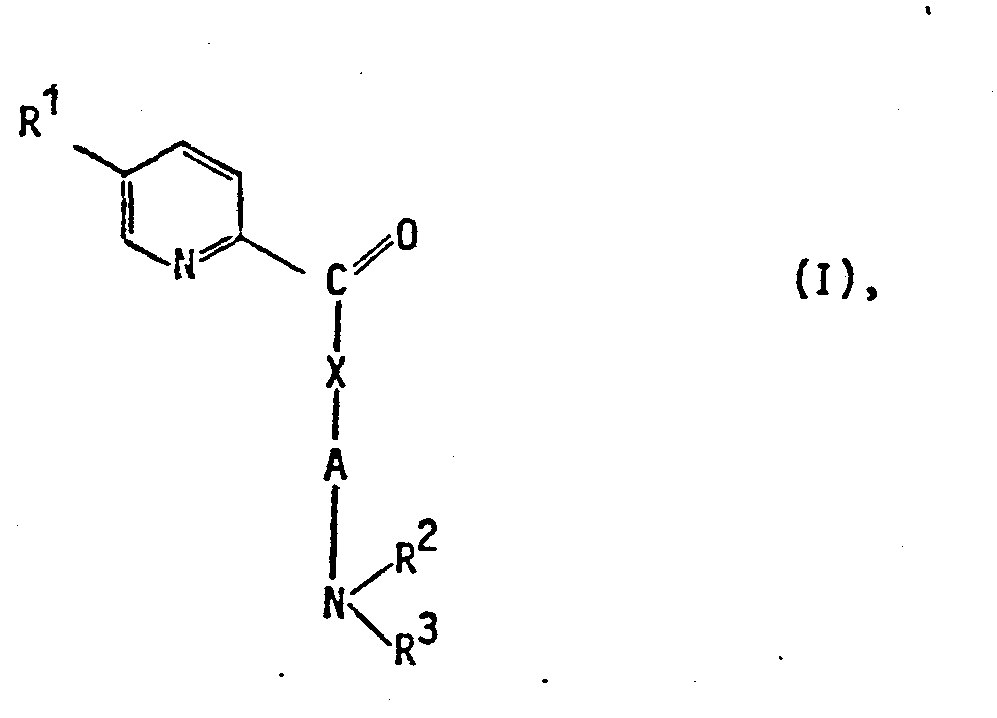
worin
R1 Alkyl mit 1 bis 7 Kohlenstoffatomen - jedoch nicht Butyl, wenn R2 und R3 die Bedeutung Alkyl haben und X NH bedeutet -, Cycloalkylalkyl mit 3 bis 7 Kohlenstoffatomen im Cycloalkyl- und 1 bis 4 Kohlenstoffatomen im Alkylenteil, Phenyl oder substituiertes Phenyl mit bis zu drei Substituenten aus der Gruppe Halogen, Hydroxy, Alkyl mit bis 4 Kohlenstoffatomen und Alkoxy mit 1 bis 4 Kohlenstoffatomen bedeutet,
R2 Alkyl mit 1 bis 4 Kohlenstoffatomen oder Alkenyl mit 3 bis 5 Kohlenstoffatomen bedeutet,
R3 Alkyl mit 1 bis 4 Kohlenstoffatomen oder Alkenyl mit 3 bis 5 Kohlenstoffatomen bedeutet, oder
R und R gemeinsam und unter Einschluß des Stickstoffatoms, an das sie gebunden sind, Pyrrolidino, Morpholino, Piperidino, Hexahydroazepino oder in 4-Position durch R4 substituiertes 1-Piperazinyl bedeuten,
R Wasserstoff, Alkyl mit 1 bis 4 Kohlenstoffatomen, Phenyl, Benzyl - oder substituiertes Phenyl mit bis zu drei Substituenten aus der Gruppe Halogen, Hydroxy, Alkyl mit 1 bis 4 Kohlenstoffatomen und Alkoxy mit 1 bis 4 Kohlenstoffatomen bedeutet,
A geradkettiges oder verzweigtes Alkylen mit 1 bis 5 Kohlenstoffatomen und
X 0 (Sauerstoff) oder NH bedeutet, sowie die Säureadditionssalze dieser Verbindungen, wobei R1, R2 und R3 nicht gleichzeitig Alkyl bedeuten,wenn X O(Sauerstoff) und A Ethylen darstellt.
2. Verbindungen der allgemeinen Formel I*

worin
sowie die Säureadditionssalze dieser Verbindungen, wobei R2* und R3* nicht Methyl oder Ethyl bedeuten, wenn X* O(Sauerstoff) und A* Ethylen darstellt.
R1* Alkyl mit 1 bis 5 Kohlenstoffatomen (jedoch nicht Butyl, wenn R und R3* die Bedeutung Methyl oder Ethyl haben und X NH darstellt) bedeutet,
R2* Methyl oder Ethyl bedeutet,
R3* Methyl oder Ethyl bedeutet oder.
R 2* und R3* gemeinsam und unter Einschluß des Stickstoffatoms, an das sie gebunden sind, Pyrrolidino, Piperidino oder in 4-Position durch R4* substituiertes 1-Piperazinyl bedeuten,
R4* Phenyl oder durch Methoxy oder Ethoxy substituiertes Phenyl bedeutet, A* Ethylen oder Trimethylen und
X* 0(Sauerstoff) oder NH bedeutet,
sowie die Säureadditionssalze dieser Verbindungen, wobei R2* und R3* nicht Methyl oder Ethyl bedeuten, wenn X* O(Sauerstoff) und A* Ethylen darstellt.
3. Verbindungen der allgemeinen Formel I**

worin
R1** Cycloalkylalkyl mit 5 oder 6 Kohlenstoffatomen im Cycloalkyl- und 1 oder 2 Kohlenstoffatomen im Alkylenteil, Phenyl oder substituiertes Phenyl mit bis zu zwei Substituenten aus der Gruppe Chlor, Methoxy oder Ethoxy bedeutet,
R 2** Methyl oder Ethyl bedeutet,
R3** Methyl oder Ethyl bedeutet,
A** Ethylen oder Trimethylen und
X** 0(Sauerstoff) oder NH bedeutet,
sowie die Säureadditionssalze dieser Verbindungen.
4. Verbindungen der allgemeinen Formel I***

worin
sowie die Säureadditionssalze dieser Verbindungen.
R1** Cycloalkylalkyl mit 5 oder 6 Kohlenstoffatomen im Cycloalkyl- und 1 oder 2 Kohlenstoffatomen im Alkylenteil, Phenyl oder substituiertes Phenyl mit bis zu zwei Substituenten aus der Gruppe Chlor, Methoxy oder Ethoxy bedeutet,
R2*** und R3*** gemeinsam und unter Einschluß des Stickstoffatoms, an das sie gebunden sind, Pyrrolidino, Piperidino oder in 4-Position durch R substituiertes 1-Piperazinyl bedeuten,
R4*** Wasserstoff, Methyl, Phenyl oder durch Methoxy oder Ethoxy substituiertes Phenyl bedeutet,
A*** Ethylen oder Trimethylen und
X*** O(Sauerstoff) oder NH bedeutet,
sowie die Säureadditionssalze dieser Verbindungen.
5. Verfahren zur Herstellung von Verbindungen der Formel I nach Anspruch 1, dadurch gekennzeichnet, daß man Picolinsäurederivate der allgemeinen Formel II

mit Aminen der allgemeinen Formel III
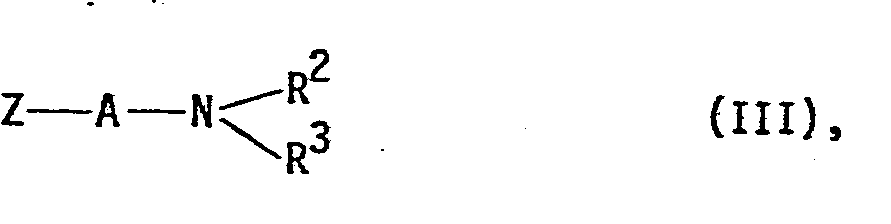
umsetzt und gewünschtenfalls anschließend in die Säureadditionssalze überführt, wobei die Reste Y und Z so zu wählen sind, daß das Glied X gebildet wird, und wobei R1, R2, R3, A und X die in Anspruch 1 angegebenen Bedeutungen haben.
6. Verbindungen nach einem oder mehreren der Ansprüche 1, 2, 3 oder 4 zur Anwendung bei der Behandlung des Bluthochdrucks.
7. Arzneimittel enthaltend eine oder mehrere Verbindungen nach einem oder mehreren der Ansprüche 1, 2, 3 oder 4 und/oder ihre pharmakologisch verträglichen Säureadditionssalze.
1. Verfahren zur Herstellung von Verbindungen der allgemeinen Formel I
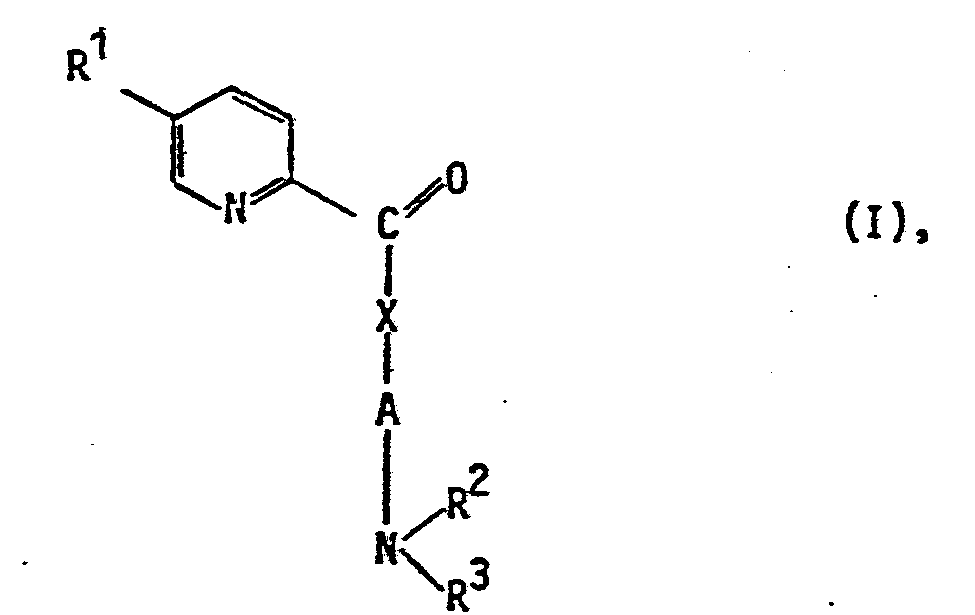
worin
sowie den Säureadditionssalzen dieser Verbindungen, wobei R1, R2 und R3 nicht gleichzeitig Alkyl bedeuten,wenn X 0(Sauerstoff) und A Ethylen darstellt, dadurch gekennzeichnet, daß man Picolinsäurederivate der allgemeinen Formel II 
mit Aminen der allgemeinen Formel III

umsetzt und gewünschtenfalls anschließend in die Säureadditionssalze überführt, wobei die Reste Y und Z so zu wählen sind, daß das Glied X gebildet wird, und wobei R1, R2, R3, A und X die vorstehend angegebenen Bedeutungen haben.
R1 Alkyl mit 1 bis 7 Kohlenstoffatomen - jedoch nicht Butyl, wenn R2 und R3 die Bedeutung Alkyl haben und X NH bedeutet -, Cycloalkylalkyl mit 3 bis 7 Kohlenstoffatomen im Cycloalkyl- und 1 bis 4 Kohlenstoffatomen im Alkylenteil, Phenyl oder substituiertes Phenyl mit bis zu drei Substituenten aus der Gruppe Halogen, Hydroxy, Alkyl mit bis 4 Kohlenstoffatomen und Alkoxy mit 1 bis 4 Kohlenstoffatomen bedeutet,
R2 Alkyl mit 1 bis 4 Kohlenstoffatomen oder Alkenyl mit.3 bis 5 Kohlenstoffatomen bedeutet,
R3 Alkyl mit 1 bis 4 Kohlenstoffatomen oder Alkenyl mit 3 bis 5 Kohlenstoffatomen bedeutet, oder
R2 und R3 gemeinsam und unter Einschluß des Stickstoffatoms, an das sie gebunden sind, Pyrrolidino, Morpholino, Piperidino, Hexahydroazepino oder in 4-Position durch R4 substituiertes 1-Piperazinyl bedeuten,
R4 Wasserstoff, Alkyl mit 1 bis 4 Kohlenstoffatomen, Phenyl, Benzyl oder substituiertes Phenyl mit bis zu drei Substituenten aus der Gruppe Halogen, Hydroxy, Alkyl mit 1 bis 4 Kohlenstoffatomen und Alkoxy mit 1 bis 4 Kohlenstoffatomen bedeutet,
A geradkettiges oder verzweigtes Alkylen mit 1 bis 5 Kohlenstoffatomen und
X 0 (Sauerstoff) oder NH bedeutet,
sowie den Säureadditionssalzen dieser Verbindungen, wobei R1, R2 und R3 nicht gleichzeitig Alkyl bedeuten,wenn X 0(Sauerstoff) und A Ethylen darstellt, dadurch gekennzeichnet, daß man Picolinsäurederivate der allgemeinen Formel II
2. Verfahren zur Herstellung von Verbindungen der allgemeinen Formel I*

worin
sowie den Säureadditionssalzen dieser Verbindungen, wobei R2* und R3* nicht Methyl oder Ethyl bedeuten, wenn X* 0(Sauerstoff) und A* Ethylen darstellt, dadurch gekennzeichnet, daß man Picolinsäurederivate der allgemeinen Formel II* 
mit Aminen der allgemeinen Formel III*
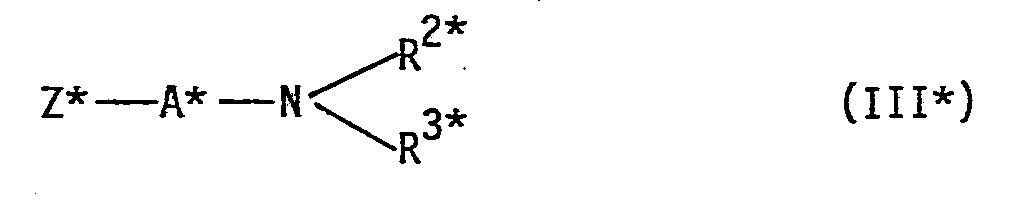
umsetzt und gewünschtenfalls anschließend in die Säureadditionssalze überführt, wobei die Reste Y* und Z* so zu wählen sind, daß das Glied X* gebildet wird, wobei R1*, R2*, R3*, A* und X* die vorstehend angegebenen Bedeutungen haben.
R1* Alkyl mit 1 bis 5 Kohlenstoffatomen (jedoch nicht Butyl, wenn R und R3* die Bedeutung Methyl oder Ethyl haben und X NH darstellt) bedeutet,
R2* Methyl oder Ethyl bedeutet,
R3* Methyl oder Ethyl bedeutet oder
R 2* und R3* gemeinsam und unter Einschluß des Stickstoffatoms, an das sie gebunden sind, Pyrrolidino, Piperidino oder in 4-Position durch R4* substituiertes 1-Piperazinyl bedeuten,
R4* Phenyl oder durch Methoxy oder Ethoxy substituiertes Phenyl bedeutet, A* Ethylen oder Trimethylen und
X* 0(Sauerstoff) oder NH bedeutet,
sowie den Säureadditionssalzen dieser Verbindungen, wobei R2* und R3* nicht Methyl oder Ethyl bedeuten, wenn X* 0(Sauerstoff) und A* Ethylen darstellt, dadurch gekennzeichnet, daß man Picolinsäurederivate der allgemeinen Formel II*
3. Verfahren zur Herstellung von Verbindungen der allgemeinen Formel I**

worin
sowie den Säureadditionssalzen dieser Verbindungen, dadurch gekennzeichnet, daß man Picolinsäurederivate der allgemeinen Formel II** 
mit Aminen der allgemeinen Formel III**
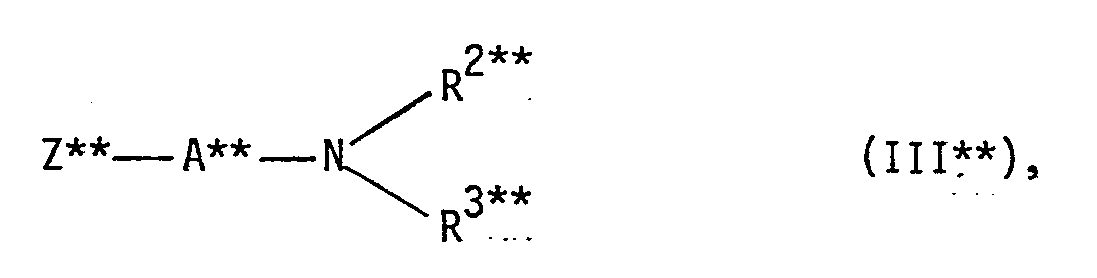
umsetzt und gewünschtenfalls anschließend in die Säureadditionssalze überführt, wobei die Reste Y** und Z** so zu wählen sind, daß das Glied X** gebildet wird, und wobei R1**, R2**, R3**, A** und X** die vorstehend angegebenen Bedeutungen haben.
R Cycloalkylalkyl mit 5 oder 6 Kohlenstoffatomen im Cycloalkyl- und 1 oder 2 Kohlenstoffatomen im Alkylenteil, Phenyl oder substituiertes Phenyl mit bis zu zwei Substituenten aus der Gruppe Chlor, Methoxy oder Ethoxy bedeutet,
R2** Methyl oder Ethyl bedeutet,
R3** Methyl oder Ethyl bedeutet,
A** Ethylen oder Trimethylen und
X** O(Sauerstoff) oder NH bedeutet,
sowie den Säureadditionssalzen dieser Verbindungen, dadurch gekennzeichnet, daß man Picolinsäurederivate der allgemeinen Formel II**
4. Verfahren zur Herstellung von Verbindungen der allgemeinen Formel I***
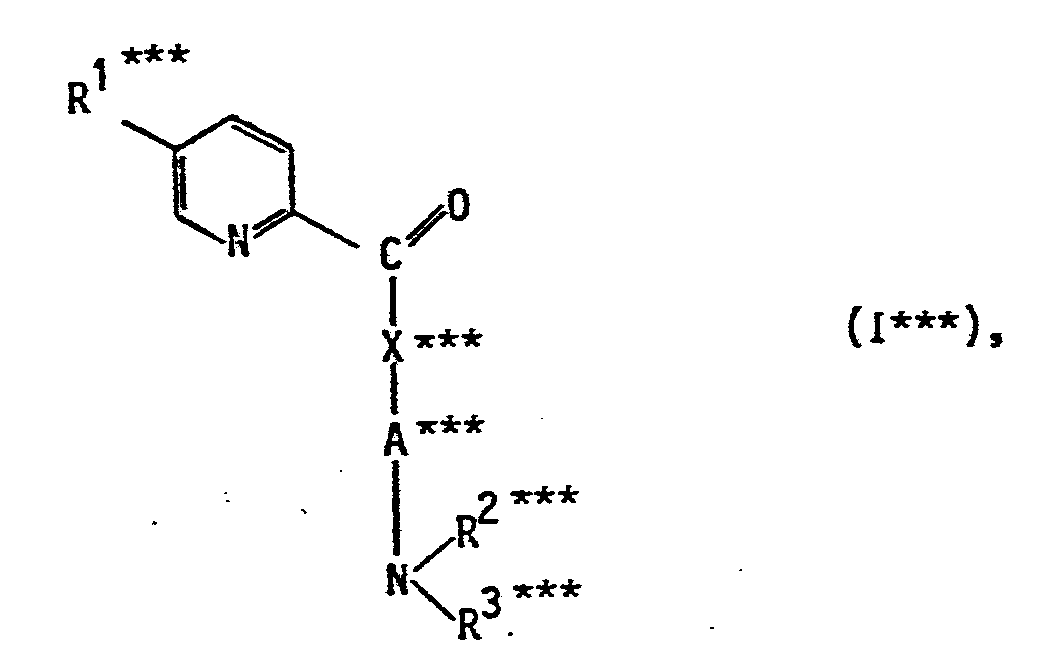
worin
sowie den Säureadditionssalzen dieser Verbindungen, dadurch gekennzeichnet, daß man Picolinsäurederivate der allgemeinen Formel II*** 
mit Aminen der allgemeinen Formel III***
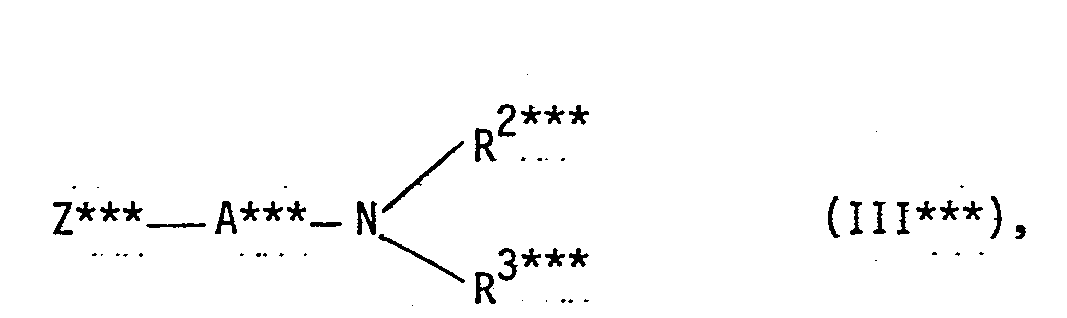
umsetzt und gewünschtenfalls anschließend in die Säureadditionssalze überführt, wobei die Reste Y*** und Z*** so zu wählen sind, daß das Glied X*** gebildet wird, und wobei R1*** , R2*** , R3*** , A*** und X*** die vorstehend angegebenen Bedeutungen haben.
R1*** Cycloalkylalkyl mit 5 oder 6 Kohlenstoffatomen im Cycloalkyl- und 1 oder 2 Kohlenstoffatomen im Alkylenteil, Phenyl oder substituiertes Phenyl mit bis zu zwei Substituenten aus der Gruppe Chlor, Methoxy oder Ethoxy bedeutet,
R2*** und R3*** gemeinsam und unter Einschluß des Stickstoffatoms, an das sie gebunden sind, Pyrrolidino, Piperidino oder in 4-Position durch R4*** substituiertes 1-Piperazinyl bedeuten,
R4*** Wasserstoff, Methyl, Phenyl oder durch Methoxy oder Ethoxy substituiertes Phenyl bedeutet,
A*** Ethylen oder Trimethylen und
X*** 0(Sauerstoff) oder NH bedeutet,
sowie den Säureadditionssalzen dieser Verbindungen, dadurch gekennzeichnet, daß man Picolinsäurederivate der allgemeinen Formel II***
Priority Applications (1)
| Application Number | Priority Date | Filing Date | Title |
|---|---|---|---|
| EP83104094A EP0123700A1 (de) | 1983-04-27 | 1983-04-27 | Substituierte Picolinsäuren, Verfahren zu ihrer Herstellung, ihre Verwendung und sie enthaltende Arzneimittel |
Applications Claiming Priority (1)
| Application Number | Priority Date | Filing Date | Title |
|---|---|---|---|
| EP83104094A EP0123700A1 (de) | 1983-04-27 | 1983-04-27 | Substituierte Picolinsäuren, Verfahren zu ihrer Herstellung, ihre Verwendung und sie enthaltende Arzneimittel |
Publications (1)
| Publication Number | Publication Date |
|---|---|
| EP0123700A1 true EP0123700A1 (de) | 1984-11-07 |
Family
ID=8190430
Family Applications (1)
| Application Number | Title | Priority Date | Filing Date |
|---|---|---|---|
| EP83104094A Withdrawn EP0123700A1 (de) | 1983-04-27 | 1983-04-27 | Substituierte Picolinsäuren, Verfahren zu ihrer Herstellung, ihre Verwendung und sie enthaltende Arzneimittel |
Country Status (1)
| Country | Link |
|---|---|
| EP (1) | EP0123700A1 (de) |
Cited By (8)
| Publication number | Priority date | Publication date | Assignee | Title |
|---|---|---|---|---|
| EP0278452A3 (en) * | 1987-02-10 | 1989-10-18 | Hoechst Aktiengesellschaft | 2,4- and 2,5-pyridine-dicarboxylic-acid derivatives, process for their preparation, their use and medicines based on these compounds |
| US6770661B2 (en) | 2001-09-07 | 2004-08-03 | Euro-Celtique S.A. | Aryl substituted pyridines and their use |
| US6867210B2 (en) | 2000-03-10 | 2005-03-15 | Euro-Celtique S.A. | Aryl substituted pyrimidines |
| US7105549B2 (en) | 2001-09-07 | 2006-09-12 | Euro-Celtique S.A. | Aryl substituted pyridines and the use thereof |
| US10710947B2 (en) | 2018-04-30 | 2020-07-14 | Scientific Design Company, Inc. | Method for improving the manufacture of ethylene glycol |
| US10807928B2 (en) | 2018-04-30 | 2020-10-20 | Scientific Design Company, Inc. | Recirculating process for preparing ethylene glycol |
| US10807929B2 (en) | 2018-04-30 | 2020-10-20 | Scientific Design Company, Inc. | Process for preparing ethylene glycol |
| US10836738B2 (en) | 2018-04-30 | 2020-11-17 | Scientific Design Company, Inc. | Epoxidation process with concentrated ethylene oxide solutions |
Citations (3)
| Publication number | Priority date | Publication date | Assignee | Title |
|---|---|---|---|---|
| US4009174A (en) * | 1972-12-08 | 1977-02-22 | The Boots Company Limited | Esters of substituted nicotinic acids |
| SU598892A1 (ru) * | 1976-09-28 | 1978-03-25 | Институт Биохимии И Физиологии Микроорганизмов Ан Ссср | Бета-( -диэтиламино) этиламид 5-п-бутил-2-пиридинкарбоновой кислоты гидрохлорид, обладающий антиаритмическим действием |
| DE3239573A1 (de) * | 1981-10-28 | 1983-05-19 | Byk Gulden Lomberg Chemische Fabrik Gmbh, 7750 Konstanz | Substituierte picolinsaeuren, verfahren zu ihrer herstellung, ihre verwendung und sie enthaltende arzneimittel |
-
1983
- 1983-04-27 EP EP83104094A patent/EP0123700A1/de not_active Withdrawn
Patent Citations (3)
| Publication number | Priority date | Publication date | Assignee | Title |
|---|---|---|---|---|
| US4009174A (en) * | 1972-12-08 | 1977-02-22 | The Boots Company Limited | Esters of substituted nicotinic acids |
| SU598892A1 (ru) * | 1976-09-28 | 1978-03-25 | Институт Биохимии И Физиологии Микроорганизмов Ан Ссср | Бета-( -диэтиламино) этиламид 5-п-бутил-2-пиридинкарбоновой кислоты гидрохлорид, обладающий антиаритмическим действием |
| DE3239573A1 (de) * | 1981-10-28 | 1983-05-19 | Byk Gulden Lomberg Chemische Fabrik Gmbh, 7750 Konstanz | Substituierte picolinsaeuren, verfahren zu ihrer herstellung, ihre verwendung und sie enthaltende arzneimittel |
Non-Patent Citations (3)
| Title |
|---|
| CHEMICAL ABSTRACTS, Band 90, Nr. 1, 1. Januar 1979, Seite 567, Nr. 6197z, Columbus Ohio (USA); * |
| IL FARMACO, Editione Scientif., Band 36, Nr. 4, 1981, Seiten 260-68, Milano (IT); * |
| SOVIET INVENTIONS ILLUSTRATED, Section Chemical, Derwent Publications Ltd., Woche B06, 21. März 1979, Seite 74; & SU - A - 598 892 (AS USSR BIOCH PHYSI) (17.03.78) * |
Cited By (10)
| Publication number | Priority date | Publication date | Assignee | Title |
|---|---|---|---|---|
| EP0278452A3 (en) * | 1987-02-10 | 1989-10-18 | Hoechst Aktiengesellschaft | 2,4- and 2,5-pyridine-dicarboxylic-acid derivatives, process for their preparation, their use and medicines based on these compounds |
| US6867210B2 (en) | 2000-03-10 | 2005-03-15 | Euro-Celtique S.A. | Aryl substituted pyrimidines |
| US6770661B2 (en) | 2001-09-07 | 2004-08-03 | Euro-Celtique S.A. | Aryl substituted pyridines and their use |
| US7105549B2 (en) | 2001-09-07 | 2006-09-12 | Euro-Celtique S.A. | Aryl substituted pyridines and the use thereof |
| US7579367B2 (en) | 2001-09-07 | 2009-08-25 | Purdue Pharma L.P. | Aryl substituted pyridines and the use thereof |
| US7943643B2 (en) | 2001-09-07 | 2011-05-17 | Purdue Pharma L.P. | Aryl substituted pyridines and the use thereof |
| US10710947B2 (en) | 2018-04-30 | 2020-07-14 | Scientific Design Company, Inc. | Method for improving the manufacture of ethylene glycol |
| US10807928B2 (en) | 2018-04-30 | 2020-10-20 | Scientific Design Company, Inc. | Recirculating process for preparing ethylene glycol |
| US10807929B2 (en) | 2018-04-30 | 2020-10-20 | Scientific Design Company, Inc. | Process for preparing ethylene glycol |
| US10836738B2 (en) | 2018-04-30 | 2020-11-17 | Scientific Design Company, Inc. | Epoxidation process with concentrated ethylene oxide solutions |
Similar Documents
| Publication | Publication Date | Title |
|---|---|---|
| DE69722858T2 (de) | Intimale verdickungsinhibitoren | |
| DE69013959T2 (de) | Aminobenzolsulfonsäurederivate. | |
| DE2559509A1 (de) | Benzcyloamidderivate und verfahren zu ihrer herstellung sowie pharmazeutische mittel, worin sie enthalten sind | |
| DE2824064A1 (de) | Phthalazin-derivate, ihre herstellung und solche derivate enthaltende arzneimittel | |
| DE69132167T2 (de) | Kondensierte benzoxa-ringverbindung, deren herstellung sowie diese enthaltendes arzneimittel | |
| EP0047923B1 (de) | Isochinolinderivate, Verfahren zu ihrer Herstellung und sie enthaltende pharmazeutische Zubereitungen | |
| DE3025579A1 (de) | Aryl-1-arylsulfonyl-4 gamma -aminopropoxy-3-1h-pyrazole, verfahren zu ihrer herstellung und sie enthaltende mittel | |
| EP0116360B1 (de) | 1-Phenyl-2-aminocarbonylindol-Verbindungen sowie Verfahren zu ihrer Herstellung und diese Verbindungen enthaltende Arzneimittel | |
| EP0185909B1 (de) | 5-Alkyl-1-phenyl-2-piperazinoalkylpyrazolin-3-on-Verbindungen sowie Verfahren und Zwischenprodukte zu ihrer Herstellung und diese Verbindungen enthaltende Arzneimittel | |
| DE3114239A1 (de) | "piperazinderivate" | |
| EP0090369B1 (de) | Salicylsäurederivate, Verfahren zu ihrer Herstellung, pharmazeutische Präparate auf Basis dieser Verbindungen und ihre Verwendung | |
| DE3035086A1 (de) | Cyclohexancarbonsaeurederivate, verfahren zu ihrer herstellung und sie enthaltende mittel | |
| DD145104B3 (de) | Verfahren zur herstellung von polyalkoxyphenylpyrrolidone | |
| DE2919800A1 (de) | 4-amino-2-piperidinochinazolin-derivate, verfahren zu ihrer herstellung und solche derivate enthaltende arzneimittel | |
| DE3873167T2 (de) | Thiazolidin-4-on-derivate und deren saeure-additionssalze. | |
| EP0072960B1 (de) | 1,5-Diphenylpyrazolin-3-on-Verbindungen sowie Verfahren und Zwischenprodukte zu ihrer Herstellung und diese Verbindungen enthaltende Arzneimittel | |
| EP0018360B1 (de) | N-(5-Methoxybentofuran-2-ylcarbonyl)-N'-benzylpiperazin und Verfahren zu dessen Herstellung | |
| EP0039519A1 (de) | Substituierte Thienotricyclen, Verfahren zu ihrer Herstellung und sie enthaltende Arzneimittel | |
| EP0665228A1 (de) | Neue 3-Phenylsulfonyl-3,7-diazabicyclo(3,3,1)nonan-Verbindungen enthaltende Arzneimittel | |
| DE3424586A1 (de) | 3-aminocarbonylmethoxy-5-phenyl-pyrazol-verbindungen sowie verfahren zu ihrer herstellung und diese verbindungen enthaltende arzneimittel | |
| DE3239573A1 (de) | Substituierte picolinsaeuren, verfahren zu ihrer herstellung, ihre verwendung und sie enthaltende arzneimittel | |
| DE3014813A1 (de) | 2-hydroxy-5-(1-hydroxy-2-piperazinylethyl)benzoesaeure-derivate | |
| EP0177907B1 (de) | Neue 2-Pyridin-thiol-Derivate, Verfahren zu ihrer Herstellung und diese enthaltende pharmazeutische Präparate | |
| AT391316B (de) | Neue thienyloxy-alkylamin-derivate, verfahren zu ihrer herstellung und diese verbindungen enthaltende arzneimittel | |
| DE3875820T2 (de) | Aromatische heterozyklische karbonsaeureamidabkoemmlinge, verfahren zur herstellung und arzneimittel, die diese enthalten. |
Legal Events
| Date | Code | Title | Description |
|---|---|---|---|
| PUAI | Public reference made under article 153(3) epc to a published international application that has entered the european phase |
Free format text: ORIGINAL CODE: 0009012 |
|
| 17P | Request for examination filed |
Effective date: 19830427 |
|
| AK | Designated contracting states |
Designated state(s): AT BE FR GB IT LU NL SE |
|
| STAA | Information on the status of an ep patent application or granted ep patent |
Free format text: STATUS: THE APPLICATION IS DEEMED TO BE WITHDRAWN |
|
| 18D | Application deemed to be withdrawn |
Effective date: 19850508 |
|
| RIN1 | Information on inventor provided before grant (corrected) |
Inventor name: SANDERS, KARL, DR. Inventor name: ULRICH, WOLF-RUEDIGER, DR. Inventor name: AMSCHLER, HERMANN, DR. |