EP0113033A2 - Verfahren zur Herstellung von Schutzlackmaske - Google Patents
Verfahren zur Herstellung von Schutzlackmaske Download PDFInfo
- Publication number
- EP0113033A2 EP0113033A2 EP83111764A EP83111764A EP0113033A2 EP 0113033 A2 EP0113033 A2 EP 0113033A2 EP 83111764 A EP83111764 A EP 83111764A EP 83111764 A EP83111764 A EP 83111764A EP 0113033 A2 EP0113033 A2 EP 0113033A2
- Authority
- EP
- European Patent Office
- Prior art keywords
- resist
- layer
- pyrene
- exposed
- process according
- Prior art date
- Legal status (The legal status is an assumption and is not a legal conclusion. Google has not performed a legal analysis and makes no representation as to the accuracy of the status listed.)
- Withdrawn
Links
Images



Classifications
-
- G—PHYSICS
- G03—PHOTOGRAPHY; CINEMATOGRAPHY; ANALOGOUS TECHNIQUES USING WAVES OTHER THAN OPTICAL WAVES; ELECTROGRAPHY; HOLOGRAPHY
- G03F—PHOTOMECHANICAL PRODUCTION OF TEXTURED OR PATTERNED SURFACES, e.g. FOR PRINTING, FOR PROCESSING OF SEMICONDUCTOR DEVICES; MATERIALS THEREFOR; ORIGINALS THEREFOR; APPARATUS SPECIALLY ADAPTED THEREFOR
- G03F7/00—Photomechanical, e.g. photolithographic, production of textured or patterned surfaces, e.g. printing surfaces; Materials therefor, e.g. comprising photoresists; Apparatus specially adapted therefor
- G03F7/004—Photosensitive materials
- G03F7/09—Photosensitive materials characterised by structural details, e.g. supports, auxiliary layers
- G03F7/094—Multilayer resist systems, e.g. planarising layers
-
- G—PHYSICS
- G03—PHOTOGRAPHY; CINEMATOGRAPHY; ANALOGOUS TECHNIQUES USING WAVES OTHER THAN OPTICAL WAVES; ELECTROGRAPHY; HOLOGRAPHY
- G03F—PHOTOMECHANICAL PRODUCTION OF TEXTURED OR PATTERNED SURFACES, e.g. FOR PRINTING, FOR PROCESSING OF SEMICONDUCTOR DEVICES; MATERIALS THEREFOR; ORIGINALS THEREFOR; APPARATUS SPECIALLY ADAPTED THEREFOR
- G03F7/00—Photomechanical, e.g. photolithographic, production of textured or patterned surfaces, e.g. printing surfaces; Materials therefor, e.g. comprising photoresists; Apparatus specially adapted therefor
- G03F7/004—Photosensitive materials
- G03F7/022—Quinonediazides
- G03F7/0226—Quinonediazides characterised by the non-macromolecular additives
Definitions
- This invention relates to photolithography, and more particularly to the fabrication of lithographic positive resist masks for the fabrication of semiconductor integrated circuit devices.
- One positive resist system in use today for microlithography applications is comprised of an alkali soluble polymer, such as phenol or o-cresol formaldehyde novolak resin, and a diazoketone or quinone sensitizer or photoactive compound (PAC).
- alkali soluble polymer such as phenol or o-cresol formaldehyde novolak resin
- PAC quinone sensitizer or photoactive compound
- sensitizers and resists are described, as for example, in US-A-3,046,118;-3,046.,121; -3,106,445; -3,201,239;-3,666,473; and -4,059,449.
- Exposure to radiation causes the exposed portions of the resist to become soluble in alkaline solutions in which the resist is normally developed.
- One method of image- wise exposing of the resist is commonly known as projection printing utilizing commercially available tools such as the Perkin-Elmer (P.E.) Projection Printer Model No. PE-300.
- a lower exposure wavelength e.g. 240 nm ⁇ 320 nm
- conventional wavelengths e.g. 360 nm m 400 nm
- a preferred resist for this application herein referred to as "DQN" is comprised of an o-cresol formaldehyde novolak and diazoquinone PAC which is 2,4-bis(6-diazo-5,6-dihydro-5-oxo-1-naphthalenesulfonyl-oxy) benzophenone, which may be admixed with corresponding monoester and triester by-products.
- DQN diazoquinone PAC which is 2,4-bis(6-diazo-5,6-dihydro-5-oxo-1-naphthalenesulfonyl-oxy) benzophenone, which may be admixed with corresponding monoester and triester by-products.
- the exposure range 300-330 nm (mid-UV) is projected as being the preferred range of the coming future.
- the extinction coefficient, e of PAC photoresist in the indicated DQN resist in the current exposure range (360 nm m 400 nm) is about 6x10 3 mol -1 cm -1 per diazoquinone unit.
- the e of the PAC is just 2.5x10 3 mol -1 cm -1 per diazoquinone unit (DQ). Because of the lower of the PAC, and lower lamp intensity at 313 nm, compared with those at 360 nm, the wafer throughput (in device fabrication) exposed at 313 nm will be half or less of that of the current exposure tools.
- Fig. 1 illustrates a quantitative depiction of photon density in a 1 mm photoresist layer with a via hole of optical density of 0.5, where the numbers 75, 56, 42 and 32 represent the percentage of incident dose.
- One object of the present invention is to provide a new and improved positive resist mask structure for the fabrication of semiconductor devices.
- Another object of this invention is to provide a new and improved resist structure having an enhanced R/Ro ratio where R is the dissolution rate of the exposed resist portion in solvent and Ro is the dissolution rate of .unexposed resist portions.
- Another object of this invention is to provide a new and improved positive resist structure adapted for formation of via holes having improved sidewall profiles or angles.
- Another object of this invention is to provide a new and improved positive resist structure having enhanced sensitivity to radiation.
- a further object of this invention is to provide a new and improved positive resist structure with reduced exposure time and corresponding processing throughput.
- Figs. 1 to 4 are explanatory schematic drawings for the background art.
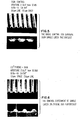
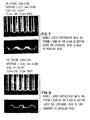
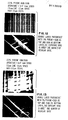
- Figs. 5 to 13 are comparative microphotographics for purposes of illustrating the invention of this application.
- a process for forming a composite resist mask on a substrate (e.g. in semiconductor device fabrication) comprising the steps of forming a first bottom layer of a blanket exposed positive resist on the substrate, and overcoating the bottom resist layer with a top layer of an unexposed positive resist containing an aromatic sensitizer such as pyrene or one of its derivatives, such as methyl pyrene.
- the top resist overcoating can be of the same composition as the bottom exposed resist layer, and optionally both being the preferred DQN resist identified above. In this manner the DQ resist can be used as the bottom exposed layer and the same DQN resist with the added sensitizer as the top layer.
- pyrene and its derivatives e.g.
- methyl pyrene have been preferred, and can be added to the DQ resist in a range of 1 to 10 wt. % and preferably from about 2 to about 4 wt. %, based on the resist solids content.
- the DQN/DQN-pyrene composite mask was found to significantly reduce the Ro of the mask.
- the composite mask After application of the composite mask, it is then image-wise exposed in a desired pattern, baked to improve adhesion and/or development, and employed for processing operations in semiconductor manufacture, after which the resist mask can be stripped from the substrate by exposure to an alkaline solvent.
- the top and bottom resist layers can be selected from commercially available diazoquinone/novolak positive resists, such as the AZ-1350 type resist of the Shipley Company.
- Examples of positive photoresists which become more soluble upon exposure to radiation are the sensitized novolak resins such as are described, for example, in US-A-3,201,239 and -3,666;473.
- the resists are applied to substrates from solvent mixtures using conventional techniques such as spraying, flowing, roller coating, spinning and dip coating, after which the solvent is removed by evaporation, which is sometimes aided by baking, to leave a layer of resist on the surface of the substrate.
- a first layer of photoresist is coated onto the substrate to be processed in a conventional manner.
- the entire resist layer is then flooded with a sufficient dose of radiation so that the photosensitive material is substantially all reacted, i.e., blanket exposed.
- the photoresist layer is then baked at a relatively high temperature to provide improved adhesion of the layer to the substrate surface.
- the baking temperatures conventionally employed to obtain improved adhesion are usually at least about 140°C. The optimum exposure times and baking times and temperatures for each photoresist can be easily determined by one skilled in the art.
- the preexposure of the bottom layer resist can be performed in two ways. First, the resist can be exposed in solution before coating on the substrate, or it can be coated first on the substrate and then exposed. The latter method was employed here, as noted above.
- a preferred diazoquinone/novolak resist comprises an o-cresol formaldehyde novolak formulated with a PAC comprised of 2,4,bis(6-diazo-5, 6-dihydro-5-oxo-l-naphthalenesulfonyloxy) benzophenone which has the structure in admixture with corresponding monoester and triester by-products.
- a second layer of a pyrene sensitized positive resist (which is preferably the same DQN resist, but which also can be different from the bottom resist layer) is then blanket coated over the bottom resist layer.
- the sensitized top resist layer can be easily formed, as for example, by adding pyrene and/or its derivatives (e.g. methyl pyrene) to the diazoquinone/novolak resists.
- the thickness of the bottom resist layer can be from about 0.5 to about 2.0 ⁇ m, and the sensitized top resist layer thickness can be in the range of about 0.4 to about 1.0 ⁇ m.
- Thermally oxidized silicon semiconductor substrates having an about 0,7 ⁇ m thick oxide layer, were coated with layers of positive resist having the thicknesses indicated in the Tables below by spin coating at a rate of 4700 rpm.
- the resists employed were.the indicated preferred DQN resists in a 30 wt. % content solution of 80 Wt. % 2-ethoxyethyl acetate, 10 wt. % n-butyl acetate and 10 wt. % xylene. A portion of these resist coated substrates were retained as controls.
- An additional number of the resist-coated substrates were blanket exposed and then overcoated with a second DQN resist containing pyrene additive sensitizer in the weight percentages indicated in the Tables below.
- the sensitized DQN resist was coated with a spin rate of about 4300 rpm as the top layer with a final thickness of about 1.0 ⁇ 0.1 ⁇ m.
- the substrates were then exposed in the Perkin-Elmer tool with UV-3 with the instrument setting: .Aperture (A) 1 or 2, slit 1 mm and scan speed (SS) as indicated in the Tables. All substrates were pre-baked for 30 minutes at 85°C on a hotplate. Additional control samples were prepared by overcoating the remaining DQN exposed substrates with the same but unexposed DQN resist.
- a pyrene sensitized DQN resist was coated directly as a single layer on the oxide surface of the semiconductor substrate, with the above- mentioned prebaking, as indicated in the Tables below.
- All substrates were then image-wise exposed in a desired pattern through a test pattern mask, and developed in a conventional alkaline developer.
- the double layer system of this invention can reduce the development time from 330s to 150s, and increase the R/Ro from 6 to 40 and the sidewall angle from 58 0 to 64 0 , respectively.
- Figures 5, 6, 7 and 8 demonstrate the significant improvement of the double layer system compared with the controls.
- R/Ro 15
- DQN- pyrene The addition of pyrene in the top DQN layer (DQN- pyrene) is a unique approach. Pyrene serves as a sensitizer to enhance the sensitivity of the diazoquinone/novolak positive resists (e.g. DQN) four times, and reduce the dissolution rate of the top resist layer which provides a good pattern mask to develop the bottom resist layer.
- DQN diazoquinone/novolak positive resists
- the double layer resist system of this invention provides an excellent resolution of 1.5 ⁇ m line-space combination, R/Ro about 15, and sidewall angle of about 70 0 , as well as the highest sensitivity ever reported for such resists at mid-UV regions (4 to about 5 times that of DQN).
- the system requires only one extra process step, with respect to the bottom resist layer.
- the blanket exposure of the bottom resist layer can be carried in solution prior to coating applications on the substrate. In fact there is indication that the blanket exposure could be omitted, since the lowest limit of blanket exposure has not been found.
- the development process is exactly the same as that for diazoquinone/novolak resists using Shipley's commercial AZ-2401 developer. Also, the system provides a convenient development time, 3 to about 4 minutes, which has a wider process window for handling, relative to development times of less than one minute for other resists.
- the sensitized top resist layer can be made thin enough to achieve the highest sensitivity, and have the total composite film thickness up to 1.0 ⁇ m (the thinner the top resist layer is, the better the pyrene is as a sensitizer, and the higher the sensitivity of the pyrene sensitized resist). Also, since the bottom layer planarizes the surface topography, images produced in the composite provide undistorted patterns over steps, Figs. 1-2 and 13.
- the exposure tool does not have to be confined to a reflective optical system such as the Perkin Elmer UV-3, but is envisioned to perform as well on refractive optical steppers, proximity printers, or contact printers.
Landscapes
- Physics & Mathematics (AREA)
- General Physics & Mathematics (AREA)
- Spectroscopy & Molecular Physics (AREA)
- Engineering & Computer Science (AREA)
- Architecture (AREA)
- Structural Engineering (AREA)
- Exposure And Positioning Against Photoresist Photosensitive Materials (AREA)
- Photosensitive Polymer And Photoresist Processing (AREA)
- Exposure Of Semiconductors, Excluding Electron Or Ion Beam Exposure (AREA)
Applications Claiming Priority (2)
| Application Number | Priority Date | Filing Date | Title |
|---|---|---|---|
| US454766 | 1982-12-30 | ||
| US06/454,766 US4464458A (en) | 1982-12-30 | 1982-12-30 | Process for forming resist masks utilizing O-quinone diazide and pyrene |
Publications (2)
| Publication Number | Publication Date |
|---|---|
| EP0113033A2 true EP0113033A2 (de) | 1984-07-11 |
| EP0113033A3 EP0113033A3 (de) | 1987-03-25 |
Family
ID=23805998
Family Applications (1)
| Application Number | Title | Priority Date | Filing Date |
|---|---|---|---|
| EP83111764A Withdrawn EP0113033A3 (de) | 1982-12-30 | 1983-11-24 | Verfahren zur Herstellung von Schutzlackmaske |
Country Status (3)
| Country | Link |
|---|---|
| US (1) | US4464458A (de) |
| EP (1) | EP0113033A3 (de) |
| JP (1) | JPS59124134A (de) |
Families Citing this family (10)
| Publication number | Priority date | Publication date | Assignee | Title |
|---|---|---|---|---|
| US4578344A (en) * | 1984-12-20 | 1986-03-25 | General Electric Company | Photolithographic method using a two-layer photoresist and photobleachable film |
| US4571374A (en) * | 1984-12-27 | 1986-02-18 | Minnesota Mining And Manufacturing Company | Multilayer dry-film positive-acting laminable photoresist with two photoresist layers wherein one layer includes thermal adhesive |
| US4672021A (en) * | 1985-06-03 | 1987-06-09 | Fairmount Chemical Company | Contrast enhancement layer composition with naphthoquinone diazide, indicator dye and polymeric binder |
| US4863827A (en) * | 1986-10-20 | 1989-09-05 | American Hoechst Corporation | Postive working multi-level photoresist |
| US5290656A (en) * | 1988-05-07 | 1994-03-01 | Sumitomo Chemical Company, Limited | Resist composition, novel phenol compound and quinone diazide sulfonic acid ester of novel phenol compound |
| JP2661671B2 (ja) * | 1989-03-20 | 1997-10-08 | 株式会社日立製作所 | パタン形成材料とそれを用いたパタン形成方法 |
| JP2720224B2 (ja) * | 1990-06-15 | 1998-03-04 | 富士写真フイルム株式会社 | 感光性平版印刷版 |
| US6187515B1 (en) * | 1998-05-07 | 2001-02-13 | Trw Inc. | Optical integrated circuit microbench system |
| US6322953B1 (en) * | 1999-03-29 | 2001-11-27 | Winbond Electronics Corporation | Method for obtaining uniform photoresist coatings |
| GB201517273D0 (en) * | 2015-09-30 | 2015-11-11 | Univ Manchester | Resist composition |
Family Cites Families (24)
| Publication number | Priority date | Publication date | Assignee | Title |
|---|---|---|---|---|
| US2937085A (en) * | 1954-01-11 | 1960-05-17 | Ditto Inc | Composite photosensitive plate, and method of making printing plate therefrom |
| BE563723A (de) * | 1957-01-04 | |||
| US3317320A (en) * | 1964-01-02 | 1967-05-02 | Bendix Corp | Duo resist process |
| US3380825A (en) * | 1964-11-27 | 1968-04-30 | Du Pont | Process for producing images |
| US3486900A (en) * | 1965-06-02 | 1969-12-30 | Keuffel & Esser Co | Diazotype material |
| US3482977A (en) * | 1966-02-11 | 1969-12-09 | Sylvania Electric Prod | Method of forming adherent masks on oxide coated semiconductor bodies |
| US3518084A (en) * | 1967-01-09 | 1970-06-30 | Ibm | Method for etching an opening in an insulating layer without forming pinholes therein |
| US3634082A (en) * | 1967-07-07 | 1972-01-11 | Shipley Co | Light-sensitive naphthoquinone diazide composition containing a polyvinyl ether |
| US3567453A (en) * | 1967-12-26 | 1971-03-02 | Eastman Kodak Co | Light sensitive compositions for photoresists and lithography |
| US3549368A (en) * | 1968-07-02 | 1970-12-22 | Ibm | Process for improving photoresist adhesion |
| US3591378A (en) * | 1968-07-31 | 1971-07-06 | Eastman Kodak Co | Process for making positive-working relief plate |
| US3716390A (en) * | 1970-05-27 | 1973-02-13 | Bell Telephone Labor Inc | Photoresist method and products produced thereby |
| US3827908A (en) * | 1972-12-11 | 1974-08-06 | Ibm | Method for improving photoresist adherence |
| US4036644A (en) * | 1973-03-16 | 1977-07-19 | International Business Machines Corporation | Photoresist process and photosensitive O-quinone diazide article with aliphatic carboxylic acid as adhesion promotor |
| US3873313A (en) * | 1973-05-21 | 1975-03-25 | Ibm | Process for forming a resist mask |
| US3982943A (en) * | 1974-03-05 | 1976-09-28 | Ibm Corporation | Lift-off method of fabricating thin films and a structure utilizable as a lift-off mask |
| US3955981A (en) * | 1975-01-06 | 1976-05-11 | Zenith Radio Corporation | Method of forming electron-transmissive apertures in a color selection mask by photoetching with two resist layers |
| US4009033A (en) * | 1975-09-22 | 1977-02-22 | International Business Machines Corporation | High speed positive photoresist composition |
| US4088490A (en) * | 1976-06-14 | 1978-05-09 | International Business Machines Corporation | Single level masking process with two positive photoresist layers |
| GB1604652A (en) * | 1977-04-12 | 1981-12-16 | Vickers Ltd | Radiation sensitive materials |
| GB1578259A (en) * | 1977-05-11 | 1980-11-05 | Philips Electronic Associated | Methods of manufacturing solid-state devices apparatus for use therein and devices manufactured thereby |
| US4212935A (en) * | 1978-02-24 | 1980-07-15 | International Business Machines Corporation | Method of modifying the development profile of photoresists |
| US4237216A (en) * | 1978-12-08 | 1980-12-02 | International Business Machines Corporation | Photosensitive patternable coating composition containing novolak type materials |
| US4352870A (en) * | 1979-11-27 | 1982-10-05 | Bell Telephone Laboratories, Incorporated | High resolution two-layer resists |
-
1982
- 1982-12-30 US US06/454,766 patent/US4464458A/en not_active Expired - Lifetime
-
1983
- 1983-08-18 JP JP58149745A patent/JPS59124134A/ja active Granted
- 1983-11-24 EP EP83111764A patent/EP0113033A3/de not_active Withdrawn
Also Published As
| Publication number | Publication date |
|---|---|
| JPS59124134A (ja) | 1984-07-18 |
| EP0113033A3 (de) | 1987-03-25 |
| US4464458A (en) | 1984-08-07 |
| JPH0143298B2 (de) | 1989-09-20 |
Similar Documents
| Publication | Publication Date | Title |
|---|---|---|
| US8846296B2 (en) | Photoresist compositions | |
| EP0045639B1 (de) | Verfahren zum Herstellen eines mikroskopischen Musters | |
| EP1240553A2 (de) | Photoresistzusammensetzung für die belichtung mit duv-strahlung | |
| US5215856A (en) | Tris-(hydroxyphenyl) lower alkane compounds as sensitivity enhancers for o-quinonediazide containing radiation-sensitive compositions and elements | |
| US4806453A (en) | Positive acting bilayer photoresist development | |
| EP1478978B1 (de) | Selbstausrichtende strukturausbildung unter verwendung zweier wellenlängen | |
| US4985344A (en) | Radiation imaging process for forming pattern without alkali-soluble polymer underlayer and water soluble radiation-sensitive diazonium salt overlayer | |
| US4464458A (en) | Process for forming resist masks utilizing O-quinone diazide and pyrene | |
| JP3078153B2 (ja) | 感光性組成物 | |
| US4797348A (en) | Method of forming a positive resist pattern in photoresist of o-naphthoquinone diazide and bisazide with UV imaging exposure and far UV overall exposure | |
| JPH0650396B2 (ja) | ポジ型ホトレジスト組成物 | |
| US6106995A (en) | Antireflective coating material for photoresists | |
| US5108870A (en) | Positive-working photoresist composition containing purified broadband dye and process of using | |
| EP0573220B1 (de) | Gafärbte positiv arbeitende strahlungsempfindliche Mischungen für das i-Band | |
| TW509821B (en) | Positive photoresist composition for reducing linewidth swing ratio containing a 2,4-dinitro-1-naphthol and it use for producing a photoresist image on a substrate | |
| KR910005031B1 (ko) | 감광성 조성물 | |
| EP0336605A2 (de) | Hochempfindlicher Resist für das mittlere und tiefe UV | |
| JPH0527441A (ja) | 光または放射線感応性組成物とパターン形成方法とホトマスクの製造方法および半導体装置の製造方法 | |
| JPH07271037A (ja) | ポジ型感電離放射線性樹脂組成物 | |
| JPH0786127A (ja) | レジストパターンの形成方法 | |
| JPH0343614B2 (de) | ||
| JPH07134416A (ja) | 放射線感応性樹脂組成物 | |
| US5281508A (en) | Positive-working photoresist containing o-naphthoquinone diazide sulfonic acid ester and novolak resin consisting of 35 to 43% m-cresol and 65 to 57% p-cresol with substantial absence of o-cresol | |
| JP3053957B2 (ja) | ナフトキノンジアジドスルホン酸混合エステルを含む組成物およびそれを使用して製造した放射感応性記録材料 | |
| EP0788620B1 (de) | Positiv arbeitende lichtempfindliche zusammensetzung |
Legal Events
| Date | Code | Title | Description |
|---|---|---|---|
| PUAI | Public reference made under article 153(3) epc to a published international application that has entered the european phase |
Free format text: ORIGINAL CODE: 0009012 |
|
| AK | Designated contracting states |
Designated state(s): DE FR GB |
|
| 17P | Request for examination filed |
Effective date: 19841029 |
|
| PUAL | Search report despatched |
Free format text: ORIGINAL CODE: 0009013 |
|
| AK | Designated contracting states |
Kind code of ref document: A3 Designated state(s): DE FR GB |
|
| 17Q | First examination report despatched |
Effective date: 19881017 |
|
| STAA | Information on the status of an ep patent application or granted ep patent |
Free format text: STATUS: THE APPLICATION HAS BEEN WITHDRAWN |
|
| 18W | Application withdrawn |
Withdrawal date: 19890223 |
|
| RIN1 | Information on inventor provided before grant (corrected) |
Inventor name: MOREAU, WAYNE MARTIN Inventor name: CHOW, MING-FEA Inventor name: FREDERICKS, EDWARD CARMINE |