EP0104772B1 - Geeichte optische Oxymetrie-Sonde - Google Patents
Geeichte optische Oxymetrie-Sonde Download PDFInfo
- Publication number
- EP0104772B1 EP0104772B1 EP83304940A EP83304940A EP0104772B1 EP 0104772 B1 EP0104772 B1 EP 0104772B1 EP 83304940 A EP83304940 A EP 83304940A EP 83304940 A EP83304940 A EP 83304940A EP 0104772 B1 EP0104772 B1 EP 0104772B1
- Authority
- EP
- European Patent Office
- Prior art keywords
- probe
- oximeter
- light
- light emitting
- known wavelength
- Prior art date
- Legal status (The legal status is an assumption and is not a legal conclusion. Google has not performed a legal analysis and makes no representation as to the accuracy of the status listed.)
- Expired - Lifetime
Links
- 239000000523 sample Substances 0.000 title claims abstract description 73
- 230000003287 optical effect Effects 0.000 title abstract description 9
- QVGXLLKOCUKJST-UHFFFAOYSA-N atomic oxygen Chemical compound [O] QVGXLLKOCUKJST-UHFFFAOYSA-N 0.000 claims abstract description 13
- 229910052760 oxygen Inorganic materials 0.000 claims abstract description 13
- 239000001301 oxygen Substances 0.000 claims abstract description 13
- 238000004891 communication Methods 0.000 claims description 3
- 230000008033 biological extinction Effects 0.000 abstract description 4
- 238000009877 rendering Methods 0.000 abstract 1
- 239000008280 blood Substances 0.000 description 6
- 210000004369 blood Anatomy 0.000 description 6
- 230000000541 pulsatile effect Effects 0.000 description 6
- 230000005540 biological transmission Effects 0.000 description 5
- 238000000034 method Methods 0.000 description 5
- 102000001554 Hemoglobins Human genes 0.000 description 4
- 108010054147 Hemoglobins Proteins 0.000 description 4
- WABPQHHGFIMREM-UHFFFAOYSA-N lead(0) Chemical compound [Pb] WABPQHHGFIMREM-UHFFFAOYSA-N 0.000 description 4
- 230000006870 function Effects 0.000 description 3
- 241001465754 Metazoa Species 0.000 description 2
- 230000003321 amplification Effects 0.000 description 2
- 230000004888 barrier function Effects 0.000 description 2
- 230000008859 change Effects 0.000 description 2
- 239000004020 conductor Substances 0.000 description 2
- 238000013461 design Methods 0.000 description 2
- 238000001514 detection method Methods 0.000 description 2
- 238000010586 diagram Methods 0.000 description 2
- 230000015654 memory Effects 0.000 description 2
- 238000003199 nucleic acid amplification method Methods 0.000 description 2
- 239000007787 solid Substances 0.000 description 2
- 230000003595 spectral effect Effects 0.000 description 2
- 238000001228 spectrum Methods 0.000 description 2
- 230000004308 accommodation Effects 0.000 description 1
- 238000004164 analytical calibration Methods 0.000 description 1
- 238000004458 analytical method Methods 0.000 description 1
- 230000008901 benefit Effects 0.000 description 1
- 230000017531 blood circulation Effects 0.000 description 1
- 230000008081 blood perfusion Effects 0.000 description 1
- 230000006931 brain damage Effects 0.000 description 1
- 231100000874 brain damage Toxicity 0.000 description 1
- 208000029028 brain injury Diseases 0.000 description 1
- 239000003990 capacitor Substances 0.000 description 1
- 238000009792 diffusion process Methods 0.000 description 1
- 230000000694 effects Effects 0.000 description 1
- 238000005516 engineering process Methods 0.000 description 1
- 239000000835 fiber Substances 0.000 description 1
- 238000001914 filtration Methods 0.000 description 1
- 230000020169 heat generation Effects 0.000 description 1
- 230000036512 infertility Effects 0.000 description 1
- 230000010354 integration Effects 0.000 description 1
- 230000002427 irreversible effect Effects 0.000 description 1
- 238000002955 isolation Methods 0.000 description 1
- 230000031700 light absorption Effects 0.000 description 1
- 238000005259 measurement Methods 0.000 description 1
- 230000007246 mechanism Effects 0.000 description 1
- 239000002184 metal Substances 0.000 description 1
- 238000012986 modification Methods 0.000 description 1
- 230000004048 modification Effects 0.000 description 1
- 210000000492 nasalseptum Anatomy 0.000 description 1
- 230000000737 periodic effect Effects 0.000 description 1
- 230000002093 peripheral effect Effects 0.000 description 1
- 239000000049 pigment Substances 0.000 description 1
- 230000008569 process Effects 0.000 description 1
- 210000004761 scalp Anatomy 0.000 description 1
- 239000000126 substance Substances 0.000 description 1
- 239000002023 wood Substances 0.000 description 1
Images
Classifications
-
- A—HUMAN NECESSITIES
- A61—MEDICAL OR VETERINARY SCIENCE; HYGIENE
- A61B—DIAGNOSIS; SURGERY; IDENTIFICATION
- A61B5/00—Measuring for diagnostic purposes; Identification of persons
- A61B5/145—Measuring characteristics of blood in vivo, e.g. gas concentration or pH-value ; Measuring characteristics of body fluids or tissues, e.g. interstitial fluid or cerebral tissue
- A61B5/1455—Measuring characteristics of blood in vivo, e.g. gas concentration or pH-value ; Measuring characteristics of body fluids or tissues, e.g. interstitial fluid or cerebral tissue using optical sensors, e.g. spectral photometrical oximeters
- A61B5/14551—Measuring characteristics of blood in vivo, e.g. gas concentration or pH-value ; Measuring characteristics of body fluids or tissues, e.g. interstitial fluid or cerebral tissue using optical sensors, e.g. spectral photometrical oximeters for measuring blood gases
- A61B5/14552—Details of sensors specially adapted therefor
-
- A—HUMAN NECESSITIES
- A61—MEDICAL OR VETERINARY SCIENCE; HYGIENE
- A61B—DIAGNOSIS; SURGERY; IDENTIFICATION
- A61B5/00—Measuring for diagnostic purposes; Identification of persons
- A61B5/145—Measuring characteristics of blood in vivo, e.g. gas concentration or pH-value ; Measuring characteristics of body fluids or tissues, e.g. interstitial fluid or cerebral tissue
- A61B5/1495—Calibrating or testing of in-vivo probes
-
- G—PHYSICS
- G01—MEASURING; TESTING
- G01N—INVESTIGATING OR ANALYSING MATERIALS BY DETERMINING THEIR CHEMICAL OR PHYSICAL PROPERTIES
- G01N21/00—Investigating or analysing materials by the use of optical means, i.e. using sub-millimetre waves, infrared, visible or ultraviolet light
- G01N21/17—Systems in which incident light is modified in accordance with the properties of the material investigated
- G01N21/25—Colour; Spectral properties, i.e. comparison of effect of material on the light at two or more different wavelengths or wavelength bands
- G01N21/31—Investigating relative effect of material at wavelengths characteristic of specific elements or molecules, e.g. atomic absorption spectrometry
- G01N21/314—Investigating relative effect of material at wavelengths characteristic of specific elements or molecules, e.g. atomic absorption spectrometry with comparison of measurements at specific and non-specific wavelengths
- G01N21/3151—Investigating relative effect of material at wavelengths characteristic of specific elements or molecules, e.g. atomic absorption spectrometry with comparison of measurements at specific and non-specific wavelengths using two sources of radiation of different wavelengths
-
- A—HUMAN NECESSITIES
- A61—MEDICAL OR VETERINARY SCIENCE; HYGIENE
- A61B—DIAGNOSIS; SURGERY; IDENTIFICATION
- A61B2562/00—Details of sensors; Constructional details of sensor housings or probes; Accessories for sensors
- A61B2562/08—Sensors provided with means for identification, e.g. barcodes or memory chips
-
- G—PHYSICS
- G01—MEASURING; TESTING
- G01N—INVESTIGATING OR ANALYSING MATERIALS BY DETERMINING THEIR CHEMICAL OR PHYSICAL PROPERTIES
- G01N35/00—Automatic analysis not limited to methods or materials provided for in any single one of groups G01N1/00 - G01N33/00; Handling materials therefor
- G01N35/00584—Control arrangements for automatic analysers
- G01N35/00722—Communications; Identification
- G01N35/00732—Identification of carriers, materials or components in automatic analysers
Definitions
- This invention relates to a probe for an oximeter monitor and oximeter for the determination of arterial oxygen saturation and/or pulse rate in a patient.
- U.S. Patent No. 2,706,927 to Wood disclosed the computation of oxygen saturation from measurements of light absorption of body tissue at two wavelengths. A series of devices and procedures have been founded using this technology.
- a required peripheral device of such photoelectric oximeters is a photoelectric probe.
- a photoelectric probe is clamped to an appendage of a patient's body, such as an ear or a finger.
- Such probes require at least one light source for directing light into the appendage and at least one sensor for receiving light diffused out of the appendage.
- One method of obtaining light of the desired frequency has been to use a light surce of indeterminate wavelength range in combination with a monochromatic filter of known output. Such devices are inefficient, and result in unwanted power demands and heat generation.
- Re-calibration perhaps necessitating return of the oximeters to the factory, can become necessary even for prior art devices when, for example, a probe is broken.
- a supply of light sources having consistently identical wavelengths is required.
- light emitting diodes are known to vary in wavelengths from unit-to-unit.
- An advantage of the embodiment of the present invention is that the apparatus is inexpensive, replaceable, easily applied and overcomes the disadvantages and limitations of the prior art as detailed above.
- the embodiment has a probe whose wavelength emission characteristics are readily ascertainable by the attendant oximeter.
- This embodiment enables factory calibration of LEDs for use in such a probe.
- LEDs are purchased in batches of one general wavelength, but whose exact wavelength characteristics are unknown and vary from piece to piece.
- Yet another feature of this embodiment is that it provides flexible attachment means for the probe which will allow rapid attachment to human or animal appendages of varying sizes yet maintain the photoelectric sensor in direct optical isolation from the LEDs.
- Yet another feature of this embodiment is that it has a multiconductor plug with wiring in a binary array to transmit probe calibration.
- the invention provides an oximeter system comprising the above-mentioned probe and an oximeter; this system is characterized by decoding means responsive to said encoded signals for selecting appropriate calibration coefficients for use in calculating oxygen saturation based upon the known wavelength of said first and/or second light emitting means.
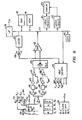
- Conventional microprocessor 116 has a bus 117 extending therefrom.
- Bus 117 has connected thereto conventional ROM 118 and RAM 119.
- An LED display 120 is schematically illustrated having a select latch 121 and a digit designation latch 122.
- Finger 114 of a patient is illustrated with probe 101 having schematic detection circuitry.
- First light emitting diode 132 in the red range and a second light emitting diode 130 in the infrared range are sequentially pulsed to emit light in their respective frequencies by amplifiers 131, 133.
- LED 132 is in the 6600 angstrom range (660 nm) with LED 130 being in the 9400 angstrom range (940 nm).
- a light impervious barrier 136 is placed between photosensor 138 and finger 114. Barrier 136, terminating in contact with the flesh of finger 114, makes the path between the respective light emitting diodes 130, 132 and the light receiving diode 138 occur only through the flesh of finger 114.
- Signal received from the respective light emitting diodes first passes through a pre-amplifier 140. This signal is thereafter amplified in parallel at amplifiers 141, 142. As amplified, the signal is passed in parallel from each amplifier through respective phase detectors 143, 144. Passage through respective low pass filters 145,146 thereafter occurs. Amplification at offset amplifiers 147, 148 then takes place. The pulsatile component is passed to multiplexer 150.
- Multiplexer 150 has output to a comparator 152.
- Comparator 152 is ramped in half steps by a 12 bit digital to analog converter (hereinafter DAC) 154.
- DAC 154 places a comparison signal divided in one part from 4096 parts with the comparator outputting to bus 117.
- microprocessor 116 is programmed to receive signal from photosensor 138 within an optimum range. Utilizing a second operating phase of DAC 154, and communicating signal to a sample hold 157, the individual LED's 130,132 are given voltage outputs 160, 161. These voltage outputs 160, 161 are adjusted so that in each case photosensor 138 looks at a signal well within the range of the DAC.
- Clock 170 controls the sequential output of light from the light emitting diodes 130, 132 to a duty cycle of at least 1 in 4. This is schematically illustrated by signals ⁇ 1 through ⁇ 4. Reception of signal at detector 143 occurs during time periods ⁇ 1 and ⁇ 2 and reception of signal occurs at detector 144 during time periods ⁇ 3 and (p4.
- FIG. 6 is a copy of Fig. 2 from European patent application No. 83304938 having been renumbered to avoid confusion with the context herewith.
- the above application is concerned with a pulse oximeter of the type wherein light of two different wavelengths is passed through human or animal body tissue, such as a finger, an ear, the nasal septum or the scalp, so as to be modulated by the pulsatile component of arterial blood therein, and thereby allowing indication of oxygen saturation, blood perfusion and heart rate.
- the level of incident light is continually adjusted for optimal detection of the pulsatile component, while permitting accommodation to variable attenuations due to skin color, flesh thickness and other invariants.
- a quotient of the pulsatile component of light transmission over the constant component of light transmission is measured for each of two wavelengths by direct digital tracking. The respective quotients are thereafter converted to a ratio, which ratio may be thereafter fitted to a curve of independently derived of oxygen saturation.
- Calibration is disclosed by solving four unknowns at at least four differing saturations. An output of pulse rate, pulsatile flow and oxygen saturation is given. An incident light source duty cycle is chosen to be at least 1 in 4 so that noise, inevitably present in the signal, may be substantially eliminated and filtered.
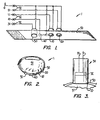
- FIG. 1 of the present application a part-schematic, part-perspective view of the optical probe 1 is shown.
- a suitable length of adjustable, self-fastening tape 50 is provided, such as that sold under the trade mark VELCRO, obtainable from American Velcro, Inc. Incorporated into tape 50 at suitably spaced intervals are the electrical components of probe 1.
- Photoelectric sensor 30 is attached to the outside of tape 50 and protrudes slightly from the underside of tape 50.
- Sensor 30 has ground wire G and lead wire 31.
- Light emitting diode 10 typically emitting frequencies in the infrared range of the spectrum, is mounted to and pierces tape 50 in a similar manner to sensor 30 and at a distance from sensor 30 selected upon the basis of the typical appendage size expected to be encountered.
- LED 10 is connected to ground wire G and has input lead wire 11.
- a second LED 20 typically having wavelength emission characterisics in the red range of the spectrum.
- LED 20 attaches to ground wire G and has input lead wire 21.
- Resistor 40 is shown mounted to tape 50 between sensor 30 and LED 10. However, the physical location of resistor 40 is not important and it may be mounted to probe 1 at any other convenient location. Resistor 40 has input lead wire 41 and is connected to ground wire G.
- Wires G, 11, 21, 31, 41 lead to connector 52 so that probe 11 may be readily disconnected from the oximeter 60 (schematically illustrated in Fig. 4).
- the probe 1 illustrated in Fig. 1 is designed for use in connection with an oximeter 60 designed to operate in conjunction with two LEDs 10, 20 sequentially transmitting light to a single sensor 30.
- the mechanism of the instant invention works equally well for oximeters requiring only a single LED and single or multiple photo sensors. Oximeters requiring more than two LEDs may be equally well accommodated by the probe of the present invention.
- Fig. is an end elevation of a typical finger 51 of a human patient. Finger 51 is encircled by probe 1 at its tip by overlapping the ends of self-connecting tape 50. Light emitted from LEDs 10, 20 enter the flesh offinger 51 and are subjected to diffusion and scattering. Sensor 30 picks up only light which has been diffused through the flesh of finger 51.
- Fig. 3 is a detailed side elevation of sensor 30, showing the manner in which it is assured that no light emitted by LEDs 10,20 is received by sensor 30 without first passing through finger 51.
- Sensor element 32 is recessed somewhat within metal cylinder wall 33 of the sensor housing. Since tape 50 presses sensor 30 directly against the skin of finger 51, it is readily seen that no light passes to sensor element 32 other than through the flesh of finger 51.
- Probe 1 is constructed in the following manner: LED's 10, 20 are selected from batches of LED's with generally known wavelength characteristics. The exact wavelength characteristics of the specific LED's 10,20 chosen are determined at this time through readily available metering means. Resistor 40 is then selected to have a resistance whose amount is exactly specified by a table made available to the factory technician forthis purpose, of all possible wavelength combinations which may be expected to be encountered from the available supplies of LEDs. The following table is an example of how a single resistor 40 might be selected for any hypothetical combination of LED's 10,20 in a case where each has only two possible wavelengths:
- a typical probe will have an infrared LED 10 of wavelength 940 nanometers and a red LED 20 of wavelength 660 nanometers. According to the above table, a probe having such wavelength characteristics will be supplied atthe factory with a resistor 40 of one, and only one, resistance value, in this case shown to be 150 ohms.
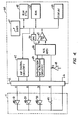
- Oximeter 60 contains a microprocessor 61, and a read only memory 62 and random access memory 63.
- Table A (the same table used for calibrating probe 1 at the factory) no matter how extensive, may be easily programmed into ROM 62 at the time oximeter 60 is fabricated.
- Current I from current source 69 is passed through resistor 40.
- the resulting voltage (per Ohm's law) is passed through multiplexer 66 through comparator 65, to microprocessor 61.
- Microprocessor 61 may be programmed to calculate the resistance of resistor 40 and thereafter to look up the wavelengths of LED's 10, 20 from Table A in ROM 62. Microprocessor 61 is also programmed to itself recalibrate the optical comparison circuitry of oximeter 60 once the wavelengths of LEDs 10, 20 are known. By this means, it is not required to recalibrate by hand oximeter 60 for each new probe 1 nor, alternatively, to require that LEDs 10, 20 be of precisely standardized wavelengths.
- circuitry schematically illustrated in Fig. 4 The specific function and design of the circuitry schematically illustrated in Fig. 4 is seen as obvious when taken in combination with the general description of its function.
- the functions of microprocessors and read only memories are well known and understood and it is well within the capability of a person with ordinary skill in the art to design and program microprocessor 61 to calculate the resistance of resistor 40 and thereby obtain the wavelengths of LEDs 10, 20 from a simple lookup table in a ROM 62.
- Probe 1 may be used with any number of prior art oximeters, the method of operation of which is well understood and beyond the scope of the teaching of the present invention.
- fresh blood is pumped into the capillaries of finger 51, thereby causing a periodic increase and decrease in reflected light intensity observed by sensor 30.
- the oxygen saturation of hemoglobin in the pulsalite blood may be determined by the oximeter 60.
- there is a known extinction coefficient B Given B and measuring the intensity of diffused light received by sensor 30 the oxygen saturation can be computed and displayed.
- the coefficients B ofthe various wavelengths oftable A can be substituted for the wavelengths directly when the table is programmed into ROM 62, thereby eliminating a computational step.
- Microprocessor 61 through LED control circuitry67, operates LEDs 10,20. Lightfrom LEDs 10, 20 results in current in sensor 30 which passes through amplification and filtration circuitry 68 to multiplexer 66. Comparator 65, in combination with a digital to analog converter 70 allows microprocessors 61 to determine oxygen saturation and/or pulse rate. Results are shown on display 64.
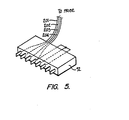
- an alternate way of coding a probe of this invention is illustrated.
- an eight bit connector 52' similar to the connector 52 is illustrating having respective connectors 201, 202,203 respectively communicating to light emitting diode 130, light emitting diode 132 and photodetector 138.
- Conductor 204 is illustrated providing the ground connection.
- the eight bit connector has four empty channels. These channels can be provided to communicate the coded value of the probe.
- the connectors when provided with a common potential provide a positive binary value and when independent of any potential provide a negative value.
- the four conductors of plug 52, as illustrated in Fig. 5 would communicate the binary value 1100.
- communication of the resistance value of the connected probe would be possible by coding the connector to a value of 1 part in 16.
Landscapes
- Physics & Mathematics (AREA)
- Health & Medical Sciences (AREA)
- Life Sciences & Earth Sciences (AREA)
- Spectroscopy & Molecular Physics (AREA)
- General Health & Medical Sciences (AREA)
- Pathology (AREA)
- Public Health (AREA)
- Surgery (AREA)
- Veterinary Medicine (AREA)
- Animal Behavior & Ethology (AREA)
- Molecular Biology (AREA)
- Medical Informatics (AREA)
- Optics & Photonics (AREA)
- Biophysics (AREA)
- Engineering & Computer Science (AREA)
- Biomedical Technology (AREA)
- Heart & Thoracic Surgery (AREA)
- Chemical & Material Sciences (AREA)
- Immunology (AREA)
- Biochemistry (AREA)
- General Physics & Mathematics (AREA)
- Toxicology (AREA)
- Analytical Chemistry (AREA)
- Measurement Of The Respiration, Hearing Ability, Form, And Blood Characteristics Of Living Organisms (AREA)
- Investigating Or Analysing Materials By Optical Means (AREA)
- Other Investigation Or Analysis Of Materials By Electrical Means (AREA)
- Investigating Or Analyzing Non-Biological Materials By The Use Of Chemical Means (AREA)
- Measurement Of Radiation (AREA)
- Steroid Compounds (AREA)
- Compositions Of Oxide Ceramics (AREA)
- Investigating Or Analyzing Materials By The Use Of Ultrasonic Waves (AREA)
Claims (8)
Priority Applications (1)
| Application Number | Priority Date | Filing Date | Title |
|---|---|---|---|
| AT83304940T ATE51134T1 (de) | 1982-09-02 | 1983-08-25 | Geeichte optische oxymetrie-sonde. |
Applications Claiming Priority (2)
| Application Number | Priority Date | Filing Date | Title |
|---|---|---|---|
| US41417682A | 1982-09-02 | 1982-09-02 | |
| US414176 | 1982-09-02 |
Related Child Applications (1)
| Application Number | Title | Priority Date | Filing Date |
|---|---|---|---|
| EP89105503.0 Division-Into | 1989-03-29 |
Publications (3)
| Publication Number | Publication Date |
|---|---|
| EP0104772A2 EP0104772A2 (de) | 1984-04-04 |
| EP0104772A3 EP0104772A3 (en) | 1985-10-23 |
| EP0104772B1 true EP0104772B1 (de) | 1990-03-21 |
Family
ID=23640289
Family Applications (1)
| Application Number | Title | Priority Date | Filing Date |
|---|---|---|---|
| EP83304940A Expired - Lifetime EP0104772B1 (de) | 1982-09-02 | 1983-08-25 | Geeichte optische Oxymetrie-Sonde |
Country Status (5)
| Country | Link |
|---|---|
| EP (1) | EP0104772B1 (de) |
| JP (2) | JPS5964031A (de) |
| AT (1) | ATE51134T1 (de) |
| DE (2) | DE3381344D1 (de) |
| HK (1) | HK161195A (de) |
Cited By (13)
| Publication number | Priority date | Publication date | Assignee | Title |
|---|---|---|---|---|
| US6725072B2 (en) | 1990-10-06 | 2004-04-20 | Hema Metrics, Inc. | Sensor for transcutaneous measurement of vascular access blood flow |
| US6746407B2 (en) | 2000-12-29 | 2004-06-08 | Hema Metrics, Inc. | Method of measuring transcutaneous access blood flow |
| US6804543B2 (en) | 1998-02-05 | 2004-10-12 | Hema Metrics, Inc. | Sensor for transcutaneous measurement of vascular access blood flow |
| US7272425B2 (en) | 1999-12-09 | 2007-09-18 | Masimo Corporation | Pulse oximetry sensor including stored sensor data |
| US7483730B2 (en) | 1991-03-21 | 2009-01-27 | Masimo Corporation | Low-noise optical probes for reducing ambient noise |
| US7496391B2 (en) | 1995-06-07 | 2009-02-24 | Masimo Corporation | Manual and automatic probe calibration |
| US7990382B2 (en) | 2006-01-03 | 2011-08-02 | Masimo Corporation | Virtual display |
| USRE44823E1 (en) | 1998-10-15 | 2014-04-01 | Masimo Corporation | Universal modular pulse oximeter probe for use with reusable and disposable patient attachment devices |
| US8706179B2 (en) | 1998-10-15 | 2014-04-22 | Masimo Corporation | Reusable pulse oximeter probe and disposable bandage apparatii |
| US8920317B2 (en) | 2003-07-25 | 2014-12-30 | Masimo Corporation | Multipurpose sensor port |
| US9560998B2 (en) | 2006-10-12 | 2017-02-07 | Masimo Corporation | System and method for monitoring the life of a physiological sensor |
| US9795739B2 (en) | 2009-05-20 | 2017-10-24 | Masimo Corporation | Hemoglobin display and patient treatment |
| US10188348B2 (en) | 2006-06-05 | 2019-01-29 | Masimo Corporation | Parameter upgrade system |
Families Citing this family (39)
| Publication number | Priority date | Publication date | Assignee | Title |
|---|---|---|---|---|
| JPS60158803U (ja) * | 1984-03-30 | 1985-10-22 | スタンレー電気株式会社 | 光センサ |
| US4934372A (en) * | 1985-04-01 | 1990-06-19 | Nellcor Incorporated | Method and apparatus for detecting optical pulses |
| US4928692A (en) * | 1985-04-01 | 1990-05-29 | Goodman David E | Method and apparatus for detecting optical pulses |
| US4802486A (en) * | 1985-04-01 | 1989-02-07 | Nellcor Incorporated | Method and apparatus for detecting optical pulses |
| US4684245A (en) * | 1985-10-28 | 1987-08-04 | Oximetrix, Inc. | Electro-optical coupler for catheter oximeter |
| US5259381A (en) * | 1986-08-18 | 1993-11-09 | Physio-Control Corporation | Apparatus for the automatic calibration of signals employed in oximetry |
| US4859056A (en) * | 1986-08-18 | 1989-08-22 | Physio-Control Corporation | Multiple-pulse method and apparatus for use in oximetry |
| US4819646A (en) * | 1986-08-18 | 1989-04-11 | Physio-Control Corporation | Feedback-controlled method and apparatus for processing signals used in oximetry |
| US4913150A (en) * | 1986-08-18 | 1990-04-03 | Physio-Control Corporation | Method and apparatus for the automatic calibration of signals employed in oximetry |
| DE3681175D1 (de) * | 1986-11-17 | 1991-10-02 | Hellige Gmbh | Kombinationssensor zur transcutanen erfassung von sauerstoff und kohlendioxid im blut. |
| JPS63252239A (ja) * | 1987-04-09 | 1988-10-19 | Sumitomo Electric Ind Ltd | 反射型オキシメ−タ |
| JPH07113604B2 (ja) * | 1987-07-24 | 1995-12-06 | テルモ株式会社 | ヘモグロビン濃度測定装置 |
| US4848901A (en) * | 1987-10-08 | 1989-07-18 | Critikon, Inc. | Pulse oximeter sensor control system |
| US4825879A (en) * | 1987-10-08 | 1989-05-02 | Critkon, Inc. | Pulse oximeter sensor |
| US4869254A (en) * | 1988-03-30 | 1989-09-26 | Nellcor Incorporated | Method and apparatus for calculating arterial oxygen saturation |
| JPH02111345A (ja) * | 1988-10-21 | 1990-04-24 | Koorin Denshi Kk | 反射型オキシメータ |
| JPH06103257B2 (ja) * | 1988-12-19 | 1994-12-14 | 大塚電子株式会社 | 光散乱を用いた物質の吸光係数測定方法および装置 |
| US5028787A (en) * | 1989-01-19 | 1991-07-02 | Futrex, Inc. | Non-invasive measurement of blood glucose |
| US6266546B1 (en) | 1990-10-06 | 2001-07-24 | In-Line Diagnostics Corporation | System for noninvasive hematocrit monitoring |
| US6246894B1 (en) | 1993-02-01 | 2001-06-12 | In-Line Diagnostics Corporation | System and method for measuring blood urea nitrogen, blood osmolarity, plasma free hemoglobin and tissue water content |
| US6681128B2 (en) | 1990-10-06 | 2004-01-20 | Hema Metrics, Inc. | System for noninvasive hematocrit monitoring |
| US5429129A (en) * | 1991-08-22 | 1995-07-04 | Sensor Devices, Inc. | Apparatus for determining spectral absorption by a specific substance in a fluid |
| US5246003A (en) * | 1991-08-28 | 1993-09-21 | Nellcor Incorporated | Disposable pulse oximeter sensor |
| AU667055B2 (en) * | 1991-09-26 | 1996-03-07 | Hans Bar | Medico-technical process and means for measuring blood irrigation of organs |
| US5249576A (en) * | 1991-10-24 | 1993-10-05 | Boc Health Care, Inc. | Universal pulse oximeter probe |
| JP3091929B2 (ja) * | 1992-05-28 | 2000-09-25 | 日本光電工業株式会社 | パルスオキシメータ |
| DE4314835A1 (de) * | 1993-05-05 | 1994-11-10 | Boehringer Mannheim Gmbh | Verfahren und Vorrichtung zur Analyse von Glucose in einer biologischen Matrix |
| IL107396A (en) * | 1992-11-09 | 1997-02-18 | Boehringer Mannheim Gmbh | Method and apparatus for analytical determination of glucose in a biological matrix |
| JPH11508691A (ja) * | 1995-07-03 | 1999-07-27 | センサー デバイシーズ,インコーポレイテッド | スペクトル吸収測定装置 |
| DE19544501A1 (de) * | 1995-11-29 | 1997-06-05 | Boehringer Mannheim Gmbh | Vorrichtung für Lichtreflexionsmessungen |
| US5913819A (en) * | 1996-04-26 | 1999-06-22 | Datex-Ohmeda, Inc. | Injection molded, heat-sealed housing and half-etched lead frame for oximeter sensor |
| US5919133A (en) * | 1996-04-26 | 1999-07-06 | Ohmeda Inc. | Conformal wrap for pulse oximeter sensor |
| US6117099A (en) | 1996-10-23 | 2000-09-12 | In-Line Diagnostics Corporation | System and method for noninvasive hemodynamic measurements in hemodialysis shunts |
| JPH10314149A (ja) * | 1997-05-20 | 1998-12-02 | Casio Comput Co Ltd | プローブが交換可能な電気測定器及びプローブ管理方法及びパルスオキシメータ |
| GB9717858D0 (en) * | 1997-08-23 | 1997-10-29 | Electrode Company Ltd | The Electrode Company Ltd |
| JP4578683B2 (ja) * | 1998-09-29 | 2010-11-10 | マリンクロッド・インコーポレイテッド | 複数コード酸素計較正素子 |
| WO2006121984A2 (en) * | 2005-05-06 | 2006-11-16 | Yeda Research And Development Co., Ltd. | Erythrocyte movement imaging and analysis |
| JP5552819B2 (ja) * | 2010-01-28 | 2014-07-16 | ソニー株式会社 | 濃度測定装置 |
| WO2017018114A1 (ja) * | 2015-07-30 | 2017-02-02 | アルプス電気株式会社 | センサモジュールおよび生体関連情報表示システム |
Family Cites Families (5)
| Publication number | Priority date | Publication date | Assignee | Title |
|---|---|---|---|---|
| FR1589461A (de) * | 1968-09-18 | 1970-03-31 | ||
| US3910701A (en) * | 1973-07-30 | 1975-10-07 | George R Henderson | Method and apparatus for measuring light reflectance absorption and or transmission |
| CA1037285A (en) * | 1975-04-30 | 1978-08-29 | Glenfield Warner | Ear oximetry process and apparatus |
| JPS5524004A (en) * | 1978-06-22 | 1980-02-20 | Minolta Camera Kk | Oxymeter |
| DE3100610C2 (de) * | 1981-01-12 | 1983-07-07 | Vladimir Dr.-Ing. Blazek | Meßeinrichtung zur nichtinvasiven Feststellung venöser bzw. arterieller Abfluß- und Durchflußstörungen |
-
1983
- 1983-08-25 EP EP83304940A patent/EP0104772B1/de not_active Expired - Lifetime
- 1983-08-25 DE DE8383304940T patent/DE3381344D1/de not_active Expired - Lifetime
- 1983-08-25 AT AT83304940T patent/ATE51134T1/de not_active IP Right Cessation
- 1983-08-25 DE DE8989105503T patent/DE3382674T2/de not_active Expired - Lifetime
- 1983-09-02 JP JP58161784A patent/JPS5964031A/ja active Granted
-
1991
- 1991-03-29 JP JP3089245A patent/JPH04250140A/ja active Granted
-
1995
- 1995-10-12 HK HK161195A patent/HK161195A/en not_active IP Right Cessation
Cited By (23)
| Publication number | Priority date | Publication date | Assignee | Title |
|---|---|---|---|---|
| US6725072B2 (en) | 1990-10-06 | 2004-04-20 | Hema Metrics, Inc. | Sensor for transcutaneous measurement of vascular access blood flow |
| US7483730B2 (en) | 1991-03-21 | 2009-01-27 | Masimo Corporation | Low-noise optical probes for reducing ambient noise |
| US7496391B2 (en) | 1995-06-07 | 2009-02-24 | Masimo Corporation | Manual and automatic probe calibration |
| US7526328B2 (en) | 1995-06-07 | 2009-04-28 | Masimo Corporation | Manual and automatic probe calibration |
| US6804543B2 (en) | 1998-02-05 | 2004-10-12 | Hema Metrics, Inc. | Sensor for transcutaneous measurement of vascular access blood flow |
| US8706179B2 (en) | 1998-10-15 | 2014-04-22 | Masimo Corporation | Reusable pulse oximeter probe and disposable bandage apparatii |
| USRE44823E1 (en) | 1998-10-15 | 2014-04-01 | Masimo Corporation | Universal modular pulse oximeter probe for use with reusable and disposable patient attachment devices |
| US7272425B2 (en) | 1999-12-09 | 2007-09-18 | Masimo Corporation | Pulse oximetry sensor including stored sensor data |
| US6937882B2 (en) | 2000-12-29 | 2005-08-30 | Hema Metrics, Inc. | Sensor for transcutaneous measurement of vascular access blood flow |
| US6746407B2 (en) | 2000-12-29 | 2004-06-08 | Hema Metrics, Inc. | Method of measuring transcutaneous access blood flow |
| US6987993B2 (en) | 2000-12-29 | 2006-01-17 | Hema Metrics, Inc. | Sensor for transcutaneous measurement of vascular access blood flow |
| US10058275B2 (en) | 2003-07-25 | 2018-08-28 | Masimo Corporation | Multipurpose sensor port |
| US8920317B2 (en) | 2003-07-25 | 2014-12-30 | Masimo Corporation | Multipurpose sensor port |
| US11020029B2 (en) | 2003-07-25 | 2021-06-01 | Masimo Corporation | Multipurpose sensor port |
| US7990382B2 (en) | 2006-01-03 | 2011-08-02 | Masimo Corporation | Virtual display |
| US10188348B2 (en) | 2006-06-05 | 2019-01-29 | Masimo Corporation | Parameter upgrade system |
| US11191485B2 (en) | 2006-06-05 | 2021-12-07 | Masimo Corporation | Parameter upgrade system |
| US10039482B2 (en) | 2006-10-12 | 2018-08-07 | Masimo Corporation | System and method for monitoring the life of a physiological sensor |
| US10342470B2 (en) | 2006-10-12 | 2019-07-09 | Masimo Corporation | System and method for monitoring the life of a physiological sensor |
| US10863938B2 (en) | 2006-10-12 | 2020-12-15 | Masimo Corporation | System and method for monitoring the life of a physiological sensor |
| US9560998B2 (en) | 2006-10-12 | 2017-02-07 | Masimo Corporation | System and method for monitoring the life of a physiological sensor |
| US9795739B2 (en) | 2009-05-20 | 2017-10-24 | Masimo Corporation | Hemoglobin display and patient treatment |
| US10413666B2 (en) | 2009-05-20 | 2019-09-17 | Masimo Corporation | Hemoglobin display and patient treatment |
Also Published As
| Publication number | Publication date |
|---|---|
| ATE51134T1 (de) | 1990-04-15 |
| JPH0547208B2 (de) | 1993-07-16 |
| DE3382674D1 (de) | 1993-05-13 |
| HK161195A (en) | 1995-10-20 |
| EP0104772A2 (de) | 1984-04-04 |
| DE3382674T2 (de) | 1993-07-08 |
| JPH04250140A (ja) | 1992-09-07 |
| JPH0355129B2 (de) | 1991-08-22 |
| DE3381344D1 (de) | 1990-04-26 |
| EP0104772A3 (en) | 1985-10-23 |
| JPS5964031A (ja) | 1984-04-11 |
Similar Documents
| Publication | Publication Date | Title |
|---|---|---|
| EP0104772B1 (de) | Geeichte optische Oxymetrie-Sonde | |
| US4621643A (en) | Calibrated optical oximeter probe | |
| US4700708A (en) | Calibrated optical oximeter probe | |
| US4770179A (en) | Calibrated optical oximeter probe | |
| EP0329196B1 (de) | Sauerstoffmesseinrichtung mit Sauerstoffmesssonde | |
| US5758644A (en) | Manual and automatic probe calibration | |
| JP4306963B2 (ja) | 波長シフトを指示する素子を有するファイバー光学系オキシメータコネクタ | |
| EP0102816A2 (de) | Messgerät für Puls und Sauerstoffgehalt | |
| JP2007532188A (ja) | 空間的に均等のマルチカラーソースを用いたフォトプレチスモグラフィ | |
| EP0290278A1 (de) | Untersuchungsgerät zur Messung der Sauerstoffsättigung | |
| AU729132B2 (en) | Manual and automatic probe calibration | |
| HK1009848B (en) | Oximeter comprising a light source and an information element |
Legal Events
| Date | Code | Title | Description |
|---|---|---|---|
| PUAI | Public reference made under article 153(3) epc to a published international application that has entered the european phase |
Free format text: ORIGINAL CODE: 0009012 |
|
| AK | Designated contracting states |
Designated state(s): AT BE CH DE FR GB IT LI LU NL SE |
|
| PUAL | Search report despatched |
Free format text: ORIGINAL CODE: 0009013 |
|
| AK | Designated contracting states |
Designated state(s): AT BE CH DE FR GB IT LI LU NL SE |
|
| 17P | Request for examination filed |
Effective date: 19860306 |
|
| RAP1 | Party data changed (applicant data changed or rights of an application transferred) |
Owner name: NELLCOR INCORPORATED |
|
| 17Q | First examination report despatched |
Effective date: 19871006 |
|
| 17Q | First examination report despatched |
Effective date: 19871023 |
|
| GRAA | (expected) grant |
Free format text: ORIGINAL CODE: 0009210 |
|
| AK | Designated contracting states |
Kind code of ref document: B1 Designated state(s): AT BE CH DE FR GB IT LI LU NL SE |
|
| REF | Corresponds to: |
Ref document number: 51134 Country of ref document: AT Date of ref document: 19900415 Kind code of ref document: T |
|
| XX | Miscellaneous (additional remarks) |
Free format text: TEILANMELDUNG 89105503.0 EINGEREICHT AM 25/08/83. |
|
| ITF | It: translation for a ep patent filed | ||
| REF | Corresponds to: |
Ref document number: 3381344 Country of ref document: DE Date of ref document: 19900426 |
|
| ET | Fr: translation filed | ||
| PLBE | No opposition filed within time limit |
Free format text: ORIGINAL CODE: 0009261 |
|
| STAA | Information on the status of an ep patent application or granted ep patent |
Free format text: STATUS: NO OPPOSITION FILED WITHIN TIME LIMIT |
|
| 26N | No opposition filed | ||
| ITTA | It: last paid annual fee | ||
| EPTA | Lu: last paid annual fee | ||
| EAL | Se: european patent in force in sweden |
Ref document number: 83304940.6 |
|
| REG | Reference to a national code |
Ref country code: GB Ref legal event code: IF02 |
|
| PGFP | Annual fee paid to national office [announced via postgrant information from national office to epo] |
Ref country code: FR Payment date: 20020731 Year of fee payment: 20 |
|
| PGFP | Annual fee paid to national office [announced via postgrant information from national office to epo] |
Ref country code: SE Payment date: 20020801 Year of fee payment: 20 Ref country code: NL Payment date: 20020801 Year of fee payment: 20 Ref country code: AT Payment date: 20020801 Year of fee payment: 20 |
|
| PGFP | Annual fee paid to national office [announced via postgrant information from national office to epo] |
Ref country code: CH Payment date: 20020802 Year of fee payment: 20 |
|
| PGFP | Annual fee paid to national office [announced via postgrant information from national office to epo] |
Ref country code: GB Payment date: 20020821 Year of fee payment: 20 |
|
| PGFP | Annual fee paid to national office [announced via postgrant information from national office to epo] |
Ref country code: LU Payment date: 20020826 Year of fee payment: 20 |
|
| PGFP | Annual fee paid to national office [announced via postgrant information from national office to epo] |
Ref country code: DE Payment date: 20020830 Year of fee payment: 20 |
|
| PGFP | Annual fee paid to national office [announced via postgrant information from national office to epo] |
Ref country code: BE Payment date: 20020904 Year of fee payment: 20 |
|
| REG | Reference to a national code |
Ref country code: CH Ref legal event code: PFA Free format text: NELLCOR INCORPORATED TRANSFER- NELLCOR PURITAN BENNETT INCORPORATED Ref country code: CH Ref legal event code: NV Representative=s name: E. BLUM & CO. PATENTANWAELTE |
|
| PG25 | Lapsed in a contracting state [announced via postgrant information from national office to epo] |
Ref country code: LI Free format text: LAPSE BECAUSE OF EXPIRATION OF PROTECTION Effective date: 20030824 Ref country code: GB Free format text: LAPSE BECAUSE OF EXPIRATION OF PROTECTION Effective date: 20030824 Ref country code: CH Free format text: LAPSE BECAUSE OF EXPIRATION OF PROTECTION Effective date: 20030824 |
|
| PG25 | Lapsed in a contracting state [announced via postgrant information from national office to epo] |
Ref country code: NL Free format text: LAPSE BECAUSE OF EXPIRATION OF PROTECTION Effective date: 20030825 Ref country code: LU Free format text: LAPSE BECAUSE OF EXPIRATION OF PROTECTION Effective date: 20030825 Ref country code: AT Free format text: LAPSE BECAUSE OF EXPIRATION OF PROTECTION Effective date: 20030825 |
|
| REG | Reference to a national code |
Ref country code: GB Ref legal event code: PE20 |
|
| EUG | Se: european patent has lapsed | ||
| REG | Reference to a national code |
Ref country code: CH Ref legal event code: PL |
|
| NLV7 | Nl: ceased due to reaching the maximum lifetime of a patent |
Effective date: 20030825 |