EP0104479B1 - Hitzewiderstandsfähige Acrylharzzusammensetzung und Verfahren zu seiner Herstellung - Google Patents
Hitzewiderstandsfähige Acrylharzzusammensetzung und Verfahren zu seiner Herstellung Download PDFInfo
- Publication number
- EP0104479B1 EP0104479B1 EP83108554A EP83108554A EP0104479B1 EP 0104479 B1 EP0104479 B1 EP 0104479B1 EP 83108554 A EP83108554 A EP 83108554A EP 83108554 A EP83108554 A EP 83108554A EP 0104479 B1 EP0104479 B1 EP 0104479B1
- Authority
- EP
- European Patent Office
- Prior art keywords
- weight
- flame
- acrylic resin
- resin composition
- partial polymer
- Prior art date
- Legal status (The legal status is an assumption and is not a legal conclusion. Google has not performed a legal analysis and makes no representation as to the accuracy of the status listed.)
- Expired
Links
- 239000000203 mixture Substances 0.000 title claims description 106
- 239000004925 Acrylic resin Substances 0.000 title claims description 45
- 229920000178 Acrylic resin Polymers 0.000 title claims description 45
- 238000000034 method Methods 0.000 title claims description 36
- 229920000642 polymer Polymers 0.000 claims description 100
- PPBRXRYQALVLMV-UHFFFAOYSA-N Styrene Chemical compound C=CC1=CC=CC=C1 PPBRXRYQALVLMV-UHFFFAOYSA-N 0.000 claims description 75
- VVQNEPGJFQJSBK-UHFFFAOYSA-N Methyl methacrylate Chemical group COC(=O)C(C)=C VVQNEPGJFQJSBK-UHFFFAOYSA-N 0.000 claims description 59
- CERQOIWHTDAKMF-UHFFFAOYSA-N Methacrylic acid Chemical compound CC(=C)C(O)=O CERQOIWHTDAKMF-UHFFFAOYSA-N 0.000 claims description 57
- 238000006116 polymerization reaction Methods 0.000 claims description 53
- 239000000178 monomer Substances 0.000 claims description 44
- 239000000463 material Substances 0.000 claims description 40
- XYLMUPLGERFSHI-UHFFFAOYSA-N alpha-Methylstyrene Chemical compound CC(=C)C1=CC=CC=C1 XYLMUPLGERFSHI-UHFFFAOYSA-N 0.000 claims description 38
- 239000003063 flame retardant Substances 0.000 claims description 37
- FPYJFEHAWHCUMM-UHFFFAOYSA-N maleic anhydride Chemical compound O=C1OC(=O)C=C1 FPYJFEHAWHCUMM-UHFFFAOYSA-N 0.000 claims description 36
- RNFJDJUURJAICM-UHFFFAOYSA-N 2,2,4,4,6,6-hexaphenoxy-1,3,5-triaza-2$l^{5},4$l^{5},6$l^{5}-triphosphacyclohexa-1,3,5-triene Chemical compound N=1P(OC=2C=CC=CC=2)(OC=2C=CC=CC=2)=NP(OC=2C=CC=CC=2)(OC=2C=CC=CC=2)=NP=1(OC=1C=CC=CC=1)OC1=CC=CC=C1 RNFJDJUURJAICM-UHFFFAOYSA-N 0.000 claims description 33
- 239000003505 polymerization initiator Substances 0.000 claims description 31
- 229920001577 copolymer Polymers 0.000 claims description 20
- 150000003014 phosphoric acid esters Chemical class 0.000 claims description 13
- 239000002253 acid Substances 0.000 claims description 12
- 238000005266 casting Methods 0.000 claims description 12
- 229910052736 halogen Inorganic materials 0.000 claims description 12
- 150000002367 halogens Chemical group 0.000 claims description 12
- 229910019142 PO4 Inorganic materials 0.000 claims description 11
- 229920000388 Polyphosphate Polymers 0.000 claims description 11
- 239000001205 polyphosphate Substances 0.000 claims description 11
- 235000011176 polyphosphates Nutrition 0.000 claims description 11
- 125000000217 alkyl group Chemical group 0.000 claims description 10
- NBIIXXVUZAFLBC-UHFFFAOYSA-K phosphate Chemical compound [O-]P([O-])([O-])=O NBIIXXVUZAFLBC-UHFFFAOYSA-K 0.000 claims description 10
- 239000010452 phosphate Substances 0.000 claims description 10
- AVXWWBFBRTXBRM-UHFFFAOYSA-N 3-bromopyridine-4-carboxylic acid Chemical group OC(=O)C1=CC=NC=C1Br AVXWWBFBRTXBRM-UHFFFAOYSA-N 0.000 claims description 6
- MYRTYDVEIRVNKP-UHFFFAOYSA-N 1,2-Divinylbenzene Chemical compound C=CC1=CC=CC=C1C=C MYRTYDVEIRVNKP-UHFFFAOYSA-N 0.000 claims description 4
- SMZOUWXMTYCWNB-UHFFFAOYSA-N 2-(2-methoxy-5-methylphenyl)ethanamine Chemical compound COC1=CC=C(C)C=C1CCN SMZOUWXMTYCWNB-UHFFFAOYSA-N 0.000 claims description 4
- NIXOWILDQLNWCW-UHFFFAOYSA-N 2-Propenoic acid Natural products OC(=O)C=C NIXOWILDQLNWCW-UHFFFAOYSA-N 0.000 claims description 4
- SOGAXMICEFXMKE-UHFFFAOYSA-N Butylmethacrylate Chemical compound CCCCOC(=O)C(C)=C SOGAXMICEFXMKE-UHFFFAOYSA-N 0.000 claims description 4
- ZAMOUSCENKQFHK-UHFFFAOYSA-N Chlorine atom Chemical compound [Cl] ZAMOUSCENKQFHK-UHFFFAOYSA-N 0.000 claims description 4
- BAPJBEWLBFYGME-UHFFFAOYSA-N Methyl acrylate Chemical compound COC(=O)C=C BAPJBEWLBFYGME-UHFFFAOYSA-N 0.000 claims description 4
- OAICVXFJPJFONN-UHFFFAOYSA-N Phosphorus Chemical compound [P] OAICVXFJPJFONN-UHFFFAOYSA-N 0.000 claims description 4
- 239000000460 chlorine Substances 0.000 claims description 4
- 229910052801 chlorine Inorganic materials 0.000 claims description 4
- 229910052698 phosphorus Inorganic materials 0.000 claims description 4
- 239000011574 phosphorus Substances 0.000 claims description 4
- NOBYOEQUFMGXBP-UHFFFAOYSA-N (4-tert-butylcyclohexyl) (4-tert-butylcyclohexyl)oxycarbonyloxy carbonate Chemical group C1CC(C(C)(C)C)CCC1OC(=O)OOC(=O)OC1CCC(C(C)(C)C)CC1 NOBYOEQUFMGXBP-UHFFFAOYSA-N 0.000 claims description 3
- KOMNUTZXSVSERR-UHFFFAOYSA-N 1,3,5-tris(prop-2-enyl)-1,3,5-triazinane-2,4,6-trione Chemical compound C=CCN1C(=O)N(CC=C)C(=O)N(CC=C)C1=O KOMNUTZXSVSERR-UHFFFAOYSA-N 0.000 claims description 2
- BJELTSYBAHKXRW-UHFFFAOYSA-N 2,4,6-triallyloxy-1,3,5-triazine Chemical compound C=CCOC1=NC(OCC=C)=NC(OCC=C)=N1 BJELTSYBAHKXRW-UHFFFAOYSA-N 0.000 claims description 2
- JAHNSTQSQJOJLO-UHFFFAOYSA-N 2-(3-fluorophenyl)-1h-imidazole Chemical compound FC1=CC=CC(C=2NC=CN=2)=C1 JAHNSTQSQJOJLO-UHFFFAOYSA-N 0.000 claims description 2
- HWSSEYVMGDIFMH-UHFFFAOYSA-N 2-[2-[2-(2-methylprop-2-enoyloxy)ethoxy]ethoxy]ethyl 2-methylprop-2-enoate Chemical compound CC(=C)C(=O)OCCOCCOCCOC(=O)C(C)=C HWSSEYVMGDIFMH-UHFFFAOYSA-N 0.000 claims description 2
- DBCAQXHNJOFNGC-UHFFFAOYSA-N 4-bromo-1,1,1-trifluorobutane Chemical compound FC(F)(F)CCCBr DBCAQXHNJOFNGC-UHFFFAOYSA-N 0.000 claims description 2
- JIGUQPWFLRLWPJ-UHFFFAOYSA-N Ethyl acrylate Chemical compound CCOC(=O)C=C JIGUQPWFLRLWPJ-UHFFFAOYSA-N 0.000 claims description 2
- OFOBLEOULBTSOW-UHFFFAOYSA-N Propanedioic acid Natural products OC(=O)CC(O)=O OFOBLEOULBTSOW-UHFFFAOYSA-N 0.000 claims description 2
- OKKRPWIIYQTPQF-UHFFFAOYSA-N Trimethylolpropane trimethacrylate Chemical compound CC(=C)C(=O)OCC(CC)(COC(=O)C(C)=C)COC(=O)C(C)=C OKKRPWIIYQTPQF-UHFFFAOYSA-N 0.000 claims description 2
- XTXRWKRVRITETP-UHFFFAOYSA-N Vinyl acetate Chemical compound CC(=O)OC=C XTXRWKRVRITETP-UHFFFAOYSA-N 0.000 claims description 2
- CQEYYJKEWSMYFG-UHFFFAOYSA-N butyl acrylate Chemical compound CCCCOC(=O)C=C CQEYYJKEWSMYFG-UHFFFAOYSA-N 0.000 claims description 2
- SUPCQIBBMFXVTL-UHFFFAOYSA-N ethyl 2-methylprop-2-enoate Chemical compound CCOC(=O)C(C)=C SUPCQIBBMFXVTL-UHFFFAOYSA-N 0.000 claims description 2
- STVZJERGLQHEKB-UHFFFAOYSA-N ethylene glycol dimethacrylate Substances CC(=C)C(=O)OCCOC(=O)C(C)=C STVZJERGLQHEKB-UHFFFAOYSA-N 0.000 claims description 2
- VZCYOOQTPOCHFL-UPHRSURJSA-N maleic acid Chemical compound OC(=O)\C=C/C(O)=O VZCYOOQTPOCHFL-UPHRSURJSA-N 0.000 claims description 2
- 239000011976 maleic acid Substances 0.000 claims description 2
- LVHBHZANLOWSRM-UHFFFAOYSA-N methylenebutanedioic acid Natural products OC(=O)CC(=C)C(O)=O LVHBHZANLOWSRM-UHFFFAOYSA-N 0.000 claims description 2
- PNJWIWWMYCMZRO-UHFFFAOYSA-N pent‐4‐en‐2‐one Natural products CC(=O)CC=C PNJWIWWMYCMZRO-UHFFFAOYSA-N 0.000 claims description 2
- 230000000379 polymerizing effect Effects 0.000 claims description 2
- VZCYOOQTPOCHFL-UHFFFAOYSA-N trans-butenedioic acid Natural products OC(=O)C=CC(O)=O VZCYOOQTPOCHFL-UHFFFAOYSA-N 0.000 claims description 2
- CERQOIWHTDAKMF-UHFFFAOYSA-M Methacrylate Chemical compound CC(=C)C([O-])=O CERQOIWHTDAKMF-UHFFFAOYSA-M 0.000 claims 1
- 238000011144 upstream manufacturing Methods 0.000 claims 1
- 238000002485 combustion reaction Methods 0.000 description 93
- 239000011347 resin Substances 0.000 description 85
- 229920005989 resin Polymers 0.000 description 85
- 230000000052 comparative effect Effects 0.000 description 32
- WYGWHHGCAGTUCH-UHFFFAOYSA-N 2-[(2-cyano-4-methylpentan-2-yl)diazenyl]-2,4-dimethylpentanenitrile Chemical compound CC(C)CC(C)(C#N)N=NC(C)(C#N)CC(C)C WYGWHHGCAGTUCH-UHFFFAOYSA-N 0.000 description 29
- XLYOFNOQVPJJNP-UHFFFAOYSA-N water Substances O XLYOFNOQVPJJNP-UHFFFAOYSA-N 0.000 description 27
- 230000000704 physical effect Effects 0.000 description 20
- FJTUUPVRIANHEX-UHFFFAOYSA-N butan-1-ol;phosphoric acid Chemical compound CCCCO.OP(O)(O)=O FJTUUPVRIANHEX-UHFFFAOYSA-N 0.000 description 15
- 238000001816 cooling Methods 0.000 description 15
- 238000003756 stirring Methods 0.000 description 15
- 238000010438 heat treatment Methods 0.000 description 14
- 229920000915 polyvinyl chloride Polymers 0.000 description 13
- 239000004800 polyvinyl chloride Substances 0.000 description 13
- 239000005341 toughened glass Substances 0.000 description 12
- 229920005601 base polymer Polymers 0.000 description 8
- 238000006243 chemical reaction Methods 0.000 description 8
- 229960000878 docusate sodium Drugs 0.000 description 8
- 230000003287 optical effect Effects 0.000 description 8
- 235000021317 phosphate Nutrition 0.000 description 8
- APSBXTVYXVQYAB-UHFFFAOYSA-M sodium docusate Chemical compound [Na+].CCCCC(CC)COC(=O)CC(S([O-])(=O)=O)C(=O)OCC(CC)CCCC APSBXTVYXVQYAB-UHFFFAOYSA-M 0.000 description 8
- 239000011342 resin composition Substances 0.000 description 7
- 239000003795 chemical substances by application Substances 0.000 description 6
- 238000010992 reflux Methods 0.000 description 6
- 230000000694 effects Effects 0.000 description 5
- 239000011541 reaction mixture Substances 0.000 description 5
- 239000000126 substance Substances 0.000 description 5
- 230000002195 synergetic effect Effects 0.000 description 5
- 239000006188 syrup Substances 0.000 description 5
- 235000020357 syrup Nutrition 0.000 description 5
- 239000000843 powder Substances 0.000 description 4
- 238000007652 sheet-forming process Methods 0.000 description 4
- 229910001220 stainless steel Inorganic materials 0.000 description 4
- 239000010935 stainless steel Substances 0.000 description 4
- 239000003054 catalyst Substances 0.000 description 3
- 230000006866 deterioration Effects 0.000 description 3
- 229920006395 saturated elastomer Polymers 0.000 description 3
- OZAIFHULBGXAKX-UHFFFAOYSA-N 2-(2-cyanopropan-2-yldiazenyl)-2-methylpropanenitrile Chemical compound N#CC(C)(C)N=NC(C)(C)C#N OZAIFHULBGXAKX-UHFFFAOYSA-N 0.000 description 2
- 229920005497 Acrypet® Polymers 0.000 description 2
- 229920000297 Rayon Polymers 0.000 description 2
- 239000000654 additive Substances 0.000 description 2
- 230000002411 adverse Effects 0.000 description 2
- 238000000137 annealing Methods 0.000 description 2
- 230000005540 biological transmission Effects 0.000 description 2
- 238000012662 bulk polymerization Methods 0.000 description 2
- 238000004040 coloring Methods 0.000 description 2
- 239000004035 construction material Substances 0.000 description 2
- 238000007334 copolymerization reaction Methods 0.000 description 2
- WOLATMHLPFJRGC-UHFFFAOYSA-N furan-2,5-dione;styrene Chemical compound O=C1OC(=O)C=C1.C=CC1=CC=CC=C1 WOLATMHLPFJRGC-UHFFFAOYSA-N 0.000 description 2
- 239000011521 glass Substances 0.000 description 2
- 238000005286 illumination Methods 0.000 description 2
- 239000007788 liquid Substances 0.000 description 2
- 229920003229 poly(methyl methacrylate) Polymers 0.000 description 2
- 239000004926 polymethyl methacrylate Substances 0.000 description 2
- 230000009257 reactivity Effects 0.000 description 2
- 230000000979 retarding effect Effects 0.000 description 2
- 239000007921 spray Substances 0.000 description 2
- 238000002834 transmittance Methods 0.000 description 2
- 239000004342 Benzoyl peroxide Substances 0.000 description 1
- OMPJBNCRMGITSC-UHFFFAOYSA-N Benzoylperoxide Chemical compound C=1C=CC=CC=1C(=O)OOC(=O)C1=CC=CC=C1 OMPJBNCRMGITSC-UHFFFAOYSA-N 0.000 description 1
- YIVJZNGAASQVEM-UHFFFAOYSA-N Lauroyl peroxide Chemical compound CCCCCCCCCCCC(=O)OOC(=O)CCCCCCCCCCC YIVJZNGAASQVEM-UHFFFAOYSA-N 0.000 description 1
- 239000004698 Polyethylene Substances 0.000 description 1
- 229910000831 Steel Inorganic materials 0.000 description 1
- 239000006096 absorbing agent Substances 0.000 description 1
- 238000010521 absorption reaction Methods 0.000 description 1
- 239000004411 aluminium Substances 0.000 description 1
- 229910052782 aluminium Inorganic materials 0.000 description 1
- XAGFODPZIPBFFR-UHFFFAOYSA-N aluminium Chemical compound [Al] XAGFODPZIPBFFR-UHFFFAOYSA-N 0.000 description 1
- WNROFYMDJYEPJX-UHFFFAOYSA-K aluminium hydroxide Chemical compound [OH-].[OH-].[OH-].[Al+3] WNROFYMDJYEPJX-UHFFFAOYSA-K 0.000 description 1
- 229910021502 aluminium hydroxide Inorganic materials 0.000 description 1
- 239000002216 antistatic agent Substances 0.000 description 1
- 235000019400 benzoyl peroxide Nutrition 0.000 description 1
- 230000015572 biosynthetic process Effects 0.000 description 1
- 125000004432 carbon atom Chemical group C* 0.000 description 1
- 239000006229 carbon black Substances 0.000 description 1
- 239000003086 colorant Substances 0.000 description 1
- 150000001875 compounds Chemical class 0.000 description 1
- 238000000354 decomposition reaction Methods 0.000 description 1
- 239000002270 dispersing agent Substances 0.000 description 1
- 125000001495 ethyl group Chemical group [H]C([H])([H])C([H])([H])* 0.000 description 1
- 239000005038 ethylene vinyl acetate Substances 0.000 description 1
- 239000006260 foam Substances 0.000 description 1
- 239000004088 foaming agent Substances 0.000 description 1
- 238000010528 free radical solution polymerization reaction Methods 0.000 description 1
- 239000003365 glass fiber Substances 0.000 description 1
- 239000012760 heat stabilizer Substances 0.000 description 1
- 229920001519 homopolymer Polymers 0.000 description 1
- 238000010348 incorporation Methods 0.000 description 1
- 238000002347 injection Methods 0.000 description 1
- 239000007924 injection Substances 0.000 description 1
- 239000011256 inorganic filler Substances 0.000 description 1
- 229910003475 inorganic filler Inorganic materials 0.000 description 1
- 239000000314 lubricant Substances 0.000 description 1
- VTHJTEIRLNZDEV-UHFFFAOYSA-L magnesium dihydroxide Chemical compound [OH-].[OH-].[Mg+2] VTHJTEIRLNZDEV-UHFFFAOYSA-L 0.000 description 1
- 239000000347 magnesium hydroxide Substances 0.000 description 1
- 229910001862 magnesium hydroxide Inorganic materials 0.000 description 1
- 229910052751 metal Inorganic materials 0.000 description 1
- 239000002184 metal Substances 0.000 description 1
- 239000000113 methacrylic resin Substances 0.000 description 1
- 238000000465 moulding Methods 0.000 description 1
- 150000002978 peroxides Chemical class 0.000 description 1
- UEZVMMHDMIWARA-UHFFFAOYSA-M phosphonate Chemical compound [O-]P(=O)=O UEZVMMHDMIWARA-UHFFFAOYSA-M 0.000 description 1
- 150000003013 phosphoric acid derivatives Chemical class 0.000 description 1
- 239000004014 plasticizer Substances 0.000 description 1
- 229920001200 poly(ethylene-vinyl acetate) Polymers 0.000 description 1
- -1 polyethylene Polymers 0.000 description 1
- 229920000573 polyethylene Polymers 0.000 description 1
- 229920002959 polymer blend Polymers 0.000 description 1
- 229920002635 polyurethane Polymers 0.000 description 1
- 239000004814 polyurethane Substances 0.000 description 1
- 238000002360 preparation method Methods 0.000 description 1
- 239000007870 radical polymerization initiator Substances 0.000 description 1
- 238000011160 research Methods 0.000 description 1
- 239000000243 solution Substances 0.000 description 1
- 239000010959 steel Substances 0.000 description 1
- 150000003440 styrenes Chemical class 0.000 description 1
- 238000003786 synthesis reaction Methods 0.000 description 1
- 229920005992 thermoplastic resin Polymers 0.000 description 1
Images
Classifications
-
- C—CHEMISTRY; METALLURGY
- C08—ORGANIC MACROMOLECULAR COMPOUNDS; THEIR PREPARATION OR CHEMICAL WORKING-UP; COMPOSITIONS BASED THEREON
- C08K—Use of inorganic or non-macromolecular organic substances as compounding ingredients
- C08K5/00—Use of organic ingredients
- C08K5/49—Phosphorus-containing compounds
- C08K5/51—Phosphorus bound to oxygen
- C08K5/52—Phosphorus bound to oxygen only
- C08K5/521—Esters of phosphoric acids, e.g. of H3PO4
-
- B—PERFORMING OPERATIONS; TRANSPORTING
- B29—WORKING OF PLASTICS; WORKING OF SUBSTANCES IN A PLASTIC STATE IN GENERAL
- B29C—SHAPING OR JOINING OF PLASTICS; SHAPING OF MATERIAL IN A PLASTIC STATE, NOT OTHERWISE PROVIDED FOR; AFTER-TREATMENT OF THE SHAPED PRODUCTS, e.g. REPAIRING
- B29C39/00—Shaping by casting, i.e. introducing the moulding material into a mould or between confining surfaces without significant moulding pressure; Apparatus therefor
- B29C39/14—Shaping by casting, i.e. introducing the moulding material into a mould or between confining surfaces without significant moulding pressure; Apparatus therefor for making articles of indefinite length
- B29C39/16—Shaping by casting, i.e. introducing the moulding material into a mould or between confining surfaces without significant moulding pressure; Apparatus therefor for making articles of indefinite length between endless belts
-
- C—CHEMISTRY; METALLURGY
- C08—ORGANIC MACROMOLECULAR COMPOUNDS; THEIR PREPARATION OR CHEMICAL WORKING-UP; COMPOSITIONS BASED THEREON
- C08F—MACROMOLECULAR COMPOUNDS OBTAINED BY REACTIONS ONLY INVOLVING CARBON-TO-CARBON UNSATURATED BONDS
- C08F220/00—Copolymers of compounds having one or more unsaturated aliphatic radicals, each having only one carbon-to-carbon double bond, and only one being terminated by only one carboxyl radical or a salt, anhydride ester, amide, imide or nitrile thereof
- C08F220/02—Monocarboxylic acids having less than ten carbon atoms; Derivatives thereof
- C08F220/10—Esters
- C08F220/12—Esters of monohydric alcohols or phenols
- C08F220/14—Methyl esters, e.g. methyl (meth)acrylate
-
- C—CHEMISTRY; METALLURGY
- C08—ORGANIC MACROMOLECULAR COMPOUNDS; THEIR PREPARATION OR CHEMICAL WORKING-UP; COMPOSITIONS BASED THEREON
- C08K—Use of inorganic or non-macromolecular organic substances as compounding ingredients
- C08K5/00—Use of organic ingredients
- C08K5/49—Phosphorus-containing compounds
- C08K5/51—Phosphorus bound to oxygen
- C08K5/53—Phosphorus bound to oxygen bound to oxygen and to carbon only
- C08K5/5317—Phosphonic compounds, e.g. R—P(:O)(OR')2
- C08K5/5333—Esters of phosphonic acids
- C08K5/5337—Esters of phosphonic acids containing also halogens
-
- B—PERFORMING OPERATIONS; TRANSPORTING
- B29—WORKING OF PLASTICS; WORKING OF SUBSTANCES IN A PLASTIC STATE IN GENERAL
- B29K—INDEXING SCHEME ASSOCIATED WITH SUBCLASSES B29B, B29C OR B29D, RELATING TO MOULDING MATERIALS OR TO MATERIALS FOR MOULDS, REINFORCEMENTS, FILLERS OR PREFORMED PARTS, e.g. INSERTS
- B29K2033/00—Use of polymers of unsaturated acids or derivatives thereof as moulding material
- B29K2033/04—Polymers of esters
- B29K2033/12—Polymers of methacrylic acid esters, e.g. PMMA, i.e. polymethylmethacrylate
Definitions
- the present invention relates to a flame resistant acrylic resin composition having high flame resistance and superior physical properties and a process for producing it. More particularly, the present invention relates to a flame resistant acrylic resin composition composed of a combination of a flame retardant and a copolymer of methyl methacrylate/styrene/maleic anhydride/a-methyl styrene/methacrylic acid and having superior physical properties, and a process for producing it.
- Acrylic resins are thermoplastic resins composed mainly of methyl methacrylate, and by virtue of their superior transparency, excellent weather resistance and good mechanical properties and heat resistance, they are widely used for illumination materials, signboards, displays, construction materials, materials for electric appliances, etc. However, they are flammable and their applications are thereby restricted.
- the present invention provides a flame resistant acrylic resin composition characterized by a combination of a copolymer composed of:
- present invention provides a process for producing a flame resistant acrylic resin composition, which comprises adding a flame retardant to a mixture comprising from 40 to 88% by weight of a methyl methacrylate monomer or its partial polymer, from 1 to 15% by weight of a-methyl styrene, from 5 to 15% by weight of styrene, from 5 to 15% by weight of maleic anhydride and from 1 to 15% by weight of methacrylic acid, or to a partial polymer of the mixture, and then polymerizing the mixture or its partial polymer in the presence of a polymerization initiator.
- partial polymer in the present specification means a polymer-in-monomer solution or so called syrup.
- component (A) i.e. from 40 to 88% by weight of a methyl methacrylate monomer or its partial polymer, is a component required to maintain the desirable optical characteristic, weather resistance or mechanical properties intrinsic to a methacrylic resin. If the amount of component (A) is less than 40% by weight, these desirable properties will be lost. On the other hand, if the amount exceeds 88% by weight, the heat resistance and flame resistance will not be adequately improved.
- the a-methyl styrene as component (B) is one of the components required to improve the heat resistance of the copolymer, and is used in an amount within a range of from 1 to 15% by weight, preferably from 3 to 10% by weight. If the amount is less than 1 % by weight, no adequate heat resistance will be obtained. On the other hand, if the amount exceeds 15% by weight, the mechanical properties will be inferior and the productivity will be lowered.
- the styrene as component (C) does not directly serve to improve the heat resistance or the flame resistance, but it serves to improve the copolymerization reactivity of components (B) and (D) which serve to improve the heat resistance, thus indirectly contributing to the improvement of the heat resistance.
- this styrene exhibits remarkable effectiveness for the improvement of the productivity and also provides extremely good effectiveness for the improvement of the mechanical properties, coloring properties and molding processability of the copolymer. Especially, with respect to the improvement of the mechanical properties and coloring properties, unexpectedly remarkable effectiveness has been observed.
- Styrene is used in an amount of from 5 to 15% by weight. If the amount is less than 5% by weight, the productivity will be inferior. On the other hand, if the amount exceeds 15% by weight, the heat resistance and optical characteristics tend to be lowered.
- the maleic anhydride as component (D) serves to improve the copolymerization reactivity of components (A) and a-methyl styrene, and it interacts with styrene to improve the heat resistance of the copolymer.
- Maleic anhydride is used in an amount within the range of from 5 to 15% by weight, preferably from 10 to 15% by weight. If the amount is less than 5% by weight, the productivity and the heat resistance will be inferior, and if the amount exceeds 15% by weight, the mechanical properties and the heat resistance tend to be lowered.
- the methacrylic acid as component (E) exhibits substantial effectiveness for the improvement of the flame resistance and the heat resistance of the flame resistant resin composition of the present invention. It is used in an amount of from 1 to 15% by weight, preferably from 3 to 10% by weight, more preferably from 5 to 7% by weight. If the amount is less than 1% by weight, no adequate effectiveness for the improvement of the flame resistance and the heat resistance will be obtained, and if the amount exceeds 15% by weight, the haze of the flame resistant resin composition tends to increase and the water absorptivity will also increase, thus bringing about adverse effects.
- the proportional ratio ( ⁇ + ⁇ )/ Y is within a range of from 1.1 to 1.5 where a is mols of a-methyl styrene, f3 is mols of styrene and y is mols of maleic anhydride.
- a+(31/ Y is smaller than 1.1, the mechanical property, the water resistance and the optical characteristics tend to be inferior.
- the value is greater than 1.5, the heat resistance tends to decrease.
- one or more other components for instance, other compolymerizable monomers such as acrylic acid, methyl acrylate, ethyl acrylate, ethyl methacrylate, butyl acrylate, butyl methacrylate and vinyl acetate, or polyfunctional cross-linkable monomers such as divinyl benzene, triallyl cyanurate, triallyl isocyanurate, ethylene glycol dimethacrylate, triethylene glycol dimethacrylate and trimethylol propane trimethacrylate.
- other compolymerizable monomers such as acrylic acid, methyl acrylate, ethyl acrylate, ethyl methacrylate, butyl acrylate, butyl methacrylate and vinyl acetate
- polyfunctional cross-linkable monomers such as divinyl benzene, triallyl cyanurate, triallyl isocyanurate, ethylene glycol dimethacrylate, triethylene glycol dimethacrylate and trimethylo
- Methacrylic acid of component (E) as one of the monomer components constituting the base polymer of the present invention may be partially or wholly replaced by acrylic acid, maleic acid or itaconic acid, if required.
- methacrylic acid when methacrylic acid is used as in the present invention, the effectiveness for improvement of the flame resistance and the heat resistance is remarkable.
- a particularly effective flame retardant for the combination with the resin composition of the present invention is a halogen-containing flame retardant such as a halogen-containing condensed phosphoric acid ester or a halogenated polyphosphonate.
- a chlorinated polyphosphate is preferred.
- chlorinated polyphosphates those having a phosphorus content of from 5 to 30% by weight, preferably from 10 to 20% by weight, a chlorine content of from 20 to 40% by weight and a molecular weight of from 300 to 1000, are particularly preferred as they provide great effectiveness for the improvement of the flame resistance.
- chlorinated polyphosphates there may be mentioned, for instance, CR-505@, CR-509@, CR-511@ and C-513@ manufactured by Daihachi Kagaku Kogyosho, Piroll 77 manufactured by Kashima Kogyo K.K. and AFR-TH 101 manufactured by Asahi Glass Company Ltd.
- CR-509@ is particularly effective when used in the present invention.
- the accurate structure of CR-509@ is not known. However, it is a chlorine- containing condensed phosphoric acid ester having a phosphorus-carbon bond, and it has a chlorine content of 26.0% by weight, a phosphorus content of 14.0% by weight and a molecular weight of about 650.
- chlorinated polyphosphonates are preferred.
- a compound of the following formula manufactured by U.S. Monsanto Co. and called Phosguard@ C-22-R (Registered Trade Mark) is particularly effective.
- the amount of the above-mentioned halogen-containing flame retardant to be used in the present invention may be varied depending upon the degree of the flame resistance required for a particular product, but is at least 3% by weight of the total composition and is usually from 3 to 40% by weight, preferably from 10 to 30% by weight in the formed resin product. If the amount of the flame retardant is less than 3% by weight, no adequate flame resistance will be imparted, and if the amount exceeds 40% by weight, the heat resistance tends to decrease and the water absorptivity tends to increase, thus leading to deterioration of the physical properties.
- an alkyl acid phosphate is used as an assistant flame retardant in combination with the above-mentioned halogen-containing condensed phosphoric acid ester or the halogenated polyphosphonate, a synergistic effect for the flame resistance will be obtained, and when combined with the composition of the present invention, it is particularly effective.
- the alkyl acid phosphate to be used in combination as an assistant flame retardant in the present invention is usually present in the form of a mixture of equimolar amounts of a monoalkyl acid phosphate of the formula: and a dialkyl acid phosphate of the formula:
- R is an alkyl group having from 2 to 6 carbon atoms.
- alkyl acid phosphates ethyl acid phosphate and butyl acid phosphate are superior in the synergistic effect for the flame resistance.
- Particularly preferred is butyl acid phosphate.
- the alkyl acid phosphate is used in an ,amount within a range of from 0.1 to 8% by weight, preferably from 0.5 to 6.0% by weight, more preferably from 1.0 to 4.0% by weight in the composition.
- this alkyl acid phosphate is less than 0.1 % by weight in the composition, no adequate synergistic effect is obtainable. On the other hand, if the amount exceeds 8% by weight, the plasticizing effect becomes too great, whereby the water absorptivity of the formed resin product tends to be increased, such being undesirable.
- casting polymerization as a kind of bulk polymerization wherein from 0.01 to 1.0% by weight of a polymerization initiator is added to the above-mentioned monomer mixture or its partial polymer; the mixture thereby obtained is heated at a temperature of from 50 to 150°C, preferably from 65 to 100°C to obtain a partial polymer; to the partial polymer thereby obtained, a flame retardant and an additional amount of the polymerization initiator are added and dissolved; the mixture thereby obtained is poured into a cell composed of mold plates made of tempered glass, stainless steel or aluminium and gaskets made of polyvinyl chloride, and polymerized at a temperature of from 50 to 90°C; and then polymerization is conducted at a temperature of from 100 to 160°C for from 10 to 180 minutes.
- the continuous sheet-forming process is a process wherein a polymerization feed material comprising a flame retardant, a polymerization initiator and a mixture (feed material) composed of from 40 to 88% by weight of a methyl methacrylate monomer or its partial polymer, from 1 to 15% by weight of a-methyl styrene, from 5 to 15% by weight of styrene from 5 to 15% by weight of maleic anhydride and from 1 to 15% by weight of methacrylic acid, is supplied to the up-stream end of a casting space defined by mutually facing surfaces of two endless belts running in face-to-face relationship with a distance from each other and gaskets held between the facing surfaces along both sides of the endless belts and running along with the endless belts; the feed material is continuously polymerized in the casting space; and a polymer sheet thereby formed is withdrawn from the down-stream end of the casting space.
- a polymerization feed material comprising a flame retardant, a polymerization initiator and a mixture
- the method for preparing the partial polymer for the casting polymerization there is no particular restriction as to the method for preparing the partial polymer for the casting polymerization.
- a method wherein to a partial polymer of methyl methacrylate, the above-mentioned other monomer components and a flame retardant are mixed and dissolved or a method wherein a homopolymer of methyl methacrylate or its copolymer and a flame retardant are dissolved in a mixture of methyl methacrylate and other monomers.
- the composition of the polymer portion of the partial polymer may be different from the composition of the mixture of the monomers.
- radical polymerization initiators for instance, azobis-type catalysts such as azobisisobutylonitrile and 2,2'-azobis-2,4-dimethylvaleronitrile; diacylperoxide-type catalysts such as lauroyl peroxide, benzoyl peroxide and bis(3,5,5-trimethylhexanoyl)peroxide; and percarbonate-type catalyts.
- Polymerization initiators particularly suitable for the continuous sheet-forming process are those having a decomposition temperature, at a half-value period of 10 hours, of from 30 to 90°C, preferably from 40 to 80°C.
- 2,2'-azobis-2,4-dimethylvaleronitrile, azobisisobutylonitrile, bis(3,5,5-trimethyihexanoyi)peroxide and bis(4-t-butylcyclohexyl)peroxydicarbonate are particularly preferred.
- two or more known flame retardants may be used in combination.
- other additives such as an ultra-violet absorbing agent, a releasing agent, a heat stabilizer, a plasticizer, a lubricant, an antistatic agent, a foaming agent, a dispersing agent or a coloring agent.
- inorganic fillers such as aluminium hydroxide, magnesium hydroxide, glass fibers or glass powder; metal powder; or carbon black may be added.
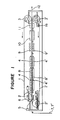
- Figure 1 illustrates an embodiment of the apparatus to be used for carrying out the process of the present invention.
- the continuous sheet-forming apparatus to be used in the present invention is not restricted to the apparatus shown in the drawing.
- reference numerals 1 and 1' designate endless belts, which are usually metallic belts made of steel or stainless steel.
- These metallic belts are thoroughly polished or, in some cases, plated to provide a smooth surface to obtain a sheet having a good outer appearance.
- the thickness of the metallic belts is usually from 0.1 to 3 mm, preferably from 0.5 to 2 mm.
- a predetermined tension is imparted to the belts by main pulleys 2, 3 and 2', 3'.
- the main pulleys 2 and 2' are provided with hydraulic cylinders, and the tension of the belts can be adjusted by changing the hydraulic pressure. It is also known to adjust the tension of the belts by means of a mechanical means such as springs or the like.
- the tension of the belts is preferably as high as possible to improve the configuration of the belts to increase the thickness precision of the sheet.
- the operation is usually conducted at a tension of from 3 to 15 kg/mm 2 .
- the belts are driven to run by driving the main pulley 3'.
- the belts are adjusted to avoid staggering by controlling the angle between the main pulleys 2 and 3 and the main pulleys 2' and 3'.
- the staggering of the belt may also be contrqiled by changing the angles of rolls 4 and 4' which are in contact with the rear surfaces of the respective belts or rolls provided at the return side of the belts, which are not shown.
- Reference numeral 5 designates an apparatus for supplying the polymerization feed material, whereby monomers or partial polymers (syrup) mixed with a catalyst and other additives are supplied at a constant flow rate usually by means of a quantitative pump.
- Reference numeral 6 designates an injection apparatus to supply the liquid polymerization feed material to the space between the belts facing to each other.
- Reference numerals 7 and 7' designate gaskets running along with the belts as they are held between the belts facing to each other, whereby they prevent the polymerization feed material from leaking out of the belts.
- the gaskets are usually made of soft polyvinyl chloride, polyethylene, an ethylene-vinyl acetate copolymer, polyurethane or other material.
- Reference numerals 4 and 4' designate groups of rolls which support the opposing belts from their rear sides.
- the rolls are arranged so that the polymerization feed material is thereby prevented from leaking out from the space defined by the opposing belts and the gaskets, in front of the polymerization zone or in the polymerization zone.
- the belts tend to flex between the adjacent rolls by the liquid pressure of the feed material or the repulsive force of the gasket. If this flexing becomes great, the thickness precision of the sheet will be poor. Further, if clearance is formed between the belts and the gaskets, the polymerization feed material will leak.
- the rolls are arranged to have a small distance between the adjacent rolls and the tension of the belts is increased. It is therefore desirable that the distance between the rolls i.e. the distance between the centers of the adjacent rolls, is set to be about from 20 to 100 cm. The rolls are provided so that even when the polymerization feed material is polymerized and contracted, they move along therewith and will not depart from the rear surfaces of the belts.
- Reference numerals 8 and 8' designate spray apparatus to spray warm water to the belts to heat them.
- the warm water has an optional temperature not higher than 100°C.
- the temperature of the warm water is usually from 50 to 95°C.
- Reference numerals 9 and 9' designate far infrared heaters provided at the second polymerization zone to heat the sheet at a temperature of at least 100°C, usually from 100 to 160°C to remove the remaining monomers.
- the far infrared heaters are effective heating means for raising the temperature of the sheet.
- the heaters are usually covered, together with the belts, by a heat shielding duct.
- the heated sheet is passed through the heat shielding duct so that it will be maintained at a predetermined period of time.
- a number of far infrared heaters may be provided or an air may be blown into the heat shielding duct.
- Other method, for instance, the provision of a hot air furnace may also be employed.
- Reference numerals 10 and 11 designate cooling or temperature-maintaining zones for cooling the sheet passing through the second polymerization zone, under proper conditions.
- Reference numeral 12 designates the sheet produced by the above process.
- the process of the present invention makes it possible to produce a shaped product of a flame resistant acrylic resin having superior flame resistance continuously under high productivity. Moreover, it is thereby possible to produce an elongated sheet and a sheet having a great width which were hardly producible by the conventional glass cell casting method. Thus, the process of the present invention is industrially extremely advantageous.
- the flame resistant acrylic resin composition according to the present invention has an extremely improved flame resistance as compared with the conventional flame resistant acrylic resin in which the same amount of the flame retardant is used.
- two types of flame retardants i.e. a halogen-containing condensed phosphoric acid ester or a halogenated polyphosphonate and an alkyl acid phosphonate, are combined with the above-mentioned specific copolymer, particularly superior flame resistance and physical properties will be imparted by the synergistic effect of the components, whereby it is possible to reduce the amount of the main flame retardant to a level of about 20% even when flame resistance to meet the standard of V-0 under the UL Standards is to be imparted, and accordingly it is possible to avoid the deterioration of the physical properties, particularly the deterioration of the heat resistance, which used to be a serious problem when a great amount of the flame retardant was added.
- the acrylic resin composition of the present invention has superior flame resistance and physical properties, and as such, is very useful for construction materials, materials for various electric appliances, signboards, glazing materials or illumination materials.
- a resin sheet of Comparative Example 1 was obtained in the same manner as in Example 1 except that a syrup was prepared by using 1000 g of a methyl methacrylate monomer alone instead of the monomer mixture comprising methyl methacrylate, a-methyl styrene, styrene and maleic anhydride.
- the flame resistant acrylic resin composition of the present invention is substantially superior in its flame resistance to the conventional flame resistant acrylic resin composition wherein a copolymer of methyl methacrylate with methacrylic acid is used as the base polymer.
- This resin sheet was subjected to a combustion test by the vertical method in accordance with Subject 94 under UL Standards. With respect to a set of five samples, the combustion times after being contacted with a flame for 10 seconds in the first and second trials were measured in the same manner as in Example 1. In each case, the combustion time was not more than 1 second, and the flame resistance was good.
- a comparative resin sheet was obtained in the same manner as in Example 2 except that 730 g of the partial polymer of methyl methacrylate alone was used without using a-methyl styrene, styrene and maleic anhydride.
- the optical characteristic of this sheet was measured by ASTM D-1003, whereby the luminous transmittance was 92.8% and the haze was 1.2%. Further, the heat distortion temperature (ASTM D-648) - was 78.5°C.
- a comparative resin sheet was prepared in the same manner as in Example 3 except that 612 g of the partial polymer of methyl methacrylate, 28 g of a-methyl styrene, 80 g of styrene and 80 g of maleic anhydride were used without using methacrylic acid in Example 3.
- This resin sheet was subjected to a combustion test in the same manner as in Example 3, whereby the combustion times of the five samples after being contacted with a flame in the first trial were 23 seconds, 28 seconds, 8 seconds, 12 seconds and 10 seconds, respectively.
- a resin sheet of Comparative Example 4 was prepared in the same manner as in Example 4 except that a partial polymer was prepared by using 1000 g of a methyl methacrylate monomer alone instead of the monomer mixture comprising methyl methacrylate, a-methyl styrene, styrene and maleic anhydride.
- the flame resistant acrylic resin composition (Example 4) of the present invention has substantially improved flame resistance and heat distortion temperature as compared with the conventional flame resistant acrylic resin composition (Comparative Example 4) wherein a copolymer obtained from methyl methacrylate and methacrylic acid was used as the base polymer, and it meets the Standards of UL 94 V-O. Further, it is evident that the water absorptivity is also improved.
- This sheet was subjected to a combustion test, whereby with respect to a set of five samples, the maximum value of the combustion time after being contacted with a flame for 10 seconds in the first trial was 0.3 seconds, and the maximum value of the combustion time after being contacted with a flame for 10 seconds in the second trial was 5.4 seconds, and the total of the combustion times was 11.6 seconds.
- a comparative resin sheet was prepared in the same manner as in Example 5 except that JP 504 in Example 5 was not used.
- This resin sheet was subjected to a combustion test in the same manner as in Example 5, whereby with respect to a set of five samples, the maximum value of the combustion time after being contacted with a flame for 10 seconds in the first trial was 2.8 seconds, but the combustion time after being contacted with a flame for 10 seconds in the second trial exceeded 35.6 seconds in some cases. From the comparison between Example 5 and Comparative Example 5, the superior flame retarding effect by the combination of two types of the flame retardants according to the present invention is evident.
- This sheet was subjected to combustion test in the same manner as in Example 5, and the heat distortion temperature was measured.
- the combustion time of each sample after being contacted with a flame in the first trial was about 0.3 second, and the combustion time of each sample after being contacted with a flame in the second trial was not more than 1.0 second.
- the heat distortion temperature was 76.1°C.
- a resin sheet was prepared in the same manner as in Example 6 except that 770 g of the partial polymer prepared in Example 4 was used without using methacrylic acid in Example 4.
- This resin sheet was subjected to a combustion test in the same manner as in Example 6, and the heat distortion temperature was measured.
- the combustion time of each sample after being contacted with a flame in the first trial was not more than 1.0 second, but the maximum value of the combustion time after being contacted with a flame in the second trial was from 24 to 35 seconds, and the total of the combustion times was 160 seconds. Further, the heat distortion temperature was as low as 62.5°C.
- the cell was heat-treated at 135°C for 2 hours in an air heating furnace. After cooling, the cell was removed to obtain a resin sheet having a thickness of 3 mm.
- This resin sheet was subjected to a combustion test. With respect to a set of 5 samples, the combustion time after being contacted with a flame for 10 seconds in the first trial and the combustion time after being contacted with a flame for 10 seconds in the second trial were measured. The results thereby obtained are shown in Table 6.
- This sheet was subjected to a combustion test in the same manner as in Example 7. As the results, the combustion time of each sample after being contacted with a flame in the first trial, was almost 0 second, and the combustion time of each sample after being contacted with a flame in the second trial, was not greater than 1.0 second. Further, the total of the combustion times was 3 seconds.
- the luminous transmission of this sheet was 92.0%, and the haze was as good as 2.1 %. Further, the heat distortion temperature was 72.0°C.
- this partial polymer 70 g of methacrylic acid, 200 g of CR-509@ (Registered Trade Mark for chlorinated polyphosphate manufactured by Daihachi Kagaku Kogyosho K.K.), 1 g of Aerosol OT@ (dioctylsulfosuccinate) as a releasing agent and 640 mg of 2,2'-azobis-(2,4-dimethylvaleronitrile) were added and dissolved.
- the composition thereby obtained was poured into a cell defined by two sheets of tempered glass facing to each other with a distance of 3 mm and gaskets made of polyvinyl chloride, and polymerized by immersing the cell in warm water of 65°C for 16 hours. Then, the cell was heat-treated at 135°C for 2 hours in an air heating furnace.
- a resin sheet having a thickness of 3 mm was prepared in the same manner as in Example 9 except that a partial polymer was prepared by using 1000 g of a methyl methacrylate monomer alone instead of the monomer mixture comprising methyl methacrylate, a-methyl styrene, styrene and maleic anhydride.
- this partial polymer 70 g of methacrylic acid, 200 g of CR-509@ (chlorinated polyphosphate manufactured by Daihachi Kagaku Kogyosho K.K.), 1 g of Aerosol OT@ (dioctylsulfosuccinate) as a releasing agent and 640 mg of 2,2'-azobis-(2,4-dimethylvaleronitrile) were added and dissolved.
- CR-509@ chlorinated polyphosphate manufactured by Daihachi Kagaku Kogyosho K.K.
- Aerosol OT@ dioctylsulfosuccinate
- 2,2'-azobis-(2,4-dimethylvaleronitrile) 640 mg of 2,2'-azobis-(2,4-dimethylvaleronitrile
- a resin sheet having a thickness of 3 mm composed of a copolymer of methyl methacrylate with methacrylic acid was prepared in the same manner as in Example 10 except that 730 g of the partial polymer of methyl methacrylate alone was used without using a-methyl styrene, styrene and maleic anhydride.
- This resin sheet was subjected to a combustion test in the same manner as in Example 10, whereby the combustion time after being contacted with a flame for 10 seconds in the first trial was about 2 seconds, but the combustion time after being contacted with a flame for 10 seconds in the second trial exceeded 30 seconds in some cases.
- This resin sheet was subjected to a combustion test by the vertical method in accordance with Subject 94 under UL Standards in the same manner as in Example 9. With respect to a set of 5 samples, the combustion time after being contacted with a flame for 10 seconds in the first and second trials, were measured. The results are shown in Table 9.
- optical characteristics of this sheet were measured in accordance with ASTM-D-1003, whereby the luminous transmittance was 92.4% and the haze was 1.0%, thus showing good optical characteristics. Further, the heat distortion temperature was measured in accordance with ASTM D-648, and was found to be as good as 96.0.
- a comparative resin sheet was prepared in the same manner as in Example 11 except that 790 g of the partial polymer of methyl methacrylate was used without using a-methyl styrene, styrene and maleic anhydride in Example 11.
- a resin sheet having a thickness of 3 mm was prepared in the same manner as in Example 12 except that a partial polymer was prepared by using 1000 g of a methyl methacrylate monomer alone instead of monomer mixture comprising methyl methacrylate, a-methyl styrene, styrene and maleic anhydride. The physical properties of this sheet were evaluated. The results are shown in Table 11.
- the resin composition (Example 12) of the present invention has substantially improved flame resistance and heat distortion temperature as compared with the conventional flame resistance acrylic resin composition (Comparative Example 10) wherein a copolymer of methyl methacrylate with methacrylic acid was used as the base polymer, and it meets the Standard UL 94 V-O. Further, the water absorptivity is small, and an improvement in this respect is also evident.
- a resin sheet having a thickness of 3 mm was prepared in the same manner as in Example 13 except that the partial polymer prepared by using 1000 g of a methyl methacrylate monomer was used instead of the monomer mixture comprising methyl methacrylate, a-methyl styrene, styrene and maleic anhydride.
- Example 12 To 700 g of the partial polymer prepared in Example 12, 70 g of methacrylic acid, 200 g of CR-509@, 30 g of JP 504® and 616 mg of 2,2'-azobis-(2,4-dimethylvaleronitrile) were added and dissolved. The subsequent operation was conducted in the same manner as in Example 1, whereby a flame resistant acrylic resin sheet having a thickness of 3 mm was obtained. This resin sheet was subjected to a combustion test, whereby the maximum value of the combustion time in the first trial was 0.2 second and the maximum value of the'combustion time in the second trial was 0.8 second. The total of combustion times was 3.4 seconds. Further, the heat distortion temperature of the resin sheet was measured and found to be 76.1°C.
- a flame resistant acrylic resin sheet having a thickness of 3 mm was prepared in the same manner as the above Example except that 770 g of the partial polymer was used without using methacrylic acid.
- This resin sheet was subjected to a combustion test, whereby the maximum value of the combustion time in the first trial was 1.1 seconds and the maximum value of the combustion time in the second trial was 26.5 seconds, and the total of combustion times was 57.8 seconds.
- the heat distortion temperature of the resin sheet was 62.0°C.
- Example 12 To 760 g of the partial polymer prepared in Example 12, 30 g of methacrylic acid, 200 g of CR-509@, 10 g of JP 504@ and 616 mg of 2,2'-azobis-(2,4-dimethylvaleronitrile) were added and dissolved. The subsequent operation was conducted in the same manner as in Example 12, whereby a flame resistant acrylic resin sheet having a thickness of 3 mm was obtained. This resin sheet was subjected to a combustion test, whereby the maximum value of the combustion time in the first trial was 0.9 seconds and the maximum value of the combustion time in the second trial was 6.3 seconds, and the total of combustion times was 13.8 seconds.
- a flame resistant acrylic resin sheet having a thickness of 3 mm was prepared in the same manner as the above Example except that 770 g of the partial polymer was used without using JP-504@.
- This resin sheet was subjected to a combustion test, whereby the maximum value of the combustion time in the first trial was 2.3 seconds and the maximum value of the combustion time in the second trial was 30.6 seconds and the total of the combustion time was 60.4 seconds.
- the monomer mixture initiated the polymerization reaction, reached the saturated temperature due to the polymerization heat and started refluxing in the condenser. Upon expiration of 15 minutes from the addition of the polymerization initiator, the mixture was rapidly cooled, whereby a partial polymer having a viscosity of 2610 mPa.s at 20°C and a conversion to the polymer of 31 %, was obtained.
- the polymerization feed material thus obtained was deaerated under reduced pressure and then poured into a continuous polymerization apparatus of Figure 1 provided with stainless steel belts polished to have a specular surface and having a thickness of 2 mm and a width of 1200 mm and with a belt clearance adjusted to 3 mm.
- the feed material was polymerized at 80°C for 30 minutes and then at 136°C for 3 minutes, whereupon a resin sheet having a thickness of 3 mm was obtained.
- This resin sheet was subjected to a combustion test.
- the flame resistant acrylic resin sheet of the present invention is for superior in its flame resistance to the conventional flame resistant acrylic resin sheet wherein a copolymer of methyl methacrylate with methacrylic acid was used as the base polymer.
- a partial polymer of methyl methacrylate having a viscosity of 3570 mPa.s at 20°C was prepared.
- VH polymethyl methacrylate powder manufactured by Mitsubishi Rayon Co. Ltd.
- the polymerization feed material thus obtained was deaerated under reduced pressure, and poured to the same continuous polymerization apparatus as used in Example 16 with a belt clearance set to be 3 mm.
- the feed material was polymerized at 82°C for 33 minutes and then at 136°C for 3.5 minutes, whereupon a resin sheet having a thickness of 3 mm was obtained. The transparency of this sheet was good.
- This resin sheet was subjected to a combustion test, and the combustion times in the first and second trials were measured and were found to be not more than 2 seconds in each case. Thus, flame resistance was satisfactory.
- the partial polymer of methyl methacrylate of Example 17 having a viscosity of 3570 mPa.s was adjusted to have a viscosity of 1100 mPa.s by adding a methyl methacrylate monomer thereto.
- a methyl methacrylate monomer thereto.
- 200 parts by weight of CR-509@, 1 part by weight of Aerosol OT@ and 0.664 part by weight of 2,2'-azobis-2,4-dimethylvaleronitrile were added and dissolved under stirring.
- the polymerization feed material thus obtained was deaerated under reduced pressure and poured into the same continuous polymerization apparatus as used in Example 16 with the belt clearance set to be 3 mm.
- the feed material was polymerized at 74°C for 33 minutes and then at 136°C for 3.5 minutes, whereupon a resin sheet having a thickness of 3 mm was obtained.
- Example 17 From the comparison of Example 17 with Comparative Example 13 (Table 15), it is evident that the flame resistant acrylic resin sheet of the present invention is far superior in its flame resistance to the conventional flame resistant acrylic resin sheet wherein a copolymer of methyl methacrylate with methacrylic acid was used as the base polymer.
- Example 17 To 604 parts by weight of the partial polymer of methyl methacrylate prepared in Example 17, 28 parts by weight of a-methyl styrene, 79 parts by weight of styrene, 79 parts by weight of maleic anhydride, 60 parts by weight of methacrylic acid, 150 parts by weight of CR-509@, 1 part by weight of Aerosol OT@ and 3.4 parts by weight of 2,2'-azobis-(2,4-dimethylvaleronitrile) were added and dissolved. The subsequent operation was conducted in the same manner as in Example 17, whereby a resin sheet having a thickness of 3 mm was obtained.
- This resin sheet was subjected to a combustion test, whereby the maximum combustion time in the first trial was 2.3 seconds, and the maximum combustion time in the second trial was 4.8 seconds.
- the reaction mixture Upon expiration of 15 minutes from the addition of the polymerization initiator, the reaction mixture was rapidly cooled, whereby a partial polymer having a viscosity of 2490 mPa.s at 20°C and a conversion to the polymer of 30% was obtained.
- the polymerization feed material thus obtained was deaerated under reduced pressure and poured to the same continuous polymerization apparatus as used in Example 16 with the belt clearance set to be 3 mm.
- the feed material was polymerized at 80°C for 30 minutes and then at 136°C for 3 minutes, whereupon a flame resistant acrylic resin sheet having a thickness of 3 mm was obtained.
- a partial polymer having a viscosity of 1750 mPa.s at 20°C and a conversion to the polymer of 21 % was prepared in the same manner as in Comparative Example 12.
- a resin sheet containing Phosguard@ C-22-R and having a thickness of 3 mm was prepared in the same manner as in the case of the syrup wherein the above-mentioned monomer mixture was used.
- the monomer mixture initiated a polymerization reaction, reached the saturation temperature due to the polymerization heat and started refluxing in the condenser. Upon expiration of 15 minutes from the addition of the polymerization initiator, the reaction mixture was rapidly cooled, whereby a partial polymer having a viscosity of 2610 mPa.s at 20°C and a conversion to the polymer of 31 % was obtained.
- the polymerization feed material thus obtained was deaerated under reduced pressure and poured into a continuous polymerization apparatus of Figure 1 provided with stainless steel belts polished to have a specular surface and having a thickness of 2 mm and a width of 1200 mm and with a belt clearance set to be 3 mm.
- the feed material was polymerized at 80°C for 30 minutes and then at 136°C for 3 minutes, whereupon a resin sheet having a thickness of 3 mm was obtained.
- a methyl methacrylate monomer alone was fed instead of the monomer mixture comprising methyl methacrylate, a-methyl styrene, styrene and maleic anhydride, and heated.
- the monomer reached 80°C, 2,2'-azobis-2,4-dimethylvaleronitrile was added as a polymerization initiator in an amount of 0.065% by weight based on the monomer, and the mixture was stirred.
- the monomer initiated a polymerization reaction, reached the saturation temperature due to the polymerization heat and started refluxing in the condenser.
- the reaction mixture Upon expiration of 8 minutes from the addition of the polymerization initiator, the reaction mixture was rapidly cooled, whereby a partial polymer having a viscosity of 1800 mPa.s at 20°C and a conversion to the polymer of 22% was obtained.
- the partial polymer of methyl methacrylate of Example 21 having a viscosity of 3540 mPa.s was adjusted to have a viscosity of 1100 mPa.s by adding a methyl methacrylate monomer thereto.
- 70 parts by weight of methacrylic acid, 200 parts by weight of CR-509@, 20 parts by weight of JP-504@, 1 part by weight of Aerosol OT@ and 0.664 part by weight of 2,2'-azobis-2,4-dimethylvaleronitrile were added and dissolved under stirring.
- the polymerization feed material thus obtained was deaerated under reduced pressure and poured into the same continuous polymerization apparatus as used in Example 20 with the belt clearance set to be 3 mm.
- the feed material was polymerized at 74°C for 33 minutes and then at 136°C for 3.5 minutes, whereupon a resin sheet having a thickness of 3 mm was obtained.
- Example 20 To 700 parts by weight of the partial polymer prepared in Example 20, 70 parts by weight of methacrylic acid, 200 parts by weight of CR-509@, 30 parts by weight of JP-504@ and 3.5 parts by weight of bis(4-t-butylcyclohexyl)peroxy dicarbonate were added and dissolved. The subsequent operation was conducted in the same manner as in Example 20, whereby a resin sheet having a thickness of 3 mm was obtained. This resin sheet was subjected to a combustion test, whereby the maximum value of the combustion time in the first trial was 0.4 second, the maximum value of the combustion time in the second trial was 0.8 second and the total of the combustion times was 4.0 seconds. Further, the heat distortion temperature of this resin sheet was measured and found to be 75.8°C.
- a flame resistant acrylic resin sheet having a thickness of 3 mm was prepared in the same manner as in the above Example except that 770 parts by weight of the partial polymer was used without using methacrylic acid.
- This resin sheet was subjected to a combustion test, whereby the maximum value of the combustion time in the first trial was 1.2 second, but the maximum value of the combustion time in the second trial was 28.3 seconds and the total of the combustion times was 49.7 seconds. Further, the heat distortion temperature of the resin sheet was 62.4°C.
- Example 20 To 760 parts by weight of the partial polymer prepared in Example 20, 30 parts by weight of methacrylic acid, 200 parts by weight of CR-509@, 10 parts by weight of JP-504@ and 3.4 parts by weight of 2,2'-azobis-(2,4-dimethylvaleronitrile) were added and dissolved. The subsequent operation was conducted in the same manner as in Example 20, whereby a resin sheet having a thickness of 3 mm was obtained. This resin sheet was subjected to a combustion test, whereby the maximum value of the combustion time in the first trial was 0.9 second, the maximum value of the combustion time in the second trial was 5.8 seconds and the total of the combustion times was 12.9 seconds.
- a resin sheet having a thickness of 3 mm was prepared in the same manner as in this Example except that 770 parts by weight of the syrup-like partial polymer was used without using JP-504®.
- This resin sheet was subjected to a combustion test, whereby the maximum value of the combustion time in the first trial was 2.5 seconds, the maximum value of the combustion time in the second trial was 34.2 seconds and the total of the combustion times was 65.8 seconds.
- Example 20 Into the same cylindrical vertical reactor as used in Example 20, 1000 I of a monomer mixture comprising 76% by weight of methyl methacrylate, 4% by weight of a-methyl styrene, 10% by weight of styrene and 10% by weight of maleic anhydride, was fed and heated. When the monomer mixture reached 80°C, 2,2'-azobis-2,4-dimethylvaleronitrile was added as a polymerization initiator in an amount of 0.25% by weight based on the polymer mixture, and the mixture was stirred. The monomer mixture initiated a polymerization reaction, reached to the saturation temperature by the polymerization heat and started refluxing in the condenser.
- the reaction mixture Upon expiration of 15 minutes from the addition of the polymerization initiator, the reaction mixture was rapidly cooled, whereby a partial polymer having a viscosity of 2530 mPa.s at 20°C and a conversion to the polymer of 30.5% was obtained.
- the polymerization feed material thus obtained was deaerated under reduced pressure and poured into the same continuous polymerization apparatus as used in Example 20 with the belt clearance set to be 3 mm.
- the feed material was polymerized at 80°C for 30 minutes and then at 136°C for 3 minutes, whereupon a resin sheet having a thickness of 3 mm was obtained.
- a syrup-like partial polymer having a viscosity of 1830 mPa.s at 20°C and a conversion to the polymer of 22.1% was prepared in the same manner as in Comparative Example 14 by using a methyl methacrylate monomer alone. By using this syrup-like partial polymer, the operation of this Example was repeated to obtain a resin sheet having a thickness of 3 mm.
Landscapes
- Chemical & Material Sciences (AREA)
- Health & Medical Sciences (AREA)
- Chemical Kinetics & Catalysis (AREA)
- Medicinal Chemistry (AREA)
- Polymers & Plastics (AREA)
- Organic Chemistry (AREA)
- Compositions Of Macromolecular Compounds (AREA)
- Addition Polymer Or Copolymer, Post-Treatments, Or Chemical Modifications (AREA)
Claims (17)
besteht, wobei bis zu 20 Gew.-%, bezogen auf die gesamte Masse, eines oder mehr als eines anderen copolymerisierbaren Monomers wie z.B. Acrylsäure, Methacrylat, Ethylacrylat, Ethylmethacrylat, Butylacrylat, Butylmethacrylat und Vinylacetat oder eines oder mehr als eines polyfunktionellen, vernetzbaren Monomers wie z.B. Divinylbenzol, Triallylcyanurat, Triallylisocyanurat, Ethylenglykoldimethacrylat, Triethylenglykoldimethacrylat und Trimethylolpropantrimethacrylat zugegeben sein können und (E) teilweise oder vollständig durch Acrylsäure, Maleinsäure oder Itaconsäure ersetzt sein kann, und daß die Masse ferner mindestens 3 Gew.-%, bezogen auf die gesamte Masse, eines Flammenverzögerungsmittels enthält.
Applications Claiming Priority (4)
| Application Number | Priority Date | Filing Date | Title |
|---|---|---|---|
| JP152349/82 | 1982-09-01 | ||
| JP15234982A JPS5941349A (ja) | 1982-09-01 | 1982-09-01 | 難燃性アクリル系樹脂組成物およびその製造方法 |
| JP153316/82 | 1982-09-02 | ||
| JP15331682A JPS5943046A (ja) | 1982-09-02 | 1982-09-02 | 難燃性アクリル系樹脂組成物およびその製造方法 |
Publications (3)
| Publication Number | Publication Date |
|---|---|
| EP0104479A2 EP0104479A2 (de) | 1984-04-04 |
| EP0104479A3 EP0104479A3 (en) | 1984-10-03 |
| EP0104479B1 true EP0104479B1 (de) | 1987-11-11 |
Family
ID=26481293
Family Applications (1)
| Application Number | Title | Priority Date | Filing Date |
|---|---|---|---|
| EP83108554A Expired EP0104479B1 (de) | 1982-09-01 | 1983-08-30 | Hitzewiderstandsfähige Acrylharzzusammensetzung und Verfahren zu seiner Herstellung |
Country Status (3)
| Country | Link |
|---|---|
| US (1) | US4533689A (de) |
| EP (1) | EP0104479B1 (de) |
| DE (1) | DE3374412D1 (de) |
Cited By (1)
| Publication number | Priority date | Publication date | Assignee | Title |
|---|---|---|---|---|
| EP4130149A1 (de) * | 2021-08-02 | 2023-02-08 | B/E Aerospace, Inc. | Feuerfestes thermoplastisches harz für faserverstärkte verbundwerkstoffe |
Families Citing this family (12)
| Publication number | Priority date | Publication date | Assignee | Title |
|---|---|---|---|---|
| DE3444867A1 (de) * | 1984-11-22 | 1986-05-22 | Bayer Ag, 5090 Leverkusen | Thermoplastische formmassen mit flammwidrigen eigenschaften |
| USH1128H (en) | 1989-04-18 | 1993-01-05 | Arco Chemical Technology, Inc. | Heat resistant thermoplastic copolymers |
| JPH04300908A (ja) * | 1991-03-29 | 1992-10-23 | Nippon Steel Chem Co Ltd | 成形材料 |
| US5380776A (en) * | 1992-09-01 | 1995-01-10 | Ici Americas Inc. | Moldable filled polyester resin composition |
| US5855983A (en) * | 1995-02-03 | 1999-01-05 | Minnesota Mining And Manufacturing Company | Flame retardant ultraviolet cured multi-layered film |
| IT1290061B1 (it) * | 1997-03-13 | 1998-10-19 | Atohaas Holding Cv | Lastre antirumore |
| FR2831545B1 (fr) * | 2001-10-31 | 2005-07-01 | Atofina | Materiau polymere methacrylique resistant au test du fil incandescent |
| ATE502074T1 (de) * | 2004-11-15 | 2011-04-15 | Lubrizol Advanced Mat Inc | Polymerzusammensetzung |
| US8221958B2 (en) * | 2008-05-30 | 2012-07-17 | E.I. Du Pont De Nemours And Company | Photosensitive paste and sintered layer |
| US9228093B2 (en) | 2013-10-18 | 2016-01-05 | Weyerhaeuser Nr Company | Colored water-repellant and crocking-resistant compositions |
| FR3069549B1 (fr) * | 2017-07-31 | 2020-10-02 | Arkema France | Composition comprenant un copolymere comprenant des monomeres de methacrylate de methyle, d'acides (meth)acrylique et de monomeres styreniques |
| EP4056603B1 (de) * | 2021-03-08 | 2025-12-03 | SHPP Global Technologies B.V. | Zusammensetzung von methacrylat-(co)polymer und poly(carbonat-siloxan) blockcopolymer und ihre verwendung in kratz- und stossbeständigen artikeln |
Family Cites Families (6)
| Publication number | Priority date | Publication date | Assignee | Title |
|---|---|---|---|---|
| FR1228328A (fr) * | 1959-03-11 | 1960-08-29 | Pierrefitte | Résines thermoplastiques oléfiniques ignifugées par adjonction de phosphites organiques |
| NL129455C (de) * | 1964-06-25 | |||
| DE1927460A1 (de) * | 1969-05-29 | 1970-12-03 | Goldschmidt Ag Th | Verfahren zur Herstellung von Copolymerisaten aus Acryl- und/oder Methacrylsaeureestern und Maleinsaeureanhydrid |
| US3666712A (en) * | 1970-01-02 | 1972-05-30 | Stauffer Chemical Co | Flame retardant polymethyl methacrylate compositions |
| US3794616A (en) * | 1971-03-29 | 1974-02-26 | Dow Chemical Co | Heat stabilized compositions |
| US4144387A (en) * | 1975-12-11 | 1979-03-13 | Mobil Oil Corporation | Phosphonate flame retardant mixture and resinous foams containing same |
-
1983
- 1983-08-17 US US06/523,763 patent/US4533689A/en not_active Expired - Fee Related
- 1983-08-30 DE DE8383108554T patent/DE3374412D1/de not_active Expired
- 1983-08-30 EP EP83108554A patent/EP0104479B1/de not_active Expired
Cited By (2)
| Publication number | Priority date | Publication date | Assignee | Title |
|---|---|---|---|---|
| EP4130149A1 (de) * | 2021-08-02 | 2023-02-08 | B/E Aerospace, Inc. | Feuerfestes thermoplastisches harz für faserverstärkte verbundwerkstoffe |
| US11879042B2 (en) | 2021-08-02 | 2024-01-23 | B/E Aerospace, Inc. | Fire resistant thermoplastic-based resin for fiber-reinforced composites |
Also Published As
| Publication number | Publication date |
|---|---|
| EP0104479A3 (en) | 1984-10-03 |
| DE3374412D1 (en) | 1987-12-17 |
| US4533689A (en) | 1985-08-06 |
| EP0104479A2 (de) | 1984-04-04 |
Similar Documents
| Publication | Publication Date | Title |
|---|---|---|
| EP0104479B1 (de) | Hitzewiderstandsfähige Acrylharzzusammensetzung und Verfahren zu seiner Herstellung | |
| EP0019372B1 (de) | Mit Kautschuk modifizierte Methylmethacrylat-Sirupe, ihre Herstellung und Anwendung bei der Herstellung von Giessplatten und Formmaterialien | |
| US5214106A (en) | Cured fluoroelastomer compositions | |
| EP2957579B1 (de) | Copolymer und formkörper | |
| EP0541797B1 (de) | Thermoplastisches copolymer, dessen herstellungsverfahren und dieses enthaltende thermoplastische harzmischung | |
| KR20020079949A (ko) | 그라프트 고무를 함유하는 폴리카보네이트 성형재 | |
| EP1068248A1 (de) | Perfluoroelastomerverbindungen | |
| US4520183A (en) | Process for making random ethylene/alkyl acrylate copolymers | |
| GB1590602A (en) | Process for the continuous casting of liquid polymerizable compositions | |
| EP0765889A1 (de) | Polymere Klebstoff und Flammschutzmittel | |
| JPS5962610A (ja) | 難燃性アクリル系樹脂成形物の製造方法 | |
| EP0913408B1 (de) | Verfahren zur Herstellung einer Poly(alkyl(meth)acrylat) Kautschuk Latex | |
| JPH0153893B2 (de) | ||
| EP0421610B1 (de) | Flammhemmende Zusammensetzungen | |
| EP0396336A1 (de) | Thermische Stabilisierung von Glutarimidpolymeren | |
| JP7352906B2 (ja) | リン酸エステル系難燃剤、(メタ)アクリル系樹脂組成物及び樹脂成形体 | |
| KR100828717B1 (ko) | 경도, 내스크래치성 및 내화학성이 우수한 투명 공중합체수지의 제조 방법 및 그 공중합체 수지 | |
| JPS63117057A (ja) | 難燃性耐熱性芳香族ビニル系樹脂組成物 | |
| JPH0662694B2 (ja) | 耐熱性に優れた共重合体の製造方法 | |
| JPH0149182B2 (de) | ||
| JPH0149181B2 (de) | ||
| JPH0149179B2 (de) | ||
| EP0438096B1 (de) | Stabilisatoren für Zusammensetzungen von Ethylen/Chlorotri- fluoroethylen Copolymeren | |
| WO2022202743A1 (ja) | 単量体混合物、樹脂組成物、樹脂成形体、水槽用パネル、照明看板、建築部材、樹脂組成物の製造方法、及び樹脂キャスト板の製造方法 | |
| JPH0149180B2 (de) |
Legal Events
| Date | Code | Title | Description |
|---|---|---|---|
| PUAI | Public reference made under article 153(3) epc to a published international application that has entered the european phase |
Free format text: ORIGINAL CODE: 0009012 |
|
| AK | Designated contracting states |
Designated state(s): DE GB IT |
|
| 17P | Request for examination filed |
Effective date: 19840403 |
|
| PUAL | Search report despatched |
Free format text: ORIGINAL CODE: 0009013 |
|
| AK | Designated contracting states |
Designated state(s): DE GB IT |
|
| GRAA | (expected) grant |
Free format text: ORIGINAL CODE: 0009210 |
|
| AK | Designated contracting states |
Kind code of ref document: B1 Designated state(s): DE GB IT |
|
| ITF | It: translation for a ep patent filed | ||
| REF | Corresponds to: |
Ref document number: 3374412 Country of ref document: DE Date of ref document: 19871217 |
|
| PLBE | No opposition filed within time limit |
Free format text: ORIGINAL CODE: 0009261 |
|
| STAA | Information on the status of an ep patent application or granted ep patent |
Free format text: STATUS: NO OPPOSITION FILED WITHIN TIME LIMIT |
|
| 26N | No opposition filed | ||
| ITTA | It: last paid annual fee | ||
| PGFP | Annual fee paid to national office [announced via postgrant information from national office to epo] |
Ref country code: GB Payment date: 19920818 Year of fee payment: 10 |
|
| PGFP | Annual fee paid to national office [announced via postgrant information from national office to epo] |
Ref country code: DE Payment date: 19920824 Year of fee payment: 10 |
|
| PG25 | Lapsed in a contracting state [announced via postgrant information from national office to epo] |
Ref country code: GB Effective date: 19930830 |
|
| GBPC | Gb: european patent ceased through non-payment of renewal fee |
Effective date: 19930830 |
|
| PG25 | Lapsed in a contracting state [announced via postgrant information from national office to epo] |
Ref country code: DE Effective date: 19940503 |