EP0103414A2 - Junction pieces for electric conduit - Google Patents
Junction pieces for electric conduit Download PDFInfo
- Publication number
- EP0103414A2 EP0103414A2 EP83304684A EP83304684A EP0103414A2 EP 0103414 A2 EP0103414 A2 EP 0103414A2 EP 83304684 A EP83304684 A EP 83304684A EP 83304684 A EP83304684 A EP 83304684A EP 0103414 A2 EP0103414 A2 EP 0103414A2
- Authority
- EP
- European Patent Office
- Prior art keywords
- sockets
- junction piece
- cover
- piece
- connecting portion
- Prior art date
- Legal status (The legal status is an assumption and is not a legal conclusion. Google has not performed a legal analysis and makes no representation as to the accuracy of the status listed.)
- Withdrawn
Links
Images


Classifications
-
- H—ELECTRICITY
- H02—GENERATION; CONVERSION OR DISTRIBUTION OF ELECTRIC POWER
- H02G—INSTALLATION OF ELECTRIC CABLES OR LINES, OR OF COMBINED OPTICAL AND ELECTRIC CABLES OR LINES
- H02G3/00—Installations of electric cables or lines or protective tubing therefor in or on buildings, equivalent structures or vehicles
- H02G3/02—Details
- H02G3/06—Joints for connecting lengths of protective tubing or channels, to each other or to casings, e.g. to distribution boxes; Ensuring electrical continuity in the joint
Definitions
- This invention relates to conduits for electrical cable.
- it relates to junction pieces for joining ends of conduits, e.g. at corners, and having removable covers to enable ease of fitting and inspection of the electric cables contained in the conduit.
- junction pieces are constructed as "elbows", "small bends” (having a larger bend radius than an “elbow”), and "T” junctions, and were originally made of cast iron.
- a flat, plate-like lid portion was provided, which was fitted over an opening in the main portion by means of screws.
- junction pieces have been made.of plastics material, using similar screwed inspection plates. To fit or inspect the cables, therefore, (and therefore costly) unscrewing of the plates is involved.
- the inclusion of metallic screws can add an undesirable electric conducting path through the material of the fitting.
- the inspection plates could therefore be inadequately secured.for a period of time until replacement screws were fixed. Replacement screws might well not be of the correct size, resulting in deterioration of the thread. The whole junction piece would eventually have to be replaced much earlier than would otherwise be necessary due to inadequate securement and permanent damage to the inspection cover.
- This present invention is aimed at overcoming these disadvantages.
- junction piece for cable conduits comprising A a base portion including
- the cover may comprise side wall portions which engage over side wall portions of the connecting portion. These side wall portions may have generally parallel outer surfaces. A part of the connecting portion immediately adjacent the sockets may extend around an upper part of each socket as a recessed shoulder so that at least part of the exterior surface of the cover (when fitted) lies substantially flush with part of the exterior surface of the sockets.
- the seating plane may be defined by the bottom surface of the side walls and end walls of the connecting portion or by one or more projections from a bottom wall of the channel part of the connecting portion. In one embodiment.the seating plane is defined by the bottom surface of a limb which projects from a bottom wall of the channel part of the connecting portion.
- the junction piece of the invention is made from a mouldable plastics material, and in particular from PVC.
- Figures 1 to 4 show at 110 a junction piece in the form of an elbow comprising a base portion 100 ( Figure 4) which comprises two sockets 130 connected at right angles one to the other by a central connecting portion 120 which provides with a cover 140 a generally cylindrical duct aligned with, and of substantially the same cross- sectional area and shape as, the interior of the sockets 130.
- the sockets 130 have generally cylindrical inner and outer surfaces. To provide a friction fit with the conduit sections which they are designed to receive, the inner surfaces of the sockets are provided with friction fitting means which comprise a slight inward taper of the sockets and "flats" or shallow ribs which taper with the general socket taper.
- the conduit sections are preferably held in place with adhesive, e.g. a solvent weld adhesive.
- a stop means in the form of a radially extending internal shoulder 132 is provided in the internal : surfaces of the sockets 130 near their inner ends.
- the central connecting portion 120 comprisessa channel part-121 of semicircular cross-section which extends through the right angle.
- Side walls 122 extend from the upper edges of the channel part 121 to define with end walls 125 a planar seating surface at their surfaces remote from the channel opening.
- the outer surfaces of the end walls 125 extend from the axially outer extremeties of the shoulders 124, as shown in Figure 4, and the parallel outer surfaces of the side walls 122 provide engagement surfaces for the cover 140.
- the cover 140 also extends through a right angle to fit over the central connecting portion 120. It comprises side walls 142 which engage over the side walls 122 of the central connecting portion 120 to a position short of the seating plane surface defined by the bottom surfaces of the walls 122, 125.
- the cover 140 is adapted to be engaged with the base portion 100 by snap engagement. This is enabled by projecting ridges 123 extending along portions of the outer surfaces of the side walls 122 which engage in grooves 143 in the inner surfaces of the walls 142 of the cover 140.
- recesses 131 having a sloping floor, are provided at the top of the sockets, leading to the shoulder 124, to allow access for a lever such as a screwdriver.
- Complementary recesses 141 are provided in the upper inner surfaces of the cover 140.
- the curved interior surfaces of the cover 140 and the channel part 121 provide a generally circular sectioned passageway continuing on a common axis from one socket to the other.
- Figures 5 to 8 show a junction piece in the form of a small bend. This embodiment is very similar to the first embodiment with two sockets being substantially at right angles to each other; the radius of bend is much larger, however. Equivalent features to those in the first embodiment shown in Figures 1 to 4 are identified by the same-last two digits prefixed by 2 instead of 1.
- the seating plane of the latter embodiment is defined by the bottom surface of a limb 226 which extends along the length of the central connecting portion 220 ( Figure 6) from the convex bottom surface of the channel part 221 and beyond the bottom surfaces of the side walls 222 and end walls 225 of the central connecting portion which are thereby raised from the wall surface against which the conduits are seated.
- the third embodiment shown in Figures 8 to 12, is a "T" junction piece, and features similar to those in the first two embodiments are prefixed by the numeral 3 instead of 1 or 2.
- the channel part 321 of the central connecting portion 320 can be considered to include a straight cross piece 321a and a straight stem piece 321b which joins the cross piece 321a substantially in the middle of the cross piece.
- Sockets 330 are disposed at each end of the channel pieces of the central connecting portion.
- the channel pieces interconnect to provide a duct between any-two sockets.
- the portion 340a of the cover 340 corresponding to the cross piece 321a is of 'U' shape-cross section, and the portion 340b corresponding to the stem portion 321b is similarly 'U' shaped, joining the cross piece portion of the cover 321a substantially in the middle. When in place, therefore, the cover 340 provides with the base portion 300 a passageway of substantially circular cross-section between any two sockets.
- the seating plane is defined in this embodiment by the bottom surfaces 326 of the side walls 322 and the bottom surfaces 327 of the of the end walls 325 of the central connecting portion 320.
- the ridges 323 of thcsnap engagement means between the cover 340 and base portion 300 are disposed along the outer surfaces of the side walls 322 of the channel part 321, and the corresponding grooves 343 are disposed along the inner surfaces of the cover 340.
- Recesses 331 are also provided in the top outer surface of the sockets 330 with complementary recesses 341 in the upper inner surface of the cover 340 adjacent the recesses 331, to permit access of a lever between the cover 340 and base portion 300.
- junction pieces of traditional form have been described, such as "elbow”, “small bend”.and “T”, other forms of junction pieces could be made within the scope of the invention.
Landscapes
- Engineering & Computer Science (AREA)
- Architecture (AREA)
- Civil Engineering (AREA)
- Structural Engineering (AREA)
- Details Of Indoor Wiring (AREA)
Abstract
Junction pieces (110) for joining electric cable conduit are made from mouldable plastics material in the traditional shapes of elbows, small bends, and «T» junctions and comprise a base portion(100) with sockets (130) for receiving the cable conduit at each end, and a cover portion (140). The base portion (100) is cut-away in the middle to provide access for inspection of the cable and to facilitate manipulation of the conduit when inserting it into the junction piece (110). The cover portion (140) fits over the cut-away part of the base portion (100) and is retained on the base portion by snap engagement means (123, 143). When in place, the cover (140) fits flush with the top and sides of the sockets (130).
Description
- This invention relates to conduits for electrical cable. In particular it relates to junction pieces for joining ends of conduits, e.g. at corners, and having removable covers to enable ease of fitting and inspection of the electric cables contained in the conduit.
- Such junction pieces are constructed as "elbows", "small bends" (having a larger bend radius than an "elbow"), and "T" junctions, and were originally made of cast iron. To enable inspection of the electric cable and to manipulate the cable when inserting the cable, a flat, plate-like lid portion was provided, which was fitted over an opening in the main portion by means of screws. More recently these junction pieces have been made.of plastics material, using similar screwed inspection plates. To fit or inspect the cables, therefore, (and therefore costly) unscrewing of the plates is involved. Also, the inclusion of metallic screws can add an undesirable electric conducting path through the material of the fitting. In addition, there is the further disadvantage that screws can be dropped and subsequently lost. The inspection plates could therefore be inadequately secured.for a period of time until replacement screws were fixed. Replacement screws might well not be of the correct size, resulting in deterioration of the thread. The whole junction piece would eventually have to be replaced much earlier than would otherwise be necessary due to inadequate securement and permanent damage to the inspection cover.
- This present invention is aimed at overcoming these disadvantages.
- In accordance with the invention there is provided a junction piece for cable conduits comprising A a base portion including
- (a) a plurality of sockets of continuous cross section formed to receive the ends of conduit sections;
- (b) a central connecting portion connecting the sockets and having at least one part of channel shape with an open wall section, means defining a seating nlane opposite to the open wall section; and B a separate cover portion of channel section,arranged to fit over the channel part of the base portion to co-operate with the base portion to define a passageway generally aligned with the sockets;
- The cover may comprise side wall portions which engage over side wall portions of the connecting portion. These side wall portions may have generally parallel outer surfaces. A part of the connecting portion immediately adjacent the sockets may extend around an upper part of each socket as a recessed shoulder so that at least part of the exterior surface of the cover (when fitted) lies substantially flush with part of the exterior surface of the sockets.
- The seating plane may be defined by the bottom surface of the side walls and end walls of the connecting portion or by one or more projections from a bottom wall of the channel part of the connecting portion. In one embodiment.the seating plane is defined by the bottom surface of a limb which projects from a bottom wall of the channel part of the connecting portion.
- In the elbows and small bends, there are two sockets connected by an angled channel in the form of a corner piece, the two sockets being substantially at right angles. An alternative embodiment has three sockets connected by channels and is in the form of a "T" piece.
- Preferably,-the junction piece of the invention is made from a mouldable plastics material, and in particular from PVC.
- Embodiments of the invention are hereafter described with reference to the accompanying drawings in which:
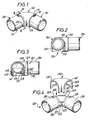
- Figure I is a perspective view of an "elbow" junction piece in accordance with the invention;
- Figure 2 is an end view of the "elbow" of Figure 1;
- Figure 3 is a sectional view of the "elbow" of Figure 1 taken along the line III-III;
- Figure 4 is a perspective view of the "elbow" of Figure 1 with the cover in a removed position;
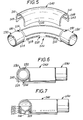
- Figure 5 is a perspective view of a "small bend" junction piece, in accordance with the invention, with the cover in a removed position;
- Figure 6 is an end view of the "small bend" of Figure 5;
- Figure 7 is a'sectional view (similar to Figure 3) of the "small bend" of Figure 5;
- Figure 8 is a.top plane view of a "T" junction piece in accordance with the invention;
- Figure 9 is a plan view from underneath the "T" piece of Figure 8;
- Figure 10 is an end view form the stem portion of the "T" piece of Figure 8;
- Figure 11 is a sectional view of the "T" piece of Figure 8 taken through the line XI-XI; and
- Figure 12 is a perspective view of the "T" piece of Figure 8 with the cover in-a removed position.
- Figures 1 to 4 show at 110 a junction piece in the form of an elbow comprising a base portion 100 (Figure 4) which comprises two
sockets 130 connected at right angles one to the other by a central connectingportion 120 which provides with a cover 140 a generally cylindrical duct aligned with, and of substantially the same cross- sectional area and shape as, the interior of thesockets 130. - The
sockets 130 have generally cylindrical inner and outer surfaces. To provide a friction fit with the conduit sections which they are designed to receive, the inner surfaces of the sockets are provided with friction fitting means which comprise a slight inward taper of the sockets and "flats" or shallow ribs which taper with the general socket taper. The conduit sections are preferably held in place with adhesive, e.g. a solvent weld adhesive. - To prevent the conduit sections being inserted too far, a stop means in the form of a radially extending
internal shoulder 132 is provided in the internal : surfaces of thesockets 130 near their inner ends. At the junction between thesockets 130 and the central connecting portion, there is formed an axially extendingcylindrical shoulder 124 recessed from the outer surface of eachsocket 130 to a depth substantially equal to the thickness of the material of thecover 140, so that when the cover is in place, as shown in Figure 1, its outer surface lies flush with, or generally continues in alignment with, the outer surfaces of theadjacent sockets 130 as far as the central diametric plane. - The central connecting
portion 120 comprisessa channel part-121 of semicircular cross-section which extends through the right angle.Side walls 122 extend from the upper edges of thechannel part 121 to define with end walls 125 a planar seating surface at their surfaces remote from the channel opening. The outer surfaces of theend walls 125 extend from the axially outer extremeties of theshoulders 124, as shown in Figure 4, and the parallel outer surfaces of theside walls 122 provide engagement surfaces for thecover 140. - The
cover 140 also extends through a right angle to fit over the central connectingportion 120. It comprisesside walls 142 which engage over theside walls 122 of the central connectingportion 120 to a position short of the seating plane surface defined by the bottom surfaces of thewalls cover 140 is adapted to be engaged with thebase portion 100 by snap engagement. This is enabled by projectingridges 123 extending along portions of the outer surfaces of theside walls 122 which engage ingrooves 143 in the inner surfaces of thewalls 142 of thecover 140. - To facilitate removal of the
cover 140,recesses 131, having a sloping floor, are provided at the top of the sockets, leading to theshoulder 124, to allow access for a lever such as a screwdriver.Complementary recesses 141 are provided in the upper inner surfaces of thecover 140. - As shown particularly in Figure 3, when the cover is fitted in place upon the base portion, the curved interior surfaces of the
cover 140 and thechannel part 121 provide a generally circular sectioned passageway continuing on a common axis from one socket to the other. - Figures 5 to 8 show a junction piece in the form of a small bend. This embodiment is very similar to the first embodiment with two sockets being substantially at right angles to each other; the radius of bend is much larger, however. Equivalent features to those in the first embodiment shown in Figures 1 to 4 are identified by the same-last two digits prefixed by 2 instead of 1.
- The main distinction between the two embodiments, apart from the size arid radius of bend, is that the seating plane of the latter embodiment is defined by the bottom surface of a
limb 226 which extends along the length of the central connecting portion 220 (Figure 6) from the convex bottom surface of the channel part 221 and beyond the bottom surfaces of theside walls 222 andend walls 225 of the central connecting portion which are thereby raised from the wall surface against which the conduits are seated. - A further distinction is that the additional and more
extensive ridges 223 andgrooves 243 are provided. - The third embodiment, shown in Figures 8 to 12, is a "T" junction piece, and features similar to those in the first two embodiments are prefixed by the numeral 3 instead of 1 or 2.
- The
channel part 321 of the central connectingportion 320 can be considered to include a straight cross piece 321a and a straight stem piece 321b which joins the cross piece 321a substantially in the middle of the cross piece.Sockets 330 are disposed at each end of the channel pieces of the central connecting portion. The channel pieces interconnect to provide a duct between any-two sockets. The portion 340a of thecover 340 corresponding to the cross piece 321a is of 'U' shape-cross section, and theportion 340b corresponding to the stem portion 321b is similarly 'U' shaped, joining the cross piece portion of the cover 321a substantially in the middle. When in place, therefore, thecover 340 provides with the base portion 300 a passageway of substantially circular cross-section between any two sockets. - As can be seen in Figure 9, the seating plane is defined in this embodiment by the
bottom surfaces 326 of theside walls 322 and thebottom surfaces 327 of the of theend walls 325 of the central connectingportion 320. - As in the previously described embodiments, the
ridges 323 of thcsnap engagement means between thecover 340 andbase portion 300 are disposed along the outer surfaces of theside walls 322 of thechannel part 321, and thecorresponding grooves 343 are disposed along the inner surfaces of thecover 340.Recesses 331 are also provided in the top outer surface of thesockets 330 withcomplementary recesses 341 in the upper inner surface of thecover 340 adjacent therecesses 331, to permit access of a lever between thecover 340 andbase portion 300. - It will be appreciated that a number of variations can be made to the embodiments described within the scope of the invention. For example, snap engagement means other than that described could be used, such as overlapping lips, or a combination of slot and lip.
- It should be noted that although junction pieces of traditional form have been described, such as "elbow", "small bend".and "T", other forms of junction pieces could be made within the scope of the invention.
the parts A and B being formed to interengage by snap action.
Claims (10)
1. A junction piece (110) for cable conduits A comprising a base portion (100) including
(a) a plurality of sockets (130) of continuous cross section formed to receive the ends of conduit sections;
(b) a central connecting portion (120) connecting the sockets(130) and having at least one part (121) of channel shape with an open wall section, and means (122, 125) defining a seating plane opposite to the open wall section; and
B a separate cover portion (140) of channel section, arranged to fit over the channel part (121) of the base portion (100) to cooperate with the base portion (100) to define a passageway generally aligned with the sockets (130);
the parts A and B being formed to interengage by snap action.
the parts A and B being formed to interengage by snap action.
2. A junction piece (110) according to claim 1 in which the cover (140) comprises side wall portions (142) which engage over side wall portions (122) of the connecting portion (120).
3. A junction piece (110) according to claim 2 in which the side wall portion (122) of the central portion (120) have generally parallel outer surfaces.
4. A junction piece (110) according to any preceding claim in which a part of the connecting portion (120) immediately adjacent the sockets (130) extends around an upper part of each socket (130) as a recessed shoulder (124) so that at least part of the exterior surface of the cover (140) (when fitted) lies substantially flush with part of the exterior surface of the sockets (130).
5. A junction piece (110) according to any preceding claim in which the bottom surface of the side walls (122) and end walls (125) of the connecting portion (120) define the seating plane.
6. A junction piece (210) according to any of claims 1 to 4 in which the seating plane is defined by one or more projections (226) from a bottom wall of the channel part (221) of the connecting portion (220).
7. A junction piece (110) according to any preceding claim in the form of a corner piece having two sockets (130) substantially at right angles.
8. A junction piece (310) according to any of claims 1 to 6 in the form of a "T" piece.
9. A junction piece (110). according to any preceding claim which is made from a mouldable plastics material.
Applications Claiming Priority (2)
| Application Number | Priority Date | Filing Date | Title |
|---|---|---|---|
| GB8223376 | 1982-08-13 | ||
| GB08223376A GB2126018B (en) | 1982-08-13 | 1982-08-13 | Junction pieces for electric conduit |
Publications (2)
| Publication Number | Publication Date |
|---|---|
| EP0103414A2 true EP0103414A2 (en) | 1984-03-21 |
| EP0103414A3 EP0103414A3 (en) | 1985-05-29 |
Family
ID=10532294
Family Applications (1)
| Application Number | Title | Priority Date | Filing Date |
|---|---|---|---|
| EP83304684A Withdrawn EP0103414A3 (en) | 1982-08-13 | 1983-08-12 | Junction pieces for electric conduit |
Country Status (2)
| Country | Link |
|---|---|
| EP (1) | EP0103414A3 (en) |
| GB (1) | GB2126018B (en) |
Cited By (2)
| Publication number | Priority date | Publication date | Assignee | Title |
|---|---|---|---|---|
| AU775235B2 (en) * | 1999-10-15 | 2004-07-22 | Legrand | Accessory adapted to be attached to a base section of trunking for routing electrical cables |
| US9948078B2 (en) | 2015-03-06 | 2018-04-17 | Alpin Management Partners Ltd. | Electrical conduit body with wiring chamber |
Families Citing this family (1)
| Publication number | Priority date | Publication date | Assignee | Title |
|---|---|---|---|---|
| DE102020133405A1 (en) * | 2020-12-14 | 2022-06-15 | Ambu A/S | Endoscope with connector |
Family Cites Families (10)
| Publication number | Priority date | Publication date | Assignee | Title |
|---|---|---|---|---|
| DE552993C (en) * | 1930-03-25 | 1932-06-20 | Carl Vitte Sen | Device for connecting pipes at branch and knee points of installation pipe systems |
| GB402555A (en) * | 1931-09-01 | 1933-12-07 | Jeumont Forges Const Elec | Metallic casing for electrical wiring |
| GB606911A (en) * | 1946-12-04 | 1948-08-23 | Crittall R & Co Ltd | Improvements in or relating to electric conduit and cable junction boxes |
| FR1023028A (en) * | 1950-08-04 | 1953-03-12 | Tubular connector for electrical conduit | |
| FR2050611A5 (en) * | 1969-06-18 | 1971-04-02 | Goyer Prosper | |
| US3711633A (en) * | 1971-12-02 | 1973-01-16 | Gen Motors Corp | Fitting means for axially slit corrugated conduits |
| GB1493410A (en) * | 1976-09-15 | 1977-11-30 | Marshall Ltd C & C | Trunking connectors |
| GB1581132A (en) * | 1977-07-04 | 1980-12-10 | Ross W B | Insulator assemblies for pipe bends |
| GB1589475A (en) * | 1977-11-22 | 1981-05-13 | Costello H J | Sheathing material for insulating a pipe or pipe fitting |
| DE2828893C2 (en) * | 1978-06-30 | 1984-08-16 | Josef Schlemmer GmbH, 8011 Poing | Pipe connector for cable protection pipes |
-
1982
- 1982-08-13 GB GB08223376A patent/GB2126018B/en not_active Expired
-
1983
- 1983-08-12 EP EP83304684A patent/EP0103414A3/en not_active Withdrawn
Cited By (2)
| Publication number | Priority date | Publication date | Assignee | Title |
|---|---|---|---|---|
| AU775235B2 (en) * | 1999-10-15 | 2004-07-22 | Legrand | Accessory adapted to be attached to a base section of trunking for routing electrical cables |
| US9948078B2 (en) | 2015-03-06 | 2018-04-17 | Alpin Management Partners Ltd. | Electrical conduit body with wiring chamber |
Also Published As
| Publication number | Publication date |
|---|---|
| EP0103414A3 (en) | 1985-05-29 |
| GB2126018A (en) | 1984-03-14 |
| GB2126018B (en) | 1985-10-02 |
Similar Documents
| Publication | Publication Date | Title |
|---|---|---|
| US12548988B2 (en) | Interchangeable modular outlet cover | |
| CA2061525C (en) | Quick connect fitting for electrical junction box | |
| US4355198A (en) | Screw retaining and aligning cover plate | |
| US4138185A (en) | Electric cord clamp device | |
| CA2260538A1 (en) | Conduit connector assembly spring clip having scalloped shaped conduit gripping end | |
| CA2174393C (en) | Snap-together wall plates for ganged electrical device installations | |
| US20070045004A1 (en) | Electrical connector having an outlet end angularly disposed relative an inlet end with outer retainer ring about the outlet end and internal unidirectional conductor retainer in the inlet end | |
| CA2008296A1 (en) | Fitting for interconnecting non-metallic conduit | |
| CA2260535A1 (en) | Conduit connector assembly with angled conduit gripping means | |
| US5484309A (en) | Electrical receptacle assembly with interference fitting and latching parts | |
| US4426754A (en) | Clamp for multiple electrical cables | |
| US4845312A (en) | Electrical outlet box and outlet therefor | |
| US4465393A (en) | Plastic ball socket extruded in one piece for a ball-and-socket joint | |
| US4575132A (en) | Conduit connector wedge type | |
| US3467768A (en) | Connector block boot | |
| US12327985B2 (en) | Adjustable width power distribution block | |
| GB2126018A (en) | Junction pieces for electric conduit | |
| US4782613A (en) | Identification seal for electricial cable | |
| US3112938A (en) | Integral cable clamp construction for electrical connection box | |
| US4920722A (en) | Composable well | |
| US4006958A (en) | Right angle electrical plug | |
| CN112714987B (en) | Electrical box cable connector | |
| US20160380418A1 (en) | Device for receiving a cable harness | |
| US6148133A (en) | Cable bend limiter trough | |
| US5641305A (en) | Electrical device having adjustable clamping mechanism |
Legal Events
| Date | Code | Title | Description |
|---|---|---|---|
| PUAI | Public reference made under article 153(3) epc to a published international application that has entered the european phase |
Free format text: ORIGINAL CODE: 0009012 |
|
| AK | Designated contracting states |
Designated state(s): AT BE CH DE FR GB IT LI LU NL SE |
|
| PUAL | Search report despatched |
Free format text: ORIGINAL CODE: 0009013 |
|
| AK | Designated contracting states |
Designated state(s): AT BE CH DE FR GB IT LI LU NL SE |
|
| STAA | Information on the status of an ep patent application or granted ep patent |
Free format text: STATUS: THE APPLICATION IS DEEMED TO BE WITHDRAWN |
|
| 18D | Application deemed to be withdrawn |
Effective date: 19860130 |
|
| RIN1 | Information on inventor provided before grant (corrected) |
Inventor name: CHEETHAM, COLIN R. |