EP0103136A2 - 5,5-Dichlor-3,3-dimethylpentansäure und ein Verfahren zu ihrer Herstellung - Google Patents
5,5-Dichlor-3,3-dimethylpentansäure und ein Verfahren zu ihrer Herstellung Download PDFInfo
- Publication number
- EP0103136A2 EP0103136A2 EP83107634A EP83107634A EP0103136A2 EP 0103136 A2 EP0103136 A2 EP 0103136A2 EP 83107634 A EP83107634 A EP 83107634A EP 83107634 A EP83107634 A EP 83107634A EP 0103136 A2 EP0103136 A2 EP 0103136A2
- Authority
- EP
- European Patent Office
- Prior art keywords
- dimethyl
- formula
- acid
- preparation
- acetoxy
- Prior art date
- Legal status (The legal status is an assumption and is not a legal conclusion. Google has not performed a legal analysis and makes no representation as to the accuracy of the status listed.)
- Granted
Links
- 0 CC(C)(CC(O*=O)O1)CC1=O Chemical compound CC(C)(CC(O*=O)O1)CC1=O 0.000 description 1
Classifications
-
- C—CHEMISTRY; METALLURGY
- C07—ORGANIC CHEMISTRY
- C07D—HETEROCYCLIC COMPOUNDS
- C07D309/00—Heterocyclic compounds containing six-membered rings having one oxygen atom as the only ring hetero atom, not condensed with other rings
- C07D309/32—Heterocyclic compounds containing six-membered rings having one oxygen atom as the only ring hetero atom, not condensed with other rings having two double bonds between ring members or between ring members and non-ring members
-
- C—CHEMISTRY; METALLURGY
- C07—ORGANIC CHEMISTRY
- C07C—ACYCLIC OR CARBOCYCLIC COMPOUNDS
- C07C51/00—Preparation of carboxylic acids or their salts, halides or anhydrides
- C07C51/093—Preparation of carboxylic acids or their salts, halides or anhydrides by hydrolysis of —CX3 groups, X being halogen
-
- C—CHEMISTRY; METALLURGY
- C07—ORGANIC CHEMISTRY
- C07C—ACYCLIC OR CARBOCYCLIC COMPOUNDS
- C07C51/00—Preparation of carboxylic acids or their salts, halides or anhydrides
- C07C51/347—Preparation of carboxylic acids or their salts, halides or anhydrides by reactions not involving formation of carboxyl groups
- C07C51/373—Preparation of carboxylic acids or their salts, halides or anhydrides by reactions not involving formation of carboxyl groups by introduction of functional groups containing oxygen only in doubly bound form
-
- C—CHEMISTRY; METALLURGY
- C07—ORGANIC CHEMISTRY
- C07C—ACYCLIC OR CARBOCYCLIC COMPOUNDS
- C07C53/00—Saturated compounds having only one carboxyl group bound to an acyclic carbon atom or hydrogen
- C07C53/15—Saturated compounds having only one carboxyl group bound to an acyclic carbon atom or hydrogen containing halogen
- C07C53/19—Acids containing three or more carbon atoms
-
- C—CHEMISTRY; METALLURGY
- C07—ORGANIC CHEMISTRY
- C07C—ACYCLIC OR CARBOCYCLIC COMPOUNDS
- C07C59/00—Compounds having carboxyl groups bound to acyclic carbon atoms and containing any of the groups OH, O—metal, —CHO, keto, ether, groups, groups, or groups
- C07C59/40—Unsaturated compounds
- C07C59/74—Unsaturated compounds containing —CHO groups
-
- C—CHEMISTRY; METALLURGY
- C07—ORGANIC CHEMISTRY
- C07D—HETEROCYCLIC COMPOUNDS
- C07D309/00—Heterocyclic compounds containing six-membered rings having one oxygen atom as the only ring hetero atom, not condensed with other rings
- C07D309/16—Heterocyclic compounds containing six-membered rings having one oxygen atom as the only ring hetero atom, not condensed with other rings having one double bond between ring members or between a ring member and a non-ring member
- C07D309/28—Heterocyclic compounds containing six-membered rings having one oxygen atom as the only ring hetero atom, not condensed with other rings having one double bond between ring members or between a ring member and a non-ring member with hetero atoms or with carbon atoms having three bonds to hetero atoms with at the most one bond to halogen, e.g. ester or nitrile radicals, directly attached to ring carbon atoms
- C07D309/30—Oxygen atoms, e.g. delta-lactones
Definitions
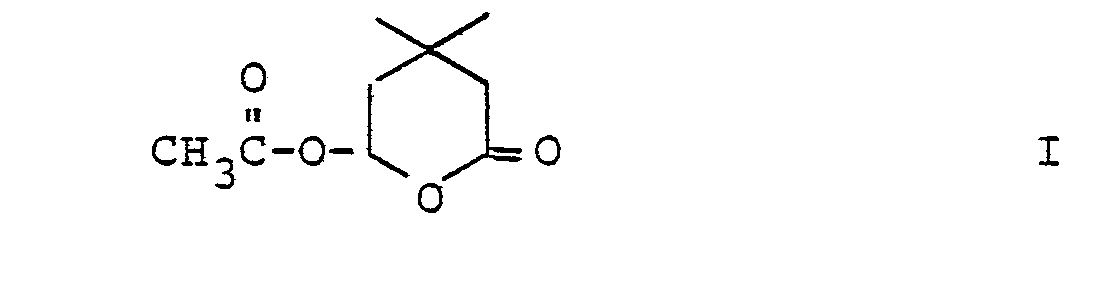
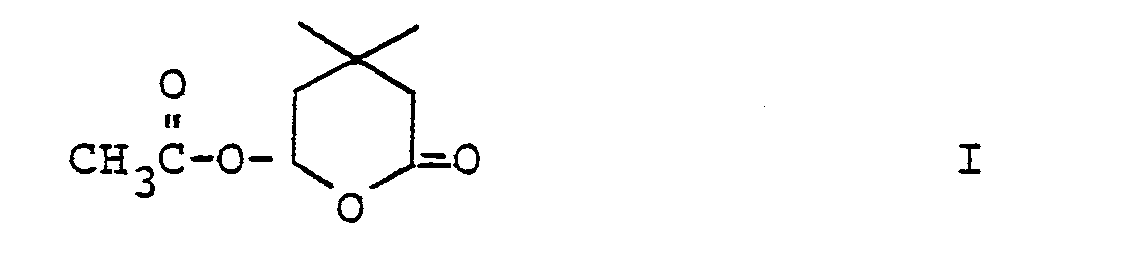
- the present invention relates to 4,4-dimethyl-6-acetoxy-valerolactone, a process for its preparation and new intermediates therefor, and its use for the preparation of 4,4-dimethyl-3,4-dihydro- ⁇ -pyrone.
- the 4,4-dimethyl-3,4-dihydropyrone can be economically produced on a large scale.
- 4,4-Dimethyl-6-acetoxy-valerolactone of the formula I is prepared by reacting 3,3-dimethyl-5-oxc-pentanoic acid with acetic anhydride.
- the reaction takes place in the liquid phase with heating to approximately 80 ° to 140 ° C., preferably 100 ° C. to 140 ° C.
- catalysts such as ZnCl2, FeC1 3 or BF 3 are preferably added to the reaction mixture. At least equivalent amounts of acetic anhydride are used, an excess does no harm.
- the reaction mixture can be worked up by fractional distillation for the isolation and purification of 4,4-dimethyl-6-acetoxy-valerolactone. However, the reaction mixture can also be processed without further work-up to 4,4-dimethyl-3,4-dihydro- ⁇ -pyrone of the formula III.
- 4,4-Dimethyl-3,4-dihydro- ⁇ -pyrone of the formula III is prepared from 4,4-dimethyl-6-acetoxy-valerolactone of the formula I by splitting off acetic acid at elevated temperatures in the gas phase.
- the compound of the formula I is metered in in liquid form into a heated tube, evaporation and reaction taking place. The reaction gases are then cooled and condensed.
- the pyrolysis is carried out at normal pressure or reduced pressure.
- the pyrolysis tube can be used with or without filling materials.
- the main purpose of the filling material is to serve as a heat exchanger.
- packing made of quartz, glass, porcelain, aluminum oxide, clay or iron can be used.
- the suitably used pyrolysis temperatures are between 300 ° and 500 ° C, preferably between 350 ° and 450 ° C.
- the preparation and cleavage of 4,4-dimethyl-6-acetoxy-valerolactone starting from 3,3-dimethyl-5-oxopentanoic acid of the formula II is combined in one process step.
- 3,3-dimethyl-5-oxopentanoic acid is reacted with acetic anhydride, if appropriate with the addition of the catalysts mentioned, in the gas phase at temperatures between 300 ° and 500 ° C.
- the mixtures obtained after the gas phase reaction are separated by fractional vacuum distillation.
- 3,3-Dimethyl-5-oxo-pentanoic acid of the formula II is new. It can be prepared by reacting 5,5-dichloro-3,3-dimethylpentanoic acid of the formula IV with bases.
- the bases are e.g. Alkali or alkaline earth hydroxides, tertiary amines, alkali or alkaline earth carbonates.
- Water is preferably used as the solvent. However, it is also possible to work in water-containing water-immiscible solvents such as aliphatic or aromatic hydrocarbons or ethers such as tetrahydrofuran. Conventional phase transfer catalysts such as tetralkylammonium hydroxides can be added as catalysts. The process is carried out at temperatures of 80-120 ° C., preferably above 90 ° C.
- the base is used in an equimolar amount, possibly in an excess of up to 10%.
- 5,5-dichloro-3,3-dimethylpentanoic acid does not need to be used in pure form; it can also be used in the form of the reaction mixture formed during its formation
- 5,5-dichloro-3,3-dimethylpentanoic acid is new. It can be obtained by acid hydrolysis of 1,1,5,5-tetrachloro-3,3-dimethylpentane of the formula IV.
- the hydrolysis is carried out in a temperature range from approximately 20 ° to 100 ° C., preferably from 40 ° to 70 ° C.
- An excess of acid is generally used, but at least the reaction mixture should contain the amount of water equivalent to the product of formula V used.
- sulfuric acid other strong acids such as e.g. Phosphoric acid, methanesulfonic acid, trifluoroacetic acid and mixtures of formic acid and hydrochloric acid are suitable.
- the reaction mixture is diluted with water and the acid (IV) with solvents such as e.g. Chlorinated hydrocarbons extracted.
- solvents such as e.g. Chlorinated hydrocarbons extracted.
- distillable acid mixtures e.g. the reaction mixtures obtained after hydrolysis with trifluoroacetic acid or formic acid-hydrochloric acid are worked up by distillation in order to obtain the acid (IV) in pure form.
- 1,1,5,5-tetrachloro-3,3-dimethyl-pentene is known and is used in very good yields e.g. obtained from carbon tetrachloride, isobutene and vinyl chloride.
Landscapes
- Chemical & Material Sciences (AREA)
- Organic Chemistry (AREA)
- Engineering & Computer Science (AREA)
- Oil, Petroleum & Natural Gas (AREA)
- Chemical Kinetics & Catalysis (AREA)
- Organic Low-Molecular-Weight Compounds And Preparation Thereof (AREA)
- Pyrane Compounds (AREA)
- Pyrrole Compounds (AREA)
Abstract
Description
- Die vorliegende Erfindung betrifft 4,4-Dimethyl-6-acet- oxy-valerolacton, ein Verfahren zu seiner Herstellung und neue Zwischenprodukte dafür sowie seine Verwendung zur Herstellung von 4,4-Dimethyl-3,4-dihydro-α-pyron.
- Es ist bekannt geworden, 4,4-Dimethyl-3,4-dihydro-α-pyron nach dem im folgenden skizzierten Reaktionsweg zu erhalten (vgl. EP-OS 31 932):

- Es wurde gefunden:
- 1. 4,4-Dimethyl-6-acetoxy-valerolacton der Formel I

- 2. Ein Verfahren zur Herstellung von 4,4-Dimethyl-6-acetoxy-valerolacton der Formel I

- 3. Verwendung von 4,4-Dimethyl-6-acetoxy-valerolacton der Formel I gemäß (1) oben zur Herstellung von 4,4-Dimethyl-3,4-dihydro- α-pyron der Formel III

- 4. 3,3-Dimethyl-5-oxo-pentansäure der Formel II

- 5. Verfahren zur Herstellung von 3,3-Dimethyl-5-oxo- pentansäure der Formel II gemäß (4) oben, dadurch gekennzeichnet, daß man 5,5-Dichlor-3,3-dimethyl- pentansäure der Formel IV

- 6. 5,5-Dichlor-3,3-dimethylpentansäure der Formel IV

- 7. Verfahren zur Herstellung von 5,5-Dichlor-3,3-dimethylpentansäure der Formel IV gemäß (6) oben, dadurch gekennzeichnet, daß man 1,1,5,5-Tetrachlor-3,3-dimethyl-penten der Formel V

- Mit Hilfe des neuen 4,4-Dimethyl-6-acetoxy-valerolactons der Formel I läßt sich das 4,4-Dimethyl-3,4-dihydro- pyron wirtschaftlich günstig in großem Maßstab herstellen.
- 4,4-Dimethyl-6-acetoxy-valerolacton der Formel I wird durch Umsetzung von 3,3-Dimethyl-5-oxc-pentansäure mit Acetanhydrid hergestellt. Die Umsetzung erfolgt in der Flüssigphase unter Erwärmen auf ca. 80° - 140°C, vorzugsweise 100°C-140°C. Vorzugsweise werden zur schnelleren Reaktionsführung Katalysatoren wie z.B. ZnCl2, FeC13 oder BF3 zum Reaktionsgemisch hinzugegeben. Es werden mindestens äquivalente Mengen Acetanhydrid eingesetzt, ein Überschuß schadet nicht.
- Das Reaktionsgemisch kann zur Isolierung und Reindarstellung von 4,4-Dimethyl-6-acetoxy-valerolacton durch fraktionierte Destillation aufgearbeitet werden. Das Reaktionsgemisch kann jedoch auch ohne Aufarbeitung zu 4,4-Dimethyl-3,4-dihydro-α-pyron der Formel III weiterverarbeitet werden.
- Die Herstellung von 4,4-Dimethyl-3,4-dihydro-α-pyron der Formel III aus 4,4-Dimethyl-6-acetoxy-valerolacton der Formel I durch Abspaltung von Essigsäure erfolgt bei erhöhten Temperaturen in der Gasphase. Beispielsweise wird die Verbindung der Formel I in flüssiger Form in ein geheiztes Rohr eindosiert, wobei Verdampfung und Reaktion erfolgt. Die Reaktionsgase werden anschließend gekühlt und kondensiert. Die Pyrolyse wird bei Normaldruck oder vermindertem Druck ausgeführt. Das Pyrolyserohr kann mit oder ohne Füllmaterialien eingesetzt werden. Das Füllmaterial hat im wesentlichen den Zweck, als Wärmeüberträger zu dienen. Dafür kommen beispielsweise Füllkörper aus Quarz, Glas, Porzellan, Aluminiumoxid, Ton oder Eisen in Frage. Die zweckmäßig angewandten Pyrolysetemperaturen liegen zwischen 300° und 500°C, vorzugsweise zwischen 350° und 450°C.
- In einer vorteilhaften Ausführungsform des erfindungsgemäßen Verfahrens wird die Herstellung und Spaltung des 4,4-Dimethyl-6-acetoxy-valerolactons ausgehend von 3,3-Dimethyl-5-oxo-pentansäure der Formel II in einer Verfahrensstufe zusammengefaßt.
- In diesem Falle wird 3,3-Dimethyl-5-oxo-pentansäure mit Acetanhydrid gegebenenfalls unter Zusatz der genannten Katalysatoren in der Gasphase bei Temperaturen zwischen 300° und 500°C umgesetzt.
- Die nach der Gasphasenreaktion erhaltenen Stoffgemische werden durch fraktionierte Vakuumdestillation aufgetrennt.
- 3,3-Dimethyl-5-oxo-pentansäure der Formel II ist neu. Sie kann hergestellt werden, indem man 5,5-Dichlor-3,3-dimethylpentansäure der Formel IV mit Basen umsetzt.
- Als Basen dienen z.B. Alkali- oder Erdalkalihydroxide, tertiäre Amine, Alkali- oder Erdalkalicarbonate.
- Als Lösungsmittel dient bevorzugt Wasser. Es kann aber auch in wasserhaltigen mit Wasser nicht mischbaren Lösungsmitteln wie aliphatischen oder aromatischen Kohlenwasserstoffen oder Ethern wie Tetrahydrofuran gearbeitet werden. Als Katalysatoren können übliche Phasentransferkatalysatoren wie Tetralkylammoniumhydroxide zugesetzt werden. Man arbeitet bei Temperaturen von 80 - 120°C, bevorzugt über 90°C.
- Man arbeitet bei Normaldruck oder leichtem Überdruck. Die Base wird in äquimolarer Menge, gegebenenfalls einem Überschuß von bis zu 10 %, eingesetzt.
- 5,5-Dichlor-3,3-dimethylpentansäure braucht nicht rein eingesetzt werden, mann kann es auch in Form des bei seiner Bildung entstehenden Reaktionsgemisches einsetzen
- 5,5-Dichlor-3,3-dimethyl-pentansäure ist neu. Sie kann durch saure Hydrolyse von 1,1,5,5-Tetrachlor-3,3-dimethyl-pentan der Formel IV erhalten werden.
- Die Hydrolyse wird in einem Temperaturbereich von ca. 20° - 100°C, vorzugsweise von 40° - 70°C, durchgeführt. Im allgemeinen wird ein Überschuß an Säure eingesetzt, mindestens jedoch soll das Reaktionsgemisch die dem eingesetzten Produkt der Formel V äquivalente Menge Wasser enthalten. Zur Hydrolyse sind neben Schwefelsäure auch andere starke Säuren wie z.B. Phosphorsäure, Methansulfonsäure, Trifluoressigsäure und Gemische von Ameisensäure und Salzsäure geeignet.
- Will man die Säure der Formel IV isolieren, so wird das Reaktionsgemisch mit Wasser verdünnt und die Säure (IV) mit Lösungsmitteln, wie z.B. Chlorkohlenwasserstoffen extrahiert. Bei Verwendung destillierbarer Säuregemische, wie z.B. die nach der Hydrolyse mit Trifluoressigsäure oder Ameisensäure-Salzsäure erhaltenen Reaktionsgemische, werden destillativ aufgearbeitet, um die Säure (IV) rein zu gewinnen.
- 1,1,5,5-Tetrachlor-3,3-dimethyl-penten ist bekannt und wird in sehr guten Ausbeuten z.B. aus Tetrachlorkohlenstoff, iso-Buten und Vinylchlorid erhalten.
- 500 g 1,1,5,5-Tetrachlor-3,3-dimethyl-penten werden innerhalb 1 Stunde unter Rühren so zu 2400 ml Schwefelsäure züdosiert, daß die Reaktionsmischung nicht über 45°C steigt. Das Reaktionsgemisch wird weitere 24 Stunden bei 40° - 45°C gehalten und dann auf 3 kg Eis gegeben. Die Mischung wird mehrfach mit Dichlormethan extrahiert. Nach dem Abdestillieren des Lösungsmittels erhält man 420 g rohe 5,5-Dichlor-3,3-dimethyl-pentansäure, nach der Destillation 380 g reine 5,5-Dichlor-3,3-dimethyl-pentansäure, Kp. 0 2 103 - 106°C.
- Zu 60 ml Wasser werden gleichzeitig 30 g 5,5-Dichlor-3,3-dimethylpentansäure und 18 g NaOH, gelöst in 20 ml Wasser, unter pH-Kontrolle so zudosiert, daß während der Reaktion ein pH von 9 - 10 besteht. Sobald der pH-Wert konstant bleibt, ist die Reaktion beendet. Das Reaktionsgemisch wird mit Salzsäure auf pH 3 gestellt und mit Dichlormethan extrahiert. Man erhält 20,9 g 4-Chlor-3,3-dimethyl-5-oxo-pentansäure, Rp0,09 110 - 115°C.
- 127 g nach Beispiel 2 erhaltene rohe 3,3-Dimethyl-5-oxo-pentansäure werden mit 400 g Acetanhydrid unter Zusatz von 0,5 g ZnC12 5 Stunden auf 120°C - 140°C erwärmt. Das Reaktionsgemisch wird fraktionierend destilliert. Es werden 145 g reines 4,4-Dimethyl-6-acetoxy-valerolacton erhalten, Kp.0,2 102° - 105°C.
- 217 g 4,4-Dimethyl-6-acetoxy-valerolacton werden unter Schutzgas (N2) innerhalb von 6 Stunden gleichmäßig in ein Pyrolyserohr (Durchmesser 19 mm, Länge 20 cm) eindosiert. Die durch elektrische Heizung eingestellte Pyrolysetemperatur beträgt 380°. Das Pyrolysat wird fraktionierend destilliert. Es werden 118 g 4,4-Dimethyl-3,4-dihydro-α-pyron (Kp.10 64 - 66°) neben 24 g Einsatzprodukt erhalten.
Claims (9)




Applications Claiming Priority (2)
| Application Number | Priority Date | Filing Date | Title |
|---|---|---|---|
| DE19823230274 DE3230274A1 (de) | 1982-08-14 | 1982-08-14 | 4,4-dimethyl-6-acetoxy-valerolacton, verfahren zu seiner herstellung, zwischenprodukte dafuer und seine verwendung |
| DE3230274 | 1982-08-14 |
Publications (3)
| Publication Number | Publication Date |
|---|---|
| EP0103136A2 true EP0103136A2 (de) | 1984-03-21 |
| EP0103136A3 EP0103136A3 (en) | 1985-05-15 |
| EP0103136B1 EP0103136B1 (de) | 1988-05-18 |
Family
ID=6170869
Family Applications (1)
| Application Number | Title | Priority Date | Filing Date |
|---|---|---|---|
| EP83107634A Expired EP0103136B1 (de) | 1982-08-14 | 1983-08-03 | 5,5-Dichlor-3,3-dimethylpentansäure und ein Verfahren zu ihrer Herstellung |
Country Status (4)
| Country | Link |
|---|---|
| US (1) | US4628118A (de) |
| EP (1) | EP0103136B1 (de) |
| JP (1) | JPS5948441A (de) |
| DE (2) | DE3230274A1 (de) |
Family Cites Families (4)
| Publication number | Priority date | Publication date | Assignee | Title |
|---|---|---|---|---|
| US3155685A (en) * | 1960-01-04 | 1964-11-03 | Monsanto Co | Preparation of ester lactones |
| US4235780A (en) * | 1979-11-01 | 1980-11-25 | Fmc Corporation | Derivatives of 2H-pyran-2-one |
| EP0031932B1 (de) * | 1979-12-22 | 1987-07-01 | Hüls Troisdorf Aktiengesellschaft | Substituierte Lactone, Pentacarbonsäurederivate und Verfahren zu ihrer Herstellung |
| DE3045555A1 (de) * | 1980-12-03 | 1982-07-01 | Dynamit Nobel Ag, 5210 Troisdorf | "verfahren zur herstellung von 3,4-dihydro- (alpha) -pyron" |
-
1982
- 1982-08-14 DE DE19823230274 patent/DE3230274A1/de not_active Withdrawn
-
1983
- 1983-08-03 DE DE8383107634T patent/DE3376648D1/de not_active Expired
- 1983-08-03 EP EP83107634A patent/EP0103136B1/de not_active Expired
- 1983-08-11 JP JP58145816A patent/JPS5948441A/ja active Pending
-
1985
- 1985-10-10 US US06/786,251 patent/US4628118A/en not_active Expired - Fee Related
Also Published As
| Publication number | Publication date |
|---|---|
| US4628118A (en) | 1986-12-09 |
| JPS5948441A (ja) | 1984-03-19 |
| DE3230274A1 (de) | 1984-02-16 |
| EP0103136B1 (de) | 1988-05-18 |
| EP0103136A3 (en) | 1985-05-15 |
| DE3376648D1 (en) | 1988-06-23 |
Similar Documents
| Publication | Publication Date | Title |
|---|---|---|
| EP0031932A2 (de) | Substituierte Lactone, Pentacarbonsäurederivate und Verfahren zu ihrer Herstellung | |
| DE2429935C3 (de) | Verfahren zur Herstellung von 2,2,6,6- Tetramethyl-4-oxopiperidin | |
| DE2710174A1 (de) | Verfahren zur herstellung von dihalogenvinyl-cyclopropancarbonsaeuren und deren ester | |
| DE2941211C2 (de) | Verfahren zum gegebenenfalls kontinuierlichen Cyclisieren von γ-Chlorcarbonsäureestern | |
| DE2630981C2 (de) | 4-β,β-Dichlor- und 4-β,β-Dibromvinyl-3,3-dimethylbutyrolactone, Verfahren zu ihrer Herstellung und deren Verwendung zur Herstellung von Estern der 3-β,β-Dichlor- oder 3-β,β-Dibrom-vinyl-2,2-dimethylcyclopropancarbonsäure | |
| DE3026094C2 (de) | Verfahren zur Herstellung von Cyclopropancarbonsäureamiden | |
| EP0123187A2 (de) | Verfahren zur Herstellung von fluorierten Phenylessigsäureestern und neue fluorierte Trichlorethylbenzole | |
| DE3422412A1 (de) | Verfahren zur herstellung eines gemisches aus einem gegebenenfalls substituierten zimtsaeureester und einem gegenbenenfalls substituierten ss-alkoxy-ss-phenyl-propionsaeureester sowie verfahren zur herstellung von gegebenenfalls substituierter zimtsaeure | |
| EP0087585A1 (de) | Verfahren zur Herstellung von 3-Alkoxi-acrylnitrilen | |
| DE2918900C2 (de) | ||
| DE3871591T2 (de) | Verfahren zur herstellung von 1-propargyl-2,4-dioxoimidazolidin. | |
| EP0103136B1 (de) | 5,5-Dichlor-3,3-dimethylpentansäure und ein Verfahren zu ihrer Herstellung | |
| EP0006180B1 (de) | 3-Phenoxybenzylidenamine und 3-Benzylbenzylidenamine, ein Verfahren zu deren Herstellung sowie deren Verwendung zur Herstellung der entsprechenden Aldehyde | |
| EP0075680B1 (de) | Substituierte Furanone sowie Verfahren zur Herstellung von 3,4-Dihydro-alpha-pyronen und substituierten Furanonen | |
| EP0103749B1 (de) | Dialkoxymethyl-butyrolactone, Verfahren zu ihrer Herstellung, Zwischenprodukte dafür und ihre Verwendung | |
| DE69109953T2 (de) | Alfa-fluorocarbonsäurederivate als Zwischenprodukte zur Herstellung von Fungiziden. | |
| EP0573999A1 (de) | Verfahren zur Herstellung von Tetronsäurealkylestern | |
| DE2952068A1 (de) | Substituierte lactone und verfahren zu deren herstellung | |
| EP0169482B1 (de) | Verfahren zur Herstellung von 5,6-Dihydro-2H-thiopyran-3-carboxaldehyden | |
| EP0061641B1 (de) | Verfahren zur Herstellung von Caronaldehydsäure und deren Derivaten | |
| EP0238569B1 (de) | Verfahren zur herstellung von cycloalkancarbonsäuren | |
| DE663375C (de) | Verfahren zur Darstellung von stickstoffhaltigen Kondensationsprodukten | |
| DE69227890T2 (de) | Verfahren zur herstellung von 5-amino-3-methylpyrazol | |
| DE2224240A1 (de) | Verfahren zur Herstellung von 1- eckige Klammer auf p-(beta-Diäthylaminoäthoxy)-phenyl eckige Klammer zu -l^-diphenyl^-chloräthylen beziehungsweise therapeutisch brauchbaren Salzen desselben | |
| EP0128279A2 (de) | Verfahren zur Herstellung von 6-Methylnicotinsäureester |
Legal Events
| Date | Code | Title | Description |
|---|---|---|---|
| PUAI | Public reference made under article 153(3) epc to a published international application that has entered the european phase |
Free format text: ORIGINAL CODE: 0009012 |
|
| 17P | Request for examination filed |
Effective date: 19830803 |
|
| AK | Designated contracting states |
Designated state(s): CH DE FR GB LI |
|
| PUAL | Search report despatched |
Free format text: ORIGINAL CODE: 0009013 |
|
| AK | Designated contracting states |
Designated state(s): CH DE FR GB LI |
|
| 17Q | First examination report despatched |
Effective date: 19860516 |
|
| GRAA | (expected) grant |
Free format text: ORIGINAL CODE: 0009210 |
|
| AK | Designated contracting states |
Kind code of ref document: B1 Designated state(s): CH DE FR GB LI |
|
| REF | Corresponds to: |
Ref document number: 3376648 Country of ref document: DE Date of ref document: 19880623 |
|
| ET | Fr: translation filed | ||
| GBT | Gb: translation of ep patent filed (gb section 77(6)(a)/1977) | ||
| PLBE | No opposition filed within time limit |
Free format text: ORIGINAL CODE: 0009261 |
|
| STAA | Information on the status of an ep patent application or granted ep patent |
Free format text: STATUS: NO OPPOSITION FILED WITHIN TIME LIMIT |
|
| 26N | No opposition filed | ||
| PGFP | Annual fee paid to national office [announced via postgrant information from national office to epo] |
Ref country code: DE Payment date: 19890718 Year of fee payment: 7 |
|
| PGFP | Annual fee paid to national office [announced via postgrant information from national office to epo] |
Ref country code: GB Payment date: 19890731 Year of fee payment: 7 |
|
| PGFP | Annual fee paid to national office [announced via postgrant information from national office to epo] |
Ref country code: FR Payment date: 19890822 Year of fee payment: 7 |
|
| PGFP | Annual fee paid to national office [announced via postgrant information from national office to epo] |
Ref country code: CH Payment date: 19890825 Year of fee payment: 7 |
|
| PG25 | Lapsed in a contracting state [announced via postgrant information from national office to epo] |
Ref country code: GB Effective date: 19900803 |
|
| PG25 | Lapsed in a contracting state [announced via postgrant information from national office to epo] |
Ref country code: LI Effective date: 19900831 Ref country code: CH Effective date: 19900831 |
|
| GBPC | Gb: european patent ceased through non-payment of renewal fee | ||
| PG25 | Lapsed in a contracting state [announced via postgrant information from national office to epo] |
Ref country code: FR Effective date: 19910430 |
|
| REG | Reference to a national code |
Ref country code: CH Ref legal event code: PL |
|
| PG25 | Lapsed in a contracting state [announced via postgrant information from national office to epo] |
Ref country code: DE Effective date: 19910501 |
|
| REG | Reference to a national code |
Ref country code: FR Ref legal event code: ST |