EP0102552A2 - Verfahren zur 2-Phasen Quadraturmodulation- und Demodulation für ein Farbvideosignal - Google Patents
Verfahren zur 2-Phasen Quadraturmodulation- und Demodulation für ein Farbvideosignal Download PDFInfo
- Publication number
- EP0102552A2 EP0102552A2 EP83107866A EP83107866A EP0102552A2 EP 0102552 A2 EP0102552 A2 EP 0102552A2 EP 83107866 A EP83107866 A EP 83107866A EP 83107866 A EP83107866 A EP 83107866A EP 0102552 A2 EP0102552 A2 EP 0102552A2
- Authority
- EP
- European Patent Office
- Prior art keywords
- signals
- phase
- color
- multiplexed
- luminance
- Prior art date
- Legal status (The legal status is an assumption and is not a legal conclusion. Google has not performed a legal analysis and makes no representation as to the accuracy of the status listed.)
- Granted
Links
- 238000000034 method Methods 0.000 title claims abstract description 72
- 239000000969 carrier Substances 0.000 claims abstract description 19
- 230000001360 synchronised effect Effects 0.000 claims description 20
- 230000005540 biological transmission Effects 0.000 claims description 15
- 230000010363 phase shift Effects 0.000 claims description 7
- 230000003111 delayed effect Effects 0.000 claims description 6
- 230000007704 transition Effects 0.000 claims description 3
- 239000002131 composite material Substances 0.000 description 19
- 230000000875 corresponding effect Effects 0.000 description 11
- 238000010586 diagram Methods 0.000 description 9
- 238000011069 regeneration method Methods 0.000 description 8
- 230000015654 memory Effects 0.000 description 7
- 230000008929 regeneration Effects 0.000 description 7
- 230000003287 optical effect Effects 0.000 description 6
- 230000010355 oscillation Effects 0.000 description 5
- 238000001514 detection method Methods 0.000 description 4
- 230000006870 function Effects 0.000 description 4
- 238000000926 separation method Methods 0.000 description 4
- 230000001172 regenerating effect Effects 0.000 description 3
- 238000010276 construction Methods 0.000 description 2
- 230000001276 controlling effect Effects 0.000 description 2
- 230000002542 deteriorative effect Effects 0.000 description 2
- 239000004065 semiconductor Substances 0.000 description 2
- BQCADISMDOOEFD-UHFFFAOYSA-N Silver Chemical compound [Ag] BQCADISMDOOEFD-UHFFFAOYSA-N 0.000 description 1
- 239000003086 colorant Substances 0.000 description 1
- 230000002596 correlated effect Effects 0.000 description 1
- 238000013500 data storage Methods 0.000 description 1
- 230000000694 effects Effects 0.000 description 1
- 238000005516 engineering process Methods 0.000 description 1
- 238000000605 extraction Methods 0.000 description 1
- 239000000463 material Substances 0.000 description 1
- 239000002985 plastic film Substances 0.000 description 1
- 229920006255 plastic film Polymers 0.000 description 1
- 229910052709 silver Inorganic materials 0.000 description 1
- 239000004332 silver Substances 0.000 description 1
- 230000000007 visual effect Effects 0.000 description 1
Images







Classifications
-
- H—ELECTRICITY
- H04—ELECTRIC COMMUNICATION TECHNIQUE
- H04N—PICTORIAL COMMUNICATION, e.g. TELEVISION
- H04N9/00—Details of colour television systems
- H04N9/79—Processing of colour television signals in connection with recording
- H04N9/80—Transformation of the television signal for recording, e.g. modulation, frequency changing; Inverse transformation for playback
- H04N9/82—Transformation of the television signal for recording, e.g. modulation, frequency changing; Inverse transformation for playback the individual colour picture signal components being recorded simultaneously only
- H04N9/83—Transformation of the television signal for recording, e.g. modulation, frequency changing; Inverse transformation for playback the individual colour picture signal components being recorded simultaneously only the recorded chrominance signal occupying a frequency band under the frequency band of the recorded brightness signal
Definitions
- the first and second carriers- perpendicular to each other are PM modulated by one of the two color signals or of the two luminance signals, at least one of the four signals consisting of two PM signals the first and the second carriers are inverted or phase-shifted per 1 horizontal scanning period in such a way that these two PM signals will become phase-shifted by 180 degrees relative to each other per one horizontal scanning period by the time these two PM signals reach their input means, and these PM signals phase-shifting by 180 degrees relative to each other are multiplexed for input in said input means.
- PM signals multiplexed by said PM modulation method are delayed by 1 horizontal scanning period and separated into'two PM signals by addition and subtraction before and after the delay, and then the thus separated respective PM signals are PM demodulated by phase-shifting the phase reference signals similarly as in the modulation method.
- the present invention concerns a rectangular 2-phase phase modulation method and its demodulation method.
- it concerns a method of modulating and transmitting or storing in an arbitrary system such as magnetic record two color signals or two separate luminance signals which will not extend the overall width of its occupied band, which is free of datamissing and AM noise effects, and a demodulation method therefor.
- the present invention is most useful not only for transmission of color picture image signals but also for obtaining high quality pictures in an arbitrary storage of picture image data such as video . recording either for movie or still picture recording.
- luminance signals were frequency modulated (FM), and two color signals-were either amplitude modulated or alternately (line sequentially) FM modulated by 1 horizontal scanning period (lH), and these FM luminance signals and two AM color signals or line sequential FM color signals were multiplexing-recorded on a magnetic medium.
- FM modulation recording system a method of recording luminance signals by phase modulating the same (PM modulation recording system) was disclosed in Japanese Patent Publication 56-51406 and Japanese Patent Application Lay-open Print No. 53-41126.
- the PM modulation system mentioned above is intended for high density recording of movie pictures (moving picture images), and is advantageous in that demodulation is carried out without cross talks despite the high density recording without guard band or by partial overwriting at the time of recording, or tracking errors at the time of reproducing. This method is outlined below in (1) to (5).
- the carrier component amplitudes recorded in respective- tracks are substantially the same because mp ⁇ 1.3 and the carrier components in the reproduced signals become constant even though the magnetic head overrides the adjacent tracks because the components are of the same phase among tracks.
- mp ⁇ 1.3 components of more than secondary side band may be disregarded; and because synchronous signals are aligned between tracks, the side band components of the regenerated signals merely become the composite of plural frames or fields even when the magnetic head overrides the adjacent tracks at the time of reproduction. Therefore, there arises no difficulty for the movie since it is a composite of strongly correlated picture images.
- the FM recording system discussed above employs the so-called tilted azimath system where azimath is varied by the adjacent tracks for a high density recording.
- the inventor of the present invention has succeeded in developing a modulation method which does not require extending of the overall occupied band, does not miss color data, and yet is capable of eliminating AM noises and suitable for high quality recording.
- This system records the two color signals by the rectangular 2-phase phase modulation (hereinafter referred to as rectangular 2-phase PM modulation method), and is outlined below in (a) - (d).
- the first and the second subcarriers of the same frequency perpendicular to each other are PM modulated by each one of the two color signals of color picture image signals.
- the main carrier is PM or FM angle-modulated. This will achieve angle modulation of all the respective signals, AM noises can be removed by passing them through an amplitude limiter. Since color signals are subjected to rectangular 2-phase PM modulation, two PM color frequency signals occupy the same/zone as shown in Fig. 2, and therefore the occupied zone for respective signals become larger even in the limited frequency zone. Naturally, there are no color data missing.
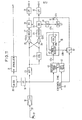
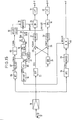
- Figs. 17 and 18 are the simplified block diagrams showing two embodiments of the transmission system; and Figs. 19 and 20 also simplified block diagrams of two examples of a storage device.
- a recording system in Fig. 4 which uses a magnetic disc as a magnetic medium and records luminance signals by FM modulation, and a reproducing system corresponding thereto in Fig. 5.
- the reference numeral 1 denotes a rectangular 2-phase PM circuit, 2 an FM circuit for luminance signals, 3 a counter for forming reference signals, 4 a composite circuit, 5 a recording amplifier, 6 a magnetic head, 7 a magnetic disc, and 8 a driving motor.
- the rectangular 2- phase PM circuit 1 comprises a carrier oscillator 9, a phase shifter 10, two balanced modulators 11, 12, composite circuits 13, 14, 15 and an inversion circuit 16. From the output (assuming f H to be horizontal scanning frequency, e .g. 756 KHz corresponding to 48 f H ), of the oscillator 9, three different carriers of Acos ⁇ c t, Asin ⁇ c t, and -Asin ⁇ c t are formed by the phase shifter 10.
- the color/signals R - Y and -Asin ⁇ c t to output balanced modulation signals, to which is added Acos ⁇ c t as a subcarrier in order to obtain R - Y carrier chromicance signal or PM color signal C R (t).
- To the other balanced modulator 12 are input B - Y color signals and Acos ⁇ c t to output balanced modulation signals, to which is added A in ⁇ c t as a subcarrier to obtain B - Y PM color signals C B (t).
- C R (t) may be input in the inversion circuit 16 to output an alter- nately inverted PM color signal ⁇ C R (t) which is phase-inverted (by 180°) per 1 H by controlling with a rectangular wave of 1/2 f H .
- PM color signal C(t) is formed by composing and multiplexing ⁇ C R (t) and C B (t), to which is further composed by frequency-multiplexing FM luminance signals Cy(t) consisting of luminance signals Y which have been FM modulated and the reference signal f P of 6f H obtained by dividing the carrier to, for instance, 8 at the counter 3, and finally recording the same in the magnetic disc 7.
- the recording track generally is shaped concentrically in the still video recording, and spirally in the movie recording.
- the recording modes employed are; rotating, for instance, the magnetic disc at 1,800 rpm in NTSC to record 1 track/l frame; and rotating at 3,600 rpm to record 1 track/1 field or 2 tracks/l frame.
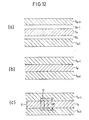
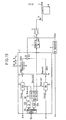
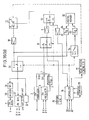
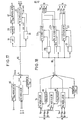
- Figs. l(a) and l(b) are diagrams to explain difficulties encountered in the prior art; Figs. 2 and 3 to explain the present invention; Fig. 4 a block diagram showing one embodiment of the recording system; Fig. 5 a block diagram showing one embodiment of a regenerating system corresponding to that shown in Fig. 4; Fig. 6 shows changes in Bessel functions; Fig. 7 shows examples of recording/regenerating methods without cross talk; Fig. 8 another example of the -regeneration system; Fig. 9 explains the inversion control for phase reference signals; Fig. 10 shows a concrete circuit diagram thereof; Fig. 11 is a block diagram showing still another embodiment of the regeneration system; Fig. 12 explains an inclined azimath system; Fig.
- FIG. 13 is another embodiment to explain the recording system;
- Fig. 14 shows still another embodiment;
- Fig. 15 is a block diagram of a regeneration system corresponding to that of Fig. 14;
- Figs. 16(a) and 16(b) simplified block diagrams showing 2 devices provided with wherein K is a constant.
- Equation (1) becomes the following; wherein the first term represents a carrier and the second term a balanced modulation wave. Accordingly, the range of R-f (t) ⁇ 1 may be PM modulated by using a balanced modulator, indicating that side band waves of over secondary order are negligible. Conditions for holding R-f (t) ⁇ 1 are now studied; and when this is substituted in (2),
- mp K.a, and represents the maximum modulation index.
- the modulation index is beneath a certain value, then it may be PM modulated by a balanced modulator. It also becomes clear that multiplexing of PM signals by rectangular 2-phase modulation is also possible.
- mp upper limit is more or less determined visually.
- the luminance signal is-PM modulated at mp ⁇ 1.0 (or mp ⁇ 1.3 for practical purposes) for allowing cross talks from the adjacent tracks.
- PM modulating by using a balanced modulator mp may further be increased than the conventional PM modulation because of the absence of secondary side band waves.
- a large mp is also allowed for still picture recording, since recording may be carried out to eliminate cross talks.
- S/N improves, but distortion increases. This distortion is amendable.
- C(t) includes the carrier of the same phase as sinwct and coswct even when either one of these phase reference signals is used for synchronous detection.
- C R (t) and C B (t) are so set for frequency-interleaving of each other.
- either one of C R (t) or C B (t) is phase inverted in 1 H so as to enable their separation by a comb filter at the time of reproduction, or further still a phase is advanced by 90 degrees for 1 H for one and delayed by 90 degrees for the other, so that C R (t) and C B (t) will be phase-shifted by 180 degrees relative to each other per 1 H for multiplexing.
- C(t) is delayed by 1 H because of the strong vertical correlation existing between adjacent -horizontal-scanning lines of the picture image signal , so that C(t) may be separated to C R (t) and C B (t) by addition and subtraction of the signals before and after the delay. After separation, they may be respectively synchronous- detected. As it becomes ⁇ C R (t) in subtraction, the phase reference signal used in the synchronous detection is also phase inverted per 1 H to become ⁇ sinwct. Such phase shift of phase reference signals per 1 H becomes necessary for, say,when C R (t) is advanced by 90 degrees as well as for deiaying C B (t) by 90 degrees per 1 H.
- the phase shift angle for the phase reference signal is determined by those of C R (t) and C B (t) during recording. Said separation becomes incomplete if the respective subcarrier phases do not align in each horizontal scanning. Therefore, the frequency Wc/2 ⁇ of subcarriers is related to horizontal scanning frequency f H .
- Wc/2 ⁇ n ⁇ fH for 1 track/l frame, and for 1 track/l field.
- n is a natural number.
- Fig. 5 shows an embodiment of the reproduction system corresponding to the recording system of Fig. 4 wherein the reference numeral 17 denotes a magnetic head for reproduction, 18 a reproduction amplifier, 19 to 21 a high pass filter for separating FM luminance signals, an amplitude limiter, an FM demodulator respectively, and 22 a demodulator circuit for multiplexed FM color signals.
- the demodulator circuit 22 of this embodiment comprises a band pass filter (BPF) for PM color signal extraction 23, a delay line for 1 horizontal scanning time (1HDL) 24, a subtractor 25, an adder 26, amplitude limiters 27 and 28, balanced modulators 29, 30, low pass filters 31, 32 and a phase reference signal generator 33.
- BPF band pass filter
- the phase reference signal generator 33 of this particular embodiment comprises a 48f H oscillator 34, a phase shifter 35 and an inversion circuit 36.
- the oscillator 34 of this embodiment comprises a band pass filter (BPF) 34a for extracting 6f H reference signals, an amplitude limiter 34b, a voltage control oscillator 34c, a counter 34d for 1/8 frequency division, and a phase comparator 34e.
- BPF band pass filter
- FM luminance signal C Y (t) among reproduced signals 37 is FM demodulated as in the prior art.
- Multiplexed PM color signals ( ⁇ C R (t) + C B (t) ) are separated to ⁇ C R (t) and C B (t) by the delay line 24, the subtractor 25 and the adder 26 after having been extracted by the band pass filter 23, and then input to balanced modulators (BM) 29 and 30 respectively after passing through the amplitude limiters 27 and 28.
- the phase reference signals given to each of the balanced modulators 29 and 30 are ⁇ sinwct and coswct, and are formed in the following manner:
- the output 48f H of the voltage control oscillator 34c is frequency-divided by 8 at the counter 34d, and is phase-compared with the 6f reference signal f' P obtained by passing the output through the band pass-filter 34a and the amplitude limiter 34b at the phase comparator 34e in order to control the phase of the oscillation output. From this oscillation output are formed sin t and coswct at the phase shifter 35, and coswct is given as is to the balanced modulator 30 for B - Y demodulation.
- Sinwct is passed through the inversion circuit 36 which is controlled by 1/2f H rectangular signal 38 inverting once per every 1 H to make it ⁇ sinwct, and is given to a balanced modulator 29 for R - Y demodulation.
- the output from each of the balanced modulators 29 and 30 is passed through the low pass filters 31 and 32, the carrier and component of higher order are removed and color signals of E R - Y(t) and E B - Y(t) are obtained.
- phase reference signals necessary for synchronous detection must absorb time base deviations caused by the relative movement of the magnetic disc and the magnetic head at either the time of recording or of reproducing.
- the 6f H reference signal fp is recorded by frequency multiplexing along with FM luminance signals and PM color signals.
- the 6f B reproducing signal f' P is used to align the phase of the phase reference signal with the time base deviation.
- Said reference signal is set on the side lower than the PM color signal band as for 6f H , although it may be set between PM color signal zone and FM luminance signal zone.
- phase reference signal generator becomes simple when considering the jitters, phase lags or S/N.
- Other methods of obtaining phase reference signals are a method to provide an auxiliary track on the magnetic disc and recording either one of the subcarriers thereon; a method for using the composite signals of the first and the second subcarriers during the horizontal blanking period; or a method of phase control by detecting the rotational deviation of the disc driving motor at FG (frequency generator). With a method of using auxiliary track or FG, the subcarrier phase is controlled also during recording.
- phase reference signals When one of PM color signals C R (t) is inverted alternately with ⁇ CR (t) per every 1H as the recording system shown in Fig. 4, unless the phase reference signals correctly respond and invert in-reproduction demodulation as the demodulated color signals become inverted as -(R - Y). Therefore, correct color picture image signals are not obtainable.
- Another method of inversion control for phase reference signals is to record special discrimination pulses with picture image signals at the time of recording. This recording of the special pulses is not so desirable. It would be more convenient if a simple and accurate inversion control of phase reference signals could be performed without taking the trouble of recording special discrimination pulses.
- one more PM demodulator 39 is added to the circuit shown in Fig. 5; and the signal ⁇ C' R (t) alone is extracted during the horizontal blanking by the gate circuit 40 from among the alternately inverting PM color signals ⁇ C R (t), signal ⁇ C' R (t) being PM demodulated by a signal of a prescribed phase, for instance, a phase reference signal coswct for C B (t) demodulation.
- the control signal 38 for the inversion circuit 36 is to be formed from said PM demodulation output 39a.
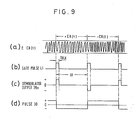
- Alternately inverting PM color signal ⁇ C R (t) is generally expressed as from (8), and has a phase which changes as in Fig. 9 (a).
- ⁇ C' R (t) is extracted by controlling the gate circuit 40 with the gate pulse 41 which becomes ON by every 1 H during the horizontal blanking period T BLK as shown in Fig. 9(b), and PM demodulated with coswct to obtain a demodulation output 39a which becomes positive or negative per every 1 H as shown in Fig. 9(c).
- the pulse 39a is input into a comparator 42 having hysterisis characteristics, 1/2f H pulse signal whose level deviates per every 1 H as shown in Fig. 9(d) is obtained.
- V ref represents a threshold value.
- the level of the pulse signal 38 always corresponds to ⁇ C R (t) by following the polarity of the demodulated output 39a during horizontal blanking which always corresponds to the alternately inverting PM color signal ⁇ C R (t). Therefore, it is possible to obtain discriminating pulse signals without recording special pulses.
- the pulse signal 38 automatically returns to the level transition correspond- . ing to ⁇ C R (t).
- the inversion circuit 36 comprises an inverter 36a and a switch 36b, said switch 36b being switched corresponding to the level of pulse signals 38.
- the parts identical to those shown in Fig. 4 are given the same reference numerals in order to avoid redundancy in explanation.
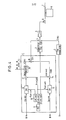
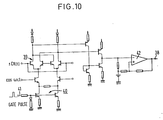
- Fig. 10 shows a PM demodulator 39, a gate circuit 40 and a concrete circuit for the comparator 42 which has hysteresis characteristics.
- Fig. 11 shows a reproducing system corresponding to the recording system of Fig. 4 when phase reference signals are formed by an alternate method. Provided, however, the recording system does not require the counter 3 of Fig. 4.
- Fig. ll the parts identical to those shown in Fig. 5 are given the identical reference numbers in order to avoid redundancy in explanation.
- a gate pulse circuit 43 inputs horizontal synchronous signals 44 to output pulses 43a of the width of horizontal blanking period, and the reference signal gate circuit 45 remains open while it receives the pulse 43a, and sends the burst reference signal (48fH) 45a to APC (automatic phase control) circuit 46. Since the horizontal blanking period for color signals lacks the signal component, the subcarrier phase becomes constant. Therefore, the output 45a of the reference signal gate circuit 45 is a mere composite of the first and second subcarriers.
- the oscillation output 47a of VCO (voltage control oscillator) 47 is phase-compared with the reference signal 45a which has been input at a phasedetector circuit 48, and its output 48a is used to control VCO 47 to obtain the output 47a of the same phase and frequency as the burst reference signals 45a.
- This oscillation output 47a is a continuous signal corresponding to the time changes.
- the oscillation output 47a passes a 90° phase shifter 49 and becomes a phase reference signal cowct of a prescribed phase corresponding to the balanced modulator 30 for B - Y modulation.
- a flip-flop (F/F) 50 relies on horizontal synchronous signal 44 as a clock, and is reset by the signal 48b output by the phase detector circuit 48 as it detects the phase of burst reference signal 45a every time it is input. Accordingly, the output of the flip-flop is used to switch the switch 51 by every 1 H, and the output 47a directly from VCO and the output 52a which has passed through a 180° phase shifter (inversion circuit) 52 are alternately given to the balanced demodulator 29 for R - Y demodulation in order to obtain a phase reference signal of ⁇ sinwot. This will achieve a stable demodulation which has absorbed time base changes.
- the luminance signals are FM modulated for recording. Therefore, if reproduction is conducted with the magnetic head overriding the adjacent track, interference between FM luminance signals of adjacent tracks will interfere beats. If the subcarrier phases of PM color signals of adjacent tracks were not aligned, the colors for the reproduced picture image will also become deviated. As shown by hatched lines in Figs. 12(a) and 12(b), a so-called inclined azimath FM recording system is recommended so that a recording track t n will have a different azimath from the track t n-1 , or the track t n+1 adjacent thereto. For the recording system, as shown in Fig.
- an oscillator 53 comprising VCO 53 a, a counter 53b and a recommended in place of the oscillator 9 in Fig. 4.
- phase comparator 53c is recommended in place of the oscillator 9 in Fig. 4.
- reference signal f' p is reproduced by using an auxiliary head, or by recording this reference signal f' P in an auxiliary track, and then reproducing the same, this reference signal f'p is input in the oscillator 53, it is possible to align the subcarrier phases between adjacent tracks. In the latter case, the center frequency of the carrier may be used as the reference signal because there are no signal interferences.
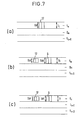
- the position of recording vertical and horizontal synchronous signals should preferably be aligned between adjacent tracks, but it suffices so long as the recording positions of the horizontal synchronous signals if the vertical synchronous signals are not aligned. are aligned, As described above, if the positions of recording horizontal synchronous signals and of subcarriers were aligned between adjacent tracks and also if the inclined azimath system was adopted, it is possible to obtain reproduced picture images with less disturbances even if a tracking error occurs despite the efforts of preventing cross talks as shown in Figs. 7 (a), 7(b) and 7(c) in still picture video tape recording. In the case of movie recording, only the picture images with intense correlation with that of the adjacent track become overlapped, presenting little problem in high density recording.
- the scanning width l HP of the reproducing head 17 may be made somewhat wider than the width of the recording track l T without any difficulties, and even with the tracking errors, the reproduction output is advantageously free from deviations.
- the parts in Fig. 13 which are identical to those of Fig. 4 are given the same numbers.
- Fig. 14 shows an example of a recording system for PM modulating and recording the luminance signals by using of balanced modulators.
- Fig. 15 shows an example of a reproducing system therefor. Except for the PM modulator/recorder for the luminance signals, the parts shown in these two figures are substantially the same and the like parts are given the like numbers in order to eliminate redundancy in explanation.
- the center carrier for PM luminance, signals is set at ca. 7.8 MHz, and the center carrier for PM color signals at a value 1/6th thereof (about 1.3 MHz) and the reference signals at 1/3 (about 2.6 MHz).
- 2.6 MHz indicates an empty frequency between the PM luminance signal band and the PM color signal band.
- the reference number 54 denotes a carrier generating circuit, which comprises a 2.6 MHz oscillator 55, a 2.6 MHz band pass filter 56, an amplitude limiter 57, a change-over switch 58, a 1/2 frequency divider 59, a 3 multiplexing circuit 60, and phase shifters 61 and 62.
- the reference number 63 denotes a balanced modulator for PM modulating the luminance signals (Y), and 64 a composite circuit.
- the switch 58 at a contact point a When recording on a new magnetic disc for the first time, the switch 58 at a contact point a is turned ON, a fixed frequency output of the oscillator 55 is used for PM modulation, and PM luminance signal C Y (t) and multiplexed PM color signals C(t) along with the 2.6 MHz reference signal f are multiple-recorded in one track.
- the switch 58 at a contact point b is turned ON, the reference signal f' P (2.6 MHz) is extracted from the track by using an auxiliary head (not shown) and BPF 56 to form a required carrier. In all the tracks, phase for each carrier thus becomes aligned.
- the center frequency of each carrier may be recorded in the auxiliary track to be used as the reference signals.
- Fig. 15 shows a regeneration system which is different from Fig. 4 or Fig. 8 in that PM luminance signals are demodulated at a balanced modulator 65, and that 2.6 MBz reference signals f'p are frequency-divided to 1/2 'to form phase reference signal for PM color signal demodulation, and multiplexed by 3 to form phase reference signal for PM luminance signal demodulation.
- the reference number 66 denotes a band pass filter, 67 an amplitude limiter, 68 a 1/2 frequency divider, 69 a multiplication circuit, and 70 a phase shifter.
- Fig. 16 shows an example of a magnetic disc video recording device to which a system of magnetic recording/ reproducing still picture images by FM modulating luminance signals is applied in order to facilitate animation reproduction.
- the circuit shown in Figs. 4, 5 and 8 is used also for the device shown in Fig. 16 and the identical parts are therefore given the identical numbers in order to eliminate redundant explanations.
- the example shown in Fig. 16(a) uses an auxiliary track formed on the magnetic disc 7, for instance, on the outermost periphery thereof for reproducing animations.
- the reference number 71 denotes a composite main head for still picture recording and is integrally formed with a wide head 6 and a narrow head 17 aligned in the direction of the track.
- the reference number 72 denotes a composite auxiliary head for reproducing animations which also includes a wide head 73 and a narrow head 74 aligned integra in the direction of the track.
- Reference number 75 indicates an oscillator for erase signals, 76 a control member, 77 a control device for head positions, 78 a rotation counter for magnetic disc, 79 and 80 amplifiers for recording and regenerating, 81 an amplifier for extracting pilot signals for tracking, and S 1 - S 4 switches for mode changes.
- the main head 71 for still picture recording is positioned on the desired track by moving the same in the radial direction of the magnetic disc, while the auxiliary head 72 for reproducing animations are fixedly positioned on the auxiliary track.
- the device shown in Fig. 16(a) has the three kinds of modes; SR for still picture recording, SP for still picture reproducing and AP for animation reproducing. Mode commands are input to the control member 76.
- W e shall now explain the operations of respective modes by referring to Table 1 assuming that the still picture images are recorded in the magnetic disc by 1 track/l field. Table 1 shows the contact selections of the switches corresponding to the modes. The contact point c for each of the switches indicates OFF.
- Switch S2 at contact point b alone is turned ON, and other switches Sl, S3 and S4 are turned OFF.
- pilot signals for tracking is fed in the control member 76, and the signal to position the main head 71 on the desired track is given to the head position control device 77, thereby to position the main head 71.
- Fig. 16(b) shows an example where a digital memory 82 for 1 field or 1 frame is shown-instead of the auxiliary track. This is the same as the example shown in Fig. 16(a) except for A/D converter 83 and D/A converter 84.
- Figs. 17 and 18 show the instances where the present invention is applied to a transmission system.
- the like parts shown in Figs. 4, 5 and 8 are allotted the like numbers to simplify the explanation.
- the embodiment shown in Fig. 17 shows transmission of one color picture image signal.
- the reference number 85 denotes a PM or FM angle modulator for luminance signals, 86 a transmission line, and 87 a PM or FM demodulator for carrier luminance signals.
- the carrier luminance signal allotted with bands and multiplexed PM color signals as shown in Fig. 2 are transmitted over the transmission line 86.
- Fig. 18 shows an example of transmitting two color picture image signals A and B.
- the band.zones are allotted for occupation by respective signals and multiplexed by rectangular 2-phase PM modulation respectively.
- the reference numbers la and lb denote PM modulator circuits which are similar to the PM modulator circuit 1 except that the former do not have a carrier oscillator. They obtain the carrier at the multiplexers 88 and 89.
- the reference numbers 22a and 22b denote PM demodulator circuits which are the same as the PM demodulator circuit 22 except for the pass band for the band pass filter, and 33a and 33b are the circuits with the same construction as the phase reference signal generating circuit 33 except for frequency.
- Figs. 19 and 20 The present invention is now explained when applied generally to storing devices by way of Figs. 19 and 20.
- the example shown in Fig. 19 corresponds to that of Fig. 17 and is the same except that the storing device 90 is used instead of the transmission line 86.
- the example of Fig. 20 corresponds to that of Fig. 18 except for the use of a storing device in place of the transmission line 86.
- the storing device requires an amplifier on both the input side and the output side as the need arises similarly as in the transmission system.
- any of the like devices mentioned below may be used;
- the optical magnetic memory, the semiconductor memory, and the magnetic memory basically convert the output 4a of the composite circuit 4 to digital signals by PCM or PNM systems, but other storage devices often can store the output as analog or digital signals.
- the output 4a of the composite circuit 4 may be stored as analog record without change, or it may be sampled once and stored as PAM, or even still may be converted to PWM and stored.
- the output 90a of the various storing devices 90 must be converted into base band signals or the same form as the output 4a of the composite circuit 4 by the detection circuit or D/A converter if they are sampled and recorded in PAM and PWM, or in PNM and PCM, except where the output 4a of the composite circuit 4 is analog recorded as a whole.
Landscapes
- Engineering & Computer Science (AREA)
- Multimedia (AREA)
- Signal Processing (AREA)
- Television Signal Processing For Recording (AREA)
Applications Claiming Priority (8)
| Application Number | Priority Date | Filing Date | Title |
|---|---|---|---|
| JP57137375A JPS5928787A (ja) | 1982-08-09 | 1982-08-09 | カラ−映像信号の記録再生方式 |
| JP137375/82 | 1982-08-09 | ||
| JP162183/82 | 1982-09-20 | ||
| JP57162183A JPS5952983A (ja) | 1982-09-20 | 1982-09-20 | カラ−映像信号の記録再生方式 |
| JP104106/83 | 1983-06-13 | ||
| JP104104/83 | 1983-06-13 | ||
| JP58104104A JPS59229984A (ja) | 1983-06-13 | 1983-06-13 | スチル画像の磁気記録・再生方式 |
| JP58104106A JPS59229710A (ja) | 1983-06-13 | 1983-06-13 | 直角2相のpm変調方式及びpm変復調方式 |
Publications (3)
| Publication Number | Publication Date |
|---|---|
| EP0102552A2 true EP0102552A2 (de) | 1984-03-14 |
| EP0102552A3 EP0102552A3 (en) | 1987-02-25 |
| EP0102552B1 EP0102552B1 (de) | 1991-11-06 |
Family
ID=27469184
Family Applications (1)
| Application Number | Title | Priority Date | Filing Date |
|---|---|---|---|
| EP83107866A Expired EP0102552B1 (de) | 1982-08-09 | 1983-08-09 | Verfahren zur 2-Phasen Quadraturmodulation- und Demodulation für ein Farbvideosignal |
Country Status (3)
| Country | Link |
|---|---|
| US (1) | US4626928A (de) |
| EP (1) | EP0102552B1 (de) |
| DE (1) | DE3382449D1 (de) |
Families Citing this family (4)
| Publication number | Priority date | Publication date | Assignee | Title |
|---|---|---|---|---|
| KR920002273B1 (ko) * | 1989-07-08 | 1992-03-20 | 삼성전자 주식회사 | 원격 pll을 이용한 직각 변복조 방식 및 회로 |
| WO1991007720A1 (en) * | 1989-11-16 | 1991-05-30 | International Business Machines Corporation | Method and apparatus for magnetic recording of data |
| US5426655A (en) * | 1991-07-16 | 1995-06-20 | International Business Machines Corporation | Method and apparatus for magnetic recording of data |
| US7227585B1 (en) | 2003-12-30 | 2007-06-05 | Conexant Systems, Inc. | Luminance and chrominance separation system |
Family Cites Families (9)
| Publication number | Priority date | Publication date | Assignee | Title |
|---|---|---|---|---|
| GB675887A (en) * | 1950-01-19 | 1952-07-16 | Pye Ltd | Improvements in or relating to television |
| US3591707A (en) * | 1969-01-08 | 1971-07-06 | Gen Electric | Color television demodulator |
| NL6908782A (de) * | 1969-06-10 | 1970-12-14 | ||
| US3849594A (en) * | 1973-05-25 | 1974-11-19 | Westinghouse Electric Corp | Multi-picture tv system with audio and doding channels |
| GB1497865A (en) * | 1973-12-28 | 1978-01-12 | Sony Corp | Magnetic recording and/or reproducing apparatus |
| JPS50133734A (de) * | 1974-04-09 | 1975-10-23 | ||
| US4217603A (en) * | 1978-11-06 | 1980-08-12 | Basf Aktiengesellschaft | Method and apparatus for processing color television signals |
| JPS5636290A (en) * | 1979-09-03 | 1981-04-09 | Matsushita Electric Ind Co Ltd | Recording and reproducing device with image pickup function |
| FR2479629B1 (fr) * | 1980-04-01 | 1985-11-08 | Thomson Csf | Procede de demodulation d'un signal module en amplitude, demodulateur mettant en oeuvre ce procede et systeme de television comportant un tel dispositif |
-
1983
- 1983-08-02 US US06/519,730 patent/US4626928A/en not_active Expired - Lifetime
- 1983-08-09 EP EP83107866A patent/EP0102552B1/de not_active Expired
- 1983-08-09 DE DE8383107866T patent/DE3382449D1/de not_active Expired - Lifetime
Also Published As
| Publication number | Publication date |
|---|---|
| DE3382449D1 (de) | 1991-12-12 |
| EP0102552A3 (en) | 1987-02-25 |
| US4626928A (en) | 1986-12-02 |
| EP0102552B1 (de) | 1991-11-06 |
Similar Documents
| Publication | Publication Date | Title |
|---|---|---|
| EP0148378B1 (de) | Magnetisches Aufzeichnungs- und Wiedergabegerät | |
| CA1099813A (en) | Color video signal recording and/or reproducing system | |
| US6246830B1 (en) | Apparatus for recording and reproducing video and audio signals in either analog or digital form | |
| JPH0123871B2 (de) | ||
| US4555735A (en) | Interconnection system between image pickup device and recording device | |
| CA1092704A (en) | Apparatus for recording and reproducing video signals on a magnetic tape movable at different speeds | |
| US4283737A (en) | Video signal reproducing apparatus with circuit avoiding skew distortion when operated at abnormal speed and/or direction | |
| US4134126A (en) | Color recorder having means for reducing luminance crosstalk in displayed image | |
| US4208673A (en) | Color recorder for reducing crosstalk | |
| US4188638A (en) | Color television signal having color-difference signals alternating between two carriers | |
| EP0102552B1 (de) | Verfahren zur 2-Phasen Quadraturmodulation- und Demodulation für ein Farbvideosignal | |
| US4344082A (en) | Apparatus for recovering a frequency-converted chrominance component that is substantially free of cross-talk components | |
| EP0361804B1 (de) | Aufzeichnungs- und/oder Wiedergabeeinrichtung von Informationssignalen | |
| US4654724A (en) | Recording method for video and audio signals in magnetic picture recording system | |
| CA1099398A (en) | Apparatus for eliminating time base errors from an information signal | |
| US6137648A (en) | Magnetic tape and a method for recording and reproducing a plurality of different information signals on and from the magnetic tape | |
| US3992719A (en) | Video signal recording/reproducing apparatus wherein the phase of the recorded signal is synchronized with the scanning head | |
| JPH0534876B2 (de) | ||
| GB2040135A (en) | Pal system colour video signal recording | |
| US5793557A (en) | Signal reproducing apparatus | |
| JP2735322B2 (ja) | ビデオテープレコーダ | |
| JPS605675Y2 (ja) | Pal方式カラ−映像信号再生装置 | |
| JPS635957B2 (de) | ||
| JP2644054B2 (ja) | 方式変換装置 | |
| JPS6015194B2 (ja) | Pal方式のカラ−映像信号の記録再生装置 |
Legal Events
| Date | Code | Title | Description |
|---|---|---|---|
| PUAI | Public reference made under article 153(3) epc to a published international application that has entered the european phase |
Free format text: ORIGINAL CODE: 0009012 |
|
| AK | Designated contracting states |
Designated state(s): DE FR GB |
|
| PUAL | Search report despatched |
Free format text: ORIGINAL CODE: 0009013 |
|
| AK | Designated contracting states |
Kind code of ref document: A3 Designated state(s): DE FR GB |
|
| RAP1 | Party data changed (applicant data changed or rights of an application transferred) |
Owner name: FUJI PHOTO FILM CO., LTD. |
|
| 17P | Request for examination filed |
Effective date: 19870821 |
|
| 17Q | First examination report despatched |
Effective date: 19890717 |
|
| GRAA | (expected) grant |
Free format text: ORIGINAL CODE: 0009210 |
|
| AK | Designated contracting states |
Kind code of ref document: B1 Designated state(s): DE FR GB |
|
| REF | Corresponds to: |
Ref document number: 3382449 Country of ref document: DE Date of ref document: 19911212 |
|
| ET | Fr: translation filed | ||
| PLBE | No opposition filed within time limit |
Free format text: ORIGINAL CODE: 0009261 |
|
| STAA | Information on the status of an ep patent application or granted ep patent |
Free format text: STATUS: NO OPPOSITION FILED WITHIN TIME LIMIT |
|
| 26N | No opposition filed | ||
| REG | Reference to a national code |
Ref country code: GB Ref legal event code: IF02 |
|
| PGFP | Annual fee paid to national office [announced via postgrant information from national office to epo] |
Ref country code: GB Payment date: 20020716 Year of fee payment: 20 |
|
| PGFP | Annual fee paid to national office [announced via postgrant information from national office to epo] |
Ref country code: FR Payment date: 20020819 Year of fee payment: 20 |
|
| PGFP | Annual fee paid to national office [announced via postgrant information from national office to epo] |
Ref country code: DE Payment date: 20021029 Year of fee payment: 20 |
|
| PG25 | Lapsed in a contracting state [announced via postgrant information from national office to epo] |
Ref country code: GB Free format text: LAPSE BECAUSE OF EXPIRATION OF PROTECTION Effective date: 20030808 |
|
| REG | Reference to a national code |
Ref country code: GB Ref legal event code: PE20 |