EP0099339A2 - Anellierte N-Phenylsulfonyl-N'-pyrimidinyl- und -triazinylharnstoffe - Google Patents
Anellierte N-Phenylsulfonyl-N'-pyrimidinyl- und -triazinylharnstoffe Download PDFInfo
- Publication number
- EP0099339A2 EP0099339A2 EP83810314A EP83810314A EP0099339A2 EP 0099339 A2 EP0099339 A2 EP 0099339A2 EP 83810314 A EP83810314 A EP 83810314A EP 83810314 A EP83810314 A EP 83810314A EP 0099339 A2 EP0099339 A2 EP 0099339A2
- Authority
- EP
- European Patent Office
- Prior art keywords
- formula
- alkyl
- halogen
- hydrogen
- oxygen
- Prior art date
- Legal status (The legal status is an assumption and is not a legal conclusion. Google has not performed a legal analysis and makes no representation as to the accuracy of the status listed.)
- Granted
Links
Classifications
-
- C—CHEMISTRY; METALLURGY
- C07—ORGANIC CHEMISTRY
- C07D—HETEROCYCLIC COMPOUNDS
- C07D307/00—Heterocyclic compounds containing five-membered rings having one oxygen atom as the only ring hetero atom
- C07D307/77—Heterocyclic compounds containing five-membered rings having one oxygen atom as the only ring hetero atom ortho- or peri-condensed with carbocyclic rings or ring systems
- C07D307/78—Benzo [b] furans; Hydrogenated benzo [b] furans
- C07D307/79—Benzo [b] furans; Hydrogenated benzo [b] furans with only hydrogen atoms, hydrocarbon or substituted hydrocarbon radicals, directly attached to carbon atoms of the hetero ring
-
- A—HUMAN NECESSITIES
- A01—AGRICULTURE; FORESTRY; ANIMAL HUSBANDRY; HUNTING; TRAPPING; FISHING
- A01N—PRESERVATION OF BODIES OF HUMANS OR ANIMALS OR PLANTS OR PARTS THEREOF; BIOCIDES, e.g. AS DISINFECTANTS, AS PESTICIDES OR AS HERBICIDES; PEST REPELLANTS OR ATTRACTANTS; PLANT GROWTH REGULATORS
- A01N47/00—Biocides, pest repellants or attractants, or plant growth regulators containing organic compounds containing a carbon atom not being member of a ring and having no bond to a carbon or hydrogen atom, e.g. derivatives of carbonic acid
- A01N47/08—Biocides, pest repellants or attractants, or plant growth regulators containing organic compounds containing a carbon atom not being member of a ring and having no bond to a carbon or hydrogen atom, e.g. derivatives of carbonic acid the carbon atom having one or more single bonds to nitrogen atoms
- A01N47/28—Ureas or thioureas containing the groups >N—CO—N< or >N—CS—N<
- A01N47/36—Ureas or thioureas containing the groups >N—CO—N< or >N—CS—N< containing the group >N—CO—N< directly attached to at least one heterocyclic ring; Thio analogues thereof
-
- C—CHEMISTRY; METALLURGY
- C07—ORGANIC CHEMISTRY
- C07D—HETEROCYCLIC COMPOUNDS
- C07D209/00—Heterocyclic compounds containing five-membered rings, condensed with other rings, with one nitrogen atom as the only ring hetero atom
- C07D209/02—Heterocyclic compounds containing five-membered rings, condensed with other rings, with one nitrogen atom as the only ring hetero atom condensed with one carbocyclic ring
- C07D209/04—Indoles; Hydrogenated indoles
- C07D209/08—Indoles; Hydrogenated indoles with only hydrogen atoms or radicals containing only hydrogen and carbon atoms, directly attached to carbon atoms of the hetero ring
-
- C—CHEMISTRY; METALLURGY
- C07—ORGANIC CHEMISTRY
- C07D—HETEROCYCLIC COMPOUNDS
- C07D215/00—Heterocyclic compounds containing quinoline or hydrogenated quinoline ring systems
- C07D215/02—Heterocyclic compounds containing quinoline or hydrogenated quinoline ring systems having no bond between the ring nitrogen atom and a non-ring member or having only hydrogen atoms or carbon atoms directly attached to the ring nitrogen atom
- C07D215/16—Heterocyclic compounds containing quinoline or hydrogenated quinoline ring systems having no bond between the ring nitrogen atom and a non-ring member or having only hydrogen atoms or carbon atoms directly attached to the ring nitrogen atom with hetero atoms or with carbon atoms having three bonds to hetero atoms with at the most one bond to halogen, e.g. ester or nitrile radicals, directly attached to ring carbon atoms
- C07D215/36—Sulfur atoms
-
- C—CHEMISTRY; METALLURGY
- C07—ORGANIC CHEMISTRY
- C07D—HETEROCYCLIC COMPOUNDS
- C07D307/00—Heterocyclic compounds containing five-membered rings having one oxygen atom as the only ring hetero atom
- C07D307/77—Heterocyclic compounds containing five-membered rings having one oxygen atom as the only ring hetero atom ortho- or peri-condensed with carbocyclic rings or ring systems
- C07D307/78—Benzo [b] furans; Hydrogenated benzo [b] furans
- C07D307/82—Benzo [b] furans; Hydrogenated benzo [b] furans with hetero atoms or with carbon atoms having three bonds to hetero atoms with at the most one bond to halogen, e.g. ester or nitrile radicals, directly attached to carbon atoms of the hetero ring
- C07D307/83—Oxygen atoms
-
- C—CHEMISTRY; METALLURGY
- C07—ORGANIC CHEMISTRY
- C07D—HETEROCYCLIC COMPOUNDS
- C07D307/00—Heterocyclic compounds containing five-membered rings having one oxygen atom as the only ring hetero atom
- C07D307/77—Heterocyclic compounds containing five-membered rings having one oxygen atom as the only ring hetero atom ortho- or peri-condensed with carbocyclic rings or ring systems
- C07D307/87—Benzo [c] furans; Hydrogenated benzo [c] furans
- C07D307/88—Benzo [c] furans; Hydrogenated benzo [c] furans with one oxygen atom directly attached in position 1 or 3
-
- C—CHEMISTRY; METALLURGY
- C07—ORGANIC CHEMISTRY
- C07D—HETEROCYCLIC COMPOUNDS
- C07D311/00—Heterocyclic compounds containing six-membered rings having one oxygen atom as the only hetero atom, condensed with other rings
- C07D311/02—Heterocyclic compounds containing six-membered rings having one oxygen atom as the only hetero atom, condensed with other rings ortho- or peri-condensed with carbocyclic rings or ring systems
- C07D311/04—Benzo[b]pyrans, not hydrogenated in the carbocyclic ring
- C07D311/06—Benzo[b]pyrans, not hydrogenated in the carbocyclic ring with oxygen or sulfur atoms directly attached in position 2
- C07D311/08—Benzo[b]pyrans, not hydrogenated in the carbocyclic ring with oxygen or sulfur atoms directly attached in position 2 not hydrogenated in the hetero ring
- C07D311/18—Benzo[b]pyrans, not hydrogenated in the carbocyclic ring with oxygen or sulfur atoms directly attached in position 2 not hydrogenated in the hetero ring substituted otherwise than in position 3 or 7
-
- C—CHEMISTRY; METALLURGY
- C07—ORGANIC CHEMISTRY
- C07D—HETEROCYCLIC COMPOUNDS
- C07D311/00—Heterocyclic compounds containing six-membered rings having one oxygen atom as the only hetero atom, condensed with other rings
- C07D311/02—Heterocyclic compounds containing six-membered rings having one oxygen atom as the only hetero atom, condensed with other rings ortho- or peri-condensed with carbocyclic rings or ring systems
- C07D311/04—Benzo[b]pyrans, not hydrogenated in the carbocyclic ring
- C07D311/22—Benzo[b]pyrans, not hydrogenated in the carbocyclic ring with oxygen or sulfur atoms directly attached in position 4
-
- C—CHEMISTRY; METALLURGY
- C07—ORGANIC CHEMISTRY
- C07D—HETEROCYCLIC COMPOUNDS
- C07D311/00—Heterocyclic compounds containing six-membered rings having one oxygen atom as the only hetero atom, condensed with other rings
- C07D311/02—Heterocyclic compounds containing six-membered rings having one oxygen atom as the only hetero atom, condensed with other rings ortho- or peri-condensed with carbocyclic rings or ring systems
- C07D311/04—Benzo[b]pyrans, not hydrogenated in the carbocyclic ring
- C07D311/58—Benzo[b]pyrans, not hydrogenated in the carbocyclic ring other than with oxygen or sulphur atoms in position 2 or 4
-
- C—CHEMISTRY; METALLURGY
- C07—ORGANIC CHEMISTRY
- C07D—HETEROCYCLIC COMPOUNDS
- C07D311/00—Heterocyclic compounds containing six-membered rings having one oxygen atom as the only hetero atom, condensed with other rings
- C07D311/02—Heterocyclic compounds containing six-membered rings having one oxygen atom as the only hetero atom, condensed with other rings ortho- or peri-condensed with carbocyclic rings or ring systems
- C07D311/04—Benzo[b]pyrans, not hydrogenated in the carbocyclic ring
- C07D311/58—Benzo[b]pyrans, not hydrogenated in the carbocyclic ring other than with oxygen or sulphur atoms in position 2 or 4
- C07D311/70—Benzo[b]pyrans, not hydrogenated in the carbocyclic ring other than with oxygen or sulphur atoms in position 2 or 4 with two hydrocarbon radicals attached in position 2 and elements other than carbon and hydrogen in position 6
-
- C—CHEMISTRY; METALLURGY
- C07—ORGANIC CHEMISTRY
- C07D—HETEROCYCLIC COMPOUNDS
- C07D311/00—Heterocyclic compounds containing six-membered rings having one oxygen atom as the only hetero atom, condensed with other rings
- C07D311/02—Heterocyclic compounds containing six-membered rings having one oxygen atom as the only hetero atom, condensed with other rings ortho- or peri-condensed with carbocyclic rings or ring systems
- C07D311/76—Benzo[c]pyrans
-
- C—CHEMISTRY; METALLURGY
- C07—ORGANIC CHEMISTRY
- C07D—HETEROCYCLIC COMPOUNDS
- C07D317/00—Heterocyclic compounds containing five-membered rings having two oxygen atoms as the only ring hetero atoms
- C07D317/08—Heterocyclic compounds containing five-membered rings having two oxygen atoms as the only ring hetero atoms having the hetero atoms in positions 1 and 3
- C07D317/44—Heterocyclic compounds containing five-membered rings having two oxygen atoms as the only ring hetero atoms having the hetero atoms in positions 1 and 3 ortho- or peri-condensed with carbocyclic rings or ring systems
- C07D317/46—Heterocyclic compounds containing five-membered rings having two oxygen atoms as the only ring hetero atoms having the hetero atoms in positions 1 and 3 ortho- or peri-condensed with carbocyclic rings or ring systems condensed with one six-membered ring
-
- C—CHEMISTRY; METALLURGY
- C07—ORGANIC CHEMISTRY
- C07D—HETEROCYCLIC COMPOUNDS
- C07D317/00—Heterocyclic compounds containing five-membered rings having two oxygen atoms as the only ring hetero atoms
- C07D317/08—Heterocyclic compounds containing five-membered rings having two oxygen atoms as the only ring hetero atoms having the hetero atoms in positions 1 and 3
- C07D317/44—Heterocyclic compounds containing five-membered rings having two oxygen atoms as the only ring hetero atoms having the hetero atoms in positions 1 and 3 ortho- or peri-condensed with carbocyclic rings or ring systems
- C07D317/46—Heterocyclic compounds containing five-membered rings having two oxygen atoms as the only ring hetero atoms having the hetero atoms in positions 1 and 3 ortho- or peri-condensed with carbocyclic rings or ring systems condensed with one six-membered ring
- C07D317/48—Methylenedioxybenzenes or hydrogenated methylenedioxybenzenes, unsubstituted on the hetero ring
- C07D317/62—Methylenedioxybenzenes or hydrogenated methylenedioxybenzenes, unsubstituted on the hetero ring with hetero atoms or with carbon atoms having three bonds to hetero atoms with at the most one bond to halogen, e.g. ester or nitrile radicals, directly attached to atoms of the carbocyclic ring
-
- C—CHEMISTRY; METALLURGY
- C07—ORGANIC CHEMISTRY
- C07D—HETEROCYCLIC COMPOUNDS
- C07D319/00—Heterocyclic compounds containing six-membered rings having two oxygen atoms as the only ring hetero atoms
- C07D319/10—1,4-Dioxanes; Hydrogenated 1,4-dioxanes
- C07D319/14—1,4-Dioxanes; Hydrogenated 1,4-dioxanes condensed with carbocyclic rings or ring systems
- C07D319/16—1,4-Dioxanes; Hydrogenated 1,4-dioxanes condensed with carbocyclic rings or ring systems condensed with one six-membered ring
- C07D319/18—Ethylenedioxybenzenes, not substituted on the hetero ring
-
- C—CHEMISTRY; METALLURGY
- C07—ORGANIC CHEMISTRY
- C07D—HETEROCYCLIC COMPOUNDS
- C07D327/00—Heterocyclic compounds containing rings having oxygen and sulfur atoms as the only ring hetero atoms
- C07D327/02—Heterocyclic compounds containing rings having oxygen and sulfur atoms as the only ring hetero atoms one oxygen atom and one sulfur atom
- C07D327/06—Six-membered rings
-
- C—CHEMISTRY; METALLURGY
- C07—ORGANIC CHEMISTRY
- C07D—HETEROCYCLIC COMPOUNDS
- C07D333/00—Heterocyclic compounds containing five-membered rings having one sulfur atom as the only ring hetero atom
- C07D333/50—Heterocyclic compounds containing five-membered rings having one sulfur atom as the only ring hetero atom condensed with carbocyclic rings or ring systems
- C07D333/52—Benzo[b]thiophenes; Hydrogenated benzo[b]thiophenes
- C07D333/54—Benzo[b]thiophenes; Hydrogenated benzo[b]thiophenes with only hydrogen atoms, hydrocarbon or substituted hydrocarbon radicals, directly attached to carbon atoms of the hetero ring
-
- C—CHEMISTRY; METALLURGY
- C07—ORGANIC CHEMISTRY
- C07D—HETEROCYCLIC COMPOUNDS
- C07D335/00—Heterocyclic compounds containing six-membered rings having one sulfur atom as the only ring hetero atom
- C07D335/04—Heterocyclic compounds containing six-membered rings having one sulfur atom as the only ring hetero atom condensed with carbocyclic rings or ring systems
- C07D335/06—Benzothiopyrans; Hydrogenated benzothiopyrans
-
- C—CHEMISTRY; METALLURGY
- C07—ORGANIC CHEMISTRY
- C07D—HETEROCYCLIC COMPOUNDS
- C07D521/00—Heterocyclic compounds containing unspecified hetero rings
Definitions
- the present invention relates to novel, herbicidally active and plant growth-regulating fused N-phenylsulfonyl-N'-pyrimidinyl- and -triazinyl-ureas, processes for their preparation, agents containing them as active compounds and their use for controlling weeds, especially selectively in useful crops or to regulate and inhibit plant growth.
- the invention also relates to new fused phenylsulfonyl isocyanates, thioisocyanates, phenylsulfonyl carbamates, phenylsulfonamides and phenylsulfonic acid chlorides produced as intermediates.
- Urea compounds, triazine compounds and pyrimidine compounds with herbicidal activity are generally known.
- arylsulfamoyl-heterocyclyl-aminocarbamoyl compounds having herbicidal and plant growth-regulating activity have been described, for example, in Dutch Patent No. 121788, in U.S. Patent No. 4,127,405 and in European Patent Applications 44807, 44808 and 51465.
- alkyl is to be understood as straight-chain or branched alkyl; e.g .: methyl, ethyl, n-propyl, i-propyl or the four isomeric butyl.
- Alkoxy is understood to mean: methoxy, ethoxy, n-propyloxy, i-propyloxy, the four isomeric butyloxy radicals, n-amyloxy, i-amyloxy, 2-amyloxy or 3-amyloxy, but in particular methoxy, ethoxy or i-propyloxy.
- alkylthio examples include methylthio, ethylthio, n-propylthio, i-propylthio, n-butylthio or n-pentylthio, but especially methylthio and ethylthio.
- alkylsulfinyl examples include methylsulfinyl, ethylsulfinyl, n-propylsulfinyl and n-butylsulfinyl, but especially methylsulfinyl and ethylsulfinyl.
- alkylsulfonyl examples include methylsulfonyl, ethylsulfonyl or n-propylsulfonyl, but especially methylsulfonyl and ethylsulfonyl.
- Halogen in the definitions and as a part in haloalkoxy are to be understood as fluorine, chlorine and bromine, but preferably fluorine and chlorine.
- the invention also encompasses the salts which the compounds of the formula I can form with amines, alkali metal and alkaline earth metal bases or quaternary ammonium bases.
- alkali and alkaline earth metal hydroxides as salt formers, the hydroxides of lithium, sodium, potassium, magnesium or calcium should be emphasized, but especially those of sodium or potassium.
- amines suitable for salt formation are primary, secondary and tertiary aliphatic and aromatic amines such as methylamine, ethylamine, propylamine, i-propylamine, the four isomeric butylamines, dimethylamine, diethylamine, diethanolamine, dipropylamine, diisopropylamine, di-n-butylamine, pyrrolidine, Piperidine, morpholine, trimethylamine, triethylamine, tripropylamine, quinuclidine, pyridine, quinoline and i-quinoline, but especially ethyl-, propyl-, diethyl- or triethylamine, but especially isopropylamine and diethanolamine.
- primary, secondary and tertiary aliphatic and aromatic amines such as methylamine, ethylamine, propylamine, i-propylamine, the four isomeric butylamines, dimethylamine, die
- Examples of quaternary ammonium bases are generally the cations of halogen ammonium salts, e.g. the tetramethylammonium cation, the trimethylbenzylammonium cation, the triethylbenzylammonium cation, the tetraethylammonium cation, the trimethylethylammonium cation, but also the ammonium cation.
- halogen ammonium salts e.g. the tetramethylammonium cation, the trimethylbenzylammonium cation, the triethylbenzylammonium cation, the tetraethylammonium cation, the trimethylethylammonium cation, but also the ammonium cation.
- Suitable substituents for bridge A are: halogen, cyano, C 1 -C 4 alkyl, C 1 -C 4 haloalkyl, C 1 -C 4 alkoxy, C 1 -C 4 alkylcarbonyl, C 1 -C 4- alkoxycarbonyl, C 1 -C 4 -alkylthiocarbonyl, carbamoyl, C 1 -C 4 -alkylaminocarbonyl, di-C 1 -C 4 -alkylaminocarbonyl, C 1 -C 4 -alkylsulfonyl, C 3 -C 5 -alkenyl or C 3 -C 5 alkynyl.
- the phenyl ring and fused-on bridge A form condensed heterocyclic, non-aromatic, saturated ring systems in which the sulfur and carbon atoms present as chain links can also be present in higher oxidation states.
- heterocycles which contain an ether, thioether, acetal or amine bridge the invention also includes, for example, heterocycles which contain lactone, lactam, sulton, sultin, sultam or acid anhydride functions or higher oxidation levels of thioether functions contain.
- Typical representatives of the basic types of the condensed saturated heterocycles which are formed from the sulfonyl-substituted phenyl ring and the fused-on bridge A are: 2,3-dihydrobenzo [b] furan, benzodioxole, 2- (3H) -benzofuranone, chroman , Dihydrocoumarin, benzodioxane, phthalide, dihydroisocoumarin, 3-isochromanone, indoline, 2,3-dihydrobenzothiophene, l-0xo-2,3-dihydrobenzothiophene, 1,1-dioxo-2,3, dihydrobenzothiophene, 4-chromanone and 3-chromanone .
- Particularly preferred groups of active compounds of the formula I are those compounds in which
- Z is oxygen
- R 1 is hydrogen, halogen or C 1 -C 4 alkoxycarbonyl
- R 2 is hydrogen
- R 3 and R 4 are, independently of one another, C 1 -C 4 alkyl, C 1 -C 4 alkoxy, di-C 1 -C 4 alkylamino, C 1 -C 4 haloalkoxy or halogen, which together contain at most 4 carbon atoms
- the bridge A contains an oxygen atom and optionally by halogen or C 1 -C 4 alkyl or those in which Z is oxygen
- R is hydrogen, halogen or C 1 -C 4 alkoxycarbonyl
- R is hydrogen
- R 3 and R are, independently of one another, C 1 -C 4 alkyl, C 1 -C 4 alkoxy, di-C 1 -C 4 alkylamino, C 1 -C 4 haloalkoxy or halogen, which together contain at most 4 carbon atoms
- the bridge A together with the phenyl
- the compounds of the formula I are prepared in an inert, organic solvent.
- the compounds of formula 1 are obtained by using a fused phenylsulfonamide of formula II wherein R 1 and A have the meaning given under formula I, in the presence of a base with an N-pyrimidinyl or triazinyl carbamate of the formula III wherein E, R 2 , R 3 , R 4 and Z have the meaning given under formula I and R represents phenyl, alkyl or substituted phenyl.
- a second method gives compounds of the formula I by using a fused phenylsulfonyl isocyanate or isothiocvanate of the formula IV wherein A, R 1 and Z have the meaning given under formula I, optionally in the presence of a base with an aminopyrimidine or triazine of the formula V. in which E, R 2 , R 3 and R 4 have the meaning given under formula I.
- the compounds of the formula I can also be obtained by using a fused N-phenylsulfonylcarbamate of the formula VI wherein A, R 1 and Z have the meaning given under formula I and R represents phenyl, alkyl or substituted phenyl, with an aminopyrimidine or triazine of the formula V given above.
- the ureas of the formula I obtained can be converted into addition salts by means of amines, alkali metal or alkaline earth metal hydroxides or quaternary ammonium bases. This is done, for example, by reacting with the equimolar amount of base and evaporating the solvent.
- Such solvents are hydrocarbons such as benzene, toluene, xylene or cyclohexane, chlorinated hydrocarbons such as methylene chloride, chloroform, carbon tetrachloride, or chlorobenzene, ethers such as diethyl ether, ethylene glycol dimethyl ether, diethylene glycol dimethyl ether, tetrahydrofuran or dioxane, nitriles such as dimethyl amide amide, such as acetonitrile amide nitrile such as acetonitrile amide or N-methylpyrrolidinone.
- the reaction temperatures are preferably between -20 ° and + 120 ° C.
- the reactions of the coupling processes are generally slightly exothermic and can be carried out at room temperature.
- the mixture is expediently warmed up briefly to the boiling point of the reaction mixture.
- the reaction times can also be shortened by adding a few drops of base as a reaction catalyst.
- Bases are in particular tertiary amines
- inorganic bases such as hydrides such as sodium or calcium hydride, hydroxides such as sodium and potassium hydroxide, carbonates such as sodium and potassium carbonate or hydrogen carbonates such as potassium and sodium hydrogen carbonate can also be used as bases.
- the end products of formula I can be isolated by concentrating and / or evaporating the solvent and can be purified by recrystallization or trituration of the solid residue in solvents in which they do not dissolve well, such as ethers, aromatic hydrocarbons or chlorinated hydrocarbons.
- the new intermediates of formula II can be produced in various ways.
- the compounds of the formula II are thus obtained by using anilines of the formula VII wherein R 1 and A have the meaning given under formula I, diazotized and the diazo group exchanged with sulfur dioxide in the presence of a catalyst such as copper chloride in hydrochloric acid or acetic acid and the phenylsulfonyl chloride of formula X formed wherein A and R 1 have the meaning given under formula 1, reacted with ammonium hydroxide solution.
- a catalyst such as copper chloride in hydrochloric acid or acetic acid
- phenylsulfonyl chloride of formula X formed wherein A and R 1 have the meaning given under formula 1 reacted with ammonium hydroxide solution.
- the corresponding aniline derivatives used as starting products are known or can be prepared by known methods.
- the compounds of the formula II can also be obtained by using a phenylsulfonic acid of the formula VIII wherein R 1 and A have the meaning given under formula I, by treatment with a chlorinating agent such as PC1 5 , POC1 3 , COC1 2 or SOC1 2, converted into the corresponding phenylsulfonyl chloride of the formula X and reacting this with ammonium hydroxide solution.
- a chlorinating agent such as PC1 5 , POC1 3 , COC1 2 or SOC1 2
- the compounds of formula II can be obtained by using a benzyl thioether of formula IX wherein R1 and A have the meaning given under formula I, treated with chlorine and the resulting phenylsulfonyl chloride of formula X is reacted with ammonium hydroxide solution.
- a direct sulfochlorination of the phenyl nucleus is possible, which leads to the corresponding fused phenylsulfonyl chloride by reaction with an excess of chlorosulfuric acid.
- Correspondingly activated fused benzene derivatives are known.
- phenylsulfonyl isocyanates of the formula IV can be obtained, for example, by reacting the sulfonamides of the formula II with phosgene in the presence of butyl isocyanate in a chlorinated hydrocarbon as solvent, at the reflux temperature. Similar representations are described in "Newer Methods of Preparative Organic Chemistry", Volume VI, 211-229, Verlag Chemie, Weinheim, 1970.
- the isothiocyanates of the formula IV are obtained by treating the sulfonamides of the formula II with carbon disulphide and potassium hydroxide and then reacting the dipotassium salt with phosgene. Such methods are described in Arch. Pharm. 299, 174 (1966).
- N-phenylsulfonylcarbamates of the formula VI are obtained by reacting the sulfonamides of the formula II with diphenyl carbonate in the presence of a base. Similar processes are mentioned in Japanese Patent 61 169.
- aminopyrimidines and triazines of the formula V used as starting materials and corresponding phenyl carbamates of the formula III have either been known for a long time or have been described in European patent application No. 70 804, or they can be obtained from known compounds by known methods.
- the active ingredients of formula I are stable compounds. No precautionary measures are required to handle them.
- the compounds of the formula I are notable for good selective growth-inhibiting and selective herbicidal properties which make them excellent for use in crops of useful plants, in particular in cereals, cotton, soybeans, corn and rice. Weeds are sometimes damaged, which previously could only be dealt with with total herbicides.
- the compounds of the formula I also have strong plant growth-regulating, in particular plant growth-inhibiting, properties. Both monocots and dicots are impaired in their growth.
- the legumes which are often cultivated in agriculture in tropical regions as cover crops are selectively inhibited in their growth by the compounds of formula 1, so that soil erosion between the crop plants is prevented, but the cover crops are not Can become competition for culture.
- An inhibition of vegetative growth allows a denser cultivation of the crop in many crop plants, so that an additional yield, based on the soil area, can be achieved.
- Another mechanism of increasing yields with growth chores is based on the fact that the nutrients benefit flower and fruit formation to a greater extent, while vegetative growth is restricted.
- the invention also relates to herbicidal and plant growth regulating compositions which comprise a new active compound of the formula I, and to processes for pre- and post-emergent weed control and for inhibiting the growth of monocotyledonous and dicotyledonous plants, in particular grasses, tropical soil coverers and tobacco stingers.
- the compounds of formula 1 are used in unchanged form or, preferably, as agents together with the auxiliaries customary in formulation technology and are therefore used, for example, to form emulsion concentrates, directly sprayable or dilutable solutions, dilute emulsions, wettable powders, soluble powders, dusts, granules, and also encapsulations in eg polymeric materials processed in a known manner.
- the application methods such as spraying, atomizing, dusting, scattering or pouring are the same as the type the means chosen in accordance with the desired goals and the given circumstances.
- the formulations i.e. the agents, preparations or compositions containing the active ingredient of formula I and optionally a solid or liquid additive are prepared in a known manner, e.g. by intimately mixing and / or grinding the active ingredients with extenders, e.g. with solvents, solid carriers, and optionally surface-active compounds (surfactants).
- extenders e.g. with solvents, solid carriers, and optionally surface-active compounds (surfactants).
- Aromatic hydrocarbons preferably the fractions C 8 to C 12 ' such as xylene mixtures or substituted naphthalenes, phthalic acid esters such as dibutyl or dicotyl phthalate, aliphatic hydrocarbons such as cyclohexane or paraffins, alcohols and glycols and their ethers and esters, such as Ethanol, ethylene glycol, ethylene glycol monomethyl or ethyl ether, ketones such as cyclohexanone, strongly polar solvents such as N-methyl-2-pyrrolidone, dimethyl sulfoxide or dimethylformamide, and optionally epoxidized vegetable oils such as epoxidized coconut oil or soybean oil; or water.
- Aromatic hydrocarbons preferably the fractions C 8 to C 12 ' such as xylene mixtures or substituted naphthalenes, phthalic acid esters such as dibutyl or dicotyl phthalate, aliphatic hydrocarbon
- solid carriers e.g. natural dust, such as calcite, talc, kaolin, montmorillonite or attapulgite
- solid carriers e.g. natural dust, such as calcite, talc, kaolin, montmorillonite or attapulgite
- highly disperse silica or highly disperse absorbent polymers can also be added.
- adsorptive granulate carriers come porous types such as Pumice stone, broken brick, sepiolite or bentonite, as non-sorptive carrier materials e.g. Calcite or sand in question.
- a large number of pre-engineered materials of inorganic or organic nature such as, in particular, dolomite or comminuted plant residues can be used.
- suitable surface-active compounds are nonionic, cationic and / or anionic surfactants with good emulsifying, dispersing and wetting agents consider.
- surfactants are also to be understood as mixtures of surfactants.
- Suitable anionic surfactants can be both so-called water-soluble soaps and water-soluble synthetic surface-active compounds.
- soaps are the alkali, alkaline earth or optionally substituted ammonium salts of higher fatty acids (C 10 -C 22 ), such as the Na or K salts of oleic or stearic acid, or of natural fatty acid mixtures, for example from coconut or Tallow oil can be obtained.
- the fatty acid methyl taurine salts should also be mentioned.
- the fatty sulfonates or sulfates are usually present as alkali, alkaline earth or optionally substituted ammonium salts and have an alkyl radical with 8 to 22 carbon atoms, alkyl also including the alkyl part of acyl radicals, e.g. the Na or Ca salt of lignin sulfonic acid, dodecylsulfuric acid ester or a fatty alcohol sulfate mixture made from natural fatty acids.
- This subheading also includes the salts of sulfuric acid esters and sulfonic acids from fatty alcohol / ethylene oxide adducts.
- the sulfonated benzimidazole derivatives preferably contain 2-sulfonic acid groups and a fatty acid residue with 8-22 carbon atoms.
- Alkylarylsulfonates are e.g. the sodium, calcium or triethanolamine salts of dodecylbenzenesulfonic acid, dibutylnaphthalenesulfonic acid or a naphthalenesulfonic acid-formaldehyde condensation product.
- Corresponding phosphates such as e.g. Salts of the phosphoric acid ester of a p-nonylphenol (4-14) ethylene oxide adduct or phospholipids in question.
- Suitable nonionic surfactants are primarily polyglycol ether derivatives of aliphatic or cycloaliphatic alcohols, saturated or unsaturated fatty acids and alkylphenols, which can contain 3 to 30 glycol ether groups and 8 to 20 carbon atoms in the (aliphatic) hydrocarbon radical and 6 to 18 carbon atoms in the alkyl radical of the alkylphenols .
- nonionic surfactants are the water-soluble polyethylene oxide adducts containing 20 to 250 ethylene glycol ether groups and 10 to 100 propylene glycol ether groups with polypropylene glycol, ethylene diaminopolypropylene glycol and alkyl polypropylene glycol with 1 to 10 carbon atoms in the alkyl chain.
- the compounds mentioned usually contain 1 to 5 ethylene glycol units per propylene glycol unit.
- nonionic surfactants are nonylphenol polyethoxyethanols, castor oil polyglycol ethers, polypropylene-polyethylene oxide adducts, tributylphenoxypolyethanol, polyethylene glycol and octylphenoxypolyethoxyethanol.
- Fatty acid esters of polyoxyethylene sorbitan such as polyoxyethylene sorbitan trioleate, are also suitable.
- the cationic surfactants are primarily quaternary ammonium salts which contain at least one alkyl radical having 8 to 22 carbon atoms as N substituents and have low, optionally halogenated altcyl, benzyl or low hydroxyalkyl radicals as further substituents.
- the salts are preferably in the form of halides, methyl sulfates or ethyl sulfates, e.g. the stearyltrimethylammonium chloride or the benzyldi (2-ehlorXchyl) ethylammonium bromide.
- the pesticidal preparations generally contain 0.1 to 95%, in particular 0.1 to 80%, active ingredient of the formula I, 1 to 99.9% of a solid or liquid additive and 0 to 25%, in particular 0.1 to 25 % of a surfactant.
- the use forms can be diluted down to 0.001% of active ingredient.
- the application rates are generally 0.01 to 10 kg ai / ha, preferably 0.025 to 5 kg ai / ha.
- the agents can also contain other additives such as stabilizers, defoamers, viscosity regulators, binders, adhesives and fertilizers or other active ingredients to achieve special effects.
- the 1,3-benzodioxole-4-sulfonic acid chloride obtained under a) is dissolved in 20 ml of ethyl acetate and added dropwise at 20-25 ° C. to 25 ml of 25% aqueous ammonia. This mixture is stirred for one hour at the same temperature. The organic phase is separated off, dried and evaporated. This gives 1,3-benzodioxol-4-sulfonamide.
- the active ingredient is mixed well with the additives and ground well in a suitable mill.
- Spray powder is obtained which can be diluted with water to form suspensions of any desired concentration.
- Emulsions of any desired concentration can be prepared from this concentrate by dilution with water.
- Ready-to-use dusts are obtained by mixing the active ingredient with the carrier and grinding it in a suitable mill.
- the active ingredient is mixed with the additives, ground and moistened with water. This mixture is extruded and then dried in an air stream.
- the finely ground active ingredient is evenly applied in a mixer to the kaolin moistened with polyethylene glycol. In this way, dust-free coating granules are obtained.
- the finely ground active ingredient is intimately mixed with the additives. This gives a suspension concentrate from which suspensions of any desired concentration can be prepared by dilution with water.
- a number of weeds and crops, both monocotyledonous and dicotyledonous, are sprayed after emergence in the 4- to 6-leaf stage with an aqueous active ingredient dispersion in dosages of 0.5 kg / AS / ha and then at 24 ° to 26 ° C and 45 -60% relative humidity. 15 days after the treatment, the test is evaluated and evaluated on the same scale as in the pre-emergent test.
- Example 8 Detection of growth inhibition in tropical ground cover legumes (cover crops).
- test plants centrosema plumieri and centrosema pubescens
- the test plants are grown to the fully grown stage and cut back to a height of 60 cm.
- the active ingredient is injected as an aqueous emulsion.
- the test plants are kept at 70% relative air humidity and 6000 lux artificial light, 14 hours a day, at temperatures of 27 ° during the day and 21 ° C at night.
- the test is evaluated 4 weeks after the application.
- the new growth compared to the control is estimated and weighed and the phytotoxicity is assessed.
- the plants treated with the active compounds of the formula I showed a significant reduction in new growth (less than 20% of the new growth in untreated control plants) without the test plants. be harmed.
Landscapes
- Chemical & Material Sciences (AREA)
- Organic Chemistry (AREA)
- Life Sciences & Earth Sciences (AREA)
- Environmental Sciences (AREA)
- Plant Pathology (AREA)
- Health & Medical Sciences (AREA)
- Engineering & Computer Science (AREA)
- Dentistry (AREA)
- General Health & Medical Sciences (AREA)
- Wood Science & Technology (AREA)
- Zoology (AREA)
- Agronomy & Crop Science (AREA)
- Pest Control & Pesticides (AREA)
- Agricultural Chemicals And Associated Chemicals (AREA)
- Plural Heterocyclic Compounds (AREA)
- Furan Compounds (AREA)
- Heterocyclic Compounds That Contain Two Or More Ring Oxygen Atoms (AREA)
- Heterocyclic Compounds Containing Sulfur Atoms (AREA)
- Quinoline Compounds (AREA)
- Pyrane Compounds (AREA)
- Nitrogen Condensed Heterocyclic Rings (AREA)
- Indole Compounds (AREA)
- Low-Molecular Organic Synthesis Reactions Using Catalysts (AREA)
- Organic Low-Molecular-Weight Compounds And Preparation Thereof (AREA)
Abstract
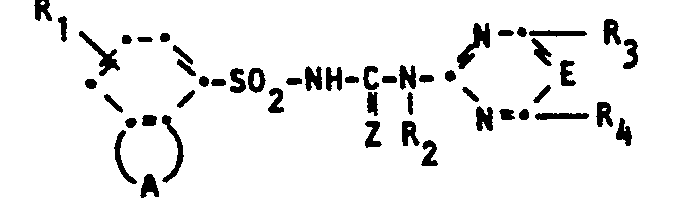
Description
- Die vorliegende Erfindung betrifft neue, herbizid wirksame und pflanzenwuchsregulierende anellierte N-Phenylsulfonyl-N'-pyrimidinyl- und -triazinyl-harnstoffe, Verfahren zu ihrer Herstellung, sie als Wirkstoffe enthaltende Mittel sowie deren Verwendung zur Bekämpfung von Unkräutern, vor allem selektiv in Nutzpflanzenkulturen oder zum Regulieren und Hemmen des Pflanzenwachstums. Darüberhinaus betrifft die Erfindung auch als Zwischenprodukte hergestellte neue anelliertePhenyl- sulfonylisocyanate,-thioisocyanate, Phenylsulfonylcarbamate, Phenylsulfonamide sowie Phenylsulfonsäurechloride.
- Die erfindungsgemässen anellierten N-Phenylsulfonyl-N'-pyrimidinyl-und -triazinyl-harnstoffe entsprechen der allgemeinen Formel I

- Z Sauerstoff oder Schwefel,
- E Stickstoff oder -CH-,
- R1 Wasserstoff, Halogen, Nitro, C1-C4-Alkyl, C1-C4-Halogenalkyl, C1-C4-Alkoxy, C1-C4-Halogenalkoxy, C1-C4-Alkoxycarboayl, C1-C4-Alkylthio, C1-C4-Alkylsulfinyl, C1-C4-Alkylsulfonyl oder C2-C5-Alkoxyalkoxy,
- R2 Wasserstoff, C1-C4-Alkyl oder C1-C3-Alkoxy,
- R3 und R4 unabhängig voneinander Wasserstoff, C1-C4-Alkyl, C1-C4-Alkoxy, C1-C4-Halogenalkoxy, C1-C4-Halogenalkylthio, C1-C4-Alkylthio, Halogen, C2-CS-Alkoxyalkyl, C2-C5-Alkoxyalkoxy oder -NR5R6, wobei
- R5 und R6 für Wasserstoff oder C1-C4-Alkyl stehen, bedeuten und
- A für eine gegebenenfalls substituierte 3- oder 4-atomige Brücke steht, die 1 bis 2 Sauerstoff-, Schwefel- oder Stickstoffatome enthält und die zusammen mit den sie bindenden Kohlenstoffatomen einen nichtaromatischen 5- bis 6-gliedrigen Heterocyclus bildet, wobei zwei Sauerstoffatome durch mindestens ein Kohlenstoffatom getrennt sind und Sauerstoff- und Schwefelatome nur dann miteinander verbunden sind, wenn das Schwefelatom als -SO- oder -S02-Gruppe vorliegt, sowie den Salzen dieser Verbindungen.
- Harnstoffverbindungen, Triazinverbindungen und Pyrimidinverbindungen mit herbizider Wirkung sind allgemein bekannt. Kürzlich wurden Arylsulfamoyl-heterocyclyl-aminocarbamoylverbindungen mit herbizider und pflanzenwuchsregulierender Wirkung, beispielsweise im niederländischen Patent Nr. 121788, im US-Patent Nr. 4 127 405 und in den europäischen Patentanmeldungen 44807, 44808 und 51465 beschrieben.
- In den Definitionen ist unter Alkyl geradkettiges oder verzweigtes Alkyl zu verstehen; z.B.: Methyl, Aethyl, n-Propyl, i-Propyl oder die vier isomeren Butyl.
- Unter Alkoxy ist zu verstehen: Methoxy, Aethoxy, n-Propyloxy, i-Propyloxy, die vier isomeren Butyloxyreste, n-Amyloxy, i-Amyloxy, 2-Amyloxy oder 3-Amyloxy, insbesondere aber Methoxy, Aethoxy oder i-Propyloxy.
- Beispiele für Alkylthio sind Methylthio, Aethylthio, n-Propylthio, i-Propylthio, n-Butylthio oder n-Pentylthio insbesondere aber Methylthio und Aethylthio.
- Beispiele für Alkylsulfinyl sind Methylsulfinyl, Aethylsulfinyl, n-Propylsulfinyl und n-Butylsulfinyl, insbesondere aber Methylsulfinyl und Aethylsulfinyl.
- Beispiele für Alkylsulfonyl sind Methylsulfonyl, Aethylsulfonyl oder n-Propylsulfonyl, insbesondere aber Methylsulfonyl und Aethylsulfonyl.
- Unter Halogen in den Definitionen sowie als Teil in Halogenalkoxy sind Fluor, Chlor und Brom, vorzugsweise jedoch Fluor und Chlor zu verstehen.
- Die Erfindung umfasst ebenfalls die Salze, die die Verbindungen der Formel I mit Aminen, Alkali- und Erdalkalimetallbasen oder quaternären Ammoniumbasen bilden können.
- Unter Alkali- und Erdalkalimetallhydroxiden als Salzbildner sind die Hydroxide von Lithium, Natrium, Kalium, Magnesium oder Calcium hervorzuheben, insbesondere aber die von Natrium oder Kalium.
- Beispiele für zur Salzbildung geeigneter Amine sind primäre, sekundäre und tertiäre aliphatische und aromatische Amine wie Methylamin, Aethylamin, Propylamin, i-Propylamin, die vier isomeren Butylamine, Dimethylamin, Diäthylamin, Diäthanolamin, Dipropylamin, Diisopropylamin, Di-n-butylamin, Pyrrolidin, Piperidin, Morpholin, Trimethylamin, Triäthylamin, Tripropylamin, Chinuclidin, Pyridin, Chinolin und i-Chinolin, insbesondere aber Aethyl-, Propyl-, Diäthyl- oder Triäthylamin, vor allem aber iso-Propylamin und Diäthanolamin.
- Beispiele für quaternäre Ammoniumbasen sind im allgemeinen die Kationen von Halogenammoniumsalzen, z.B. das Tetramethylammoniumkation, das Trimethylbenzylammoniumkation, das Triäthylbenzylammoniumkation, das Tetraäthylammoniumkation, das Trimethyläthylammoniumkation, aber auch das Ammoniumkation.
- Als Substituenten der Brücke A kommen beispielsweise in Frage: Halogen, Cyan, C1-C4-Alkyl, C1-C4-Halogenalkyl, C1-C4-Alkoxy, C1-C4-Alkylcarbonyl, C1-C4-Alkoxycarbonyl, C1-C4-Alkylthiocarbonyl, Carbamoyl, C1-C4-Alkylaminocarbonyl, Di-C1-C4-alkylaminocarbonyl, C1-C4-Alkylsulfonyl, C3-C5-Alkenyl oder C3-C5-Alkinyl.
- Durch den Phenylring und anellierte Brücke A werden kondensierte heterocyclische nichtaromatische gesättigte Ringsysteme gebildet, in denen die als Kettenglieder vorliegenden Schwefel- und Kohlenstoffatome auch in höheren Oxidationsstufen vorliegen können. Somit sind neben Heterocyclen, die eine Aether-, Thioäther-, Acetal- oder Aminbrücke enthalten, von der Erfindung beispielsweise auch solche Heterocyclen umfasst, die Lacton-, Lactam-, Sulton-, Sultin-, Sultam- oder Säureanhydridfunktionen oder höhere Oxidationsstufen von Thioätherfunktionen enthalten.
- Als typische Vertreter der Grundtypen der kondensierten gesättigten Heterocyclen, die aus dem sulfonylsubstituierten Phenylring und der anellierten Brücke A gebildet werden, sind zu nennen: 2,3-Dihydro- benzo[b]furan, Benzodioxol, 2-(3H)-Benzofuranon, Chroman, Dihydrocumarin, Benzodioxan, Phthalid, Dihydroisocumarin, 3-Isochromanon, Indolin, 2,3-Dihydrobenzothiophen, l-0xo-2,3-dihydrobenzothiophen, 1,1-Dioxo-2,3,dihydrobenzothiophen, 4-Chromanon und 3-Chromanon.
- Unter den Verbindungen der Formel I sind diejenigen bevorzugt, in denen entweder
- a) die Substituenten der Brücke A Halogen oder C1-C4-Alkyl sind oder
- b) die Brücke A mindestens ein Sauerstoffatom enthält oder
- c) die Brücke A nur ein Heteroatom enthält oder
- d) Z Sauerstoff ist oder
- e) Rl Wasserstoff, Halogen oder C1-C4-Alkoxycarbonyl ist oder
- f) R2 für Wasserstoff steht oder
- g) R3 und R4 unabhängig voneinander C1-C4-Alkyl, C1-C4-Alkoxy, Di-C1-C4-alkylamino, C1-C4-Halogenalkoxy oder Halogen bedeuten und zusammen höchstens 4 Kohlenstoffatome enthalten.
- Weiter bevorzugte Untergruppen enthalten Verbindungen der Formel I, in denen
- die Brücke A als Heteroatom ein Sauerstoffatom enthält und gegebenenfalls durch Halogen oder C1-C4-Alkyl substituiert ist oder
- die Brücke A mindestens ein Sauerstoffatom enthält und gegebenenfalls durch Halogen oder C1-C4-Alkyl substituiert ist oder
- die Brücke A zusammen mit dem sie tragenden Phenylkern ein 3,4-Di- hydro-2-dioxo-1,2-benzoxathiin-System bildet und gegebenenfalls durch C1-C4-Alkyl substituiert ist oder
- Z Sauerstoff, R1 Wasserstoff, Halogen oder C1-C4-Alkoxycarbonyl, R2 Wasserstoff und R3 und R4 unabhängig voneinander C1-C4-Alkyl, C1-C4-Alkoxy, Di-C1-C4-alkylamino, C1-C4-Halogenalkoxy oder Halogen, welche zusammen höchstens 4 Kohlenstoffatome enthalten, bedeuten.
- Besonders bevorzugte Gruppen von Wirkstoffen der Formel I bilden diejenigen Verbindungen, in denen
- Z Sauerstoff, R Wasserstoff, Halogen oder C1-C4-Alkoxycarbonyl, R2 Wasserstoff, R3 und R4 unabhängig voneinander C1-C4-Alkyl, C1-C4-Alkoxy, Di-C1-C4-alkylamino, C1-C4-Halogenalkoxy oder Halogen, welche zusammen höchstens 4 Kohlenstoffatome enthalten, bedeuten und die Brücke A mindestens ein Sauerstoffatom enthält und gegebenenfalls durch Halogen oder C1-C4-Alkyl substituiert ist oder diejenigen, in denen
- Z Sauerstoff, R1 Wasserstoff, Halogen oder C1-C4 Alkoxycarbonyl, R2 Wasserstoff, R3 und R4 unabhängig voneinander C1-C4-Alkyl, C1-C4-Alkoxy, Di-C1-C4-alkylamino, C1-C4-Halogenalkoxy oder Halogen, welche zusammen höchstens 4 Kohlenstoffatome enthalten, bedeuten und die Brücke A ein Sauerstoffatom enthält und gegebenenfalls durch Halogen oder C1-C4-Alkyl substituiert ist oder diejenigen, in denen Z Sauerstoff, R Wasserstoff, Halogen oder C1-C4-Alkoxycarbonyl, R Wasserstoff, R3 und R unabhängig voneinander C1-C4-Alkyl, C1-C4 Alkoxy, Di-C1-C4-alkylamino, C1-C4-Halogenalkoxy oder Halogen, welche zusammen höchstens 4 Kohlenstoffatome enthalten, bedeuten und die Brücke A zusammen mit dem sie tragenden Phenylkern ein 3,4-Dihydro-2,2-dioxo-1,2-benzoxathiin-System bildet und gegebenenfalls durch C1-C4-Alkyl substituiert ist.
- Als bevorzugte Einzelsubstanzen sind zu nennen:
- N-Chroman-8-ylsulfonyl-N'-(4-methoxy-6-methyl-pyrimidin-2-yl)-harastoff,
- N-(2,3-Dihydro-2-methyl-benzo[b]furan-7-yl-sulfonyl)-N'-(4,6-dimethyl--pyrimidin-2-yl)-harnstoff,
- N-(2,3-Dihydro-2-methyl-benzo[b]furan-7-yl-sulfonyl)-N'-(4-methoxy-6-methyl--pyrimidin-2-yl)-harnstoff.
- Die Herstellung der Verbindungen der Formel I erfolgt in einem inerten, organischen Lösungsmittel.
- Nach einem ersten Verfahren werden die Verbindungen der Formel 1 erhalten, indem man ein anelliertes Phenylsulfonamid der Formel II


- Nach einem zweiten Verfahren gelangt man zu Verbindungen der Formel I, indem man ein anelliertes Phenylsulfonylisocyanat oder -isothiocvanat der Formel IV


- Schliesslich kann man die Verbindungen der Formel I auch erhalten, indem man ein anelliertes N-Phenylsulfonylcarbamat der Formel VI

- Die erhaltenen Harnstoffe der Formel I können gewünschtenfalls mittels Aminen, Alkalimetall- oder Erdalkalimetallhydroxiden oder quaternären Ammoniumbasen in Additionssalze überführt werden. Dieses geschieht beispielsweise durch Umsetzen mit der äquimolaren Menge Base und Verdampfen des Lösungsmittels.
- Die Umsetzungen zu Verbindungen der Formel I werden mit Vorteil in aprotischen, inerten organischen Lösungsmitteln vorgenommen.
- Solche Lösungsmittel sind Kohlenwasserstoffe wie Benzol, Toluol, Xylol oder Cyclohexan, chlorierte Kohlenwasserstoffe wie Methylenchlorid, Chloroform, Tetrachlorkohlenstoff, oder Chlorbenzol, Aether wie Diäthyläther, Aethylenglykoldimethyläther, Diäthylenglykoldimethyl- äther, Tetrahydrofuran oder Dioxan, Nitrile wie Acetonitril oder Propionitril, Amide wie Dimethylformamid, Diäthylformamid oder N-Methylpyrrolidinon. Die Reaktionstemperaturen liegen vorzugsweise zwischen -20° und +120°C. Die Umsetzungen der Kupplungsverfahren verlaufen im allgemeinen leicht exotherm und können bei Raumtemperatur durchgeführt werden. Zwecks Abkürzung der Reaktionszeit oder auch zum Einleiten der Umsetzung wird zweckdienlich für kurze Zeit bis zum Siedepunkt des Reaktionsgemisches aufgewärmt. Die Reaktionszeiten können ebenfalls durch Zugabe einiger Tropfen Base als Reaktionskatalysator verkürzt werden. Als Basen sind insbesondere tertiäre Amine
- wie Trimethylamin, Triäthylamin, Chinuclidin, 1,4-Diazabi- cyclo-(2,2,2)-octan, 1,5-Diazabicyclo(4,3,O)non-5-en oder 1,5-Diaza- bicyclo(5,4,0)un-dec-7-en geeignet. Als Basen können aber auch anorganische Basen wie Hydride wie Natrium- oder Calciumhydrid, Hydroxide wie Natrium- und Kaliumhydroxid, Carbonate wie Natrium- und Kaliumcarbonat oder Hydrogencarbonate wie Kalium- und Natriumhydrogencarbonat, verwendet werden.
- Die Endprodukte der Formel I können durch Einengen und/oder Verdampfen des Lösungsmittels isoliert und durch Umkristallisieren oder Zerreiben des festen Rückstandes in Lösungsmitteln, in denen sie sich nicht gut lösen, wie Aether, aromatischen Kohlenwasserstoffen oder chlorierten Kohlenwasserstoffen gereinigt werden.
- Die Zwischenprodukte der Formeln II, IV und VI sind neu und wurden speziell für die Synthese der Verbindungen der Formel I entwickelt. Sie bilden daher einen Bestandteil der vorliegenden Erfindung.
- Die neuen Zwischenprodukte der Formel II können auf verschiedenen Wegen hergestellt werden. So erhält man die Verbindungen der Formel II, indem man Aniline der Formel VII


- Ebenso kann man die Verbindungen der Formel II erhalten, indem man eine Phenylsulfonsäure der Formel VIII

- Weiter kann man die Verbindungen der Formel II erhalten, indem man einen Benzylthioäther der Formel IX

- Die ebenfalls neuen Phenylsulfonylisocyanate der Formel IV können beispielsweise durch Umsetzungen der Sulfonamide der Formel II mit Phosgen in Anwesenheit von Butylisocyanat in einem chlorierten Kohlenwasserstoff als Lösungsmittel, bei Rückflusstemperatur erhalten werden. Aehnliche Darstellungen sind in "Neuere Methoden der präparativen organischen Chemie", Band VI, 211-229, Verlag Chemie, Weinheim, 1970, beschrieben.
- Die Isothiocyanate der Formel IV werden durch Behandlung der Sulfonamide der Formel II mit Schwefelkohlenstoff und Kaliumhydroxid und anschliessende Umsetzung des Dikaliumsalzes mit Phosgen erhalten. Solche Verfahren sind in Arch. Pharm. 299, 174 (1966) beschrieben.
- Die N-Phenylsulfonylcarbamate der Formel VI werden durch Umsetzung der Sulfonamide der Formel II mit Diphenylcarbonat in Gegenwart einer Base erhalten. Aehnliche Verfahren sind in der japanischen Patentschrift 61 169 erwähnt.
- Die ebenfalls neuen anellierten Phenylsulfonylchloride der Formel X wurden ebenfalls speziell für die Synthese der Wirkstoffe der Formel I entwickelt. Sie sind daher ebenfalls Gegenstand der vorliegenden Erfindung.
- Die als Ausgangsmaterialien verwendeten Aminopyrimidine und -triazine der Formel V sowie entsprechende Phenylcarbamate der Formel III sind entweder seit langem bekannt oder in der europäischen Patentanmeldung Nr. 70 804 beschrieben oder sie lassen sich nach bekannten Methoden aus dort beschriebenen Verbindungen erhalten.
- Die Wirkstoffe der Formel I sind stabile Verbindungen. Ihre Handhabung bedarf keiner vorsorglicher Massnahmen.
- Bei geringeren Aufwandmengen zeichnen sich die Verbindungen der Formel I durch gute selektiv-wuchshemmende und selektiv-herbizide Eigenschaften aus, die sie ausgezeichnet zum Einsatz in Kulturen von Nutzpflanzen, insbesondere in Getreide, Baumwolle, Soja, Mais und Reis, befähigen. Es werden dabei teilweise auch Unkräuter geschädigt, welchen bisher nur mit Totalherbiziden beizukommen war.
- Die Wirkungsart dieser Wirkstoffe ist unüblich. Viele sind translozierbar, d.h. sie werden von der Pflanze aufgenommen und an andere Stellen transportiert, wo sie dann zur Wirkung koc=en. So gelingt es beispielsweise, durch Oberflächenbehandlung perennierende Unkräuter bis in die Wurzeln zu schädigen. Die neuen Verbindungen der Formel I wirken bereits bei - im Vergleich zu anderen Herbiziden und Wuchsregulatoren - sehr geringen Aufwandmengen.
- Die Verbindungen der Formel I haben ausserdem starke pflanzenwuchsregulierende, insbesondere pflanzenwuchshemmende, Eigenschaften. Es werden sowohl Monokotyledonen als auch Dikotyledonen in ihrem Wachstum beeinträchtigt.
- So können z.B. die in der Landwirtschaft in tropischen Gegenden häufig als "cover crops" (Bodenbedecker) angepflanzten Leguminosen durch die Verbindungen der Formel 1 in ihrem Wachstum selektiv gehemmt werden, so dass zwar die Bodenerosion zwischen den Kulturpflanzen verhindert wird, die "cover crops" jedoch nicht zur Konkurrenz für die Kultur werden können.
- Eine Hemmung des vegetativen Wachstums erlaubt bei vielen Kulturpflanzen eine dichtere Anpflanzung der Kultur,so dass ein Mehrertrag, bezogen auf die Bodenfläche, erzielt werden kann.
- Ein weiterer Mechanismus der Ertragssteigerung mit Wachstumshern beruht darauf, dass die Nährstoffe in stärkerem Masse der Blüten- und Fruchtbildung zugute kommen, während das vegetative Wachstum eingeschränkt wird.
- Bei grösseren Aufwandmengen werden alle getesteten Pflanzen in ihrer Entwicklung so geschädigt, dass sie absterben.
- Die Erfindung betrifft auch herbizide und pflanzenwachstumsregulierende Mittel, welche einen neuen Wirkstoff der Formel I enthalten, sowie Verfahren zur pre- und post-emergeaten Unkrautbekäpfung und zur Hemmung des Pflanzenwuchses von monokotylen und dikotylen Pflanzen, insbesondere Gräsern, tropischen Bodenbedeckern und Tabakgeiztrieben.
- Die Verbindungen der Formel 1 werden in unveränderter Form oder vorzugsweise als Mittel zusammen mit den in der Formulierungstechnik üblichen Hilfsmitteln eingesetzt und werden daher z.B. zu Emulsionskonzentraten, direkt versprühbaren oder verdünnbaren Lösungen, verdünnten Emulsionen, Spritzpulvern, löslichen Pulvern, Stäubemitteln, Granulaten, auch Verkapselungen in z.B. polymeren Stoffen in bekannter Weise verarbeitet. Die Anwendungsverfahren wie Versprühen, Vernebeln, Verstäuben, Verstreuen oder Giessen werden gleich wie die Art der Mittel den angestrebten Zielen und den gegebenen Verhältnissen entsprechend gewählt.
- Die Formulierungen, d.h. die den Wirkstoff der Formel I und gegebenenfalls einen festen oder flüssigen Zusatzstoff enthaltenden Mittel, Zubereitungen oder Zusammensetzungen werden in bekannter Weise hergestellt, z.B. durch inniges Vermischen und/oder Vermahlen der Wirkstoffe mit Streckmitteln, wie z.B. mit Lösungsmitteln, festen Trägerstoffen, und gegebenenfalls oberflächenaktiven Verbindungen (Tensiden).
- Als Lösungsmittel können in Frage kommen: Aromatische Kohlenwasserstoffe, bevorzugt die Fraktionen C8 bis C12' wie z.B. Xylolgemische oder substituierte Naphthaline, Phthalsäureester wie Dibutyl- oder Dicotylphthalat, aliphatische Kohlenwasserstoffe wie Cyclohexan oder Paraffine, Alkohole und Glykole sowie deren Aether und Ester, wie Aethanol, Aethylenglykol, Aethylenglykolmonomethyl- oder-äthyläther, Ketone wie Cyclohexanon, stark polare Lösungsmittel wie N-Methyl-2-pyrrolidon, Dimethylsulfoxid oder Dimethylformamid, sowie gegebenenfalls epoxidierte Pflanzenöle, wie epoxidiertes Kokosnussöl oder Sojaöl; oder Wasser.
- Als feste Trägerstoffe, z.B. für Stäubemittel und dispergierbare Pulver, werden in der Regel natürliche Gesteinsmehle verwendet, wie Calcit, Talkum, Kaolin, Montmorillonit oder Attapulgit. Zur Verbesserung der physikalischen Eigenschaften können auch hochdisperse Kieselsäure oder hochdisperse saugfähige Polymerisate zugesetzt werden. Als gekörnte, adsorptive Granulatträger kommen poröse Typen wie z.B. Bimsstein, Ziegelbruch, Sepiolit oder Bentonit, als nicht sorptive Trägermaterialien z.B. Calcit oder Sand in Frage. Darüberhinaus kann eine Vielzahl von vorganulierten Materialien anorganischer oder organischer Natur wie insbesondere Dolomit oder zerkleinerte Pflanzenrückstände verwendet werden.
- Als oberflächenaktive Verbindungen kommen je nach der Art des zu formulierenden Wirkstoffes der Formel I nichtionogene, kation- und/oder anionaktive Tenside mit guten Emulgier-, Dispergier- und Netzeigenschaften in Betracht. Unter Tensiden sind auch Tensidgemische zu verstehen.
- Geeignete anionische Tenside können sowohl sog. wasserlösliche Seifen als auch wasserlösliche synthetische oberflächenaktive Verbindungen sein.
- Als Seifen seien die Alkali-, Erdalkali- oder gegebenenfalls substituierte Ammoniumsalze von höheren Fettsäuren (C10-C22), wie z.B. die Na- oder K-Salze der Oel- oder Stearinsäure, oder von natürlichen Fettsäuregemischen, die z.B. aus Kokosnuss- oder Talgöl gewonnen werden können, genannt. Ferner sind auch die Fettsäure-methyl-taurinsalze zu erwähnen.
- Häufiger werden jedoch sogenannte synthetische Tenside verwendet, insbesondere Fettsulfonate, Fettsulfate, sulfonierte Benzimidazolderivate oder Alkylarylsulfonate.
- Die Fettsulfonate oder -sulfate liegen in der Regel als Alkali-, Erdalkali- oder gegebenenfalls substituierte Ammoniumsalze vor-und weisen einen Alkylrest mit 8 bis 22 C-Atomen auf, wobei Alkyl auch den Alkylteil von Acylresten einschliesst, z.B. das Na- oder Ca-Salz der Ligninsulfonsäure, des Dodecylschwefelsäureesters oder eines aus natürlichen Fettsäuren hergestellten Fettalkoholsulfatgemisches. Hierher gehören auch die Salze der Schwefelsäureester und Sulfonsäuren von Fettalkohol-Aethylenoxid-Addukten. Die sulfonierten Benzimidazolderivate enthalten vorzugsweise 2-Sulfonsäuregruppen und einen Fettsäurerest mit 8-22 C-Atomen. Alkylarylsulfonate sind z.B. die Na-, Ca- oder Triäthanolaminsalze der Dodecylbenzolsulfonsäure, der Dibutylnaphthalinsulfonsäure oder eines Naphthalinsulfonsäure-Formaldehydkondensationsproduktes.
- Ferner kommen auch entsprecherde Phosphate wie z.B. Salze des Phosphorsäureesters eines p-Nonylphenol-(4-14)-Aethylenoxid-Adduktes oder Phospholipide in Frage.
- Als nicht ionische Tenside kommen in erster Linie Polyglykolätherderivate von aliphatischen oder cycloaliphatischen Alkoholen, gesättigten oder ungesättigten Fettsäuren und Alkylphenolen in Frage, die 3 bis 30 Glykoläthergruppen und 8 bis 20 Kohlenstoffatome im (aliphatischen) Kohlenwasserstoffrest und 6 bis 18 Kohlenstoffatome im Alkylrest der Alkylphenole enthalten können.
- Weitere geeignete nichtionische Tenside sind die wasserlöslichen, 20 bis 250 Aethylenglykoläthergruppen und 10 bis 100 Propylenglykoläthergruppen enthaltenden Polyäthylenoxidaddukte an Polypropylenglykol, Aethylendiaminopolypropylenglykol und Alkylpolypropylenglykol mit 1 bis 10 Kohlenstoffatomen in der Alkylkette. Die genannten Verbindungen enthalten üblicherweise pro Propylenglykol-Einheit 1 bis 5 Aethylenglykoleinheiten.
- Als Beispiele nichtionischer Tenside seien Nonylphenolpolyäthoxy- äthanole, Ricinusölpolyglykoläther, Polypropylen-Polyäthylenoxidaddukte, Tributylphenoxypolyäthanol, Polyäthylenglykol und Octylphenoxypolyäthoxyäthanol erwähnt.
- Ferner kommen auch Fettsäureester von Polyoxyäthylensorbitan wie das Polyoxyäthylensorbitan-trioleat in Betracht.
- Bei den kationischen Tensiden handelt es sich vor allem um quaternäre Ammoniumsalze, welche als N-Substituenten mindestens einen Alkylrest mit 8 bis 22 C-Atomen enthalten und als weitere Substituenten niedrige, gegebenenfalls halogenierte Altcyl-, Benzyl oder niedrige Hydroxyalkylreste aufweisen. Die Salze liegen vorzugsweise als Halogenide, Methylsulfate oder Aethylsulfate vor, z.B. das Stearyltrimethylammoniumchlorid oder das Benzyldi(2-ehlorXchyl)-äthylammoniumbromid.
- Die in der Formulierungstechnik gebräuchlichen Tenside sind u.a. in folgenden Publikationen beschrieben:
- "Mc Cutcheon's Detergents and Emulsifiers Annual" MC Publishing Corp.,Ridgewood, New Jersey, 1979.
- Sisley and Wood, "Encyclopedia of Surface Active Agents"..
- Cheaical Publishing Co., Inc. New York, 1964.
- Die pestiziden Zubereitungen enthalten in der Regel 0,1 bis 95%, insbesondere 0,1 bis 80%, Wirkstoff der Formel I, 1 bis 99,9% eines festen oder flüssigen Zusatzstoffes und 0 bis 25%, insbesondere 0,1 bis 25% eines Tensides.
- Insbesondere setzen sich bevorzugte Formulierungen folgendermassen zusarmen: (% = Gewichtsprozent)
- Emulgierbare Konzentrate
-

-

-

-

-

- Die Mittel können auch weitere Zusätze wie Stabilisatoren, Entschäumer, Viskositätsregulatoren, Bindemittel, Haftmittel sowie Dünger oder andere Wirkstoffe zur Erzielung spezieller Effekte enthalten.
- Zu einem Gemisch von 237 g (1,77 Mol) 2,3-Dihydro-2-methyl-benzo-[b]furan, 148,7 g (1,77 Mol) Natriumhydrogencarbonat, 500 ml Methylenchlorid und 500 ml Wasser lässt man unter kräftigem Rühren bei 0° bis 5°C 283 g (1,77 Mol) Brom zutropfen. Nach Beendigung des Bromzusatzes wird das Gemisch für weitere 0,5 Stunden bei 20° bis 25°C gerührt. Die organische Phase wird abgetrennt, über Natriumsulfat getrocknet, eingedampft und im Vakuum fraktioniert. Man erhält 242 g (66% d. Th.) 5-Brom-2,3-dihydro-2-methyl-benzo[b]furan und 77 g (15% d. Th.) 5,7-Dibrom-2,3-dihydro-2-methyl-benzo[b]furan.
- Zu einer Lösung von 106 g (0,5 Mol) 5-Brom-2,3-dihydro-2-methyl--benzo[b]furan in 300 ml Chloroform lässt man bei -7°C innerhalb von 20 Minuten 470 g (4,03 Mol) Chlorschwefelsäure zutropfen und rührt das Gemisch anschliessend für weitere 15 Minuten bei 20° bis 25°C. Das Reaktionsgemisch wird in Eiswasser aufgenommen, die organische Phase abgetrennt und die wässrige Phase zweimal mit je 500 ml Chloroform extrahiert. Die vereinigten organischen Phasen werden zweimal mit je 250 ml Wasser gewaschen, über Natriumsulfat getrocknet und eingedampft. Als Rückstand erhält man 101 g (65% d. Th.) 5-Brom-2,3-dihydro-2-methyl-7-benzo[b]furanylsulfon- säurechlorid.
- Das unter b) erhaltene Rohprodukt wird in 200 ml Aethylacetat gelöst und bei 20° bis 25°C tropfenweise zu 250 ml 25 %igem wässrigen Ammoniak zugesetzt. Nachdem die Reaktionsmischung für eine weitere Stunde bei der gleichen Temperatur gerührt worden ist, wird die organische Phase abgetrennt, mit Aktivkohle behandelt, über Natriumsulfat getrocknet und eingedampft. Durch Kristallisation des Rückstands erhält man 75 g (80% d. Th.) 5-Brom-2,3-di- hydro-2-methyl-7-sulfamoyl-benzo[b]furan, Smp. 167-169°C.
- 72,5 g (0,25 Mol) 5-Brom-2,3-dihydro-2-methyl-7-sulfamoyl-benzo[b]-furan werden in Gegenwart von 22,4 g (0,25 Mol) Natriumacetat und 7,5 g 5%igem Palladium/Kohle-Katalysator in 750 ml Methanol hydriert. Nach Abtrennen des Katalysators, Abdampfen des Lösungsmittels und Kristallisieren des Rückstandes aus Wasser/Aethanol-Gemisch erhält man 42,3 g (79% d. Th.) 2,3-Dihydro-2-methyl-7-sulfamyol-benzo[b]furan, Smp. 174-177°C.
- Eine Lösung von 5,2 g (0,025 Mol) 2,3-Dihydro-2-methyl-7-sulfamoyl--benzo[b]furan und 6,0 g (0,025 Mol) N-(4,6-Dimethyl-pyrimidin-2-yl)-phenylcarbamat in 50 ml Acetonitril wird mit 3,9 g (0,025 Mol) l,5-Diazabicyclo(5,4,0)undec-5-en versetzt und für 2 Stunden bei 20° bis 25°C gerührt. Nach Beendigung der Reaktion wird das Gemisch mit Wasser verdünnt, wobei das Produkt auskristallisiert. Der Niederschlag wird abgetrennt, mit Wasser und Hexan gewaschen und im Vakuum über Kaliumhydroxid getrocknet. Man erhält 7,0 g (78% d. Th.) N-(2,3-Dihydro-2-methyl-benzo[b]furan-7-ylsulfonyl)--N'-(4,6-dimethyl-pyrimidin-2-yl)-harnstoff, Smp. 190-193°C.
- 7,5 g 4-Amino-l,3-benzodioxol werden in 23 ml 36 %iger Salzsäure suspendiert und unter Kühlung mit Eis mit einer Lösung von 4,06 g Natriumnitrit in 8 ml Wasser diazotiert. Die erhaltene Diazoniumsalzlösung wird tropfenweise einem Gemisch aus 50 ml Eisessig, 5 ml Wasser, 15 g Schwefeldioxid und 2,3 g Kupfer-II-chlorid-hydrat zugesetzt. Die Temperatur wird bis zum vollständigen Zusatz der Diazoniumsalzlösung auf 40° C konstant gehalten. Anschliessend wird das Reaktionsgemisch abgekühlt und mit 500 ml Eiswasser verdünnt. Das anfallende rohe 1,3-Benzodioxol-4-sulfonsäurechlorid wird abgetrennt und getrocknet, Smp. 121-124°C.
- Das unter a) erhaltene 1,3-Benzodioxol-4-sulfonsäurechlorid wird in 20 ml Aethylacetat gelöst und bei 20 - 25°C tropfenweise zu 25 ml 25 Zigem wässrigen Ammoniak zugesetzt. Diese Mischung wird für eine Stunde bei der gleichen Temperatur gerührt. Die organische Phase wird abgetrennt, getrocknet und eingedampft. Man erhält so 1,3-Benzodioxol-4-sulfonsäureamid.
- Zu 9,9 g (0,0436 Mol) 2,3-Dihydro-2,2-dimethyl-7-sulfamoyl-benzo[b]-furan in Dioxan (Verb. 1.4.) werden 6.54 ml 1,5-Diazabicyclo(5,4,0)-undec-5-en zugefügt. Anschliessend lässt man unter Kühlung mit Eis 2,65 ml Methylisocyanat zutropfen. Nach Rühren für 2 Stunden bei 20 - 25°C wird das Gemisch mit Wasser verdünnt, mit 10 ml 5 Ziger Sodalösung versetzt und filtriert. Beim Ansäuern des Filtrates fallen 11,1 g (89,5 Z) N-(2,3-Dihydro-2,2-dimethyl-benzo[b]furan-7-yl- sulfonyl)-N'-methylharnstoff an.
- 8 g N-(2,3-Dihydro-2,2-dimethyl-benzo[b]furan-7-yl-sulfonyl)-N'-methylharnstoff werden in 400 ml absolutem Chlorbenzol dispergiert und bei etwa 130°C mit Phosgen gesättigt. Dabei erhält man eine klare Lösung. Anschliessend wird das Lösungsmittel im Vakuum unter Feuchtigkeitsschluss abdestilliert. Das als Oel anfallende 2,3-Dihydro-2,2-dimethyl- benzo[b]furan-7-yl-sulfonylisocyanat kann ohne weitere Reinigung zur Darstellung der erfindungsgemässen anellierten N-Phenyleulfonyl-N'- pyrimidinyl und -triazinyl-harnstoffe der Formel I weiterverwendet werden.
- In analoger Weise erhält man die in den folgenden Tabellen aufgelisteten Zwischen- und Endprodukte.
- Die in der Tabelle 1 zusätzlich aufgeführten Ringsystem-Nummern beziehen sich nur auf den anellierten Phenylring und werden für den gleichen Substituenten in den nachfolgenden Tabellen verwendet.
-


-


- Aus diesem Konzentrat können durch Verdünnen mit Wasser Emulsionen jeder gewünschten Konzentration hergestellt werden.

- Man erhält anwendungsfertige Stäubemittel, indem der Wirkstoff mit dem Träger vermischt und auf einer geeigneten Mühle vermahlen wird.

- Der Wirkstoff wird mit den Zusatzstoffen vermischt, vermahlen und mit Wasser angefeuchtet. Dieses Gemisch wird extrudiert und anschliessend im Luftstrom getrocknet.

- Der fein gemahlene Wirkstoff wird in einem Mischer auf das mit Polyäthylenglykol angefeuchtete Kaolin gleichmässig aufgetragen. Auf diese Weise erhält man staubfreie Umhüllungs-Granulate.


- Der fein gemahlene Wirkstoff wird mit den Zusatzstoffen innig vermischt. Man erhält so ein Suspensions-Konzentrat, aus welchem durch Verdünnen mit Wasser Suspensionen jeder gewünschten Konzentration hergestellt werden können.

- Beispiel S: Nachweis der Herbizidwirkung vor dem Auflaufen der Pflanzen Kunststofftöpfe werden mit expandiertem Vermiculit (Dichte: 0,135 g/cm3, Wasserabsorptionsvermögen: 0,565 1/1) gefüllt. Nach dem Sättigen des nicht adsorptiven Vermiculits mit einer wässrigen Wirkstoffemulsion in deionisiertem Wasser, die die Wirkstoffe in einer Konzentration von 70,8 ppm enthält, werden Samen der folgenden Pflanzen auf die Oberfläche gesät: Nasturtium officinalis, Agrostis tenuis, Stellaria media und Digitaria sanguinalis. Die Versuchsgefässe werden anschliessend in einer Klimakammer bei 20°C, einer Beleuchtung von ca. 20 kLux und einer relativen Luftfeuchtigkeit von 70 Z gehalten. Während der Keimphase von 4 bis 5 Tagen werden die Töpfe zur Erhöhung der örtlichen Luftfeuchtigkeit mit lichtdurchlässigem Material abgedeckt und mit deionisiertem Wasser gegossen. Nach dem 5. Tage wird dem Giesswasser 0,5 % eines handelsüblichen Flüssigdüngers ® Greenzit) zugesetzt. 12 Tage nach der Aussaat wird der Versuch ausgewertet und die Wirkung auf die Versuchspflanzen nach dem folgenden Massstab bewertet:
- 1 : Pflanze nicht gekeimt oder total abgestorben
- 2-3 : sehr starke Wirkung
- 4-6 : mittlere Wirkung
- 7-8 : schwache Wirkung
- 9 : keine Wirkung (wie unbehandelte Kontrolle).
- Pre-emergente Wirkung: Konzentration der Wirkstoffemulsion: 70,8 ppm


- -: nicht geprüft.
- Im Gewächshaus werden Samen von Baumwolle und der mit Baumwolle vergesellschafteten Unkräuter in Blumentöpfe von 12-15 cm Durchmesser gesät. Unmittelbar danach wird die Erdoberfläche mit einer wässrigen Dispersion oder Lösung der Wirkstoffe behandelt. Es werden Konzentrationen von 125 und 30 g Wirkstoffmengen pro Hektar angewendet. Die Töpfe werden dann im Gewächshaus bei einer Temperatur von 22-25° C und 50-70 % relativer Luftfeuchtigkeit gehalten. Nach 3 Wochen wird der Versuch ausgewertet und die Wirkung nach dem im Beispiel 5 angegebenen Massstab beurteilt.
-

- Eine Anzahl Unkräuter und Kulturpflanzen, sowohl monokotyle wie dikotyle, werden nach dem Auflaufen, im 4- bis 6-Blattstadium mit einer wässrigen Wirkstoffdispersion in Dosierungen von 0,5 kg/AS/ha gespritzt und dann bei 24° bis 26°C und 45-60 % relativer Luftfeuchtig gehalten. 15 Tage nach der Behandlung wird der Versuch ausgewertet und nach dem gleichen Massstab wie im pre-emergenten Versuch bewertet.
- Aufwandmenge: 0,5 kg Wirksubstanz/Hektar

- Die Versuchspflanzen (centrosema plumieri und centrosema pubescens) werden bis zum ausgewachsenen Stadium herangezogen und bis auf eine Höhe von 60 cm zurückgeschnitten. Nach 7 Tagen wird der Wirkstoff als wässrige Emulsion gespritzt. Die Versuchspflanzen werden bei 70 % relativer Luftfeuchtigkeit und 6000 lux Kunstlicht, pro Tag 14 Stunden, bei Temperaturen von 27° bei Tag und 21°C bei Nacht gehalten. 4 Wochen nach der Applikation wird der Versuch ausgewertet. Es werden dabei der Neuzuwachs im Vergleich zur Kontrolle abgeschätzt und gewogen und die Phytotoxizität bewertet. In diesem Versuch zeigen die mit den Wirkstoffen der Formel I behandelten Pflanzen eine deutliche Reduktion des Neuzuwachses (weniger als 20 % des Neuzuwachses bei unbehandelten Kontrollpflanzen) ohne dass dabei die Versuchspflanzen. geschädigt werden.
Claims (60)


Priority Applications (1)
| Application Number | Priority Date | Filing Date | Title |
|---|---|---|---|
| AT83810314T ATE24725T1 (de) | 1982-07-16 | 1983-07-11 | Anellierte n-phenylsulfonyl-n'-pyrimidinyl- und - triazinylharnstoffe. |
Applications Claiming Priority (2)
| Application Number | Priority Date | Filing Date | Title |
|---|---|---|---|
| CH4357/82 | 1982-07-16 | ||
| CH435782 | 1982-07-16 |
Publications (3)
| Publication Number | Publication Date |
|---|---|
| EP0099339A2 true EP0099339A2 (de) | 1984-01-25 |
| EP0099339A3 EP0099339A3 (en) | 1984-12-27 |
| EP0099339B1 EP0099339B1 (de) | 1987-01-07 |
Family
ID=4274584
Family Applications (1)
| Application Number | Title | Priority Date | Filing Date |
|---|---|---|---|
| EP83810314A Expired EP0099339B1 (de) | 1982-07-16 | 1983-07-11 | Anellierte N-Phenylsulfonyl-N'-pyrimidinyl- und -triazinylharnstoffe |
Country Status (11)
| Country | Link |
|---|---|
| US (2) | US4634465A (de) |
| EP (1) | EP0099339B1 (de) |
| JP (2) | JPH0660179B2 (de) |
| AT (1) | ATE24725T1 (de) |
| AU (2) | AU582530B2 (de) |
| BR (1) | BR8303794A (de) |
| CA (1) | CA1237132A (de) |
| DE (1) | DE3368928D1 (de) |
| ES (2) | ES8504177A1 (de) |
| IL (1) | IL69225A (de) |
| ZA (1) | ZA835165B (de) |
Cited By (29)
| Publication number | Priority date | Publication date | Assignee | Title |
|---|---|---|---|---|
| EP0123303A1 (de) * | 1983-04-21 | 1984-10-31 | Montedison S.p.A. | Dihydro-Benzofuran-Derivate mit herbizider Wirkung |
| US4521241A (en) * | 1983-09-19 | 1985-06-04 | E. I. Du Pont De Nemours And Company | Herbicidal benzenesulfonamides |
| US4560771A (en) * | 1984-10-01 | 1985-12-24 | Ciba Geigy Corporation | Process for the preparation of 1,2-benzoxathiines |
| EP0165653A1 (de) * | 1984-03-07 | 1985-12-27 | E.I. Du Pont De Nemours And Company | Fluoräthoxypyrimidine und -triazine Herbizide |
| EP0168135A3 (en) * | 1984-05-07 | 1986-02-19 | E.I. Du Pont De Nemours And Company | Herbicidal sulfonamides |
| US4582527A (en) * | 1982-08-11 | 1986-04-15 | E. I. Du Pont De Nemours And Company | Phenyl-substituted sulfonamides |
| US4586950A (en) * | 1982-05-31 | 1986-05-06 | E. I. Du Pont De Nemours & Company | Novel phenyl-substituted sulfonamides |
| EP0161905A3 (en) * | 1984-05-09 | 1986-09-17 | E.I. Du Pont De Nemours And Company | Herbicidal halopyrimidines |
| EP0166516A3 (en) * | 1984-05-07 | 1986-09-24 | E.I. Du Pont De Nemours And Company | Novel phenyl-subsituted sulfonamides |
| EP0202762A1 (de) * | 1985-04-16 | 1986-11-26 | E.I. Du Pont De Nemours And Company | Herbizides Sulfonamid |
| EP0206995A1 (de) * | 1985-06-18 | 1986-12-30 | Ciba-Geigy Ag | N-Heterocyclosulfonyl-N'-pyrimidinyl-, N'-triazolyl- und N'-triazinyl-harnstoffe |
| US4643759A (en) * | 1984-07-13 | 1987-02-17 | E. I. Du Pont De Nemours And Company | Herbicidal sulfonamides |
| EP0079683B1 (de) * | 1981-10-16 | 1987-05-06 | E.I. Du Pont De Nemours And Company | Sulfonamide mit herbizider Wirkung |
| EP0222475A1 (de) * | 1985-09-23 | 1987-05-20 | Eli Lilly And Company | Sulfonylharnstoffe zur Tumorbekämpfung |
| US4683000A (en) * | 1983-12-22 | 1987-07-28 | E. I. Du Pont De Nemours And Comany | Herbicidal sulfonamides |
| EP0128116B1 (de) * | 1983-05-11 | 1987-08-12 | Ciba-Geigy Ag | Anellierte N-Phenylsulfonyl-N'-pyrimidinyl- und -triazinylharnstoffe |
| EP0241254A3 (de) * | 1986-04-07 | 1987-12-23 | E.I. Du Pont De Nemours And Company | Herbizide Sulfonamide |
| EP0203679A3 (de) * | 1985-03-11 | 1988-03-16 | E.I. Du Pont De Nemours And Company | Herbizide Sulfonamide |
| EP0196786A3 (de) * | 1985-02-28 | 1988-03-23 | E.I. Du Pont De Nemours And Company | Herbizide Sulfonamide |
| EP0152286B1 (de) * | 1984-02-09 | 1988-08-10 | E.I. Du Pont De Nemours And Company | Herbizide Pyrazol-Sulfonylharnstoffe |
| US4845128A (en) * | 1984-06-27 | 1989-07-04 | Eli Lilly And Company | N([(4-trifluoromethylphenyl)amino]carbonyl)benzene sulfonamides |
| EP0313311A3 (de) * | 1987-10-20 | 1990-03-07 | Ici Australia Operations Proprietary Limited | Herbizide Sulfonamide |
| US4911751A (en) * | 1984-04-11 | 1990-03-27 | Ciba-Geigy Corporation | Process for selectively controlling weeds in crops of useful plants |
| EP0364141A1 (de) * | 1988-10-12 | 1990-04-18 | Ici Australia Limited | Herbizide Sulfonylharnstoff-Derivate |
| EP0155767B1 (de) * | 1984-02-21 | 1990-08-16 | E.I. Du Pont De Nemours And Company | Herbizide Sulfonamide |
| EP0393999A1 (de) * | 1989-04-20 | 1990-10-24 | Ici Australia Limited | Herbizide Sulfonamid-Derivate |
| EP0395251A1 (de) * | 1989-04-12 | 1990-10-31 | Ici Australia Limited | Herbizide Sulfonamide |
| US5116874A (en) * | 1985-09-23 | 1992-05-26 | Eli Lilly And Company | Anti-tumor method and compounds |
| US5302724A (en) * | 1990-07-17 | 1994-04-12 | Eli Lilly And Company | Antitumor compositions and methods of treatment |
Families Citing this family (43)
| Publication number | Priority date | Publication date | Assignee | Title |
|---|---|---|---|---|
| US4720298A (en) * | 1982-08-11 | 1988-01-19 | E. I. Du Pont De Nemours And Company | Phenyl-substituted sulfonamides |
| GR79414B (de) * | 1982-10-29 | 1984-10-22 | Du Pont | |
| US4741761A (en) * | 1983-09-20 | 1988-05-03 | E. I. Du Pont De Nemours And Company | Novel phenyl-substituted sulfonamides |
| US4772313A (en) * | 1983-12-22 | 1988-09-20 | E. I. Du Pont De Nemours And Company | Herbicidal sulfonamides |
| US4746355A (en) * | 1984-12-26 | 1988-05-24 | E. I. Du Pont De Nemours And Company | Benzylsulfonylureas and arylsulfamoylureas |
| US4853025A (en) * | 1984-03-01 | 1989-08-01 | E. I. Du Pont De Nemour And Company | Benzylsulfonylureas and arylsulfamoylureas |
| US4842639A (en) * | 1984-05-07 | 1989-06-27 | E. I. Du Pont De Nemours And Company | Phenyl-substituted sulfonamides |
| US4892575A (en) * | 1984-06-07 | 1990-01-09 | E. I. Du Pont De Nemours And Company | Herbicidal sulfonamides |
| US4820332A (en) * | 1984-07-13 | 1989-04-11 | E. I. Dupont De Nemours And Company | Herbicidal sulfonamides |
| US4737184A (en) * | 1984-10-17 | 1988-04-12 | E. I. Du Pont De Nemours And Company | Herbicidal sulfonamides |
| US4715885A (en) * | 1984-12-10 | 1987-12-29 | E. I. Du Pont De Nemours And Company | Herbicidal pyrazole sulfonylureas |
| US4802911A (en) * | 1985-03-01 | 1989-02-07 | E. I. Du Pont De Nemours And Company | Phenyl-substituted sulfonamides |
| US4795485A (en) * | 1985-03-01 | 1989-01-03 | E. I. Du Pont De Nemours And Company | Phenyl-substituted sulfonamides |
| US4752322A (en) * | 1986-04-02 | 1988-06-21 | Dumas Donald J | Herbicidal sulfonamides |
| US4878937A (en) * | 1985-05-14 | 1989-11-07 | E. I. Du Pont De Nemours And Company | Herbicidal sulfonamides |
| US4741765A (en) * | 1986-01-30 | 1988-05-03 | E. I. Du Pont De Nemours And Company | Herbicidal sulfonamides |
| US4746356A (en) * | 1986-05-23 | 1988-05-24 | E. I. Dupont De Nemours And Company | Herbicidal sulfonamides |
| US4759792A (en) * | 1986-06-05 | 1988-07-26 | Ciba-Geigy Corporation | Phenylsulfonylureas |
| WO1987007606A1 (en) * | 1986-06-13 | 1987-12-17 | Du Pont | Herbicidal sulfonamides |
| US4867781A (en) * | 1986-06-25 | 1989-09-19 | E. I. Du Pont De Nemours And Company | Phenyl-substituted sulfonamides |
| US4927450A (en) * | 1986-11-28 | 1990-05-22 | Ciba-Geigy Corporation | N-heterocyclosulfonyl-n'-pyrimidinylureas |
| US4854962A (en) * | 1987-04-16 | 1989-08-08 | E. I. Du Pont De Nemours And Company | Herbicidal sulfonamides |
| AU626551B2 (en) | 1988-06-28 | 1992-08-06 | E.I. Du Pont De Nemours And Company | Tablet formulations of pesticides |
| EP0558448A1 (de) * | 1992-02-26 | 1993-09-01 | Ciba-Geigy Ag | 1,5-Diphenylpyrazol-3-Carbonsäure-Derivate als Antidots für Sulfonylharnstoffherbizide |
| US6140505A (en) | 1995-03-10 | 2000-10-31 | G. D. Searle & Co. | Synthesis of benzo fused heterocyclic sulfonyl chlorides |
| US5756533A (en) * | 1995-03-10 | 1998-05-26 | G.D. Searle & Co. | Amino acid hydroxyethylamino sulfonamide retroviral protease inhibitors |
| US6407134B1 (en) | 1995-03-10 | 2002-06-18 | G. D. Searle & Co. | Heterocyclecarbonyl amino acid hydroxyethylamino sulfonamide retroviral protease inhibitors |
| US6169085B1 (en) | 1995-03-10 | 2001-01-02 | G. D. Searle & Company | Sulfonylalkanoylamino hydroxyethylamino sulfonamide retroviral protease inhibitors |
| EP1188766A1 (de) | 1995-03-10 | 2002-03-20 | G.D. Searle & Co. | Verbindungen der Struktur bis-Aminosäure-Hydroxyethylamino-Sulfonamid als Inhibitoren der retroviralen Protease |
| US6150556A (en) | 1995-03-10 | 2000-11-21 | G. D. Dearle & Co. | Bis-amino acid hydroxyethylamino sulfonamide retroviral protease inhibitors |
| US5985870A (en) * | 1995-03-10 | 1999-11-16 | G.D. Searle & Co. | Sulfonylalkanoylamino hydroxyethylamino sulfonamide retroviral protease inhibitors |
| US5776971A (en) | 1995-03-10 | 1998-07-07 | G.D. Searle & Co. | Heterocyclecarbonyl amino acid hydroxyethylamino sulfonamide retroviral protease inhibitors |
| CZ297676B6 (cs) | 1995-03-10 | 2007-03-07 | G. D. Searle & Co. | Deriváty hydroxyethylaminosulfonamidu jako inhibitory retrovirové proteázy, farmaceutická kompozice |
| US6667307B2 (en) | 1997-12-19 | 2003-12-23 | G.D. Searle & Co. | Sulfonylalkanoylamino hydroxyethylamino sulfonamide retroviral protease inhibitors |
| US7339078B2 (en) * | 1995-03-10 | 2008-03-04 | G.D. Searle Llc | Bis-amino acid hydroxyethylamino sulfonamide retroviral protease inhibitors |
| US5705500A (en) * | 1995-03-10 | 1998-01-06 | G.D. Searle & Co. | Sulfonylalkanoylamino hydroxyethylamino sulfonamide retroviral protease inhibitors |
| US6861539B1 (en) | 1995-03-10 | 2005-03-01 | G. D. Searle & Co. | Bis-amino acid hydroxyethylamino sulfonamide retroviral protease inhibitors |
| JP2000515488A (ja) * | 1995-11-15 | 2000-11-21 | ジー.ディー.サール アンド カンパニー | 置換スルホニルアルカノイルアミノヒドロキシエチルアミノスルホンアミド レトロウイルスプロテアーゼ阻害剤 |
| EP0901485A1 (de) * | 1996-05-07 | 1999-03-17 | E.I. Du Pont De Nemours And Company | 1,2-benzoxathin- und thiepin 2,2-dioxid-herbizide |
| WO2000002862A1 (en) * | 1998-07-08 | 2000-01-20 | G.D. Searle & Co. | Retroviral protease inhibitors |
| US20050064076A1 (en) * | 2003-09-22 | 2005-03-24 | Fmc Technologies, Inc. | Method of measuring volatile components of foods |
| ES2358754T3 (es) * | 2006-08-16 | 2011-05-13 | Sumitomo Chemical Company, Limited | Composición herbicida. |
| WO2024156007A1 (en) * | 2023-01-20 | 2024-07-25 | The Research Foundation For The State University Of New York | Hydrazonyl sultones and uses thereof |
Family Cites Families (14)
| Publication number | Priority date | Publication date | Assignee | Title |
|---|---|---|---|---|
| NL121788C (de) * | ||||
| GB1238158A (de) * | 1970-03-18 | 1971-07-07 | ||
| CA1082189A (en) * | 1976-04-07 | 1980-07-22 | George Levitt | Herbicidal sulfonamides |
| US4391627A (en) * | 1980-07-25 | 1983-07-05 | E. I. Du Pont De Nemours And Company | Herbicidal benzothiophene and benzofuran sulfonamides |
| US4369320A (en) * | 1980-11-03 | 1983-01-18 | E. I. Du Pont De Nemours And Company | N-[Heterocyclicaminocarbonyl]-8-quinolinesulfonamides |
| JPS57106680A (en) * | 1980-11-03 | 1982-07-02 | Du Pont | Herbicidal sulfonamides |
| ZA825242B (en) * | 1981-07-24 | 1984-03-28 | Du Pont | Benzofuran sulfamates |
| ES8401019A1 (es) * | 1981-10-16 | 1983-11-16 | Du Pont | "un compuesto". |
| US4492596A (en) * | 1982-08-11 | 1985-01-08 | E. I. Du Pont De Nemours And Company | Phenyl-substituted sulfonamides |
| BR8207267A (pt) * | 1981-12-17 | 1983-10-18 | Du Pont | Compostos composicao adequada e processo para controlar crescimento de vegetacao indesejada |
| US4514211A (en) * | 1982-08-27 | 1985-04-30 | E. I. Du Pont De Nemours And Company | Benzofuran and benzothiophene sulfonamides |
| GR79414B (de) * | 1982-10-29 | 1984-10-22 | Du Pont | |
| AU571869B2 (en) * | 1983-05-09 | 1988-04-28 | E.I. Du Pont De Nemours And Company | Pyridyl- and pyrimidyl- sulphonamides |
| US4521241A (en) * | 1983-09-19 | 1985-06-04 | E. I. Du Pont De Nemours And Company | Herbicidal benzenesulfonamides |
-
1983
- 1983-07-08 US US06/512,091 patent/US4634465A/en not_active Expired - Fee Related
- 1983-07-11 EP EP83810314A patent/EP0099339B1/de not_active Expired
- 1983-07-11 AT AT83810314T patent/ATE24725T1/de not_active IP Right Cessation
- 1983-07-11 DE DE8383810314T patent/DE3368928D1/de not_active Expired
- 1983-07-14 IL IL69225A patent/IL69225A/xx not_active IP Right Cessation
- 1983-07-14 CA CA000432425A patent/CA1237132A/en not_active Expired
- 1983-07-15 AU AU16889/83A patent/AU582530B2/en not_active Ceased
- 1983-07-15 BR BR8303794A patent/BR8303794A/pt active IP Right Grant
- 1983-07-15 ES ES524155A patent/ES8504177A1/es not_active Expired
- 1983-07-15 ZA ZA835165A patent/ZA835165B/xx unknown
- 1983-07-16 JP JP58130150A patent/JPH0660179B2/ja not_active Expired - Lifetime
-
1984
- 1984-10-04 US US06/658,003 patent/US4677212A/en not_active Expired - Fee Related
- 1984-12-28 ES ES84539144A patent/ES8606860A1/es not_active Expired
-
1987
- 1987-11-23 AU AU81487/87A patent/AU602542B2/en not_active Ceased
-
1993
- 1993-09-16 JP JP5253849A patent/JPH0714928B2/ja not_active Expired - Lifetime
Cited By (33)
| Publication number | Priority date | Publication date | Assignee | Title |
|---|---|---|---|---|
| EP0079683B1 (de) * | 1981-10-16 | 1987-05-06 | E.I. Du Pont De Nemours And Company | Sulfonamide mit herbizider Wirkung |
| US4586950A (en) * | 1982-05-31 | 1986-05-06 | E. I. Du Pont De Nemours & Company | Novel phenyl-substituted sulfonamides |
| US4582527A (en) * | 1982-08-11 | 1986-04-15 | E. I. Du Pont De Nemours And Company | Phenyl-substituted sulfonamides |
| EP0123303A1 (de) * | 1983-04-21 | 1984-10-31 | Montedison S.p.A. | Dihydro-Benzofuran-Derivate mit herbizider Wirkung |
| EP0128116B1 (de) * | 1983-05-11 | 1987-08-12 | Ciba-Geigy Ag | Anellierte N-Phenylsulfonyl-N'-pyrimidinyl- und -triazinylharnstoffe |
| US4521241A (en) * | 1983-09-19 | 1985-06-04 | E. I. Du Pont De Nemours And Company | Herbicidal benzenesulfonamides |
| US4683000A (en) * | 1983-12-22 | 1987-07-28 | E. I. Du Pont De Nemours And Comany | Herbicidal sulfonamides |
| EP0152286B1 (de) * | 1984-02-09 | 1988-08-10 | E.I. Du Pont De Nemours And Company | Herbizide Pyrazol-Sulfonylharnstoffe |
| EP0155767B1 (de) * | 1984-02-21 | 1990-08-16 | E.I. Du Pont De Nemours And Company | Herbizide Sulfonamide |
| EP0165653A1 (de) * | 1984-03-07 | 1985-12-27 | E.I. Du Pont De Nemours And Company | Fluoräthoxypyrimidine und -triazine Herbizide |
| US4911751A (en) * | 1984-04-11 | 1990-03-27 | Ciba-Geigy Corporation | Process for selectively controlling weeds in crops of useful plants |
| EP0166516A3 (en) * | 1984-05-07 | 1986-09-24 | E.I. Du Pont De Nemours And Company | Novel phenyl-subsituted sulfonamides |
| EP0168135A3 (en) * | 1984-05-07 | 1986-02-19 | E.I. Du Pont De Nemours And Company | Herbicidal sulfonamides |
| EP0161905A3 (en) * | 1984-05-09 | 1986-09-17 | E.I. Du Pont De Nemours And Company | Herbicidal halopyrimidines |
| US4845128A (en) * | 1984-06-27 | 1989-07-04 | Eli Lilly And Company | N([(4-trifluoromethylphenyl)amino]carbonyl)benzene sulfonamides |
| EP0168264A3 (de) * | 1984-07-13 | 1988-08-31 | E.I. Du Pont De Nemours And Company | Herbizide Sulfonamide |
| US4643759A (en) * | 1984-07-13 | 1987-02-17 | E. I. Du Pont De Nemours And Company | Herbicidal sulfonamides |
| US4560771A (en) * | 1984-10-01 | 1985-12-24 | Ciba Geigy Corporation | Process for the preparation of 1,2-benzoxathiines |
| GB2165242A (en) * | 1984-10-01 | 1986-04-09 | Ciba Geigy Ag | Process for the preparation of 1, 2-benzoxathiine derivatives |
| EP0196786A3 (de) * | 1985-02-28 | 1988-03-23 | E.I. Du Pont De Nemours And Company | Herbizide Sulfonamide |
| EP0203679A3 (de) * | 1985-03-11 | 1988-03-16 | E.I. Du Pont De Nemours And Company | Herbizide Sulfonamide |
| EP0202762A1 (de) * | 1985-04-16 | 1986-11-26 | E.I. Du Pont De Nemours And Company | Herbizides Sulfonamid |
| US4759791A (en) * | 1985-06-18 | 1988-07-26 | Ciba-Geigy Corporation | N-heterocyclosulfonyl-N'-pyrimidinylureas |
| EP0206995A1 (de) * | 1985-06-18 | 1986-12-30 | Ciba-Geigy Ag | N-Heterocyclosulfonyl-N'-pyrimidinyl-, N'-triazolyl- und N'-triazinyl-harnstoffe |
| EP0222475A1 (de) * | 1985-09-23 | 1987-05-20 | Eli Lilly And Company | Sulfonylharnstoffe zur Tumorbekämpfung |
| US5116874A (en) * | 1985-09-23 | 1992-05-26 | Eli Lilly And Company | Anti-tumor method and compounds |
| US5594028A (en) * | 1985-09-23 | 1997-01-14 | Eli Lilly And Company | Anti-tumor method and compounds |
| EP0241254A3 (de) * | 1986-04-07 | 1987-12-23 | E.I. Du Pont De Nemours And Company | Herbizide Sulfonamide |
| EP0313311A3 (de) * | 1987-10-20 | 1990-03-07 | Ici Australia Operations Proprietary Limited | Herbizide Sulfonamide |
| EP0364141A1 (de) * | 1988-10-12 | 1990-04-18 | Ici Australia Limited | Herbizide Sulfonylharnstoff-Derivate |
| EP0395251A1 (de) * | 1989-04-12 | 1990-10-31 | Ici Australia Limited | Herbizide Sulfonamide |
| EP0393999A1 (de) * | 1989-04-20 | 1990-10-24 | Ici Australia Limited | Herbizide Sulfonamid-Derivate |
| US5302724A (en) * | 1990-07-17 | 1994-04-12 | Eli Lilly And Company | Antitumor compositions and methods of treatment |
Also Published As
| Publication number | Publication date |
|---|---|
| AU8148787A (en) | 1988-03-24 |
| BR8303794A (pt) | 1984-02-21 |
| EP0099339B1 (de) | 1987-01-07 |
| ES539144A0 (es) | 1986-05-16 |
| JPH0660179B2 (ja) | 1994-08-10 |
| US4677212A (en) | 1987-06-30 |
| AU1688983A (en) | 1984-01-19 |
| JPH06234761A (ja) | 1994-08-23 |
| IL69225A (en) | 1988-06-30 |
| AU602542B2 (en) | 1990-10-18 |
| ATE24725T1 (de) | 1987-01-15 |
| CA1237132A (en) | 1988-05-24 |
| ES524155A0 (es) | 1985-04-16 |
| AU582530B2 (en) | 1989-04-06 |
| DE3368928D1 (en) | 1987-02-12 |
| ES8606860A1 (es) | 1986-05-16 |
| ZA835165B (en) | 1984-04-25 |
| US4634465A (en) | 1987-01-06 |
| IL69225A0 (en) | 1983-11-30 |
| EP0099339A3 (en) | 1984-12-27 |
| ES8504177A1 (es) | 1985-04-16 |
| JPH0714928B2 (ja) | 1995-02-22 |
| JPS5942379A (ja) | 1984-03-08 |
Similar Documents
| Publication | Publication Date | Title |
|---|---|---|
| EP0099339B1 (de) | Anellierte N-Phenylsulfonyl-N'-pyrimidinyl- und -triazinylharnstoffe | |
| EP0116518B1 (de) | N-Phenylsulfonyl-N'-pyrimidinyl- und -triazinylharnstoffe | |
| EP0044807B1 (de) | N-Phenylsulfonyl-N'-pyrimidinyl- und -triazinylharnstoffe | |
| EP0103543B1 (de) | Neue Sulfonylharnstoffe | |
| EP0120814B1 (de) | N-Phenylsulfonyl-N'-pyrimidinyl- und -triazinylharnstoffe | |
| EP0070802B1 (de) | N-Phenylsulfonyl-N'-pyrimidinyl- und -triazinylharnstoffe | |
| EP0097122B1 (de) | N-Heterocyclosulfonyl-N'-pyrimidinyl- und -triazinylharnstoffe | |
| EP0072347B1 (de) | N-Phenylsulfonyl-N'-pyrimidinyl- und -triazinylharnstoffe | |
| EP0126711B1 (de) | Herbizid wirksame und pflanzenwuchsregulierende Pyrimidin-Derivate, deren Herstellung und Verwendung | |
| EP0085028B1 (de) | N-Phenylsulfonyl-N'-pyrimidinyl- und -triazinylharnstoffe | |
| EP0096002B1 (de) | N-Phenylsulfonyl-N'-pyrimidinyl- und -triazinylharnstoffe | |
| CH649081A5 (de) | Triaza-verbindungen. | |
| EP0141777A2 (de) | Herbizide Sulfonylharnstoffe | |
| EP0161211B1 (de) | N-Heterocyclosulfonyl-N'-pyrimidinyl- und -triazinylharnstoffe | |
| EP0128116B1 (de) | Anellierte N-Phenylsulfonyl-N'-pyrimidinyl- und -triazinylharnstoffe | |
| EP0459949B1 (de) | Sulfonylharnstoffe mit herbizider und pflanzenwuchsregulierender Wirkung | |
| EP0125205A1 (de) | N-Phenylsulfonyl-N'-pyrimidinyl- und -triazinylharnstoffe | |
| EP0139612B1 (de) | Herbizide Mittel | |
| EP0145664B1 (de) | Herbizide Sulfonylharnstoffe | |
| EP0169815B1 (de) | N-Arylsulfonyl-N'-triazinyl- und -pyrimidinylharnstoffe | |
| EP0102924B1 (de) | N-Azidophenylsulfonyl-N'-pyrimidinyl- und -triazinylharnstoffe | |
| EP0206995B1 (de) | N-Heterocyclosulfonyl-N'-pyrimidinyl-, N'-triazolyl- und N'-triazinyl-harnstoffe | |
| EP0111442A1 (de) | N-2-Heterocyclyl-phenylsulfonyl-N'-pyrimidinyl- und -triazinyl-harnstoffe | |
| EP0159966B1 (de) | Sulfonylharnstoffe | |
| EP0273860A1 (de) | N-Heterocyclosulfonyl-N'-pyrimidinyl-, N-'-triazolyl- und N'-triazinylharnstoffe |
Legal Events
| Date | Code | Title | Description |
|---|---|---|---|
| PUAI | Public reference made under article 153(3) epc to a published international application that has entered the european phase |
Free format text: ORIGINAL CODE: 0009012 |
|
| 17P | Request for examination filed |
Effective date: 19830713 |
|
| AK | Designated contracting states |
Designated state(s): AT BE CH DE FR GB IT LI NL SE |
|
| PUAL | Search report despatched |
Free format text: ORIGINAL CODE: 0009013 |
|
| AK | Designated contracting states |
Designated state(s): AT BE CH DE FR GB IT LI NL SE |
|
| RHK1 | Main classification (correction) |
Ipc: C07D405/12 |
|
| GRAA | (expected) grant |
Free format text: ORIGINAL CODE: 0009210 |
|
| AK | Designated contracting states |
Kind code of ref document: B1 Designated state(s): AT BE CH DE FR GB IT LI NL SE |
|
| REF | Corresponds to: |
Ref document number: 24725 Country of ref document: AT Date of ref document: 19870115 Kind code of ref document: T |
|
| REF | Corresponds to: |
Ref document number: 3368928 Country of ref document: DE Date of ref document: 19870212 |
|
| ITF | It: translation for a ep patent filed | ||
| ET | Fr: translation filed | ||
| PLBE | No opposition filed within time limit |
Free format text: ORIGINAL CODE: 0009261 |
|
| STAA | Information on the status of an ep patent application or granted ep patent |
Free format text: STATUS: NO OPPOSITION FILED WITHIN TIME LIMIT |
|
| 26N | No opposition filed | ||
| ITTA | It: last paid annual fee | ||
| PGFP | Annual fee paid to national office [announced via postgrant information from national office to epo] |
Ref country code: AT Payment date: 19930615 Year of fee payment: 11 |
|
| PGFP | Annual fee paid to national office [announced via postgrant information from national office to epo] |
Ref country code: SE Payment date: 19930730 Year of fee payment: 11 |
|
| PGFP | Annual fee paid to national office [announced via postgrant information from national office to epo] |
Ref country code: NL Payment date: 19930731 Year of fee payment: 11 |
|
| PGFP | Annual fee paid to national office [announced via postgrant information from national office to epo] |
Ref country code: BE Payment date: 19930803 Year of fee payment: 11 |
|
| PG25 | Lapsed in a contracting state [announced via postgrant information from national office to epo] |
Ref country code: AT Effective date: 19940711 |
|
| PG25 | Lapsed in a contracting state [announced via postgrant information from national office to epo] |
Ref country code: SE Effective date: 19940712 |
|
| PG25 | Lapsed in a contracting state [announced via postgrant information from national office to epo] |
Ref country code: BE Effective date: 19940731 |
|
| BERE | Be: lapsed |
Owner name: CIBA-GEIGY A.G. Effective date: 19940731 |
|
| EUG | Se: european patent has lapsed |
Ref document number: 83810314.1 Effective date: 19950210 |
|
| PG25 | Lapsed in a contracting state [announced via postgrant information from national office to epo] |
Ref country code: NL Effective date: 19950201 |
|
| NLV4 | Nl: lapsed or anulled due to non-payment of the annual fee | ||
| EUG | Se: european patent has lapsed |
Ref document number: 83810314.1 |
|
| REG | Reference to a national code |
Ref country code: CH Ref legal event code: PFA Free format text: CIBA-GEIGY AG TRANSFER- NOVARTIS AG |
|
| PGFP | Annual fee paid to national office [announced via postgrant information from national office to epo] |
Ref country code: FR Payment date: 19970409 Year of fee payment: 15 |
|
| PGFP | Annual fee paid to national office [announced via postgrant information from national office to epo] |
Ref country code: DE Payment date: 19970416 Year of fee payment: 15 |
|
| REG | Reference to a national code |
Ref country code: GB Ref legal event code: 732E |
|
| PGFP | Annual fee paid to national office [announced via postgrant information from national office to epo] |
Ref country code: GB Payment date: 19970606 Year of fee payment: 15 |
|
| PGFP | Annual fee paid to national office [announced via postgrant information from national office to epo] |
Ref country code: CH Payment date: 19970617 Year of fee payment: 15 |
|
| REG | Reference to a national code |
Ref country code: FR Ref legal event code: TP |
|
| PG25 | Lapsed in a contracting state [announced via postgrant information from national office to epo] |
Ref country code: GB Free format text: LAPSE BECAUSE OF NON-PAYMENT OF DUE FEES Effective date: 19980711 |
|
| PG25 | Lapsed in a contracting state [announced via postgrant information from national office to epo] |
Ref country code: LI Free format text: LAPSE BECAUSE OF NON-PAYMENT OF DUE FEES Effective date: 19980731 Ref country code: CH Free format text: LAPSE BECAUSE OF NON-PAYMENT OF DUE FEES Effective date: 19980731 |
|
| GBPC | Gb: european patent ceased through non-payment of renewal fee |
Effective date: 19980711 |
|
| REG | Reference to a national code |
Ref country code: CH Ref legal event code: PL |
|
| PG25 | Lapsed in a contracting state [announced via postgrant information from national office to epo] |
Ref country code: FR Free format text: LAPSE BECAUSE OF NON-PAYMENT OF DUE FEES Effective date: 19990331 |
|
| PG25 | Lapsed in a contracting state [announced via postgrant information from national office to epo] |
Ref country code: DE Free format text: LAPSE BECAUSE OF NON-PAYMENT OF DUE FEES Effective date: 19990501 |
|
| REG | Reference to a national code |
Ref country code: FR Ref legal event code: ST |