EP0097780B1 - Dot matrix printer - Google Patents
Dot matrix printer Download PDFInfo
- Publication number
- EP0097780B1 EP0097780B1 EP19830103802 EP83103802A EP0097780B1 EP 0097780 B1 EP0097780 B1 EP 0097780B1 EP 19830103802 EP19830103802 EP 19830103802 EP 83103802 A EP83103802 A EP 83103802A EP 0097780 B1 EP0097780 B1 EP 0097780B1
- Authority
- EP
- European Patent Office
- Prior art keywords
- dot
- patterns
- printing
- belt
- Prior art date
- Legal status (The legal status is an assumption and is not a legal conclusion. Google has not performed a legal analysis and makes no representation as to the accuracy of the status listed.)
- Expired
Links
- 239000011159 matrix material Substances 0.000 title description 16
- 230000003116 impacting effect Effects 0.000 description 3
- 238000000034 method Methods 0.000 description 3
- YBJHBAHKTGYVGT-ZKWXMUAHSA-N (+)-Biotin Chemical compound N1C(=O)N[C@@H]2[C@H](CCCCC(=O)O)SC[C@@H]21 YBJHBAHKTGYVGT-ZKWXMUAHSA-N 0.000 description 2
- 230000007423 decrease Effects 0.000 description 2
- 230000001419 dependent effect Effects 0.000 description 2
- 230000002093 peripheral effect Effects 0.000 description 2
- FEPMHVLSLDOMQC-UHFFFAOYSA-N virginiamycin-S1 Natural products CC1OC(=O)C(C=2C=CC=CC=2)NC(=O)C2CC(=O)CCN2C(=O)C(CC=2C=CC=CC=2)N(C)C(=O)C2CCCN2C(=O)C(CC)NC(=O)C1NC(=O)C1=NC=CC=C1O FEPMHVLSLDOMQC-UHFFFAOYSA-N 0.000 description 2
- 230000000694 effects Effects 0.000 description 1
- 238000010304 firing Methods 0.000 description 1
- 230000006870 function Effects 0.000 description 1
- 238000007619 statistical method Methods 0.000 description 1
Images

Classifications
-
- B—PERFORMING OPERATIONS; TRANSPORTING
- B41—PRINTING; LINING MACHINES; TYPEWRITERS; STAMPS
- B41J—TYPEWRITERS; SELECTIVE PRINTING MECHANISMS, i.e. MECHANISMS PRINTING OTHERWISE THAN FROM A FORME; CORRECTION OF TYPOGRAPHICAL ERRORS
- B41J2/00—Typewriters or selective printing mechanisms characterised by the printing or marking process for which they are designed
- B41J2/485—Typewriters or selective printing mechanisms characterised by the printing or marking process for which they are designed characterised by the process of building-up characters or image elements applicable to two or more kinds of printing or marking processes
-
- B—PERFORMING OPERATIONS; TRANSPORTING
- B41—PRINTING; LINING MACHINES; TYPEWRITERS; STAMPS
- B41J—TYPEWRITERS; SELECTIVE PRINTING MECHANISMS, i.e. MECHANISMS PRINTING OTHERWISE THAN FROM A FORME; CORRECTION OF TYPOGRAPHICAL ERRORS
- B41J2/00—Typewriters or selective printing mechanisms characterised by the printing or marking process for which they are designed
- B41J2/485—Typewriters or selective printing mechanisms characterised by the printing or marking process for which they are designed characterised by the process of building-up characters or image elements applicable to two or more kinds of printing or marking processes
- B41J2/50—Typewriters or selective printing mechanisms characterised by the printing or marking process for which they are designed characterised by the process of building-up characters or image elements applicable to two or more kinds of printing or marking processes by the selective combination of two or more non-identical printing elements
Definitions
- This invention relates to impact printing and in particular to impact line printers which employ dot patterns in the printing operation to record dots on a print medium to form characters, images symbols, lines or the like.
- Dot matrix printers may be of various diverse type, such as chain type printers, helical printers and band printers.
- a dot-helix matrix printer which is an enhancement of the bar-helix printer, consists of a rotating cylinder having rows of single raised dot print elements formed in a helical pattern around the peripheral surface.
- a plurality of print hammers having a bar-shaped impact surface is provided.
- a paper print medium is continuously fed between the hammers and the cylinder.
- Actuators are provided which selectively actuate the hammers to strike the dot print elements against an ink ribbon and paper whenever one of the dot elements is in position to be printed to record printed dots on the paper.
- Band matrix printers employ single raised dots distributed along a band or belt which moves horizontally across the paper to be printed.
- GB-A-1.493.719 describes such a band printer, in which the print belt is provided with sets of staggered print elements.
- EP-A-43.434 describes another type of band printer in which the print belt is provided with a plurality of dot font sizes and shapes.
- Another form is a drum printer which has raised dots distributed in columns around a drum which rotates around an axes parallel to the line to be printed.
- printing is achieved by impacting the raised dot printing elements with a print hammer which results in the raised dots impacting a printing ribbon against paper and transferring ink or printing dots at the position of the dots when the paper is contacted.
- Patterns are printed by striking the hammers against the printing belt or drum whenever one of the dot printing elements, which move along the printing line, is in a position where a printed dot is desired. In this way, any desired pattern is formed by an array of dots which are printed along a line. Subsequent lines are printed by stepping the paper vertically or normal to the printing line.
- the present invention makes use of multiple dot patterns distributed on the cylinder, belt, band or drum of a line printer to provide an improved printing throughput for an all points addressable line printer.
- a dot-helix matrix printer different arrangements of the dots are used which can be varied in position and spacing to increase printing speed.
- a 1, 2, 1, 2, dot pattern By using a 1, 2, 1, 2, dot pattern, a 66% printing speed and a 33% power saving is realized over the use of a single dot pattern.
- the use of a 1, 2, 1, 3, dot pattern results in a speed improvement of 100% over the single dot pattern.
- multiple dot patterns are given a predetermined distribution. More specifically, arrangements of dots are used which provide enhanced performance due to the fact that they are determined by an analysis of the statistical occurrence of a particular dot pattern in a character set.
- the higher statistical probability dot patterns are used more often on the belt, band or drum. For example, assume pattern 1 consists of a dot in the upper case position, pattern 2 consists of a dot in the lower case position and pattern 3 consists of dots in both the upper and lower case positions. If it is found that, for the character set for a particular application, pattern 1 occurs statistically more often than the other two patterns, then pattern 1 can be used more often and distributed in more places on the belt, band or drum.
- the general case for any number of rows and columns is 2""'1 possible patterns.
- the particular patterns that are used and distributed more often will depend on a statistical analysis of whatever character set is to be employed.
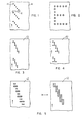
- FIG. 1 there is illustrated a rotating cylinder 10 of a dot-helix matrix printer.
- a row of single raised dot print elements 11 is shown formed in a helical pattern around the peripheral surface of the cylinder.
- a plurality of similar rows would be disposed along the cylinder, there being one row for each character print position.
- a printer hammer 12 having a bar-shaped impact surface is provided for each row of dot print elements. It is not shown, but it is well known that a paper print medium is continuously fed vertically between the rotating cylinder and print hammers. Magnetically operated actuators are provided which selectively actuate the hammers to strike the dot print elements against an ink ribbon and paper whenever one of the dot elements is in position to be printed to record printed dots on the paper.
- the printing speed and power consumption can be improved.
- Figure 3 wherein the dot elements are disposed in a 1, 2, 1, 2, arrangement. The vertical spacing between dots is maintained at .05 cm. With the hammer repetition rate fixed at 1 ms. and the cylinder now rotating at a surface speed of 150 cm/sec., the dot pattern is so arranged that the hammer is never required to strike within 3 rows of dots (1 ms). To print a 5 dot row now requires 4 ms. instead of 6 ms., as is the case for the pattern shown in Figure 1. A printing speed increase of 66% is realized. To print the character "E", shown in Figure 2, requires only 12 hammer strikes instead of 18. This results in a power saving of 33%.
- the printing speed can be further improved by different arrangements of dot patterns.
- a 1, 2, 1, 3, pattern is shown in Figure 4. Assume the same fixed parameters and the cylinder rotating at a speed of 200 cm/sec. It now requires only 3 ms. to print a 5 dot line resulting in a 100% speed improvement. To print the character "E”, shown in Figure 2, now requires only 10 hammer strikes. Other designs of dot patterns for different resolutions can achieve similar printing speed improvements.
- embossed patterns do not have to be in dot form. They can be extended to bar forms to further improve the print quality.
- the bar pattern shown in Figure 5 can be used to replace the dot pattern shown in Figure 3.
- Solid line printing can be achieved with overlapping dots or bars.
- multiple dot patterns are distributed on a belt, band or drum of a line printer to provide an improved printing throughout for an all points addressable line printer.
- a single dot band printer in which the hammer 13 can strike a single raised dot print element 14 at any one of seven locations across the hammer.
- the dot print elements are spaced at intervals of eight print positions along the belt 15 so that no two dots are in front of a print hammer simultaneously.
- the belt moves horizontally across a paper print medium to be printed. Printing is achieved by impacting the raised dot print elements to a printing ribbon against the paper and transferring ink or printing dots at the position of the dots when the paper is contacted.
- Patterns are printed by selectively energizing magnetic actuators to effect the striking of hammers against the printing belt or drum whenever one of the dot print elements, which move along or across the printing line, is in a position where a printed dot is desired.
- the number of hammers employed can vary and depends on the number of characters to be printed per line and the spacing between dots. In this way, any desired pattern is formed by an array of dots which are printed along a line. Subsequent lines are printed by stepping the paper vertically or normal to the printing line.
- This pattern comprises dot P1 in the upper case position, dot P2 in the lower case position, and dots P3 in both the upper and lower case positions.
- Figure 8 shows the same pattern in shaded square form for purposes of illustration. P1, P2 and P3 would be arranged around the belt as shown.
- S A function which varies dependent on the initial position of the dot patterns relative to the printed information.
- the factor S is unity for a single dot pattern and S>1 for a multidot band. It increases the further the initial position of the required dot pattern is from the position to be printed. In order for the printing throughput to be better than the single dot case, it is desirable that (S/mn) decreases to less than one. If this ratio is less than one, the multidot pattern will be definitely better than the single dot pattern. Even if this ratio is not less than one, if the ()v)/n)xTp term reduces the paper advance time to the extent that the total time is less, then the multidot pattern is still better than the single dot case.
- the factor S reduces if the belt speed is higher or if the statistics for the multidot patterns are skewed. The latter is the essence of the present invention, as described later.
- the single dot band requires 56 msec for the printing operation and 40 msec to advance the paper, for a total printing time of 96 msec.
- the average printing speed for all characters of the alphanumeric set is 43.424 msec. This results in an average improvement of 54.7%.
- this printing speed improvement requires an eight fold increase in the belt speed but an overall decrease in the number of actual hammer firings per printed job. Further increase in the belt speed will further increase the print throughput. The essence is that even if the belt speed is increased, the throughput will not increase for the single dot belt.
- Non-statistical belt 21.47 msec average, 33.75 msec worst case
- patterns are shown distributed in a horizontal row around the belt.
- the number of patterns is 2"-1.
- patterns P1 and P2 are redundant so that only patterns P1 and P3 need be used, as shown in Figure 11.
- patterns 1 and 3,4 and 6 are redundant and only patterns P1, P4, P5 and P7 need be used, as shown in Figure 13.
Landscapes
- Impact Printers (AREA)
- Character Spaces And Line Spaces In Printers (AREA)
- Electronic Switches (AREA)
- Color, Gradation (AREA)
- Accessory Devices And Overall Control Thereof (AREA)
Applications Claiming Priority (2)
| Application Number | Priority Date | Filing Date | Title |
|---|---|---|---|
| US39401782A | 1982-06-30 | 1982-06-30 | |
| US394017 | 1989-08-15 |
Publications (2)
| Publication Number | Publication Date |
|---|---|
| EP0097780A1 EP0097780A1 (en) | 1984-01-11 |
| EP0097780B1 true EP0097780B1 (en) | 1986-08-27 |
Family
ID=23557199
Family Applications (1)
| Application Number | Title | Priority Date | Filing Date |
|---|---|---|---|
| EP19830103802 Expired EP0097780B1 (en) | 1982-06-30 | 1983-04-20 | Dot matrix printer |
Country Status (4)
| Country | Link |
|---|---|
| EP (1) | EP0097780B1 (enExample) |
| JP (1) | JPS599065A (enExample) |
| CA (1) | CA1200431A (enExample) |
| DE (1) | DE3365571D1 (enExample) |
Family Cites Families (5)
| Publication number | Priority date | Publication date | Assignee | Title |
|---|---|---|---|---|
| FR2163353B1 (enExample) * | 1971-12-15 | 1976-06-11 | Centre Nat Etd Spatiales | |
| DE2432499A1 (de) * | 1974-07-04 | 1976-01-22 | Siemens Ag | Mechanischer drucker |
| US4102268A (en) * | 1975-06-30 | 1978-07-25 | Dataproducts Corporation | Impact printer type character |
| US4230039A (en) * | 1977-05-20 | 1980-10-28 | Citizen Watch Company Limited | Drum printer with helically arranged type sets |
| DE3165975D1 (en) * | 1980-07-09 | 1984-10-18 | Ibm | Matrix printer comprising an oscillary printing element carrier |
-
1983
- 1983-04-11 CA CA000425601A patent/CA1200431A/en not_active Expired
- 1983-04-20 DE DE8383103802T patent/DE3365571D1/de not_active Expired
- 1983-04-20 EP EP19830103802 patent/EP0097780B1/en not_active Expired
- 1983-05-13 JP JP8283283A patent/JPS599065A/ja active Granted
Also Published As
| Publication number | Publication date |
|---|---|
| CA1200431A (en) | 1986-02-11 |
| JPS599065A (ja) | 1984-01-18 |
| EP0097780A1 (en) | 1984-01-11 |
| DE3365571D1 (en) | 1986-10-02 |
| JPH0326656B2 (enExample) | 1991-04-11 |
Similar Documents
| Publication | Publication Date | Title |
|---|---|---|
| EP0513989B1 (en) | Raster imaging device speed-resolution product multiplying method and resulting pixel image data structure | |
| GB1432581A (en) | High speed dot matrix printer | |
| US3625142A (en) | High-speed printing apparatus having slidably mounted character-forming elements forming a dot matrix | |
| WO2003068507A3 (en) | Improved subcovered printing mode for a printhead with multiple sized ejectors | |
| EP0207788B1 (en) | Apparatus and method for displaying dot matrix characters in enhanced form | |
| US5007748A (en) | Printer for bar code using thin and thick bar code fonts | |
| US5190382A (en) | Print element arrangement in serial matrix printer | |
| US3207067A (en) | Type carrier for high speed printing mechanism | |
| EP0097780B1 (en) | Dot matrix printer | |
| US4596479A (en) | Dot matrix printer | |
| US3715978A (en) | Printer hammer mechanism | |
| US4068583A (en) | Hammer actuated dot matrix pattern printer | |
| US3719139A (en) | High-speed printer with selectively operable print hammer | |
| US4102268A (en) | Impact printer type character | |
| US5876132A (en) | Method and system for high character density printing utilizing low pel density characters | |
| US3665852A (en) | High speed front impact printer | |
| EP0264909B1 (en) | Impact printer | |
| JP3307035B2 (ja) | ドットラインプリンタ | |
| US4363268A (en) | Drum type bar code line printer | |
| US4005650A (en) | Print hammer | |
| JP2888614B2 (ja) | 千鳥ドット配列型シリアルドットプリンタおよびシリアルドットプリンタ | |
| US4540296A (en) | Bar band intersectional matrix printer | |
| JPS5714056A (en) | Method of forming dot row in dot printer | |
| EP0082332B1 (en) | Dot matrix printer | |
| JPH05238068A (ja) | シリアルインパクトドットプリンタにおける複写紙印字方式 |
Legal Events
| Date | Code | Title | Description |
|---|---|---|---|
| PUAI | Public reference made under article 153(3) epc to a published international application that has entered the european phase |
Free format text: ORIGINAL CODE: 0009012 |
|
| AK | Designated contracting states |
Designated state(s): DE FR GB IT |
|
| 17P | Request for examination filed |
Effective date: 19840426 |
|
| GRAA | (expected) grant |
Free format text: ORIGINAL CODE: 0009210 |
|
| AK | Designated contracting states |
Kind code of ref document: B1 Designated state(s): DE FR GB IT |
|
| PG25 | Lapsed in a contracting state [announced via postgrant information from national office to epo] |
Ref country code: IT Free format text: LAPSE BECAUSE OF FAILURE TO SUBMIT A TRANSLATION OF THE DESCRIPTION OR TO PAY THE FEE WITHIN THE PRESCRIBED TIME-LIMIT;WARNING: LAPSES OF ITALIAN PATENTS WITH EFFECTIVE DATE BEFORE 2007 MAY HAVE OCCURRED AT ANY TIME BEFORE 2007. THE CORRECT EFFECTIVE DATE MAY BE DIFFERENT FROM THE ONE RECORDED. Effective date: 19860827 |
|
| ET | Fr: translation filed | ||
| REF | Corresponds to: |
Ref document number: 3365571 Country of ref document: DE Date of ref document: 19861002 |
|
| PLBE | No opposition filed within time limit |
Free format text: ORIGINAL CODE: 0009261 |
|
| STAA | Information on the status of an ep patent application or granted ep patent |
Free format text: STATUS: NO OPPOSITION FILED WITHIN TIME LIMIT |
|
| 26N | No opposition filed | ||
| PGFP | Annual fee paid to national office [announced via postgrant information from national office to epo] |
Ref country code: FR Payment date: 19920226 Year of fee payment: 10 |
|
| PGFP | Annual fee paid to national office [announced via postgrant information from national office to epo] |
Ref country code: GB Payment date: 19920304 Year of fee payment: 10 |
|
| PGFP | Annual fee paid to national office [announced via postgrant information from national office to epo] |
Ref country code: DE Payment date: 19920504 Year of fee payment: 10 |
|
| PG25 | Lapsed in a contracting state [announced via postgrant information from national office to epo] |
Ref country code: GB Effective date: 19930420 |
|
| GBPC | Gb: european patent ceased through non-payment of renewal fee |
Effective date: 19930420 |
|
| PG25 | Lapsed in a contracting state [announced via postgrant information from national office to epo] |
Ref country code: FR Effective date: 19931229 |
|
| PG25 | Lapsed in a contracting state [announced via postgrant information from national office to epo] |
Ref country code: DE Effective date: 19940101 |
|
| REG | Reference to a national code |
Ref country code: FR Ref legal event code: ST |