EP0085147B1 - Gerader, blattartiger Schaft für eine Gelenkendoprothese - Google Patents
Gerader, blattartiger Schaft für eine Gelenkendoprothese Download PDFInfo
- Publication number
- EP0085147B1 EP0085147B1 EP82110500A EP82110500A EP0085147B1 EP 0085147 B1 EP0085147 B1 EP 0085147B1 EP 82110500 A EP82110500 A EP 82110500A EP 82110500 A EP82110500 A EP 82110500A EP 0085147 B1 EP0085147 B1 EP 0085147B1
- Authority
- EP
- European Patent Office
- Prior art keywords
- stem
- blade
- end piece
- narrow side
- shaft
- Prior art date
- Legal status (The legal status is an assumption and is not a legal conclusion. Google has not performed a legal analysis and makes no representation as to the accuracy of the status listed.)
- Expired
Links
- 241000309551 Arthraxon hispidus Species 0.000 claims abstract description 13
- 210000004394 hip joint Anatomy 0.000 claims description 5
- 230000007704 transition Effects 0.000 claims description 3
- 210000000988 bone and bone Anatomy 0.000 description 12
- 238000004873 anchoring Methods 0.000 description 5
- 239000007943 implant Substances 0.000 description 5
- RTAQQCXQSZGOHL-UHFFFAOYSA-N Titanium Chemical compound [Ti] RTAQQCXQSZGOHL-UHFFFAOYSA-N 0.000 description 3
- 239000000463 material Substances 0.000 description 3
- 239000010936 titanium Substances 0.000 description 3
- 229910052719 titanium Inorganic materials 0.000 description 3
- 238000003466 welding Methods 0.000 description 3
- 229910045601 alloy Inorganic materials 0.000 description 2
- 239000000956 alloy Substances 0.000 description 2
- 239000004568 cement Substances 0.000 description 2
- 238000010276 construction Methods 0.000 description 2
- 229910052751 metal Inorganic materials 0.000 description 2
- 239000002184 metal Substances 0.000 description 2
- 150000002739 metals Chemical class 0.000 description 2
- ATJFFYVFTNAWJD-UHFFFAOYSA-N Tin Chemical compound [Sn] ATJFFYVFTNAWJD-UHFFFAOYSA-N 0.000 description 1
- 230000005540 biological transmission Effects 0.000 description 1
- 239000002639 bone cement Substances 0.000 description 1
- 229910010293 ceramic material Inorganic materials 0.000 description 1
- 238000000576 coating method Methods 0.000 description 1
- 239000002131 composite material Substances 0.000 description 1
- 238000012937 correction Methods 0.000 description 1
- 230000001054 cortical effect Effects 0.000 description 1
- 210000005257 cortical tissue Anatomy 0.000 description 1
- 238000005516 engineering process Methods 0.000 description 1
- 238000000605 extraction Methods 0.000 description 1
- 210000002436 femur neck Anatomy 0.000 description 1
- 239000000945 filler Substances 0.000 description 1
- 210000001624 hip Anatomy 0.000 description 1
- 238000002513 implantation Methods 0.000 description 1
- 229910001092 metal group alloy Inorganic materials 0.000 description 1
- 239000000126 substance Substances 0.000 description 1
- 210000001519 tissue Anatomy 0.000 description 1
- 210000000689 upper leg Anatomy 0.000 description 1
Images
Classifications
-
- A—HUMAN NECESSITIES
- A61—MEDICAL OR VETERINARY SCIENCE; HYGIENE
- A61F—FILTERS IMPLANTABLE INTO BLOOD VESSELS; PROSTHESES; DEVICES PROVIDING PATENCY TO, OR PREVENTING COLLAPSING OF, TUBULAR STRUCTURES OF THE BODY, e.g. STENTS; ORTHOPAEDIC, NURSING OR CONTRACEPTIVE DEVICES; FOMENTATION; TREATMENT OR PROTECTION OF EYES OR EARS; BANDAGES, DRESSINGS OR ABSORBENT PADS; FIRST-AID KITS
- A61F2/00—Filters implantable into blood vessels; Prostheses, i.e. artificial substitutes or replacements for parts of the body; Appliances for connecting them with the body; Devices providing patency to, or preventing collapsing of, tubular structures of the body, e.g. stents
- A61F2/02—Prostheses implantable into the body
- A61F2/30—Joints
- A61F2/30721—Accessories
- A61F2/30734—Modular inserts, sleeves or augments, e.g. placed on proximal part of stem for fixation purposes or wedges for bridging a bone defect
-
- A—HUMAN NECESSITIES
- A61—MEDICAL OR VETERINARY SCIENCE; HYGIENE
- A61F—FILTERS IMPLANTABLE INTO BLOOD VESSELS; PROSTHESES; DEVICES PROVIDING PATENCY TO, OR PREVENTING COLLAPSING OF, TUBULAR STRUCTURES OF THE BODY, e.g. STENTS; ORTHOPAEDIC, NURSING OR CONTRACEPTIVE DEVICES; FOMENTATION; TREATMENT OR PROTECTION OF EYES OR EARS; BANDAGES, DRESSINGS OR ABSORBENT PADS; FIRST-AID KITS
- A61F2/00—Filters implantable into blood vessels; Prostheses, i.e. artificial substitutes or replacements for parts of the body; Appliances for connecting them with the body; Devices providing patency to, or preventing collapsing of, tubular structures of the body, e.g. stents
- A61F2/02—Prostheses implantable into the body
- A61F2/30—Joints
- A61F2/32—Joints for the hip
- A61F2/36—Femoral heads ; Femoral endoprostheses
- A61F2/3662—Femoral shafts
-
- A—HUMAN NECESSITIES
- A61—MEDICAL OR VETERINARY SCIENCE; HYGIENE
- A61F—FILTERS IMPLANTABLE INTO BLOOD VESSELS; PROSTHESES; DEVICES PROVIDING PATENCY TO, OR PREVENTING COLLAPSING OF, TUBULAR STRUCTURES OF THE BODY, e.g. STENTS; ORTHOPAEDIC, NURSING OR CONTRACEPTIVE DEVICES; FOMENTATION; TREATMENT OR PROTECTION OF EYES OR EARS; BANDAGES, DRESSINGS OR ABSORBENT PADS; FIRST-AID KITS
- A61F2/00—Filters implantable into blood vessels; Prostheses, i.e. artificial substitutes or replacements for parts of the body; Appliances for connecting them with the body; Devices providing patency to, or preventing collapsing of, tubular structures of the body, e.g. stents
- A61F2/02—Prostheses implantable into the body
- A61F2/30—Joints
- A61F2002/30001—Additional features of subject-matter classified in A61F2/28, A61F2/30 and subgroups thereof
- A61F2002/30316—The prosthesis having different structural features at different locations within the same prosthesis; Connections between prosthetic parts; Special structural features of bone or joint prostheses not otherwise provided for
- A61F2002/30329—Connections or couplings between prosthetic parts, e.g. between modular parts; Connecting elements
- A61F2002/30383—Connections or couplings between prosthetic parts, e.g. between modular parts; Connecting elements made by laterally inserting a protrusion, e.g. a rib into a complementarily-shaped groove
-
- A—HUMAN NECESSITIES
- A61—MEDICAL OR VETERINARY SCIENCE; HYGIENE
- A61F—FILTERS IMPLANTABLE INTO BLOOD VESSELS; PROSTHESES; DEVICES PROVIDING PATENCY TO, OR PREVENTING COLLAPSING OF, TUBULAR STRUCTURES OF THE BODY, e.g. STENTS; ORTHOPAEDIC, NURSING OR CONTRACEPTIVE DEVICES; FOMENTATION; TREATMENT OR PROTECTION OF EYES OR EARS; BANDAGES, DRESSINGS OR ABSORBENT PADS; FIRST-AID KITS
- A61F2220/00—Fixations or connections for prostheses classified in groups A61F2/00 - A61F2/26 or A61F2/82 or A61F9/00 or A61F11/00 or subgroups thereof
- A61F2220/0025—Connections or couplings between prosthetic parts, e.g. between modular parts; Connecting elements
Definitions
- the invention relates to a straight, sheet-like stem for a joint endoprosthesis, in particular a hip joint prosthesis, the blade sides extend from the distal free end initially symmetrically to a longitudinal central axis of conical, wherein the cone along the lateral narrow side at about 3/4 of the shaft height ends, while medially the Widening of the leaf sides out of the cone opens into a constantly curved curve into the prosthetic neck that supports the condyle.
- a hip joint prosthesis in which a slightly curved shaft is wedged laterally at a location on the cortex with the aid of a wedge, the lateral boundary of which runs parallel to the lateral side of the actual shaft.
- the wedge is guided in a guide on the lateral side of the shaft, driven into the cancellous bone and presses the distal end of the shaft against the cortex on the medial side of the bone cavity.
- the cap-shaped head of the prosthesis is supported on a remaining part of the natural femoral head in order to ensure compliance with a functional height level of the prosthesis head.
- the extension of the cone reaches the shaft height up to about 2/3 of up to 3/4; from there the lateral narrow side 5 of the end piece 4 runs parallel to the longitudinal central axis 2.
Landscapes
- Health & Medical Sciences (AREA)
- Orthopedic Medicine & Surgery (AREA)
- Cardiology (AREA)
- Oral & Maxillofacial Surgery (AREA)
- Transplantation (AREA)
- Engineering & Computer Science (AREA)
- Biomedical Technology (AREA)
- Heart & Thoracic Surgery (AREA)
- Vascular Medicine (AREA)
- Life Sciences & Earth Sciences (AREA)
- Animal Behavior & Ethology (AREA)
- General Health & Medical Sciences (AREA)
- Public Health (AREA)
- Veterinary Medicine (AREA)
- Prostheses (AREA)
- Joining Of Building Structures In Genera (AREA)
Description
- Die Erfindung betrifft einen geraden, blattartigen Schaft für eine Gelenkendoprothese, insbesondere eine Hüftgelenkprothese, dessen Blattseiten sich vom distalen freien Ende zunächst symmetrisch zu einer Längsmittelachse konisch erweitern, wobei der Konus entlang der lateralen Schmalseite auf etwa 3/4 der Schafthöhe endet, während medial die Erweiterung der Blattseiten aus dem Konus heraus in einer stetig gekrümmten Kurve in den den Gelenkkopf tragenden Prothesenhals mündet.
- Prothesenschäfte der genannten Art für die Verankerung von Knochenimplantaten, insbesondere von Hüftgelenkprothesen, sind beispielsweise bekannt aus der CH-A-622423; sie dienen vor allem zur zementfreien oder zumindest zementarmen Verankerung einer Prothese, wobei bei einer zementarmen Verankerung der als Füllmaterial dienende Knochenzement von einer tragenden Funktion entlastet ist und auch bei dieser Verankerungsart die tragende Abstützung weitestgehend durch Verklemmen des Schaftes im Knochen erfolgt.
- Weiterhin ist aus der FR-A-1 278 359 eine Hüftgelenksprothese bekannt, bei der ein leicht gebogener Schaft mit Hilfe eines Keiles, dessen laterale Begrenzung parallel zur lateralen Seite des eigentlichen Schaftes verläuft, lateral an einer Stelle der Kortikalis verkeilt wird. Der Keil ist dabei in einer Führung auf der lateralen Seite des Schaftes geführt, in die Spongiosa eingeschlagen und drückt das distale Ende des Schaftes gegen die Kortikalis auf der medialen Seite des Knochenhohlraumes. Der kappenförmige Kopf der Prothese stützt sich auf einem verbliebenen Teil des natürlichen Femurkopfes ab, um die Einhaltung eines funktionsgerechten Höhenniveaus des Prothesenkopfes zu gewährleisten.
- Die mehr oder weniger punktförmige Fixierung an der Kortikalis ergibt keine dauerhafte Verankerung des Schaftes, so daß es sehr häufig zu Schaftlockerungen, besonders bei Knochenabbau infolge von »Spitzen«-Belastungen und Mikrobewegungen kommt.
- Um eine funktionsgerechte Lage des Gelenkkopfes der Prothese sicherzustellen, muß die Prothese bekanntlich so implantiert werden, daß das Zentrum des Gelenkkopfes sich etwa auf der Höhe der Spitze des großen Trochanters befindet. Da, wie vorstehend erwähnt, der Schaft vor allem durch Verklemmen fixiert ist, bereitet die Einhaltung der vorstehenden Forderung dem Operateur sehr oft Schwierigkeiten.
- Aufgabe der Erfindung ist es daher, die Fixierung des Gelenkkopfes in einer bestimmten Höhe zu erleichtern; diese Aufgabe wird nach der Erfindung dadurch gelöst, daß der Schaft aus dem eigentlichen Blatt und einem sich über die ganze Schaftlänge erstreckenden keilförmigen, lateralen Endstück besteht, das, in einer Führung der lateralen Schmalseite des Blattes gleitend, auf das Blatt aufschiebbar ist.
- Bei der neuen Prothese kann das den Gelenkkopf tragende Blatt zuerst in den vorbereiteten Knochen eingeschlagen und in einer Lage festgehalten werden, in der der Gelenkkopf die vorgeschriebene Höhe gegenüber dem großen Trochanter hat. Anschließend kann das Endstück auf die Führung des Blattes aufgeschoben und bei festgehaltenem Blatt eingeschlagen werden, wobei die Keilform des Endstückes ein Verkeilen des ganzen Schaftes im Knochen bewirkt, ohne daß der Gelenkkopf bzw. das Schaftblatt in ihrer Höhenlage verändert werden.
- Ein weiterer Vorteil der neuen Konstruktion liegt darin, daß eine Serie verschiedener Schaftbreiten mit ein oder zwei Schaftblättern und einer Anzahl verschieden breiter Endstücke erheblich wirtschaftlicher bereitgestellt werden kann, als bisher, wo für jede Schaftbreite eines Satzes ein eigener Schaft gefertigt werden mußte; weiterhin sind mit der neuen Prothese unter Umständen kleinere Korrekturen, beispielsweise bei Schaftlockerungen, auch zu einem späteren Zeitpunkt nach der Implantation ohne großen Aufwand möglich, indem in einem kleinen Eingriff das Endstück - ebenfalls wiederum bei festgehaltenen Blatt - nochmals eingeschlagen wird.
- Das Einschlagen des keilförmigen Endstückes wird erleichtert, wenn die Führung parallel zur Längsmittelachse des Schaftes verläuft. Um die Fixierung des Endstückes im Knochen zu verbessern, ist es zweckmäßig, wenn das Endstück längs seiner konischen Erweiterung mit wiederhakenartigen Verzahnungen versehen ist, wobei diese Verzahnungen vorteilhafterweise in den beiden Ecken des Übergangs von einer Breitseite zur lateralen Schmalseite angeordnet sind.
- Um am proximalen Ende des Schaftes ein Einwachsen des Gewebes von oben in die Führung zu erschweren, ist es weiterhin sinnvoll, wenn die laterale Schmalseite der Endstücke im oberen proximalen Bereich der Schafthöhe parallel zur Längsmittelachse verläuft; diese Maßnahme hat zusätzlich den Vorteil, daß die Übertragung der Rotationskräfte vom Trochanter auf das Implantat und umgekehrt verbessert wird.
- Um bei nicht völlig auszuschließenden Reoperationen das Ausziehen des Endstückes zu erleichtern, kann dieses an seinem oberen Ende für den Eingriff eines Auszieh-Instrumentes vorbereitet sein.
- Als Führung eignen sich ganz allgemein einander übergreifende Elemente, die ein seitliches Abgleiten des Endstückes von der lateralen Schmalseite des Blattes verhindern, wobei es zweckmäßig ist, die gegenseitige Haftung von Blatt und Endstück durch eine möglichst große Reiboberfläche sicherzustellen; die Führung weist darüber hinaus - wie in der Implantat-Technik üblich - abgerundete Formen auf, um Belastungsspitzen im Implantat oder Knochen zu vermeiden.
- Als Materialien für das Blatt und das Endstück dienen in erster Linie die in der Implantat-Technik gebräuchlichen Metalle und Metall-Legierungen; jedoch ist es auch möglich, beide Teile aus keramischem Material oder Kunststoff herzustellen, die gegebenenfalls mit geeigneten Überzügen versehen werden. Um ein kaltes Verschweißen der Führungsflächen von Blatt und Endstück während des Einschlagens des Endstückes zu vermeiden, ist es vorteilhaft, beide aus unterschiedlichen Metallen, die nicht zum Kaltschwei- ßen neigen, wie z. B. Titan und einer Co-Basislegierung, zu fertigen. Es ist jedoch zu diesem Zweck auch möglich, eine oder beide Führungsflächen mit einer geeigneten Hartschicht, z. B. aus TiN, zu versehen.
- Im folgenden wird die Erfindung anhand eines Ausführungsbeispiels im Zusammenhang mit der Zeichnung näher erläutert.
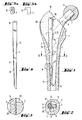
- Fig. 1 zeigt in einem Längsschnitt durch das obere Ende eines Femurknochens eine in diesem fixierte Hüftgelenkprothese mit dem erfindungsgemäßen Schaft.
- Fig. 2 ist der Schnitt 11-11 von Fig. 1.
- Fig. 3 gibt einen Bereich A aus Fig. 1 in größerem Maßstab wieder.
- Fig. 4 stellt in gleicher Ansicht wie Fig. 1 eine Ausführjngsform des keilförmigen Endstückes dar, während in
- Fig. 5a und 5b weitere Möglichkeiten für das Eingreifen eines Auszieh-Instrumentes in das obere Ende des Endstückes gezeigt sind.
- Der blattartige Prothesenschaft (Fig. 1), der sich von seinem distalen Ende 8 nach allen Seiten konisch erweitert, setzt sich gemäß der Erfindung zusammen aus einem eigentlichen Blatt 1 und einem an dessen laterale Schmalseite angesetzten, keilförmig verlaufenden Endstück 4; sein Konus ist symmetrisch zu einer Längsmittelachse 2 ausgebildet. Die mediale Schmalseite 3 des Konus geht in einen Bogen über, der in einem Hals 6 endet. Auf diesen ist ein sich nach außen konisch verjüngender Zapfen 7 aufgesetzt, der einen kugelförmigen Gelenkkopf 9 aufnimmt. Die Achse des Zapfens 7 schneidet die Längsmittelachse 2 des Schaftes unter einem Winkel, der im wesentlichen dem Winkel zwischen dem Schenkelhals der Femurachse eines natürlichen Hüftgelenkes entspricht und im vorliegenden Fall 45° beträgt.
- Das Blatt 1 und das Endstück 4 sind über eine Führung miteinander verbunden; diese besteht aus einer allseitig abgerundeten parallel zur Längsachse 2 verlaufenden Hohlkehle 11 in der lateralen Schmalseite des Blattes 1. Als Gegenstück zu dieser Hohlkehle 11 hat das Endstück 4 in der Mitte eine vorspringende kufenartige Längsleiste 12. Weiterhin umfaßt es mit seinen Rändern 13 die Seitenflanken der Hohlkehle 11. Auf diese Weise wird das Endstück 4 beim Einschlagen so geführt, daß ein seitliches Abgleiten nicht möglich ist. 1
- Wie bereits erwähnt, werden - um Kaltverschweißen zu verhindern - das Schaftblatt 1 und das Endstück 4 aus verschiedenen Materialien hergestellt, wobei das Blatt 1 beispielsweise aus einer Co-Basislegierung besteht, während das Endstück 4 aus Titan gefertigt ist; es kann jedoch auch mit einer Hartschicht auf Titan-Basis zumindest entlang der Führung belegt sein.
- Auf der lateralen Schmalseite 5 des zusammengesetzten Schaftes bzw. des Endstückes 4 reicht die Erweiterung des Konus bis auf etwa 2/3 bis 3/4 der Schafthöhe; von dort aus verläuft die laterale Schmalseite 5 des Endstückes 4 parallel zur Längsmittelachse 2.
- Die beiden Übergänge von der »Breitseite« des Endstückes 4 zur lateralen Schmalseite 5 sind über die Höhe des Konus mit je einer Verzahnung 19 versehen, die nach dem Einschlagen des Endstückes 4 widerhakenartig in die kortikale Knochensubstanz 14 eingreift und so ein unbeabsichtigtes Herausziehen des keilförmigen Endstückes 4 verhindert.
- Für den Eingriff eines Ausziehinstrumentes hat das Endstück 4 an seinem oberen oder proximalen Ende eine Öse 15; diese kann jedoch durch andere geeignete Verbindungselemente, wie z. B. ein Gewinde 16 (Fig. 5a) oder einen hakenartigen Ansatz 17 (Fig. 5b) ersetzt sein.
- Wie bereits erwähnt, erlaubt die neue Schaftkonstruktion zunächst das den Gelenkkopf 9 tragende Blatt 1 in das operativ vorbereitete, spongiöse Knochengewebe 20 soweit einzuschlagen, daß das Zentrum des Gelenkkopfes 9 etwa auf der Höhe der Trochanterspitze 18 liegt, und dann das Blatt 1 bzw. der Gelenkkopf 9 festzuhalten und die Prothese durch Einschlagen des Endstückes 4 zu fixieren, wobei das Blatt 1 und das Endstück 4 miteinander zwischen einander gegenüberliegenden Bereichen des kortikalen Gewebes 14 gegeneinander verkeilt werden.
Claims (6)
Priority Applications (1)
| Application Number | Priority Date | Filing Date | Title |
|---|---|---|---|
| AT82110500T ATE14187T1 (de) | 1982-01-29 | 1982-11-13 | Gerader, blattartiger schaft fuer eine gelenkendoprothese. |
Applications Claiming Priority (2)
| Application Number | Priority Date | Filing Date | Title |
|---|---|---|---|
| CH541/82A CH652911A5 (de) | 1982-01-29 | 1982-01-29 | Gerader, blattartiger schaft fuer eine gelenkendoprothese. |
| CH541/82 | 1982-01-29 |
Publications (2)
| Publication Number | Publication Date |
|---|---|
| EP0085147A1 EP0085147A1 (de) | 1983-08-10 |
| EP0085147B1 true EP0085147B1 (de) | 1985-07-10 |
Family
ID=4189375
Family Applications (1)
| Application Number | Title | Priority Date | Filing Date |
|---|---|---|---|
| EP82110500A Expired EP0085147B1 (de) | 1982-01-29 | 1982-11-13 | Gerader, blattartiger Schaft für eine Gelenkendoprothese |
Country Status (6)
| Country | Link |
|---|---|
| US (1) | US4530115A (de) |
| EP (1) | EP0085147B1 (de) |
| AT (1) | ATE14187T1 (de) |
| CH (1) | CH652911A5 (de) |
| DE (1) | DE3264687D1 (de) |
| ES (1) | ES268646Y (de) |
Families Citing this family (24)
| Publication number | Priority date | Publication date | Assignee | Title |
|---|---|---|---|---|
| CH658185A5 (de) * | 1983-02-10 | 1986-10-31 | Sulzer Ag | Gerader, blattartiger schaft fuer eine gelenkendoprothese. |
| DE3323131A1 (de) * | 1983-06-27 | 1985-01-03 | Waldemar Link (Gmbh & Co), 2000 Hamburg | Endoprothese mit einem im knochen zu verankernden schaft |
| DE3330062A1 (de) * | 1983-08-19 | 1985-02-28 | Waldemar Link (Gmbh & Co), 2000 Hamburg | Zuganker fuer roehrenknochen |
| GB8401059D0 (en) * | 1984-01-16 | 1984-02-15 | Exeter University Of | Fixation of implants in bone |
| EP0170982A1 (de) * | 1984-07-26 | 1986-02-12 | Ivica Jerkovic | Gelenkendoprothese, insbesondere Hüftgelenkprothese |
| FR2575064B1 (fr) * | 1984-12-21 | 1989-08-18 | Caltran Maurice | Prothese de la hanche |
| FR2579453B1 (fr) * | 1985-03-27 | 1991-06-28 | Epinette Jean Alain | Composant femoral de prothese de hanche, non cimente |
| FR2579887A1 (de) * | 1985-04-05 | 1986-10-10 | France Implant Sarl | |
| DE3516203A1 (de) * | 1985-05-06 | 1986-11-06 | Metripond Mérleggyár, Hódmezövásárhely | Hueftgelenkprothese |
| US4775381A (en) * | 1985-05-06 | 1988-10-04 | Metripond Merleggyar | Hip prosthesis |
| JPS62501960A (ja) * | 1985-05-23 | 1987-08-06 | ラバ− フユ− エクスペリメンテル シル−ジ− シユバイツエリシエス フオ−チユングスインステイチユ−ト | ジョイント エンド・プロテ−ゼのためのセルフ・ロッキング式ステム要素 |
| GB2178320B (en) * | 1985-07-29 | 1989-07-19 | Finsbury | Hip implant |
| CH667199A5 (de) * | 1985-08-30 | 1988-09-30 | Sulzer Ag | Geradschaft aus metall fuer eine femurkopfprothese. |
| CH669902A5 (de) * | 1986-04-30 | 1989-04-28 | Kurt Karpf | |
| FR2606997A1 (fr) * | 1986-08-25 | 1988-05-27 | Gilles Crespy | Prothese femorale mecanique auto-bloquee et procede de mise en oeuvre |
| DE3722853A1 (de) * | 1987-07-10 | 1989-01-19 | Kernforschungsz Karlsruhe | Endoprothese fuer ein femurhueftgelenk |
| US5089004A (en) * | 1988-01-19 | 1992-02-18 | Osteonics Corp. | Prosthetic implant procedure and femoral broach therefor |
| DE3811207A1 (de) * | 1988-04-01 | 1989-10-12 | Berchem & Schaberg Gmbh | Gelenkprothese, insbesondere hueftgelenkprothese |
| US5032133A (en) * | 1990-01-23 | 1991-07-16 | Orthovations, Inc. | Method and apparatus for expanding a shaft for use in prosthesis |
| FR2703583B1 (fr) * | 1993-04-07 | 1995-06-09 | Medinov Sa | Implant femoral pour prothese de hanche. |
| US5458654A (en) * | 1993-07-14 | 1995-10-17 | Ao-Forschungsinstitut Davos | Screw-fixed femoral component for hip joint prosthesis |
| ITUD20030092A1 (it) * | 2003-04-30 | 2004-11-01 | Lima Lto Spa | Protesi per l'articolazione della spalla. |
| WO2011005189A1 (en) | 2009-07-10 | 2011-01-13 | Milux Holding S.A. | Hip joint device and method |
| CA3065709A1 (en) * | 2010-08-31 | 2012-03-08 | Synthes Usa, Llc | Controlling the degradation of bioresorbable metal implants |
Family Cites Families (9)
| Publication number | Priority date | Publication date | Assignee | Title |
|---|---|---|---|---|
| BE560587A (de) * | ||||
| FR893401A (fr) * | 1940-02-05 | 1944-06-08 | Cheville ou clou d'enchevillement pour os tubulaires | |
| US2486303A (en) * | 1948-04-29 | 1949-10-25 | Harry Herschel Leiter | Surgical appliance for bone fractures |
| FR1278359A (fr) * | 1961-01-13 | 1961-12-08 | Maison Drapier | Perfectionnement aux prothèses fémorales |
| GB1511859A (en) * | 1974-12-24 | 1978-05-24 | Friedrichsfeld Gmbh | Hip-joint endoprostheses |
| DE2519488A1 (de) * | 1975-05-02 | 1976-11-18 | Anton Dr Drgalic | Verbindungselement fuer knochenfrakturen |
| DE2834155C3 (de) * | 1978-08-04 | 1981-09-17 | Friedrichsfeld Gmbh, Steinzeug- Und Kunststoffwerke, 6800 Mannheim | Oberschenkelschaft für eine Hüftgelenkendoprothese |
| DE2931750C2 (de) * | 1979-08-04 | 1986-06-19 | Howmedica International, Inc. Zweigniederlassung Kiel, 2300 Kiel | Einteiliges Oberschenkelteil einer Hüftgelenkendoprothese |
| CH640407A5 (de) * | 1979-10-11 | 1984-01-13 | Sulzer Ag | Hueftgelenkprothese. |
-
1982
- 1982-01-29 CH CH541/82A patent/CH652911A5/de not_active IP Right Cessation
- 1982-11-13 AT AT82110500T patent/ATE14187T1/de not_active IP Right Cessation
- 1982-11-13 DE DE8282110500T patent/DE3264687D1/de not_active Expired
- 1982-11-13 EP EP82110500A patent/EP0085147B1/de not_active Expired
- 1982-11-22 ES ES1982268646U patent/ES268646Y/es not_active Expired
-
1983
- 1983-01-03 US US06/454,991 patent/US4530115A/en not_active Expired - Fee Related
Also Published As
| Publication number | Publication date |
|---|---|
| ES268646U (es) | 1983-06-01 |
| EP0085147A1 (de) | 1983-08-10 |
| CH652911A5 (de) | 1985-12-13 |
| ES268646Y (es) | 1984-10-16 |
| DE3264687D1 (en) | 1985-08-14 |
| US4530115A (en) | 1985-07-23 |
| ATE14187T1 (de) | 1985-07-15 |
Similar Documents
| Publication | Publication Date | Title |
|---|---|---|
| EP0085147B1 (de) | Gerader, blattartiger Schaft für eine Gelenkendoprothese | |
| EP0135755B1 (de) | Schaft für eine Hüftgelenkprothese | |
| DE69728001T2 (de) | Prothese mit veränderbarer Passungs- und Spannungsverteilung | |
| EP0158014B1 (de) | Hüftgelenkprothese | |
| EP0204919B1 (de) | Femurkopfprothese | |
| EP0032165B1 (de) | Blattartiger Schaft für die Verankerung einer Hüftgelenkprothese | |
| EP0159462B1 (de) | Femurale Totalendoprothese für ein Hüftgelenk | |
| AT390183B (de) | Knochenimplantat fuer endoprothesen | |
| EP0927010A1 (de) | Tibia-teil einer kniegelenkendoprothese | |
| EP0169976B1 (de) | Sich vom distalen Ende konisch erweiternder Schaft für eine Hüftgelenksprothese | |
| DE3917285A1 (de) | Schulterprothese | |
| EP0366603A1 (de) | Blattartiger Schaft aus Metall für eine Femurkopfprothese | |
| DE2839092C3 (de) | Einstückiger Oberschenkelteil einer Hüftgelenk-Endoprothese | |
| EP0217034B1 (de) | Geradschaft aus Metall für eine Femurkopfprothese | |
| EP0145939A2 (de) | Zementfrei zu implantierender, blattartiger Schaft für eine Hüftgelenkprothese | |
| DE10320034A1 (de) | Kniegelenkprothese | |
| EP0145938B1 (de) | In einen Röhrenknochen einsetzbarer Prothesenschaft | |
| DE9401529U1 (de) | Oberschenkelteil für eine Hüftgelenk-Endoprothese | |
| DE3331191C2 (de) | Pfanne für eine Hüftgelenk-Endoprothese | |
| DE19547638A1 (de) | Oberschenkelteil einer Hüftgelenkendoprothese | |
| EP0238860A2 (de) | Femurale Totalendoprothese für ein Hüftgelenk | |
| CH680110A5 (de) | ||
| EP0141820A1 (de) | Gerader, blattartiger schaft für eine gelenkendoprothese. | |
| DE3819948C2 (de) | ||
| DE4223373C2 (de) | Endoprothesenschaft für Kniegelenke und Verfahren zu seiner Herstellung |
Legal Events
| Date | Code | Title | Description |
|---|---|---|---|
| PUAI | Public reference made under article 153(3) epc to a published international application that has entered the european phase |
Free format text: ORIGINAL CODE: 0009012 |
|
| AK | Designated contracting states |
Designated state(s): AT BE DE FR GB IT NL |
|
| 17P | Request for examination filed |
Effective date: 19830901 |
|
| ITF | It: translation for a ep patent filed | ||
| GRAA | (expected) grant |
Free format text: ORIGINAL CODE: 0009210 |
|
| AK | Designated contracting states |
Designated state(s): AT BE DE FR GB IT NL |
|
| REF | Corresponds to: |
Ref document number: 14187 Country of ref document: AT Date of ref document: 19850715 Kind code of ref document: T |
|
| REF | Corresponds to: |
Ref document number: 3264687 Country of ref document: DE Date of ref document: 19850814 |
|
| ET | Fr: translation filed | ||
| PLBE | No opposition filed within time limit |
Free format text: ORIGINAL CODE: 0009261 |
|
| STAA | Information on the status of an ep patent application or granted ep patent |
Free format text: STATUS: NO OPPOSITION FILED WITHIN TIME LIMIT |
|
| 26N | No opposition filed | ||
| PGFP | Annual fee paid to national office [announced via postgrant information from national office to epo] |
Ref country code: AT Payment date: 19891114 Year of fee payment: 8 |
|
| PGFP | Annual fee paid to national office [announced via postgrant information from national office to epo] |
Ref country code: BE Payment date: 19891117 Year of fee payment: 8 |
|
| PGFP | Annual fee paid to national office [announced via postgrant information from national office to epo] |
Ref country code: NL Payment date: 19891130 Year of fee payment: 8 |
|
| PGFP | Annual fee paid to national office [announced via postgrant information from national office to epo] |
Ref country code: GB Payment date: 19901105 Year of fee payment: 9 |
|
| PG25 | Lapsed in a contracting state [announced via postgrant information from national office to epo] |
Ref country code: AT Effective date: 19901113 |
|
| PGFP | Annual fee paid to national office [announced via postgrant information from national office to epo] |
Ref country code: FR Payment date: 19901114 Year of fee payment: 9 |
|
| ITTA | It: last paid annual fee | ||
| PG25 | Lapsed in a contracting state [announced via postgrant information from national office to epo] |
Ref country code: BE Effective date: 19901130 |
|
| PGFP | Annual fee paid to national office [announced via postgrant information from national office to epo] |
Ref country code: DE Payment date: 19901228 Year of fee payment: 9 |
|
| BERE | Be: lapsed |
Owner name: PROTEK A.G. Effective date: 19901130 Owner name: GEBRUDER SULZER A.G. Effective date: 19901130 |
|
| PG25 | Lapsed in a contracting state [announced via postgrant information from national office to epo] |
Ref country code: NL Effective date: 19910601 |
|
| NLV4 | Nl: lapsed or anulled due to non-payment of the annual fee | ||
| PG25 | Lapsed in a contracting state [announced via postgrant information from national office to epo] |
Ref country code: GB Effective date: 19911113 |
|
| GBPC | Gb: european patent ceased through non-payment of renewal fee | ||
| PG25 | Lapsed in a contracting state [announced via postgrant information from national office to epo] |
Ref country code: FR Effective date: 19920731 |
|
| PG25 | Lapsed in a contracting state [announced via postgrant information from national office to epo] |
Ref country code: DE Effective date: 19920801 |
|
| REG | Reference to a national code |
Ref country code: FR Ref legal event code: ST |