EP0084986B1 - Keramische Zusammensetzung auf der Basis von Alumimiumoxid für die Herstellung eines Substrats und Verfahren zur Herstellung des Substrats - Google Patents
Keramische Zusammensetzung auf der Basis von Alumimiumoxid für die Herstellung eines Substrats und Verfahren zur Herstellung des Substrats Download PDFInfo
- Publication number
- EP0084986B1 EP0084986B1 EP83400022A EP83400022A EP0084986B1 EP 0084986 B1 EP0084986 B1 EP 0084986B1 EP 83400022 A EP83400022 A EP 83400022A EP 83400022 A EP83400022 A EP 83400022A EP 0084986 B1 EP0084986 B1 EP 0084986B1
- Authority
- EP
- European Patent Office
- Prior art keywords
- alumina
- weight
- substrate
- ceramic composition
- comprised
- Prior art date
- Legal status (The legal status is an assumption and is not a legal conclusion. Google has not performed a legal analysis and makes no representation as to the accuracy of the status listed.)
- Expired
Links
Images
Classifications
-
- C—CHEMISTRY; METALLURGY
- C04—CEMENTS; CONCRETE; ARTIFICIAL STONE; CERAMICS; REFRACTORIES
- C04B—LIME, MAGNESIA; SLAG; CEMENTS; COMPOSITIONS THEREOF, e.g. MORTARS, CONCRETE OR LIKE BUILDING MATERIALS; ARTIFICIAL STONE; CERAMICS; REFRACTORIES; TREATMENT OF NATURAL STONE
- C04B35/00—Shaped ceramic products characterised by their composition; Ceramics compositions; Processing powders of inorganic compounds preparatory to the manufacturing of ceramic products
- C04B35/622—Forming processes; Processing powders of inorganic compounds preparatory to the manufacturing of ceramic products
- C04B35/626—Preparing or treating the powders individually or as batches ; preparing or treating macroscopic reinforcing agents for ceramic products, e.g. fibres; mechanical aspects section B
- C04B35/63—Preparing or treating the powders individually or as batches ; preparing or treating macroscopic reinforcing agents for ceramic products, e.g. fibres; mechanical aspects section B using additives specially adapted for forming the products, e.g.. binder binders
- C04B35/632—Organic additives
- C04B35/634—Polymers
- C04B35/63404—Polymers obtained by reactions only involving carbon-to-carbon unsaturated bonds
- C04B35/63416—Polyvinylalcohols [PVA]; Polyvinylacetates
-
- C—CHEMISTRY; METALLURGY
- C04—CEMENTS; CONCRETE; ARTIFICIAL STONE; CERAMICS; REFRACTORIES
- C04B—LIME, MAGNESIA; SLAG; CEMENTS; COMPOSITIONS THEREOF, e.g. MORTARS, CONCRETE OR LIKE BUILDING MATERIALS; ARTIFICIAL STONE; CERAMICS; REFRACTORIES; TREATMENT OF NATURAL STONE
- C04B35/00—Shaped ceramic products characterised by their composition; Ceramics compositions; Processing powders of inorganic compounds preparatory to the manufacturing of ceramic products
- C04B35/01—Shaped ceramic products characterised by their composition; Ceramics compositions; Processing powders of inorganic compounds preparatory to the manufacturing of ceramic products based on oxide ceramics
- C04B35/10—Shaped ceramic products characterised by their composition; Ceramics compositions; Processing powders of inorganic compounds preparatory to the manufacturing of ceramic products based on oxide ceramics based on aluminium oxide
- C04B35/111—Fine ceramics
-
- C—CHEMISTRY; METALLURGY
- C04—CEMENTS; CONCRETE; ARTIFICIAL STONE; CERAMICS; REFRACTORIES
- C04B—LIME, MAGNESIA; SLAG; CEMENTS; COMPOSITIONS THEREOF, e.g. MORTARS, CONCRETE OR LIKE BUILDING MATERIALS; ARTIFICIAL STONE; CERAMICS; REFRACTORIES; TREATMENT OF NATURAL STONE
- C04B35/00—Shaped ceramic products characterised by their composition; Ceramics compositions; Processing powders of inorganic compounds preparatory to the manufacturing of ceramic products
- C04B35/622—Forming processes; Processing powders of inorganic compounds preparatory to the manufacturing of ceramic products
- C04B35/626—Preparing or treating the powders individually or as batches ; preparing or treating macroscopic reinforcing agents for ceramic products, e.g. fibres; mechanical aspects section B
- C04B35/63—Preparing or treating the powders individually or as batches ; preparing or treating macroscopic reinforcing agents for ceramic products, e.g. fibres; mechanical aspects section B using additives specially adapted for forming the products, e.g.. binder binders
- C04B35/632—Organic additives
- C04B35/634—Polymers
-
- C—CHEMISTRY; METALLURGY
- C04—CEMENTS; CONCRETE; ARTIFICIAL STONE; CERAMICS; REFRACTORIES
- C04B—LIME, MAGNESIA; SLAG; CEMENTS; COMPOSITIONS THEREOF, e.g. MORTARS, CONCRETE OR LIKE BUILDING MATERIALS; ARTIFICIAL STONE; CERAMICS; REFRACTORIES; TREATMENT OF NATURAL STONE
- C04B35/00—Shaped ceramic products characterised by their composition; Ceramics compositions; Processing powders of inorganic compounds preparatory to the manufacturing of ceramic products
- C04B35/622—Forming processes; Processing powders of inorganic compounds preparatory to the manufacturing of ceramic products
- C04B35/626—Preparing or treating the powders individually or as batches ; preparing or treating macroscopic reinforcing agents for ceramic products, e.g. fibres; mechanical aspects section B
- C04B35/63—Preparing or treating the powders individually or as batches ; preparing or treating macroscopic reinforcing agents for ceramic products, e.g. fibres; mechanical aspects section B using additives specially adapted for forming the products, e.g.. binder binders
- C04B35/632—Organic additives
- C04B35/634—Polymers
- C04B35/63404—Polymers obtained by reactions only involving carbon-to-carbon unsaturated bonds
- C04B35/63424—Polyacrylates; Polymethacrylates
-
- H—ELECTRICITY
- H10—SEMICONDUCTOR DEVICES; ELECTRIC SOLID-STATE DEVICES NOT OTHERWISE PROVIDED FOR
- H10W—GENERIC PACKAGES, INTERCONNECTIONS, CONNECTORS OR OTHER CONSTRUCTIONAL DETAILS OF DEVICES COVERED BY CLASS H10
- H10W70/00—Package substrates; Interposers; Redistribution layers [RDL]
- H10W70/60—Insulating or insulated package substrates; Interposers; Redistribution layers
- H10W70/67—Insulating or insulated package substrates; Interposers; Redistribution layers characterised by their insulating layers or insulating parts
- H10W70/69—Insulating materials thereof
- H10W70/692—Ceramics or glasses
-
- H—ELECTRICITY
- H10—SEMICONDUCTOR DEVICES; ELECTRIC SOLID-STATE DEVICES NOT OTHERWISE PROVIDED FOR
- H10W—GENERIC PACKAGES, INTERCONNECTIONS, CONNECTORS OR OTHER CONSTRUCTIONAL DETAILS OF DEVICES COVERED BY CLASS H10
- H10W99/00—Subject matter not provided for in other groups of this subclass
Definitions
- the present invention relates to a ceramic composition based on alumina for the production of substrates as well as a process for producing real substrates.
- Ceramic substrates are currently widely used in the electronic industry, in particular for the production of integrated circuit supports ("chip-carrier” according to the Anglo-Saxon name) or as a support for hybrid circuits. Electrical connections are made on these substrates which make it possible to connect the components, such as integrated circuits, to the electrical elements of the device in which this ceramic substrate is mounted. These networks of electrical connections are generally made either according to the technique known as "thick layer” (by a screen printing method, for example) or according to the technique known as "thin layer” (by a method of the vacuum deposition type, for example ).
- the first of these techniques can be used in all cases but more particularly when the average roughness of the substrate is quite high (greater than 0.254 ⁇ m (10 micro-inches), while the second can only be used for substrates of low roughness
- the first technique is easier and more economical to use, but does not allow fine patterns to be obtained.
- the second is the most sought after for its simplicity, in particular when it comes to making directly parts ready to be sintered in an oven.
- the part being molded directly the existing cutting step either in the casting process or in the isostatic pressing process is thus avoided, as are any operations for drilling the part by designing the mold appropriately. It suffices to provide pins in the mold corresponding to the holes in the substrate.
- This particularly economical process does not, however, allow the direct manufacture of ceramic substrates of the "thin layer" type with ceramic compositions well known to those skilled in the art. Indeed, the parts obtained have a much too high roughness and it is necessary then to practice a rectification operation on the surface of the substrate to make it suitable for depositing thin layers.
- French patent 2,394,506 and American patent 40,445,412 derive from processes for manufacturing substrates by casting on a smooth support of the polyethylene terephthalate film type. Such a process necessitates then making the passage holes for the connections, by an additional mechanical operation, delicate and expensive.
- the ceramic composition according to the invention makes it possible to solve the problem posed and to obtain directly mechanically pressed parts having a low roughness.
- the ceramic composition according to the invention is characterized in that it consists, in dry extract, of 95 to 99% by weight of a mixture of a first alumina having a particle size of between 0.4 and 0, 8 ⁇ m, a raw density between 2.00 and 2.20, a cooked density between 3.85 and 3.96 for a sintering temperature from 1450 ° C to 1580 ° C, and a second alumina having a particle size between 1.2 and 1.6 ⁇ .Lm, a raw density less than 2.4, a cooked density between 3.85 and 3.96 for a sintering temperature of 1580 ° C to 1650 ° C and from 1 to 5% by weight of organic products comprising at least one deflocculant and at least one acrylic binder, based on homo or on polyalkyl acrylate copolymers.
- the alumina mixture will generally comprise from 65 to 95% by weight of the first alumina and from 35 to 5% by weight of the second, the best results from the point of view of the roughness of the substrate being obtained for a mixture of alumina comprising from 70 to 80% by weight of the first alumina and from 30 to 20% by weight of the second.
- the ceramic compositions according to the invention may also comprise from 0 to 5% by weight of mineral additions usually used in ceramics such as calcium oxides, magnesium, metal oxides, silica, etc., oxides having properties well known to those skilled in the art.
- the best results from the roughness point of view are obtained by adding to the above compositions from 0 to 1% by weight of these mineral additions.
- the particle size will preferably be less than 2 ⁇ m while the sintering temperature will be less than 1620 ° C for an eru density less than 2.45.
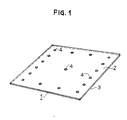
- the substrate 1 has two parallel faces 2 and 3 pierced with a plurality of holes 4.
- These holes 4 in the prior art, are obtained by drilling a raw substrate obtained by casting and then cutting.
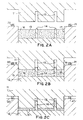
- These holes 4 can be obtained in the case of the invention directly during molding. For this, it suffices to use, for example, a mold having the shape shown in FIG. 2.
- FIG. 2 various details of the mold are represented making it possible to obtain a substrate according to the invention and the various stages of pressing.
- 11 represents the upper imprint of the mold, 12 the lower imprint, 14 and 15, respectively the male and female lugs of the mold, complementary to each other and 13 the ceramic composition. according to the invention.
- This is disposed in the lower part 12 of the mold comprising side walls 16, 17 which retain the ceramic composition.
- the height thereof, before pressing, is less than that of the male pins 14 so as to create the holes in the substrate during pressing.
- the upper part 11 of the mold slides by its side walls 18, 19 along the walls 16, 17 of the lower part 12 of the mold.
- the stops shown diagrammatically by 20 and 21 stop the relative movement of the upper and lower parts, determining the end of the pressing. It is found that the ceramic granule distributes correctly in the mold during pressing with the composition according to the invention, without porosity in the substrate.
- Water is added to the mixture so as to obtain a dry matter to slip ratio of the order of 65% to 70%.
- the mixing must be done while ensuring at all times the balance of the preparation.
- the slip thus obtained is atomized and a granule is obtained after sieving with a particle size between 80 and 250 ⁇ m.
- This granule is used to mechanically press into a mold a 2.54 cm x 2.54 cm substrate comprising 48 calibrated holes (Figure 1), this substrate for a raw density of 2.45 sintering at a temperature of 1580 ° C.
- the duration of the sintering stage is approximately 0.5 hours, the oven temperature profile going from 20 ° C. to 1580 ° C. and then to 20 ° C. which gives a sintering time of approximately 15 hours.
- the cooked density of the substrate is 3.90.
- substrates are obtained having an average roughness measured using a roughness tester according to the usual method, of approximately 0.2 ⁇ m (8 ⁇ inch).
Landscapes
- Chemical & Material Sciences (AREA)
- Engineering & Computer Science (AREA)
- Ceramic Engineering (AREA)
- Manufacturing & Machinery (AREA)
- Materials Engineering (AREA)
- Structural Engineering (AREA)
- Organic Chemistry (AREA)
- Inorganic Chemistry (AREA)
- Chemical Kinetics & Catalysis (AREA)
- Compositions Of Oxide Ceramics (AREA)
Claims (7)
Applications Claiming Priority (2)
| Application Number | Priority Date | Filing Date | Title |
|---|---|---|---|
| FR8200373 | 1982-01-12 | ||
| FR8200373A FR2519625B1 (fr) | 1982-01-12 | 1982-01-12 | Composition ceramique a base d'alumine et substrat obtenu a l'aide de cette composition |
Publications (2)
| Publication Number | Publication Date |
|---|---|
| EP0084986A1 EP0084986A1 (de) | 1983-08-03 |
| EP0084986B1 true EP0084986B1 (de) | 1985-10-02 |
Family
ID=9269909
Family Applications (1)
| Application Number | Title | Priority Date | Filing Date |
|---|---|---|---|
| EP83400022A Expired EP0084986B1 (de) | 1982-01-12 | 1983-01-04 | Keramische Zusammensetzung auf der Basis von Alumimiumoxid für die Herstellung eines Substrats und Verfahren zur Herstellung des Substrats |
Country Status (6)
| Country | Link |
|---|---|
| US (1) | US4480045A (de) |
| EP (1) | EP0084986B1 (de) |
| JP (1) | JPS58125661A (de) |
| CA (1) | CA1196034A (de) |
| DE (1) | DE3360896D1 (de) |
| FR (1) | FR2519625B1 (de) |
Families Citing this family (13)
| Publication number | Priority date | Publication date | Assignee | Title |
|---|---|---|---|---|
| US4587068A (en) * | 1983-06-24 | 1986-05-06 | Materials Research Corporation | Method of making ceramic tapes |
| US4769294A (en) * | 1986-11-26 | 1988-09-06 | Ceramics Process Systems Corp. | Alumina materials for low temperature co-sintering with refractory metallization |
| KR930011269B1 (ko) * | 1987-10-23 | 1993-11-29 | 닛뽕쇼꾸바이가가꾸고오교 가부시끼가이샤 | 세라믹 그린 시이트 |
| DE3801328A1 (de) * | 1988-01-19 | 1989-07-27 | Asea Brown Boveri | Verfahren zur herstellung eines formkoerpers aus oxidkeramik |
| CA2000193C (en) * | 1988-10-05 | 1997-03-25 | Leslie Charles Edwards | Low cement refractory |
| US5201916A (en) * | 1992-07-23 | 1993-04-13 | Minnesota Mining And Manufacturing Company | Shaped abrasive particles and method of making same |
| US5366523A (en) * | 1992-07-23 | 1994-11-22 | Minnesota Mining And Manufacturing Company | Abrasive article containing shaped abrasive particles |
| RU95105160A (ru) * | 1992-07-23 | 1997-01-10 | Миннесота Майнинг энд Мануфакчуринг Компани (US) | Способ приготовления абразивной частицы, абразивные изделия и изделия с абразивным покрытием |
| CA2137667A1 (en) * | 1992-07-23 | 1994-02-03 | Todd A. Berg | Shaped abrasive particles and method of making same |
| RU2150442C1 (ru) * | 1998-08-31 | 2000-06-10 | Сибирский химический комбинат | Керамическая масса |
| ES2191539B1 (es) * | 2001-08-16 | 2005-02-01 | Esmalglass, S.A. | Proceso para fabricacion de fritas, instalacion correspondiente y fritas asi obtenidas. |
| RU2379257C1 (ru) * | 2008-10-17 | 2010-01-20 | Федеральное государственное унитарное предприятие "Обнинское научно-производственное предприятие "Технология" | Способ изготовления изделий из корундовой керамики |
| US11342649B2 (en) * | 2019-09-03 | 2022-05-24 | Corning Incorporated | Flexible waveguides having a ceramic core surrounded by a lower dielectric constant cladding for terahertz applications |
Family Cites Families (8)
| Publication number | Priority date | Publication date | Assignee | Title |
|---|---|---|---|---|
| FR1388155A (fr) * | 1963-01-23 | 1965-02-05 | Gen Motors Corp | Produit céramique et son procédé de fabrication |
| US3516840A (en) * | 1964-10-22 | 1970-06-23 | Aluminum Co Of America | Production of ceramic bodies |
| US3698923A (en) * | 1970-05-06 | 1972-10-17 | Western Electric Co | Alumina substrates |
| JPS53120B2 (de) * | 1972-03-03 | 1978-01-05 | ||
| GB1366119A (en) * | 1972-04-25 | 1974-09-11 | British Ceramic Res Ass | Process of ceramic materials |
| JPS5110813A (en) * | 1974-07-16 | 1976-01-28 | Fujitsu Ltd | Seramitsukukibanno seizohoho |
| DE2727364A1 (de) * | 1977-06-16 | 1979-01-04 | Siemens Ag | Verfahren zur herstellung von keramiksubstraten |
| JPS5463399A (en) * | 1977-10-31 | 1979-05-22 | Fujitsu Ltd | Preparing alumina substrate |
-
1982
- 1982-01-12 FR FR8200373A patent/FR2519625B1/fr not_active Expired
-
1983
- 1983-01-04 EP EP83400022A patent/EP0084986B1/de not_active Expired
- 1983-01-04 DE DE8383400022T patent/DE3360896D1/de not_active Expired
- 1983-01-10 CA CA000419152A patent/CA1196034A/en not_active Expired
- 1983-01-11 JP JP58001836A patent/JPS58125661A/ja active Pending
-
1984
- 1984-03-14 US US06/587,855 patent/US4480045A/en not_active Expired - Fee Related
Also Published As
| Publication number | Publication date |
|---|---|
| FR2519625A1 (fr) | 1983-07-18 |
| JPS58125661A (ja) | 1983-07-26 |
| DE3360896D1 (en) | 1985-11-07 |
| FR2519625B1 (fr) | 1986-01-10 |
| CA1196034A (en) | 1985-10-29 |
| EP0084986A1 (de) | 1983-08-03 |
| US4480045A (en) | 1984-10-30 |
Similar Documents
| Publication | Publication Date | Title |
|---|---|---|
| EP0084986B1 (de) | Keramische Zusammensetzung auf der Basis von Alumimiumoxid für die Herstellung eines Substrats und Verfahren zur Herstellung des Substrats | |
| FR2488597A1 (fr) | Composition de liant pour le moulage d'une poudre minerale et son utilisation dans un procede de preparation d'un corps mineral fritte | |
| EP1343600B1 (de) | Herstellungsverfahren für dünne bänder aus metall/keramik-kompositmaterial | |
| TW202010725A (zh) | 陶瓷製造用顆粒之製造方法 | |
| KR102277881B1 (ko) | 사출 성형 조성물용 바인더 | |
| FR2729584A1 (fr) | Support poreux inorganique pour membrane et procede de fabrication | |
| WO2021245356A1 (fr) | Liant pour composition de moulage par injection | |
| EP0583427A1 (de) | Verfahren zur herstellung einer keramik mit glatter oberfläche | |
| EP1785408A1 (de) | Verfahren zur Herstellung von porösen keramischen Trägern mit kontrollierter Mikrostruktur | |
| WO1988000933A1 (fr) | Procede de fabrication de moules en nitrure de silicium poreux pour coulee sous pression | |
| EP0511301A1 (de) | Verfahren zur verminderung des schrumpfens beim brennen von keramischen grünkörpern. | |
| US20240351952A1 (en) | Process for the preparation of a zirconia granulate | |
| KR100314100B1 (ko) | 원심성형에 의한 세라믹 튜브 제조 방법 및 제조된 세라믹 튜브 | |
| CA1110421A (en) | Cadmium mercury telluride sputtering targets | |
| JP3707866B2 (ja) | 窒化アルミニウムグリーン体の製造方法 | |
| EP1966109B1 (de) | Sinterkeramikprodukt mit stickstoffhaltiger form mit verbesserten oberflächeneigenschaften | |
| RU2234167C1 (ru) | Способ изготовления подложки для втсп покрытий на основе mgo - керамики и серебра | |
| KR100302564B1 (ko) | 분말사출성형방법 | |
| FR2555161A1 (fr) | Nouvelles compositions de perovskites oxyfluorees a base de plomb frittant a basse temperature et utilisables comme ceramiques dielectriques pour condensateurs multicouches | |
| JPH02129055A (ja) | セラミックスグリーンシートの製造方法 | |
| JP4854354B2 (ja) | 窒化珪素接合体とその製造方法およびこれを用いた半導体製造装置用部材 | |
| JPH11171671A (ja) | 板状SiC−Si系複合セラミックスの製造方法 | |
| JPS6243956B2 (de) | ||
| JP3004562B2 (ja) | セラミックボールベアリング | |
| JP2001019558A (ja) | 乾式加圧成形用セラミックス粉末及びその製造方法 |
Legal Events
| Date | Code | Title | Description |
|---|---|---|---|
| PUAI | Public reference made under article 153(3) epc to a published international application that has entered the european phase |
Free format text: ORIGINAL CODE: 0009012 |
|
| AK | Designated contracting states |
Designated state(s): DE GB IT NL SE |
|
| 17P | Request for examination filed |
Effective date: 19830808 |
|
| RAP1 | Party data changed (applicant data changed or rights of an application transferred) |
Owner name: L.C.C.-C.I.C.E. - COMPAGNIE EUROPEENNE DE COMPOSAN |
|
| RAP1 | Party data changed (applicant data changed or rights of an application transferred) |
Owner name: C.I.C.E. S.A. |
|
| GRAA | (expected) grant |
Free format text: ORIGINAL CODE: 0009210 |
|
| AK | Designated contracting states |
Designated state(s): DE GB IT NL SE |
|
| PG25 | Lapsed in a contracting state [announced via postgrant information from national office to epo] |
Ref country code: NL Effective date: 19851002 Ref country code: IT Free format text: LAPSE BECAUSE OF FAILURE TO SUBMIT A TRANSLATION OF THE DESCRIPTION OR TO PAY THE FEE WITHIN THE PRESCRIBED TIME-LIMIT;WARNING: LAPSES OF ITALIAN PATENTS WITH EFFECTIVE DATE BEFORE 2007 MAY HAVE OCCURRED AT ANY TIME BEFORE 2007. THE CORRECT EFFECTIVE DATE MAY BE DIFFERENT FROM THE ONE RECORDED. Effective date: 19851002 |
|
| PG25 | Lapsed in a contracting state [announced via postgrant information from national office to epo] |
Ref country code: SE Effective date: 19851030 |
|
| REF | Corresponds to: |
Ref document number: 3360896 Country of ref document: DE Date of ref document: 19851107 |
|
| NLV1 | Nl: lapsed or annulled due to failure to fulfill the requirements of art. 29p and 29m of the patents act | ||
| PLBE | No opposition filed within time limit |
Free format text: ORIGINAL CODE: 0009261 |
|
| STAA | Information on the status of an ep patent application or granted ep patent |
Free format text: STATUS: NO OPPOSITION FILED WITHIN TIME LIMIT |
|
| 26N | No opposition filed | ||
| GBPC | Gb: european patent ceased through non-payment of renewal fee | ||
| PG25 | Lapsed in a contracting state [announced via postgrant information from national office to epo] |
Ref country code: DE Effective date: 19871001 |
|
| PG25 | Lapsed in a contracting state [announced via postgrant information from national office to epo] |
Ref country code: GB Effective date: 19881122 |