EP0084385B1 - Leichtmetallkolben - Google Patents
Leichtmetallkolben Download PDFInfo
- Publication number
- EP0084385B1 EP0084385B1 EP83200003A EP83200003A EP0084385B1 EP 0084385 B1 EP0084385 B1 EP 0084385B1 EP 83200003 A EP83200003 A EP 83200003A EP 83200003 A EP83200003 A EP 83200003A EP 0084385 B1 EP0084385 B1 EP 0084385B1
- Authority
- EP
- European Patent Office
- Prior art keywords
- piston
- light
- light metal
- iron
- layer
- Prior art date
- Legal status (The legal status is an assumption and is not a legal conclusion. Google has not performed a legal analysis and makes no representation as to the accuracy of the status listed.)
- Expired - Lifetime
Links
- 229910052751 metal Inorganic materials 0.000 title claims description 26
- 239000002184 metal Substances 0.000 title claims description 26
- XEEYBQQBJWHFJM-UHFFFAOYSA-N Iron Chemical compound [Fe] XEEYBQQBJWHFJM-UHFFFAOYSA-N 0.000 claims description 29
- 238000002485 combustion reaction Methods 0.000 claims description 22
- 239000010410 layer Substances 0.000 claims description 15
- PXHVJJICTQNCMI-UHFFFAOYSA-N Nickel Chemical compound [Ni] PXHVJJICTQNCMI-UHFFFAOYSA-N 0.000 claims description 14
- 229910052742 iron Inorganic materials 0.000 claims description 14
- 229910052759 nickel Inorganic materials 0.000 claims description 7
- 239000011241 protective layer Substances 0.000 claims description 5
- 230000006378 damage Effects 0.000 description 6
- RYGMFSIKBFXOCR-UHFFFAOYSA-N Copper Chemical compound [Cu] RYGMFSIKBFXOCR-UHFFFAOYSA-N 0.000 description 5
- 239000007789 gas Substances 0.000 description 5
- VYZAMTAEIAYCRO-UHFFFAOYSA-N Chromium Chemical group [Cr] VYZAMTAEIAYCRO-UHFFFAOYSA-N 0.000 description 4
- 229910052802 copper Inorganic materials 0.000 description 4
- 239000010949 copper Substances 0.000 description 4
- 239000000463 material Substances 0.000 description 4
- 239000000446 fuel Substances 0.000 description 3
- 150000002739 metals Chemical class 0.000 description 3
- 239000000203 mixture Substances 0.000 description 3
- BASFCYQUMIYNBI-UHFFFAOYSA-N platinum Chemical compound [Pt] BASFCYQUMIYNBI-UHFFFAOYSA-N 0.000 description 3
- KDLHZDBZIXYQEI-UHFFFAOYSA-N Palladium Chemical compound [Pd] KDLHZDBZIXYQEI-UHFFFAOYSA-N 0.000 description 2
- 239000000853 adhesive Substances 0.000 description 2
- 230000001070 adhesive effect Effects 0.000 description 2
- 229910052782 aluminium Inorganic materials 0.000 description 2
- XAGFODPZIPBFFR-UHFFFAOYSA-N aluminium Chemical compound [Al] XAGFODPZIPBFFR-UHFFFAOYSA-N 0.000 description 2
- 238000000576 coating method Methods 0.000 description 2
- 230000006835 compression Effects 0.000 description 2
- 238000007906 compression Methods 0.000 description 2
- 229910001234 light alloy Inorganic materials 0.000 description 2
- 229910052709 silver Inorganic materials 0.000 description 2
- 239000004332 silver Substances 0.000 description 2
- ZOKXTWBITQBERF-UHFFFAOYSA-N Molybdenum Chemical compound [Mo] ZOKXTWBITQBERF-UHFFFAOYSA-N 0.000 description 1
- BQCADISMDOOEFD-UHFFFAOYSA-N Silver Chemical compound [Ag] BQCADISMDOOEFD-UHFFFAOYSA-N 0.000 description 1
- ATJFFYVFTNAWJD-UHFFFAOYSA-N Tin Chemical compound [Sn] ATJFFYVFTNAWJD-UHFFFAOYSA-N 0.000 description 1
- HCHKCACWOHOZIP-UHFFFAOYSA-N Zinc Chemical compound [Zn] HCHKCACWOHOZIP-UHFFFAOYSA-N 0.000 description 1
- QCWXUUIWCKQGHC-UHFFFAOYSA-N Zirconium Chemical compound [Zr] QCWXUUIWCKQGHC-UHFFFAOYSA-N 0.000 description 1
- 239000000956 alloy Substances 0.000 description 1
- 229910045601 alloy Inorganic materials 0.000 description 1
- 230000033228 biological regulation Effects 0.000 description 1
- 229910052793 cadmium Inorganic materials 0.000 description 1
- BDOSMKKIYDKNTQ-UHFFFAOYSA-N cadmium atom Chemical compound [Cd] BDOSMKKIYDKNTQ-UHFFFAOYSA-N 0.000 description 1
- 229910052804 chromium Inorganic materials 0.000 description 1
- 239000011651 chromium Substances 0.000 description 1
- 239000011248 coating agent Substances 0.000 description 1
- 229910017052 cobalt Inorganic materials 0.000 description 1
- 239000010941 cobalt Substances 0.000 description 1
- GUTLYIVDDKVIGB-UHFFFAOYSA-N cobalt atom Chemical compound [Co] GUTLYIVDDKVIGB-UHFFFAOYSA-N 0.000 description 1
- 238000009792 diffusion process Methods 0.000 description 1
- 238000006073 displacement reaction Methods 0.000 description 1
- 230000000694 effects Effects 0.000 description 1
- 230000017525 heat dissipation Effects 0.000 description 1
- 230000007774 longterm Effects 0.000 description 1
- 230000001050 lubricating effect Effects 0.000 description 1
- 229910052750 molybdenum Inorganic materials 0.000 description 1
- 239000011733 molybdenum Substances 0.000 description 1
- 230000003647 oxidation Effects 0.000 description 1
- 238000007254 oxidation reaction Methods 0.000 description 1
- 229910052763 palladium Inorganic materials 0.000 description 1
- 229910052697 platinum Inorganic materials 0.000 description 1
- 229910052761 rare earth metal Inorganic materials 0.000 description 1
- 150000002910 rare earth metals Chemical class 0.000 description 1
- 229910052703 rhodium Inorganic materials 0.000 description 1
- 239000010948 rhodium Substances 0.000 description 1
- MHOVAHRLVXNVSD-UHFFFAOYSA-N rhodium atom Chemical compound [Rh] MHOVAHRLVXNVSD-UHFFFAOYSA-N 0.000 description 1
- 230000000630 rising effect Effects 0.000 description 1
- 238000004544 sputter deposition Methods 0.000 description 1
- 239000000126 substance Substances 0.000 description 1
- 229910052715 tantalum Inorganic materials 0.000 description 1
- GUVRBAGPIYLISA-UHFFFAOYSA-N tantalum atom Chemical compound [Ta] GUVRBAGPIYLISA-UHFFFAOYSA-N 0.000 description 1
- 238000005494 tarnishing Methods 0.000 description 1
- 238000002207 thermal evaporation Methods 0.000 description 1
- WFKWXMTUELFFGS-UHFFFAOYSA-N tungsten Chemical compound [W] WFKWXMTUELFFGS-UHFFFAOYSA-N 0.000 description 1
- 229910052721 tungsten Inorganic materials 0.000 description 1
- 239000010937 tungsten Substances 0.000 description 1
- 229910052720 vanadium Inorganic materials 0.000 description 1
- LEONUFNNVUYDNQ-UHFFFAOYSA-N vanadium atom Chemical compound [V] LEONUFNNVUYDNQ-UHFFFAOYSA-N 0.000 description 1
- 229910052725 zinc Inorganic materials 0.000 description 1
- 239000011701 zinc Substances 0.000 description 1
- 229910052726 zirconium Inorganic materials 0.000 description 1
Images

Classifications
-
- F—MECHANICAL ENGINEERING; LIGHTING; HEATING; WEAPONS; BLASTING
- F02—COMBUSTION ENGINES; HOT-GAS OR COMBUSTION-PRODUCT ENGINE PLANTS
- F02F—CYLINDERS, PISTONS OR CASINGS, FOR COMBUSTION ENGINES; ARRANGEMENTS OF SEALINGS IN COMBUSTION ENGINES
- F02F3/00—Pistons
- F02F3/10—Pistons having surface coverings
- F02F3/12—Pistons having surface coverings on piston heads
Definitions
- the invention relates to a light metal piston for internal combustion engines, in particular for Otto engines, on whose piston crown at least partially and on its top land at least on the portion adjacent to the piston crown, a metal protective layer is applied.
- the knock in the petrol engine is caused by the fact that the tail gas - that is the proportion of the mixture not yet captured by the combustion - creates thermodynamic and chemical conditions due to the pressure and temperature increase due to the compression movement of the piston and the combustion that has already occurred in part of the charge that lead to a sudden release of the energy contained in the tail gas.
- Typical pressure vibrations of high frequency acting on the walls of the combustion chamber are measured, which are superimposed on the normal pressure curve.
- the temperature vibrations that can be measured on the combustion chamber surfaces are significantly higher locally during knocking combustion during the work cycle, without an increase e.g. the mean piston crown temperature can be determined, which recognizably exceeds the temperature increase corresponding to the changed time course of the burn-through function.
- the iron or nickel layer primarily exerts a shielding effect, in particular by keeping the high-frequency temperature fluctuations and corrosive stress components away from the light metal of the piston body. It is also essential, however, that the iron or nickel layer itself withstands the stresses caused by knocking combustion due to its high strength, its homogeneous structure, the smooth surface and the high adhesive strength on the light metal. The totality of these properties cannot be achieved with other coatings, for example a hard anodized layer of comparable thickness (DE-A 25 07 899) produced by anodic oxidation on the piston head, which cannot prevent damage to the light metal piston due to knocking combustion, although the hard anodized layer does Light metal pistons for diesel engines protect the surface of the piston on the combustion chamber against thermal fatigue.
- a copper layer applied electrochemically to a light metal piston shows comparatively less damage from knocking combustion than the uncoated piston, but detaches from the piston crown after a short period of operation due to insufficient adhesive strength. It is known from MTZ (Motortechnische Zeitschrift) No. 2/1974 pages 33-41 to electrochemically deposit an iron layer on a light metal piston. This piston is used in unreinforced aluminum cylinders. The iron layer is applied to the piston skirt, which has the task of avoiding contact between the light metal of the cylinder and that of the piston under all circumstances in extreme running conditions. Due to the iron coating on the piston skirt, piston skirt wear is considerably reduced and the tendency to seize between the piston skirt and cylinder is greatly reduced.
- the top land and ring section are also provided with an iron layer, so that the top land and ring field game can be designed to achieve low oil consumption and gas passage in such a way that tarnishing of the top land on the cylinder wall can be tolerated in the case of strongly deformed cylinders.
- CH-A-227 662 describes a light metal piston for internal combustion engines which is at least partially covered with a metal protective layer of 0.001 to a few millimeters thick which is alloyed by diffusion onto the base material of the piston.
- the metal protective layers which are applied by cathode sputtering or by thermal evaporation of the metal in vacuo, consist of any metals or alloys, advantageously of metals of the chromium group, such as chromium, molybdenum, tungsten, the iron group, such as iron, Cobalt, nickel, the copper group such as copper, silver or a platinum metal such as platinum, palladium, rhodium or metals such as tin, lead, aluminum, cadmium, zinc or rare earth metals such as vanadium, tantalum, zirconium individually or in any combination.
- the piston crown receives a protective layer made of silver, nickel, chrome or copper for better heat dissipation and reflection, whereas layers of copper, nickel, iron or chrome are applied to the piston skirt to improve the running properties, which cause little wear or even a lubricating effect.
- CH-A-227 662 is therefore based on a different task than the subject of the application, and the solution measures also differ from one another.
Landscapes
- Engineering & Computer Science (AREA)
- Chemical & Material Sciences (AREA)
- Combustion & Propulsion (AREA)
- Mechanical Engineering (AREA)
- General Engineering & Computer Science (AREA)
- Pistons, Piston Rings, And Cylinders (AREA)
Description
- Die Erfindung betrifft einen Leichtmetallkolben für Brennkraftmaschinen, insbesondere für Otto-Motoren, auf dessen Kolbenboden mindestens teilweise und auf dessen Feuersteg mindestens auf dem an den Kolbenboden angrenzenden Abschnitt eine Metallschutzschicht aufgetragen ist.
- Steigende Kraftstoffkosten und die gesetzlichen Vorschriften, insbesondere hinsichtlich der Abgaszusammensetzung, haben dazu geführt, daß Verbrennungsmotoren bezüglich des Kraftstoffverbrauchs optimal ausgelegt werden, indem unter anderem auch das Verdichtungsverhältnis vergrößert wird, um eine größere Leistung aus Hubraum und Kraftstoffverbrauch und eine unschädliche Zusammensetzung der Abgase zu erzielen. Das hat jedoch zur Folge, daß der Verbrennungsmotor auf Dauer und auch im oberen Bereich seines Last-Drehzahl-Kennfeldes einer das Klopfen erzeugenden Verbrennung unterliegt. Darunter leiden vorzugsweise alle den Brennraum begrenzenden Bauteile des Verbrennungsmotors, insbesondere aber der Leichtmetallkolben, der schon nach relativ kurzer Dauer zerstört wird, indem es, insbesondere in diskreten Bereichen, deren Lage beispielsweise von der Brennraumform abhängt, am Kolbenboden und/oder Feuersteg zu kraterähnlichen Materialzerstörungen, wie diese beispielsweise aus der in Figur 1 der Zeichnungen wiedergegebenen fotographischen Aufnahme des Feuerstegs eines Leichtmetallkolbens zu erkennen sind, kommt. Diese Materialzerstörungen sind eindeutig auf eine klopfende Verbrennung zurückzuführen. Das Klopfen im Otto-Motor entsteht dadurch, daß im Endgas - das ist der noch nicht von der Verbrennung erfaßte Gemischanteil - bedingtdurch die Druck- und Temperatursteigerung infolge der Verdichtungsbewegung des Kolbens und die in einem Teil der Ladung bereits abgelaufene Verbrennung thermodynamische und chemische Bedingungen erzeugt werden, die zu einer schlagartigen Freisetzung der im Endgas enthaltenen Energie führen. Dabei werden auf die Brennraumwandungen wirkende typische Druckschwingungen hoher Frequenz gemessen, die dem normalen Druckverlauf überlagert sind. Auch die an den Brennraumoberflächen meßbaren Temperaturschwingungen sind bei klopfender Verbrennung örtlich während des Arbeitsspiels deutlich höher, ohne daß eine Erhöhung z.B. der mittleren Kolbenbodentemperatur festgestellt werden kann, die erkennbar die dem geänderten zeitlichen Verlauf der Durchbrennfunktion entsprechende Temperaturerhöhung übersteigt.
- Es ist die Aufgabe der vorliegenden Erfindung, einen Leichtmetallkolben bereitzustellen, der eine gegenüber den im Dauerbetrieb mit klopfender Verbrennung entstehenden erosionsartigen Oberflächenschäden am Kolbenboden und/oder Feuersteg verbesserte Standzeit aufweist.
- Die Lösung dieser Aufgabe erfolgt durch eine 5 bis 30 µm dicke elektrochemisch abgeschiedene Eisen- oder Nickelschicht.
- Die Eisen- bzw. Nickelschicht übt in erster Linie eine Abschirmwirkung aus, indem vor allem die hochfrequenten Temperaturschwingungen sowie korrosive Beanspruchungskomponenten vom Leichtmetall des Kolbenkörpers ferngehalten werden. Wesentlich ist aber auch, daß die Eisen-oder Nickelschicht selbst aufgrund ihrer hohen Festigkeit ihres homogenen Aufbaus, der glatten Oberfläche und durch die hohe Haftfestigkeit auf dem Leichtmetall den durch klopfende Verbrennung hervorgerufenen Beanspruchungen standhält. Die Gesamtheit dieser Eigenschaften läßt sich mit anderen Beschichtungen nicht erreichen, so kann beispielsweise eine durch anodische Oxidation auf dem Kolbenboden erzeugte Harteloxalschicht vergleichbarer Dicke (DE-A 25 07 899), die durch klopfende Verbrennung eintretende Beschädigung des Leichtmetallkolbens nicht verhindern, obwohl die Harteloxalschicht bei Leichtmetallkolben für Dieselmotoren einen Schutz der brennraumseitigen Oberfläche des Kolbens gegenüber thermischen Ermüdungserscheinungen bewirkt. Eine auf elektrochemischem Wege auf einen Leichtmetallkolben aufgebrachte Kupferschicht zeigt eine vergleichsweise geringere Beschädigung durch klopfende Verbrennung als der unbeschichtete Kolben, löst sich jedoch nach kurzer Betriebszeit infolge nicht ausreichender Haftfestigkeit vom Kolbenboden ab. Aus MTZ (Motortechnische Zeitschrift) Nr. 2/ 1974 Seiten 33-41 ist es bekannt, auf einen Leichtmetallkolben eine Eisenschicht elektrochemisch abzuscheiden. Dieser Kolben wird in unbewehrten Aluminiumzylinder eingesetzt. Die Eisenschicht ist dabei auf dem Kolbenschaft aufgebracht, die die Aufgabe hat, bei extremen Laufbedingungen unter allen Umständen einen Kontakt zwischen dem Leichtmetall des Zylinders und demjenigen des Kolbens zu vermeiden. Durch die Eisenbeschichtung des Kolbenschaftes wird der Kolbenschaftverschleiß erheblich gesenkt und die Freßneigung zwischen Kolbenschaft und Zylinder sehr stark reduziert. Bei Leichtmetallkolben für luftgekühlte Motoren sind auch Feuersteg und Ringpartie mit einer Eisenschicht versehen, damit das Feuersteg- und Ringfeldspiel zur Erzielung geringen Ölverbrauchs und Gasdurchlasses so angelegt werden können, daß bei stark verformten Zylindern ein Anlaufen des Feuerstegs an die Zylinderwand toleriert werden kann.
- In der CH-A-227 662 ist zwar ein Leichtmetallkolben für Brennkraftmaschinen beschrieben, der mindestens teilweise mit einer durch Diffusion an das Grundmaterial des Kolbens anlegierten Metallschutzschicht von 0,001 bis einige Millimeter Dicke überzogen ist. Die Metallschutzschichten, die durch Kathodenzerstäubung oder durch thermische Verdampfung des Metalls im Vakuum aufgebracht werden, bestehen aus beliebigen Metallen oder Legierungen, vorteilhaft aus Metallen der Chromgruppe, wie Chrom, Molybdän, Wolfram, der Eisengruppe, wie Eisen, Kobalt, Nickel, der Kupfergruppe, wie Kupfer, Silber oder einem Platinmetall, wie Platin, Palladium, Rhodium oder Metallen wie Zinn, Blei, Aluminium, Kadmium, Zink oder Seltenen Erdmetallen, wie Vanadium, Tantal, Zirkonium einzeln oder in beliebiger Kombination. So erhält der Kolbenboden zur besseren Wärmeableitung und Reflexion eine Schutzschicht aus Silber, Nickel, Chrom oder Kupfer, wogegen auf den Kolbenschaft zur Verbesserung der Laufeigenschaften Schichten aus Kupfer, Nickel, Eisen oder Chrom aufgebracht sind, die einen geringen Verschleiß oder sogar eine Schmierwirkung hervorrufen. Der CH-A-227 662 liegt daher eine andere Aufgabenstellung als dem Anmeldungsgegenstand zugrunde, ebenso weichen die Lösungsmaßnahmen voneinander ab.
- Die in den Zeichnungen dargestellte Erfindung wird nachfolgend beispielhaft erläutert.
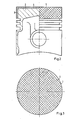
- Fig. 2 zeigt eine Vorderansicht sowie einen Teillängsschnitt und
- Fig. 3 eine Draufsicht auf den Kolbenboden (1) des Leichtmetallkolbens (2), dessen Feuersteg (3) und Kolbenboden (1) mit einer 20 um dicken elektrochemisch abgeschiedenen Eisenschicht (4) überzogen sind. Der von der Eisenschicht bedeckte Oberflächenbereich ist in der Draufsicht durch Kreuzschraffur gekennzeichnet.
- In einem Versuchsverbrennungsmotor, der reproduzierbar mit klopfender Verbrennung gefahren wurde, wurden mit einer Eisenschicht am Kolbenboden und Feuersteg versehene Leichtmetallkolben in einem Satz zusammen mit unbeschichteten Leichtmetallkolben über mehr als 60 Stunden erprobt. Während die unbeschichteten Leichtmetallkolben nach jeweils etwa 12 Stunden Laufdauer erhebliche Materialzerstörungen am Kolbenboden aufwiesen und ausgewechseit werden mußten, konnten an den mit einer Eisenschicht am Kolbenboden versehenen Leichtmetallkolben keinerlei Veränderungen festgestellt werden.
Claims (1)
- Leichtmetallkolben für Brennkraftmaschinen, insbesondere für Otto-Motoren, auf dessen Kolbenboden mindestens teilweise und auf dessen Feuersteg wenigstens in dem an den Kolbenboden angrenzenden Abschnitt als Metallschutzschicht eine 5 bis 30 um dicke elektrochemisch abgeschiedene Eisen- oder Nickelschicht aufgetragen ist.
Applications Claiming Priority (2)
| Application Number | Priority Date | Filing Date | Title |
|---|---|---|---|
| DE3201498 | 1982-01-20 | ||
| DE19823201498 DE3201498A1 (de) | 1982-01-20 | 1982-01-20 | Leichtmetallkolben |
Publications (2)
| Publication Number | Publication Date |
|---|---|
| EP0084385A1 EP0084385A1 (de) | 1983-07-27 |
| EP0084385B1 true EP0084385B1 (de) | 1990-11-07 |
Family
ID=6153390
Family Applications (1)
| Application Number | Title | Priority Date | Filing Date |
|---|---|---|---|
| EP83200003A Expired - Lifetime EP0084385B1 (de) | 1982-01-20 | 1983-01-04 | Leichtmetallkolben |
Country Status (2)
| Country | Link |
|---|---|
| EP (1) | EP0084385B1 (de) |
| DE (2) | DE3201498A1 (de) |
Families Citing this family (5)
| Publication number | Priority date | Publication date | Assignee | Title |
|---|---|---|---|---|
| DE3304320C1 (de) * | 1983-02-09 | 1988-07-07 | M.A.N. Maschinenfabrik Augsburg-Nürnberg AG, 8900 Augsburg | Leichtmetallkolben für - insbesondere schwerölbetriebene - Brennkraftmaschinen |
| GB2163073B (en) * | 1984-08-13 | 1988-03-02 | Ae Plc | Treatment of pistons |
| GB8714287D0 (en) * | 1987-06-18 | 1987-07-22 | Ae Plc | Pistons |
| DE10315232A1 (de) * | 2003-04-03 | 2004-10-28 | Federal-Mogul Nürnberg GmbH | Kolben für einen Verbrennungsmotor und Verfahren zur Herstellung eines Kolbens |
| JP5998696B2 (ja) * | 2012-07-19 | 2016-09-28 | マツダ株式会社 | エンジン燃焼室の断熱構造 |
Family Cites Families (7)
| Publication number | Priority date | Publication date | Assignee | Title |
|---|---|---|---|---|
| US1426138A (en) * | 1919-01-09 | 1922-08-15 | Aluminum Manufactures Inc | Piston |
| FR600601A (fr) * | 1925-06-26 | 1926-02-11 | Ets De Dion Bouton | Nouveau piston pour moteur à explosion |
| GB492345A (en) * | 1936-07-03 | 1938-09-19 | Aluminum Colors Inc | Improvements in or relating to pistons |
| GB510404A (en) * | 1938-05-03 | 1939-08-01 | Bernhard Berghaus | Improvements in and relating to light metal pistons and coatings therefor |
| CH227662A (de) * | 1938-05-03 | 1943-06-30 | Berghaus Bernhard | Mit Metallschutzschicht versehener Leichtmetallkolben für Verbrennungskraftmaschinen, sowie Verfahren und Vorrichtung zur Herstellung von Metallschutzschichten an Leichtmetallkolben. |
| DE2743512A1 (de) * | 1977-08-27 | 1979-03-01 | Eugen Stump | Fuehrungsring |
| DE2921952A1 (de) * | 1979-05-30 | 1980-12-04 | Volkswagenwerk Ag | Aus aluminium oder einer aluminiumlegierung gefertigter kolben fuer eine verbrennungskraftmaschine |
-
1982
- 1982-01-20 DE DE19823201498 patent/DE3201498A1/de not_active Withdrawn
-
1983
- 1983-01-04 DE DE8383200003T patent/DE3381978D1/de not_active Expired - Fee Related
- 1983-01-04 EP EP83200003A patent/EP0084385B1/de not_active Expired - Lifetime
Also Published As
| Publication number | Publication date |
|---|---|
| EP0084385A1 (de) | 1983-07-27 |
| DE3381978D1 (de) | 1990-12-13 |
| DE3201498A1 (de) | 1983-07-28 |
Similar Documents
| Publication | Publication Date | Title |
|---|---|---|
| DE69700387T2 (de) | Zylinderbüchse, kolben sowie kolbenring eines dieselmotors | |
| DE3330554A1 (de) | Kolben fuer brennkraftmaschinen | |
| DE69509163T2 (de) | Kolben und Kolbenringaufbau | |
| DE3008330A1 (de) | Fluessigkeitsgekuehlter kolben fuer brennkraftmaschinen | |
| DE102014201337A1 (de) | Kolben für eine Kolbenmaschine | |
| DE3301366A1 (de) | Kolben fuer brennkraftmaschinen | |
| EP0084385A1 (de) | Leichtmetallkolben | |
| DE3036792A1 (de) | Verbundkolben | |
| EP0215511B1 (de) | Kolben-Zylinder-Bausatz für Brennkraftmaschinen | |
| DE60216631T2 (de) | Kolben für verbrennungsmotor | |
| DE2211690C3 (de) | Leichtmetallkolben für Brennkraftmaschinen | |
| DE2438548A1 (de) | Kolben fuer verbrennungskraftmaschinen | |
| DE2513324A1 (de) | Leichtmetallkolben fuer viertakt- brennkraftmaschinen | |
| DE10014515C2 (de) | Kolbenring mit Verschleißschutzschicht sowie Verschleißschutzschicht für einen Kolbenring | |
| DE102005022469B4 (de) | Brennkraftmaschine mit einem Zylinderkurbelgehäuse | |
| DE3011216C2 (de) | Zylinderkopfdichtung für Kolbenbrennkraftmaschinen mit Nebenbrennkammer | |
| DE19510050A1 (de) | Leichter, gegossener Kolben für Verbrennungsmotoren | |
| DE2937216C2 (de) | ||
| EP3828309A1 (de) | Kolbenring für einen grossmotor sowie grossmotor | |
| EP0777072B1 (de) | Kolben-Pleuelverbindung | |
| EP0977002A2 (de) | Waffenrohr mit einer verschleissmindernden Hartchromschicht | |
| DE102012009029A1 (de) | Kolben für einen Verbrennungsmotor | |
| DE60022845T2 (de) | Verfahren zur Verstärkung eines Brennkraftmaschinenkolbens und verstärkter Kolben nach dem Verfahren | |
| EP0097215B1 (de) | Kolben einer Hubkolbenbrennkraftmaschine | |
| DE10297308T5 (de) | Hubkolbenmaschine |
Legal Events
| Date | Code | Title | Description |
|---|---|---|---|
| PUAI | Public reference made under article 153(3) epc to a published international application that has entered the european phase |
Free format text: ORIGINAL CODE: 0009012 |
|
| AK | Designated contracting states |
Designated state(s): DE FR GB IT SE |
|
| 17P | Request for examination filed |
Effective date: 19830829 |
|
| RAP1 | Party data changed (applicant data changed or rights of an application transferred) |
Owner name: KOLBENSCHMIDT AKTIENGESELLSCHAFT |
|
| GRAA | (expected) grant |
Free format text: ORIGINAL CODE: 0009210 |
|
| AK | Designated contracting states |
Kind code of ref document: B1 Designated state(s): DE FR GB IT SE |
|
| PG25 | Lapsed in a contracting state [announced via postgrant information from national office to epo] |
Ref country code: SE Effective date: 19901107 |
|
| REF | Corresponds to: |
Ref document number: 3381978 Country of ref document: DE Date of ref document: 19901213 |
|
| ET | Fr: translation filed | ||
| ITF | It: translation for a ep patent filed | ||
| GBT | Gb: translation of ep patent filed (gb section 77(6)(a)/1977) | ||
| PLBI | Opposition filed |
Free format text: ORIGINAL CODE: 0009260 |
|
| PLBI | Opposition filed |
Free format text: ORIGINAL CODE: 0009260 |
|
| 26 | Opposition filed |
Opponent name: BAYERISCHE MOTOREN WERKE AG, PATENTABTEILUNG AJ-3, Effective date: 19910724 |
|
| 26 | Opposition filed |
Opponent name: ALCAN DEUTSCHLAND GMBH Effective date: 19910807 Opponent name: BAYERISCHE MOTOREN WERKE AG, PATENTABTEILUNG AJ-3, Effective date: 19910724 |
|
| PGFP | Annual fee paid to national office [announced via postgrant information from national office to epo] |
Ref country code: FR Payment date: 19921208 Year of fee payment: 11 |
|
| PGFP | Annual fee paid to national office [announced via postgrant information from national office to epo] |
Ref country code: GB Payment date: 19921216 Year of fee payment: 11 |
|
| PGFP | Annual fee paid to national office [announced via postgrant information from national office to epo] |
Ref country code: DE Payment date: 19930211 Year of fee payment: 11 |
|
| PLBM | Termination of opposition procedure: date of legal effect published |
Free format text: ORIGINAL CODE: 0009276 |
|
| STAA | Information on the status of an ep patent application or granted ep patent |
Free format text: STATUS: OPPOSITION PROCEDURE CLOSED |
|
| 27C | Opposition proceedings terminated |
Effective date: 19930128 |
|
| PG25 | Lapsed in a contracting state [announced via postgrant information from national office to epo] |
Ref country code: GB Effective date: 19940104 |
|
| GBPC | Gb: european patent ceased through non-payment of renewal fee |
Effective date: 19940104 |
|
| PG25 | Lapsed in a contracting state [announced via postgrant information from national office to epo] |
Ref country code: FR Effective date: 19940930 |
|
| PG25 | Lapsed in a contracting state [announced via postgrant information from national office to epo] |
Ref country code: DE Effective date: 19941001 |
|
| REG | Reference to a national code |
Ref country code: FR Ref legal event code: ST |
|
| APAH | Appeal reference modified |
Free format text: ORIGINAL CODE: EPIDOSCREFNO |