EP0081895B1 - Method and apparatus for the thermal treatment of heavy fuel oil - Google Patents
Method and apparatus for the thermal treatment of heavy fuel oil Download PDFInfo
- Publication number
- EP0081895B1 EP0081895B1 EP82302978A EP82302978A EP0081895B1 EP 0081895 B1 EP0081895 B1 EP 0081895B1 EP 82302978 A EP82302978 A EP 82302978A EP 82302978 A EP82302978 A EP 82302978A EP 0081895 B1 EP0081895 B1 EP 0081895B1
- Authority
- EP
- European Patent Office
- Prior art keywords
- stream
- distillation unit
- gas oil
- vacuum
- oil
- Prior art date
- Legal status (The legal status is an assumption and is not a legal conclusion. Google has not performed a legal analysis and makes no representation as to the accuracy of the status listed.)
- Expired
Links
- 238000000034 method Methods 0.000 title claims abstract description 24
- 239000010763 heavy fuel oil Substances 0.000 title claims abstract description 11
- 238000007669 thermal treatment Methods 0.000 title claims abstract description 7
- 239000003921 oil Substances 0.000 claims abstract description 42
- 238000004821 distillation Methods 0.000 claims abstract description 20
- 239000001993 wax Substances 0.000 claims abstract description 10
- 238000004227 thermal cracking Methods 0.000 claims abstract description 8
- 238000005292 vacuum distillation Methods 0.000 claims abstract description 6
- 239000000446 fuel Substances 0.000 claims description 11
- 239000007788 liquid Substances 0.000 claims description 5
- 238000002485 combustion reaction Methods 0.000 claims description 2
- 238000004064 recycling Methods 0.000 claims description 2
- 239000012141 concentrate Substances 0.000 abstract description 2
- 230000005611 electricity Effects 0.000 abstract description 2
- 239000000047 product Substances 0.000 description 10
- 239000012530 fluid Substances 0.000 description 5
- 238000012856 packing Methods 0.000 description 5
- 239000000295 fuel oil Substances 0.000 description 4
- 230000003134 recirculating effect Effects 0.000 description 4
- 239000010779 crude oil Substances 0.000 description 3
- 238000012432 intermediate storage Methods 0.000 description 2
- 239000003208 petroleum Substances 0.000 description 2
- 230000015572 biosynthetic process Effects 0.000 description 1
- 238000009835 boiling Methods 0.000 description 1
- 239000004568 cement Substances 0.000 description 1
- 239000000498 cooling water Substances 0.000 description 1
- 238000005336 cracking Methods 0.000 description 1
- 238000010586 diagram Methods 0.000 description 1
- 239000012467 final product Substances 0.000 description 1
- 230000001939 inductive effect Effects 0.000 description 1
- 238000009413 insulation Methods 0.000 description 1
- 238000000638 solvent extraction Methods 0.000 description 1
- 238000003860 storage Methods 0.000 description 1
- 239000002699 waste material Substances 0.000 description 1
- XLYOFNOQVPJJNP-UHFFFAOYSA-N water Substances O XLYOFNOQVPJJNP-UHFFFAOYSA-N 0.000 description 1
Images
Classifications
-
- C—CHEMISTRY; METALLURGY
- C10—PETROLEUM, GAS OR COKE INDUSTRIES; TECHNICAL GASES CONTAINING CARBON MONOXIDE; FUELS; LUBRICANTS; PEAT
- C10G—CRACKING HYDROCARBON OILS; PRODUCTION OF LIQUID HYDROCARBON MIXTURES, e.g. BY DESTRUCTIVE HYDROGENATION, OLIGOMERISATION, POLYMERISATION; RECOVERY OF HYDROCARBON OILS FROM OIL-SHALE, OIL-SAND, OR GASES; REFINING MIXTURES MAINLY CONSISTING OF HYDROCARBONS; REFORMING OF NAPHTHA; MINERAL WAXES
- C10G7/00—Distillation of hydrocarbon oils
- C10G7/06—Vacuum distillation
Definitions
- the present invention relates to a method and apparatus for the thermal treatment of heavy fuel oil, for example a method and apparatus to recover lighter products and to utilise the heavier products, and such a method comprises supplying the heavy fuel oil to a vacuum distillation unit operating at a sub-atmospheric pressure, withdrawing a heavy gas oil and any other contained lighter fractions as a top product, and withdrawing a vacuum residue as a bottom product.
- vacuum unit In modern oil refineries the reduced crude from a crude oil topping still is commonly passed to a unit referred to as a vacuum unit, where, under sub-atmospheric pressure, heavy gas oil is flashed out and separated from the heaviest petroleum fraction, commonly called vacuum residue. When cooled to atmospheric temperatures this residue is a very viscous fluid.
- the heavy gas oil is usually recovered for subsequent use as feedstock in cracking processes and is generally accepted as being more valuable than reduced crude.
- a method for the thermal treatment of heavy fuel oil characterised by withdrawing a gas oil stream from the distillation unit, subjecting this stream to mild thermal cracking conditions in which the temperature of the stream is raised whereby a portion of the waxes present are cracked, and introducing the heated stream into the feedstock inlet stream, thereby recycling the stream to the distillation unit, and by supplying the vacuum residue directly to fuel burning means where combustion of the vacuum residue is effected and the heat released is used to generate power.
- the vacuum residue is burned to release energy and the energy is used to generate power.
- the method may be particularly suitable in situations where a power station receives fuel oil, delivered by water or served by a connecting pipeline from an oil refinery:
- the method according to the invention is preferably carried out on or close to the power station premises and preferably as close to the boilers as is practically possible.
- the techniques may be allied to other large consumers of heavy oil fuels such as cement manufacturers.
- reduced crude or heavy fuel oil to typical power station specifications may be received at the power station and supplied to a vacuum still to separate out those pertroleum fractions lighter than vacuum residue.
- the vacuum residue may then be at a sufficiently high temperature, e.g. between 200 and 375°C such that it readily flows through pipework and can be effectively burnt in the power station boilers.
- the separated heavy gas oil and lighter fractions which are recovered may be returned to the originating oil refinery or may be marketed as a more valuable product than the fuel oil feedstock received at the power station.
- any subsequent pipework, intermediate storage and burner systems should preferably be provided with appropriate insulation and heat tracing to keep the fuel hot.
- a considerable benefit of the method of the invention is that it is possible to save that energy which would otherwise be consumed in visbreaking the vacuum residue or alternatively to conserve more valuable lower boiling petroleum fractions so that they may be put to more useful applications.
- the method includes the steps of withdrawing one or more fractions from the column and heat-exchanging these streams against the feedstock inlet stream to the column.
- a characteristic of many crude oils is that wax components tend to concentrate in the heavier gas oil fractions recovered in a vacuum unit. This impairs the fluid flow characteristics of the recovered heavy gas oil, especially at ambient temperature. A method of measuring this characteristic is a well known test to determine the pour point of the fluid. Pour points greater than 25°C are generally unacceptable. It is quite common for recovered heavy gas oil to have a pour point value greater than 25°C.
- the heat supplied to the system to enable the vacuum column to operate is also used to subject a portion of the fuel oil, namely the heavier gas oil fraction, to mild thermal cracking conditions. This is carried out by withdrawing a stream of heavy gas oil from near the base of the vacuum column and passing this stream through a heater. This heated stream is then mixed with the feedstock inlet stream to the column. No additional heat may be required to be introduced into the system.
- the vacuum distillation unit operates at a temperature of between 150 and 375°C e.g. about 345°C and at a pressure of between 0.03 and 0.3 atmospheres e.g. about 0.065 atmospheres.
- apparatus for the thermal treatment of heavy fuel oil comprising a vacuum distillation unit and a heater arranged to supply heat to the distillation unit, characterised in that the heater has an inlet arranged to receive a gas oil stream from the distillation unit and an outlet arranged to introduce the heated stream into the feedstock inlet stream to the distillation unit and further characterised by fuel burning means arranged to receive directly the bottom product from the distillation unit and to burn the bottom product to generate power.
- the distillation unit includes two or more sections of gas/liquid contact medium and a liquid catch tray beneath each section.
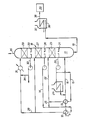
- Reduced crude feedstock enters the process at 11 at ambient temperature and is heat exchanged in heat exchangers 12, 13 against recirculating heavy gas oil in two recycle streams 14, 15 respectively.
- the feedstock is then passed via a transfer line 16 to the flash zone 17 of a vacuum column 18 which operates between 0.03 and 0.3 atmospheres pressure and at about 345°C.
- the heavier gas oil fractions are withdrawn as a liquid stream 20 by means of a catch tray 21 located immediately above the flash zone 17 having been condensed by a cooled recirculating gas oil stream 22, in a packing section 23.
- the heavier fractions are led to a heater 24 where the temperature is raised to between 450°C and 500°C e.g. about 480°C to induce mild thermal cracking. This tends to crack and hence reduce the wax components in the gas oil.
- the heated stream is then mixed with the feedstock in line 16 and thus recycled.
- the heat supplied is preferably sufficient to cause heavy gas oil and any ligher fractions to flash off in the distillation unit 18.
- a portion of the withdrawn heavy gas oil 20 is heat exchanged with feedstock as recycle stream 15 in heat exchanger 13, cooled to about 260°C and returned as stream 22 to the column 18 at the top of section 23.
- Excess gas oil in this recirculating circuit comprises an overflow line 25 which joins recycle stream 14.
- This stream comprises recirculating gas oil from a catch tray 26 located beneath a second packing section 27 and is heat exchanged against the feedstock in heat exchanger 12. The stream is then reintroduced to the column 18 above the packing section 27 where gas oil and lighter fractions in the column are condensed.
- Excess gas oil and lighter fractions in the recycle stream 14 comprise overflow stream 28 which is passed to a top packing section 29.
- This stream 28 is cooled against cooling water or air in a heat exchanger 31 to a temperature between 40 and 60°C.
- the final product is withdrawn in stream 32 from a catch tray 33 beneath the packing section 29 at about 75°C and some of this stream is mixed with stream 28 via line 34 prior to its being cooled.
- the lightest fractions resulting from mild thermal cracking of the heavier gas oil fraction tend to dissolve into the final withdawn product stream 32 together with any light fractions contained in the feedstock. This also reduces the load on the vacuum inducing equipment.
- the vacuum in the system may be induced by any suitable means such as vacuum pumps or steam ejectors (not shown) via a top outlet 35.
- the vacuum residue in line 19 is removed from the process at the temperature of the flash zone 17 and either passed directly to burners 36 in a power station boilers 37 or to intermediate hot storage (not shown) without heat exchanging against any other stream.
- the boilers generate steam which is transferred via steam line 38 to electricity generators 39.
- the vacuum residue in line 19 may be heat exchanged and cooled to the practical temperature limit set by the fluid flow properties of the fuel which will be above 150°C.
Landscapes
- Chemical & Material Sciences (AREA)
- Oil, Petroleum & Natural Gas (AREA)
- Engineering & Computer Science (AREA)
- Chemical Kinetics & Catalysis (AREA)
- General Chemical & Material Sciences (AREA)
- Organic Chemistry (AREA)
- Production Of Liquid Hydrocarbon Mixture For Refining Petroleum (AREA)
Priority Applications (1)
| Application Number | Priority Date | Filing Date | Title |
|---|---|---|---|
| AT82302978T ATE18252T1 (de) | 1981-12-09 | 1982-06-09 | Verfahren und vorrichtung zur thermischen behandlung von schwerem brennstoffoel. |
Applications Claiming Priority (2)
| Application Number | Priority Date | Filing Date | Title |
|---|---|---|---|
| GB8137083 | 1981-12-09 | ||
| GB8137083 | 1981-12-09 |
Publications (2)
| Publication Number | Publication Date |
|---|---|
| EP0081895A1 EP0081895A1 (en) | 1983-06-22 |
| EP0081895B1 true EP0081895B1 (en) | 1986-02-26 |
Family
ID=10526470
Family Applications (1)
| Application Number | Title | Priority Date | Filing Date |
|---|---|---|---|
| EP82302978A Expired EP0081895B1 (en) | 1981-12-09 | 1982-06-09 | Method and apparatus for the thermal treatment of heavy fuel oil |
Country Status (9)
| Country | Link |
|---|---|
| EP (1) | EP0081895B1 (da) |
| JP (1) | JPS58122983A (da) |
| AT (1) | ATE18252T1 (da) |
| CA (1) | CA1181710A (da) |
| DE (1) | DE3269344D1 (da) |
| DK (1) | DK547082A (da) |
| GB (1) | GB2111074B (da) |
| GR (1) | GR77105B (da) |
| NO (1) | NO824128L (da) |
Families Citing this family (7)
| Publication number | Priority date | Publication date | Assignee | Title |
|---|---|---|---|---|
| CA1231911A (en) * | 1983-02-09 | 1988-01-26 | Jose L. Calderon | Process and facility for upgrading heavy hydrocarbons employing a diluent |
| CA1219236A (en) * | 1985-03-01 | 1987-03-17 | David W. Mcdougall | Diluent distallation process and apparatus |
| DE3814242A1 (de) * | 1988-04-27 | 1989-11-09 | Siemens Ag | Dampfkraftwerk |
| EP1025186B1 (en) * | 1998-08-21 | 2004-05-19 | Sasol Wax (South Africa) (Pty) Limited | Process for distilling fischer-tropsch derived paraffinic hydrocarbons |
| ES2170660B1 (es) * | 2000-05-04 | 2003-12-16 | Sinae En Y Medio Ambiente S A | Procedimiento e instalacion para convertir aceites usados en gasoleo. |
| RU2360945C2 (ru) * | 2007-09-11 | 2009-07-10 | Открытое акционерное общество "ТАИФ-НК" (ОАО "ТАИФ-НК") | Способ подготовки сырья для процесса висбрекинг |
| JP2024051520A (ja) * | 2022-09-30 | 2024-04-11 | コスモ石油株式会社 | 蒸留方法 |
Family Cites Families (5)
| Publication number | Priority date | Publication date | Assignee | Title |
|---|---|---|---|---|
| US1945600A (en) * | 1929-11-16 | 1934-02-06 | Lummus Co | Contact apparatus |
| GB389203A (en) * | 1931-12-12 | 1933-03-16 | Auguste Haeck | Improvements in or relating to process and apparatus for the manufacture of mixturessuitable for carburation or combustion, from oils wholly or partly unfit for such uses |
| DE1034299B (de) * | 1956-02-23 | 1958-07-17 | Josef Raky | Verfahren und Vorrichtung zur Energieausnutzung des bei der Destillation von Rohoel anfallenden Rohbenzins zum Antrieb von Gasturbinen |
| GB829966A (en) * | 1957-09-17 | 1960-03-09 | Exxon Research Engineering Co | Power generation |
| US3207675A (en) * | 1961-11-24 | 1965-09-21 | James Morris Gladieux | Apparatus for recovering waste gases in a refinery |
-
1982
- 1982-06-09 EP EP82302978A patent/EP0081895B1/en not_active Expired
- 1982-06-09 AT AT82302978T patent/ATE18252T1/de not_active IP Right Cessation
- 1982-06-09 DE DE8282302978T patent/DE3269344D1/de not_active Expired
- 1982-06-22 CA CA000405703A patent/CA1181710A/en not_active Expired
- 1982-12-08 NO NO824128A patent/NO824128L/no unknown
- 1982-12-08 JP JP57214066A patent/JPS58122983A/ja active Pending
- 1982-12-09 DK DK547082A patent/DK547082A/da not_active Application Discontinuation
- 1982-12-09 GB GB08235152A patent/GB2111074B/en not_active Expired
- 1982-12-09 GR GR70031A patent/GR77105B/el unknown
Also Published As
| Publication number | Publication date |
|---|---|
| DE3269344D1 (en) | 1986-04-03 |
| JPS58122983A (ja) | 1983-07-21 |
| ATE18252T1 (de) | 1986-03-15 |
| DK547082A (da) | 1983-06-10 |
| GR77105B (da) | 1984-09-06 |
| GB2111074B (en) | 1984-10-10 |
| EP0081895A1 (en) | 1983-06-22 |
| NO824128L (no) | 1983-06-10 |
| CA1181710A (en) | 1985-01-29 |
| GB2111074A (en) | 1983-06-29 |
Similar Documents
| Publication | Publication Date | Title |
|---|---|---|
| CA2904903C (en) | Method and apparatus for reducing phosphorus in crude refining | |
| CA1137019A (en) | Process for recovering heat in distillation process | |
| US6013852A (en) | Producing light olefins from a contaminated liquid hydrocarbon stream by means of thermal cracking | |
| EP0081895B1 (en) | Method and apparatus for the thermal treatment of heavy fuel oil | |
| EP0030446A1 (en) | Process for cracking hydrocarbons | |
| CA3181320C (en) | Hydrocarbon stream separation system and method | |
| WO2010117401A1 (en) | Processing of organic acids containing hydrocarbons | |
| US6337011B1 (en) | Pour point depression unit using mild thermal cracker | |
| US2174858A (en) | Process of treating hydrocarbon oil | |
| RU2191800C2 (ru) | Способ первичной перегонки углеводородного сырья (газового конденсата и нефти) | |
| RU2056456C1 (ru) | Способ переработки нефти | |
| US1740691A (en) | Apparatus and process of treating hydrocarbon oils | |
| US20100243523A1 (en) | Processing of acid containing hydrocarbons | |
| US12234418B2 (en) | Hydrocarbon stream separation system and method | |
| US1753432A (en) | Art of cracking hydrocarbons | |
| RU2108364C1 (ru) | Способ получения низших олефинов из нефти | |
| US1945275A (en) | Art of cracking hydrocarbons | |
| US1981914A (en) | Art of cracking hydrocarbons | |
| US2185516A (en) | Method of and apparatus for converting oil | |
| US1960909A (en) | Art of cracking hydrocarbons | |
| US1843570A (en) | Method for distilling oil | |
| US1407619A (en) | Manufacture of motor fuel | |
| US2115606A (en) | Process for hydrocarbon oil conversion | |
| US2049018A (en) | Cracking and apparatus | |
| US1725434A (en) | Method and apparatus for converting hydrocarbons |
Legal Events
| Date | Code | Title | Description |
|---|---|---|---|
| PUAI | Public reference made under article 153(3) epc to a published international application that has entered the european phase |
Free format text: ORIGINAL CODE: 0009012 |
|
| AK | Designated contracting states |
Designated state(s): AT BE CH DE FR GB IT LI LU NL SE |
|
| 17P | Request for examination filed |
Effective date: 19831213 |
|
| GRAA | (expected) grant |
Free format text: ORIGINAL CODE: 0009210 |
|
| ITF | It: translation for a ep patent filed | ||
| AK | Designated contracting states |
Designated state(s): AT BE CH DE FR GB IT LI LU NL SE |
|
| REF | Corresponds to: |
Ref document number: 18252 Country of ref document: AT Date of ref document: 19860315 Kind code of ref document: T |
|
| REF | Corresponds to: |
Ref document number: 3269344 Country of ref document: DE Date of ref document: 19860403 |
|
| ET | Fr: translation filed | ||
| PGFP | Annual fee paid to national office [announced via postgrant information from national office to epo] |
Ref country code: AT Payment date: 19860613 Year of fee payment: 5 |
|
| PG25 | Lapsed in a contracting state [announced via postgrant information from national office to epo] |
Ref country code: LU Free format text: LAPSE BECAUSE OF NON-PAYMENT OF DUE FEES Effective date: 19860630 |
|
| PGFP | Annual fee paid to national office [announced via postgrant information from national office to epo] |
Ref country code: NL Payment date: 19860630 Year of fee payment: 5 |
|
| PLBE | No opposition filed within time limit |
Free format text: ORIGINAL CODE: 0009261 |
|
| STAA | Information on the status of an ep patent application or granted ep patent |
Free format text: STATUS: NO OPPOSITION FILED WITHIN TIME LIMIT |
|
| 26N | No opposition filed | ||
| PG25 | Lapsed in a contracting state [announced via postgrant information from national office to epo] |
Ref country code: AT Effective date: 19870609 |
|
| PG25 | Lapsed in a contracting state [announced via postgrant information from national office to epo] |
Ref country code: SE Effective date: 19870610 |
|
| PG25 | Lapsed in a contracting state [announced via postgrant information from national office to epo] |
Ref country code: LI Effective date: 19870630 Ref country code: CH Effective date: 19870630 |
|
| BERE | Be: lapsed |
Owner name: SPENCER PETER Effective date: 19870630 |
|
| PG25 | Lapsed in a contracting state [announced via postgrant information from national office to epo] |
Ref country code: NL Effective date: 19880101 |
|
| NLV4 | Nl: lapsed or anulled due to non-payment of the annual fee | ||
| PG25 | Lapsed in a contracting state [announced via postgrant information from national office to epo] |
Ref country code: FR Free format text: LAPSE BECAUSE OF NON-PAYMENT OF DUE FEES Effective date: 19880226 |
|
| REG | Reference to a national code |
Ref country code: CH Ref legal event code: PL |
|
| PG25 | Lapsed in a contracting state [announced via postgrant information from national office to epo] |
Ref country code: DE Effective date: 19880301 |
|
| GBPC | Gb: european patent ceased through non-payment of renewal fee | ||
| REG | Reference to a national code |
Ref country code: FR Ref legal event code: ST |
|
| PG25 | Lapsed in a contracting state [announced via postgrant information from national office to epo] |
Ref country code: GB Effective date: 19881122 |
|
| PG25 | Lapsed in a contracting state [announced via postgrant information from national office to epo] |
Ref country code: BE Effective date: 19890630 |
|
| EUG | Se: european patent has lapsed |
Ref document number: 82302978.0 Effective date: 19880712 |