EP0072142A2 - Herstellung von mischgetrockneten Aluminiumoxyhydroxyden - Google Patents
Herstellung von mischgetrockneten Aluminiumoxyhydroxyden Download PDFInfo
- Publication number
- EP0072142A2 EP0072142A2 EP82303962A EP82303962A EP0072142A2 EP 0072142 A2 EP0072142 A2 EP 0072142A2 EP 82303962 A EP82303962 A EP 82303962A EP 82303962 A EP82303962 A EP 82303962A EP 0072142 A2 EP0072142 A2 EP 0072142A2
- Authority
- EP
- European Patent Office
- Prior art keywords
- aluminium
- protein
- grams
- glycerol
- additive
- Prior art date
- Legal status (The legal status is an assumption and is not a legal conclusion. Google has not performed a legal analysis and makes no representation as to the accuracy of the status listed.)
- Granted
Links
Images
Classifications
-
- A—HUMAN NECESSITIES
- A61—MEDICAL OR VETERINARY SCIENCE; HYGIENE
- A61K—PREPARATIONS FOR MEDICAL, DENTAL OR TOILETRY PURPOSES
- A61K33/00—Medicinal preparations containing inorganic active ingredients
- A61K33/06—Aluminium, calcium or magnesium; Compounds thereof, e.g. clay
- A61K33/08—Oxides; Hydroxides
-
- A—HUMAN NECESSITIES
- A61—MEDICAL OR VETERINARY SCIENCE; HYGIENE
- A61K—PREPARATIONS FOR MEDICAL, DENTAL OR TOILETRY PURPOSES
- A61K8/00—Cosmetics or similar toiletry preparations
- A61K8/18—Cosmetics or similar toiletry preparations characterised by the composition
- A61K8/19—Cosmetics or similar toiletry preparations characterised by the composition containing inorganic ingredients
- A61K8/26—Aluminium; Compounds thereof
-
- A—HUMAN NECESSITIES
- A61—MEDICAL OR VETERINARY SCIENCE; HYGIENE
- A61Q—SPECIFIC USE OF COSMETICS OR SIMILAR TOILETRY PREPARATIONS
- A61Q19/00—Preparations for care of the skin
-
- C—CHEMISTRY; METALLURGY
- C01—INORGANIC CHEMISTRY
- C01F—COMPOUNDS OF THE METALS BERYLLIUM, MAGNESIUM, ALUMINIUM, CALCIUM, STRONTIUM, BARIUM, RADIUM, THORIUM, OR OF THE RARE-EARTH METALS
- C01F7/00—Compounds of aluminium
- C01F7/02—Aluminium oxide; Aluminium hydroxide; Aluminates
Definitions
- This invention is concerned with a process for the preparation of co-dried aluminium oxyhydroxides which are useful as adsorptive, protein-binding agents and with compositions comprising such aluminium oxyhydroxides for topical application to the skin.
- U.S. Patents 4,112,072 and 4,115,553 are directed to producing dried antacids. These patents describe the co-drying of certain basic reactive aluminium bicarbonate-carbonate compounds with polyols to form novel antacid tablets.
- U.S. 3,599,150 concerns a freeze stable suspension of an aluminium hydroxide gel.
- the suspension has an alum-precipitated aqueous extract or aqueous pyridine extract of an antibody producing antigenic substance absorbed thereon in an aqueous solution containing a water-soluble non-toxic polyhydric alcohol and water-soluble non-toxic polymers.
- This patent is not concerned with co-drying of the aluminium hydroxide gel.
- Non-reactive aluminium oxyhydroxides in the wet state i.e., suspended in water
- such suspensions are used in vaccines as toxin adsorbers (an adsorbent is a material that attracts and holds to its surface a gas, liquid, or solid).
- toxin adsorbers an adsorbent is a material that attracts and holds to its surface a gas, liquid, or solid.
- these gels were useful only in the wet state. It was recognized that it was uneconomical to "ship large quantities of water around" with the aluminium hydroxide and that it would be advantageous to concentrate the aluminium hydroxide and resuspend it when needed. Attempts to dry such suspensions in order to concentrate them have heretofore not met with success due to the degradation of aluminium hydroxide upon drying as discussed above.
- aqueous suspensions of aluminium oxyhydroxide can be dried to give an adsorptive, protein-binding product and that such a product which is also re-suspendable in water can be obtained by acidifying the aluminium oxyhydroxide-additive mixture.
- a method for the preparation of adsorptive, protein-binding aluminium oxyhydroxide which comprises mixing an aqueous suspension of a carbonate-free, highly hydrated, aluminium oxyhydroxide which is relatively inert towards weak alkalis and acids, with an additive which is soluble in water and is capable of providing coordinating moieties with aluminium, and drying the mixture to form solid particles.
- the aluminium oxyhydroxide used as starting material in the process according to the invention may be any inert aluminium hydroxide in which only the aluminium and the hydroxy and/or oxy entities are present, such as, for example, boehmite (alpha-alumina monohydrate) and diaspore (beta-alumina monohydrate). These compounds are distinguished from "reactive-grade aluminium hydroxide" which contains carbonate/bicarbonate. Such reactive compounds which find wide use as, inter alia, antacids are distinguished from inert aluminium hydroxide by simple carbon dioxide evolution analysis.
- the additive mixed with the aluminium oxyhydroxide must be capable of furnishing coordinating moieties with aluminium and must be soluble in water.
- the additive must further be topically acceptable, i.e. safe for use on the skin.
- the additive can be a polyhydric alcohol, sugar, amino acid, polysaccharide or polyfunctional nitrogen-containing compound.
- Suitable polyhydric alcohols include, for example, glycerol, sorbitol, mannitol, polyethylene glycol (Carbowax), polypropylene glycol, butylene glycol and xylitol.
- Suitable sugars include, for example, lactose, sucrose and glucose.
- Suitable polyfunctional nitrogen-containing compounds include, for example, amino acids, such as L-glutamic acid, glycine and beta-alanine, and urea.
- an amino acid is used in a suitable strength, i.e. concentration, it can act both as an additive and as the acidifier when a re-suspendable product is desired.
- Suitable polysaccharides include, for example, corn starch, "VEEGUM”, “CERULOSE”, “CARBOPOLS” and “CELLOSIZE”.
- the weight ratio of additive to aluminium oxyhydroxide, calculated as aluminium oxide present in the suspension prior to drying is suitably from 10:1 to 3:2, and preferably from 6:1 to 3:2. Based on the product, after drying, the additive can amount to from 5 to 30 % by weight of the total product.
- the point of determination of the amount of additive, either before or after drying, is not per se critical and only has significance when volatile additives are utilized. A volatile additive will dissipate to some degree during drying depending on its volatility and the drying temperature.
- the weight ratios of additive to aluminium oxide as given above assume no loss of additive during drying. It would be a simple matter for one practising this invention to calculate the estimated loss of additive due to evaporation and then add extra additive in anticipation of such loss. For a non-volatile additive, such as corn starch, this procedure is, of course, unnecessary.
- the mixture of additive and aluminium oxyhydroxide compound is subjected to co-drying at appropriate temperatures.
- High drying temperatures should not, however, be used since there is a tendency to break bonds at high temperatures. It is advantageous to drive off as much moisture as possible without over-drying the mixture. It is preferred to dry the mixture to attain from 55 to 65 % by weight aluminium oxyhydroxide, calculated as aluminium oxide.
- Any convenient drying method can be employed, such as spray drying, vacuum drying, and hot air circulating ovens.
- the type of drying used will generally determine the particle size of the resultant solids. It is preferred in many instances to form a fine powder.
- Such powder can, for example, be produced using a spray drying technique or other drying techniques which produce larger particles which are subsequently comminuted by various grinding techniques known in the art.
- Acidification can be effected either prior to co-drying or after co-drying. It is preferred to acidify prior to co-drying in order to produce a concentrated re-suspendable solution.
- the aluminium oxyhydroxide in aqueous suspension is acidified to give a pH for the suspension of from 4 to 6.5, preferably from 5 to 6.
- the acidified suspension is then mixed with the additive and co-dried to the desired degree.
- the aluminium oxyhydroxide aqueous suspension can be mixed with additive and then acidified to the pH range as given above prior to co-drying.
- the acidification can be effected with any moderately strong acid, for example hydrochloric acid, nitric acid or sulphuric acid. Acidification can also be carried out with compounds which yield acids upon hydrolysis, such as AIC1 ] .
- Acidification can also be effected after co-drying.
- the co-dried product is mixed with water to form a suspension and the latter is acidified to the pH range as given above.
- the adsorptive, protein-binding aluminium oxyhydroxide product produced by the method of the present invention can be employed in topical skin compositions. It can be used alone or in combination with other ingredients to form compositions which can be used as sun screens, wrinkle fillers, acne medications, poison ivy remedies, burn remedies, antifungicides, antiseptics, analgesics, cosmetics, for example, lipsticks, and skin creams.
- the other ingredients used in conjunction with the product of the present invention to form topical skin compositions include emulsifiers, such as a combination of glycerol monostearate, triethanolamine and stearic acid; thickeners, such as stearic acid; emollients, such as isopropyl myristate; and humectants, such as glycerine.
- emulsifiers such as a combination of glycerol monostearate, triethanolamine and stearic acid
- thickeners such as stearic acid
- emollients such as isopropyl myristate
- humectants such as glycerine.
- Typical formulations are, for example, as follows:
- the present invention gives an aluminium oxyhydroxide agent having the following attributes:
- F-5000 The source for Al 2 O 3 used throughout all the examples herein was Reheis Chemical Company "F-5000" gel.
- F-5000 is a carbonate-free, highly hydrated, aluminium oxyhydroxide gel which is relatively inert towards weak alkalis and acids.
- Example 2 This example is identical to the above Example 1 with the exception that 34.1 grams of glycerol were added to the slurry for a projected 3/1 ratio of A1 2 0 3 to glycerol. Spray drying parameters and resuspendability techniques for 4% and 8% resuspensions were identical to Example 1 and for succeeding Examples 3-5.
- Example 2 The slurry was agitated one hour, and then screened through a #40 mesh sieve before spray drying (No extra well water was added to the slurry since it was pumpable).
- the spray drying parameters followed exactly those enumerated above in Example 1. 130 grams of finely divided, free-flowing powder resulted with a 6/1 pre-spray dry A1 2 0 3 to glycerol ratio (see Table II).
- Resuspendability of this system was achieved by adding 2 grams of the powder to 25 grams deionized water in a 4" x 1" glass vial. The vial was shaken ten times and left to stand overnight. After a minimum of 24 hours, pH's and descriptions were recorded.
- Example 6 This example was identical to Example 6 except 36 grams of glycerol was added to the slurry to yield a 3/1 ratio. Dilution, spray drying parameters and resuspendability techniques for 4% resuspensions were identical to Example 6 for this and the succeeding Examples 8 through 10.
- the third aliquot received 54 grams of glycerol for an Al 2 O 3 /glycerol ratio of 2/1.
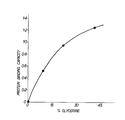
- Table IV given herein describes resuspendability of the Al 2 O 3 -glycerol-HCl system at various glycerol concentrations.
- Example 6 To the first 1800 gram aliquot was added 36 grams glycerol and 15.7 ml 31% HC1 under constant agitation from a dispersator. The pH was measured and found to be 4.3. 130 grams of finely divided, free-flowing, white powder resulted after spray drying at parameters mentioned in Example 1. Resuspension of this powder and the powders of Examples 12 through 15 were according to the procedures of Example 6.
- Example 7 One gram of Example 7 powder and 25 grams of deionized water were put into a 4" x 1" glass vial and shaken ten times. This represented the 2% A1 2 0 3 example. Except for powder quantities, all resuspensions were performed identically and followed the procedures given in Example 6.
- Example 7 This example is a duplicate of Example 7.
- the acidified batch was split into two equal portions of 3800 grams, each put into an 8 liter Nalgene polypropylene vessel. To one of these 3800 gram batches was added 43.4 grams of glycerol. This batch was agitated for one hour. The other 3800 gram batch received no glycerol.
- the unacidified half was also split into two aliquots of about 3060 grams each. Again, each was placed in an 8 liter Nalgene polypropylene vessel. One portion received 35.0 gram glycerol according to the formula given for Examples 1-5, and one portion received no glycerol.
- the regime for Examples 21-33 is given in Table VII herein; the results for Examples 21-33 are given in Tables VIII and IX herein.
- the slurries were all spray dried according to Example 1, but 2 liters of well water had to be added to the unacidified slurries to make them pumpable.
- Al 2 O 3 -glycerol co-dried powder was used in Examples 27 to 29. These resuspensions were prepared according to the procedure in Example 21A.
- Examples 34-50 show the superior resuspendability of A1 2 0 3 gel co-dried with a number of additives, thirteen of eighteen having a positive effect on resuspendability.
- a protein reagent was prepared by pipetting 30 ml of deionized water into a 100 ml breaker. 1.596 grams of bovine albumin Fraction V powder, Armour Pharmaceutical Company, was added to the water. The resultant mixture was gently stirred to effect solution. The solution was then filtered through Whatman #4 filter paper and stored in a glass stoppered flask.
- Protein reagent as prepared according to the above was pipetted in amounts of 0.5, 1.0, 1.5 and 2.0 ml respectively into four different 50 ml volumetric flasks and each flask was diluted to the mark with deionized water.
- the four standards were each well mixed. Each standard contained 0.25, 0.50, 0.75 and 1.00 mg. protein per/ml respectively.
- Absorbance of each standard was obtained at a wavelength of 280 nm using 10 mm silica cells on a Beckman Model 25 spectrophotometer using deionized water as a blank.
- a standard graph was prepared by plotting absorbance vs. concentration of each protein standard (mg. Protein/ml) on linear graph paper. The best possible straight line to fit most of the points and the origin was drawn.
- the tubes were centrifuged for 15 minutes at 2000 to 2500 R P M. The supernatant was filtered through a millipore HA (0.45 pm) membrane filter paper. 10 ml of clear filtrate was pipetted into a 100 ml volumetric flask and diluted to volume with deionized water. The absorbance for each sample at 280 nm wavelength was read using 10 mm silica cells, the model 25 spectrophotometer and deionized water as a blank. The concentration of each non-adsorbed protein sample was obtained in mg/ml at approximately 40 mg A 1 2 0 3 and 80.0 mg A1 2 0 3 level from the standard graph.
- the average of both the mg Protein/mg Al 2 O 3 were taken at approximately 40 mg Al 2 O 3 and 80 m g A1 2 0 3 level and reported as mg Protein/mg Al 2 O 3 .
- micronization might increase the values of the co-dried systems and not the A1 2 0 3 dried without additives.
- Example 51-71 The same test procedure as in Examples 51-71 was utilized in Examples 72-91 except the pH was adjusted to 5.5.
- the glycerine control (100% glycerine) test was not applicable, since both it and the protein solution were soluble in mixed form.
- Examples 92-100 co-dried systems of Al 2 O 3 - glycerine prepared in accordance with this invention were evaluated with and without the addition of acid (HCl).
- the results for Examples 92-100 are given in Table XV herein. It is evident from Table XV that re-suspendability was afforded to only those systems employing acid. The use of acid also increased the protein binding capacity of the co-dried systems.
Landscapes
- Health & Medical Sciences (AREA)
- Life Sciences & Earth Sciences (AREA)
- Chemical & Material Sciences (AREA)
- General Health & Medical Sciences (AREA)
- Inorganic Chemistry (AREA)
- Veterinary Medicine (AREA)
- Public Health (AREA)
- Animal Behavior & Ethology (AREA)
- Organic Chemistry (AREA)
- Epidemiology (AREA)
- Pharmacology & Pharmacy (AREA)
- Geology (AREA)
- Medicinal Chemistry (AREA)
- Dermatology (AREA)
- Birds (AREA)
- Medicinal Preparation (AREA)
Applications Claiming Priority (2)
| Application Number | Priority Date | Filing Date | Title |
|---|---|---|---|
| US28968781A | 1981-08-03 | 1981-08-03 | |
| US289687 | 1981-08-03 |
Publications (3)
| Publication Number | Publication Date |
|---|---|
| EP0072142A2 true EP0072142A2 (de) | 1983-02-16 |
| EP0072142A3 EP0072142A3 (en) | 1984-08-08 |
| EP0072142B1 EP0072142B1 (de) | 1991-01-16 |
Family
ID=23112642
Family Applications (1)
| Application Number | Title | Priority Date | Filing Date |
|---|---|---|---|
| EP82303962A Expired - Lifetime EP0072142B1 (de) | 1981-08-03 | 1982-07-27 | Herstellung von mischgetrockneten Aluminiumoxyhydroxyden |
Country Status (4)
| Country | Link |
|---|---|
| US (1) | US5558858A (de) |
| EP (1) | EP0072142B1 (de) |
| CA (1) | CA1174975A (de) |
| DE (1) | DE3280292D1 (de) |
Cited By (3)
| Publication number | Priority date | Publication date | Assignee | Title |
|---|---|---|---|---|
| US4710373A (en) * | 1984-03-12 | 1987-12-01 | Kao Corporation | Long wavelength ultraviolet ray absorber |
| EP0369715A1 (de) * | 1988-11-14 | 1990-05-23 | Tomita Pharmaceutical Corporation Limited | Aluminiumhydroxid vom Boehmit-Typ, Verfahren zu dessen Herstellung und das Hydroxid als wirksamen Bestandteil enthaltendes Phosphationen-Adsorptionsmittel |
| US7241713B2 (en) | 2003-10-02 | 2007-07-10 | Exxonmobil Chemical Patents Inc. | Molecular sieve catalyst composition, its making and use in conversion processes |
Families Citing this family (2)
| Publication number | Priority date | Publication date | Assignee | Title |
|---|---|---|---|---|
| US20040138180A1 (en) * | 2002-10-03 | 2004-07-15 | Barr Laboratories, Inc. | Bisphosphonate composition and process for the preparation thereof |
| CA2606407A1 (en) * | 2005-04-26 | 2006-11-02 | Tda Research, Inc. | Releasable corrosion inhibitor compositions |
Family Cites Families (15)
| Publication number | Priority date | Publication date | Assignee | Title |
|---|---|---|---|---|
| US1621528A (en) * | 1921-09-21 | 1927-03-22 | Ellis Carleton | Composition of matter for treating animal tissue |
| GB489769A (en) * | 1937-01-25 | 1938-08-03 | Ig Farbenindustrie Ag | Improvements in the manufacture and production of water-soluble basic aluminium compounds |
| US2256505A (en) * | 1939-03-25 | 1941-09-23 | William R Warner & Company Inc | Cosmetic |
| US2373198A (en) * | 1940-06-05 | 1945-04-10 | Victor H Roehrich | Aluminum solutions and preparations |
| US2350047A (en) * | 1941-09-13 | 1944-05-30 | Lehn & Fink Products Corp | Antiperspirant and deodorant |
| US2392153A (en) * | 1943-12-31 | 1946-01-01 | William R Warner & Co Inc | Production of basic aluminum chloride |
| US2459289A (en) * | 1945-03-24 | 1949-01-18 | Victor H Rochrich | Basic aluminum salt solutions |
| US3014055A (en) * | 1958-12-15 | 1961-12-19 | Nalco Chemical Co | Water soluble complexes of alumina |
| US2944914A (en) * | 1959-08-17 | 1960-07-12 | Du Pont | Method of esterifying the surface of alumina monohydrate platelets and product thereof |
| US3259545A (en) * | 1961-07-10 | 1966-07-05 | Wallace & Tiernan Inc | Stable aluminum hydroxide gel or aluminum hydroxide-sodium zirconium lactate antiperspirant stick |
| US3499963A (en) * | 1964-04-15 | 1970-03-10 | Armour Pharma | Codried aluminum hydroxide-aluminum chelate antacid |
| US3599150A (en) * | 1969-08-01 | 1971-08-10 | Miles Lab | Stabilized aluminum hydroxide suspensions |
| DE2163036A1 (de) * | 1971-12-18 | 1973-06-20 | Gerhard Dr Walter | Pharmazeutisches oder kosmetisches praeparat mit retardwirkung fuer externe applikation |
| AU5526173A (en) * | 1972-05-12 | 1974-11-07 | Armour Pharma | Resuspendable dried antacids resuspendable dried antacids |
| US4115553A (en) * | 1973-12-10 | 1978-09-19 | Armour Pharmaceutical Company | Antacid tablets |
-
1982
- 1982-06-29 CA CA000406212A patent/CA1174975A/en not_active Expired
- 1982-07-27 DE DE8282303962T patent/DE3280292D1/de not_active Expired - Lifetime
- 1982-07-27 EP EP82303962A patent/EP0072142B1/de not_active Expired - Lifetime
-
1990
- 1990-09-17 US US07/586,333 patent/US5558858A/en not_active Expired - Fee Related
Cited By (3)
| Publication number | Priority date | Publication date | Assignee | Title |
|---|---|---|---|---|
| US4710373A (en) * | 1984-03-12 | 1987-12-01 | Kao Corporation | Long wavelength ultraviolet ray absorber |
| EP0369715A1 (de) * | 1988-11-14 | 1990-05-23 | Tomita Pharmaceutical Corporation Limited | Aluminiumhydroxid vom Boehmit-Typ, Verfahren zu dessen Herstellung und das Hydroxid als wirksamen Bestandteil enthaltendes Phosphationen-Adsorptionsmittel |
| US7241713B2 (en) | 2003-10-02 | 2007-07-10 | Exxonmobil Chemical Patents Inc. | Molecular sieve catalyst composition, its making and use in conversion processes |
Also Published As
| Publication number | Publication date |
|---|---|
| US5558858A (en) | 1996-09-24 |
| DE3280292D1 (de) | 1991-02-21 |
| EP0072142B1 (de) | 1991-01-16 |
| EP0072142A3 (en) | 1984-08-08 |
| CA1174975A (en) | 1984-09-25 |
Similar Documents
| Publication | Publication Date | Title |
|---|---|---|
| EP0261560B1 (de) | Titandioxydsol und Verfahren zur seiner Herstellung | |
| US4618488A (en) | Toothpaste composition | |
| EP1242307B1 (de) | Verfahren zur herstellung von orthokieselsäure, sowie nach dem verfahren hergestellte kieselsäure und ihre verwendung | |
| HU207968B (en) | Composition containing adsorbing silicium-dioide and process for producing such silicium-dioxide | |
| GB2144992A (en) | Antiperspirants | |
| EP0072142A2 (de) | Herstellung von mischgetrockneten Aluminiumoxyhydroxyden | |
| EP0137935B1 (de) | Zahnpastazubereitung | |
| EP3284717B1 (de) | Pulver mit eisenpyrophosphat und verfahren zur herstellung davon | |
| EP0337464B1 (de) | Schweisshemmende Mittel und Verfahren zur Herstellung | |
| US4482542A (en) | Antacid material based on magnesium aluminium hydroxide and the preparation thereof | |
| US3361769A (en) | Bi-metallic salts of gluconic, glucuronic, or galacturonic acid | |
| US4639362A (en) | Process for the production of magaldrate | |
| US4112072A (en) | Resuspendable dried antacids | |
| US5563258A (en) | Sucralfate aqueous suspension and its method of preparation | |
| US5039514A (en) | Alumina hydrate-containing toothpaste | |
| CA1201383A (en) | Antacid composition and process for its preparation | |
| US20030215485A1 (en) | Composition comprising a liquid absorbed on a support based on precipitated silica | |
| US6767559B2 (en) | DASC compositions, process for preparing same and suspensions containing same | |
| US4338311A (en) | Hydrophilic choline salicylate formulation | |
| US3208906A (en) | Glycine-stabilized aluminum hydroxidemagnesium compound codried gel antacids and process of making the same | |
| JPH059122A (ja) | スクラルフエート水性懸濁原液及びその製法 | |
| DE1617277C3 (de) | Verfahren zur Herstellung eines flüssigen Antazidums | |
| AU2024253395A1 (en) | Methods of manufacturing peptide salts | |
| HU186227B (en) | Process for producing new antacid composition | |
| CZ283320B6 (cs) | Deoxyspergualintrihydrochlorid v krystalické formě beta a způsob jeho výroby |
Legal Events
| Date | Code | Title | Description |
|---|---|---|---|
| PUAI | Public reference made under article 153(3) epc to a published international application that has entered the european phase |
Free format text: ORIGINAL CODE: 0009012 |
|
| AK | Designated contracting states |
Designated state(s): DE FR GB |
|
| PUAL | Search report despatched |
Free format text: ORIGINAL CODE: 0009013 |
|
| AK | Designated contracting states |
Designated state(s): DE FR GB |
|
| 17P | Request for examination filed |
Effective date: 19840822 |
|
| 17Q | First examination report despatched |
Effective date: 19851030 |
|
| R17C | First examination report despatched (corrected) |
Effective date: 19860616 |
|
| RAP1 | Party data changed (applicant data changed or rights of an application transferred) |
Owner name: REHEIS, INC. |
|
| GRAA | (expected) grant |
Free format text: ORIGINAL CODE: 0009210 |
|
| AK | Designated contracting states |
Kind code of ref document: B1 Designated state(s): DE FR GB |
|
| ET | Fr: translation filed | ||
| REF | Corresponds to: |
Ref document number: 3280292 Country of ref document: DE Date of ref document: 19910221 |
|
| PG25 | Lapsed in a contracting state [announced via postgrant information from national office to epo] |
Ref country code: GB Effective date: 19910727 |
|
| PLBE | No opposition filed within time limit |
Free format text: ORIGINAL CODE: 0009261 |
|
| STAA | Information on the status of an ep patent application or granted ep patent |
Free format text: STATUS: NO OPPOSITION FILED WITHIN TIME LIMIT |
|
| 26N | No opposition filed | ||
| GBPC | Gb: european patent ceased through non-payment of renewal fee | ||
| PG25 | Lapsed in a contracting state [announced via postgrant information from national office to epo] |
Ref country code: FR Effective date: 19920331 |
|
| PG25 | Lapsed in a contracting state [announced via postgrant information from national office to epo] |
Ref country code: DE Effective date: 19920401 |
|
| REG | Reference to a national code |
Ref country code: FR Ref legal event code: ST |