EP0071663B1 - Integrated circuit for the regulation of the power supply voltage according to the switching principle in television apparatuses - Google Patents
Integrated circuit for the regulation of the power supply voltage according to the switching principle in television apparatuses Download PDFInfo
- Publication number
- EP0071663B1 EP0071663B1 EP19810106182 EP81106182A EP0071663B1 EP 0071663 B1 EP0071663 B1 EP 0071663B1 EP 19810106182 EP19810106182 EP 19810106182 EP 81106182 A EP81106182 A EP 81106182A EP 0071663 B1 EP0071663 B1 EP 0071663B1
- Authority
- EP
- European Patent Office
- Prior art keywords
- input
- output
- counter
- voltage
- flop
- Prior art date
- Legal status (The legal status is an assumption and is not a legal conclusion. Google has not performed a legal analysis and makes no representation as to the accuracy of the status listed.)
- Expired
Links
- 230000001105 regulatory effect Effects 0.000 claims description 13
- 239000004065 semiconductor Substances 0.000 claims description 5
- 238000010079 rubber tapping Methods 0.000 claims 1
- 238000011161 development Methods 0.000 description 10
- 230000018109 developmental process Effects 0.000 description 10
- 238000010586 diagram Methods 0.000 description 4
- 230000010354 integration Effects 0.000 description 4
- 238000004804 winding Methods 0.000 description 3
- 230000001419 dependent effect Effects 0.000 description 2
- 238000000034 method Methods 0.000 description 2
- 238000010276 construction Methods 0.000 description 1
- 239000013078 crystal Substances 0.000 description 1
- 230000000694 effects Effects 0.000 description 1
- 238000005516 engineering process Methods 0.000 description 1
- 230000005669 field effect Effects 0.000 description 1
- 238000002347 injection Methods 0.000 description 1
- 239000007924 injection Substances 0.000 description 1
- 230000007257 malfunction Effects 0.000 description 1
- 230000010355 oscillation Effects 0.000 description 1
- 230000001681 protective effect Effects 0.000 description 1
- 238000000926 separation method Methods 0.000 description 1
- 238000011144 upstream manufacturing Methods 0.000 description 1
Images


Classifications
-
- H—ELECTRICITY
- H02—GENERATION; CONVERSION OR DISTRIBUTION OF ELECTRIC POWER
- H02M—APPARATUS FOR CONVERSION BETWEEN AC AND AC, BETWEEN AC AND DC, OR BETWEEN DC AND DC, AND FOR USE WITH MAINS OR SIMILAR POWER SUPPLY SYSTEMS; CONVERSION OF DC OR AC INPUT POWER INTO SURGE OUTPUT POWER; CONTROL OR REGULATION THEREOF
- H02M3/00—Conversion of DC power input into DC power output
- H02M3/22—Conversion of DC power input into DC power output with intermediate conversion into AC
- H02M3/24—Conversion of DC power input into DC power output with intermediate conversion into AC by static converters
- H02M3/28—Conversion of DC power input into DC power output with intermediate conversion into AC by static converters using discharge tubes with control electrode or semiconductor devices with control electrode to produce the intermediate AC
- H02M3/325—Conversion of DC power input into DC power output with intermediate conversion into AC by static converters using discharge tubes with control electrode or semiconductor devices with control electrode to produce the intermediate AC using devices of a triode or a transistor type requiring continuous application of a control signal
- H02M3/335—Conversion of DC power input into DC power output with intermediate conversion into AC by static converters using discharge tubes with control electrode or semiconductor devices with control electrode to produce the intermediate AC using devices of a triode or a transistor type requiring continuous application of a control signal using semiconductor devices only
- H02M3/33507—Conversion of DC power input into DC power output with intermediate conversion into AC by static converters using discharge tubes with control electrode or semiconductor devices with control electrode to produce the intermediate AC using devices of a triode or a transistor type requiring continuous application of a control signal using semiconductor devices only with automatic control of the output voltage or current, e.g. flyback converters
- H02M3/33515—Conversion of DC power input into DC power output with intermediate conversion into AC by static converters using discharge tubes with control electrode or semiconductor devices with control electrode to produce the intermediate AC using devices of a triode or a transistor type requiring continuous application of a control signal using semiconductor devices only with automatic control of the output voltage or current, e.g. flyback converters with digital control
Definitions
- the invention relates to integrable circuit arrangements for regulating DC supply voltages according to the switching regulator principle, according to the preamble of claim 1.
- Such a circuit arrangement is known from "IBM Technical Disclosure Bulletin", July 1980, pages 466 and 467.
- the object of the invention characterized in the claims is therefore to develop the known integrated switching regulator so that it is suitable for use in television sets, only such further digital basic circuits, such as counters and logic gates, are to be used, which in their special circuitry Link to solve the special control task and in particular to generate the pulse width modulated control signal are suitable.
- DE-OS 28 43 988 it is known from DE-OS 28 43 988 to also build control circuits based on the switching regulator principle in such a way that the pulse-width-modulated control signal is generated on the basis of digital circuit principles.
- a microprocessor is used for this purpose, which, starting from a clock signal, generates the pulse-width-modulated signal in steps of this clock frequency.
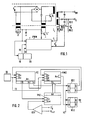
- Fig. 1 the construction of a television power supply unit using a switching regulator, which is conventional in principle, is shown.
- the essential parts of this basic circuit diagram are provided with reference numerals.
- the mains voltage U N is applied to the primary winding of a main transformer via a rectifier bridge and the power semiconductor component TL.
- Another small transformer feeds another rectifier, from which the operating voltage for the switching regulator is taken.
- the network side is completely galvanically isolated from the DC voltage side, as required by the VDE standards.
- the half-liter component TL ' is shown, which is controlled by the pulse-width modulator PWM and acts on the power semiconductor component TL mentioned in a known manner via the associated additional transformer.
- corresponding alternating voltages are generated in the two secondary windings shown according to the flyback converter principle known from direct voltage converters, which in the same direction result in the regulated voltages Ug and Ugg.
- the voltage U9 proportional to this is taken off and the pulse width modulator PWM as information about the Actual value supplied.
- the load current I L flowing in the load circuit is measured by means of the current measuring resistor Ri1 and the voltage drop resulting therefrom is also supplied to the pulse width modulator as current information U j .
- the tap for the current signal U j that is to say the connection point between the secondary windings and the current measuring resistor R11, is connected to the regulated voltage Ug via the resistor R12, so that this connection point is fixed in terms of potential.
- FIG. 1 also shows the clock generator TG, the output signal of which is fed to the pulse width modulator PWM as a clock signal TS, as well as the horizontal synchronizing pulses HZ originating from the synchronizing signal separation stage SS of the television set.
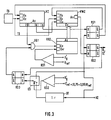
- the pulse width modulated signal is generated by means of digital circuits based on the period of the clock signal and is variable in steps of this period.
- the target / actual comparison is carried out by the first digital comparator stage KS1, at the first input of which the reference voltage Urf and at the second input of which the voltage U9 proportional to the regulated voltage Ug is shown in FIG. 1.
- the reference voltage U ref can be generated in any of the known ways, for example by means of a Z-diode or a temperature-compensated Z-diode.
- the first digital comparator KS1 only generates a binary signal at its output, the two values of which, that is to say an H level assigned to a positive voltage value and an L level assigned to a lower voltage value, of the two input signal ranges U ref > U ' g and U ref ⁇ U ' g are assigned.
- control amplifier used in conventional analog control circuits is therefore replaced by the comparator stage, which only supplies a binary signal in relation to the reference voltage U ret falling below or exceeding the actual value in the form of the voltage U9.
- the further digital comparator stages to be added in the further exemplary embodiments and further developments are also stages of this type with a binary signal output.
- the clock generator TG is connected to the counting input Ez of the up counter VZ of the counting capacitance n and to the counting input Ez of the preselection counter VWZ.
- the pulses of the clock signal TS are therefore counted by means of these two counters during certain times to be described.
- the counter reading output Azg is located at the counter input Ez of the up / down counter, which thus counts these output pulses of the up counter VZ either in the up or down direction, the output signal of the first comparator stage KS1 defining the counting direction via the switchover input Evr for up or down counting.
- the counter status outputs Az of the up / down counter VRZ are connected in parallel to the preselection inputs Ev of the preselection counter VWZ, which is indicated by the band-like arrow in FIG. 2.
- the count reached at certain times in the up / down counter TCC is thus read into the preset counter VWZ and serves to determine the duration of a Zählz y klus.
- the preset counter VWZ can either be an up counter that counts from the preselected counter reading up to a certain higher counter reading and then emits an impulse at this counter reading output as a zero crossing output, or it can be a down counter that counts down to zero from the preselected counter reading and then emits a zero crossing output pulse.
- the take-over input Eu of the preselection counter VWZ is at one of the other counter reading outputs, namely the output Azk, of the up-counter VZ. If this counter has thus reached the counter reading k, the counter reading reached in the up / down counter at this time is adopted as the preselection counter reading in the preselection counter VWZ.
- the nth counter output Azn of the up counter VZ is connected to the R input of the first RS flip-flop RS1, whose Q output is at the start and enable input Es of the up counter VZ, while its Q output is connected to the start and enable input Es of the preset counter VWZ is connected.
- the horizontal synchronizing pulses HZ are located at the S input of the first RS flip-flop RS1. At the beginning of each horizontal pulse, the first RS flip-flop RS1 is thus set, and the up counter VZ is started by the corresponding Q signal. When it has reached its nth counter reading, the first RS flip-flop RS1 is reset again, so that on the one hand the up counter VZ cannot continue counting but on the other hand the preset counter VWZ is now started via the Q signal.
- the zero crossing output of the preselection counter VWZ is connected to the R input of the second RS flip-flop RS2, at whose S ' input lie the horizontal pulses HZ.
- This flip-flop like the flip-flop RS1, is therefore set by each horizontal pulse and is reset when the preselection counter VWZ reaches zero.
- a pulse is thus generated at the Q output of the second RS flip-flop RS2, which is the pulse-width-modulated pulse for driving the power semiconductor component TL.
- This control pulse is thus composed of a first part in time, which is represented by the Counting capacity n of the up-counter VZ is predetermined, and a second part, which is determined by the count given at the time of takeover by the count of the up / down counter.
- the pulse width modulated signal thus has a minimum pulse width predetermined by the up counter VZ and a maximum pulse width which is determined by the counting capacities of the up counter VZ and the up / down counter VRZ.
- the counting capacities of the three counters VZ, VWZ, VRZ are selected taking into account the frequency of the clock generator TG and the line duration so that the maximum pulse width of the pulse-width-modulated signal does not exceed a certain part of the line duration, for example 44 ⁇ s.
- FIG. 3 shows a further development of the arrangement according to FIG. 2, which contains additional circuit parts for the start-up phase of the switching regulator after the mains voltage has been switched on.
- the second digital comparator stage KS2 is provided, which compares the voltage U9 with a reference voltage U ' ref , which is approximately 0.75 to 0.95 times the reference voltage U ref . If the voltage U9 which is proportional to the regulated voltage Ug is 5 to 25% below its nominal value, the second comparator stage KS2 emits one binary signal level and above this range the other binary signal level.
- These two signal levels control the changeover contact of the electronic switch ES, the output of which is at the S input of the third RS flip-flop RS3.
- At one input of the switch ES are the horizontal synchronizing pulses HZ and at the other the output of the frequency divider BT, the input of which is also supplied with the horizontal synchronizing pulses HZ.
- the R input of the third RS flip-flop RS3 is connected to the Q output of the second RS flip-flop RS2 and is therefore supplied with the pulse-width-modulated pulse.
- the Q output of the third RS flip-flop RS3 is connected to an input of the first AND gate UG1, which with its other input-output path into the connecting line between the counter reading output Azg of the up counter VZ and the counting input Ez of the up / down counter VRZ is inserted.
- the third RS flip-flop RS3 is set by the number of horizontal pulses reduced by the divider factor of the frequency divider BT.
- the counting pulses to the up / down counter are passed through the first AND gate UG1.
- the change in its counter reading Az is therefore much slower, i.e. the pulse-width-modulated signal is not changed during the start-up phase for the duration of each line, but only during every rth line if the divisor of the frequency divider BT is designated by r.
- the horizontal synchronizing pulses HZ are located directly at the S input of the third RS flip-flop RS3, so that operation as in FIG. 2 occurs because during every synchronizing pulse the output pulses of the counter output Azg of the up-counter VZ reach the counting input Ez of the up-down counter VRZ.
- FIG. 4 shows a further development of the arrangement according to FIG. 3, which relates to the additional circuit parts compared to FIG. 3, the third digital comparator stage KS3 and the first OR gate OG1.
- these two additional circuit parts can also be used in the arrangement according to FIG. that is, without the additional circuit parts shown in FIG. 3. They relate to the measuring circuit short-circuit protection of the control circuit and can therefore also be used independently of the start-up circuit shown in FIG.
- the third comparator stage KS3 compares the voltage U9, which is proportional to the regulated voltage Ug, with the fixed voltage U s of a first voltage threshold, which is approximately 0.1 to 0.2 times the reference voltage U, ef .
- the output signal of the third comparator stage KS3 is fed to the up / down counter VRZ now equipped with the reset input Er and also via the first OR gate OG1 also to the R input of the second RS flip-flop RS2.
- the first input OR gate OG1 is inserted with its other input - output path into the connecting line between the zero crossing output An of the preselection counter VWZ and the R input of the second RS flip-flop RS2.
- the output signal of the third comparator stage KS3 resets the up / down counter to its zero position and thus ensures that the preselection counter also comes to its zero position after the next takeover pulse .
- this output pulse from the third comparator stage KS3 also resets the second RS flip-flop RS2, which determines the duration of the pulse-width-modulated signal, and the output pulse duration is thereby immediately reduced to the minimum duration.
- Revelschleife protection is therefore effective immediately after the short circuit occurs and is also maintained for the duration of the short circuit. Furthermore, the short-circuit protection automatically becomes ineffective after the short-circuit has ceased, i.e. the function of a so-called electronic fuse with automatic restart is present.
- FIG. 5 shows a further development of the arrangement according to FIG. 4, which in addition to the control loop protection also provides protection in the case of short circuit and current overload of the power supply output voltage represents.
- the additional circuit parts compared to FIG. 4 are provided, namely the fourth and fifth digital comparator stages KS4 and KS5, the fourth RS flip-flop RS4, the second and the third OR gate OG2, OG3 and the second and the third AND gate UG2, UG3.
- the second OR gate OG2 can be omitted if the control loop protection is not provided by means of the third comparator stage KS3.
- the fourth and fifth comparator stages KS4, KS5 compare the fixed voltage U s of the first voltage threshold and the fixed voltage US of a second voltage threshold in each case with the load current-proportional voltage U ; , see. Fig. 1.
- the fixed voltage Us of the second voltage threshold is 0.25 to 0.4 times the reference voltage U ref .
- the output of the fourth comparator stage KS4 is OR-linked to that of the third comparator stage KS3 via the second OR gate OG2 and thus leads to the reset input Er of the up / down counter VRZ. So if the load current exceeds a value corresponding to the second voltage threshold, the instantaneous regulation back to the minimum pulse width of the pulse-width-modulated signal takes place, as in the short-circuit case of the control loop described above.
- the fifth comparator stage KS5 gradually reduces the pulse width of the pulse-width-modulated signal in a load current range between the maximum load current specified by the first voltage threshold U s and the load current specified by the second voltage threshold US.
- the fifth comparator stage KS5 compares the fixed voltage value Us of the second voltage threshold with the load current-dependent voltage U 1 .
- the output of the fifth comparator stage KS5 is connected to the S input of the fourth RS flip-flop RS4, the R input of which is connected to the Q output of the first RS flip-flop RS1.
- the Q output of the fourth RS flip-flop Rs4 is connected to one input of the second AND gate UG2, the other input of which is connected to a further counter output Azj of the up-counter VZ and the output of which is connected to an input of the third OR gate OG3. This is inserted with its other input - output path into the connecting line between the output of the first AND gate UG1 and the counting input Ez of the up / down counter.
- the counting input Ez of the up / down counter VRZ is supplied with the additional pulse at the counter reading output Azj of the upstream counter VZ in addition to the output pulse at the counter output Azg , the up / down counter is counted in the reverse direction at twice the frequency.
- the pulse widths are twice as large - the speed of reduction as in normal control mode.
- the Q output of the fourth RS flip-flop RS4 is AND-linked to the output signal of the first comparator stage KS1 by means of the third AND gate UG3, that is to say that regardless of the output signal of the comparator stage KS1, the up / down counter VRZ can only count down as long as how a current exceedance proportional to the U ' s threshold is determined by the comparator stage KS5.
- the invention is thus specially designed for the requirements of a switching regulator that occur in a television set. It can be adapted to a wide variety of accidents, particularly when using the explained further developments. Due to the principle on which the invention is based, the division of the pulse duration of the pulse-width-modulated signal into a minimum pulse duration and a variable, it is always ensured that each fault, depending on its severity, leads to a reduction in the instantaneous pulse width either immediately or at twice the rate of change.
- further functions of the power supply unit can also be implemented, for example a shutdown of the power supply unit after a certain number of malfunctions occurring or an electronic on / off switch.
- the maximum pulse width of the pulse-width-modulated signal is 44.8 ⁇ s and the minimum pulse width is 1.5 ⁇ s, while the pulse width in the adjusted state is 26 to 32 ps.
- the switch-off delay after the protective circuits described have responded is 1 ⁇ s.
- the circuit according to the invention is suitable due to the fact that it works with exclusively digital subcircuits, in particular for integration by means of an insulating layer - field effect transistors, that is to say for integration in the so-called MOS technology.
- bipolar integration techniques which are particularly suitable for digital circuits, for example the technique of the so-called integrated injection logic (I 2 L circuits) or the implementation using other bipolar digital circuit families.
- the steepness of the slope in the start-up range is +56 ns per 32 lines.
- the rate of change of the load current limitation is -112 ns per line.
Landscapes
- Engineering & Computer Science (AREA)
- Power Engineering (AREA)
- Dc-Dc Converters (AREA)
Description
Die Erfindung betrifft integrierbare Schaltungsanordnungen zur Regelung von Versorgungsgleichspannungen nach dem Schaltregler - Prinzip, nach dem Oberbegriff des Anspruchs 1. Eine solche Schaltungsanordnung ist aus "IBM Technical Disclosure Bulletin", Juli 1980, Seiten 466 und 467 bekannt.The invention relates to integrable circuit arrangements for regulating DC supply voltages according to the switching regulator principle, according to the preamble of
Sollen derartige Schaltregler in Fernsehgeräten verwendet werden, so sind spezielle Forderungen zu erfüllen. Als Hauptforderung ist dabei anzusehen, daß die Regelgeschwindigkeit, mit der eine Regelabweichung zu einer Nachregelung führt, so groß sein muß, daß dieseinnerhalb der Zeilendauer erfolgt. Die oben genannte Veröffentlichung enthält keinen Hinweis darauf, wie ein Betrieb in Fernsehgeräten mit dieser Schaltungsanordnung zu ermöglichen ist, insbesondere im Hinblick auf kritisch werdende Störfälle der Spannungsversorgung.If such switching regulators are to be used in television sets, special requirements have to be met. The main requirement is that the control speed with which a control deviation leads to readjustment must be so high that it takes place within the line duration. The above-mentioned publication contains no indication of how an operation in television sets with this circuit arrangement is to be made possible, in particular with regard to critical power supply failures.
Die Aufgabe der in den Ansprüchen gekennzeichnet Erfindung besteht daher darin, den bekannten integrierten Schaltregler so weiterzubilden, daß er für den Betrieb in Fernsehgeräten geeignet ist, wobei nur solche weitere digitale Grundschaltungen, wie Zähler und Verknüpfungsglieder, verwendet werden sollen, die in ihrer speziellen schaltungstechnischen Verknüpfung die spezielle Regelaufgabe zu lösen und insbesondere das impulsbreitenmodulierte Steuersignal zu erzeugen geeignet sind.The object of the invention characterized in the claims is therefore to develop the known integrated switching regulator so that it is suitable for use in television sets, only such further digital basic circuits, such as counters and logic gates, are to be used, which in their special circuitry Link to solve the special control task and in particular to generate the pulse width modulated control signal are suitable.
Weitere Schaltregler in integrierter Form für allgemeine Verwendung mit pulsbreiten moduliertem Steuersignal für das periodisch ein-und auszuschaltende Leistungshalbleiterbauelement sind auch in der Zeitschrift "Electronic Design", 01. Februar 1979, Seite 102 und 18. Januar 1980, Seiten 94-101 beschrieben. Die gezeigten Schaltregler erzeugen das pulsbreitenmodulierte Steuersignal nach Art analoger Schaltungen, d.h. in Abhängigkeit vom Ist/Soll-Vergleich ist die Pulsbreite kontinuierlich veränderbar. Bei diesen Schaltungen ist jeweils ein Sägezahngenerator vorgesehen, der als Vergleichsspannung bei der Erzeugung des pulsbreitenmodulierten Steuersignals dient. Dieser Sägezahngenerator hat in der dritt-genannten Literaturstelle einen Synchronisiereingang.Further switching regulators in an integrated form for general use with a pulse-width modulated control signal for the power semiconductor component which is periodically switched on and off are also described in the magazine "Electronic Design", February 1, 1979, pages 102 and 18 January 1980, pages 94-101. The switching regulators shown generate the pulse-width-modulated control signal in the manner of analog circuits, i.e. the pulse width can be changed continuously depending on the actual / target comparison. In these circuits, a sawtooth generator is provided, which serves as a reference voltage when generating the pulse-width-modulated control signal. This sawtooth generator has a synchronization input in the third cited reference.
Andererseits ist es aus der DE-OS 28 43 988 bekannt, Regelschaltungen nach dem Schaltregler-Prinzip auch so aufzubauen, daß das pulsbreitenmodulierte Steuersignal aufgrund digitaler Schaltungsprinzipien erzeugt wird. Hierzu dient im wesentlichen ein Mikroprozessor, der, ausgehend von einem Taktsignal, das pulsbreitenmodulierte Signal in Schritten dieser Taktfrequenz erzeugt.On the other hand, it is known from DE-OS 28 43 988 to also build control circuits based on the switching regulator principle in such a way that the pulse-width-modulated control signal is generated on the basis of digital circuit principles. A microprocessor is used for this purpose, which, starting from a clock signal, generates the pulse-width-modulated signal in steps of this clock frequency.
Die gestellte Aufgabe wird bei der gattungsgermäßen Schaltungsanordnung durch die kennzeichnenden Merkmale des Patentanspruchs 1 gelöst.The object is achieved in the generic circuit arrangement by the characterizing features of
Die in den abhängigen Ansprüchen gekenzeichneten Weiterbildungen der Erfindung erweitern das im Anspruch 1 niedergelegte Prinzip der Erfindung durch die bei Regelschaltungen bekannten zusätzlichen Funktionen der sogenannten elektronischen Sicherung, also des Abschaltens des Reglers bzw. des Zurückregelns in einen ungefährlichen Belastungsbereich, wenn im Lastkreis ein Kurzschluß oder eine Überlastung auftritt. Diese zusätzlichen Funktionen sind dabei jedoch ebenfalls wie die Grundfunktionen mittels digitaler Schaltungs- und Funktionsprinzipien realisiert und unterscheiden sich somit von der nach analogen Prinzipien arbeitenden Realisierung bei den bekannten Anordnungen,The further developments of the invention characterized in the dependent claims extend the principle of the invention as set out in
Der Gegenstand der Erfindung und dessen Weiterbildungen werden num anhand der Figuren der Zeichnung näher erläutert.
- Fig. 1 zeigt in Form eines Prinzipschaltbilds ein Fernsehgerät-Netzteil unter Verwendung der Schaltungsanordnung nach der Erfindung,
- Fig. 2 zeigt in Form eines Blockschaltbilds de Grundaufbau des der Erfindung zugrundeliegenden Prinzips,
- Fig. 3 zeigt eine Weiterbildung der Anordnung nach Fig. 2 für den Anlaufbetrieb nach Einschalten der Netzspannung,
- Fig. 4 zeigt eine Weiterbildung der Anordnung nach Fig. 3 mit Kurzschlußschutz im Meßkreis, und
- Fig. 5 zeigt eine Weiterbildung der Anordnung nach Fig. 4 mit einer Erweiterung für den erwähnten Schutz bei Überlastung und Kurzschluß im Lastkreis.
- 1 shows in the form of a basic circuit diagram a television power supply using the circuit arrangement according to the invention,
- 2 shows in the form of a block diagram the basic structure of the principle on which the invention is based,
- 3 shows a development of the arrangement according to FIG. 2 for the start-up operation after switching on the mains voltage,
- Fig. 4 shows a development of the arrangement of FIG. 3 with short-circuit protection in the measuring circuit, and
- FIG. 5 shows a development of the arrangement according to FIG. 4 with an extension for the protection mentioned in the event of overload and short circuit in the load circuit.
In Fig. 1 ist der vom Prinzip her übliche Aufbau eines Fernsehgerät - Netzteils unter Verwendung eines Schaltreglers gezeigt. Für die Zwecke der Erfindung sind die wesentlichen Teile dieses Prinzipschaltbilds mit Bezugszeichen versehen. So wird die Netzspannung UN über eine Gleichrichterbrücke und das Leistungshalbleiterbauelement TL an die Primärwicklung eines Haupttransformators gelegt. Ein weiterer kleiner Transformator speist einen weiteren Gleichrichter, dem die Betriebsspannung für den Schaltregler entnommen wird. Wie durch die gestrichelten Linien zum Ausdruck kommt, ist die Netz-Seite vollständig von der Gleichspannungsseite galvanisch getrennt, wie dies von den VDE-Normen gefordert wird.In Fig. 1, the construction of a television power supply unit using a switching regulator, which is conventional in principle, is shown. For the purposes of the invention, the essential parts of this basic circuit diagram are provided with reference numerals. Thus, the mains voltage U N is applied to the primary winding of a main transformer via a rectifier bridge and the power semiconductor component TL. Another small transformer feeds another rectifier, from which the operating voltage for the switching regulator is taken. As is shown by the dashed lines, the network side is completely galvanically isolated from the DC voltage side, as required by the VDE standards.
Auf der netzgetrennten Seite ist das Halbeliterbauelement TL' gezeigt, das vom Pulsbreitenmodulator PWM angesteuert wird und über den zugeordneten weiteren Transformator auf das erwähnte Leistungshalbleiterbauelement TL in bekannter Weise einwirkt. Dadurch werden in den beiden gezeigten Sekundärwicklungen nach dem von Gleichspannungskonvertern her bekannten Sperrwandler - Prinzip entsprechende Wechselspannungen erzeugt, die gleichgerichtet die geregelten Spannungen Ug und Ugg ergeben. Am Abgriff des zwischen dem auf das Fernsehgerät - Chassis bezogenen Schaltungsnullpunkt und der geregelten Spannung Ug liegenden Spannungsteilers RG1, RG2 wird die hierzu proportionale Spannung U9 abgenommen und dem Impulsbreitenmodulator PWM als Information über den Ist-Wert zugeführt. Ferner wird mittels des Strommeß-Widerstands Ri1 der im Lastkreis fließende Laststrom IL gemessen und der daraus resultierende Spannungsabfall als Strominformation Uj dem Pulsbreitenmodulator ebenfalls zugeführt. Der Abgriff für das Stromsignal Uj, also der Verbindungspunkt zwischen den Sekundärwicklungen und dem Strommeß-Widerstand R11, ist über den Widerstand R12 an die geregelte Spannung Ug gelegt, so daß dieser Verbindungspunkt potentialmäßig festliegt.On the mains-separated side, the half-liter component TL 'is shown, which is controlled by the pulse-width modulator PWM and acts on the power semiconductor component TL mentioned in a known manner via the associated additional transformer. As a result, corresponding alternating voltages are generated in the two secondary windings shown according to the flyback converter principle known from direct voltage converters, which in the same direction result in the regulated voltages Ug and Ugg. At the tap of the voltage divider RG1, RG2 lying between the circuit zero relating to the television chassis and the regulated voltage Ug, the voltage U9 proportional to this is taken off and the pulse width modulator PWM as information about the Actual value supplied. Furthermore, the load current I L flowing in the load circuit is measured by means of the current measuring resistor Ri1 and the voltage drop resulting therefrom is also supplied to the pulse width modulator as current information U j . The tap for the current signal U j , that is to say the connection point between the secondary windings and the current measuring resistor R11, is connected to the regulated voltage Ug via the resistor R12, so that this connection point is fixed in terms of potential.
In Fig. 1 ist ferner der Taktgenerator TG gezeigt, dessen Ausgangssignal als Taktsignal TS dem Pulsbreitenmodulator PWM zugeführt ist, ebenso wie die aus der Synchronsignal - Abtrennstufe SS des Fernsehgeräts stammenden Horizontal - Synchronimpulse HZ.1 also shows the clock generator TG, the output signal of which is fed to the pulse width modulator PWM as a clock signal TS, as well as the horizontal synchronizing pulses HZ originating from the synchronizing signal separation stage SS of the television set.
In Fig. 2 ist das Grundprinzip des Pulsbreitenmodulators PWM nach Fig. 1 in Form eines schematischen Blockschaltbilds gezeigt. Das pulsbreitenmodulierte Signal wird mittels Digitalschaltungen, ausgehend von der Periodendauer des Taktsignals, erzeugt und ist in Schritten dieser Periodendauer veriabel. Als Taktgenerator TG eignet sich beispielsweise ein Quarzoszillator mit der vierfachen Farbhilfsträgerfrequenz von Farbfernsehgeräten, also ein Oszillator mit einer Schwingfrequenz von 17,7 MHz.2 shows the basic principle of the pulse width modulator PWM according to FIG. 1 in the form of a schematic block diagram. The pulse width modulated signal is generated by means of digital circuits based on the period of the clock signal and is variable in steps of this period. A crystal oscillator with four times the color subcarrier frequency of color television sets, for example an oscillator with an oscillation frequency of 17.7 MHz, is suitable as the clock generator TG.
Der Soll/Ist-Vergleich wird von der ersten digitalen Komparatorstufe KS1 vorgenommen, an deren erstem Eingang die Referenzspannung Urf und an deren zweitem Eingang die der geregelten Spannung Ug proportionale Spannung U9 nach Fig. 1 liegt. Die Referenzspannung Uref kann auf irgendeine der bekannten Arten erzeugt werden, also beispielsweise mittels einer Z-Diode oder einer temperaturkomponensierten Z-Diode. Der erste digitale Komparator KS1 erzeugt an seinem Ausgang lediglich ein Binärsignal, dessen beide Werte, also ein einem positiven Spannungswert zugeordneter H-Pegel und ein einem dazu niedrigeren Spannungswert zugeordneter L-Pegel, den beiden Eingangssignalbereichen Uref>U'g bzw. Uref<U'g zugeordnet sind. Bei der Erfindung wird also der bei üblichen analogen Regelschaltungen verwendete Regelverstärker durch die Komparatorstufe ersetzt, die lediglich ein Binärsignal bezüglich des Unter- bzw. Überschreitens der Referenzspannung Uret durch den Ist-Wert in Form der Spannung U9 liefert. Auch die in den weiteren Ausführungsbeispielen und Weiterbildungen hinzutretenden weiteren digitalen Komparatorstufen sind derartige Stufen mit Binärsignalausgang.The target / actual comparison is carried out by the first digital comparator stage KS1, at the first input of which the reference voltage Urf and at the second input of which the voltage U9 proportional to the regulated voltage Ug is shown in FIG. 1. The reference voltage U ref can be generated in any of the known ways, for example by means of a Z-diode or a temperature-compensated Z-diode. The first digital comparator KS1 only generates a binary signal at its output, the two values of which, that is to say an H level assigned to a positive voltage value and an L level assigned to a lower voltage value, of the two input signal ranges U ref > U ' g and U ref <U ' g are assigned. In the case of the invention, the control amplifier used in conventional analog control circuits is therefore replaced by the comparator stage, which only supplies a binary signal in relation to the reference voltage U ret falling below or exceeding the actual value in the form of the voltage U9. The further digital comparator stages to be added in the further exemplary embodiments and further developments are also stages of this type with a binary signal output.
Der Taktgenerator TG ist am Zähleingang Ez des Vorwärtszählers VZ der Zählkapazität n und am Zähleingang Ez des Vorwahlzähler VWZ angeschlossen. Die Impulse des Taktsignals TS werden also mittels dieser beiden Zähler während bestimmter, noch zu schildernder Zeiten gezählt.The clock generator TG is connected to the counting input Ez of the up counter VZ of the counting capacitance n and to the counting input Ez of the preselection counter VWZ. The pulses of the clock signal TS are therefore counted by means of these two counters during certain times to be described.
Von den Zählerstandausgängen Az... des Vorwärtszählers VZ werden einige zur Ableitung von Steuersignalen sowohl für den Vorwahlzähler VWZ als auch für den Vorwärts/Rückwärtszähler VRZ verwendet. So liegt der Zählerstandausgang Azg am Zähleingang Ez des Vorwärts/Rückwärtszählers, der somit diese Ausgangsimpulse des Vorwärtszählers VZ entweder in Vorwärts- oder Rückwärtsrichtung zählt, wobei das Ausgangssignal der ersten Komparatorstufe KS1 über den Umschalteingang Evr für Vor- oder Rückwärtszählen die Zählrichtung festlegt. Die Zählerstandausgänge Az des Vorwärts/Rückwärtszählers VRZ sind mit den Vorwahleingängen Ev des Vorwahlzählers VWZ parallel verbunden, was durch den bandartigen Pfeil in Fig. 2 angedeutet ist. Der zu bestimmten Zeitpunkten im Vorwärts/Rückwärtszähler VRZ erreichte Zählerstand wird also in den Vorwahlzähler VWZ eingelesen und dient dort zur Bestimmung der Dauer eines Zählzyklus. Der Vorwahlzähler VWZ kann dabei entwder ein Vorwärtszähler sein, der vom vorgewählten Zählerstand ausgehend bis zu einem bestimmten höheren Zählerstand zählt und dann an diesem Zählerstandausgang als Nulldurchgangsausgang An einen Impuls abgibt, oder er kann ein Rückwärtszähler sein, der vom vorgewählten Zählerstand aus auf Null zurückzählt und dann einen Nulldurchgangs - Ausgangsimpuls abgibt.Some of the counter outputs Az ... of the up counter VZ are used to derive control signals both for the preselection counter VWZ and for the up / down counter VRZ. The counter reading output Azg is located at the counter input Ez of the up / down counter, which thus counts these output pulses of the up counter VZ either in the up or down direction, the output signal of the first comparator stage KS1 defining the counting direction via the switchover input Evr for up or down counting. The counter status outputs Az of the up / down counter VRZ are connected in parallel to the preselection inputs Ev of the preselection counter VWZ, which is indicated by the band-like arrow in FIG. 2. The count reached at certain times in the up / down counter TCC is thus read into the preset counter VWZ and serves to determine the duration of a Zählz y klus. The preset counter VWZ can either be an up counter that counts from the preselected counter reading up to a certain higher counter reading and then emits an impulse at this counter reading output as a zero crossing output, or it can be a down counter that counts down to zero from the preselected counter reading and then emits a zero crossing output pulse.
Der Übernahmeeingang Eu des Vorwahlzählers VWZ liegt an einem der anderen Zählerstandausgänge, nämlich dem Ausgang Azk, des Vorwärtszählers VZ. Hat dieser Zähler somit den Zählerstand k erreicht, wird der zu diesem Zeitpunkt im Vorwärts/Rückwartszähler erreichte Zählerstand als Vorwahl-Zählerstand in den Vorwahlzähler VWZ übernommen.The take-over input Eu of the preselection counter VWZ is at one of the other counter reading outputs, namely the output Azk, of the up-counter VZ. If this counter has thus reached the counter reading k, the counter reading reached in the up / down counter at this time is adopted as the preselection counter reading in the preselection counter VWZ.
Der n-te Zählerstandausgang Azn des Vorwärtszählers VZ is mit dem R-Eingang des ersten RS-Flipflops RS1 verbunden, dessen Q-Ausgang am Start- und Freigabeeingang Es des Vorwärtszählers VZ liegt, während dessen Q-Ausgang mit dem Start- und Freigabeeingang Es des Vorwahlzählers VWZ verbunden ist. Am S-Eingang des ersten RS-Flipflops RS1 liegen die Horizontal - Synchronimpulse HZ. Zu Beginn jeden Horizontalimpulses wird das erste RS-Flipflop RS1 also gesetzt, und durch das entsprechende Q-Signal wird der Vorwärtszähler VZ gestartet. Hat er seinen n-ten Zählerstand erreicht, so wird das erste RS-Flipflop RS1 wieder zurückgesetzt, so daß einerseits der Vorwärtszähler VZ nicht weiterzählen kann, andererseits jedoch über das Q-Signal der Vorwahlzähler VWZ nun gestartet wird.The nth counter output Azn of the up counter VZ is connected to the R input of the first RS flip-flop RS1, whose Q output is at the start and enable input Es of the up counter VZ, while its Q output is connected to the start and enable input Es of the preset counter VWZ is connected. The horizontal synchronizing pulses HZ are located at the S input of the first RS flip-flop RS1. At the beginning of each horizontal pulse, the first RS flip-flop RS1 is thus set, and the up counter VZ is started by the corresponding Q signal. When it has reached its nth counter reading, the first RS flip-flop RS1 is reset again, so that on the one hand the up counter VZ cannot continue counting but on the other hand the preset counter VWZ is now started via the Q signal.
Der Nulldurchgangsausgang An des Vorwahlzählers VWZ ist am R-Eingang des zweiten RS-Flipflops RS2 angeschlossen, an dessen S-' Eingang die Horizontalimpulse HZ liegen. Dieses Flipflop wird also ebenfalls wie das Flipflop RS1 durch jeden Horizontalimpuls gesetzt und bei Erreichen des Nulldurchgangs des Vorwahlzählers VWZ zurückgesetzt. Am Q-Ausgang des zweiten RS-Flipflops RS2 entsteht somit ein Impuls, der der impulsbreitenmodulierte Impuls zur Ansteuerung des Leistungshalbleiterbauelements TL ist.The zero crossing output of the preselection counter VWZ is connected to the R input of the second RS flip-flop RS2, at whose S ' input lie the horizontal pulses HZ. This flip-flop, like the flip-flop RS1, is therefore set by each horizontal pulse and is reset when the preselection counter VWZ reaches zero. A pulse is thus generated at the Q output of the second RS flip-flop RS2, which is the pulse-width-modulated pulse for driving the power semiconductor component TL.
Dieser Ansteuerimpuls setzt sich somit zeitlich aus einem ersten Teil zusammen, der durch die Zählkapazität n des Vorwärtszählers VZ vorgegeben ist, und aus einem zweiten Teil, der durch den zum Übernahmezeitpunkt durch den Zählerstand des Vorwärts/Rückwärtszählers gegebenen Zählerstand bestimmt ist. Da dieser Zählerstand aber durch den Soll/Ist-Vergleich beeinflußt wird, ergibt sich die beabsichtige Regelwirkung. Das impulsbreitenmodulierte Signal hat also eine durch den Vorwärtszähler VZ vorgegebene minimale Impulsbreite und eine maximale Impulsbreite, die durch die Zählkapazitäten des Vorwärtszählers VZ und des Vorwärts/Rückwärtszählers VRZ festgelegt ist. die Zählkapazitäten der drei Zähler VZ, VWZ, VRZ werden unter Berücksichtigung der Frequenz des Taktgenerators TG und der Zeilendauer so gewählt, daß die maximale Impulsbreite des impulsbreitenmodulierten Signals einen bestimmten Teil der Zeilendauer, z.B. 44 µs, nicht überschreitet.This control pulse is thus composed of a first part in time, which is represented by the Counting capacity n of the up-counter VZ is predetermined, and a second part, which is determined by the count given at the time of takeover by the count of the up / down counter. However, since this counter reading is influenced by the target / actual comparison, the intended control effect results. The pulse width modulated signal thus has a minimum pulse width predetermined by the up counter VZ and a maximum pulse width which is determined by the counting capacities of the up counter VZ and the up / down counter VRZ. the counting capacities of the three counters VZ, VWZ, VRZ are selected taking into account the frequency of the clock generator TG and the line duration so that the maximum pulse width of the pulse-width-modulated signal does not exceed a certain part of the line duration, for example 44 μs.
In Fig. 3 ist eine Weiterbildung der Anordnung nach Fig. 2 gezeigt, die für die Anlaufphase des Schaltreglers nach Einschalten der Netzspannung zusätzliche Schaltungsteile enthält. Hierzu ist die zweite digitale Komparatorstufe KS2 vorgesehen, die die Spannung U9 mit einer Bezungsspannung U'ref vergleicht, die etwa das 0,75- bis 0,95 fache der Referenzspannung Uref beträgt. Liegt also die der geregelten Spannung Ug proportionale Spannung U9 um 5 bis 25 % unterhalb ihres Nominalwertes, so gibt die zweite Komparatorstufe KS2 den einen Binärsignalpegel und oberhalb dieses Bereichs den anderen Binärsignalpegel ab. Diese beiden Signalpegel steuern den Umschaltkontakt des elektronischen Umschalters ES, dessen Ausgang am S-Eingang des dritten RS-Flipflops RS3 liegt. Am einen Eingang des Umschalters ES liegen die Horizontal-Synchronimpulse HZ und am anderen der Ausgang des Frequenzteilers BT, dessen Eingang ebenfalls die Horizontal-Synchronimpulse HZ zugeführt sind.3 shows a further development of the arrangement according to FIG. 2, which contains additional circuit parts for the start-up phase of the switching regulator after the mains voltage has been switched on. For this purpose, the second digital comparator stage KS2 is provided, which compares the voltage U9 with a reference voltage U ' ref , which is approximately 0.75 to 0.95 times the reference voltage U ref . If the voltage U9 which is proportional to the regulated voltage Ug is 5 to 25% below its nominal value, the second comparator stage KS2 emits one binary signal level and above this range the other binary signal level. These two signal levels control the changeover contact of the electronic switch ES, the output of which is at the S input of the third RS flip-flop RS3. At one input of the switch ES are the horizontal synchronizing pulses HZ and at the other the output of the frequency divider BT, the input of which is also supplied with the horizontal synchronizing pulses HZ.
Der R-Eingang des dritten RS-Flipflops RS3 liegt am Q-Ausgang des zweiten RS-Flipflops RS2, erhält also den impulsbreitenmodulierten Impuls zugeführt. Der Q-Ausgang des dritten RS-Flipflops RS3 liegt am einen Eingang des ersten UND-Gliedes UG1, das mit seiner anderen Eingangs-Ausgangs-Strecke in die Verbindungsleitung zwischen dem einen Zählerstandausgang Azg des Vorwärtszählers VZ und dem Zähleingang Ez des Vorwärts/Rückwärtszählers VRZ eingefügt ist.The R input of the third RS flip-flop RS3 is connected to the Q output of the second RS flip-flop RS2 and is therefore supplied with the pulse-width-modulated pulse. The Q output of the third RS flip-flop RS3 is connected to an input of the first AND gate UG1, which with its other input-output path into the connecting line between the counter reading output Azg of the up counter VZ and the counting input Ez of the up / down counter VRZ is inserted.
In der Anlaufphase, also solange die Spannung U9 kleiner als 95 bis 75 % ihres Soll-Wertes ist, wird das dritte RS-Flipflop RS3 durch die durch den Teilerfaktor des Frequenzteilers BT verringerte Anzahl von Horizontalimpulsen gesetzt. Somit werden über das erste UND-Glied UG1 die Zählimpulse zum Vorwärts/Rückwärtszähler durchgelassen. Die Änderung von dessen Zählerstand Az erfolgt somit wesentlich langsamer, d.h., das impulsbreitenmodulierte Signal wird in der Anlaufphase nicht während der Dauer jeder Zeile, sondern nur während jeder r-ten Zeile verändert, wenn mit r der Divisor des Frequenzteilers BT bezeichnet ist.In the start-up phase, ie as long as the voltage U9 is less than 95 to 75% of its target value, the third RS flip-flop RS3 is set by the number of horizontal pulses reduced by the divider factor of the frequency divider BT. Thus, the counting pulses to the up / down counter are passed through the first AND gate UG1. The change in its counter reading Az is therefore much slower, i.e. the pulse-width-modulated signal is not changed during the start-up phase for the duration of each line, but only during every rth line if the divisor of the frequency divider BT is designated by r.
Hat der Ist-Wert der Spannung U9 dagegen die Bezugsspannung U',ef überstrichen, so liegen am S-Eingang des dritten RS-Flipflops RS3 direkt die Horizontal-Synchronimpulse HZ, so daß sich ein Betrieb wie nach Fig. 2 einstellt, weil während jeden Synchronimpulses die Ausgangsimpulse des Zählerstandausgangs Azg des Vorwärtszählers VZ zum Zähleingang Ez des Vorwärts/Rückwärtszählers VRZ gelangen.If, on the other hand, the actual value of the voltage U9 has swept over the reference voltage U ', ef , the horizontal synchronizing pulses HZ are located directly at the S input of the third RS flip-flop RS3, so that operation as in FIG. 2 occurs because during every synchronizing pulse the output pulses of the counter output Azg of the up-counter VZ reach the counting input Ez of the up-down counter VRZ.
In Fig. 4 ist eine Weiterbildung der Anordnung nach Fig. 3 gezeigt, die die gegenüber Fig. 3 zusätzlichen Schaltungsteile, die dritte digitale Komparatorstufe KS3 und das erste ODER-Glied OG1, betrifft. Diese beiden zusätzlichen Schaltungsteile können jedoch auch bei der Anordnung nach Fig. 2, d.h. also ohne die in Fig. 3 zusätzlichen Schaltungsteile, vorgesehen werden. Sie betreffen den Meßkreis-Kurzschlußschutz der Regelschaltung und sind somit auch unabhängig vom Einsatz der Anlaufschaltung nach Fig. 3 einsetzbar.FIG. 4 shows a further development of the arrangement according to FIG. 3, which relates to the additional circuit parts compared to FIG. 3, the third digital comparator stage KS3 and the first OR gate OG1. However, these two additional circuit parts can also be used in the arrangement according to FIG. that is, without the additional circuit parts shown in FIG. 3. They relate to the measuring circuit short-circuit protection of the control circuit and can therefore also be used independently of the start-up circuit shown in FIG.
Die dritte Komparatorstufe KS3 vergleicht die der geregelten Spannung Ug proportionale Spannung U9 mit der festen Spannung Us einer ersten Spannungsschwelle, die etwa das 0,1- bis 0,2 fache der Referenzspannung U,ef beträgt. Das Ausgangssignal der dritten Komparatorstufe KS3 ist dem nunmehr mit dem Rückstelleingang Er ausgerüsteten Vorwärts/Rückwärtszähler VRZ zugeführt und ferner über das erste ODER-Glied OG1 auch dem R-Eingang des zweiten RS-Flipflops RS2. Das erste ODER-Glied OG1 ist mit seiner anderen Eingangs - Ausgangs - Strecke in die Verbindungsleitung zwischen dem Nulldurchgangsausgang An des Vorwählzählers VWZ und dem R-Eingang des zweiten RS-Flipflops RS2 eingefügt.The third comparator stage KS3 compares the voltage U9, which is proportional to the regulated voltage Ug, with the fixed voltage U s of a first voltage threshold, which is approximately 0.1 to 0.2 times the reference voltage U, ef . The output signal of the third comparator stage KS3 is fed to the up / down counter VRZ now equipped with the reset input Er and also via the first OR gate OG1 also to the R input of the second RS flip-flop RS2. The first input OR gate OG1 is inserted with its other input - output path into the connecting line between the zero crossing output An of the preselection counter VWZ and the R input of the second RS flip-flop RS2.
Tritt somit ein Kurzschluß im Meßkreis der Regelschaltung auf (Kurzschluß von RG2), so wird einerseits durch das Ausgangssignal der dritten Komparatorstufe KS3 der Vorwärts/Rückwärtszähler in seine Nullstellung zurückgesetzt und damit dafür gesorgt, daß auch der Vorwahlzähler nach dem nächsten Übernahmeimpuls in seine Nullstellung gelangt. Zusätzlich wird aber durch diesen Ausgangsimpuls der dritten Komparatorstufe KS3 auch das die Dauer des impulsbreitenmodulierten Signals bestimmende zweite RS-Flipflop RS2 zurückgesetzt und dadurch auch die Ausgangsimpulsdauer sofort auf die minimale Dauer reduziert.If a short circuit occurs in the measuring circuit of the control circuit (short circuit of RG2), on the one hand the output signal of the third comparator stage KS3 resets the up / down counter to its zero position and thus ensures that the preselection counter also comes to its zero position after the next takeover pulse . In addition, however, this output pulse from the third comparator stage KS3 also resets the second RS flip-flop RS2, which determines the duration of the pulse-width-modulated signal, and the output pulse duration is thereby immediately reduced to the minimum duration.
Diese Art des Revelschleifenschutzes wird somit ohne Verzögerung sofort nach Auftreten des Kurzschlusses wirksam und außerdem für die Dauer des Kurzschlusses aufrechterhalten. Ferner wird der Kurschlußschutz nach Wegfall des Kurzschlusses automatisch unwirksam, d.h., es liegt die Wirkungsweise einer sogennanten elektronischen Sicherung mit automatischer Wiedereinschaltung vor.This type of Revelschleife protection is therefore effective immediately after the short circuit occurs and is also maintained for the duration of the short circuit. Furthermore, the short-circuit protection automatically becomes ineffective after the short-circuit has ceased, i.e. the function of a so-called electronic fuse with automatic restart is present.
In Fig. 5 ist eine Weiterbildung der Anordnung nach Fig. 4 gezeigt, die zusätzlich zum Regelschleifenschutz auch noch einen Schutz bei Kurzschluß und strommäßiger Überlastung der Netzteilausgangsspannung darstellt. Hierzu sind die gegenüber Fig. 4 zusätzlichen Schaltungsteile vorgesehen, nämlich die vierte und die fünfte digitale Komparatorstufe KS4 und KS5, das vierte RS-Flipflop RS4, das zweite und das dritte ODER-Glied OG2, OG3 sowie das zweite und das dritte UND-Glied UG2, UG3. Das zweite ODER-Glied OG2 kann entfallen, wenn der Regelschleifenschutz mittels der dritten Komparatorstufe KS3 nicht vorgesehen wird.5 shows a further development of the arrangement according to FIG. 4, which in addition to the control loop protection also provides protection in the case of short circuit and current overload of the power supply output voltage represents. For this purpose, the additional circuit parts compared to FIG. 4 are provided, namely the fourth and fifth digital comparator stages KS4 and KS5, the fourth RS flip-flop RS4, the second and the third OR gate OG2, OG3 and the second and the third AND gate UG2, UG3. The second OR gate OG2 can be omitted if the control loop protection is not provided by means of the third comparator stage KS3.
Die vierte und die fünfte Komparatorstufe KS4, KS5 vergleichen die feste Spannung Us der ersten Spannungsschwelle bzw. die feste Spannung US einer zweiten Spannungsschwelle jeweils mit der laststromproportionalen Spannung U;, vgl. Fig. 1. Die feste Spannung Us der zweiten Spannungsschwelle beträgt dabei das 0,25- bis 0,4 fache der Referenzspannung Uref. Der Ausgang der vierten Komparatorstufe KS4 ist mit dem der dritten Komparatorstufe KS3 über das zweite ODER-Glied OG2 ODER-verknüpft und führt somit zum Rückstelleingang Er des Vorwärts/Rückwärtszählers VRZ. Überschreitet also der Laststrom einen der zweiten Spannungsschwelle entsprechenden Wert, so erfolgt die sofortige Zurückregelung auf die minimale Impulsbreite des impulsbreitenmodulierten Signals wie im oben geschilderten Kurzschlußfall der Regelschleife.The fourth and fifth comparator stages KS4, KS5 compare the fixed voltage U s of the first voltage threshold and the fixed voltage US of a second voltage threshold in each case with the load current-proportional voltage U ; , see. Fig. 1. The fixed voltage Us of the second voltage threshold is 0.25 to 0.4 times the reference voltage U ref . The output of the fourth comparator stage KS4 is OR-linked to that of the third comparator stage KS3 via the second OR gate OG2 and thus leads to the reset input Er of the up / down counter VRZ. So if the load current exceeds a value corresponding to the second voltage threshold, the instantaneous regulation back to the minimum pulse width of the pulse-width-modulated signal takes place, as in the short-circuit case of the control loop described above.
Mittels der fünften Komparatorstufe KS5 wird in einem Laststrombereich zwischen dem durch die erste Spannungsschwelle Us vorgegebenen maximalen Laststrom und dem durch die zweite Spannungsschwelle US vorgegebenen Laststrom eine stufenweise Verminderung der Impulsbreite des impulsbreitenmodulierten Signals erreicht. Hierzu vergleicht die fünfte Komparatorstufe KS5 den festen Spannungswert Us der zweiten Spannungsschwelle mit der laststromabhängigen Spannung U1. Der Ausgang der fünften Komparatorstufe KS5 ist mit dem S-Eingang des vierten RS-Flipflops RS4 verbunden, dessen R-Eingang mit dem Q-Ausgang des ersten RS-Flipflops RS1 verbunden ist. Der Q-Ausgang des vierten RS-Flipflops Rs4 liegt am einen Eingang des zweiten UND-Glieds UG2, dessen anderer Eingang an einem weiteren Zählerstandausgang Azj des Vorwärtszählers VZ angeschlossen ist und dessen Ausgang am einen Eingang des dritten ODER-Gliedes OG3 liegt. Dieses ist mit seiner anderen Eingangs - Ausgangs - Strecke in die Verbindungsleitung zwischen dem Ausgang des ersten UND-Gliedes UG1 und dem Zähleingang Ez des Vorwärts/Rückwärtszählers eingefügt.The fifth comparator stage KS5 gradually reduces the pulse width of the pulse-width-modulated signal in a load current range between the maximum load current specified by the first voltage threshold U s and the load current specified by the second voltage threshold US. For this purpose, the fifth comparator stage KS5 compares the fixed voltage value Us of the second voltage threshold with the load current-dependent voltage U 1 . The output of the fifth comparator stage KS5 is connected to the S input of the fourth RS flip-flop RS4, the R input of which is connected to the Q output of the first RS flip-flop RS1. The Q output of the fourth RS flip-flop Rs4 is connected to one input of the second AND gate UG2, the other input of which is connected to a further counter output Azj of the up-counter VZ and the output of which is connected to an input of the third OR gate OG3. This is inserted with its other input - output path into the connecting line between the output of the first AND gate UG1 and the counting input Ez of the up / down counter.
Liegt also der Laststrom IL im Bereich zwischen den von den beiden Spannungsschwellen Us, Us vorgegebenen Stromwerten, so wird dem Zähleingang Ez des Vorwärts/Rückwärtszählers VRZ zusätzlich zum Ausgangsimpuls am Zählerstandausgang Azg noch der weitere Impuls am Zählerstandausgang Azj des Vorwärtszählers VZ zugeführt, d.h., der Vorwärts/Rückwärtszähler wird mit doppelter Frequenz in Rückwärtsrichtung gezählt. In jeder Zeile ergibt sich also eine doppelt so große Impulsbreiten - Verringerungsgeschwindigkeit wie bei normalem Regelbetrieb.If the load current I L is in the range between the current values specified by the two voltage thresholds U s , Us, the counting input Ez of the up / down counter VRZ is supplied with the additional pulse at the counter reading output Azj of the upstream counter VZ in addition to the output pulse at the counter output Azg , the up / down counter is counted in the reverse direction at twice the frequency. In each line, the pulse widths are twice as large - the speed of reduction as in normal control mode.
Der Q-Ausgang des vierten RS-Flipflops RS4 ist mit dem Ausgangssignal der ersten Komparatorstufe KS1 mittles des dritten UND-Glieds UG3 UND-verknüpft, d.h., daß unabhängig vom Ausgangssignal der Komparatorstufe KS1 der Vorwärts/Rückwärtszähler VRZ so lange nur rückwärts zählen kann, wie eine Stromüberschreitung proportional zur U's-Schwelle von der Komparatorstufe KS5 festgestellt wird.The Q output of the fourth RS flip-flop RS4 is AND-linked to the output signal of the first comparator stage KS1 by means of the third AND gate UG3, that is to say that regardless of the output signal of the comparator stage KS1, the up / down counter VRZ can only count down as long as how a current exceedance proportional to the U ' s threshold is determined by the comparator stage KS5.
Die Erfindung ist somit auf die in einem Fernsehgerät auftretenden Anforderungen an einem Schaltregler speziell ausgelegt. Sie kann insbesondere bei Anwendung der erläuterten Weiterbildungen den verschiedensten Störfällen angepaßt werden. Aufgrund des der Erfindung zugrundeliegenden Prinzips der Aufteilung der Impulsdauer des impulsbreitenmodulierten Signals in eine minimale Impulsdauer und eine variable ist immer sichergestellt, daß jeder Störfall entsprechend seiner Schwere entweder sofort oder mit doppelter Änderungsgeschwindigkeit zu einer Verringerung der momentanen Impulsbreite führt.The invention is thus specially designed for the requirements of a switching regulator that occur in a television set. It can be adapted to a wide variety of accidents, particularly when using the explained further developments. Due to the principle on which the invention is based, the division of the pulse duration of the pulse-width-modulated signal into a minimum pulse duration and a variable, it is always ensured that each fault, depending on its severity, leads to a reduction in the instantaneous pulse width either immediately or at twice the rate of change.
Es liegt im Rahmen der Erfindung, wenn die Zurückregelung der Impulsbereite in besonderen Fällen nicht nur mit doppelter Änderungsgeschwindigkeit, sondern durch Ausnutzung weiterer Ausgangsimpulse des Vorwärtszählers VZ entsprechend vergrößert wird.It is within the scope of the invention if the back regulation of the pulse width is increased in special cases not only with twice the rate of change, but also by utilizing further output pulses of the up counter VZ.
Durch Anwendung des der Erfindung zugrundeliegenden Prinzips und weiterer Komparatorstufen können auch noch weitere Funktionen des Netzteils realisiert werden, so beispielsweise eine Abschaltung des Netzteils nach einer bestimmten Anzahl von auftretenden Störfällen oder eine elektronische Ein/Ausschaltung.By applying the principle on which the invention is based and further comparator stages, further functions of the power supply unit can also be implemented, for example a shutdown of the power supply unit after a certain number of malfunctions occurring or an electronic on / off switch.
Bei einer zur Integrierung vorgesehenen integrierten Schaltung entsprechend der Erfindung beträgt die maximale Impulsbreite des impulsbreitenmodulierten Signals 44,8 µs und die minimale Impulsbreite 1,5 µs, während die Impulsbreite im eingeregelten Zustand 26 bis 32 ps beträgt. Die Abschaltverzögerung nach Ansprechen der beschriebenen Schutzschaltungen beträgt 1 µs.In the case of an integrated circuit provided for integration in accordance with the invention, the maximum pulse width of the pulse-width-modulated signal is 44.8 μs and the minimum pulse width is 1.5 μs, while the pulse width in the adjusted state is 26 to 32 ps. The switch-off delay after the protective circuits described have responded is 1 µs.
Die Schaltung nach der Erfindung eignet sich aufgrund der Tatsache, daß sie mit ausschließlich digitalen Teilschaltungen arbeitet, insbesondere zur Integrierung mittels Isolierschicht - Feldeffekttransistoren, also zur Integrierung in der sogenannten MOS-Technik. Es können jedoch auch selbstverständlich bipolare Integrierungstechniken angewendet werden, die sich besonders für Digitalschaltungen eignen, also beispielsweise die Technik der sogenannten integrierten Injektionslogik (I2L-Schaltungen) oder die Realisierung mittels anderer bipolarer Digital-Schaltungsfamilien.The circuit according to the invention is suitable due to the fact that it works with exclusively digital subcircuits, in particular for integration by means of an insulating layer - field effect transistors, that is to say for integration in the so-called MOS technology. However, it is of course also possible to use bipolar integration techniques which are particularly suitable for digital circuits, for example the technique of the so-called integrated injection logic (I 2 L circuits) or the implementation using other bipolar digital circuit families.
Bei Ausführung des Frequenzteilers BT nach den Fig. 3 bis 5 als fünfstufiger Binärteiler beträgt die Äberungssteilheit im Anlaufbereich +56 ns pro 32 Zeilen. Die Änderungsgeschwindigkeit der Laststrombegrenzung begrägt -112 ns pro Zeile.When the frequency divider BT according to FIGS. 3 to 5 is designed as a five-stage binary divider, the steepness of the slope in the start-up range is +56 ns per 32 lines. The rate of change of the load current limitation is -112 ns per line.
Claims (4)
characterized by the following embodiment for use with television receivers:


Priority Applications (1)
| Application Number | Priority Date | Filing Date | Title |
|---|---|---|---|
| EP19810106182 EP0071663B1 (en) | 1981-08-07 | 1981-08-07 | Integrated circuit for the regulation of the power supply voltage according to the switching principle in television apparatuses |
Applications Claiming Priority (1)
| Application Number | Priority Date | Filing Date | Title |
|---|---|---|---|
| EP19810106182 EP0071663B1 (en) | 1981-08-07 | 1981-08-07 | Integrated circuit for the regulation of the power supply voltage according to the switching principle in television apparatuses |
Publications (3)
| Publication Number | Publication Date |
|---|---|
| EP0071663A2 EP0071663A2 (en) | 1983-02-16 |
| EP0071663A3 EP0071663A3 (en) | 1983-05-04 |
| EP0071663B1 true EP0071663B1 (en) | 1986-12-03 |
Family
ID=8187850
Family Applications (1)
| Application Number | Title | Priority Date | Filing Date |
|---|---|---|---|
| EP19810106182 Expired EP0071663B1 (en) | 1981-08-07 | 1981-08-07 | Integrated circuit for the regulation of the power supply voltage according to the switching principle in television apparatuses |
Country Status (1)
| Country | Link |
|---|---|
| EP (1) | EP0071663B1 (en) |
Families Citing this family (5)
| Publication number | Priority date | Publication date | Assignee | Title |
|---|---|---|---|---|
| CH656683A5 (en) * | 1981-05-27 | 1986-07-15 | Ferag Ag | Chain made up of ball-joint links |
| EP0149066A1 (en) * | 1983-12-08 | 1985-07-24 | WILLI STUDER AG Fabrik für elektronische Apparate | Power supply for an electrical signal-processing installation |
| DE3742749A1 (en) * | 1987-12-17 | 1989-07-06 | Philips Patentverwaltung | TELECOMMUNICATION DEVICE WITH A SIGNAL PROCESSOR |
| DE68929285T2 (en) * | 1988-04-12 | 2001-08-09 | Canon K.K., Tokio/Tokyo | Control device |
| EP2033301B1 (en) * | 2006-05-30 | 2013-07-24 | ST-Ericsson SA | Digitally controlled dc-dc converter |
Family Cites Families (2)
| Publication number | Priority date | Publication date | Assignee | Title |
|---|---|---|---|---|
| DE2843988A1 (en) * | 1978-10-09 | 1980-04-24 | Palyn Associates Inc | Digitally controlled power system - has control memory providing instructions program to digital control processor controlling power supplies |
| DE3025719C2 (en) * | 1980-07-08 | 1983-06-23 | Deutsche Itt Industries Gmbh, 7800 Freiburg | Integrated circuit arrangement for supply voltage regulation based on the switching regulator principle in television sets |
-
1981
- 1981-08-07 EP EP19810106182 patent/EP0071663B1/en not_active Expired
Also Published As
| Publication number | Publication date |
|---|---|
| EP0071663A3 (en) | 1983-05-04 |
| EP0071663A2 (en) | 1983-02-16 |
Similar Documents
| Publication | Publication Date | Title |
|---|---|---|
| DE3632746C2 (en) | Circuit arrangement for generating an AC voltage | |
| DE69011905T2 (en) | Switched supply voltage circuit with start-up circuit. | |
| DE3048130C2 (en) | Control circuit for a television receiver | |
| EP0419724B1 (en) | Circuit arrangement for a flyback switching power supply | |
| DE69719207T2 (en) | CONTROL CIRCUIT FOR AUXILIARY POWER | |
| DE3335220A1 (en) | PHASE CONTROL CIRCUIT FOR A LOW VOLTAGE LOAD | |
| DE69725751T2 (en) | CIRCUIT FOR MONITORING THE OPERATION OF AN ELECTRONIC SWITCHING POWER SUPPLY | |
| DE19732169B4 (en) | Device for DC power supply | |
| EP0750389B1 (en) | Converter | |
| DE3615901C2 (en) | ||
| DE3025719C2 (en) | Integrated circuit arrangement for supply voltage regulation based on the switching regulator principle in television sets | |
| DE2905003A1 (en) | COMPLEMENTARY LOCK-HOLD CIRCUIT | |
| DE2261407A1 (en) | OVERCURRENT PROTECTION FOR POWER SYSTEM USING A VOLTAGE ADJUSTMENT | |
| EP0071663A2 (en) | Integrated circuit for the regulation of the power supply voltage according to the switching principle in television apparatuses | |
| DE19830758B4 (en) | Switching Power Supply | |
| EP0262739B1 (en) | Switching dc-dc converter | |
| DE69019040T2 (en) | Switched supply voltage circuit. | |
| EP0024523B1 (en) | Single-ended forward converter for generating electrically separated d.c. output voltages | |
| DE2456625A1 (en) | MAGNETIC SEMI-CONDUCTOR MODULATOR FOR A RADAR WITH FOLDER MARK DELETION | |
| EP0120258B1 (en) | Energy economising circuit | |
| DE2611439A1 (en) | HIGH EFFICIENCY SWITCHING DRIVE FOR RESONANCE POWER TRANSFORMER | |
| DE2755607C2 (en) | ||
| DE60212563T2 (en) | Power circuit of a plasma display | |
| DE1613998A1 (en) | Stabilized DC-fed power supply | |
| DE1938481A1 (en) | Device for regulating a battery voltage |
Legal Events
| Date | Code | Title | Description |
|---|---|---|---|
| PUAI | Public reference made under article 153(3) epc to a published international application that has entered the european phase |
Free format text: ORIGINAL CODE: 0009012 |
|
| AK | Designated contracting states |
Designated state(s): FR GB IT NL |
|
| PUAL | Search report despatched |
Free format text: ORIGINAL CODE: 0009013 |
|
| AK | Designated contracting states |
Designated state(s): FR GB IT NL |
|
| 17P | Request for examination filed |
Effective date: 19831018 |
|
| GRAA | (expected) grant |
Free format text: ORIGINAL CODE: 0009210 |
|
| AK | Designated contracting states |
Kind code of ref document: B1 Designated state(s): FR GB IT NL |
|
| ITF | It: translation for a ep patent filed | ||
| ET | Fr: translation filed | ||
| PLBE | No opposition filed within time limit |
Free format text: ORIGINAL CODE: 0009261 |
|
| STAA | Information on the status of an ep patent application or granted ep patent |
Free format text: STATUS: NO OPPOSITION FILED WITHIN TIME LIMIT |
|
| 26N | No opposition filed | ||
| PG25 | Lapsed in a contracting state [announced via postgrant information from national office to epo] |
Ref country code: NL Effective date: 19880301 |
|
| NLV4 | Nl: lapsed or anulled due to non-payment of the annual fee | ||
| PG25 | Lapsed in a contracting state [announced via postgrant information from national office to epo] |
Ref country code: FR Free format text: LAPSE BECAUSE OF NON-PAYMENT OF DUE FEES Effective date: 19880429 |
|
| GBPC | Gb: european patent ceased through non-payment of renewal fee | ||
| REG | Reference to a national code |
Ref country code: FR Ref legal event code: ST |
|
| PG25 | Lapsed in a contracting state [announced via postgrant information from national office to epo] |
Ref country code: GB Free format text: LAPSE BECAUSE OF NON-PAYMENT OF DUE FEES Effective date: 19881121 |