EP0069488A2 - Verfahren zur Reinigung von Urease und Glutamat-Dehydrogenase - Google Patents
Verfahren zur Reinigung von Urease und Glutamat-Dehydrogenase Download PDFInfo
- Publication number
- EP0069488A2 EP0069488A2 EP82303157A EP82303157A EP0069488A2 EP 0069488 A2 EP0069488 A2 EP 0069488A2 EP 82303157 A EP82303157 A EP 82303157A EP 82303157 A EP82303157 A EP 82303157A EP 0069488 A2 EP0069488 A2 EP 0069488A2
- Authority
- EP
- European Patent Office
- Prior art keywords
- urea
- enzymes
- urease
- assay mixture
- gdh
- Prior art date
- Legal status (The legal status is an assumption and is not a legal conclusion. Google has not performed a legal analysis and makes no representation as to the accuracy of the status listed.)
- Granted
Links
Images
Classifications
-
- C—CHEMISTRY; METALLURGY
- C12—BIOCHEMISTRY; BEER; SPIRITS; WINE; VINEGAR; MICROBIOLOGY; ENZYMOLOGY; MUTATION OR GENETIC ENGINEERING
- C12N—MICROORGANISMS OR ENZYMES; COMPOSITIONS THEREOF; PROPAGATING, PRESERVING, OR MAINTAINING MICROORGANISMS; MUTATION OR GENETIC ENGINEERING; CULTURE MEDIA
- C12N9/00—Enzymes; Proenzymes; Compositions thereof; Processes for preparing, activating, inhibiting, separating or purifying enzymes
- C12N9/0004—Oxidoreductases (1.)
- C12N9/0012—Oxidoreductases (1.) acting on nitrogen containing compounds as donors (1.4, 1.5, 1.6, 1.7)
- C12N9/0014—Oxidoreductases (1.) acting on nitrogen containing compounds as donors (1.4, 1.5, 1.6, 1.7) acting on the CH-NH2 group of donors (1.4)
- C12N9/0016—Oxidoreductases (1.) acting on nitrogen containing compounds as donors (1.4, 1.5, 1.6, 1.7) acting on the CH-NH2 group of donors (1.4) with NAD or NADP as acceptor (1.4.1)
-
- C—CHEMISTRY; METALLURGY
- C12—BIOCHEMISTRY; BEER; SPIRITS; WINE; VINEGAR; MICROBIOLOGY; ENZYMOLOGY; MUTATION OR GENETIC ENGINEERING
- C12N—MICROORGANISMS OR ENZYMES; COMPOSITIONS THEREOF; PROPAGATING, PRESERVING, OR MAINTAINING MICROORGANISMS; MUTATION OR GENETIC ENGINEERING; CULTURE MEDIA
- C12N9/00—Enzymes; Proenzymes; Compositions thereof; Processes for preparing, activating, inhibiting, separating or purifying enzymes
- C12N9/14—Hydrolases (3)
- C12N9/78—Hydrolases (3) acting on carbon to nitrogen bonds other than peptide bonds (3.5)
- C12N9/80—Hydrolases (3) acting on carbon to nitrogen bonds other than peptide bonds (3.5) acting on amide bonds in linear amides (3.5.1)
-
- C—CHEMISTRY; METALLURGY
- C12—BIOCHEMISTRY; BEER; SPIRITS; WINE; VINEGAR; MICROBIOLOGY; ENZYMOLOGY; MUTATION OR GENETIC ENGINEERING
- C12Q—MEASURING OR TESTING PROCESSES INVOLVING ENZYMES, NUCLEIC ACIDS OR MICROORGANISMS; COMPOSITIONS OR TEST PAPERS THEREFOR; PROCESSES OF PREPARING SUCH COMPOSITIONS; CONDITION-RESPONSIVE CONTROL IN MICROBIOLOGICAL OR ENZYMOLOGICAL PROCESSES
- C12Q1/00—Measuring or testing processes involving enzymes, nucleic acids or microorganisms; Compositions therefor; Processes of preparing such compositions
- C12Q1/58—Measuring or testing processes involving enzymes, nucleic acids or microorganisms; Compositions therefor; Processes of preparing such compositions involving urea or urease
Definitions
- This invention relates to a urea assay mixture particularly for determining urea in physiological fluids such as blood, to a process for the production of the mixture, to a method for the purification of enzymes which can be used in the process for the production of the mixture and to a method of testing physiological fluids and particularly blood serum using the mixture.
- a test for urea in clinical blood samples which is widely used in hospital pathological laboratories relies upon the two enzymes glutamate debydrogenase (GDH) and urease.
- the test is carried out using an assay mixture containing the two enzymes and cofactors NAD(P)H (i.e. the reduced form of nicotinamide adenine dinucleotide (phosphate) - the cofactor of the GDH enzyme) and ⁇ - ketoglutarate in a suitable buffered medium.
- NAD(P)H i.e. the reduced form of nicotinamide adenine dinucleotide (phosphate) - the cofactor of the GDH enzyme
- ⁇ - ketoglutarate i.e. the reduced form of nicotinamide adenine dinucleotide (phosphate) - the cofactor of the GDH enzyme
- urea assay mixture comprising urease and glutamate dehydrogenase (GDH) enzymes from the same micro-organism source and cofactors, for the reactions whereby these enzymes convert urea into glutamate.
- GDH glutamate dehydrogenase
- a process for the production of a urea assay mixture which comprises the steps of purifying the enzymes urease and glutamate dehydrogenase (GDH) from the same micro-organism source and admixing the purified enzymes with cofactors, for the reactions whereby the enzymes convert urea into glutamate.
- GDH glutamate dehydrogenase
- a method for the purification together of the enzymes urease and glutamate dehydrogenase (GDH) from the same micro-organism source which comprises a step (A) in which a solution containing the enzymes is contacted with ammonium sulphate under conditions such that a precipitate containing both enzymes is produced followed by a step (B) in which the precipitate is re-dissolved, the resulting solution is applied to an ion exchange material, suitably a dextran, and a liquid fraction containing the enzymes is collected.
- GDH glutamate dehydrogenase
- a sample of urea-containing fluid is contacted with an assay mixture comprising urease and glutamate dehydrogenase (GDH) enzymes from the same micro-organism source and cofactors, for the reaction whereby these enzymes convert urea into glutamate, in an appropriate buffered medium.
- GDH glutamate dehydrogenase
- an enzyme component of a urea assay mixture which comprises urease and glutamate dehydrogenase (GDE) enzymes extracted from the same micro-organism source.
- GDE glutamate dehydrogenase
- a process for the production of an enzyme component of a urea assay mixture which comprises the step of purifying the enzymes urease and glutamate dehydrogenase (GDR) from the same micro-organism source.
- GDR glutamate dehydrogenase
- the assay mixture is useful for determining urea in physiological fluids and in particular for determining blood urea.
- the reaction mechanism by which the assay mixture converts urea from e.g. blood into glutamate involves two reactions.
- a first reaction which is catalysed by the enzyme urease
- urea is converted into carbon dioxide and ammonia.
- a second reaction which is catalysed by the GDH enzyme
- the ammonia produced by the first reaction and ⁇ -ketoglutarate are converted into glutamate.
- cofactor NAD(P)H is converted into NAD(P) (i.e. the cofactor in its oxidised form).
- This conversion of NAD(P)H to NAD(P) provides a means by which the extent of the reaction and hence the amount of urea in a blood sample can be determined by UV spectrophotometry.
- NAD(P)H absorbs at 340 nm in the UV whilst NAD(P) does not absorb at this wavelength.
- the urea concentration in e.g. blood is determined from measurements of the decline in the height of the peak at 340 nm in the UV spectrum of a sample under test.
- the source micro-organism for the enzyme component of the assay mixture may be any micro-organism which contains both enzymes and from which they may be purified.
- the micro-organism may be one which contains both enzymes naturally or it may be one into which DNA material comprising the gene or genes specifying either or both enzymes has been introduced by a genetic manipulation technique.
- the source micro-organism is a bacterium.
- Useful bacterial strains are urease-containing strains of the species Methylophilus methylotrophus (formerly named Pseudomonas methylotropha) which have been genetically modified to include in them the GDH enzyme.
- GDH-containing strains derived from one of the above-mentioned Methylophilus methylotrophus strains, strain NCIB 10515, by genetic manipulation, in particular the modified GDH-containing strain NCIB 11585 and variants and mutants thereof.
- Genetically modified GDH-containing strains of Methylophilus methylotrophus, in particular strain NCIB 11585 are described in our co-pending European Patent Application No. 81300538.
- Two advantages of strain NCIB 11585 are (a) the urease and GDH enzymes are readily co-purified and (b) the GDH enzyme is constitutive and the alternative pathway using glutamine synthetase and glutamine glutamate aminotransferase cannot occur.
- NCIB is the National Collection of Industrial bacteria, Torrey Research Station, Aberdeen, Scotland, UK
- NRRL is the collection maintained by the US Department of Agriculture, Peoria, Illinois
- FRI is the Fermentation Research Institute, Japan.
- the source micro-organism is a strain of Methylophilus methylotrophus such as NCIB 11585 it is suitably produced by a process such as that described in our UK Patent No. 1370892. In such a process a culture of the micro-organism is produced in a fermenter.
- the process of the present invention for the production of an enzyme component or a blood assay mixture may be carried out as an addition to the process for producing the source micro-organism or the production of the source micro-organism and the purification of the enzyme component from the micro-organism may be performed separately, for instance at different locations.
- the production of the enzyme component and its admixture with the other components of the assay mixture may be performed together as a two-stage process at the same location or separately at different locations.
- the extent to which the assay mixture is made up ready for use before being supplied to the user can vary considerably.
- the enzyme component alone could be supplied, the user then adding everything else.
- the user could be supplied with a mixture fully made up and containing enzymes, cofactors and such other ingredients as stabilisers, which are desirably included, in a buffered medium, i.e. a liquid mixture.
- the user is supplied with an assay mixture which contains the dry ingredients - enzymes, cofactors, buffering materials and other desired ingredients and which on addition to a solvent, usually water, will give the mixture in a suitable buffered medium.
- the cofactors to be included in the assay mixture are suitably ⁇ -keto glutarate and NAD(P)H.
- Suitable buffering materials include tris(hydroxymetbyl) amino methane, triethanolamine, phosphate, imidazole, N-2 hydroxyethylpiperazine-N-2 ethane sulphonic acid (Hepes).
- Other ingredients include stabilisers, for example albumin (from bovine serum), dithiothreitol or mercapto ethanol.
- the amounts of the various components of the mixture in typical assay mixtures are in the following ranges:- Such a mixture is suitably provided as dried mixture to which water is added to give the concentrations indicated.
- a preferred mixture has the following composition: urease - 1.6 units/ml; GDH - 10 units/ml; ⁇ -ketoglutarate - 1.2 mM; NAD(P)H - 0.18 mM and Hepes buffer 50 mM to pH 7.5.
- the assay mixture in a suitable buffered medium is prepared and a fluid sample e.g. a sample of blood serum is added to it in a conventional manner.
- a fluid sample e.g. a sample of blood serum is added to it in a conventional manner.
- Blood serum which will be a common material to be tested is formed by removing cells from blood.
- spectrophotometeric measurements are made at 340 nm and the urea content of the test sample is determined.
- Urea in other fluids such as urine or plasma may be similarly determined.
- the source micro-organism for the enzyme component of the assay mixture is preferably grown continuously under carbon limitation and preferably with urea as a nitrogen source. In ideal circumstances cultivation under nitrogen limitation is preferred but we have found that with NCIB 11585 at least this results in some loss of GDH activity. Hence for practical purposes at present growth under carbon limitation is preferred.
- step (A) ammonium sulphate is added to the solution of enzymes at 4°C to give 30% saturation with ammonium sulphate. This causes a precipitate of protein not containing the urease and GDH enzymes to form. This precipitate is removed by centrifugation.
- the ammonium sulphate concentration in the solution is then preferably raised to 50% which causes precipitation of both urease and GDH.
- the precipitate containing urease and GDH can be re-dissolved, de-salted, e.g. by dialysis, diafiltration or gel chromatography, to remove ammonium sulphate, and treated according to step (B) of the purification method.
- the enzyme-containing solution in a suitable buffer is applied to a column containing an ion-exchange material, e.g. a column containing a cellulose or other polymer such as diethyl amino ethyl-Sepharose (Sepharose is a trade name for a product of Pharmacia Chemical Co).
- the enzymes are retained on the column which is then washed with buffer containing an increasing concentration of sodium chloride solution.
- the urease and GDH enzymes are eluted from the columm in the same or closely adjacent fractions at a concentration of sodium chloride between 0.25 and 0.4 M and are collected together.
- the purification method of the invention provides a simple and effective means of purifying the urease and GDH enzymes and is the preferred purification method for the process for the production of the enzyme component or the assay mixture.
- the enzymes may be purified either separately or together in the production process.
- the enzymes are purified together.
- Methylophilus methylotrophus strain HCIB 11585 was grown continuously under carbon limitation with urea as nitrogen source. Cells obtained from the culture were broken mechanically and the material thus produced was centrifuged to remove insoluble matter and to give a crude extract containing urease and GD3 enzymes. The crude extract was dissolved in water and ammonium sulphate was added at 4°C to give 3C% saturation with-ammonium sulphate. This caused precipitation of protein not containing urease and GDH enzymes. After centrifuging to remove this precipitate further ammonium sulphate was added to raise the ammonium sulphate concentration to 50% and to cause precipitation of both urease and GIE.
- the precipitate containing urease and GDH was re-dissolved, de-salted and applied to a column containing diethyl amino ethyl (DEAE) Sepharose in 10 mM phosphate buffer pH 7.5.
- the enzymes were retained upon the column which was washed with an increasing concentration of sodium chloride (0 - 0.5 M) in the same buffer and the enzymes eluted between 0.25 and 0.4 M, the eluted fractions containing the two enzymes being collected together.
- a series of standard urea solutions containing respectively 10, 20, 30, 40 and 50 mg urea per 100 ml solution were made up.
- the concentrations of urea in these test solutions were then measured using in turn an assay mixture containing the enzyme mixture purified as described above and a commercially available assay mixture.
- the procedure was to put the assay mixture into a recording spectrophotometer and record absorbance at 340 nm against time obtaining a constant reading.
- the standard urea solution under test was then added and the reduction in absorbance, due to oxidation of NAD(P)H to NAD(P) as the reaction proceeds, was observed. This takes 2 to 5 minutes.
- the total change in absorbance is proportional to the amount of urea in the standard solution under test and hence the concentration of urea in the sample can be calculated by conventional means. This was done for each of the standard urea solutions using both the assay mixture of the invention and a commercially available assay mixture. The results are given in Table 2.
- the assay mixture of the invention comprised 200 ⁇ l of an enzyme extract prepared as described above and containing 194 ⁇ g protein, 1.2 mM ⁇ -ketoglutarate, 0.18 mM NAD(P)H and 50 mM Hepes buffer, being buffered to pH 7.5.
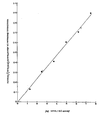
- the concentration of urea may be calculated from the maximum rate of the reaction which is achieved 5 - 10 seconds after adding the urea-containing sample to the reaction mixture described above.
- the concentration of urea in an unknown sample is determined by reference to a curve constructed from reaction rates obtained with standard urea solutions. Such a standard curve and the results of tests with standard serum samples are shown in the Figure.
- the reaction rate is proportional to the mass of urea in the range 0 - 8 ⁇ g urea/ml assay volume.
- the results obtained with standard serum samples were in good agreement with the standard curve.
- This method has the advantage that, since the maximum reaction rate is achieved only 5 - 10 seconds after mixing, the measurement may be completed in 30 seconds or less so that the procedure is particularly suitable for use with centrifugal reaction rate analysers.
Landscapes
- Chemical & Material Sciences (AREA)
- Life Sciences & Earth Sciences (AREA)
- Health & Medical Sciences (AREA)
- Organic Chemistry (AREA)
- Wood Science & Technology (AREA)
- Zoology (AREA)
- Engineering & Computer Science (AREA)
- Bioinformatics & Cheminformatics (AREA)
- Genetics & Genomics (AREA)
- General Health & Medical Sciences (AREA)
- Microbiology (AREA)
- Biotechnology (AREA)
- Molecular Biology (AREA)
- Biochemistry (AREA)
- General Engineering & Computer Science (AREA)
- Medicinal Chemistry (AREA)
- Biomedical Technology (AREA)
- Proteomics, Peptides & Aminoacids (AREA)
- Physics & Mathematics (AREA)
- Analytical Chemistry (AREA)
- Biophysics (AREA)
- Immunology (AREA)
- Measuring Or Testing Involving Enzymes Or Micro-Organisms (AREA)
- Enzymes And Modification Thereof (AREA)
- Investigating Or Analysing Biological Materials (AREA)
Applications Claiming Priority (2)
| Application Number | Priority Date | Filing Date | Title |
|---|---|---|---|
| GB8121131 | 1981-07-08 | ||
| GB8121131 | 1981-07-08 |
Publications (3)
| Publication Number | Publication Date |
|---|---|
| EP0069488A2 true EP0069488A2 (de) | 1983-01-12 |
| EP0069488A3 EP0069488A3 (en) | 1983-03-30 |
| EP0069488B1 EP0069488B1 (de) | 1986-06-11 |
Family
ID=10523110
Family Applications (1)
| Application Number | Title | Priority Date | Filing Date |
|---|---|---|---|
| EP19820303157 Expired EP0069488B1 (de) | 1981-07-08 | 1982-06-17 | Verfahren zur Reinigung von Urease und Glutamat-Dehydrogenase |
Country Status (3)
| Country | Link |
|---|---|
| EP (1) | EP0069488B1 (de) |
| JP (1) | JPS5816700A (de) |
| DE (1) | DE3271643D1 (de) |
Cited By (3)
| Publication number | Priority date | Publication date | Assignee | Title |
|---|---|---|---|---|
| EP0133681A3 (en) * | 1983-08-09 | 1986-03-12 | Miles Italiana Spa | Enzymatic urea assay |
| EP0173276A3 (de) * | 1984-08-27 | 1988-08-24 | Kyowa Hakko Kogyo Co., Ltd. | Verfahren zur Bestimmung eines Substrats oder der Enzymwirksamkeit |
| WO2016018465A1 (en) * | 2014-07-30 | 2016-02-04 | Medtronic, Inc. | Urease purification from jack beans or other organisms |
Family Cites Families (3)
| Publication number | Priority date | Publication date | Assignee | Title |
|---|---|---|---|---|
| US3527674A (en) * | 1966-06-30 | 1970-09-08 | Calbiochem | Reagent material and method for urea assay |
| US3989594A (en) * | 1970-12-09 | 1976-11-02 | Imperial Chemical Industries Limited | Microbiological production of protein |
| EP0035831B1 (de) * | 1980-03-07 | 1986-01-08 | Imperial Chemical Industries Plc | Verfahren zur Herstellung genetisch modifizierter Mikroorganismen |
-
1982
- 1982-06-17 DE DE8282303157T patent/DE3271643D1/de not_active Expired
- 1982-06-17 EP EP19820303157 patent/EP0069488B1/de not_active Expired
- 1982-07-08 JP JP11914482A patent/JPS5816700A/ja active Pending
Cited By (3)
| Publication number | Priority date | Publication date | Assignee | Title |
|---|---|---|---|---|
| EP0133681A3 (en) * | 1983-08-09 | 1986-03-12 | Miles Italiana Spa | Enzymatic urea assay |
| EP0173276A3 (de) * | 1984-08-27 | 1988-08-24 | Kyowa Hakko Kogyo Co., Ltd. | Verfahren zur Bestimmung eines Substrats oder der Enzymwirksamkeit |
| WO2016018465A1 (en) * | 2014-07-30 | 2016-02-04 | Medtronic, Inc. | Urease purification from jack beans or other organisms |
Also Published As
| Publication number | Publication date |
|---|---|
| EP0069488A3 (en) | 1983-03-30 |
| DE3271643D1 (en) | 1986-07-17 |
| EP0069488B1 (de) | 1986-06-11 |
| JPS5816700A (ja) | 1983-01-31 |
Similar Documents
| Publication | Publication Date | Title |
|---|---|---|
| JP3034698B2 (ja) | 非酵素的グリコシル化タンパク質の検定法 | |
| US5387109A (en) | Fructosylamine deglycase and a method of producing it | |
| EP0204283B1 (de) | Uricase und Verfahren zu deren Herstellung | |
| EP0012446A1 (de) | Saure Uricase, Verfahren zu ihrer Herstellung und ihre Verwendung zur Bestimmung von Harnsäure | |
| EP0049078B1 (de) | Glutathion-Peroxidase, Verfahren zu deren Herstellung, Methode und Zusammensetzung zur quantitativen Bestimmung von Lipoid-Peroxid | |
| EP0069488B1 (de) | Verfahren zur Reinigung von Urease und Glutamat-Dehydrogenase | |
| EP0016845A1 (de) | Verfahren und zusammensetzung zur bestimmung von xanthin-oxidase-substraten mittels einer neuen xanthine-oxidase und verfahren zu deren herstellung | |
| EP0264815A1 (de) | Verfahren zur selektiven Abmessung von Aminosäuren | |
| EP0806482A2 (de) | Verfahren und Reagenz zur enzymatischen Analyse | |
| EP0252490B1 (de) | 3-Alpha-Hydroxysteroid-Oxydase und Massanalyse von 3-alpha-Hydroxysteroid unter Verwendung derselben | |
| EP0101653B1 (de) | Leucindehydrogenase und ein Verfahren zur Gewinnung derselben | |
| JPS5915625B2 (ja) | 新規なアシルコエンザイムaオキシダ−ゼおよびその製法 | |
| JPH11243950A (ja) | フルクトシルアミノ酸オキシダーゼ及びその製造方法 | |
| JPH0414957B2 (de) | ||
| EP0387697A2 (de) | Bestimmung von Aminotransferasen | |
| JP3773283B2 (ja) | D−乳酸脱水素酵素およびその製造法 | |
| EP0097949A2 (de) | L-Glutaminsäure-Oxidase, ihre Gewinnung und ihre Verwendung | |
| MORITA | Biochemical genetics of purine catabolism in Drosophila melanogaster | |
| AU638658B2 (en) | Stable 6-phosphogluconolactonase, process for its production as well as use of the enzyme | |
| JPH0191778A (ja) | マルトースホスホリラーゼ | |
| US5002886A (en) | Oxidoreductase and the preparation thereof | |
| JP3532937B2 (ja) | 耐熱性の高い新規nadph依存性ディアフォラ−ゼおよびその製造法 | |
| JPS6126356B2 (de) | ||
| EP0079792A2 (de) | Verfahren zur Herstellung von Urease | |
| EP0260866A2 (de) | Oxydoreduktase und deren Herstellung |
Legal Events
| Date | Code | Title | Description |
|---|---|---|---|
| PUAI | Public reference made under article 153(3) epc to a published international application that has entered the european phase |
Free format text: ORIGINAL CODE: 0009012 |
|
| AK | Designated contracting states |
Designated state(s): BE CH DE FR GB IT LI NL SE |
|
| PUAL | Search report despatched |
Free format text: ORIGINAL CODE: 0009013 |
|
| AK | Designated contracting states |
Designated state(s): BE CH DE FR GB IT LI NL SE |
|
| 17P | Request for examination filed |
Effective date: 19830905 |
|
| GRAA | (expected) grant |
Free format text: ORIGINAL CODE: 0009210 |
|
| AK | Designated contracting states |
Kind code of ref document: B1 Designated state(s): BE CH DE FR GB IT LI NL SE |
|
| ITF | It: translation for a ep patent filed | ||
| PGFP | Annual fee paid to national office [announced via postgrant information from national office to epo] |
Ref country code: NL Payment date: 19860630 Year of fee payment: 5 |
|
| REF | Corresponds to: |
Ref document number: 3271643 Country of ref document: DE Date of ref document: 19860717 |
|
| ET | Fr: translation filed | ||
| PLBE | No opposition filed within time limit |
Free format text: ORIGINAL CODE: 0009261 |
|
| STAA | Information on the status of an ep patent application or granted ep patent |
Free format text: STATUS: NO OPPOSITION FILED WITHIN TIME LIMIT |
|
| 26N | No opposition filed | ||
| PG25 | Lapsed in a contracting state [announced via postgrant information from national office to epo] |
Ref country code: SE Effective date: 19870618 |
|
| PG25 | Lapsed in a contracting state [announced via postgrant information from national office to epo] |
Ref country code: LI Effective date: 19870630 Ref country code: CH Effective date: 19870630 |
|
| BERE | Be: lapsed |
Owner name: IMPERIAL CHEMICAL INDUSTRIES P.L.C. Effective date: 19870630 |
|
| PG25 | Lapsed in a contracting state [announced via postgrant information from national office to epo] |
Ref country code: NL Effective date: 19880101 |
|
| NLV4 | Nl: lapsed or anulled due to non-payment of the annual fee | ||
| PG25 | Lapsed in a contracting state [announced via postgrant information from national office to epo] |
Ref country code: FR Free format text: LAPSE BECAUSE OF NON-PAYMENT OF DUE FEES Effective date: 19880226 |
|
| REG | Reference to a national code |
Ref country code: CH Ref legal event code: PL |
|
| PG25 | Lapsed in a contracting state [announced via postgrant information from national office to epo] |
Ref country code: DE Effective date: 19880301 |
|
| REG | Reference to a national code |
Ref country code: FR Ref legal event code: ST |
|
| PG25 | Lapsed in a contracting state [announced via postgrant information from national office to epo] |
Ref country code: BE Effective date: 19890630 |
|
| PGFP | Annual fee paid to national office [announced via postgrant information from national office to epo] |
Ref country code: GB Payment date: 19920601 Year of fee payment: 11 |
|
| PG25 | Lapsed in a contracting state [announced via postgrant information from national office to epo] |
Ref country code: GB Effective date: 19930617 |
|
| GBPC | Gb: european patent ceased through non-payment of renewal fee |
Effective date: 19930617 |
|
| EUG | Se: european patent has lapsed |
Ref document number: 82303157.0 Effective date: 19880713 |