EP0064452B1 - Oligosaccharides à chaînes courtes possédant des propriétés biologiques, leur préparation et leurs applications en tant que médicaments - Google Patents
Oligosaccharides à chaînes courtes possédant des propriétés biologiques, leur préparation et leurs applications en tant que médicaments Download PDFInfo
- Publication number
- EP0064452B1 EP0064452B1 EP82400739A EP82400739A EP0064452B1 EP 0064452 B1 EP0064452 B1 EP 0064452B1 EP 82400739 A EP82400739 A EP 82400739A EP 82400739 A EP82400739 A EP 82400739A EP 0064452 B1 EP0064452 B1 EP 0064452B1
- Authority
- EP
- European Patent Office
- Prior art keywords
- octasaccharides
- hexasaccharides
- compositions
- order
- heparinase
- Prior art date
- Legal status (The legal status is an assumption and is not a legal conclusion. Google has not performed a legal analysis and makes no representation as to the accuracy of the status listed.)
- Expired
Links
- 238000000034 method Methods 0.000 title claims abstract description 35
- 230000008569 process Effects 0.000 title claims abstract description 27
- 229920001542 oligosaccharide Polymers 0.000 title claims abstract description 24
- 150000002482 oligosaccharides Chemical class 0.000 title claims abstract description 24
- 238000002360 preparation method Methods 0.000 title claims abstract description 6
- 239000003814 drug Substances 0.000 title claims description 9
- 229940079593 drug Drugs 0.000 title claims 5
- 230000004071 biological effect Effects 0.000 title description 7
- 239000000203 mixture Substances 0.000 claims abstract description 40
- 108090000790 Enzymes Proteins 0.000 claims abstract description 20
- 102000004190 Enzymes Human genes 0.000 claims abstract description 20
- 239000000872 buffer Substances 0.000 claims abstract description 20
- 230000002255 enzymatic effect Effects 0.000 claims abstract description 11
- 230000015556 catabolic process Effects 0.000 claims abstract description 10
- 238000006731 degradation reaction Methods 0.000 claims abstract description 10
- 239000003795 chemical substances by application Substances 0.000 claims abstract description 8
- 150000003839 salts Chemical class 0.000 claims abstract description 7
- 125000004435 hydrogen atom Chemical group [H]* 0.000 claims abstract description 5
- OYPRJOBELJOOCE-UHFFFAOYSA-N Calcium Chemical compound [Ca] OYPRJOBELJOOCE-UHFFFAOYSA-N 0.000 claims abstract description 4
- 229910052791 calcium Inorganic materials 0.000 claims abstract description 4
- 239000011575 calcium Substances 0.000 claims abstract description 4
- 239000012634 fragment Substances 0.000 claims abstract description 4
- 108010022901 Heparin Lyase Proteins 0.000 claims description 43
- 230000000694 effects Effects 0.000 claims description 25
- 239000000243 solution Substances 0.000 claims description 18
- 238000005194 fractionation Methods 0.000 claims description 13
- 229920000669 heparin Polymers 0.000 claims description 13
- HTTJABKRGRZYRN-UHFFFAOYSA-N Heparin Chemical compound OC1C(NC(=O)C)C(O)OC(COS(O)(=O)=O)C1OC1C(OS(O)(=O)=O)C(O)C(OC2C(C(OS(O)(=O)=O)C(OC3C(C(O)C(O)C(O3)C(O)=O)OS(O)(=O)=O)C(CO)O2)NS(O)(=O)=O)C(C(O)=O)O1 HTTJABKRGRZYRN-UHFFFAOYSA-N 0.000 claims description 11
- 229960002897 heparin Drugs 0.000 claims description 11
- 241000605114 Pedobacter heparinus Species 0.000 claims description 8
- 230000001580 bacterial effect Effects 0.000 claims description 5
- 239000008194 pharmaceutical composition Substances 0.000 claims description 5
- 208000007536 Thrombosis Diseases 0.000 claims description 3
- 229910052799 carbon Inorganic materials 0.000 claims description 3
- 239000008188 pellet Substances 0.000 claims description 3
- 239000003826 tablet Substances 0.000 claims description 3
- 239000000443 aerosol Substances 0.000 claims description 2
- 239000002775 capsule Substances 0.000 claims description 2
- 238000006911 enzymatic reaction Methods 0.000 claims description 2
- 239000002502 liposome Substances 0.000 claims description 2
- 239000006187 pill Substances 0.000 claims description 2
- 230000003449 preventive effect Effects 0.000 claims description 2
- 239000000829 suppository Substances 0.000 claims description 2
- 238000009109 curative therapy Methods 0.000 claims 1
- 239000007972 injectable composition Substances 0.000 claims 1
- 238000010253 intravenous injection Methods 0.000 claims 1
- 230000010412 perfusion Effects 0.000 claims 1
- 238000010254 subcutaneous injection Methods 0.000 claims 1
- 239000007929 subcutaneous injection Substances 0.000 claims 1
- 229940088598 enzyme Drugs 0.000 description 16
- 239000000047 product Substances 0.000 description 12
- FAPWRFPIFSIZLT-UHFFFAOYSA-M Sodium chloride Chemical compound [Na+].[Cl-] FAPWRFPIFSIZLT-UHFFFAOYSA-M 0.000 description 10
- 238000005119 centrifugation Methods 0.000 description 10
- 241000894006 Bacteria Species 0.000 description 9
- 238000012360 testing method Methods 0.000 description 9
- GUBGYTABKSRVRQ-WFVLMXAXSA-N DEAE-cellulose Chemical compound OC1C(O)C(O)C(CO)O[C@H]1O[C@@H]1C(CO)OC(O)C(O)C1O GUBGYTABKSRVRQ-WFVLMXAXSA-N 0.000 description 8
- 230000009471 action Effects 0.000 description 8
- BFNBIHQBYMNNAN-UHFFFAOYSA-N ammonium sulfate Chemical compound N.N.OS(O)(=O)=O BFNBIHQBYMNNAN-UHFFFAOYSA-N 0.000 description 8
- 229910052921 ammonium sulfate Inorganic materials 0.000 description 8
- 235000011130 ammonium sulphate Nutrition 0.000 description 8
- 230000001858 anti-Xa Effects 0.000 description 8
- 102000004169 proteins and genes Human genes 0.000 description 8
- 108090000623 proteins and genes Proteins 0.000 description 8
- 229920000936 Agarose Polymers 0.000 description 7
- 239000002253 acid Substances 0.000 description 7
- 150000002016 disaccharides Chemical class 0.000 description 7
- 238000000746 purification Methods 0.000 description 7
- 150000004044 tetrasaccharides Chemical group 0.000 description 7
- HEMHJVSKTPXQMS-UHFFFAOYSA-M Sodium hydroxide Chemical compound [OH-].[Na+] HEMHJVSKTPXQMS-UHFFFAOYSA-M 0.000 description 6
- 239000001166 ammonium sulphate Substances 0.000 description 6
- 238000010828 elution Methods 0.000 description 6
- 238000011282 treatment Methods 0.000 description 6
- XLYOFNOQVPJJNP-UHFFFAOYSA-N water Chemical compound O XLYOFNOQVPJJNP-UHFFFAOYSA-N 0.000 description 6
- 238000000605 extraction Methods 0.000 description 5
- 239000002609 medium Substances 0.000 description 5
- 239000002244 precipitate Substances 0.000 description 5
- 239000007974 sodium acetate buffer Substances 0.000 description 5
- 239000011780 sodium chloride Substances 0.000 description 5
- 229910052713 technetium Inorganic materials 0.000 description 5
- GKLVYJBZJHMRIY-UHFFFAOYSA-N technetium atom Chemical compound [Tc] GKLVYJBZJHMRIY-UHFFFAOYSA-N 0.000 description 5
- 102000004411 Antithrombin III Human genes 0.000 description 4
- 108090000935 Antithrombin III Proteins 0.000 description 4
- 108010074860 Factor Xa Proteins 0.000 description 4
- 229920002684 Sepharose Polymers 0.000 description 4
- 229960005348 antithrombin iii Drugs 0.000 description 4
- 239000012153 distilled water Substances 0.000 description 4
- 238000001914 filtration Methods 0.000 description 4
- 238000002523 gelfiltration Methods 0.000 description 4
- 230000001371 heparinic effect Effects 0.000 description 4
- 238000001727 in vivo Methods 0.000 description 4
- 230000014508 negative regulation of coagulation Effects 0.000 description 4
- 230000003287 optical effect Effects 0.000 description 4
- 238000003756 stirring Methods 0.000 description 4
- LKAPTZKZHMOIRE-KVTDHHQDSA-N (2s,3s,4s,5r)-3,4-dihydroxy-5-(hydroxymethyl)oxolane-2-carbaldehyde Chemical group OC[C@H]1O[C@H](C=O)[C@@H](O)[C@@H]1O LKAPTZKZHMOIRE-KVTDHHQDSA-N 0.000 description 3
- 0 *C1[C@@](*)OC(N)=C(*)C1* Chemical compound *C1[C@@](*)OC(N)=C(*)C1* 0.000 description 3
- QTBSBXVTEAMEQO-UHFFFAOYSA-N Acetic acid Chemical compound CC(O)=O QTBSBXVTEAMEQO-UHFFFAOYSA-N 0.000 description 3
- OVRNDRQMDRJTHS-FMDGEEDCSA-N N-acetyl-beta-D-glucosamine Chemical compound CC(=O)N[C@H]1[C@H](O)O[C@H](CO)[C@@H](O)[C@@H]1O OVRNDRQMDRJTHS-FMDGEEDCSA-N 0.000 description 3
- IOVCWXUNBOPUCH-UHFFFAOYSA-N Nitrous acid Chemical compound ON=O IOVCWXUNBOPUCH-UHFFFAOYSA-N 0.000 description 3
- 241000283973 Oryctolagus cuniculus Species 0.000 description 3
- 230000002785 anti-thrombosis Effects 0.000 description 3
- 239000008280 blood Substances 0.000 description 3
- 210000004369 blood Anatomy 0.000 description 3
- 239000003153 chemical reaction reagent Substances 0.000 description 3
- 239000000706 filtrate Substances 0.000 description 3
- 238000000227 grinding Methods 0.000 description 3
- 239000006174 pH buffer Substances 0.000 description 3
- 239000000825 pharmaceutical preparation Substances 0.000 description 3
- 239000012487 rinsing solution Substances 0.000 description 3
- 239000000126 substance Substances 0.000 description 3
- 238000005406 washing Methods 0.000 description 3
- UXVMQQNJUSDDNG-UHFFFAOYSA-L Calcium chloride Chemical compound [Cl-].[Cl-].[Ca+2] UXVMQQNJUSDDNG-UHFFFAOYSA-L 0.000 description 2
- OKTJSMMVPCPJKN-UHFFFAOYSA-N Carbon Chemical group [C] OKTJSMMVPCPJKN-UHFFFAOYSA-N 0.000 description 2
- DGAQECJNVWCQMB-PUAWFVPOSA-M Ilexoside XXIX Chemical compound C[C@@H]1CC[C@@]2(CC[C@@]3(C(=CC[C@H]4[C@]3(CC[C@@H]5[C@@]4(CC[C@@H](C5(C)C)OS(=O)(=O)[O-])C)C)[C@@H]2[C@]1(C)O)C)C(=O)O[C@H]6[C@@H]([C@H]([C@@H]([C@H](O6)CO)O)O)O.[Na+] DGAQECJNVWCQMB-PUAWFVPOSA-M 0.000 description 2
- OVRNDRQMDRJTHS-UHFFFAOYSA-N N-acelyl-D-glucosamine Natural products CC(=O)NC1C(O)OC(CO)C(O)C1O OVRNDRQMDRJTHS-UHFFFAOYSA-N 0.000 description 2
- MBLBDJOUHNCFQT-LXGUWJNJSA-N N-acetylglucosamine Natural products CC(=O)N[C@@H](C=O)[C@@H](O)[C@H](O)[C@H](O)CO MBLBDJOUHNCFQT-LXGUWJNJSA-N 0.000 description 2
- PVNIIMVLHYAWGP-UHFFFAOYSA-N Niacin Chemical compound OC(=O)C1=CC=CN=C1 PVNIIMVLHYAWGP-UHFFFAOYSA-N 0.000 description 2
- NBIIXXVUZAFLBC-UHFFFAOYSA-N Phosphoric acid Chemical compound OP(O)(O)=O NBIIXXVUZAFLBC-UHFFFAOYSA-N 0.000 description 2
- 229920005654 Sephadex Polymers 0.000 description 2
- 239000012507 Sephadex™ Substances 0.000 description 2
- 238000010521 absorption reaction Methods 0.000 description 2
- 238000005273 aeration Methods 0.000 description 2
- PNEYBMLMFCGWSK-UHFFFAOYSA-N aluminium oxide Inorganic materials [O-2].[O-2].[O-2].[Al+3].[Al+3] PNEYBMLMFCGWSK-UHFFFAOYSA-N 0.000 description 2
- 239000003146 anticoagulant agent Substances 0.000 description 2
- 230000023555 blood coagulation Effects 0.000 description 2
- 239000001110 calcium chloride Substances 0.000 description 2
- 229910001628 calcium chloride Inorganic materials 0.000 description 2
- 238000004587 chromatography analysis Methods 0.000 description 2
- 230000015271 coagulation Effects 0.000 description 2
- 238000005345 coagulation Methods 0.000 description 2
- 238000011161 development Methods 0.000 description 2
- 238000010586 diagram Methods 0.000 description 2
- 239000006185 dispersion Substances 0.000 description 2
- 230000008030 elimination Effects 0.000 description 2
- 238000003379 elimination reaction Methods 0.000 description 2
- 238000002270 exclusion chromatography Methods 0.000 description 2
- 238000013467 fragmentation Methods 0.000 description 2
- 238000006062 fragmentation reaction Methods 0.000 description 2
- 238000001802 infusion Methods 0.000 description 2
- 238000002347 injection Methods 0.000 description 2
- 239000007924 injection Substances 0.000 description 2
- 239000004570 mortar (masonry) Substances 0.000 description 2
- 229950006780 n-acetylglucosamine Drugs 0.000 description 2
- 239000000546 pharmaceutical excipient Substances 0.000 description 2
- 238000001556 precipitation Methods 0.000 description 2
- 230000001698 pyrogenic effect Effects 0.000 description 2
- 239000012217 radiopharmaceutical Substances 0.000 description 2
- 229940121896 radiopharmaceutical Drugs 0.000 description 2
- 230000002799 radiopharmaceutical effect Effects 0.000 description 2
- 238000011084 recovery Methods 0.000 description 2
- 230000000717 retained effect Effects 0.000 description 2
- 239000011734 sodium Substances 0.000 description 2
- 229910052708 sodium Inorganic materials 0.000 description 2
- 239000006228 supernatant Substances 0.000 description 2
- 239000013589 supplement Substances 0.000 description 2
- 239000000725 suspension Substances 0.000 description 2
- 230000002885 thrombogenetic effect Effects 0.000 description 2
- 201000005665 thrombophilia Diseases 0.000 description 2
- 230000001732 thrombotic effect Effects 0.000 description 2
- TXUICONDJPYNPY-UHFFFAOYSA-N (1,10,13-trimethyl-3-oxo-4,5,6,7,8,9,11,12,14,15,16,17-dodecahydrocyclopenta[a]phenanthren-17-yl) heptanoate Chemical compound C1CC2CC(=O)C=C(C)C2(C)C2C1C1CCC(OC(=O)CCCCCC)C1(C)CC2 TXUICONDJPYNPY-UHFFFAOYSA-N 0.000 description 1
- VSKBNXJTZZAEPH-NSEZLWDYSA-N (3r,4r,5s,6r)-3-amino-6-(hydroxymethyl)oxane-2,4,5-triol;sulfuric acid Chemical group OS(O)(=O)=O.N[C@H]1C(O)O[C@H](CO)[C@@H](O)[C@@H]1O VSKBNXJTZZAEPH-NSEZLWDYSA-N 0.000 description 1
- QKNYBSVHEMOAJP-UHFFFAOYSA-N 2-amino-2-(hydroxymethyl)propane-1,3-diol;hydron;chloride Chemical compound Cl.OCC(N)(CO)CO QKNYBSVHEMOAJP-UHFFFAOYSA-N 0.000 description 1
- 206010053567 Coagulopathies Diseases 0.000 description 1
- 241000589565 Flavobacterium Species 0.000 description 1
- 208000032843 Hemorrhage Diseases 0.000 description 1
- FYYHWMGAXLPEAU-UHFFFAOYSA-N Magnesium Chemical compound [Mg] FYYHWMGAXLPEAU-UHFFFAOYSA-N 0.000 description 1
- 241001465754 Metazoa Species 0.000 description 1
- 241000699670 Mus sp. Species 0.000 description 1
- 206010028980 Neoplasm Diseases 0.000 description 1
- 108010094028 Prothrombin Proteins 0.000 description 1
- 102100027378 Prothrombin Human genes 0.000 description 1
- GKLVYJBZJHMRIY-OUBTZVSYSA-N Technetium-99 Chemical compound [99Tc] GKLVYJBZJHMRIY-OUBTZVSYSA-N 0.000 description 1
- ATJFFYVFTNAWJD-UHFFFAOYSA-N Tin Chemical class [Sn] ATJFFYVFTNAWJD-UHFFFAOYSA-N 0.000 description 1
- 229910021626 Tin(II) chloride Inorganic materials 0.000 description 1
- 102000003990 Urokinase-type plasminogen activator Human genes 0.000 description 1
- 108090000435 Urokinase-type plasminogen activator Proteins 0.000 description 1
- 238000005903 acid hydrolysis reaction Methods 0.000 description 1
- 150000007513 acids Chemical class 0.000 description 1
- 239000012190 activator Substances 0.000 description 1
- 238000013019 agitation Methods 0.000 description 1
- 229910000147 aluminium phosphate Inorganic materials 0.000 description 1
- 238000003556 assay Methods 0.000 description 1
- 230000015572 biosynthetic process Effects 0.000 description 1
- 208000015294 blood coagulation disease Diseases 0.000 description 1
- 238000009534 blood test Methods 0.000 description 1
- 230000001413 cellular effect Effects 0.000 description 1
- 230000009852 coagulant defect Effects 0.000 description 1
- 238000004737 colorimetric analysis Methods 0.000 description 1
- 238000004440 column chromatography Methods 0.000 description 1
- 150000001875 compounds Chemical class 0.000 description 1
- 238000001514 detection method Methods 0.000 description 1
- 238000003745 diagnosis Methods 0.000 description 1
- HESHRHUZIWVEAJ-JGRZULCMSA-N dihydroergotamine Chemical compound C([C@H]1C(=O)N2CCC[C@H]2[C@]2(O)O[C@@](C(N21)=O)(C)NC(=O)[C@H]1CN([C@H]2[C@@H](C3=CC=CC4=NC=C([C]34)C2)C1)C)C1=CC=CC=C1 HESHRHUZIWVEAJ-JGRZULCMSA-N 0.000 description 1
- 229960004704 dihydroergotamine Drugs 0.000 description 1
- 239000002552 dosage form Substances 0.000 description 1
- 239000003937 drug carrier Substances 0.000 description 1
- 229940088679 drug related substance Drugs 0.000 description 1
- 239000011790 ferrous sulphate Substances 0.000 description 1
- 235000003891 ferrous sulphate Nutrition 0.000 description 1
- MSWZFWKMSRAUBD-IVMDWMLBSA-N glucosamine group Chemical group OC1[C@H](N)[C@@H](O)[C@H](O)[C@H](O1)CO MSWZFWKMSRAUBD-IVMDWMLBSA-N 0.000 description 1
- 239000001963 growth medium Substances 0.000 description 1
- 230000036541 health Effects 0.000 description 1
- 230000002008 hemorrhagic effect Effects 0.000 description 1
- 230000023597 hemostasis Effects 0.000 description 1
- 239000002565 heparin fraction Substances 0.000 description 1
- 238000000338 in vitro Methods 0.000 description 1
- 230000006698 induction Effects 0.000 description 1
- 230000002401 inhibitory effect Effects 0.000 description 1
- 230000005764 inhibitory process Effects 0.000 description 1
- 238000001990 intravenous administration Methods 0.000 description 1
- 150000002500 ions Chemical class 0.000 description 1
- 159000000014 iron salts Chemical class 0.000 description 1
- BAUYGSIQEAFULO-UHFFFAOYSA-L iron(2+) sulfate (anhydrous) Chemical compound [Fe+2].[O-]S([O-])(=O)=O BAUYGSIQEAFULO-UHFFFAOYSA-L 0.000 description 1
- 229910000359 iron(II) sulfate Inorganic materials 0.000 description 1
- 229910052749 magnesium Inorganic materials 0.000 description 1
- 239000011777 magnesium Substances 0.000 description 1
- 238000005259 measurement Methods 0.000 description 1
- 229910052751 metal Inorganic materials 0.000 description 1
- 239000002184 metal Substances 0.000 description 1
- 235000001968 nicotinic acid Nutrition 0.000 description 1
- 229960003512 nicotinic acid Drugs 0.000 description 1
- 239000011664 nicotinic acid Substances 0.000 description 1
- 238000000655 nuclear magnetic resonance spectrum Methods 0.000 description 1
- 238000009206 nuclear medicine Methods 0.000 description 1
- 239000002674 ointment Substances 0.000 description 1
- 125000004430 oxygen atom Chemical group O* 0.000 description 1
- 229940124531 pharmaceutical excipient Drugs 0.000 description 1
- 238000011321 prophylaxis Methods 0.000 description 1
- 229940039716 prothrombin Drugs 0.000 description 1
- 239000002510 pyrogen Substances 0.000 description 1
- 230000009257 reactivity Effects 0.000 description 1
- 230000009467 reduction Effects 0.000 description 1
- 230000002829 reductive effect Effects 0.000 description 1
- 230000008684 selective degradation Effects 0.000 description 1
- 238000001179 sorption measurement Methods 0.000 description 1
- 239000001119 stannous chloride Substances 0.000 description 1
- 235000011150 stannous chloride Nutrition 0.000 description 1
- 239000007858 starting material Substances 0.000 description 1
- 125000001424 substituent group Chemical group 0.000 description 1
- IIACRCGMVDHOTQ-UHFFFAOYSA-N sulfamic acid Chemical class NS(O)(=O)=O IIACRCGMVDHOTQ-UHFFFAOYSA-N 0.000 description 1
- 229940056501 technetium 99m Drugs 0.000 description 1
- 230000002537 thrombolytic effect Effects 0.000 description 1
- 150000003608 titanium Chemical class 0.000 description 1
- YONPGGFAJWQGJC-UHFFFAOYSA-K titanium(iii) chloride Chemical compound Cl[Ti](Cl)Cl YONPGGFAJWQGJC-UHFFFAOYSA-K 0.000 description 1
- 231100000331 toxic Toxicity 0.000 description 1
- 230000002588 toxic effect Effects 0.000 description 1
- 231100000419 toxicity Toxicity 0.000 description 1
- 230000001988 toxicity Effects 0.000 description 1
- 230000009466 transformation Effects 0.000 description 1
- 229960005356 urokinase Drugs 0.000 description 1
- 230000001643 venotonic effect Effects 0.000 description 1
- 239000011534 wash buffer Substances 0.000 description 1
Images


Classifications
-
- C—CHEMISTRY; METALLURGY
- C08—ORGANIC MACROMOLECULAR COMPOUNDS; THEIR PREPARATION OR CHEMICAL WORKING-UP; COMPOSITIONS BASED THEREON
- C08B—POLYSACCHARIDES; DERIVATIVES THEREOF
- C08B37/00—Preparation of polysaccharides not provided for in groups C08B1/00 - C08B35/00; Derivatives thereof
- C08B37/006—Heteroglycans, i.e. polysaccharides having more than one sugar residue in the main chain in either alternating or less regular sequence; Gellans; Succinoglycans; Arabinogalactans; Tragacanth or gum tragacanth or traganth from Astragalus; Gum Karaya from Sterculia urens; Gum Ghatti from Anogeissus latifolia; Derivatives thereof
- C08B37/0063—Glycosaminoglycans or mucopolysaccharides, e.g. keratan sulfate; Derivatives thereof, e.g. fucoidan
- C08B37/0075—Heparin; Heparan sulfate; Derivatives thereof, e.g. heparosan; Purification or extraction methods thereof
-
- A—HUMAN NECESSITIES
- A61—MEDICAL OR VETERINARY SCIENCE; HYGIENE
- A61P—SPECIFIC THERAPEUTIC ACTIVITY OF CHEMICAL COMPOUNDS OR MEDICINAL PREPARATIONS
- A61P7/00—Drugs for disorders of the blood or the extracellular fluid
- A61P7/02—Antithrombotic agents; Anticoagulants; Platelet aggregation inhibitors
-
- C—CHEMISTRY; METALLURGY
- C07—ORGANIC CHEMISTRY
- C07H—SUGARS; DERIVATIVES THEREOF; NUCLEOSIDES; NUCLEOTIDES; NUCLEIC ACIDS
- C07H3/00—Compounds containing only hydrogen atoms and saccharide radicals having only carbon, hydrogen, and oxygen atoms
- C07H3/06—Oligosaccharides, i.e. having three to five saccharide radicals attached to each other by glycosidic linkages
-
- C—CHEMISTRY; METALLURGY
- C12—BIOCHEMISTRY; BEER; SPIRITS; WINE; VINEGAR; MICROBIOLOGY; ENZYMOLOGY; MUTATION OR GENETIC ENGINEERING
- C12N—MICROORGANISMS OR ENZYMES; COMPOSITIONS THEREOF; PROPAGATING, PRESERVING, OR MAINTAINING MICROORGANISMS; MUTATION OR GENETIC ENGINEERING; CULTURE MEDIA
- C12N9/00—Enzymes; Proenzymes; Compositions thereof; Processes for preparing, activating, inhibiting, separating or purifying enzymes
- C12N9/88—Lyases (4.)
-
- C—CHEMISTRY; METALLURGY
- C12—BIOCHEMISTRY; BEER; SPIRITS; WINE; VINEGAR; MICROBIOLOGY; ENZYMOLOGY; MUTATION OR GENETIC ENGINEERING
- C12P—FERMENTATION OR ENZYME-USING PROCESSES TO SYNTHESISE A DESIRED CHEMICAL COMPOUND OR COMPOSITION OR TO SEPARATE OPTICAL ISOMERS FROM A RACEMIC MIXTURE
- C12P19/00—Preparation of compounds containing saccharide radicals
- C12P19/26—Preparation of nitrogen-containing carbohydrates
-
- C—CHEMISTRY; METALLURGY
- C12—BIOCHEMISTRY; BEER; SPIRITS; WINE; VINEGAR; MICROBIOLOGY; ENZYMOLOGY; MUTATION OR GENETIC ENGINEERING
- C12Y—ENZYMES
- C12Y402/00—Carbon-oxygen lyases (4.2)
- C12Y402/02—Carbon-oxygen lyases (4.2) acting on polysaccharides (4.2.2)
- C12Y402/02007—Heparin lyase (4.2.2.7), i.e. heparinase I
Definitions
- the invention relates to short-chain oligosaccharides, having biological properties allowing them in particular to control only certain stages of blood coagulation.
- the inverters have already described oligosaccharides having biological properties of the type mentioned above.
- the inventors According to the process described in application EP No. 0027 089, the inventors have in particular obtained by depolymerization of heparin by chemical means a depolymerization mixture containing octasaccharides and oligosaccharides with shorter chains.
- fractionation of this mixture made it possible to isolate fractions of octasaccharides of great value corresponding to the sequence A ⁇ B ⁇ C ⁇ D ⁇ E ⁇ F ⁇ G ⁇ H (designated below by the abbreviation A- H) .
- R represents a hydrogen atom or a group -S0 3 -.
- octasaccharides are particularly valuable because of their high specificity vis-à-vis activated factor X or factor Xa of the blood (measured according to the Yin-Wessler test) while their activity on overall coagulation (measured according to the USP test or APTT) is very low.
- the object of the invention is therefore to provide new oligosaccharides with shorter chains than the octasaccharides, advantageously having at least the biological properties of these octasaccharides.
- the highly homogeneous oligosaccharide compositions according to the invention are characterized in that they are essentially formed from hexasaccharides having the sequence C'DEFGH (hereinafter designated by the abbreviation C'-H). in which R represents a hydrogen atom or the group -S0 3 -.
- the hexasaccharides of the invention are characterized by a high affinity for ATIII.
- NMR spectra comprising, inter alia, a signal in the carbon region at position 2 of the N-sulfate-glucosamine residues, which does not appear with heparin.
- This signal can be attributed to the presence of a substituent on the oxygen atom in position 3, and more particularly to a 3-0-sulfate group on an N-sulfate-D-glucosamine residue (motif F of the diagram) .
- hexasaccharides of the invention are, moreover, characterized by Yin-Wessler titers much higher than those of heparin. More specifically, hexasaccharide compositions of the invention may have Yin-Wessler titers, greater than 2000 ⁇ / mg, possibly even reaching approximately 2500 ⁇ / mg.
- their APTT or USP titer proves to be particularly low, of the order of 10, which corresponds to compositions having ratios of their Yin-Wessler title to their USP or APTT title as high as 200 or even 250 about.
- Advantageous hexasaccharide compositions are formed from C'-H hexasaccharide in which at least one or two of the R groups represent a group - SO 3 -.
- the invention also relates to a process for obtaining the hexasaccharide compositions mentioned above.
- A-H octasaccharides if appropriate octasaccharide compositions formed from a major part of these A-H octasaccharides, are subjected, under determined conditions, to the action of an enzyme.
- the process according to the invention is therefore characterized in that the AH octasaccharides mentioned above are contacted, or octasaccharide compositions formed from a major part of these octasaccharides, having a high ratio of their Yin-Wessler titer to their APTT or USP titer, with an enzymatic agent under conditions adjusted so as to fragment these octasaccharides in a specific manner in order to eliminate the AB motifs which do not play an essential role in the activity considered, this specificity leading to obtaining mixtures formed almost entirely of active hexasaccharides.
- This specific fragmentation is obtained by using an enzymatic agent having an enzymatic activity of at least 90,000 units, used at a rate of 0.25 to 1 mg per mg of octasaccharides treated, preferably of the order of 0.5 mg of enzyme per mg of octasaccharides.
- the active hexasaccharides C′-H are then separated from the degradation mixture.
- the fragmentation is carried out in a buffer medium containing calcium.
- hexasaccharide compositions which are highly homogeneous in hexasaccharides C' ⁇ H
- use is advantageously made of a treatment making it possible to separate from the mixture, degradation at least the major part of the active hexasaccharides C'-H.
- Appropriate treatment involves fractionation to remove the resulting proteins of the enzymatic reaction and unreacted reagents. This fractionation can be carried out, for example, by permeation gel according to the molecular weight and / or the ion density of the products.
- the octasaccharide A-H is subjected to the action of an enzyme.
- a heparinase As an appropriate enzyme for obtaining the selective elimination of the AB motifs from the octasaccharide A-H, it is advantageous to use a heparinase, more especially a heparinase of bacterial origin.
- Such a heparinase is advantageously of the type of heparinases obtainable from the bacteria of Flavobacterium heparinum.
- a heparinase as obtained according to a process comprising stages, in particular of culture of the bacteria of Flavobacterium heparinum d extraction of crude heparinase from these bacteria, and purifications, carried out so as to obtain a purified heparinase, having an activity of at least 90,000 units making it possible to carry out the desired elimination of the AB motifs with yields satisfactory.
- the heparinase used has a heparinic activity greater than 100,000 units, in particular, of the order of 110,000 to 140,000 units.
- the activity of the enzyme is evaluated, relative to the increase in the absorption of a heparin titrating at least 215 gi / mg at 230 nm.
- 0.25 to 1 mg of enzyme (having an activity of the order of at least 90,000 units) is used per mg of octasaccharide, preferably approximately 0.5 mg of enzyme.
- the operation is advantageously carried out in a buffer medium, preferably at a pH of the order of 6 to 8, in particular close to neutrality.
- the process of the invention uses a starting product, namely the high-quality octasaccharide A-H: homogeneous, highly specific.
- this octasaccharide therefore appears to be degradable and this, in a selective manner, leading to shorter chains conserving the sequence responsible for the activity of these products and therefore advantageously having biological properties at less as important, even higher than those of octasaccharide.
- the method of the invention is implemented with a heparinase obtained by induction from bacteria of Flavobacterium heparinum, extraction of crude heparinase from bacteria, fractionation of the crude heparinase extract obtained followed by several stages of purification of the fractions having the desired heparinasic activity.
- heparinase The preparation of heparinase is carried out from a culture of Flavobacterium heparinum made under the conditions described by Payza et Coll. (J. Biol. Chem. 1956,223, p. 853-858).
- the bacteria are then recovered from the culture medium, for example by centrifugation, preferably carried out at low temperature, in particular below 10 ° C., preferably of the order of 4 ° C.
- the bacteria are then subjected to a treatment for the extraction of heparinase.
- This treatment advantageously comprises grinding and then their recovery, for example by centrifugation.
- the crude heparinase extract recovered by centrifugation is subjected, for the purpose of purification, to a fractionation step.
- a fractionation step In order to have a heparinase having the activity and the desired properties, additional operations for the purification of the successively obtained fractions are advantageously carried out.
- the study of these fractionation and purification processes has shown that it is preferable to operate at a temperature below ambient, in particular below 10 ° C., preferably of the order of + 4 ° C.
- the fractionation step is advantageously carried out in particular according to an exclusion chromatography process using DEAE cellulose, in the presence of ammonium sulfate.
- DEAE cellulose is advantageously used at a rate of approximately at least 3 g per g of bacterial cells, preferably of the order of 5 g.
- the DEAE cellulose is advantageously balanced beforehand using a pH buffer of the order of 6 to 8, preferably of the order of 7.
- Ammonium sulphate is used at a rate of approximately at least 3 g / l, preferably of the order of 6 g / l.
- the suspension thus formed is filtered and the filtrate is collected, advantageously added with rinsing solutions of the DEAE cellulose.
- the previously obtained solution is subjected to additional fractionation using DEAE cellulose, advantageously pre-balanced using the buffer used previously.
- This step is advantageously carried out by column chromatography, the filtrates being percolated at a flow rate of the order of 40 to 60 ml / h.
- heparinase is recovered, for example, by precipitation, in particular using ammonium sulfate.
- the heparinase obtained at the end of this fractionation operation which, under the specific conditions reported above, is in the form of a sulfo-ammonium precipitate, is then advantageously purified according to a process comprising at least one setting contact with an agarose of the Sepharosem 'type, more particularly that known under the name CM Sepharose CL 6 B e followed by contacting the purified fractions, with heparinas activity collected with an agarose of the type marketed under the name ULTRAGEL ACA 54 0 .
- the purification step using an agarose of the CM Sepharose CL 6 B O type is advantageously carried out in a chromatography column.
- heparinase in distilled water (which is in the form of a sulfoammonic precipitate), so as to obtain a solution having a conductivity of the order of 6000 microhos and to adjust its pH to approximately 6 .
- the agarose used is advantageously balanced beforehand using a pH buffer of the order of 5 to 7, preferably close to 6.
- the heparinase solution is chromatographed and the heparinase is recovered by elution with a linear gradient obtained with the buffer used for washing and this same buffer brought to a higher ionic strength.
- fractions having the desired heparinic activity are recovered to collect the heparinase which they contain.
- precipitation is carried out in particular using ammonium sulphate, followed by centrifugation.
- an additional purification of the heparinase collected by operating a new contact with an agarose preferably an agarose such as ULTROGEL ACA 54®.
- This operation is preferably carried out in a balanced column using a pH buffer of the order of 6 to 8, in particular of the order of 7.
- This buffer is advantageously used to develop the column.
- the AH octasaccharide used in the process of the invention can be obtained by contacting heparin (or heparin fractions) having an anticoagulant activity and chains having a molecular weight of around 2,000 to 50,000 approximately, with an enzymatic agent, preferably a purified heparinase, more especially, of bacterial origin having an activity of the order of 45,000 units, it being understood that the assay is carried out with a heparin at least 215 ⁇ i / mg.
- the conditions used for carrying out this step are adjusted so as to obtain a depolymerization mixture containing octasaccharide chains having anti-Xa activity (Yin-Wessler) and comprising a sequence responsible for the specific anti-Xa activity of these products .
- the enzyme causes the heparin chains to be cut between the anomeric carbon of the N-sulfateglucosamine residue and the following uronic acid motif.
- the biologically active octasaccharides are then separated from the depolymerization mixture by adsorption on antithrombin III (ATIII) fixed on a support such as agarose, under conditions allowing octasaccharides having an affinity for ATIII to be fixed or retained on the ATlll.
- ATIII antithrombin III
- This step is advantageously followed by the elution of the products retained or adsorbed in order to recover them and by their fractionation, for example by gel filtration in order to isolate them.
- oligosaccharides appear capable of exerting a powerful antithrombotic activity. Due to their weak and even practically zero anticoagulant activity, the risks of hemorrhage are advantageously practically eliminated. It has also been found that this type of oligosaccharides does not cause any reactivity of the platelets in the blood.
- the short chain hexasaccharides of the invention are devoid of toxicity.
- the administration of 10,000 p / kg (Yin-Wessler titer) of C'-H does not cause any toxic reaction in rabbits or a pyrogenic effect in the rabbit pyrogenicity test in accordance with the French pharmacopoeia.
- the invention therefore relates to pharmaceutical preparations which contain said hexasaccharides with high anti-Xa activity.
- It relates more particularly to pharmaceutical preparations devoid of pyrogenic substances containing an effective amount of active principles in combination with pharmaceutical excipients.
- compositions in which the pharmaceutical vehicle is suitable prayed for oral administration can advantageously be pastroresistant capsules, tablets or tablets, pills, or also presented in the form of liposomes.
- compositions include these oligosaccharides in combination with excipients suitable for rectal administration.
- Corresponding forms of administration are constituted by suppositories.
- the invention also relates to injectable, sterile or sterilizable pharmaceutical compositions.
- solutions advantageously contain 1000 to 100,000 ⁇ (Yin-Wessler) / ml of oligosaccharides, preferably from 5,000 to 50,000, for example from 25,000 ⁇ / ml, when these solutions are intended for injection by sub-route.
- cutaneous can contain, for example, from 500 to 10,000, in particular 5000 I / ml of oligosaccharides when they are intended for injection by intravenous route or by infusion.
- Such pharmaceutical preparations are presented in the form of non-recoverable syringes, ready for use.
- the invention also relates to pharmaceutical compositions containing said oligosaccharides in association with another active principle, which can be used in particular for the prophylaxis and treatment of thrombosis, such as a venotonic agent such as dihydroergotamine, a salt of nicotinic acid or an agent thrombolytic like urokinase.
- a venotonic agent such as dihydroergotamine, a salt of nicotinic acid or an agent thrombolytic like urokinase.
- the short chain oligosaccharides of the invention are advantageously in the form of salts of at least one physiologically acceptable metal such as sodium and / or calcium and / or magnesium.
- compositions of the invention are particularly suitable for the control (preventive or curative) of certain stages of blood coagulation in humans or animals), in particular in the case where the patient is subjected to risks of hypercoagulability resulting from a disturbance in the intrinsic phase, for example as a consequence of a release by the organism of thromboplastins, for example, of tissue thromboplastins (surgical operations, atheromatous process, development of tumors and coagulation disorders by bacterial activators or enzymatic, etc.).
- this dosage includes, for example, administration to the patient of 1000 to 25,000 ⁇ m (Yin and Wessler) by subcutaneously, two or three times a day, depending on the patient's risk of hypercoagulability or the thrombotic condition, or from 1000 to 25,000 ⁇ / 24 hours intravenously, in discontinuous administrations at regular intervals, or continuously by infusion, or from 1000 to 25,000 ⁇ (three times a week) intramuscularly or subcutaneously (these titles are expressed in Yin-Wessler units).
- These doses can be naturally adjusted for each patient according to the results and blood tests carried out before, the nature of the affections from which he suffers and, in general, his state of health.
- the invention also relates to the application of the oligosaccharides of the invention and the fractions which contain them, to the constitution of biological reagents, usable in laboratories, in particular as elements of comparison for the study of other substances which it is desired test the anticoagulant activity, in particular at the level of inhibition of factor Xa.
- the invention also relates to medicaments in which said oligosaccharides are marked with tracers in order to develop radiopharmaceutical products usable in nuclear medicine.
- Conventional tracers are used, in particular technetium 99 m.
- the 99 m technetium obtained from commercial generators is transformed, in the form of non-reactive valence sodium pertechnetate 7, into reduced valet technetium 4 which would be the most reactive form of technetium.
- This transformation is carried out using a reducing system produced from tin salts (stannous chloride), iron salts (ferrous sulfate), titanium salts (titanium trichloride) or other salts.
- Products can be used of the invention, which constitute a kind of support, at doses of the order of 100 to 200 There i Yin-Wessler.
- the products thus labeled are advantageously used in in vivo tests for the detection and diagnosis of the extension of thromboses and thrombotic states.
- the pH of the broth is finally adjusted to 7.0 with phosphoric acid or sodium hydroxide.
- This culture is carried out at a temperature of + 24 ° C. with aeration and medium stirring.
- the medium is cooled to + 4 ° C. over a period of approximately 2 hours.
- the bacteria are recovered by centrifugation at 50,000 rpm, on a centrifuge like the pneumatic SHARPLESS centrifuge type T 313 A® and this for 2 hours.
- the centrifugation residue is taken up in 1 liter of cold distilled water, subjected to a dispersion by ULTRA-TURAX® turbine at maximum speed for 5 minutes, then lyophilized. The total duration of this operation is approximately 36 hours. Under these conditions, 4.1 grams of cells are obtained.
- the cells, lyophilized, obtained according to the preceding step, are vigorously ground dry, in a mortar, in the presence of 2 g of calcined alumina, for 1 hour. 10 ml of buffer 1) are then added (0.1 M sodium acetate buffer, pH 7). The mortar grinding of the paste then obtained is continued for 30 minutes at + 4 ° C. 450 ml of cold buffer 1) are then added and the whole is left stirring for 1 hour at + 4 ° C. The suspension obtained is centrifuged on a centrifuge of the SORVALL RC2 B® type, at 18,000 rpm at + 4 ° C, for 20 minutes. The centrifugation pellets composed of alumina and cellular debris are discarded. The supernatant (orange-yellow and viscous) which collects the crude cell extract is collected and corresponds to a volume of 470 ml. The rest of the manipulations are carried out at + 4 ° C.
- the column is finally rinsed with buffer 2), until there is no protein in the rinsing solutions.
- the column effluents and the rinsing solutions are combined, which corresponds to a volume of 1100 ml and 715 g of ammonium sulphate are added, with stirring.
- the precipitated proteins are collected by centrifugation at 7000 rpm for 30 minutes, on a centrifuge of the SORVALL® genus. 2.5 g of very wet precipitate are collected, which constitutes heparinase. This precipitate can be stored at -20 ° C for several weeks.
- the sulfoammonic precipitate previously obtained is dissolved in cold distilled water used in sufficient quantity to obtain a final conductivity of 6000 micromhos.
- the pH of the solution obtained is adjusted to 6.0 with acetic acid or 2N sodium hydroxide.
- the final volume is 440 ml.
- the solution is then percolated at + 4 ° C. on a column of 70 ml (15 ⁇ 2.6 cm) of CM Sepharose CL 6 B® previously equilibrated in buffer 3) (0.1 M sodium acetate buffer, NaCl 0, 22 M, pH 6.0), at a flow rate of 25 ml / h.
- the column is rinsed with tempon 3) until there is no protein in the effluent.
- the column effluents are discarded.
- the heparinase is then eluted at 60 ml / h using a linear gradient formed from 600 ml of buffer 3) and 600 ml of buffer 3) adjusted to 0.34 M NaCl.
- the proteins leaving the column are detected by continuous recording of the optical density (O.D.) at 280 nm and the eluate is collected in 5 ml fractions using a fraction collector.
- O.D. optical density
- Figure 1 there is shown the elution graph obtained by recording the O.D. at 280 nm of the column effluent.
- the proteins are precipitated by adding 30 g of ammonium sulphate and are recovered by centrifugation at + 4 ° C at 15,000 rpm, for 10 minutes.
- the centrifugation pellet previously obtained is dissolved in cold distilled water and a final volume of 5 ml is obtained.
- This solution is deposited at the top of a column (1 m ⁇ 26 mm) of ULTROGEL ACA 54 @ balanced in 0.1 M sodium acetate buffer, 0.33 M NaCl, pH 7.
- the column is developed by this same buffer at a rate of 15 ml per hour.
- the proteins leaving the column are detected at 280 nm, and the column effluent is collected in 5 ml fractions.
- the elution graph is represented in FIG. 2. The heparinasic activity of each fraction is assayed.
- Fractions 32 to 37 which contain heparinic activity, are grouped, which corresponds to a volume of 60 ml.
- This solution contains 7 mg of purified heparinase, having an activity of the order of 100,000 to 110,000 units / mg.
- an enzyme unit the quantity of enzyme which shows at 231 nm, one thousandth of a unit of optical density per minute when contacting at 38 ° C, heparinase with l heparin titrating at least 215 ⁇ i / mg 0.065% in tris-HCl buffer, 0.125 M, pH 7, to which calcium chloride CaC1 2 is added .
- the solution obtained is stored and frozen at -20 ° C.
- the solution is incubated at + 37 ° C.
- the addition of heparinase is carried out as follows.
- the mixture obtained at the end of the degradation step is deposited at the top of a column of Sephadex G-50 superfine @ 200 x 2.5 cm.
- the products are eluted using 0.2 M sodium chloride.
- the products are detected by their absorption at 230 nm.
- the elution diagram obtained is reported in FIG. 3.
- the first consists of non-degraded starting material (4 mg)
- the second contains the desired hexasaccharides (7 mg)
- the third of the disaccharides There is also a smaller fraction in the tetrasaccharide region between the hexa and disaccharide peaks.
- the hexasaccharide fractions are combined, the salts are eliminated and they are lyophilized.
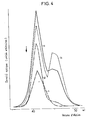
- a structure study of these fractions is carried out by colorimetric analysis of the fragments obtained by degradation using nitrous acid followed by a filtration gel.
- the degradation, using nitrous acid is carried out according to the method of SHIVELY and CONRAD described in Biochemistry, vol. 15, No. 12,1976, p. 3932 to 3942.
- nitrous acid results in cutting the glycosidic links between the N-sulfate-glucosamine units and the following uronic acid and transforms the sulfate-glucosamine units into 2,5-anhydromannose residues.
- the hexasaccharide is then transformed into tetrasaccharide and disaccharide. These two oligosaccharides are separated by filtration on a column (200 x 0.6 cm) of Sephadex G-50 Superfine, eluted with 0.2 M sodium chloride.
- FIG. 4 the values of the measured optical density are reported. at 230 nm, eluted fractions (curve a) in solid lines) as well as their content of 2,5-anhydromannose groups (curve b) in dotted lines, etc.), uronic acids (curve c) in dashed lines - - -) and N-acetyl-glucosamine (curve d) in dashes alternating with points ⁇ . ⁇ . ⁇ .) (For the determination of this last group, measurements are carried out before and after acid hydrolysis, the difference obtained corresponding to the content of groups N-acetyl-glucosamine).
- the content of uronic acid group appears to be twice as high in the tetrasaccharide fraction as in the disaccharide fraction.
- hexasaccharide fraction consists almost exclusively of a single species which carries an N-sulfate-glucosamine motif at its reducing end, an unsaturated uronic acid motif at its non-reducing end.
- the anti-Xa activity is determined according to the Yin-Wessler test described by its authors in J. Lab. Clin. Med. 1976, 81, 298 ⁇ 300.
- the overall anticoagulant activity is measured according to the USP test or the APTT method.
- the APTT titer is measured according to the method of J. CAEN et al. in Hemostasis, French scientific expansion, Paris, 1968, pages 133-135.
Landscapes
- Chemical & Material Sciences (AREA)
- Health & Medical Sciences (AREA)
- Life Sciences & Earth Sciences (AREA)
- Organic Chemistry (AREA)
- Engineering & Computer Science (AREA)
- General Health & Medical Sciences (AREA)
- Bioinformatics & Cheminformatics (AREA)
- Genetics & Genomics (AREA)
- Biochemistry (AREA)
- Zoology (AREA)
- Wood Science & Technology (AREA)
- Molecular Biology (AREA)
- Medicinal Chemistry (AREA)
- General Engineering & Computer Science (AREA)
- Chemical Kinetics & Catalysis (AREA)
- Biotechnology (AREA)
- Microbiology (AREA)
- General Chemical & Material Sciences (AREA)
- Diabetes (AREA)
- Materials Engineering (AREA)
- Nuclear Medicine, Radiotherapy & Molecular Imaging (AREA)
- Pharmacology & Pharmacy (AREA)
- Hematology (AREA)
- Animal Behavior & Ethology (AREA)
- Veterinary Medicine (AREA)
- Public Health (AREA)
- Polymers & Plastics (AREA)
- Biomedical Technology (AREA)
- Pharmaceuticals Containing Other Organic And Inorganic Compounds (AREA)
- Polysaccharides And Polysaccharide Derivatives (AREA)
- Saccharide Compounds (AREA)
- Preparation Of Compounds By Using Micro-Organisms (AREA)
- Coloring Foods And Improving Nutritive Qualities (AREA)
Priority Applications (1)
| Application Number | Priority Date | Filing Date | Title |
|---|---|---|---|
| AT82400739T ATE12791T1 (de) | 1981-04-29 | 1982-04-26 | Kurzkettige oligosaccharide mit biologischen eigenschaften, verfahren zu ihrer herstellung und ihre verwendungen als arzneimittel. |
Applications Claiming Priority (2)
| Application Number | Priority Date | Filing Date | Title |
|---|---|---|---|
| FR8108604A FR2504928A1 (fr) | 1981-04-29 | 1981-04-29 | Oligosaccharides a chaines courtes possedant des proprietes biologiques, leur preparation et leurs applications en tant que medicaments |
| FR8108604 | 1981-04-29 |
Publications (2)
| Publication Number | Publication Date |
|---|---|
| EP0064452A1 EP0064452A1 (fr) | 1982-11-10 |
| EP0064452B1 true EP0064452B1 (fr) | 1985-04-17 |
Family
ID=9257922
Family Applications (1)
| Application Number | Title | Priority Date | Filing Date |
|---|---|---|---|
| EP82400739A Expired EP0064452B1 (fr) | 1981-04-29 | 1982-04-26 | Oligosaccharides à chaînes courtes possédant des propriétés biologiques, leur préparation et leurs applications en tant que médicaments |
Country Status (9)
| Country | Link |
|---|---|
| EP (1) | EP0064452B1 (da) |
| JP (1) | JPS57190001A (da) |
| AT (1) | ATE12791T1 (da) |
| CA (1) | CA1180292A (da) |
| DE (1) | DE3263083D1 (da) |
| DK (1) | DK189982A (da) |
| ES (1) | ES511470A0 (da) |
| FR (1) | FR2504928A1 (da) |
| IE (1) | IE52906B1 (da) |
Families Citing this family (15)
| Publication number | Priority date | Publication date | Assignee | Title |
|---|---|---|---|---|
| FR2584728B1 (fr) * | 1985-07-12 | 1987-11-20 | Choay Sa | Procede de sulfatation de glycosaminoglycanes et de leurs fragments |
| EP0209924A1 (en) * | 1985-07-12 | 1987-01-28 | Akzo N.V. | New anti-trombosis agent based on glycosaminoglycan, process for its preparation, and pharmaceutical compositions |
| US5106734A (en) * | 1986-04-30 | 1992-04-21 | Novo Nordisk A/S | Process of using light absorption to control enzymatic depolymerization of heparin to produce low molecular weight heparin |
| US5707973A (en) * | 1991-04-23 | 1998-01-13 | Rhone-Poulenc Rorer S.A. | Sulfated polysaccharids for treatment or prevention of thromboses |
| EP0861903A1 (en) * | 1997-02-22 | 1998-09-02 | Lansing, Manfred | Method for reversible immobilizing oligo and/or polysaccharides |
| US5985582A (en) * | 1997-12-09 | 1999-11-16 | Sigma-Aldrich Co. | Thrombin-based assay for antithrombin III |
| FR2845686B1 (fr) * | 2002-10-10 | 2013-08-30 | Aventis Pharma Sa | Melanges de polysaccharides derives d'heparine, leur preparation et les compositions pharmaceutiques les contenant |
| FR2857971B1 (fr) * | 2003-07-24 | 2005-08-26 | Aventis Pharma Sa | Melanges d'oligosaccharides derives d'heparine, leur preparation et les compositions pharmaceutiques les contenant |
| EP1582531A1 (en) | 2004-03-24 | 2005-10-05 | Aventis Pharma S.A. | Process for oxidizing unfractionated heparins and detecting presence or absence of glycoserine in heparin and heparin products |
| EP1792621B1 (en) | 2005-11-30 | 2012-04-04 | Istituto di Ricerche Chimiche e Biochimiche "G. Ronzoni" | Orally administrable heparin derivatives |
| WO2009155108A1 (en) | 2008-05-30 | 2009-12-23 | Momenta Pharmaceuticals, Inc. | Saccharide structures and methods of making and using such structures |
| EP3398971A4 (en) * | 2015-12-30 | 2019-09-25 | Shenzhen Hepalink Pharmaceutical Group Co., Ltd. | SULFATED HEPARINOLIGOSACCHARIDE AND MANUFACTURING METHOD AND APPLICATION THEREOF |
| WO2022015794A1 (en) | 2020-07-14 | 2022-01-20 | Optimvia, Llc | Methods for synthesizing non-anticoagulant heparan sulfate |
| JP2022540849A (ja) | 2019-07-09 | 2022-09-20 | オプティムヴィア、エルエルシー | 抗凝固性多糖類の合成方法 |
| JP7611465B2 (ja) * | 2019-10-10 | 2025-01-10 | ジェイ・アイ・サイエンス有限会社 | 溶離液性の利用フラクションコレクター |
Family Cites Families (3)
| Publication number | Priority date | Publication date | Assignee | Title |
|---|---|---|---|---|
| US3766167A (en) * | 1971-03-26 | 1973-10-16 | Research Corp | Orally active anticoagulant |
| IL61201A (en) * | 1979-10-05 | 1984-09-30 | Choay Sa | Oligosaccharides having no more than 8 saccharide moieties,their obtention from heparin and pharmaceutical compositions containing them |
| JPH0231721A (ja) * | 1988-07-20 | 1990-02-01 | Matsushita Electric Ind Co Ltd | 充電式掃除機 |
-
1981
- 1981-04-29 FR FR8108604A patent/FR2504928A1/fr active Granted
-
1982
- 1982-03-29 IE IE741/82A patent/IE52906B1/en not_active IP Right Cessation
- 1982-03-31 CA CA000399961A patent/CA1180292A/en not_active Expired
- 1982-04-16 ES ES511470A patent/ES511470A0/es active Granted
- 1982-04-26 AT AT82400739T patent/ATE12791T1/de active
- 1982-04-26 DE DE8282400739T patent/DE3263083D1/de not_active Expired
- 1982-04-26 EP EP82400739A patent/EP0064452B1/fr not_active Expired
- 1982-04-27 JP JP57071124A patent/JPS57190001A/ja active Pending
- 1982-04-28 DK DK189982A patent/DK189982A/da not_active Application Discontinuation
Also Published As
| Publication number | Publication date |
|---|---|
| EP0064452A1 (fr) | 1982-11-10 |
| ES8302094A1 (es) | 1983-02-01 |
| CA1180292A (en) | 1985-01-02 |
| IE820741L (en) | 1982-10-29 |
| ES511470A0 (es) | 1983-02-01 |
| DE3263083D1 (en) | 1985-05-23 |
| FR2504928B1 (da) | 1984-02-24 |
| ATE12791T1 (de) | 1985-05-15 |
| JPS57190001A (en) | 1982-11-22 |
| DK189982A (da) | 1982-10-30 |
| IE52906B1 (en) | 1988-04-13 |
| FR2504928A1 (fr) | 1982-11-05 |
Similar Documents
| Publication | Publication Date | Title |
|---|---|---|
| EP0027089B1 (fr) | Fractions oligosaccharidiques et oligosaccharides possédant des propriétés biologiques, leurs procédés de préparation et leurs applications en tant que médicaments | |
| EP0214879B1 (fr) | Procédé de sulfatation de glycosaminoglycanes, nouveaux glycosaminoglycanes obtenus et leurs applications biologiques | |
| EP0064452B1 (fr) | Oligosaccharides à chaînes courtes possédant des propriétés biologiques, leur préparation et leurs applications en tant que médicaments | |
| EP0489647B1 (fr) | Héparosanes-N,O-sulfatés, leur procédé de préparation et les compositions pharmaceutiques qui les contiennent | |
| US4826827A (en) | Short chained oligosaccharides having biological properties, a process for making the same and the use thereof as drugs | |
| CA1327968C (fr) | Heparines de bas poids moleculaire, a structure reguliere leur preparation et leurs applications biologiques | |
| CA1339925C (fr) | Oligosaccharides hepariniques affines pour les facteurs de croissance cellulaires | |
| EP0037319B1 (fr) | Mucopolysaccharides possédant des propriétés biologiques, leur préparation et leur application en tant que médicaments | |
| EP0403377B1 (fr) | Polysaccharides sulfatés, agent anticoagulant et agent anti-complémentaire obtenus à partir de fucanes d'algues brunes et leur procédé d'obtention | |
| EP0544592B1 (fr) | Héparosanes-N,O-sulfates de haute masse moléculaire, leur procédé de préparation et les compositions pharmaceutiques qui les contiennent | |
| EP0293539B1 (fr) | Procédé pour la dépolymérisation de l'héparine pour l'obtention d'une héparine de bas poids moléculaire dotée d'une activité antithrombotique | |
| EP0208623A2 (fr) | Utilisation de poly- et oligosaccharides pour l'obtention de médicaments actifs dans les pathologies du tissu conjonctif | |
| CA2107362A1 (en) | New non-anticoagulant heparin derivatives | |
| CA2107365A1 (en) | New non-anticoagulant heparin derivatives | |
| US6001820A (en) | Compositions and methods for inhibiting thrombogenesis | |
| CN1244702C (zh) | 一种鞘氨醇杆菌及用其生产的肝素酶生产肝素寡糖的方法 | |
| USRE35770E (en) | Oligosaccharides having anti-Xa activity and pharmaceutical compositions containing them | |
| EP0138632B1 (fr) | Complexes contenant des oligosaccharides, leur préparation et leurs applications biologiques et biochimiques | |
| FR2461719A2 (fr) | Composition mucopolysaccharidique ayant une activite regulatrice de la coagulation, medicament la contenant et procede pour l'obtenir | |
| WO1994008595A1 (en) | Use of non-anticoagulant heparin for treating ischemia/reperfusion injury | |
| JP4166846B2 (ja) | ヘパリン結合担体及びフルクトース−1,6−ビスリン酸アルドラーゼの分離方法 | |
| FR2495935A1 (fr) | Fractions mucopolysaccharidiques possedant des proprietes biologiques, leur procede de preparation et leur application en tant que medicaments | |
| JPH0616687A (ja) | ヘパリン不飽和4糖およびその製造法 | |
| FR2572080A1 (fr) | Procede de preparation de compositions de mucopolysaccharides dotees d'une activite antithrombotique elevee, les compositions obtenues et leur application en tant que medicaments | |
| FR2587707A1 (fr) | Glycopeptide et toute composition le contenant, leur procede de preparation et leurs applications anticoagulantes |
Legal Events
| Date | Code | Title | Description |
|---|---|---|---|
| PUAI | Public reference made under article 153(3) epc to a published international application that has entered the european phase |
Free format text: ORIGINAL CODE: 0009012 |
|
| AK | Designated contracting states |
Designated state(s): AT BE CH DE GB IT LU NL SE |
|
| 17P | Request for examination filed |
Effective date: 19830425 |
|
| ITF | It: translation for a ep patent filed | ||
| GRAA | (expected) grant |
Free format text: ORIGINAL CODE: 0009210 |
|
| AK | Designated contracting states |
Designated state(s): AT BE CH DE GB IT LI LU NL SE |
|
| REF | Corresponds to: |
Ref document number: 12791 Country of ref document: AT Date of ref document: 19850515 Kind code of ref document: T |
|
| REF | Corresponds to: |
Ref document number: 3263083 Country of ref document: DE Date of ref document: 19850523 |
|
| PLBE | No opposition filed within time limit |
Free format text: ORIGINAL CODE: 0009261 |
|
| STAA | Information on the status of an ep patent application or granted ep patent |
Free format text: STATUS: NO OPPOSITION FILED WITHIN TIME LIMIT |
|
| 26N | No opposition filed | ||
| PGFP | Annual fee paid to national office [announced via postgrant information from national office to epo] |
Ref country code: CH Payment date: 19920320 Year of fee payment: 11 Ref country code: AT Payment date: 19920320 Year of fee payment: 11 |
|
| PGFP | Annual fee paid to national office [announced via postgrant information from national office to epo] |
Ref country code: DE Payment date: 19920402 Year of fee payment: 11 |
|
| PGFP | Annual fee paid to national office [announced via postgrant information from national office to epo] |
Ref country code: GB Payment date: 19920421 Year of fee payment: 11 |
|
| PGFP | Annual fee paid to national office [announced via postgrant information from national office to epo] |
Ref country code: BE Payment date: 19920428 Year of fee payment: 11 |
|
| PGFP | Annual fee paid to national office [announced via postgrant information from national office to epo] |
Ref country code: SE Payment date: 19920429 Year of fee payment: 11 |
|
| ITTA | It: last paid annual fee | ||
| PGFP | Annual fee paid to national office [announced via postgrant information from national office to epo] |
Ref country code: NL Payment date: 19920430 Year of fee payment: 11 |
|
| PGFP | Annual fee paid to national office [announced via postgrant information from national office to epo] |
Ref country code: LU Payment date: 19920625 Year of fee payment: 11 |
|
| EPTA | Lu: last paid annual fee | ||
| PG25 | Lapsed in a contracting state [announced via postgrant information from national office to epo] |
Ref country code: LU Free format text: LAPSE BECAUSE OF NON-PAYMENT OF DUE FEES Effective date: 19930426 Ref country code: GB Effective date: 19930426 Ref country code: AT Effective date: 19930426 |
|
| PG25 | Lapsed in a contracting state [announced via postgrant information from national office to epo] |
Ref country code: SE Effective date: 19930427 |
|
| PG25 | Lapsed in a contracting state [announced via postgrant information from national office to epo] |
Ref country code: LI Effective date: 19930430 Ref country code: CH Effective date: 19930430 Ref country code: BE Effective date: 19930430 |
|
| BERE | Be: lapsed |
Owner name: CHOAY S.A. Effective date: 19930430 |
|
| PG25 | Lapsed in a contracting state [announced via postgrant information from national office to epo] |
Ref country code: NL Effective date: 19931101 |
|
| NLV4 | Nl: lapsed or anulled due to non-payment of the annual fee | ||
| GBPC | Gb: european patent ceased through non-payment of renewal fee |
Effective date: 19930426 |
|
| REG | Reference to a national code |
Ref country code: CH Ref legal event code: PL |
|
| PG25 | Lapsed in a contracting state [announced via postgrant information from national office to epo] |
Ref country code: DE Effective date: 19940101 |
|
| EUG | Se: european patent has lapsed |
Ref document number: 82400739.7 Effective date: 19931110 |