EP0062005A1 - Verfahren zur Herstellung von Styrol- und/oder Stilbenderivaten - Google Patents
Verfahren zur Herstellung von Styrol- und/oder Stilbenderivaten Download PDFInfo
- Publication number
- EP0062005A1 EP0062005A1 EP82810134A EP82810134A EP0062005A1 EP 0062005 A1 EP0062005 A1 EP 0062005A1 EP 82810134 A EP82810134 A EP 82810134A EP 82810134 A EP82810134 A EP 82810134A EP 0062005 A1 EP0062005 A1 EP 0062005A1
- Authority
- EP
- European Patent Office
- Prior art keywords
- formula
- palladium
- hydrogen
- compounds
- alkyl
- Prior art date
- Legal status (The legal status is an assumption and is not a legal conclusion. Google has not performed a legal analysis and makes no representation as to the accuracy of the status listed.)
- Granted
Links
- 238000000034 method Methods 0.000 title claims abstract description 28
- PJANXHGTPQOBST-UHFFFAOYSA-N stilbene Chemical class C=1C=CC=CC=1C=CC1=CC=CC=C1 PJANXHGTPQOBST-UHFFFAOYSA-N 0.000 title abstract description 8
- 238000004519 manufacturing process Methods 0.000 title abstract description 3
- PPBRXRYQALVLMV-UHFFFAOYSA-N Styrene Chemical compound C=CC1=CC=CC=C1 PPBRXRYQALVLMV-UHFFFAOYSA-N 0.000 title description 14
- KDLHZDBZIXYQEI-UHFFFAOYSA-N Palladium Chemical compound [Pd] KDLHZDBZIXYQEI-UHFFFAOYSA-N 0.000 claims abstract description 42
- 150000001875 compounds Chemical class 0.000 claims abstract description 40
- 239000001257 hydrogen Substances 0.000 claims abstract description 32
- 229910052739 hydrogen Inorganic materials 0.000 claims abstract description 32
- UFHFLCQGNIYNRP-UHFFFAOYSA-N Hydrogen Chemical compound [H][H] UFHFLCQGNIYNRP-UHFFFAOYSA-N 0.000 claims abstract description 20
- VGGSQFUCUMXWEO-UHFFFAOYSA-N Ethene Chemical compound C=C VGGSQFUCUMXWEO-UHFFFAOYSA-N 0.000 claims abstract description 18
- 239000005977 Ethylene Substances 0.000 claims abstract description 17
- 125000001997 phenyl group Chemical group [H]C1=C([H])C([H])=C(*)C([H])=C1[H] 0.000 claims abstract description 17
- YJVFFLUZDVXJQI-UHFFFAOYSA-L palladium(ii) acetate Chemical compound [Pd+2].CC([O-])=O.CC([O-])=O YJVFFLUZDVXJQI-UHFFFAOYSA-L 0.000 claims abstract description 15
- 239000003054 catalyst Substances 0.000 claims abstract description 12
- 239000002253 acid Substances 0.000 claims abstract description 10
- 150000004820 halides Chemical class 0.000 claims abstract description 10
- 229910052763 palladium Inorganic materials 0.000 claims abstract description 6
- 125000001624 naphthyl group Chemical group 0.000 claims abstract description 5
- 125000004957 naphthylene group Chemical group 0.000 claims abstract description 4
- 125000000843 phenylene group Chemical group C1(=C(C=CC=C1)*)* 0.000 claims abstract description 4
- YXFVVABEGXRONW-UHFFFAOYSA-N Toluene Chemical compound CC1=CC=CC=C1 YXFVVABEGXRONW-UHFFFAOYSA-N 0.000 claims description 33
- 125000000217 alkyl group Chemical group 0.000 claims description 33
- 238000006243 chemical reaction Methods 0.000 claims description 32
- 125000002496 methyl group Chemical group [H]C([H])([H])* 0.000 claims description 23
- 229910052794 bromium Inorganic materials 0.000 claims description 21
- WKBOTKDWSSQWDR-UHFFFAOYSA-N Bromine atom Chemical group [Br] WKBOTKDWSSQWDR-UHFFFAOYSA-N 0.000 claims description 20
- 239000000460 chlorine Substances 0.000 claims description 18
- 229910052801 chlorine Inorganic materials 0.000 claims description 17
- 150000002431 hydrogen Chemical group 0.000 claims description 16
- 125000004432 carbon atom Chemical group C* 0.000 claims description 14
- XXBDWLFCJWSEKW-UHFFFAOYSA-N dimethylbenzylamine Chemical compound CN(C)CC1=CC=CC=C1 XXBDWLFCJWSEKW-UHFFFAOYSA-N 0.000 claims description 12
- 101150003085 Pdcl gene Proteins 0.000 claims description 10
- 125000001309 chloro group Chemical group Cl* 0.000 claims description 10
- 125000000956 methoxy group Chemical group [H]C([H])([H])O* 0.000 claims description 10
- PJANXHGTPQOBST-VAWYXSNFSA-N Stilbene Natural products C=1C=CC=CC=1/C=C/C1=CC=CC=C1 PJANXHGTPQOBST-VAWYXSNFSA-N 0.000 claims description 9
- 125000001797 benzyl group Chemical group [H]C1=C([H])C([H])=C(C([H])=C1[H])C([H])([H])* 0.000 claims description 9
- GDTBXPJZTBHREO-UHFFFAOYSA-N bromine Chemical group BrBr GDTBXPJZTBHREO-UHFFFAOYSA-N 0.000 claims description 9
- 125000000449 nitro group Chemical group [O-][N+](*)=O 0.000 claims description 7
- 238000002360 preparation method Methods 0.000 claims description 7
- 235000021286 stilbenes Nutrition 0.000 claims description 7
- HVCNXQOWACZAFN-UHFFFAOYSA-N 4-ethylmorpholine Chemical compound CCN1CCOCC1 HVCNXQOWACZAFN-UHFFFAOYSA-N 0.000 claims description 6
- RDOXTESZEPMUJZ-UHFFFAOYSA-N anisole Chemical compound COC1=CC=CC=C1 RDOXTESZEPMUJZ-UHFFFAOYSA-N 0.000 claims description 6
- 125000002485 formyl group Chemical group [H]C(*)=O 0.000 claims description 6
- UKSZBOKPHAQOMP-SVLSSHOZSA-N (1e,4e)-1,5-diphenylpenta-1,4-dien-3-one;palladium Chemical compound [Pd].C=1C=CC=CC=1\C=C\C(=O)\C=C\C1=CC=CC=C1.C=1C=CC=CC=1\C=C\C(=O)\C=C\C1=CC=CC=C1 UKSZBOKPHAQOMP-SVLSSHOZSA-N 0.000 claims description 5
- 229910052740 iodine Chemical group 0.000 claims description 5
- 239000002904 solvent Substances 0.000 claims description 5
- IMFACGCPASFAPR-UHFFFAOYSA-N tributylamine Chemical compound CCCCN(CCCC)CCCC IMFACGCPASFAPR-UHFFFAOYSA-N 0.000 claims description 5
- ROFVEXUMMXZLPA-UHFFFAOYSA-N Bipyridyl Chemical group N1=CC=CC=C1C1=CC=CC=N1 ROFVEXUMMXZLPA-UHFFFAOYSA-N 0.000 claims description 4
- XYZMOVWWVXBHDP-UHFFFAOYSA-N cyclohexyl isocyanide Chemical compound [C-]#[N+]C1CCCCC1 XYZMOVWWVXBHDP-UHFFFAOYSA-N 0.000 claims description 4
- NLFBCYMMUAKCPC-KQQUZDAGSA-N ethyl (e)-3-[3-amino-2-cyano-1-[(e)-3-ethoxy-3-oxoprop-1-enyl]sulfanyl-3-oxoprop-1-enyl]sulfanylprop-2-enoate Chemical compound CCOC(=O)\C=C\SC(=C(C#N)C(N)=O)S\C=C\C(=O)OCC NLFBCYMMUAKCPC-KQQUZDAGSA-N 0.000 claims description 4
- 150000002941 palladium compounds Chemical class 0.000 claims description 4
- LMBFAGIMSUYTBN-MPZNNTNKSA-N teixobactin Chemical compound C([C@H](C(=O)N[C@@H]([C@@H](C)CC)C(=O)N[C@@H](CO)C(=O)N[C@H](CCC(N)=O)C(=O)N[C@H]([C@@H](C)CC)C(=O)N[C@@H]([C@@H](C)CC)C(=O)N[C@@H](CO)C(=O)N[C@H]1C(N[C@@H](C)C(=O)N[C@@H](C[C@@H]2NC(=N)NC2)C(=O)N[C@H](C(=O)O[C@H]1C)[C@@H](C)CC)=O)NC)C1=CC=CC=C1 LMBFAGIMSUYTBN-MPZNNTNKSA-N 0.000 claims description 4
- ZCYVEMRRCGMTRW-UHFFFAOYSA-N 7553-56-2 Chemical group [I] ZCYVEMRRCGMTRW-UHFFFAOYSA-N 0.000 claims description 3
- 239000011630 iodine Chemical group 0.000 claims description 3
- 229910052751 metal Inorganic materials 0.000 claims description 3
- 239000002184 metal Substances 0.000 claims description 3
- UZKWTJUDCOPSNM-UHFFFAOYSA-N methoxybenzene Substances CCCCOC=C UZKWTJUDCOPSNM-UHFFFAOYSA-N 0.000 claims description 3
- 239000008096 xylene Substances 0.000 claims description 3
- QDBOAKPEXMMQFO-UHFFFAOYSA-N 4-(4-carbonochloridoylphenyl)benzoyl chloride Chemical group C1=CC(C(=O)Cl)=CC=C1C1=CC=C(C(Cl)=O)C=C1 QDBOAKPEXMMQFO-UHFFFAOYSA-N 0.000 claims description 2
- 125000006283 4-chlorobenzyl group Chemical group [H]C1=C([H])C(=C([H])C([H])=C1Cl)C([H])([H])* 0.000 claims description 2
- 125000004217 4-methoxybenzyl group Chemical group [H]C1=C([H])C(=C([H])C([H])=C1OC([H])([H])[H])C([H])([H])* 0.000 claims description 2
- 125000006181 4-methyl benzyl group Chemical group [H]C1=C([H])C(=C([H])C([H])=C1C([H])([H])[H])C([H])([H])* 0.000 claims description 2
- 239000000376 reactant Substances 0.000 claims description 2
- 150000003738 xylenes Chemical class 0.000 claims description 2
- 239000001211 (E)-4-phenylbut-3-en-2-one Substances 0.000 claims 1
- ZKXGEOSWQSVEBT-UHFFFAOYSA-N 4-[2-(4-carbonochloridoylphenyl)ethenyl]benzoyl chloride Chemical compound C1=CC(C(=O)Cl)=CC=C1C=CC1=CC=C(C(Cl)=O)C=C1 ZKXGEOSWQSVEBT-UHFFFAOYSA-N 0.000 claims 1
- 229930008407 benzylideneacetone Natural products 0.000 claims 1
- 239000012442 inert solvent Substances 0.000 claims 1
- BWHOZHOGCMHOBV-BQYQJAHWSA-N trans-benzylideneacetone Chemical compound CC(=O)\C=C\C1=CC=CC=C1 BWHOZHOGCMHOBV-BQYQJAHWSA-N 0.000 claims 1
- 230000003287 optical effect Effects 0.000 abstract description 8
- 239000000543 intermediate Substances 0.000 abstract description 2
- -1 benzoyl palladium chloride Chemical compound 0.000 description 61
- 239000000203 mixture Substances 0.000 description 30
- 239000013078 crystal Substances 0.000 description 19
- ZMXDDKWLCZADIW-UHFFFAOYSA-N N,N-Dimethylformamide Chemical compound CN(C)C=O ZMXDDKWLCZADIW-UHFFFAOYSA-N 0.000 description 15
- URLKBWYHVLBVBO-UHFFFAOYSA-N Para-Xylene Chemical group CC1=CC=C(C)C=C1 URLKBWYHVLBVBO-UHFFFAOYSA-N 0.000 description 14
- YMWUJEATGCHHMB-UHFFFAOYSA-N Dichloromethane Chemical compound ClCCl YMWUJEATGCHHMB-UHFFFAOYSA-N 0.000 description 12
- HEMHJVSKTPXQMS-UHFFFAOYSA-M Sodium hydroxide Chemical compound [OH-].[Na+] HEMHJVSKTPXQMS-UHFFFAOYSA-M 0.000 description 12
- 229910052731 fluorine Inorganic materials 0.000 description 12
- 125000004093 cyano group Chemical group *C#N 0.000 description 11
- XKRFYHLGVUSROY-UHFFFAOYSA-N Argon Chemical compound [Ar] XKRFYHLGVUSROY-UHFFFAOYSA-N 0.000 description 10
- 239000007788 liquid Substances 0.000 description 10
- CSNNHWWHGAXBCP-UHFFFAOYSA-L Magnesium sulfate Chemical compound [Mg+2].[O-][S+2]([O-])([O-])[O-] CSNNHWWHGAXBCP-UHFFFAOYSA-L 0.000 description 9
- OKKJLVBELUTLKV-UHFFFAOYSA-N Methanol Chemical compound OC OKKJLVBELUTLKV-UHFFFAOYSA-N 0.000 description 9
- 125000001495 ethyl group Chemical group [H]C([H])([H])C([H])([H])* 0.000 description 9
- ZAMOUSCENKQFHK-UHFFFAOYSA-N Chlorine atom Chemical compound [Cl] ZAMOUSCENKQFHK-UHFFFAOYSA-N 0.000 description 8
- VLKZOEOYAKHREP-UHFFFAOYSA-N n-Hexane Chemical compound CCCCCC VLKZOEOYAKHREP-UHFFFAOYSA-N 0.000 description 8
- RIOQSEWOXXDEQQ-UHFFFAOYSA-N triphenylphosphine Chemical compound C1=CC=CC=C1P(C=1C=CC=CC=1)C1=CC=CC=C1 RIOQSEWOXXDEQQ-UHFFFAOYSA-N 0.000 description 8
- 239000011541 reaction mixture Substances 0.000 description 7
- CSCPPACGZOOCGX-UHFFFAOYSA-N Acetone Chemical compound CC(C)=O CSCPPACGZOOCGX-UHFFFAOYSA-N 0.000 description 6
- UHOVQNZJYSORNB-UHFFFAOYSA-N Benzene Chemical compound C1=CC=CC=C1 UHOVQNZJYSORNB-UHFFFAOYSA-N 0.000 description 6
- BAPJBEWLBFYGME-UHFFFAOYSA-N Methyl acrylate Chemical compound COC(=O)C=C BAPJBEWLBFYGME-UHFFFAOYSA-N 0.000 description 6
- ZMANZCXQSJIPKH-UHFFFAOYSA-N Triethylamine Chemical compound CCN(CC)CC ZMANZCXQSJIPKH-UHFFFAOYSA-N 0.000 description 6
- 125000003545 alkoxy group Chemical group 0.000 description 6
- 125000002924 primary amino group Chemical group [H]N([H])* 0.000 description 6
- 238000001953 recrystallisation Methods 0.000 description 6
- 150000003440 styrenes Chemical class 0.000 description 6
- VZGDMQKNWNREIO-UHFFFAOYSA-N tetrachloromethane Chemical compound ClC(Cl)(Cl)Cl VZGDMQKNWNREIO-UHFFFAOYSA-N 0.000 description 6
- 125000004178 (C1-C4) alkyl group Chemical group 0.000 description 5
- XDTMQSROBMDMFD-UHFFFAOYSA-N Cyclohexane Chemical compound C1CCCCC1 XDTMQSROBMDMFD-UHFFFAOYSA-N 0.000 description 5
- 229910052786 argon Inorganic materials 0.000 description 5
- 239000002585 base Substances 0.000 description 5
- 125000002023 trifluoromethyl group Chemical group FC(F)(F)* 0.000 description 5
- 125000004400 (C1-C12) alkyl group Chemical group 0.000 description 4
- 125000004769 (C1-C4) alkylsulfonyl group Chemical group 0.000 description 4
- FNWLIFTZDCZCIR-UHFFFAOYSA-N 3-(4-ethenylphenyl)prop-2-enenitrile Chemical compound C=CC1=CC=C(C=CC#N)C=C1 FNWLIFTZDCZCIR-UHFFFAOYSA-N 0.000 description 4
- LFQSCWFLJHTTHZ-UHFFFAOYSA-N Ethanol Chemical compound CCO LFQSCWFLJHTTHZ-UHFFFAOYSA-N 0.000 description 4
- PXGOKWXKJXAPGV-UHFFFAOYSA-N Fluorine Chemical compound FF PXGOKWXKJXAPGV-UHFFFAOYSA-N 0.000 description 4
- OFBQJSOFQDEBGM-UHFFFAOYSA-N Pentane Chemical compound CCCCC OFBQJSOFQDEBGM-UHFFFAOYSA-N 0.000 description 4
- 125000000113 cyclohexyl group Chemical group [H]C1([H])C([H])([H])C([H])([H])C([H])(*)C([H])([H])C1([H])[H] 0.000 description 4
- 125000001511 cyclopentyl group Chemical group [H]C1([H])C([H])([H])C([H])([H])C([H])(*)C1([H])[H] 0.000 description 4
- 150000002148 esters Chemical class 0.000 description 4
- 125000005843 halogen group Chemical group 0.000 description 4
- 229910052943 magnesium sulfate Inorganic materials 0.000 description 4
- 235000019341 magnesium sulphate Nutrition 0.000 description 4
- 125000004108 n-butyl group Chemical group [H]C([H])([H])C([H])([H])C([H])([H])C([H])([H])* 0.000 description 4
- 150000001629 stilbenes Chemical class 0.000 description 4
- 125000001424 substituent group Chemical group 0.000 description 4
- RKIDDEGICSMIJA-UHFFFAOYSA-N 4-chlorobenzoyl chloride Chemical compound ClC(=O)C1=CC=C(Cl)C=C1 RKIDDEGICSMIJA-UHFFFAOYSA-N 0.000 description 3
- NQUVCRCCRXRJCK-UHFFFAOYSA-N 4-methylbenzoyl chloride Chemical compound CC1=CC=C(C(Cl)=O)C=C1 NQUVCRCCRXRJCK-UHFFFAOYSA-N 0.000 description 3
- RTZKZFJDLAIYFH-UHFFFAOYSA-N Diethyl ether Chemical compound CCOCC RTZKZFJDLAIYFH-UHFFFAOYSA-N 0.000 description 3
- IMNFDUFMRHMDMM-UHFFFAOYSA-N N-Heptane Chemical compound CCCCCCC IMNFDUFMRHMDMM-UHFFFAOYSA-N 0.000 description 3
- VYPSYNLAJGMNEJ-UHFFFAOYSA-N Silicium dioxide Chemical compound O=[Si]=O VYPSYNLAJGMNEJ-UHFFFAOYSA-N 0.000 description 3
- 125000001931 aliphatic group Chemical group 0.000 description 3
- 150000001336 alkenes Chemical class 0.000 description 3
- JFDZBHWFFUWGJE-UHFFFAOYSA-N benzonitrile Chemical compound N#CC1=CC=CC=C1 JFDZBHWFFUWGJE-UHFFFAOYSA-N 0.000 description 3
- PASDCCFISLVPSO-UHFFFAOYSA-N benzoyl chloride Chemical compound ClC(=O)C1=CC=CC=C1 PASDCCFISLVPSO-UHFFFAOYSA-N 0.000 description 3
- 230000015572 biosynthetic process Effects 0.000 description 3
- CCRCUPLGCSFEDV-UHFFFAOYSA-N cinnamic acid methyl ester Natural products COC(=O)C=CC1=CC=CC=C1 CCRCUPLGCSFEDV-UHFFFAOYSA-N 0.000 description 3
- 239000012043 crude product Substances 0.000 description 3
- 238000001704 evaporation Methods 0.000 description 3
- 230000008020 evaporation Effects 0.000 description 3
- 239000000706 filtrate Substances 0.000 description 3
- 239000011737 fluorine Substances 0.000 description 3
- 125000001449 isopropyl group Chemical group [H]C([H])([H])C([H])(*)C([H])([H])[H] 0.000 description 3
- 150000002576 ketones Chemical class 0.000 description 3
- IETHYZIUYMMJRF-UHFFFAOYSA-N methyl 2-benzoylprop-2-enoate Chemical compound COC(=O)C(=C)C(=O)C1=CC=CC=C1 IETHYZIUYMMJRF-UHFFFAOYSA-N 0.000 description 3
- CCRCUPLGCSFEDV-BQYQJAHWSA-N methyl trans-cinnamate Chemical compound COC(=O)\C=C\C1=CC=CC=C1 CCRCUPLGCSFEDV-BQYQJAHWSA-N 0.000 description 3
- 239000002244 precipitate Substances 0.000 description 3
- 239000000047 product Substances 0.000 description 3
- 239000000741 silica gel Substances 0.000 description 3
- 229910002027 silica gel Inorganic materials 0.000 description 3
- 150000003512 tertiary amines Chemical class 0.000 description 3
- 125000000008 (C1-C10) alkyl group Chemical group 0.000 description 2
- 125000000229 (C1-C4)alkoxy group Chemical group 0.000 description 2
- RXYPXQSKLGGKOL-UHFFFAOYSA-N 1,4-dimethylpiperazine Chemical compound CN1CCN(C)CC1 RXYPXQSKLGGKOL-UHFFFAOYSA-N 0.000 description 2
- MJZUMMKYWBNKIP-UHFFFAOYSA-N 2-isocyanopropane Chemical compound CC(C)[N+]#[C-] MJZUMMKYWBNKIP-UHFFFAOYSA-N 0.000 description 2
- UENLNPJRTOHQIC-UHFFFAOYSA-N 2-methyl-3-nitrobenzoyl chloride Chemical compound CC1=C(C(Cl)=O)C=CC=C1[N+]([O-])=O UENLNPJRTOHQIC-UHFFFAOYSA-N 0.000 description 2
- 125000001622 2-naphthyl group Chemical group [H]C1=C([H])C([H])=C2C([H])=C(*)C([H])=C([H])C2=C1[H] 0.000 description 2
- BUHYMJLFRZAFBF-UHFFFAOYSA-N 3,4,5-trimethoxybenzoyl chloride Chemical compound COC1=CC(C(Cl)=O)=CC(OC)=C1OC BUHYMJLFRZAFBF-UHFFFAOYSA-N 0.000 description 2
- VTXNOVCTHUBABW-UHFFFAOYSA-N 3,4-dichlorobenzoyl chloride Chemical compound ClC(=O)C1=CC=C(Cl)C(Cl)=C1 VTXNOVCTHUBABW-UHFFFAOYSA-N 0.000 description 2
- RGAKSNQOIIYQRM-UHFFFAOYSA-N 3,4-dimethylbenzoyl chloride Chemical compound CC1=CC=C(C(Cl)=O)C=C1C RGAKSNQOIIYQRM-UHFFFAOYSA-N 0.000 description 2
- SYBYTAAJFKOIEJ-UHFFFAOYSA-N 3-Methylbutan-2-one Chemical compound CC(C)C(C)=O SYBYTAAJFKOIEJ-UHFFFAOYSA-N 0.000 description 2
- RUQIUASLAXJZIE-UHFFFAOYSA-N 3-methoxybenzoyl chloride Chemical compound COC1=CC=CC(C(Cl)=O)=C1 RUQIUASLAXJZIE-UHFFFAOYSA-N 0.000 description 2
- QBFNGLBSVFKILI-UHFFFAOYSA-N 4-ethenylbenzaldehyde Chemical compound C=CC1=CC=C(C=O)C=C1 QBFNGLBSVFKILI-UHFFFAOYSA-N 0.000 description 2
- FYDIVWLLJXNXCE-UHFFFAOYSA-N 4-formylbenzoyl chloride Chemical compound ClC(=O)C1=CC=C(C=O)C=C1 FYDIVWLLJXNXCE-UHFFFAOYSA-N 0.000 description 2
- SKDHHIUENRGTHK-UHFFFAOYSA-N 4-nitrobenzoyl chloride Chemical compound [O-][N+](=O)C1=CC=C(C(Cl)=O)C=C1 SKDHHIUENRGTHK-UHFFFAOYSA-N 0.000 description 2
- DBEJPQQGEMWGRE-UHFFFAOYSA-N 5-ethenyl-1,2,3-trimethoxybenzene Chemical compound COC1=CC(C=C)=CC(OC)=C1OC DBEJPQQGEMWGRE-UHFFFAOYSA-N 0.000 description 2
- JFBDGPDLSDISBB-UHFFFAOYSA-N Cl[BrH]F Chemical compound Cl[BrH]F JFBDGPDLSDISBB-UHFFFAOYSA-N 0.000 description 2
- RGSFGYAAUTVSQA-UHFFFAOYSA-N Cyclopentane Chemical compound C1CCCC1 RGSFGYAAUTVSQA-UHFFFAOYSA-N 0.000 description 2
- PXHVJJICTQNCMI-UHFFFAOYSA-N Nickel Chemical compound [Ni] PXHVJJICTQNCMI-UHFFFAOYSA-N 0.000 description 2
- DKGAVHZHDRPRBM-UHFFFAOYSA-N Tert-Butanol Chemical compound CC(C)(C)O DKGAVHZHDRPRBM-UHFFFAOYSA-N 0.000 description 2
- WYURNTSHIVDZCO-UHFFFAOYSA-N Tetrahydrofuran Chemical compound C1CCOC1 WYURNTSHIVDZCO-UHFFFAOYSA-N 0.000 description 2
- DGEZNRSVGBDHLK-UHFFFAOYSA-N [1,10]phenanthroline Chemical compound C1=CN=C2C3=NC=CC=C3C=CC2=C1 DGEZNRSVGBDHLK-UHFFFAOYSA-N 0.000 description 2
- 229910052783 alkali metal Inorganic materials 0.000 description 2
- 150000004945 aromatic hydrocarbons Chemical class 0.000 description 2
- 150000008378 aryl ethers Chemical class 0.000 description 2
- FDQSRULYDNDXQB-UHFFFAOYSA-N benzene-1,3-dicarbonyl chloride Chemical compound ClC(=O)C1=CC=CC(C(Cl)=O)=C1 FDQSRULYDNDXQB-UHFFFAOYSA-N 0.000 description 2
- 239000006227 byproduct Substances 0.000 description 2
- 238000006555 catalytic reaction Methods 0.000 description 2
- MVPPADPHJFYWMZ-UHFFFAOYSA-N chlorobenzene Chemical compound ClC1=CC=CC=C1 MVPPADPHJFYWMZ-UHFFFAOYSA-N 0.000 description 2
- 150000004292 cyclic ethers Chemical class 0.000 description 2
- JHIVVAPYMSGYDF-UHFFFAOYSA-N cyclohexanone Chemical compound O=C1CCCCC1 JHIVVAPYMSGYDF-UHFFFAOYSA-N 0.000 description 2
- 230000006324 decarbonylation Effects 0.000 description 2
- 238000006606 decarbonylation reaction Methods 0.000 description 2
- 238000001035 drying Methods 0.000 description 2
- 150000002527 isonitriles Chemical class 0.000 description 2
- 125000003136 n-heptyl group Chemical group [H]C([H])([H])C([H])([H])C([H])([H])C([H])([H])C([H])([H])C([H])([H])C([H])([H])* 0.000 description 2
- 125000001280 n-hexyl group Chemical group C(CCCCC)* 0.000 description 2
- 125000000740 n-pentyl group Chemical group [H]C([H])([H])C([H])([H])C([H])([H])C([H])([H])C([H])([H])* 0.000 description 2
- 125000004123 n-propyl group Chemical group [H]C([H])([H])C([H])([H])C([H])([H])* 0.000 description 2
- TVMXDCGIABBOFY-UHFFFAOYSA-N octane Chemical compound CCCCCCCC TVMXDCGIABBOFY-UHFFFAOYSA-N 0.000 description 2
- 239000003921 oil Substances 0.000 description 2
- 150000002894 organic compounds Chemical class 0.000 description 2
- 239000003960 organic solvent Substances 0.000 description 2
- FDPIMTJIUBPUKL-UHFFFAOYSA-N pentan-3-one Chemical compound CCC(=O)CC FDPIMTJIUBPUKL-UHFFFAOYSA-N 0.000 description 2
- 125000000951 phenoxy group Chemical group [H]C1=C([H])C([H])=C(O*)C([H])=C1[H] 0.000 description 2
- SCVFZCLFOSHCOH-UHFFFAOYSA-M potassium acetate Chemical compound [K+].CC([O-])=O SCVFZCLFOSHCOH-UHFFFAOYSA-M 0.000 description 2
- BDERNNFJNOPAEC-UHFFFAOYSA-N propan-1-ol Chemical compound CCCO BDERNNFJNOPAEC-UHFFFAOYSA-N 0.000 description 2
- 239000011734 sodium Substances 0.000 description 2
- 239000000126 substance Substances 0.000 description 2
- LXEJRKJRKIFVNY-UHFFFAOYSA-N terephthaloyl chloride Chemical compound ClC(=O)C1=CC=C(C(Cl)=O)C=C1 LXEJRKJRKIFVNY-UHFFFAOYSA-N 0.000 description 2
- 125000003944 tolyl group Chemical group 0.000 description 2
- XLYOFNOQVPJJNP-UHFFFAOYSA-N water Substances O XLYOFNOQVPJJNP-UHFFFAOYSA-N 0.000 description 2
- WJJFGJRYSSEGDE-UHFFFAOYSA-N (4-methoxyphenyl)-methylidyneazanium Chemical compound COC1=CC=C([N+]#C)C=C1 WJJFGJRYSSEGDE-UHFFFAOYSA-N 0.000 description 1
- 125000000027 (C1-C10) alkoxy group Chemical group 0.000 description 1
- XULIXFLCVXWHRF-UHFFFAOYSA-N 1,2,2,6,6-pentamethylpiperidine Chemical compound CN1C(C)(C)CCCC1(C)C XULIXFLCVXWHRF-UHFFFAOYSA-N 0.000 description 1
- DUESHOUIPOUGCU-UHFFFAOYSA-N 1,2,3-trimethoxy-5-[2-(3,4,5-trimethoxyphenyl)ethenyl]benzene Chemical compound COC1=C(OC)C(OC)=CC(C=CC=2C=C(OC)C(OC)=C(OC)C=2)=C1 DUESHOUIPOUGCU-UHFFFAOYSA-N 0.000 description 1
- SEYMIRJSQDOFDO-UHFFFAOYSA-N 1,2-dichloro-4-[2-(3,4-dichlorophenyl)ethenyl]benzene Chemical compound C1=C(Cl)C(Cl)=CC=C1C=CC1=CC=C(Cl)C(Cl)=C1 SEYMIRJSQDOFDO-UHFFFAOYSA-N 0.000 description 1
- BJQFWAQRPATHTR-UHFFFAOYSA-N 1,2-dichloro-4-ethenylbenzene Chemical compound ClC1=CC=C(C=C)C=C1Cl BJQFWAQRPATHTR-UHFFFAOYSA-N 0.000 description 1
- RYHBNJHYFVUHQT-UHFFFAOYSA-N 1,4-Dioxane Chemical compound C1COCCO1 RYHBNJHYFVUHQT-UHFFFAOYSA-N 0.000 description 1
- OEZKSNAMPUQHNQ-UHFFFAOYSA-N 1-(4-chlorophenyl)-n,n-dimethylmethanamine Chemical compound CN(C)CC1=CC=C(Cl)C=C1 OEZKSNAMPUQHNQ-UHFFFAOYSA-N 0.000 description 1
- HNAGHMKIPMKKBB-UHFFFAOYSA-N 1-benzylpyrrolidine-3-carboxamide Chemical compound C1C(C(=O)N)CCN1CC1=CC=CC=C1 HNAGHMKIPMKKBB-UHFFFAOYSA-N 0.000 description 1
- WELCIURRBCOJDX-UHFFFAOYSA-N 1-chloro-4-[2-(4-chlorophenyl)ethenyl]benzene Chemical compound C1=CC(Cl)=CC=C1C=CC1=CC=C(Cl)C=C1 WELCIURRBCOJDX-UHFFFAOYSA-N 0.000 description 1
- KTZVZZJJVJQZHV-UHFFFAOYSA-N 1-chloro-4-ethenylbenzene Chemical compound ClC1=CC=C(C=C)C=C1 KTZVZZJJVJQZHV-UHFFFAOYSA-N 0.000 description 1
- SONMHRTUBVZYOV-UHFFFAOYSA-N 1-ethenyl-2-methyl-3-nitrobenzene Chemical compound CC1=C(C=C)C=CC=C1[N+]([O-])=O SONMHRTUBVZYOV-UHFFFAOYSA-N 0.000 description 1
- PECUPOXPPBBFLU-UHFFFAOYSA-N 1-ethenyl-3-methoxybenzene Chemical compound COC1=CC=CC(C=C)=C1 PECUPOXPPBBFLU-UHFFFAOYSA-N 0.000 description 1
- IYSVFZBXZVPIFA-UHFFFAOYSA-N 1-ethenyl-4-(4-ethenylphenyl)benzene Chemical group C1=CC(C=C)=CC=C1C1=CC=C(C=C)C=C1 IYSVFZBXZVPIFA-UHFFFAOYSA-N 0.000 description 1
- YFZHODLXYNDBSM-UHFFFAOYSA-N 1-ethenyl-4-nitrobenzene Chemical compound [O-][N+](=O)C1=CC=C(C=C)C=C1 YFZHODLXYNDBSM-UHFFFAOYSA-N 0.000 description 1
- ONQBOTKLCMXPOF-UHFFFAOYSA-N 1-ethylpyrrolidine Chemical compound CCN1CCCC1 ONQBOTKLCMXPOF-UHFFFAOYSA-N 0.000 description 1
- ZBFPZUMLGZJSNN-UHFFFAOYSA-N 1-methoxy-3-[2-(3-methoxyphenyl)ethenyl]benzene Chemical compound COC1=CC=CC(C=CC=2C=C(OC)C=CC=2)=C1 ZBFPZUMLGZJSNN-UHFFFAOYSA-N 0.000 description 1
- KINZBJFIDFZQCB-VAWYXSNFSA-N 1-methyl-4-[(e)-2-(4-methylphenyl)ethenyl]benzene Chemical compound C1=CC(C)=CC=C1\C=C\C1=CC=C(C)C=C1 KINZBJFIDFZQCB-VAWYXSNFSA-N 0.000 description 1
- PAMIQIKDUOTOBW-UHFFFAOYSA-N 1-methylpiperidine Chemical group CN1CCCCC1 PAMIQIKDUOTOBW-UHFFFAOYSA-N 0.000 description 1
- AVFZOVWCLRSYKC-UHFFFAOYSA-N 1-methylpyrrolidine Chemical group CN1CCCC1 AVFZOVWCLRSYKC-UHFFFAOYSA-N 0.000 description 1
- 125000001637 1-naphthyl group Chemical group [H]C1=C([H])C([H])=C2C(*)=C([H])C([H])=C([H])C2=C1[H] 0.000 description 1
- SVONRAPFKPVNKG-UHFFFAOYSA-N 2-ethoxyethyl acetate Chemical compound CCOCCOC(C)=O SVONRAPFKPVNKG-UHFFFAOYSA-N 0.000 description 1
- LTHNHFOGQMKPOV-UHFFFAOYSA-N 2-ethylhexan-1-amine Chemical compound CCCCC(CC)CN LTHNHFOGQMKPOV-UHFFFAOYSA-N 0.000 description 1
- XLLIQLLCWZCATF-UHFFFAOYSA-N 2-methoxyethyl acetate Chemical compound COCCOC(C)=O XLLIQLLCWZCATF-UHFFFAOYSA-N 0.000 description 1
- MKNICFLRRWWMKK-UHFFFAOYSA-N 2-methyl-1-[2-(2-methyl-3-nitrophenyl)ethenyl]-3-nitrobenzene Chemical compound C1=CC=C([N+]([O-])=O)C(C)=C1C=CC1=CC=CC([N+]([O-])=O)=C1C MKNICFLRRWWMKK-UHFFFAOYSA-N 0.000 description 1
- IQDVGIBHYSRSEU-UHFFFAOYSA-N 3-[4-[2-[4-(2-cyanoethenyl)phenyl]ethenyl]phenyl]prop-2-enenitrile Chemical compound C1=CC(C=CC#N)=CC=C1C=CC1=CC=C(C=CC#N)C=C1 IQDVGIBHYSRSEU-UHFFFAOYSA-N 0.000 description 1
- DCWQZPJHHVLHSV-UHFFFAOYSA-N 3-ethoxypropanenitrile Chemical compound CCOCCC#N DCWQZPJHHVLHSV-UHFFFAOYSA-N 0.000 description 1
- 125000006497 3-methoxybenzyl group Chemical group [H]C1=C([H])C(=C([H])C(OC([H])([H])[H])=C1[H])C([H])([H])* 0.000 description 1
- OOWFYDWAMOKVSF-UHFFFAOYSA-N 3-methoxypropanenitrile Chemical compound COCCC#N OOWFYDWAMOKVSF-UHFFFAOYSA-N 0.000 description 1
- 125000006180 3-methyl benzyl group Chemical group [H]C1=C([H])C(=C([H])C(=C1[H])C([H])([H])[H])C([H])([H])* 0.000 description 1
- CLVIIRIMEIEKOQ-OWOJBTEDSA-N 4,4'-Dinitrostilbene Chemical compound C1=CC([N+](=O)[O-])=CC=C1\C=C\C1=CC=C([N+]([O-])=O)C=C1 CLVIIRIMEIEKOQ-OWOJBTEDSA-N 0.000 description 1
- JLBJTVDPSNHSKJ-UHFFFAOYSA-N 4-Methylstyrene Chemical compound CC1=CC=C(C=C)C=C1 JLBJTVDPSNHSKJ-UHFFFAOYSA-N 0.000 description 1
- FVCBVFUTQNQWRO-UHFFFAOYSA-N 4-[2-(3,4-dimethylphenyl)ethenyl]-1,2-dimethylbenzene Chemical compound C1=C(C)C(C)=CC=C1C=CC1=CC=C(C)C(C)=C1 FVCBVFUTQNQWRO-UHFFFAOYSA-N 0.000 description 1
- NCAJMNHLAZAVRZ-UHFFFAOYSA-N 4-[2-(4-formylphenyl)ethenyl]benzaldehyde Chemical compound C1=CC(C=O)=CC=C1C=CC1=CC=C(C=O)C=C1 NCAJMNHLAZAVRZ-UHFFFAOYSA-N 0.000 description 1
- JODFDXUBCBQKNC-UHFFFAOYSA-N 4-bromobenzenecarboximidamide Chemical compound NC(=N)C1=CC=C(Br)C=C1 JODFDXUBCBQKNC-UHFFFAOYSA-N 0.000 description 1
- 125000004800 4-bromophenyl group Chemical group [H]C1=C([H])C(*)=C([H])C([H])=C1Br 0.000 description 1
- PMZXJPLGCUVUDN-UHFFFAOYSA-N 4-ethenyl-1,2-dimethylbenzene Chemical compound CC1=CC=C(C=C)C=C1C PMZXJPLGCUVUDN-UHFFFAOYSA-N 0.000 description 1
- JRLTTZUODKEYDH-UHFFFAOYSA-N 8-methylquinoline Chemical group C1=CN=C2C(C)=CC=CC2=C1 JRLTTZUODKEYDH-UHFFFAOYSA-N 0.000 description 1
- VHUUQVKOLVNVRT-UHFFFAOYSA-N Ammonium hydroxide Chemical compound [NH4+].[OH-] VHUUQVKOLVNVRT-UHFFFAOYSA-N 0.000 description 1
- DKPFZGUDAPQIHT-UHFFFAOYSA-N Butyl acetate Natural products CCCCOC(C)=O DKPFZGUDAPQIHT-UHFFFAOYSA-N 0.000 description 1
- FERIUCNNQQJTOY-UHFFFAOYSA-M Butyrate Chemical compound CCCC([O-])=O FERIUCNNQQJTOY-UHFFFAOYSA-M 0.000 description 1
- FERIUCNNQQJTOY-UHFFFAOYSA-N Butyric acid Natural products CCCC(O)=O FERIUCNNQQJTOY-UHFFFAOYSA-N 0.000 description 1
- QDSXNHIPPQOYCK-NTMALXAHSA-N CC(C(C1N=C)/C1=N/C)=C Chemical compound CC(C(C1N=C)/C1=N/C)=C QDSXNHIPPQOYCK-NTMALXAHSA-N 0.000 description 1
- OYPRJOBELJOOCE-UHFFFAOYSA-N Calcium Chemical compound [Ca] OYPRJOBELJOOCE-UHFFFAOYSA-N 0.000 description 1
- 239000004215 Carbon black (E152) Substances 0.000 description 1
- OIFBSDVPJOWBCH-UHFFFAOYSA-N Diethyl carbonate Chemical compound CCOC(=O)OCC OIFBSDVPJOWBCH-UHFFFAOYSA-N 0.000 description 1
- ZAFNJMIOTHYJRJ-UHFFFAOYSA-N Diisopropyl ether Chemical compound CC(C)OC(C)C ZAFNJMIOTHYJRJ-UHFFFAOYSA-N 0.000 description 1
- XEKOWRVHYACXOJ-UHFFFAOYSA-N Ethyl acetate Natural products CCOC(C)=O XEKOWRVHYACXOJ-UHFFFAOYSA-N 0.000 description 1
- DGAQECJNVWCQMB-PUAWFVPOSA-M Ilexoside XXIX Chemical compound C[C@@H]1CC[C@@]2(CC[C@@]3(C(=CC[C@H]4[C@]3(CC[C@@H]5[C@@]4(CC[C@@H](C5(C)C)OS(=O)(=O)[O-])C)C)[C@@H]2[C@]1(C)O)C)C(=O)O[C@H]6[C@@H]([C@H]([C@@H]([C@H](O6)CO)O)O)O.[Na+] DGAQECJNVWCQMB-PUAWFVPOSA-M 0.000 description 1
- WHXSMMKQMYFTQS-UHFFFAOYSA-N Lithium Chemical compound [Li] WHXSMMKQMYFTQS-UHFFFAOYSA-N 0.000 description 1
- HBBGRARXTFLTSG-UHFFFAOYSA-N Lithium ion Chemical compound [Li+] HBBGRARXTFLTSG-UHFFFAOYSA-N 0.000 description 1
- WSMYVTOQOOLQHP-UHFFFAOYSA-N Malondialdehyde Chemical compound O=CCC=O WSMYVTOQOOLQHP-UHFFFAOYSA-N 0.000 description 1
- FXHOOIRPVKKKFG-UHFFFAOYSA-N N,N-Dimethylacetamide Chemical compound CN(C)C(C)=O FXHOOIRPVKKKFG-UHFFFAOYSA-N 0.000 description 1
- HTLZVHNRZJPSMI-UHFFFAOYSA-N N-ethylpiperidine Chemical compound CCN1CCCCC1 HTLZVHNRZJPSMI-UHFFFAOYSA-N 0.000 description 1
- 101100028920 Neurospora crassa (strain ATCC 24698 / 74-OR23-1A / CBS 708.71 / DSM 1257 / FGSC 987) cfp gene Proteins 0.000 description 1
- CTQNGGLPUBDAKN-UHFFFAOYSA-N O-Xylene Chemical compound CC1=CC=CC=C1C CTQNGGLPUBDAKN-UHFFFAOYSA-N 0.000 description 1
- 229910021605 Palladium(II) bromide Inorganic materials 0.000 description 1
- ZLMJMSJWJFRBEC-UHFFFAOYSA-N Potassium Chemical compound [K] ZLMJMSJWJFRBEC-UHFFFAOYSA-N 0.000 description 1
- CZPWVGJYEJSRLH-UHFFFAOYSA-N Pyrimidine Chemical compound C1=CN=CN=C1 CZPWVGJYEJSRLH-UHFFFAOYSA-N 0.000 description 1
- 125000002777 acetyl group Chemical group [H]C([H])([H])C(*)=O 0.000 description 1
- 239000000654 additive Substances 0.000 description 1
- 239000000853 adhesive Substances 0.000 description 1
- 230000001070 adhesive effect Effects 0.000 description 1
- 150000001298 alcohols Chemical class 0.000 description 1
- 229910052784 alkaline earth metal Inorganic materials 0.000 description 1
- 125000004183 alkoxy alkyl group Chemical group 0.000 description 1
- 125000002947 alkylene group Chemical group 0.000 description 1
- 125000000746 allylic group Chemical group 0.000 description 1
- ZIXLDMFVRPABBX-UHFFFAOYSA-N alpha-methylcyclopentanone Natural products CC1CCCC1=O ZIXLDMFVRPABBX-UHFFFAOYSA-N 0.000 description 1
- 125000003277 amino group Chemical group 0.000 description 1
- QGZKDVFQNNGYKY-UHFFFAOYSA-N ammonia Natural products N QGZKDVFQNNGYKY-UHFFFAOYSA-N 0.000 description 1
- 125000003118 aryl group Chemical group 0.000 description 1
- YCOXTKKNXUZSKD-UHFFFAOYSA-N as-o-xylenol Natural products CC1=CC=C(O)C=C1C YCOXTKKNXUZSKD-UHFFFAOYSA-N 0.000 description 1
- 229910052788 barium Inorganic materials 0.000 description 1
- DSAJWYNOEDNPEQ-UHFFFAOYSA-N barium atom Chemical compound [Ba] DSAJWYNOEDNPEQ-UHFFFAOYSA-N 0.000 description 1
- 238000009835 boiling Methods 0.000 description 1
- CODNYICXDISAEA-UHFFFAOYSA-N bromine monochloride Chemical compound BrCl CODNYICXDISAEA-UHFFFAOYSA-N 0.000 description 1
- 125000004799 bromophenyl group Chemical group 0.000 description 1
- 244000309464 bull Species 0.000 description 1
- OBNCKNCVKJNDBV-UHFFFAOYSA-N butanoic acid ethyl ester Natural products CCCC(=O)OCC OBNCKNCVKJNDBV-UHFFFAOYSA-N 0.000 description 1
- KVNRLNFWIYMESJ-UHFFFAOYSA-N butyronitrile Chemical compound CCCC#N KVNRLNFWIYMESJ-UHFFFAOYSA-N 0.000 description 1
- 125000004063 butyryl group Chemical group O=C([*])C([H])([H])C([H])([H])C([H])([H])[H] 0.000 description 1
- 229910052791 calcium Inorganic materials 0.000 description 1
- 239000011575 calcium Substances 0.000 description 1
- VSGNNIFQASZAOI-UHFFFAOYSA-L calcium acetate Chemical compound [Ca+2].CC([O-])=O.CC([O-])=O VSGNNIFQASZAOI-UHFFFAOYSA-L 0.000 description 1
- 239000001639 calcium acetate Substances 0.000 description 1
- 235000011092 calcium acetate Nutrition 0.000 description 1
- 229960005147 calcium acetate Drugs 0.000 description 1
- BVKZGUZCCUSVTD-UHFFFAOYSA-N carbonic acid Chemical compound OC(O)=O BVKZGUZCCUSVTD-UHFFFAOYSA-N 0.000 description 1
- 230000003197 catalytic effect Effects 0.000 description 1
- 239000007795 chemical reaction product Substances 0.000 description 1
- 125000000068 chlorophenyl group Chemical group 0.000 description 1
- 238000004587 chromatography analysis Methods 0.000 description 1
- 238000001816 cooling Methods 0.000 description 1
- 229920001577 copolymer Polymers 0.000 description 1
- BGTOWKSIORTVQH-UHFFFAOYSA-N cyclopentanone Chemical compound O=C1CCCC1 BGTOWKSIORTVQH-UHFFFAOYSA-N 0.000 description 1
- 229960004132 diethyl ether Drugs 0.000 description 1
- CCAFPWNGIUBUSD-UHFFFAOYSA-N diethyl sulfoxide Chemical compound CCS(=O)CC CCAFPWNGIUBUSD-UHFFFAOYSA-N 0.000 description 1
- 125000000118 dimethyl group Chemical group [H]C([H])([H])* 0.000 description 1
- 239000000975 dye Substances 0.000 description 1
- 239000003480 eluent Substances 0.000 description 1
- 238000005516 engineering process Methods 0.000 description 1
- 125000004185 ester group Chemical group 0.000 description 1
- 125000006125 ethylsulfonyl group Chemical group 0.000 description 1
- 125000000524 functional group Chemical group 0.000 description 1
- 239000007789 gas Substances 0.000 description 1
- 239000011521 glass Substances 0.000 description 1
- 150000002367 halogens Chemical group 0.000 description 1
- DMEGYFMYUHOHGS-UHFFFAOYSA-N heptamethylene Natural products C1CCCCCC1 DMEGYFMYUHOHGS-UHFFFAOYSA-N 0.000 description 1
- NUKZAGXMHTUAFE-UHFFFAOYSA-N hexanoic acid methyl ester Natural products CCCCCC(=O)OC NUKZAGXMHTUAFE-UHFFFAOYSA-N 0.000 description 1
- 229920001519 homopolymer Polymers 0.000 description 1
- 229930195733 hydrocarbon Natural products 0.000 description 1
- 150000002430 hydrocarbons Chemical class 0.000 description 1
- 150000007529 inorganic bases Chemical class 0.000 description 1
- 150000002484 inorganic compounds Chemical class 0.000 description 1
- 239000002917 insecticide Substances 0.000 description 1
- PNDPGZBMCMUPRI-UHFFFAOYSA-N iodine Chemical compound II PNDPGZBMCMUPRI-UHFFFAOYSA-N 0.000 description 1
- SNHMUERNLJLMHN-UHFFFAOYSA-N iodobenzene Chemical compound IC1=CC=CC=C1 SNHMUERNLJLMHN-UHFFFAOYSA-N 0.000 description 1
- 150000008424 iodobenzenes Chemical class 0.000 description 1
- GJRQTCIYDGXPES-UHFFFAOYSA-N iso-butyl acetate Natural products CC(C)COC(C)=O GJRQTCIYDGXPES-UHFFFAOYSA-N 0.000 description 1
- FGKJLKRYENPLQH-UHFFFAOYSA-M isocaproate Chemical compound CC(C)CCC([O-])=O FGKJLKRYENPLQH-UHFFFAOYSA-M 0.000 description 1
- OQAGVSWESNCJJT-UHFFFAOYSA-N isovaleric acid methyl ester Natural products COC(=O)CC(C)C OQAGVSWESNCJJT-UHFFFAOYSA-N 0.000 description 1
- 239000003446 ligand Substances 0.000 description 1
- 239000004611 light stabiliser Substances 0.000 description 1
- 229910052744 lithium Inorganic materials 0.000 description 1
- XIXADJRWDQXREU-UHFFFAOYSA-M lithium acetate Chemical compound [Li+].CC([O-])=O XIXADJRWDQXREU-UHFFFAOYSA-M 0.000 description 1
- 229940031993 lithium benzoate Drugs 0.000 description 1
- 229940006487 lithium cation Drugs 0.000 description 1
- 229940118019 malondialdehyde Drugs 0.000 description 1
- 238000002844 melting Methods 0.000 description 1
- 230000008018 melting Effects 0.000 description 1
- MYWUZJCMWCOHBA-VIFPVBQESA-N methamphetamine Chemical compound CN[C@@H](C)CC1=CC=CC=C1 MYWUZJCMWCOHBA-VIFPVBQESA-N 0.000 description 1
- ZNEGOHIZLROWAT-BQYQJAHWSA-N methyl (e)-4-oxo-4-phenylbut-2-enoate Chemical compound COC(=O)\C=C\C(=O)C1=CC=CC=C1 ZNEGOHIZLROWAT-BQYQJAHWSA-N 0.000 description 1
- FYRXIYRIBCDWOA-UHFFFAOYSA-N methylidyne-(4-methylphenyl)azanium Chemical compound CC1=CC=C([N+]#C)C=C1 FYRXIYRIBCDWOA-UHFFFAOYSA-N 0.000 description 1
- 125000004170 methylsulfonyl group Chemical group [H]C([H])([H])S(*)(=O)=O 0.000 description 1
- 230000004048 modification Effects 0.000 description 1
- 238000012986 modification Methods 0.000 description 1
- DIHKMUNUGQVFES-UHFFFAOYSA-N n,n,n',n'-tetraethylethane-1,2-diamine Chemical compound CCN(CC)CCN(CC)CC DIHKMUNUGQVFES-UHFFFAOYSA-N 0.000 description 1
- TXXWBTOATXBWDR-UHFFFAOYSA-N n,n,n',n'-tetramethylhexane-1,6-diamine Chemical compound CN(C)CCCCCCN(C)C TXXWBTOATXBWDR-UHFFFAOYSA-N 0.000 description 1
- DMQSHEKGGUOYJS-UHFFFAOYSA-N n,n,n',n'-tetramethylpropane-1,3-diamine Chemical compound CN(C)CCCN(C)C DMQSHEKGGUOYJS-UHFFFAOYSA-N 0.000 description 1
- XTAZYLNFDRKIHJ-UHFFFAOYSA-N n,n-dioctyloctan-1-amine Chemical compound CCCCCCCCN(CCCCCCCC)CCCCCCCC XTAZYLNFDRKIHJ-UHFFFAOYSA-N 0.000 description 1
- ZWRDBWDXRLPESY-UHFFFAOYSA-N n-benzyl-n-ethylethanamine Chemical compound CCN(CC)CC1=CC=CC=C1 ZWRDBWDXRLPESY-UHFFFAOYSA-N 0.000 description 1
- 125000006610 n-decyloxy group Chemical group 0.000 description 1
- NZZGQZMNFCTNAM-UHFFFAOYSA-N naphthalene-2,6-dicarbonyl chloride Chemical compound C1=C(C(Cl)=O)C=CC2=CC(C(=O)Cl)=CC=C21 NZZGQZMNFCTNAM-UHFFFAOYSA-N 0.000 description 1
- 229910052759 nickel Inorganic materials 0.000 description 1
- 150000002825 nitriles Chemical class 0.000 description 1
- LYGJENNIWJXYER-UHFFFAOYSA-N nitromethane Chemical compound C[N+]([O-])=O LYGJENNIWJXYER-UHFFFAOYSA-N 0.000 description 1
- QIQXTHQIDYTFRH-UHFFFAOYSA-N octadecanoic acid Chemical compound CCCCCCCCCCCCCCCCCC(O)=O QIQXTHQIDYTFRH-UHFFFAOYSA-N 0.000 description 1
- 125000002801 octanoyl group Chemical group C(CCCCCCC)(=O)* 0.000 description 1
- JRZJOMJEPLMPRA-UHFFFAOYSA-N olefin Natural products CCCCCCCC=C JRZJOMJEPLMPRA-UHFFFAOYSA-N 0.000 description 1
- 230000003647 oxidation Effects 0.000 description 1
- 238000007254 oxidation reaction Methods 0.000 description 1
- INIOZDBICVTGEO-UHFFFAOYSA-L palladium(ii) bromide Chemical compound Br[Pd]Br INIOZDBICVTGEO-UHFFFAOYSA-L 0.000 description 1
- NFBAXHOPROOJAW-UHFFFAOYSA-N phenindione Chemical class O=C1C2=CC=CC=C2C(=O)C1C1=CC=CC=C1 NFBAXHOPROOJAW-UHFFFAOYSA-N 0.000 description 1
- RCIBIGQXGCBBCT-UHFFFAOYSA-N phenyl isocyanide Chemical compound [C-]#[N+]C1=CC=CC=C1 RCIBIGQXGCBBCT-UHFFFAOYSA-N 0.000 description 1
- 239000002798 polar solvent Substances 0.000 description 1
- 229910052700 potassium Inorganic materials 0.000 description 1
- 239000011591 potassium Substances 0.000 description 1
- 235000011056 potassium acetate Nutrition 0.000 description 1
- FVSKHRXBFJPNKK-UHFFFAOYSA-N propionitrile Chemical compound CCC#N FVSKHRXBFJPNKK-UHFFFAOYSA-N 0.000 description 1
- 125000001501 propionyl group Chemical group O=C([*])C([H])([H])C([H])([H])[H] 0.000 description 1
- QQONPFPTGQHPMA-UHFFFAOYSA-N propylene Natural products CC=C QQONPFPTGQHPMA-UHFFFAOYSA-N 0.000 description 1
- 125000004805 propylene group Chemical group [H]C([H])([H])C([H])([*:1])C([H])([H])[*:2] 0.000 description 1
- 239000012429 reaction media Substances 0.000 description 1
- 125000002914 sec-butyl group Chemical group [H]C([H])([H])C([H])([H])C([H])(*)C([H])([H])[H] 0.000 description 1
- 229910052708 sodium Inorganic materials 0.000 description 1
- WXMKPNITSTVMEF-UHFFFAOYSA-M sodium benzoate Chemical compound [Na+].[O-]C(=O)C1=CC=CC=C1 WXMKPNITSTVMEF-UHFFFAOYSA-M 0.000 description 1
- 235000010234 sodium benzoate Nutrition 0.000 description 1
- 239000004299 sodium benzoate Substances 0.000 description 1
- RYYKJJJTJZKILX-UHFFFAOYSA-M sodium octadecanoate Chemical compound [Na+].CCCCCCCCCCCCCCCCCC([O-])=O RYYKJJJTJZKILX-UHFFFAOYSA-M 0.000 description 1
- 238000006277 sulfonation reaction Methods 0.000 description 1
- 150000003462 sulfoxides Chemical class 0.000 description 1
- 238000003786 synthesis reaction Methods 0.000 description 1
- 125000000999 tert-butyl group Chemical group [H]C([H])([H])C(*)(C([H])([H])[H])C([H])([H])[H] 0.000 description 1
- FAGLEPBREOXSAC-UHFFFAOYSA-N tert-butyl isocyanide Chemical compound CC(C)(C)[N+]#[C-] FAGLEPBREOXSAC-UHFFFAOYSA-N 0.000 description 1
- DZLFLBLQUQXARW-UHFFFAOYSA-N tetrabutylammonium Chemical class CCCC[N+](CCCC)(CCCC)CCCC DZLFLBLQUQXARW-UHFFFAOYSA-N 0.000 description 1
- CBXCPBUEXACCNR-UHFFFAOYSA-N tetraethylammonium Chemical compound CC[N+](CC)(CC)CC CBXCPBUEXACCNR-UHFFFAOYSA-N 0.000 description 1
- YLQBMQCUIZJEEH-UHFFFAOYSA-N tetrahydrofuran Natural products C=1C=COC=1 YLQBMQCUIZJEEH-UHFFFAOYSA-N 0.000 description 1
- 125000003698 tetramethyl group Chemical group [H]C([H])([H])* 0.000 description 1
- 230000007704 transition Effects 0.000 description 1
- SWZDQOUHBYYPJD-UHFFFAOYSA-N tridodecylamine Chemical compound CCCCCCCCCCCCN(CCCCCCCCCCCC)CCCCCCCCCCCC SWZDQOUHBYYPJD-UHFFFAOYSA-N 0.000 description 1
- IMNIMPAHZVJRPE-UHFFFAOYSA-N triethylenediamine Chemical compound C1CN2CCN1CC2 IMNIMPAHZVJRPE-UHFFFAOYSA-N 0.000 description 1
- COIOYMYWGDAQPM-UHFFFAOYSA-N tris(2-methylphenyl)phosphane Chemical compound CC1=CC=CC=C1P(C=1C(=CC=CC=1)C)C1=CC=CC=C1C COIOYMYWGDAQPM-UHFFFAOYSA-N 0.000 description 1
- 125000000391 vinyl group Chemical group [H]C([*])=C([H])[H] 0.000 description 1
- 229920002554 vinyl polymer Polymers 0.000 description 1
Classifications
-
- C—CHEMISTRY; METALLURGY
- C07—ORGANIC CHEMISTRY
- C07C—ACYCLIC OR CARBOCYCLIC COMPOUNDS
- C07C17/00—Preparation of halogenated hydrocarbons
- C07C17/26—Preparation of halogenated hydrocarbons by reactions involving an increase in the number of carbon atoms in the skeleton
- C07C17/263—Preparation of halogenated hydrocarbons by reactions involving an increase in the number of carbon atoms in the skeleton by condensation reactions
-
- C—CHEMISTRY; METALLURGY
- C07—ORGANIC CHEMISTRY
- C07C—ACYCLIC OR CARBOCYCLIC COMPOUNDS
- C07C2/00—Preparation of hydrocarbons from hydrocarbons containing a smaller number of carbon atoms
- C07C2/86—Preparation of hydrocarbons from hydrocarbons containing a smaller number of carbon atoms by condensation between a hydrocarbon and a non-hydrocarbon
-
- C—CHEMISTRY; METALLURGY
- C07—ORGANIC CHEMISTRY
- C07C—ACYCLIC OR CARBOCYCLIC COMPOUNDS
- C07C201/00—Preparation of esters of nitric or nitrous acid or of compounds containing nitro or nitroso groups bound to a carbon skeleton
- C07C201/06—Preparation of nitro compounds
- C07C201/12—Preparation of nitro compounds by reactions not involving the formation of nitro groups
-
- C—CHEMISTRY; METALLURGY
- C07—ORGANIC CHEMISTRY
- C07C—ACYCLIC OR CARBOCYCLIC COMPOUNDS
- C07C41/00—Preparation of ethers; Preparation of compounds having groups, groups or groups
- C07C41/01—Preparation of ethers
- C07C41/18—Preparation of ethers by reactions not forming ether-oxygen bonds
- C07C41/30—Preparation of ethers by reactions not forming ether-oxygen bonds by increasing the number of carbon atoms, e.g. by oligomerisation
-
- C—CHEMISTRY; METALLURGY
- C07—ORGANIC CHEMISTRY
- C07C—ACYCLIC OR CARBOCYCLIC COMPOUNDS
- C07C45/00—Preparation of compounds having >C = O groups bound only to carbon or hydrogen atoms; Preparation of chelates of such compounds
- C07C45/61—Preparation of compounds having >C = O groups bound only to carbon or hydrogen atoms; Preparation of chelates of such compounds by reactions not involving the formation of >C = O groups
- C07C45/67—Preparation of compounds having >C = O groups bound only to carbon or hydrogen atoms; Preparation of chelates of such compounds by reactions not involving the formation of >C = O groups by isomerisation; by change of size of the carbon skeleton
- C07C45/68—Preparation of compounds having >C = O groups bound only to carbon or hydrogen atoms; Preparation of chelates of such compounds by reactions not involving the formation of >C = O groups by isomerisation; by change of size of the carbon skeleton by increase in the number of carbon atoms
-
- Y—GENERAL TAGGING OF NEW TECHNOLOGICAL DEVELOPMENTS; GENERAL TAGGING OF CROSS-SECTIONAL TECHNOLOGIES SPANNING OVER SEVERAL SECTIONS OF THE IPC; TECHNICAL SUBJECTS COVERED BY FORMER USPC CROSS-REFERENCE ART COLLECTIONS [XRACs] AND DIGESTS
- Y02—TECHNOLOGIES OR APPLICATIONS FOR MITIGATION OR ADAPTATION AGAINST CLIMATE CHANGE
- Y02P—CLIMATE CHANGE MITIGATION TECHNOLOGIES IN THE PRODUCTION OR PROCESSING OF GOODS
- Y02P20/00—Technologies relating to chemical industry
- Y02P20/50—Improvements relating to the production of bulk chemicals
- Y02P20/52—Improvements relating to the production of bulk chemicals using catalysts, e.g. selective catalysts
Definitions
- the invention relates to a new process for the preparation of styrene and / or stilbene derivatives.
- halogenobenzenes with ethylene is carried out under pressure, preferably an ethylene pressure of about 1.4 to 14 bar, styrene and / or stilbene being formed depending on the reaction conditions and / or starting halogenbenzene [cf. e.g. U.S. Patent 3,922,299 and J. Org. Chem., 43, 2454 and 43, 2941 (1978)].
- various olefins including ethylene or propylene
- olefins can be arylated in the presence of palladium black or PdC1 2 and an excess of potassium acetate as acid acceptor with halogenobenzenes, especially iodobenzenes.
- halogenobenzenes especially iodobenzenes.
- the compounds of the formula I can be prepared in a simple, economical manner under mild reaction conditions and using readily available starting products.
- the reaction surprisingly proceeds selectively with decarbonylation of the acid halides of the formula II or III.
- the substituents occurring in groups Z, Z or Z 2 are those which are inert under the reaction conditions.
- the groups Z, Z 1 or Z 2 mentioned can be substituted one or more times.
- X in formulas II and III preferably represents bromine and in particular chlorine.
- Alkyl groups R can be straight-chain or branched. Straight-chain alkyl groups R having 1 to 4 and especially 1 or 2 carbon atoms are preferred.
- R 6 and R 7 can be bonded to the same ring or to different rings, R 6 is hydrogen, C1, Br, F, methyl, ethyl, methoxy, ethoxy, -CHO , -COCH 3 , -SO 2 CH 3 , -CN, -NO 2 or -CH (OCH 3 ) 2 and R 7 are hydrogen, C1, Br, F, methyl, methoxy or -N0 2 .
- Preferred compounds of the formula IIb are those in which R 6 is methyl and in particular hydrogen and R 7 is hydrogen.
- the reaction can mainly be controlled by varying the pressure used.
- Stilbenes are primarily formed at a pressure between 0.1 and 1 bar, preferably at 1 bar (normal pressure), while at higher pressures, a pressure between 5 and 15 bar, preferably at 10 bar, mainly styrene derivatives are formed.
- the reaction with the acid halides of the formula III to give compounds of the formula Ib is preferably carried out under pressure, in particular a pressure between 5 and 15 bar, preferably 10 bar.
- the catalysts and the compounds of the formulas II and III are known or can be prepared by methods known per se. Regarding the preparation of compounds of formulas II and III cf. e.g. "Organikum", 387-388, VEB German Publishing House of Sciences, Berlin 1964.
- Suitable compounds of the formula IV are, for example, PdCl 2 , PdB r 2 , Pd (CN) 2 , Pd (NO 3 ) 2 , Pd (O 2 CC 1-12 alkyl) 2 , in particular Pd (OOCCH 3 ) 2 , Pd ( CH 3 COCHCOCH 3 ) 2 , [Pd (NH 3 ) 4 ] Cl 2 , [PdCl 4 ] Na 2 .
- Pd (OOCCH 3 ) 2 (2,2'-bipyridyl) Pd (OOCCH 3 ) 2 - (o-phenanthroline), PdCl 2 [OS (CH 3 ) 2 ] 2 and PdCl 2 (NC-phenyl) 2 .
- palladium compounds of other oxidation states can also be used, e.g. Bis (dibenzylidene acetone) palladium (0) and bis (isonitrile) palladium (0) compounds.
- isonitriles are: bis (cyclohexylisonitrile) palladium (0), bis (isopropylisonitrile) palladium (O), bis (tert-butylisonitrile) palladium (0), bis (p-tolylisonitrile) Palladium (0), bis (phenylisonitrile) palladium (0) and bis (p-methoxyphenyl isonitrile) palladium (0).
- bis (dibenzylidene acetone) palladium (0), bis (cyclohexylisonitrile) palladium (0) and bis (isopropylisonitrile) palladium (0) are preferred.
- PdCl 2 , PdBr2, Pd (OOCCH 3 ) 2 ' Pd (CH 3 COCHCOCH 3 ) 2 , Pd (OOCCH 3 ) 2 (2,2'-bipyridyl), PdCl 2 (NC-phenyl) 2 are preferably used as catalysts.
- PdCl 2 , palladium acetate and bis (dibenzylidene acetone) palladium (0) are very particularly preferred.
- the catalysts are generally used in an amount of 0.0001 to 20 mol%, preferably 0.001 to 3 mol%, based on the compound of the formula II or III.
- bases are at for example compounds of the formulas V to VII and also cyclic tertiary amines, for example N-methyl- or N-ethylpiperidine, 1,2,2,6,6-pentamethylpiperidine, 4-0xo-l, 2,2,6,6-pentamethylpiperidine, 1,4-diazabicyclo [2.2 .2] octane (DABCO), N-alkylmorpholines.
- DABCO 1,4-diazabicyclo [2.2 .2] octane
- N-alkylpyrrolidines such as N-methyl- and N-ethylmorpholines, N-methyl- and N-ethylpyrrolidine, or N, N'-dialkylpiperazines, such as N, N'-dimethylpiperazine.
- Alkyl groups Q 'and Q 1 to Q 7 can be straight-chain or branched. If Q 5 to Q represent alkyl groups, these advantageously have at least 9 C atoms together, while alkyl groups Q to Q 4 preferably each have 1-4 C atoms.
- Examples of compounds of the formulas V to VII are: the lithium acetate, butyrate and stearate, the barium and calcium acetate, the potassium, calcium and sodium stearate, the lithium and sodium benzoate, and the corresponding trimethyl, tetramethyl and tetraethyl - and tetra-n-butylammonium salts; Triethylamine, tri-n-butylamine, tri- (2-ethylhexylamine), tri-n-octylamine and tri-n-dodecylamine; N-benzyldialkylamines, such as N-benzyldimethylamine, N-benzyldiethylamine, N- (4-chlorobenzyl) -dimethylamine and N- (3-methyl- or 3-methoxybenzyl) -dimethylamine; N, N, N ', N'-tetramethyl- and N, N, N', N'-tetraeth
- the bases used are preferably tertiary amines of the aforementioned type, especially N-ethylmorpholine or compounds of the formula VI in which Q 5 is 4-chlorobenzyl, 4-methylbenzyl or 4-methoxybenzyl and in particular benzyl and Q 6 and Q 7 are each alkyl with 1- 4 carbon atoms, especially 1 or 2 carbon atoms, or wherein Q 5 , Q 6 and Q 7 each represent alkyl with 3-12 carbon atoms.
- N-Benzyldimethylamine, N-ethylmorpholine and tri-n-butylamine are particularly preferred.
- reaction temperatures for the reaction according to the invention are between 0 and 200.degree. C., preferably between 80 and 150.degree. If the compounds of the formulas II or III are liquid, the reaction can be carried out without adding a solvent. However, the reaction is preferably carried out in an organic solvent which is inert to the reactants.
- suitable inert organic solvents are, for example, optionally chlorinated aliphatic, cycloaliphatic table or aromatic hydrocarbons, such as n-pentane, n-heptane, n-octane, cyclopentane, cyclohexane, benzene, toluene, xylene oils and chlorobenzene; aromatic, aliphatic and cyclic ethers, such as anisole, diethyl ether, di-isopropyl ether, tetrahydrofuran and dioxane; Nitriles, especially benzonitrile and alkyl nitriles with 2 to 5 carbon atoms, such as propionitrile and butyronitrile; 3-methoxypropionitrile and 3-ethoxypropionitrile; Dialkyl sulfoxides such as dimethyl and diethyl sulfoxide; N, N-dialkylamides of aliphatic
- Preferred solvents are ketones, esters, aromatic and cyclic ethers and aromatic hydrocarbons of the type mentioned above.
- Polar solvents such as ketones and esters are particularly suitable for the reaction in the presence of inorganic bases.
- the reaction is very particularly preferably carried out in the presence of an aromatic ether or hydrocarbon, especially anisole, xylenes or toluene.
- the compounds that can be produced according to the invention and their applications are largely known. For example, they can be used directly as optical brighteners or as intermediates for optical brighteners or scintillators. Such optical brighteners or scintillators are described, for example, in US Pat. No. 4,108,887 and British Pat. No. 2,015,021.
- the compounds prepared according to the invention can furthermore in a manner known per se, if appropriate with the introduction of suitable ones functional groups, such as amino groups, and / or by sulfonation of the aromatic radicals Z, Z 1 and Z 2 are converted into dyes or optical brighteners [cf. eg Encyclopedia of Chemical Technology, 2nd edition vol. 19, pp. 1 to 16].
- Stilbenes and stilbene derivatives are also used as adhesive additives, insecticides or light stabilizers; see. eg Chemical Abstracts 78, 39352; 84, 137386 and 85, 22416. Styrenes and styrene derivatives are also suitable for the production of homopolymers or copolymers.
- Example 1 5.76 ml (50 mmol) of benzoyl chloride, 7.53 ml (50 mmol) of N-benzyldimethylamine and 0.1122 g (0.5 mmol) of palladium acetate are added to 100 ml of toluene. Ethylene is passed through the reaction mixture. The mixture is then stirred at 100 ° C for 8 hours. According to gas chromatographic analysis, the reaction mixture contains 37% trans-stilbene and 18% styrene.
- Example 1 is repeated, with the modification of some process parameters as indicated below:
- Example 14 34.1 g (0.2 mol) of 4-chlorobenzoyl chloride, 27.04 g (0.2 mol) of N-benzyldimethylamine and 0.448 g (2 mmol) of palladium acetate are added to 400 ml of p-xylene. Ethylene is passed through the reaction mixture and the mixture is stirred at 120 ° C for 6 hours. The mixture is then filtered and the filtrate is evaporated.
- Example 15 Example 14 is repeated using 30.92 g (0.2 mol) of p-toluyl chloride. The mixture is stirred at 120 ° C for 8 hours. After working up as described in Example 14 and recrystallization, 9.3 g (45% of theory) of 4,4'-dimethylstilbene (trans) are obtained in the form of white, shiny crystals; Mp 184.5 ° C.
- Example 16 Example 14 is repeated using 46.13 g (0.2 mole) 3,4,5-trimethoxybenzoyl chloride. The mixture is stirred at 120 ° C. for 4.5 hours. After working up as described in Example 14 and recrystallization twice (once from 200 ml cyclohexane and 500 ml toluene and once from 900 ml acetone). 10.7 g (30% of theory) 3,3 ', 4 , 4 ', 5,5'-hexamethoxystilbene (trans) in the form of yellow crystals; Mp 220.4 ° C.
- Example 17 Example 14 is repeated using 33.7 g (0.2 mol) of 3,4-dimethylbenzoyl chloride. The mixture is stirred at 120 ° C. for 6.5 hours. After working up as described in Example 14 and recrystallization from 250 ml of n-hexane, 1 0 is obtained, 2 g (43% of theory) of 3,3 ', 4,4'-tetramethylstilbene (trans) as light yellow crystals; Mp 137.6 ° C.
- Example 18 Example 14 is repeated using 34.1 g (0.2 mol) of 3-methoxybenzoyl chloride. The mixture is stirred at 120 ° C for 7 hours. After working up as described in Example 14 and recrystallization from 200 ml of n-hexane, 10.0 g (42% of theory) of 3,3'-dimethoxystilbene (trans) are obtained in the form of light yellow crystals; Mp 98.4 ° C.
- Example 19 Example 14 is repeated using 41.89 g (0.2 mol) of 3,4-dichlorobenzoyl chloride. The mixture is stirred at 120 ° C. for 6 1/4 hours. After working up as described in Example 14 and recrystallization from a mixture of 300 ml of cyclohexane and 250 ml of carbon tetrachloride, 10.1 g (32% of theory) of 3,3 ', 4,4'-tetrachlorstilbene (trans) are obtained. in the form of light brown crystals; Mp 187.7 ° C.
- Example 20 Example 14 is repeated using 37.11 g (0.2 mol) of 4-nitrobenzoyl chloride and 23.04 g (0.2 mol) of N-ethylmorpholine. The mixture is stirred at 120 ° C for 6 hours. After working up according to Example 14 and recrystallization twice from 50 ml of N, N-dimethylformamide, 8.65 g (32% of theory) of 4,4'-dinitrostilbene (trans) are obtained in the form of yellow needles; Mp> 300 ° C.
- Example 21 Example 20 is repeated using 39.9 g (0.2 mol) of 2-methyl-3-nitrobenzoyl chloride instead of 4-chlorobenzoyl chloride. The mixture is cooled to 5 ° C., the crude product is filtered off and washed with 200 ml of 2N HCl. The mixture is then recrystallized once from 200 ml of N, N-dimethylformamide and once from 100 ml of N, N-dimethylformamide. 13.1 g (44% of theory) of 2,2'-dimethyl-3,3'-dinitrostilbene (trans) are obtained in the form of light yellow crystals; Mp 246.0 ° C.
- Example 22 8.43 g (50 mmol) of 4-formylbenzoyl chloride, 11.91 ml (50 mmol) of tri-n-butylamine and 0.1122 g (0.5 mmol) of palladium acetate are added to 100 ml of p-xylene. Ethylene is passed through the mixture and the mixture is stirred at 120 ° C for 3 hours. Then the mixture is shaken with 100 ml of 2N HC1 and with 5 g Magnesium sulfate dried. After evaporation, the brown residue is chromatographed on silica gel (mobile solvent: dichloromethane). Two products are received.
- the first is distilled after evaporation of the dichloromethane in a bulb tube at 55 ° C / 0.002 bar. 0.32 g (5% of theory) of 4-formylstyrene are obtained.
- the second reaction product is recrystallized from benzene / cyclohexane after removal of the dichloromethane. 0.57 g (10% of theory) of 4,4'-diformylstilbene are obtained in the form of yellow leaflets; Mp 168.9 ° C.
- Example 23 1.44 ml (12.5 mmol) of benzoyl chloride, 1.88 ml (12.5 mmol) of N-benzyldimethylamine and 0.0281 g (0.125 mmol) of palladium acetate are added to 25 ml of toluene in a glass pressure apparatus. The equipment is flushed with ethylene to remove the air. The mixture is then pressed in at 10 bar of ethylene and stirred at 120 ° C. for 4 hours. 55% styrene and 9% trans-stilbene are formed.
- Example 39 7.73 g (50 mmol) of p-toluyl chloride, 6.76 g (50 mmol) of N-benzyldimethylamine and 0.112 g (0.5 mmol) of palladium acetate are added to 100 ml of toluene. The mixture is stirred for 4 hours at 140 ° C and an ethylene pressure of 10 bar. The reaction mixture is filtered, the filtrate is concentrated with 100 ml of 2N HCl, 100 ml of 2N NaOH and then with 30 ml. aqueous ammonia and 50 ml of water. After drying with magnesium sulfate, the mixture is evaporated and chromatographed on silica gel. After evaporation, 2.1 g (36% of theory) of 4-methylstyrene are obtained as a colorless liquid. Bromine is added to the double bond for identification:
- the bromine derivative is obtained in the form of white crystals; Mp 44.7 ° C.
- Example 40 Example 39 is repeated using 8.75 g (50 mmol) of 4-chlorobenzoyl chloride instead of p-toluyl chloride. After working up as described in Example 39, 3.8 g (55% of theory) of 4-chlorostyrene are obtained as a colorless liquid, the corresponding bromine derivative in the form of white crystals of mp 46.0 ° C. precipitates.
- Example 41 Example 39 is repeated using 8.53 g (50 mmol) of 3-methoxybenzoyl chloride. After working up according to Example 39, 3.2 g (48% of theory) of 3-methoxystyrene are obtained as a colorless liquid, the corresponding bromine derivative in the form of white crystals of melting point 63.3 ° C. precipitates.
- Example 42 Example 39 is repeated using 11.53 g (50 mmol) of 3,4,5-trimethoxybenzoyl chloride. After working up according to Example 39, 4.1 g (36% of theory) of 3,4,5-trimethoxystyrene are obtained as a yellow liquid. The 3,4,5-trimethoxystyrene is converted into the corresponding bromine derivative (light yellow needles, mp 104.1 ° C).
- Example 43 Example 39 is repeated using 10.47 g (50 mmol) of 3,4-dichlorobenzoyl chloride. After working up according to Example 39, 1.6 g (18% of theory) of 3,4-dichlorostyrene are obtained as a yellow liquid. By conversion into the corresponding bromine derivative, white crystals of mp 49.3 ° C. are obtained.
- Example 44 Analogously to the procedure described in Example 39, using 8.41 g (50 mmol) of 3,4-dimethylbenzoyl chloride, 3.5 g (53% of theory) of 3,4-dimethylstyrene are obtained as a colorless liquid. Transfer to the bromine derivative gives light yellow crystals with an mp below 40 ° C.
- Example 45 Analogously to the procedure described in Example 39, using 9.98 g (50 mmol) of 2-methyl-3-nitrobenzoyl chloride and 5.76 g (50 mmol) of N-ethylmorpholine, 4.15 g (51% of theory) Th.) 2-methyl-3-nitrostyrene obtained as a light brown liquid. By conversion into the bromine derivative, white crystals of mp. 56.7 ° C. are obtained.
- Example 46 Example 45 is repeated using 9.29 g (50 mmol) of 4-nitrobenzoyl chloride. After working up, 2.2 g (30% of theory) of 4-nitrostyrene are obtained as a yellow liquid. The conversion into the bromine derivative gives white crystals of mp. 74.8 ° C.
- Example 47 Example 45 is repeated using 8.44 g (50 mmol) of 4-formylbenzoyl chloride. After working up, 0.7 g (11% of theory) of 4-formylstyrene are obtained as a deep yellow liquid. The conversion into the bromine derivative gives white crystals of mp. 65.9 ° C.
- Example 48 2.39 g (12.5 mmol) of cinnamonitrile-4-carboxylic acid chloride, 1.69 g (12.5 mmol) of N-benzyldimethylamine and 0.0280 g (0.125 mmol) of palladium acetate are added to 25 ml of toluene under argon .
- the reaction mixture is stirred for 4 hours at 140 ° C. under an ethylene pressure of 10 bar.
- the mixture is shaken at room temperature with 100 ml of 2N HCl and 100 ml of 2N NaOH and dried over magnesium sulfate.
- the solution is then evaporated and on silica gel with dichloromethane as the eluent chromatographed.
- Example 49 1.743 g (6.25 mmol) of biphenyl-4,4'-dicarboxylic acid dichloride, 1.88 ml (12.5 mmol) of N-benzyldimethylamine and 0.0280 g (0.125 mmol) of palladium acetate are added to 25 ml of toluene under argon given. The mixture is stirred for 1.5 hours at 115 ° C. under an ethylene pressure of 10 bar. The mixture is then filtered at room temperature and extracted with 40 ml of 2N HC1 and 40 ml of 2N NaOH. Finally, it is dried with magnesium sulfate, evaporated and recrystallized once from n-hexane. 0.17 g (12% of theory) of 4,4'-divinylbiphenyl are obtained as white crystals; Mp> 300 ° C (dec.).
- Example 50 3.83 g (20 mmol) of cinnamonitrile-4-carboxylic acid chloride are added to 40 ml of p-xylene under argon. 2.70 g (20 mmol) of N-benzyldimethylamine and 0.0448 g (0.2 mmol) of palladium acetate were added. Ethylene is passed through the mixture and the mixture is stirred at 130 ° C for 23 hours. The reaction mixture is then diluted at 130 ° C. with 40 ml of p-xylene and filtered. 10 ml of n-hexane are added to the filtrate. After cooling to room temperature, 0.39 g (15% of theory) of 4,4'-bis (2-cyanovinyl) stilbene, mp. 220 ° C.
Landscapes
- Chemical & Material Sciences (AREA)
- Organic Chemistry (AREA)
- Chemical Kinetics & Catalysis (AREA)
- Organic Low-Molecular-Weight Compounds And Preparation Thereof (AREA)
- Low-Molecular Organic Synthesis Reactions Using Catalysts (AREA)
Abstract
Description
- Die Erfindung betrifft ein neues Verfahren zur Herstellung von Styrol- und/oder Stilbenderivaten.
- Es ist bekannt, dass man vinylisch oder allylisch substituierte organische Verbindungen, u.a. auch Styrole und/oder Stilbene, durch katalytische Umsetzung von entsprechenden Halogeniden mit Olefinen, z.B. Acrylsäuremethylester oder Aethylen, in Gegenwart von tertiären Aminen herstellen kann. Als Katalysatoren werden bevorzugt Gemische von Palladiumacetat und Triphenylphosphin oder . Tri-o-tolylphosphin verwendet. Die Umsetzung kann auch so vorgenommen werden, dass man zuerst aus dem Halogenid und dem Katalysatorsystem einen Komplex bildet und diesen anschliessend in Gegenwart eines tertiären Amins mit dem Olefin reagieren lässt. Die Umsetzung von Halogenbenzolen mit Aethylen wird unter Druck, bevorzugt einem Aethylendruck von etwa 1,4 bis 14 bar, durchgeführt, wobei je nach Reaktionsbedingungen und/oder Ausgangs-Halogenbenzol Styrole und/oder Stilbene entstehen [vgl. z.B. U.S. Patentschrift 3.922.299 und J. Org. Chem.,43, 2454 und 43, 2941 (1978)].
- Gemäss Bull. Chem. Soc. Japan, 46, 1505 (1973) lassen sich verschiedene Olefine, u.a. Aethylen oder Propylen, in Gegenwart von Palladiumschwarz oder PdC12 und eines Ueberschusses an Kaliumacetat als Säureakzeptor mit Halogenbenzolen, besonders Jodbenzolen, arylieren. Bei der Umsetzung von Jodbenzol mit Aethylen unter Druck wird dabei mit einer Selektivität von 60-90% Styrol gebildet. Andererseits ist bekannt, dass die Umsetzung von Benzoylchlorid mit Acrylsäuremethylester in Gegenwart stöchiometrischer Mengen eines Nickel(O)-Katalysators bei Nachbehandlung des Reaktionsgemisches mit Jod in Methanol zur Bildung von trans-3-Benzoylacrylsäuremethylester führt. Als Nebenprodukt fällt dabei Zimtsäuremethylester an. Durch Umsetzung eines Komplexes aus Benzoylpalladiumchlorid und Triphenylphosphin mit Acrylsäuremethylester bei 70 bis 85°C in Gegenwart von Triäthylamin erhält man Zimtsäuremethylester als Hauptprodukt und Benzoylacrylsäuremethylester als Nebenprodukt. Werden das Palladium und das Triphenylphosphin nur in katalytischen Mengen eingesetzt, so verschiebt sich das Reaktionsgleichgewicht zu Gunsten der Bildung des Benzoylacrylsäuremethylesters (Gewichtsverhältnis von Benzoylacrylsäuremethylester: Zimtsäuremethylester = ca. 8,3 : 1) [vgl. Transition Met. Chem. 2, 270 (1977) und 4, 298 (1979)]. Schliesslich ist aus Synthesis, 777 (1977) bekannt, dass die Umsetzung von aromatischen Säurehalogeniden mit 1-Alkinen unter Pd-Katalyse ohne Decarbonylierung zu Alkinylketonen führt.
- Es wurde gefunden, dass man Verbindungen der Formel Ia oder Ib

- Z- Wasserstoff ist oder dieselbe Bedeutung wie Z hat und
- Z2 unsubstituiertes oder substituiertes Phenylen, Naphthylen oder p-Biphenylen oder einen unsubstituierten oder substituierten Stilbenrest bedeutet,
- Nach dem erfindungsgemässen Verfahren lassen sich die Verbindungen der Formel I auf einfache, wirtschaftliche Weise unter milden Reaktionsbedingungen und unter Verwendung von leicht zugänglichen Ausgangsprodukten herstellen. Dabei verläuft die Reaktion überraschenderweise selektiv unter Decarbonylierung der Säurehalogenide der Formel II oder III.
- Die in Gruppen Z, Z oder Z2 vorkommenden Substituenten sind solche, die unter den Reaktionsbedingungen inert sind. Die genannten Gruppen Z, Z1 oder Z2 können ein- oder mehrfach substituiert sein.
- Als Substituenten an Gruppen Z, Z1 und Z2 kommen z.B. in Betracht: Halogenatome, Formyl, -CH(OCH3)2, -CH(OC2H5)2,

- C1-10-Alkyl-, C1-16-Alkoxy-, Phenoxy-, Di(C1-10alkyl)amino-, Nitro-, Cyano-; -CH2Cl-, Trifluormethyl-, Benzyl-, C1-4-Alkylsulfonyl-, -CO-C1-10-Alkyl-, -CO-Phenyl-, -

- X in den Formeln II und III stellt vorzugsweise Brom und insbesondere Chlor dar. Alkylgruppen R können geradkettig oder verzweigt sein. Bevorzugt sind geradkettige Alkylgruppen R mit 1 - 4 und vor allem 1 oder 2 C-Atomen.
- Bevorzugt herstellbare Verbindungen der Formel Ia sind die Verbindungen der Formeln


- Als Verbindungen der Formeln II und III kommen insbesondere in Betracht:
- 1. Verbindungen der Formel IIa


- Bevorzugt sind Verbindungen der Formel IIa, worin X Chlor, R Wasserstoff, C1, Br, F, J, -CH=CHCN, -CH=CHCOOCH3 -CH=CHCOOC2H5, C1-4-Alkyl, besonders Methyl oder Aethyl, Methoxy, N,N-Dimethyl- amino, -NO2, -CN, Formyl, Methylsulfonyl oder Phenyl, R2 Wasserstoff, C1, Br, Methyl, Aethyl, Methoxy oder Nitro, R3 Wasserstoff, C1, Br, Methyl, Aethyl oder Methoxy und R4 und R5 je Wasserstoff bedeuten und besonders solche worin X Chlor, R -CH=CHCN oder -CH=CH-COOC2H5 und R2 bis R5 je Wasserstoff bedeuten.
- 2. Verbindungen der Formel IIb

- 3. Verbindungen der Formel IIIa

- 4. Verbindungen der Formel IIIb

- 5. Die Verbindungen der Formeln IIIc und IIId

- Beim erfindungsgemässen Verfahren können bei der Umsetzung mit Säurehalogeniden der Formel II je nach Reaktionsbedingungen Gemische von Styrolderivaten (Z = H) und Stilbenen entstehen. Die Reaktion lässt sich hauptsächlich durch Variation des angewendeten Druckes steuern. Stilbene werden vornehmlich bei einem Druck zwischen 0,1 und 1 bar vorzugsweise bei 1 bar (Normaldruck) gebildet, während bei höherem Druck zweckmässig einem Druck zwischen 5 und 15 bar vorzugsweise bei 10 bar, zur Hauptsache Styrolderivate entstehen. Die Umsetzung mit den Säurehalogeniden der Formel III zu Verbindungen der Formel Ib wird vorzugsweise unter Druck, besonders einem Druck zwischen 5 und 15 bar vorzugsweise 10 bar, vorgenommen.
- Die Katalysatoren sowie die Verbindungen der Formeln II und III sind bekannt oder können nach an sich bekannten Methoden hergestellt werden. Bezüglich der Herstellung von Verbindungen der Formeln II und III vgl. z.B. "Organikum", 387-388, VEB Deutscher Verlag der Wissenschaften, Berlin 1964.
- Als definitionsgemässe Palladiumverbindungen können - neben Palladium-Metall.- z.B. Verbindungen der Formel IV

- Ausser den oben genannten Verbindungen können auch Palladiumverbindungen anderer Oxidationsstufen eingesetzt werden, z.B. Bis-(Dibenzylidenaceton)Palladium(0) und Bis-(Isonitril)Palladium(0)-Verbindungen. Als Beispiele solcher Isonitrile seien genannt: Bis-(Cyclohexylisonitril)Palladium(0), Bis-(Isopropylisonitril)-Palladium(O), Bis-(tert.-Butylisonitril)Pälladium(0), Bis-(p-Tolyl- isonitril)Palladium(0), Bis-(Phenylisonitril)Palladium(0) und Bis-(p-Methoxyphenyl-isonitril)Palladium(0). Davon sind Bis-(Di- benzylidenaceton)Palladium(0), Bis-(Cyclohexylisonitril)Palladium(0) und Bis-(Isopropylisonitril)Palladium(0) bevorzugt.
- Als Katalysatoren verwendet man bevorzugt PdCl2, PdBr2, Pd(OOCCH3)2' Pd(CH3COCHCOCH3)2, Pd(OOCCH3)2(2,2'-Bipyridyl), PdCl2(NC-Phenyl)2, Bis-(Dibenzylidenaceton)Palladium(0) und Bis-(Cyclohexylisonitril)-Palladium(0). Ganz besonders bevorzugt sind PdCl2, Palladiumacetat und Bis-(Dibenzylidenaceton)Palladium(0). Die Katalysatoren werden im allgemeinen in einer Menge von 0,0001 bis 20 Mol.%, bevorzugt 0,001 bis 3 Mol.%, bezogen auf die Verbindung der Formel II bzw. III, eingesetzt.
- Als Basen können im erfindungsgemässen Verfahren sowohl anorganische als auch organische Verbindungen, die im Reaktionsmedium ausreichend löslich sind, verwendet werden. Geeignete Basen sind beispielsweise Verbindungen der Formeln V bis VII

- In den obigen Formeln bedeuten:
- n die Zahl 1 oder 2,
- Q' Phenyl oder Cl-17-Alkyl,
- Z' ein Alkalimetallkation, ein Erdalkalimetallkation oder

- Q geradkettiges oder verzweigtes Alkylen mit 2-6 C-Atomen,
- Q1 Wasserstoff, C1-12-Alkyl, Cyclopentyl, Cyclohexyl, Benzyl oder Phenyl,
- Q2, Q3 und Q4 gleiches oder verschiedenes C1-12-Alkyl,
- Q5 C1-12-Alkyl, Cyclopentyl, Cyclohexyl, Phenyl oder Benzyl, das auch substituiert sein kann, beispielsweise durch ein Halogenatom, wie Chlor oder Brom, eine Alkyl- oder Alkoxygruppe mit je 1-4 und besonders 1 oder 2 C-Atomen,
- Q6 und Q7 gleiches oder verschiedenes C1-12-Alkyl und
- Q8 Methyl oder Aethyl.
- Z in der Bedeutung eines Alkalimetallkations ist besonders das Natrium- und vor allem das Lithiumkation. Alkylgruppen Q' und Q1 bis Q7 können geradkettig oder verzweigt sein. Stellen Q5 bis Q Alkylgruppen dar, so weisen diese mit Vorteil zusammen mindestens 9 C-Atome auf, während Alkylgruppen Q bis Q4 bevorzugt je 1-4 C-Atome aufweisen. Beispiele von Verbindungen der Formeln V bis VII sind: das Lithiumacetat, -butyrat und -stearat, das Barium-und Calciumacetat, das Kalium-, Calcium- und Natriumstearat, das Lithium- und Natriumbenzoat, sowie die entsprechenden Trimethyl-, Tetramethyl-, Tetraäthyl- und Tetra-n-butylammoniumsalze; Triäthylamin, Tri-n-butylamin, Tri-(2-äthylhexylamin), Tri-n-octylamin und Tri-n-dodecylamin; N-Benzyldialkylamine, wie N-Benzyldimethylamin, N-Benzyldiäthylamin, N-(4-Chlorbenzyl)-dimethylamin und N-(3-Methyl- oder 3-Methoxybenzyl)-dimethylamin; N,N,N',N'-Tetramethyl- und N,N,N',N'-Tetraäthyl-äthylendiamin, N,N,N',N'-Tetramethyl-l,3-diaminopropan und N,N,N',N'-Tetramethyl-1,6-diaminohexan.
- Bevorzugt verwendet man als Basen tertiäre Amine der vorerwähnten Art, vor allem N-Aethylmorpholin oder Verbindungen der Formel VI, worin Q5 4-Chlorbenzyl, 4-Methylbenzyl oder 4-Methoxybenzyl und insbesondere Benzyl und Q6 und Q7 je Alkyl mit 1-4 C-Atomen, vor allem 1 oder 2 C-Atomen, darstellen, oder worin Q5, Q6 und Q7 je Alkyl mit 3-12 C-Atomen darstellen. Besonders bevorzugt sind N-Benzyldimethylamin, N-Aethylmorpholin und Tri-n-butylamin.
- Die Reaktionstemperaturen für die erfindungsgemässe Umsetzung liegen zwecksmässig zwischen 0 und 200°C, vorzugsweise zwischen 80 und 150°C. Sind die Verbindungen der Formeln II oder III flüssig, so kann die Umsetzung ohne Zusatz eines Lösungsmittels durchgeführt werden. Bevorzugt wird die Reaktion jedoch in einem gegenüber den Reaktionspartnern inerten organischen Lösungsmittel durchgeführt. Geeignete inerte organische Lösungsmittel sind je nach Reaktionskomponenten z.B. gegebenenfalls chlorierte aliphatische, cycloaliphatische oder aromatische Kohlenwasserstoffe, wie n-Pentan, n-Heptan, n-Octan, Cyclopentan, Cyclohexan, Benzol, Toluol, Xylöle und Chlorbenzol; aromatische, aliphatische und cyclische Aether, wie Anisol, Diäthyläther, Di-isopropyläther, Tetrahydrofuran und Dioxan; Nitrile, besonders Benzonitril und Alkylnitrile mit 2 bis 5 C-Atomen, wie Propionitril und Butyronitril; 3-Methoxypropionitril und 3-Aethoxypropionitril; Dialkylsulfoxide, wie Dimethyl- und Diäthylsulfoxid; N,N-Dialkylamide von aliphatischen Monocarbonsäuren mit 1-3 C-Atomen im Säureteil, wie N,N-Dimethylformamid und N,N-Dimethylacetamid; Alkohole mit bis zu 8 C-Atomen, wie Aethanol, n-Propanol und tert.-Butanol; aliphatische und cycloaliphatische Ketone, wie Aceton, Diäthylketon, Methylisopropylketon, Cyclopentanon und Cyclohexanon; Ester, wie Ester der Kohlensäure, z.B. Diäthylcarbonat; Nitromethan; Alkyl- oder Alkoxyalkylester von aliphatischen Monocarbonsäuren mit insgesamt 2-8 C-Atomen, wie Essigsäuremethyl-, -äthyl-, -n-butyl- und -isobutylester, Buttersäureäthyl- und -n-butylester sowie 1-Acetoxy-2-äthoxyäthan und l-Acetoxy-2-methoxyäthan. Bevorzugte Lösungsmittel sind Ketone, Ester, aromatische und cyclische Aether und aromatische Kohlenwasserstoffe der oben erwähnten Art. Für die Umsetzung in Gegenwart anorganischer Basen eignen sich vor allem polare Lösungsmittel, wie Ketone und Ester. Ganz besonders bevorzugt wird die Umsetzung in Gegenwart eines aromatischen Aethers oder Kohlenwasserstoffs, vor allem Anisol, Xylolen oder Toluol, vorgenommen.
- Die erfindungsgemäss herstellbaren Verbindungen und deren Anwendungen sind zum grossen Teil bekannt. Sie können beispielsweise direkt als optische Aufheller oder aber als Zwischenprodukte für optische Aufheller oder Scintillatoren eingesetzt werden. Derartige optische Aufheller bzw. Scintillatoren sind z.B. in der U.S. Patentschrift 4.108.887 und der britischen Patentschrift 2.015.021 beschrieben. Die erfindungsgemäss hergestellten Verbindungen können ferner in an sich bekannter Weise, gegebenenfalls unter Einführung von geeigneten funktionellen Gruppen, wie Aminogruppen, und/oder durch Sulfonierung der aromatischen Reste Z, Z1 und Z2 in Farbstoffe oder optische Aufheller übergeführt werden [vgl. z.B. Encyclopedia of Chemical Technology, 2. Auflage Bd. 19, S. 1 bis 16]. Stilbene und Stilbenderivate finden auch Anwendung als Klebstoffadditive, Insektizide oder Lichtstabilisatoren; vgl. z.B. Chemical Abstracts 78, 39352; 84, 137386 und 85, 22416. Styrole und Styrolderivate eignen sich auch zur Herstellung von Homo- oder Copolymeren.
- In den folgenden Beispielen wurden die Umsetzungen, sofern nichts anderes angegeben ist, bei Normaldruck (ca. 1 bar) durchgeführt.
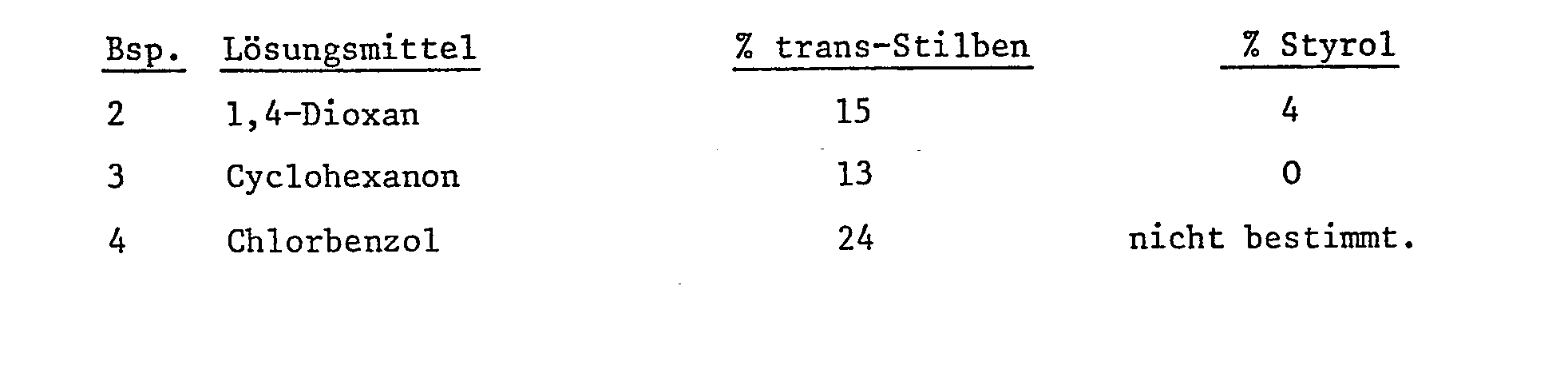
- Beispiel 1: Zu 100 ml Toluol werden 5,76 ml (50 mMol) Benzoylchlorid, 7,53 ml (50 mMol) N-Benzyldimethylamin und 0,1122 g (0,5 mMol) Palladiumacetat gegeben. Aethylen wird durch das Reaktionsgemisch geleitet. Anschliessend wird 8 Stunden bei 100°C gerührt. Gemäss gaschromatographischer Analyse enthält das Reaktionsgemisch 37% trans-Stilben und 18% Styrol.
- Beispiele 2-4: Beispiel 1 wird wiederholt unter Verwendung anderer Lösungsmittel:
- Beispiele 5-13: Beispiel 1 wird wiederholt, unter Abänderung einiger Verfahrensparameter wie unten angegeben:

- Beispiel 14: Zu 400 ml p-Xylol werden 34,1g (0,2 Mol) 4-Chlorbenzoylchlorid, 27,04 g (0,2 Mol) N-Benzyldimethylamin und 0,448 g (2 mMol) Palladiumacetat zugegeben. Aethylen wird durch das Reaktionsgemisch geleitet und das Gemisch wird 6 Stunden bei 120°C gerührt. Dann wird das Gemisch filtriert, und das Filtrat wird eingedampft.
- Der Rückstand wird am Filter mit 200 ml Methanol gewaschen, um das entstandene Aminsalz zu entfernen. Anschliessend wird aus 400 ml Cyclohexan umkristallisiert. Man erhält 13,7 g (56% d.Th.) 4,4'-Dichlorstilben (trans) in Form weisser Kristalle; Fp. 176,2°C.
- Beispiel 15: Beispiel 14 wird wiederholt unter Verwendung von 30,92 g (0,2 Mol) p-Toluylchlorid. Das Gemisch wird 8 Stunden bei 120°C gerührt. Nach dem Aufarbeiten wie in Beispiel 14 beschrieben und dem Umkristallisieren erhält man 9,3 g (45% d.Th.) 4,4'-Dimethylstilben (trans) in Form weisser glänzender Kristalle; Fp. 184,5°C.
- Beispiel 16: Beispiel 14 wird wiederholt unter Verwendung von 46,13 g (0,2 Mol) 3,4,5-Trimethoxybenzoylchlorid. Das Gemisch wird 4,5 Stunden bei 120°C gerührt. Nach der Aufarbeitung wie in Beispiel 14 be- schrieben und zweimaligem Umkristallisieren (einmal aus 200 ml Cyclohexan und 500 ml Toluol und einmal aus 900 ml Aceton) erhält.man 10,7 g (30% d.Th) 3,3',4,4',5,5'-Hexamethoxystilben (trans) in Form gelber Kristalle; Fp. 220,4°C.
- Beispiel 17: Beispiel 14 wird wiederholt unter Verwendung von 33,7 g (0,2 Mol) 3,4-Dimethylbenzoylchlorid. Das Gemisch wird 6,5 Stunden bei 120°C gerührt. Nach dem Aufarbeiten wie in Beispiel 14 beschrieben und dem Umkristallisieren aus 250 ml n-Hexan erhält man 10,2 g (43% d.Th.) 3,3',4,4'-Tetramethylstilben (trans) als hellgelbe Kristalle; Fp. 137,6°C.
- Beispiel 18: Beispiel 14 wird wiederholt unter Verwendung von 34,1 g (0,2 Mol) 3-Methoxybenzoylchlorid. Das Gemisch wird 7 Stunden bei 120°C gerührt. Nach dem Aufarbeiten wie in Beispiel 14 beschrieben und dem Umkristallisieren aus 200 ml n-Hexan erhält man 10,0 g (42% d.Th.) 3,3'-Dimethoxystilben (trans) in Form hellgelber Kristalle; Fp. 98,4°C.
- Beispiel 19: Beispiel 14 wird wiederholt unter Verwendung von 41,89 g (0,2 Mol) 3,4-Dichlorbenzoylchlorid. Das Gemisch wird 6 1/4 Stunden bei 120°C gerührt. Nach dem Aufarbeiten wie in Beispiel 14 beschrieben und dem Umkristallisieren aus einem Gemisch von 300 ml Cyclohexan und 250 ml Tetrachlorkohlenstoff erhält man 10,1 g (32% d.Th.) 3,3',4,4'-Tetrachlorstilben (trans) in Form hellbrauner Kristalle; Fp. 187,7°C.
- Beispiel 20: Beispiel 14 wird wiederholt unter Verwendung von 37,11 g (0,2 Mol) 4-Nitrobenzoylchlorid und 23,04 g (0,2 Mol) N-Aethylmorpholin. Das Gemisch wird 6 Stunden bei 120°C gerührt. Nach dem Aufarbeiten gemäss Beispiel 14 und zweimaligem Umkristallisieren aus je 50 ml N,N-Dimethylformamid erhält man 8,65 g (32% d.Th.) 4,4'-Dinitrostilben (trans) in Form gelber Nadeln; Fp. > 300°C.
- Beispiel 21: Beispiel 20 wird wiederholt unter Verwendung von 39,9 g (0,2 Mol) 2-Methyl-3-nitrobenzoylchlorid anstelle von 4-Chlorbenzoylchlorid. Das Gemisch wird auf 5°C gekühlt, das Rohprodukt wird abfiltriert und mit 200 ml 2N HC1 gewaschen. Anschliessend wird einmal aus 200 ml N,N-Dimethylformamid und einmal aus 100 ml N,N-Dimethylformamid umkristallisiert. Man erhält 13,1 g (44% d.Th.) 2,2'-Dimethyl-3,3'-dinitrostilben (trans) in Form hellgelber Kristalle; Fp. 246,0°C.
- Beispiel 22: Zu 100 ml p-Xylol werden 8,43 g (50 mMol) 4-Formylbenzoylchlorid, 11,91 ml (50 mMol) Tri-n-butylamin und 0,1122 g (0,5 mMol) Palladiumacetat gegeben. Aethylen wird durch das Gemisch geleitet, und das Gemisch wird 3 Stunden bei 120°C gerührt. Dann wird das Gemisch mit 100 ml 2N HC1 ausgeschüttelt und mit 5 g Magnesiumsulfat getrocknet. Nach dem Eindampfen wird der braune Rückstand auf Kieselgel chromatographiert (Laufmittel: Dichlormethan). Es werden zwei Produkte erhalten. Das erste wird nach dem Abdampfen des Dichlormethans in einem Kugelrohr bei 55°C/0,002 bar destilliert. Man erhält 0,32 g (5% d.Th.) 4-Formylstyrol. Das zweite Reaktionsprodukt wird nach dem Entfernen des Dichlormethans aus Benzol/Cyclohexan umkristallisiert. Man erhält 0,57 g (10% d.Th.) 4,4'-Diformylstilben in Form gelber Blättchen; Fp. 168,9°C.
- Gemäss Beispielen 14-21 wurden stets kleinere Anteile der entsprechenden Styrole gebildet, die aber nicht isoliert wurden.
- Beispiel 23: Zu 25 ml Toluol werden in einer Druckapparatur aus Glas 1,44 ml (12,5 mMol) Benzoylchlorid, 1,88 ml (12,5 mMol) N-Benzyldimethylamin und 0,0281 g (0,125 mMol) Palladiumacetat gegeben. Die Apparatur wird mit Aethylen gespült, um die Luft zu entfernen. Dann wird bei 10 bar Aethylen aufgepresst und 4 Stunden bei 120°C gerührt. Es werden 55% Styrol und 9% trans-Stilben gebildet.
- Beispiele 24-38: Analog der in Beispiel 23 beschriebenen Arbeitsweise werden unter Abänderung einiger Verfahrensparameter wie unten angegeben die folgenden Anteile an Styrol bzw. trans-Stilben erhalten:


- Beispiel 39: Zu 100 ml Toluol werden 7,73 g (50 mMol) p-Toluylchlorid, 6,76 g (50 mMol) N-Benzyldimethylamin und 0,112 g (0,5 mMol) Palladiumacetat gegeben. Das Gemisch wird 4 Stunden bei 140°C und einem Aethylendruck von 10 bar gerührt. Das Reaktionsgemisch wird filtriert, das Filtrat wird mit 100 ml 2N HC1, 100 ml 2N NaOH und dann mit 30 ml konz. wässrigem Ammoniak und 50 ml Wasser ausgeschüttelt. Nach dem Trocken mit Magnesiumsulfat wird das Gemisch eingedampft und auf Kieselgel chromatographiert. Nach dem Eindampfen erhält man 2,1 g (36% d.Th.) 4-Methylstyrol als farblose Flüssigkeit. Zur Identifizierung wird Brom an die Doppelbindung addiert:

- Man erhält das Bromderivat in Form weisser Kristalle; Fp. 44,7°C.
- Beispiel 40: Beispiel 39 wird wiederholt unter Verwendung von 8,75 g (50 mMol) 4-Chlorbenzoylchlorid anstelle von p-Toluylchlorid. Nach dem Aufarbeiten wie in Beispiel 39 beschrieben erhält man 3,8 g (55 % d.Th.) 4-Chlorstyrol als farblose Flüssigkeit, deren entsprechendes Bromderivat in Form von weissen Kristallen vom Fp. 46,0°C ausfällt.
- Beispiel 41: Beispiel 39 wird wiederholt unter Verwendung von 8,53 g (50 mMol) 3-Methoxybenzoylchlorid. Nach dem Aufarbeiten gemäss Beispiel 39 erhält man 3,2 g (48 % d.Th.) 3-Methoxystyrol als farblose Flüssigkeit, deren entsprechendes Bromderivat in Form von weissen Kristallen vom Fp. 63,3°C ausfällt.
- Beispiel 42: Beispiel 39 wird wiederholt unter Verwendung von 11,53 g (50 mMol) 3,4,5-Trimethoxybenzoylchlorid. Nach dem Aufarbeiten gemäss Beispiel 39 erhält man 4,1 g (36 % d.Th.) 3,4,5-Trimethoxystyrol als gelbe Flüssigkeit. Das 3,4,5-Trimethoxystyrol wird in das entsprechende Bromderivat übergeführt (hellgelbe Nadeln vom F. 104,1°C).
- Beispiel 43: Beispiel 39 wird wiederholt unter Verwendung von 10,47g (50 mMol) 3,4-Dichlorbenzoylchlorid. Nach dem Aufarbeiten gemäss Beispiel 39 erhält man 1,6 g (18 % d.Th.) 3,4-Dichlorstyrol als gelbe Flüssigkeit. Durch Ueberführen in das entsprechende Bromderivat erhält man weisse Kristalle vom Fp. 49,3°C.
- Beispiel 44: Analog der in Beispiel 39 beschriebenen Arbeitsweise werden unter Verwendung von 8,41 g (50 mMol) 3,4-Dimethylbenzoylchlorid 3,5 g (53 % d.Th.) 3,4-Dimethylstyrol als farblose Flüssigkeit erhalten. Durch Ueberführen in das Bromderivat erhält man hellgelbe Kristalle mit einem Fp. unter 40°C.
- Beispiel 45: Analog der in Beispiel 39 beschriebenen Arbeitsweise werden unter Verwendung von 9,98 g (50 mMol) 2-Methyl-3-nitrobenzoylchlorid und 5,76 g (50 mMol) N-Aethylmorpholin 4,15 g (51 % d.Th.) 2-Methyl-3-nitrostyrol als hellbraune Flüssigkeit erhalten, Durch Ueberführen in das Bromderivat erhält man weisse Kristalle vom Fp. 56,7°C.
- Beispiel 46: Beispiel 45 wird wiederholt unter Verwendung von 9.,29 g (50 mMol) 4-Nitrobenzoylchlorid. Nach dem Aufarbeiten erhält man 2,2 g (30 % d.Th.) 4-Nitrostyrol als gelbe Flüssigkeit. Das Ueberführen in das Bromderivat ergibt weisse Kristalle vom Fp. 74,8°C..
- Beispiel 47: Beispiel 45 wird wiederholt unter Verwendung von 8,44 g (50 mMol) 4-Formylbenzoylchlorid. Nach dem Aufarbeiten erhält man 0,7 g (11 % d.Th.) 4-Formylstyrol als tiefgelbe Flüssigkeit. Das Ueberführen in das Bromderivat ergibt weisse Kristalle vom Fp. 65,9°C.
- Beispiel 48: Zu 25 ml Toluol werden unter Argon 2,39 g (12,5 mMol) Zimtsäurenitril-4-carbonsäurechlorid, 1,69 g (12,5 mMol) N-Benzyldimethylamin und 0,0280 g (0,125 mMo1) Palladiumacetat gegeben. Das Reaktionsgemisch wird während 4 Stunden bei 140°C unter einem Aethylendruck von 10 bar gerührt. Dann wird das Gemisch bei Raumtemperatur mit 100 ml 2N HCl und 100 ml 2N NaOH ausgeschüttelt und über Magnesiumsulfat getrocknet. Anschliessend wird die Lösung eingedampft und auf Kieselgel mit Dichlormethan als Laufmittel chromatographiert. Das so erhaltene gelbe Oel wird in kochendem n-Pentan gelöst. Bei -20°C werden 0,84 g (44% d.Th.) 4-Vinylzimtsäurenitril in Form weisser Kristalle gebildet; Fp. 45,8°C.
- Beispiel 49: Zu 25 ml Toluol werden unter Argon 1,743 g (6,25 mMol) Biphenyl-4,4'-dicarbonsäuredichlorid, 1,88 ml (12,5 mMol) N-Benzyldimethylamin und 0,0280 g (0,125 mMol) Palladiumacetat gegeben. Das Gemisch wird 1,5 Stunden bei 115°C unter einem Aethylendruck von 10 bar gerührt. Dann wird das Gemisch bei Raumtemperatur filtriert und mit 40 ml 2N HC1 und 40 ml 2N NaOH ausgeschüttelt. Schliesslich wird mit Magnesiumsulfat getrocknet, eingedampft und einmal aus n-Hexan umkristallisiert. Man erhält 0,17 g (12% d.Th.) 4,4'-Divinyl-biphenyl als weisse Kristalle; Fp. > 300°C (Zers.).
- Beispiel 50: Zu 40 ml p-Xylol werden unter Argon 3,83 g (20 mMol) Zimtsäurenitril-4-carbonsäurechlorid,. 2,70 g (20 mMol) N-Benzyldimethylamin und 0,0448 g (0,2 mMol) Palladiumacetat gegeben. Aethylen wird durch das Gemisch geleitet, und das Gemisch wird 23 Stunden bei 130°C gerührt. Danach wird das Reaktionsgemisch bei 130°C mit 40 ml p-Xylol verdünnt und filtriert. Zum Filtrat werden 10 ml n-Hexan zugegeben. Nach dem Abkühlen auf Raumtemperatur erhält man 0,39 g (15 % d.Th.) 4,4'-Bis-(2-cyanovinyl)stilben vom Fp. 220°C.
-


- Zu 12,25 mg (0,0549 mMol) Palladiumacetat in 24,5 ml p-Xylol werden - unter Argon 0,84 g (5,49 mMol) 4-Vinylzimtsäurenitril, 1,309 g (5,49 mMol) Zimtsäureäthylester-4-carbonsäurechlorid und 0,742 g (5,49 mMol) N-Benzyldimethylamin gegeben. Das Gemisch wird während 5,5 Std. bei 130°C gerührt. Dann wird das Gemisch mit 100 ml Toluol verdünnt und mit 100 ml 2N HC1 und 100 ml 2N NaOH aüsgeschüttelt. Nach dem Trocknen mit Magnesiumsulfat wird die Lösung eingedampft, und das Rohprodukt wird einmal aus 100 ml Tetrachlorkohlenstoff und einmal aus 50 ml Aethanol umkristallisiert. Man erhält 0,47 g (26% d.Th.) des obigen optischen Aufhellers in Form hellgelber Kristalle; Fp. 155,1°C.

- Zu 20 ml p-Xylol werden unter Argon 0,0449 g (0,2 mMol) Palladiumacetat, 0,1048 g (0,4 mMol) Triphenylphosphin, 4,7 g (20 mMol) 2-(4-Bromphenyl)-pyrimidin [hergestellt durch Umsetzung von 4-Brombenzamidin mit Malondialdehyd in basischem Milieu], 3,1 g (20 mMol) 4-Vinylzimtsäurenitril und 4,47 g (20 mMol) Tri-n-butylamin gegeben, und das Gemisch wird während 6 Std. bei 130° gerührt. Das erhaltene Rohprodukt wird bei Raumtemperatur abfiltriert und zweimal aus Toluol/Tetrachlorkohlenstoff umkristallisiert. Man erhält 1,9 g (31% d.Th.) des obigen optischen Aufhellers in Form gelber Kristalle; Fp. 290-291°C.
dadurch herstellen kann, dass man bei einem Druck von 0,1 bis 20 bar Aethylen in Gegenwart einer Base und unter Zusatz von Palladium-Metall oder von Palladiumverbindungen, die unter den Reaktionsbedingungen phosphorfreie labile Palladium(0)Verbindungen bilden, als Katalysator, mit einer Verbindung der Formel II oder III

Claims (17)

dadurch gekennzeichnet, dass man bei einem Druck von 0,1 bis 20 bar Aethylen in Gegenwart einer Base und unter- Zusatz von Palladium-Metall oder von Palladiumverbindungen, die unter den Reaktionsbedingungen phosphorfreie labile Palladium(0)Verbindungen bilden, als Katalysator, mit einer Verbindung der Formel II oder III


Applications Claiming Priority (2)
| Application Number | Priority Date | Filing Date | Title |
|---|---|---|---|
| CH217981 | 1981-03-31 | ||
| CH2179/81 | 1981-03-31 |
Publications (2)
| Publication Number | Publication Date |
|---|---|
| EP0062005A1 true EP0062005A1 (de) | 1982-10-06 |
| EP0062005B1 EP0062005B1 (de) | 1985-06-26 |
Family
ID=4227734
Family Applications (1)
| Application Number | Title | Priority Date | Filing Date |
|---|---|---|---|
| EP82810134A Expired EP0062005B1 (de) | 1981-03-31 | 1982-03-25 | Verfahren zur Herstellung von Styrol- und/oder Stilbenderivaten |
Country Status (4)
| Country | Link |
|---|---|
| US (1) | US4533505A (de) |
| EP (1) | EP0062005B1 (de) |
| JP (1) | JPS57175131A (de) |
| DE (1) | DE3264392D1 (de) |
Cited By (1)
| Publication number | Priority date | Publication date | Assignee | Title |
|---|---|---|---|---|
| EP0129956A1 (de) * | 1983-03-29 | 1985-01-02 | Nippon Petrochemicals Company, Limited | Verfahren zur Arylierung ungesättiger Verbindungen |
Families Citing this family (1)
| Publication number | Priority date | Publication date | Assignee | Title |
|---|---|---|---|---|
| US4925595A (en) * | 1987-07-03 | 1990-05-15 | Ciba-Geigy Corporation | Liquid detergent compositions containing disulfonated fluorescent whitening agents: di-styryl-biphenyl or di-styryl-benzene derivatives |
Citations (3)
| Publication number | Priority date | Publication date | Assignee | Title |
|---|---|---|---|---|
| DE1914601B2 (de) * | 1968-03-23 | 1974-02-28 | Asahi Kasei Kogyo K.K., Osaka (Japan) | Verfahren zur Herstellung von alpha, be ta-ungesättigten aliphatischen Nitrilen aus Olefinen |
| DE2602750A1 (de) * | 1975-02-05 | 1976-08-19 | Sandoz Ag | Organische verbindungen, deren herstellung und verwendung |
| CH586644A5 (de) * | 1972-05-19 | 1977-04-15 | Nippon Kayaku Kk |
Family Cites Families (3)
| Publication number | Priority date | Publication date | Assignee | Title |
|---|---|---|---|---|
| US3869500A (en) * | 1968-03-23 | 1975-03-04 | Asahi Chemical Ind | Process for the production of unsaturated aliphatic nitriles |
| US3689583A (en) * | 1968-12-10 | 1972-09-05 | Naoya Kominami | Production of dimethylstyrenes |
| DE3160641D1 (en) * | 1980-05-13 | 1983-08-25 | Ciba Geigy Ag | Process for the preparation of benzene or naphthalene alkenyl carboxylic acid derivatives |
-
1982
- 1982-03-19 US US06/360,017 patent/US4533505A/en not_active Expired - Fee Related
- 1982-03-25 EP EP82810134A patent/EP0062005B1/de not_active Expired
- 1982-03-25 DE DE8282810134T patent/DE3264392D1/de not_active Expired
- 1982-03-29 JP JP57049230A patent/JPS57175131A/ja active Granted
Patent Citations (3)
| Publication number | Priority date | Publication date | Assignee | Title |
|---|---|---|---|---|
| DE1914601B2 (de) * | 1968-03-23 | 1974-02-28 | Asahi Kasei Kogyo K.K., Osaka (Japan) | Verfahren zur Herstellung von alpha, be ta-ungesättigten aliphatischen Nitrilen aus Olefinen |
| CH586644A5 (de) * | 1972-05-19 | 1977-04-15 | Nippon Kayaku Kk | |
| DE2602750A1 (de) * | 1975-02-05 | 1976-08-19 | Sandoz Ag | Organische verbindungen, deren herstellung und verwendung |
Cited By (1)
| Publication number | Priority date | Publication date | Assignee | Title |
|---|---|---|---|---|
| EP0129956A1 (de) * | 1983-03-29 | 1985-01-02 | Nippon Petrochemicals Company, Limited | Verfahren zur Arylierung ungesättiger Verbindungen |
Also Published As
| Publication number | Publication date |
|---|---|
| DE3264392D1 (en) | 1985-08-01 |
| JPS57175131A (en) | 1982-10-28 |
| US4533505A (en) | 1985-08-06 |
| JPH0321007B2 (de) | 1991-03-20 |
| EP0062005B1 (de) | 1985-06-26 |
Similar Documents
| Publication | Publication Date | Title |
|---|---|---|
| EP0041043B1 (de) | Verfahren zur Herstellung von Alkenylbenzol- oder -naphthalin-derivaten | |
| EP0040177B1 (de) | Verfahren zur Herstellung von Alkenylbenzol- oder -naphthalincarbonsäurederivaten | |
| Kikukawa et al. | Reaction of diazonium salts with transition metals—III: Palladium (0)-catalyzed arylation of unsaturated compounds with arenediazoium salts | |
| DE68920429T2 (de) | An der seite fluorierte 4-cyanophenyl und 4'-cyanobiphenyl-benzoate. | |
| EP0078768B1 (de) | Verfahren zur Pd-katalysierten Arylierung von Olefinen mit Arylhalogeniden | |
| EP0307519A1 (de) | Perfluoralkylierungsverfahren | |
| CH621767A5 (en) | Process for the preparation of optically active alkyl chrysanthemates. | |
| EP1437356A1 (de) | Kupferkomplexe und ihre Verwendung | |
| EP0103544A1 (de) | Verfahren zur Pd-katalysierten Arylierung von Olefinen mit Arylchloriden | |
| EP0062005B1 (de) | Verfahren zur Herstellung von Styrol- und/oder Stilbenderivaten | |
| US6127583A (en) | Process for preparing acetylene derivative from a ketone compound | |
| EP0606057A1 (de) | Verfahren zur Herstellung von aromatischen Olefinen | |
| DE19801598C2 (de) | Katalytische Synthese von N-alkylierten Anilinen aus Olefinen und Anilinen | |
| EP0184981B1 (de) | Neue Pyrrolinone und deren Zwischenprodukte | |
| US5274171A (en) | Process for the palladium catalyzed coupling of a diazonium salt with an olefinic bond | |
| EP0104296B1 (de) | Verfahren zur Herstellung von Stilben-4,4'-dialdehyd | |
| EP0062608B1 (de) | 4-Halogenstilbenderivate und Verfahren zu deren Herstellung | |
| EP0391212B1 (de) | Verfahren zur Herstellung von bifunktionellen Z-Stilbenverbindungen, neue bifunktionelle Z-Stilbenverbindungen sowie die Verwendung der Z-Stilbenverbindungen zur Herstellung von Polymeren | |
| US3937722A (en) | α-(Cyanoethyl)-benzoin ethers | |
| EP0066246A2 (de) | Verfahren zur Herstellung basisch substituierter Phenylacetonitrile | |
| DE4324751A1 (de) | 2,4,5-Trihalogenstilbene, Verfahren zu ihrer Herstellung und ihre Verwendung | |
| Miller et al. | A General Synthesis of α-Substituted Acrylonitriles | |
| DE60127979T2 (de) | Verfahren zur herstellung von 3,5-bisalkylphenolen | |
| EP0085030A1 (de) | Verfahren zur Herstellung von substituierten Divinylpyridinen und neue substituierte Divinylpyridine | |
| DE2615706C2 (de) | Verfahren zur Herstellung von o-(N-monosubstituierten-Amino)-benzylalkoholen |
Legal Events
| Date | Code | Title | Description |
|---|---|---|---|
| PUAI | Public reference made under article 153(3) epc to a published international application that has entered the european phase |
Free format text: ORIGINAL CODE: 0009012 |
|
| 17P | Request for examination filed |
Effective date: 19820327 |
|
| AK | Designated contracting states |
Designated state(s): CH DE FR GB IT |
|
| ITF | It: translation for a ep patent filed | ||
| GRAA | (expected) grant |
Free format text: ORIGINAL CODE: 0009210 |
|
| AK | Designated contracting states |
Designated state(s): CH DE FR GB IT LI |
|
| REF | Corresponds to: |
Ref document number: 3264392 Country of ref document: DE Date of ref document: 19850801 |
|
| ET | Fr: translation filed | ||
| PLBE | No opposition filed within time limit |
Free format text: ORIGINAL CODE: 0009261 |
|
| STAA | Information on the status of an ep patent application or granted ep patent |
Free format text: STATUS: NO OPPOSITION FILED WITHIN TIME LIMIT |
|
| 26N | No opposition filed | ||
| ITTA | It: last paid annual fee | ||
| PGFP | Annual fee paid to national office [announced via postgrant information from national office to epo] |
Ref country code: FR Payment date: 19920123 Year of fee payment: 11 |
|
| PGFP | Annual fee paid to national office [announced via postgrant information from national office to epo] |
Ref country code: DE Payment date: 19920210 Year of fee payment: 11 |
|
| PGFP | Annual fee paid to national office [announced via postgrant information from national office to epo] |
Ref country code: GB Payment date: 19920214 Year of fee payment: 11 |
|
| PGFP | Annual fee paid to national office [announced via postgrant information from national office to epo] |
Ref country code: CH Payment date: 19920224 Year of fee payment: 11 |
|
| PG25 | Lapsed in a contracting state [announced via postgrant information from national office to epo] |
Ref country code: GB Effective date: 19930325 |
|
| PG25 | Lapsed in a contracting state [announced via postgrant information from national office to epo] |
Ref country code: LI Effective date: 19930331 Ref country code: CH Effective date: 19930331 |
|
| GBPC | Gb: european patent ceased through non-payment of renewal fee |
Effective date: 19930325 |
|
| PG25 | Lapsed in a contracting state [announced via postgrant information from national office to epo] |
Ref country code: FR Effective date: 19931130 |
|
| REG | Reference to a national code |
Ref country code: CH Ref legal event code: PL |
|
| PG25 | Lapsed in a contracting state [announced via postgrant information from national office to epo] |
Ref country code: DE Effective date: 19931201 |
|
| REG | Reference to a national code |
Ref country code: FR Ref legal event code: ST |