EP0061148B1 - Elektronisches Flüssigkeitsstandmessgerät - Google Patents
Elektronisches Flüssigkeitsstandmessgerät Download PDFInfo
- Publication number
- EP0061148B1 EP0061148B1 EP82102185A EP82102185A EP0061148B1 EP 0061148 B1 EP0061148 B1 EP 0061148B1 EP 82102185 A EP82102185 A EP 82102185A EP 82102185 A EP82102185 A EP 82102185A EP 0061148 B1 EP0061148 B1 EP 0061148B1
- Authority
- EP
- European Patent Office
- Prior art keywords
- oscillator
- counter
- divider
- pulses
- pulse
- Prior art date
- Legal status (The legal status is an assumption and is not a legal conclusion. Google has not performed a legal analysis and makes no representation as to the accuracy of the status listed.)
- Expired
Links
- 239000007788 liquid Substances 0.000 title claims description 65
- 230000004044 response Effects 0.000 claims description 8
- 230000001939 inductive effect Effects 0.000 claims description 7
- 230000001960 triggered effect Effects 0.000 claims description 7
- 239000000446 fuel Substances 0.000 description 11
- 239000003990 capacitor Substances 0.000 description 6
- 238000005259 measurement Methods 0.000 description 6
- 238000010586 diagram Methods 0.000 description 3
- 230000008859 change Effects 0.000 description 2
- 230000001419 dependent effect Effects 0.000 description 2
- 238000005070 sampling Methods 0.000 description 2
- 239000000654 additive Substances 0.000 description 1
- 238000010276 construction Methods 0.000 description 1
- 230000006870 function Effects 0.000 description 1
- 239000010763 heavy fuel oil Substances 0.000 description 1
- 238000000034 method Methods 0.000 description 1
- 238000012986 modification Methods 0.000 description 1
- 230000004048 modification Effects 0.000 description 1
- 239000003208 petroleum Substances 0.000 description 1
- 230000001172 regenerating effect Effects 0.000 description 1
- 102220028659 rs1801496 Human genes 0.000 description 1
- 239000000523 sample Substances 0.000 description 1
Images
Classifications
-
- G—PHYSICS
- G01—MEASURING; TESTING
- G01F—MEASURING VOLUME, VOLUME FLOW, MASS FLOW OR LIQUID LEVEL; METERING BY VOLUME
- G01F23/00—Indicating or measuring liquid level or level of fluent solid material, e.g. indicating in terms of volume or indicating by means of an alarm
- G01F23/22—Indicating or measuring liquid level or level of fluent solid material, e.g. indicating in terms of volume or indicating by means of an alarm by measuring physical variables, other than linear dimensions, pressure or weight, dependent on the level to be measured, e.g. by difference of heat transfer of steam or water
- G01F23/26—Indicating or measuring liquid level or level of fluent solid material, e.g. indicating in terms of volume or indicating by means of an alarm by measuring physical variables, other than linear dimensions, pressure or weight, dependent on the level to be measured, e.g. by difference of heat transfer of steam or water by measuring variations of capacity or inductance of capacitors or inductors arising from the presence of liquid or fluent solid material in the electric or electromagnetic fields
- G01F23/263—Indicating or measuring liquid level or level of fluent solid material, e.g. indicating in terms of volume or indicating by means of an alarm by measuring physical variables, other than linear dimensions, pressure or weight, dependent on the level to be measured, e.g. by difference of heat transfer of steam or water by measuring variations of capacity or inductance of capacitors or inductors arising from the presence of liquid or fluent solid material in the electric or electromagnetic fields by measuring variations in capacitance of capacitors
Definitions
- This invention relates to an electronic liquid level gauge fnr measuring the level of a liquid contained in a vessel and, more particularly, to such an electronic liquid level gauge employing an electrode pair having two electrode plates faced in spaced-parallel relation to each other and immersed in the liquid, the electrode pair having an electrostatic capacity determinative on the liquid level.
- Another electrode pair has been employed in addition to the former electrode pair.
- the latter electrode pair has two electrode plates faced in spaced-parallel relation to each other and immersed in the liquid, the electrode pair having an electrostatic capacity determinative on the specific inductive capacity of the liquid.
- the oscillator pulse repetition period T i which is represented by B 1 C 1 , is converted into a binary number by a repetition period detector.
- the detector output is coupled to a subtractor which subtracts a constant B 1 .C 1 from the repetition rate binary value and provides a difference B 1 . (C 1 -C 0 ).
- the latter electrode pair is associated with an oscillator which generates oscillator pulses of a repetition period T 2 directly proportional to the electrostatic capacity C 2 of the latter electrode pair.
- the oscillator pulse repetition period T 3 which is represented by B 2 - C 2 , is converted into a binary number by a repetition period detector.
- the detector output is coupled to a multiplier which multiplies a constant K by the repetition period binary number B 2 ⁇ C 2 .
- the multiplier output is coupled to a subtractor which subtracts a constant B 2 ⁇ C 0 from the resulting product K - B 2 - C 2 and provides a difference B 2 . (K . C 2 ⁇ C o ).
- a control circuit that calculates the results from the input values supplied by a first and a second oscillator, each being connected to a first and a second electrode, respectively, comprises several operational amplifiers, a multiplier and a divider. Due to these many parts the circuit is rather complicated and expensive.
- DE-A1-28 52 212 Another apparatus for adjusting deviations that could occur due to temperature changes of the liquid is known from DE-A1-28 52 212.
- the apparatus described in the application uses two measuring capacities and two compensation capacities.
- Several operational amplifiers, flip- flops and gates are used to calculate the liquid level from the signals supplied by said four capacitors. Due to the many electronic components also this apparatus is rather complicated and expensive.
- This invention provides an improved apparatus for measuring the level of liquid contained in a vessel, which apparatus employs a simple and inexpensive electronic circuit and gives correct liquid level measurements, within close tolerances.
- an apparatus which includes a first electrode pair having two electrode plates opposed in parallel relationship to each other and immersed in the liquid, said electrode pair having an electrostatic capacity determined by the liquid level, a first oscillator connected to said first electrode pair for regenerating oscillator pulses at a first repetition period directly proportional to the electrostatic capacity of said first electrode pair, a reference pulse generator for generating a series of reference pulses, and a first counter responsive to a start signal for counting reference pulses from said reference pulse generator, said first counter being reset to zero in response to a reset signal, whereby said reset signal is triggered by an oscillator pulse from said first oscillator, and said start signal is provided by a control circuit accessing said first counter in a way that said first counter starts counting with a predetermined time delay after said reset signal, so that the value of the count in said first counter determined between said start signal and the following reset signal is proportional to the liquid level.
- the apparatus measures the level of a liquid contained in a vessel with taking into account the change in the specific inductive capacity of the liquid.
- a reference pulse generator which comprises a second electrode pair and a second oscillator. The second oscillator generates said reference pulses at a repetition rate directly proportional to the electrostatic capacity of said second electrode pair.
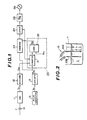
- the liquid level gauge employs an electrode pair 10 which, as shown in Fig. 2, has two electrode plates 10A and 10B faced in spaced-parallel relation to each other and immersed in a liquid 2 contained in a vessel 1.
- the electrode plates constitute a capacitor having an electrostatic capacity determinative on the level of the liquid.
- the electrode pair 10 is associated with an oscillator 11 which generates oscillator pulses of a repetition period T 11 directly proportional to the electrostatic capacity of the electrode pair 10.
- the oscillator pulse output is coupled to a divider 12 which has a predetermined frequency divisor N, so that the pulse signal outputted therefrom has a repetition period T, 2 represented by T 11 x N 1
- the liquid level gauge also employs a reference pulse generator 13 which generates a series of reference pulses of a predetermined repetition period To.
- the reference pulses are coupled to a divider 14 which has a predetermined frequency divisor N 2 so that the pulse signal outputted therefrom has a repetition period T 14 represented by T o xN 2 .
- the output of the divider 12 is coupled to a monostable multivibrator 20 which is shown as including a counter 21 and a comparator 22. When receiving a pulse from the divider 12, the counter 21 is reset to zero and at the same time starts counting pulses from the divider 14.
- the output of the counter 21 is coupled to the comparator 22 which compares the value of the count in the counter 21 with a reference value N 3 and provides a high output when the former is equal to the latter.
- the output of the comparator 22 is held low before the value of the count in the counter 21 reaches the predetermined value N 3 .
- the counter 21 stops counting up in response to the high output of the comparator 22.
- the output of the monostable multivibrator 20 or the comparator 22 is coupled to a counter 23 which starts counting pulses from the divider 14 when the output of the comparator 22 goes high.
- the counter 23 is reset to zero when the output of the comparator 22 goes low which is caused by the next pulse applied from the divider 12 to the counter 21 so as to reset it to zero.
- the output of the comparator 22 is also coupled to a latch circuit 24.
- the latch circuit 24 latches the value of the count in the counter 23 just before the counter 23 is reset when the output of the comparator 22 goes low.
- the latched count value T 23 is represented by T 12 ⁇ T 22
- the output of the latch circuit 24 is coupled to a digital-to-analog converter 25 wherein the latched count value is converted into analog form.
- the output of the D to A converter 25 is coupled to an analog meter 26 for indication of the converted analog value which represents the liquid level in a linear relationship to the electrostatic capacity C of the electrode pair 10, as will be described in greater
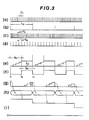
- Fig. 3a illustrates the pulse output produced by the oscillator 11.
- the oscillator pulse output has a repetition period T" directly proportional to the electrostatic capacity C of the electrode pair 10.
- Fig. 3b illustrates the pulse output produced by the divider 12.
- the divider pulse output has a repetition period T, 2 , represented by T 11 xN 1 which is obtained as a result of dividing the repetition frequency 1/T 11 of the oscillator pulse output by a predetermined frequency divisor N,.
- Fig. 3c illustrates the pulse output produced by the reference pulse generator 13, which has a predetermined repetition period To.
- Fig. 3a illustrates the pulse output produced by the oscillator 11.
- the oscillator pulse output has a repetition period T" directly proportional to the electrostatic capacity C of the electrode pair 10.
- Fig. 3b illustrates the pulse output produced by the divider 12.
- the divider pulse output has a repetition period T, 2 , represented by T 11 xN 1 which is obtained as a result of dividing
- the divider pulse output has a repetition period T, 4 , represented by T o xN 2 , which is obtained as a result of dividing the repetition frequency 1/To of the generator output pulses by a predetermined frequency divisor N 2 .
- the counter 21 starts counting the pulses from the divider 14, as shown in Fig. 3e.
- the output of the comparator 22 changes from its low level to its high level, as shown in Fig. 3f, and at the same time the counter 21 stops counting the pulses, as shown in Fig. 3e.
- the counter 23 starts counting pulses from the divider 14, as shown in Fig. 3g, at time t 2 when the output of the comparator 22 goes high.
- the counter 23 stops counting the pulses at time t 3 when the output of the comparator 22 goes low and the counter 21 is reset to zero.
- the counter 21 starts counting pulses from the divider 14 again, as shown in Fig. 3e.
- the value N of the count in the counter 23 is latched in the latch circuit 24, as shown in Fig. 3h.
- the latched value is applied to the D to A converter 25 which converts it into analog form, as shown in Fig. 3i.
- the converted analog value is indicated on the analog meter 26.
- a digital indicator may be used to provide thereon a digital indication of the measured liquid level by directly reading the count value in the counter 23.
- the value in the counter 23 or the latch circuit 24 may be utilized for other calculations made based upon the measured liquid level, such as for example, calculations of the possible distance of travel of an automotive vehicle from values of fuel consumption rate and residual fuel quantity.
- the dividers 12 and 14, used for adjustment of the pulse sampling timing, may be eliminated in some instances dependent upon the kind of used liquid and the required accuracy of liquid level measurement.
- the oscillator 11 should be designed to generate a pulse signal of a repetition frequency as high as several hundreds of kilohertz in order to avoid the influence of gasoline's dielectric constant upon frequency characteristics, however, the fuel level indication changes improperly in the microsecond order without the divider 12. It is desirable in such applications to indicate the measured fuel level in the minute order to provide stabilized fuel level indication with the fuel level shaking being absorbed which occurs during automotive vehicle running.
- the divider 12 may be designed to have a frequency divisor on the order of 10 8 .
- the divider 14 may be eliminated in employing a reference pulse generator adapted to generate a series of pulses of a low repetition frequency. It is desirable, however, to use the divider 14 because of cost and space considerations.
- the reference pulse generator 13 normally includes a capacitor on which its time constant is determinative. A large and expensive capacitor is required to obtain a series of pulses having a low repetition frequency, resulting in a space-consuming and expensive structure.
- the frequency divisor of the divider 12 it is preferable in automotive vehicle fuel level measuring applications to change the frequency divisor of the divider 12 to a small value so that the divider 12 generates pulses at elongated time intervals during vehicle travelling and to a large value so that the divider 12 generates pulses at shortened time intervals during vehicle starting and refueling.
- This may be attained by replacing the divider 12 with a presettable divider, the frequency divisor of which is changed in accordance with a signal such as, for example, a vehicle speed indicative signal from a vehicle speed sensor.
- a further alternative device is a pulse generator which generates a first signal in response to a pulse from the divider 12 and a second signal with a predetermined time delay relative to the occurrence of the pulse from the divider 12.
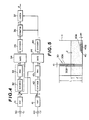
- the liquid level gauge employs first and second electrode pairs 30 and 40.
- the first electrode pair 30 has two electrode plates 30A and 308 faced in spaced-parallel relation to each other and immersed in a liquid 2 contained in a vessel 1.
- the electrode plates 30A and 30B constitue a capacitor having an electrostatic capacity determinative on the level of the liquid.
- the second electrode pair 40 has two electrode plates 40A and 40B faced in spaced-parallel relation to each other and immersed in the liquid 2.
- the electrode plates 40A and 40B constitute a capacitor having an electrostatic capacity determinative on the specific inductive capacity of the liquid.
- the second electrode pair 40 is placed near the bottom of the vessel 1.
- the first electrode pair 30 is associated with an oscillator 31 which generates oscillator pulses of a repetition period T 3 , directly proportional to the electrostatic capacity C, of the first electrode pair 30.
- the divider pulse output is used to trigger a monostable multivibrator 33 into its unstable state.
- the monostable multivibrator 33 generates a pulse signal having a pulse width T 33 and a repetition period of T 31 x N 32 .
- the second electrode pair 40 is associated with an oscillator 41 which generates oscillator pulses of a repetition period T 4 , directly proportional to the electrostatic capacity C 2 of the second electrode pair 40.
- the output of the monostable multivibrator 33 is coupled to a gate circuit 34 which passes pulses from the oscillator 41 only when the monostable multivibrator 33 is in its stable state.
- the time during which the gate circuit 34 passes the oscillator pulses is represented by T 41 xN 32 -T 33 ⁇
- the output of the gate circuit 34 is coupled through a divider 35 to a counter 36.
- the divider 35 has a predetermined frequency divisor N 35 .
- the output of the monostable multivibrator 43 is coupled to a gate circuit 44 which passes pulses from the oscillator 31 only when the monostable multivibrator 43 is in its stable state.
- the time during which the gate circuit 44 passes the oscillator pulses is represented by T 31 xN 42 -T 43 ⁇
- the output of the gate circuit 44 is coupled to a divider 45 having a predetermined frequency divisor N 45 .
- the output of the divider 45 is coupled to the counter 36 and also to a latch circuit 37.
- the counter 36 is reset to zero and at the same time starts counting pulses from the divider 35 in response to a pulse from the divider 45.
- the latch circuit 37 latches the value of the count in the counter 36 in response to a pulse from the divider 45.
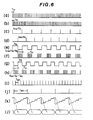
- FIG. 6 there are shown voltage-versus-time waveforms obtained at various points in the circuit of Fig. 4.
- Figs. 6a to 6h are drawn on the same time scale.
- Figs. 6i to 61 are drawn on the same time scale but on the enlarged time scale as compared to that of Figs. 6a to 6h.
- Fig. 6a illustrates the pulse output produced by the oscillator 31.
- the oscillator pulse output has a repetition period T 3 , directly proportional to the electrostatic capacity C, of the first electrode pair 30.
- the repetition period T 3 is represented by B 1 xC 1 wherein B 1 is a constant.
- Fig. 6b illustrates the pulse output produced by the oscillator 41.
- the oscillator pulse output has a repetition period T 4 , directly proportional to the electrostatic capacity C 2 of the second electrode pair 40.
- the repetition period T 4 is represented by B 2 xC 2 , wherein B 2 is a constant.
- Fig. 6C illustrates the pulse output produced by the divider 32.
- the divider pulse output has a repetition period T 3 ,xN 32 obtained as a result of dividing the repetition frequency 1/T31 of the oscillator pulse output by a predetermined frequency divisor N 33 .
- Fig. 6d illustrates the pulse output produced by the divider 42.
- the divider pulse output has a repetition period T 41 xN 42 obtained as a result of dividing the repetition frequency 1/T 41 of the oscillator pulse output by a predetermined frequency divisor N 42 .
- Fig. 6e illustrates the pulse output produced by the monostable multivibrator 33 which is triggered into its unstable state to provide a high output by a pulse from the divider 32.
- the output of the monostable multivibrator 33 remains high for a predetermined time T 33 and then goes low.
- the multivibrator pulse output has a pulse width of T 33 and a repetition period equal to that of the pulse signal from the divider 32.
- Fig. 6g illustrates the pulse output produced by the monostable multivibrator 43 which is triggered into its unstable state to provide a high output by a pulse from the divider 42.
- the output of the monostable multivibrator 43 remains high for a predetermined time T 43 and then goes low.
- the multivibrator pulse output has a pulse width of T 43 and a repetition period equal to that of the pulse signal from the divider 42.
- Fig. 6f illustrates the pulse output produced by the gate circuit 34 which responds to a stable state of the monostable multivibrator 33 for passing pulses from the oscillator 41.
- the time during which the monostable multivibrator is in its stable state is represented by N 32 .
- T 31 -T 33 is represented by the average repetition period T MO of the pulse signal from the gate circuit 34.
- Fig. 6h illustrates the pulse output produced by the gate circuit 44 which responds to a stable state of the monostable multivibrator 43 for passing pulses from the oscillator 31.
- the time during which the monostable multivibrator is in its stable state is represented by N 42 xT 41 -T 43 .
- the average repetition period T so of the pulse signal from the gate circuit 44 may be given by
- Fig. 6i illustrates the pulse output produced by the divider 35 which divides the repetition frequency of the pulse signal from the gate circuit 34 by a predetermined dividing ratio N 35 .
- the divider output pulse has an average repetition rate T MO 1 which is represented by
- Fig. 6j illustrates the pulse output produced by the divider 45 which divides the repetition frequency of the pulse signal from the gate circuit 44 by a predetermined frequency divisor N 45 .
- the divider output pulse has an average repetition rate T so , which is represented by
- Fig. 6k illustrates the value of the count in the counter 36 which is reset to zero and at the same time starts counting pulses from the divider 35 when receiving a pulse from the divider 45.
- the latch circuit 37 responds to a pulse from the divider 45 for latching the value of the count in the counter 36, as shown in Fig. 61.
- the latched value N is represented by
- the divider 35 used for adjustment of the pulse sampling timing, may be eliminated in some instances dependent upon the kind of used liquid and the required accuracy of liquid level measurement. In automotive vehicle fuel level measuring applications, however, it is desirable to use the divider so as to provide stabilized fuel level measurement with the fuel level shaking being absorbed which occurs during automotive vehicle running.
Landscapes
- Physics & Mathematics (AREA)
- Engineering & Computer Science (AREA)
- Power Engineering (AREA)
- Electromagnetism (AREA)
- Thermal Sciences (AREA)
- Fluid Mechanics (AREA)
- General Physics & Mathematics (AREA)
- Measurement Of Levels Of Liquids Or Fluent Solid Materials (AREA)
Claims (13)
dadurch gekennzeichnet, daß
Applications Claiming Priority (4)
| Application Number | Priority Date | Filing Date | Title |
|---|---|---|---|
| JP56039186A JPS57153222A (en) | 1981-03-18 | 1981-03-18 | Liquid quantity measuring circuit |
| JP39186/81 | 1981-03-18 | ||
| JP96350/81 | 1981-06-22 | ||
| JP56096350A JPS57211018A (en) | 1981-06-22 | 1981-06-22 | Liquid quantity measuring circuit |
Publications (2)
| Publication Number | Publication Date |
|---|---|
| EP0061148A1 EP0061148A1 (de) | 1982-09-29 |
| EP0061148B1 true EP0061148B1 (de) | 1986-09-03 |
Family
ID=26378512
Family Applications (1)
| Application Number | Title | Priority Date | Filing Date |
|---|---|---|---|
| EP82102185A Expired EP0061148B1 (de) | 1981-03-18 | 1982-03-17 | Elektronisches Flüssigkeitsstandmessgerät |
Country Status (3)
| Country | Link |
|---|---|
| US (1) | US4444051A (de) |
| EP (1) | EP0061148B1 (de) |
| DE (1) | DE3272970D1 (de) |
Families Citing this family (24)
| Publication number | Priority date | Publication date | Assignee | Title |
|---|---|---|---|---|
| US5049878A (en) * | 1981-05-13 | 1991-09-17 | Drexelbrook Engineering Company | Two-wire compensated level measuring instrument |
| US4611287A (en) * | 1982-08-16 | 1986-09-09 | Nissan Motor Company, Limited | Fuel volume measuring system for automotive vehicle |
| US4530372A (en) * | 1982-09-09 | 1985-07-23 | Conoco Inc. | Liquid level controller |
| US4733560A (en) * | 1983-10-24 | 1988-03-29 | Introtek International, Inc. | Liquid sensing system |
| US4589281A (en) * | 1984-09-20 | 1986-05-20 | Keystone International, Inc. | Material level detector and control |
| US4672840A (en) * | 1985-11-12 | 1987-06-16 | Mobil Oil Corporation | Method and system for determining fluid volumes of a two-phase effluent fluid flow through a porous material |
| US5042299A (en) * | 1990-07-23 | 1991-08-27 | Iimorrow, Inc. | Capacitive fluid level sensor |
| DE69835795T2 (de) | 1997-11-19 | 2007-09-13 | Grifols, S.A. | Vorrichtung zur automatischen Durchführung von Laboratoriumprüfungen |
| ES2132034B1 (es) * | 1997-11-19 | 2000-03-01 | Grifols Grupo Sa | Dispositivo para la manipulacion y deteccion de nivel de liquidos. |
| DE19800054A1 (de) * | 1998-01-02 | 1999-07-08 | Volkswagen Ag | Meßvorrichtung für eine Kraftstoffanzeige |
| JP3909618B2 (ja) * | 1998-01-30 | 2007-04-25 | 本田技研工業株式会社 | 車両用液体残量計 |
| US6295315B1 (en) * | 1999-04-20 | 2001-09-25 | Arnold M. Frisch | Jitter measurement system and method |
| EP1400787A1 (de) * | 2002-09-17 | 2004-03-24 | Nanmat Technology Co., Ltd. | Verfahren zur Detektion Mengenvariation von hochreinen flüssigen Chemikalien und Vorrichtungen zur Ausführung des Verfahrens |
| DE10252562A1 (de) * | 2002-11-12 | 2004-05-27 | Volkswagen Ag | Verfahren und Vorrichtung zum Ermitteln eines Füllstands einer Flüssigkeit in einem Behälter eines Kraftfahrzeugs |
| EP1677084A1 (de) * | 2004-12-22 | 2006-07-05 | Roxer Industries S.A. | Flüssigkeitspegelsensor und Verfahren zur Schätzung |
| US8602744B2 (en) * | 2005-03-25 | 2013-12-10 | Diversitech Corporation | Condensate pump |
| BRPI0504625A (pt) * | 2005-07-05 | 2006-05-30 | Indebras Ind Eletromecanica Br | dispositivo para a indicação do nìvel de um lìquido armazenado no interior de um reservatório |
| FR2892509B1 (fr) * | 2005-10-26 | 2007-12-21 | Inergy Automotive Systems Res | Jauge capacitive pour reservoir a carburant |
| JP2009513963A (ja) * | 2005-10-26 | 2009-04-02 | イナジー・オートモーティブ・システムズ・リサーチ・(ソシエテ・アノニム) | 静電容量式ゲージ |
| PL1862806T3 (pl) * | 2006-06-01 | 2018-01-31 | Electrolux Home Products Corp Nv | Sposób i urządzenie do pomiaru pojemności elektrycznej elementu pojemnościowego |
| RU2329473C2 (ru) * | 2006-06-15 | 2008-07-20 | Открытое акционерное общество "ТЕПЛОПРИБОР" | Устройство контроля уровня |
| US8810260B1 (en) | 2007-04-02 | 2014-08-19 | Cypress Semiconductor Corporation | Device and method for detecting characteristics of a material occupying a volume with capactive sensing of mirrored plates |
| US8225654B2 (en) * | 2009-07-01 | 2012-07-24 | Tecan Trading Ag | Self-compensating capacitive liquid level detector |
| DE102010010749B4 (de) * | 2010-03-09 | 2016-12-22 | Wacker Neuson Produktion GmbH & Co. KG | Antriebssystem mit Vorrichtung zur Unterbrechung des Betriebs bei drohendem Betriebsstoffmangel sowie Arbeitsgerät und Verfahren |
Family Cites Families (7)
| Publication number | Priority date | Publication date | Assignee | Title |
|---|---|---|---|---|
| US4083248A (en) * | 1975-09-04 | 1978-04-11 | Simmonds Precision Products, Inc. | Digital liquid-level gauging systems |
| GB1601338A (en) * | 1977-03-14 | 1981-10-28 | Huddart R | Measuring apparatus using parameter dependant capacitance |
| US4226118A (en) * | 1978-07-28 | 1980-10-07 | Keystone International, Inc. | Level detector |
| US4235106A (en) * | 1978-12-08 | 1980-11-25 | Drexelbrook Controls, Inc. | System and method for obtaining compensated level measurements |
| DE2852212A1 (de) * | 1978-12-02 | 1980-06-19 | Vdo Schindling | Einrichtung zur kapazitiven fuellstandsmessung |
| US4214479A (en) * | 1979-05-21 | 1980-07-29 | Simmonds Precision Products, Inc. | Capacitive type fuel probe compensation circuit |
| JPS5619723U (de) * | 1979-07-23 | 1981-02-21 |
-
1982
- 1982-03-12 US US06/357,585 patent/US4444051A/en not_active Expired - Lifetime
- 1982-03-17 DE DE8282102185T patent/DE3272970D1/de not_active Expired
- 1982-03-17 EP EP82102185A patent/EP0061148B1/de not_active Expired
Also Published As
| Publication number | Publication date |
|---|---|
| US4444051A (en) | 1984-04-24 |
| EP0061148A1 (de) | 1982-09-29 |
| DE3272970D1 (en) | 1986-10-09 |
Similar Documents
| Publication | Publication Date | Title |
|---|---|---|
| EP0061148B1 (de) | Elektronisches Flüssigkeitsstandmessgerät | |
| US4470296A (en) | Fuel gauge for an automotive vehicle | |
| US3534606A (en) | Fuel gage | |
| US4201085A (en) | Apparatus for determining the liquid level in a tank | |
| US4296472A (en) | Non-intrusive fluid measuring system | |
| US3699320A (en) | Temperature compensated liquid metering system and method | |
| US4399699A (en) | Electrostatic type fuel measuring device | |
| JPS6236161B2 (de) | ||
| GB2097129A (en) | Capacitance liquid level and concentration apparatus | |
| US3115615A (en) | Measuring systems | |
| US3312107A (en) | Liquid storage and measuring system | |
| US3985022A (en) | Ultrasonic thickness measuring method and apparatus | |
| DE2948961C2 (de) | Meßvorrichtung für den Massenstrom der Ansaugluft einer Brennkraftmaschine mit einem Karman-Wirbelfühler | |
| US4012948A (en) | Fuel consumption measuring device | |
| US4214479A (en) | Capacitive type fuel probe compensation circuit | |
| US3008332A (en) | Supersonic pressure gauge | |
| US4531407A (en) | Fuel gauge for an automotive vehicle | |
| US3612876A (en) | Standardization system for a digital radiation gauge | |
| RU2163005C2 (ru) | Способ измерения количества топлива в баке автомобиля | |
| US4448071A (en) | Method of measuring and indicating fluid levels | |
| US3619613A (en) | Digital measuring system utilized in standardizing a nucleonic measuring gauge | |
| JPS6310771B2 (de) | ||
| US3697730A (en) | Apparatus to produce data count signals | |
| JPH0113523B2 (de) | ||
| USRE27246E (en) | Electroniciliquid measuring system |
Legal Events
| Date | Code | Title | Description |
|---|---|---|---|
| PUAI | Public reference made under article 153(3) epc to a published international application that has entered the european phase |
Free format text: ORIGINAL CODE: 0009012 |
|
| AK | Designated contracting states |
Designated state(s): DE FR GB |
|
| 17P | Request for examination filed |
Effective date: 19820825 |
|
| RAP1 | Party data changed (applicant data changed or rights of an application transferred) |
Owner name: NISSAN MOTOR CO., LTD. |
|
| GRAA | (expected) grant |
Free format text: ORIGINAL CODE: 0009210 |
|
| AK | Designated contracting states |
Kind code of ref document: B1 Designated state(s): DE FR GB |
|
| REF | Corresponds to: |
Ref document number: 3272970 Country of ref document: DE Date of ref document: 19861009 |
|
| ET | Fr: translation filed | ||
| PLBE | No opposition filed within time limit |
Free format text: ORIGINAL CODE: 0009261 |
|
| STAA | Information on the status of an ep patent application or granted ep patent |
Free format text: STATUS: NO OPPOSITION FILED WITHIN TIME LIMIT |
|
| 26N | No opposition filed | ||
| PGFP | Annual fee paid to national office [announced via postgrant information from national office to epo] |
Ref country code: FR Payment date: 19910131 Year of fee payment: 10 |
|
| PG25 | Lapsed in a contracting state [announced via postgrant information from national office to epo] |
Ref country code: FR Effective date: 19921130 |
|
| REG | Reference to a national code |
Ref country code: FR Ref legal event code: ST |
|
| PGFP | Annual fee paid to national office [announced via postgrant information from national office to epo] |
Ref country code: GB Payment date: 19970310 Year of fee payment: 16 |
|
| PGFP | Annual fee paid to national office [announced via postgrant information from national office to epo] |
Ref country code: DE Payment date: 19970321 Year of fee payment: 16 |
|
| PG25 | Lapsed in a contracting state [announced via postgrant information from national office to epo] |
Ref country code: GB Free format text: LAPSE BECAUSE OF NON-PAYMENT OF DUE FEES Effective date: 19980317 |
|
| GBPC | Gb: european patent ceased through non-payment of renewal fee |
Effective date: 19980317 |
|
| PG25 | Lapsed in a contracting state [announced via postgrant information from national office to epo] |
Ref country code: DE Free format text: LAPSE BECAUSE OF NON-PAYMENT OF DUE FEES Effective date: 19981201 |