EP0048388B1 - Thermoplastische Formmasse - Google Patents
Thermoplastische Formmasse Download PDFInfo
- Publication number
- EP0048388B1 EP0048388B1 EP81107078A EP81107078A EP0048388B1 EP 0048388 B1 EP0048388 B1 EP 0048388B1 EP 81107078 A EP81107078 A EP 81107078A EP 81107078 A EP81107078 A EP 81107078A EP 0048388 B1 EP0048388 B1 EP 0048388B1
- Authority
- EP
- European Patent Office
- Prior art keywords
- weight
- essentially
- copolymer
- molding material
- monomer
- Prior art date
- Legal status (The legal status is an assumption and is not a legal conclusion. Google has not performed a legal analysis and makes no representation as to the accuracy of the status listed.)
- Expired
Links
- 239000004415 thermoplastic moulding composition Substances 0.000 title 1
- 239000000203 mixture Substances 0.000 claims description 31
- 239000000178 monomer Substances 0.000 claims description 19
- 238000000465 moulding Methods 0.000 claims description 17
- 229920001400 block copolymer Polymers 0.000 claims description 13
- 229920000642 polymer Polymers 0.000 claims description 9
- 229920001577 copolymer Polymers 0.000 claims description 8
- LLVWLCAZSOLOTF-UHFFFAOYSA-N 1-methyl-4-[1,4,4-tris(4-methylphenyl)buta-1,3-dienyl]benzene Chemical group C1=CC(C)=CC=C1C(C=1C=CC(C)=CC=1)=CC=C(C=1C=CC(C)=CC=1)C1=CC=C(C)C=C1 LLVWLCAZSOLOTF-UHFFFAOYSA-N 0.000 claims description 5
- 239000012778 molding material Substances 0.000 claims description 5
- 238000001746 injection moulding Methods 0.000 claims description 3
- 238000009757 thermoplastic moulding Methods 0.000 claims description 3
- 229920000578 graft copolymer Polymers 0.000 claims description 2
- 238000004519 manufacturing process Methods 0.000 claims description 2
- 239000004793 Polystyrene Substances 0.000 description 15
- KAKZBPTYRLMSJV-UHFFFAOYSA-N Butadiene Chemical compound C=CC=C KAKZBPTYRLMSJV-UHFFFAOYSA-N 0.000 description 14
- PPBRXRYQALVLMV-UHFFFAOYSA-N Styrene Chemical compound C=CC1=CC=CC=C1 PPBRXRYQALVLMV-UHFFFAOYSA-N 0.000 description 12
- 229920002223 polystyrene Polymers 0.000 description 10
- RRHGJUQNOFWUDK-UHFFFAOYSA-N Isoprene Chemical compound CC(=C)C=C RRHGJUQNOFWUDK-UHFFFAOYSA-N 0.000 description 6
- 238000000034 method Methods 0.000 description 5
- 239000000047 product Substances 0.000 description 5
- 101000623895 Bos taurus Mucin-15 Proteins 0.000 description 4
- 229920002554 vinyl polymer Polymers 0.000 description 4
- 239000000654 additive Substances 0.000 description 3
- 230000000052 comparative effect Effects 0.000 description 3
- 229920001971 elastomer Polymers 0.000 description 3
- 238000002474 experimental method Methods 0.000 description 3
- 238000002360 preparation method Methods 0.000 description 3
- 238000012545 processing Methods 0.000 description 3
- 238000010276 construction Methods 0.000 description 2
- 230000008878 coupling Effects 0.000 description 2
- 238000002156 mixing Methods 0.000 description 2
- 239000004033 plastic Substances 0.000 description 2
- 229920003023 plastic Polymers 0.000 description 2
- 239000005060 rubber Substances 0.000 description 2
- OEVVKKAVYQFQNV-UHFFFAOYSA-N 1-ethenyl-2,4-dimethylbenzene Chemical compound CC1=CC=C(C=C)C(C)=C1 OEVVKKAVYQFQNV-UHFFFAOYSA-N 0.000 description 1
- DXIJHCSGLOHNES-UHFFFAOYSA-N 3,3-dimethylbut-1-enylbenzene Chemical compound CC(C)(C)C=CC1=CC=CC=C1 DXIJHCSGLOHNES-UHFFFAOYSA-N 0.000 description 1
- JLBJTVDPSNHSKJ-UHFFFAOYSA-N 4-Methylstyrene Chemical compound CC1=CC=C(C=C)C=C1 JLBJTVDPSNHSKJ-UHFFFAOYSA-N 0.000 description 1
- NLHHRLWOUZZQLW-UHFFFAOYSA-N Acrylonitrile Chemical compound C=CC#N NLHHRLWOUZZQLW-UHFFFAOYSA-N 0.000 description 1
- WKBOTKDWSSQWDR-UHFFFAOYSA-N Bromine atom Chemical compound [Br] WKBOTKDWSSQWDR-UHFFFAOYSA-N 0.000 description 1
- ZAMOUSCENKQFHK-UHFFFAOYSA-N Chlorine atom Chemical compound [Cl] ZAMOUSCENKQFHK-UHFFFAOYSA-N 0.000 description 1
- 229920002943 EPDM rubber Polymers 0.000 description 1
- 244000043261 Hevea brasiliensis Species 0.000 description 1
- 239000005062 Polybutadiene Substances 0.000 description 1
- 229920002472 Starch Polymers 0.000 description 1
- XYLMUPLGERFSHI-UHFFFAOYSA-N alpha-Methylstyrene Chemical compound CC(=C)C1=CC=CC=C1 XYLMUPLGERFSHI-UHFFFAOYSA-N 0.000 description 1
- 238000010539 anionic addition polymerization reaction Methods 0.000 description 1
- 229920005605 branched copolymer Polymers 0.000 description 1
- GDTBXPJZTBHREO-UHFFFAOYSA-N bromine Substances BrBr GDTBXPJZTBHREO-UHFFFAOYSA-N 0.000 description 1
- 229910052794 bromium Inorganic materials 0.000 description 1
- 238000006243 chemical reaction Methods 0.000 description 1
- 239000007795 chemical reaction product Substances 0.000 description 1
- 239000003795 chemical substances by application Substances 0.000 description 1
- 229910052801 chlorine Inorganic materials 0.000 description 1
- 239000000460 chlorine Substances 0.000 description 1
- 229940125898 compound 5 Drugs 0.000 description 1
- 238000010168 coupling process Methods 0.000 description 1
- 238000005859 coupling reaction Methods 0.000 description 1
- 230000007423 decrease Effects 0.000 description 1
- 239000000806 elastomer Substances 0.000 description 1
- 238000001125 extrusion Methods 0.000 description 1
- 239000000945 filler Substances 0.000 description 1
- 238000010348 incorporation Methods 0.000 description 1
- 239000003999 initiator Substances 0.000 description 1
- 238000002347 injection Methods 0.000 description 1
- 239000007924 injection Substances 0.000 description 1
- 239000006082 mold release agent Substances 0.000 description 1
- 229920003052 natural elastomer Polymers 0.000 description 1
- 229920001194 natural rubber Polymers 0.000 description 1
- 150000002894 organic compounds Chemical class 0.000 description 1
- 150000002900 organolithium compounds Chemical class 0.000 description 1
- 238000004806 packaging method and process Methods 0.000 description 1
- 239000002245 particle Substances 0.000 description 1
- 239000000049 pigment Substances 0.000 description 1
- 229920002857 polybutadiene Polymers 0.000 description 1
- 238000006116 polymerization reaction Methods 0.000 description 1
- 239000003381 stabilizer Substances 0.000 description 1
- 239000008107 starch Substances 0.000 description 1
- 235000019698 starch Nutrition 0.000 description 1
- 238000012360 testing method Methods 0.000 description 1
- 125000000391 vinyl group Chemical group [H]C([*])=C([H])[H] 0.000 description 1
Classifications
-
- C—CHEMISTRY; METALLURGY
- C08—ORGANIC MACROMOLECULAR COMPOUNDS; THEIR PREPARATION OR CHEMICAL WORKING-UP; COMPOSITIONS BASED THEREON
- C08L—COMPOSITIONS OF MACROMOLECULAR COMPOUNDS
- C08L51/00—Compositions of graft polymers in which the grafted component is obtained by reactions only involving carbon-to-carbon unsaturated bonds; Compositions of derivatives of such polymers
- C08L51/04—Compositions of graft polymers in which the grafted component is obtained by reactions only involving carbon-to-carbon unsaturated bonds; Compositions of derivatives of such polymers grafted on to rubbers
-
- C—CHEMISTRY; METALLURGY
- C08—ORGANIC MACROMOLECULAR COMPOUNDS; THEIR PREPARATION OR CHEMICAL WORKING-UP; COMPOSITIONS BASED THEREON
- C08L—COMPOSITIONS OF MACROMOLECULAR COMPOUNDS
- C08L53/00—Compositions of block copolymers containing at least one sequence of a polymer obtained by reactions only involving carbon-to-carbon unsaturated bonds; Compositions of derivatives of such polymers
- C08L53/02—Compositions of block copolymers containing at least one sequence of a polymer obtained by reactions only involving carbon-to-carbon unsaturated bonds; Compositions of derivatives of such polymers of vinyl-aromatic monomers and conjugated dienes
Definitions
- the invention relates to a thermoplastic molding composition which essentially contains a mixture of rubber-modified polymers of vinyl aromatics and a branched block copolymer containing styrene and butadiene.
- Shaped parts made from impact-resistant polystyrenes, as are known from DE ⁇ AS ⁇ 17 70 392 or from DE-OS-26 13 352, with a disperse phase composed of discrete, in this case crosslinked, elastomer particles show increasing orientation with falling processing temperature. As a result, the toughness decreases in the case of biaxial loading towards lower plastic temperatures.
- Component I of the molding composition according to the invention can be prepared by continuous polymerization of impact-resistant polystyrene in two or more reaction zones (processes for this are described in US Pat. Nos. 3,243,481 and 3,903,202, respectively).
- Component I of the molding composition according to the invention is particularly preferably prepared by the process described in DE-AS-17 70 392 or the process described in DE-OS-2613352.
- numerous impact-resistant polystyrenes with crosslinked or uncrosslinked soft components are commercially available.
- Component I of the molding compositions according to the invention i.e. the preferred impact-resistant polystyrene with crosslinked rubber based on polybutadiene is used in amounts of 95 to 20% by weight, based on I and II.
- Suitable vinyl aromatic monomers a) for the preparation of component I are, in particular, styrene and its derivatives such as a-methylstyrene, o-, m-, p-methylstyrene, 2,4-dimethylstyrene and tert-butylstyrene. Acrylonitrile can also be used in small quantities. However, styrene is preferably used alone.
- the monomer a2) for the construction of component I of the molding composition according to the invention is predominantly 1,3-butadiene, but isoprene or mixtures of butadiene and isoprene can also be used. Natural rubbers or EPDM-based rubbers can also be used.
- Component II of the molding composition according to the invention is a star-shaped, branched block copolymer which is essentially composed of at least one vinylaromatic monomer, preferably styrene, and at least one 1,3-diene; Butadiene is preferred over isoprene or mixtures of the two.
- Component II of the molding composition is used in amounts of 5 to 80% by weight, based on I and II.
- Component II of the molding composition according to the invention contains 70 to 80% by weight of the monomers b1) and 20 to 30% by weight of the monomers b2).
- the star-branched block Mixed polymer 11 is prepared by the methods known from (1), (2) or (4) by anionic polymerization using organolithium compounds as the initiator. It can by the general formula below or being represented.
- A is intended to mean a polymer segment which is essentially composed of vinyl aromatic monomers.
- B denotes a polymer segment which essentially contains 1,3-dienes as a monomer unit.
- the general formula is only intended to express that both the butadiene and the styrene ends can be attached to the coupling center Y.
- branched polymodal block copolymers obtainable according to claim 3 of DE-OS-25 50 226 can be used with good result as component 11 of the molding compositions according to the invention.
- Preferred are the branched block copolymers obtainable according to claim 3 of DE-OS-25 50 227 with a polymodal structure.
- the molding compositions according to the invention can optionally contain conventional additives as component III.
- additives Known stabilizers, flow agents, mold release agents, fillers, color pigments and the like can be used as additives.
- the molding compositions according to the invention also have an outstanding gloss.
- the preparation of the molding composition according to the invention and the incorporation of any additives used can be carried out by a suitable and known mixing process, e.g. in extruders, kneaders or rollers.
- the molding compositions according to the invention can be processed into molded parts by injection molding or extrusion.
- the molding materials according to the invention can also be provided with the usual bromine and / or chlorine-containing organic compounds and with the use of conventional synergists in effective amounts in a flame-resistant manner.
- a translucent mixture of three suitable for the packaging sector can be produced.
- the mixture of Example 2 with standard polystyrene with a viscosity number of 74 (ml / g) in a weight ratio of 1: 1 shows a reflectance of 70% and a notched impact strength of 10.5 kJ / m 2 .
- the mixture of three is therefore translucent.
- Filter paper with a reflection value of 0% was used as standard.
Landscapes
- Chemical & Material Sciences (AREA)
- Health & Medical Sciences (AREA)
- Chemical Kinetics & Catalysis (AREA)
- Medicinal Chemistry (AREA)
- Polymers & Plastics (AREA)
- Organic Chemistry (AREA)
- Compositions Of Macromolecular Compounds (AREA)
- Manufacture Of Macromolecular Shaped Articles (AREA)
Description
- Die Erfindung betrifft eine thermoplastische Formmasse, die im wesentlichen eine Mischung von mit Kautschuk modifizierten Polymerisaten von Vinylaromaten und einem verzweigten, Styrol und Butadien enthaltendeen, Blockcopolymerisat enthält.
- Zum Stand der Technik nennen wir:
- (1) DE―OS―26 10 068(GB―PS―1 570 404)

- (2) DE―PS―17 45 258

- (3) FR―PS―22 63 277

- (4) DE―OS―25 05 701(CA―PS―1 061 927).

- Mischungen aus Polystyrol und Sternblockcopolymerisaten sind aus (1) bzw. (2) bekannt. Es ist auch schon vorgeschlagen worden schlagfestes Polystyrol mit linearen Blockcopoly-' merisaten abzumischen [vgl. (3)] bzw. Mischungen mit radialen Blockcopolymerisaten, die einen Butadiengehalt von 50 Gew.% bzw. oberhalb von 50 Gew.% aufweisen, herzustellen [vgl. (4)].
- Nach dem Spritzgußverfahren hergestellte Formteile aus schlagfesten Polystyrolen, wie sie aus der DE―AS―17 70 392 bzw. aus der DE-OS-26 13 352 bekannt sind, mit einer dispersen Phase aus diskreten, in diesem Falle vernetzten, Elastomerpartikeln zeigen zunehmende Orientierung mit sinkender Verarbeitungstemperatur. Demzufolge sinkt die Zähigkeit bei biaxialer Belastung zu tieferen Kunstofftemperaturen hin ab.
- Diese Verarbeitungstemperaturabhängigkeit der Festigkeit gegen schockartige Belastung war zu beseitigen. Das insgesamt hohe Niveau der mechanischen Eigenschaften war dabei zu erhalten.
- Die Aufgabe wurde gelöst durch die Maßnahmen des kennzeichnenden Teils von Patentanspruch 1.
- Die Erfindung betrifft demzufolge thermoplastische Formmassen, enthaltend im wesentlichen eine Mischung aus zwei Mischpolymeristen I und 11, wobei
- I ein schlagfestes (Pfropf)-Mischpolymerisat darstellt, das aufgebaut ist aus
- a1) mindestens einem vinylaromatischen Monomeren und
- a2) wenigstens einem, überwiegend 1,3-Diene enthaltenden, gegebenenfalls vernetzten, (Co)-Polymerisat und
- II ein sternförmig verzweigtes (radiales) Blockmischpolymerisat bedeutet, das der allgemeinen Formel


- b1) mindestens einem vinylaromatischen Monomeren, das im wesentlichen die Polymersegmente A aufbaut und
- b2) mindestens einem 1,3-Dien als Monomerem, das im wesentlichen die Polymersegmente B aufbaut, gegebenenfalls ferner enthaltend,
- III übliche Hilfsmittel in wirksamen Mengen, dadurch gekennzeichnet, daß die Formmasse 5
bis 80 Gew.% des Mischpolymerisates 11, bezogen auf I+II, enthält
und daß ferner
das Mischpolymerisat II aus 70 bis 80 Gew.% der Monomeren b1) und
20 bis 30 Gew.% der Monomeren b2) aufgebaut ist. - Die Komponente I der erfindungsgemäßen Formmasse kann durch kontinuierliche Polymerisation von schlagfestem Polystyrol in zwei oder mehr Reaktionszonen hergestellt werden (Verfahren hierzu sind in der US-PS-3 243 481 bzw. in der US-PS-3 903 202 beschrieben). Besonders bevorzugt wird die Komponente I der erfindungsgemäßen Formmasse nach dem in der DE-AS-17 70 392 oder dem in der DE-OS-2613352 beschriebenen Verfahren hergestellt. Im übrigen sind zahlreiche schlagfeste Polystyrole mit vernetzten oder unvernetzten Weichkomponenten im Handel erhältlich.
- Die Komponente I der erfindungsgemäßen Formmassen, d.h. das bevorzugt verwendete schlagfeste Polystyrol mit vernetztem Kautschuk auf Basis Polybutadien wird in Mengen von 95 bis 20 Gew.%, bezogen auf I und II angewendet.
- Als vinylaromatische Monomere a) für die Herstellung der Komponente I kommen insbesondere Styrol sowie dessen Derivate wie a-Methylstyrol, o-, m-, p-Methylstyrol, 2,4-Dimethylstyrol sowie tert.-Butylstyrol in Betracht. Es können auch in geringen Mengen Acrylnitril verwendet werden. Bevorzugt wird jedoch Styrol alleine verwendet.
- Das Monomere a2) für den Aufbau der Komponente I der erfindungsgemäßen Formmasse ist überwiegend Butadien-1,3, es können jedoch auch Isopren bzw. Mischungen aus Butadien und Isopren angewendet werden. Ebenso lassen sich Kautschuke natürlicher Herkunft oder auf EPDM-Basis verwenden.
- Die Komponente II der erfindungsgemäßen Formmasse ist ein sternförmig verzweigtes Blockmischpolymerisat, das im wesentlichen aufgebaut ist aus mindestens einem vinylaromatischen Monomeren, bevorzugt Styrol, und mindestens einem 1,3-Dien; Butadien ist gegenüber Isopren oder Mischungen aus beiden bevorzugt. Die Komponente II der Formmasse wird in Mengen von 5 bis 80 Gew.%, bezogen auf I und II angewendet. Die Komponente II der erfindungsgemäßen Formmasse enthält 70 bis 80 Gew.% der Monomeren b1) sowie 20 bis 30 Gew.% der Monomeren b2).
- Als Monomere b1) werden insbesondere Styrol und als Monomere b2) insbesondere Butadien angewendet. Das sternförmig verzweigte Blockmischpolymerisat 11 wird nach den aus (1), (2) oder (4) bekannten Methoden durch anionische Polymerisation mit Hilfe von lithiumorganischen Verbindungen als Initiator hergestellt. Es kann durch die nachstehend allgemeine Formel


- In der Formel soll A ein Polymersegment bedeuten, das im wesentlichen aus vinylaromatischen Monomeren aufgebaut ist. B bedeutet ein Polymersegment, das im wesentlichen 1.3-Diene als Monomerenbaustein enthält. Die allgemeine Formel soll lediglich zum Ausdruck bringen, daß sowohl die Butadien- als auch die Styrolenden an das Kupplungszentrum Y angebunden sein können. Bezüglich des Aufbaus der linearen Seitenäste des verzweigten Blockcopolymerisats bestehen verschiedene Möglichkeiten; Es können lineare Zweiblock- oder Dreiblockcopolymerisate oder Mischungen derselben vor der Herstellung des gekoppelten Endproduktes vorliegen, so daß die Komponente II in der Regel, da die Kopplung nicht quantitativ verläuft, eine komplizierte Mischung aus linearen und sternförmig verzweigten Copolymerisaten unterschiedlichen Sternastgehaltes darstellt.
- Es können mit gutem Ergebnis die gemäß Patentanspruch 3 der DE-OS-25 50 226 erhältlichen verzweigten polymodalen Blockcopolymerisate als Komponente 11 der erfindungsgemäßen Formmassen verwendet werden. Bevorzugt sind auch die nach Patentanspruch 3. der DE-OS-25 50 227 erhältlichen verzweigten Blockcopolymerisate mit polymodalem Aufbau.
- Die erfindungsgemäßen Formmassen können gegebenenfalls übliche Zusatzstoffe als Komponente III enthalten. Als Zusatzstoffe kommen bekannte Stabilisatoren, Fließmittel, Entformungshilfsmittel, Füllstoffe, Farbpigmente und dgl. in Frage. Die erfindungsgemäßen Formmassen besitzen neben einer guten Zähigkeit auch einen hervorragenden Glanz. Die Herstellung der erfindungsgemäßen Formmasse sowie die Einarbeitung der eventuell verwendeten Zusatzstoffe kann nach geeignetem und bekanntem Mischverfahren, z.B. in Extrudern, Knetern oder Walzen erfolgen.
- Die erfindungsgemäßen Formmassen können durch Spritzgießen oder Strangpressen zu Formteilen verarbeitet werden.
- Die erfindungsgemäßen Formmasen können auch mit den üblichen Brom- und/oder Chlor enthaltenden organischen Verbindungen und unter Mitverwendung üblicher Synergisten in wirksamen Mengen flammfest ausgerüstet werden.
- Durch Abmischen der erfindungsgemäßen Formmasse mit Standardpolystyrol läßt sich eine für den Verpackungssektor geeignete translucente Dreiermischung herstellen. So zeigt z.B. die Mischung von Beispiel 2, mit Standardpolystyrol der Viskositätszahl von 74 (ml/g) im Gewichtsverhältnis 1:1 eine Remission von 70%, und eine Lochkerbschlagzähigkeit von 10,5 kJ/m2. Die Dreiermischung ist somit translucent.
- Für die Durchführung der Beispiele wurden folgende Produkte verwendet:
- Produkt A:
- ein nach Beispiel 2 der DE-AS-17 70 392 hergestelltes schlagfestes Polystyrol.
- Produkt B:
- ein verzweigtes Blockcopolymer, hergestellt nach Beispiel 1 der DE―OS―25 50 226.
- Die in den Beispielen und Vergleichsversuchen aufgeführten Produkteigenschaften wurden wie folgt gemessen:
- 1. die Schädigungsarbeit in Nm nach DIN 53 443
- 2. die Streckspannung in [N/mm2] sowie die Reißdehnung in [%] nach DIN 53 455
- 3. die Lochkerbschlagzähigkeit, akl, in kJ/m2 nach dem DIN-Entwurf auf Beschluß des Fachnormenausschusses Kunststoffe 4.3 vom März 1975, in Vorbereitung.
- 4. Der Oberflächenglanz wurde an Spritzlingen als Remission des eingestrahlten Lichtes in [%] mit einem Multiflexgalvanometer nach Dr. Lange gemessen.
- Als Standard diente Filterpapier mit einem Reflektionswert von 0%.
- Die Erfindung wird nachstehend anhand von Beispielen und Vergleichsversuchen näher erläutert. Alle darin angegebenen Teile und Prozente beziehen sich, sofern nichts anderes vermerkt ist, auf das Gewicht.
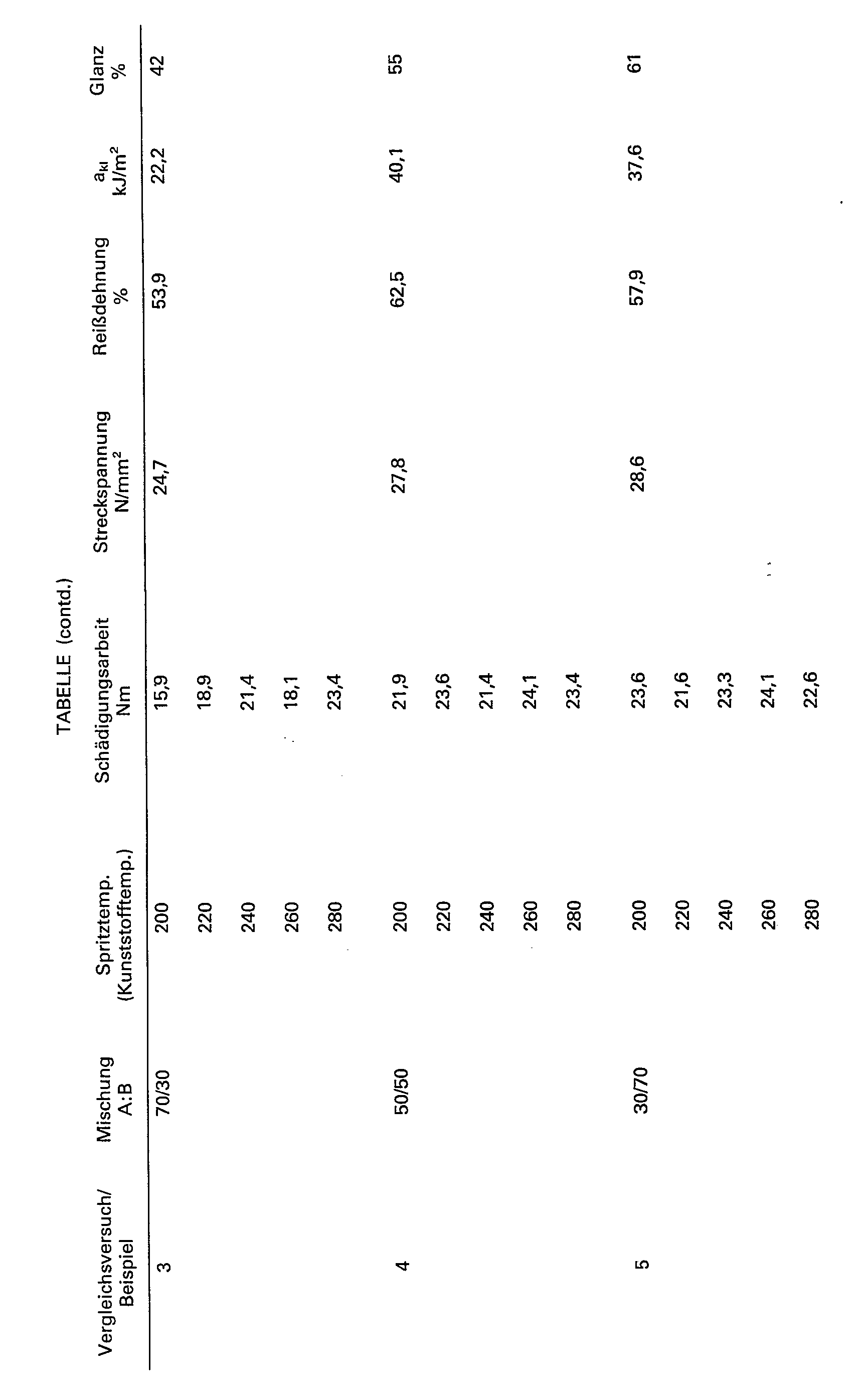
- Zur Durchführung der Beispiele wurde aus den vorstehend beschriebenen Produkten A und B in den in der Tabelle genannten Menge eine Mischung bei Temperaturen zwischen 180° und 260°C auf einer ZDSK-28 (Werner und Pfleiderer) hergestellt. Aus den erhaltenen Mischungen wurden bei Spritztemperaturen zwischen 200 und 280°C Rundplatten von 2 mm Dicke und 60 mm Durchmesser durch Spritzgießen hergestellt und an diesen die in der Tabelle genannten Meßwerte bestimmt. Wie aus einem Vergleich der Meßwerte mit den Ergebnissen von Versuch A hervorgeht, ist ersichtlich, daß die erfindungsgemäßen Formmassen praktisch keine Abhängigkeit der Zähigkeit von der Verarbeitungstemperatur zeigen; auch der Glanz der erfindungsgemäßen Formmasse ist hervorzuheben.

Claims (3)


Applications Claiming Priority (2)
| Application Number | Priority Date | Filing Date | Title |
|---|---|---|---|
| DE3035637 | 1980-09-20 | ||
| DE19803035637 DE3035637A1 (de) | 1980-09-20 | 1980-09-20 | Thermoplastische formmasse, verwendung der formmasse, sowie formteile aus dieser |
Publications (2)
| Publication Number | Publication Date |
|---|---|
| EP0048388A1 EP0048388A1 (de) | 1982-03-31 |
| EP0048388B1 true EP0048388B1 (de) | 1985-04-03 |
Family
ID=6112510
Family Applications (1)
| Application Number | Title | Priority Date | Filing Date |
|---|---|---|---|
| EP81107078A Expired EP0048388B1 (de) | 1980-09-20 | 1981-09-09 | Thermoplastische Formmasse |
Country Status (2)
| Country | Link |
|---|---|
| EP (1) | EP0048388B1 (de) |
| DE (2) | DE3035637A1 (de) |
Families Citing this family (6)
| Publication number | Priority date | Publication date | Assignee | Title |
|---|---|---|---|---|
| DE3209624A1 (de) * | 1982-03-17 | 1983-09-22 | Basf Ag, 6700 Ludwigshafen | Thermoplastische formmasse |
| JP2727710B2 (ja) * | 1989-12-08 | 1998-03-18 | 住友化学工業株式会社 | 耐熱耐衝撃性ポリスチレン複合組成物 |
| DE4036929C2 (de) * | 1990-11-20 | 1994-11-10 | Bunawerke Huels Gmbh | Folien zum Verpacken von niedrigviskosen Kautschuken und deren Verwendung |
| IT1255489B (it) * | 1992-08-05 | 1995-11-06 | Enichem Polimeri | Materiale antiurto termoplastico da stampaggio |
| US5969034A (en) * | 1996-09-26 | 1999-10-19 | Shell Oil Company | Block copolymers with improved overmolding adhesion |
| JPH10126752A (ja) * | 1996-10-23 | 1998-05-15 | Matsushita Electric Ind Co Ltd | 放送システム |
Family Cites Families (3)
| Publication number | Priority date | Publication date | Assignee | Title |
|---|---|---|---|---|
| GB1438262A (en) * | 1974-03-20 | 1976-06-03 | Belgochim Sa | Highimpact moulding composition formed from radial block co- polymers and high impact poly-vinyl-aromatic compound |
| DE2610068C2 (de) * | 1976-03-11 | 1987-02-19 | Basf Ag, 6700 Ludwigshafen | Transparente schlagfeste Polymermischungen |
| JPS5575441A (en) * | 1978-12-04 | 1980-06-06 | Asahi Chem Ind Co Ltd | Styrene resin composition having excellent impact resistance |
-
1980
- 1980-09-20 DE DE19803035637 patent/DE3035637A1/de not_active Withdrawn
-
1981
- 1981-09-09 DE DE8181107078T patent/DE3169693D1/de not_active Expired
- 1981-09-09 EP EP81107078A patent/EP0048388B1/de not_active Expired
Also Published As
| Publication number | Publication date |
|---|---|
| EP0048388A1 (de) | 1982-03-31 |
| DE3169693D1 (en) | 1985-05-09 |
| DE3035637A1 (de) | 1982-05-06 |
Similar Documents
| Publication | Publication Date | Title |
|---|---|---|
| EP0048389B1 (de) | Schlagfeste thermoplastische Formmasse | |
| DE68924253T2 (de) | Polypropylenzusammensetzung. | |
| DE1260135B (de) | Schlagfeste thermoplastische Formmassen | |
| EP1062275A1 (de) | Polymermischungen aus styrolpolymeren | |
| DE2948615A1 (de) | Polymermassen auf basis von aromatischen alkenylharzen und deren verwendung zur herstellung von formteilen | |
| EP0545181B1 (de) | Thermoplastische Formmasse | |
| DE2249870B2 (de) | Zusammensetzung aus einem PoIyphenylenäther und einem mit Acrylharz modifizierten Acrylnitril-Butadien-Styrolharz (ABS-Harz) | |
| DE69534119T2 (de) | Styrolpolymerharze mit verbessertem glanz und schlagfestigkeit | |
| DE2632235C3 (de) | Verfahren zur Herstellung von schlagzähen Polystyrolen | |
| DE69700829T2 (de) | Verfahren zur Herstellung von mit Kautschuk verstärkten vinylaromatischen Polymeren | |
| DE2526246B2 (de) | Polystyrolmasse mit hoher Schlagfestigkeit | |
| DE69118956T2 (de) | Mischungen auf Basis von vinylaromatischen Polymeren mit guten mechanischen Eigenschaften | |
| DE2254202B2 (de) | Thermoplastische Mischmasse | |
| EP0048388A1 (de) | Thermoplastische Formmasse | |
| EP0244857A1 (de) | Thermoplastische Formmasse auf Basis von Polycarbonat, 2 Pfropfmischpolymerisaten unterschiedlicher Pfropfgrundlage (ASA + AES) und Vinylaromat/AN enthaltenden Copolymerisaten | |
| EP0546356B1 (de) | Thermoplastische Formmasse | |
| EP0927226B1 (de) | Thermoplastische formmassen | |
| EP0307818A2 (de) | Transparente, schlagfeste thermoplastische Formmasse, Verfahren zur Herstellung derselben und ihre Verwendung | |
| EP0088960B1 (de) | Thermoplastische Formmasse | |
| EP0283731B1 (de) | Mit funktionalisierten Polymeren schlagzäh modifizierte Thermoplaste und deren Verwendung zur Herstellung von Formteilen | |
| EP0042985B1 (de) | Verfahren zur kontinuierlichen Herstellung von mit Kautschuk modifizierten Polymerisaten von Vinylaromaten | |
| DE2705657A1 (de) | Pfropfcopolymerisatmassen und verfahren zu ihrer herstellung | |
| DE69017637T2 (de) | Feuerhemmendes Polymer mit stabilem, polymerem Additiv. | |
| EP0340415A2 (de) | Hochtemperaturbeständige Mischungen aus einem thermoplastischen Elastomeren und einem Thermoplasten | |
| EP0257516A2 (de) | Halogenfreie, selbstverlöschende, schlagfeste, thermoplastische Formmassen |
Legal Events
| Date | Code | Title | Description |
|---|---|---|---|
| PUAI | Public reference made under article 153(3) epc to a published international application that has entered the european phase |
Free format text: ORIGINAL CODE: 0009012 |
|
| 17P | Request for examination filed |
Effective date: 19811022 |
|
| AK | Designated contracting states |
Designated state(s): BE DE FR GB IT NL SE |
|
| ITF | It: translation for a ep patent filed | ||
| GRAA | (expected) grant |
Free format text: ORIGINAL CODE: 0009210 |
|
| AK | Designated contracting states |
Designated state(s): BE DE FR GB IT NL SE |
|
| REF | Corresponds to: |
Ref document number: 3169693 Country of ref document: DE Date of ref document: 19850509 |
|
| ET | Fr: translation filed | ||
| PLBE | No opposition filed within time limit |
Free format text: ORIGINAL CODE: 0009261 |
|
| STAA | Information on the status of an ep patent application or granted ep patent |
Free format text: STATUS: NO OPPOSITION FILED WITHIN TIME LIMIT |
|
| 26N | No opposition filed | ||
| ITTA | It: last paid annual fee | ||
| EAL | Se: european patent in force in sweden |
Ref document number: 81107078.8 |
|
| PGFP | Annual fee paid to national office [announced via postgrant information from national office to epo] |
Ref country code: FR Payment date: 19980824 Year of fee payment: 18 |
|
| PGFP | Annual fee paid to national office [announced via postgrant information from national office to epo] |
Ref country code: SE Payment date: 19980825 Year of fee payment: 18 |
|
| PGFP | Annual fee paid to national office [announced via postgrant information from national office to epo] |
Ref country code: NL Payment date: 19980831 Year of fee payment: 18 |
|
| PGFP | Annual fee paid to national office [announced via postgrant information from national office to epo] |
Ref country code: GB Payment date: 19980901 Year of fee payment: 18 |
|
| PGFP | Annual fee paid to national office [announced via postgrant information from national office to epo] |
Ref country code: BE Payment date: 19980908 Year of fee payment: 18 |
|
| PGFP | Annual fee paid to national office [announced via postgrant information from national office to epo] |
Ref country code: DE Payment date: 19980922 Year of fee payment: 18 |
|
| PG25 | Lapsed in a contracting state [announced via postgrant information from national office to epo] |
Ref country code: GB Free format text: LAPSE BECAUSE OF NON-PAYMENT OF DUE FEES Effective date: 19990909 |
|
| PG25 | Lapsed in a contracting state [announced via postgrant information from national office to epo] |
Ref country code: DE Free format text: LAPSE BECAUSE OF THE APPLICANT RENOUNCES Effective date: 19990928 |
|
| PG25 | Lapsed in a contracting state [announced via postgrant information from national office to epo] |
Ref country code: SE Free format text: THE PATENT HAS BEEN ANNULLED BY A DECISION OF A NATIONAL AUTHORITY Effective date: 19990929 |
|
| PG25 | Lapsed in a contracting state [announced via postgrant information from national office to epo] |
Ref country code: BE Free format text: LAPSE BECAUSE OF NON-PAYMENT OF DUE FEES Effective date: 19990930 |
|
| BERE | Be: lapsed |
Owner name: BASF A.G. Effective date: 19990930 |
|
| PG25 | Lapsed in a contracting state [announced via postgrant information from national office to epo] |
Ref country code: NL Free format text: LAPSE BECAUSE OF NON-PAYMENT OF DUE FEES Effective date: 20000401 |
|
| GBPC | Gb: european patent ceased through non-payment of renewal fee |
Effective date: 19990909 |
|
| EUG | Se: european patent has lapsed |
Ref document number: 81107078.8 |
|
| PG25 | Lapsed in a contracting state [announced via postgrant information from national office to epo] |
Ref country code: FR Free format text: LAPSE BECAUSE OF NON-PAYMENT OF DUE FEES Effective date: 20000531 |
|
| NLV4 | Nl: lapsed or anulled due to non-payment of the annual fee |
Effective date: 20000401 |
|
| REG | Reference to a national code |
Ref country code: FR Ref legal event code: ST |