EP0041789B1 - Photochromic glass for spectacle lenses and production thereof - Google Patents
Photochromic glass for spectacle lenses and production thereof Download PDFInfo
- Publication number
- EP0041789B1 EP0041789B1 EP81302283A EP81302283A EP0041789B1 EP 0041789 B1 EP0041789 B1 EP 0041789B1 EP 81302283 A EP81302283 A EP 81302283A EP 81302283 A EP81302283 A EP 81302283A EP 0041789 B1 EP0041789 B1 EP 0041789B1
- Authority
- EP
- European Patent Office
- Prior art keywords
- glass
- transmittance
- photochromic
- photochromic glass
- glass article
- Prior art date
- Legal status (The legal status is an assumption and is not a legal conclusion. Google has not performed a legal analysis and makes no representation as to the accuracy of the status listed.)
- Expired
Links
- 239000011521 glass Substances 0.000 title claims description 81
- 238000004519 manufacturing process Methods 0.000 title description 6
- 238000002834 transmittance Methods 0.000 claims description 43
- 230000005855 radiation Effects 0.000 claims description 25
- 239000003086 colorant Substances 0.000 claims description 18
- 239000002344 surface layer Substances 0.000 claims description 16
- 208000007014 Retinitis pigmentosa Diseases 0.000 claims description 13
- 238000000034 method Methods 0.000 claims description 12
- FUJCRWPEOMXPAD-UHFFFAOYSA-N Li2O Inorganic materials [Li+].[Li+].[O-2] FUJCRWPEOMXPAD-UHFFFAOYSA-N 0.000 claims description 10
- KOPBYBDAPCDYFK-UHFFFAOYSA-N Cs2O Inorganic materials [O-2].[Cs+].[Cs+] KOPBYBDAPCDYFK-UHFFFAOYSA-N 0.000 claims description 9
- KKCBUQHMOMHUOY-UHFFFAOYSA-N Na2O Inorganic materials [O-2].[Na+].[Na+] KKCBUQHMOMHUOY-UHFFFAOYSA-N 0.000 claims description 9
- VYPSYNLAJGMNEJ-UHFFFAOYSA-N Silicium dioxide Chemical compound O=[Si]=O VYPSYNLAJGMNEJ-UHFFFAOYSA-N 0.000 claims description 9
- UFHFLCQGNIYNRP-UHFFFAOYSA-N Hydrogen Chemical compound [H][H] UFHFLCQGNIYNRP-UHFFFAOYSA-N 0.000 claims description 8
- 239000001257 hydrogen Substances 0.000 claims description 7
- 229910052739 hydrogen Inorganic materials 0.000 claims description 7
- 229910052709 silver Inorganic materials 0.000 claims description 7
- GWEVSGVZZGPLCZ-UHFFFAOYSA-N Titan oxide Chemical compound O=[Ti]=O GWEVSGVZZGPLCZ-UHFFFAOYSA-N 0.000 claims description 6
- AKUNKIJLSDQFLS-UHFFFAOYSA-M dicesium;hydroxide Chemical compound [OH-].[Cs+].[Cs+] AKUNKIJLSDQFLS-UHFFFAOYSA-M 0.000 claims description 6
- 239000004615 ingredient Substances 0.000 claims description 6
- MCMNRKCIXSYSNV-UHFFFAOYSA-N Zirconium dioxide Chemical compound O=[Zr]=O MCMNRKCIXSYSNV-UHFFFAOYSA-N 0.000 claims description 5
- 229910000272 alkali metal oxide Inorganic materials 0.000 claims description 5
- 229910052681 coesite Inorganic materials 0.000 claims description 5
- 229910052906 cristobalite Inorganic materials 0.000 claims description 5
- XUCJHNOBJLKZNU-UHFFFAOYSA-M dilithium;hydroxide Chemical compound [Li+].[Li+].[OH-] XUCJHNOBJLKZNU-UHFFFAOYSA-M 0.000 claims description 5
- 230000001747 exhibiting effect Effects 0.000 claims description 5
- ZKATWMILCYLAPD-UHFFFAOYSA-N niobium pentoxide Inorganic materials O=[Nb](=O)O[Nb](=O)=O ZKATWMILCYLAPD-UHFFFAOYSA-N 0.000 claims description 5
- 229910052682 stishovite Inorganic materials 0.000 claims description 5
- 229910052723 transition metal Inorganic materials 0.000 claims description 5
- 150000003624 transition metals Chemical class 0.000 claims description 5
- 229910052905 tridymite Inorganic materials 0.000 claims description 5
- PNEYBMLMFCGWSK-UHFFFAOYSA-N aluminium oxide Inorganic materials [O-2].[O-2].[O-2].[Al+3].[Al+3] PNEYBMLMFCGWSK-UHFFFAOYSA-N 0.000 claims description 4
- 229910052593 corundum Inorganic materials 0.000 claims description 4
- 239000000377 silicon dioxide Substances 0.000 claims description 4
- 238000011282 treatment Methods 0.000 claims description 4
- 229910001845 yogo sapphire Inorganic materials 0.000 claims description 4
- MRELNEQAGSRDBK-UHFFFAOYSA-N lanthanum oxide Inorganic materials [O-2].[O-2].[O-2].[La+3].[La+3] MRELNEQAGSRDBK-UHFFFAOYSA-N 0.000 claims description 3
- 229910052761 rare earth metal Inorganic materials 0.000 claims description 3
- 150000002910 rare earth metals Chemical class 0.000 claims description 3
- 229910000428 cobalt oxide Inorganic materials 0.000 claims 1
- IVMYJDGYRUAWML-UHFFFAOYSA-N cobalt(ii) oxide Chemical compound [Co]=O IVMYJDGYRUAWML-UHFFFAOYSA-N 0.000 claims 1
- 210000000695 crystalline len Anatomy 0.000 description 39
- 239000000203 mixture Substances 0.000 description 13
- 210000001525 retina Anatomy 0.000 description 8
- 210000001508 eye Anatomy 0.000 description 7
- 238000010304 firing Methods 0.000 description 6
- 230000003595 spectral effect Effects 0.000 description 6
- 230000004438 eyesight Effects 0.000 description 5
- 239000010410 layer Substances 0.000 description 5
- 201000007737 Retinal degeneration Diseases 0.000 description 4
- 230000008901 benefit Effects 0.000 description 4
- 230000006378 damage Effects 0.000 description 4
- 201000010099 disease Diseases 0.000 description 4
- 208000037265 diseases, disorders, signs and symptoms Diseases 0.000 description 4
- 230000004297 night vision Effects 0.000 description 4
- 230000004258 retinal degeneration Effects 0.000 description 4
- 238000001228 spectrum Methods 0.000 description 4
- 206010002945 Aphakia Diseases 0.000 description 3
- 238000010521 absorption reaction Methods 0.000 description 3
- 230000003412 degenerative effect Effects 0.000 description 3
- KDLHZDBZIXYQEI-UHFFFAOYSA-N palladium Substances [Pd] KDLHZDBZIXYQEI-UHFFFAOYSA-N 0.000 description 3
- 230000004310 photopic vision Effects 0.000 description 3
- 230000001681 protective effect Effects 0.000 description 3
- 108020003175 receptors Proteins 0.000 description 3
- 230000002207 retinal effect Effects 0.000 description 3
- 230000004296 scotopic vision Effects 0.000 description 3
- QGZKDVFQNNGYKY-UHFFFAOYSA-N Ammonia Chemical compound N QGZKDVFQNNGYKY-UHFFFAOYSA-N 0.000 description 2
- IJGRMHOSHXDMSA-UHFFFAOYSA-N Atomic nitrogen Chemical compound N#N IJGRMHOSHXDMSA-UHFFFAOYSA-N 0.000 description 2
- 206010003694 Atrophy Diseases 0.000 description 2
- 206010038910 Retinitis Diseases 0.000 description 2
- 208000027418 Wounds and injury Diseases 0.000 description 2
- 230000037444 atrophy Effects 0.000 description 2
- 230000009286 beneficial effect Effects 0.000 description 2
- 239000002419 bulk glass Substances 0.000 description 2
- 210000003986 cell retinal photoreceptor Anatomy 0.000 description 2
- 230000004456 color vision Effects 0.000 description 2
- 238000005520 cutting process Methods 0.000 description 2
- 230000007423 decrease Effects 0.000 description 2
- 239000010931 gold Substances 0.000 description 2
- 238000005286 illumination Methods 0.000 description 2
- 208000014674 injury Diseases 0.000 description 2
- 230000005043 peripheral vision Effects 0.000 description 2
- 108091008695 photoreceptors Proteins 0.000 description 2
- 239000000047 product Substances 0.000 description 2
- 229910001404 rare earth metal oxide Inorganic materials 0.000 description 2
- 230000035484 reaction time Effects 0.000 description 2
- 230000004044 response Effects 0.000 description 2
- 230000035945 sensitivity Effects 0.000 description 2
- 239000004332 silver Substances 0.000 description 2
- -1 silver halide Chemical class 0.000 description 2
- 229910001415 sodium ion Inorganic materials 0.000 description 2
- 239000000126 substance Substances 0.000 description 2
- 229910000314 transition metal oxide Inorganic materials 0.000 description 2
- 206010003210 Arteriosclerosis Diseases 0.000 description 1
- 241000894006 Bacteria Species 0.000 description 1
- 201000004569 Blindness Diseases 0.000 description 1
- 208000024172 Cardiovascular disease Diseases 0.000 description 1
- 208000002177 Cataract Diseases 0.000 description 1
- 208000034656 Contusions Diseases 0.000 description 1
- 241000233866 Fungi Species 0.000 description 1
- 206010020772 Hypertension Diseases 0.000 description 1
- 208000001140 Night Blindness Diseases 0.000 description 1
- 206010034944 Photokeratitis Diseases 0.000 description 1
- 208000017442 Retinal disease Diseases 0.000 description 1
- 206010038923 Retinopathy Diseases 0.000 description 1
- 229910000831 Steel Inorganic materials 0.000 description 1
- 241000700605 Viruses Species 0.000 description 1
- 230000009471 action Effects 0.000 description 1
- 229910021529 ammonia Inorganic materials 0.000 description 1
- 208000007502 anemia Diseases 0.000 description 1
- 238000000137 annealing Methods 0.000 description 1
- 239000005391 art glass Substances 0.000 description 1
- 210000002565 arteriole Anatomy 0.000 description 1
- 208000011775 arteriosclerosis disease Diseases 0.000 description 1
- 238000004061 bleaching Methods 0.000 description 1
- 210000004204 blood vessel Anatomy 0.000 description 1
- 210000005252 bulbus oculi Anatomy 0.000 description 1
- 210000004027 cell Anatomy 0.000 description 1
- 239000003795 chemical substances by application Substances 0.000 description 1
- 229910017052 cobalt Inorganic materials 0.000 description 1
- 239000010941 cobalt Substances 0.000 description 1
- GUTLYIVDDKVIGB-UHFFFAOYSA-N cobalt atom Chemical compound [Co] GUTLYIVDDKVIGB-UHFFFAOYSA-N 0.000 description 1
- 229910001429 cobalt ion Inorganic materials 0.000 description 1
- XLJKHNWPARRRJB-UHFFFAOYSA-N cobalt(2+) Chemical compound [Co+2] XLJKHNWPARRRJB-UHFFFAOYSA-N 0.000 description 1
- 230000009519 contusion Effects 0.000 description 1
- 230000003247 decreasing effect Effects 0.000 description 1
- 230000006735 deficit Effects 0.000 description 1
- 230000007850 degeneration Effects 0.000 description 1
- 230000002939 deleterious effect Effects 0.000 description 1
- 230000001419 dependent effect Effects 0.000 description 1
- 230000008021 deposition Effects 0.000 description 1
- 206010012601 diabetes mellitus Diseases 0.000 description 1
- 239000003814 drug Substances 0.000 description 1
- 229940079593 drug Drugs 0.000 description 1
- 230000002526 effect on cardiovascular system Effects 0.000 description 1
- 208000030533 eye disease Diseases 0.000 description 1
- 239000012467 final product Substances 0.000 description 1
- 239000007789 gas Substances 0.000 description 1
- PCHJSUWPFVWCPO-UHFFFAOYSA-N gold Chemical compound [Au] PCHJSUWPFVWCPO-UHFFFAOYSA-N 0.000 description 1
- 229910052737 gold Inorganic materials 0.000 description 1
- 238000010438 heat treatment Methods 0.000 description 1
- 230000001631 hypertensive effect Effects 0.000 description 1
- 238000007654 immersion Methods 0.000 description 1
- 239000012678 infectious agent Substances 0.000 description 1
- 208000015181 infectious disease Diseases 0.000 description 1
- 208000017169 kidney disease Diseases 0.000 description 1
- 208000032839 leukemia Diseases 0.000 description 1
- 229910001416 lithium ion Inorganic materials 0.000 description 1
- 230000007774 longterm Effects 0.000 description 1
- 239000000463 material Substances 0.000 description 1
- 210000005036 nerve Anatomy 0.000 description 1
- 229910052757 nitrogen Inorganic materials 0.000 description 1
- KTUFCUMIWABKDW-UHFFFAOYSA-N oxo(oxolanthaniooxy)lanthanum Chemical compound O=[La]O[La]=O KTUFCUMIWABKDW-UHFFFAOYSA-N 0.000 description 1
- 229910052763 palladium Inorganic materials 0.000 description 1
- 230000002093 peripheral effect Effects 0.000 description 1
- 239000000049 pigment Substances 0.000 description 1
- 210000004694 pigment cell Anatomy 0.000 description 1
- 238000005498 polishing Methods 0.000 description 1
- 229910001414 potassium ion Inorganic materials 0.000 description 1
- 230000008569 process Effects 0.000 description 1
- 230000002250 progressing effect Effects 0.000 description 1
- 230000000750 progressive effect Effects 0.000 description 1
- 230000002035 prolonged effect Effects 0.000 description 1
- 230000000717 retained effect Effects 0.000 description 1
- 230000004256 retinal image Effects 0.000 description 1
- 239000000790 retinal pigment Substances 0.000 description 1
- 150000003839 salts Chemical class 0.000 description 1
- 230000037390 scarring Effects 0.000 description 1
- 238000002791 soaking Methods 0.000 description 1
- VWDWKYIASSYTQR-UHFFFAOYSA-N sodium nitrate Inorganic materials [Na+].[O-][N+]([O-])=O VWDWKYIASSYTQR-UHFFFAOYSA-N 0.000 description 1
- 239000010959 steel Substances 0.000 description 1
- 238000005728 strengthening Methods 0.000 description 1
- 230000009885 systemic effect Effects 0.000 description 1
- 238000003466 welding Methods 0.000 description 1
Images

Classifications
-
- C—CHEMISTRY; METALLURGY
- C03—GLASS; MINERAL OR SLAG WOOL
- C03C—CHEMICAL COMPOSITION OF GLASSES, GLAZES OR VITREOUS ENAMELS; SURFACE TREATMENT OF GLASS; SURFACE TREATMENT OF FIBRES OR FILAMENTS MADE FROM GLASS, MINERALS OR SLAGS; JOINING GLASS TO GLASS OR OTHER MATERIALS
- C03C4/00—Compositions for glass with special properties
- C03C4/04—Compositions for glass with special properties for photosensitive glass
- C03C4/06—Compositions for glass with special properties for photosensitive glass for phototropic or photochromic glass
-
- G—PHYSICS
- G02—OPTICS
- G02B—OPTICAL ELEMENTS, SYSTEMS OR APPARATUS
- G02B5/00—Optical elements other than lenses
- G02B5/20—Filters
- G02B5/22—Absorbing filters
- G02B5/23—Photochromic filters
-
- G—PHYSICS
- G02—OPTICS
- G02C—SPECTACLES; SUNGLASSES OR GOGGLES INSOFAR AS THEY HAVE THE SAME FEATURES AS SPECTACLES; CONTACT LENSES
- G02C7/00—Optical parts
- G02C7/10—Filters, e.g. for facilitating adaptation of the eyes to the dark; Sunglasses
- G02C7/104—Filters, e.g. for facilitating adaptation of the eyes to the dark; Sunglasses having spectral characteristics for purposes other than sun-protection
-
- Y—GENERAL TAGGING OF NEW TECHNOLOGICAL DEVELOPMENTS; GENERAL TAGGING OF CROSS-SECTIONAL TECHNOLOGIES SPANNING OVER SEVERAL SECTIONS OF THE IPC; TECHNICAL SUBJECTS COVERED BY FORMER USPC CROSS-REFERENCE ART COLLECTIONS [XRACs] AND DIGESTS
- Y10—TECHNICAL SUBJECTS COVERED BY FORMER USPC
- Y10S—TECHNICAL SUBJECTS COVERED BY FORMER USPC CROSS-REFERENCE ART COLLECTIONS [XRACs] AND DIGESTS
- Y10S428/00—Stock material or miscellaneous articles
- Y10S428/913—Material designed to be responsive to temperature, light, moisture
-
- Y—GENERAL TAGGING OF NEW TECHNOLOGICAL DEVELOPMENTS; GENERAL TAGGING OF CROSS-SECTIONAL TECHNOLOGIES SPANNING OVER SEVERAL SECTIONS OF THE IPC; TECHNICAL SUBJECTS COVERED BY FORMER USPC CROSS-REFERENCE ART COLLECTIONS [XRACs] AND DIGESTS
- Y10—TECHNICAL SUBJECTS COVERED BY FORMER USPC
- Y10S—TECHNICAL SUBJECTS COVERED BY FORMER USPC CROSS-REFERENCE ART COLLECTIONS [XRACs] AND DIGESTS
- Y10S501/00—Compositions: ceramic
- Y10S501/90—Optical glass, e.g. silent on refractive index and/or ABBE number
- Y10S501/905—Ultraviolet transmitting or absorbing
-
- Y—GENERAL TAGGING OF NEW TECHNOLOGICAL DEVELOPMENTS; GENERAL TAGGING OF CROSS-SECTIONAL TECHNOLOGIES SPANNING OVER SEVERAL SECTIONS OF THE IPC; TECHNICAL SUBJECTS COVERED BY FORMER USPC CROSS-REFERENCE ART COLLECTIONS [XRACs] AND DIGESTS
- Y10—TECHNICAL SUBJECTS COVERED BY FORMER USPC
- Y10T—TECHNICAL SUBJECTS COVERED BY FORMER US CLASSIFICATION
- Y10T428/00—Stock material or miscellaneous articles
- Y10T428/26—Web or sheet containing structurally defined element or component, the element or component having a specified physical dimension
- Y10T428/263—Coating layer not in excess of 5 mils thick or equivalent
-
- Y—GENERAL TAGGING OF NEW TECHNOLOGICAL DEVELOPMENTS; GENERAL TAGGING OF CROSS-SECTIONAL TECHNOLOGIES SPANNING OVER SEVERAL SECTIONS OF THE IPC; TECHNICAL SUBJECTS COVERED BY FORMER USPC CROSS-REFERENCE ART COLLECTIONS [XRACs] AND DIGESTS
- Y10—TECHNICAL SUBJECTS COVERED BY FORMER USPC
- Y10T—TECHNICAL SUBJECTS COVERED BY FORMER US CLASSIFICATION
- Y10T428/00—Stock material or miscellaneous articles
- Y10T428/31—Surface property or characteristic of web, sheet or block
- Y10T428/315—Surface modified glass [e.g., tempered, strengthened, etc.]
Definitions
- This invention relates to photochromic glasses and to the production thereof, which glasses are suitable for spectacle lenses whereby discomfort from aphakia and other eye diseases is reduced.
- Aphakia is the absence of the crystalline lens of the eye.
- the cause of that disability is normally the result of an operation to remove cataracts from the lens of the eye.
- the crystalline lens of the eye provides protection to the retina against wave (ultraviolet) radiation since it acts to strongly absorb radiations having wavelengths shorter than about 420 nm.
- wave ultraviolet
- a lens exhibiting near-zero transmittance of wavelengths shorter than about 440 nm would be of great benefit to aphakics.
- Retinitis has been generally defined as inflamation of the retina. Retinitis may be due to infectious agents (customarily bacteria, less commonly fungi, rarely viruses), mechanical injury of the eyeball (contusion), intense light (photoretinitis), or to chromic progressive damage to the retina (degenerative retino- phathy).
- Photoretinitis may follow direct observation of intense light sources such as the sun, electrical arcs welding operations, or even reflected sunlight (snow blindness).
- the resulting blind spot is central and is usually temporary, but it may be permanent if the exposure is severe enough.
- photoretinitis resulting from prolonged exposure to the sun's rays is not caused by thermal injury but, rather, is primarily due to radiations of short wavelengths in the sun's spectrum. Consequently, in like manner to aphakia, a spectacle lens capable of cutting off radiations in the ultraviolet and near-ultraviolet regions of the spectrum would be beneficial. Therefore, a lens exhibiting near-zero transmittance of wavelengths shorter than about 440 nm would also be highly desirable for persons subject to photoretinitis.
- Degenerative retinopathy is frequently associated with systemic diseases of the blood vessel system; e.g., arteriosclerosis, hypertensive cardiovascular and kidney diseases, diabetes, leukemia, and anemia.
- retinitis pigmentosa is one type of degenerative retinal infection which has been defined as a hereditary affection inherited as a sex-linked recessive characterized by slowly progressing atrophy of the retinal nerve layers and clumping of retinal pigment followed by attenuation of the retinal arterioles and waxy atrophy of the optic discs.
- the disease results in the gradual impairment of peripheral and night vision. The rate of progression varies widely in individual patients such that some persons retain useful vision up to 40-50 years of age.
- the eye contains two different kinds of photoreceptors, viz., cones and rods.
- the cones comprise the principal rectors in daylight vision (photopic vision) and the rods constitute the principal receptors in night vision (scotopic vision).
- the cones are located generally in the central portion of the retina and permit the recognition of fine detail, presumably because they function largely independently of one another.
- the cones also permit color vision, i.e., they allow hues and saturation to be distinguished. In the presence of bright light, the eye is most sensitive to radiations at about 555 nm.
- the rods are located in the peripheral portions of the retina, there being few if any rods found in the central retina.
- the rods do not permit the recognition of colors, only shades of gray.
- Their peak sensitivity is at a wavelength of about 510 nm.
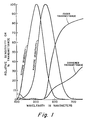
- Figure 1 depicts the relative wavelength response for photopic and scotopic vision.
- retinal degeneration can be decelerated by preventing both receptors of the retina (cones and rods) from being subjected to bright illumination and great changes in light levels.
- the continuously decreasing quality of night vision eventually resulting in complete night blindness wit- nessed in patients suffering from retinitis pigmentosa has led to the conclusion that the rods are degenerating more rapidly and to a greater degree than the cones.
- some vision is retained in serious cases of retinitis pigmentosa thereby indicating that some cone function continues even after degeneration of the rods. It is only in the very last stages of retinal degeneration that the surviving cones begin to deteriorate.
- the rods should be more protected than the cones.
- the photopigment concentration of the rods should be maintained at relatively high values to inhibit the production of bleaching products caused by exposure to light. Therefore, in order to reduce the deposition of worn out cells of the laminar layers of the outer receptor segments which normally are continuously absorbed, protective lenses should transmit light intensities in only such wavelengths that are primarily outside of the absorption range of the rod pigment. Hence, if a spectacle lens could be developed which would permit sufficient light to enter the eye for acceptable vision via the cones alone, it might significantly decrease or even inhibit further retinal degeneration.
- the spectacle lenses designed for aphakics and for those persons subject to photoretinities or retinities pigmentosa prepared from glasses demonstrating photochromic behavior would act to compensate for differences in indoor and outdoor radiation intensity levels.
- polarizing capability can also be incorporated into the spectacle lenses as, for example, by attaching a film of polarizing material to the rear face of the lens. Such action would combine the well-recognized benefit of polarizing eyewear with the advantages of the short wavelength filter characteristics of the present inventive glasses.
- the primary objective of the instant invention is to provide a glass suitable for a spectacle lens exhibiting near-zero transmittance of radiations having wavelengths shorter than a specified value while at the same time demonstrating photochromic behavior.
- a specific objective is to provide a photochromic glass especially suitable for a spectacle lens for use by aphakics or by persons subject to photoretinitis which exhibits near-zero transmittance of radiations having wavelengths shorter than 440 nm.
- Another specific objective is to provide a photochromic glass especially suitable for a spectacle lens for use by persons subject to retinitis pigmentosa which exhibits near-zero transmittance of radiations having wavelengths shorter than about 550 nm, a photopic transmittance in the faded state no greater than 25% and no greater than 10% in the darkened state, and a scotopic transmittance in the faded state no greater than 10% and no greater than 5% in the darkened state.
- Those objectives can be achieved by treating photochromic glasses having compositions within certain delineated ranges in a strongly reducing environment at temperatures ranging from 350°-520°C to develop an integral color layer in a surface thereof.
- a photochromic glass article especially suitable for spectacle lenses, said glass consisting essentially, expressed in weight percent on the oxide basis, of 0-2.5% Li 2 0, 0-9% Na 2 0, 0.17% K 2 O, 0-6% Cs 2 O, 8-20% Li 2 O+Na 2 O+K 2 O+Cs 2 O, 14-23% B 2 O 3 , 5-25% Al 2 O 3 , 0-25% P 2 0 51 20-65% SiO 2 , 0.004-0.02% CuO, 0.15-0.3% Ag, 0.1-0.25% Cl, and 0.1-0.2% Br, wherein the molar ratio of alkali metal oxides; B 2 0 3 varies between 0.55-0.85 and the weight ratio Ag: (CI+Br) ranges between 0.65-0.95, characterised in that the glass article has an integral colored surface layer and exhibits near-zero transmittance of radiations having wavelengths shorter than a selected cut-off wavelength ranging between 440-550 nm.
- a process for making a photochromic glass article according to the invention which comprises subjecting a photochromic glass consisting essentially, expressed in weight percent on the oxide basis, of 0-2.5% Li 2 O, 0-9% Na 2 0, 0-17% K 2 0 1 0-6% Cs 2 0, 8-20% Li 2 O+Na 2 O+K 2 O+Cs 2 O, 14-23% B203, 5-25% Al 2 O 3 , 0-25% P 2 O 51 20-65% SiO 2 , 0.004-0.2% CuO, 0.15-0.3% Ag, 0.1-0.25% Cl, and 0.1-0.2% Br, wherein the molar ratio of alkali metal oxide: B 2 0 3 varies between 0.55-0.85 and the weight ratio Ag: (CI+Br) ranges between 0.65-0.95, to a strongly reducing atmosphere at a temperature between 350°-520°C for a period of time of at least 12 hours to develop an integral colored surface layer therein, said glass also including as optional
- the back surface only of a spectacle lens will have the colored surface layer. Since the development of color in one surface only requires care in exposing only one surface of the glass to the reducing environment, it is more practical to soak the entire glass body in the heated reducing atmosphere and thereafter to remove the color layer from the front surface by chemical or mechanical means.
- United States Patent No. 4,240,836 discloses a method for producing surface colored, photochromic glass articles by firing such articles in reducing atmospheres at temperatures between about 200°-450°C for such times that the glasses exhibited absorption peaks at longer wavelengths than prior art glasses and surface colors varying from orange, red, purple, and blue are developed. No periods of firing times are claimed but the working examples therein cited times ranging from 15 minutes at 420°C to 16 hours at 200°C.
- the colored surface layer In general, only a selected area of the colored surface layer will be removed such that a pattern or color gradient will be developed in the surface. As noted therein, the colors produced customarily reside in a very thin surface layer,-commonly about 10-100 micrometres in depth. Therefore removal of the surface layer does not substantially affect the refractive power of a lens surface quality thereof.
- composition of the photochromic glass plays a substantive role in achieving the desired cutoff of radiations having wavelengths below 550 nm.
- the composition of the glass is disclosed in United States Patent No. 4,190,451.
- Such glasses consist essentially, expressed in weight percent on the oxide basis of 0-2.5% Li 2 0, 0-9% Na 2 0, 0-17% K 2 0, 0-6% Cs 2 0, 8-20% Li 2 0+K 2 0+C S2 0, 14-23% B 2 0 3 , 5-25% A1 2 0 3 1 0-25% P 2 0 5 , 20-65% Si0 2 , 0.004-0.02% CuO, 0.15-0.3% Ag, 0.1-0.25% Cl, and 0.1-0.2% Br, wherein the molar ratio of alkali metal oxides: B 2 0 3 varies between 0.55-0.85 and the weight ratio Ag: (CI+Br) ranges between 0.65-0.95.
- the glasses may also optionally contain up to 10% total of other ingredients selected from the group in the indicated proportions of 0-6% Zr0 2 , 0 ⁇ 3% TiO 2 , 0-0.5% PbO, 0-7% BaO, 0-4% CaO, 0-3% MgO, 0-6% Nb Z 0 5 , 0-4% La Z 0 3 , and 0-2% F.
- the glass compositions are compatible with the conventional glass colorants selected from the transition metal oxides and rare earth metal oxides. Hence, up to 1% total of transition metal oxide colorants and/or up to 5% total rare earth metal oxide colorants may be included to modify the color of the bulk glass.
- the time of exposure to which the glass will be subjected is dependent upon the objective to be achieved. Two factors must be borne in mind when determining the time of exposure: (1) the development of color takes place more rapidly at higher temperatures; and (2) less reaction time is required to impart to a glass a cut-off of radiations of shorter wavelengths than of longer wavelengths. Starting this second factor in different and more specific terms, it requires a longer reaction time to develop a glass demonstrating near-zero transmittance of radiations having wavelengths shorter than 550 nm than a glass displaying near-zero transmittance of radiations having wavelengths shorter than 440 nm.
- an exposure period of 12 hours in an atmosphere of pure hydrogen at temperatures in the 500°-520°C interval may be sufficient to cause the glass to exhibit near-zero transmittance to radiations having wavelengths no greater than 440 nm whereas soaking times of a week (168 hours) or ever more may be demanded at temperatures of 350°-375°C to produce a glass manifesting near-zero transmittance to wavelengths shorter than 550 nm.
- One final inherent glass property which must also be taken into consideration is the temperature-viscosity characteristics thereof at the reducing firing temperature employed.
- the annealing points of the above-cited preferred glass compositions are in the vicinity of 500°C. Accordingly, temperatures greatly in excess of that temperature hazard thermal deformation of the glass shape and/or deleterious effects upon its utility as a photochromic spectacle lens.
- the present invention provides a glass having an integral colored surface layer and exhibiting near-zero transmittance of radiations having wavelengths shorter than a selected cut-off which may range from 440-550 nm. Furthermore, the invention provides means for adjusting the transmittance in the remainder of the visible portion of the radiation spectrum through photochromic behavior and, optionally, through the addition of colorants.
- the luminous transmittance of the glasses in the faded state is a function of the selection of cutoff wavelength and the content of added colorants, if any. Hence, it is well-recognised that luminous transmittance decreases with increasing cutoff wavelength and colorant concentration.
- the method according to the invention comprises subjecting the glass to a highly reducing atmosphere at a temperature between 350°-520°C for a time sufficient to cause the development of an integral colored surface layer at least capable of cutting off essentially all radiations shorter than 440 nm (at least 12 hours with an environment of pure hydrogen) and, where it is desired to cut off essentially all radiations shorter than 550 nm, exposure times of at least 96 hours and up to 168 hours and more may be required to insure essentially complete cutoff.
- the choice of exposure time is based upon the temperature of reducing environment and the cutoff wavelength desired.
- the depth of the colored surface layer increases slowly with increasing exposure time. In general, the depth of the surface layers ranges between 25-100 micrometres.
- Pure hydrogen gas constitutes the most efficient reducing atmosphere although other agents such as cracked ammonia, mixtures of CO and CO 2 , and forming gas (blends of hydrogen and nitrogen) might be used. Such environments will obviously require longer exposure periods to achieve the colored surface layer produced by an atmosphere of pure hydrogen.
- Figure 1 there is graphically depicted the relative wavelength response for photopic and scotopic vision and the spectral transmittance curves in the faded state and darkened state measured on one glass composition specified below suitable for use as a spectacle lens for a person subject to retinitis pigmentosa.
- Figure 2 there is graphically illustrated the spectral transmittance curves in the faded state and in the darkened measured on one glass composition specified below suitable for use in a spectacle lens for an aphakic or for a person subject to photoretinitis.
- Uncut polished piano lens pairs of both of the above glasses were heated in a flowing 100% hydrogen atmosphere in an electrically-fired tube furnace for the times and temperatures given reported in Table II, below.
- the color layer on the front side of each lens (a depth of about 50-100 micrometres) was removed by polishing.
- the lenses were then cut and chemically strengthened via immersion for 16 hours in a bath of molten KN0 3 and NaN0 3 operating at a temperature of 400°C to cause an exchange of Li + and Na + ions in the glass surface with Na + and K + ions from the salt bath. This strengthening is necessary to insure that the lenses will survive the Federal Food and Drug Administration's (FDA) drop ball test (a 1.59 cm (5/8") diameter steel ball dropped from a height of 1.270 m (50”)).
- FDA Federal Food and Drug Administration's
- the spectral transmittance of the lenses in both the darkened state and faded state was determined spectrophotometrically.
- Figure 1 shows the spectral transmittance curves in the darkened and faded states for the lenses produced from Code 8111 glass in Run IV recorded in Table II
- Figure 2 shows the spectral transmittance curves in the darkened and faded states for the lenses produced from Code 8111 1 glass in Run V listed in Table II.
- the glass resulting from the long term exposure to hydrogen exhibits near-zero transmittance of radiations having wavelengths shorter than about 550 nm.
- the relatively short term exposure of Run V yielded a glass demonstrating near-zero transmittance of radiations having wavelengths shorter than about 440 nm.
- the luminous transmittance of Code 8111 glass at room temperature after the inventive reducing firing treatment will be in the vicinity of 72% in the faded state and about 17% in the darkened state.
- the luminous transmittance of a 2 mm-thick lens of Code 8113 glass at room temperature after a similar inventive reducing firing treatment will be about 54% in the faded state and about 13% in the darkened state.
- the photopic and scotopic transmittances (in %) of each glass were calculated for 1931 CIE Illuminant C and the ratio therebetween determined. Table II gives the production parameters for the heat treatments and the calculated transmittance values.
- the photopic and scotopic transmittances were not calculated for Run V since the cutoff of the glass is at a much shorter wavelength than the peak sensitivities of those vision regions.
- Run IV yielded a glass which would be useful for a person subject to retinitis pigmentosa whereas Run V produced a glass suitable for an aphakic or for a person subject to photoretinitis.
- the lenses prepared from Code 8113 glass illustrate that it is possible to adjust the luminous transmittance with a bulk glass colorant if an otherwise acceptable lens is too light.
- Table II illustrates the relationship of time and temperature to achieve the desired final product.
- lower heat treating temperatures demand longer exposure times to produce an operable product.
- Temperatures between 380-420°C are preferred for treating glasses designed for use in cases of retinitis pigmentosa because the wavelength cutoff secured within that temperature interval appears to be more desirable.
- Glasses for use with persons subject to retinitis pigmentosa will desirably demonstrate a photopic:scotopic transmittance ratio of at least 4:1 with higher ratios therebetween (8:1-12:1) and scotopic transmittances of about 2.5% and less being deemed the most preferred.
Landscapes
- Physics & Mathematics (AREA)
- Health & Medical Sciences (AREA)
- Ophthalmology & Optometry (AREA)
- General Physics & Mathematics (AREA)
- Optics & Photonics (AREA)
- Chemical & Material Sciences (AREA)
- Materials Engineering (AREA)
- Organic Chemistry (AREA)
- Geochemistry & Mineralogy (AREA)
- Engineering & Computer Science (AREA)
- General Chemical & Material Sciences (AREA)
- Chemical Kinetics & Catalysis (AREA)
- Life Sciences & Earth Sciences (AREA)
- General Health & Medical Sciences (AREA)
- Spectroscopy & Molecular Physics (AREA)
- Glass Compositions (AREA)
- Eyeglasses (AREA)
- Optical Filters (AREA)
Applications Claiming Priority (2)
| Application Number | Priority Date | Filing Date | Title |
|---|---|---|---|
| US06/157,250 US4284686A (en) | 1980-06-09 | 1980-06-09 | Spectacle lenses to reduce discomfort from aphakia and certain eye diseases |
| US157250 | 1993-11-26 |
Publications (2)
| Publication Number | Publication Date |
|---|---|
| EP0041789A1 EP0041789A1 (en) | 1981-12-16 |
| EP0041789B1 true EP0041789B1 (en) | 1984-05-16 |
Family
ID=22562946
Family Applications (1)
| Application Number | Title | Priority Date | Filing Date |
|---|---|---|---|
| EP81302283A Expired EP0041789B1 (en) | 1980-06-09 | 1981-05-22 | Photochromic glass for spectacle lenses and production thereof |
Country Status (6)
| Country | Link |
|---|---|
| US (1) | US4284686A (enExample) |
| EP (1) | EP0041789B1 (enExample) |
| JP (1) | JPS5738341A (enExample) |
| CA (1) | CA1145169A (enExample) |
| DE (1) | DE3163593D1 (enExample) |
| ES (1) | ES501921A0 (enExample) |
Families Citing this family (36)
| Publication number | Priority date | Publication date | Assignee | Title |
|---|---|---|---|---|
| DE3117000C2 (de) * | 1981-04-29 | 1986-05-28 | Schott Glaswerke, 6500 Mainz | Phototropes Glas mit einem Brechungsindex ≥ 1,59, einer Abbezahl ≥ 40 und einer Dichte ≦ 3,2 g/cm↑3↑ |
| FR2517712A1 (fr) * | 1981-12-04 | 1983-06-10 | Corning Glass Works | Procede de teinture d'une feuille de polyurethane |
| US4454170A (en) * | 1981-12-04 | 1984-06-12 | Corning Glass Works | Method for tinting a sheet of polyurethane |
| FR2528982B2 (fr) * | 1982-06-17 | 1986-07-11 | Corning Glass Works | Procede de teinture d'une feuille de polyurethane |
| DE3206958C2 (de) * | 1982-02-26 | 1986-09-18 | Schott Glaswerke, 6500 Mainz | Phototropes Glas mit einem Brechungsindex ≥ 1,59, einer Abbezahl ≥ 44 und einer Dichte ≦ 3,0 g/cm↑3↑ |
| US4390635A (en) * | 1982-03-01 | 1983-06-28 | Corning Glass Works | Alkali metal aluminoborosilicate photochromic glasses |
| US4710430A (en) * | 1982-04-01 | 1987-12-01 | Corning Glass Works | Colored photochromic glasses and method |
| US4537612A (en) * | 1982-04-01 | 1985-08-27 | Corning Glass Works | Colored photochromic glasses and method |
| JPS5920992A (ja) * | 1982-07-23 | 1984-02-02 | 松下電器産業株式会社 | 高周波加熱装置 |
| US4498919A (en) * | 1983-10-31 | 1985-02-12 | Corning Glass Works | Method for making colored photochromic prescription ophthalmic lenses |
| FR2584706B1 (fr) * | 1985-07-11 | 1991-08-16 | Corning Glass Works | Verre photochromique a eclaircissement rapide |
| DE3534276A1 (de) * | 1985-09-26 | 1987-04-02 | Schott Glaswerke | Phototropes material mit reflexions- und/oder absorptionsschichten oder schichtenfolgen |
| US4854957A (en) * | 1988-04-13 | 1989-08-08 | Corning Incorporated | Method for modifying coloration in tinted photochromic glasses |
| DE3825210A1 (de) * | 1988-07-25 | 1990-02-08 | Deutsche Spezialglas Ag | Hochbrechendes phototropes glas niedriger dichte |
| FR2634752B1 (fr) * | 1988-07-29 | 1992-09-18 | Corning France | Verres photochromiques a indice de refraction eleve |
| JPH0714825B2 (ja) * | 1989-11-01 | 1995-02-22 | ユー・エイチ・アイ システムズ株式会社 | 抗菌・殺菌用ガラス |
| JPH0794334B2 (ja) * | 1991-03-04 | 1995-10-11 | 五鈴精工硝子株式会社 | 着色ガラス |
| US5244845A (en) * | 1992-10-02 | 1993-09-14 | Corning Incorporated | Multipurpose photochromic brown glasses |
| US5256601A (en) * | 1992-10-07 | 1993-10-26 | Corning Incorporated | Slow fading photochromic glass |
| US5381193A (en) * | 1993-02-22 | 1995-01-10 | Corning Incorporated | Protective filter lenses |
| US5482901A (en) * | 1994-07-15 | 1996-01-09 | Corning Incorporated | Amber photochromic glasses |
| US5534041A (en) * | 1994-11-07 | 1996-07-09 | Corning Incorporated | Method of making laser eyewear protection |
| FR2739095B1 (fr) * | 1995-09-25 | 1997-11-14 | Saint Gobain Vitrage | Lentilles optiques et procedes de fabrication |
| US5639701A (en) * | 1996-01-09 | 1997-06-17 | Corning Incorporated | Permanent tint photochromic glasses |
| US5973865A (en) * | 1996-04-29 | 1999-10-26 | Corning Incorporated | Ophthalmic filter materials |
| JP2001522777A (ja) | 1997-11-07 | 2001-11-20 | コーニング インコーポレイテッド | フォトクロミックガラスおよびレンズ |
| US6165922A (en) * | 1997-11-07 | 2000-12-26 | Corning S.A. | Photochromic glass and lens |
| US6838400B1 (en) | 1998-03-23 | 2005-01-04 | International Business Machines Corporation | UV absorbing glass cloth and use thereof |
| US6197711B1 (en) * | 1998-09-09 | 2001-03-06 | Corning S.A. | Protective filter lens |
| US6811727B2 (en) * | 2002-01-09 | 2004-11-02 | Corning Incorporated | Ophthalmic filter materials |
| JP2010534350A (ja) * | 2007-07-20 | 2010-11-04 | ラパポート ファミリー インスティテュート フォー リサーチ イン ザ メディカル サイエンシーズ | 光誘導性損傷から網膜を保護するための方法およびシステム |
| US20100232003A1 (en) * | 2009-03-13 | 2010-09-16 | Transitions Optical, Inc. | Vision enhancing optical articles |
| JP5183730B2 (ja) * | 2010-12-28 | 2013-04-17 | Hoya Candeo Optronics株式会社 | コバルト含有ガラス、青色フィルタおよび放射線画像読取装置 |
| US9145330B2 (en) * | 2012-11-30 | 2015-09-29 | Corning Incorporated | Photochromic glasses |
| US10150692B2 (en) * | 2015-12-18 | 2018-12-11 | Corning Incorporated | Photochromic glass with sharp cutoff |
| US10175508B2 (en) * | 2016-03-14 | 2019-01-08 | Younger Mfg. Co. | Photochromic optical lens with selective blue light attenuation |
Family Cites Families (6)
| Publication number | Priority date | Publication date | Assignee | Title |
|---|---|---|---|---|
| US3892582A (en) * | 1974-02-01 | 1975-07-01 | Robert A Simms | Process for changing the tint of a photochromic material and material formed thereby |
| US3920463A (en) * | 1974-02-01 | 1975-11-18 | Robert A Simms | Process for changing the tint of a photochromic material and material formed thereby |
| US4018965A (en) * | 1975-04-14 | 1977-04-19 | Corning Glass Works | Photochromic sheet glass compositions and articles |
| US4125405A (en) * | 1976-11-05 | 1978-11-14 | Corning Glass Works | Colored, dichroic, birefringent glass articles produced by optical alteration of additively-colored glasses containing silver and silver halides |
| US4118214A (en) * | 1977-06-22 | 1978-10-03 | Corning Glass Works | Treating polychromatic glass in reducing atmospheres |
| US4190451A (en) * | 1978-03-17 | 1980-02-26 | Corning Glass Works | Photochromic glass |
-
1980
- 1980-06-09 US US06/157,250 patent/US4284686A/en not_active Expired - Lifetime
-
1981
- 1981-04-07 CA CA000374858A patent/CA1145169A/en not_active Expired
- 1981-05-06 ES ES501921A patent/ES501921A0/es active Granted
- 1981-05-22 EP EP81302283A patent/EP0041789B1/en not_active Expired
- 1981-05-22 DE DE8181302283T patent/DE3163593D1/de not_active Expired
- 1981-06-09 JP JP8877081A patent/JPS5738341A/ja active Granted
Also Published As
| Publication number | Publication date |
|---|---|
| EP0041789A1 (en) | 1981-12-16 |
| JPS6351979B2 (enExample) | 1988-10-17 |
| DE3163593D1 (en) | 1984-06-20 |
| ES8205467A1 (es) | 1982-06-16 |
| JPS5738341A (en) | 1982-03-03 |
| ES501921A0 (es) | 1982-06-16 |
| CA1145169A (en) | 1983-04-26 |
| US4284686A (en) | 1981-08-18 |
Similar Documents
| Publication | Publication Date | Title |
|---|---|---|
| US4284686A (en) | Spectacle lenses to reduce discomfort from aphakia and certain eye diseases | |
| EP0710630B1 (en) | Laser eyewear protection | |
| CA1333760C (en) | High index photochromic glasses | |
| EP0164884B1 (en) | Ultraviolet absorbing photochromic glass of low silver content | |
| US5300465A (en) | Photochromic glasses which darken to a pink hue | |
| US4290794A (en) | Method of making colored photochromic glasses | |
| JP2645288B2 (ja) | 急速退色、高屈折率光互変性ガラス | |
| KR900006114B1 (ko) | 신속하게 탈색되는 광호변성 유리조성물 | |
| US5381193A (en) | Protective filter lenses | |
| US5973865A (en) | Ophthalmic filter materials | |
| CA1270689A (en) | Fast fading photochromic glass | |
| JPH04224138A (ja) | フォトクロミックガラスの着色方法 | |
| EP0722910B1 (en) | Optical filter glasses | |
| GB2063852A (en) | Coloured photochromic glasses | |
| JP2521099B2 (ja) | 透過率可変着色ガラス | |
| US6177371B1 (en) | Photochromic glass and lens | |
| JPH06219772A (ja) | フォトクロミックガラス組成物およびそのレンズ | |
| US4076395A (en) | Preparation of photochromic gradient lenses of improved color | |
| US6197711B1 (en) | Protective filter lens | |
| CA2343364A1 (en) | Protective filter lens |
Legal Events
| Date | Code | Title | Description |
|---|---|---|---|
| PUAI | Public reference made under article 153(3) epc to a published international application that has entered the european phase |
Free format text: ORIGINAL CODE: 0009012 |
|
| AK | Designated contracting states |
Designated state(s): CH DE FR GB IT LI NL SE |
|
| 17P | Request for examination filed |
Effective date: 19820529 |
|
| ITF | It: translation for a ep patent filed | ||
| GRAA | (expected) grant |
Free format text: ORIGINAL CODE: 0009210 |
|
| RAP1 | Party data changed (applicant data changed or rights of an application transferred) |
Owner name: CORNING GLASS WORKS |
|
| AK | Designated contracting states |
Designated state(s): CH DE FR GB IT LI NL SE |
|
| REF | Corresponds to: |
Ref document number: 3163593 Country of ref document: DE Date of ref document: 19840620 |
|
| ET | Fr: translation filed | ||
| PGFP | Annual fee paid to national office [announced via postgrant information from national office to epo] |
Ref country code: CH Payment date: 19840917 Year of fee payment: 4 |
|
| PLBI | Opposition filed |
Free format text: ORIGINAL CODE: 0009260 |
|
| 26 | Opposition filed |
Opponent name: SCHOTT GLASWERKE Effective date: 19850215 |
|
| NLR1 | Nl: opposition has been filed with the epo |
Opponent name: SCHOTT GLASWERKE |
|
| PLAB | Opposition data, opponent's data or that of the opponent's representative modified |
Free format text: ORIGINAL CODE: 0009299OPPO |
|
| R26 | Opposition filed (corrected) |
Opponent name: SCHOTT GLASWERKE Effective date: 19850215 |
|
| PLBN | Opposition rejected |
Free format text: ORIGINAL CODE: 0009273 |
|
| STAA | Information on the status of an ep patent application or granted ep patent |
Free format text: STATUS: OPPOSITION REJECTED |
|
| 27O | Opposition rejected |
Effective date: 19871219 |
|
| NLR2 | Nl: decision of opposition | ||
| PG25 | Lapsed in a contracting state [announced via postgrant information from national office to epo] |
Ref country code: LI Effective date: 19890531 Ref country code: CH Effective date: 19890531 |
|
| REG | Reference to a national code |
Ref country code: CH Ref legal event code: PL |
|
| ITTA | It: last paid annual fee | ||
| EAL | Se: european patent in force in sweden |
Ref document number: 81302283.7 |
|
| PGFP | Annual fee paid to national office [announced via postgrant information from national office to epo] |
Ref country code: NL Payment date: 20000320 Year of fee payment: 20 |
|
| PGFP | Annual fee paid to national office [announced via postgrant information from national office to epo] |
Ref country code: GB Payment date: 20000404 Year of fee payment: 20 |
|
| PGFP | Annual fee paid to national office [announced via postgrant information from national office to epo] |
Ref country code: SE Payment date: 20000504 Year of fee payment: 20 Ref country code: FR Payment date: 20000504 Year of fee payment: 20 |
|
| PGFP | Annual fee paid to national office [announced via postgrant information from national office to epo] |
Ref country code: DE Payment date: 20000531 Year of fee payment: 20 |
|
| PG25 | Lapsed in a contracting state [announced via postgrant information from national office to epo] |
Ref country code: GB Free format text: LAPSE BECAUSE OF EXPIRATION OF PROTECTION Effective date: 20010521 |
|
| PG25 | Lapsed in a contracting state [announced via postgrant information from national office to epo] |
Ref country code: NL Free format text: LAPSE BECAUSE OF EXPIRATION OF PROTECTION Effective date: 20010522 |
|
| PG25 | Lapsed in a contracting state [announced via postgrant information from national office to epo] |
Ref country code: SE Free format text: THE PATENT HAS BEEN ANNULLED BY A DECISION OF A NATIONAL AUTHORITY Effective date: 20010530 |
|
| REG | Reference to a national code |
Ref country code: GB Ref legal event code: PE20 Effective date: 20010521 |
|
| EUG | Se: european patent has lapsed |
Ref document number: 81302283.7 |
|
| NLV7 | Nl: ceased due to reaching the maximum lifetime of a patent |
Effective date: 20010522 |