EP0036519B1 - Verfahren zur Herstellung von Imidazolen - Google Patents
Verfahren zur Herstellung von Imidazolen Download PDFInfo
- Publication number
- EP0036519B1 EP0036519B1 EP81101534A EP81101534A EP0036519B1 EP 0036519 B1 EP0036519 B1 EP 0036519B1 EP 81101534 A EP81101534 A EP 81101534A EP 81101534 A EP81101534 A EP 81101534A EP 0036519 B1 EP0036519 B1 EP 0036519B1
- Authority
- EP
- European Patent Office
- Prior art keywords
- catalyst
- parts
- oxide
- percent
- weight
- Prior art date
- Legal status (The legal status is an assumption and is not a legal conclusion. Google has not performed a legal analysis and makes no representation as to the accuracy of the status listed.)
- Expired
Links
- RAXXELZNTBOGNW-UHFFFAOYSA-N imidazole Natural products C1=CNC=N1 RAXXELZNTBOGNW-UHFFFAOYSA-N 0.000 title claims description 36
- 238000000034 method Methods 0.000 title claims description 22
- 238000002360 preparation method Methods 0.000 title description 6
- 239000003054 catalyst Substances 0.000 claims description 94
- 229910052757 nitrogen Inorganic materials 0.000 claims description 37
- 238000006243 chemical reaction Methods 0.000 claims description 30
- 230000008929 regeneration Effects 0.000 claims description 18
- 238000011069 regeneration method Methods 0.000 claims description 18
- -1 by reacting an N Inorganic materials 0.000 claims description 16
- 229910000428 cobalt oxide Inorganic materials 0.000 claims description 9
- IVMYJDGYRUAWML-UHFFFAOYSA-N cobalt(ii) oxide Chemical compound [Co]=O IVMYJDGYRUAWML-UHFFFAOYSA-N 0.000 claims description 9
- 229910052739 hydrogen Inorganic materials 0.000 claims description 9
- PQQKPALAQIIWST-UHFFFAOYSA-N oxomolybdenum Chemical compound [Mo]=O PQQKPALAQIIWST-UHFFFAOYSA-N 0.000 claims description 9
- GNRSAWUEBMWBQH-UHFFFAOYSA-N oxonickel Chemical compound [Ni]=O GNRSAWUEBMWBQH-UHFFFAOYSA-N 0.000 claims description 9
- 239000001257 hydrogen Substances 0.000 claims description 8
- 229910000480 nickel oxide Inorganic materials 0.000 claims description 8
- 238000004519 manufacturing process Methods 0.000 claims description 5
- 125000004435 hydrogen atom Chemical class [H]* 0.000 claims description 3
- 125000001931 aliphatic group Chemical group 0.000 claims description 2
- 229910052751 metal Inorganic materials 0.000 claims description 2
- 239000002184 metal Substances 0.000 claims description 2
- 239000007789 gas Substances 0.000 description 33
- IJGRMHOSHXDMSA-UHFFFAOYSA-N Atomic nitrogen Chemical compound N#N IJGRMHOSHXDMSA-UHFFFAOYSA-N 0.000 description 30
- 239000007858 starting material Substances 0.000 description 26
- XLOMVQKBTHCTTD-UHFFFAOYSA-N Zinc monoxide Chemical compound [Zn]=O XLOMVQKBTHCTTD-UHFFFAOYSA-N 0.000 description 18
- 239000000203 mixture Substances 0.000 description 18
- BDAGIHXWWSANSR-UHFFFAOYSA-N methanoic acid Natural products OC=O BDAGIHXWWSANSR-UHFFFAOYSA-N 0.000 description 11
- WSFSSNUMVMOOMR-UHFFFAOYSA-N Formaldehyde Chemical compound O=C WSFSSNUMVMOOMR-UHFFFAOYSA-N 0.000 description 9
- 150000002460 imidazoles Chemical class 0.000 description 9
- 239000011787 zinc oxide Substances 0.000 description 9
- 229910000476 molybdenum oxide Inorganic materials 0.000 description 8
- TWNQGVIAIRXVLR-UHFFFAOYSA-N oxo(oxoalumanyloxy)alumane Chemical compound O=[Al]O[Al]=O TWNQGVIAIRXVLR-UHFFFAOYSA-N 0.000 description 8
- VYPSYNLAJGMNEJ-UHFFFAOYSA-N silicon dioxide Inorganic materials O=[Si]=O VYPSYNLAJGMNEJ-UHFFFAOYSA-N 0.000 description 8
- 239000011541 reaction mixture Substances 0.000 description 7
- UFHFLCQGNIYNRP-UHFFFAOYSA-N Hydrogen Chemical compound [H][H] UFHFLCQGNIYNRP-UHFFFAOYSA-N 0.000 description 6
- NBIIXXVUZAFLBC-UHFFFAOYSA-N Phosphoric acid Chemical compound OP(O)(O)=O NBIIXXVUZAFLBC-UHFFFAOYSA-N 0.000 description 6
- 239000007795 chemical reaction product Substances 0.000 description 6
- 239000011261 inert gas Substances 0.000 description 6
- VNWKTOKETHGBQD-UHFFFAOYSA-N methane Chemical compound C VNWKTOKETHGBQD-UHFFFAOYSA-N 0.000 description 6
- TZIHFWKZFHZASV-UHFFFAOYSA-N methyl formate Chemical compound COC=O TZIHFWKZFHZASV-UHFFFAOYSA-N 0.000 description 6
- 239000007787 solid Substances 0.000 description 6
- OSWFIVFLDKOXQC-UHFFFAOYSA-N 4-(3-methoxyphenyl)aniline Chemical compound COC1=CC=CC(C=2C=CC(N)=CC=2)=C1 OSWFIVFLDKOXQC-UHFFFAOYSA-N 0.000 description 5
- 125000005263 alkylenediamine group Chemical group 0.000 description 5
- QVGXLLKOCUKJST-UHFFFAOYSA-N atomic oxygen Chemical compound [O] QVGXLLKOCUKJST-UHFFFAOYSA-N 0.000 description 5
- 125000004432 carbon atom Chemical group C* 0.000 description 5
- 229910002091 carbon monoxide Inorganic materials 0.000 description 5
- 235000019253 formic acid Nutrition 0.000 description 5
- 239000007788 liquid Substances 0.000 description 5
- 229910052760 oxygen Inorganic materials 0.000 description 5
- 239000001301 oxygen Substances 0.000 description 5
- XLYOFNOQVPJJNP-UHFFFAOYSA-N water Substances O XLYOFNOQVPJJNP-UHFFFAOYSA-N 0.000 description 5
- PXHVJJICTQNCMI-UHFFFAOYSA-N Nickel Chemical compound [Ni] PXHVJJICTQNCMI-UHFFFAOYSA-N 0.000 description 4
- 150000004985 diamines Chemical class 0.000 description 4
- 230000000694 effects Effects 0.000 description 4
- NBNDPGGJEJRDBJ-UHFFFAOYSA-N n-(2-formamidoethyl)formamide Chemical compound O=CNCCNC=O NBNDPGGJEJRDBJ-UHFFFAOYSA-N 0.000 description 4
- 239000002245 particle Substances 0.000 description 4
- 239000010453 quartz Substances 0.000 description 4
- 235000012239 silicon dioxide Nutrition 0.000 description 4
- ZMXDDKWLCZADIW-UHFFFAOYSA-N N,N-Dimethylformamide Chemical compound CN(C)C=O ZMXDDKWLCZADIW-UHFFFAOYSA-N 0.000 description 3
- YXFVVABEGXRONW-UHFFFAOYSA-N Toluene Chemical compound CC1=CC=CC=C1 YXFVVABEGXRONW-UHFFFAOYSA-N 0.000 description 3
- PNEYBMLMFCGWSK-UHFFFAOYSA-N aluminium oxide Inorganic materials [O-2].[O-2].[O-2].[Al+3].[Al+3] PNEYBMLMFCGWSK-UHFFFAOYSA-N 0.000 description 3
- 229910000147 aluminium phosphate Inorganic materials 0.000 description 3
- 125000001797 benzyl group Chemical group [H]C1=C([H])C([H])=C(C([H])=C1[H])C([H])([H])* 0.000 description 3
- 230000015572 biosynthetic process Effects 0.000 description 3
- 229910017052 cobalt Inorganic materials 0.000 description 3
- 239000010941 cobalt Substances 0.000 description 3
- GUTLYIVDDKVIGB-UHFFFAOYSA-N cobalt atom Chemical compound [Co] GUTLYIVDDKVIGB-UHFFFAOYSA-N 0.000 description 3
- 125000000113 cyclohexyl group Chemical group [H]C1([H])C([H])([H])C([H])([H])C([H])(*)C([H])([H])C1([H])[H] 0.000 description 3
- 239000000428 dust Substances 0.000 description 3
- 239000005078 molybdenum compound Substances 0.000 description 3
- 150000002752 molybdenum compounds Chemical class 0.000 description 3
- GQDCNSNHIMZCMH-UHFFFAOYSA-N n-(2-formamidopropyl)formamide Chemical compound O=CNC(C)CNC=O GQDCNSNHIMZCMH-UHFFFAOYSA-N 0.000 description 3
- BASFCYQUMIYNBI-UHFFFAOYSA-N platinum Chemical compound [Pt] BASFCYQUMIYNBI-UHFFFAOYSA-N 0.000 description 3
- 229920000642 polymer Polymers 0.000 description 3
- 230000007306 turnover Effects 0.000 description 3
- XLSZMDLNRCVEIJ-UHFFFAOYSA-N 4-methylimidazole Chemical compound CC1=CNC=N1 XLSZMDLNRCVEIJ-UHFFFAOYSA-N 0.000 description 2
- QGZKDVFQNNGYKY-UHFFFAOYSA-N Ammonia Chemical compound N QGZKDVFQNNGYKY-UHFFFAOYSA-N 0.000 description 2
- OKTJSMMVPCPJKN-UHFFFAOYSA-N Carbon Chemical compound [C] OKTJSMMVPCPJKN-UHFFFAOYSA-N 0.000 description 2
- UGFAIRIUMAVXCW-UHFFFAOYSA-N Carbon monoxide Chemical compound [O+]#[C-] UGFAIRIUMAVXCW-UHFFFAOYSA-N 0.000 description 2
- VYZAMTAEIAYCRO-UHFFFAOYSA-N Chromium Chemical compound [Cr] VYZAMTAEIAYCRO-UHFFFAOYSA-N 0.000 description 2
- OTMSDBZUPAUEDD-UHFFFAOYSA-N Ethane Chemical compound CC OTMSDBZUPAUEDD-UHFFFAOYSA-N 0.000 description 2
- VGGSQFUCUMXWEO-UHFFFAOYSA-N Ethene Chemical compound C=C VGGSQFUCUMXWEO-UHFFFAOYSA-N 0.000 description 2
- 239000005977 Ethylene Substances 0.000 description 2
- PIICEJLVQHRZGT-UHFFFAOYSA-N Ethylenediamine Chemical compound NCCN PIICEJLVQHRZGT-UHFFFAOYSA-N 0.000 description 2
- ZHNUHDYFZUAESO-UHFFFAOYSA-N Formamide Chemical compound NC=O ZHNUHDYFZUAESO-UHFFFAOYSA-N 0.000 description 2
- XEEYBQQBJWHFJM-UHFFFAOYSA-N Iron Chemical compound [Fe] XEEYBQQBJWHFJM-UHFFFAOYSA-N 0.000 description 2
- GWEVSGVZZGPLCZ-UHFFFAOYSA-N Titan oxide Chemical compound O=[Ti]=O GWEVSGVZZGPLCZ-UHFFFAOYSA-N 0.000 description 2
- 238000006887 Ullmann reaction Methods 0.000 description 2
- YKTSYUJCYHOUJP-UHFFFAOYSA-N [O--].[Al+3].[Al+3].[O-][Si]([O-])([O-])[O-] Chemical compound [O--].[Al+3].[Al+3].[O-][Si]([O-])([O-])[O-] YKTSYUJCYHOUJP-UHFFFAOYSA-N 0.000 description 2
- 125000000217 alkyl group Chemical group 0.000 description 2
- 239000000969 carrier Substances 0.000 description 2
- 229910052804 chromium Inorganic materials 0.000 description 2
- 239000011651 chromium Substances 0.000 description 2
- 230000006866 deterioration Effects 0.000 description 2
- 238000004821 distillation Methods 0.000 description 2
- 238000004508 fractional distillation Methods 0.000 description 2
- 239000000395 magnesium oxide Substances 0.000 description 2
- CPLXHLVBOLITMK-UHFFFAOYSA-N magnesium oxide Inorganic materials [Mg]=O CPLXHLVBOLITMK-UHFFFAOYSA-N 0.000 description 2
- AXZKOIWUVFPNLO-UHFFFAOYSA-N magnesium;oxygen(2-) Chemical compound [O-2].[Mg+2] AXZKOIWUVFPNLO-UHFFFAOYSA-N 0.000 description 2
- 150000002736 metal compounds Chemical class 0.000 description 2
- 229910052759 nickel Inorganic materials 0.000 description 2
- 229910000510 noble metal Inorganic materials 0.000 description 2
- 125000001997 phenyl group Chemical group [H]C1=C([H])C([H])=C(*)C([H])=C1[H] 0.000 description 2
- 229910052939 potassium sulfate Inorganic materials 0.000 description 2
- 235000011151 potassium sulphates Nutrition 0.000 description 2
- AOHJOMMDDJHIJH-UHFFFAOYSA-N propylenediamine Chemical compound CC(N)CN AOHJOMMDDJHIJH-UHFFFAOYSA-N 0.000 description 2
- RMAQACBXLXPBSY-UHFFFAOYSA-N silicic acid Chemical class O[Si](O)(O)O RMAQACBXLXPBSY-UHFFFAOYSA-N 0.000 description 2
- 239000000243 solution Substances 0.000 description 2
- 238000003860 storage Methods 0.000 description 2
- 239000000126 substance Substances 0.000 description 2
- 150000003467 sulfuric acid derivatives Chemical class 0.000 description 2
- 229940066765 systemic antihistamines substituted ethylene diamines Drugs 0.000 description 2
- XOLBLPGZBRYERU-UHFFFAOYSA-N tin dioxide Chemical compound O=[Sn]=O XOLBLPGZBRYERU-UHFFFAOYSA-N 0.000 description 2
- 238000005406 washing Methods 0.000 description 2
- 125000003903 2-propenyl group Chemical group [H]C([*])([H])C([H])=C([H])[H] 0.000 description 1
- YSWBFLWKAIRHEI-UHFFFAOYSA-N 4,5-dimethyl-1h-imidazole Chemical compound CC=1N=CNC=1C YSWBFLWKAIRHEI-UHFFFAOYSA-N 0.000 description 1
- XHLKOHSAWQPOFO-UHFFFAOYSA-N 5-phenyl-1h-imidazole Chemical compound N1C=NC=C1C1=CC=CC=C1 XHLKOHSAWQPOFO-UHFFFAOYSA-N 0.000 description 1
- 229910018072 Al 2 O 3 Inorganic materials 0.000 description 1
- 239000005995 Aluminium silicate Substances 0.000 description 1
- 0 CC(CNC=O)C(*)N(*)C=O Chemical compound CC(CNC=O)C(*)N(*)C=O 0.000 description 1
- OYPRJOBELJOOCE-UHFFFAOYSA-N Calcium Chemical compound [Ca] OYPRJOBELJOOCE-UHFFFAOYSA-N 0.000 description 1
- RYGMFSIKBFXOCR-UHFFFAOYSA-N Copper Chemical compound [Cu] RYGMFSIKBFXOCR-UHFFFAOYSA-N 0.000 description 1
- 239000005909 Kieselgur Substances 0.000 description 1
- ZOKXTWBITQBERF-UHFFFAOYSA-N Molybdenum Chemical compound [Mo] ZOKXTWBITQBERF-UHFFFAOYSA-N 0.000 description 1
- 229910019142 PO4 Inorganic materials 0.000 description 1
- ZLMJMSJWJFRBEC-UHFFFAOYSA-N Potassium Chemical compound [K] ZLMJMSJWJFRBEC-UHFFFAOYSA-N 0.000 description 1
- PMZURENOXWZQFD-UHFFFAOYSA-L Sodium Sulfate Chemical compound [Na+].[Na+].[O-]S([O-])(=O)=O PMZURENOXWZQFD-UHFFFAOYSA-L 0.000 description 1
- NINIDFKCEFEMDL-UHFFFAOYSA-N Sulfur Chemical compound [S] NINIDFKCEFEMDL-UHFFFAOYSA-N 0.000 description 1
- MCMNRKCIXSYSNV-UHFFFAOYSA-N ZrO2 Inorganic materials O=[Zr]=O MCMNRKCIXSYSNV-UHFFFAOYSA-N 0.000 description 1
- YUDRVAHLXDBKSR-UHFFFAOYSA-N [CH]1CCCCC1 Chemical compound [CH]1CCCCC1 YUDRVAHLXDBKSR-UHFFFAOYSA-N 0.000 description 1
- CIUQDSCDWFSTQR-UHFFFAOYSA-N [C]1=CC=CC=C1 Chemical compound [C]1=CC=CC=C1 CIUQDSCDWFSTQR-UHFFFAOYSA-N 0.000 description 1
- 150000001242 acetic acid derivatives Chemical class 0.000 description 1
- 239000002253 acid Substances 0.000 description 1
- 150000007513 acids Chemical class 0.000 description 1
- 238000005882 aldol condensation reaction Methods 0.000 description 1
- 125000003545 alkoxy group Chemical group 0.000 description 1
- AZDRQVAHHNSJOQ-UHFFFAOYSA-N alumane Chemical class [AlH3] AZDRQVAHHNSJOQ-UHFFFAOYSA-N 0.000 description 1
- 235000012211 aluminium silicate Nutrition 0.000 description 1
- SNAAJJQQZSMGQD-UHFFFAOYSA-N aluminum magnesium Chemical compound [Mg].[Al] SNAAJJQQZSMGQD-UHFFFAOYSA-N 0.000 description 1
- DNEHKUCSURWDGO-UHFFFAOYSA-N aluminum sodium Chemical compound [Na].[Al] DNEHKUCSURWDGO-UHFFFAOYSA-N 0.000 description 1
- 150000001412 amines Chemical class 0.000 description 1
- 229910021529 ammonia Inorganic materials 0.000 description 1
- 229910052849 andalusite Inorganic materials 0.000 description 1
- 239000007864 aqueous solution Substances 0.000 description 1
- 239000010425 asbestos Substances 0.000 description 1
- 239000012298 atmosphere Substances 0.000 description 1
- 159000000009 barium salts Chemical class 0.000 description 1
- 229910001570 bauxite Inorganic materials 0.000 description 1
- 239000000440 bentonite Substances 0.000 description 1
- 229910000278 bentonite Inorganic materials 0.000 description 1
- SVPXDRXYRYOSEX-UHFFFAOYSA-N bentoquatam Chemical compound O.O=[Si]=O.O=[Al]O[Al]=O SVPXDRXYRYOSEX-UHFFFAOYSA-N 0.000 description 1
- 238000004061 bleaching Methods 0.000 description 1
- 150000001649 bromium compounds Chemical class 0.000 description 1
- ULEAQRIQMIQDPJ-UHFFFAOYSA-N butane-1,2-diamine Chemical compound CCC(N)CN ULEAQRIQMIQDPJ-UHFFFAOYSA-N 0.000 description 1
- GHWVXCQZPNWFRO-UHFFFAOYSA-N butane-2,3-diamine Chemical compound CC(N)C(C)N GHWVXCQZPNWFRO-UHFFFAOYSA-N 0.000 description 1
- 125000000484 butyl group Chemical group [H]C([*])([H])C([H])([H])C([H])([H])C([H])([H])[H] 0.000 description 1
- 239000006227 byproduct Substances 0.000 description 1
- 238000001354 calcination Methods 0.000 description 1
- 239000011575 calcium Substances 0.000 description 1
- 229910052791 calcium Inorganic materials 0.000 description 1
- BRPQOXSCLDDYGP-UHFFFAOYSA-N calcium oxide Chemical compound [O-2].[Ca+2] BRPQOXSCLDDYGP-UHFFFAOYSA-N 0.000 description 1
- 239000000292 calcium oxide Substances 0.000 description 1
- ODINCKMPIJJUCX-UHFFFAOYSA-N calcium oxide Inorganic materials [Ca]=O ODINCKMPIJJUCX-UHFFFAOYSA-N 0.000 description 1
- 150000004649 carbonic acid derivatives Chemical class 0.000 description 1
- 150000001728 carbonyl compounds Chemical class 0.000 description 1
- 150000001735 carboxylic acids Chemical class 0.000 description 1
- 239000012876 carrier material Substances 0.000 description 1
- 230000003197 catalytic effect Effects 0.000 description 1
- 150000001805 chlorine compounds Chemical class 0.000 description 1
- KYYSIVCCYWZZLR-UHFFFAOYSA-N cobalt(2+);dioxido(dioxo)molybdenum Chemical compound [Co+2].[O-][Mo]([O-])(=O)=O KYYSIVCCYWZZLR-UHFFFAOYSA-N 0.000 description 1
- 239000000470 constituent Substances 0.000 description 1
- 238000010924 continuous production Methods 0.000 description 1
- 238000001816 cooling Methods 0.000 description 1
- 229910052802 copper Inorganic materials 0.000 description 1
- 239000010949 copper Substances 0.000 description 1
- 229910052593 corundum Inorganic materials 0.000 description 1
- 239000010431 corundum Substances 0.000 description 1
- 125000001511 cyclopentyl group Chemical group [H]C1([H])C([H])([H])C([H])([H])C([H])(*)C1([H])[H] 0.000 description 1
- QUCPAABJVZTOHP-UHFFFAOYSA-N decane-2,3-diamine Chemical compound CCCCCCCC(N)C(C)N QUCPAABJVZTOHP-UHFFFAOYSA-N 0.000 description 1
- GQRAEOJYFFMJFD-UHFFFAOYSA-N decane-3,4-diamine Chemical compound CCCCCCC(N)C(N)CC GQRAEOJYFFMJFD-UHFFFAOYSA-N 0.000 description 1
- HCRCDCOTVAJIJU-UHFFFAOYSA-N decane-4,5-diamine Chemical compound CCCCCC(N)C(N)CCC HCRCDCOTVAJIJU-UHFFFAOYSA-N 0.000 description 1
- TZUBFUIDRMUKIX-UHFFFAOYSA-N decane-5,6-diamine Chemical compound CCCCC(N)C(N)CCCC TZUBFUIDRMUKIX-UHFFFAOYSA-N 0.000 description 1
- 125000002704 decyl group Chemical group [H]C([H])([H])C([H])([H])C([H])([H])C([H])([H])C([H])([H])C([H])([H])C([H])([H])C([H])([H])C([H])([H])C([H])([H])* 0.000 description 1
- IQDXNHZDRQHKEF-UHFFFAOYSA-N dialuminum;dicalcium;dioxido(oxo)silane Chemical compound [Al+3].[Al+3].[Ca+2].[Ca+2].[O-][Si]([O-])=O.[O-][Si]([O-])=O.[O-][Si]([O-])=O.[O-][Si]([O-])=O.[O-][Si]([O-])=O IQDXNHZDRQHKEF-UHFFFAOYSA-N 0.000 description 1
- GUJOJGAPFQRJSV-UHFFFAOYSA-N dialuminum;dioxosilane;oxygen(2-);hydrate Chemical compound O.[O-2].[O-2].[O-2].[Al+3].[Al+3].O=[Si]=O.O=[Si]=O.O=[Si]=O.O=[Si]=O GUJOJGAPFQRJSV-UHFFFAOYSA-N 0.000 description 1
- ZFTFAPZRGNKQPU-UHFFFAOYSA-N dicarbonic acid Chemical class OC(=O)OC(O)=O ZFTFAPZRGNKQPU-UHFFFAOYSA-N 0.000 description 1
- 239000003085 diluting agent Substances 0.000 description 1
- 125000005805 dimethoxy phenyl group Chemical group 0.000 description 1
- KZHJGOXRZJKJNY-UHFFFAOYSA-N dioxosilane;oxo(oxoalumanyloxy)alumane Chemical compound O=[Si]=O.O=[Si]=O.O=[Al]O[Al]=O.O=[Al]O[Al]=O.O=[Al]O[Al]=O KZHJGOXRZJKJNY-UHFFFAOYSA-N 0.000 description 1
- 239000003814 drug Substances 0.000 description 1
- 238000001035 drying Methods 0.000 description 1
- 239000000975 dye Substances 0.000 description 1
- 239000003822 epoxy resin Substances 0.000 description 1
- 125000001495 ethyl group Chemical group [H]C([H])([H])C([H])([H])* 0.000 description 1
- 238000005243 fluidization Methods 0.000 description 1
- 150000004675 formic acid derivatives Chemical class 0.000 description 1
- 229910052736 halogen Inorganic materials 0.000 description 1
- 150000002367 halogens Chemical class 0.000 description 1
- LNEPOXFFQSENCJ-UHFFFAOYSA-N haloperidol Chemical compound C1CC(O)(C=2C=CC(Cl)=CC=2)CCN1CCCC(=O)C1=CC=C(F)C=C1 LNEPOXFFQSENCJ-UHFFFAOYSA-N 0.000 description 1
- 229910001385 heavy metal Inorganic materials 0.000 description 1
- DJNAPPJTQCZQAP-UHFFFAOYSA-N heptane-2,3-diamine Chemical compound CCCCC(N)C(C)N DJNAPPJTQCZQAP-UHFFFAOYSA-N 0.000 description 1
- PZSIPPXABSEBKH-UHFFFAOYSA-N heptane-3,4-diamine Chemical compound CCCC(N)C(N)CC PZSIPPXABSEBKH-UHFFFAOYSA-N 0.000 description 1
- 125000003187 heptyl group Chemical group [H]C([*])([H])C([H])([H])C([H])([H])C([H])([H])C([H])([H])C([H])([H])C([H])([H])[H] 0.000 description 1
- CZQPFXAHULAFHQ-UHFFFAOYSA-N hexane-2,3-diamine Chemical compound CCCC(N)C(C)N CZQPFXAHULAFHQ-UHFFFAOYSA-N 0.000 description 1
- IWCAQTQMDRGMPI-UHFFFAOYSA-N hexane-3,4-diamine Chemical compound CCC(N)C(N)CC IWCAQTQMDRGMPI-UHFFFAOYSA-N 0.000 description 1
- 125000004051 hexyl group Chemical group [H]C([H])([H])C([H])([H])C([H])([H])C([H])([H])C([H])([H])C([H])([H])* 0.000 description 1
- 150000002431 hydrogen Chemical class 0.000 description 1
- 229910052742 iron Inorganic materials 0.000 description 1
- UQSXHKLRYXJYBZ-UHFFFAOYSA-N iron oxide Inorganic materials [Fe]=O UQSXHKLRYXJYBZ-UHFFFAOYSA-N 0.000 description 1
- 125000000959 isobutyl group Chemical group [H]C([H])([H])C([H])(C([H])([H])[H])C([H])([H])* 0.000 description 1
- 125000001449 isopropyl group Chemical group [H]C([H])([H])C([H])(*)C([H])([H])[H] 0.000 description 1
- NLYAJNPCOHFWQQ-UHFFFAOYSA-N kaolin Chemical compound O.O.O=[Al]O[Si](=O)O[Si](=O)O[Al]=O NLYAJNPCOHFWQQ-UHFFFAOYSA-N 0.000 description 1
- 239000000463 material Substances 0.000 description 1
- 238000002844 melting Methods 0.000 description 1
- 230000008018 melting Effects 0.000 description 1
- 229910044991 metal oxide Inorganic materials 0.000 description 1
- 150000004706 metal oxides Chemical class 0.000 description 1
- 125000002496 methyl group Chemical group [H]C([H])([H])* 0.000 description 1
- 229910052750 molybdenum Inorganic materials 0.000 description 1
- 239000011733 molybdenum Substances 0.000 description 1
- ICYJJTNLBFMCOZ-UHFFFAOYSA-J molybdenum(4+);disulfate Chemical compound [Mo+4].[O-]S([O-])(=O)=O.[O-]S([O-])(=O)=O ICYJJTNLBFMCOZ-UHFFFAOYSA-J 0.000 description 1
- 229910052901 montmorillonite Inorganic materials 0.000 description 1
- 229910052863 mullite Inorganic materials 0.000 description 1
- IWAMWHBCLCELLI-UHFFFAOYSA-N n-(2-formamido-2-phenylethyl)formamide Chemical compound O=CNCC(NC=O)C1=CC=CC=C1 IWAMWHBCLCELLI-UHFFFAOYSA-N 0.000 description 1
- 125000001624 naphthyl group Chemical group 0.000 description 1
- 150000002816 nickel compounds Chemical class 0.000 description 1
- LGQLOGILCSXPEA-UHFFFAOYSA-L nickel sulfate Chemical compound [Ni+2].[O-]S([O-])(=O)=O LGQLOGILCSXPEA-UHFFFAOYSA-L 0.000 description 1
- 229910000363 nickel(II) sulfate Inorganic materials 0.000 description 1
- 150000002823 nitrates Chemical class 0.000 description 1
- 150000004957 nitroimidazoles Chemical class 0.000 description 1
- DRXXIXJVXBPWPU-UHFFFAOYSA-N nonane-2,3-diamine Chemical compound CCCCCCC(N)C(C)N DRXXIXJVXBPWPU-UHFFFAOYSA-N 0.000 description 1
- RJWMNFWCHKBKCG-UHFFFAOYSA-N nonane-3,4-diamine Chemical compound CCCCCC(N)C(N)CC RJWMNFWCHKBKCG-UHFFFAOYSA-N 0.000 description 1
- RHCFSUQTTLNNOH-UHFFFAOYSA-N nonane-4,5-diamine Chemical compound CCCCC(N)C(N)CCC RHCFSUQTTLNNOH-UHFFFAOYSA-N 0.000 description 1
- 125000001400 nonyl group Chemical group [H]C([*])([H])C([H])([H])C([H])([H])C([H])([H])C([H])([H])C([H])([H])C([H])([H])C([H])([H])C([H])([H])[H] 0.000 description 1
- SGMCLQKQDCHEFT-UHFFFAOYSA-N octane-2,3-diamine Chemical compound CCCCCC(N)C(C)N SGMCLQKQDCHEFT-UHFFFAOYSA-N 0.000 description 1
- BFTWWYXHVSKZOJ-UHFFFAOYSA-N octane-3,4-diamine Chemical compound CCCCC(N)C(N)CC BFTWWYXHVSKZOJ-UHFFFAOYSA-N 0.000 description 1
- NHOGRGYHBHZMIL-UHFFFAOYSA-N octane-4,5-diamine Chemical compound CCCC(N)C(N)CCC NHOGRGYHBHZMIL-UHFFFAOYSA-N 0.000 description 1
- 230000001590 oxidative effect Effects 0.000 description 1
- NDLPOXTZKUMGOV-UHFFFAOYSA-N oxo(oxoferriooxy)iron hydrate Chemical compound O.O=[Fe]O[Fe]=O NDLPOXTZKUMGOV-UHFFFAOYSA-N 0.000 description 1
- RVTZCBVAJQQJTK-UHFFFAOYSA-N oxygen(2-);zirconium(4+) Chemical compound [O-2].[O-2].[Zr+4] RVTZCBVAJQQJTK-UHFFFAOYSA-N 0.000 description 1
- 238000012856 packing Methods 0.000 description 1
- LPGZAWSMGCIBOF-UHFFFAOYSA-N pentane-1,2-diamine Chemical compound CCCC(N)CN LPGZAWSMGCIBOF-UHFFFAOYSA-N 0.000 description 1
- ZNUSBSVDROQNFN-UHFFFAOYSA-N pentane-2,3-diamine Chemical compound CCC(N)C(C)N ZNUSBSVDROQNFN-UHFFFAOYSA-N 0.000 description 1
- 125000001147 pentyl group Chemical group C(CCCC)* 0.000 description 1
- 235000021317 phosphate Nutrition 0.000 description 1
- 150000003013 phosphoric acid derivatives Chemical class 0.000 description 1
- 239000006187 pill Substances 0.000 description 1
- 229910052697 platinum Inorganic materials 0.000 description 1
- 229920000647 polyepoxide Polymers 0.000 description 1
- 238000006116 polymerization reaction Methods 0.000 description 1
- 239000004814 polyurethane Substances 0.000 description 1
- 229920002635 polyurethane Polymers 0.000 description 1
- 239000011148 porous material Substances 0.000 description 1
- 239000011591 potassium Substances 0.000 description 1
- CHWRSCGUEQEHOH-UHFFFAOYSA-N potassium oxide Chemical compound [O-2].[K+].[K+] CHWRSCGUEQEHOH-UHFFFAOYSA-N 0.000 description 1
- 229910001950 potassium oxide Inorganic materials 0.000 description 1
- OTYBMLCTZGSZBG-UHFFFAOYSA-L potassium sulfate Chemical compound [K+].[K+].[O-]S([O-])(=O)=O OTYBMLCTZGSZBG-UHFFFAOYSA-L 0.000 description 1
- 239000010970 precious metal Substances 0.000 description 1
- 239000002244 precipitate Substances 0.000 description 1
- 125000001436 propyl group Chemical group [H]C([*])([H])C([H])([H])C([H])([H])[H] 0.000 description 1
- 239000011814 protection agent Substances 0.000 description 1
- 239000008262 pumice Substances 0.000 description 1
- 150000003254 radicals Chemical class 0.000 description 1
- 230000007420 reactivation Effects 0.000 description 1
- 238000001953 recrystallisation Methods 0.000 description 1
- 238000001226 reprecipitation Methods 0.000 description 1
- 229910052895 riebeckite Inorganic materials 0.000 description 1
- 125000002914 sec-butyl group Chemical group [H]C([H])([H])C([H])([H])C([H])(*)C([H])([H])[H] 0.000 description 1
- 238000000926 separation method Methods 0.000 description 1
- 239000000741 silica gel Substances 0.000 description 1
- 229910002027 silica gel Inorganic materials 0.000 description 1
- 150000004760 silicates Chemical class 0.000 description 1
- 239000000377 silicon dioxide Substances 0.000 description 1
- 239000011734 sodium Substances 0.000 description 1
- KKCBUQHMOMHUOY-UHFFFAOYSA-N sodium oxide Chemical compound [O-2].[Na+].[Na+] KKCBUQHMOMHUOY-UHFFFAOYSA-N 0.000 description 1
- 229910001948 sodium oxide Inorganic materials 0.000 description 1
- 229910052938 sodium sulfate Inorganic materials 0.000 description 1
- 235000011152 sodium sulphate Nutrition 0.000 description 1
- 239000002904 solvent Substances 0.000 description 1
- 125000004079 stearyl group Chemical group [H]C([*])([H])C([H])([H])C([H])([H])C([H])([H])C([H])([H])C([H])([H])C([H])([H])C([H])([H])C([H])([H])C([H])([H])C([H])([H])C([H])([H])C([H])([H])C([H])([H])C([H])([H])C([H])([H])C([H])([H])C([H])([H])[H] 0.000 description 1
- 238000003756 stirring Methods 0.000 description 1
- 239000004575 stone Substances 0.000 description 1
- 229910052717 sulfur Inorganic materials 0.000 description 1
- 239000011593 sulfur Substances 0.000 description 1
- 239000004094 surface-active agent Substances 0.000 description 1
- 125000000999 tert-butyl group Chemical group [H]C([H])([H])C(*)(C([H])([H])[H])C([H])([H])[H] 0.000 description 1
- 239000004753 textile Substances 0.000 description 1
- 239000004408 titanium dioxide Substances 0.000 description 1
- 125000003944 tolyl group Chemical group 0.000 description 1
- 238000011144 upstream manufacturing Methods 0.000 description 1
- 239000002912 waste gas Substances 0.000 description 1
- 125000005023 xylyl group Chemical group 0.000 description 1
- 239000010457 zeolite Substances 0.000 description 1
Classifications
-
- C—CHEMISTRY; METALLURGY
- C07—ORGANIC CHEMISTRY
- C07D—HETEROCYCLIC COMPOUNDS
- C07D233/00—Heterocyclic compounds containing 1,3-diazole or hydrogenated 1,3-diazole rings, not condensed with other rings
- C07D233/54—Heterocyclic compounds containing 1,3-diazole or hydrogenated 1,3-diazole rings, not condensed with other rings having two double bonds between ring members or between ring members and non-ring members
Definitions
- the invention relates to a new process for the preparation of imidazoles by reacting N, N'-diformyl-1,2-diamines at temperatures from 350 to 500 ° C. in the presence of molybdenum oxide and cobalt oxide and / or nickel oxide as catalysts.
- U.S. Patent 2,847,417 describes the preparation of imidazoles from alkylenediamines and carboxylic acids over supported platinum metal catalysts.
- Such catalysts are expensive and are easily poisoned by certain substances such as sulfur, heavy metals or halogens.
- Precious metal catalysts require complex manufacturing processes to ensure the uniform effectiveness of the catalyst, as well as very pure starting materials, so as not to impair the effectiveness of the catalyst.
- hydrogen is added to avoid the formation of tarry polymers and deposits on the catalyst and to maintain the effectiveness of the catalyst as long as possible.
- imidazole can be prepared by reacting N, N'-diformylethylenediamine in the gas phase over zinc oxide catalysts at temperatures between 250 and 800.degree.
- the imidazole yield in this process is between 42% and 80% of theory. All examples show that nitrogen is additionally added as entrainer or diluent, the concentration being from 1 to 999 moles of nitrogen per mole of starting material. According to the patent, the yields when using zinc oxide as the only catalyst are unsatisfactory.
- the catalysts are manufactured in a simple manner and have no special structural features, only a grain size of 0.2 to 0.4 mm. In contrast to the process described in US Pat.
- German Offenlegungsschrift No. 2,729,017 does not use N, N'-diformyl-1,2-diamines, but instead substitutes 1,2-diamines with formic acid on zinc oxide or on zinc oxide and aluminum oxide , preferably of a certain structure, at 300 to 600 ° C. It is expressly stated that with this catalyst addition of hydrogen is neither expedient nor necessary, since formation of tarry polymers, deposits on the catalyst and a rapid decrease in catalyst activity are not observed.
- Example 2 A comparison of the production method of imidazole (Example 2) with the best procedure of German Offenlegungsschrift 1 231 249 (Example 2) shows that the particularly structured zinc oxide / aluminum oxide catalyst is also essential in the presence of nitrogen and at a temperature of 550 ° C poorer (69.2%) yield than the catalyst formed from 9 components and any structured zinc oxide in Example 2 of the patent.
- French Patent 1,266,702 describes the reaction of a mixture of an alkylenediamine and formaldehyde at advantageously 315 to 482 ° C. over a supported noble metal catalyst; a platinum catalyst on alumina is used in all examples. The yields are unsatisfactory. It is mentioned that although cobalt molybdate can be used as a catalyst on a support, it should be noted (page 2, last paragraph) that good results are not necessarily the same. The patent explains that only the real compound cobalt molybdate and no mixtures of cobalt oxide and molybdenum oxide can be used. Aluminum oxide is specified as the carrier.
- the process can be carried out advantageously if the reaction is carried out in a fluidized bed, part of the catalyst being removed from the reaction space and fed to the regeneration and regenerated catalyst being introduced into the reaction space.
- the process according to the invention provides imidazoles in a better space-time yield in a simpler and more economical way.
- the formation of tarry polymers, which lead to a rapid decrease in catalyst activity, is not observed.
- the catalysts of the invention are economical and easy to regenerate.
- the process provides fewer mono-, di-, or trialkylimidazoles than by-products with respect to processes using catalysts containing zinc oxide or noble metals.
- the end product is in particular mono- and di-alkylated imidazoles, e.g. B. 1-, 4-, 2-alkylimidazole, 2,4-dialkylimidazole, 2,5-dialkylimidazole, contaminated, which are difficult to remove.
- the N, N'-diformyl-1,2-diamines II can by reaction of the corresponding diamines with formic acid esters, formamide or formic acid, for. B. in a molar ratio of 1: 2 to 4, advantageously 1: 2 to 2.5, preferably at elevated temperature and pressure, advantageously 50 to 130 ° C and 2 to 10 bar.
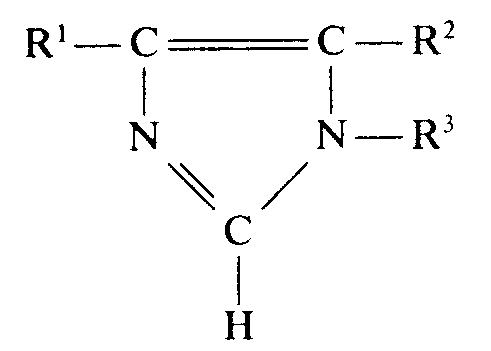
- Preferred starting materials II and accordingly preferred end products I are those in the formulas R 1 , R 2 and R 3 can be the same or different and each have an alkyl radical with 1 to 18 carbon atoms, in particular with 1 to 8 carbon atoms, an alkenyl radical with several or in particular a double bond and having 2 to 18, preferably 3 to 18, in particular 4 to 8 carbon atoms, a cyclohexyl radical, an aralkyl radical or alkylaryl radical with 7 to 12 carbon atoms, a phenyl radical or a hydrogen atom.
- the abovementioned radicals can also be replaced by groups which are inert under the reaction conditions, e.g. B. alkyl groups or Alkoxy groups each having 1 to 4 carbon atoms.
- N N'-diformyl compounds of ethylenediamine, 1,2-propylenediamine, 1,2-butylenediamine, 1,2-pentylenediamine, 1,2-n-hexylenediamine, 1,2-n-heptylenediamine, 1 , 2-n-octylenediamine, 1,2-n-nonylenediamine, 1,2-n-decylenediamine, 1,2-n-octadecylenediamine; 2,3-butylenediamine, 2,3-pentylenediamine, 2,3-hexylenediamine, 2,3-heptylenediamine, 2,3-octylenediamine, 2,3-nonylenediamine, 2,3-decylenediamine, 3,4-hexylenediamine, 3, 4-heptylenediamine, 3,4-octylenediamine, 3,4-nonylenediamine, 3,4-nonylenedi
- the reaction is carried out at a temperature of 350 to 500.degree. C., expediently from 400 to 480.degree. C., without pressure or under pressure, batchwise or preferably continuously.
- the reaction mixture also serves as a solution medium.
- Nickel oxide or cobalt oxide alone or a mixture of nickel oxide and cobalt oxide, always together with molybdenum oxide, are expediently used as the catalyst in a ratio of 0.1 to 50, preferably 0.2 to 2, mol of nickel oxide and / or cobalt oxide to 1 mol of molybdenum oxide.
- a ratio of 0.1 to 10, preferably 0.2 to 3, moles of molybdenum oxide per mole of starting material II is advantageous.
- the catalyst can optionally also be present in catalytic amounts, advantageously 0.1 to 10 percent by weight of potassium and / or sodium sulfate, 0.1 contain up to 5 percent by weight magnesium oxide and / or ferric oxide and / or 0.1 to 3 percent by weight phosphoric acid.
- the catalyst can be carrier-free or can be applied to a carrier, advantageously in an amount of 1 to 18 percent by weight of catalyst, based on the carrier.
- Aluminum compounds preferably aluminum oxides, and silicic acid compounds are expediently suitable as carriers.
- aluminum oxide z. B. a-, ó- and y-aluminum oxide or instead of aluminum oxide, this oxide-containing substances or mixtures into consideration, for. B.
- silicic acid compounds are: silicates, e.g. B. montmorillonite, Florida earth, quartz, asbestos; precipitated silica, silica gel, diatomaceous earth.
- carrier are titanium dioxide, zirconium dioxide, tin dioxide, activated carbon; Alkaline earth sulfates or alkaline earth phosphates, e.g. B. the calcium or barium salts; or corresponding mixtures of the aforementioned carrier materials.
- the preparation of the supported catalysts is carried out by the usual methods, e.g. B. by applying a cobalt and / or nickel compound and a molybdenum compound on the carrier, drying and calcining, for example between 400 and 1200 ° C in a reducing, oxidizing or inert atmosphere.
- the carrier can also be in its desired geometric shape with a solution of a molybdenum compound alone or the nickel, cobalt and molybdenum compound, e.g.
- metal compounds are those which form the corresponding metal oxides under the reaction conditions, for. B. the sulfates, nitrates, chlorides, bromides, carbonates, dicarbonates, formates, acetates of nickel, cobalt and molybdenum.
- the particle size of the catalysts is preferably from 0.005 to 7, in particular 2 to 4 millimeters.
- the shape can be arbitrary, e.g. B. in pill, cylinder or strand shape, spherical or granular.
- the catalyst suitably has pore volumes of 0.1 to 0.6 milliliters per gram, preferably from 0.2 to 0.4 milliliters per gram, specific surface area from 10 to 200 square meters per gram, preferably from 50 to 100 square meters per gram, and Bulk weights of 0.4 to 0.9, preferably 0.5 to 0.8 grams per milliliter.
- the catalysts on the support are preferably used in the fluidized bed in the form of chips or spheres, it being expedient to use catalyst particles having particle sizes of 0.005 to 3 mm, in particular 0.1 to 1 mm, preferably 0.2 to 0.4 mm.
- the layer height of the catalyst bed in the fluidized state is advantageously 30 to 2000 millimeters or is expediently chosen so that the residence times of the starting materials 11 in the catalyst layer are from 0.01 to 20, preferably from 5 to 10 seconds.
- Houben-Weyl Methods of Organic Chemistry, Volume 4/2, pages 142 ff. And Ullmanns Encyklopadie der Technische Chemie, Volume 9, pages 271 ff.
- the reaction is advantageously carried out in the presence of inert gases, advantageously nitrogen, CO, CO 2 or hydrogen.
- inert gases advantageously nitrogen, CO, CO 2 or hydrogen.
- the mixtures may contain other gaseous or vaporous.
- the waste gas from the reaction according to the invention is preferably recycled (cycle gas) and used as a gas mixture of CO / H z .
- the reaction can be carried out as follows:
- the solid, liquefied or expediently vaporous starting material is passed in a mixture with inert gas, expediently in the form of the offgas from the reaction as circulating gas, at the reaction temperature over the catalyst or catalyst on the support in a fixed bed.
- the reaction mixture emerging in vapor form from the reactor is optionally dedusted in a cyclone and condensed in a cooled receiver.
- the end product is then expediently separated off by fractional distillation.
- the end product can also be obtained by recrystallization or reprecipitation from suitable solvents, e.g. B. with toluene, dimethylformamide, or dilute acids, e.g. B. with formic acid.
- the starting material 11 is reacted in a fluidized bed at the reaction temperature.
- the catalyst or supported catalyst can be kept in a fluidized bed by the starting mixture or the inert gas alone, expediently in the form of the aforementioned circulating gas, as a fluidized bed gas at atmospheric pressure or reduced or elevated pressure. Accordingly, the total amount or a partial amount of starting material can be introduced into the fluidized bed reactor separately from the fluidized bed gas.
- the diamine 11 is expediently kept liquid in a heated storage vessel and metered into an evaporator which is connected upstream of the fluidized bed reactor.
- a weak circulating gas stream advantageously from 5000 to 50,000 parts by volume of the aforementioned circulating gas per hour, is advantageously passed through the evaporator.
- the vaporized starting material is passed through the catalyst bed together with the circulating gas stream.
- the process according to the invention can be carried out in a simple or subdivided, open or closed fluidized bed system with and without flowing dust circulation.
- reactors implementation, process variants and reaction conditions of the fluidized bed process, reference is made to Ullmann's Encyclopedia of Industrial Chemistry, Volume 1, pages 916 to 933.
- the reaction mixture is worked up in the aforementioned manner.
- the vaporous reaction mixture is passed into a separation column after the reaction, the end product is drawn off from the bottom and the remaining mixture is passed over the top of the column into a receiver, where the condensable constituents, essentially water and the starting material I underlying diamine to be condensed.
- a portion of the exhaust gas expediently a portion which contains the abovementioned amounts of CO and H 2 , is passed into a washing column, then dried and recycled as cycle gas.
- the catalyst is reacted in the fluidized bed and without pressure or under pressure, discontinuously or continuously at the same time to the fluidized reactor, advantageously from 1 to 100, preferably 20 to 50 percent by weight of catalyst per 24 hours of fluidized bed operation, based on the total amount of catalyst in the fluidized bed , withdrawn and fed a corresponding, regenerated amount of catalyst.
- the operating time of the fluidized bed can mean the duration of one continuous operation or the duration of operating several batch reactions with the same catalyst.
- the aforementioned ratio of nickel oxide and / or cobalt oxide and of molybdenum oxide per hour and mole of starting material II is generally used. Feeding and removal of the catalyst can be carried out with the usual solids transport equipment, e.g. B. feed pumps, screw conveyors, pneumatic conveying.
- the catalyst removed in this way can be regenerated continuously, expediently in a circuit from the removal via the regeneration to the feeding into the fluidized bed, or discontinuously.
- the regeneration (reactivation) of the catalyst is expediently carried out in a vortex reactor.
- the layer height in the regeneration vortex reactor is advantageously 30 to 2000 millimeters, the residence time of the catalyst in the regeneration vortex reactor 1 to 100, preferably 3 to 50 hours.
- the aforementioned inert gases, gas mixtures and cycle gas, optionally with the addition of water vapor, and air or oxygen can be used as the fluidized bed gas in the regeneration fluidization reactor (regeneration gas).
- the regeneration is generally carried out at a temperature of 300 to 600, preferably 400 to 500 ° C., without pressure or under pressure, advantageously with 0 to 99.9, preferably 80 to 99 parts by volume of inert gas or inert gas mixture per hour and kg of catalyst Air or oxygen, preferably in an amount of 0.01 to 1, in particular 0.05 to 0.5 mole of oxygen per hour and mole of nickel oxide, cobalt oxide and molybdenum oxide.
- the oxygen content in the regeneration gas is generally 0.1 to 100 percent by weight, advantageously 0.3 to 20 percent by weight. If necessary, the catalyst after Ent Removal of catalyst dust in a cyclone or additional catalyst to replace catalyst losses are fed back into the reaction according to the invention.
- This embodiment of the continuous regeneration of the catalyst avoids plant shutdown and interruptions in the reaction to carry out the regeneration of the entire reactor charge. Continuous production is guaranteed. At the same time, catalyst dust formed can easily be removed from the reaction system. A decrease in the catalyst activity by the regeneration is not observed. The yields are not affected.
- the imidazoles 1 which can be prepared by the process of the invention are valuable starting materials for the production of dyes, crop protection agents, textile auxiliaries, catalysts for polyurethanes and epoxy resins, surface-active agents and pharmaceuticals, for. B. the corresponding nitroimidazoles.
- Imidazoles I are used as catalysts for polymerization reactions and aldol condensations.
- the parts listed in the following examples are parts by weight.
- the parts by weight relate to the parts by volume like kilograms to liters.
- the vortex reactor is a vertical, electrically heated quartz tube, which is closed at the bottom with a quartz frit.
- the solid starting material II is metered into the side of the reactor.
- the quartz tube is half filled with 1000 parts of a catalyst made of 6 parts NiO and 14 parts Mo03 on 80 parts aluminum silicate (grain size 0.1 to 0.3 mm).
- the vapors leaving the reactor are condensed and fractionally distilled.
- 30.8 parts of imidazole (65.7% of theory, based on starting materials II used) of mp 89 ° C. are obtained per hour.
- the turnover is 99.3 percent.
- the yield remains constant even after 250 hours of operation.
- reaction mixture leaving the reactor is condensed and fractionally distilled. 39.1 parts (57.7% of theory) of 4,5-dimethylimidazole, mp 112 ° C., are obtained per hour.
- the circulating gas leaving the distillation column is cleaned with water in a washing column, cooled to 5 ° C. and returned.
- Example 1 50 parts of liquid N, N'-diformyl-1,2-ethylenediamine are fed hourly to the vortex reactor described in Example 1. 200,000 parts of an equimolar mixture of hydrogen and carbon monoxide serve as the fluidizing gas.
- the vortex reactor is filled with a catalyst with a grain size of 0.1 to 0.3 mm (3 parts NiO, 15 parts Mo03 and 4 parts phosphoric acid to 78 parts ⁇ -Al 2 O 3 ).
- the reaction and processing are carried out analogously to Example 1. 20.4 parts (69.7% of theory) of imidazole, mp 89 ° C., are obtained per hour. The same yield is obtained over 100 hours of operation.
- Example 4 40 parts per hour of N, N'-diformyl-1,2-ethylenediamine (liquid) together with 100,000 parts of circulating gas are passed into a vortex reactor to which an additional 1 78,000 parts of circulating gas are fed.
- the reactor is filled with 800 parts of the catalyst described in Example 3 with a grain size of 0.1 to 0.3 mm.
- the mixture is heated from 390 ° C. vortex reactor temperature to 470 ° C. over 250 hours. 17.2 parts (73.3% of theory) of imidazole, mp 89 ° C., are obtained per hour. The same yield is obtained over 250 hours.
- N, N'-diformyl-1,2-ethylenediamine 80 parts are passed per hour at 380 ° C. as a solid together with 200,000 parts of nitrogen into a first vortex reactor.
- 350,000 parts of cycle gas are supplied every hour.
- the cycle gas contains 78.5 percent by weight of CO, 6.6 percent by weight of H 2 , 0.9 percent by weight of NH 3 , 3.8 percent by weight of methane, 0.3 percent by weight of ethane and ethylene and 9.9 percent by weight of CO 2 .
- the reactor is filled with 2000 parts of a fluidized catalyst (6 parts of NiO; 30 parts of MoO 3; 8 parts of phosphoric acid; 1956 parts of y-aluminum oxide).
- the height of the catalyst zone in the fluidized state is 600 mm, the residence time in the catalyst zone in the fluidized state is 6 seconds.
- 50 parts of the catalyst are continuously discharged per hour through a discharge nozzle on the side.
- the discharged catalyst is discontinuously in a second (regeneration) vortex reactor, which is filled up to half with 5000 parts of the used contact, by supplying 250,000 parts of nitrogen per hour, 50,000 parts of water vapor and 2000 parts of O 2 at 440 ° C regenerated within 24 hours.
- 50 parts of the catalyst regenerated in this way are recycled every hour and metered in together with the starting material II into the first vortex reactor.
- the vapors leaving the first vortex reactor are dedusted in a cyclone, condensed and fractionally distilled.
- the reaction is carried out analogously to Example 3.
- 100 parts of regenerated catalyst are fed continuously to the vortex reactor every hour via a separate side nozzle.
- the catalyst volume in the reactor is kept constant via an overflow with a gas-tight solids lock.
- 100 parts of continuously discharged catalyst are continuously hourly in a second Vortex reactor (regeneration) regenerated at 440 ° C.
- An hourly mixture of 200,000 parts of nitrogen and 4,000 parts of oxygen is supplied as the regeneration gas.
- the average residence time of the catalyst in the regeneration zone is 2 hours.
- the catalyst volume in the second reactor is kept constant via an overflow and a gas-tight lock.
- the regenerated catalyst is pneumatically transferred to an intermediate container.
- the first vortex reactor is charged with catalyst from this intermediate container.
- 5 parts of catalyst are fed to the intermediate container every hour.
- the yield corresponds to that of Example 3. Even after 600 hours, no change in the catalyst behavior and in the yield is found.
Landscapes
- Chemical & Material Sciences (AREA)
- Organic Chemistry (AREA)
- Organic Low-Molecular-Weight Compounds And Preparation Thereof (AREA)
Description
- Die Erfindung betrifft ein neues Verfahren zur Herstellung von Imidazolen durch Umsetzung von N,N'-Diformyl-1,2-diaminen bei Temperaturer von 350 bis 500°C in Gegenwart von Molybdänoxid und Kobaltoxid und/oder Nickeloxid als Katalysatoren.
- Es ist aus der deutschen Offenlegungsschrift 1 952 991 bekannt, daß man Alkylendiamine mit Carbonylverbindungen in Gegenwart eines Kupfer- und/oder Chrom-Katalysators bei 320 bis 650°C zu Imidazolen umsetzen kann. Zusätzlich wird Wasserstoff der Reaktion zugeführt. Die Herstellung von in 2-Stellung unsubstituierten Imidazolen durch Umsetzung der entsprechenden Alkylendiamine mit Ameisensäure oder Formaldehyd gelingt auf diesem Wege jedoch nur in mäßigen Ausbeuten.
- Die US-Patentschrift 2 847 417 beschreibt die Herstellung von Imidazolen ausAlkylendiaminen und Carbonsäuren an Trägerkatalysatoren der Platinmetalle. Solche Katalysatoren sind teuer und werden durch bestimmte Stoffe wie Schwefel, Schwermetalle oder Halogene leicht vergiftet. Edelmetallkatalysatoren verlangen aufwendige Herstellungsverfahren, um die gleichmäßige Wirksamkeit des Katalysators zu gewährleisten, sowie sehr reine Ausgangsstoffe, um die Wirkung des Katalysators nicht zu beeinträchtigen. Zusätzlich wird Wasserstoff zugesetzt, um die Bildung teeriger Polymere und Ablagerungen auf dem Katalysator zu vermeiden und die Wirksamkeit des Katalysators so möglichst lange zu erhalten.
- Nach den Angaben der deutschen Patentschrift 1 231 249 läßt sich Imidazol durch Umsetzung von N,N'-Diformyläthylendiamin in der Gasphase an Zinkoxidkatalysatoren bei Temperaturen zwischen 250 und 800°C herstellen. Die Imidazolausbeute beträgt bei diesem Verfahren zwischen 42% und 80%derTheorie. Alle Beispiele zeigen, daß zusätzlich Stickstoff als Schlepp- oder Verdünnungsmittel zugeführt wird, wobei die Konzentration von 1 bis 999 Mol Stickstoff je Mol Ausgangsstoff beträgt. Nach den Angaben der Patentschrift sind die Ausbeuten bei Verwendung von Zinkoxid als dem einzigen Katalysator unbefriedigend. Wie die Beschreibung (Spalte 2, Zeilen 29 bis 36) zeigt, werden die Katalysatoren in einfacher Weise hergestellt und weisen keine besonderen Strukturmerkmale, lediglich eine Korngröße von 0,2 bis 0,4 mm auf. Im Gegensatz zu dem in der US-Patentschrift 2 847 417 beschriebenen Verfahren, dessen Ausbeuten in der Beschreibung als sehr gering angegeben werden, wird kein Wasserstoff verwendet; in allen Beispielen kommt Stickstoff in einer Menge von 45 bis 60 Mol je Mol Ausgangsstoff zur Anwendung. Die beste Ausbeute an Imidazol von 80%(Beispiel 2) wird mit einem Katalysator von 78 Gewichtsprozent Zinkoxid, 7 Gewichtsprozent Aluminiumoxid, 5 Gewichtsprozent Calciumoxid, 5 Gewichtsprozent Kaliumsulfat, 2 Gewichtsprozent Magnesiumoxid, 1 Gewichtsprozent Chrom-lll-oxid, 2 Gewichtsprozent Eisen-III-oxid, Natriumoxid und Kaliumoxid bei 500°C in Gegenwart von Stickstoff erhalten.
- Die nachgängige deutsche Offenlegungsschrift 2 729 017 verwendet im Gegensatz zu dem Verfahren der deutschen Patentschrift 1 231 249 keine N,N'-Diformyl-1,2-diamine, sondern setzt 1,2-Diamine mit Ameisensäure an Zinkoxid bzw. an Zinkoxid und Aluminiumoxid, bevorzugt von bestimmter Struktur, bei 300 bis 600°C um. Es wird ausdrücklich festgestellt, daß bei diesem Katalysator ein Zusatz von Wasserstoff nicht zweckmäßig und auch nicht notwendig ist, da eine Bildung teeriger Polymere, Ablagerungen auf dem Katalysator und ein rascher Rückgang der Katalysatoraktivität nicht beobachtet werden. Ein Vergleich der Herstellungsweise von Imidazol (Beispiel 2) mit der besten Verfahrensweise der deutschen Offenlegungsschrift 1 231 249 (Beispiel 2) zeigt, daß der besonders strukturierte Zinkoxid/Aluminiumoxid-Katalysator auch in Gegenwart von Stickstoff und bei einer Temperatur von 550°C eine wesentlich schlechtere (69,2 %) Ausbeute als der aus 9 Komponenten und beliebig strukturiertem Zinkoxid gebildete Katalysator im Beispiel 2 der Patentschrift liefert.
- Die französische Patentschrift 1 266 702 beschreibt die Umsetzung eines Gemischs von einem Alkylendiamin und Formaldehyd bei vorteilhaft 315 bis 482°C an einem Edelmetallkatalysator auf Träger; in allen Beispielen wird ein Platinkatalysator auf Aluminiumoxid verwendet. Die Ausbeuten sind unbefriedigend. Es wird erwähnt, daß zwar Kobaltmolybdat auf einem Träger als Katalysator verwendet werden kann,aber darauf aufmerksam gemacht (Seite 2, letzter Absatz), daß nicht notwendigerweise gleich gute Ergebnisse erhalten werden. Die Patentschrift erläutert, daß nur die echte Verbindung Kobaltmolybdat und keine Gemische von Kobaltoxid und Molybdänoxid verwendet werden können. Als Träger wird Aluminiumoxid angegeben.
- Es wurde nun gefunden, daß man Imidazole der Formel


- a) Molybdänoxid und
- b) Nickeloxid und/oder Kobaltoxid als Katalysatoren umsetzt.
- Weiterhin wurde gefunden, daß man das Verfahren vorteilhaft ausführt, wenn man die Umsetzung in einem Wirbelbett durchgeführt, wobei ein Teil des Katalysators aus dem Reaktionsraum entnommen und der Regenerierung zugeführt wird und regenerierter Katalysator in den Reaktionsraum eingegeben wird.
- Die Umsetzung kann für den Fall der Verwendung von N,N'-Diformyl-1,2-diaminopropan durch die folgenden Formeln wiedergegeben werden:

- Im Vergleich zu den bekannten Verfahren liefert das Verfahren nach der Erfindung auf einfacherem und wirtschaftlicherem Wege Imidazole in besserer Raum-Zeit-Ausbeute. Die Bildung teeriger Polymere, die zu einem raschen Rückgang der Katalysatoraktivität führen, wird nicht beobachtet. Die erfindungsgemäßen Katalysatoren sind wirtschaftlich und leicht regenerierbar. Insbesondere liefert das Verfahren im Hinblick auf die Verfahren mit Zinkoxid oder Edelmetalle enthaltenden Katalysatoren weniger Mono-, Di- oderTrialkylimidazole als Nebenprodukte. Bei den bekannten Verfahren ist der Endstoff insbesondere mit ein- und zweifach alkylierten Imidazolen, z. B. 1-, 4-, 2-Alkylimidazol, 2,4-Dialkylimidazol, 2,5-Dialkylimidazol, verunreinigt, die nur schwer abtrennbar sind. Entsprechende zusätzliche Anlagen zur fraktionierten Destillation werden eingespart. Die erfindungsgemäßen Katalysatoren zeigen höhere Aktivität und Lebensdauer. Alle diese vorteilhaften Eigenschaften sind im Hinblick auf den Stand der Technik überraschend. So hätte man im Hinblick auf die deutsche Patentschrift 1 2.31 249 nicht vermuten können, daß gerade der erfindungsgemäße Katalysator, obwohl er nicht die 9 Komponenten des in der Patentschrift beschriebenen Katalysators enthält und kein Zinkoxid besonderer Struktur aufweist, höhere Raum-Zeit-Ausbeuten an Endstoff liefert. Hinzu kommt, daß man im Hinblick auf die Lehre der deutschen Offenlegungsschrift 2 729 017 die Verwendung derfreien Amine mit Ameisensäure und nicht die der N,N'-Diformylverbindungen als vorteilhafte Arbeitsweise betrachtet hätte. Auch war mit Bezug auf die französische Patentschrift 1 266 702 überraschend, daß die erfindungsgemäßen Ausgangsstoffe anstelle von Gemischen von Alkylendiaminen und Formaldehyd und noch dazu unter Verwendung der erfindungsgemäßen Katalysatoren diese vorteilhaften Ergebnisse liefern.
- Die N,N'-Diformyl-1,2-diamine II können durch Reaktion der entsprechenden Diamine mit Ameisensäureestern, Formamid oder Ameisensäure, z. B. im Molverhältnis 1 : 2 bis 4, vorteilhaft 1 : 2 bis 2,5, vorzugsweise bei erhöhter Temperatur und Druck, zweckmäßig 50 bis 130°C und 2 bis 10 bar, hergestellt werden. Bevorzugte Ausgangsstoffe II und dementsprechend bevorzugte Endstoffe I sind solche, in deren Formeln R1, R2 und R3 gleich oder verschieden sein können und jeweils einen Alkylrest mit 1 bis 18 Kohlenstoffatomen, insbesondere mit 1 bis 8 Kohlenstoffatomen, einen Alkenylrest mit mehreren oder insbesondere einer Doppelbindung und mit 2 bis 18, vorzugsweise 3 bis 18, insbesondere 4 bis 8 Kohlenstoffatomen, einen Cyclohexylrest, einen Aralkylrest oder Alkylarylrest mit 7 bis 12 Kohlenstoffatomen, einen Phenyirest oder ein Wasserstoffatom bedeuten. Die vorgenannten Reste können noch durch unter den Reaktionsbedingungen inerte Gruppen, z. B. Alkylgruppen oder Alkoxygruppen mit jeweils 1 bis 4 Kohlenstoffatomen, substituiert sein.
- Als Ausgangsstoffe 11 kommen z. B. in Frage: Die N,N'-Diformylverbindungen von Äthylendiamin, 1,2-Propylendiamin, 1,2-Butylendiamin, 1,2-Pentylendiamin, 1,2-n-Hexylendiamin, 1,2-n-Heptylendiamin, 1,2-n-Octylendiamin, 1,2-n-Nonylendiamin, 1,2-n-Decylendiamin, 1,2-n-Octadecylendiamin; 2,3-Butylendiamin, 2,3-Pentylendiamin, 2,3-Hexylendiamin, 2,3-Heptylendiamin, 2,3-Octylendiamin, 2,3-Nonylendiamin, 2,3-Decylendiamin, 3,4-Hexylendiamin, 3,4-Heptylendiamin, 3,4-Octylendiamin, 3,4-Nonylendiamin, 3,4-Decylendiamin, 4,5-Octylendiamin, 4,5-Nonylendiamin, 4,5-Decylendiamin, 5,6-Decylendiamin; durch die Benzyl-, Cyclohexyl- und/oder Phenylgruppe in 1-Stellung einfach oder in 1 - und 2-Stellung gleichzeitig substituierten Athylendiaminen; durch vorgenannte Alkylgruppen in 1-Stellung und durch die Benzyl-, Cyclohexyl- oder Phenylgruppe in 2-Stellung substituierten Äthylendiamine; homologen, durch die Methyl-, Äthyl-, Allyl-, Crotyl-, Propyl-, Isopropyl-, Butyl-, Isobutyl-, Pentyl-, sek.-Butyl-, tert.-Butyl-, Hexyl-, Heptyl-, Octyl-, Nonyl-, Decyl-, Octadecyl-, Cyclohexyl-, Cyclopentyl-, Benzyl-, Tolyl-, Xylyl-, Naphthyl-, Methoxyphenyl-, Äthoxyphenyl-, Äthylphenyl-, Dimethoxyphenylgruppe mono-N-substituierten 1,2-Diaminen.
- Die Umsetzung wird bei einer Temperatur von 350 bis 500°C, zweckmäßig von 400 bis 480°C, drucklos oder unter Druck, diskontinuierlich oder bevorzugt kontinuierlich durchgeführt. In der Regel dient das Reaktionsgemisch auch als Lösungsmedium.
- Als Katalysator werden Nickeloxid oder Kobaltoxid allein oder ein Gemisch von Nickeloxid und Kobaltoxid, stets zusammen mit Molybdänoxid, zweckmäßig in einem Verhältnis von 0,1 bis 50, vorzugsweise 0,2 bis 2 Mol Nickeloxid und/oder Kobaltoxid zu 1 Mol Molybdänoxid, verwendet. Vorteilhaft ist ein Verhältnis von 0,1 bis 10, vorzugsweise 0,2 bis 3 Mol Molybdänoxid je Mol Ausgangsstoff II. Der Katalysator kann gegebenenfalls noch in katalytischen Mengen, zweckmäßig 0,1 bis 10 Gewichtsprozent Kalium- und/oder Natriumsulfat, 0,1 bis 5 Gewichtsprozent Magnesiumoxid und/oder Eisen-III-oxid und/oder 0,1 bis 3 Gewichtsprozent Phosphorsäure enthalten. Der Katalysator kann trägerfrei sein oder auf einem Träger, vorteilhaft in einer Menge von 1 bis 18 Gewichtsprozent Katalysator, bezogen auf den Träger, aufgebracht sein. Als Träger kommen zweckmäßig Aluminiumverbindungen, bevorzugt Aluminiumoxide, und Kieselsäureverbindungen in Frage. Als Aluminiumoxid kommen z. B. a-, ó-und y-Aluminiumoxid oder anstelle von Aluminiumoxid auch dieses Oxid enthaltende Stoffe oder Stoffgemische in Betracht, z. B. Aluminiumsilikat, Magnesiumaluminiumsilikathydrat, Dimagnesiumaluminiumsilikathydrat, Natriumaluminiumsilikat, Calciumaluminiumsilikat, Fullererde, Tone, Bleicherden wie Bentonit, Bauxit, Bimsstein, Andalusit, Kaolin, Allophane, Zeolithe, Mullit, Korund, y-Tonerde, Hydrargillit, Böhmit. Als Kieselsäureverbindungen kommen in Frage: Silikate, z. B. Montmorillonit, Floridaerde, Quarz, Asbest; gefällte Kieselsäure, Kieselgel, Kieselgur. Weitere Träger sind Titandioxid, Zirkondioxid, Zinndioxid, Aktivkohle; Erdalkalisulfate oder Erdalkaliphosphate, z. B. die Calcium- oder Bariumsalze; oder entsprechende Gemische vorgenannter Trägermaterialien. Die Herstellung der Trägerkatalysatoren wird nach den üblichen Verfahren, z. B. durch Auftragen einer Kobalt- und/oder Nikkelverbindung und einer Molybdänverbindung auf den Träger, Trocknen und Calcinieren, beispielsweise zwischen 400 und 1200°C in reduzierender, oxidierender oder inerter Atmosphäre, durchgeführt. Der Träger kann auch in seiner gewünschten geometrischen Form mit einer Lösung einer Molybdänverbindung allein bzw. der Nickel-, Kobalt- und Molybdänverbindung, z. B. einer wäßrigen Lösung von Nickelsulfat und Molybdänsulfat, getränkt und getrocknet werden. Ebenfalls kann man das Trägermaterial mit vorgenannten Metallverbindungen und Wasser verkneten, in die gewünschte Form bringen, trocknen und bei einerTemperaturvon 400 bis 1200°C calcinieren. In allen diesen Fällen kommen als Metallverbindungen solche, die unter den Reaktionsbedingungen die entsprechenden Metalloxide bilden, in Betracht, z. B. die Sulfate, Nitrate, Chloride, Bromide, Carbonate, Dicarbonate, Formiate, Acetate von Nickel, Kobalt und Molybdän.
- Die Teilchengröße der Katalysatoren beträgt vorzugsweise von 0,005 bis 7, Insbesondere 2 bis 4 Millimeter. Die Form kann beliebig, z. B. in Pillen-, Zylinder- oder Strangform, kugelförmig oder körnig, gewählt werden. Der Katalysator besitzt zweckmäßig Porenvolumina von 0,1 bis 0,6 Milliliter je Gramm, vorzugsweise von 0,2 bis 0,4 Milliliter je Gramm, spezifische Oberfläche von 10 bis 200 Quadratmeter je Gramm, vorzugsweise von 50 bis 100 Quadratmeter je Gramm, und Schüttgewichte von 0,4 bis 0,9, vorzugsweise von 0,5 bis 0,8 Gramm je Milliliter.
- Vorzugsweise werden die Katalysatoren auf dem Träger in Splitt- oder Kugelform in der Wirbelschicht eingesetzt, wobei zweckmäßig Katalysatorteilchen mit Korngrößen von 0,005 bis 3 mm, insbesondere von 0,1 bis 1 mm, bevorzugt 0,2 bis 0,4 mm, verwendet werden. Die Schichthöhe des Katalysatorbettes im Wirbelzustand beträgt vorteilhaft 30 bis 2000 Millimeter oder wird zweckmäßig so gewählt, daß sich Verweilzeiten der Ausgangsstoffe 11 in der Katalysatorschicht von 0,01 bis 20, vorzugsweise von 5 bis 10 Sekunden ergeben. Bezüglich der Herstellung der Katalysatoren wird auf Houben-Weyl, Methoden der Organischen Chemie, Band 4/2, Seiten 142 ff. und Ullmanns Encyklopädie der technischen Chemie, Band 9, Seiten 271 ff., verwiesen.
- Die Umsetzung wird vorteilhaft in Gegenwart von Inertgasen durchgeführt, zweckmäßig von Stickstoff, CO, C02 oder Wasserstoff. Man verwendet zweckmäßig Mengen von 1 bis 200, insbesondere 10 bis 50 Mol Stickstoff oder CO/H2-Gemische in Mengen von 1 bis 100, vorteilhaft 2 bis 50, insbesondere 3 bis 18 Mol Kohlenmonoxid und 1 bis 100, vorteilhaft 3 bis 50, insbesondere 6 bis 20 Mol Was- serstoff je Mol Ausgangsstoff II. Die Gemische können noch weitere gasförmige bzw. dampfförmige Komponenten enthalten. Bevorzugt wird das Abgas der erfindungsgemäßen Reaktion zurückgeführt (Kreisgas) und als Gasgemisch von CO/Hz verwendet. Vorteilhaft ist ein Kreisgas von 30 bis 90, insbesondere 50 bis 75 Gewichtsprozent CO, von 3 bis 15, insbesondere 5 bis 7 Gewichtsprozent Wasserstoff, das im allgemeinen noch von 0 bis 50, insbesondere 10 bis 40 Gewichtsprozent COz, 0 bis 30, insbesondere von 0 bis 10 Gewichtsprozent Stickstoff, 0 bis 10, insbesondere 0,5 bis 5 Gewichtsprozent Ammoniak, 0 bis 15, insbesondere 0,5 bis 10 Gewichtsprozent dem Ausgangsstoff 11 zugrundeliegendes Diamin, 0 bis 12, insbesondere 0,1 bis 6 Gewichtsprozent Methan enthält.
- Die Reaktion kann wie folgt durchgeführt werden: Derfeste, verflüssigte oder zweckmäßig dampfförmige Ausgangsstoff wird im Gemisch mit Inertgas, zweckmäßig in Form des Abgases der Reaktion als Kreisgas, bei der Reaktionstemperatur über den Katalysator bzw. Katalysator auf dem Träger in einem Festbett geleitet. Das aus dem Reaktor dampfförmig austretende Reaktionsgemisch wird gegebenenfalls in einem Zyklon entstaubt und in einer gekühlten Vorlage kondensiert. Durch fraktionierte Destillation wird dann zweckmäig der Endstoff abgetrennt. Der Endstoff kann auch durch Umkristallisation oder Umfällung aus geeigneten Lösungsmitteln, z. B. mit Toluol, Dimethylformamid, oder verdünnten Säuren, z. B. mit Ameisensäure, isoliert werden.
- In einer bevorzugten Ausführungsform des Verfahrens wird der Ausgangsstoff 11 in einer Wirbelschicht bei der Reaktionstemperatur umgesetzt. Der Katalysator bzw. Katalysator auf Träger kann durch das Ausgangsgemisch oder das Inertgas allein, zweckmäßig in Gestalt des vorgenannten Kreisgases, als Wirbelschichtgas bei Normaldruck odervermindertem oder erhöhtem Druck in einer Wirbelschicht gehalten werden. Entsprechend kann die Gesamtmenge oder eine Teilmenge an Ausgangsstoff getrennt von dem Wirbelschichtgas in den Wirbelschichtreaktor eingeleitet werden. Das Diamin 11 wird zweckmäßig in einem beheizten Vorratsgefäß flüssig gehalten und in einen Verdampfer dosiert, der dem Wirbelschichtreaktor vorgeschaltet ist. Gleichzeitig leitet man vorteilhaft einen schwachen Kreisgasstrom, zweckmäßig von 5000 bis 50 000 Volumenteilen des vorgenannten Kreisgases je Stunde, durch den Verdampfer. Der verdampfte Ausgangsstoff wird zusammen mit dem Kreisgasstrom durch das Katalysatorbett geleitet. Ebenfalls kann man aber auch den Ausgangsstoff II in fester Form, vorteilhaft in einer Korngröße zwischen 0,1 bis 3 Millimeter, oder in flüssiger Form direkt in den Wirbelschichtreaktor eindosieren, wobei die Zudosierung des Ausgangsstoffs 11 getrennt von dem Wirbelgas oder zusammen mit ihm erfolgen kann. Man kann das Verfahren nach der Erfindung in einem einfachen oder unterteilten, offenen oder geschlossenen Wirbelschichtsystem mit und ohne Fließstaubzirkulation durchführen. Bezüglich Reaktoren, Durchführung, Verfahrensvarianten und Reaktionsbedingungen des Wirbelschichtverfahrens wird auf Ullmanns Encyklopädie der technischen Chemie, Band 1, Seiten 916 bis 933, verwiesen. Die Aufarbeitung des Reaktionsgemisches erfolgt in vorgenannter Weise.
- In einer vorteilhaften Ausführungsform führt man nach der Reaktion das dampfförmige Reaktionsgemisch in eine Trennkolonne, zieht aus dem Sumpf den Endstoff ab und führt über den Kopf der Kolonne das restliche Gemisch in eine Vorlage, wo die kondensierbaren Anteile, im wesentlichen Wasser und das dem Ausgangsstoff I zugrundeliegende Diamin, kondensiert werden. Ein Teil des Abgases, zweckmäßig ein Anteil, der die vorgenannten Mengen an CO und H2 enthält, wird in eine Waschkolonne geführt, anschließend getrocknet und als Kreisgas zurückgeführt.
- In einer bevorzugten Ausführungsform wird im Wirbelbett umgesetzt und drucklos oder unter Druck, diskontinuierlich oder kontinuierlich gleichzeitig dem Wirbelreaktor ein Katalysatoranteil, zweckmäßig von 1 bis 100, vorzugsweise 20 bis 50 Gewichtsprozent Katalysator je 24 Stunden Betriebsdauer des Wirbelbetts, bezogen auf die Gesamtmenge des Katalysators im Wirbelbett, entzogen und eine entsprechende, regenerierte Katalysatormenge zugeführt. Die Betriebsdauer des Wirbelbetts kann die Dauer eines kontinuierlichen Betriebs oder die Dauer des Betriebs mehrerer diskontinuierlicher Umsetzungen mit demselben Katalysator bedeuten. In einem kontinuierlichen Betrieb, insbesondere im Wirbelreaktor, wird in der Regel das vorgenannte Verhältnis von Nickeloxid und/oder Kobaltoxid und von Molybdänoxid je Stunde und Mol Ausgangsstoff II verwendet. Zuführung und Entnahme des Katalysators kann mit den üblichen Apparaturen des Feststofftransports, z. B. Förderpumpen, Transportschnecken, pneumatische Förderung erfolgen.
- Der so entnommene Katalysator kann kontinuierlich, zweckmäßig im Kreislauf von der Entnahme über die Regenerierung zur Zuführung in das Wirbelbett, oder diskontinuierlich regeneriert werden. Die Regenerierung (Reaktivierung) des Katalysators erfolgt zweckmäßig in einem vorgenannten Wirbelreaktor. Die Schichthöhe im Regenerierungswirbelreaktor beträgt zweckmäßig 30 bis 2000 Millimeter, die Verweilzeit des Katalysators im Regenerierungswirbelreaktor 1 bis 100, vorzugsweise 3 bis 50 Stunden. Als Wirbelschichtgas im Regenerierungswirbelreaktor (Regeneriergas) können die vorgenannten Inertgase, Gasgemische und Kreisgas, gegebenenfalls unter Zusatz von Wasserdampf, und Luft bzw. Sauerstoff verwendet werden. Die Regenerierung wird in der Regel bei einer Temperatur von 300 bis 600, vorzugsweise 400 bis 500°C, drucklos oder unter Druck, zweckmäßig mit 0 bis 99,9, vorzugsweise 80 bis 99 Volumenteilen Inertgas bzw. Inertgasgemisch je Stunde und Kilogramm Katalysator, mit Luft oder Sauerstoff, vorzugsweise in einer Menge von 0,01 bis 1, insbesondere 0,05 bis 0,5 Mol Sauerstoff je Stunde und Mol Nickeloxid, Kobaltoxid und Molybdänoxid, durchgeführt. Der Sauerstoffgehalt im Regeneriergas beträgt im allgemeinen 0,1 bis 100 Gewichtsprozent, zweckmäßigerweise 0,3 bis 20 Gewichtsprozent. Gegebenenfalls kann der Katalysator nach der Entnahme in einem Zyklon vom Katalysatorstaub befreit werden bzw. zusätzlicher Katalysator zum Ersatz von Katalysatorverlusten der erfindungsgemäßen Reaktion wieder zugeführt werden. Diese Ausführungsform der kontinuierlichen Regenerierung des Katalysators vermeidet Abstellung der Anlage und Unterbrechungen der Reaktion zur Durchführung der Regenerierung der gesamten Reaktorfüllung. Eine kontinuierliche Produktion wird gewährleistet. Gleichzeitig kann gebildeter Katalysatorstaub einfach aus dem Reaktionssystem entfernt werden. Ein Nachlassen der Katalysatoraktivität durch die Regenerierung wird nicht beobachtet. Die Ausbeuten werden nicht beeinträchtigt.
- Die nach dem Verfahren der Erfindung herstellbaren Imidazole 1 sind wertvolle Ausgangsstoffe für die Herstellung von Farbstoffen, Pflanzenschutzmitteln, Textilhilfsmitteln, Katalysatoren für Polyurethane und Epoxidharze, oberflächenaktiven Mitteln und Pharmazeutika, z. B. den entsprechenden Nitroimidazolen. Imidazole I werden als Katalysatoren für Polymerisationsreaktionen und Aldolkondensationen verwendet. Bezüglich der Verwendung wird auf die vorgenannten Veröffentlichungen und Ullmanns Encyklopädie der technischen Chemie (3. Auflage), Band 8, Seite 499, und (4. Auflage), Band 13, Seiten 173 bis 175, verwiesen.
- Die in den folgenden Beispielen aufgeführten Teile bedeuten Gewichtsteile. Die Gewichtsteile verhalten sich zu den Volumenteilen wie Kilogramm zu Liter.
- 180 Teile 1,2-Diaminoäthan werden unter Rühren und Kühlung mit 400 Teilen Ameisensäuremethylester bei 25 bis 30°C gemischt. Nach dem Abkühlen des Reaktionsgemisches wird der Niederschlag abgesaugt und getrocknet. Man erhält 343 Teile (98,5 %) der Theorie) N,N'-Diformyl-diaminoäthan vom Fp 111 °C.
- 80 Teile N,N'-Diformyl-diaminoäthan werden pro Stunde aus einem Vorratsgefäß zusammen mit 550 000 Volumenteilen pro Stunde Stickstoff durch einen auf 400°C erhitzten Wirbelreaktor geleitet. Der Wirbelreaktor ist ein vertikales, elektrisch beheiztes Quarzrohr, das nach unten mit einer Quarzfritte abgeschlossen ist. Der feste Ausgangsstoff II wird seitlich in den Reaktor eindosiert. Das Quarzrohr ist mit 1000 Teilen eines Katalysators aus 6 Teilen NiO und 14Teilen Mo03 auf 80 Teilen Aluminiumsilikat (Korngröße 0,1 bis 0,3 mm) zur Hälfte gefüllt. Die den Reaktor verlassenden Dämpfe werden kondensiert und fraktioniert destilliert. Man erhält stündlich 30,8 Teile Imidazol (65,7%derTheorie, bezogen auf eingesetzten Ausgangsstoffe II) vom Fp 89°C. Der Umsatz beträgt 99,3 Prozent. Die Ausbeute bleibt auch noch nach 250 Stunden Betrieb konstant.
-
- a) 120 Teile 1,2-Diaminopropan werden pro Stunde bei 100°C und 4 bar Druck in einen Schlaufenreaktor geleitet. Gleichzeitig werden 225 Teile Ameisensäuremethylester pro Stunde zugeführt. Die Verweilzeit im Reaktor beträgt 5 Minuten. Das Reaktionsgemisch wird kontinuierlich destillativ getrennt, wobei überschüssiger Ameisensäuremethylester zurückgeführt wird. Man erhält 207 Teile (98,2% der Theorie) N,N'-Diformyl-1,2-diaminopropan vom Fp 64°C.
- b) Stündlich werden 50 Teile geschmolzenes N,N'-Diformyl-1,2-diaminopropan bei 300°C verdampft und die Dämpfe zusammen mit 310 000 Volumenteilen pro Stunde Stickstoff bei 420°C durch einen elektrisch beheizten Festbettreaktor geleitet. Der Reaktor sitzt senkrecht auf dem Verdampfer und ist mit 5 mm langen und 2 mm dicken zylindrischen Füllkörpern (500 Teilen), bestehend aus 4 Teilen Co0 und 15 Teilen Mo03 auf 81 Teilen γ Aluminiumoxid, gefüllt. Nach der Aufarbeitung analog Beispiel 1 erhält man stündlich 19 Teile (60,2% Ausbeute, bezogen auf eingesetzten Ausgangsstoff II) 4-Methylimidazol vom Fp 50°C. Der Umsatz beträgt 98,5%, bezogen auf Ausgangsstoff 11. Die Ausbeute ist auch nach 200 Stunden Betrieb noch konstant.
- 100 Teile flüssiges 2,3-Diamino-N,N'-diformylbutan werden stündlich zusammen mit 200 000 Teilen Kreisgas bei 435°C in einen Wirbelreaktor geleitet. Zusätzlich werden 350 000Teile Kreisgas zugeführt. Das Kreisgas enthält 61 Gewichtsprozent CO, 6 Gewichtsprozent H2, 6 Gewichtsprozent NH3, 5 Gewichtsprozent Methan, 4 Gewichtsprozent Äthan und Äthylen und 23 Gewichtsprozent CO2. Der Reaktor ist mit 2000 Teilen eines Wirbelkatalysators (3 Teile NiO, 15 Teile MoO3, 75 Teile Aluminiumoxid, 0,5 Teile Na20, 5,8 Teile PzOs) gefüllt. Die Korngröße des Katalysators beträgt 0,1 bis 0,3 mm. Das den Reaktor verlassende Reaktionsgemisch wird kondensiert und fraktioniert destilliert. Man erhält stündlich 39,1 Teile (57,7%derTheorie) 4,5-Dimethylimidazol vom Fp 112°C. Das die Destillationskolonne verlassende Kreisgas wird mit Wasser in einer Waschkolonne gereinigt, auf 5°C gekühlt und zurückgeführt.
- 50 Teile flüssiges N,N'-Diformyl-1,2-ethylendiamin werden stündlich dem in Beispiel 1 beschriebenen Wirbelreaktor zugeführt. Als Wirbelgas dienen 200 000 Teile eines äquimolaren Gemisches aus Wasserstoff und Kohlenstoffmonoxid. Der Wirbelreaktor ist mit einem Katalysator der Korngröße 0,1 bis 0,3 mm (3 Teile NiO, 15 Teile Mo03 und 4 Teile Phosphorsäure auf 78 Teile γ-Al2O3) gefüllt. Die Umsetzung und Aufarbeitung erfolgt analog Beispiel 1. Man erhält stündlich 20,4 Teile (69,7% der Theorie) Imidazol vom Fp 89°C. Über 100 Stunden Betriebsdauer wird dieselbe Ausbeute erhalten.
- Entsprechend Beispiel 4 werden 40 Teile pro Stunden N,N'-Diformyl-1,2-ethylendiamin (flüssig) zusammen mit 100 000 Teilen Kreisgas in einen Wirbelreakor geleitet, dem zusätzlich 1 78 000 Teile Kreisgas zugeführt werden. Der Reaktor ist mit 800Teilen des in Beispiel 3 beschriebenen Katalysators der Korngröße 0,1 bis 0,3 mm gefüllt. Man erhitzt während 250 Stunden von 390°C Wirbelreaktortemperatur auf 470°C. Man erhält stündlich 17,2Teile (73,3% der Theorie) Imidazol vom Fp 89°C. Über 250 Stunden wird dieselbe Ausbeute erhalten.
- 80 Teile N,N'-Diformyl-1,2-ethylendiamin werden stündlich bei 380°C als Feststoff zusammen mit 200 000 Teilen Stickstoff in einen ersten Wirbelreaktor geleitet. Zusätzlich werden 350 000 Teile Kreisgas stündlich zugeführt. Das Kreisgas enthält 78,5 Gewichtsprozent CO, 6,6 Gewichtsprozent H2, 0,9 Gewichtsprozent NH3, 3,8 Gewichtsprozent Methan, 0,3 Gewichtsprozent Äthan und Äthylen und 9,9 Gewichtsprozent CO2. Der Reaktor ist mit 2000 Teilen eines Wirbelkatalysators (6 Teile NiO; 30 Teile Mo03; 8 Teile Phosphorsäure; 1956 Teile y-Aluminiumoxid) gefüllt.
- Die Höhe der Katalysatorzone beträgt im Wirbelzustand 600 mm, die Verweilzeit in der Katalysatorzone im Wirbelzustand beträgt 6 Sekunden. Durch einen seitlich angebrachten Entnahmestutzen werden kontinuierlich stündlich 50 Teile des Katalysators ausgeschleust. Der ausgeschleuste Katalysator wird diskontinuierlich in einem zweiten (Regenerierungs-)Wirbelreaktor, der jeweils mit 5000 Teilen des gebrauchten Kontaktes bis zur Hälfte gefüllt ist, durch Zufuhr von stündlich 250 000 Teilen Stickstoff, 50 000 Teilen Wasserdampf und 2000 Teilen O2 bei 440°C innerhalb von 24 Stunden regeneriert. 50Teile des so regenerierten Katalysators werden stündlich zurückgeführt und zusammen mit dem Ausgangsstoff II seitlich in den ersten Wirbelreaktoreindosiert. Die den ersten Wirbelreaktorverlassenden Dämpfe werden in einem Zyklon entstaubt, kondensiert und fraktioniert destilliert. Ein Teil des verbleibenden Gasgemisches wird gewaschen, getrocknet und als Kreisgas zurückgeführt. Überschüssiges Kreisgas wird ausgeschleust. Man erhält stündlich 36,7 Teile Imidazol (78,3%derTheorie, bezogen auf eingesetzten Ausgangsstoff 11) vom Fp 88°C. Der Umsatz beträgt 99,5%. Eine Ausbeuteverschlechterung ist auch nach 400 Stunden noch nicht festzustellen.
- Bei der Umsetzung und Katalysatorregenerierung nach Beispiel 6 werden stündlich 100 Teile N,N'-Diformyl-2-phenyl-1,2-ethylendiamin zusammen mit 150000 Teilen Stickstoff flüssig zugeführt, wobei weitere 400 000 Teile Stickstoff als Wirbelgas dienen. Man erhält 62 Teile (82,1 % der Theorie) 4(5)-Phenylimidazol vom Schmelzpunkt Fp 127 bis 129°C. Der Umsatz beträgt 99,5%. Eine Ausbeuteverschlechterung ist auch nach 400 Stunden noch nicht festzustellen.
- Die Umsetzung wird analog Beispiel 3 durchgeführt. Über einen separaten seitlichen Stutzen werden dem Wirbelreaktor kontinuierlich stündlich 100 Teile regenerierten Katalysators zugeführt. Über einen Überlauf mit gasdichter Feststoffschleuse wird das Katalysatorvolumen im Reaktor konstant gehalten. 100 Teile kontinuierlich ausgeschleuster Katalysator werden stündlich kontinuierlich in einem zweiten Wirbelreaktor (Regenerierung) bei 440°C regeneriert. Als Regeneriergas wird stündlich ein Gemisch aus 200 000 Teilen Stickstoff und 4000 Teilen Sauerstoff zugeführt. Die mittlere Verweilzeit des Katalysators in der Regenerierzone beträgt 2 Stunden. Über einen Überlauf und eine gasdichte Schleuse wird das Katalysatorvolumen im zweiten Reaktor konstant gehalten. Der regenerierte Katalysator wird pneumatisch in einen Zwischenbehälter überführt. Aus diesem Zwischenbehälter wird der erste Wirbelreaktor mit Katalysator beschickt. Zum Ausgleich der Katalysatorverluste werden diskontinuierlich stündlich 5 Teile Katalysator dem Zwischenbehälter zugeführt. Die Ausbeute entspricht der von Beispiel 3. Auch nach 600 Stunden wird keine Veränderung im Katalysatorverhalten und in der Ausbeute festgestellt.
Claims (2)

Applications Claiming Priority (2)
| Application Number | Priority Date | Filing Date | Title |
|---|---|---|---|
| DE3009605 | 1980-03-13 | ||
| DE19803009605 DE3009605A1 (de) | 1980-03-13 | 1980-03-13 | Verfahren zur herstellung von imidazolen |
Publications (2)
| Publication Number | Publication Date |
|---|---|
| EP0036519A1 EP0036519A1 (de) | 1981-09-30 |
| EP0036519B1 true EP0036519B1 (de) | 1983-03-02 |
Family
ID=6097064
Family Applications (1)
| Application Number | Title | Priority Date | Filing Date |
|---|---|---|---|
| EP81101534A Expired EP0036519B1 (de) | 1980-03-13 | 1981-03-04 | Verfahren zur Herstellung von Imidazolen |
Country Status (2)
| Country | Link |
|---|---|
| EP (1) | EP0036519B1 (de) |
| DE (2) | DE3009605A1 (de) |
Families Citing this family (4)
| Publication number | Priority date | Publication date | Assignee | Title |
|---|---|---|---|---|
| US4921969A (en) * | 1988-12-15 | 1990-05-01 | Texaco Chemical Co. | Method for the preparation of imidazoles |
| US4927942A (en) * | 1988-12-15 | 1990-05-22 | Texaco Chemical Co. | Method for the preparation of imidazoles |
| EP0378910B1 (de) * | 1988-12-15 | 1994-08-31 | Texaco Development Corporation | Verfahren zur Herstellung von Imidazolen |
| DE4209847A1 (de) * | 1992-03-26 | 1993-09-30 | Basf Ag | Verfahren zur Herstellung von 4-substituierten Imidazolen |
Citations (1)
| Publication number | Priority date | Publication date | Assignee | Title |
|---|---|---|---|---|
| EP0000208A1 (de) * | 1977-06-28 | 1979-01-10 | BASF Aktiengesellschaft | Verfahren zur Herstellung von Imidazolen |
Family Cites Families (1)
| Publication number | Priority date | Publication date | Assignee | Title |
|---|---|---|---|---|
| DE2161770C3 (de) * | 1971-12-13 | 1979-02-08 | Basf Ag, 6700 Ludwigshafen | Verfahren zur Herstellung von in 2- und 4 (5)-Stellung substituierten 13 (4) -Dimethylimidazolen durch katalytisch* Methylierung in der Gasphase |
-
1980
- 1980-03-13 DE DE19803009605 patent/DE3009605A1/de not_active Withdrawn
-
1981
- 1981-03-04 DE DE8181101534T patent/DE3160092D1/de not_active Expired
- 1981-03-04 EP EP81101534A patent/EP0036519B1/de not_active Expired
Patent Citations (1)
| Publication number | Priority date | Publication date | Assignee | Title |
|---|---|---|---|---|
| EP0000208A1 (de) * | 1977-06-28 | 1979-01-10 | BASF Aktiengesellschaft | Verfahren zur Herstellung von Imidazolen |
Also Published As
| Publication number | Publication date |
|---|---|
| DE3160092D1 (en) | 1983-04-07 |
| EP0036519A1 (de) | 1981-09-30 |
| DE3009605A1 (de) | 1981-10-01 |
Similar Documents
| Publication | Publication Date | Title |
|---|---|---|
| DE2034380A1 (de) | Hydrierung von Adiponitnl | |
| DE2164341C3 (de) | Verfahren zur katalytischen Hydrierung von Adiponitril zu Hexamethylendiamin | |
| DE2366002A1 (de) | Verfahren zur gleichzeitigen herstellung von cyanwasserstoff und acrylnitril bzw. methacrylnitril | |
| EP0351661B1 (de) | Ruthenium-Trägerkatalysator, seine Herstellung und sein Einsatz bei der Herstellung von gegebenenfalls substituiertem Cyclohexylamin und gegebenenfalls substituiertem Dicyclohexylamin | |
| DE69411537T2 (de) | Verfahren zur amidherstellung | |
| EP0036129B1 (de) | Verfahren zur Herstellung von Imidazolen | |
| EP0312734A1 (de) | Verfahren zur Herstellung von 1,4-Diazabicyclo(2.2.2)-octan aus Piperazin | |
| EP1480942B1 (de) | Verfahren zur herstellung von primären aminen durch hydrierung von nitrilen | |
| EP0000208B1 (de) | Verfahren zur Herstellung von Imidazolen | |
| DE1568968A1 (de) | Verfahren zur Herstellung von Nitrilen | |
| EP0984005A1 (de) | Verfahren zur Herstellung von Nikotinsäure | |
| EP0012371B1 (de) | Verfahren zur Herstellung von 2-Imidazolinen | |
| EP0036519A1 (de) | Verfahren zur Herstellung von Imidazolen | |
| EP0135833B1 (de) | Verfahren zur Herstellung von 2-Amino-alkylpyridinen | |
| EP0025191B1 (de) | Verfahren zur Herstellung von Imidazolen | |
| EP2412698B1 (de) | DMAPN mit niedrigem DGN-Gehalt und ein Verfahren zur Herstellung von DMAPA aus DMAPN mit niedrigem DGN-gehalt | |
| EP0452693B1 (de) | Verfahren zur Herstellung von 2,2-disubstituierten Pentan-1,5-diaminen | |
| EP0036521B1 (de) | Verfahren zur Herstellung von 2-Imidazolinen | |
| EP0075819A2 (de) | Verfahren zur Verbesserung der Melaminqualität durch Reaktivierung von bei der Melaminsynthese eingesetzten Katalysatoren | |
| EP0814075A1 (de) | Verfahren zur Herstellung von Aminen aus Olefinen an Oxiden der Gruppen IVB, VIB oder deren Gemischen auf Trägern | |
| EP0073326B1 (de) | Verfahren zur Herstellung von Nitrilen aus Formamiden | |
| EP0190101B1 (de) | Verfahren zur Herstellung von N-Alkylanilinen | |
| DE2733466A1 (de) | Verfahren zur herstellung von imidazolen | |
| DE2728976A1 (de) | Verfahren zur herstellung von imidazolen | |
| DE2729017A1 (de) | Verfahren zur herstellung von imidazolen |
Legal Events
| Date | Code | Title | Description |
|---|---|---|---|
| PUAI | Public reference made under article 153(3) epc to a published international application that has entered the european phase |
Free format text: ORIGINAL CODE: 0009012 |
|
| AK | Designated contracting states |
Designated state(s): BE CH DE FR GB |
|
| 17P | Request for examination filed |
Effective date: 19811022 |
|
| GRAA | (expected) grant |
Free format text: ORIGINAL CODE: 0009210 |
|
| AK | Designated contracting states |
Designated state(s): BE CH DE FR GB LI |
|
| REF | Corresponds to: |
Ref document number: 3160092 Country of ref document: DE Date of ref document: 19830407 |
|
| ET | Fr: translation filed | ||
| PGFP | Annual fee paid to national office [announced via postgrant information from national office to epo] |
Ref country code: DE Payment date: 19840215 Year of fee payment: 4 |
|
| PGFP | Annual fee paid to national office [announced via postgrant information from national office to epo] |
Ref country code: CH Payment date: 19840220 Year of fee payment: 4 |
|
| PGFP | Annual fee paid to national office [announced via postgrant information from national office to epo] |
Ref country code: FR Payment date: 19840222 Year of fee payment: 4 |
|
| PGFP | Annual fee paid to national office [announced via postgrant information from national office to epo] |
Ref country code: BE Payment date: 19840331 Year of fee payment: 4 |
|
| PG25 | Lapsed in a contracting state [announced via postgrant information from national office to epo] |
Ref country code: GB Effective date: 19890304 |
|
| PG25 | Lapsed in a contracting state [announced via postgrant information from national office to epo] |
Ref country code: DE Effective date: 19890325 |
|
| PG25 | Lapsed in a contracting state [announced via postgrant information from national office to epo] |
Ref country code: LI Effective date: 19890331 Ref country code: CH Effective date: 19890331 Ref country code: BE Effective date: 19890331 |
|
| BERE | Be: lapsed |
Owner name: BASF A.G. Effective date: 19890331 |
|
| GBPC | Gb: european patent ceased through non-payment of renewal fee | ||
| PG25 | Lapsed in a contracting state [announced via postgrant information from national office to epo] |
Ref country code: FR Free format text: LAPSE BECAUSE OF NON-PAYMENT OF DUE FEES Effective date: 19891130 |
|
| REG | Reference to a national code |
Ref country code: CH Ref legal event code: PL |
|
| REG | Reference to a national code |
Ref country code: FR Ref legal event code: ST |
|
| PLBE | No opposition filed within time limit |
Free format text: ORIGINAL CODE: 0009261 |
|
| STAA | Information on the status of an ep patent application or granted ep patent |
Free format text: STATUS: NO OPPOSITION FILED WITHIN TIME LIMIT |