EP0036309A2 - Verfahren zur Herstellung eines partikelförmigen Produkts aus einer Saccharidlösung - Google Patents
Verfahren zur Herstellung eines partikelförmigen Produkts aus einer Saccharidlösung Download PDFInfo
- Publication number
- EP0036309A2 EP0036309A2 EP81301060A EP81301060A EP0036309A2 EP 0036309 A2 EP0036309 A2 EP 0036309A2 EP 81301060 A EP81301060 A EP 81301060A EP 81301060 A EP81301060 A EP 81301060A EP 0036309 A2 EP0036309 A2 EP 0036309A2
- Authority
- EP
- European Patent Office
- Prior art keywords
- product
- process according
- waveguide
- solid
- particulate
- Prior art date
- Legal status (The legal status is an assumption and is not a legal conclusion. Google has not performed a legal analysis and makes no representation as to the accuracy of the status listed.)
- Withdrawn
Links
- 238000000034 method Methods 0.000 title claims abstract description 78
- 150000001720 carbohydrates Chemical class 0.000 title claims abstract description 62
- 230000008569 process Effects 0.000 title claims description 56
- 239000007787 solid Substances 0.000 claims abstract description 66
- XLYOFNOQVPJJNP-UHFFFAOYSA-N water Substances O XLYOFNOQVPJJNP-UHFFFAOYSA-N 0.000 claims abstract description 55
- 239000000047 product Substances 0.000 claims description 84
- 235000014633 carbohydrates Nutrition 0.000 claims description 59
- 238000001035 drying Methods 0.000 claims description 47
- 239000002245 particle Substances 0.000 claims description 41
- 235000000346 sugar Nutrition 0.000 claims description 33
- RFSUNEUAIZKAJO-ARQDHWQXSA-N Fructose Chemical compound OC[C@H]1O[C@](O)(CO)[C@@H](O)[C@@H]1O RFSUNEUAIZKAJO-ARQDHWQXSA-N 0.000 claims description 25
- 229930091371 Fructose Natural products 0.000 claims description 20
- 239000005715 Fructose Substances 0.000 claims description 20
- CZMRCDWAGMRECN-UGDNZRGBSA-N Sucrose Chemical compound O[C@H]1[C@H](O)[C@@H](CO)O[C@@]1(CO)O[C@@H]1[C@H](O)[C@@H](O)[C@H](O)[C@@H](CO)O1 CZMRCDWAGMRECN-UGDNZRGBSA-N 0.000 claims description 13
- 229930006000 Sucrose Natural products 0.000 claims description 13
- 239000012528 membrane Substances 0.000 claims description 13
- 239000005720 sucrose Substances 0.000 claims description 13
- 239000012265 solid product Substances 0.000 claims description 11
- 150000008163 sugars Chemical class 0.000 claims description 9
- 241000219310 Beta vulgaris subsp. vulgaris Species 0.000 claims description 5
- 240000000111 Saccharum officinarum Species 0.000 claims description 5
- 235000007201 Saccharum officinarum Nutrition 0.000 claims description 5
- 235000021536 Sugar beet Nutrition 0.000 claims description 5
- 238000004064 recycling Methods 0.000 claims description 5
- 238000001816 cooling Methods 0.000 claims description 4
- 238000002844 melting Methods 0.000 claims description 4
- 230000008018 melting Effects 0.000 claims description 4
- 235000013379 molasses Nutrition 0.000 claims description 4
- WQZGKKKJIJFFOK-GASJEMHNSA-N Glucose Natural products OC[C@H]1OC(O)[C@H](O)[C@@H](O)[C@@H]1O WQZGKKKJIJFFOK-GASJEMHNSA-N 0.000 claims description 3
- 239000008121 dextrose Substances 0.000 claims description 3
- WQZGKKKJIJFFOK-VFUOTHLCSA-N beta-D-glucose Chemical compound OC[C@H]1O[C@@H](O)[C@H](O)[C@@H](O)[C@@H]1O WQZGKKKJIJFFOK-VFUOTHLCSA-N 0.000 claims description 2
- 238000007599 discharging Methods 0.000 claims description 2
- 238000010438 heat treatment Methods 0.000 abstract description 25
- 238000009834 vaporization Methods 0.000 abstract description 2
- 230000008016 vaporization Effects 0.000 abstract 1
- 239000000243 solution Substances 0.000 description 72
- 239000007789 gas Substances 0.000 description 53
- 239000000463 material Substances 0.000 description 52
- 235000020357 syrup Nutrition 0.000 description 42
- 239000006188 syrup Substances 0.000 description 42
- 239000008187 granular material Substances 0.000 description 22
- 229960004793 sucrose Drugs 0.000 description 12
- 239000012530 fluid Substances 0.000 description 11
- 235000021310 complex sugar Nutrition 0.000 description 7
- 239000007788 liquid Substances 0.000 description 7
- 239000000203 mixture Substances 0.000 description 7
- RZVAJINKPMORJF-UHFFFAOYSA-N Acetaminophen Chemical compound CC(=O)NC1=CC=C(O)C=C1 RZVAJINKPMORJF-UHFFFAOYSA-N 0.000 description 6
- 239000005297 pyrex Substances 0.000 description 6
- RFSUNEUAIZKAJO-VRPWFDPXSA-N D-Fructose Natural products OC[C@H]1OC(O)(CO)[C@@H](O)[C@@H]1O RFSUNEUAIZKAJO-VRPWFDPXSA-N 0.000 description 5
- 239000007864 aqueous solution Substances 0.000 description 5
- 238000001704 evaporation Methods 0.000 description 5
- 239000011236 particulate material Substances 0.000 description 5
- 230000009471 action Effects 0.000 description 4
- 230000008020 evaporation Effects 0.000 description 4
- 235000013305 food Nutrition 0.000 description 4
- 235000021433 fructose syrup Nutrition 0.000 description 4
- 239000011521 glass Substances 0.000 description 4
- 238000004519 manufacturing process Methods 0.000 description 4
- 241000196324 Embryophyta Species 0.000 description 3
- 238000004458 analytical method Methods 0.000 description 3
- 239000013078 crystal Substances 0.000 description 3
- 238000009826 distribution Methods 0.000 description 3
- 230000005684 electric field Effects 0.000 description 3
- 230000000644 propagated effect Effects 0.000 description 3
- 230000004044 response Effects 0.000 description 3
- 235000020374 simple syrup Nutrition 0.000 description 3
- 239000010409 thin film Substances 0.000 description 3
- 240000008042 Zea mays Species 0.000 description 2
- 235000005824 Zea mays ssp. parviglumis Nutrition 0.000 description 2
- 235000002017 Zea mays subsp mays Nutrition 0.000 description 2
- 238000010521 absorption reaction Methods 0.000 description 2
- 239000012159 carrier gas Substances 0.000 description 2
- 230000003750 conditioning effect Effects 0.000 description 2
- 235000005822 corn Nutrition 0.000 description 2
- 238000000227 grinding Methods 0.000 description 2
- 235000019534 high fructose corn syrup Nutrition 0.000 description 2
- 239000011261 inert gas Substances 0.000 description 2
- 230000033001 locomotion Effects 0.000 description 2
- 239000013081 microcrystal Substances 0.000 description 2
- 238000002156 mixing Methods 0.000 description 2
- 235000021309 simple sugar Nutrition 0.000 description 2
- 238000004513 sizing Methods 0.000 description 2
- 239000007921 spray Substances 0.000 description 2
- 238000003860 storage Methods 0.000 description 2
- 235000016068 Berberis vulgaris Nutrition 0.000 description 1
- 241000335053 Beta vulgaris Species 0.000 description 1
- 229920002799 BoPET Polymers 0.000 description 1
- 229920001353 Dextrin Polymers 0.000 description 1
- 239000004375 Dextrin Substances 0.000 description 1
- 241001465754 Metazoa Species 0.000 description 1
- 239000005041 Mylar™ Substances 0.000 description 1
- 239000004677 Nylon Substances 0.000 description 1
- 241001272996 Polyphylla fullo Species 0.000 description 1
- 230000005540 biological transmission Effects 0.000 description 1
- 230000015572 biosynthetic process Effects 0.000 description 1
- 238000004364 calculation method Methods 0.000 description 1
- 230000015556 catabolic process Effects 0.000 description 1
- 239000000919 ceramic Substances 0.000 description 1
- 230000008859 change Effects 0.000 description 1
- 238000010960 commercial process Methods 0.000 description 1
- 230000008878 coupling Effects 0.000 description 1
- 238000010168 coupling process Methods 0.000 description 1
- 238000005859 coupling reaction Methods 0.000 description 1
- 230000001351 cycling effect Effects 0.000 description 1
- 238000006731 degradation reaction Methods 0.000 description 1
- 230000018044 dehydration Effects 0.000 description 1
- 238000006297 dehydration reaction Methods 0.000 description 1
- 239000008367 deionised water Substances 0.000 description 1
- 229910021641 deionized water Inorganic materials 0.000 description 1
- 235000019425 dextrin Nutrition 0.000 description 1
- 239000006185 dispersion Substances 0.000 description 1
- 238000010981 drying operation Methods 0.000 description 1
- 239000004744 fabric Substances 0.000 description 1
- 239000010408 film Substances 0.000 description 1
- 239000010419 fine particle Substances 0.000 description 1
- 230000004927 fusion Effects 0.000 description 1
- 239000011491 glass wool Substances 0.000 description 1
- 229940095686 granule product Drugs 0.000 description 1
- 238000009998 heat setting Methods 0.000 description 1
- 238000009434 installation Methods 0.000 description 1
- 239000004570 mortar (masonry) Substances 0.000 description 1
- 229920001778 nylon Polymers 0.000 description 1
- 238000013021 overheating Methods 0.000 description 1
- 230000001902 propagating effect Effects 0.000 description 1
- 238000010298 pulverizing process Methods 0.000 description 1
- 238000007670 refining Methods 0.000 description 1
- 229920006395 saturated elastomer Polymers 0.000 description 1
- 238000000926 separation method Methods 0.000 description 1
- 239000002002 slurry Substances 0.000 description 1
- 238000007711 solidification Methods 0.000 description 1
- 230000008023 solidification Effects 0.000 description 1
- 239000000126 substance Substances 0.000 description 1
- 229960004016 sucrose syrup Drugs 0.000 description 1
- 238000001291 vacuum drying Methods 0.000 description 1
- 238000007738 vacuum evaporation Methods 0.000 description 1
- 230000000007 visual effect Effects 0.000 description 1
- 238000010792 warming Methods 0.000 description 1
- 230000004580 weight loss Effects 0.000 description 1
Images

Classifications
-
- C—CHEMISTRY; METALLURGY
- C13—SUGAR INDUSTRY
- C13B—PRODUCTION OF SUCROSE; APPARATUS SPECIALLY ADAPTED THEREFOR
- C13B30/00—Crystallisation; Crystallising apparatus; Separating crystals from mother liquors ; Evaporating or boiling sugar juice
- C13B30/02—Crystallisation; Crystallising apparatus
- C13B30/028—Crystallisation; Crystallising apparatus obtaining sugar crystals by drying sugar syrup or sugar juice, e.g. spray-crystallisation
-
- C—CHEMISTRY; METALLURGY
- C13—SUGAR INDUSTRY
- C13K—SACCHARIDES OBTAINED FROM NATURAL SOURCES OR BY HYDROLYSIS OF NATURALLY OCCURRING DISACCHARIDES, OLIGOSACCHARIDES OR POLYSACCHARIDES
- C13K1/00—Glucose; Glucose-containing syrups
- C13K1/10—Crystallisation
-
- C—CHEMISTRY; METALLURGY
- C13—SUGAR INDUSTRY
- C13K—SACCHARIDES OBTAINED FROM NATURAL SOURCES OR BY HYDROLYSIS OF NATURALLY OCCURRING DISACCHARIDES, OLIGOSACCHARIDES OR POLYSACCHARIDES
- C13K11/00—Fructose
-
- Y—GENERAL TAGGING OF NEW TECHNOLOGICAL DEVELOPMENTS; GENERAL TAGGING OF CROSS-SECTIONAL TECHNOLOGIES SPANNING OVER SEVERAL SECTIONS OF THE IPC; TECHNICAL SUBJECTS COVERED BY FORMER USPC CROSS-REFERENCE ART COLLECTIONS [XRACs] AND DIGESTS
- Y10—TECHNICAL SUBJECTS COVERED BY FORMER USPC
- Y10S—TECHNICAL SUBJECTS COVERED BY FORMER USPC CROSS-REFERENCE ART COLLECTIONS [XRACs] AND DIGESTS
- Y10S159/00—Concentrating evaporators
- Y10S159/01—Electric heat
-
- Y—GENERAL TAGGING OF NEW TECHNOLOGICAL DEVELOPMENTS; GENERAL TAGGING OF CROSS-SECTIONAL TECHNOLOGIES SPANNING OVER SEVERAL SECTIONS OF THE IPC; TECHNICAL SUBJECTS COVERED BY FORMER USPC CROSS-REFERENCE ART COLLECTIONS [XRACs] AND DIGESTS
- Y10—TECHNICAL SUBJECTS COVERED BY FORMER USPC
- Y10S—TECHNICAL SUBJECTS COVERED BY FORMER USPC CROSS-REFERENCE ART COLLECTIONS [XRACs] AND DIGESTS
- Y10S159/00—Concentrating evaporators
- Y10S159/26—Electric field
Definitions
- the invention relates to a method of drying which is especially effective for forming solid, particulate and stable products from carbohydrate solutions, including complex carbohydrates.
- U.S. Patent Specification No. 3,600,222 discloses a process for drying sucrose solutions wherein separate feeds of sucrose solution and fine sucrose particles are dispersed in a current of heated air, water is evaporated from the sucrose solution which becomes coated on the sucrose particles, and the coated particles are recovered.
- U.S. Patent Specification No. 3,956,009 teaches a process for preparing dried free-flowing particulate solid particles from fructose solutions wherein a di s - persed fructose solution is dried in a current of heated gas in the presence of separately introduced recycled dried solid product.
- U.S. Patent Specification No. 4,162,926 is concerned with a process for the production of a dried, free-flowing stable particulate sugar product from difficultly crystallizable complex sugar solutions by a process wherein dispersed complex sugar solutions are spray-dried in a current of heated gas in the presence of separately introduced recycled solid product which has been subjected to a conditioning step wherein the moisture content of the spray-dried product is reduced to an amount not greater than 0.5% by contacting spray-dried product with a conditioning gas having a humidity of less than 50% and a temperature below the melting point of the solid.
- the principal objects of the present invention are (a) to produce (from carbohydrate solutions) dried, solid particulate carbohydrate products Which remain in a dry, solid particulate state for an extended period of time; and (b) to provide a method or process for preparing such products from carbohydrate solutions.
- a process for drying a carbohydrate solution to form a stable, solid, substantially anhydrous particulate product comprises:
- Dry, free-flowing, stable particulate products may be produced in this way from difficulty crystallizable carbohydrate solutions by the process which comprises drying the solution in the presence of recycled dry solid product using dielectric heating to supply heat of water evaporation.
- the new process may be used for the production of dried particulate carbohydrate products from;
- This process may also be used for drying (a) a syrup or solution of a pure carbohydrate (e.g. a sugar) or (b) a complex carbohydrate solution or syrup to form a dry, free-flowing, particular solid comprising the pure carbohydrate, respectively.
- the carbohydrate component (or components) of such syrup can be a sugar or a mixture of sugars.
- the syrup' is also known as sugar syrup, carbohydrate syrup, sugar solution or simply as syrup solution, or as complex carbohydrate solution.
- the carbohydrate solution is mingled with finely divided recycled product (which is also known as recycled solid product, recycled product, recycled solids, recycle solids, recycle product, recycled material or simply as recycle) to distribute effectively the carbohydrate syrup over the surface of the recycled product particles to obtain a particulate material amenable to conveying through a dielectric (electromagnetic) heating operation.
- finely divided recycled product which is also known as recycled solid product, recycled product, recycled solids, recycle solids, recycle product, recycled material or simply as recycle
- Electromagnetic energy in the radio-frequency range is particularly effective for evaporating water.
- Water has a far greater dissipation factor than the associated sugars.
- the relative response to dielectric heating of water is 0.4, whereas carbohydrates have a response of 0.1 or less.
- the rate of electromagnetic energy absorption drops abruptly as the water is vaporized, minimizing local overheating.
- Evaporated water may be conveyed out of the dielectric heating zone via (a) a gas stream or (b) a vacuum - with or without a stream of sweep gas.
- Material temperature within the dielectric heating unit is a function, of a summation of the electromagnetic energy used to'vaporize water and that absorbed by solids present, balanced by the heat removed from the system by a through-flowing gas stream, or by water vapour per se when using vacuum without a sweep gas.
- the gas stream which is preferably cooled before entering the dielectrically heated dryer, not only serves to remove water vapour from the system, but also serves as a means to control the temperature of the particulate material within the dielectrically heated dryer.
- the temperature of the particulate material in the dryer must be maintained below a fusion point of such material.
- the water content of the gas stream should be maintained below the saturation point.
- the dried product from the dielectric heating unit has a water content of near zero.
- the dried product when examined with the unaided eye, appear to be clusters of microcrystals, thereby giving the dried product an amorphous character.
- the dried particles When the dried particles are crushed between one's teeth, they have a grainy texture indicating a micro-crystalline structure (i.e.,,the presence of micro-crystals) rather than a taffy-like structure.
- the dryer output is split, part to product and part to recycle.
- the product is sized as desired, but the recycle must be reduced in particle size so as to obtain a recycle material having extensive surface on which to disperse the sugar solution being dried.
- Recycle particle size and quantity of recycled solid product used relative to the quantity of sugar (or carbohydrate) solution dried per unit of time can be varied within mechanically operable limits.
- recycled solids having a particle size of from 50 to 500 microns provide adequate surface on which to distribute fresh feed (carbohydrate or sugar solution) using a wide range of other operating conditions, although this particular particle size is not. a limitation in the instant process. Small recycle particles have more surface per unit weight on which a given amount of solution can be distributed than have larger particles. Selection of a given recycle particle size range, in a commercial process, is made on the basis of cost of grinding to obtain sufficient surface to operate with a desired recycle solids-to-fresh feed ratio.
- Co-mingling recycled particulate solids (preferably having a particle size of about 50 - 500 microns) with a carbohydrate solution forms loosely bonded agglomerated particles having a somewhat loose granular structure with the carbohydrate solution on the surfaces of the individual recycled particulate solids comprising the the agglomerated particles (granules) which are fed to the dielectrically heated dryer.
- a relationship which controls granular size i.e. the size of the granules fed into the dielectrically heated drying zone) for efficient operation of the drying step in the process of this invention has been observed to exist between granule size and moisture (water) content of said granules.
- the process is operable with granules containing about 1% or less moisture having a particle size ("major dimension", i.e. a maximum or major cross-section or “diameter") not exceeding 7 to 8 mm. while similar granules having a moisture content of about 4% or slightly greater (e.g. about 4.05 or 4.1%) must have a major dimension of only 3 to 4 mm. for efficient operation of the drying step.
- major dimension i.e. a maximum or major cross-section or "diameter”
- Granules having intermediate amounts of water should be intermediate in size (i.e. have a major dimension greater than about 4 mm. but less than about 7 mm.). A water content of not more than 4% is thus preferred.
- Determining the largest operable major dimension for individual granules containing such intermediate amounts of water is, because of this disclosure, a simple matter for those skilled in the art. This can be done by preparing a lot (e.g. 100 g.) of granules having a predetermined intermediate water content and a predetermined particle size greater than 3 mm. and less than 7 mm. by co-mingling an appropriate amount of an appropriate carbohydrate solution and an appropriate amount of recycled product .(preferably ca. 50 - 500 microns in size) or an appropriate simultated recycled material. The resulting loosely bound granules are crushed as necessary and classified (e.g. with screens or sieves of appropriate size) to obtain particles having said predetermined size. The resulting sized granules are then dried in a dielectrically heated oven as described in Example 1, infra.
- the granules dry to form a free-flowing substantially water-free granule product, they are of an operable size.
- the operator may decide to use granules of such size or he may decide to test somewhat larger granules in the hope that they are operable.
- the granules do not become dry when in the heated oven for about 3 minutes or if they melt or tend to "pseudo-melt" (i.e. soften) and form globules rather than lose their water in the drying step, they are too large for efficient operation of the process.
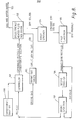
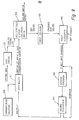
- crushing and classifying steps (not shown in the drawings) with appropriate recycle of oversized particles from the classifying step to the crushing step, can be placed between the co-mingler (see Figures 8, 9, and 10) and the dielectrically heated dryer (see Figures 8,9 and 10) to adjust the size of granules passing from the co-mingler to said dryer.
- This process should not be used with granular dryer feed which contains more than about 4% water (e.g. more than about 4.05 or 4.1% water) because efficient drying will not result.
- Apparatus required to put the invention into practice includes: (a) means to co-mingle the carbohydrate solutions with the recycled solid product; (b) a dielectrically heated dryer; (c) means to remove water vapour from the dryer using a gas stream of controlled flow rate and temperature or vacuum with or without a sweep gas; (d) means to separate the dryer output into product and recycle solids; and (e) means to control the particle size of recycled product.
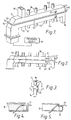
- 10 is a transmission waveguide composed of an upper portion 11 and a lower portion 12.
- the upper portion 11 has a flange 13 about its lower circumference
- the lower portion 12 has a flange 14 about its upper circumference, the lower portion and upper portion being joined at flanges 13 and 14.
- the upper portion 11 and lower portion 12 may be joined in a manner which will allow easy opening ot separation of the portions to provide ready access to the. interior of waveguide 10.
- a membrane 15 is captured between the flanges 13 and 14 and transversely separates the upper portion 11 and lower portion 12.
- the membrane 15 may be made of a variety of materials which are porous and permeable and will readily pass air or other suitable gas, but are impervious to the material to be dried.
- the membrane should also have a low dielectric loss factor for microwave energy, and preferably is electrically transparent.
- a variety of materials are available for this application, including various nylon fabrics, porous ceramics and glass wool.
- the membrane 15 stretches completely across the width and length of waveguide 10, dividing the waveguide into an upper portion and a lower portion.
- the membrane is apertured at a discharge end 40 of waveguide 10 in the area above a material output duct 16, as shown in detail in Figures 4 and 5.
- the treated material is allowed to pass from the upper portion 11 through the lower portion 12 and to be discharged through the output duct 16 by means of the aperture.
- the height of vertical walls 41 and 42 of the waveguide 10 is greater than the width of top 43 and bottom 44 walls of the waveguide 10. That is, the side or vertical walls are the broad walls of the waveguide, whereas the top and bottom walls are the narrow walls of the waveguide.
- a material inlet duct 19 is provided in the top wall 43 of the waveguide 10, the duct being oriented across the width of the top wall of the waveguide.
- the material output duct 16 is provided at the opposite end of waveguide 10 oriented across the bottom wall of the waveguide.
- Gas inlet ports 17 are spaced along the bottom wall of the waveguide 10, and gas outlet or exhaust ports 18 are spaced along the top wall of the waveguide 10. There may be only one gas inlet port and one outlet port, or there may be a plurality of either or both. Moreover, the gas inlet ports may be each connected to an independent source of gas, or they may be interconnected by a manifold means (not shown) and supplied with gas from a single source. Similarly, when a plurality of outlet ports is employed, the outlet ports may be interconnected by a manifold means (not shown). If desired, the inlet ports 17 and outlet ports 18 may be interconnected through means (not shown) to provide for a continuous recirculation of the treating gas. Preferably, air is used as the treating gas, but other gases can be used as desired for particular materials and conditions.
- a source 20 of microwave energy may be located at the material inlet end of the waveguide 10, which source may be selected from a variety of available microwave generators, such as the microton, magnetron or klystron.
- waveguide 10 is curved 90° at the input end. In this manner, the installation of the microwave source 20 does not interfere with the continuity of the membrane 15.
- Other configurations could be arranged for terminating the membrane 15 when the microwave energy source is located at the inlet end of the waveguide 10.
- Load tubes 21 and 22 may be arranged near the discharge end of the waveguide 10, passing through the upper and lower portions thereof.
- the output duct 16 is dimensioned to allow the load tube 22 to pass through the end wall of the waveguide 10 without interference with the outflow of treated material, as shown in Figures 3, 4 and 5.
- the load tubes 21 and 22 may be coupled to a source of water or other lossy liquid not shown, and a provision made for the continuous circulation of the liquid through the load tubes 21 and 22.
- the waveguide 10 be of rectangular cross-section dimensioned so as to propagate cbly the TE10 mode. This mode has a maximum electric field at the centre of a broad wall of the waveguide and normal to the broad wall. It has also been observed that maximum coupling of microwave energy to a thin or granular product occurs when the product is located within the maximum electric field oriented parallel to the product. This is accomplished through the provision of the membrane 15 transverse to the broad walls of the waveguide 10.
- Still another characteristic of a rectangular waveguide propagating the TE 10 mode is that a longitudinal slot may be present to the mid-point of the broad walls without significant leakage of microwave energy.
- the upper portion 11 is joined to the lower portion 12 to form the waveguide 10 having the broad walls oriented vertically.
- the upper portion 11 is separated from the lower portion 12 by the membrane 15, which creates a slot, electrically speaking, due to the dielectric characteristics of the membrane.
- the slot occurs in the broad walls of the waveguide 10, the loss of microwave energy caused thereby is insignificant.
- the material inlet duct 19, output duct 16 and gas ports 17 and 18 are preferably dimensioned so as to function as waveguides beyond cutoff, thereby preventing the escape of microwave energy from the waveguide 10 through the ducts 16 and 19, and ports 17 and 18.
- the dimensions of the ducts 16 and 19 and ports 17 and 18 measured along the longitudinal axis of the waveguide 10 is less than i the wavelength of the microwave energy propagated through the waveguide 10, in the embodiment illustrated in Figures 1 - 5.
- load tubes 21 and 22 are provided near the output end of the waveguide 10. A lossy liquid, such as water, is circulated through the load tubes to absorb any excess microwave energy not absorbed by the material treated.
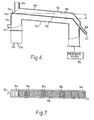
- FIGS. 6 and 7 show another embodiment of the apparatus of the U.S. Patent Specification No. 3,528,179 which is excellently adapted for use as a dielectrically heated fluid bed dryer in the process of this invention.
- an upper portion lla 'of a waveguide 10a may be of a perforated material lined with a transparent polyethylene-type film material with a low loss factor such as Du Pont's Mylar brand.
- the product to be treated is viewable through the upper portion lla as it passes through the waveguide 10a.
- microwave energy may be introduced into the waveguide at the product output end of the waveguide from a microwave energy source 20a.
- Load tubes 21a and 22a are provided at the product input end of the waveguide to absorb any microwave energy not dissipated in the product being treated.
- Treating gas is introduced into the waveguide 10a through a port 17a.
- the gas may be exhausted from the waveguide through one or more slots 18a in the liner of the upper portion lla allowing gas flow through the perforations in th waveguide upper portion lla.
- the waveguide 10a is angled through 90° at the product output end, preferably a series of angular portions of less than 90° are successively arranged to form the full 90° angle.
- An. output duct 16a projects outwardly from the angular portion of the upper portion lla, dimensioned so as to be beyond cutoff for the microwave energy propagated through the waveguide 10a.
- a flap valve 23 may be provided at the end of the duct 16a to aid in controlling product flow through the duct.
- the dimensions of the waveguide 10 and input and outlet ducts 16 and 19 can be widely varied according to the microwave energy propagated through the waveguide.
- the vertical or broad walls of the waveguide 10 are preferably from about 7.21 to 10.92 cm. in order to establish the TE 10 mode.
- the vertical or broad wall dimension is preferably 19.93 to 30.48 cm.
- the narrow or top and bottom walls can be varied to adjust electric field intensities but, in order to avoid higher order modes, should be less than the wavelength in free space of the microwave frequency used.
- the length of the structure can be varied according to the attenuation rate of the particular product to be dried.
- a syrup or syrup solution is introduced into a co-mingling operation where the syrup is dispersed on the surface of recycled solids.
- the recycled solids tend to be agglomerated by the syrup but, in proper ratio, agglomerates can be dispersed in small particulate form directly into a dielectrically heated dryer using a cocurrently flowing gas stream (or through an air lock into a vacuum with or without a sweep gas stream) to remove water vapour therefrom.
- co-mingled syrup and recycled solids can be dispersed throughout an ebulliating fluid or a fluidized bed of co-mingled recycled solids and syrup within a dielectrically heated unit..
- This latter means of operation provides a large, effective ratio of dried solids to syrup being dried in the dielectrically heated fluid bed with little consumed energy penalty, in that the dried carbohydrates have a relatively low response to dielectric heating.
- Water vapour is removed by a carrier gas.
- the carrier gas is also used as a cooling means to keep material in the bed below the melting point of solids present.
- the dried solids are conveyed to a product crushing and classification unit. A desired size range is taken as product, and the remaining reduced in size suitable for recycling.
- dry solid starting feed This may be material from a previous run or one can use, as simulated recycle, any material compatible with the sugar solution to be dried.
- dry product is displaced from the drying system at a rate depending upon the ratio of recycled solids to solids in the fresh feed (feedstuff to be dried).
- the product At a recycle ratio of twelve parts recycled solids per one part of solids in the syrup fed, the product, after 30 cycles, comprises about 90% fresh feed solids (i.e. solids from the syrup fed). This results when the syrup solution contains 80% solids and 20% water. If four parts of recycled solids are used per one part solids in the syrup fed, the product comprises about 90% fresh feed solids after seven cycles through the process.
- dielectrically heated drying unit useful for conducting the process of the instant invention is selected for energy efficiency and uniform material heating. Dielectric heating and drying for other purposes is, as noted supra, well known.
- Dielectric heating apparatus may, as noted supra, employ vacuum (reduced pressure) as a means to easily remove vaporised water with or without the employment of a water vapour removing sweep gas.
- vacuum reduced pressure
- the use of vacuum to reduce the temperature-necessary to obtain water vaporisation is well known. Since actual particle temperature is important in optimally accomplishing drying in the process, the use of vacuum in conjunction with dielectric heating comprising product recycle is a preferred embodiment.
- the liquid i.e. sugar solution or sugar syrup
- the liquid may be reduced to a fine spray and further dispersed in thin film on a tumbling mass of recycled solids, or the two may be co-mingled by a rubbing action as in a shear mixer.
- test fructose syrup solution was made by dissolving 80 parts commercially available food grade anhydrous crystalline D-fructose in 20 parts of deionized water.
- the commercially available D-fructose used had a crystal size approximately 1 mm. in maximum dimension.
- a simulated recycled product was made by pulverizing a quantity of the D-fructose crystals to a size range of 50 to 500 microns (0.05 to 0.5 mm.).
- a Montgomery Ward microwave oven, Model 8077 was used as a dielectric heating device. This heating device or unit was rated as having a 700 watt output power when loaded with 2,000 ml. of water. It'was experimentally determined that the unit would evaporate one gram of water per minute when an experimental sample (110 g. of an admixture of 10 parts by weight of the aforesaid test fructose syrup solution and 100 parts by weight of said simulated recycled product) was co-mingled and spread in granular form in thin section (ca. 3 to 4 mm. thick) over a 25.4 cm. diameter Pyrex glass pie plate. A heat setting designated as "reheat" was maintained as a constant.
- the process was initiated by distributing 100 grams of the simulated recycled product (particulate anhydrous D-fructose) in thin section (ca. 3 to 4 mm. thick) in the Pyrex dish.
- the pie plate containing the 100 grams of the simulated recycled product was placed in the microwave oven and subjected to heating for one minute at the aforesaid "reheat" setting. Less than 0.05 gram weight loss was observed, indicating that the anhydrous crystalline fructose used as a simulated recycle material was essentially non-responsive to dielectric heating and essentially anhydrous. Slight warming of the Pyrex glass plate was noted. After cooling to near room temperature, the dish and its contents were returned to the oven and subjected to a second one-minute of heating. No change in weight was observed. A third one-minute of heating likewise produced no loss in weight.
- syrup addition was initiated by co-mingling 10 grams of syrup (containing 8 grams fructose and 2 grams water) with the simulated recycle product in the dish. Shear mixing was simulated by using a spatula in a back- and-forth rubbing action. The co-mingled material tended to agglomerate, but was readily particulated to approximately 3 mm. diameter- particles. These were spread in thin section in the Pyrex dish for the heating cycle. After one-minute heating, it was found that approximately one gram of water was evaporated. After the sample weight was recorded, the material in the Pyrex glass plate was pushed around with the spatula to simulate material movement as would be obtained in a continuous commercial operation.
- the product of this example was placed in a container and subjected to twenty(20) freeze/thaw cycles to note caking performance. There was a slight tendency for the particles which had been subject to this freeze/thaw treatment to adhere one to the other, but a sharp tap on the side of the container was sufficient to render the total mass free-flowing. Each particle maintained its identity, and there was no tendency for the individual particles to fuse together in hard lumps.
- This example demonstrates an important relationship between particle size and water content of sugar/water compositions undergoing dehydration by dielectric heating.
- Example 1 The procedure described.in Example 1 was followed with the exception that the recycled material with sugar syrup added thereto was mulled in a mortar to ensure better even distribution of the syrup as a thin film over the recycled material.
- fructose syrups of three different concentrations (i.e. 80, 70 and 65% fructose, respectively, in water). These solutions were prepared by dissolving commercially available food grade crystalline D-fructose in water. Simulated recycle material for use in starting each series of runs was prepared by grinding the crystalline fructose to a size range of 50 to 500 microns. Dryer feed compositions, as specified in Runs A to H in the following Table, were investigated using the procedure described in Example 1.
- Example 2 Following the procedure of Example 1, a ten cycle run was made, using 50-500 micron crystalline fructose as a starting seed material (i.e. simulated recycle material in the first cycle). Feed to the dryer was fixed at 3% moisture using a recycle ratio of 8.7 parts of recycle per part of dry solids in the syrup feed. after ten cycles, the product was dry, granular and free-flowing, thereby establishing process operability.
- Example 2 Following the procedure described in Example 1, a ten cycle run was made using 50 - 500 micron crystalline fructose as a starting seed material (i.e. a simulated recycle in the first cycle of this run). Feed to the dryer was fixed at 3% moisture using a recycle ratio of 12.5 parts recycle per part of dry solids in the syrup fed. After ten cycles, the product was dry, granular and free-flowing, establishing process operability.
- This example demonstrates process operability for converting another commercially available fructose-containing syrup (Isomerose 900 brand fructose corn syrup) to a dry granular solid.
- This syrup had the following typical analysis:
- Example 2 Following the procedure of Example 1, a thirty cycle run was made using 50 - 500 micro crystalline fructose as a starting seed material (i.e. as simulated recycle material in the first cycle. Feed to the dryer was fixed at 3% moisture content, using a recycle ratio of 7.1 parts recycle to one part solids in the syrup fed. After 30 cycles, over 90% of the starting simulated recycle material was removed from the system to establish process operability. The product was a free-flowing, particulate solid. It cakes slightly after storage in a closed jar for about six weeks. The cake broke up into granular free-flowing particles when the jar was sharply tapped on its side, indicating a non hard-caking quality.
- sucrose Pure commercially available sucrose is made from sugar cane or sugar beets.
- a test syrup feed syrup comprising 80 parts of pure sucrose and 20 parts water was prepared.
- a ten cycle run was made using 50 - 500 micron crystalline sucrose as a starting seed material (i.e. a simulate recycle in the first cycle of the run).
- Feed to the dryer was fixed at 1.8% moisture content using a recycle ratio of 12.5 parts recycle to one part solids in the feed syrup.
- Ten cycles were run and a dry, free-flowing particulate product (sucrose) was produced, thereby establishing process operability.
- Example 2 which followed the general procedure of Example 1, demonstrates process operability with a sucrose syrup comprising molasses.
- a sugar solution of this kind is representative of the complex mixture of total sugars obtained in a cane or beet refiner operation.
- the test syrup was made by mixing 80 parts of the pure sucrose solution used in Example 6 with 20 parts of commercially available food grade cane molasses (approximately 80% solids)
- a ten cycle run was made using 50 - 500 micron crystalline sucrose as a starting seed material. Feed to the dryer was fixed at 1.8% moisture content using a recycle ratio of 12.5 parts recycle to one part solids in the syrup feed.
- Ten cycles were completed and a dry, free-flowing particulate product was produced. This established process operability.
- a dry, free-flowing, stable, non-caking particulate product can be prepared from a complex carbohydrate solution or other carbohydrate solution in a continuous manner by using the following procedure:
- a dry, free-flowing, stable, non-caking particulate product can be prepared from a complex carbohydrate solution or other carbohydrate solution in a continuous manner by using the following procedure:
- a free-flowing, stable, non-caking particulate product can be prepared from a complex carbohydrate solution or other carbohydrate solution, such as an aqueous solution of (a) fructose, (b) dextrose, in a continuous manner by using the following procedure:
- a vacuum source 310 communicates with the dielectrically heated vacuum dryer 302 via a vacuum line 312.
- a stream of sweep gas may be provided via a line 314 and a valve 309.
- cooled sweep gas may be provided via a sweep gas cooler 103, a cooled sweep gas line 316.and a valve 308.
- the admixture prepared by co-mingling recycle (or simulated recycle) and syrup is fed into microwave fluidized bed heater via the inlet port or duct 19 or 19a, and dried granular product exits from said dryer via the outlet port or duct 16 or 16a.
- Drying gas which can be cooled or heated enters the dryer via the gas inlet ports or ducts 17 or 17a and exits (as a stream of gas and water vapour) from the dryer via the gas outlet ports or ducts 18 or 18a,
- Solid particulate materials used or produced in the process of this invention can be conveyed e.g. by conveyor belts, screw conveyors, conveyor buckets, continuous flow conveyors or chain conveyors.
- Co-minglers which are operable in the process of this invention (see, for example, the procedure described in Examples 8 - 10) include, but are not limited to, blade mixers, mullers, rotor mixers screw conveyor mixers, kneader mixers and ribbon mixers.
- Crushers which are operable in the process of this invention (see, for example, the procedure described in Examples 8 - 10) include, but are not limited to, jaw crushers, gyratory crushers, cone crushers, pan crushers, roll crushers, rotary crushers, impact crushers, ball or pebble mill crushers and disc attrition mills.
- Classifiers which are operable in the process of this invention (see, for example, the procedures set forth in Examples 8 - 10 ) include, but are not limited to, screens, including vibratory screens, sieves and air classifiers.
- Carbohydrates solutions operable in the process of this invention include aqueous sugar solutions prepared by multi-stage vacuum evaporation to economically and operationally minimum water content.
- dissolved carbohydrate concentration is not critical because very dilute (e.g. 1-10% carbohydrate content) solutions are operable but, for economic reasons, are not preferred.
- slurries or dispersions comprising solid particles of a carbohydrate in an aqueous solution saturated with said carbohydrates are operable.
- recycle ratio is based on the carbohydrate content of the carbohydrate solution to be dried, it becomes generally economically impractical (although technically operable) to dry solutions containing less than. about 65% by weight of dissolved carbohydrate..
- the process of this invention is operable for preparing a stable, solid, substantially anhydrous particulate product from aqueous solutions comprising total sugars from sugar cane and from sugar beets:
- total sugars as used herein, unless otherwise defined where used, means all the sugars extracted from sugar cane or sugar beets in a sugar refining operation.
- percent (%) means parts per hundred by weight.
- the stable, solid, substantially anhydrous particulate product prepared by the process of this invention is useful as food for humans and as feed for animals. Various other uses will be readily apparent to those skilled in the art.
Landscapes
- Chemical & Material Sciences (AREA)
- Life Sciences & Earth Sciences (AREA)
- Biochemistry (AREA)
- Organic Chemistry (AREA)
- Crystallography & Structural Chemistry (AREA)
- Health & Medical Sciences (AREA)
- Emergency Medicine (AREA)
- General Health & Medical Sciences (AREA)
- Drying Of Solid Materials (AREA)
Applications Claiming Priority (2)
| Application Number | Priority Date | Filing Date | Title |
|---|---|---|---|
| US130531 | 1980-03-14 | ||
| US06/130,531 US4294624A (en) | 1980-03-14 | 1980-03-14 | Drying co-mingled carbohydrate solution and recycled product by dielectric heating |
Publications (1)
| Publication Number | Publication Date |
|---|---|
| EP0036309A2 true EP0036309A2 (de) | 1981-09-23 |
Family
ID=22445128
Family Applications (1)
| Application Number | Title | Priority Date | Filing Date |
|---|---|---|---|
| EP81301060A Withdrawn EP0036309A2 (de) | 1980-03-14 | 1981-03-13 | Verfahren zur Herstellung eines partikelförmigen Produkts aus einer Saccharidlösung |
Country Status (4)
| Country | Link |
|---|---|
| US (1) | US4294624A (de) |
| EP (1) | EP0036309A2 (de) |
| JP (1) | JPS56158100A (de) |
| CA (1) | CA1178953A (de) |
Cited By (5)
| Publication number | Priority date | Publication date | Assignee | Title |
|---|---|---|---|---|
| EP0692304A1 (de) * | 1994-07-06 | 1996-01-17 | Raffinerie Tirlemontoise | Verfahren zur Behandlung von pulverförmigen Materialien und die so erhaltenen Produkte |
| NL1006216C2 (nl) * | 1997-06-03 | 1998-12-04 | Aquarius Bv | Inrichting voor het drogen van suikerklonten. |
| WO1999003869A3 (de) * | 1997-07-18 | 1999-04-08 | Henkel Kgaa | Verfahren zur herstellung von alkylglykosiden |
| JP2015524856A (ja) * | 2012-06-22 | 2015-08-27 | スガニット・システムズ・インコーポレーテッド | バイオマス基剤の処理のための方法および装置 |
| US10914847B2 (en) | 2011-01-18 | 2021-02-09 | Minnesota Imaging And Engineering Llc | High resolution imaging system for digital dentistry |
Families Citing this family (28)
| Publication number | Priority date | Publication date | Assignee | Title |
|---|---|---|---|---|
| US4546226A (en) * | 1982-04-29 | 1985-10-08 | Entron Technologies, Inc. | Method and apparatus for the conveying and radio frequency processing of dielectric materials |
| US4567340A (en) * | 1985-01-09 | 1986-01-28 | Phillips Petroleum Company | Apparatus and method for drying solid materials |
| US5234503A (en) * | 1987-02-02 | 1993-08-10 | A.E. Saley Manufacturing Co. | Integrated process for producing crystalline fructose and a high-fructose, liquid-phase sweetener |
| US5230742A (en) * | 1987-02-02 | 1993-07-27 | A. E. Staley Manufacturing Co. | Integrated process for producing crystalline fructose and high-fructose, liquid-phase sweetener |
| US5656094A (en) * | 1987-02-02 | 1997-08-12 | A.E. Staley Manufacturing Company | Integrated process for producing crystalline fructose and a high-fructose, liquid phase sweetener |
| US5350456A (en) * | 1987-02-02 | 1994-09-27 | A. E. Staley Manufacturing Company | Integrated process for producing crystalline fructose and a high fructose, liquid-phase sweetener |
| US5039346A (en) * | 1988-03-25 | 1991-08-13 | A. E. Staley Manufacturing Company | Fructose syrups and sweetened beverages |
| US5092960A (en) * | 1989-11-22 | 1992-03-03 | Brown Robert E | Method for drying suspensions of organic solids in water |
| US5211808A (en) * | 1990-11-13 | 1993-05-18 | Savant Instruments | Microwave heating in a vacuum centrifugal concentrator |
| AU659645B2 (en) * | 1991-06-26 | 1995-05-25 | Inhale Therapeutic Systems | Storage of materials |
| US6509006B1 (en) | 1992-07-08 | 2003-01-21 | Inhale Therapeutic Systems, Inc. | Devices compositions and methods for the pulmonary delivery of aerosolized medicaments |
| US6582728B1 (en) * | 1992-07-08 | 2003-06-24 | Inhale Therapeutic Systems, Inc. | Spray drying of macromolecules to produce inhaleable dry powders |
| US6024090A (en) | 1993-01-29 | 2000-02-15 | Aradigm Corporation | Method of treating a diabetic patient by aerosolized administration of insulin lispro |
| US7448375B2 (en) | 1993-01-29 | 2008-11-11 | Aradigm Corporation | Method of treating diabetes mellitus in a patient |
| US5484606A (en) * | 1994-01-24 | 1996-01-16 | The Procter & Gamble Company | Process for reducing the precipitation of difficulty soluble pharmaceutical actives |
| US6051256A (en) | 1994-03-07 | 2000-04-18 | Inhale Therapeutic Systems | Dispersible macromolecule compositions and methods for their preparation and use |
| JPH10501519A (ja) | 1994-03-07 | 1998-02-10 | インヘイル・セラピューティック・システムズ | インシュリンを肺に送給できる方法および組成物 |
| US20030203036A1 (en) | 2000-03-17 | 2003-10-30 | Gordon Marc S. | Systems and processes for spray drying hydrophobic drugs with hydrophilic excipients |
| US7575761B2 (en) | 2000-06-30 | 2009-08-18 | Novartis Pharma Ag | Spray drying process control of drying kinetics |
| GB0216562D0 (en) | 2002-04-25 | 2002-08-28 | Bradford Particle Design Ltd | Particulate materials |
| US9339459B2 (en) | 2003-04-24 | 2016-05-17 | Nektar Therapeutics | Particulate materials |
| DE10234165B4 (de) * | 2002-07-26 | 2008-01-03 | Advanced Micro Devices, Inc., Sunnyvale | Verfahren zum Füllen eines Grabens, der in einem Substrat gebildet ist, mit einem isolierenden Material |
| EP2937653B1 (de) * | 2010-02-25 | 2018-12-12 | Corning Incorporated | Ablageanordnungen und verfahren zur herstellung von keramikartikeln |
| JP5701070B2 (ja) * | 2011-01-13 | 2015-04-15 | 独立行政法人石油天然ガス・金属鉱物資源機構 | 触媒回収システム、炭化水素合成反応装置、および炭化水素合成反応システム、並びに触媒回収方法 |
| EP2481820B1 (de) * | 2011-01-28 | 2013-10-16 | CFS Weert B.V. | Vorrichtung zur Trocknung von Zuckerwürfeln mittels Mikrowellenstrahlung |
| WO2018232422A1 (en) * | 2017-06-14 | 2018-12-20 | Poviva Tea, Llc | Microwave processing methods for formulating orally ingestible compositions comprising lipophilic active agents |
| EP4201228A1 (de) * | 2021-12-21 | 2023-06-28 | Südzucker AG | Rieselfähige kohlenhydrate und verfahren zu ihrer herstellung |
| WO2025076075A1 (en) * | 2023-10-03 | 2025-04-10 | Corn Products Development, Inc. | Methods of making solid sweeteners and solid sweetener blends |
Family Cites Families (14)
| Publication number | Priority date | Publication date | Assignee | Title |
|---|---|---|---|---|
| US3072490A (en) * | 1959-09-22 | 1963-01-08 | Ralph G Sargeant | Method of producing high density low viscosity citrus juice concentrate |
| US3582399A (en) * | 1968-07-15 | 1971-06-01 | Penick & Ford Ltd | Process for preparing granular crystalline sugar products |
| US3528179A (en) * | 1968-10-28 | 1970-09-15 | Cryodry Corp | Microwave fluidized bed dryer |
| GB1282878A (en) * | 1968-11-26 | 1972-07-26 | Grace W R & Co | Improvements in sugar and in processes for its production |
| US3549848A (en) * | 1969-02-06 | 1970-12-22 | Varian Associates | Composite microwave applicator and product conveyor |
| SE326783B (de) * | 1969-05-27 | 1970-08-03 | Alfa Laval Ab | |
| US3655442A (en) * | 1969-08-27 | 1972-04-11 | California & Hawaiian Sugar | Method of making sugar and sugar products |
| US3619293A (en) * | 1970-02-18 | 1971-11-09 | Nippon Shiryo Kogyo Kk | Granular sucrose products and process for producing same |
| US3674557A (en) * | 1971-05-03 | 1972-07-04 | Grace W R & Co | Method for drying sugar solutions |
| US3712971A (en) * | 1971-06-03 | 1973-01-23 | Mac Millan Bloedel Ltd | Waveguide apparatus for microwave drying of materials |
| US4162927A (en) * | 1972-11-13 | 1979-07-31 | Morfin Alvarez Rafael | Apparatus for crystallizing sugar solution and mother liquors continuously by evaporation |
| US4045639A (en) * | 1973-01-16 | 1977-08-30 | Food Processing Systems Corporation | Continuous microwave and vacuum dryer |
| US3956009A (en) * | 1975-05-14 | 1976-05-11 | W. R. Grace & Co. | Method for drying fructose solutions |
| US4162926A (en) * | 1978-01-11 | 1979-07-31 | W. R. Grace & Co. | Method of drying complex sugar solutions |
-
1980
- 1980-03-14 US US06/130,531 patent/US4294624A/en not_active Expired - Lifetime
-
1981
- 1981-03-13 CA CA000372937A patent/CA1178953A/en not_active Expired
- 1981-03-13 EP EP81301060A patent/EP0036309A2/de not_active Withdrawn
- 1981-03-14 JP JP3599281A patent/JPS56158100A/ja active Pending
Cited By (8)
| Publication number | Priority date | Publication date | Assignee | Title |
|---|---|---|---|---|
| EP0692304A1 (de) * | 1994-07-06 | 1996-01-17 | Raffinerie Tirlemontoise | Verfahren zur Behandlung von pulverförmigen Materialien und die so erhaltenen Produkte |
| BE1008736A3 (fr) * | 1994-07-06 | 1996-07-02 | Raffinerie Tirlemontoise Sa | Procede de traitement de matieres poudreuses et produits obtenus. |
| NL1006216C2 (nl) * | 1997-06-03 | 1998-12-04 | Aquarius Bv | Inrichting voor het drogen van suikerklonten. |
| EP0894871A1 (de) * | 1997-06-03 | 1999-02-03 | Aquarius B.V. | Einrichtung zur Trocknung von Zucker |
| WO1999003869A3 (de) * | 1997-07-18 | 1999-04-08 | Henkel Kgaa | Verfahren zur herstellung von alkylglykosiden |
| US10914847B2 (en) | 2011-01-18 | 2021-02-09 | Minnesota Imaging And Engineering Llc | High resolution imaging system for digital dentistry |
| JP2015524856A (ja) * | 2012-06-22 | 2015-08-27 | スガニット・システムズ・インコーポレーテッド | バイオマス基剤の処理のための方法および装置 |
| EP2864364A4 (de) * | 2012-06-22 | 2016-03-09 | Suganit Systems Inc | Verfahren und vorrichtung zur behandlung von biomassesubstraten |
Also Published As
| Publication number | Publication date |
|---|---|
| US4294624A (en) | 1981-10-13 |
| JPS56158100A (en) | 1981-12-05 |
| CA1178953A (en) | 1984-12-04 |
Similar Documents
| Publication | Publication Date | Title |
|---|---|---|
| US4294624A (en) | Drying co-mingled carbohydrate solution and recycled product by dielectric heating | |
| US2751687A (en) | Process and apparatus for producing stabilized products | |
| US3520066A (en) | Spray drying method | |
| US2900256A (en) | Method and apparatus for producing granulated food products | |
| US2995773A (en) | Process and apparatus for agglomerating pulverulent materials | |
| US3743539A (en) | Process and apparatus for producing a free-flowing granular glucose product | |
| US4073951A (en) | Agglomeration method | |
| GB1061227A (en) | Process and apparatus for preparing free-flowing and readily dispersible products from finely powdered materials | |
| US3365331A (en) | Sugar process and product | |
| US3360865A (en) | Process and apparatus for agglomerating and drying flour | |
| US5172487A (en) | Method for continuous drying of a material and an assembly for carrying out said method | |
| US3194682A (en) | Sugar product and method of producing same | |
| GB2278603A (en) | Spray drying | |
| US4561192A (en) | Spray drying apparatus and method | |
| US3880668A (en) | Apparatus for producing molasses food product | |
| US3596699A (en) | Apparatus for spray drying milk and the like | |
| US3103439A (en) | Dehydration process and product | |
| US2957771A (en) | Aggregated dehydrated allium powder and process for making the same | |
| GB1564770A (en) | Method of evaporating and spray drying of a sucrose solution and a plant for performing this process | |
| JPH0638680A (ja) | 乾燥粒子を湿潤、溶解させる装置および方法 | |
| US2972584A (en) | Production of granular water-soluble perborate-containing salt mixtures | |
| US4320105A (en) | Pellitizing method | |
| Masters | Spray dryers | |
| US3533805A (en) | Method for the manufacture of low density products | |
| US3271194A (en) | Solidification of saccharide solutions |
Legal Events
| Date | Code | Title | Description |
|---|---|---|---|
| PUAI | Public reference made under article 153(3) epc to a published international application that has entered the european phase |
Free format text: ORIGINAL CODE: 0009012 |
|
| AK | Designated contracting states |
Designated state(s): BE DE FR GB NL |
|
| RBV | Designated contracting states (corrected) |
Designated state(s): BE DE FR GB NL |
|
| STAA | Information on the status of an ep patent application or granted ep patent |
Free format text: STATUS: THE APPLICATION HAS BEEN WITHDRAWN |
|
| 18W | Application withdrawn |
Withdrawal date: 19820310 |