EP0034513B1 - Procédé de fabrication de pièces en électrolyte solide à base de zircone stabilisée et les pièces obtenues par ce procédé - Google Patents
Procédé de fabrication de pièces en électrolyte solide à base de zircone stabilisée et les pièces obtenues par ce procédé Download PDFInfo
- Publication number
- EP0034513B1 EP0034513B1 EP81400113A EP81400113A EP0034513B1 EP 0034513 B1 EP0034513 B1 EP 0034513B1 EP 81400113 A EP81400113 A EP 81400113A EP 81400113 A EP81400113 A EP 81400113A EP 0034513 B1 EP0034513 B1 EP 0034513B1
- Authority
- EP
- European Patent Office
- Prior art keywords
- process according
- precipitate
- salt
- zirconium
- solution
- Prior art date
- Legal status (The legal status is an assumption and is not a legal conclusion. Google has not performed a legal analysis and makes no representation as to the accuracy of the status listed.)
- Expired
Links
- 238000000034 method Methods 0.000 title claims description 31
- 239000007784 solid electrolyte Substances 0.000 title claims description 28
- 230000008569 process Effects 0.000 title claims description 25
- 229910002076 stabilized zirconia Inorganic materials 0.000 title claims description 5
- PNEYBMLMFCGWSK-UHFFFAOYSA-N aluminium oxide Inorganic materials [O-2].[O-2].[O-2].[Al+3].[Al+3] PNEYBMLMFCGWSK-UHFFFAOYSA-N 0.000 claims description 28
- 239000002244 precipitate Substances 0.000 claims description 25
- 239000000843 powder Substances 0.000 claims description 23
- UHOVQNZJYSORNB-UHFFFAOYSA-N Benzene Chemical compound C1=CC=CC=C1 UHOVQNZJYSORNB-UHFFFAOYSA-N 0.000 claims description 21
- MCMNRKCIXSYSNV-UHFFFAOYSA-N Zirconium dioxide Chemical compound O=[Zr]=O MCMNRKCIXSYSNV-UHFFFAOYSA-N 0.000 claims description 21
- XLYOFNOQVPJJNP-UHFFFAOYSA-N water Substances O XLYOFNOQVPJJNP-UHFFFAOYSA-N 0.000 claims description 20
- 239000002184 metal Substances 0.000 claims description 19
- 229910052751 metal Inorganic materials 0.000 claims description 18
- QCWXUUIWCKQGHC-UHFFFAOYSA-N Zirconium Chemical compound [Zr] QCWXUUIWCKQGHC-UHFFFAOYSA-N 0.000 claims description 13
- 239000000203 mixture Substances 0.000 claims description 13
- 229910052726 zirconium Inorganic materials 0.000 claims description 13
- KFZMGEQAYNKOFK-UHFFFAOYSA-N Isopropanol Chemical group CC(C)O KFZMGEQAYNKOFK-UHFFFAOYSA-N 0.000 claims description 12
- 238000005245 sintering Methods 0.000 claims description 12
- 230000000087 stabilizing effect Effects 0.000 claims description 12
- 238000001354 calcination Methods 0.000 claims description 10
- 229910052727 yttrium Inorganic materials 0.000 claims description 10
- VWQVUPCCIRVNHF-UHFFFAOYSA-N yttrium atom Chemical compound [Y] VWQVUPCCIRVNHF-UHFFFAOYSA-N 0.000 claims description 10
- 150000003754 zirconium Chemical class 0.000 claims description 9
- 238000007906 compression Methods 0.000 claims description 8
- 230000006835 compression Effects 0.000 claims description 8
- 239000001257 hydrogen Substances 0.000 claims description 8
- 229910052739 hydrogen Inorganic materials 0.000 claims description 8
- SIWVEOZUMHYXCS-UHFFFAOYSA-N oxo(oxoyttriooxy)yttrium Chemical compound O=[Y]O[Y]=O SIWVEOZUMHYXCS-UHFFFAOYSA-N 0.000 claims description 8
- 150000003839 salts Chemical class 0.000 claims description 8
- 239000002904 solvent Substances 0.000 claims description 8
- LFQSCWFLJHTTHZ-UHFFFAOYSA-N Ethanol Chemical compound CCO LFQSCWFLJHTTHZ-UHFFFAOYSA-N 0.000 claims description 7
- UFHFLCQGNIYNRP-UHFFFAOYSA-N Hydrogen Chemical compound [H][H] UFHFLCQGNIYNRP-UHFFFAOYSA-N 0.000 claims description 7
- 238000001035 drying Methods 0.000 claims description 7
- 238000002360 preparation method Methods 0.000 claims description 7
- QGZKDVFQNNGYKY-UHFFFAOYSA-N Ammonia Chemical compound N QGZKDVFQNNGYKY-UHFFFAOYSA-N 0.000 claims description 6
- 229910052782 aluminium Inorganic materials 0.000 claims description 6
- XAGFODPZIPBFFR-UHFFFAOYSA-N aluminium Chemical compound [Al] XAGFODPZIPBFFR-UHFFFAOYSA-N 0.000 claims description 6
- 239000011230 binding agent Substances 0.000 claims description 6
- 239000007788 liquid Substances 0.000 claims description 6
- WNROFYMDJYEPJX-UHFFFAOYSA-K aluminium hydroxide Chemical compound [OH-].[OH-].[OH-].[Al+3] WNROFYMDJYEPJX-UHFFFAOYSA-K 0.000 claims description 5
- 238000004821 distillation Methods 0.000 claims description 5
- 238000005406 washing Methods 0.000 claims description 5
- 235000019441 ethanol Nutrition 0.000 claims description 4
- IVORCBKUUYGUOL-UHFFFAOYSA-N 1-ethynyl-2,4-dimethoxybenzene Chemical compound COC1=CC=C(C#C)C(OC)=C1 IVORCBKUUYGUOL-UHFFFAOYSA-N 0.000 claims description 3
- NGDQQLAVJWUYSF-UHFFFAOYSA-N 4-methyl-2-phenyl-1,3-thiazole-5-sulfonyl chloride Chemical group S1C(S(Cl)(=O)=O)=C(C)N=C1C1=CC=CC=C1 NGDQQLAVJWUYSF-UHFFFAOYSA-N 0.000 claims description 3
- VVQNEPGJFQJSBK-UHFFFAOYSA-N Methyl methacrylate Chemical group COC(=O)C(C)=C VVQNEPGJFQJSBK-UHFFFAOYSA-N 0.000 claims description 3
- 230000001476 alcoholic effect Effects 0.000 claims description 3
- 239000004411 aluminium Substances 0.000 claims description 3
- 229910021529 ammonia Inorganic materials 0.000 claims description 3
- 150000004692 metal hydroxides Chemical class 0.000 claims description 3
- RVTZCBVAJQQJTK-UHFFFAOYSA-N oxygen(2-);zirconium(4+) Chemical compound [O-2].[O-2].[Zr+4] RVTZCBVAJQQJTK-UHFFFAOYSA-N 0.000 claims description 3
- 150000003746 yttrium Chemical class 0.000 claims description 3
- 229910001928 zirconium oxide Inorganic materials 0.000 claims description 3
- 238000010438 heat treatment Methods 0.000 claims description 2
- XLYOFNOQVPJJNP-UHFFFAOYSA-M hydroxide Chemical compound [OH-] XLYOFNOQVPJJNP-UHFFFAOYSA-M 0.000 claims description 2
- 229910000000 metal hydroxide Inorganic materials 0.000 claims description 2
- 159000000013 aluminium salts Chemical class 0.000 claims 4
- 229910000329 aluminium sulfate Inorganic materials 0.000 claims 4
- KILURZWTCGSYRE-LNTINUHCSA-K (z)-4-bis[[(z)-4-oxopent-2-en-2-yl]oxy]alumanyloxypent-3-en-2-one Chemical group CC(=O)\C=C(\C)O[Al](O\C(C)=C/C(C)=O)O\C(C)=C/C(C)=O KILURZWTCGSYRE-LNTINUHCSA-K 0.000 claims 1
- 229910021502 aluminium hydroxide Inorganic materials 0.000 claims 1
- 239000003792 electrolyte Substances 0.000 description 13
- 238000007792 addition Methods 0.000 description 7
- HIGRAKVNKLCVCA-UHFFFAOYSA-N alumine Chemical compound C1=CC=[Al]C=C1 HIGRAKVNKLCVCA-UHFFFAOYSA-N 0.000 description 6
- AZDRQVAHHNSJOQ-UHFFFAOYSA-N alumane Chemical class [AlH3] AZDRQVAHHNSJOQ-UHFFFAOYSA-N 0.000 description 4
- 238000005868 electrolysis reaction Methods 0.000 description 4
- 239000000919 ceramic Substances 0.000 description 3
- 238000001914 filtration Methods 0.000 description 3
- 238000004519 manufacturing process Methods 0.000 description 3
- XBIUWALDKXACEA-UHFFFAOYSA-N 3-[bis(2,4-dioxopentan-3-yl)alumanyl]pentane-2,4-dione Chemical compound CC(=O)C(C(C)=O)[Al](C(C(C)=O)C(C)=O)C(C(C)=O)C(C)=O XBIUWALDKXACEA-UHFFFAOYSA-N 0.000 description 2
- 230000008901 benefit Effects 0.000 description 2
- BSDOQSMQCZQLDV-UHFFFAOYSA-N butan-1-olate;zirconium(4+) Chemical compound [Zr+4].CCCC[O-].CCCC[O-].CCCC[O-].CCCC[O-] BSDOQSMQCZQLDV-UHFFFAOYSA-N 0.000 description 2
- 238000007796 conventional method Methods 0.000 description 2
- 150000002431 hydrogen Chemical class 0.000 description 2
- 239000000463 material Substances 0.000 description 2
- 238000005259 measurement Methods 0.000 description 2
- 229910044991 metal oxide Inorganic materials 0.000 description 2
- 150000004706 metal oxides Chemical class 0.000 description 2
- 238000001000 micrograph Methods 0.000 description 2
- TWNQGVIAIRXVLR-UHFFFAOYSA-N oxo(oxoalumanyloxy)alumane Chemical compound O=[Al]O[Al]=O TWNQGVIAIRXVLR-UHFFFAOYSA-N 0.000 description 2
- 238000003756 stirring Methods 0.000 description 2
- OYPRJOBELJOOCE-UHFFFAOYSA-N Calcium Chemical compound [Ca] OYPRJOBELJOOCE-UHFFFAOYSA-N 0.000 description 1
- 229910052684 Cerium Inorganic materials 0.000 description 1
- PXHVJJICTQNCMI-UHFFFAOYSA-N Nickel Chemical compound [Ni] PXHVJJICTQNCMI-UHFFFAOYSA-N 0.000 description 1
- 241000206607 Porphyra umbilicalis Species 0.000 description 1
- 239000000654 additive Substances 0.000 description 1
- 229910052791 calcium Inorganic materials 0.000 description 1
- 239000011575 calcium Substances 0.000 description 1
- BRPQOXSCLDDYGP-UHFFFAOYSA-N calcium oxide Chemical compound [O-2].[Ca+2] BRPQOXSCLDDYGP-UHFFFAOYSA-N 0.000 description 1
- ODINCKMPIJJUCX-UHFFFAOYSA-N calcium oxide Inorganic materials [Ca]=O ODINCKMPIJJUCX-UHFFFAOYSA-N 0.000 description 1
- 239000000292 calcium oxide Substances 0.000 description 1
- GWXLDORMOJMVQZ-UHFFFAOYSA-N cerium Chemical compound [Ce] GWXLDORMOJMVQZ-UHFFFAOYSA-N 0.000 description 1
- 229910000420 cerium oxide Inorganic materials 0.000 description 1
- 238000000975 co-precipitation Methods 0.000 description 1
- 238000010586 diagram Methods 0.000 description 1
- 238000001704 evaporation Methods 0.000 description 1
- 230000008020 evaporation Effects 0.000 description 1
- 238000004108 freeze drying Methods 0.000 description 1
- 239000000446 fuel Substances 0.000 description 1
- 230000007062 hydrolysis Effects 0.000 description 1
- 238000006460 hydrolysis reaction Methods 0.000 description 1
- 150000004679 hydroxides Chemical class 0.000 description 1
- 230000006872 improvement Effects 0.000 description 1
- 125000001449 isopropyl group Chemical group [H]C([H])([H])C([H])(*)C([H])([H])[H] 0.000 description 1
- 239000002923 metal particle Substances 0.000 description 1
- BMMGVYCKOGBVEV-UHFFFAOYSA-N oxo(oxoceriooxy)cerium Chemical compound [Ce]=O.O=[Ce]=O BMMGVYCKOGBVEV-UHFFFAOYSA-N 0.000 description 1
- 239000001301 oxygen Substances 0.000 description 1
- 229910052760 oxygen Inorganic materials 0.000 description 1
- -1 oxygen ions Chemical class 0.000 description 1
- 239000002245 particle Substances 0.000 description 1
- 238000001556 precipitation Methods 0.000 description 1
- 229910052761 rare earth metal Inorganic materials 0.000 description 1
- 229910001404 rare earth metal oxide Inorganic materials 0.000 description 1
- 150000002910 rare earth metals Chemical class 0.000 description 1
- 230000009257 reactivity Effects 0.000 description 1
- 230000009467 reduction Effects 0.000 description 1
- 229910052706 scandium Inorganic materials 0.000 description 1
- SIXSYDAISGFNSX-UHFFFAOYSA-N scandium atom Chemical compound [Sc] SIXSYDAISGFNSX-UHFFFAOYSA-N 0.000 description 1
- HYXGAEYDKFCVMU-UHFFFAOYSA-N scandium oxide Chemical compound O=[Sc]O[Sc]=O HYXGAEYDKFCVMU-UHFFFAOYSA-N 0.000 description 1
- 238000004611 spectroscopical analysis Methods 0.000 description 1
- 239000000126 substance Substances 0.000 description 1
Images
Classifications
-
- C—CHEMISTRY; METALLURGY
- C25—ELECTROLYTIC OR ELECTROPHORETIC PROCESSES; APPARATUS THEREFOR
- C25B—ELECTROLYTIC OR ELECTROPHORETIC PROCESSES FOR THE PRODUCTION OF COMPOUNDS OR NON-METALS; APPARATUS THEREFOR
- C25B1/00—Electrolytic production of inorganic compounds or non-metals
- C25B1/01—Products
- C25B1/02—Hydrogen or oxygen
- C25B1/04—Hydrogen or oxygen by electrolysis of water
-
- C—CHEMISTRY; METALLURGY
- C01—INORGANIC CHEMISTRY
- C01G—COMPOUNDS CONTAINING METALS NOT COVERED BY SUBCLASSES C01D OR C01F
- C01G25/00—Compounds of zirconium
- C01G25/02—Oxides
-
- C—CHEMISTRY; METALLURGY
- C04—CEMENTS; CONCRETE; ARTIFICIAL STONE; CERAMICS; REFRACTORIES
- C04B—LIME, MAGNESIA; SLAG; CEMENTS; COMPOSITIONS THEREOF, e.g. MORTARS, CONCRETE OR LIKE BUILDING MATERIALS; ARTIFICIAL STONE; CERAMICS; REFRACTORIES; TREATMENT OF NATURAL STONE
- C04B35/00—Shaped ceramic products characterised by their composition; Ceramics compositions; Processing powders of inorganic compounds preparatory to the manufacturing of ceramic products
- C04B35/01—Shaped ceramic products characterised by their composition; Ceramics compositions; Processing powders of inorganic compounds preparatory to the manufacturing of ceramic products based on oxide ceramics
- C04B35/48—Shaped ceramic products characterised by their composition; Ceramics compositions; Processing powders of inorganic compounds preparatory to the manufacturing of ceramic products based on oxide ceramics based on zirconium or hafnium oxides, zirconates, zircon or hafnates
- C04B35/486—Fine ceramics
-
- H—ELECTRICITY
- H01—ELECTRIC ELEMENTS
- H01M—PROCESSES OR MEANS, e.g. BATTERIES, FOR THE DIRECT CONVERSION OF CHEMICAL ENERGY INTO ELECTRICAL ENERGY
- H01M8/00—Fuel cells; Manufacture thereof
- H01M8/10—Fuel cells with solid electrolytes
- H01M8/12—Fuel cells with solid electrolytes operating at high temperature, e.g. with stabilised ZrO2 electrolyte
- H01M8/124—Fuel cells with solid electrolytes operating at high temperature, e.g. with stabilised ZrO2 electrolyte characterised by the process of manufacturing or by the material of the electrolyte
- H01M8/1246—Fuel cells with solid electrolytes operating at high temperature, e.g. with stabilised ZrO2 electrolyte characterised by the process of manufacturing or by the material of the electrolyte the electrolyte consisting of oxides
- H01M8/1253—Fuel cells with solid electrolytes operating at high temperature, e.g. with stabilised ZrO2 electrolyte characterised by the process of manufacturing or by the material of the electrolyte the electrolyte consisting of oxides the electrolyte containing zirconium oxide
-
- C—CHEMISTRY; METALLURGY
- C01—INORGANIC CHEMISTRY
- C01P—INDEXING SCHEME RELATING TO STRUCTURAL AND PHYSICAL ASPECTS OF SOLID INORGANIC COMPOUNDS
- C01P2004/00—Particle morphology
- C01P2004/01—Particle morphology depicted by an image
- C01P2004/02—Particle morphology depicted by an image obtained by optical microscopy
-
- C—CHEMISTRY; METALLURGY
- C01—INORGANIC CHEMISTRY
- C01P—INDEXING SCHEME RELATING TO STRUCTURAL AND PHYSICAL ASPECTS OF SOLID INORGANIC COMPOUNDS
- C01P2006/00—Physical properties of inorganic compounds
- C01P2006/80—Compositional purity
-
- Y—GENERAL TAGGING OF NEW TECHNOLOGICAL DEVELOPMENTS; GENERAL TAGGING OF CROSS-SECTIONAL TECHNOLOGIES SPANNING OVER SEVERAL SECTIONS OF THE IPC; TECHNICAL SUBJECTS COVERED BY FORMER USPC CROSS-REFERENCE ART COLLECTIONS [XRACs] AND DIGESTS
- Y02—TECHNOLOGIES OR APPLICATIONS FOR MITIGATION OR ADAPTATION AGAINST CLIMATE CHANGE
- Y02E—REDUCTION OF GREENHOUSE GAS [GHG] EMISSIONS, RELATED TO ENERGY GENERATION, TRANSMISSION OR DISTRIBUTION
- Y02E60/00—Enabling technologies; Technologies with a potential or indirect contribution to GHG emissions mitigation
- Y02E60/30—Hydrogen technology
- Y02E60/36—Hydrogen production from non-carbon containing sources, e.g. by water electrolysis
-
- Y—GENERAL TAGGING OF NEW TECHNOLOGICAL DEVELOPMENTS; GENERAL TAGGING OF CROSS-SECTIONAL TECHNOLOGIES SPANNING OVER SEVERAL SECTIONS OF THE IPC; TECHNICAL SUBJECTS COVERED BY FORMER USPC CROSS-REFERENCE ART COLLECTIONS [XRACs] AND DIGESTS
- Y02—TECHNOLOGIES OR APPLICATIONS FOR MITIGATION OR ADAPTATION AGAINST CLIMATE CHANGE
- Y02E—REDUCTION OF GREENHOUSE GAS [GHG] EMISSIONS, RELATED TO ENERGY GENERATION, TRANSMISSION OR DISTRIBUTION
- Y02E60/00—Enabling technologies; Technologies with a potential or indirect contribution to GHG emissions mitigation
- Y02E60/30—Hydrogen technology
- Y02E60/50—Fuel cells
-
- Y—GENERAL TAGGING OF NEW TECHNOLOGICAL DEVELOPMENTS; GENERAL TAGGING OF CROSS-SECTIONAL TECHNOLOGIES SPANNING OVER SEVERAL SECTIONS OF THE IPC; TECHNICAL SUBJECTS COVERED BY FORMER USPC CROSS-REFERENCE ART COLLECTIONS [XRACs] AND DIGESTS
- Y02—TECHNOLOGIES OR APPLICATIONS FOR MITIGATION OR ADAPTATION AGAINST CLIMATE CHANGE
- Y02P—CLIMATE CHANGE MITIGATION TECHNOLOGIES IN THE PRODUCTION OR PROCESSING OF GOODS
- Y02P70/00—Climate change mitigation technologies in the production process for final industrial or consumer products
- Y02P70/50—Manufacturing or production processes characterised by the final manufactured product
Definitions
- the present invention relates to a process for the preparation of parts made of solid electrolyte based on stabilized zirconia and the parts obtained by this process.
- a solid electrolyte based on zirconia which has an improved electrical conductivity compared to solid electrolytes of this type currently known, which makes it particularly advantageous for use as a solid electrolyte. in a high temperature water vapor electrolysis cell for the production of hydrogen gas, or as a solid electrolyte in a fuel cell.
- water vapor is introduced at a temperature of about 760 to 950 ° C into the cathode part of the cell, and it is reduced to gaseous hydrogen on the surface of the solid electrolyte when applied across the terminals. of the cell a voltage of the order of magnitude of the volt.
- zirconia-based electrolytes have been used in such cells comprising small additions of a stabilizing oxide such as calcium oxide, yttrium oxide, cerium oxide, scandium oxide or a rare earth oxide.
- a stabilizing oxide such as calcium oxide, yttrium oxide, cerium oxide, scandium oxide or a rare earth oxide.
- the present invention specifically relates to a process for the preparation of a solid electrolyte based on stabilized zirconia which makes it possible to improve the conductivity of this electrolyte by adding controlled amounts of aluminum oxide.
- the method as characterized above thus has the advantage of leading to the production of a solid electrolyte whose density and conductivity are improved by the addition of small amounts of alumina at the stage of preparation of the powder. of electrolyte. Indeed, it is assumed that the method of preparation of the powder by coprecipitation of the various hydroxides and the fact of subjecting the precipitate obtained to washing with a hydrophilic solvent and to drying at a temperature below 100 ° C. makes it possible then to obtain by compression and sintering a part in which the alumina is distributed in the grains rather than at the grain boundaries, with larger grain dimensions, which improves the conductivity of the part obtained.
- the contents of zirconium salt, of salt of said stabilizing metal and of aluminum salt of the starting solution are chosen to obtain the best resistivity.
- the zirconium salt content is such that the relative proportions between the zirconium, the stabilizing metal and the aluminum present in solution, correspond to an electrolyte composition comprising 90 to 91 mol% of zirconia, the remainder being consisting of yttrium oxide and alumina.
- these contents are such that the relative proportions between the zirconium, the stabilizing metal and the aluminum in solution correspond to a solid electrolyte composition comprising 90 to 91% by moles of zirconium oxide, 7 to 10% by moles of stabilizing metal oxide and an amount of alumina greater than 0 and up to 2 mol%.
- the stabilizing metal is a metal whose oxide makes it possible to stabilize the zirconia.
- this metal can be yttrium, scandium, calcium, cerium or a metal from the rare earth series.
- yttrium is used.
- the solution comprises a zirconium salt, an yttrium salt and an aluminum salt
- the relative proportions between the zirconium, the yttrium and the aluminum present in the solution are such that they correspond to a composition d solid electrolyte comprising 90 to 91% of Zr0 2 , 8 to 9% of yttrium oxide and 1% of alumina, these percentages also being expressed in moles.
- the solution is formed by dissolving the salts in an alcohol such as ethyl alcohol.
- the salts used for the preparation of this solution are advantageously a zirconium alcoholate such as zirconium butylate, yttrium nitrate and aluminum acetyl acetonate.
- a coprecipitate of zirconium hydroxide, stabilizing metal hydroxide such as yttrium and aluminum hydroxide by hydrolysis with ammonia, by stirring the solution.
- the coprecipitate obtained is separated by conventional techniques, for example by filtration, then this precipitate is washed with a hydrophilic solvent such as isopropyl alcohol, to remove most of the water present in the coprecipitate. .
- the precipitate is dried at a temperature below 100 ° C. to remove the last traces of water and it is calcined in air to obtain a powder of zirconium, yttrium and aluminum oxides.
- the step of drying the precipitate is carried out by dispersing the precipitate washed by the hydrophilic solvent in a liquid capable of forming an azeotrope with water at a temperature below 100 ° C, and by heating the liquid in which is arranged the precipitate so as to extract the water by distillation in the form of an azeotrope.
- drying step can be carried out by evaporation under vacuum or even by lyophilization.
- hydrophilic solvent for example by continuing the washing with the hydrophilic solvent for a time sufficient to remove the last traces of water.
- the calcination step is advantageously carried out at a temperature of 700 to 800 ° C for a period of 3 to 4 hours, when the powder consists of Zr0 2 , Y 2 0 3 and A1 2 0 3 .
- a sufficiently reactive powder is obtained by calcination, which allows sintering to be carried out at low temperatures.
- This powder is then shaped by compression, advantageously under a pressure of 1.5 to 2 t / cm 2 .
- an organic binder such as methyl methacrylate is added to the powder.
- the blank obtained is sintered in a humid hydrogen atmosphere.
- the duration and the sintering temperature are chosen as a function of the reactivity of the powder obtained by calcination, so as to obtain a part having a high density and a low porosity.
- the sintering is advantageously carried out at a temperature of approximately 1300 ° C., for a period of approximately 6 hours when the calcination has was carried out under the aforementioned conditions.
- a metal powder is distributed over the surface of the blank.
- a nickel powder for example a nickel powder, so as to obtain, by co-sintering of the metal powder and of the oxide powder, a cathode-electrolyte assembly usable in particular in a cell for electrolysis of water vapor at high temperature .
- a quantity of metal particles is distributed over one of the surfaces of the blank before or after compression of the powder, which, after sintering the assembly, constitutes either a conductive cathode network or points fixing for a thin conductive deposit then deposited on the part according to a route determined by conventional techniques.
- the parts can be produced in the form of cylinders having, for example, 20 mm in diameter and 5 mm in thickness and a density which corresponds to 98% of the theoretical density. It is also possible, by the process of the invention, to produce objects of tubular shape, or even flat objects of larger dimensions, for example, discs 90 mm in diameter and 0.6 mm thick having a corresponding density. at 98% of the theoretical density.
- Such parts can constitute the electrochemically active part of the core of an electrolyser of water vapor at 800/900 ° C.
- This example relates to the preparation of a solid electrolyte part consisting of zirconia, yttrium oxide and alumina.
- a coprecipitate of zirconium, yttrium and aluminum hydroxides is formed from this solution by means of ammonia, by stirring the solution. After the precipitate has formed, the latter is separated from the solution by filtration, then washed with isopropyl alcohol to remove most of the water.
- the precipitate is introduced into a distillation apparatus containing benzene in an amount such that it corresponds to an excess of benzene relative to the isopropyl alcohol-benzene-water azeotrope, then the precipitate dispersed in benzene is heated to extract the water and isopropyl alcohol present in the precipitate by distillation in the form of an azeotrope. The distillation is stopped when one is in the presence of pure benzene. The precipitate is then separated from the benzene by filtration, then dried in air and calcined in air at 750 ° C. for 3 hours. An organic binder consisting of methyl methacrylate is then added to the powder thus obtained in an amount such that it represents of the order of% by weight of the mixture of powder and binder.
- a blank of the part to be obtained is then produced from this mixture by compressing this mixture in a double-acting press, under a pressure of 147-196 MPa (1.5 to 2 t / cm 2 ), then the sintering of the compressed blank thus obtained in an atmosphere of moist hydrogen, that is to say of undried hydrogen, at 1300 ° C. for 6 hours.
- the part obtained comprises 91% of Zr0 2 , 8% of Y 2 0 3 and 1% of Al z 0 3 , the% being expressed in moles.
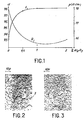
- the resistivity of the part obtained is measured by the complex impedance method, using alternating current, at a temperature of 850 ° C. and this part is thus found to have a resistivity of 15.5 ohms.cm.
- the resistivity is 18 ohms.cm and that the addition of 1% of alumina makes it possible to lower the resistivity to a value of 15 , 5 ohms.cm, which represents a reduction of about 15%. Furthermore, it is found that the addition of alumina amounts greater than 1% by moles does not improve the result obtained.
- alumina With regard to density, it can be seen that the addition of alumina also makes it possible to improve the density of the parts obtained. Thus, with 1% of alumina, a density representing 98% of the theoretical density is obtained, whereas for an electrolyte without alumina, the density is only 93% of the theoretical density.
- the overall conductivity gain measured in alternating current by spectroscopy of complex impedances is 50% for a part having the composition 91% Zr0 2 , 8% Y 2 0 3 and 1% Al Z O 3 .
Landscapes
- Chemical & Material Sciences (AREA)
- Engineering & Computer Science (AREA)
- Organic Chemistry (AREA)
- Manufacturing & Machinery (AREA)
- Inorganic Chemistry (AREA)
- Ceramic Engineering (AREA)
- Materials Engineering (AREA)
- Chemical Kinetics & Catalysis (AREA)
- Electrochemistry (AREA)
- General Chemical & Material Sciences (AREA)
- Sustainable Energy (AREA)
- Sustainable Development (AREA)
- Metallurgy (AREA)
- Composite Materials (AREA)
- Life Sciences & Earth Sciences (AREA)
- Structural Engineering (AREA)
- Conductive Materials (AREA)
- Compositions Of Oxide Ceramics (AREA)
- Fuel Cell (AREA)
Applications Claiming Priority (2)
| Application Number | Priority Date | Filing Date | Title |
|---|---|---|---|
| FR8002788A FR2475531A1 (fr) | 1980-02-08 | 1980-02-08 | Procede de preparation de pieces en electrolyte solide a base de zircone stabilisee et les pieces obtenues par ce procede |
| FR8002788 | 1980-02-08 |
Publications (2)
| Publication Number | Publication Date |
|---|---|
| EP0034513A1 EP0034513A1 (fr) | 1981-08-26 |
| EP0034513B1 true EP0034513B1 (fr) | 1984-05-30 |
Family
ID=9238364
Family Applications (1)
| Application Number | Title | Priority Date | Filing Date |
|---|---|---|---|
| EP81400113A Expired EP0034513B1 (fr) | 1980-02-08 | 1981-01-27 | Procédé de fabrication de pièces en électrolyte solide à base de zircone stabilisée et les pièces obtenues par ce procédé |
Country Status (4)
| Country | Link |
|---|---|
| US (1) | US4365011A (enExample) |
| EP (1) | EP0034513B1 (enExample) |
| DE (1) | DE3163789D1 (enExample) |
| FR (1) | FR2475531A1 (enExample) |
Families Citing this family (19)
| Publication number | Priority date | Publication date | Assignee | Title |
|---|---|---|---|---|
| US4501818A (en) * | 1983-07-05 | 1985-02-26 | Norton Company | Process for the preparation of ceramic powders |
| JPS60103515A (ja) * | 1983-11-11 | 1985-06-07 | Hitachi Ltd | 薄膜磁気ヘツド |
| US4543341A (en) * | 1983-12-23 | 1985-09-24 | Massachusetts Institute Of Technology | Synthesis and processing of monosized oxide powders |
| US4605631A (en) * | 1984-03-19 | 1986-08-12 | Norton Company | Advanced preparation of ceramic powders |
| GB8524140D0 (en) * | 1985-10-01 | 1985-11-06 | Tioxide Group Plc | Stabilised metallic oxides |
| US4639356A (en) * | 1985-11-05 | 1987-01-27 | American Cyanamid Company | High technology ceramics with partially stabilized zirconia |
| US4719091A (en) * | 1986-07-01 | 1988-01-12 | Corning Glass Works | Preparation of mono-sized zirconia powders by forced hydrolysis |
| DE3777940D1 (de) * | 1986-09-27 | 1992-05-07 | Nissan Chemical Ind Ltd | Verfahren zur herstellung von feinem zirkonoxydpulver. |
| US4920083A (en) * | 1988-05-18 | 1990-04-24 | Research Triangle Institute | Novel process for the production of ceramic flakes |
| US5130210A (en) * | 1989-08-25 | 1992-07-14 | Tonen Corporation | Stabilized zirconia solid electrolyte and process for preparation thereof |
| US5154987A (en) * | 1990-07-17 | 1992-10-13 | The United States Of America As Represented By The United States Department Of Energy | Highly conductive electrolyte composites containing glass and ceramic, and method of manufacture |
| JPH04149064A (ja) * | 1990-10-08 | 1992-05-22 | Nissan Chem Ind Ltd | 固体電解質磁器 |
| JP2651332B2 (ja) * | 1992-09-21 | 1997-09-10 | 松下電工株式会社 | ジルコニア系複合セラミック焼結体及びその製法 |
| DE4237519C1 (de) * | 1992-11-06 | 1994-03-31 | Dornier Gmbh | Festelektrolyt mit darauf angebrachter mehrschichtiger Elektrode |
| DE59703678D1 (de) * | 1997-08-18 | 2001-07-05 | Siemens Ag | Verfahren zum Herstellen eines keramischen Pulvers für einen Elektrolyten einer Hochtemperatur-Brennstoffzelle und Hochtemperatur-Brennstoffzelle |
| US6541073B1 (en) * | 1999-08-31 | 2003-04-01 | Ube Industries, Ltd. | Zirconium oxide and zirconium oxide precursor and process for producing them |
| KR101698210B1 (ko) * | 2009-10-07 | 2017-01-20 | 한양대학교 에리카산학협력단 | 고체산화물 전해질, 이를 포함하는 고체산화물 연료전지 및 이의 제조방법 |
| JP6615127B2 (ja) * | 2014-06-20 | 2019-12-04 | ボーグワーナー インコーポレーテッド | 調整可能なベーンを有するターボチャージャ |
| RU2614322C1 (ru) * | 2015-12-29 | 2017-03-24 | Федеральное государственное бюджетное учреждение науки Ордена Трудового Красного Знамени Институт химии силикатов им. И.В. Гребенщикова Российской академии наук (ИХС РАН) | Способ жидкофазного синтеза многокомпонентного керамического материала в системе ZrO2-Y2O3-Gd2O3-MgO для создания электролита твердооксидного топливного элемента |
Citations (1)
| Publication number | Priority date | Publication date | Assignee | Title |
|---|---|---|---|---|
| EP0004808A2 (fr) * | 1978-03-30 | 1979-10-17 | COMMISSARIAT A L'ENERGIE ATOMIQUE Etablissement de Caractère Scientifique Technique et Industriel | Procédé de préparation d'une pièce en céramique et ensemble cathode-électrolyte solide obtenu par ce procédé |
Family Cites Families (6)
| Publication number | Priority date | Publication date | Assignee | Title |
|---|---|---|---|---|
| CA750994A (en) * | 1967-01-17 | Compagnie Francaise De Raffinage | Fuel cell solid electrolyte | |
| US1624162A (en) * | 1924-08-13 | 1927-04-12 | Philips Nv | Process for converting hafnium and zirconium phosphates |
| US2599326A (en) * | 1951-06-19 | 1952-06-03 | Atomic Energy Commission | Decomposition of complex metal phosphate salts |
| NL300914A (enExample) * | 1962-11-23 | 1900-01-01 | ||
| FR1459437A (fr) * | 1964-11-11 | 1966-04-29 | Ciba Geigy | Procédé de fabrication d'oxydes composites |
| DE2105643A1 (de) * | 1971-02-06 | 1972-08-17 | Petrolchemisches Kombinat | Verfahren und vorrichtung zur elektrochemischen herstellung von wasserstoff aus wasserdampf und stickstoff aus luft |
-
1980
- 1980-02-08 FR FR8002788A patent/FR2475531A1/fr active Granted
-
1981
- 1981-01-27 DE DE8181400113T patent/DE3163789D1/de not_active Expired
- 1981-01-27 EP EP81400113A patent/EP0034513B1/fr not_active Expired
- 1981-01-27 US US06/228,897 patent/US4365011A/en not_active Expired - Fee Related
Patent Citations (1)
| Publication number | Priority date | Publication date | Assignee | Title |
|---|---|---|---|---|
| EP0004808A2 (fr) * | 1978-03-30 | 1979-10-17 | COMMISSARIAT A L'ENERGIE ATOMIQUE Etablissement de Caractère Scientifique Technique et Industriel | Procédé de préparation d'une pièce en céramique et ensemble cathode-électrolyte solide obtenu par ce procédé |
Also Published As
| Publication number | Publication date |
|---|---|
| FR2475531B1 (enExample) | 1984-04-27 |
| US4365011A (en) | 1982-12-21 |
| EP0034513A1 (fr) | 1981-08-26 |
| DE3163789D1 (en) | 1984-07-05 |
| FR2475531A1 (fr) | 1981-08-14 |
Similar Documents
| Publication | Publication Date | Title |
|---|---|---|
| EP0034513B1 (fr) | Procédé de fabrication de pièces en électrolyte solide à base de zircone stabilisée et les pièces obtenues par ce procédé | |
| JP4663125B2 (ja) | 固体酸化物形燃料電池用アノードの製造法 | |
| EP1601820B1 (fr) | Procede de fabrication d'une anode inerte pour la production d'aluminium par electrolyse ignee | |
| De Haart et al. | Deposition and electrical properties of thin porous ceramic electrode layers for solid oxide fuel cell application | |
| JP5598920B2 (ja) | 固体酸化物燃料電池用電解質緻密材料の製造方法 | |
| FR2756270A1 (fr) | Compose du type lamo3, m etant l'aluminium, le gallium ou l'indium, sous forme poudre ou sous forme frittee, son procede de preparation et son utilisation en tant que conducteur d'oxygene | |
| US6207038B1 (en) | Process for preparing a composite electrolyte based on BIMEVOX and the use of said compound in separating oxygen from a gas mixture | |
| FR2820054A1 (fr) | Structures-microstructures de membrane ceramique conducteurs par ions oxyde ; utilisation pour separer l'oxygene de l'air | |
| EP1358003A1 (fr) | Structures-microstructures de membrane ceramique conducteurs par ions oxyde pour la production d'oxygene sous pression elevee | |
| EP2374177B1 (fr) | Procédé de fabrication d'une électrode cermet au nickel | |
| Desclaux et al. | Influence of the carbon/anode interaction on direct carbon conversion in a SOFC | |
| WO2005007595A2 (fr) | Materiau perovskite, procede de preparation et utilisation dans un reacteur catalytique membranaire | |
| EP2734486A1 (en) | A method for the densification of ceramic layers, especially ceramic layers within solid oxide cell (soc) technology, and products obtained by the method | |
| US20200112043A1 (en) | Porous solid oxide fuel cell anode with nanoporous surface and process for fabrication | |
| FR2518583A1 (fr) | Electrode recouverte d'un catalyseur presentant une faible surtension pour le degagement de l'oxygene utilisable notamment pour l'electrolyse de l'eau en milieu alcalin et procede pour sa preparation | |
| JP2000044245A (ja) | Lscm/ysz複合粉末の製造方法、およびそれを用いた固体電解質型燃料電池の製造方法 | |
| Wijayasinghe et al. | New cathode materials for molten carbonate fuel cells | |
| FR2856397A1 (fr) | Procede de preparation de couches d'oxydes d'elements metalliques | |
| Liu et al. | Characteristics of La0. 8Sr0. 2Ga0. 8Mg0. 2O3− δ-supported micro-tubular solid oxide fuel cells with bi-layer and tri-layer electrolytes | |
| JPH02504445A (ja) | 燃料電池電解質のための固体組成物 | |
| JP5300331B2 (ja) | リチウム電池用正極合剤成形体及びリチウム電池 | |
| US10403881B2 (en) | Method for producing ceramic cathode layers on current collectors | |
| US20070098905A1 (en) | Method for preparing metal oxide layers | |
| WO2019167811A1 (ja) | プロトンセラミックス燃料電池及びその製造方法 | |
| Huang et al. | Electrochemical characterization of La0. 8Sr0. 2MnO3-coated NiO as cathodes for molten carbonate fuel cells |
Legal Events
| Date | Code | Title | Description |
|---|---|---|---|
| PUAI | Public reference made under article 153(3) epc to a published international application that has entered the european phase |
Free format text: ORIGINAL CODE: 0009012 |
|
| AK | Designated contracting states |
Designated state(s): DE FR GB SE |
|
| 17P | Request for examination filed |
Effective date: 19820129 |
|
| GRAA | (expected) grant |
Free format text: ORIGINAL CODE: 0009210 |
|
| AK | Designated contracting states |
Designated state(s): DE FR GB SE |
|
| REF | Corresponds to: |
Ref document number: 3163789 Country of ref document: DE Date of ref document: 19840705 |
|
| PGFP | Annual fee paid to national office [announced via postgrant information from national office to epo] |
Ref country code: DE Payment date: 19841219 Year of fee payment: 5 |
|
| PLBE | No opposition filed within time limit |
Free format text: ORIGINAL CODE: 0009261 |
|
| STAA | Information on the status of an ep patent application or granted ep patent |
Free format text: STATUS: NO OPPOSITION FILED WITHIN TIME LIMIT |
|
| 26N | No opposition filed | ||
| PG25 | Lapsed in a contracting state [announced via postgrant information from national office to epo] |
Ref country code: SE Effective date: 19870128 |
|
| GBPC | Gb: european patent ceased through non-payment of renewal fee | ||
| PG25 | Lapsed in a contracting state [announced via postgrant information from national office to epo] |
Ref country code: FR Free format text: LAPSE BECAUSE OF NON-PAYMENT OF DUE FEES Effective date: 19870930 |
|
| PG25 | Lapsed in a contracting state [announced via postgrant information from national office to epo] |
Ref country code: DE Effective date: 19871001 |
|
| REG | Reference to a national code |
Ref country code: FR Ref legal event code: ST |
|
| PG25 | Lapsed in a contracting state [announced via postgrant information from national office to epo] |
Ref country code: GB Effective date: 19881118 |
|
| EUG | Se: european patent has lapsed |
Ref document number: 81400113.7 Effective date: 19870923 |