EP0029778B1 - Verfahren zur Abtrennung gesättigter Kohlenwasserstoffe aus einem Kohlenwasserstoffstrom - Google Patents
Verfahren zur Abtrennung gesättigter Kohlenwasserstoffe aus einem Kohlenwasserstoffstrom Download PDFInfo
- Publication number
- EP0029778B1 EP0029778B1 EP80401650A EP80401650A EP0029778B1 EP 0029778 B1 EP0029778 B1 EP 0029778B1 EP 80401650 A EP80401650 A EP 80401650A EP 80401650 A EP80401650 A EP 80401650A EP 0029778 B1 EP0029778 B1 EP 0029778B1
- Authority
- EP
- European Patent Office
- Prior art keywords
- solvent
- dilution
- fraction
- temperature
- oil
- Prior art date
- Legal status (The legal status is an assumption and is not a legal conclusion. Google has not performed a legal analysis and makes no representation as to the accuracy of the status listed.)
- Expired
Links
Images
Classifications
-
- C—CHEMISTRY; METALLURGY
- C10—PETROLEUM, GAS OR COKE INDUSTRIES; TECHNICAL GASES CONTAINING CARBON MONOXIDE; FUELS; LUBRICANTS; PEAT
- C10G—CRACKING HYDROCARBON OILS; PRODUCTION OF LIQUID HYDROCARBON MIXTURES, e.g. BY DESTRUCTIVE HYDROGENATION, OLIGOMERISATION, POLYMERISATION; RECOVERY OF HYDROCARBON OILS FROM OIL-SHALE, OIL-SAND, OR GASES; REFINING MIXTURES MAINLY CONSISTING OF HYDROCARBONS; REFORMING OF NAPHTHA; MINERAL WAXES
- C10G73/00—Recovery or refining of mineral waxes, e.g. montan wax
- C10G73/02—Recovery of petroleum waxes from hydrocarbon oils; Dewaxing of hydrocarbon oils
- C10G73/06—Recovery of petroleum waxes from hydrocarbon oils; Dewaxing of hydrocarbon oils with the use of solvents
- C10G73/08—Organic compounds
Definitions
- the present invention relates to a method for separating at least part of the saturated hydrocarbons contained in a hydrocarbon feedstock. It relates more particularly to a process of the type known as dewaxing of oils.
- the dewaxed oil obtained is sufficiently fluid in winter to be used for the formulation of lubricating oils, which is not the case when it contains paraffin, which precipitates at a relatively high temperature.
- a common type of dewaxing process is the solvent dewaxing process.
- a solvent is added to the charge of oil to be dewaxed, which dissolves the oil and causes the paraffin to precipitate, this precipitation being favored by cooling.
- the "solvent” can consist of a single chemical compound, for example propane. More often, it includes two chemical compounds: -
- a first compound which dissolves the oil very well, for example benzene or toluene,
- solvent namely that it may be composed at least in part of a paraffin antisolvent.
- the solvent can be added to the oil in several ways: -
- the solvent can also be precooled and the precooled solvent is added to the oil to be dewaxed in several successive fractions;
- fractional dilution the solvent has a constant composition during the various additions.
- US-A-3 871 991 describes a process for dewaxing oils by fractional dilution and gradual cooling of the mixture with a solvent whose composition varies during different dilutions.
- methyl ethyl ketone MEC
- toluene is similarly introduced at various stages of the lower part of this tour.
- the injection of the solvent is adjusted so as to maintain a temperature gradient throughout the cooling tower and to create in the tower an alternation of miscibility and immiscibility periods between the solvent and the oil charge.
- the MEC content of the solvent varies randomly, since it decreases between certain successive stages of the cooling tower, but increases appreciably between other stages.
- the present invention aims to propose an alternative to this dewaxing process, which no longer searches for a succession of miscibility and immiscibility periods between the solvent and the oil charge, but which uses different operating conditions, both as regards concerns the composition of the solvent between two successive charges as the temperature of the solvent introduced.
- the solvent consists entirely of methyl ethyl ketone, during the first dilution, while, in subsequent dilutions, it contains, in addition to methyl ethyl ketone, a certain proportion of toluene.
- the process according to the invention has the advantage, as will be shown below with the aid of comparative implementation examples, of facilitating the separation of the oil and paraffin.
- the number of dilutions which is at least equal to two, can vary depending on the load of hydrocarbons to be treated.
- the Applicant has thus implemented a process comprising five dilutions, but there may be more or less.
- the method according to the invention can be used in particular for the dewaxing of oils from the refining of crude oil and intended for the formulation of lubricating oils.
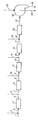
- This dewaxing unit is supplied, via line 1, with a charge of dewaxing oil of petroleum origin.
- the temperature of the charge, in line 1, is between 25 and 100 ° C.
- a solvent is added to this charge, via line 2; which may, for example, consist entirely of methyl ethyl ketone.
- the temperature of the solvent in line 2 is between 30 and 70 ° C.
- the addition of solvent to the oil takes place under conditions such as the volume ratio
- the mixture obtained is led, via line 3, to a scraper exchanger 4, where the mixture is cooled to a temperature which can be between 15 and 60 ° C.
- the mixture leaving the exchanger 4 via line 5 is supplemented, via line 6, with a solvent, which may consist, for example, of a mixture of 90% by volume of methyl ethyl ketone and 10% by volume toluene.
- the temperature of the solvent in line 6 is between 20 and 70 ° C.
- the addition of the solvent via line 6 is carried out under conditions such as the volume ratio
- the new mixture is led, via line 7, to a scraper exchanger 8, where the mixture is cooled to a temperature which is between 5 and 40 ° C.
- the mixture leaving the exchanger 8 via line 9 is supplemented, via line 10, with a solvent, which can consist, for example, of a mixture of 80% by volume of methyl ethyl ketone and 20% by volume of toluene.
- a solvent which can consist, for example, of a mixture of 80% by volume of methyl ethyl ketone and 20% by volume of toluene.
- the temperature of the solvent in line 10 is between 0 and 50 ° C.
- the addition of the solvent via line 10 takes place under conditions such as the volume ratio
- the new mixture obtained is led, via line 11, to a scraper exchanger 12, where the mixture is cooled to a temperature which is between -10 and 15 ° C.
- the mixture leaving the exchanger 12 via line 13 is supplemented, via line 14, with a solvent which may consist, for example, of a mixture of 70% by volume of methyl ethyl ketone and 30% by volume of toluene .
- the temperature of the solvent in line 14 is between 0 and -15 ° C.
- the addition of the solvent via line 14 takes place under conditions such as the volume ratio
- the new mixture obtained is led, via line 15, to a scraper exchanger 16, where the mixture is cooled to a temperature which is between -5 and -20 ° C.
- the mixture leaving the exchanger 16 via line 17 is supplemented, via line 18, with a solvent which may consist, for example, of a mixture of 30% by volume of toluene and 70% by volume of methyl ethyl ketone.
- the temperature of the solvent in line 18 is between -5 and -20 ° C.
- the addition of the solvent via line 18 takes place under conditions such as the volume ratio
- the new mixture obtained is led by line 19 in a scraper exchanger 20, where the mixture is cooled to a temperature which is between -15 and -30 ° C.
- the mixture leaving the exchanger 20 via line 21 is led into a rotary filter 22, of the type operating under reduced pressure and well known to those skilled in the art.
- Solvent intended to wash the paraffin at a temperature close to that of the exchanger 20 is introduced into the filter, via line 25.
- the dewaxed oil containing solvent is evacuated from the filter 22 by line 23.
- the paraffin containing the solvent is removed from the filter 22 by line 24.
- the solvent is separated, on the one hand, from the dewaxed oil, and on the other hand, from the paraffin, by separation means not shown, by distillation for example.
- This example relates to two tests for dewaxing an oil, carried out in an installation similar to that shown in the figure described above.
- control test TA for comparison, using a known fractional dilution method, without changing the composition of the solvent during the various dilutions.
- Tests A and TA were carried out with a charge of dewaxed oil from the refining of crude oil of Iraqi origin, a charge the characteristics of which are as follows: - The conditions of the TA and A tests are given in Table 1 below.
- Tests B and TB were carried out with a charge of dewaxed oil from the refining of crude oil of Iraqi origin, a charge the characteristics of which are as follows: -
Landscapes
- Chemical & Material Sciences (AREA)
- Oil, Petroleum & Natural Gas (AREA)
- Engineering & Computer Science (AREA)
- Chemical Kinetics & Catalysis (AREA)
- General Chemical & Material Sciences (AREA)
- Organic Chemistry (AREA)
- Production Of Liquid Hydrocarbon Mixture For Refining Petroleum (AREA)
Claims (2)
Applications Claiming Priority (2)
| Application Number | Priority Date | Filing Date | Title |
|---|---|---|---|
| FR7928853 | 1979-11-22 | ||
| FR7928853A FR2470151A1 (fr) | 1979-11-22 | 1979-11-22 | Procede de separation d'hydrocarbures satures d'une charge d'hydrocarbures en contenant |
Publications (2)
| Publication Number | Publication Date |
|---|---|
| EP0029778A1 EP0029778A1 (de) | 1981-06-03 |
| EP0029778B1 true EP0029778B1 (de) | 1988-03-30 |
Family
ID=9232000
Family Applications (1)
| Application Number | Title | Priority Date | Filing Date |
|---|---|---|---|
| EP80401650A Expired EP0029778B1 (de) | 1979-11-22 | 1980-11-18 | Verfahren zur Abtrennung gesättigter Kohlenwasserstoffe aus einem Kohlenwasserstoffstrom |
Country Status (6)
| Country | Link |
|---|---|
| US (1) | US4376035A (de) |
| EP (1) | EP0029778B1 (de) |
| JP (1) | JPS5692992A (de) |
| CA (1) | CA1137911A (de) |
| DE (1) | DE3072085D1 (de) |
| FR (1) | FR2470151A1 (de) |
Families Citing this family (2)
| Publication number | Priority date | Publication date | Assignee | Title |
|---|---|---|---|---|
| US4541917A (en) * | 1983-12-19 | 1985-09-17 | Exxon Research And Engineering Co. | Modified deoiling-dewaxing process |
| US5196133A (en) * | 1989-10-31 | 1993-03-23 | The Procter & Gamble Company | Granular detergent compositions containing peroxyacid bleach and sulfobenzoyl end-capped ester oligomers useful as soil-release agents |
Family Cites Families (7)
| Publication number | Priority date | Publication date | Assignee | Title |
|---|---|---|---|---|
| US2133338A (en) * | 1934-01-22 | 1938-10-18 | Sun Oil Co | Process of dewaxing hydrocarbon oils |
| US2342798A (en) * | 1939-11-17 | 1944-02-29 | Fischer Karl | Separation of mineral oils, tars, and fractions thereof |
| US2625502A (en) * | 1948-07-24 | 1953-01-13 | Union Oil Co | Wax-oil separation |
| US2760904A (en) * | 1951-12-07 | 1956-08-28 | Exxon Research Engineering Co | Selective use of solvent components in solvent dewaxing |
| DE1645743A1 (de) * | 1968-01-30 | 1970-05-14 | Exxon Research Engineering Co | Abtrennung von Kohlenwasserstoffwachs von Mineraloel unter Verwendung von Entparaffinierungshilfsmitteln |
| US3642609A (en) * | 1969-11-13 | 1972-02-15 | Exxon Research Engineering Co | Dewaxing waxy oil by dilution chilling |
| US3871991A (en) * | 1973-06-22 | 1975-03-18 | Exxon Research Engineering Co | Temporarily immiscible dewaxing |
-
1979
- 1979-11-22 FR FR7928853A patent/FR2470151A1/fr active Granted
-
1980
- 1980-11-18 DE DE8080401650T patent/DE3072085D1/de not_active Expired
- 1980-11-18 EP EP80401650A patent/EP0029778B1/de not_active Expired
- 1980-11-19 CA CA000365026A patent/CA1137911A/en not_active Expired
- 1980-11-19 US US06/208,137 patent/US4376035A/en not_active Expired - Lifetime
- 1980-11-21 JP JP16447680A patent/JPS5692992A/ja active Pending
Also Published As
| Publication number | Publication date |
|---|---|
| EP0029778A1 (de) | 1981-06-03 |
| DE3072085D1 (en) | 1988-05-05 |
| JPS5692992A (en) | 1981-07-28 |
| CA1137911A (en) | 1982-12-21 |
| US4376035A (en) | 1983-03-08 |
| FR2470151A1 (fr) | 1981-05-29 |
| FR2470151B1 (de) | 1985-03-01 |
Similar Documents
| Publication | Publication Date | Title |
|---|---|---|
| US2015748A (en) | Method for producing pour inhibitors | |
| US6497813B2 (en) | Solvent extraction refining of petroleum products | |
| FR2849447A1 (fr) | Procede de separation des aromatiques par distillation extractive et utilisation d'un solvant composite | |
| FR2768717A1 (fr) | Procede de separation de fluorure d'hydrogene de ses melanges avec un hydrofluoroalcane contenant de 3 a 6 atomes de carbone | |
| EP0029778B1 (de) | Verfahren zur Abtrennung gesättigter Kohlenwasserstoffe aus einem Kohlenwasserstoffstrom | |
| EP0154750B1 (de) | Verfahren zur Trennung von Wachs und stark entparaffiniertem Öl von wachshaltigem Kohlenwasserstofföl | |
| US4169044A (en) | Re-refining used lube oil | |
| FR2470762A1 (fr) | Procede de traitement d'un residu de production d'acide adipique | |
| FR2889698A1 (fr) | Procede de separation du metaxylene d'une charge d'hydrocarbures aromatiques par adsorption en phase liquide utilisant la tetraline comme desorbant | |
| WO2022122458A1 (fr) | Procédé d'extraction de composés aromatiques au 2-methylbutane | |
| FR2569687A1 (fr) | Procede de raffinage de tertio-butylstyrene | |
| EP0329510B1 (de) | Verfahren zur Entasphaltierung schwerer Erdölfraktionen und dessen Verwendung | |
| US1947359A (en) | Dewaxing petroleum oils | |
| US3044949A (en) | Process for lowering the pour point of | |
| US2220619A (en) | Process of separating hydrocarbon mixtures | |
| US2210383A (en) | Solvent extraction of petroleum oils | |
| WO2000056687A1 (fr) | Procede de separation de fluorure d'hydrogene de ses melanges avec du 1,1,1,3,3-pentafluorobutane et procede de fabrication de 1,1,1,3,3-pentafluorobutane | |
| SU288714A1 (de) | ||
| Gurbanov et al. | THE RESEARCH ON INFLUENCE OF GOSSYPOL-BASED COMPOSITION ON PARAFFIN SEDIMENT. | |
| US3507785A (en) | Separation of long chain normal paraffin hydrocarbons | |
| US2017730A (en) | Process of refining hydrocarbons, their derivatives, and the like | |
| FR2675812A1 (fr) | Procede de preparation d'huiles de base et de cires liquides biodegradables, nouveaux produits lubrifiants biodegradables obtenus. | |
| BE394154A (de) | ||
| FR2787443A1 (fr) | Procede de separation de florure d'hydrogene de ses melanges avec du 1,1,1,3,3-pentafluorobutane et procede de fabrication de 1,1,1,3,-pentafluorobutane | |
| EP3891255A1 (de) | Verfahren zur trennung von polymeren in einem kohlenwasserstoffgemisch |
Legal Events
| Date | Code | Title | Description |
|---|---|---|---|
| PUAI | Public reference made under article 153(3) epc to a published international application that has entered the european phase |
Free format text: ORIGINAL CODE: 0009012 |
|
| AK | Designated contracting states |
Designated state(s): BE DE GB IT NL |
|
| ITCL | It: translation for ep claims filed |
Representative=s name: BARZANO' E ZANARDO MILANO S.P.A. |
|
| 17P | Request for examination filed |
Effective date: 19810609 |
|
| DET | De: translation of patent claims | ||
| GRAA | (expected) grant |
Free format text: ORIGINAL CODE: 0009210 |
|
| RAP1 | Party data changed (applicant data changed or rights of an application transferred) |
Owner name: COMPAGNIE DE RAFFINAGE ET DE DISTRIBUTION TOTAL F |
|
| AK | Designated contracting states |
Kind code of ref document: B1 Designated state(s): BE DE GB IT NL |
|
| PG25 | Lapsed in a contracting state [announced via postgrant information from national office to epo] |
Ref country code: NL Effective date: 19880330 Ref country code: IT Free format text: LAPSE BECAUSE OF FAILURE TO SUBMIT A TRANSLATION OF THE DESCRIPTION OR TO PAY THE FEE WITHIN THE PRESCRIBED TIME-LIMIT;WARNING: LAPSES OF ITALIAN PATENTS WITH EFFECTIVE DATE BEFORE 2007 MAY HAVE OCCURRED AT ANY TIME BEFORE 2007. THE CORRECT EFFECTIVE DATE MAY BE DIFFERENT FROM THE ONE RECORDED. Effective date: 19880330 |
|
| REF | Corresponds to: |
Ref document number: 3072085 Country of ref document: DE Date of ref document: 19880505 |
|
| NLV1 | Nl: lapsed or annulled due to failure to fulfill the requirements of art. 29p and 29m of the patents act | ||
| GBV | Gb: ep patent (uk) treated as always having been void in accordance with gb section 77(7)/1977 [no translation filed] | ||
| PG25 | Lapsed in a contracting state [announced via postgrant information from national office to epo] |
Ref country code: GB Free format text: LAPSE BECAUSE OF NON-PAYMENT OF DUE FEES Effective date: 19881118 |
|
| PG25 | Lapsed in a contracting state [announced via postgrant information from national office to epo] |
Ref country code: BE Effective date: 19881130 |
|
| PLBE | No opposition filed within time limit |
Free format text: ORIGINAL CODE: 0009261 |
|
| STAA | Information on the status of an ep patent application or granted ep patent |
Free format text: STATUS: NO OPPOSITION FILED WITHIN TIME LIMIT |
|
| 26N | No opposition filed | ||
| BERE | Be: lapsed |
Owner name: CIE DE RAFFINAGE ET DE DISTRIBUTION TOTAL FRANCE Effective date: 19881130 |
|
| PG25 | Lapsed in a contracting state [announced via postgrant information from national office to epo] |
Ref country code: DE Effective date: 19890801 |
|
| APAH | Appeal reference modified |
Free format text: ORIGINAL CODE: EPIDOSCREFNO |