EP0025751B1 - Film de matériau composite piézo-électrique, et son procédé de fabrication - Google Patents
Film de matériau composite piézo-électrique, et son procédé de fabrication Download PDFInfo
- Publication number
- EP0025751B1 EP0025751B1 EP80401271A EP80401271A EP0025751B1 EP 0025751 B1 EP0025751 B1 EP 0025751B1 EP 80401271 A EP80401271 A EP 80401271A EP 80401271 A EP80401271 A EP 80401271A EP 0025751 B1 EP0025751 B1 EP 0025751B1
- Authority
- EP
- European Patent Office
- Prior art keywords
- accordance
- polymer
- tissue
- composite material
- electric
- Prior art date
- Legal status (The legal status is an assumption and is not a legal conclusion. Google has not performed a legal analysis and makes no representation as to the accuracy of the status listed.)
- Expired
Links
- 239000002131 composite material Substances 0.000 title claims description 27
- 238000004519 manufacturing process Methods 0.000 title description 11
- 239000000463 material Substances 0.000 claims description 28
- 229920000642 polymer Polymers 0.000 claims description 20
- 229920002620 polyvinyl fluoride Polymers 0.000 claims description 20
- 238000000034 method Methods 0.000 claims description 15
- 239000002904 solvent Substances 0.000 claims description 8
- 239000002033 PVDF binder Substances 0.000 claims description 5
- 239000011248 coating agent Substances 0.000 claims description 5
- 238000000576 coating method Methods 0.000 claims description 5
- 230000005684 electric field Effects 0.000 claims description 5
- 230000010287 polarization Effects 0.000 claims description 5
- 229920002981 polyvinylidene fluoride Polymers 0.000 claims description 5
- 229920006125 amorphous polymer Polymers 0.000 claims description 4
- 230000006698 induction Effects 0.000 claims description 4
- 229920006126 semicrystalline polymer Polymers 0.000 claims description 4
- 229920001577 copolymer Polymers 0.000 claims description 3
- 239000004800 polyvinyl chloride Substances 0.000 claims description 3
- 239000007788 liquid Substances 0.000 claims description 2
- 239000012047 saturated solution Substances 0.000 claims description 2
- 229920000131 polyvinylidene Polymers 0.000 claims 4
- 238000007598 dipping method Methods 0.000 claims 2
- 229920001343 polytetrafluoroethylene Polymers 0.000 claims 1
- 239000004810 polytetrafluoroethylene Substances 0.000 claims 1
- 229920000915 polyvinyl chloride Polymers 0.000 claims 1
- 239000004744 fabric Substances 0.000 description 28
- ZMXDDKWLCZADIW-UHFFFAOYSA-N N,N-Dimethylformamide Chemical compound CN(C)C=O ZMXDDKWLCZADIW-UHFFFAOYSA-N 0.000 description 18
- 239000012071 phase Substances 0.000 description 15
- 238000013459 approach Methods 0.000 description 10
- 239000000243 solution Substances 0.000 description 8
- 239000002861 polymer material Substances 0.000 description 7
- 238000005470 impregnation Methods 0.000 description 6
- 238000001704 evaporation Methods 0.000 description 5
- 230000008020 evaporation Effects 0.000 description 4
- 239000004952 Polyamide Substances 0.000 description 3
- 230000000694 effects Effects 0.000 description 3
- 230000001747 exhibiting effect Effects 0.000 description 3
- 230000006355 external stress Effects 0.000 description 3
- 229920002647 polyamide Polymers 0.000 description 3
- 210000001519 tissue Anatomy 0.000 description 3
- BQCADISMDOOEFD-UHFFFAOYSA-N Silver Chemical compound [Ag] BQCADISMDOOEFD-UHFFFAOYSA-N 0.000 description 2
- JHIVVAPYMSGYDF-UHFFFAOYSA-N cyclohexanone Chemical compound O=C1CCCCC1 JHIVVAPYMSGYDF-UHFFFAOYSA-N 0.000 description 2
- 238000010586 diagram Methods 0.000 description 2
- 239000007789 gas Substances 0.000 description 2
- 229910052751 metal Inorganic materials 0.000 description 2
- 239000002184 metal Substances 0.000 description 2
- -1 polyethylene Polymers 0.000 description 2
- 229910052709 silver Inorganic materials 0.000 description 2
- 239000004332 silver Substances 0.000 description 2
- 238000002791 soaking Methods 0.000 description 2
- OKTJSMMVPCPJKN-UHFFFAOYSA-N Carbon Chemical compound [C] OKTJSMMVPCPJKN-UHFFFAOYSA-N 0.000 description 1
- UFHFLCQGNIYNRP-UHFFFAOYSA-N Hydrogen Chemical compound [H][H] UFHFLCQGNIYNRP-UHFFFAOYSA-N 0.000 description 1
- 239000004698 Polyethylene Substances 0.000 description 1
- 238000007664 blowing Methods 0.000 description 1
- 238000003490 calendering Methods 0.000 description 1
- 229910052799 carbon Inorganic materials 0.000 description 1
- 239000000919 ceramic Substances 0.000 description 1
- 229910010293 ceramic material Inorganic materials 0.000 description 1
- 239000002178 crystalline material Substances 0.000 description 1
- 230000007547 defect Effects 0.000 description 1
- 238000001514 detection method Methods 0.000 description 1
- 238000006073 displacement reaction Methods 0.000 description 1
- 239000002360 explosive Substances 0.000 description 1
- 125000001153 fluoro group Chemical group F* 0.000 description 1
- 229910052739 hydrogen Inorganic materials 0.000 description 1
- 239000001257 hydrogen Substances 0.000 description 1
- 238000003331 infrared imaging Methods 0.000 description 1
- 239000004922 lacquer Substances 0.000 description 1
- 239000012528 membrane Substances 0.000 description 1
- 239000000203 mixture Substances 0.000 description 1
- 238000000465 moulding Methods 0.000 description 1
- 230000007935 neutral effect Effects 0.000 description 1
- 229920003023 plastic Polymers 0.000 description 1
- 239000004033 plastic Substances 0.000 description 1
- 229920006112 polar polymer Polymers 0.000 description 1
- 229920000573 polyethylene Polymers 0.000 description 1
- 238000003825 pressing Methods 0.000 description 1
- 230000005616 pyroelectricity Effects 0.000 description 1
- 239000010453 quartz Substances 0.000 description 1
- 230000005855 radiation Effects 0.000 description 1
- VYPSYNLAJGMNEJ-UHFFFAOYSA-N silicon dioxide Inorganic materials O=[Si]=O VYPSYNLAJGMNEJ-UHFFFAOYSA-N 0.000 description 1
- 239000007790 solid phase Substances 0.000 description 1
- 238000007711 solidification Methods 0.000 description 1
- 230000008023 solidification Effects 0.000 description 1
- 230000035882 stress Effects 0.000 description 1
- 229920002994 synthetic fiber Polymers 0.000 description 1
- 239000004758 synthetic textile Substances 0.000 description 1
- 238000003856 thermoforming Methods 0.000 description 1
- 238000002604 ultrasonography Methods 0.000 description 1
Images
Classifications
-
- H—ELECTRICITY
- H10—SEMICONDUCTOR DEVICES; ELECTRIC SOLID-STATE DEVICES NOT OTHERWISE PROVIDED FOR
- H10N—ELECTRIC SOLID-STATE DEVICES NOT OTHERWISE PROVIDED FOR
- H10N30/00—Piezoelectric or electrostrictive devices
- H10N30/80—Constructional details
- H10N30/85—Piezoelectric or electrostrictive active materials
- H10N30/852—Composite materials, e.g. having 1-3 or 2-2 type connectivity
-
- H—ELECTRICITY
- H10—SEMICONDUCTOR DEVICES; ELECTRIC SOLID-STATE DEVICES NOT OTHERWISE PROVIDED FOR
- H10N—ELECTRIC SOLID-STATE DEVICES NOT OTHERWISE PROVIDED FOR
- H10N30/00—Piezoelectric or electrostrictive devices
- H10N30/01—Manufacture or treatment
- H10N30/09—Forming piezoelectric or electrostrictive materials
- H10N30/092—Forming composite materials
-
- Y—GENERAL TAGGING OF NEW TECHNOLOGICAL DEVELOPMENTS; GENERAL TAGGING OF CROSS-SECTIONAL TECHNOLOGIES SPANNING OVER SEVERAL SECTIONS OF THE IPC; TECHNICAL SUBJECTS COVERED BY FORMER USPC CROSS-REFERENCE ART COLLECTIONS [XRACs] AND DIGESTS
- Y10—TECHNICAL SUBJECTS COVERED BY FORMER USPC
- Y10T—TECHNICAL SUBJECTS COVERED BY FORMER US CLASSIFICATION
- Y10T428/00—Stock material or miscellaneous articles
- Y10T428/31504—Composite [nonstructural laminate]
- Y10T428/3154—Of fluorinated addition polymer from unsaturated monomers
-
- Y—GENERAL TAGGING OF NEW TECHNOLOGICAL DEVELOPMENTS; GENERAL TAGGING OF CROSS-SECTIONAL TECHNOLOGIES SPANNING OVER SEVERAL SECTIONS OF THE IPC; TECHNICAL SUBJECTS COVERED BY FORMER USPC CROSS-REFERENCE ART COLLECTIONS [XRACs] AND DIGESTS
- Y10—TECHNICAL SUBJECTS COVERED BY FORMER USPC
- Y10T—TECHNICAL SUBJECTS COVERED BY FORMER US CLASSIFICATION
- Y10T428/00—Stock material or miscellaneous articles
- Y10T428/31504—Composite [nonstructural laminate]
- Y10T428/31725—Of polyamide
- Y10T428/3175—Next to addition polymer from unsaturated monomer[s]
- Y10T428/31754—Natural source-type polyamide
-
- Y—GENERAL TAGGING OF NEW TECHNOLOGICAL DEVELOPMENTS; GENERAL TAGGING OF CROSS-SECTIONAL TECHNOLOGIES SPANNING OVER SEVERAL SECTIONS OF THE IPC; TECHNICAL SUBJECTS COVERED BY FORMER USPC CROSS-REFERENCE ART COLLECTIONS [XRACs] AND DIGESTS
- Y10—TECHNICAL SUBJECTS COVERED BY FORMER USPC
- Y10T—TECHNICAL SUBJECTS COVERED BY FORMER US CLASSIFICATION
- Y10T442/00—Fabric [woven, knitted, or nonwoven textile or cloth, etc.]
- Y10T442/20—Coated or impregnated woven, knit, or nonwoven fabric which is not [a] associated with another preformed layer or fiber layer or, [b] with respect to woven and knit, characterized, respectively, by a particular or differential weave or knit, wherein the coating or impregnation is neither a foamed material nor a free metal or alloy layer
- Y10T442/2762—Coated or impregnated natural fiber fabric [e.g., cotton, wool, silk, linen, etc.]
-
- Y—GENERAL TAGGING OF NEW TECHNOLOGICAL DEVELOPMENTS; GENERAL TAGGING OF CROSS-SECTIONAL TECHNOLOGIES SPANNING OVER SEVERAL SECTIONS OF THE IPC; TECHNICAL SUBJECTS COVERED BY FORMER USPC CROSS-REFERENCE ART COLLECTIONS [XRACs] AND DIGESTS
- Y10—TECHNICAL SUBJECTS COVERED BY FORMER USPC
- Y10T—TECHNICAL SUBJECTS COVERED BY FORMER US CLASSIFICATION
- Y10T442/00—Fabric [woven, knitted, or nonwoven textile or cloth, etc.]
- Y10T442/20—Coated or impregnated woven, knit, or nonwoven fabric which is not [a] associated with another preformed layer or fiber layer or, [b] with respect to woven and knit, characterized, respectively, by a particular or differential weave or knit, wherein the coating or impregnation is neither a foamed material nor a free metal or alloy layer
- Y10T442/2861—Coated or impregnated synthetic organic fiber fabric
- Y10T442/2893—Coated or impregnated polyamide fiber fabric
Definitions
- the present invention relates to a piezoelectric composite material and to the manufacturing process for obtaining it.
- Piezoelectric materials also exhibit pyroelectric properties. Mention may be made, for example, of polarized ferroelectric ceramics or monocrystalline quartz. More recently, piezoelectric polymers have appeared. The latter are used in the form of flat films metallized on two faces, which have been oriented mechanically or not, and in all cases polarized by application of an intense electric field (of the order of 1 MV / cm), at temperature greater than or equal to room temperature. Thanks to this treatment, the films of polymer material acquire pyroelectric and piezoelectric properties allowing them to be used as transducers.
- an intense electric field of the order of 1 MV / cm
- polyvinylidene fluoride PVF z
- polyvinyl chloride PVVC
- polyvinyl fluoride PVF
- copolymers for example of polyethylene tetrafluoride- vinylydene polyfluoride (PTFE-PVF Z ).
- Flat films of these polymers are usually obtained by extrusion-blowing, calendering, pressing or evaporation of solvents. However, it is difficult to obtain large films.
- Each piezoelectric material has a mechanical compliance and a specific dielectric permittivity, which means that these two parameters are fixed by the choice of material. It is advantageous for certain applications, and in particular in the case of hydrophones, to have piezoelectric materials whose aforementioned coefficients meet pre-established standards and can be fixed independently of one another. This is not always possible with homogeneous materials, so composite piezoelectric materials have been proposed. It is possible, for example, to combine piezoelectric ceramic materials with plastic.
- the invention provides a composite material capable of exhibiting piezoelectric properties and its manufacturing process after an appropriate treatment.
- This material consists of a fabric impregnated with polymer.
- the subject of the invention is therefore a composite material capable of exhibiting piezoelectric properties by induction of an electric anisotropy, being in the form of a film, mainly characterized in that it is reinforced with at least one layer of 'a fabric impregnated with polymer capable of exhibiting piezoelectric properties by induction of an electrical anisotropy, in at least one of its regions.
- the invention also relates to a method of manufacturing such a material.
- PVF 2 polyvinylidene fluoride
- the molecular chains are wound in a helix and have an arrangement of carbon, hydrogen and fluorine atoms of PVF, such that the bipolar electric moments compensate for each other as we progress along the chain.
- the ⁇ form is less stable than the ⁇ form and is characterized by a zigzag chain and by bipolar electric moments whose effects are added.
- the ⁇ form is obtained by evaporating a solution of PVF 2 in a solvent (for example DMF) at a temperature below about 70 ° C.
- this element therefore comprises a certain number of chains having a strongly polar solid phase 1 ( ⁇ phase). If the polymer material has not undergone any stress after solidification, it has good mechanical stability and, since it has not been electrically polarized, it can be considered that from a macroscopic point of view, it is electrically isotropic. It is also known that to establish piezoelectric and pyroelectric properties in polyvinylidene fluoride as well as in other polar polymers, it is necessary to subject these materials to a significant stretch (300 to 500%) which aims to convert the non-polar phase II in polar phase I. This stretching induces mechanical anisotropy.
- the material is subjected to an intense electric field of direction essentially orthogonal to the main planes of the sheet of polymer material:
- an intense electric field of direction essentially orthogonal to the main planes of the sheet of polymer material:
- the assembly forms a transducer element which produces a proportional electric voltage when it is heated or when it is subjected to an external stress, for example a pressure in a direction orthogonal to the plane of the sheet.
- an electric voltage applied between the electrodes generates proportional mechanical deformations, this always in the direction orthogonal to the plane of the sheet.
- PVF z in non-polar phase is thus made pseudo-polar (ap phase).
- This process should also be used for amorphous polymers such as polyvinyl chloride (PVC) and polyvinyl fluoride (PVF).
- the invention proposes a composite material and its manufacturing process allowing films of this large area material to be obtained.
- a fabric is impregnated with polymeric material.
- the fabric forms a flat support and its impregnation with a polymer material makes it possible to obtain a film with the same surface as that of the fabric used.
- the impregnation of the fabric, or coating can be done according to two approaches: according to the first approach, the fabric is impregnated by soaking in a bath of molten polymer, generally at a temperature in the range 170-180 ° C; according to the second approach, the impregnation can be done at room temperature using a solution of a polymer in a solvent, for example dimethylformamide or cyclohexanone.
- a solvent for example dimethylformamide or cyclohexanone.
- the choice of fabric will be determined by, on the one hand, the approach used for impregnation and, on the other hand, by the mechanical and electrical properties with which it is desired to provide the composite material obtained by the process of the invention.
- Impregnation of a fabric according to the first approach limits the choice of fabric to those able to withstand high temperatures, which notably excludes certain synthetic fabrics.
- Impregnation according to the second approach excludes fabrics for which the composition would be incompatible with the solvent used.
- the treatment aimed at imparting piezoelectric and pyroelectric properties to the composite materials thus obtained also conditions the choice of the support fabric. In fact, most fabrics are not likely to accept stretching of the order of 300 to 500% necessary to obtain a mechanically oriented phase. In this case, the method used to induce piezoelectric and pyroelectric properties is used by the sole application of an intense electric field in a direction orthogonal to the plane of the tissue.
- Some fabrics are, however, liable to be stretched: these are elastically textured fabrics. tick. We can give as a non-limiting example the so-called “stretch” fabrics. This possibility can be further increased by specially treating the threads constituting the fabric so that they are twisted on themselves and capable of being stretched in large proportions.
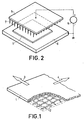
- FIG. 1 An example of such a fabric is illustrated diagrammatically in FIG. 1 by the reference 2.
- This fabric is then impregnated with a polymer 1 to form the composite material of the invention.
- the film can then be stretched in any direction parallel to the plane of this film and for example in directions 3 or 4 illustrated in the figure.
- semi-crystalline materials such as PVF z are capable of acquiring a polar phase of the ⁇ type by stretching.
- this polarization can be carried out by the Corona method, as illustrated in FIG. 2.
- the impregnated tissue 1 is stretched on a metallic plane 6, connected to the negative pole of an energy source of continuous high voltage 8.
- the voltage used is of the order of 15 KV, applied for 5 minutes at room temperature.
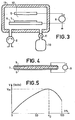
- FIG. 3 the elements of FIG. 2, namely the electrodes 5 and 6 and the film of composite material 1 are placed in an enclosure 13 in which Ika pressure is lowered using a vacuum pump 9.
- a neutral gas tank 10 provided with an adjustment valve 11 makes it possible to obtain discharge conditions such that a plasma is formed between the electrode 5 and the film in the region 12 A gas electrode is thus produced in this region.
- the two main faces of the film 1 are metallized to produce two electrodes 5 and 6.
- the electrodes 5 and 6 are connected as before to the positive and negative poles of a DC voltage source 8.
- This polarization can also be carried out according to other approaches not shown and, for example, by contacting the film of composite material on at least one of its faces with a conductive liquid electrode or by placing the film between two electrodes planes applied by pressure.
- the film of composite material of the invention can be used in different transducers and for example be used for the production of a pressure sensor.
- the previously described samples were metallized on both sides using a cold silver lacquer and the piezoelectric coefficients measured.
- the film placed on a plane was pressed using a known weight and the electrical charge developed between electrodes was measured.
- the piezoelectric coefficient measured is: d - 8 10- 13 CN - 1.
- the order of magnitude is sufficient for the composite material obtained according to the method of the invention to be usefully used as a piezoelectric transducer.
- FIG. 5 is a diagram showing the evolution of the tension response of a composite material produced according to the invention as a function of the above-mentioned percentage, this for a constant external stress (for example a pressure). We see that the curve passes through a maximum for x o .
- the composite material of the invention covers all the fields of application of piezoelectricity and pyroelectricity, in particular the electroacoustic devices, transmitters and receivers of ultrasound used in underwater acoustics, sensors of infrared radiation, inkjet recording devices, devices for igniting an explosive charge, electrical relays and electromechanical filters.
- the electroacoustic devices transmitters and receivers of ultrasound used in underwater acoustics
- sensors of infrared radiation sensors of infrared radiation
- inkjet recording devices devices for igniting an explosive charge
- electrical relays electrical relays and electromechanical filters
- the composite material film according to the invention may comprise more than one layer of fabrics or be reinforced by the fabric only in certain determined regions, the remaining part of the film being made up only of polymeric material.
Landscapes
- Engineering & Computer Science (AREA)
- Chemical & Material Sciences (AREA)
- Composite Materials (AREA)
- Materials Engineering (AREA)
- Manufacturing & Machinery (AREA)
- Treatments Of Macromolecular Shaped Articles (AREA)
- Laminated Bodies (AREA)
- Manufacture Of Macromolecular Shaped Articles (AREA)
- Piezo-Electric Transducers For Audible Bands (AREA)
Applications Claiming Priority (2)
| Application Number | Priority Date | Filing Date | Title |
|---|---|---|---|
| FR7922984 | 1979-09-14 | ||
| FR7922984A FR2465320A1 (fr) | 1979-09-14 | 1979-09-14 | Film de materiau composite piezo-electrique et son procede de fabrication |
Publications (2)
| Publication Number | Publication Date |
|---|---|
| EP0025751A1 EP0025751A1 (fr) | 1981-03-25 |
| EP0025751B1 true EP0025751B1 (fr) | 1982-12-22 |
Family
ID=9229661
Family Applications (1)
| Application Number | Title | Priority Date | Filing Date |
|---|---|---|---|
| EP80401271A Expired EP0025751B1 (fr) | 1979-09-14 | 1980-09-05 | Film de matériau composite piézo-électrique, et son procédé de fabrication |
Country Status (8)
| Country | Link |
|---|---|
| US (1) | US4327153A (online.php) |
| EP (1) | EP0025751B1 (online.php) |
| JP (1) | JPS5654082A (online.php) |
| CA (1) | CA1171979A (online.php) |
| DE (1) | DE3061434D1 (online.php) |
| FR (1) | FR2465320A1 (online.php) |
| GB (1) | GB2061614B (online.php) |
| NO (1) | NO802721L (online.php) |
Families Citing this family (24)
| Publication number | Priority date | Publication date | Assignee | Title |
|---|---|---|---|---|
| US4615848A (en) * | 1980-07-23 | 1986-10-07 | Minnesota Mining And Manufacturing Company | Pyroelectric and isotropic piezoelectric polymer blends |
| US4393093A (en) * | 1981-06-12 | 1983-07-12 | Pennwalt Corporation | Preparation of high gamma (α)phase poly(vinylidene fluoride) piezoelectric materials |
| FR2519503B1 (fr) * | 1981-12-31 | 1991-09-06 | Thomson Csf | Transducteurs piezoelectriques polymeres et procede de fabrication |
| US4465764A (en) * | 1982-09-30 | 1984-08-14 | Pennwalt Corporation | Use of pyroelectric and photovoltaic polyvinylidene fluoride to enchance the photosensitivity of silver halide emulsions and the products made thereby |
| JPS59118320U (ja) * | 1983-01-29 | 1984-08-09 | 加瀬 晃 | 電子部品用キヤツプ |
| GB8325861D0 (en) * | 1983-09-28 | 1983-11-02 | Syrinx Presicion Instr Ltd | Force transducer |
| GB8431682D0 (en) * | 1984-12-14 | 1985-01-30 | British Telecomm | Optical compositions |
| US4698110A (en) * | 1985-11-27 | 1987-10-06 | E. I. Du Pont De Nemours And Company | Preparation of fluoropolymer coated material |
| JPH01151813A (ja) * | 1987-12-09 | 1989-06-14 | Seiko Electronic Components Ltd | 小型水晶振動子 |
| US4918567A (en) * | 1988-12-08 | 1990-04-17 | Industrial Technology Research Institute | Moving corona discharging apparatus |
| JPH0511535U (ja) * | 1991-07-18 | 1993-02-12 | シチズン時計株式会社 | 水晶振動子 |
| DE4305081C2 (de) * | 1993-02-19 | 1996-08-01 | Minnesota Mining & Mfg | Verfahren und Vorrichtung zum Auftragen von Haftkleber auf Bogen aus Papier oder dergleichen Material |
| US5885722A (en) * | 1994-02-15 | 1999-03-23 | Minnesota Mining And Manufacturing | Method for applying coating materials to overlapped individuals sheets |
| US5851592A (en) * | 1994-08-17 | 1998-12-22 | Minnesota Mining And Manufacturing Company | Apparatus and method for applying coating materials to individual sheet members |
| FR2727215B1 (fr) * | 1994-11-18 | 1996-12-20 | Thomson Csf | Dispositif de veille panoramique infrarouge statique a detecteurs matriciels multiples |
| FR2750487B1 (fr) * | 1996-06-28 | 2005-10-21 | Thomson Csf | Revetement pour la protection personnelle d'un fantassin |
| US6447887B1 (en) | 1999-09-14 | 2002-09-10 | Virginia Tech Intellectual Properties, Inc. | Electrostrictive and piezoelectric thin film assemblies and method of fabrication therefor |
| JP4922482B2 (ja) * | 2000-12-28 | 2012-04-25 | マイクロストーン株式会社 | 圧電性ファイバおよび圧電性織物デバイス |
| US20040151978A1 (en) * | 2003-01-30 | 2004-08-05 | Huang Wen C. | Method and apparatus for direct-write of functional materials with a controlled orientation |
| TWI231644B (en) * | 2003-06-12 | 2005-04-21 | Tung Chiou Yue | Application of low-temperature solid-state type thermo-electric power converter |
| US20130153813A1 (en) * | 2010-07-27 | 2013-06-20 | Youtec Co. Ltd. | Poling treatment method, plasma poling device, piezoelectric substance, and manfacturing method therefor |
| ITRM20110461A1 (it) | 2011-09-07 | 2013-03-08 | Pielleitalia S R L | "materiale composito comprendente uno strato di materiale piezoelettrico polimerico accoppiato con un substrato tessile e procedimento per realizzare detto materiale composito" |
| JP5927475B2 (ja) * | 2014-09-08 | 2016-06-01 | 株式会社ユーテック | ポーリング処理方法、プラズマポーリング装置、圧電体及びその製造方法、成膜装置及びエッチング装置、ランプアニール装置 |
| US10959481B2 (en) | 2019-01-09 | 2021-03-30 | Zero Point Energy Inc. | Footwear apparatus with removable power supply |
Family Cites Families (8)
| Publication number | Priority date | Publication date | Assignee | Title |
|---|---|---|---|---|
| JPS5029159B1 (online.php) * | 1970-12-02 | 1975-09-20 | ||
| JPS5185499A (online.php) * | 1975-01-24 | 1976-07-27 | Kureha Chemical Ind Co Ltd | |
| FR2382488A1 (fr) * | 1977-03-04 | 1978-09-29 | Ugine Kuhlmann | Procede de traitement du polyfluorure de vinyle en vue de son adherence avec un autre polymere |
| JPS5953715B2 (ja) * | 1977-10-04 | 1984-12-26 | 日本特殊陶業株式会社 | 可撓性圧電シ−トの製造法 |
| FR2415000A1 (fr) * | 1978-01-20 | 1979-08-17 | Ugine Kuhlmann | Materiau composite polyfluorure de vinylidene et polyurethane obtenu par coextrusion |
| FR2435348A1 (fr) * | 1978-05-11 | 1980-04-04 | Solvay | Structure laminee comprenant une couche de polymere fluore |
| US4241128A (en) * | 1979-03-20 | 1980-12-23 | Bell Telephone Laboratories, Incorporated | Production of piezoelectric PVDF films |
| DE3011736A1 (de) * | 1979-03-26 | 1980-10-09 | Daikin Ind Ltd | Polymeres piezoelektrisches material und verfahren zu dessen herstellung |
-
1979
- 1979-09-14 FR FR7922984A patent/FR2465320A1/fr active Granted
-
1980
- 1980-09-05 EP EP80401271A patent/EP0025751B1/fr not_active Expired
- 1980-09-05 DE DE8080401271T patent/DE3061434D1/de not_active Expired
- 1980-09-11 CA CA000360126A patent/CA1171979A/en not_active Expired
- 1980-09-12 NO NO802721A patent/NO802721L/no unknown
- 1980-09-12 GB GB8029509A patent/GB2061614B/en not_active Expired
- 1980-09-15 US US06/186,845 patent/US4327153A/en not_active Expired - Lifetime
- 1980-09-16 JP JP12847280A patent/JPS5654082A/ja active Pending
Also Published As
| Publication number | Publication date |
|---|---|
| CA1171979A (en) | 1984-07-31 |
| FR2465320B1 (online.php) | 1981-09-11 |
| US4327153A (en) | 1982-04-27 |
| NO802721L (no) | 1981-03-16 |
| JPS5654082A (en) | 1981-05-13 |
| EP0025751A1 (fr) | 1981-03-25 |
| DE3061434D1 (en) | 1983-01-27 |
| GB2061614B (en) | 1983-08-17 |
| GB2061614A (en) | 1981-05-13 |
| FR2465320A1 (fr) | 1981-03-20 |
Similar Documents
| Publication | Publication Date | Title |
|---|---|---|
| EP0025751A1 (fr) | Film de matériau composite piézo-électrique, et son procédé de fabrication | |
| Murayama et al. | Persistent polarization in poly (vinylidene fluoride). II. Piezoelectricity of poly (vinylidene fluoride) thermoelectrets | |
| EP0086922B1 (fr) | Procédé de fabrication de transducteurs piézo-électriques polymères | |
| EP0048642B1 (fr) | Procédé de fabrication de films polymères piézoélectriques | |
| US4241128A (en) | Production of piezoelectric PVDF films | |
| EP0021879A1 (fr) | Dispositif transducteur sensible à la pression à élément en polymère piézoélectrique, et son procédé de fabrication | |
| CA2783951C (fr) | Materiau solide composite piezoelectrique et/ou pyroelectrique, procede d'obtention et utilisation d'un tel materiau | |
| CA1183595A (en) | Piezoelectric polymer material, a process for producing the same and an ultrasonic transducer utilized the same | |
| EP2202265B1 (en) | Electrolyte polymer film, polymer actuator using cross-linked PVDF-based polymer, and method of manufacturing the polymer actuator | |
| FR2645349A1 (fr) | Structure piezoelectrique stratifiee et procede pour sa formation | |
| GB2044992A (en) | Piezoelectric polmer transducer and method of fabrication | |
| Jiang et al. | Study of thermally poled and corona charged poly (vinylidene fluoride) films | |
| EP0316365A1 (en) | Process for making polarized material and polarized products | |
| FR2535113A1 (fr) | Procede de fabrication d'un materiau polymere piezo- ou pyroelectrique comportant une etape de reticulation | |
| FR2618801A1 (fr) | Film polymere composite conducteur et son procede de fabrication | |
| Scheinbeim et al. | Field‐induced dipole reorientation and piezoelectricity in heavily plasticized nylon 11 films | |
| US5336422A (en) | Polarized products and processes | |
| JP6395470B2 (ja) | 熱可塑性ポリ尿素薄膜、その積層体、およびそれらの製造方法 | |
| FR2700220A1 (fr) | Procédé pour polariser au moins une zone d'une feuille de matériau ferroélectrique, et procédé pour réaliser un élément polarisé pour capteur piézoélectrique ou pyroélectrique. | |
| EP0061374B1 (fr) | Procédé de fabrication d'un matériau composite piézoélectrique | |
| Mathur et al. | Piezoelectricity in uniaxially stretched and plasticized nylon 11 films | |
| CH318038A (fr) | Feuille isolante de l'électricité et utilisation de cette feuille | |
| Bloomfield | Production of ferroelectric oriented PVDF films | |
| FR2525616A1 (fr) | Materiaux polymeres piezoelectriques | |
| WO2026093687A1 (fr) | Polymère p(vdf-trfe-vc) et procédé d'obtention |
Legal Events
| Date | Code | Title | Description |
|---|---|---|---|
| PUAI | Public reference made under article 153(3) epc to a published international application that has entered the european phase |
Free format text: ORIGINAL CODE: 0009012 |
|
| AK | Designated contracting states |
Designated state(s): DE NL SE |
|
| 17P | Request for examination filed |
Effective date: 19810409 |
|
| GRAA | (expected) grant |
Free format text: ORIGINAL CODE: 0009210 |
|
| AK | Designated contracting states |
Designated state(s): DE NL SE |
|
| PG25 | Lapsed in a contracting state [announced via postgrant information from national office to epo] |
Ref country code: SE Effective date: 19821222 |
|
| REF | Corresponds to: |
Ref document number: 3061434 Country of ref document: DE Date of ref document: 19830127 |
|
| PGFP | Annual fee paid to national office [announced via postgrant information from national office to epo] |
Ref country code: SE Payment date: 19840930 Year of fee payment: 5 |
|
| PGFP | Annual fee paid to national office [announced via postgrant information from national office to epo] |
Ref country code: NL Payment date: 19870930 Year of fee payment: 8 |
|
| PG25 | Lapsed in a contracting state [announced via postgrant information from national office to epo] |
Ref country code: NL Effective date: 19890401 |
|
| NLV4 | Nl: lapsed or anulled due to non-payment of the annual fee | ||
| PGFP | Annual fee paid to national office [announced via postgrant information from national office to epo] |
Ref country code: DE Payment date: 19900814 Year of fee payment: 11 |
|
| PG25 | Lapsed in a contracting state [announced via postgrant information from national office to epo] |
Ref country code: DE Effective date: 19920602 |
|
| EUG | Se: european patent has lapsed |
Ref document number: 80401271.4 Effective date: 19890614 |
|
| PLBE | No opposition filed within time limit |
Free format text: ORIGINAL CODE: 0009261 |
|
| STAA | Information on the status of an ep patent application or granted ep patent |
Free format text: STATUS: NO OPPOSITION FILED WITHIN TIME LIMIT |