EP0025275B1 - Immunoglobulin-containing composition containing an aggregation preventing or aggregate dissociating agent for the immunoglobulin, and process for preparation thereof - Google Patents
Immunoglobulin-containing composition containing an aggregation preventing or aggregate dissociating agent for the immunoglobulin, and process for preparation thereof Download PDFInfo
- Publication number
- EP0025275B1 EP0025275B1 EP80302740A EP80302740A EP0025275B1 EP 0025275 B1 EP0025275 B1 EP 0025275B1 EP 80302740 A EP80302740 A EP 80302740A EP 80302740 A EP80302740 A EP 80302740A EP 0025275 B1 EP0025275 B1 EP 0025275B1
- Authority
- EP
- European Patent Office
- Prior art keywords
- immunoglobulin
- aggregated
- molecules
- water
- acid addition
- Prior art date
- Legal status (The legal status is an assumption and is not a legal conclusion. Google has not performed a legal analysis and makes no representation as to the accuracy of the status listed.)
- Expired
Links
Classifications
-
- A—HUMAN NECESSITIES
- A61—MEDICAL OR VETERINARY SCIENCE; HYGIENE
- A61K—PREPARATIONS FOR MEDICAL, DENTAL OR TOILETRY PURPOSES
- A61K39/00—Medicinal preparations containing antigens or antibodies
- A61K39/395—Antibodies; Immunoglobulins; Immune serum, e.g. antilymphocytic serum
- A61K39/39591—Stabilisation, fragmentation
-
- Y—GENERAL TAGGING OF NEW TECHNOLOGICAL DEVELOPMENTS; GENERAL TAGGING OF CROSS-SECTIONAL TECHNOLOGIES SPANNING OVER SEVERAL SECTIONS OF THE IPC; TECHNICAL SUBJECTS COVERED BY FORMER USPC CROSS-REFERENCE ART COLLECTIONS [XRACs] AND DIGESTS
- Y10—TECHNICAL SUBJECTS COVERED BY FORMER USPC
- Y10S—TECHNICAL SUBJECTS COVERED BY FORMER USPC CROSS-REFERENCE ART COLLECTIONS [XRACs] AND DIGESTS
- Y10S530/00—Chemistry: natural resins or derivatives; peptides or proteins; lignins or reaction products thereof
- Y10S530/827—Proteins from mammals or birds
- Y10S530/829—Blood
- Y10S530/83—Plasma; serum
- Y10S530/831—Cohn fractions
Definitions
- This invention relates to an immunoglobulin composition having a high monomer content, and to a process for production thereof.
- Immunoglobulins are of great medical significance as agents responsible for humoral immunity, and have immune activity against various pathogenic microorganisms. Administration of immunoglobulins can therefore lead to the prevention and treatment of viral infections such as measles and viral hepatitis and of infections caused by antibiotic-resistant bacteria such as staphylococci. In such prevention and treatment, intravenous injection is preferred to intramuscular injection in order to administer large amounts of an immunoglobulin and cause it to produce a rapid effect. However, intravenous administration of an immunoglobulin fractionated from human plasma may cause anaphylactic side-effects involving hypotension, chill and pyrexia, dyspnea, headache, etc.
- Such aggregated immunoglobulins are inherently contained in the immunoglobulins fractionated from human plasma, and tend to form gradually with the passage of time during their formulation into dosage forms.
- a method comprising treating an immunoglobulin containing aggregated molecules with plasmin, which is a protease, is also known to dissociate the aggregated immunoglobulin molecules into monomers.
- plasmin which is a protease
- the monomers will undergo decomposition upon standing in contact with the plasmin, and it is necessary to remove the plasmin completely after the treatment. It is difficult in practice to remove the plasmin completely, and moreover, with this method, a period of several days is required to dissociate the aggregated immunoglobulin molecules.
- Japanese Laid-Open Patent Publication No. 20124/79 discloses a method which comprises adding a neutral amino acid such as glycine or alanine, a sugar such as glucose or fructose, or a neutral inorganic salt such as sodium chloride or potassium chloride as a dissociating agent to gamma-globulin for intramuscular injection including aggregated molecules, thereby dissociating the aggregated gamma-globulin molecules and preventing re-formation of aggregated molecules.
- a neutral amino acid such as glycine or alanine
- a sugar such as glucose or fructose
- a neutral inorganic salt such as sodium chloride or potassium chloride
- immunoglobulin-containing compositions comprising these acid addition salts have a higher immunoglobulin monomer content and lower anti-complement activity than otherwise similar immunoglobulin-containing compositions comprising an acid addition salt of lysine.
- an immunoglobulin-containing composition comprising an immunoglobulin and an aggregation preventing or an aggregate dissociating agent for the immunoglobulin, characterised in that said agent is a water-soluble acid addition salt of a basic nitrogen-containing organic compound selected from L-arginine, guanidine, imidazole, 2-methylimidazole and L-leucinamide, said agent being present in an amount of from 1 to 600% by weight, based on the weight of the immunoglobulin.
- a basic nitrogen-containing organic compound selected from L-arginine, guanidine, imidazole, 2-methylimidazole and L-leucinamide
- a process for producing a composition containing a high proportion of monomeric immunoglobulin which comprises contacting an immunoglobulin in an aqueous solution with an agent to prevent aggregation of the monomeric immunoglobulin, and when immunoglobulin is present in the form of aggregated molecules, to dissociate the aggregated immunoglobulin molecules into monomers, characterised in that said immunoglobulin is contacted with, as said agent, from 1 to 600% by weight, based on the weight of the immunoglobulin, of a water-soluble acid addition salt of a basic nitrogen-containing organic compound selected from L-arginine, guanidine, imidazole, 2-methylimidazole and L-leucinamide at a temperature from 0° to 50°C and pH of from 5 to 8.
- a basic nitrogen-containing organic compound selected from L-arginine, guanidine, imidazole, 2-methylimidazole and L-leucinamide
- the product resulting from this process can be lyophilized.
- the immunoglobulin used in this invention consists mainly of gamma-globulin obtained from the serum, plasma and other body fluids or extracts of organs by a known method such as the ethanol fractionating method of Cohn et al. [E. G. Cohn et al., J. Am. Chem. Soc., 68, 459 (1946)].
- the immunoglobulin may be used as fractionated without purification (such immunoglobulin usually contains at least 20% by weight of aggregated immunoglobulin molecules having a sedimentation constant of at least 9S).
- the immunoglobulin may be purified by purifying methods known in the art, such as treatment at pH4, salting out, treatment with acrinol, or ion-exchange chromatography to reduce the content of aggregated immunoglobulin molecules to varying degrees, and sometimes to substantially zero.
- the basic nitrogen-containing organic compound is used in the form of a water-soluble acid addition salt in this invention.
- the water-soluble acid addition salt can be favorably prepared by using a mineral acid such as hydrochloric acid, hydrobromic acid, phosphoric acid or sulfuric acid or an organic carboxylic acid such as acetic acid.
- the mineral acid salts are preferred. Especially preferred are the mineral acid salts, above all hydrochlorides, of L-arginine, guanidine, L-leucinamide, imidazole, and 2-methylimidazole.
- the immunoglobulin composition of this invention contains 1 to 600% by weight, preferably 10 to 600% by weight, more preferably 20 to 400% by weight, based on the immunoglobulin, of the water-soluble acid addition salt of the basic nitrogen-containing organic compound. If the amount of the water-soluble acid addition salt is less than 1 % by weight, the effect of this compound to dissociate the aggregated immunoglobulins and prevent re-aggregation of the molecular chains of the immunoglobulin becomes so small as to deviate from the range intended by the present invention. If, on the other hand, it exceeds 600% by weight, the intended effect can be obtained but economic or operational disadvantages are caused.
- the immunoglobulin composition of this invention contains the water-soluble acid addition salt of the basic nitrogen-containing organic compound as an aggregation preventing agent or as an aggregate dissociating agent for the immunoglobulin.
- the water-soluble acid addition salt serves to dissociate the aggregated immunoglobulin molecules and prevent aggregation of the molecules of the immunoglobulin.
- the essence of this invention lies in the provision of an immunoglobulin composition which has a low content of the aggregated immunoglobulin molecules and therefore a high monomer content:
- the water-soluble acid addition salt of the basic nitrogen-containing organic compound of this invention acts not only as an aggregate dissociating agent for immunoglobulins but also as an aggregation inhibiting agent for immunoglobulins. Accordingly, the immunoglobulin composition of this invention may also be used as an intermediate in a process for producing an intravenously injectable immunoglobulin preparation from an immunoglobulin as fractionated (usually, a period of several days is required to formulate the fractionated immunoglobulin industrially into a lyophilized preparation).
- the immunoglobulin preparation for intravenous injection is prepared by adding the water-soluble acid-addition salt of the basic nitrogen-containing compound to an aqueous solution of the fractionated immunoglobulin in the early stage of the process for production of the intravenously injectable immunoglobulin preparation, performing the process while inhibiting aggregation of the immunoglobulin molecules, and removing the water-soluble acid addition salt of the basic nitrogen-containing organic compound by dialysis, etc. in a step as close as possible to the final step of lyophilization, and rapidly lyophilizing the resulting aqueous solution of immunoglobulin having a high monomer content.
- composition of this invention is produced by contacting an immunoglobulin containing aggregated immunoglobulin molecules with the water-soluble acid addition salt, or contacting a purified immunoglobulin substantially free from aggregated immunoglobulin molecules with the water-soluble acid addition salt.
- the immunoglobulin and the water-soluble acid addition salt of the basic nitrogen-containing organic compound are contacted in aqueous solution.
- the contacting is carried out at 0 to 50°C, preferably at 0 to 30°C, and the pH of the aqueous solution at the time of contact is 5 to 8.
- the greatest characteristic of the method of this invention is that as soon as the aggregated immunoglobulin molecules in the starting immunoglobulin are contacted with the water soluble acid addition salt under the aforesaid contacting conditions, dissociation of the aggregated molecules begins, and within a period of as short as 1 hour, dissociation of the aggregated immunoglobulin molecules can be substantially achieved and thereby an immunoglobulin having a high monomer content can be provided.
- a second feature of this invention is that even when the contacting is continued for a period beyond the aforesaid time, substantial dissociation of the aggregated immunoglobulin molecules is retained over a long period of time.
- the water-soluble acid addition salt may also be produced in situ by preparing an aqueous solution of the basic nitrogen-containing organic compound and adding to the aqueous solution an acid such as hydrochloric acid capable of converting the basic nitrogen containing organic compound into the water-soluble acid addition salt, to adjust its pH to 5 to 8.
- the resulting aqueous solution of immunoglobulin having a high monomer content can be lyophilized by a method known per se to provide the composition of this invention in the form of a lyophilized solid.
- the composition of this invention provided in the form of a lyophilized solid is an intravenously injectable composition comprising a non-toxic water-soluble acid addition salt capable of being used in intravenous injection.
- Such an intravenously injectable composition is dissolved in sterilized water or physiological saline to form an intravenous injecting preparation.
- the composition of this invention provided in the form of a lyophilized solid contains 1 to 100% by weight, based on the weight of the immunoglobulin, of a nontoxic water-soluble acid addition salt such as L-arginine hydrochloride.
- the method of this invention includes the following embodiments so long as the aggregated immunoglobulin molecules can be substantially dissociated and aggregation of the immunoglobulin molecules is substantially inhibited.
- the present invention provides the following types of composition.
- the method of this invention makes it possible to dissociate the aggregated molecules of an immunoglobulin, and to prevent aggregation of the immunoglobulin molecules. Accordingly, the invention also brings about the excellent advantage that aggregated molecules can be utilized as dissociated immunoglobulins which can be intravenously injected.
- the monomer content and the anticomplement activity of an immunoglobulin were measured by the following methods.
- the content of monomers is determined by subjecting 0.3 ml of a 5% aqueous solution of an immunoglobulin.
- Sepharose CL-6B (Pharmacia Co.) is used as a gel, and a column having a diameter of 1.5 cm and a length of 30 cm is used.
- the rate of flow of the solution is 1/6 ml/min.
- a 1% immunoglobulin solution containing guinea pig serum, 20 CH 50 /ml, adjusted to 5 ml with GVB" is incubated at 37°C for an hour, and the consumed complement is measured by the method described in Kabat Et Mayer, "Experimental Immunochemistry", page 225, 1961.
- the anticomplement activity levels are indicated by the percentage of consumption to 20 CH 50 /ml.
- immunoglobulin compositions obtained by adding water-soluble acid addition salts in accordance with the invention have a lower level of the concentration of aggregated molecules, and re-formation of aggregated molecules is inhibited over a longer period of time, than in the case of immunoglobulin compositions obtained in the Comparative Examples.
- a 10% solution of human immunoglobulin (fraction II obtained by the Cohn's ethanol fractionating method) was purified by salting out with sodium sulfate.
- To 10 ml of a 5% solution of the purified human immunoglobulin was added 1 g of L-arginine hydrochloride.
- the mixture was allowed to stand to 4°C for 1 week.
- the resulting mixture had an anticomplement activity of 21.5 and a monomer content of 93.0%.
- L-arginine hydrochloride was not added, the immunoglobulin had an anti- complement activity of 57.2 and a monomer content of 76.5%.
- a 10% solution of human immunoglobulin (fraction II obtained by the Cohn's ethanol fractionating method) was treated with acrinol to remove aggregated molecules.
- To 10 ml of a 5% solution of the purified human immunoglobulin was added 1 g of L-arginine hydrochloride.
- the mixture was allowed to stand at 4°C for 1 week.
- the product had an anticomplement activity of 19.6 and a monomer content of 91.5%.
- L-arginine hydrochloride was not added, the human immunoglobulin had an anti- complement activity of 57.0, and a monomer content of 77.2%.
- Powder of human immunoglobulin (fraction II obtained by the Cohn's ethanol fractionating method) was dissolved to a concentration of 2% in water containing 0.2% in human albumin and 2% of polyethylene glycol (PEG 4000).
- the pH of the aqueous solution was adjusted to 5.1, and the resulting turbidity (aggregated molecules) was removed by centrifugation.
- the polyethylene glycol concentration of the supernatent liquid was increased to 4% by adding a 50% solution of PEG 4000. After standing for one hour, the resulting precipitate (aggregated molecules) was removed by centrifugation. Ethanol was gradually added to the supernatant liquid at 0°C until the concentration became 6%.
- the mixture was allowed to stand overnight, and the resulting precipitate (aggregated molecules) was removed by centrifugation. Then, the pH of the mixture was adjusted to 8.0, and ethanol was further added to adjust the concentration of ethanol to 25%.
- the resulting turbidity (composed mainly of monomer) was collected by centrifugation, and dissolved in 0.9% aqueous solution of sodium chloride, and the solution was further dialyzed against 0.9% sodium chloride. The monomer content of the dialyzed solution was 93.2%.
- L-arginine hydrochloride was added to a concentration of 5%. On standing for a week, the monomer content was 93.5%. When L-arginine hydrochloride was not added, the monomer content was 85.2% on standing for a week.
- immunoglobulin compositions obtained by adding water-soluble acid addition salts in accordance with the invention have a higher monomer content and a much lower anticomplement activity than those obtained in the Comparative Examples because the aggregated molecules were dissociated, and that such monomer contents and anticomplement activities are substantially retained even after standing for 3 weeks.
- the monomer content and the anticomplement activity generally seem to be correlated to each other. It is noted that as the monomer content increases, the anticomplement activity generally tends to decrease. It may be said that a composition having a low anticomplement activity of generally not more than 20 contains an immunoglobulin which can be used for intravenous injection.
- Immunoglobulins containing no additive (Comparative Examples 1, 6 and 11), immunoglobulins containing glycine as an additive (Comparative Examples 2, 7 and 12) and immunoglobulins containing glucose as an additive (Comparative Examples 3, 8 and 13) have a high anticomplement activity and a low monomer content, and with time, their monomer contents gradually decrease. These results show that glycine and glucose cannot be substantially used as a dissociating agent for the aggregated molecules of immunoglobulins or as an aggregation inhibitor for immunoglobulins.
Landscapes
- Health & Medical Sciences (AREA)
- Medicinal Chemistry (AREA)
- Chemical & Material Sciences (AREA)
- Life Sciences & Earth Sciences (AREA)
- Mycology (AREA)
- Bioinformatics & Cheminformatics (AREA)
- Immunology (AREA)
- Microbiology (AREA)
- Engineering & Computer Science (AREA)
- Pharmacology & Pharmacy (AREA)
- Epidemiology (AREA)
- Animal Behavior & Ethology (AREA)
- General Health & Medical Sciences (AREA)
- Public Health (AREA)
- Veterinary Medicine (AREA)
- Medicines Containing Antibodies Or Antigens For Use As Internal Diagnostic Agents (AREA)
Description
- This invention relates to an immunoglobulin composition having a high monomer content, and to a process for production thereof.
- Immunoglobulins are of great medical significance as agents responsible for humoral immunity, and have immune activity against various pathogenic microorganisms. Administration of immunoglobulins can therefore lead to the prevention and treatment of viral infections such as measles and viral hepatitis and of infections caused by antibiotic-resistant bacteria such as staphylococci. In such prevention and treatment, intravenous injection is preferred to intramuscular injection in order to administer large amounts of an immunoglobulin and cause it to produce a rapid effect. However, intravenous administration of an immunoglobulin fractionated from human plasma may cause anaphylactic side-effects involving hypotension, chill and pyrexia, dyspnea, headache, etc. This is because aggregated immunoglobulin molecules in the immunoglobulin fractionated from human plasma combine with complements in the blood to activate them and thereby liberate biologically active factors such as an anaphylatoxin-like substance or a vascular-permeable factor.
- Such aggregated immunoglobulins are inherently contained in the immunoglobulins fractionated from human plasma, and tend to form gradually with the passage of time during their formulation into dosage forms.
- In an attempt to obtain intravenously injectable immunoglobulins free from the aforesaid defects, some methods have been suggested heretofore which include, for example, the removal of the aggregated immunoglobulin molecules, the dissociation of the aggregated molecules into monomers, or the inhibition of formation of the aggregated immunoglobulin molecules.
- For example, there have been proposed a method of removing the aggregated immunoglobulin molecules by subjecting an aqueous solution of an immunoglobulin to ultracentrifugation at 100,000 G, and a method of removing the aggregated immunoglobulin molecules by adding a polymeric substance such as polyethylene glycol, a salt such as ammonium sulfate, acrinol, etc. to a solution of an immunoglobulin to precipitate the aggregated immunoglobulin molecules. These methods, however, have the defect that the aggregated immunoglobulin molecules are not sufficiently removed, and moreover after the treatment, aggregation again begins. Furthermore, since these methods rely on the removal of the aggregated immunoglobulin molecules out of the system, the yield of the immunoglobulin that can be finally utilized decreases by an amount corresponding to the removed aggregated molecules.
- Treatment of an immunoglobulins containing aggregated molecules with an acidic aqueous solution at a pH of 4 is known as the method for dissociating the aggregated immunoglobulin molecules into monomers [see Acta Chemica Scandinavica, vol. 22, pages 490-496 (1968)]. The immunoglobulin, however, undergoes denaturation on standing for a long period of time at a pH of 4, and it is necessary to render the treating solution neutral after the treatment. At this time, the dissociated monomers again aggregate.
- A method comprising treating an immunoglobulin containing aggregated molecules with plasmin, which is a protease, is also known to dissociate the aggregated immunoglobulin molecules into monomers. However, the monomers will undergo decomposition upon standing in contact with the plasmin, and it is necessary to remove the plasmin completely after the treatment. It is difficult in practice to remove the plasmin completely, and moreover, with this method, a period of several days is required to dissociate the aggregated immunoglobulin molecules.
- Japanese Laid-Open Patent Publication No. 20124/79 discloses a method which comprises adding a neutral amino acid such as glycine or alanine, a sugar such as glucose or fructose, or a neutral inorganic salt such as sodium chloride or potassium chloride as a dissociating agent to gamma-globulin for intramuscular injection including aggregated molecules, thereby dissociating the aggregated gamma-globulin molecules and preventing re-formation of aggregated molecules. The specification of this Japanese Patent Publication states that in order to dissociate the aggregated gamma-globulin molecules completely into monomers, the reaction must be performed at 4 to 50°C for 2 to 30 days, preferably at 4°C for 20 to 30 days or at 37°C for 3 to 7 days. Thus, because of the slow rate of reaction, this method cannot be advantageously used in commercial practice.
- Acta Chemica Scandinavica vol 24, pages 1585-1589 (1970), reports studies on the effect upon immunoglobulin aggregation of straight-chain aliphatic alpha-amino acids with three or more carbon atoms. The aggregation preventing agents referred to in this document are, with one exception, added as amino acids or bases. The exception is DL-lysine monohydrochloride but no significance is attached by the author to the use of an acid addition salt as opposed to the corresponding amino acid.
- We have now found that certain water-soluble acid addition salts of basic nitrogen-containing organic compounds are highly effective in preventing or inhibiting the aggregation of immunoglobulin. Thus immunoglobulin-containing compositions comprising these acid addition salts have a higher immunoglobulin monomer content and lower anti-complement activity than otherwise similar immunoglobulin-containing compositions comprising an acid addition salt of lysine.
- According to the invention there is provided an immunoglobulin-containing composition comprising an immunoglobulin and an aggregation preventing or an aggregate dissociating agent for the immunoglobulin, characterised in that said agent is a water-soluble acid addition salt of a basic nitrogen-containing organic compound selected from L-arginine, guanidine, imidazole, 2-methylimidazole and L-leucinamide, said agent being present in an amount of from 1 to 600% by weight, based on the weight of the immunoglobulin.
- Also according to the invention there is provided a process for producing a composition containing a high proportion of monomeric immunoglobulin, which comprises contacting an immunoglobulin in an aqueous solution with an agent to prevent aggregation of the monomeric immunoglobulin, and when immunoglobulin is present in the form of aggregated molecules, to dissociate the aggregated immunoglobulin molecules into monomers, characterised in that said immunoglobulin is contacted with, as said agent, from 1 to 600% by weight, based on the weight of the immunoglobulin, of a water-soluble acid addition salt of a basic nitrogen-containing organic compound selected from L-arginine, guanidine, imidazole, 2-methylimidazole and L-leucinamide at a temperature from 0° to 50°C and pH of from 5 to 8.
- If desired, the product resulting from this process can be lyophilized.
- The immunoglobulin used in this invention consists mainly of gamma-globulin obtained from the serum, plasma and other body fluids or extracts of organs by a known method such as the ethanol fractionating method of Cohn et al. [E. G. Cohn et al., J. Am. Chem. Soc., 68, 459 (1946)]. The immunoglobulin may be used as fractionated without purification (such immunoglobulin usually contains at least 20% by weight of aggregated immunoglobulin molecules having a sedimentation constant of at least 9S). Or after fractionation, the immunoglobulin may be purified by purifying methods known in the art, such as treatment at pH4, salting out, treatment with acrinol, or ion-exchange chromatography to reduce the content of aggregated immunoglobulin molecules to varying degrees, and sometimes to substantially zero.
- The basic nitrogen-containing organic compound is used in the form of a water-soluble acid addition salt in this invention. The water-soluble acid addition salt can be favorably prepared by using a mineral acid such as hydrochloric acid, hydrobromic acid, phosphoric acid or sulfuric acid or an organic carboxylic acid such as acetic acid. The mineral acid salts are preferred. Especially preferred are the mineral acid salts, above all hydrochlorides, of L-arginine, guanidine, L-leucinamide, imidazole, and 2-methylimidazole.
- The immunoglobulin composition of this invention contains 1 to 600% by weight, preferably 10 to 600% by weight, more preferably 20 to 400% by weight, based on the immunoglobulin, of the water-soluble acid addition salt of the basic nitrogen-containing organic compound. If the amount of the water-soluble acid addition salt is less than 1 % by weight, the effect of this compound to dissociate the aggregated immunoglobulins and prevent re-aggregation of the molecular chains of the immunoglobulin becomes so small as to deviate from the range intended by the present invention. If, on the other hand, it exceeds 600% by weight, the intended effect can be obtained but economic or operational disadvantages are caused.
- The immunoglobulin composition of this invention contains the water-soluble acid addition salt of the basic nitrogen-containing organic compound as an aggregation preventing agent or as an aggregate dissociating agent for the immunoglobulin. The water-soluble acid addition salt serves to dissociate the aggregated immunoglobulin molecules and prevent aggregation of the molecules of the immunoglobulin.
- The essence of this invention lies in the provision of an immunoglobulin composition which has a low content of the aggregated immunoglobulin molecules and therefore a high monomer content:
- Since the immunoglobulin composition provided by this invention contains a lesser amount of aggregated immunoglobulin molecules and a much lower anticomplement activity than immunoglobulins fractionated from human plasma, it can sometimes be used directly as an immunoglobulin preparation for intravenous injection. For example, a composition in accordance with this invention comprising an immunoglobulin and 10 to 100% by weight of L-arginine hydrochloride can be directly formed into an immunoglobulin preparation for intravenous injection in a known manner.
- The water-soluble acid addition salt of the basic nitrogen-containing organic compound of this invention acts not only as an aggregate dissociating agent for immunoglobulins but also as an aggregation inhibiting agent for immunoglobulins. Accordingly, the immunoglobulin composition of this invention may also be used as an intermediate in a process for producing an intravenously injectable immunoglobulin preparation from an immunoglobulin as fractionated (usually, a period of several days is required to formulate the fractionated immunoglobulin industrially into a lyophilized preparation). Specifically, the immunoglobulin preparation for intravenous injection is prepared by adding the water-soluble acid-addition salt of the basic nitrogen-containing compound to an aqueous solution of the fractionated immunoglobulin in the early stage of the process for production of the intravenously injectable immunoglobulin preparation, performing the process while inhibiting aggregation of the immunoglobulin molecules, and removing the water-soluble acid addition salt of the basic nitrogen-containing organic compound by dialysis, etc. in a step as close as possible to the final step of lyophilization, and rapidly lyophilizing the resulting aqueous solution of immunoglobulin having a high monomer content.
- The composition of this invention is produced by contacting an immunoglobulin containing aggregated immunoglobulin molecules with the water-soluble acid addition salt, or contacting a purified immunoglobulin substantially free from aggregated immunoglobulin molecules with the water-soluble acid addition salt.
- When the immunoglobulin is contacted in aqueous solution with the water-soluble acid addition salt, dissociation of the aggregated immunoglobulin molecules proceeds, and the dissociated immunoglobulin molecules are prevented from re-aggregation.
- In the method of this invention, the immunoglobulin and the water-soluble acid addition salt of the basic nitrogen-containing organic compound are contacted in aqueous solution. The contacting is carried out at 0 to 50°C, preferably at 0 to 30°C, and the pH of the aqueous solution at the time of contact is 5 to 8.
- The greatest characteristic of the method of this invention is that as soon as the aggregated immunoglobulin molecules in the starting immunoglobulin are contacted with the water soluble acid addition salt under the aforesaid contacting conditions, dissociation of the aggregated molecules begins, and within a period of as short as 1 hour, dissociation of the aggregated immunoglobulin molecules can be substantially achieved and thereby an immunoglobulin having a high monomer content can be provided.
- A second feature of this invention is that even when the contacting is continued for a period beyond the aforesaid time, substantial dissociation of the aggregated immunoglobulin molecules is retained over a long period of time.
- In the latter-mentioned method, the water-soluble acid addition salt may also be produced in situ by preparing an aqueous solution of the basic nitrogen-containing organic compound and adding to the aqueous solution an acid such as hydrochloric acid capable of converting the basic nitrogen containing organic compound into the water-soluble acid addition salt, to adjust its pH to 5 to 8.
- According to the method of this invention, the resulting aqueous solution of immunoglobulin having a high monomer content, if required, can be lyophilized by a method known per se to provide the composition of this invention in the form of a lyophilized solid. Preferably, the composition of this invention provided in the form of a lyophilized solid is an intravenously injectable composition comprising a non-toxic water-soluble acid addition salt capable of being used in intravenous injection. Such an intravenously injectable composition is dissolved in sterilized water or physiological saline to form an intravenous injecting preparation.
- Preferably, the composition of this invention provided in the form of a lyophilized solid contains 1 to 100% by weight, based on the weight of the immunoglobulin, of a nontoxic water-soluble acid addition salt such as L-arginine hydrochloride.
- As can be appreciated from the foregoing, the method of this invention includes the following embodiments so long as the aggregated immunoglobulin molecules can be substantially dissociated and aggregation of the immunoglobulin molecules is substantially inhibited.
-
- 1) A method comprising contacting an immunoglobulin containing at least 20% by weight of aggregated molecules and prepared by the Cohn's ethanol fractionating method with the water-soluble acid addition salt in aqueous solution. If the immunoglobulin is provided as a lyophilized product, it is used as an aqueous solution. A solid mixture of such a solid immunoglobulin and a predetermined amount of the water-soluble acid addition salt should be understood as constituting part of the immunoglobulin composition of this invention because by converting it into an aqueous solution, substantial dissociation of the aggregated immunoglobulin molecules can be achieved.
- 2) A method comprising contacting an immunoglobulin treated with an acid by the method of Hanson et al. [Acta Chemica Scandinavica, vol. 22, pages 490-496 (1968)] with the water-soluble acid addition salt in aqueous solution. When the immunoglobulin treated with an acid by the method of Hanson et al. is adjusted to a pH near neutrality, the immunoglobulin molecules again aggregate. Moreover, when the immunoglobulin is maintained at a pH of about 4 for a long period of time, it undergoes denaturation. Thus, it is desirable to perform the acid treatment as immediately as possible before contact with the water-soluble acid addition salt.
- 3) A method comprising contacting a purified immunoglobulin substantially free from aggregated molecules with the water-soluble acid addition salt in aqueous solution. This method is naturally performed when the contacting time elapses in the methods 1) and 2).
- The present invention provides the following types of composition.
- 1) An immunoglobulin composition being substantially free from aggregated molecules and being in the form of an aqueous solution capable of being directly used for intravenous injection.
- 2) An immunoglobulin composition in the form of a lyophilized solid which does not substantially contain aggregated molecules and can be used as an intravenous injecting preparation by being formed into an aqueous solution.
- 3) An immunoglobulin composition which does not substantially contain aggregated molecules but is in the form of an aqueous solution which cannot be directly used as an intravenous injecting preparation. An intravenously injectable immunoglobulin preparation can be prepared by removing the water-soluble acid addition salt from this composition not suitable for intravenous injection.
- 4) An immunoglobulin composition in the form of a lyophilized solid which does not substantially contain aggregated molecules but cannot be used for intravenous injection even when it is formed into an aqueous solution. An intravenously injectable immunoglobulin preparation can be prepared from this type of composition by first dissolving it in water to form an aqueous solution, and then treating the aqueous solution in the same way as in the case of the composition 3) described above.
- As can be appreciated from the detailed description above, the method of this invention makes it possible to dissociate the aggregated molecules of an immunoglobulin, and to prevent aggregation of the immunoglobulin molecules. Accordingly, the invention also brings about the excellent advantage that aggregated molecules can be utilized as dissociated immunoglobulins which can be intravenously injected.
- The following Examples and Comparative Examples illustrate the present invention in detail. All percentages in these examples are by weight.
- In these examples, the monomer content and the anticomplement activity of an immunoglobulin were measured by the following methods.
- The content of monomers (sedimentation constant 7S; molecular weight about 160,000) is determined by subjecting 0.3 ml of a 5% aqueous solution of an immunoglobulin. Sepharose CL-6B (Pharmacia Co.) is used as a gel, and a column having a diameter of 1.5 cm and a length of 30 cm is used. The rate of flow of the solution is 1/6 ml/min.
- A 1% immunoglobulin solution containing guinea pig serum, 20 CH50/ml, adjusted to 5 ml with GVB" is incubated at 37°C for an hour, and the consumed complement is measured by the method described in Kabat Et Mayer, "Experimental Immunochemistry", page 225, 1961. The anticomplement activity levels are indicated by the percentage of consumption to 20 CH50/ml.
- A predetermined amount of each of the additives shown in Table 1 (the water-soluble acid addition salts in accordance with this invention of comparative additives) was added to 10 ml of a 5% solution of human immunoglobulin (fraction 11 obtained by the Cohn's ethanol fractionating method; a product of Armour Co.) (monomer content 76.3%; anticomplement activity more than 90). One hour later, the content of monomer and the anticomplement value of the immunoglobulin were measured. The results are shown in Table 1.

- It is seen from Table 1 that immunoglobulins obtained by adding water-soluble acid addition salts in accordance with the invention (Examples 1 to 7) have a higher monomer content and a much lower anti-complement activity than those obtained in Comparative Examples 1 to 5 because the aggregated molecules of the immunoglobulin are dissociated.
- 10 ml of a 10% solution of human immunoglobulin (fraction II obtained by the Cohn's ethanol fractionating method) was dialyzed with a 0.1 M acetate buffer having a pH of 4, and then treated with an acid by the method of Hanson et al. [see Acta Chemica Scandinavica, vol. 22, pages 490-496, 1968). Then, it was neutralized by dialyzing it against a 0.05M phosphate buffer (pH=7.0) containing 0.50M of sodium chloride to obtain 12 ml of acid-treated gamma-globulin having a pH of 4 (concentration 8%).
- A predetermined amount of each of the additives (the water-soluble acid addition salts in accordance with the invention and comparative additives) shown in Table 2 was added to 10 ml of a 5% solution of the acid-treated gamma-globulin. The monomer content and the anticomplement activity of the acid-treated gamma-globulin were measured one hour after the addition and after standing for a week at 4°C. The results are shown in Table 2.

- It is seen from Table 2 that immunoglobulin compositions obtained by adding water-soluble acid addition salts in accordance with the invention (Examples 8 to 15) have a lower level of the concentration of aggregated molecules, and re-formation of aggregated molecules is inhibited over a longer period of time, than in the case of immunoglobulin compositions obtained in the Comparative Examples.
- A 10% solution of human immunoglobulin (fraction II obtained by the Cohn's ethanol fractionating method) was purified by salting out with sodium sulfate. To 10 ml of a 5% solution of the purified human immunoglobulin was added 1 g of L-arginine hydrochloride. The mixture was allowed to stand to 4°C for 1 week. The resulting mixture had an anticomplement activity of 21.5 and a monomer content of 93.0%. When L-arginine hydrochloride was not added, the immunoglobulin had an anti- complement activity of 57.2 and a monomer content of 76.5%.
- A 10% solution of human immunoglobulin (fraction II obtained by the Cohn's ethanol fractionating method) was treated with acrinol to remove aggregated molecules. To 10 ml of a 5% solution of the purified human immunoglobulin was added 1 g of L-arginine hydrochloride. The mixture was allowed to stand at 4°C for 1 week. The product had an anticomplement activity of 19.6 and a monomer content of 91.5%. When L-arginine hydrochloride was not added, the human immunoglobulin had an anti- complement activity of 57.0, and a monomer content of 77.2%.
- Powder of human immunoglobulin (fraction II obtained by the Cohn's ethanol fractionating method) was dissolved to a concentration of 2% in water containing 0.2% in human albumin and 2% of polyethylene glycol (PEG 4000). The pH of the aqueous solution was adjusted to 5.1, and the resulting turbidity (aggregated molecules) was removed by centrifugation. The polyethylene glycol concentration of the supernatent liquid was increased to 4% by adding a 50% solution of PEG 4000. After standing for one hour, the resulting precipitate (aggregated molecules) was removed by centrifugation. Ethanol was gradually added to the supernatant liquid at 0°C until the concentration became 6%. The mixture was allowed to stand overnight, and the resulting precipitate (aggregated molecules) was removed by centrifugation. Then, the pH of the mixture was adjusted to 8.0, and ethanol was further added to adjust the concentration of ethanol to 25%. The resulting turbidity (composed mainly of monomer) was collected by centrifugation, and dissolved in 0.9% aqueous solution of sodium chloride, and the solution was further dialyzed against 0.9% sodium chloride. The monomer content of the dialyzed solution was 93.2%. L-arginine hydrochloride was added to a concentration of 5%. On standing for a week, the monomer content was 93.5%. When L-arginine hydrochloride was not added, the monomer content was 85.2% on standing for a week.
- A predetermined amount of each of the additives shown in Table 3 was added to 10 ml of a 5% solution of human immunoglobulin (fraction II obtained by the Cohn's ethanol fractionating method). The gamma-globulin monomer content and anticomplement activity were measured one hour after the addition and after standing at 4°C for 3 weeks. The results are shown in Table 3.
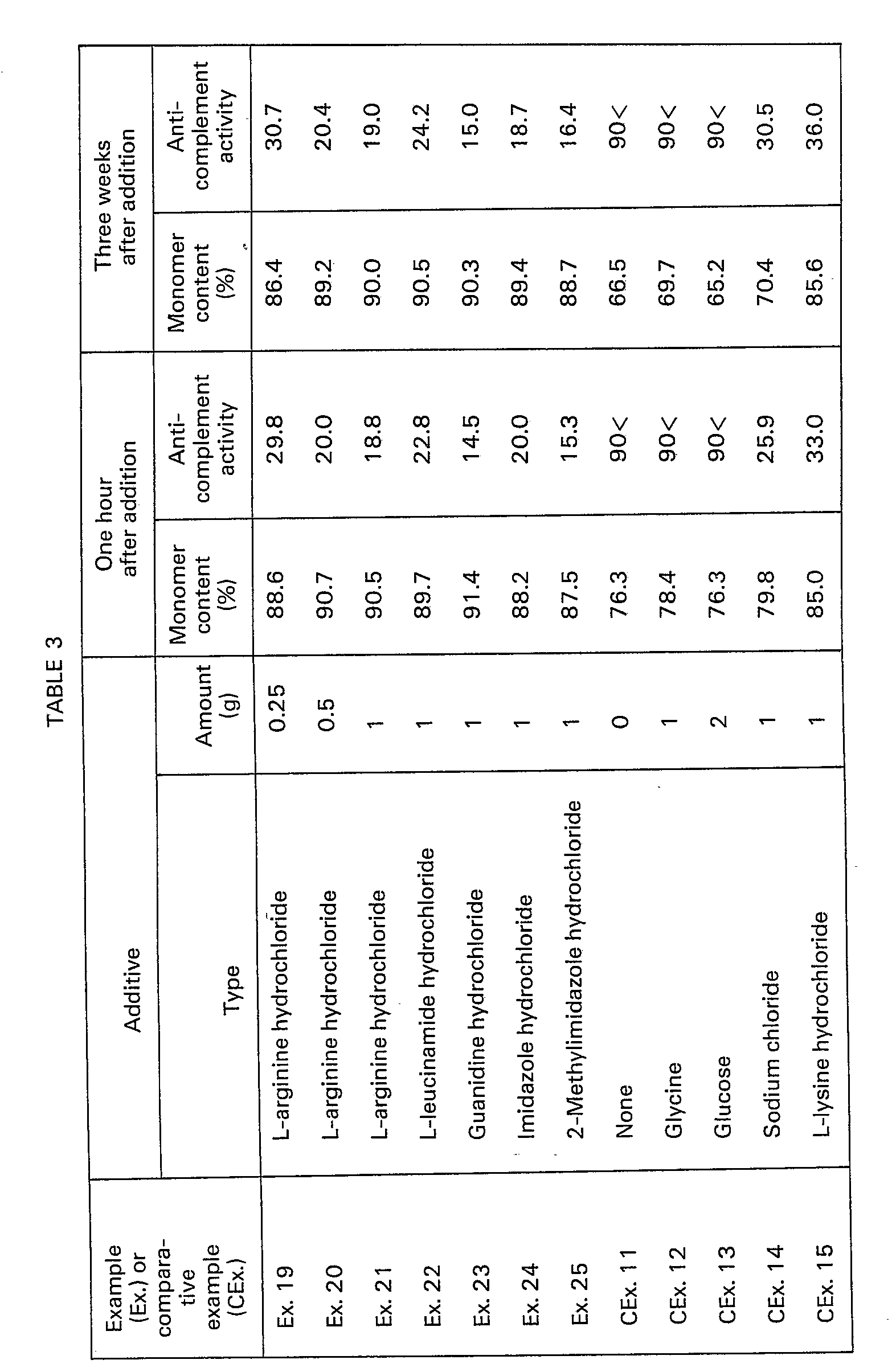
- It is seen from Table 3 that immunoglobulin compositions obtained by adding water-soluble acid addition salts in accordance with the invention (Examples 19 to 25) have a higher monomer content and a much lower anticomplement activity than those obtained in the Comparative Examples because the aggregated molecules were dissociated, and that such monomer contents and anticomplement activities are substantially retained even after standing for 3 weeks.
- To 10 ml of a 5% solution of human immunoglobulin (fraction II obtained by the Cohn's ethanol fractionating method) was added 0.5 g of L-arginine hydrobromide or 1 g of guanidine hydrobromide. The results obtained are shown in Table 4.

- In Tables 1 to 4, the monomer content and the anticomplement activity generally seem to be correlated to each other. It is noted that as the monomer content increases, the anticomplement activity generally tends to decrease. It may be said that a composition having a low anticomplement activity of generally not more than 20 contains an immunoglobulin which can be used for intravenous injection.
- Immunoglobulins containing no additive (Comparative Examples 1, 6 and 11), immunoglobulins containing glycine as an additive (Comparative Examples 2, 7 and 12) and immunoglobulins containing glucose as an additive (Comparative Examples 3, 8 and 13) have a high anticomplement activity and a low monomer content, and with time, their monomer contents gradually decrease. These results show that glycine and glucose cannot be substantially used as a dissociating agent for the aggregated molecules of immunoglobulins or as an aggregation inhibitor for immunoglobulins.
- When sodium chloride was used (Comparative Examples 4, 9 and 14), substantially the same tendency as in the case of using glycine or glucose is noted. It is clearly seen that when sodium chloride is used, the anticomplement activity of an immunoglobulin is lower than in the case of using glycine or glucose, but the monomer content is much the same as in the case of using glycine or glucose. It is presumed therefore that a correct anticomplement activity is not shown because sodium chloride exerts some influence on the assay system for anticomplement activity.
Claims (6)
Priority Applications (1)
| Application Number | Priority Date | Filing Date | Title |
|---|---|---|---|
| AT80302740T ATE11370T1 (en) | 1979-08-09 | 1980-08-08 | COMPOSITION CONTAINING AN IMMUNOGLOBULIN AND ANAGAGING ANTI-AGAGING AGENT OR AGAGING DISSOCIATION AGENT AND PROCESS FOR THE PREPARATION THEREOF. |
Applications Claiming Priority (4)
| Application Number | Priority Date | Filing Date | Title |
|---|---|---|---|
| JP100757/79 | 1979-08-09 | ||
| JP10075779A JPS5625115A (en) | 1979-08-09 | 1979-08-09 | Immunoglobulin composition |
| JP100758/79 | 1979-08-09 | ||
| JP10075879A JPS5625116A (en) | 1979-08-09 | 1979-08-09 | Preparation of immunoglobulin having high content of monomer |
Publications (3)
| Publication Number | Publication Date |
|---|---|
| EP0025275A2 EP0025275A2 (en) | 1981-03-18 |
| EP0025275A3 EP0025275A3 (en) | 1981-12-16 |
| EP0025275B1 true EP0025275B1 (en) | 1985-01-23 |
Family
ID=26441715
Family Applications (1)
| Application Number | Title | Priority Date | Filing Date |
|---|---|---|---|
| EP80302740A Expired EP0025275B1 (en) | 1979-08-09 | 1980-08-08 | Immunoglobulin-containing composition containing an aggregation preventing or aggregate dissociating agent for the immunoglobulin, and process for preparation thereof |
Country Status (4)
| Country | Link |
|---|---|
| US (1) | US4362661A (en) |
| EP (1) | EP0025275B1 (en) |
| CA (1) | CA1165235A (en) |
| DE (1) | DE3070012D1 (en) |
Families Citing this family (28)
| Publication number | Priority date | Publication date | Assignee | Title |
|---|---|---|---|---|
| US4374763A (en) * | 1979-09-17 | 1983-02-22 | Morishita Pharmaceutical Co., Ltd. | Method for producing gamma-globulin for use in intravenous administration and method for producing a pharmaceutical preparation thereof |
| JPS56113713A (en) * | 1980-02-14 | 1981-09-07 | Chemo Sero Therapeut Res Inst | Preparation of immunoglobulin with high content of monomer |
| DE3203775A1 (en) * | 1982-02-04 | 1983-08-11 | Behringwerke Ag, 3550 Marburg | FIBRINOGEN PREPARATION, METHOD FOR THEIR PRODUCTION AND THEIR USE |
| US4432895A (en) * | 1982-11-24 | 1984-02-21 | Hoffmann-La Roche Inc. | Monomeric interferons |
| JPS59157017A (en) * | 1983-02-25 | 1984-09-06 | Green Cross Corp:The | Gamma-globulin preparation for intravenous injection |
| US4597966A (en) * | 1985-01-09 | 1986-07-01 | Ortho Diagnostic Systems, Inc. | Histidine stabilized immunoglobulin and method of preparation |
| EP0448605A4 (en) * | 1988-12-15 | 1991-11-21 | Invitron Corporation | Use of basic amino acids to solubilize immunoglobulins |
| US5945098A (en) * | 1990-02-01 | 1999-08-31 | Baxter International Inc. | Stable intravenously-administrable immune globulin preparation |
| US5219578A (en) * | 1991-02-25 | 1993-06-15 | Innovet, Inc. | Composition and method for immunostimulation in mammals |
| GB9418092D0 (en) * | 1994-09-08 | 1994-10-26 | Red Cross Found Cent Lab Blood | Organic compounds |
| DK0917879T3 (en) | 1997-11-22 | 2002-11-04 | Roche Diagnostics Gmbh | Improved protein stabilization method |
| SI1478394T1 (en) | 2002-02-27 | 2008-12-31 | Immunex Corp | Stabilized TNFR-Fc composition comprising arginine |
| US20040002451A1 (en) | 2002-06-20 | 2004-01-01 | Bruce Kerwin | Compositions of pegylated soluble tumor necrosis factor receptors and methods of preparing |
| AU2004210679A1 (en) * | 2003-02-10 | 2004-08-26 | Elan Pharmaceuticals, Inc. | Immunoglobulin formulation and method of preparation thereof |
| EP1532983A1 (en) * | 2003-11-18 | 2005-05-25 | ZLB Bioplasma AG | Immunoglobulin preparations having increased stability |
| US20060051347A1 (en) | 2004-09-09 | 2006-03-09 | Winter Charles M | Process for concentration of antibodies and therapeutic products thereof |
| WO2006138181A2 (en) | 2005-06-14 | 2006-12-28 | Amgen Inc. | Self-buffering protein formulations |
| TWI532498B (en) | 2008-03-17 | 2016-05-11 | 巴克斯特保健公司 | Combination and method for subcutaneous administration of immunoglobulin and hyaluronic acid |
| KR20170116193A (en) | 2008-06-20 | 2017-10-18 | 노파르티스 아게 | Immunoglobulins with reduced aggregation |
| CN102655853B (en) | 2009-09-17 | 2015-07-29 | 巴克斯特卫生保健有限公司 | The stable compound formulation of hyaluronidase and immunoglobulin and using method thereof |
| JP6078344B2 (en) | 2010-02-04 | 2017-02-08 | ツェー・エス・エル・ベーリング・アクチエンゲゼルシャフト | Immunoglobulin preparation |
| EP2361636A1 (en) | 2010-02-26 | 2011-08-31 | CSL Behring AG | Immunoglobulin preparation and storage system for an immunoglobulin preparation |
| EP2552482A2 (en) | 2010-03-31 | 2013-02-06 | Université de Genève | Stabilized antibody preparations and uses thereof |
| WO2011121559A2 (en) | 2010-03-31 | 2011-10-06 | Universite De Geneve | Stabilized antibody preparations and uses thereof |
| US9474803B2 (en) | 2012-11-27 | 2016-10-25 | Alteogen Inc. | Composition for stabilizing fusion protein in which protein and FC domain are fused |
| HUE052280T2 (en) | 2014-12-03 | 2021-04-28 | Csl Behring Ag | Pharmaceutical product with increased stability containing immunoglobulins |
| ES3064802T3 (en) | 2016-10-21 | 2026-04-29 | Amgen Inc | Pharmaceutical formulations and methods of making the same |
| US11236146B2 (en) | 2016-10-28 | 2022-02-01 | Celltrion Inc. | Stable pharmaceutical formulation |
Family Cites Families (4)
| Publication number | Priority date | Publication date | Assignee | Title |
|---|---|---|---|---|
| DE2560155C2 (en) * | 1974-03-08 | 1984-04-26 | Teijin Ltd., Osaka | Human immunoglobulin derivative |
| US4118379A (en) * | 1974-09-06 | 1978-10-03 | Behringwerke Aktiengesellschaft | Amidated immune globulins and process for preparing them |
| US4374763A (en) * | 1979-09-17 | 1983-02-22 | Morishita Pharmaceutical Co., Ltd. | Method for producing gamma-globulin for use in intravenous administration and method for producing a pharmaceutical preparation thereof |
| JPS56113713A (en) * | 1980-02-14 | 1981-09-07 | Chemo Sero Therapeut Res Inst | Preparation of immunoglobulin with high content of monomer |
-
1980
- 1980-08-06 US US06/175,739 patent/US4362661A/en not_active Expired - Lifetime
- 1980-08-08 EP EP80302740A patent/EP0025275B1/en not_active Expired
- 1980-08-08 DE DE8080302740T patent/DE3070012D1/en not_active Expired
- 1980-08-11 CA CA000357959A patent/CA1165235A/en not_active Expired
Also Published As
| Publication number | Publication date |
|---|---|
| DE3070012D1 (en) | 1985-03-07 |
| CA1165235A (en) | 1984-04-10 |
| EP0025275A2 (en) | 1981-03-18 |
| US4362661A (en) | 1982-12-07 |
| EP0025275A3 (en) | 1981-12-16 |
Similar Documents
| Publication | Publication Date | Title |
|---|---|---|
| US4362661A (en) | Immunoglobulin composition having a high monomer content, and process for production thereof | |
| JP3004729B2 (en) | Liquid immunoglobulin preparation | |
| US4597966A (en) | Histidine stabilized immunoglobulin and method of preparation | |
| US4374763A (en) | Method for producing gamma-globulin for use in intravenous administration and method for producing a pharmaceutical preparation thereof | |
| Skeggs Jr et al. | The preparation and function of the hypertensin-converting enzyme | |
| US4880913A (en) | Process for the preparation of an immunoglobulin which can be administered intravenously and is stable in liquid form | |
| EP0196761B1 (en) | Method of virus-inactivating heat treatment of gamma-globulin | |
| JP3176604B2 (en) | Factor Xa inhibitor and pharmaceutical composition containing the same | |
| JPH0694421B2 (en) | Intravenous immunoglobulin | |
| CA1137413A (en) | Method for the production of immunoglobulin having a high monomer content | |
| US4168303A (en) | Lyophilized native gamma globulin preparation for intravenous administration | |
| WO1998042376A1 (en) | Composition comprising immunoglobulin | |
| US4650858A (en) | Concentrate of the antihemophilic factor VIII and a process for producing it | |
| US4360457A (en) | S-Sulfonated immunoglobulin composition having a high monomer content and a process for production thereof | |
| CA2161682A1 (en) | Liquid globulin composition for intravenous injection, process for producing the same, and method of inhibiting globulin dimer increase in said composition | |
| US4356173A (en) | IgM Derivatives and process for the preparation thereof | |
| JPS647051B2 (en) | ||
| JPS6016406B2 (en) | Method for producing intravenously administrable gamma globulin and gamma globulin prepared thereby | |
| CA1059504A (en) | Acylated orgotein | |
| EP0449897B1 (en) | A pure factor i protein and a process for producing said protein | |
| JPS6155895B2 (en) | ||
| JPH07503705A (en) | Pharmaceutical lysine-containing polypeptide compositions and methods of use thereof | |
| JPH02111728A (en) | Production of albumin preparation | |
| KR810001235B1 (en) | Method for preparing lyophilized natural gamma globulin for intravenous injection | |
| JPS62886B2 (en) |
Legal Events
| Date | Code | Title | Description |
|---|---|---|---|
| PUAI | Public reference made under article 153(3) epc to a published international application that has entered the european phase |
Free format text: ORIGINAL CODE: 0009012 |
|
| AK | Designated contracting states |
Designated state(s): AT CH DE FR GB IT NL SE |
|
| PUAL | Search report despatched |
Free format text: ORIGINAL CODE: 0009013 |
|
| AK | Designated contracting states |
Designated state(s): AT CH DE FR GB IT NL SE |
|
| 17P | Request for examination filed |
Effective date: 19820420 |
|
| 18W | Application withdrawn |
Withdrawal date: 19840704 |
|
| D18W | Application withdrawn (deleted) | ||
| ITF | It: translation for a ep patent filed | ||
| GRAA | (expected) grant |
Free format text: ORIGINAL CODE: 0009210 |
|
| AK | Designated contracting states |
Designated state(s): AT CH DE FR GB IT LI NL SE |
|
| REF | Corresponds to: |
Ref document number: 11370 Country of ref document: AT Date of ref document: 19850215 Kind code of ref document: T |
|
| REF | Corresponds to: |
Ref document number: 3070012 Country of ref document: DE Date of ref document: 19850307 |
|
| ET | Fr: translation filed | ||
| PLBE | No opposition filed within time limit |
Free format text: ORIGINAL CODE: 0009261 |
|
| STAA | Information on the status of an ep patent application or granted ep patent |
Free format text: STATUS: NO OPPOSITION FILED WITHIN TIME LIMIT |
|
| 26N | No opposition filed | ||
| ITTA | It: last paid annual fee | ||
| EAL | Se: european patent in force in sweden |
Ref document number: 80302740.8 |
|
| PGFP | Annual fee paid to national office [announced via postgrant information from national office to epo] |
Ref country code: FR Payment date: 19990617 Year of fee payment: 20 |
|
| PGFP | Annual fee paid to national office [announced via postgrant information from national office to epo] |
Ref country code: SE Payment date: 19990621 Year of fee payment: 20 |
|
| PGFP | Annual fee paid to national office [announced via postgrant information from national office to epo] |
Ref country code: CH Payment date: 19990622 Year of fee payment: 20 |
|
| PGFP | Annual fee paid to national office [announced via postgrant information from national office to epo] |
Ref country code: GB Payment date: 19990625 Year of fee payment: 20 |
|
| PGFP | Annual fee paid to national office [announced via postgrant information from national office to epo] |
Ref country code: NL Payment date: 19990630 Year of fee payment: 20 |
|
| PGFP | Annual fee paid to national office [announced via postgrant information from national office to epo] |
Ref country code: AT Payment date: 19990709 Year of fee payment: 20 |
|
| PGFP | Annual fee paid to national office [announced via postgrant information from national office to epo] |
Ref country code: DE Payment date: 19990930 Year of fee payment: 20 |
|
| PG25 | Lapsed in a contracting state [announced via postgrant information from national office to epo] |
Ref country code: LI Free format text: LAPSE BECAUSE OF EXPIRATION OF PROTECTION Effective date: 20000807 Ref country code: GB Free format text: LAPSE BECAUSE OF EXPIRATION OF PROTECTION Effective date: 20000807 Ref country code: CH Free format text: LAPSE BECAUSE OF EXPIRATION OF PROTECTION Effective date: 20000807 |
|
| PG25 | Lapsed in a contracting state [announced via postgrant information from national office to epo] |
Ref country code: NL Free format text: LAPSE BECAUSE OF EXPIRATION OF PROTECTION Effective date: 20000808 Ref country code: AT Free format text: LAPSE BECAUSE OF EXPIRATION OF PROTECTION Effective date: 20000808 |
|
| PG25 | Lapsed in a contracting state [announced via postgrant information from national office to epo] |
Ref country code: SE Free format text: THE PATENT HAS BEEN ANNULLED BY A DECISION OF A NATIONAL AUTHORITY Effective date: 20000830 |
|
| REG | Reference to a national code |
Ref country code: GB Ref legal event code: PE20 Effective date: 20000807 |
|
| REG | Reference to a national code |
Ref country code: CH Ref legal event code: PL |
|
| NLV7 | Nl: ceased due to reaching the maximum lifetime of a patent |
Effective date: 20000808 |
|
| EUG | Se: european patent has lapsed |
Ref document number: 80302740.8 |