EP0024498B1 - Non-bleeding thixotropic thermally conductive dielectric material - Google Patents
Non-bleeding thixotropic thermally conductive dielectric material Download PDFInfo
- Publication number
- EP0024498B1 EP0024498B1 EP80103557A EP80103557A EP0024498B1 EP 0024498 B1 EP0024498 B1 EP 0024498B1 EP 80103557 A EP80103557 A EP 80103557A EP 80103557 A EP80103557 A EP 80103557A EP 0024498 B1 EP0024498 B1 EP 0024498B1
- Authority
- EP
- European Patent Office
- Prior art keywords
- thermally conductive
- present
- lamellar
- zinc oxide
- thermal
- Prior art date
- Legal status (The legal status is an assumption and is not a legal conclusion. Google has not performed a legal analysis and makes no representation as to the accuracy of the status listed.)
- Expired
Links
Images

Classifications
-
- C—CHEMISTRY; METALLURGY
- C09—DYES; PAINTS; POLISHES; NATURAL RESINS; ADHESIVES; COMPOSITIONS NOT OTHERWISE PROVIDED FOR; APPLICATIONS OF MATERIALS NOT OTHERWISE PROVIDED FOR
- C09K—MATERIALS FOR MISCELLANEOUS APPLICATIONS, NOT PROVIDED FOR ELSEWHERE
- C09K5/00—Heat-transfer, heat-exchange or heat-storage materials, e.g. refrigerants; Materials for the production of heat or cold by chemical reactions other than by combustion
- C09K5/08—Materials not undergoing a change of physical state when used
-
- H—ELECTRICITY
- H10—SEMICONDUCTOR DEVICES; ELECTRIC SOLID-STATE DEVICES NOT OTHERWISE PROVIDED FOR
- H10W—GENERIC PACKAGES, INTERCONNECTIONS, CONNECTORS OR OTHER CONSTRUCTIONAL DETAILS OF DEVICES COVERED BY CLASS H10
- H10W72/00—Interconnections or connectors in packages
- H10W72/851—Dispositions of multiple connectors or interconnections
- H10W72/874—On different surfaces
- H10W72/877—Bump connectors and die-attach connectors
Definitions
- the present invention relates to non-bleeding thixotropic thermally conductive dielectric materials which find special but not exclusive use as heat transfer materials for cooling electronic components.
- U.S.-A-4,001,128 teaches an electrical insulating material especially suitable for high- voltage applications which comprises a polymer and an anti-tracking filler system comprising at least 20% by weight of aluminium trihydrate and at least 196 by weight of an inorganic silica filler which has been treated with an organic silicone compound. While liquid silicone materials are mentioned as possible polymers, this patent fails to disclose any improvement in bleed characteristics and does not disclose the use of thermal filler powders or bleed stopping agents as contemplated in the present invention. It should be noted that the aluminium trihydrate is alien to the present invention; it is amorphous and its main function appears to be as a water retainer.
- U.S.-A-2,428,608 teaches plastic dielectric compositions which comprise a finely- divided inorganic aerogel, e.g., of silicon dioxide, aluminium oxide or iron oxide, or a mixture thereof, blended with a liquid polymer of an organo-silicone to be well adapted for sealing the space between an electric conductor and an adjacent grounded metal.
- This patent does not provide the unique characteristics of the material of the present invention nor the use of a thermal filler powder specifically of the kind called for in the present invention.
- Bass specifically suggests the use of powdered mica; mica is a good heat insulator and, since it is a mineral, its purity cannot be readily controlled. It thus cannot be substituted for either the boron or aluminium nitride of the present invention.
- organopolysiloxane grease compositions of low noise level having, inter alia, good dielectric properties and heat transfer properties can be obtained by utilizing certain proportions of a polysiloxane fluid, a dielectric desiccant selected from anhydrous calcium sulfate and synthetic zeolites, and a grease thickening and thermal conducting agent.
- Useful thickening agents include silica, and useful thermal conducting agents include zinc oxide.
- thermally conductive grease has been utilized.
- Such modules generally comprise a cap portion to protect the integrated circuit chip; the thermally conductive grease is typically applied between the integrated circuit chip and the cap, either in direct contact with both elements or separated from one or both by a thin wall of some type. Heat generated from the integrated circuit chip during use is conducted from the integrated circuit chip by the grease to the module cap, whereafter it is dissipated into the ambient surroundings.
- Thermally conductive greases for this purpose are well known; typically, they comprise a liquid carrier of some type and a thermal filler to increase heat conduction.
- Various other components may also be present to achieve various specific purposes, for example, to thicken the grease, remove moisture from the grease, and the like.
- the present invention provides a thermally conductive grease which exhibits the following excellent features:
- thermally conducting grease of the present invention i.e., liquid silicone carrier, thermal filler powder, and bleed inhibiting agent, and their preferred proportions in the thermally conductive grease of the present invention are discussed below.
- the liquid carrier in accordance with the present invention is a liquid organo-silicone material.
- any liquid organo-silicone material can be used in the present invention with proper variation of the proportions of the three components of the thermally conductive grease so long as it is resistant to drying out over extended periods of time, retains the thermal filler powder and submicron silica fibres without separation, is chemically inert, and has high thermal conductivity.
- the liquid organo-silicone compound have a viscosity of from 10 centistokes to 10,000 centistokes at 25°C, and most preferred that the liquid organo-silicone compound have a viscosity of from 20 to 1000 centistokes at 25°C.
- liquid organo-silicone compounds for use in the present invention are the liquid organo-polysiloxanes which can be represented by the following formula: where R represents an alkyl radical having up to 22 carbon atoms, a cycloalkyl radical having 5-7 carbon atoms in the ring, mononuclear and binuclear aryl radicals, mononuclear aryl lower alkyl radicals, cyano lower alkyl radicals, and lower alkenyl radicals having from 2 to 8 carbon atoms; and n has a value of from 2.002 to 3.0.
- the organopolysiloxanes as described in U.S.-A-3,882,033 to Wright, hereby incorporated by reference, are, in general, useful in the present invention.
- polydimethylsiloxane having a viscosity of about 100 centistokes at 25°C.
- a conventional wetting agent can be used in the composition of the present invention to increase the amount of thermal filler powder.
- the wetting agent can be selected from those conventionally known in the art, and we have not found any special criticality to be attached to the exact identity thereof.
- conventional anionic, cationic or nonionic wetting agents can be used, typical examples of which include Tergitol NR 27 (nonionic), Tergitol No. 7 (anionic) and Triton X-100 (cationic) wetting agents.
- the use of such a wetting agent (or surface active agent) also facilitates mixing of the composition of the present invention.
- "Tergitol" and “Triton” are Registered Trade Marks.
- the bleed inhibiting agent of the present invention comprises silica fibres, the majority of which are less than 1 micrometer in size, and substantially all of which are less than 5 micrometers in size.
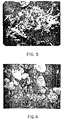
- the silica fibres of the present invention are generally so small that when size measurements are given the size represents the average silica fibre diameter, i.e., the fibres tend to be rather spherical in shape as shown in Figure 6, and thus average diameter can be used to particularize the dimensions thereof as opposed to, for example, a diameter plus length measurement as would typically be used for a fibre in the textile art.
- silica fibres form some type of framework or network in which the thermal filler powder is retained; we found this to be quite surprising since the amounts of silica fibres (substantially none having an average diameter larger than 5 micrometers, and most smaller than 1 micrometer) utilized are very small as compared to the overall materials in the thermally conductive grease.
- the bleed inhibiting agent above discussed is quite different from a silica aerogel.
- the silica fibres of the present invention are highly porous, and it is most preferred that at least about 80 volume percent thereof be smaller than 1 micrometer in average diameter.
- the minimum size of the silica fibres is not important, and we have yet to discover any minimum silica fibre size which will not be effective in the present invention.
- the maximum silica fibre size tends to be important, however, as discussed above.
- Figure 6 shows typical silica fibres as used in the present invention.
- thermally conductive greases formed in accordance with the present invention utilizing the silica fibres changes only slightly over a wide temperature range, e.g., -40°C to 200°C.
- the thermal filler powder The thermal filler powder
- thermal filler powders Perhaps the most important aspect of the present invention is the utilization of certain highly specific thermal filler powders. We have discovered that it is necessary to use such thermal filler powders, in combination with the silica fibres, in order to achieve the non-bleed characteristics in combination with very high thermal conductivity gain per unit of filler.
- thermal filler powder is extremely important.
- size and shape are more important than solid conductivity values of the thermal filler powder used.
- the thermally conductive greases of the present invention illustrate very similar thermal conductivity values, regardless of the solid conductivity value of the thermal filler powder per se.
- thermal filler powders are unacceptable in the present invention; thus, the use of Si0 2 or AI 2 0 3 as a thermal filler material is not suitable for the present invention.
- a certain dendritic material i.e., zinc oxide
- cubic or spherical materials such as Si0 2 or AI z 0 3
- lamellar materials i.e., AIN and BN
- the thermal filler powder utilized is dendritic zinc oxide, lamellar aluminium nitride, lamellar boron nitride or a mixture of two or more thereof.
- dendritic zinc oxide is available in four different particle shapes, only dendritic zinc oxide is useful in the present invention. Accordingly, of the zinc oxide present, at least 80 volume percent of the zinc oxide must be dendritic zinc oxide, preferably all the zinc oxide used being dendritic zinc oxide. Dendritic zinc oxide, of course, has the tree-like or arbore- scent structure typical of dendritic materials in general.
- the boron nitride or aluminium nitride used in the present invention should be at least 50 volume percent lamellar and preferably all the boron and/or aluminium nitride present is lamellar.
- the above percentages also apply. Specifically, at least 80 volume percent of the zinc oxide present should be dendritic and at least 50 volume percent of the aluminium and/or boron nitride should be lamellar. Where a mixture of two or more of dendritic zinc oxide, lamellar boron nitride or lamellar aluminium nitride is used, there is no special restriction on the individual ratios of dendritic zinc oxide, lamellar boron nitride or lamellar aluminium nitride. For example, high proportions of dendritic oxide could be used with very low proportions of lamellar boron nitride and/or lamellar aluminium nitride, or vice versa.
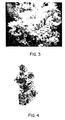
- Lamellar of course, defines a crystalline material which consists of flat plate-like individuals superimposed upon and adhering to each other. It is most preferred in the present invention that the lamellar boron or aluminium nitride used have a thickness of 1 to 25% of the width thereof and a width of 10 to less than 100% of the length thereof. If the aluminium nitride or boron nitride used in the present invention approaches a stubbier shape, such as cubic, the thermal conductivity of the formulation of the present invention is reduced. Typical examples of boron nitride and of aluminium nitride useful in the present invention are shown in Figure 4 and Figure 5, respectively.
- Increasing the volume concentration of the filler also assists to increase the thermal conductivity of the thermal grease; thus, lighter fillers which have a specific gravity of the order of 2-4, which include AIN and BN, produce better results than the heavier filler, zinc oxide; this effect is secondary, however, as compared to the filler particle shape.
- the size of the thermal filler powder we have generally found that decreasing the size thereof increases thermal conductivity effects without any harm to the other characteristics of the thermally conductive grease.
- zinc oxide we prefer to use zinc oxide of a submicron size with 99% of all particles having an average diameter of 5 micrometers or less.
- lamellar aluminium nitride and/or boron nitride when lamellar aluminium nitride and/or boron nitride is used, we prefer that at least 90% of the particles thereof have a length of 0.5 to 20 micrometers, the length, of course, representing the longest dimension of the lamellar particles. No substantial proportion of the lamellar aluminium nitride or boron nitride particles present should be larger than 25 micrometers, again this representing the length or longest dimension of the lamellar particles.
- thermal filler powder from 15% by volume to 60% by volume thermal filler powder, from 0.1% to 4% by volume silica fibres, the balance being the liquid organo-silicone carrier and a small amount of wetting agent (less than 5% by volume) if used.
- Basis is always by volume, herein, unless otherwise indicated.
- the components of the thermal grease are well mixed at ambient conditions.
- the components can be heated (or cooled) during mixing to facilitate mixing, if desired, however.
- the silica fibres it is most preferred to merely add the silica fibres to the liquid organo-silicone and then add the thermal filler powder to produce formulations with the lowest bleed. This is, however, not necessary, and the three components of the thermally conductive grease of the present invention can be mixed in any order desired. As earlier indicated, however, if the thermal filler powder is initially added to the liquid organo-silicone carrier, or vice versa, the silica fibres should be added thereto before any bleeding can occur.
- the mixing may be conducted using any conventional mixing means which does not, of course, destroy the character of the silica fibres or the thermal filler powder.
- a typical mixing means which can be utilized is a 3 roll mill.
- the thermally conductive grease of the present invention is thixotropic, it can be applied to the desired location using conventional means to apply thixotropic materials.
- application can be by hand using a small spatula, can be by the use of a small injection nozzle, roller, brush coating means, or the like. No criticality is attached to the means of applying the thermally conductive grease of the present invention.
- thermally conductive grease finds particular use for heat transfer application with electronic components, particularly in systems as shown in Figure 1 wherein reference 17 denotes the module as a whole, reference 10 denotes a conventional integrated circuit chip, and reference 11 denotes metal contacts putting chip 10 into contact with substrate 12 provided with conductor pins 13. Cap 14 is placed. over substrate 12 and chip 10, the thermally conductive grease 1 being interposed between chip 10 and cap 14 in intimate contact with both.
- thermally conductive grease could be utilized to completely fill space 16 in module 1, or can, for example, be separated from either or both of cap 14 and chip 10 by a thin film of, for example, a good heat transfer material such as a thin polymeric film which is also advisably dielectric.
- the thermally conductive grease is most preferably used in direct contact with chip 10 and cap 14, however. While not shown in Figure 1, when needed heat sinks would be provided in a conventional manner.
- thermally conductive grease of the present invention has been described as finding particular application in cooling electronic components, it should be understood that its use is not so limited. In fact, the thermally conductive grease of the present invention finds general application wherever good heat transfer is required. However, considering the relatively high cost of the components used to formulate the thermally conductive grease of the present invention, typically it will be utilized in precision applications, that is, wherein the specific characteristics of the thermally conductive grease of the present invention are required.
- reagent grade materials were used. This is important since the use of highly pure materials (reagent grade) avoids corrosion problems often encountered with prior art thermally conductive greases and ensures low water absorption in use.
- polydimethylsiloxane approximately 55 ml of polydimethylsiloxane was placed into an appropriate container.
- the polydimethylsiloxane was reagent grade and had a specific gravity of 0.97 at 25°C, a dielectric constant of 2.5 KHz, a dielectric strength of 350 volts/ml, and a viscosity of 100 Cs at 25°C.
- lamellar aluminium nitride having a particle size of 1 to 20 micrometers, again mixing well to ensure formation of a uniform mixture of all components.
- substantially all of the aluminium nitride was lamellar and had a particle size in the 1 to 20 micrometers range for length, with no particles having a length larger than 25 micrometers. While precise measurements of thickness and width were not taken, this being unnecessary, both thickness and width were within our preferred bounds, i.e., thickness was 1 to 25% of width and width was 10 to less than 100% of length.
- the lamellar aluminium nitride was essentially the same as shown in Figure 4. The thermal conductivity of the resulting product is shown in the attached Figure 2 by data point 1.
- Example 1 The procedure of Example 1 was followed except that the amount of lamellar aluminium nitride was reduced to 25% by volume; all other parameters were the same.
- thermal conductivity of the resulting thermally conductive grease is represented in the attached Figure 3 by data point 2.
- Example 1 The procedure of Example 1 was followed except that the lamellar aluminium nitride was replaced by lamellar boron nitride of similar dimensions and the boron nitride was used in an amount of only 35% by volume. Again, substantially all of the boron nitride was lamellar.
- thermally conductive grease illustrated a thermal conductivity as shown by data point 3 in attached Figure 2.
- the thermally conductive grease comprised the indicated percent volume of zinc oxide, 0.2 to 2% by volume silica fibres as used in Example 1, balance polydimethylsiloxane as used in Example 1. All of the zinc oxide was in the dendritic form.
- Example 4 Using polydimethylsiloxane, dendritic zinc oxide particles and silica fibres as in Example 4, a thermally conductive grease composition in accordance with the present invention was formulated following the procedure of Example 4 except for using a ratio by weight of zinc oxide to polydimethylsiloxane of 4.6:1 and 2% by weight silica fibres.
- Bleed was determined by permitting the thus formulated thermally conductive grease to sit in a filter paper suspended in an open flask for 24 hours at 200°C.
- the percent by weight of the polydimethylsiloxane which escaped from the thermally conductive grease through the filter paper at the end of this test period is expressed as "bleed" in weight percent based upon the total weight of the thermally conductive grease.
- Example 6 the basic procedure and materials as described in Example 3 above were utilized except for using a lamellar aluminium nitride:polydimethylsiloxane ratio by weight (solids:liquid) of 1:1, and in Example 7 the basic procedure and materials as described in Example 3 above were utilized except for using a lamellar boron nitride:polydimethylsiloxane ratio by weight (solids:liquid) of 1.18:1.
- the K value for each thermal filler powder, the bleed value following testing for 24 hours at 200°C, the amount of filler and characteristics of the resulting thermally conductive grease are set forth in the following table.
- Example 4 for formulating a dendritic zinc oxide containing thermally conductive grease
- Example 3 for formulating a lamellar boron nitride containing thermally conductive grease
- thermally conductive grease compositions were formed, they were applied to individual single chip 25 mm MC modules as shown in Figure 1 to encapsulate the same.
- the chip/cap gap was 2-10 mils.
- the thermally conductive greases were silk- screened onto the chips before caps were put on in an amount of 0.5"x0.5"x0.03" in volume per chip.
- the resistance through the grease was measured with the module being thermally isolated so that all of the heat generated was forced through the thermally conductive grease layer into measuring means.
- the difference between the chip temperature and the temperature of the measuring apparatus was determined to yield the thermal resistance value of the thermally conducting grease layer in °C/watt units. An average value of four readings were used to obtain the values set forth below.
- thermal resistance through the grease in °C/watt at 1 watt was 4.9 and at 2 watts was 4.5; in run 2, these values were 4.7 and 4.6, respectively; and in run 3, these values were 6.7 and 6.35, respectively.
Landscapes
- Chemical & Material Sciences (AREA)
- Engineering & Computer Science (AREA)
- Physics & Mathematics (AREA)
- Chemical Kinetics & Catalysis (AREA)
- Combustion & Propulsion (AREA)
- Thermal Sciences (AREA)
- Materials Engineering (AREA)
- Organic Chemistry (AREA)
- Lubricants (AREA)
- Cooling Or The Like Of Electrical Apparatus (AREA)
- Organic Insulating Materials (AREA)
Applications Claiming Priority (2)
| Application Number | Priority Date | Filing Date | Title |
|---|---|---|---|
| US06/067,481 US4265775A (en) | 1979-08-16 | 1979-08-16 | Non-bleeding thixotropic thermally conductive material |
| US67481 | 1979-08-16 |
Publications (2)
| Publication Number | Publication Date |
|---|---|
| EP0024498A1 EP0024498A1 (en) | 1981-03-11 |
| EP0024498B1 true EP0024498B1 (en) | 1982-11-24 |
Family
ID=22076280
Family Applications (1)
| Application Number | Title | Priority Date | Filing Date |
|---|---|---|---|
| EP80103557A Expired EP0024498B1 (en) | 1979-08-16 | 1980-06-24 | Non-bleeding thixotropic thermally conductive dielectric material |
Country Status (4)
| Country | Link |
|---|---|
| US (1) | US4265775A (ca) |
| EP (1) | EP0024498B1 (ca) |
| JP (1) | JPS5628264A (ca) |
| DE (1) | DE3061149D1 (ca) |
Families Citing this family (56)
| Publication number | Priority date | Publication date | Assignee | Title |
|---|---|---|---|---|
| JPS58219034A (ja) * | 1982-06-14 | 1983-12-20 | Toray Silicone Co Ltd | 電気絶縁性放熱ゴムシ−トの製造方法 |
| US4448840A (en) * | 1982-06-14 | 1984-05-15 | Toray Silicone Company, Ltd. | Method for manufacturing a rubber sheet which is electrically insulating and thermally radiating and rubber sheets made therefrom with improve resistance to flexural fatigue |
| DE3366648D1 (en) * | 1983-01-11 | 1986-11-06 | Ferranti Plc | Thermally conducting filler for enclosing electrical components |
| US4701016A (en) * | 1985-01-31 | 1987-10-20 | American Telephone And Telegraph Company, At&T Bell Laboratories | Thixotropic grease composition and cable comprising same |
| DE3525301A1 (de) * | 1985-07-16 | 1987-01-22 | Egbert Dr Brandau | Reaktionsharz |
| US4803100A (en) * | 1987-10-21 | 1989-02-07 | International Business Machines Corporation | Suspension and use thereof |
| US5094769A (en) * | 1988-05-13 | 1992-03-10 | International Business Machines Corporation | Compliant thermally conductive compound |
| US5213704A (en) * | 1988-05-13 | 1993-05-25 | International Business Machines Corporation | Process for making a compliant thermally conductive compound |
| US5028984A (en) * | 1988-11-04 | 1991-07-02 | International Business Machines Corporation | Epoxy composition and use thereof |
| US5098609A (en) * | 1989-11-03 | 1992-03-24 | The Research Foundation Of State Univ. Of N.Y. | Stable high solids, high thermal conductivity pastes |
| US4960634A (en) * | 1990-03-14 | 1990-10-02 | International Business Machines Corporation | Epoxy composition of increased thermal conductivity and use thereof |
| JP2795011B2 (ja) * | 1990-11-28 | 1998-09-10 | 株式会社日立製作所 | 摺動部を有する冷却構造体を備えた機器及びそれに用いるコンパウンド |
| US5250209A (en) * | 1991-04-22 | 1993-10-05 | Thermoset Plastics, Inc. | Thermal coupling with water-washable thermally conductive grease |
| US5167851A (en) * | 1991-04-22 | 1992-12-01 | Thermoset Plastics, Inc. | Hydrophilic thermally conductive grease |
| US5190595A (en) * | 1991-09-03 | 1993-03-02 | International Business Machines Corporation | Ozone safe stripping solution for thermal grease |
| US5441690A (en) * | 1993-07-06 | 1995-08-15 | International Business Machines Corporation | Process of making pinless connector |
| US5548486A (en) * | 1994-01-21 | 1996-08-20 | International Business Machines Corporation | Pinned module |
| US5545473A (en) * | 1994-02-14 | 1996-08-13 | W. L. Gore & Associates, Inc. | Thermally conductive interface |
| US5591034A (en) * | 1994-02-14 | 1997-01-07 | W. L. Gore & Associates, Inc. | Thermally conductive adhesive interface |
| US5652055A (en) * | 1994-07-20 | 1997-07-29 | W. L. Gore & Associates, Inc. | Matched low dielectric constant, dimensionally stable adhesive sheet |
| US6022487A (en) * | 1995-01-14 | 2000-02-08 | Daume; Jochen | Heat-transfer concentrate, method of manufacturing it and its use as well as a latent-heat accumulator making use of the concentrate |
| US5878483A (en) * | 1995-06-01 | 1999-03-09 | International Business Machines Corporation | Hammer for forming bulges in an array of compliant pin blanks |
| US5950066A (en) * | 1996-06-14 | 1999-09-07 | The Bergquist Company | Semisolid thermal interface with low flow resistance |
| US5738936A (en) * | 1996-06-27 | 1998-04-14 | W. L. Gore & Associates, Inc. | Thermally conductive polytetrafluoroethylene article |
| JP3142800B2 (ja) * | 1996-08-09 | 2001-03-07 | 信越化学工業株式会社 | 熱伝導性シリコーン組成物、熱伝導性材料及び熱伝導性シリコーングリース |
| JP3195277B2 (ja) * | 1997-08-06 | 2001-08-06 | 信越化学工業株式会社 | 熱伝導性シリコーン組成物 |
| JP2000114438A (ja) * | 1998-09-30 | 2000-04-21 | Shin Etsu Chem Co Ltd | 半導体装置 |
| JP2000109373A (ja) * | 1998-10-02 | 2000-04-18 | Shin Etsu Chem Co Ltd | 放熱用シリコーングリース組成物及びそれを使用した半導体装置 |
| JP2000169873A (ja) * | 1998-12-02 | 2000-06-20 | Shin Etsu Chem Co Ltd | シリコーングリース組成物 |
| US6160939A (en) * | 1999-03-31 | 2000-12-12 | Lucent Technologies Inc. | Optical cable having a filling material with stable viscosity and yield stress |
| US6400565B1 (en) | 2000-04-21 | 2002-06-04 | Dell Products L.P. | Thermally conductive interface member |
| JP4603700B2 (ja) | 2001-01-04 | 2010-12-22 | 株式会社日立製作所 | 高熱伝導グリース組成物及びそれを用いた冷却装置 |
| US20030128519A1 (en) * | 2002-01-08 | 2003-07-10 | International Business Machine Corporartion | Flexible, thermally conductive, electrically insulating gap filler, method to prepare same, and method using same |
| DE602004005493T2 (de) * | 2003-11-05 | 2007-11-29 | Dow Corning Corp., Midland | Wärmeleitfähiges schmierfett und verfahren und vorrichtungen, bei denen das schmierfett verwendet wird |
| TWI385246B (zh) * | 2004-05-21 | 2013-02-11 | 信越化學工業股份有限公司 | 聚矽氧烷潤滑油組成物 |
| JP2007005670A (ja) * | 2005-06-27 | 2007-01-11 | Fujitsu Ltd | 電子部品パッケージおよび接合組立体 |
| DE102005045767B4 (de) * | 2005-09-23 | 2012-03-29 | Infineon Technologies Ag | Verfahren zur Herstellung eines Halbleiterbauteils mit Kunststoffgehäusemasse |
| JP4933094B2 (ja) | 2005-12-27 | 2012-05-16 | 信越化学工業株式会社 | 熱伝導性シリコーングリース組成物 |
| JP2007177921A (ja) * | 2005-12-28 | 2007-07-12 | Nsk Ltd | ボールねじ装置 |
| JP4514058B2 (ja) | 2006-08-30 | 2010-07-28 | 信越化学工業株式会社 | 熱伝導性シリコーン組成物及びその硬化物 |
| JP5489409B2 (ja) * | 2007-04-10 | 2014-05-14 | コスモ石油ルブリカンツ株式会社 | 高熱伝導性コンパウンド |
| CN102066488A (zh) * | 2008-04-21 | 2011-05-18 | 霍尼韦尔国际公司 | 热互连和界面材料、它们的制造方法和用途 |
| US8546476B2 (en) * | 2009-07-14 | 2013-10-01 | Sakai Chemical Industry Co., Ltd. | Exoergic filler composition, resin composition, exoergic grease and exoergic coating composition |
| DE102010003330A1 (de) * | 2010-03-26 | 2011-09-29 | Robert Bosch Gmbh | Wärmeleitende Anordnung zwischen zwei Bauteilen und Verfahren zum Herstellen einer wärmeleitenden Anordnung |
| WO2013158071A1 (en) * | 2012-04-16 | 2013-10-24 | Clustered Systems Company | Cold plate with reduced bubble effects |
| WO2017119937A1 (en) | 2016-01-07 | 2017-07-13 | Xilinx, Inc. | Stacked silicon package assembly having enhanced stiffener |
| WO2018070351A1 (ja) | 2016-10-14 | 2018-04-19 | 信越化学工業株式会社 | 熱伝導性複合シリコーンゴムシートおよびその製造方法 |
| JP7031203B2 (ja) * | 2017-09-29 | 2022-03-08 | 東洋インキScホールディングス株式会社 | 放熱用接着シート、放熱接着部材用積層体、及び複合部材 |
| US11186798B2 (en) | 2017-11-09 | 2021-11-30 | Shin-Etsu Chemical Co., Ltd. | Thermally conductive silicone grease composition |
| CN108192576B (zh) * | 2017-12-05 | 2021-02-02 | 云南靖创液态金属热控技术研发有限公司 | 一种液态金属热界面材料及其制备方法和应用 |
| JP6866877B2 (ja) | 2018-05-31 | 2021-04-28 | 信越化学工業株式会社 | 低熱抵抗シリコーン組成物 |
| JP7050704B2 (ja) | 2019-02-07 | 2022-04-08 | 信越化学工業株式会社 | 熱伝導性粘着層を有する熱伝導性シリコーンゴムシート |
| US11746236B2 (en) | 2020-03-05 | 2023-09-05 | Dow Global Technologies Llc | Shear thinning thermally conductive silicone compositions |
| JP6997263B1 (ja) * | 2020-07-10 | 2022-01-17 | イビデン株式会社 | 熱伝達抑制シート及び組電池 |
| WO2024024498A1 (ja) | 2022-07-29 | 2024-02-01 | 信越化学工業株式会社 | 熱伝導性シリコーン組成物及びその製造方法 |
| JP2024148978A (ja) | 2023-04-07 | 2024-10-18 | 信越化学工業株式会社 | シリコーン組成物 |
Family Cites Families (6)
| Publication number | Priority date | Publication date | Assignee | Title |
|---|---|---|---|---|
| US2428608A (en) * | 1942-11-02 | 1947-10-07 | Dow Chemical Co | Plastic dielectric composition and shielded spark plug terminal construction comprising same |
| US3405066A (en) * | 1965-01-22 | 1968-10-08 | Union Carbide Corp | High thermal conductivity fluid dielectric |
| US3499859A (en) * | 1968-07-05 | 1970-03-10 | Dow Corning | Stable thermally conductive room temperature vulcanizable silicone rubber |
| US3882033A (en) * | 1971-07-06 | 1975-05-06 | Gen Electric | Silicone grease for semiconductors |
| US3885984A (en) * | 1973-12-18 | 1975-05-27 | Gen Electric | Methyl alkyl silicone thermoconducting compositions |
| DE2556420A1 (de) * | 1975-12-15 | 1977-06-16 | Wacker Chemie Gmbh | Zu elastomeren haertbare massen auf grundlage von diorganopolysiloxanen und verfahren zum herstellen von organopolysiloxanelastomeren |
-
1979
- 1979-08-16 US US06/067,481 patent/US4265775A/en not_active Expired - Lifetime
-
1980
- 1980-06-24 EP EP80103557A patent/EP0024498B1/en not_active Expired
- 1980-06-24 DE DE8080103557T patent/DE3061149D1/de not_active Expired
- 1980-07-04 JP JP9078880A patent/JPS5628264A/ja active Granted
Also Published As
| Publication number | Publication date |
|---|---|
| JPS5628264A (en) | 1981-03-19 |
| DE3061149D1 (en) | 1982-12-30 |
| EP0024498A1 (en) | 1981-03-11 |
| US4265775A (en) | 1981-05-05 |
| JPS5736302B2 (ca) | 1982-08-03 |
Similar Documents
| Publication | Publication Date | Title |
|---|---|---|
| EP0024498B1 (en) | Non-bleeding thixotropic thermally conductive dielectric material | |
| US5011870A (en) | Thermally conductive organosiloxane compositions | |
| CA2207114C (en) | Semisolid thermal interface with low flow resistance | |
| US5167851A (en) | Hydrophilic thermally conductive grease | |
| US10329424B2 (en) | Silicone composition | |
| US5591789A (en) | Polyester dispersants for high thermal conductivity paste | |
| EP2257616B1 (en) | Thermally conductive silicone grease composition | |
| DE69808999T2 (de) | Wärmeleitende Siliconzusammensetzung | |
| US5250209A (en) | Thermal coupling with water-washable thermally conductive grease | |
| US3037933A (en) | Greases made by thickening silicone oils with silica and silica coated with octamethylcyclotetrasiloxane | |
| EP1143511B1 (en) | Method of preparing thermally conductive compounds by liquid metal bridged particle clusters | |
| JPH02153995A (ja) | シリコーングリース組成物 | |
| JP4767409B2 (ja) | 放熱グリース | |
| CN116694081B (zh) | 一种高导热无溶剂导热硅脂及其制备方法 | |
| US3405066A (en) | High thermal conductivity fluid dielectric | |
| EP4244290A1 (en) | Aluminum nitride filled thermally conductive silicone composition | |
| EP0100913B1 (en) | Encapsulation of electronic components with poly(arylene sulfide) containing mercaptosilane | |
| US11746236B2 (en) | Shear thinning thermally conductive silicone compositions | |
| US4803100A (en) | Suspension and use thereof | |
| EP1197674A2 (en) | Vibration damping silicone composition | |
| IE61206B1 (en) | An electrical insulator composition | |
| US4994514A (en) | Encapsulation of electronic components with poly(arylene sulfide) containing mercaptosilane | |
| WO2018093030A1 (ko) | 방열성이 우수한 실리콘 조성물 | |
| JPH05194982A (ja) | 電気流動学的流体 | |
| TW202607078A (zh) | 導熱性片及其製造方法 |
Legal Events
| Date | Code | Title | Description |
|---|---|---|---|
| PUAI | Public reference made under article 153(3) epc to a published international application that has entered the european phase |
Free format text: ORIGINAL CODE: 0009012 |
|
| AK | Designated contracting states |
Designated state(s): DE FR GB |
|
| 17P | Request for examination filed |
Effective date: 19810331 |
|
| GRAA | (expected) grant |
Free format text: ORIGINAL CODE: 0009210 |
|
| AK | Designated contracting states |
Designated state(s): DE FR GB |
|
| REF | Corresponds to: |
Ref document number: 3061149 Country of ref document: DE Date of ref document: 19821230 |
|
| ET | Fr: translation filed | ||
| PGFP | Annual fee paid to national office [announced via postgrant information from national office to epo] |
Ref country code: GB Payment date: 19900516 Year of fee payment: 11 |
|
| PGFP | Annual fee paid to national office [announced via postgrant information from national office to epo] |
Ref country code: FR Payment date: 19900529 Year of fee payment: 11 |
|
| PGFP | Annual fee paid to national office [announced via postgrant information from national office to epo] |
Ref country code: DE Payment date: 19900707 Year of fee payment: 11 |
|
| PG25 | Lapsed in a contracting state [announced via postgrant information from national office to epo] |
Ref country code: GB Effective date: 19910624 |
|
| GBPC | Gb: european patent ceased through non-payment of renewal fee | ||
| PG25 | Lapsed in a contracting state [announced via postgrant information from national office to epo] |
Ref country code: FR Effective date: 19920228 |
|
| PG25 | Lapsed in a contracting state [announced via postgrant information from national office to epo] |
Ref country code: DE Effective date: 19920401 |
|
| REG | Reference to a national code |
Ref country code: FR Ref legal event code: ST |
|
| PLBE | No opposition filed within time limit |
Free format text: ORIGINAL CODE: 0009261 |
|
| STAA | Information on the status of an ep patent application or granted ep patent |
Free format text: STATUS: NO OPPOSITION FILED WITHIN TIME LIMIT |