EP0022820B1 - Three dimensional television system - Google Patents
Three dimensional television system Download PDFInfo
- Publication number
- EP0022820B1 EP0022820B1 EP80900211A EP80900211A EP0022820B1 EP 0022820 B1 EP0022820 B1 EP 0022820B1 EP 80900211 A EP80900211 A EP 80900211A EP 80900211 A EP80900211 A EP 80900211A EP 0022820 B1 EP0022820 B1 EP 0022820B1
- Authority
- EP
- European Patent Office
- Prior art keywords
- field
- past
- image
- video signal
- chrominance
- Prior art date
- Legal status (The legal status is an assumption and is not a legal conclusion. Google has not performed a legal analysis and makes no representation as to the accuracy of the status listed.)
- Expired
Links
- 230000000295 complement effect Effects 0.000 claims abstract description 12
- 239000011521 glass Substances 0.000 claims abstract description 11
- 239000000872 buffer Substances 0.000 claims description 10
- 238000000034 method Methods 0.000 claims description 10
- 239000002131 composite material Substances 0.000 claims description 8
- 238000005070 sampling Methods 0.000 claims 1
- 239000003086 colorant Substances 0.000 abstract description 3
- 238000006073 displacement reaction Methods 0.000 abstract description 2
- 230000000694 effects Effects 0.000 description 14
- 230000003111 delayed effect Effects 0.000 description 3
- 238000012986 modification Methods 0.000 description 3
- 230000004048 modification Effects 0.000 description 3
- 238000012545 processing Methods 0.000 description 3
- 230000003304 psychophysiological effect Effects 0.000 description 3
- 238000010586 diagram Methods 0.000 description 2
- 238000004519 manufacturing process Methods 0.000 description 2
- 238000000926 separation method Methods 0.000 description 2
- 238000001914 filtration Methods 0.000 description 1
- 238000012544 monitoring process Methods 0.000 description 1
- 230000000135 prohibitive effect Effects 0.000 description 1
- 230000000979 retarding effect Effects 0.000 description 1
- 239000007787 solid Substances 0.000 description 1
- 238000012546 transfer Methods 0.000 description 1
Images
Classifications
-
- H—ELECTRICITY
- H04—ELECTRIC COMMUNICATION TECHNIQUE
- H04N—PICTORIAL COMMUNICATION, e.g. TELEVISION
- H04N13/00—Stereoscopic video systems; Multi-view video systems; Details thereof
- H04N13/20—Image signal generators
- H04N13/261—Image signal generators with monoscopic-to-stereoscopic image conversion
-
- H—ELECTRICITY
- H04—ELECTRIC COMMUNICATION TECHNIQUE
- H04N—PICTORIAL COMMUNICATION, e.g. TELEVISION
- H04N13/00—Stereoscopic video systems; Multi-view video systems; Details thereof
- H04N13/20—Image signal generators
- H04N13/257—Colour aspects
-
- H—ELECTRICITY
- H04—ELECTRIC COMMUNICATION TECHNIQUE
- H04N—PICTORIAL COMMUNICATION, e.g. TELEVISION
- H04N13/00—Stereoscopic video systems; Multi-view video systems; Details thereof
- H04N13/20—Image signal generators
- H04N13/296—Synchronisation thereof; Control thereof
-
- H—ELECTRICITY
- H04—ELECTRIC COMMUNICATION TECHNIQUE
- H04N—PICTORIAL COMMUNICATION, e.g. TELEVISION
- H04N13/00—Stereoscopic video systems; Multi-view video systems; Details thereof
- H04N13/30—Image reproducers
- H04N13/324—Colour aspects
-
- H—ELECTRICITY
- H04—ELECTRIC COMMUNICATION TECHNIQUE
- H04N—PICTORIAL COMMUNICATION, e.g. TELEVISION
- H04N13/00—Stereoscopic video systems; Multi-view video systems; Details thereof
- H04N13/30—Image reproducers
- H04N13/332—Displays for viewing with the aid of special glasses or head-mounted displays [HMD]
- H04N13/334—Displays for viewing with the aid of special glasses or head-mounted displays [HMD] using spectral multiplexing
-
- H—ELECTRICITY
- H04—ELECTRIC COMMUNICATION TECHNIQUE
- H04N—PICTORIAL COMMUNICATION, e.g. TELEVISION
- H04N13/00—Stereoscopic video systems; Multi-view video systems; Details thereof
- H04N13/10—Processing, recording or transmission of stereoscopic or multi-view image signals
- H04N13/106—Processing image signals
- H04N13/15—Processing image signals for colour aspects of image signals
-
- H—ELECTRICITY
- H04—ELECTRIC COMMUNICATION TECHNIQUE
- H04N—PICTORIAL COMMUNICATION, e.g. TELEVISION
- H04N13/00—Stereoscopic video systems; Multi-view video systems; Details thereof
- H04N13/10—Processing, recording or transmission of stereoscopic or multi-view image signals
- H04N13/106—Processing image signals
- H04N13/158—Switching image signals
-
- H—ELECTRICITY
- H04—ELECTRIC COMMUNICATION TECHNIQUE
- H04N—PICTORIAL COMMUNICATION, e.g. TELEVISION
- H04N13/00—Stereoscopic video systems; Multi-view video systems; Details thereof
- H04N13/10—Processing, recording or transmission of stereoscopic or multi-view image signals
- H04N13/106—Processing image signals
- H04N13/167—Synchronising or controlling image signals
-
- H—ELECTRICITY
- H04—ELECTRIC COMMUNICATION TECHNIQUE
- H04N—PICTORIAL COMMUNICATION, e.g. TELEVISION
- H04N13/00—Stereoscopic video systems; Multi-view video systems; Details thereof
- H04N13/10—Processing, recording or transmission of stereoscopic or multi-view image signals
- H04N13/189—Recording image signals; Reproducing recorded image signals
-
- H—ELECTRICITY
- H04—ELECTRIC COMMUNICATION TECHNIQUE
- H04N—PICTORIAL COMMUNICATION, e.g. TELEVISION
- H04N13/00—Stereoscopic video systems; Multi-view video systems; Details thereof
- H04N13/10—Processing, recording or transmission of stereoscopic or multi-view image signals
- H04N13/194—Transmission of image signals
-
- H—ELECTRICITY
- H04—ELECTRIC COMMUNICATION TECHNIQUE
- H04N—PICTORIAL COMMUNICATION, e.g. TELEVISION
- H04N19/00—Methods or arrangements for coding, decoding, compressing or decompressing digital video signals
- H04N19/50—Methods or arrangements for coding, decoding, compressing or decompressing digital video signals using predictive coding
- H04N19/597—Methods or arrangements for coding, decoding, compressing or decompressing digital video signals using predictive coding specially adapted for multi-view video sequence encoding
Definitions
- This invention relates to video signal processing. More specifically, this invention concerns real time processing of video signals for the purpose of creating a three dimensional effect.
- Three dimensional or stereoscopic viewing generally requires the production of disparate left and right images.
- Most conventional three dimensional techniques produce images which are not compatible, i.e. which cannot be viewed comfortably without specially filtered glasses.
- Songer U.S. Patent No. 3,712,199
- an anaglyph i.e. color encoded
- the image is compatible in that when it is viewed without the specially filtered glasses required for-stereoscopy, it is seen as an acceptable two-dimensional image.
- image separation (sometimes referred to as binocular disparity) is created by a color fringing effect on the out-of-focus objects.
- objects fore of the plane of focus may be imaged with a magenta defocus blur on the left side and a cyan defocus blur on the right side.
- Objects aft of the plane of focus will be encoded in the opposite sense, i.e. cyan on the left and magenta on the right.
- a process in accordance with the generic clause of claim 1 is already known from US-A-2 865 988.
- This prior art reference discloses how to provide a three-dimensional effect based on the motion of a moving element with respect to the background of the moving element including the comparing of past and current fields or frames.
- a conventional video signal is transmitted to a television receiver which is suitably modified and converts the conventional video signal to a stereoscopic signal.
- a first drawback of this prior art process consists in that the receiver has to be modified in order to convert the conventional video signal into a stereoscopic signal. This modification causes high costs and therefore, lacks in practical usability. Futhermore, this known process is incapable of providing a "full colour" image since each frame is produced in only a single colour. As the system uses the polarizing technique, another drawback is that the images are displayed sequentially and not concurrently.
- the main object of this invention is to provide a practical apparatus and method for processing standard video signals so as to enable compatible three dimensional television using standard television receivers.
- the present invention requires no modification of existing lens systems and can produce compatible three dimensional images regardless of the depth of focus of the taking lens.
- the invention can be used to process prerecorded video signals to produce compatible stereoscopic images.
- a three dimensional effect requires that there be movement of at least one object in the scene being viewed.
- One of the chrominance components of the video signal corresponding to a preselected past field is combined with the complementary chrominance component of the current field in such a way as to produce disparate color encoded images, preferably in the background, due to the object movement.
- the disparate images are blurred slightly but not so much as to be objectionable.
- the image disparity produces a realistic three dimensional effect.
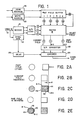
- a conventional incoming color video signal (from a camera or recorder) appears on line 10. This signal is fed to a sync generator 12 and a decoder 14. The sync generator 12 produces the timing signals for the system which therefore is locked to the incoming video. Decoder 14 separates the video signal into its luminance (Y) and chrominance (R-Y and B-Y) components. As is well known, all of the required color information is contained in these complementary R-Y (magenta) and B-Y (cyan) components.
- the decoder outputs are coupled to an analog-to-digital converter 16 which samples the three components and converts each sample to a discrete digital value.
- each analog signal may be sampled at four times the NTSC subcarrier frequency (e.g. about 15 MHz) with the luminance samples converted into eight bit words and the chrominance samples into four bit words. This is indicated in Figure 1 by the numerals "8" and "4" placed within circles at the outputs of analog-to-digital converter 16.
- the sync generator 12, decoder 14 and analog-to-digital converter 16 may be conventional, commercially available devices.
- binocular disparity is created by the change in position, from field to field, which exists in the case of an object moving in the scene being viewed (in the United States, a field includes 262.5 horizontal lines; a raster consists of two interlaced fields).
- Figures 2A-2E The way in which the invention produces a three dimensional effect is explained with reference to Figures 2A-2E.
- Figures 2A and 2B may be considered to represent successive fields, with Figure 2A representing a "past” field and Figure 2B representing the "current" field.
- Figure 2B shows the image of the past field shifted left the distance "d" so that the moving squares of the past and current fields are in exact registry and the stationary circles are out of registry. If these images are color encoded as described above and combined, the composite image of Figure 2E results. In this composite image, the entire moving square is in full color whereas the stationary circle includes a central full colored core 46 with magenta and cyan fringes 48 and 50, respectively. Since the same binocular disparity exists in Figure 2 as in Figure 2C, the same psychophysiological 3-D effect is achieved but compatability is enhanced since the principal object of interest (the moving square) no longer includes the requisite color fringes.
- the system shown in Figure 1 produces the past and current fields corresponding to Figures 2A and 2B, shifts the past field so that the moving objects of the two fields are in registry, and then combines complementary chrominance components of the two fields to produce a composite color encoded field corresponding to Figure 2E.
- the color fringes are transferred from the moving object to the stationary object.
- the digital signals from converter 16 are fed to a switching network 18.
- Switch 18 routes the digital signals throughout the system and will be computer controlled.
- the digital signals corresponding to the last four fields of the original television picture are routed to a past field buffer 20 for temporary storage so that the operator can change the image disparity (for example, depending on the object speed) between the current field and the selected field.
- each of the past field buffers 20 is returned to the switching network 18.
- the switch 18 selects the luminance component and one of the chrominance components (e.g. R-Y) of the current field and couples these signals. to two inputs of a digital-to-analog converter 22.
- the complementary chrominance component (e.g. R-Y) of the selected past field is coupled through switch 18 to a third input of digital-to-analog converter 22 which then produces three video signals corresponding, respectively, to the luminance and R-Y chrominance component of the current field and the B-Y chrominance component of the selected past field.
- the three outputs of the converter 22 are combined in an encoder 24 which also adds the appropriate timing signals from the sync generator 12, suitably delayed by a delay-fine 25 to compensate for the operation of the system as described.
- the operation of the past field buffers 20 is under control of a read address circuit 26 and a write address circuit 28. In a well-known manner, these devices select starting addresses for the reading and writing operations and enable the selected data to be written in or read from memory.
- the video signal of the encoder 24 would produce the type of image shown in Figure 2C, i.e. with a color fringe on the moving objects only.
- the arrangement shown in Figure 1 enables the moving object(s) of the selected past and current fields to be brought into registration by retarding or advancing the starting address of the read address counter 26.
- the read address circuit 26 would advance the read-out of the selected past field buffer 20 to thereby shift the image on the screen to the left.
- the effect is to move the color fringing to the stationary objects which are usually in the background.
- Registration of the moving objects may be manual or automatic. If manual, the operator will monitor the video image and adjust the starting address of the read address circuit 26 so that the moving object includes no color fringe (i.e. the moving objects of the past and current fields are in registry). Continuous monitoring will not normally be required if the moving objects move at an approximately constant rate.
- the computer may be programmed to compare the relative moving object position and adjust the read address circuit 26 accordingly.
- Each of the past field buffers 20 stores a digital representation of a single video field. This may comprise 263 horizontal lines of 390 "dots" each. As noted previously each "dot” includes light luminance bits and form bits for each of the two chrominance components (R-Y and B-Y). This enables the production of sixty- four different colors and/or shades of gray.
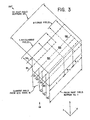
- Figure 3 shows diagrammatically a three-dimensional switching network which can be used to route the signals to the various locations shown in Figure 1.
- the inputs and outputs in Figure 3 are labeled to correspond to Figure 1 with many individual input lines being omitted for the purposes of clarity.
- the 16-line input from each of the four past field buffers 20 is represented by only a single input line or (in the case of buffer No. 1) by the first and last lines.
- control lines 50-55 For purposes of the switching operation as shown in Figure 1, six separate control lines 50-55 are shown.
- the application of a control voltage to line 50 couples to 16-bit current field signal (from the analog-to-digital converter 16) to the past field buffers 20.
- Application of a control signal to line 51 couples the luminance and R-Y chrominance component of the current field to the digital-to-analog converter 22.
- Application of a control signal to any of lines 52, 53, 54 or 55 will couple the complementary chrominance component (B-Y) of the selected past field (depending on which of the control lines is energized) to the third input of converter 22.
- B-Y complementary chrominance component
- the switch may be considered to be broken up into three separate sections 18A, 18B and 18C.
- Section 18A switches all of the luminance information whereas the chrominance components are switched by the sections 18B (R-Y) and 18C (B-Y).
Landscapes
- Engineering & Computer Science (AREA)
- Multimedia (AREA)
- Signal Processing (AREA)
- Physics & Mathematics (AREA)
- Spectroscopy & Molecular Physics (AREA)
- Color Television Systems (AREA)
- Testing, Inspecting, Measuring Of Stereoscopic Televisions And Televisions (AREA)
- Processing Of Color Television Signals (AREA)
Applications Claiming Priority (2)
| Application Number | Priority Date | Filing Date | Title |
|---|---|---|---|
| US06/000,144 US4264926A (en) | 1979-01-02 | 1979-01-02 | Three dimensional television system |
| US144 | 1979-01-02 |
Publications (3)
| Publication Number | Publication Date |
|---|---|
| EP0022820A1 EP0022820A1 (en) | 1981-01-28 |
| EP0022820A4 EP0022820A4 (en) | 1981-05-15 |
| EP0022820B1 true EP0022820B1 (en) | 1984-01-25 |
Family
ID=21690125
Family Applications (1)
| Application Number | Title | Priority Date | Filing Date |
|---|---|---|---|
| EP80900211A Expired EP0022820B1 (en) | 1979-01-02 | 1980-07-14 | Three dimensional television system |
Country Status (7)
| Country | Link |
|---|---|
| US (1) | US4264926A (Direct) |
| EP (1) | EP0022820B1 (Direct) |
| JP (1) | JPS56500114A (Direct) |
| AU (1) | AU5427580A (Direct) |
| CA (1) | CA1143051A (Direct) |
| DE (1) | DE2966595D1 (Direct) |
| WO (1) | WO1980001447A1 (Direct) |
Families Citing this family (9)
| Publication number | Priority date | Publication date | Assignee | Title |
|---|---|---|---|---|
| DE3217849C1 (de) * | 1982-03-19 | 1983-07-21 | Hofmann, Hasso, 2000 Hamburg | Verfahren und Vorrichtung zum Erzeugen eines raeumlich wirkenden Schirmbildes eines Fernsehempfaengers |
| US4677468A (en) * | 1984-08-13 | 1987-06-30 | Nec Home Electronics Ltd. | Stereoscopic television image-pickup device display device |
| JPH01503747A (ja) * | 1987-06-22 | 1989-12-14 | アスペックス リミテッド | 画像の記録及び再生 |
| CN1113320C (zh) * | 1994-02-01 | 2003-07-02 | 三洋电机株式会社 | 将二维图像转换成三维图像的方法以及三维图像显示系统 |
| US20040012670A1 (en) * | 2000-10-04 | 2004-01-22 | Yun Zhang | Combined colour 2d/3d imaging |
| WO2008091615A1 (en) * | 2007-01-23 | 2008-07-31 | Monte Ramstad | High-fidelity printed anaglyphs and viewing filters |
| US8086025B2 (en) * | 2007-05-10 | 2011-12-27 | Monte Jerome Ramstad | Universal stereoscopic file format |
| US20080297530A1 (en) * | 2007-05-31 | 2008-12-04 | Monte Jerome Ramstad | Four primary color display apparatus and method |
| KR101723235B1 (ko) * | 2010-10-04 | 2017-04-04 | 삼성전자주식회사 | 입체 영상의 입체감을 감쇠하기 위한 장치 및 방법 |
Family Cites Families (6)
| Publication number | Priority date | Publication date | Assignee | Title |
|---|---|---|---|---|
| US2865988A (en) * | 1953-05-26 | 1958-12-23 | Itt | Quasi-stereoscopic systems |
| FR1201435A (fr) * | 1957-10-08 | 1959-12-30 | R Derveaux Lab | Procédé de transmission d'informations en relief et en couleur bichrome et dispositifs pour sa mise en oeuvre |
| US3715480A (en) * | 1969-09-29 | 1973-02-06 | Itt | Motion detection system |
| GB1435954A (en) * | 1973-08-01 | 1976-05-19 | Tesler V E | Compatible stereoscopic colouer television system |
| GB1511647A (en) * | 1974-08-02 | 1978-05-24 | Post Office | Digital television system |
| US4096525A (en) * | 1976-03-08 | 1978-06-20 | William James Lathan | Video scanning change discriminator |
-
1979
- 1979-01-02 US US06/000,144 patent/US4264926A/en not_active Expired - Lifetime
- 1979-12-27 DE DE8080900211T patent/DE2966595D1/de not_active Expired
- 1979-12-27 JP JP80500376A patent/JPS56500114A/ja active Pending
- 1979-12-27 WO PCT/US1979/001154 patent/WO1980001447A1/en not_active Ceased
- 1979-12-31 CA CA000342851A patent/CA1143051A/en not_active Expired
-
1980
- 1980-01-02 AU AU54275/80A patent/AU5427580A/en not_active Abandoned
- 1980-07-14 EP EP80900211A patent/EP0022820B1/en not_active Expired
Also Published As
| Publication number | Publication date |
|---|---|
| CA1143051A (en) | 1983-03-15 |
| EP0022820A4 (en) | 1981-05-15 |
| WO1980001447A1 (en) | 1980-07-10 |
| US4264926A (en) | 1981-04-28 |
| JPS56500114A (Direct) | 1981-02-05 |
| AU5427580A (en) | 1980-07-17 |
| DE2966595D1 (en) | 1984-03-01 |
| EP0022820A1 (en) | 1981-01-28 |
Similar Documents
| Publication | Publication Date | Title |
|---|---|---|
| DE69516558T2 (de) | Verfahren und Vorrichtung zum Umsetzen von zweidimensionalen Bildern in dreidimensionalen Bilder | |
| JP4295711B2 (ja) | イメージ変換及び符号化技術 | |
| JP2693221B2 (ja) | 立体映像信号変換装置 | |
| AU5720698A (en) | System and method for synthesizing three-dimensional video from a two-dimensio nal video source | |
| EP0022820B1 (en) | Three dimensional television system | |
| KR100221742B1 (ko) | 영상표시장치 | |
| JP3454675B2 (ja) | 立体映像伝送方法及び装置 | |
| US4994898A (en) | Color television system for processing signals from a television camera to produce a stereoscopic effect | |
| CA2367177C (en) | A method and an apparatus for stereoprojection of pictures | |
| JPH08223603A (ja) | 三次元ビデオ画像を表示する方法及び装置 | |
| JPH11187426A (ja) | 立体映像装置及び方法 | |
| JPH01202093A (ja) | 立体テレビジョン伝送方式 | |
| JPH08294144A (ja) | 立体映像信号の伝送方式 | |
| JPH0777455B2 (ja) | 立体画像再生装置 | |
| KR0159590B1 (ko) | 입체영상표시장치 | |
| JP3112367B2 (ja) | ビデオ映像立体視装置 | |
| JPH07250349A (ja) | 2次元映像から3次元映像を生成する方法 | |
| JPS62154894A (ja) | 立体テレビジヨン受像機 | |
| JPH0452034B2 (Direct) | ||
| MXPA99006050A (en) | System and method for synthesizing three-dimensional video from a two-dimensional video source | |
| JPS62265886A (ja) | 立体テレビジヨン方式 | |
| JPH0452035B2 (Direct) | ||
| JPS63116592A (ja) | 立体画像再生装置 | |
| JPH0563078B2 (Direct) | ||
| JPH0965373A (ja) | 立体映像の立体度調整方法および立体度調整装置 |
Legal Events
| Date | Code | Title | Description |
|---|---|---|---|
| PUAI | Public reference made under article 153(3) epc to a published international application that has entered the european phase |
Free format text: ORIGINAL CODE: 0009012 |
|
| AK | Designated contracting states |
Designated state(s): DE FR GB |
|
| 17P | Request for examination filed |
Effective date: 19810108 |
|
| GRAA | (expected) grant |
Free format text: ORIGINAL CODE: 0009210 |
|
| AK | Designated contracting states |
Designated state(s): DE FR GB |
|
| REF | Corresponds to: |
Ref document number: 2966595 Country of ref document: DE Date of ref document: 19840301 |
|
| ET | Fr: translation filed | ||
| PLBE | No opposition filed within time limit |
Free format text: ORIGINAL CODE: 0009261 |
|
| STAA | Information on the status of an ep patent application or granted ep patent |
Free format text: STATUS: NO OPPOSITION FILED WITHIN TIME LIMIT |
|
| 26N | No opposition filed | ||
| GBPC | Gb: european patent ceased through non-payment of renewal fee | ||
| PG25 | Lapsed in a contracting state [announced via postgrant information from national office to epo] |
Ref country code: FR Free format text: LAPSE BECAUSE OF NON-PAYMENT OF DUE FEES Effective date: 19850830 |
|
| PG25 | Lapsed in a contracting state [announced via postgrant information from national office to epo] |
Ref country code: DE Effective date: 19850903 |
|
| REG | Reference to a national code |
Ref country code: FR Ref legal event code: ST |
|
| PG25 | Lapsed in a contracting state [announced via postgrant information from national office to epo] |
Ref country code: GB Effective date: 19881118 |