EP0022716B1 - Semelle de chaussure d'athlétisme - Google Patents
Semelle de chaussure d'athlétisme Download PDFInfo
- Publication number
- EP0022716B1 EP0022716B1 EP80401039A EP80401039A EP0022716B1 EP 0022716 B1 EP0022716 B1 EP 0022716B1 EP 80401039 A EP80401039 A EP 80401039A EP 80401039 A EP80401039 A EP 80401039A EP 0022716 B1 EP0022716 B1 EP 0022716B1
- Authority
- EP
- European Patent Office
- Prior art keywords
- sole
- pads
- sole according
- spike
- bosses
- Prior art date
- Legal status (The legal status is an assumption and is not a legal conclusion. Google has not performed a legal analysis and makes no representation as to the accuracy of the status listed.)
- Expired
Links
- 230000000386 athletic effect Effects 0.000 title claims abstract description 6
- 238000005192 partition Methods 0.000 claims description 8
- 229920000642 polymer Polymers 0.000 claims description 8
- 238000000465 moulding Methods 0.000 claims description 5
- 210000002683 foot Anatomy 0.000 description 10
- 239000000463 material Substances 0.000 description 8
- 230000035939 shock Effects 0.000 description 5
- 230000000694 effects Effects 0.000 description 4
- 208000027418 Wounds and injury Diseases 0.000 description 3
- 230000001154 acute effect Effects 0.000 description 3
- 230000006378 damage Effects 0.000 description 3
- 208000014674 injury Diseases 0.000 description 3
- 239000004952 Polyamide Substances 0.000 description 2
- 240000008042 Zea mays Species 0.000 description 2
- 230000000593 degrading effect Effects 0.000 description 2
- 210000003205 muscle Anatomy 0.000 description 2
- 229920002647 polyamide Polymers 0.000 description 2
- 229920000728 polyester Polymers 0.000 description 2
- 229920002635 polyurethane Polymers 0.000 description 2
- 239000004814 polyurethane Substances 0.000 description 2
- 208000031968 Cadaver Diseases 0.000 description 1
- 239000005062 Polybutadiene Substances 0.000 description 1
- 239000006096 absorbing agent Substances 0.000 description 1
- 238000010521 absorption reaction Methods 0.000 description 1
- 238000004026 adhesive bonding Methods 0.000 description 1
- 230000001174 ascending effect Effects 0.000 description 1
- MTAZNLWOLGHBHU-UHFFFAOYSA-N butadiene-styrene rubber Chemical compound C=CC=C.C=CC1=CC=CC=C1 MTAZNLWOLGHBHU-UHFFFAOYSA-N 0.000 description 1
- 229920001971 elastomer Polymers 0.000 description 1
- 230000008030 elimination Effects 0.000 description 1
- 238000003379 elimination reaction Methods 0.000 description 1
- 229940082150 encore Drugs 0.000 description 1
- 230000002349 favourable effect Effects 0.000 description 1
- 239000002184 metal Substances 0.000 description 1
- 239000004033 plastic Substances 0.000 description 1
- 229920003023 plastic Polymers 0.000 description 1
- 229920001195 polyisoprene Polymers 0.000 description 1
- 238000006116 polymerization reaction Methods 0.000 description 1
- 230000000750 progressive effect Effects 0.000 description 1
- 239000005060 rubber Substances 0.000 description 1
- 239000011359 shock absorbing material Substances 0.000 description 1
- 239000002689 soil Substances 0.000 description 1
- 210000003371 toe Anatomy 0.000 description 1
- 238000002604 ultrasonography Methods 0.000 description 1
- 238000003466 welding Methods 0.000 description 1
Images

Classifications
-
- A—HUMAN NECESSITIES
- A43—FOOTWEAR
- A43B—CHARACTERISTIC FEATURES OF FOOTWEAR; PARTS OF FOOTWEAR
- A43B13/00—Soles; Sole-and-heel integral units
- A43B13/14—Soles; Sole-and-heel integral units characterised by the constructive form
- A43B13/22—Soles made slip-preventing or wear-resisting, e.g. by impregnation or spreading a wear-resisting layer
- A43B13/223—Profiled soles
Definitions
- the invention relates to a sole for athletic shoes, flexible over most of its extent, having rigid bosses now trapped in the threaded bases for screwing on spikes, and also comprising hollow protuberances.
- the soles of shoes most frequently used for the practice of athletics, or spiked shoes comprise, in a first type, for the front of the sole, a shoe which maintains the spikes and, for the rear , a half rubber sole with or without a part in a shock absorbing material; in a second type, the sole reigns from one end to the other of the shoe, maintains the toes and has hollow protuberances (DE-A-2 202 934).
- the shoe or sole is usually made of semi-rigid material capable of securely hanging four or six points of different lengths according to the nature of the terrain provided for the competition, said material being part of the group comprising high polymers of polyamides, of polyesters , of polyurethanes, natural or synthetic, with high hardness, equal to or greater than 40 Shore D, and whose flexural modulus is equal to or greater than 400 daN / cm 2 .
- the rear part of the sole is made of one or more flexible materials, chosen from the group consisting of high polymers, natural or synthetic, for example butadiene-styrene rubber, polyisoprene, poly-butadiene, etc., the material forming a microcellular compact whose hardness, low, is equal to or less than 80 Shore A and having a flexural modulus equal to or less than 100 daN / cm 2.
- the surface of the pads can be smooth or have roughness intended to improve the grip on such or such type of terrain.
- these pads because of their rigidity, do not contribute to the comfort of the foot.
- shock absorbers in the heel are notoriously insufficient and do not avoid the risk of injury.
- the invention relates to a sole which, simultaneously, allows the runner equipped with shoes with such soles, to achieve optimal performance and provides him with comfort conditions unknown hitherto.
- the rigid zones are intended to receive and strongly maintain the points.
- the sole is flexible, so that the contact and therefore the grip with the ground, are the best possible.
- the flexible zones are obtained by the smallest possible thickness of material; conversely, a rigid zone is fairly thick.
- the function of the cushion (s) is, on the one hand, to absorb the shocks felt by the foot when it resumes contact with the ground, thus ensuring better comfort and reducing the risk of accidents. muscle and other injuries, on the other hand, by their deformation, further improve the grip of the skate with the ground, thus providing better security for the athlete and less degrading the tracks.
- the maximum thickness of the pad and heel are equal to that of the pads.
- the points are usually orthogonal to the surface of the skate. This results in incidents with regard to the connection between the points and the skate: the force exerted on the point, during the race, is in fact not directed in the axis thereof; forces then tend to tear off the point and its base from the shoe. On the other hand, when making contact with the ground, the points, orthogonal to the skate, do not immediately come into contact with the track, which can result in a lack of grip with the ground.
- the heel In the case of a sole according to the invention, where the heel is made of the same material as the shoe, the heel has a recess for the establishment of a shock absorbing pad and has an extra thickness constituted by a series of ribs inclined which, when resumed contact with the ground, lie down, thus adding their action to the cushioning effect of the pad.
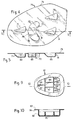
- the sole 21 (FIG. 1), made of plastic material with a high degree of polymerization, has a contour 22 of usual shape and includes a front part 23, a middle part 24 and a rear part 25.
- the body 26 of the sole 21 is flexible because of its thinness. From its lower face 27 protrude, at the front part 23, and coming from molding with the body, bosses 28 and, at the rear part 25, transverse rectilinear reliefs or ribs 29, arranged in parallel, leaving the posterior end a thin tongue 31.
- the body 26 has cutouts, namely a cutout 32, substantially in the center of the front part 23 of the sole, in the general shape of a V, or crescent, with two branches 33 and 34, or horns, and with a crown 35 turned towards the front, a substantially isosceles triangular anterior cut 36, at the acute angle turned towards the front, framed by two anterior bosses 28 1 and 28 2 , a median boss 28 3 adjacent to the outer edge 37 of the sole and three bosses 28 4 , 28 5 , 28 6 present in the widest region of the front part 23, the front part 23 of the sole body having isosceles triangular cutouts or openings 38 and 39, at an acute angle facing forward between, on the one hand, the bosses 28 4 and 28 5 and, on the other hand, the bosses 28 6 and 28 5 .
- Each boss has a polygonal contour, advantageously hexagonal or octagonal, limited by two parallel transverse faces 41, 42 substantially the same length, two long oblique faces 43, 44 slightly divergent from the rear face 42 and two or four faces 45, 46 and 47, 48 (depending on whether the outline is hexagonal or octagonal) up to the front face 41.
- the rear face 42 of a boss is less tall than the front face 41 (FIG. 3), so that the base of the boss is oblique or else, as shown, shows a horizontal face 47 ′, that is to say parallel to the lower surface 27 of the body 26, and an oblique face 49.
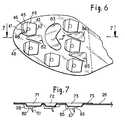
- a point 51 protrudes (FIG. 7) whose conical body 52 (FIG. 8) is extended by a rod. threaded 53 cooperating with a sleeve 54 internally threaded, and depending on the bottom 55 of a metal bowl or insert 56 embedded in the boss 26, a shoulder 57 of the tip being provided at the connection between the body 52 and the rod 53 which is supported against the oblique face 49 of said boss.
- the axis 58 of the tip 51 perpendicular to the oblique face 49 is thus directed rearward from the root.
- Each of the ribs 29 is limited by two parallel faces 61 and 62 (FIG. 3) directed towards the rear from the extra thickness 63 of the body 26 on which it depends and by a front face 64.
- the ribs 29 border an opening or opening of heel 30 and are perpendicular to the middle line 65 of the sole.
- Each of the openings or cutouts of the sole is provided for the passage of a protuberance, namely a triangular protuberance 71 (FIGS. 4 and 5), of shape conjugated to that of the cutout 36, a protuberance 72 of conjugate shape of the cutout. 32, in the general shape of a V, and triangular protrusions 73 and 74, of conjugate shapes respectively of the cutouts 38 and 39.
- the protrusions 71, 72, 73 and 74 depend on a blank 75, for example made of high polymer, thin and flexible, the outline 76 of which is that of the front part 23 of the sole body 26, so that, when the protrusions are introduced into the conjugate cutouts, the outline76 is an extension of the outline 22 of the sole.
- the protrusions from the blank 75 are limited by a wall of the same thickness as the latter, so that they are flexibly crushable, their crushing characteristics depending on their shape.
- 72 in the shape of a crescent, contribute two partitions 77 and 78 interposed between the opposite walls 79 and 81 limiting the branches of the V.
- the lower faces 82, 83, 84, 85 of the protrusions are at a level slightly higher than that of the horizontal faces 47 'of the bosses.
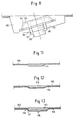
- a heel cup 91 (FIGS. 9 and 10), in the general shape of a bowl, the vertical wall 92 of which cooperates with the edge 90 of the opening 30 and which has a rim 93 whose bottom face 94 is applied to the upper surface of the sheet constituting the sole body 26.
- the height of the edge 92 of the cup is slightly greater than that of the protrusions 71, 72, etc. so that the heel of the shoe wearer is slightly raised relative to the sole of the foot.
- the longitudinal vertical partitions 96, 97, 98, 99 and transverse 101 and 102 From the bottom 95 of the bowl 91 depend the longitudinal vertical partitions 96, 97, 98, 99 and transverse 101 and 102.
- the partitions 96 and 97 are extended rearwards by oblique partitions 103 and 104, the height of the partitions being slightly lower than that of the bowl. These partitions have a stiffening role. In a variant, the height of the partitions is equal to that of the bowl.
- the assembly of the sole is extremely easy. It suffices to present the blank provided with its protrusions in front of the body 26 of the cut-out sole and to engage the protrusions of the blank in said cut-outs. Likewise, the heel piece is presented by its cup 91 in front of the cutout 30 and is simply pushed into it, the movement being limited by cooperation of the rim 93 of the heel piece with the sheet 26.
- the spiked shoe with such a sole allows the runner to take full advantage of his physical possibilities and avoids to the greatest extent muscle or joint accidents.
- transverse flexible zones formed by the intervals between the bosses allow the free play of the joints of the foot.
- the backward inclination of the tips is favorable for propulsion.
- Good support is provided by the cooperation of the horizontal faces of the bosses with the track.
- Soft protrusions provide cushioning that increases the comfort felt by the athlete and gives the shoe exceptional performance. Such protrusions absorb the shock when the foot makes contact with the ground, and this by progressive deformation under the effect of stress. When the constraint ceases, the protuberance returns to its original form. The air present in the protuberance contributes to the absorption of energy.
- the protrusions increase the grip of the sole to the ground, and this by a slight suction or suction effect produced by their deformation.
- the rear portions of the protrusions or pads are rearward relative to the points of the adjacent bosses and their fronts in front of the root of the points. Thus, the foot rests first on the pads, and it is only then that the points come into contact with the ground.
- a protuberance or pad is formed by an extra thickness 111 of a blank 112.
- a pad 113 of flexible expanded material is included between the blank 114 and a talk 115.
- a protrusion 116 is defined by the wall 117 of a cell 118 which has a blank 119, and in the cell 118 is housed a pad 121 of a blank 122 superimposed on the blank 119.
- the sole can be manufactured by molding a high polymer, natural or synthetic, from the group comprising polyesters, polyamides, polyurethanes.
- the pads or protuberances being made of a polymer of lower hardness and flexural modulus than those of the polymer used for the rest of the sole.
- the sole can also result from the assembly of the pads or protrusions of the sole body with the bosses by gluing, welding, heat or ultrasound, etc.
Landscapes
- Footwear And Its Accessory, Manufacturing Method And Apparatuses (AREA)
Priority Applications (1)
| Application Number | Priority Date | Filing Date | Title |
|---|---|---|---|
| AT80401039T ATE5846T1 (de) | 1979-07-13 | 1980-07-10 | Sohle fuer athletikschuh. |
Applications Claiming Priority (2)
| Application Number | Priority Date | Filing Date | Title |
|---|---|---|---|
| FR7918264 | 1979-07-13 | ||
| FR7918264A FR2460636A1 (fr) | 1979-07-13 | 1979-07-13 | Semelle de chaussure d'athletisme |
Publications (3)
| Publication Number | Publication Date |
|---|---|
| EP0022716A2 EP0022716A2 (fr) | 1981-01-21 |
| EP0022716A3 EP0022716A3 (en) | 1981-05-06 |
| EP0022716B1 true EP0022716B1 (fr) | 1984-01-18 |
Family
ID=9227863
Family Applications (1)
| Application Number | Title | Priority Date | Filing Date |
|---|---|---|---|
| EP80401039A Expired EP0022716B1 (fr) | 1979-07-13 | 1980-07-10 | Semelle de chaussure d'athlétisme |
Country Status (4)
| Country | Link |
|---|---|
| EP (1) | EP0022716B1 (OSRAM) |
| AT (1) | ATE5846T1 (OSRAM) |
| DE (1) | DE3066162D1 (OSRAM) |
| FR (1) | FR2460636A1 (OSRAM) |
Families Citing this family (2)
| Publication number | Priority date | Publication date | Assignee | Title |
|---|---|---|---|---|
| GB2285569A (en) * | 1994-01-13 | 1995-07-19 | Moss Hayes Richard Vere | Twin grip trainer soles |
| US8375604B2 (en) | 2010-04-07 | 2013-02-19 | Nike, Inc. | Article of footwear with multiple cleat systems |
Family Cites Families (7)
| Publication number | Priority date | Publication date | Assignee | Title |
|---|---|---|---|---|
| GB191226524A (en) * | 1912-11-19 | 1913-04-24 | Sylvain Dreyfus | Improvements in or relating to Attachable Rubber Soles for Boots and Shoes. |
| US3487563A (en) * | 1967-11-16 | 1970-01-06 | Luther Austin & Sons Ltd | Sports shoes |
| US3507059A (en) * | 1968-05-14 | 1970-04-21 | Hyde & Sons Co A R | Shoe sole |
| DE2202934A1 (de) * | 1972-01-21 | 1973-07-26 | Adolf Dassler | Sportschuh |
| CA980112A (en) * | 1973-01-31 | 1975-12-23 | Onitsuka Co. | Sport shoe |
| FR2261721A1 (en) * | 1974-02-22 | 1975-09-19 | Beneteau Charles | Sole of sports shoe for outdoor use - has deformable protuberances on the base of the sole |
| CH611140A5 (OSRAM) * | 1975-06-09 | 1979-05-31 | Dassler Puma Sportschuh |
-
1979
- 1979-07-13 FR FR7918264A patent/FR2460636A1/fr active Granted
-
1980
- 1980-07-10 EP EP80401039A patent/EP0022716B1/fr not_active Expired
- 1980-07-10 AT AT80401039T patent/ATE5846T1/de not_active IP Right Cessation
- 1980-07-10 DE DE8080401039T patent/DE3066162D1/de not_active Expired
Also Published As
| Publication number | Publication date |
|---|---|
| EP0022716A3 (en) | 1981-05-06 |
| FR2460636B1 (OSRAM) | 1983-12-30 |
| FR2460636A1 (fr) | 1981-01-30 |
| DE3066162D1 (en) | 1984-02-23 |
| ATE5846T1 (de) | 1984-02-15 |
| EP0022716A2 (fr) | 1981-01-21 |
Similar Documents
| Publication | Publication Date | Title |
|---|---|---|
| EP1222868B1 (fr) | Semelle intermédiaire et chaussure équipée d'une telle semelle | |
| EP0340053B2 (fr) | Semelage de chaussures pour la pratique d'activités sportives et de plein air | |
| EP2198729B1 (fr) | Chaussure à semelage amélioré | |
| EP0991334B1 (fr) | Chaussure a semelage avec structure deformable | |
| EP1100349B1 (fr) | Semelle de chaussure | |
| CH675524A5 (OSRAM) | ||
| FR2475371A1 (fr) | Semelle pour chaussure de sport a cramponnage oblique | |
| FR2481086A1 (fr) | Chaussure de course munie d'un coussin de protection du metatarse sur la plaque a pointes | |
| CH677450A5 (OSRAM) | ||
| FR2483196A1 (fr) | Chaussure pour la pratique du golf | |
| FR2786371A1 (fr) | Chaussure souple pour sport de glisse | |
| FR2967874A1 (fr) | Chaussure de sport de type a crampons | |
| WO2019069277A1 (fr) | Semelle pour article chaussant a amortissement progressif | |
| EP0103507B1 (fr) | Semelle perfectionnée pour chaussure de sport, à saillies sous-jacentes de tenue sur le terrain, pour la pratique notamment du football, du rugby, du hockey sur gazon ou autres | |
| EP0022716B1 (fr) | Semelle de chaussure d'athlétisme | |
| WO2019141735A1 (fr) | Semelle pour chaussure de sport comprenant une ou plusieurs figures de déformation | |
| EP0401108B1 (fr) | Semelage pour chaussure de sport améliorant la propulsion et la réception | |
| EP3873630B1 (fr) | Raquette à neige avec semelle comportant des zones de crampons | |
| FR2548545A1 (fr) | Ski de marche anti-glisse | |
| FR2761273A3 (fr) | Planche de glisse | |
| CA2014773A1 (fr) | Dispositif de stabilisation, d'amortissement et de restitution d'energie pour chaussures, notamment de sport et chaussures equipees d'un tel dispositif | |
| EP0736312B1 (fr) | Perfectionnement pour tamis de raquette à neige | |
| EP0059660A1 (fr) | Chaussure | |
| FR2808977A1 (fr) | Orthese dynamique bifonctionnelle pour chaussures | |
| EP3405061A1 (fr) | Semelle de chaussure |
Legal Events
| Date | Code | Title | Description |
|---|---|---|---|
| PUAI | Public reference made under article 153(3) epc to a published international application that has entered the european phase |
Free format text: ORIGINAL CODE: 0009012 |
|
| AK | Designated contracting states |
Designated state(s): AT BE CH DE GB IT LU NL SE |
|
| PUAL | Search report despatched |
Free format text: ORIGINAL CODE: 0009013 |
|
| AK | Designated contracting states |
Designated state(s): AT BE CH DE GB IT LU NL SE |
|
| 17P | Request for examination filed |
Effective date: 19810704 |
|
| ITF | It: translation for a ep patent filed | ||
| GRAA | (expected) grant |
Free format text: ORIGINAL CODE: 0009210 |
|
| AK | Designated contracting states |
Designated state(s): AT BE CH DE GB IT LI LU NL SE |
|
| REF | Corresponds to: |
Ref document number: 5846 Country of ref document: AT Date of ref document: 19840215 Kind code of ref document: T |
|
| REF | Corresponds to: |
Ref document number: 3066162 Country of ref document: DE Date of ref document: 19840223 |
|
| PLBE | No opposition filed within time limit |
Free format text: ORIGINAL CODE: 0009261 |
|
| STAA | Information on the status of an ep patent application or granted ep patent |
Free format text: STATUS: NO OPPOSITION FILED WITHIN TIME LIMIT |
|
| 26N | No opposition filed | ||
| REG | Reference to a national code |
Ref country code: CH Ref legal event code: PUE Owner name: PATRICK INTERNATIONAL SOCIETE ANONYME |
|
| ITPR | It: changes in ownership of a european patent |
Owner name: CESSIONE;PATRICK INTERNATIONAL |
|
| NLS | Nl: assignments of ep-patents |
Owner name: PATRICK INTERNATIONAL TE POUZAUGES, FRANKRIJK. |
|
| REG | Reference to a national code |
Ref country code: GB Ref legal event code: 732 |
|
| PGFP | Annual fee paid to national office [announced via postgrant information from national office to epo] |
Ref country code: AT Payment date: 19920624 Year of fee payment: 13 |
|
| PGFP | Annual fee paid to national office [announced via postgrant information from national office to epo] |
Ref country code: GB Payment date: 19920703 Year of fee payment: 13 |
|
| PGFP | Annual fee paid to national office [announced via postgrant information from national office to epo] |
Ref country code: CH Payment date: 19920708 Year of fee payment: 13 |
|
| PGFP | Annual fee paid to national office [announced via postgrant information from national office to epo] |
Ref country code: LU Payment date: 19920722 Year of fee payment: 13 |
|
| PGFP | Annual fee paid to national office [announced via postgrant information from national office to epo] |
Ref country code: SE Payment date: 19920724 Year of fee payment: 13 |
|
| ITTA | It: last paid annual fee | ||
| PGFP | Annual fee paid to national office [announced via postgrant information from national office to epo] |
Ref country code: NL Payment date: 19920731 Year of fee payment: 13 |
|
| PGFP | Annual fee paid to national office [announced via postgrant information from national office to epo] |
Ref country code: BE Payment date: 19920812 Year of fee payment: 13 |
|
| EPTA | Lu: last paid annual fee | ||
| PG25 | Lapsed in a contracting state [announced via postgrant information from national office to epo] |
Ref country code: LU Free format text: LAPSE BECAUSE OF NON-PAYMENT OF DUE FEES Effective date: 19930710 Ref country code: GB Effective date: 19930710 Ref country code: AT Effective date: 19930710 |
|
| PG25 | Lapsed in a contracting state [announced via postgrant information from national office to epo] |
Ref country code: SE Effective date: 19930711 |
|
| PG25 | Lapsed in a contracting state [announced via postgrant information from national office to epo] |
Ref country code: LI Effective date: 19930731 Ref country code: CH Effective date: 19930731 Ref country code: BE Effective date: 19930731 |
|
| BERE | Be: lapsed |
Owner name: S.A. PATRICK INTERNATIONAL Effective date: 19930731 |
|
| PG25 | Lapsed in a contracting state [announced via postgrant information from national office to epo] |
Ref country code: NL Effective date: 19940201 |
|
| GBPC | Gb: european patent ceased through non-payment of renewal fee |
Effective date: 19930710 |
|
| NLV4 | Nl: lapsed or anulled due to non-payment of the annual fee | ||
| REG | Reference to a national code |
Ref country code: CH Ref legal event code: PL |
|
| EUG | Se: european patent has lapsed |
Ref document number: 80401039.5 Effective date: 19940210 |
|
| PGFP | Annual fee paid to national office [announced via postgrant information from national office to epo] |
Ref country code: DE Payment date: 19950722 Year of fee payment: 16 |
|
| PG25 | Lapsed in a contracting state [announced via postgrant information from national office to epo] |
Ref country code: DE Effective date: 19970402 |