EP0022597A1 - Procédé et installation pour la fabrication de solutions aqueuses d'hyprochlorite de métal alcalin - Google Patents
Procédé et installation pour la fabrication de solutions aqueuses d'hyprochlorite de métal alcalin Download PDFInfo
- Publication number
- EP0022597A1 EP0022597A1 EP80200651A EP80200651A EP0022597A1 EP 0022597 A1 EP0022597 A1 EP 0022597A1 EP 80200651 A EP80200651 A EP 80200651A EP 80200651 A EP80200651 A EP 80200651A EP 0022597 A1 EP0022597 A1 EP 0022597A1
- Authority
- EP
- European Patent Office
- Prior art keywords
- alkali metal
- redox potential
- chlorine
- potential
- metal hypochlorite
- Prior art date
- Legal status (The legal status is an assumption and is not a legal conclusion. Google has not performed a legal analysis and makes no representation as to the accuracy of the status listed.)
- Ceased
Links
Images
Classifications
-
- C—CHEMISTRY; METALLURGY
- C01—INORGANIC CHEMISTRY
- C01B—NON-METALLIC ELEMENTS; COMPOUNDS THEREOF; METALLOIDS OR COMPOUNDS THEREOF NOT COVERED BY SUBCLASS C01C
- C01B11/00—Oxides or oxyacids of halogens; Salts thereof
- C01B11/04—Hypochlorous acid
- C01B11/06—Hypochlorites
- C01B11/062—Hypochlorites of alkali metals
-
- G—PHYSICS
- G05—CONTROLLING; REGULATING
- G05D—SYSTEMS FOR CONTROLLING OR REGULATING NON-ELECTRIC VARIABLES
- G05D21/00—Control of chemical or physico-chemical variables, e.g. pH value
- G05D21/02—Control of chemical or physico-chemical variables, e.g. pH value characterised by the use of electric means
Definitions
- the present invention relates to the manufacture of aqueous solutions of alkali metal hypochlorite and more particularly of sodium hypochlorite.
- an aqueous solution of alkali metal hydroxide and hypochlorite is circulated in shuttle between a tank containing an aqueous solution of alkali metal hydroxide and a reaction chamber supplied with chlorine; the solution in the room of the reaction is thus gradually enriched in alkali metal hypochlorite and its composition must therefore be continuously and precisely controlled, so as to reduce the chlorine flow in time and to cancel it as soon as the alkali metal hydroxide content in the reaction mixture falls below a predetermined critical value.
- the invention aims to remedy the aforementioned difficulties. It more specifically aims to provide a process and an installation for the manufacture of aqueous solutions of alkali metal hypochlorite, in which the progress of the reaction of chlorine on the aqueous solution of alkali metal hydroxide is followed at all times by a precise, reliable and independent control method of accidental variations in the flow rates and compositions of the streams of chlorine and of alkali metal hydroxide solution.
- the invention therefore relates to a process for the production of aqueous solutions of alkali metal hypochlorite, in which chlorine is reacted with an aqueous solution of alkali metal hydroxide, and the relative weights of chlorine and hydroxide are adjusted alkali metal of the reaction according to a function of the redox potential of the reaction; according to the invention, the function of the redox potential of the reaction is the derivative, with respect to time, of the redox potential, modulated by an instantaneous magnitude of said redox potential.
- the sources of chlorine and alkali metal hydroxide are not critical.
- the aqueous solution of alkali metal hydroxide can for example be obtained by electrolysis of an alkali metal chloride brine in a cell with a mercury cathode or in a cell with an ion exchange membrane, with selective permeability.
- Chlorine can also be obtained by electrolysis of an alkali metal chloride brine in a mercury cathode cell or in a permeable diaphragm cell or a membrane with selective permeability.
- the process according to the invention is however well suited to using, as a source of chlorine, residual gas mixtures containing chlorine, in particular residual gas mixtures for the liquefaction of chlorine produced by electrolysis of sodium chloride brines.
- the redox potential of the reaction of chlorine on the aqueous solution of alkali metal hydroxide is a concept well known in the art. It is usually measured by means of an electrochemical cell comprising a measurement electrode made of an unassailable metal or alloy, for example platinum, and a reference electrode (generally a saturated calomel electrode), immersed in the vicinity of one another in the reaction bath.
- a measurement electrode made of an unassailable metal or alloy, for example platinum
- a reference electrode generally a saturated calomel electrode
- the calculation of the derivative of the redox potential with respect to time does not present any difficulty and can be executed at any time automatically by analog or digital computers.
- the choice of the mathematical function according to which the derivative of the redox potential is modulated is imposed by the choice of the aforementioned instantaneous magnitude of the redox potential.
- the modulation chosen must be such that its response is little influenced by accidental fluctuations occurring in the flow rate of chlorine or of the alkali metal hydroxide solution.
- the modulation can for example be a multiplication, a division or an exponential function.
- the quantity chosen to express the redox potential is the redox potential itself expressed for example in mV, as measured by the electrochemical measurement described above.
- the quantity chosen to express the redox potential is the antilogarithm of the redox potential of the reaction. Variations in the pH of the reaction mixture in fact produce corresponding, generally large, variations in the antilogarithm of the redox potential, so that this preferred embodiment of the process according to the invention provides the advantage of increasing the sensitivity. of reaction control.
- the modulation chosen is preferably a multiplication.
- the supply of chlorine and of an aqueous solution of alkali metal hydroxide in the reaction mixture is generally regulated, so that the result of the multiplication of the redox potential or of its antilogarithm by the derivative of the redox potential is at any time less than a predetermined set value.
- Normally chosen values are chosen which correspond to pH values in the reaction mixture at least equal to 12 and preferably between 12.2 and 12.6.
- an installation comprising, on the one hand, a reaction chamber in communication with a chlorine inlet pipe, a pipe for admitting an aqueous solution of alkali metal hydroxide and a conduit for discharging an aqueous solution of alkali metal hypochlorite and, on the other hand, a motorized adjusting member for the relative flow rates of chlorine and alkali metal hydroxide, coupled to a control device comprising a cell for measuring the redox potential of the alkali metal hypochlorite solution and an analog circuit of the derivative, with respect to the time of the potential measured by the cell; according to the invention, the regulating device further comprises an analog circuit of the antilogarithmic function of said potential and an analog multiplier of the respective signals of the two analog circuits.
- reaction chamber is not critical; it can advantageously consist of a vertical stacking column.
- the device for adjusting the respective flow rates of chlorine and sodium hydroxide solution generally consists of a valve mounted on the intake pipe of the sodium hydroxide solution or, more generally, on the intake pipe of chlorine, as described in Belgian patents 605,926 of July 10, 1961, 610,753 of November 24, 1961 and 617,794 of May 17, 1962, all three in the name of the Applicant.
- the valve can be driven for example by means of an electric, hydraulic or pneumatic motor.
- the function of the regulating device is to control the operation of the regulating member as a function of the pH value in the alkali metal hypochlorite solution.
- the electrochemical cell for measuring the redox potential is of the type described above. It is located in the reaction chamber or in the outlet for the sodium hypochlorite solution.
- Analog derivative and antilogarithmic function circuits are well known in the art.
- the function of the derivative circuit is to emit a signal proportional to the derivative of the redox potential with respect to time;
- the function of the antilogarithmic circuit is to emit a signal proportional to the antilogarithm of the redox potential.
- the analog multiplier is also an analog circuit well known in itself. Its function is to modulate the signal emitted by the derivative circuit by multiplying it by the signal emitted by the antilogarithmic circuit, the resulting signal being transmitted to the motor of the regulating member, possibly via an amplifier.
- the method and the installation according to the invention apply to the manufacture of aqueous solutions of alkali metal hypochlorite, and more especially of sodium hypochlorite solutions, either by the continuous route or by the discontinuous route.
- the reaction chamber is continuously supplied with an aqueous solution of alkali metal hydroxide and the aqueous solution of alkali metal hypochlorite withdrawn immediately from said chamber is immediately removed.
- the respective flow rates of the sodium hydroxide and chlorine solution should be adjusted so that the alkali metal hypochlorite solution which is drawn out of the reaction can be used as it is and therefore has pH and hypochlorite concentration values which are compatible with the use for which it is intended.
- an aqueous solution of alkali metal hypochlorite and alkali metal hydroxide is circulated as a shuttle between the reaction chamber and a tank containing an alkali metal hydroxide solution, and the installation is emptied as soon as the solution circulating in the shuttle has pH and alkali metal hypochlorite concentration values which are compatible with the use for which it is intended.
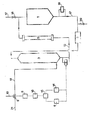
- the installation shown in the figure is designed to operate on the discontinuous track. To this end, it comprises a reaction chamber 3, a chlorine collector 10 and a reservoir 1 intended to contain, at the start of the installation, an aqueous solution of sodium hydroxide.
- the reaction chamber 3 is advantageously a stacking column. It is connected on the one hand to the chlorine collector 10 via a three-way valve 9 and a conduit 11 and, on the other hand, to the reservoir l, via a loop comprising a circulation pump 2, a refrigerant 5 and the conduits 12 and 13.
- the drive motor 8 of the valve 9 is coupled to a regulating device which comprises an electrochemical measuring cell 4 of the redox potential, mounted in bypass on the conduit 13 downstream of the reaction chamber 3, an analog derivative 6 and an antilogarithmic circuit 14 connected to the measurement cell 4, an analog multiplier 15 connected to the derivative 6 and to the antilogarithmic circuit 14 and an amplifier 16 of the signal emitted by the multiplier 15 and transmitted to the motor 8.
- a regulating device which comprises an electrochemical measuring cell 4 of the redox potential, mounted in bypass on the conduit 13 downstream of the reaction chamber 3, an analog derivative 6 and an antilogarithmic circuit 14 connected to the measurement cell 4, an analog multiplier 15 connected to the derivative 6 and to the antilogarithmic circuit 14 and an amplifier 16 of the signal emitted by the multiplier 15 and transmitted to the motor 8.
- the tank 1 Before starting the installation, the tank 1 is filled with a concentrated aqueous solution of sodium hydroxide, via the intake pipe 17, then the valve 18 is closed.
- the pump 2 is then started and the valve 9 is operated so that the entire chlorine flow rate coming from the manifold 10 is sent to the bottom of the reaction chamber 3, via the conduit 11.
- the sodium hydroxide solution circulating in shuttle between the reaction chamber 3 and the reservoir 1 is gradually enriched with sodium hypochlorite, and its ox slidingdoreduction potential is continuously measured at the exit of chamber 3 by the electrochemical measurement 4.
- the potential measured by cell 4 is processed by the differentiator 6 and by the circuit 14 which simultaneously send a signal proportional to its derivative with respect to time and a signal proportional to its antilogarithm.
- the signals emitted by the circuits 6 and 14 are introduced into the multiplier 15 where they are multiplied by one another.
- the redox potential is very low and varies little, even in the case where the chlorine flow rate in the collector 10 comes to undergo untimely, uncontrolled variations.
- the signal emitted by the analog multiplier 15 and transmitted to the motor 8 is therefore insufficient to actuate the latter, so that the valve 9 remains open as much as possible on the conduit 11.
- the potential measured by the cell 4 is higher and it also undergoes significant variations if the pH changes; the signal transmitted to the motor 8 is therefore sufficiently perceptible for it to operate the valve 9 so as to reduce the chlorine flow rate in the conduit 11 until it is canceled when the pH reaches the critical value.
- the critical pH value can be reached in the reaction chamber 3, not only at the end of the operating cycle but also in the event of a running incident leading to a sudden and unexpected increase in the chlorine flow rate in the collector 10 ..
- the pump 2 is stopped, the valve 20 is operated to drain the installation, then the tank 1 is filled with a new load of sodium hydroxide solution, before starting a new operating cycle.
- the third branch 21 of the valve 9 is connected to the reaction chamber of a second installation for the manufacture of sodium hypochlorite, similar to that which has just been described.
- the operation of the two installations coupled to the valve 9 is then adjusted so that at the end of an operating cycle of one installation corresponds to the start of an operating cycle of the other installation.
Landscapes
- Chemical & Material Sciences (AREA)
- Organic Chemistry (AREA)
- Physics & Mathematics (AREA)
- Geology (AREA)
- Inorganic Chemistry (AREA)
- General Life Sciences & Earth Sciences (AREA)
- Life Sciences & Earth Sciences (AREA)
- General Physics & Mathematics (AREA)
- Engineering & Computer Science (AREA)
- Automation & Control Theory (AREA)
- Electrolytic Production Of Non-Metals, Compounds, Apparatuses Therefor (AREA)
- Agricultural Chemicals And Associated Chemicals (AREA)
- Treatment Of Water By Oxidation Or Reduction (AREA)
Applications Claiming Priority (5)
| Application Number | Priority Date | Filing Date | Title |
|---|---|---|---|
| FR7918548 | 1979-07-16 | ||
| FR7918548A FR2461973A1 (fr) | 1979-07-16 | 1979-07-16 | Procede et installation pour la fabrication de solutions aqueuses d'hypochlorite de metal alcalin |
| ZA00807858A ZA807858B (en) | 1979-07-16 | 1980-12-15 | Process and apparatus for the manufacture of aqueous solutions of alkali metal hypochlorite |
| AU65483/80A AU6548380A (en) | 1979-07-16 | 1980-12-17 | Manufacture of aqueous solutions of alkali metal hypocloride |
| FI810087A FI810087L (fi) | 1979-07-16 | 1981-01-14 | Foerfarande och anordningar foer framstaellning av vattenloesningar av alkalimetallhypoklorit |
Publications (1)
| Publication Number | Publication Date |
|---|---|
| EP0022597A1 true EP0022597A1 (fr) | 1981-01-21 |
Family
ID=32512368
Family Applications (1)
| Application Number | Title | Priority Date | Filing Date |
|---|---|---|---|
| EP80200651A Ceased EP0022597A1 (fr) | 1979-07-16 | 1980-07-04 | Procédé et installation pour la fabrication de solutions aqueuses d'hyprochlorite de métal alcalin |
Country Status (8)
| Country | Link |
|---|---|
| US (1) | US4330521A (enExample) |
| EP (1) | EP0022597A1 (enExample) |
| AU (1) | AU6548380A (enExample) |
| BR (1) | BR8004369A (enExample) |
| ES (1) | ES493380A0 (enExample) |
| FI (1) | FI810087L (enExample) |
| FR (1) | FR2461973A1 (enExample) |
| ZA (1) | ZA807858B (enExample) |
Families Citing this family (11)
| Publication number | Priority date | Publication date | Assignee | Title |
|---|---|---|---|---|
| US5532389A (en) * | 1993-11-23 | 1996-07-02 | The Dow Chemical Company | Process for preparing alkylene oxides |
| AU3967497A (en) * | 1996-07-29 | 1998-02-20 | Robert Eric Montgomery | Chlorine dioxide tooth whitening compositions |
| RU2241658C1 (ru) * | 2003-05-19 | 2004-12-10 | Закрытое акционерное общество "Каустик" | Способ получения двуосновной соли гипохлорита кальция |
| US20050169832A1 (en) * | 2004-02-02 | 2005-08-04 | Powell Technologies Llc | Concurrent packed tower manufacture of hypochlorite |
| US7578991B2 (en) * | 2004-06-07 | 2009-08-25 | Powell Technologies Llc | Concurrent low-pressure manufacture of hypochlorite |
| US8623318B2 (en) * | 2004-07-12 | 2014-01-07 | Powell Technologies Llc | Manufacture of high-strength, low-salt aqueous sodium hypochlorite bleach and substantially dry crystalline salt |
| US8491864B2 (en) * | 2004-07-12 | 2013-07-23 | Powell Technologies Llc | Manufacture of high-strength, low-salt sodium hypochlorite bleach |
| US7175824B2 (en) * | 2004-07-12 | 2007-02-13 | Powell Technologies Llc A Michigan Limited Liability Company | Manufacture of high-strength, low-salt sodium hypochlorite bleach |
| BRPI0710338A2 (pt) * | 2006-04-29 | 2011-08-09 | Electrolytic Technologies Corp | sistema de geração eletroquìmica para produzir gás de cloro, naoh e solução de hipoclorito de sódio e processo para produzir eletroliticamante gás de cloro, naoh e opcionalmente um hipoclorito de sódio |
| ES2379216T3 (es) * | 2009-08-31 | 2012-04-23 | Lanxess Deutschland Gmbh | Procedimiento para preparar compuestos de yodopropargilo |
| MY174824A (en) * | 2016-08-05 | 2020-05-18 | Chew Kong Cheng | System and method for recovering sodium hypochlorite from exhaust chlorine gas |
Citations (3)
| Publication number | Priority date | Publication date | Assignee | Title |
|---|---|---|---|---|
| FR1327699A (fr) * | 1962-07-05 | 1963-05-17 | Solvay | Procédé pour la fabrication d'hypochlorite |
| US3702234A (en) * | 1970-03-26 | 1972-11-07 | Edgar H Pavia | Manufacture of sodium hypochlorite |
| SU538984A1 (ru) * | 1974-10-22 | 1976-12-15 | Предприятие П/Я В-8469 | Способ контрол состава реакционной массы при автоматическом управлении процессом получени гипохлорита натри |
Family Cites Families (4)
| Publication number | Priority date | Publication date | Assignee | Title |
|---|---|---|---|---|
| US3199949A (en) * | 1962-07-10 | 1965-08-10 | Solvay | Process control for hypochlorite production |
| US3880348A (en) * | 1974-06-03 | 1975-04-29 | Energoinvest Istrazivacko Razv | Variable structure adaptive controller |
| US4025763A (en) * | 1975-10-06 | 1977-05-24 | Phillips Petroleum Company | Process control including simulating a derivative |
| US4069413A (en) * | 1976-10-29 | 1978-01-17 | Phillips Petroleum Company | Process measurement and control |
-
1979
- 1979-07-16 FR FR7918548A patent/FR2461973A1/fr active Granted
-
1980
- 1980-07-04 EP EP80200651A patent/EP0022597A1/fr not_active Ceased
- 1980-07-09 US US06/167,132 patent/US4330521A/en not_active Expired - Lifetime
- 1980-07-14 BR BR8004369A patent/BR8004369A/pt not_active IP Right Cessation
- 1980-07-15 ES ES493380A patent/ES493380A0/es active Granted
- 1980-12-15 ZA ZA00807858A patent/ZA807858B/xx unknown
- 1980-12-17 AU AU65483/80A patent/AU6548380A/en not_active Abandoned
-
1981
- 1981-01-14 FI FI810087A patent/FI810087L/fi not_active Application Discontinuation
Patent Citations (3)
| Publication number | Priority date | Publication date | Assignee | Title |
|---|---|---|---|---|
| FR1327699A (fr) * | 1962-07-05 | 1963-05-17 | Solvay | Procédé pour la fabrication d'hypochlorite |
| US3702234A (en) * | 1970-03-26 | 1972-11-07 | Edgar H Pavia | Manufacture of sodium hypochlorite |
| SU538984A1 (ru) * | 1974-10-22 | 1976-12-15 | Предприятие П/Я В-8469 | Способ контрол состава реакционной массы при автоматическом управлении процессом получени гипохлорита натри |
Non-Patent Citations (2)
| Title |
|---|
| CHEMICAL ABSTRACTS, Vol. 86, No. 14, 4 Avril 1977, page 186, colonne 1, Abrege 92680y Columbus, Ohio (US) & SU - A - 538 984 (ZOBNIN et al.) (15 Decembre 1976) * |
| JOURNAL OF THE ELECTROCHEMICAL SOCIETY, Vol. 97, No. 8, 1950 Princeton (US) P.J. PYE: "The Control of Bleach Manufacture by Oxidation Potential" pages 245-248 * |
Also Published As
| Publication number | Publication date |
|---|---|
| BR8004369A (pt) | 1981-01-27 |
| FR2461973A1 (fr) | 1981-02-06 |
| ES8107120A1 (es) | 1981-10-01 |
| FR2461973B1 (enExample) | 1983-01-28 |
| ES493380A0 (es) | 1981-10-01 |
| FI810087A7 (fi) | 1982-07-15 |
| FI810087L (fi) | 1982-07-15 |
| AU6548380A (en) | 1982-06-24 |
| ZA807858B (en) | 1981-12-30 |
| US4330521A (en) | 1982-05-18 |
Similar Documents
| Publication | Publication Date | Title |
|---|---|---|
| EP0022597A1 (fr) | Procédé et installation pour la fabrication de solutions aqueuses d'hyprochlorite de métal alcalin | |
| EP0002423B1 (fr) | Procédé et machine pour le lavage et le blanchiment de matières textiles | |
| EP2274786B1 (fr) | Biopile a rendement ameliore | |
| KR102099656B1 (ko) | 리튬 이온 커패시터용 전극의 제조 장치 및 제조 방법 | |
| US20080149493A1 (en) | Method and apparatus for ammonia (nh3) generation | |
| TWI424089B (zh) | 蝕刻方法、微結構之製作方法及蝕刻裝置 | |
| WO2001079592A1 (en) | Apparatus and method for electrochemical processing of substrates | |
| FR2755789A1 (fr) | Procede et appareil de traitement d'une solution de dechets radioactifs | |
| EP0333556B1 (fr) | Procédé de régulation d'une cellule d'électrolyse | |
| EP2294648A2 (fr) | Production d'un biofilm sur une electrode pour biopile, electrode et biopile obtenues | |
| FR2480794A1 (fr) | Procede pour concentrer un hydroxyde de metal alcalin dans une serie de cellules hybrides | |
| EP2170775A2 (fr) | Procede de traitement mixte chimique electrochimique d'un milieu liquide charge en nitrates, dispositif pour traiter un tel milieu liquide et applications | |
| WO2013030376A1 (fr) | Procede de reduction electrochimique du co2 catalysee par un biofilm electrochimiquement actif | |
| EP1375436A1 (fr) | Procédé de conduite d'un réacteur séquentiel discontinu de traitement d'eaux résiduaires | |
| EP2718483A1 (fr) | Procédé de traitement par percolation d'un élément de feutre par électrodéposition | |
| EP0127492B1 (fr) | Procédé de traitement d'une solution de purge notamment destinée à un procédé d'extraction de zinc par voie électrolytique | |
| WO2018002548A1 (fr) | Systeme electrolytique pour la synthese du perchlorate de sodium avec anode a surface externe en diamant dope au bore | |
| JP2006334498A (ja) | 電解質溶液供給装置 | |
| CH671966A5 (en) | Mfr. of chlorine soln. for treating water - by electrolysing hydrochloric acid and recycling catholyte | |
| CH412827A (fr) | Procédé pour régler la fabrication d'hypochlorite | |
| FR2981363A1 (fr) | Procede de culture de levures oleagineuses sur substrat carbone | |
| WO2024180294A1 (fr) | Installation pour la production d'electricite et engin comprenant une telle installation | |
| FR2738754A1 (fr) | Procede et appareil pour la cristallisation et la filtration d'un materiau cristallisable en solution | |
| FR3085971A1 (fr) | Reacteur bio-electrochimique comportant une bio-anode et une anode abiotique et son utilisation pour l'electrosynthese microbienne | |
| WO2025008355A1 (fr) | Réacteur d'équilibrage pour un système électro-chimique de stockage d'énergie |
Legal Events
| Date | Code | Title | Description |
|---|---|---|---|
| PUAI | Public reference made under article 153(3) epc to a published international application that has entered the european phase |
Free format text: ORIGINAL CODE: 0009012 |
|
| AK | Designated contracting states |
Designated state(s): AT BE CH DE FR GB IT NL SE |
|
| 17P | Request for examination filed |
Effective date: 19810709 |
|
| STAA | Information on the status of an ep patent application or granted ep patent |
Free format text: STATUS: THE APPLICATION HAS BEEN REFUSED |
|
| 18R | Application refused |
Effective date: 19830518 |
|
| RIN1 | Information on inventor provided before grant (corrected) |
Inventor name: GLINEUR, WILLY |