EP0022420A1 - Procédé de préparation d'un produit abrasif, à base d'alumine et d'oxycarbures d'aluminium et utilisation d'un tel abrasif - Google Patents
Procédé de préparation d'un produit abrasif, à base d'alumine et d'oxycarbures d'aluminium et utilisation d'un tel abrasif Download PDFInfo
- Publication number
- EP0022420A1 EP0022420A1 EP80420081A EP80420081A EP0022420A1 EP 0022420 A1 EP0022420 A1 EP 0022420A1 EP 80420081 A EP80420081 A EP 80420081A EP 80420081 A EP80420081 A EP 80420081A EP 0022420 A1 EP0022420 A1 EP 0022420A1
- Authority
- EP
- European Patent Office
- Prior art keywords
- high hardness
- abrasive
- ratio
- alumina
- product
- Prior art date
- Legal status (The legal status is an assumption and is not a legal conclusion. Google has not performed a legal analysis and makes no representation as to the accuracy of the status listed.)
- Granted
Links
- PNEYBMLMFCGWSK-UHFFFAOYSA-N aluminium oxide Inorganic materials [O-2].[O-2].[O-2].[Al+3].[Al+3] PNEYBMLMFCGWSK-UHFFFAOYSA-N 0.000 title claims abstract description 25
- 238000000034 method Methods 0.000 title claims description 9
- 238000004519 manufacturing process Methods 0.000 title claims 4
- 230000005496 eutectics Effects 0.000 claims abstract description 16
- 229910052782 aluminium Inorganic materials 0.000 claims abstract description 10
- 238000001816 cooling Methods 0.000 claims abstract description 9
- 239000011159 matrix material Substances 0.000 claims abstract description 9
- XAGFODPZIPBFFR-UHFFFAOYSA-N aluminium Chemical compound [Al] XAGFODPZIPBFFR-UHFFFAOYSA-N 0.000 claims abstract description 7
- 239000003575 carbonaceous material Substances 0.000 claims abstract description 7
- 125000004432 carbon atom Chemical group C* 0.000 claims abstract description 6
- 239000013078 crystal Substances 0.000 claims abstract description 5
- 125000004430 oxygen atom Chemical group O* 0.000 claims abstract description 3
- 239000000203 mixture Substances 0.000 claims description 21
- 229910018072 Al 2 O 3 Inorganic materials 0.000 claims description 20
- 239000006185 dispersion Substances 0.000 claims description 12
- 239000003082 abrasive agent Substances 0.000 claims description 11
- 238000000227 grinding Methods 0.000 claims description 10
- OKTJSMMVPCPJKN-UHFFFAOYSA-N Carbon Chemical group [C] OKTJSMMVPCPJKN-UHFFFAOYSA-N 0.000 claims description 6
- 229910052799 carbon Inorganic materials 0.000 claims description 6
- 238000003754 machining Methods 0.000 claims description 5
- 239000000463 material Substances 0.000 claims description 4
- 238000002844 melting Methods 0.000 claims description 4
- 230000008018 melting Effects 0.000 claims description 4
- 238000005520 cutting process Methods 0.000 claims description 3
- 238000005553 drilling Methods 0.000 claims description 3
- 230000004927 fusion Effects 0.000 claims description 3
- 239000011261 inert gas Substances 0.000 claims description 3
- CAVCGVPGBKGDTG-UHFFFAOYSA-N alumanylidynemethyl(alumanylidynemethylalumanylidenemethylidene)alumane Chemical group [Al]#C[Al]=C=[Al]C#[Al] CAVCGVPGBKGDTG-UHFFFAOYSA-N 0.000 claims description 2
- 229910003481 amorphous carbon Inorganic materials 0.000 claims description 2
- 239000000571 coke Substances 0.000 claims description 2
- 229910002804 graphite Inorganic materials 0.000 claims description 2
- 239000010439 graphite Substances 0.000 claims description 2
- 239000000843 powder Substances 0.000 claims description 2
- 238000002360 preparation method Methods 0.000 claims description 2
- 239000000779 smoke Substances 0.000 claims description 2
- 101100421144 Danio rerio selenoo1 gene Proteins 0.000 claims 1
- 101100202896 Mus musculus Selenoo gene Proteins 0.000 claims 1
- 229910052593 corundum Inorganic materials 0.000 abstract description 15
- 229910001845 yogo sapphire Inorganic materials 0.000 abstract description 9
- 239000004411 aluminium Substances 0.000 abstract 1
- 229910052751 metal Inorganic materials 0.000 description 12
- 239000002184 metal Substances 0.000 description 12
- MCMNRKCIXSYSNV-UHFFFAOYSA-N Zirconium dioxide Chemical compound O=[Zr]=O MCMNRKCIXSYSNV-UHFFFAOYSA-N 0.000 description 8
- 238000012360 testing method Methods 0.000 description 8
- 239000010431 corundum Substances 0.000 description 6
- 238000010586 diagram Methods 0.000 description 6
- 150000001875 compounds Chemical class 0.000 description 5
- 229910001570 bauxite Inorganic materials 0.000 description 3
- 239000007788 liquid Substances 0.000 description 3
- 229910016384 Al4C3 Inorganic materials 0.000 description 2
- HIGRAKVNKLCVCA-UHFFFAOYSA-N alumine Chemical compound C1=CC=[Al]C=C1 HIGRAKVNKLCVCA-UHFFFAOYSA-N 0.000 description 2
- 238000000137 annealing Methods 0.000 description 2
- 239000012634 fragment Substances 0.000 description 2
- VNWKTOKETHGBQD-UHFFFAOYSA-N methane Chemical compound C VNWKTOKETHGBQD-UHFFFAOYSA-N 0.000 description 2
- 230000002035 prolonged effect Effects 0.000 description 2
- 239000000700 radioactive tracer Substances 0.000 description 2
- 230000009466 transformation Effects 0.000 description 2
- 229910052582 BN Inorganic materials 0.000 description 1
- PZNSFCLAULLKQX-UHFFFAOYSA-N Boron nitride Chemical compound N#B PZNSFCLAULLKQX-UHFFFAOYSA-N 0.000 description 1
- 229910000975 Carbon steel Inorganic materials 0.000 description 1
- 229910000831 Steel Inorganic materials 0.000 description 1
- 241001080024 Telles Species 0.000 description 1
- QCWXUUIWCKQGHC-UHFFFAOYSA-N Zirconium Chemical compound [Zr] QCWXUUIWCKQGHC-UHFFFAOYSA-N 0.000 description 1
- -1 aluminum nitrides Chemical class 0.000 description 1
- 230000015572 biosynthetic process Effects 0.000 description 1
- 238000005422 blasting Methods 0.000 description 1
- 239000010962 carbon steel Substances 0.000 description 1
- 239000000470 constituent Substances 0.000 description 1
- 238000010276 construction Methods 0.000 description 1
- 238000002425 crystallisation Methods 0.000 description 1
- 230000008025 crystallization Effects 0.000 description 1
- 230000001186 cumulative effect Effects 0.000 description 1
- 229910003460 diamond Inorganic materials 0.000 description 1
- 239000010432 diamond Substances 0.000 description 1
- 238000011156 evaluation Methods 0.000 description 1
- 239000004744 fabric Substances 0.000 description 1
- 230000006870 function Effects 0.000 description 1
- 150000004677 hydrates Chemical class 0.000 description 1
- 229910052500 inorganic mineral Inorganic materials 0.000 description 1
- 238000012423 maintenance Methods 0.000 description 1
- 230000015654 memory Effects 0.000 description 1
- 239000011707 mineral Substances 0.000 description 1
- 230000002093 peripheral effect Effects 0.000 description 1
- 238000010587 phase diagram Methods 0.000 description 1
- 238000005498 polishing Methods 0.000 description 1
- 238000012552 review Methods 0.000 description 1
- 239000011435 rock Substances 0.000 description 1
- HBMJWWWQQXIZIP-UHFFFAOYSA-N silicon carbide Chemical compound [Si+]#[C-] HBMJWWWQQXIZIP-UHFFFAOYSA-N 0.000 description 1
- 229910010271 silicon carbide Inorganic materials 0.000 description 1
- 238000010583 slow cooling Methods 0.000 description 1
- 239000007787 solid Substances 0.000 description 1
- 230000000087 stabilizing effect Effects 0.000 description 1
- 229910001220 stainless steel Inorganic materials 0.000 description 1
- 239000010959 steel Substances 0.000 description 1
- 238000005303 weighing Methods 0.000 description 1
- 229910052726 zirconium Inorganic materials 0.000 description 1
Images

Classifications
-
- C—CHEMISTRY; METALLURGY
- C09—DYES; PAINTS; POLISHES; NATURAL RESINS; ADHESIVES; COMPOSITIONS NOT OTHERWISE PROVIDED FOR; APPLICATIONS OF MATERIALS NOT OTHERWISE PROVIDED FOR
- C09K—MATERIALS FOR MISCELLANEOUS APPLICATIONS, NOT PROVIDED FOR ELSEWHERE
- C09K3/00—Materials not provided for elsewhere
- C09K3/14—Anti-slip materials; Abrasives
- C09K3/1409—Abrasive particles per se
- C09K3/1427—Abrasive particles per se obtained by division of a mass agglomerated by melting, at least partially, e.g. with a binder
-
- C—CHEMISTRY; METALLURGY
- C04—CEMENTS; CONCRETE; ARTIFICIAL STONE; CERAMICS; REFRACTORIES
- C04B—LIME, MAGNESIA; SLAG; CEMENTS; COMPOSITIONS THEREOF, e.g. MORTARS, CONCRETE OR LIKE BUILDING MATERIALS; ARTIFICIAL STONE; CERAMICS; REFRACTORIES; TREATMENT OF NATURAL STONE
- C04B35/00—Shaped ceramic products characterised by their composition; Ceramics compositions; Processing powders of inorganic compounds preparatory to the manufacturing of ceramic products
- C04B35/01—Shaped ceramic products characterised by their composition; Ceramics compositions; Processing powders of inorganic compounds preparatory to the manufacturing of ceramic products based on oxide ceramics
- C04B35/10—Shaped ceramic products characterised by their composition; Ceramics compositions; Processing powders of inorganic compounds preparatory to the manufacturing of ceramic products based on oxide ceramics based on aluminium oxide
- C04B35/107—Refractories by fusion casting
Definitions
- the present invention relates to a new abrasive product, with high hardness, based on alumina and aluminum oxycarbons. It also relates to the process for the preparation of this product and its application to all machining operations by removing material and to parts which must resist wear.
- ratio p is numerically equal to the fraction molai- re Al 4 C 3 in the diagram Al 2 O 3 / Al 4 C 3.
- compositions corresponding to p of between 0.02 and 0.20 have proved to be the most interesting.
- the Applicant has also discovered, and it is another object of the invention, that the high hardness abrasive compositions which have just been described can be obtained by melting alumina and a carbonaceous substance and controlled speed cooling.
- the carbonaceous substance can be carbon itself in one of its usual forms, for example graphite, coke, smoke black, amorphous carbon, or a compound such as aluminum carbide Al 4 C 3 , or even an aluminum + carbon mixture.
- the proportions of the initial constituents are calculated on the basis of the stoichiometric equations, as a function of the composition targeted. Examples will be given to clarify the implementation of this process. Although one can observe, during the fusion, a volatilization of Al 2 OC, one observes only very small differences between the calculated compositions and the obtained compositions. Depending on the type of furnace in which the fusion is carried out, it may be desirable to operate under a dry inert gas atmosphere, so as to avoid any risk of formation of aluminum nitrides or carbonitrides, but it is also possible operate in the open air.
- the cooling rate is the essential element that determines the structure of the product. Slow cooling, for example 10 to 20 ° C per minute or rapid cooling followed by prolonged annealing, for example 24 hours at 1500 ° C, or 15 minutes at 1810 ° C, lead to the stable structure, that is to say containing mainly the compounds Al 2 O 3 and Al 4 O 4 C.
- Examples 1 to 6 do not call for any particular comment; Examples 7 and 8 show that a metastable structure obtained by rapid cooling is brought back to the stable state by annealing for 15 minutes at 1810 ° C. A series of tests was then carried out to determine the properties of the abrasive compositions, high hardness, objects of the invention.
- the method used is as follows: for a given metal, we measure the quantity removed on a cylinder made of this metal by a tool formed by a three-sided pyramid, making an angle of 120 °, cut in the abrasive to be studied.
- the metal cylinder is fixed to the periphery of a mandrel rotating at a peripheral speed of the order of 30 m / s. At each mandrel revolution, the cylinder passes in front of the point of the tool studied, which traces a groove there. The tool moves along a generatrix of the cylinder and cuts a series of controlled overlap grooves there, over its entire length which is 6 centimeters there.
- the quantity of metal removed and the degree of wear of the tool are measured by weighing.
- the pyramidal tool has a point which, as the pyramid wears out, turns into a triangular plane surface.
- the wear of the tool is expressed by the area of this triangular planar face.
- this area is reduced to the tip of the pyramid, the area of which is around 0.005 to 0.01 mm 2 .
- We are in conditions approaching a grinding grinding work fine grain grinding wheels.
- the surface created can reach 2 mm2.
- FIG. 1 represents a series of curves relating to tools made of sintered bauxite, of corundum with zirconia and based on compositions according to the invention.
- compositions which are the subject of the invention over conventional abrasives and, in particular, composition No. 4, the characteristics of which are quite extraordinary and leave far behind the best abrasives used today.
- metalastable abrasive compositions have, even under the most severe working conditions, total stability, and that the transformation of the aetastable structure into a stable structure occurs only by prolonged maintenance at temperatures above 1500 ° C.
- the parts can be obtained in the form by pouring liquid into cooled molds.
- the possible applications thus relate either to metal transformation and machining work, or work on mineral materials (drilling, sawing of rocks for example), or even even equipment construction industries with significant wear stresses.
Landscapes
- Chemical & Material Sciences (AREA)
- Engineering & Computer Science (AREA)
- Materials Engineering (AREA)
- Organic Chemistry (AREA)
- Ceramic Engineering (AREA)
- Manufacturing & Machinery (AREA)
- Structural Engineering (AREA)
- Polishing Bodies And Polishing Tools (AREA)
- Compositions Of Oxide Ceramics (AREA)
- Compounds Of Alkaline-Earth Elements, Aluminum Or Rare-Earth Metals (AREA)
Abstract
Description
- La présente invention concerne un nouveau produit abrasif, à haute dureté, à base d'alumine et d'oxycarbures d'aluminium. Elle concerne également le procédé de préparation de ce produit et son application à toutes les opérations d'usinage par enlèvement de matière et aux pièces devant résister à l'usure.
- La majorité des produits dehaute dureté et, en particulier des abrasifs utilisés actuellement, sont à base, soit de carbure de silicium, soit d'alumine frittée ou électrofondue (corindon), ou de mélanges d'alunine et de zirconium électrofondus (corindon à la zircone). Mais, il existe de nombreux cas où l'on souhaiterait disposer de produits résistant à l'usure et, en particulier d'abrasifs plus performants sans pour autant faire appel aux produits tels que le diamant ou le nitrure de bore cubique, dont le prix élevé limite les emplois à des cas tout à fait spéciaux.
- La demanderesse a découvert que certaines compositions cristallines à base d'alumine et d'oxycarbures d'aluminium possédaient une dureté et un pouvoir abrasif très supérieurs à ceux du corindon et du corindon à la zircone, et constituaient une nouvelle classe de produits à haute dureté, utilisable aussi bien pour leurs propriétés abrasives que pour leur résistance à l'usure. Si l'on considère le diagramme Al2O3 - Al4C3, tel qu'il a été publié par FOSTER et al dans J.Am. Ceram. Soc. (1956)39; n°1, 1-11 et reproduit dans "Phase Diagrams for Ceramists", tome (1964) n°1914 p.524, on voit qu'il existe deux oxycarbures d'aluminium définis : Al2OC et A1404C. En pratique, seule la partie gauche de ce diagramme, correspondant à des compositions ne comportant pas d'Al4C3 est intéressante, dans le cas présent, car il est connu que ce carbure se décompose progressivement à l'air humide en donnant des hydrates d'alumine et du méthane.
- La demanderesse a découvert, d'une part, que l'oxycarbure Al4O4C était stable, alors que l'oxycarbure Al2OC n'était stable qu'à haute température, mais pouvait être obtenu à l'état métastable par un refroidissement rapide du mélange initial Al2O3 - Al4C3 liquide, et d'autre part, qu'il existait un eutectique Al2O3 - Al2OC correspondant à 13 molécules% d'Al4C3, et dont le point de fusion est voisin de 1800°C, alors que le diagramme de FOSTER ne fait apparaître que le seul eutectique stable Al2O - Al4O4C, correspondant à 10 molécules% d'Al4C3, et dont le point de fusion est à environ 1840°C. Pour éviter toute ambiguïté dans la composition des produits, objets de l'invention, nous conviendrons de caractériser chaque produit par son rapport : nombre d'atomes de carbone sur nombre d'atomes de carbone + d'atomes d'oxygène, soit : C/C + 0, que l'on désigne par p. Selon cette définition, on a pour les composés :
- Al2O3 : p = 0
- Al4O4C : p = 0,2
- Al2OC : p = 0,5
- Al4C3 : p = 1
- On remarque que ce rapport p est numériquement égal à la fraction molai- re d'Al4C3 dans le diagramme Al2O3/Al4C3.
- Les produits abrasifs, à haute dureté, objets de l'invention pouvant comporter, outre l'alumine, l'un et/ou l'autre ou les deux oxycarbures, vont se répartir en sept catégories :
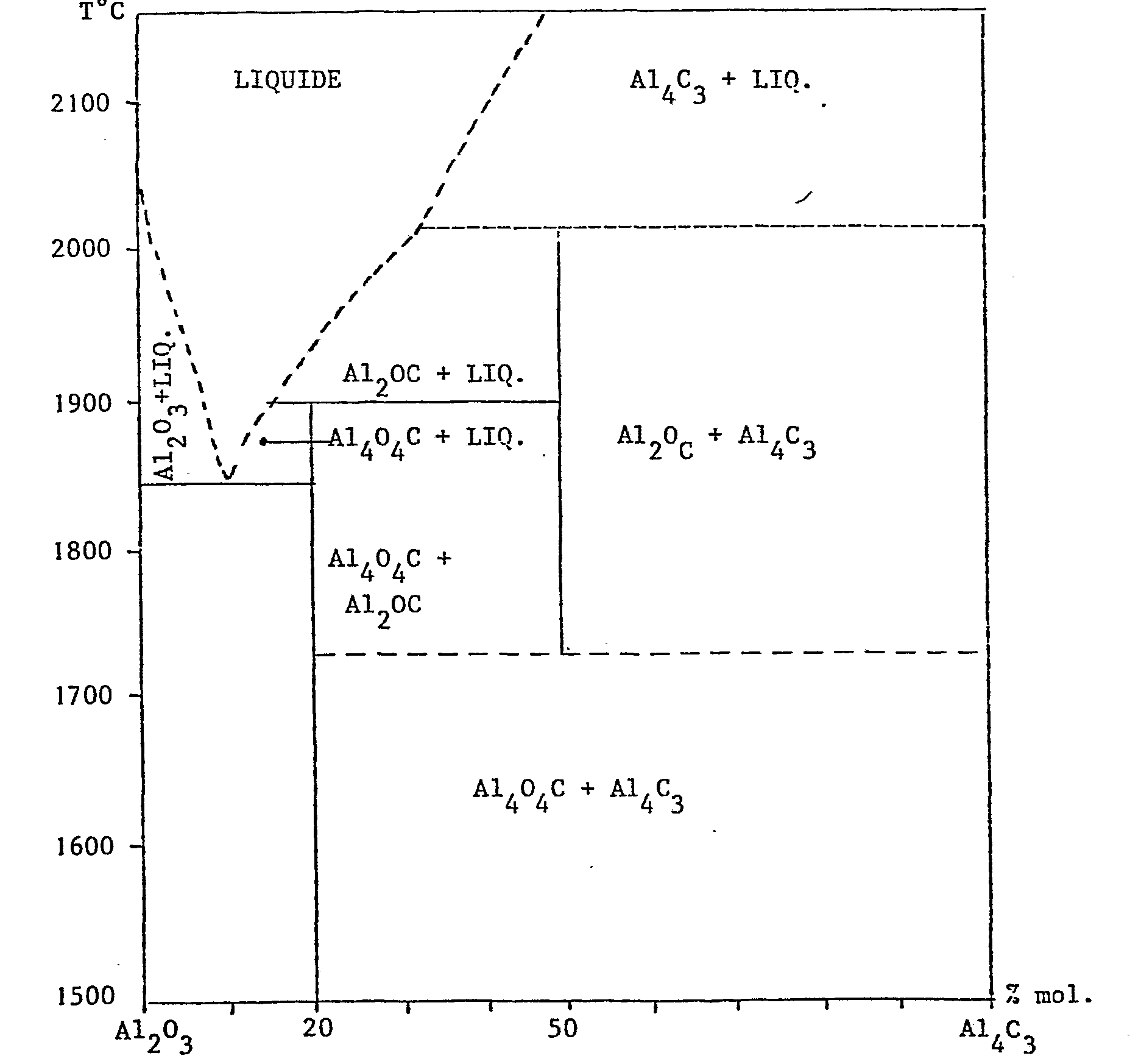
- A/ Les produits constitués par une combinaison stable Al2O3 - Al4O4C :
- 1 - hypoeutectique, formée par une dispersion de cristaux d'alunine primaire dans la matrice eutectique Al2O3 - Al4O4C avec p compris entre 0,01 et 0,10
- 2 - eutectique, avec p sensiblement égal à 0,10
- 3 - hypereutectique, constituée par une dispersion de grains d'Al4O4C dans une matrice d'eutectique Al2O3 - Al4O4C avec p compris entre 0,10 et 0,20.
- B/ Les produits constitués par une combinaison métastable Al2O3 -Al2OC:
- 4 - hypoeutectique formée par une dispersion de cristaux d'alumine primaire dans une matrice eutectique Al2O3 - Al2OC, avec p compris entre 0,01 et 0,13
- 5 - eutectique, avec p sensiblement égal à 0,13
- 6 - hypereutectique, constituée par une dispersion de grains d'Al2OC dans une matrice eutectique Al2O3 - Al2OC avec ρ compris entre 0,13 et 0,50
- 7 - les produits constitués par une combinaison ternaire Al2O3-Al2OC-Al404C pour lesquels p peut varier entre 0,20,et 0,50.
- Dans les différents cas, la teneur en alumine est limitée :
- a) du côté des basses teneurs, par la nécessité d'avoir une proportion d'eutectique suffisante pour assurer la liaison des grains d'alumine primaire. Cette limite correspond approximativement à p = 0,01
- b) du côté des hautes teneurs, par la nécessité d'éviter la présence d'Al4C3, instable à l'air humide, qui apparaît, pour les états stables, au-delà de p = 0,20 et, pour les états métastables, au-delà de p = 0,50.
- En pratique, cependant, les compositions correspondant à p compris entre 0,02 et 0,20 se sont révélées les plus intéressantes.
- La demanderesse a également découvert, et c'est un autre objet de l'invention, que les compositions abrasives, à haute dureté, que l'on vient de décrire, pouvaient être obtenues par fusion d'alumine et d'une substance carbonée et refroidissement à vitesse contrôlée.
- La substance carbonée peut être le carbone lui-même sous une de ses formes habituelles, par exemple le graphite, le coke, le noir de fumée, le carbone amorphe, ou un composé tel que le carbure d'aluminium Al4C3, ou même un mélange aluminium + carbone.
- Les proportions des constituants initiaux sont calculées sur la base des équations stoechiométriques, en fonction de la composition visée. Des exemples seront donnés pour préciser la mise en oeuvre de ce procédé. Bien que l'on puisse observer, au cours de la fusion, une volatilisation d'Al2OC, on n'observe que de très faibles écarts entre les compositions calculées et les compositions obtenues. Selon le type de four dans lequel on opère la fusion, il peut être souhaitable d'opérer sous atmos- phèrede gaz inerte sec, de façon à éviter tout risque de formation de ni― trures ou de carbonitrures d'aluminium, mais on peut également opérer à l'air libre.
- La vitesse de refroidissement est l'élément essentiel qui détermine la structure du produit. Un refroidissement lent, par exemple de 10 à 20°C par minute ou un refroidissement rapide suivi d'un recuit prolongé, par exemple de 24 heures à 1500°C, ou de 15 minutes à 1810°C, conduisent à la structure stable, c'est-à-dire contenant principalement les composés Al2O3 et Al4O4C.
- Un refroidissement rapide de l'ordre de 50 à 100° par minute, ou au-delà, conduit à la structure métastable, c'est-à-dire contenant principalement les composés Al2O3 et Al2OC.
- Pour des vitesses de refroidissement intermédiaires, on peut aussi obtenir un matériau à structure ternaire complexe contenant les composés Al2O3,Al2OC et Al4O4C.
- Des vitesses encore plus élevées, obtenues par exemple par coulée du liquide dans ou sur de grandes masses métalliques, de façon connue (lingotière'massive refroidie, empilement de boulets métalliques), conduisent également à la structure métastable, avec une cristallisation plus fine.
- Les exemples qui suivent précisent de façon non limitative les conditions de mise en oeuvre de l'invention. Ils sont regroupés sur le tableau 1. (page 6).
- Les exemples 1 à 6 n'appellent pas de commentaire particulier ; les exemples 7 et 8 montrent qu'une structure métastable obtenue par refroidissement rapide est ramenée à l'état stable par recuit de 15mn à 1810°C.. On a ensuite procédé à une série de tests pour déterminer les propriétés des compositions abrasives, à haute dureté, objets de l'invention.
- On a utilisé, pour cette évaluation, la machine et le mode opératoire dont le principe a été décrit par C. RAGON, L. BELON et H. FORESTIER dans "Revue de Métallurgie, Paris Juin 1969", pages 471 à 476, et par J.L. BELON, C.RACON et H. FORESTIER dans "Mémoires Scientifiques de la Revue Métallurgique" n°1, 1973, pages 53 à 59.
- La méthode utilisée est la suivante : pour un métal donné, on mesure la quantité enlevée sur un cylindre constitué en ce métal par un outil formé par une pyramide à trois faces, faisant un angle de 120°, taillé dans l'abrasif à étudier.
- Le cylindre de métal est fixé à la périphérie d'un mandrin tournant à une vitesse périphérique de l'ordre de 30 m/s. A chaque tour de mandrin, le cylindre passe devant la pointe de l'outil étudié, qui y trace un sillon. L'outil se déplace le long d'une génératrice du cylindre et y taille une série de sillons à recouvrement contrôlé, sur toute sa longueur qui y est de 6 centimètres.
- Après chaque essai, on mesure par pesée la quantité de métal enlevé et le degré d'usure de l'outil. Au début de l'essai, l'outil pyramidal présente une pointe qui, au fur et à mesure de l'usure de la pyramide, se transforme en une surface plane triangulaire. On exprime l'usure de l'outil par l'aire de cette face plane triangulaire.
- Au début de l'essai, cette surface est réduite à la pointe de la pyramide dont la surface est de l'ordre de 0,005 à 0,01 mm2. On se trouve dans des conditions se rapprochant d'un travail de meulage de rectification (meules à grains fins). Vers la fin de l'essai, la surface créée peut atteindre 2 mm2. On est alors dans des conditions voisines d'un travail de meulage d'ébarbage (meules à gros grains).
- Dans cet essai, on caractérise le travail des grains étudiés par la quantité de métal enlevée par un outil entre deux valeurs successives de l'aire de la surface triangulaire formée par l'usure.
- Pour mieux visualiser les résultats de ces tests et faciliter les comparaisons entre divers abrasifs, on peut :
- - d'une part, tracer un diagramme en portant en abcisses la surface S de la face triangulaire usée de l'outil, en millimètres-carrés et, en ordonnées, le volume total cumulé V de métal enlevé, en millimètres- cubes. Pour chaque essai et pour chaque type de métal, on peut tracer une courbe caractéristique V = f(S) qui est, en pratique, assimilable à une droite dont le coefficient angulaire est d'autant plus grand que l'abrasif est plus performant.
- - d'autre part, retenir le coefficient angulaire de chaque courbe comme "coefficient de qualité" λ de l'abrasif, utilisé dans des conditions données, coefficient qui, étant un rapport Volume/Surface, est expriméen millimètres.

- La figure 1 représente une série de courbes concernant des outils en bauxite frittée, en corindon à la zircone et à base de compositions selon l'invention.
- Le tableau 2 (page 8) indique pour les huit produits correspondant aux exemplés du tableau 1 :
- - la dureté KNOOP sous une charge de 4 daN appliquée pendant 20 secondes (dureté exprimée en daN/mm - colonne n°1),
- - le coefficient de qualité " λ" des huit produits essayés d'une part sur un acier au carbone XC38, non traité (colonne n°2), et d'autre part, sur un acier inoxydable ferritique Z10 CF 17 (colonne n°3). Compositions :

- Sur la figure 1, les courbes correspondent aux abrasifs suivants, utilisés en enlèvement de métal sur un acier XC 38 :
- - courbe 1 : bauxite frittée ( λ = 6 mm)
- - courbe 2 : corindon à la zircone ( λ = 800 mm)
- - courbe 3 : abrasif selon l'invention, n°3 tableau 1 ( λ = 1130 mm)
- - courbe 4 : abrasif selon l'invention, n°6 tableau 1 ( λ = 2080 mm)
- - courbe 5 : abrasif selon l'invention, n°4 tableau 1 ( λ = 6200 mm)

- On constate la supériorité des compositions, objets de l'invention sur les abrasifs classiques et, en particulier, la composition n°4 dont les caractéristiques sont tout à fait extraordinaires et laissent loin derrière elle les meilleurs abrasifs utilisés à l'heure actuelle. Il faut également noter que les compositions abrasives dites "métastables" possèdent, même dans les conditions de travail les plus sévères, une stabilité totale, et que la transformation de la structure aétasta- ble en structure stable ne se produit que par maintien prolongé à des températures supérieures à 1500°C.
- Ces nouvelles compositions à haute dureté conviennent en tant qu'abrasifs aussi bien pour les travaux grossiers d'ébarbage que pour les travaux fins de meulage et de rectification. Dans tous les cas, les quantités de métal enlevées par l'outil sont très supérieures à celles enlevées par les autres abrasifs, si on les rapporte à une même quantité d'abrasif consommé. Elles peuvent être utilisées sous toutes les formes connues et en vue de toutes les applications mettant à profit leur haute dureté'et/ou leur pouvoir abrasif. Citons à titre non limitatif :
- - abrasifs aggiomérés pour disques de tronçonnage, meules de rectification ou d'ébarhage,
- - abrasifs appliqués pour toiles et papiers d'usinage ou de polissage,
- - poudres pour le rodage, le sciage,
- - fragments pour les travaux de finition mécanique de surface, tels que le grenaillage ou le tonnelage,
- - pièces massives ou pièces rapportées devant résister à l'usure telles que les filières et matrices, les guide-fils, les plaquettes d'usinage par coupe.
- Dans ces cas, les pièces peuvent être obtenues à la forme par coulée de liquide dans des moules refroidis.
- Les applications possibles relèvent ainsi soit des travaux de transformation et usinage des métaux, soit des travaux sur les matières minérales (forage, sciage des roches par exemple), ou soit même des industries de construction d'équipement comportant des sollicitations d'usure importantes.
Claims (17)
Priority Applications (1)
| Application Number | Priority Date | Filing Date | Title |
|---|---|---|---|
| AT80420081T ATE4124T1 (de) | 1979-07-05 | 1980-07-02 | Verfahren zur herstellung eines schleifmittels auf basis von aluminiumoxid und aluminiumoxikarbiden und anwendung eines solchen schleifmittels. |
Applications Claiming Priority (2)
| Application Number | Priority Date | Filing Date | Title |
|---|---|---|---|
| FR7917935A FR2460315A1 (fr) | 1979-07-05 | 1979-07-05 | Produit abrasif, a haute durete, a base d'alumine et d'oxycarbures d'aluminium et procede de preparation |
| FR7917935 | 1979-07-05 |
Publications (2)
| Publication Number | Publication Date |
|---|---|
| EP0022420A1 true EP0022420A1 (fr) | 1981-01-14 |
| EP0022420B1 EP0022420B1 (fr) | 1983-07-13 |
Family
ID=9227741
Family Applications (1)
| Application Number | Title | Priority Date | Filing Date |
|---|---|---|---|
| EP80420081A Expired EP0022420B1 (fr) | 1979-07-05 | 1980-07-02 | Procédé de préparation d'un produit abrasif, à base d'alumine et d'oxycarbures d'aluminium et utilisation d'un tel abrasif |
Country Status (10)
| Country | Link |
|---|---|
| US (1) | US4341533A (fr) |
| EP (1) | EP0022420B1 (fr) |
| JP (1) | JPS596275B2 (fr) |
| AT (1) | ATE4124T1 (fr) |
| CA (1) | CA1145564A (fr) |
| DE (1) | DE3064120D1 (fr) |
| ES (1) | ES493062A0 (fr) |
| FR (1) | FR2460315A1 (fr) |
| IE (1) | IE50499B1 (fr) |
| NO (1) | NO150919C (fr) |
Cited By (5)
| Publication number | Priority date | Publication date | Assignee | Title |
|---|---|---|---|---|
| AT379979B (de) * | 1984-08-01 | 1986-03-25 | Treibacher Chemische Werke Ag | Verfahren zur herstellung von schleifmitteln |
| FR2628414A1 (fr) * | 1988-03-11 | 1989-09-15 | Pechiney Electrometallurgie | Materiau electrofondu polyphase a base d'alumine, d'oxycarbure et d'oxynitrure d'aluminium |
| AU595352B2 (en) * | 1986-07-30 | 1990-03-29 | Firma Ernst Winter & Sohn (Gmbh & Co.) | Process for treating diamond grains |
| EP2415732A4 (fr) * | 2009-03-30 | 2012-10-31 | Krosakiharima Corp | Composition d'oxycarbure d'aluminium et son procédé de fabrication |
| CN102898157A (zh) * | 2012-10-08 | 2013-01-30 | 北京科技大学 | Al4O4C结合Al-Al2O3复合无碳滑板及制备方法 |
Families Citing this family (43)
| Publication number | Priority date | Publication date | Assignee | Title |
|---|---|---|---|---|
| DE3022213C2 (de) * | 1980-06-13 | 1987-12-23 | Feldmühle AG, 4000 Düsseldorf | Keramischer Formkörper mit eutektischen Gefügebestandteilen und Verfahren zu seiner Herstellung |
| FR2565964A1 (fr) * | 1984-06-13 | 1985-12-20 | Lafarge Refractaires | Nouveaux refractaires a haute teneur en alumine et leur procede d'obtention |
| US4829027A (en) * | 1987-01-12 | 1989-05-09 | Ceramatec, Inc. | Liquid phase sintering of silicon carbide |
| US4946835A (en) * | 1988-07-15 | 1990-08-07 | Merck & Co., Inc. | Antifungal fermentation product and method |
| US4845086A (en) * | 1988-08-09 | 1989-07-04 | Merck & Co., Inc. | Antifungal agent |
| US4845085A (en) * | 1988-08-09 | 1989-07-04 | Merck & Co., Inc. | Antifungal agent |
| CH677928A5 (fr) * | 1989-01-10 | 1991-07-15 | N Proizv Ob Abrazivam I Shlifo | |
| DE4339031C1 (de) * | 1993-11-15 | 1995-01-12 | Treibacher Chemische Werke Ag | Verfahren und Vorrichtung zur Herstellung eines Schleifmittels auf Basis Korund |
| US6592640B1 (en) | 2000-02-02 | 2003-07-15 | 3M Innovative Properties Company | Fused Al2O3-Y2O3 eutectic abrasive particles, abrasive articles, and methods of making and using the same |
| US6451077B1 (en) | 2000-02-02 | 2002-09-17 | 3M Innovative Properties Company | Fused abrasive particles, abrasive articles, and methods of making and using the same |
| US6607570B1 (en) | 2000-02-02 | 2003-08-19 | 3M Innovative Properties Company | Fused Al2O3-rare earth oxide eutectic abrasive particles, abrasive articles, and methods of making and using the same |
| US6669749B1 (en) | 2000-02-02 | 2003-12-30 | 3M Innovative Properties Company | Fused abrasive particles, abrasive articles, and methods of making and using the same |
| US6596041B2 (en) | 2000-02-02 | 2003-07-22 | 3M Innovative Properties Company | Fused AL2O3-MgO-rare earth oxide eutectic abrasive particles, abrasive articles, and methods of making and using the same |
| US7384438B1 (en) | 2000-07-19 | 2008-06-10 | 3M Innovative Properties Company | Fused Al2O3-Y2O3-ZrO2 eutectic abrasive particles, abrasive articles, and methods of making and using the same |
| US6666750B1 (en) | 2000-07-19 | 2003-12-23 | 3M Innovative Properties Company | Fused AL2O3-rare earth oxide-ZrO2 eutectic abrasive particles, abrasive articles, and methods of making and using the same |
| AU2001234692A1 (en) * | 2000-07-19 | 2002-02-05 | 3M Innovative Properties Company | Fused aluminum oxycarbide/nitride-al2o3y2 o3 eutectic materials, abrasive particles, abrasive articles, and methods of making and using the same |
| EP1303464B1 (fr) * | 2000-07-19 | 2006-06-28 | 3M Innovative Properties Company | Materiaux eutectiques fusionnes a base d' oxyde d' aluminium des terres rares et d' oxycarbure/nitrure d' aluminium, particules abrasives, articles abrasives, et procedes de fabrication et d' utilisation de ceux-ci |
| US6583080B1 (en) | 2000-07-19 | 2003-06-24 | 3M Innovative Properties Company | Fused aluminum oxycarbide/nitride-Al2O3·rare earth oxide eutectic materials |
| US6458731B1 (en) | 2000-07-19 | 2002-10-01 | 3M Innovative Properties Company | Fused aluminum oxycarbide/nitride-AL2O3.Y2O3 eutectic materials |
| US6582488B1 (en) | 2000-07-19 | 2003-06-24 | 3M Innovative Properties Company | Fused Al2O3-rare earth oxide-ZrO2 eutectic materials |
| US6454822B1 (en) | 2000-07-19 | 2002-09-24 | 3M Innovative Properties Company | Fused aluminum oxycarbide/nitride-Al2O3·Y2O3 eutectic abrasive particles, abrasive articles, and methods of making and using the same |
| US6589305B1 (en) | 2000-07-19 | 2003-07-08 | 3M Innovative Properties Company | Fused aluminum oxycarbide/nitride-Al2O3 • rare earth oxide eutectic abrasive particles, abrasive articles, and methods of making and using the same |
| US7563293B2 (en) | 2001-08-02 | 2009-07-21 | 3M Innovative Properties Company | Al2O3-rare earth oxide-ZrO2/HfO2 materials, and methods of making and using the same |
| BR0211579A (pt) | 2001-08-02 | 2004-07-13 | 3M Innovative Properties Co | Vidro-cerâmica, contas, pluralidade de partìculas abrasivas, artigo abrasivo, e, métodos para abradar uma superfìcie, para fabricar vidro-cerâmica, para fabricar um artigo de vidro-cerâmica e para fabricar partìculas abrasivas |
| BR0211576A (pt) | 2001-08-02 | 2004-06-29 | 3M Innovative Properties Co | Método para fabricar um artigo a partir de vidro |
| AU2002321872A1 (en) | 2001-08-02 | 2003-02-17 | 3M Innovative Properties Company | Abrasive particles, and methods of making and using the same |
| US7625509B2 (en) | 2001-08-02 | 2009-12-01 | 3M Innovative Properties Company | Method of making ceramic articles |
| AU2002367931A1 (en) | 2001-08-02 | 2003-12-22 | 3M Innovative Properties Company | Alumina-yttria-zirconium oxide/hafnium oxide materials, and methods of making and using the same |
| US7179526B2 (en) | 2002-08-02 | 2007-02-20 | 3M Innovative Properties Company | Plasma spraying |
| US8056370B2 (en) | 2002-08-02 | 2011-11-15 | 3M Innovative Properties Company | Method of making amorphous and ceramics via melt spinning |
| US7175786B2 (en) | 2003-02-05 | 2007-02-13 | 3M Innovative Properties Co. | Methods of making Al2O3-SiO2 ceramics |
| US7258707B2 (en) | 2003-02-05 | 2007-08-21 | 3M Innovative Properties Company | AI2O3-La2O3-Y2O3-MgO ceramics, and methods of making the same |
| US7811496B2 (en) | 2003-02-05 | 2010-10-12 | 3M Innovative Properties Company | Methods of making ceramic particles |
| US7197896B2 (en) | 2003-09-05 | 2007-04-03 | 3M Innovative Properties Company | Methods of making Al2O3-SiO2 ceramics |
| US7297171B2 (en) | 2003-09-18 | 2007-11-20 | 3M Innovative Properties Company | Methods of making ceramics comprising Al2O3, REO, ZrO2 and/or HfO2 and Nb205 and/or Ta2O5 |
| US7141522B2 (en) | 2003-09-18 | 2006-11-28 | 3M Innovative Properties Company | Ceramics comprising Al2O3, Y2O3, ZrO2 and/or HfO2, and Nb2O5 and/or Ta2O5 and methods of making the same |
| US7141523B2 (en) | 2003-09-18 | 2006-11-28 | 3M Innovative Properties Company | Ceramics comprising Al2O3, REO, ZrO2 and/or HfO2, and Nb2O5 and/or Ta2O5 and methods of making the same |
| US7497093B2 (en) * | 2004-07-29 | 2009-03-03 | 3M Innovative Properties Company | Method of making ceramic articles |
| US7332453B2 (en) * | 2004-07-29 | 2008-02-19 | 3M Innovative Properties Company | Ceramics, and methods of making and using the same |
| US7281970B2 (en) | 2005-12-30 | 2007-10-16 | 3M Innovative Properties Company | Composite articles and methods of making the same |
| US7598188B2 (en) | 2005-12-30 | 2009-10-06 | 3M Innovative Properties Company | Ceramic materials and methods of making and using the same |
| JP2012066986A (ja) * | 2010-09-27 | 2012-04-05 | Kurosaki Harima Corp | アルミニウムオキシカーバイド組成物及びその製造方法 |
| JP5622325B2 (ja) * | 2011-09-02 | 2014-11-12 | 黒崎播磨株式会社 | アルミニウムオキシカーバイド組成物及びその製造方法、並びに耐火物 |
Citations (4)
| Publication number | Priority date | Publication date | Assignee | Title |
|---|---|---|---|---|
| DE69030C (de) * | Dr. J. MORRIS in Glasgow, Schottland | Verfahren zur Herstellung von krystallinischer Thonerde | ||
| FR1100434A (fr) * | 1953-03-23 | 1955-09-20 | Mountrose Schleifmittel Establ | Perfectionnements aux abrasifs |
| DE1058423B (de) * | 1956-09-19 | 1959-05-27 | Helga Monath Geb Brindlinger | Verfahren zur Herstellung eines Hartstoffes |
| FR2349633A1 (fr) * | 1976-04-27 | 1977-11-25 | Sofrem | Nouvelles compositions a haute durete, a base d'alumine et de carbure de silicium |
Family Cites Families (7)
| Publication number | Priority date | Publication date | Assignee | Title |
|---|---|---|---|---|
| US3615307A (en) * | 1967-10-19 | 1971-10-26 | Norton Co | Method for producing alpha-alumina crystals from aluminum oxide containing calcium oxide |
| US3615308A (en) * | 1968-02-09 | 1971-10-26 | Norton Co | Crystalline abrasive alumina |
| US3580708A (en) * | 1969-03-06 | 1971-05-25 | Nippon Tungsten | Method of forming cutting tool materials consisting of alumina and titanium carbide |
| GB1323282A (en) | 1971-02-04 | 1973-07-11 | Norton Co | Production of fused abrasives |
| US3792553A (en) * | 1971-09-28 | 1974-02-19 | Wallace Murray Corp | Abrasive powder of fused alumina containing vanadium tetroxide |
| DE2560066B1 (de) * | 1974-05-29 | 1979-12-13 | Treibacher Chemische Werke Ag | Verfahren zur Herstellung von Schleifmaterialien auf der Basis von Aluminiumoxid,gegebenenfalls zusammen mit anderen Oxiden |
| US4063908A (en) * | 1976-01-21 | 1977-12-20 | Nippon Tungsten Co., Ltd. | Process for manufacturing ceramic cutting tool materials |
-
1979
- 1979-07-05 FR FR7917935A patent/FR2460315A1/fr active Granted
-
1980
- 1980-07-02 EP EP80420081A patent/EP0022420B1/fr not_active Expired
- 1980-07-02 AT AT80420081T patent/ATE4124T1/de not_active IP Right Cessation
- 1980-07-02 DE DE8080420081T patent/DE3064120D1/de not_active Expired
- 1980-07-03 JP JP55091216A patent/JPS596275B2/ja not_active Expired
- 1980-07-03 US US06/165,686 patent/US4341533A/en not_active Expired - Lifetime
- 1980-07-03 ES ES493062A patent/ES493062A0/es active Granted
- 1980-07-03 NO NO802010A patent/NO150919C/no unknown
- 1980-07-04 CA CA000355422A patent/CA1145564A/fr not_active Expired
- 1980-07-14 IE IE1398/80A patent/IE50499B1/en not_active IP Right Cessation
Patent Citations (4)
| Publication number | Priority date | Publication date | Assignee | Title |
|---|---|---|---|---|
| DE69030C (de) * | Dr. J. MORRIS in Glasgow, Schottland | Verfahren zur Herstellung von krystallinischer Thonerde | ||
| FR1100434A (fr) * | 1953-03-23 | 1955-09-20 | Mountrose Schleifmittel Establ | Perfectionnements aux abrasifs |
| DE1058423B (de) * | 1956-09-19 | 1959-05-27 | Helga Monath Geb Brindlinger | Verfahren zur Herstellung eines Hartstoffes |
| FR2349633A1 (fr) * | 1976-04-27 | 1977-11-25 | Sofrem | Nouvelles compositions a haute durete, a base d'alumine et de carbure de silicium |
Cited By (8)
| Publication number | Priority date | Publication date | Assignee | Title |
|---|---|---|---|---|
| AT379979B (de) * | 1984-08-01 | 1986-03-25 | Treibacher Chemische Werke Ag | Verfahren zur herstellung von schleifmitteln |
| EP0171846A3 (en) * | 1984-08-01 | 1987-04-29 | Treibacher Chemische Werke Aktiengesellschaft | Process for manufacturing abrasives |
| AU595352B2 (en) * | 1986-07-30 | 1990-03-29 | Firma Ernst Winter & Sohn (Gmbh & Co.) | Process for treating diamond grains |
| FR2628414A1 (fr) * | 1988-03-11 | 1989-09-15 | Pechiney Electrometallurgie | Materiau electrofondu polyphase a base d'alumine, d'oxycarbure et d'oxynitrure d'aluminium |
| WO1989008624A1 (fr) * | 1988-03-11 | 1989-09-21 | Pechiney Electrometallurgie | Materiau electrofondu polyphase a base d'alumine, d'oxycarbure et d'oxynitrure d'aluminium |
| EP0332541A3 (fr) * | 1988-03-11 | 1990-10-17 | Pechiney Electrometallurgie | Matériau électrofondu polyphase à base d'alumine, d'oxycarbure et d'oxynitrure d'aluminium |
| EP2415732A4 (fr) * | 2009-03-30 | 2012-10-31 | Krosakiharima Corp | Composition d'oxycarbure d'aluminium et son procédé de fabrication |
| CN102898157A (zh) * | 2012-10-08 | 2013-01-30 | 北京科技大学 | Al4O4C结合Al-Al2O3复合无碳滑板及制备方法 |
Also Published As
| Publication number | Publication date |
|---|---|
| IE50499B1 (en) | 1986-04-30 |
| FR2460315A1 (fr) | 1981-01-23 |
| JPS596275B2 (ja) | 1984-02-09 |
| ATE4124T1 (de) | 1983-07-15 |
| DE3064120D1 (en) | 1983-08-18 |
| CA1145564A (fr) | 1983-05-03 |
| JPS569281A (en) | 1981-01-30 |
| US4341533A (en) | 1982-07-27 |
| IE801398L (en) | 1981-01-05 |
| ES8103144A1 (es) | 1981-02-16 |
| ES493062A0 (es) | 1981-02-16 |
| FR2460315B1 (fr) | 1983-03-18 |
| EP0022420B1 (fr) | 1983-07-13 |
| NO802010L (no) | 1981-01-06 |
| NO150919B (no) | 1984-10-01 |
| NO150919C (no) | 1985-01-16 |
Similar Documents
| Publication | Publication Date | Title |
|---|---|---|
| EP0022420B1 (fr) | Procédé de préparation d'un produit abrasif, à base d'alumine et d'oxycarbures d'aluminium et utilisation d'un tel abrasif | |
| RU2110369C1 (ru) | Керамика на основе нитрида кремния и режущий инструмент из нее | |
| Jackson et al. | High performance grinding and advanced cutting tools | |
| US5567532A (en) | Amorphous metal/diamond composite material | |
| FR2544711A1 (fr) | Plaquette de coupe pour travail par enlevement de copeaux et son procede de fabrication | |
| JP5709147B2 (ja) | 溶融酸化アルミニウムに基づく多結晶Al2O3体 | |
| US5326731A (en) | Ceramic compositions for wear resistant applications | |
| WO2011004352A1 (fr) | Suspension de grains abrasifs | |
| KR0174545B1 (ko) | 코발트 결합 다이아몬드 공구와 그 제조방법 | |
| RU1838084C (ru) | Металлорежуща вставка | |
| JP2861487B2 (ja) | 高硬度焼結体切削工具 | |
| KR20060042066A (ko) | 2종 금속 기계가공을 위한 절삭 공구 | |
| JPH02232106A (ja) | 工具用多結晶ダイヤモンド | |
| FR3117108A1 (fr) | Grain fondu à base d’alumine | |
| Jackson et al. | Micro-and Nanocrystalline-Fused Aluminum Oxide Abrasives Manufactured by Mechanical Stirring | |
| JPS58190874A (ja) | 高圧相窒化ホウ素含有焼結体及びその製造方法 | |
| Jackson et al. | by Mechanical Stirring | |
| RU2086394C1 (ru) | Абразивная масса для изготовления полировального инструмента | |
| JP2691049B2 (ja) | 工具用焼結材料 | |
| Klauch et al. | Grinding of Refractory Tungsten Alloys | |
| Burden | The manufacture and use of cemented carbides | |
| SU1463459A1 (ru) | Абразивный материал | |
| US20240199932A1 (en) | Abrasive zirconium corundum grains having a high sio2 content | |
| Rushforth | Machining properties of platinum | |
| JP2954996B2 (ja) | 工具用焼結材料 |
Legal Events
| Date | Code | Title | Description |
|---|---|---|---|
| PUAI | Public reference made under article 153(3) epc to a published international application that has entered the european phase |
Free format text: ORIGINAL CODE: 0009012 |
|
| AK | Designated contracting states |
Designated state(s): AT BE CH DE GB IT LU NL SE |
|
| 17P | Request for examination filed |
Effective date: 19810119 |
|
| ITF | It: translation for a ep patent filed | ||
| GRAA | (expected) grant |
Free format text: ORIGINAL CODE: 0009210 |
|
| AK | Designated contracting states |
Designated state(s): AT BE CH DE GB IT LI LU NL SE |
|
| REF | Corresponds to: |
Ref document number: 4124 Country of ref document: AT Date of ref document: 19830715 Kind code of ref document: T |
|
| REF | Corresponds to: |
Ref document number: 3064120 Country of ref document: DE Date of ref document: 19830818 |
|
| PLBE | No opposition filed within time limit |
Free format text: ORIGINAL CODE: 0009261 |
|
| STAA | Information on the status of an ep patent application or granted ep patent |
Free format text: STATUS: NO OPPOSITION FILED WITHIN TIME LIMIT |
|
| 26N | No opposition filed | ||
| PGFP | Annual fee paid to national office [announced via postgrant information from national office to epo] |
Ref country code: DE Payment date: 19920615 Year of fee payment: 13 Ref country code: CH Payment date: 19920615 Year of fee payment: 13 |
|
| PGFP | Annual fee paid to national office [announced via postgrant information from national office to epo] |
Ref country code: AT Payment date: 19920617 Year of fee payment: 13 |
|
| PGFP | Annual fee paid to national office [announced via postgrant information from national office to epo] |
Ref country code: SE Payment date: 19920618 Year of fee payment: 13 |
|
| PGFP | Annual fee paid to national office [announced via postgrant information from national office to epo] |
Ref country code: GB Payment date: 19920622 Year of fee payment: 13 |
|
| PGFP | Annual fee paid to national office [announced via postgrant information from national office to epo] |
Ref country code: LU Payment date: 19920629 Year of fee payment: 13 |
|
| ITTA | It: last paid annual fee | ||
| PGFP | Annual fee paid to national office [announced via postgrant information from national office to epo] |
Ref country code: NL Payment date: 19920731 Year of fee payment: 13 Ref country code: BE Payment date: 19920731 Year of fee payment: 13 |
|
| EPTA | Lu: last paid annual fee | ||
| PG25 | Lapsed in a contracting state [announced via postgrant information from national office to epo] |
Ref country code: LU Free format text: LAPSE BECAUSE OF NON-PAYMENT OF DUE FEES Effective date: 19930702 Ref country code: GB Effective date: 19930702 Ref country code: AT Effective date: 19930702 |
|
| PG25 | Lapsed in a contracting state [announced via postgrant information from national office to epo] |
Ref country code: SE Effective date: 19930703 |
|
| PG25 | Lapsed in a contracting state [announced via postgrant information from national office to epo] |
Ref country code: LI Effective date: 19930731 Ref country code: CH Effective date: 19930731 Ref country code: BE Effective date: 19930731 |
|
| BERE | Be: lapsed |
Owner name: SOC. FRANCAISE D'ELECTROMETALLURGIE SOFREM Effective date: 19930731 |
|
| PG25 | Lapsed in a contracting state [announced via postgrant information from national office to epo] |
Ref country code: NL Effective date: 19940201 |
|
| GBPC | Gb: european patent ceased through non-payment of renewal fee |
Effective date: 19930702 |
|
| NLV4 | Nl: lapsed or anulled due to non-payment of the annual fee | ||
| REG | Reference to a national code |
Ref country code: CH Ref legal event code: PL |
|
| PG25 | Lapsed in a contracting state [announced via postgrant information from national office to epo] |
Ref country code: DE Effective date: 19940401 |
|
| EUG | Se: european patent has lapsed |
Ref document number: 80420081.4 Effective date: 19940210 |