EP0016640B1 - Xanthan gum slurries - Google Patents
Xanthan gum slurries Download PDFInfo
- Publication number
- EP0016640B1 EP0016640B1 EP80300849A EP80300849A EP0016640B1 EP 0016640 B1 EP0016640 B1 EP 0016640B1 EP 80300849 A EP80300849 A EP 80300849A EP 80300849 A EP80300849 A EP 80300849A EP 0016640 B1 EP0016640 B1 EP 0016640B1
- Authority
- EP
- European Patent Office
- Prior art keywords
- weight
- slurry
- oil
- alcohol
- kerosene
- Prior art date
- Legal status (The legal status is an assumption and is not a legal conclusion. Google has not performed a legal analysis and makes no representation as to the accuracy of the status listed.)
- Expired
Links
Classifications
-
- C—CHEMISTRY; METALLURGY
- C09—DYES; PAINTS; POLISHES; NATURAL RESINS; ADHESIVES; COMPOSITIONS NOT OTHERWISE PROVIDED FOR; APPLICATIONS OF MATERIALS NOT OTHERWISE PROVIDED FOR
- C09K—MATERIALS FOR MISCELLANEOUS APPLICATIONS, NOT PROVIDED FOR ELSEWHERE
- C09K8/00—Compositions for drilling of boreholes or wells; Compositions for treating boreholes or wells, e.g. for completion or for remedial operations
- C09K8/02—Well-drilling compositions
-
- C—CHEMISTRY; METALLURGY
- C08—ORGANIC MACROMOLECULAR COMPOUNDS; THEIR PREPARATION OR CHEMICAL WORKING-UP; COMPOSITIONS BASED THEREON
- C08B—POLYSACCHARIDES; DERIVATIVES THEREOF
- C08B37/00—Preparation of polysaccharides not provided for in groups C08B1/00 - C08B35/00; Derivatives thereof
-
- C—CHEMISTRY; METALLURGY
- C08—ORGANIC MACROMOLECULAR COMPOUNDS; THEIR PREPARATION OR CHEMICAL WORKING-UP; COMPOSITIONS BASED THEREON
- C08L—COMPOSITIONS OF MACROMOLECULAR COMPOUNDS
- C08L5/00—Compositions of polysaccharides or of their derivatives not provided for in groups C08L1/00 or C08L3/00
-
- F—MECHANICAL ENGINEERING; LIGHTING; HEATING; WEAPONS; BLASTING
- F02—COMBUSTION ENGINES; HOT-GAS OR COMBUSTION-PRODUCT ENGINE PLANTS
- F02B—INTERNAL-COMBUSTION PISTON ENGINES; COMBUSTION ENGINES IN GENERAL
- F02B3/00—Engines characterised by air compression and subsequent fuel addition
- F02B3/06—Engines characterised by air compression and subsequent fuel addition with compression ignition
Definitions
- U.S. Patent 3,894,880 discloses the method of thickening alcohol/water solvent systems with xanthan gum. This system is then used to suspend a slurry of alginates.
- U.S. Patent 3,894,879 discloses the method of thickening alcohol/water solvent systems with hydroxypropyl cellulose.
- a polymer slurry comprises 20-75 weight % of fine mesh xanthan gum; 20-75 weight % hydrophobic solvent base (as defined below); 0.05-0.25 weight % suspending agent; optionally 0.5-1 weight % thinning agent, optionally 0.1-7.0 weight % dispersant and optionally 2.5 weight % methanol.
- a thinning agent such as lecithin
- pourable slurries at polymer concentrations exceeding 50% can be obtained.
- the solvent base used in accordance with the present invention, as well as being hydrophobic is considerably less volatile than that of the prior art and crust formation can be substantially avoided.
- the total weight of polymer in the final composition is from 20-75 weight %.
- a finely divided form of polymer is preferable (200-mesh, Tyler screen or finer) to achieve these levels.
- the sieve opening is 0.074 mm in this 200-mesh screen.
- hydrophobic solvent base herein means an anhydrous solvent, i.e. one containing less than 0.1% water, that is insoluble in water, does not solvate or swell hydrophilic colloids, that has a melting point of no more than 30°C and a vapor pressure at 20°C of no more than 1 torr (133 Pa), and that is one or more of the following: mineral oil, diesel oil, kerosene, a mixture of diesel oil or kerosene with a C S-12 alcohol, vegetable oil, an ester-alcohol, e.g., 2,2,4-trimethyl-pentanediol-1,3- monoisobutyrate (sold under the trade mark Texanol by Eastman Kodak), certain polyol ethers, (e.g.
- ethylene glycol monobutyl ether ethylene glycol monobutyl ether
- silicone oil a halogenated solvent.
- One preferred solvent base is a mixture of about equal amounts of diesel oil or kerosene with a mixture of a C S-1o alcohol.
- Another preferred solvent is mineral oil.
- the rest of the slurry is made up of minor amounts of suspending agents, dispersants, and thinning agents.
- the preferred suspending agent is an organophilic clay or hydroxypropyl cellulose. Hydroxypropyl methylcellulose, hydroxybutyl methylcellulose, aluminum/phosphate soaps, aluminum stearate/fatty acid soaps, dehydrated castor oil, fine-mesh fumed silica, quaternary salts of sodium cellulose (Soloid R ), and similar viscosifiers or thixotropic agents for the before-mentioned solvents can also be used.
- the preferred dispersants which are critical only to the most hydrophobic solvent systems, are ethoxylated linear alcohols. Fatty acid esters of vegetable or animal oils, ethoxylated nonyl phenols, and similar surfactants are also acceptable for dispersion of very hydrophobic solvents of the invention. Ethylene glycol monobutyl ether and other glycol ethers are used as dispersants in less hydrohobic solvent systems. When it is present, the amount of dispersant is 0.1-7.0 weight %.
- the preferred thinning agent when used, is lecithin.
- Lignosulfonate salts, salts of naphthalene formaldehyde condensate and naphthalene sulfonic acid condensate also can be used.
- the amount of thinning agent is 0.5-1 weight %, preferably 0.85-0.9 weight %.
- the procedure to make the slurries is generally simple: The solvent base is put in a suitable container and agitated. The selected dispersing/suspending agents are added, and the polymer is then slowly added with agitation until a uniform slurry is obtained. Eductors attached to suitable containers equipped with circulating pumps can also acceptably mix the slurries.
- the polymer slurries of this invention can be used in any application requiring aqueous polymers. They are particularly applicable in conditions of minimal mixing agitation given to the aqueous fluids to be viscosified. Dosages or formulation of the slurry are dependent upon the end use of the slurry or polymer. Such slurries are particularly useful in oil field applications.
- the polymer slurry is mixed into the water to be viscosified under agitation, in a volume sufficient to deliver the desired weight of the polymer, until the polymer is fully hydrated.
Landscapes
- Chemical & Material Sciences (AREA)
- Health & Medical Sciences (AREA)
- Organic Chemistry (AREA)
- Chemical Kinetics & Catalysis (AREA)
- Medicinal Chemistry (AREA)
- Polymers & Plastics (AREA)
- Life Sciences & Earth Sciences (AREA)
- Engineering & Computer Science (AREA)
- Materials Engineering (AREA)
- General Life Sciences & Earth Sciences (AREA)
- General Health & Medical Sciences (AREA)
- Molecular Biology (AREA)
- Biochemistry (AREA)
- Colloid Chemistry (AREA)
- Compositions Of Macromolecular Compounds (AREA)
- Processes Of Treating Macromolecular Substances (AREA)
- Polysaccharides And Polysaccharide Derivatives (AREA)
Description
- U.S. Patent 3,894,880 discloses the method of thickening alcohol/water solvent systems with xanthan gum. This system is then used to suspend a slurry of alginates. U.S. Patent 3,894,879 discloses the method of thickening alcohol/water solvent systems with hydroxypropyl cellulose.
- Other art includes mechanical and chemical means of improving the dispersibility of xanthan gum and other hydrophilic colloids. Mechnical mixers are not completely effective. Chemical means consist of either treating the colloid with materials such as dialdehydes that delay hydration or slurrying the polymer. The slurries of prior art have two major disadvantages. First, to remain pourable these slurries are limited to polymer concentrations well below 50%. Secondly, volatile solvents in these slurry formulations evaporate when exposed to the atmosphere leaving a crusty film of dried polymer on the surface of the slurry. This crust resists reconstitution into the slurry and is not dispersible in water.
- In accordance with the present invention a polymer slurry comprises 20-75 weight % of fine mesh xanthan gum; 20-75 weight % hydrophobic solvent base (as defined below); 0.05-0.25 weight % suspending agent; optionally 0.5-1 weight % thinning agent, optionally 0.1-7.0 weight % dispersant and optionally 2.5 weight % methanol. By incorporating a thinning agent such as lecithin, pourable slurries at polymer concentrations exceeding 50% can be obtained. The solvent base used in accordance with the present invention, as well as being hydrophobic, is considerably less volatile than that of the prior art and crust formation can be substantially avoided.
- The total weight of polymer in the final composition is from 20-75 weight %. A finely divided form of polymer is preferable (200-mesh, Tyler screen or finer) to achieve these levels. The sieve opening is 0.074 mm in this 200-mesh screen.
- The term "hydrophobic solvent base" herein means an anhydrous solvent, i.e. one containing less than 0.1% water, that is insoluble in water, does not solvate or swell hydrophilic colloids, that has a melting point of no more than 30°C and a vapor pressure at 20°C of no more than 1 torr (133 Pa), and that is one or more of the following: mineral oil, diesel oil, kerosene, a mixture of diesel oil or kerosene with a CS-12 alcohol, vegetable oil, an ester-alcohol, e.g., 2,2,4-trimethyl-pentanediol-1,3- monoisobutyrate (sold under the trade mark Texanol by Eastman Kodak), certain polyol ethers, (e.g. ethylene glycol monobutyl ether), a silicone oil or a halogenated solvent. One preferred solvent base is a mixture of about equal amounts of diesel oil or kerosene with a mixture of a CS-1o alcohol. Another preferred solvent is mineral oil.
- The rest of the slurry is made up of minor amounts of suspending agents, dispersants, and thinning agents.
- The preferred suspending agent, the amount of which is 0.05-0.25 weight %, is an organophilic clay or hydroxypropyl cellulose. Hydroxypropyl methylcellulose, hydroxybutyl methylcellulose, aluminum/phosphate soaps, aluminum stearate/fatty acid soaps, dehydrated castor oil, fine-mesh fumed silica, quaternary salts of sodium cellulose (SoloidR), and similar viscosifiers or thixotropic agents for the before-mentioned solvents can also be used.
- The preferred dispersants, which are critical only to the most hydrophobic solvent systems, are ethoxylated linear alcohols. Fatty acid esters of vegetable or animal oils, ethoxylated nonyl phenols, and similar surfactants are also acceptable for dispersion of very hydrophobic solvents of the invention. Ethylene glycol monobutyl ether and other glycol ethers are used as dispersants in less hydrohobic solvent systems. When it is present, the amount of dispersant is 0.1-7.0 weight %.
- The preferred thinning agent, when used, is lecithin. Lignosulfonate salts, salts of naphthalene formaldehyde condensate and naphthalene sulfonic acid condensate also can be used. The amount of thinning agent is 0.5-1 weight %, preferably 0.85-0.9 weight %.
- The percentages of the above components should add up to 100%, so obviously selection of exact amounts from within these ranges can be made by those practising this invention.
- The procedure to make the slurries is generally simple: The solvent base is put in a suitable container and agitated. The selected dispersing/suspending agents are added, and the polymer is then slowly added with agitation until a uniform slurry is obtained. Eductors attached to suitable containers equipped with circulating pumps can also acceptably mix the slurries.
- The polymer slurries of this invention can be used in any application requiring aqueous polymers. They are particularly applicable in conditions of minimal mixing agitation given to the aqueous fluids to be viscosified. Dosages or formulation of the slurry are dependent upon the end use of the slurry or polymer. Such slurries are particularly useful in oil field applications. The polymer slurry is mixed into the water to be viscosified under agitation, in a volume sufficient to deliver the desired weight of the polymer, until the polymer is fully hydrated.
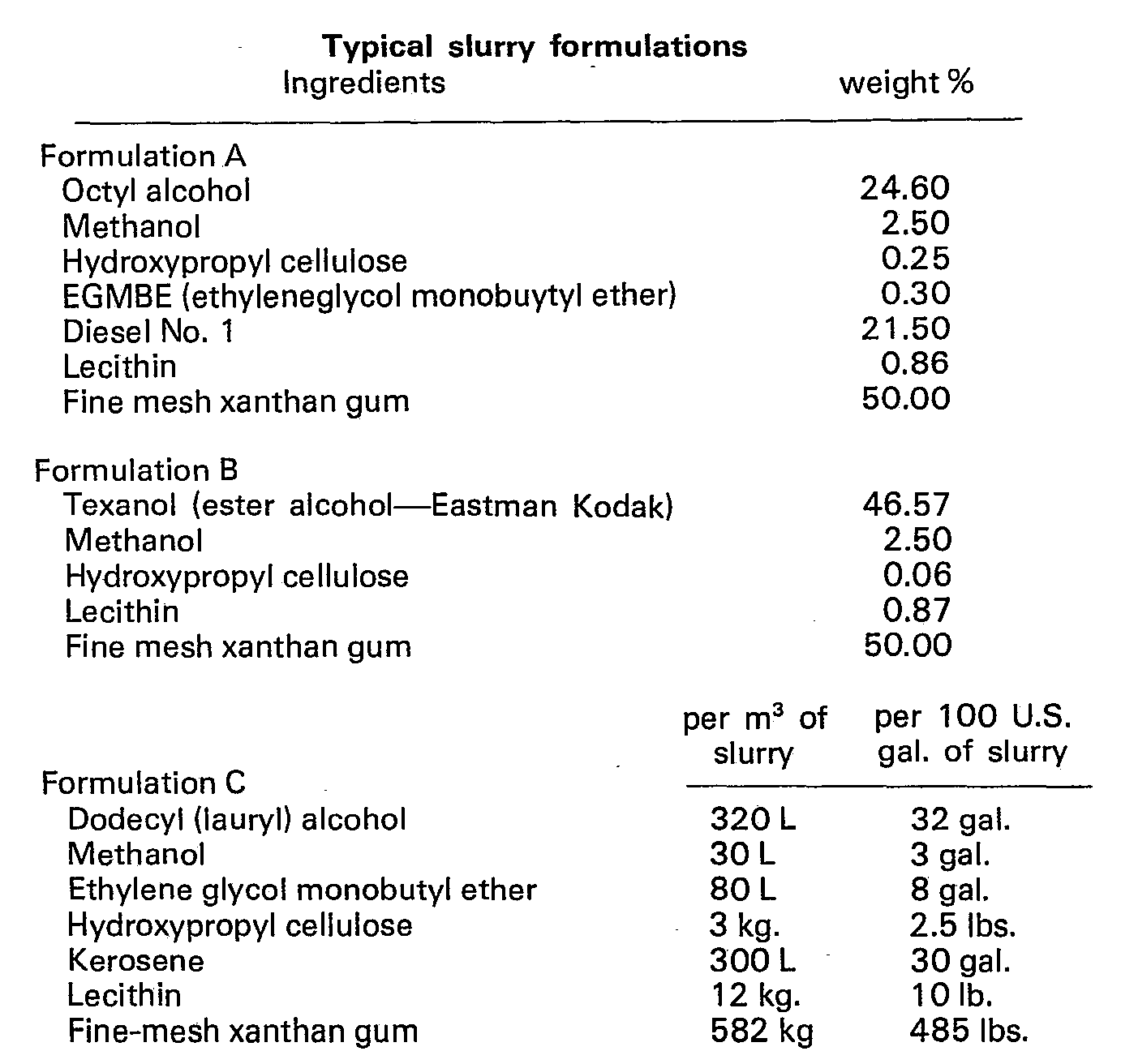
- This invention is further illustrated by the following examples. In Formulation C, the quantities given, though not set out as weight percentages, produce compositions in accordance with the invention.
-
- 1. Place solvent in a suitable container.
- 2. Agitate solvent with sufficient shear to allow for incorporation of polymer in Step 4.
- 3. Add dispersing agents/suspending agents, as required.
- 4. Add polymer slowly. Mix until slurry is uniform.
Claims (6)
Applications Claiming Priority (2)
| Application Number | Priority Date | Filing Date | Title |
|---|---|---|---|
| US2351179A | 1979-03-23 | 1979-03-23 | |
| US23511 | 1979-03-23 |
Publications (2)
| Publication Number | Publication Date |
|---|---|
| EP0016640A1 EP0016640A1 (en) | 1980-10-01 |
| EP0016640B1 true EP0016640B1 (en) | 1984-05-02 |
Family
ID=21815525
Family Applications (1)
| Application Number | Title | Priority Date | Filing Date |
|---|---|---|---|
| EP80300849A Expired EP0016640B1 (en) | 1979-03-23 | 1980-03-19 | Xanthan gum slurries |
Country Status (5)
| Country | Link |
|---|---|
| EP (1) | EP0016640B1 (en) |
| JP (1) | JPS55137142A (en) |
| KR (1) | KR840000398B1 (en) |
| CA (1) | CA1136355A (en) |
| NO (1) | NO156130C (en) |
Families Citing this family (11)
| Publication number | Priority date | Publication date | Assignee | Title |
|---|---|---|---|---|
| CA1163035A (en) * | 1980-04-07 | 1984-02-28 | Albert R. Reid | Water soluble polymer suspensions |
| FR2486950B1 (en) * | 1980-07-15 | 1985-09-13 | Inst Francais Du Petrole | STABLE SUSPENSIONS OF WATER-SOLUBLE POLYMERS AND THEIR PREPARATION |
| US4717488A (en) * | 1986-04-23 | 1988-01-05 | Merck Co., Inc. | Spacer fluid |
| GB2250761A (en) * | 1990-12-06 | 1992-06-17 | Shell Int Research | Aqueous polysaccharide compositions and their use |
| GB2310861A (en) * | 1996-03-08 | 1997-09-10 | Polycell Prod Ltd | Adhesive composition |
| GB2318797A (en) * | 1996-11-01 | 1998-05-06 | Polycell Prod Ltd | Liquid adhesive concentrate |
| EP1848765A1 (en) * | 2005-01-20 | 2007-10-31 | The Sherwin-Williams Company | Non-aqueous slurries used as thickeners and defoamers and method of using slurries in aqueous systems |
| WO2011065831A2 (en) | 2009-11-27 | 2011-06-03 | Ceradis B.V. | Improved formulations comprising heteropolysaccharides |
| US8544546B2 (en) | 2009-12-28 | 2013-10-01 | Halliburton Energy Services, Inc. | Delivering water-soluble polysaccharides for well treatments |
| NO20120438A1 (en) * | 2012-04-13 | 2013-10-14 | Elkem As | Oil-based drilling fluids and mixture for use in oil-based drilling fluids |
| CN104861951B (en) * | 2014-02-24 | 2018-02-09 | 中国石油化工股份有限公司 | A kind of liquid viscosifier system and its application |
Family Cites Families (4)
| Publication number | Priority date | Publication date | Assignee | Title |
|---|---|---|---|---|
| FR2243228A1 (en) * | 1973-06-06 | 1975-04-04 | Jec Enterprise Cy Ltd | Water-retaining, adsorbing polysaccharide dispersion - contg. glycol or sugar alcohol dispersant, water and surfactant |
| US3894880A (en) * | 1974-11-04 | 1975-07-15 | Kelco Co | Process of suspending soluble alginates and compositions so produced |
| US3894879A (en) * | 1974-11-04 | 1975-07-15 | Kelco Co | Process of suspending soluble xanthan gum and pumpable compositions so produced |
| US4105461A (en) * | 1976-08-26 | 1978-08-08 | Merck & Co., Inc. | Thickening compositions containing xanthan gum, guar gum and starch |
-
1980
- 1980-03-12 CA CA000347538A patent/CA1136355A/en not_active Expired
- 1980-03-14 KR KR1019800001062A patent/KR840000398B1/en not_active Expired
- 1980-03-19 EP EP80300849A patent/EP0016640B1/en not_active Expired
- 1980-03-20 NO NO800808A patent/NO156130C/en unknown
- 1980-03-22 JP JP3580580A patent/JPS55137142A/en active Granted
Non-Patent Citations (2)
| Title |
|---|
| CRC HANDBOOK OF CHEMISTRY AND PHYSICS, 60th ED., pp. C337, C-419 * |
| DICTIONARY OF ORGANIC COMPOUNDS, p. 2632 * |
Also Published As
| Publication number | Publication date |
|---|---|
| KR830001993A (en) | 1983-05-21 |
| JPH0116847B2 (en) | 1989-03-28 |
| NO800808L (en) | 1980-09-24 |
| NO156130B (en) | 1987-04-21 |
| NO156130C (en) | 1987-07-29 |
| KR840000398B1 (en) | 1984-03-30 |
| CA1136355A (en) | 1982-11-30 |
| JPS55137142A (en) | 1980-10-25 |
| EP0016640A1 (en) | 1980-10-01 |
Similar Documents
| Publication | Publication Date | Title |
|---|---|---|
| US4312675A (en) | High concentration polymer slurries | |
| US3060084A (en) | Improved homogeneous, readily dispersed, pesticidal concentrate | |
| EP1549723B1 (en) | Additives for water-resistant gypsum products | |
| DE60123666T2 (en) | AQUEOUS SUSPENSION OF A CELLULOSE ETHER, A METHOD FOR THE PRODUCTION THEREOF AND A DRY MIXTURE | |
| EP0016640A1 (en) | Xanthan gum slurries | |
| KR100266801B1 (en) | Liquid formulations of 1,2-benzisothiazolin-3-one and its preparation method | |
| US4138270A (en) | Aqueous aluminum paste composition | |
| EP0630871A1 (en) | Thickener combinations for building products | |
| JP3719706B2 (en) | Dispersant for gypsum slurry | |
| CN109258631A (en) | Suspending agent and preparation method thereof | |
| EP0797620B1 (en) | Method for producing a suspension in water of a cellulose ether, and dry mixture suitable for use in the production of the suspension | |
| BG107911A (en) | Agrochemical formulation | |
| US5045232A (en) | Low viscosity defoaming/antiforming formulations | |
| JPH02214760A (en) | Composition and its application | |
| US4726912A (en) | Stable suspensions of carboxymethyl cellulose and their preparation | |
| JPS61180701A (en) | Aqueous suspensionlike biocidal composition and production thereof | |
| JP2796778B2 (en) | Dispersant for magnetic powder liquid used in wet magnetic particle test | |
| EP0663237B1 (en) | Concentrated high flash point surfactant compositions | |
| JP3703845B2 (en) | Method of forming the solution | |
| JP4518781B2 (en) | High concentration concentrated Bordeaux liquid and its production method | |
| JPH0249763B2 (en) | SHOHOZAI | |
| JP4359888B2 (en) | Liquid dispersant for magnetic powder preparation | |
| JPS61115966A (en) | Electrical insulating varnish | |
| JPS60258139A (en) | Aqueous dispersion of metal soap | |
| EP0345042A2 (en) | Defoamers and their use |
Legal Events
| Date | Code | Title | Description |
|---|---|---|---|
| PUAI | Public reference made under article 153(3) epc to a published international application that has entered the european phase |
Free format text: ORIGINAL CODE: 0009012 |
|
| AK | Designated contracting states |
Designated state(s): FR GB NL |
|
| 17P | Request for examination filed |
Effective date: 19810212 |
|
| GRAA | (expected) grant |
Free format text: ORIGINAL CODE: 0009210 |
|
| AK | Designated contracting states |
Designated state(s): FR GB NL |
|
| ET | Fr: translation filed | ||
| PGFP | Annual fee paid to national office [announced via postgrant information from national office to epo] |
Ref country code: FR Payment date: 19841129 Year of fee payment: 6 |
|
| PLBI | Opposition filed |
Free format text: ORIGINAL CODE: 0009260 |
|
| 26 | Opposition filed |
Opponent name: SHELL INTERNATIONALE RESEARCH MAATSCHAPPIJ B.V. Effective date: 19850201 |
|
| NLR1 | Nl: opposition has been filed with the epo |
Opponent name: SHELL INTERNATIONALE RESEARCH MAATSCHAPPIJ B.V. |
|
| PGFP | Annual fee paid to national office [announced via postgrant information from national office to epo] |
Ref country code: NL Payment date: 19870331 Year of fee payment: 8 |
|
| RDAG | Patent revoked |
Free format text: ORIGINAL CODE: 0009271 |
|
| STAA | Information on the status of an ep patent application or granted ep patent |
Free format text: STATUS: PATENT REVOKED |
|
| 27W | Patent revoked |
Effective date: 19870814 |
|
| NLR2 | Nl: decision of opposition | ||
| GBPR | Gb: patent revoked under art. 102 of the ep convention designating the uk as contracting state |