EP0013552B1 - Method and apparatus for portioning a pasty mass, particularly sausage stock - Google Patents
Method and apparatus for portioning a pasty mass, particularly sausage stock Download PDFInfo
- Publication number
- EP0013552B1 EP0013552B1 EP80100009A EP80100009A EP0013552B1 EP 0013552 B1 EP0013552 B1 EP 0013552B1 EP 80100009 A EP80100009 A EP 80100009A EP 80100009 A EP80100009 A EP 80100009A EP 0013552 B1 EP0013552 B1 EP 0013552B1
- Authority
- EP
- European Patent Office
- Prior art keywords
- portioning
- extrusion
- value
- measured
- nominal value
- Prior art date
- Legal status (The legal status is an assumption and is not a legal conclusion. Google has not performed a legal analysis and makes no representation as to the accuracy of the status listed.)
- Expired
Links
- 238000000034 method Methods 0.000 title claims description 35
- 235000013580 sausages Nutrition 0.000 title claims description 19
- 235000011837 pasties Nutrition 0.000 title 1
- 230000008569 process Effects 0.000 claims description 28
- 230000033001 locomotion Effects 0.000 claims description 23
- 238000005259 measurement Methods 0.000 claims description 7
- 230000005540 biological transmission Effects 0.000 claims description 6
- 238000001125 extrusion Methods 0.000 claims 14
- 239000012530 fluid Substances 0.000 claims 1
- 230000000977 initiatory effect Effects 0.000 claims 1
- 230000008878 coupling Effects 0.000 description 7
- 238000010168 coupling process Methods 0.000 description 7
- 238000005859 coupling reaction Methods 0.000 description 7
- 230000008859 change Effects 0.000 description 5
- 238000013519 translation Methods 0.000 description 4
- 230000014616 translation Effects 0.000 description 4
- 238000010586 diagram Methods 0.000 description 3
- 238000004804 winding Methods 0.000 description 3
- 238000012937 correction Methods 0.000 description 2
- 238000013461 design Methods 0.000 description 2
- 230000004048 modification Effects 0.000 description 2
- 238000012986 modification Methods 0.000 description 2
- 230000008901 benefit Effects 0.000 description 1
- 239000003990 capacitor Substances 0.000 description 1
- 230000009849 deactivation Effects 0.000 description 1
- 230000001934 delay Effects 0.000 description 1
- 238000011161 development Methods 0.000 description 1
- 238000006073 displacement reaction Methods 0.000 description 1
- 238000005429 filling process Methods 0.000 description 1
- 230000009969 flowable effect Effects 0.000 description 1
- 238000012432 intermediate storage Methods 0.000 description 1
- 239000007788 liquid Substances 0.000 description 1
- 238000004519 manufacturing process Methods 0.000 description 1
- 239000000463 material Substances 0.000 description 1
- 230000007246 mechanism Effects 0.000 description 1
- 239000000203 mixture Substances 0.000 description 1
- 230000036632 reaction speed Effects 0.000 description 1
- 230000001960 triggered effect Effects 0.000 description 1
Images


Classifications
-
- A—HUMAN NECESSITIES
- A22—BUTCHERING; MEAT TREATMENT; PROCESSING POULTRY OR FISH
- A22C—PROCESSING MEAT, POULTRY, OR FISH
- A22C11/00—Sausage making ; Apparatus for handling or conveying sausage products during manufacture
- A22C11/02—Sausage filling or stuffing machines
- A22C11/0245—Controlling devices
Definitions
- the invention relates to a method for portioning a plastically deformable mass, in particular sausage mass, in which the individual portions are gradually ejected according to a set desired value and the ejection movement is measured continuously, with a caster occurring after each ejection process.
- Such a method is the subject of DE-C2002100, for example.
- a hydraulically operated sausage filling and twisting machine is shown there, the hydraulic motor of which is controlled by a rotary servo valve.
- the servo valve is presented in cycles by a control motor, and the hydraulic motor copies the specified control path. Since the angle of rotation of the hydraulic motor is proportional to the volume of the mass ejected, there is great weight accuracy. Because of the copying process used there, this version can only be realized with a hydraulic drive and a relatively high control effort.
- the volume filling accuracy is largely determined by the follow-up process, i.e. the filling quantity that is still filled between the switch-off command and the standstill of the portioning element.
- the size of this overrun quantity depends on various factors, above all on the number of cycles or filling speed, but also on the type and design of the respective conveyor, the working temperature, dirt, wear on the drive parts and the like.
- the metering takes place by measuring a time span between the switch-on and switch-off commands, check measurements have to be carried out again and again in the meantime and the settings have to be corrected if sufficient portioning accuracy is to be achieved.
- the set control value always remains constant for a while. If the operating conditions change in the meantime, the resulting deviations in the filling process remain until the next check and change of the control value.
- a portioning device is described and shown in US Pat. No. 3,207,368, in which a pump for sausage mass is driven by a hydraulic drive motor.
- a perforated disc is attached to the pump shaft, which detects the rotation of the pump shaft and is connected to a pulse counter.
- a shut-off valve with a piston slide is located behind the pump, which is pneumatically controlled by an electromagnetic control valve, which in turn is controlled by a second pulse counter.
- an electromagnetically operated 4-way valve is provided, which is also controlled by the second pulse generator.
- the sausage mass When the hydraulic motor that drives the sausage mass pump is switched on, the sausage mass is pushed out through the open shut-off valve.
- the pulse counter counts the shaft revolutions; when a preselected number of revolutions has been reached, counter relay contacts are closed, whereby at the same time the shut-off valve is closed and the pressure oil supply to the hydraulic motor for the sausage mass pump is interrupted.
- the subject of DE-A 22 49 070 is a sausage filling device with two guide rollers for the sausages, one of which is connected to a pulse generator that controls a pulse generator provided with a setpoint adjustment device.
- a sausage filling device With this sausage filling device, the length of the sausages produced is measured and the ejection process is interrupted and a twisting device is started as soon as the actual value for the length has reached the predetermined target value.
- the invention is based on the object of specifying a method of the type described at the outset and a device suitable for this purpose, in which deviations from a predetermined portion size are immediately compensated for even with a high portioning speed and a high number of cycles.
- This method of compensating the wake can be done after each ejection step, so that only one measurement u. a comparison is required, the difference directly influencing the following ejection movement, so that intermediate storage is not necessary. In many cases, however, it is also sufficient to carry out the process at intervals, with deviations in individual portions being accepted in the meantime. This is generally of no particular importance, particularly in the case of sausage filling machines, since here the deviations hardly ever happen immediately, but only through a slow change in the operating state, for example through changes in the temperature, the nature of the mass to be portioned, the wear and tear on a machine part or the like . To rule out possible inaccuracies in the measurement, it may also be appropriate to change the ejection movement only when there are several consecutive portions a certain, same deviation is found.
- the movements are measured using a parameter proportional to the volume expelled.
- This parameter can be an angle of rotation or the displacement path of a portioning element or a variable proportional to such a value.
- the ejection movement of which can be adjusted according to a setpoint value
- a measuring device for continuously measuring the ejection movements
- a comparison arrangement for continuously comparing the setpoint value and actual value
- control means for Stop the ejection movements and initiate the following ejection movement when a certain actual value is reached.
- the comparison arrangement is connected to control means for resetting the measuring device to the initial value for a new ejection process and for starting a new measurement process as soon as the desired value and the actual value match in the previous ejection process.
- the measuring device can have a measuring transducer connected to the portioning element, a push button assigned to it and a measuring device controllable by it, which is connected by the comparison arrangement to a setpoint adjustment device.
- measurements can also be carried out analogously, for example in such a way that an adjustable capacitor is charged in such a way that its voltage is proportional to the portion just ejected, the braking and switching process being triggered after a setpoint voltage has been reached.
- the design of the transmitter as a pulse generator and of the measuring device as a digital counter appears to be simpler and more reliable, the setpoint adjustment device also expediently being designed digitally. It is immaterial whether the setpoint is counted digitally backwards or forwards. It is essential, however, that the switchover is reliably ensured when a preselected number is reached, which corresponds, for example, to the volume of the portion, measured in cubic centimeters.
- the transducer can be rotatably mounted and can be translated with respect to the portioning element such that one revolution of the transducer corresponds to a volume unit of the displaced mass or the integral multiple of such a volume unit.
- the drive can be formed by a turbomachine connected to the hydraulic drive circuit. This can be the drive hydraulic motor or a pump working with it in a closed circuit, but better is a separate, small hydraulic motor that only drives the sensor in the manner of a liquid counter.
- variable sizes or different units such as volume, mass or weight.
- an adjustment means provided between the drive of the sensor and the setpoint adjustment device is recommended for adapting the units of actual value and setpoint.
- Such means can also be of advantage if manufacturing inaccuracies or signs of wear have to be compensated for.
- the adjustment means can be designed, for example, as a transmission with a continuously variable translation in the drive of the measuring value transmitter or as an electronic converter provided between the measuring device and the setpoint value setting device.
- a drive motor 1 designed as an electric motor drives a pump shaft 6 via control gear 2, magnetic coupling 3, pinion 4 and toothed wheel 5, which carries the portioning element 7 of a conveyor 8 designed as a pump wheel.
- This conveyor is here the filling pump of a sausage filling machine, to which the filling material is fed from a funnel 9 and which it fills into a stuffing tube 10 by stepwise advancement in the form of individual portions.
- the control gear 2 comprises two conical pulleys 11 which are axially adjustable relative to one another to change the transmission ratio and which drive a drive pulley 13 of the magnetic coupling 3 via a V-belt 12.
- This drive disk is rotatably seated on a shaft 14 carrying the pinion 4 by means of ball bearings.
- a clutch disc 16 which serves as an anchor for a magnetic winding 17 embedded in the drive disc 13 and is pressed against the housing part 15 by a coil spring 18 attached to the shaft 14.
- the clutch disc 16 and thus the portioning element 7 (impeller) of the conveyor mechanism 8 are non-positively fixed on the housing part 15.
- the clutch disc 16 is attracted to the drive disc 13 by magnetic adhesion and thereby the conveyor 8 is coupled to the drive during the on-time period of the magnetic winding.
- a pinion 20 which is rotatably mounted in the housing part 5 and is fixedly connected to a disk-shaped transmitter 21, on the circumference of which a push button 22 projects, engages in the gear wheel 5.
- the transducer 21 has ten teeth attached at the same spacing on its circumference, during the passage of which at the button 22 a pulse is transmitted to the control unit 23 via the lines 27, which is transmitted through lines 24 with a switch 25, for example, as a toggle switch, and through lines 26 with the Slip rings 19 of the magnetic coupling 3 is connected.
- a 4-digit digital counter (FIG. 2) is used as the measuring device 29, which counts the signals coming in via the lines 27 and sent out by the transmitter 21 and thus first the number of revolutions of the transmitter.
- the translation of the measuring transducer 21 to the portioning element 7 is designed such that each volume unit cm 3 of filling mass ejected from the stuffing tube 10 corresponds to a tenth of a revolution of the measuring transducer 21 and, as a result, each conveyance of a cm 3 triggers a pulse output for the measuring device 29 (digital counter).
- transducer 21 can choose a different reference unit or translation, give the transducer 21 a different shape, such as a drum, and provide it with a plurality of permanent magnets or other elements that emit signals, evenly distributed over the circumference.
- the measuring device 29 has a binary stage 33 and a decimal stage 34. Like the decimal setting device 30 for the desired value, the decimal stage is connected to a comparison arrangement 35 which, when the adjusted desired value is reached by the measuring device 29 counting the actual value
- a program control 37 is set in motion via a line 36 and resets the counter of the measuring device 29 via control means 38 and switches over to counting or measuring the next portion.
- the magnetic coupling 3 and thus the portioning element 7 are switched off or braked via an amplifier 39, and after the pause time specified by the pause adjuster 32, a switch-on command is transmitted to the magnetic coupling 3 and a new portioning process is thereby effectively started.
- control means 38 not only control the resetting of the counter, but at the same time a new counting process is initiated, while the program control 37, via the amplifier 39, delays the deactivation of the magnetic coupling 3, which already results in an electrical delay which is followed by a braking time. During all of these times, the portioning element 7 continues to run a certain distance, thus conveying mass that is already counted for the next portion. For the mass delivered during the switch-on time, the run-on of the previous portion is counted instead of the subsequent run-on.
- each degree of angle - for example based on the angle of rotation of the portioning element 7 - corresponds to a cm 3 expelled mass.
- Each portion should be filled with 90 cm 3 .
- the maximum deviations are also comparable if the speed is changed during operation . Since such deviations are clearly within the tolerance limits for sausage filling machines, it is sufficient there, only the first portion to be eliminated during the start-up process.
- each pulse corresponds to the selected unit of measure. If this is not the case or if other measuring units are to be used, any adjustment option can be provided between the drive of the portioning element and the setpoint adjustment device.
- the transmitter 21 can be preceded by a transmission with an infinitely adjustable speed or the actual setpoint comparison can be carried out in the comparison arrangement 35 with an adjustable ratio that differs from 1: 1.
- the pinion 4 is seated directly on a hydraulic motor 40, which is fed by a pump 41 from the oil container 42 and is controlled by a magnetic slide valve 43 via the lines 26 '; instead of a slide valve, poppet valves or other control elements can also be used.
- FIG. 5 A further possibility is shown in FIG. 5.
- the stuffing tube 10 is fed from a roasting cylinder 44 through a portion element 45 designed as a roasting piston, which is firmly connected by a piston rod 46 to a hydraulic piston 47 in a hydraulic cylinder 48.
- the piston arrangement is advanced step by step in the same way as the hydraulic motor 40 from FIG. 4 is rotated.
- a small hydraulic motor 50 was switched into the pressure line 49 coming from the pump 41 to drive the sensor 21.
- the versions shown are primarily based on the simplest possible control arrangement. Compared to the reaction speed achieved, an exceptionally high portioning accuracy is achieved, which with constant speed and the usually slow operating. Changes in the order of a single measuring unit such as 1 cm 3 . If this is not enough, a smaller measuring unit can be used or other measured values can be used for an additional control.
- the measured values match the sizes actually portioned, ie that the translations are correct or the arrangement is reliably calibrated and adjusted. For example, would that be for a setpoint of. 100 cm 3 set first portion reach a value of 110 cm 3 , the measurement of the following portion would already start at 100 cm 3 . Since the overrun of 10 cm 3 of the first portion is counted in the second, this is actually completed after 100 cm 3 , provided the external conditions remain constant. If you want to measure all portions very precisely, it is sufficient to simply empty the first portion, to branch off or not to use it further. The second portion starts counting at 110 or continues to count when the first volume unit is filled.
Landscapes
- Life Sciences & Earth Sciences (AREA)
- Engineering & Computer Science (AREA)
- Wood Science & Technology (AREA)
- Zoology (AREA)
- Food Science & Technology (AREA)
- Processing Of Meat And Fish (AREA)
- Meat, Egg Or Seafood Products (AREA)
- Formation Of Various Coating Films On Cathode Ray Tubes And Lamps (AREA)
Abstract
Description
Die Erfindung betrifft ein Verfahren zum Portionieren einer plastich verformbaren Masse, insbesondere Wurstmasse, bei dem man die einzelnen Portionen nach einem eingestellten Sollwert schrittweise ausstößt und die Ausstoßbewegung laufend mißt, wobei nach jedem Ausstoßvorgang ein Nachlauf auftritt.The invention relates to a method for portioning a plastically deformable mass, in particular sausage mass, in which the individual portions are gradually ejected according to a set desired value and the ejection movement is measured continuously, with a caster occurring after each ejection process.
Ein derartiges Verfahren ist beispielsweise Gegenstand der DE-C2002100. Dort ist eine hydraulisch betriebene Wurstfüll- und Abdrehmaschine gezeigt, deren Hydromotor durch ein Rotations-Servo-Ventil gesteuert wird. Dabei wird das Servo-Ventil taktweise durch einen Steuermotor vorgestellt, und der Hydromotor kopiert die vorgegebene Steuerstrecke nach. Da der Drehwinkel des Hydromotors dem Volumen der ausgestoßenen Masse proportional ist, ergibt sich große Gewichtsgenauigkeit. Wegen des dort angewandten Kopierverfahrens kann diese Ausführung nur mit einem hydraulischen Antrieb und relativ hohem Steuerungsaufwand realisiert werden.Such a method is the subject of DE-C2002100, for example. A hydraulically operated sausage filling and twisting machine is shown there, the hydraulic motor of which is controlled by a rotary servo valve. The servo valve is presented in cycles by a control motor, and the hydraulic motor copies the specified control path. Since the angle of rotation of the hydraulic motor is proportional to the volume of the mass ejected, there is great weight accuracy. Because of the copying process used there, this version can only be realized with a hydraulic drive and a relatively high control effort.
Überall dort, wo der Portioniervorgang durch Steuerkommandos eingeleitet und beendet wird, ist die volumenmäßige Abfüllgenauigkeit maßgeblich bestimmt durch den Nachlaufvorgang, d.h. die Füllmenge, die zwischen Abschaltkommando und Stillstand des Portionierelementes noch eingefüllt wird. Die Größe dieser Nachlaufmenge ist von verschiedenen Faktoren abhängig, vor allem von der Taktzahl bzw. Abfüllgeschwindigkeit, aber auch von der Art und Ausbildung des jeweiligen Förderwerkes, der Arbeitstemperatur, Verschmutzung, Verschleiß der Antriebsteile und dergleichen. Vor allem dann, wenn die Dosierung durch die Bemessung einer Zeitspanne zwischen Ein- und Ausschaltkommando erfolgt, müssen zwischenzeitig immer wieder Kontrollmessungen durchegeführt und die Einstellungen korrigiert werden, wenn hinreichende Portioniergenauigkeit erzielt werden soll. Stets bleibt jedoch der eingestellte Steuerwert für eine Weile konstant. Ändern sich in der Zwischenzeit die Betriebsbedingungen, so bleiben die dadurch bedingten Abweichungen beim Abfüllvorgang bis zur nächsten Kontrolle und Änderung des Steuerwertes erhalten.Wherever the portioning process is initiated and ended by control commands, the volume filling accuracy is largely determined by the follow-up process, i.e. the filling quantity that is still filled between the switch-off command and the standstill of the portioning element. The size of this overrun quantity depends on various factors, above all on the number of cycles or filling speed, but also on the type and design of the respective conveyor, the working temperature, dirt, wear on the drive parts and the like. Especially if the metering takes place by measuring a time span between the switch-on and switch-off commands, check measurements have to be carried out again and again in the meantime and the settings have to be corrected if sufficient portioning accuracy is to be achieved. However, the set control value always remains constant for a while. If the operating conditions change in the meantime, the resulting deviations in the filling process remain until the next check and change of the control value.
In der US-PS 3 207 368 ist eine Portioniervorrichtung beschrieben und dargestellt, bei der eine Pumpe für Wurstmasse durch einen hydraulischen Antriebsmotor angetrieben wird. An der Pumpenwelle ist eine Lochscheibe befestigt, die die Rotation der Pumpenwelle erfaßt und mit einem Impulszähler verbunden ist. Hinter der Pumpe sitzt ein Absperrventil mit Kolbenschieber, der pneumatisch gesteuert wird durch ein elektromagnetisches Steuerventil, das seinerseits durch einen zweiten Impulszähler gesteuert wird. Zur Steuerung eines Hydromotors für die Wurstmassenpumpe ist ein elektromagnetisch betätigtes 4-Wege-Ventil vorgesehen, das ebenfalls durch den zweiten Impulsgeber gesteuert wird.A portioning device is described and shown in US Pat. No. 3,207,368, in which a pump for sausage mass is driven by a hydraulic drive motor. A perforated disc is attached to the pump shaft, which detects the rotation of the pump shaft and is connected to a pulse counter. A shut-off valve with a piston slide is located behind the pump, which is pneumatically controlled by an electromagnetic control valve, which in turn is controlled by a second pulse counter. To control a hydraulic motor for the sausage mass pump, an electromagnetically operated 4-way valve is provided, which is also controlled by the second pulse generator.
Beim Einschalten des Hydromotors, der die Wurstmassenpumpe antreibt, wird die Wurstmasse durch das geöffnete Absperrventil ausgeschoben. Während der Rotation der Pumpenwelle zählt der Impulszähler die Wellenumdrehungen ; wenn eine vorgewählte Umdrehungszahl erreicht ist, werden Zählerrelaiskontakte geschlossen, wodurch gleichzeitig das Absperrventil geschlossen und die Druckölzuführung zu dem Hydromotor für die Wurstmassenpumpe unterbrochen wird.When the hydraulic motor that drives the sausage mass pump is switched on, the sausage mass is pushed out through the open shut-off valve. During the rotation of the pump shaft, the pulse counter counts the shaft revolutions; when a preselected number of revolutions has been reached, counter relay contacts are closed, whereby at the same time the shut-off valve is closed and the pressure oil supply to the hydraulic motor for the sausage mass pump is interrupted.
Gegenstand der DE-A 22 49 070 ist eine Wurstfüllvorrichtung mit zwei Führungsrollen für die Würste, von denen eine mit einem Impulsgeber verbunden ist, der einen mit einer Sollwert-Einstellvorrichtung versehenen Impulsgeber steuert. Bei dieser Wurstfüllvorrichtung wird die Länge der hergestellten Würste gemessen und der Ausstoßvorgang unterbrochen und eine Abdrehvorrichtung in Gang gesetzt, sobald der Istwert für die Länge den vorgegebenen Sollwert erreicht hat.The subject of DE-A 22 49 070 is a sausage filling device with two guide rollers for the sausages, one of which is connected to a pulse generator that controls a pulse generator provided with a setpoint adjustment device. With this sausage filling device, the length of the sausages produced is measured and the ejection process is interrupted and a twisting device is started as soon as the actual value for the length has reached the predetermined target value.
Weder in der US-PS 3 207 368 noch in der DE-A 22 49 070 wird der auftretende Nachlauf berücksichtigt oder gar zu kompensieren versucht.Neither in US Pat. No. 3,207,368 nor in DE-A 22 49 070 the run-on that occurs is taken into account or even attempted to compensate.
Der Erfindung liegt die Aufgabe zugrunde, ein Verfahren der eingangs beschriebenen Gattung und eine hierzu geeignete Vorrichtung anzugeben, bei denen auch bei grosser Portioniergeschwindigkeit und hoher Taktzahl Abweichungen von einer vorgegebenen Portionsgröße unverzüglich ausgeglichen werden.The invention is based on the object of specifying a method of the type described at the outset and a device suitable for this purpose, in which deviations from a predetermined portion size are immediately compensated for even with a high portioning speed and a high number of cycles.
Bei einem Verfahren der eingangs erläuterten Gattung wird diese Aufgabe erfindungsgemäß dadurch gelöst, daß man
- a) nach Beendigung der Ausstoßbewegung den diesem folgenden Nachlauf mißt,
- b) für den darauffolgenden Ausstoßvorgang die Differenz zwischen dem Sollwert und diesem Nachlauf bildet,
- c) die Ausstoßbewegung abschaltet, sobald diese Differenz erreicht ist.
- a) measures the caster following this after the ejection movement,
- b) for the subsequent ejection process forms the difference between the target value and this wake,
- c) the ejection movement stops as soon as this difference is reached.
Dieses Verfahren zur Kompensation des Nachlaufes kann nach jedem Ausstoßschritt erfolgen, so daß jeweils nur eine Messung u. ein Vergleich erforderlich sind, wobei die Differenz unmittelbar die folgende Ausstoßbewegung beeinflußt, eine Zwischenspeicherung also nicht erforderlich ist. Vielfach genügt es jedoch auch, das Verfahren in Intervallen durchzuführen, wobei man zwischenzeitlich an einzelnen Portionen Abweichungen in Kauf nimmt. Dies ist in aller Regel, insbesondere bei Wurstfüllmaschinen, ohne größere Bedeutung, da hier die Abweichungen kaum jemals augenblicklich, sondern erst durch langsame Änderung des Betriebszustandes erfolgen, etwa durch Änderungen der Temperatur, der Beschaffenheit der zu portionierenden Masse, der Abnutzung eines Maschinenteiles oder dergleichen. Um mögliche Meßungenauigkeiten auszuschließen, kann es auch angebracht sein, eine Änderung der Ausstoßbewegung erst dann vorzunehmen, wenn bei mehreren aufeinanderfolgenden Portionen eine bestimmte, gleiche Abweichung festgestellt wird.This method of compensating the wake can be done after each ejection step, so that only one measurement u. a comparison is required, the difference directly influencing the following ejection movement, so that intermediate storage is not necessary. In many cases, however, it is also sufficient to carry out the process at intervals, with deviations in individual portions being accepted in the meantime. This is generally of no particular importance, particularly in the case of sausage filling machines, since here the deviations hardly ever happen immediately, but only through a slow change in the operating state, for example through changes in the temperature, the nature of the mass to be portioned, the wear and tear on a machine part or the like . To rule out possible inaccuracies in the measurement, it may also be appropriate to change the ejection movement only when there are several consecutive portions a certain, same deviation is found.
Es ist zweckmäßig, daß die Bewegungen an einem dem ausgestoßenen Volumen proportionalen Parameter gemessen werden. Dieser Parameter kann ein Drehwinkel oder der Verschiebeweg eines Portionierelementes sein oder auch eine einem solchen Wert porportionale Größe.It is expedient that the movements are measured using a parameter proportional to the volume expelled. This parameter can be an angle of rotation or the displacement path of a portioning element or a variable proportional to such a value.
Bei einer zur Durchführung des Verfahrens geeigneten Anordnung zum Portionieren einer fließfähigen Masse mit einem schrittweise beweglichen Portionierelement, dessen Ausstoßbewegung nach einem Sollwert einstellbar ist, mit einer Meßeinrichtung zum ständigen Messen der Ausstoßbewegungen, mit einer Vergleichsanordnung zum ständigen Vergleichen von Sollwert und Istwert und mit Steuermitteln zum Beenden der Ausstoßbewegungen und Einleiten der jeweils folgenden Ausstoßbewegung bei Erreichen eines bestimmten Istwertes. wobei nach Beendigung der Ausstoßbewegungen ein Nachlauf auftritt, wird die der Erfindung zugrundeliegende Aufgabe gelöst durch Mittel zur Messung des Nachlaufs, zur Bildung der Differenz zwischen dem Sollwert für den folgenden Ausstoßvorgang und dem bereits gemessenen Nachlauf und zum Abschalten der Ausstoßbewegung bei Erreichen der gebildeten Differenz.In an arrangement suitable for carrying out the method for portioning a flowable mass with a step-wise movable portioning element, the ejection movement of which can be adjusted according to a setpoint value, with a measuring device for continuously measuring the ejection movements, with a comparison arrangement for continuously comparing the setpoint value and actual value and with control means for Stop the ejection movements and initiate the following ejection movement when a certain actual value is reached. where after the ejection movements a caster occurs, the object on which the invention is based is achieved by means for measuring the caster, for forming the difference between the setpoint for the following ejection process and the already measured caster, and for switching off the ejection movement when the difference formed is reached.
In Weiterbildung dieser Anordnung ist vorgesehen, daß die Vergleichsanordnung mit Steuermitteln verbunden ist zum Zurückstellen der Meßeinrichtung auf den Anfangswert für einen neuen Ausstoßvorgang und zum Beginn eines neuen Meßvorgangs, sobald bei dem vorhergehenden Ausstoßvorgang Sollwert und Istwert übereinstimmen.In a further development of this arrangement, it is provided that the comparison arrangement is connected to control means for resetting the measuring device to the initial value for a new ejection process and for starting a new measurement process as soon as the desired value and the actual value match in the previous ejection process.
Die Meßeinrichtung kann einen mit dem Portionierelement verbundenen Meßwertgeber, einen diesem zugeordneten Taster und ein durch diesen steuerbares Meßgerät aufweisen, das durch die Vergleichsanordnung mit einer Sollwert-Einstellvorrichtung verbunden ist. Im-Prinzip kann hier auch analog gemessen werden, etwa so, daß ein einstellbarer Kondensator in solcher Weise aufgeladen wird, daß seine Spannung der gerade ausgestoßenen Portion proportional ist, wobei nach Erreichen einer Sollwert-Spannung der Abbrems- und Umschaltvorgang ausgelöst wird.The measuring device can have a measuring transducer connected to the portioning element, a push button assigned to it and a measuring device controllable by it, which is connected by the comparison arrangement to a setpoint adjustment device. In principle, measurements can also be carried out analogously, for example in such a way that an adjustable capacitor is charged in such a way that its voltage is proportional to the portion just ejected, the braking and switching process being triggered after a setpoint voltage has been reached.
Einfacher und zuverlässiger erscheint jedoch die Ausbildung des Meßwertgebers als Impulsgeber und des Meßgerätes als Digitalzähler, wobei zweckmäßigerweise auch die Sollwert-Einstellvorrichtung digital ausgebildet ist. Dabei ist es unwesentlich, ob der eingestellte Sollwert digital rückwärts oder vorwärts ausgezählt wird. Wesentlich ist jedoch, daß die Umschaltung zuverlässig gewährleistet wird, wenn eine vorgewählte Zahl erreicht ist, die beispielsweise dem Volumen der abgefüllten Portion, gemessen in Kubikzentimetern, entspricht.However, the design of the transmitter as a pulse generator and of the measuring device as a digital counter appears to be simpler and more reliable, the setpoint adjustment device also expediently being designed digitally. It is immaterial whether the setpoint is counted digitally backwards or forwards. It is essential, however, that the switchover is reliably ensured when a preselected number is reached, which corresponds, for example, to the volume of the portion, measured in cubic centimeters.
Nach einem weiteren Merkmal der Erfindung kann der Meßwertgeber drehbar gelagert und gegenüber dem Portionierelement so übersetzt sein, daß eine Umdrehung des Meßwertgebers einer Volumeneinheit der verdrängten Masse oder dem ganzzahligen Vielfachen einer solchen Volumeneinheit entspricht.According to a further feature of the invention, the transducer can be rotatably mounted and can be translated with respect to the portioning element such that one revolution of the transducer corresponds to a volume unit of the displaced mass or the integral multiple of such a volume unit.
Bei einem hydraulisch angetriebenen Portionierelement muß nicht einmal eine mechanische Antriebsverbindung zum Meßwertgeber bestehen. Der Antrieb läßt sich vielmehr durch eine in den hydraulischen Antriebskreis geschaltete Strömungsmaschine bilden. Diese kann der Antriebs-Hydromotor oder eine mit diesem in geschlossenem Kreislauf arbeitende Pumpe sein, besser aber ein gesonderter, kleiner Hydromotor, der nach Art eines Flüssigkeitszählers lediglich den Meßwertgeber antreibt.In the case of a hydraulically driven portioning element, there is not even a need for a mechanical drive connection to the transmitter. Rather, the drive can be formed by a turbomachine connected to the hydraulic drive circuit. This can be the drive hydraulic motor or a pump working with it in a closed circuit, but better is a separate, small hydraulic motor that only drives the sensor in the manner of a liquid counter.
Für die meisten Anwendungsgebiete kommt man mit fest vorgesehenen Übertragungsverbindungen ohne jede Änderungsmöglichkeit aus. Mitunter ist es jedoch vorteilhaft, veränderliche Größen oder unterschiedliche Einheiten wie Volumen, Masse oder Gewicht leicht einstellen zu können. Wenigstens für diesen Fall empfiehlt sich ein zwischen dem Antrieb des Meßwertgebers und der Sollwert-Einstellvorrichtung vorgesehenes Justiermittel zum Anpassen der Einheiten von Istwert und Sollwert. Solche Mittel können auch dann von Vorteil sein, wenn Fertigungsungenauigkeiten oder Verschleißerscheinungen auszugleichen sind.For most areas of application, fixed transmission connections do not require any changes. However, it is sometimes advantageous to be able to easily adjust variable sizes or different units such as volume, mass or weight. In this case at least, an adjustment means provided between the drive of the sensor and the setpoint adjustment device is recommended for adapting the units of actual value and setpoint. Such means can also be of advantage if manufacturing inaccuracies or signs of wear have to be compensated for.
Die Justiermittel können beispielsweise als Getriebe mit stufenlos veränderlicher Übersetzung im Antrieb des Meßwertgebers oder als zwischen Meßgerät und Sollwert-Einstellvorrichtung vorgesehener elektronischer Wandler ausgebildet sein.The adjustment means can be designed, for example, as a transmission with a continuously variable translation in the drive of the measuring value transmitter or as an electronic converter provided between the measuring device and the setpoint value setting device.
Die Erfindung ist nachstehend an Ausführungsbeispielen erläutert, die in der Zeichnung dargestellt sind.The invention is explained below using exemplary embodiments which are illustrated in the drawing.
Es zeigen :
Figur 1 in schematischer Darstellung eine erfindungsgemäß ausgebildete Anordnung zum Portionieren einer Wurstmasse,Figur 2 ein zugehöriges Blockschaltbild,Figur 3 ein Winkeldiagramm,- Figur4 eine Abwandlung der in Fig. 1 gezeigten Anordnung mit regelbarem Hydro-Antriebsmotor und
Figur 5 eine weitere Abwandlung dieser Anordnung mit Abfüllzylinder.
- 1 shows a schematic representation of an arrangement designed according to the invention for portioning a sausage mixture,
- FIG. 2 shows an associated block diagram,
- FIG. 3 shows an angle diagram,
- Figure 4 shows a modification of the arrangement shown in Fig. 1 with adjustable hydraulic drive motor and
- Figure 5 shows a further modification of this arrangement with filling cylinder.
Nach Figur 1 treibt ein als Elektromotor ausgebildeter Antriebsmotor 1 über Regelgetriebe 2, Magnetkupplung 3, Ritzel 4 und Zahnrad 5 eine Pumpenwelle 6 an, die das als Pumpenrad ausgebildete Portionierelement 7 eines Förderwerkes 8 trägt. Dieses Förderwerk ist hier die Füllpumpe einer Wurstfüllmaschine, der das Füllgut aus einem Trichter 9 zugeführt wird und die es durch schrittweise Fortschaltung in Form einzelner Portionen in ein Stopfrohr 10 einfüllt.According to FIG. 1, a
Das Regelgetriebe 2 umfaßt zwei Kegelscheiben 11, die zur Änderung des Übersetzungsverhältnisses axial gegeneinander verstellbar sind und über einen Keilriemen 12 eine Antriebsscheibe 13 der Magnetkupplung 3 antreiben. Diese Antriebsscheibe sitzt mittels Kugellager drehbar auf einer das Ritzel 4 tragenden Welle 14. Zwischen der Antriebsscheibe 13 und einem Gehäuseteil15 sitzt drehschlüssig, aber längsverschiebbar auf der Welle 14 eine Kupplungsscheibe 16, die als Anker für eine in der Antriebsscheibe 13 eingelassene Magnetwicklung 17 dient und durch eine auf der Welle 14 angebrachte Schraubenfeder 18 gegen das Gehäuseteil 15 gedrückt wird. Bei stromloser Magnetkupplung ist die Kupplungsscheibe 16 und damit das Portionierelement 7 (Pumpenrad) des Förderwerkes 8 kraftschlüssig am Gehäuseteil 15 festgelegt. Wird jedoch die Magnetwicklung 17 über die Schleifringe 19 an Spannung gelegt, so wird die Kupplungsscheibe 16 durch magnetischen Kraftschluß an die Antriebsscheibe 13 angezogen und dadurch das Förderwerk 8 während der Einschaltdauer der Magnetwicklung mit dem Antrieb gekuppelt.The
In das Zahnrad 5 greift ein Ritzel 20, das im Gehäuseteill5 drehbar gelagert und fest mit einem scheibenförmigen Meßwertgeber 21 verbunden ist, an dessen Umfang ein Taster 22 heranragt. Der Meßwertgeber 21 hat an seinem Umfang zehn unter gleichen Zwischenabständen angebrachte Zähne, bei deren Durchgang am Taster 22 jeweils über die Leitungen27 ein Impuls einem Steuergerät 23 übermittelt wird, das durch Leitungen 24 mit einem beispielsweise als Kniehebelschalter ausgebildeten Schalter 25 und durch Leitungen 26 mit den Schleifringen 19 der Magnetkupplung 3 verbunden ist. Das Steuergerät 23 umfaßt einer Sollwert-Einstellvorrichtung 30 mit Einstellknöpfen für vier Dekaden, einen Funktionseinsteller 31 mit den Einstellungen F = Füllen und P = Portionieren und einen Pauseneinsteller32 zum Einstellen der Pausenzeit zwischen zwei Ausstoßvorgängen.A
Als Meßgerät 29 dient ein 4-stelliger Digitalzähler (Fig. 2), der die über die Leitungen 27 eingehenden, vom Meßwertgeber 21 ausgesandten Signale und damit zunächst die Anzahl der Umdrehungen des Meßwertgebers zählt. Die Übersetzung des Meßwertgebers 21 zum Portionierelement 7 ist derart ausgebildet, daß jeder aus dem Stopfrohr 10 augestoßenen Volumeneinheit cm3 Füllmasse eine Zehntel-Umdrehung des Meßwertgebers 21 entspricht und dadurch jede Förderung eines cm3 eine Impulsabgabe für das Meßgerät 29 (Digitalzähler) auslöst.A 4-digit digital counter (FIG. 2) is used as the measuring
Es versteht sich, daß man eine andere Bezugseinheit oder Übersetzung wählen, dem Meßwertgeber 21 eine andere, etwa eine Trommelform, geben und ihn mit mehreren am Umfang gleichmäßig verteilten Dauermagneten oder anderen, Signale aussendenden Elementen versehen kann.It goes without saying that one can choose a different reference unit or translation, give the transducer 21 a different shape, such as a drum, and provide it with a plurality of permanent magnets or other elements that emit signals, evenly distributed over the circumference.
Wie Fig. 2 erkennen läßt, hat das Meßgerät 29 eine Binärstufe 33 und eine Dezimalstufe 34. Die Dezimalstufe ist ebenso wie die dezimale Einstellvorrichtung 30 für den Sollwert an eine Vergleichsanordnung 35 angeschlossen, die bei Erreichen des eingestellten Sollwertes durch das den Istwert zählende Meßgerät 29 über eine Leitung 36 eine Programmsteuerung 37 in Gang setzt und über Steuermittel 38 den Zähler des Meßgerätes 29 zurückstellt und zum Zählen bzw. Messen der nächsten Portion umschaltet. Über einen Verstärker 39 werden dabei die Magnetkupplung 3 und somit das Portionierelement 7 abgeschaltet bzw. abgebremst, und nach Ablauf der durch den Pauseneinsteller 32 vorgegebenen Pausenzeit wird ein Einschaltkommando an die Magnetkupplung 3 übermittelt und dadurch effektiv ein neuer Portioniervorgang begonnen.As can be seen in FIG. 2, the measuring
Nun wird über die Steuermittel 38 nicht nur die Rückstellung des Zählers gesteuert, sondern gleichzeitig ein neuer Zählvorgang eingeleitet, während erst von der Programmsteuerung 37 über den Verstärker 39 verzögert die Abschaltung der Magnetkupplung 3 bewirkt wird, was schon eine elektrische Verzögerung zur Folge hat, an die sich eine Bremszeit anschließt. Während aller dieser Zeiten läuft das Portionierelement 7 noch eine bestimmte Strecke weiter, fördert also Masse, die schon für die nächste Portion gezählt wird. Zu der in der Einschaltzeit geförderten Masse wird also anstelle des anschließenden Nachlaufs der Nachlauf der vorhergehenden Portion gezählt.Now, the control means 38 not only control the resetting of the counter, but at the same time a new counting process is initiated, while the
Im Winkeldiagramm der Fig. 3 ist davon ausgegangen, daß jeder Winkelgrad - beispielsweise bezogen auf den Drehwinkel des Portionierelementes 7 - einem cm3 ausgestoßener Masse entspricht. Jede Portion soll mit 90 cm3 abgefüllt werden. Dabei ist der Sollwert S = 90° = 90 cm3 vorgegeben.In the angular diagram of FIG. 3 it is assumed that each degree of angle - for example based on the angle of rotation of the portioning element 7 - corresponds to a cm 3 expelled mass. Each portion should be filled with 90 cm 3 . The setpoint S = 90 ° = 90 cm 3 is specified.
Die erste Portion wird ohne jede Korrektur ausgeführt, d.h. mit dem Anlauf des Portionierelementes 7 beginnt der Zähler des Meßgerätes 29 bis E1 = S = 90 zu zählen. Am Ende dieses Vorganges wird ein neuer Zählvorgang für die zweite Portion eingeleitet. Das Portionierelement 7 läuft aber noch aus und fördert im Nachlaufwinkel N1 = 10° weiter. Insgesamt wird also eine Istportion 11 = E1 + N1 = S + N1 ausgestoßen.The first serving is carried out without any correction, i.e. with the start of the portioning
Da für die nächste Portion schon 10° = N1 angezählt sind, wird dort nach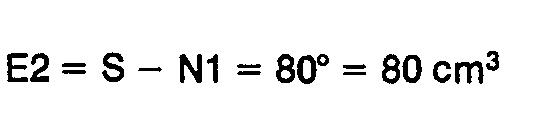

Diese Gleichung läßt erkennen, daß schon 12 dann mit dem Sollwert S übereinstimmt, wenn die beiden Nachlaufgrößen N1 und N2 gleich sind. Das ist dann der Fall, wenn am Ende der ersten Portion schon die Endgeschwindigkeit erzielt ist.This equation shows that 12 already corresponds to the target value S if the two lagging variables N1 and N2 are the same. This is the case when the end speed has already been reached at the end of the first portion.
In der Praxis kann jedenfalls davon ausgegangen werden, daß N2 schon um weniger als 20 % von N1 abweicht, d.h. um weniger als 2 cm3 = 2,2 % S. Vergleichbar sind auch die maximalen Abweichungen, falls während des Betriebes die Geschwindigkeit geändert wird. Da solche Abweichungen jedenfalls bei Wurstabfüllmaschinen eindeutig innerhalb der Toleranzgrenzen liegen, genügt es dort, lediglich die erste Portion beim Anlaufvorgang auszuscheiden.In practice, it can be assumed that N2 already deviates by less than 20% from N1, ie by less than 2 cm 3 = 2.2% S. The maximum deviations are also comparable if the speed is changed during operation . Since such deviations are clearly within the tolerance limits for sausage filling machines, it is sufficient there, only the first portion to be eliminated during the start-up process.
Voraussetzung für diese Steuerungsgenauigkeit ist selbstverständlich, daß jeder Impuls der gewählten Mengeneinheit entspricht. Wenn dies nicht ohne weiteres zutrifft oder mit anderen Meßeinheiten gearbeitet werden soll, kann irgendeine Justiermöglichkeit zwischen dem Antrieb des Portionierelementes und der Sollwert-Einstellvorrichtung vorgesehen sein. Beispielsweise kann man dem Meßwertgeber 21 ein Getriebe mit stufenlos einstellbarer Geschwindigkeit vorschalten oder den Ist-Sollwertvergleich in der Vergleichsanordnung 35 mit einem von 1 : 1 abweichenden, einstellbaren Verhältnis ausführen.A prerequisite for this control accuracy is, of course, that each pulse corresponds to the selected unit of measure. If this is not the case or if other measuring units are to be used, any adjustment option can be provided between the drive of the portioning element and the setpoint adjustment device. For example, the
Bei der Ausführung der Fig. 4 sitzt das Ritzel 4 unmittelbar an einem Hydromotor40, der durch eine Pumpe 41 aus dem Ölbehälter 42 gespeist und durch ein Magnet-Schieberventil 43 über die Leitungen 26' gesteuert wird ; anstelle eines Schieberventils können auch Tellerventile oder andere Steuerelemente eingesetzt werden.4, the
Eine weitere Möglichkeit zeigt Fig. 5. Dort wird das Stopfrohr 10 aus einem Brätzylinder 44 durch ein als Brätkolben ausgebildetes Portionselement45 gespeist, das durch eine Kolbenstange 46 mit einem Hydraulikkolben 47 in einem Hydraulikzylinder48 fest verbunden ist. Dabei wird die Kolbenanordnung schrittweise in der gleichen Weise vorgeschoben, wie der Hydraulikmotor 40 aus Fig. 4 gedreht wird. Auch dabei ist es grundsätzlich möglich, einen Meßwertgeber beispielsweise unmittelbar durch das Portionierelement 45 anzutreiben. Da dort jedoch die Verstellgröße zu klein ist, wurde in die von der Pumpe 41 kommende Druckleitung 49 ein kleiner Hydromotor 50 zum Antrieb des Meßwertgebers 21 eingeschaltet.A further possibility is shown in FIG. 5. There, the stuffing
Die dargestellten Ausführungen sind vornehmlich auf eine möglichst einfache Steueranordnung abgestellt. Im Vergleich zu der erzielten Reaktionsgeschwindigkeit wird eine außergewöhnlich große Portioniergenauigkeit erzielt, die bei gleichbleibender Geschwindigkeit und den üblicherweise langsam auftretenden Betriebs-. änderungen in der Größenordnung einer einzigen Meßeinheit wie 1 cm3 liegt. Sollte dies nicht genügen, kann man eine kleinere Meßeinheit einsetzen oder auch weitere Meßwerte für eine zusätzliche Steuerung heranziehen.The versions shown are primarily based on the simplest possible control arrangement. Compared to the reaction speed achieved, an exceptionally high portioning accuracy is achieved, which with constant speed and the usually slow operating. Changes in the order of a single measuring unit such as 1 cm 3 . If this is not enough, a smaller measuring unit can be used or other measured values can be used for an additional control.
Bei der Nachlaufkompensation.gemäß der Erfindung muß immer gewährleistet sein, daß die gemessenen Werte mit den tatsächlich portionierten Größen übereinstimmen, d.h., daß die Übersetzungen stimmen oder die Anordnung zuverlässig geeicht und einjustiert ist. Würde beispielsweise die für einen Sollwert von. 100 cm3 eingestellte erste Portion einen Wert von 110 cm3 erreichen, so würde bei 100 cm3 bereits mit der Messung der folgenden Portion begonnen. Da der Nachlauf von 10 cm3 der ersten Portion bei der zweiten mitgezählt wird, ist diese auch tatsächlich nach 100 cm3 abgeschlossen, sofern die äußeren Bedingungen konstant bleiben. Wenn man alle Portionen ganz exakt bemessen will, genügt es, lediglich die erste Portion leer ablaufen zu lassen, abzuzweigen bzw. nicht weiter zu verwerten. Bei der zweiten Portion beginnt man schon mit 110 zu zählen bzw. weiterzuzählen, wenn die erste Volumeneinheit eingefüllt wird. Wenn bis 100 gezählt ist und umgeschaltet wird, ist erst bis 90 eingefüllt. Mit konstantem Nachlauf von 10 cm3 wird die Portion nach der Umschaltung auf 100 Einheiten vervollständigt. Bei Taktzahlen von beispielsweise 300/min. werden in einer einzigen Sekunde bereits 5 Korrekturen durchgeführt. Die in 0,2 Sek. auftretenden Änderungen liegen, da z.B. bei Wurstfüllmaschinen Änderungen nur in einer Größeren Zeitspanne eintreten können, in aller Regel zuverlässig innerhalb der Portionstoleranzen.In the case of tracking compensation according to the invention, it must always be ensured that the measured values match the sizes actually portioned, ie that the translations are correct or the arrangement is reliably calibrated and adjusted. For example, would that be for a setpoint of. 100 cm 3 set first portion reach a value of 110 cm 3 , the measurement of the following portion would already start at 100 cm 3 . Since the overrun of 10 cm 3 of the first portion is counted in the second, this is actually completed after 100 cm 3 , provided the external conditions remain constant. If you want to measure all portions very precisely, it is sufficient to simply empty the first portion, to branch off or not to use it further. The second portion starts counting at 110 or continues to count when the first volume unit is filled. If up to 100 is counted and the switch is made, only 90 is filled in. With a constant overrun of 10 cm 3 , the portion is completed after switching to 100 units. At cycle rates of 300 / min, for example. 5 corrections are made in a single second. The changes that occur in 0.2 seconds are, because changes in sausage filling machines, for example, can only occur in a longer period of time, as a rule reliably within the portion tolerances.
Claims (11)
Priority Applications (1)
| Application Number | Priority Date | Filing Date | Title |
|---|---|---|---|
| AT80100009T ATE1491T1 (en) | 1979-01-09 | 1980-01-03 | METHOD AND ARRANGEMENT FOR PORTIONING A PLASTIC DEFORMABLE MASS, IN PARTICULAR SAUSAGE MASS. |
Applications Claiming Priority (2)
| Application Number | Priority Date | Filing Date | Title |
|---|---|---|---|
| DE2900585 | 1979-01-09 | ||
| DE19792900585 DE2900585A1 (en) | 1979-01-09 | 1979-01-09 | METHOD AND ARRANGEMENT FOR THE FOLLOWING PORTIONING OF A PLASTICALLY DEFORMABLE DIMENSION, IN PARTICULAR SAUSAGE DIMENSION |
Publications (2)
| Publication Number | Publication Date |
|---|---|
| EP0013552A1 EP0013552A1 (en) | 1980-07-23 |
| EP0013552B1 true EP0013552B1 (en) | 1982-09-01 |
Family
ID=6060218
Family Applications (1)
| Application Number | Title | Priority Date | Filing Date |
|---|---|---|---|
| EP80100009A Expired EP0013552B1 (en) | 1979-01-09 | 1980-01-03 | Method and apparatus for portioning a pasty mass, particularly sausage stock |
Country Status (6)
| Country | Link |
|---|---|
| US (1) | US4347646A (en) |
| EP (1) | EP0013552B1 (en) |
| AT (1) | ATE1491T1 (en) |
| BR (1) | BR8000102A (en) |
| DE (2) | DE2900585A1 (en) |
| ES (1) | ES487491A0 (en) |
Families Citing this family (18)
| Publication number | Priority date | Publication date | Assignee | Title |
|---|---|---|---|---|
| DE2921427C2 (en) * | 1979-05-26 | 1985-12-19 | Vemag Verdener Maschinen- und Apparatebau GmbH, 2810 Verden | Device for intermittently ejecting a sausage mass or the like |
| DE3018793A1 (en) * | 1980-05-16 | 1981-11-26 | Albert Handtmann Gmbh & Co, 7950 Biberach | ARRANGEMENT FOR THE FOLLOWING PORTIONING OF A FLOWABLE FILLING MEASUREMENT, IN PARTICULAR SAUSAGE MEASUREMENT |
| EP0061995A1 (en) * | 1981-03-26 | 1982-10-06 | C. Hoegger & Cie. AG | Sausage meat proportioning device |
| DE3363262D1 (en) * | 1982-06-02 | 1986-06-05 | Teepak Prod Nv | Method and apparatus for automatically making strands of sausages |
| DE3249657C2 (en) * | 1982-06-25 | 1985-05-30 | Günter 6080 Groß-Gerau Kollross | Sausage casing tubular material for use in particular in a method for automatically producing sausages in a strand on a sausage filling machine |
| DE3246421A1 (en) * | 1982-12-15 | 1984-06-20 | Nordischer Maschinenbau Rud. Baader GmbH + Co KG, 2400 Lübeck | Metering device for pasty substances |
| DE3518529C1 (en) * | 1985-05-23 | 1986-05-07 | Nordischer Maschinenbau Rud. Baader GmbH + Co KG, 2400 Lübeck | Device for dispensing pasty fillings in portions |
| US4839123A (en) * | 1986-08-18 | 1989-06-13 | Mobil Oil Corporation | Process of applying a silicone release coating to an oriented polymer film |
| DE9001076U1 (en) * | 1990-01-31 | 1990-08-30 | Albert Handtmann Maschinenfabrik GmbH & Co KG, 7950 Biberach | Filling machine for producing sausages by cutting a sausage strand |
| JP3592409B2 (en) * | 1995-07-16 | 2004-11-24 | ハイテック株式会社 | Filling pump used for sausage filling equipment |
| US5951391A (en) * | 1996-10-21 | 1999-09-14 | Townsend Engineering Company | Method and means for linking sausage |
| US6627241B1 (en) | 2002-03-27 | 2003-09-30 | The Pillsbury Company | Apparatus and method for processing viscous food products |
| ES2435450T3 (en) * | 2010-12-01 | 2013-12-19 | Poly-Clip System Gmbh & Co. Kg | Stapling machine and control procedure of said stapling machine |
| EP2628391B1 (en) * | 2012-02-15 | 2016-04-20 | Albert Handtmann Maschinenfabrik GmbH & Co. KG | Method for filling sausages with paste mass and filling machine for performing this method |
| DE102016216851A1 (en) * | 2016-09-06 | 2018-03-08 | Albert Handtmann Maschinenfabrik Gmbh & Co. Kg | Method and filling machine for filling a food |
| WO2018232044A1 (en) | 2017-06-12 | 2018-12-20 | Covidien Lp | Tools for sheathing treatment devices and associated systems and methods |
| EP3566585B1 (en) * | 2018-05-09 | 2022-12-07 | Poly-clip System GmbH & Co. KG | Method for controlling a clipping machine as well as a clipping machine therefor |
| CN110637863A (en) * | 2019-08-30 | 2020-01-03 | 徐州爱迪食品有限公司 | A filling equipment for factory's material packing |
Family Cites Families (13)
| Publication number | Priority date | Publication date | Assignee | Title |
|---|---|---|---|---|
| DE1128782B (en) * | 1959-05-29 | 1962-04-26 | Vemag Verdener Masch App | Electrically operated filling machine for the processing of sausage mass or similar goods |
| US3207368A (en) * | 1963-12-02 | 1965-09-21 | Mayer & Co Inc O | Product metering apparatus |
| CH442125A (en) * | 1964-11-09 | 1967-08-15 | Harvag Ets | Machine for portion-wise ejection of plastic masses, in particular sausage meat into intestines, cans, bags and tubes |
| GB1090390A (en) * | 1965-01-28 | 1967-11-08 | Johnson & Johnson | Method and apparatus for packaging food products |
| US3303967A (en) * | 1965-09-28 | 1967-02-14 | Westinghouse Electric Corp | Feedback control for a material handling system providing automatic overshoot correction |
| DE1623302A1 (en) * | 1967-08-12 | 1970-12-23 | Siemens Ag | Thread measuring device on textile machines |
| US3538726A (en) * | 1968-01-16 | 1970-11-10 | Westinghouse Electric Corp | Method and apparatus for controlling the crop shear of a hot strip mill |
| CH514286A (en) * | 1970-01-19 | 1971-10-15 | Handtmann Metallguss Albert | Hydraulic sausage filling and linking machine |
| DE2025620A1 (en) * | 1970-05-26 | 1971-12-09 | Schnell, Karl, 7065 Winterbach | Sausage stuffing |
| US3743140A (en) * | 1970-12-21 | 1973-07-03 | Diehl Mateer G Co | Filler apparatus with hopper and rotary feed mechanism for dispensing controlled volumes of materials |
| DE2352229C3 (en) * | 1973-10-18 | 1978-09-21 | Albert Handtmann Gmbh & Co, 7950 Biberach | Filling machine for filling plastically deformable fillings such as sausage meat |
| US3995517A (en) * | 1974-12-12 | 1976-12-07 | International Business Machines Corporation | Method and apparatus for obtaining desired batch weight in a solid slicing control system |
| US4208933A (en) * | 1977-01-31 | 1980-06-24 | Armour And Company | Method and machine for slicing materials |
-
1979
- 1979-01-09 DE DE19792900585 patent/DE2900585A1/en not_active Withdrawn
-
1980
- 1980-01-03 EP EP80100009A patent/EP0013552B1/en not_active Expired
- 1980-01-03 DE DE8080100009T patent/DE3060783D1/en not_active Expired
- 1980-01-03 AT AT80100009T patent/ATE1491T1/en active
- 1980-01-04 US US06/109,205 patent/US4347646A/en not_active Expired - Lifetime
- 1980-01-07 ES ES487491A patent/ES487491A0/en active Granted
- 1980-01-09 BR BR8000102A patent/BR8000102A/en unknown
Also Published As
| Publication number | Publication date |
|---|---|
| BR8000102A (en) | 1980-09-23 |
| EP0013552A1 (en) | 1980-07-23 |
| ATE1491T1 (en) | 1982-09-15 |
| ES8101981A1 (en) | 1980-12-16 |
| DE2900585A1 (en) | 1980-07-17 |
| ES487491A0 (en) | 1980-12-16 |
| DE3060783D1 (en) | 1982-10-28 |
| US4347646A (en) | 1982-09-07 |
Similar Documents
| Publication | Publication Date | Title |
|---|---|---|
| EP0013552A1 (en) | Method and apparatus for portioning a pasty mass, particularly sausage stock | |
| DE69201928T2 (en) | Method of dosing by weight when filling containers. | |
| DE3239190C2 (en) | ||
| DE2148917C3 (en) | Device for optimizing the speed setting of a rotatable and axially displaceable plasticizing screw of a plastic injection molding machine | |
| DE3586576T2 (en) | INJECTION MOLDING MACHINES AND METHOD FOR THE CONTROL THEREOF. | |
| DE2914944C2 (en) | Device for controlling the speed and the back pressure during the plasticizing and dosing process of a plastic screw injection molding machine | |
| DE2210854A1 (en) | CONTROL SYSTEM FOR INJECTION MOLDING MACHINE | |
| DE2253506A1 (en) | PROCESS AND EQUIPMENT FOR CONTROLLING INJECTION MOLDING MACHINES | |
| DE2402817A1 (en) | Prodn. of sausages with the same weight, length and dia. - using constant filling rate related to sausage sepn. into desired portions | |
| EP0099098B1 (en) | Arrangement at a baler for the introduction of a treating liquid into a crop | |
| EP0051626A1 (en) | Apparatus for dividing a mass into successive portions, parcicularly sausage meat. | |
| EP1082543B1 (en) | Regulation of the stroke frequency of a dosing pump | |
| DE19726238C1 (en) | Method and device for filling sausage casings | |
| DE2460936A1 (en) | SHOT VOLUME AND PILLOW POINT CONTROL FOR INJECTION MOLDING DEVICE | |
| DE69118298T2 (en) | Injection molding machine with control means for driving the screw | |
| EP0061995A1 (en) | Sausage meat proportioning device | |
| DE2155650C2 (en) | Device for driving a passive element according to a given law of motion | |
| DE2856308C2 (en) | Device for the dosed discharge of a material from a storage container | |
| DE2940152A1 (en) | METHOD AND DEVICE FOR REGULATING THE PLASTIFICATION OF A RESIN IN A ROW SCREW INJECTION MOLDING MACHINE | |
| EP0548482B1 (en) | Method and device for controlling a dough divider and at least one subsequent machine | |
| DE3420019A1 (en) | Method for injecting meat with curing brine and apparatus for carrying out the method | |
| EP0246667B1 (en) | Process and apparatus for preparing stuffed products | |
| DE2121006C3 (en) | Method and device for portioning and twisting off a pasty mass | |
| DE19507817A1 (en) | Method and device for dosing flowable media | |
| DE3020563C2 (en) | Device for regulating the drive of a butter transport device |
Legal Events
| Date | Code | Title | Description |
|---|---|---|---|
| PUAI | Public reference made under article 153(3) epc to a published international application that has entered the european phase |
Free format text: ORIGINAL CODE: 0009012 |
|
| AK | Designated contracting states |
Designated state(s): AT CH DE FR GB IT |
|
| 17P | Request for examination filed |
Effective date: 19801211 |
|
| ITF | It: translation for a ep patent filed | ||
| GRAA | (expected) grant |
Free format text: ORIGINAL CODE: 0009210 |
|
| AK | Designated contracting states |
Designated state(s): AT CH DE FR GB IT |
|
| REF | Corresponds to: |
Ref document number: 1491 Country of ref document: AT Date of ref document: 19820915 Kind code of ref document: T |
|
| REF | Corresponds to: |
Ref document number: 3060783 Country of ref document: DE Date of ref document: 19821028 |
|
| ITTA | It: last paid annual fee | ||
| PGFP | Annual fee paid to national office [announced via postgrant information from national office to epo] |
Ref country code: GB Payment date: 19911224 Year of fee payment: 13 |
|
| PGFP | Annual fee paid to national office [announced via postgrant information from national office to epo] |
Ref country code: AT Payment date: 19911231 Year of fee payment: 13 |
|
| PGFP | Annual fee paid to national office [announced via postgrant information from national office to epo] |
Ref country code: FR Payment date: 19920110 Year of fee payment: 13 |
|
| PGFP | Annual fee paid to national office [announced via postgrant information from national office to epo] |
Ref country code: CH Payment date: 19920212 Year of fee payment: 13 |
|
| PG25 | Lapsed in a contracting state [announced via postgrant information from national office to epo] |
Ref country code: GB Effective date: 19930103 Ref country code: AT Effective date: 19930103 |
|
| PG25 | Lapsed in a contracting state [announced via postgrant information from national office to epo] |
Ref country code: CH Effective date: 19930131 |
|
| PGFP | Annual fee paid to national office [announced via postgrant information from national office to epo] |
Ref country code: DE Payment date: 19930226 Year of fee payment: 14 |
|
| GBPC | Gb: european patent ceased through non-payment of renewal fee |
Effective date: 19930103 |
|
| PG25 | Lapsed in a contracting state [announced via postgrant information from national office to epo] |
Ref country code: FR Effective date: 19930930 |
|
| REG | Reference to a national code |
Ref country code: CH Ref legal event code: PL |
|
| REG | Reference to a national code |
Ref country code: FR Ref legal event code: ST |
|
| PG25 | Lapsed in a contracting state [announced via postgrant information from national office to epo] |
Ref country code: DE Effective date: 19941001 |
|
| PLBE | No opposition filed within time limit |
Free format text: ORIGINAL CODE: 0009261 |
|
| STAA | Information on the status of an ep patent application or granted ep patent |
Free format text: STATUS: NO OPPOSITION FILED WITHIN TIME LIMIT |