EP0012205B1 - Verfahren zur Herstellung von chemisch gebundene saure Phosphorsäurederivate enthaltenden Bindemitteln für Einkomponentenlacke - Google Patents
Verfahren zur Herstellung von chemisch gebundene saure Phosphorsäurederivate enthaltenden Bindemitteln für Einkomponentenlacke Download PDFInfo
- Publication number
- EP0012205B1 EP0012205B1 EP19790104223 EP79104223A EP0012205B1 EP 0012205 B1 EP0012205 B1 EP 0012205B1 EP 19790104223 EP19790104223 EP 19790104223 EP 79104223 A EP79104223 A EP 79104223A EP 0012205 B1 EP0012205 B1 EP 0012205B1
- Authority
- EP
- European Patent Office
- Prior art keywords
- phosphoric acid
- process according
- formula
- parts
- ist
- Prior art date
- Legal status (The legal status is an assumption and is not a legal conclusion. Google has not performed a legal analysis and makes no representation as to the accuracy of the status listed.)
- Expired
Links
- 239000011230 binding agent Substances 0.000 title claims description 29
- 238000000034 method Methods 0.000 title claims description 24
- 239000002253 acid Substances 0.000 title claims description 14
- OAICVXFJPJFONN-UHFFFAOYSA-N Phosphorus Chemical class [P] OAICVXFJPJFONN-UHFFFAOYSA-N 0.000 title claims 4
- 239000004922 lacquer Substances 0.000 title description 12
- NBIIXXVUZAFLBC-UHFFFAOYSA-N Phosphoric acid Chemical class OP(O)(O)=O NBIIXXVUZAFLBC-UHFFFAOYSA-N 0.000 claims description 27
- 229920000137 polyphosphoric acid Polymers 0.000 claims description 20
- ZMXDDKWLCZADIW-UHFFFAOYSA-N N,N-Dimethylformamide Chemical compound CN(C)C=O ZMXDDKWLCZADIW-UHFFFAOYSA-N 0.000 claims description 19
- 230000002378 acidificating effect Effects 0.000 claims description 18
- 125000002887 hydroxy group Chemical group [H]O* 0.000 claims description 17
- 239000003973 paint Substances 0.000 claims description 16
- 238000006243 chemical reaction Methods 0.000 claims description 15
- 239000007795 chemical reaction product Substances 0.000 claims description 14
- 239000007859 condensation product Substances 0.000 claims description 12
- 150000003013 phosphoric acid derivatives Chemical class 0.000 claims description 12
- AFINAILKDBCXMX-PBHICJAKSA-N (2s,3r)-2-amino-3-hydroxy-n-(4-octylphenyl)butanamide Chemical compound CCCCCCCCC1=CC=C(NC(=O)[C@@H](N)[C@@H](C)O)C=C1 AFINAILKDBCXMX-PBHICJAKSA-N 0.000 claims description 11
- 229910000147 aluminium phosphate Inorganic materials 0.000 claims description 10
- 239000002904 solvent Substances 0.000 claims description 8
- 150000001875 compounds Chemical class 0.000 claims description 6
- 125000001797 benzyl group Chemical group [H]C1=C([H])C([H])=C(C([H])=C1[H])C([H])([H])* 0.000 claims description 5
- 238000004132 cross linking Methods 0.000 claims description 4
- 150000001298 alcohols Chemical class 0.000 claims description 3
- 125000000113 cyclohexyl group Chemical group [H]C1([H])C([H])([H])C([H])([H])C([H])(*)C([H])([H])C1([H])[H] 0.000 claims description 3
- 150000002009 diols Chemical class 0.000 claims description 3
- 238000002156 mixing Methods 0.000 claims description 3
- 125000001997 phenyl group Chemical group [H]C1=C([H])C([H])=C(*)C([H])=C1[H] 0.000 claims description 3
- 229920001223 polyethylene glycol Polymers 0.000 claims description 3
- 239000002202 Polyethylene glycol Substances 0.000 claims description 2
- 125000000217 alkyl group Chemical group 0.000 claims description 2
- 238000009833 condensation Methods 0.000 claims description 2
- 230000005494 condensation Effects 0.000 claims description 2
- OKKJLVBELUTLKV-UHFFFAOYSA-N Methanol Chemical class OC OKKJLVBELUTLKV-UHFFFAOYSA-N 0.000 claims 2
- 229910004856 P—O—P Inorganic materials 0.000 claims 1
- 125000003827 glycol group Chemical group 0.000 claims 1
- XLYOFNOQVPJJNP-UHFFFAOYSA-N water Substances O XLYOFNOQVPJJNP-UHFFFAOYSA-N 0.000 description 12
- 238000000576 coating method Methods 0.000 description 11
- 230000007797 corrosion Effects 0.000 description 10
- 238000005260 corrosion Methods 0.000 description 10
- 235000011007 phosphoric acid Nutrition 0.000 description 9
- 238000004519 manufacturing process Methods 0.000 description 8
- -1 phosphoric acid ether polyols Chemical class 0.000 description 8
- 229910052698 phosphorus Inorganic materials 0.000 description 8
- 229920003180 amino resin Polymers 0.000 description 7
- 239000000047 product Substances 0.000 description 7
- ZJCCRDAZUWHFQH-UHFFFAOYSA-N Trimethylolpropane Chemical compound CCC(CO)(CO)CO ZJCCRDAZUWHFQH-UHFFFAOYSA-N 0.000 description 6
- MTHSVFCYNBDYFN-UHFFFAOYSA-N diethylene glycol Chemical compound OCCOCCO MTHSVFCYNBDYFN-UHFFFAOYSA-N 0.000 description 6
- 229920000877 Melamine resin Polymers 0.000 description 5
- 238000007792 addition Methods 0.000 description 5
- 125000000524 functional group Chemical group 0.000 description 5
- 239000000203 mixture Substances 0.000 description 5
- 229920000642 polymer Polymers 0.000 description 5
- 229920005989 resin Polymers 0.000 description 5
- 239000011347 resin Substances 0.000 description 5
- 239000000126 substance Substances 0.000 description 5
- DLYUQMMRRRQYAE-UHFFFAOYSA-N tetraphosphorus decaoxide Chemical compound O1P(O2)(=O)OP3(=O)OP1(=O)OP2(=O)O3 DLYUQMMRRRQYAE-UHFFFAOYSA-N 0.000 description 5
- 239000002966 varnish Substances 0.000 description 5
- LRHPLDYGYMQRHN-UHFFFAOYSA-N N-Butanol Chemical compound CCCCO LRHPLDYGYMQRHN-UHFFFAOYSA-N 0.000 description 4
- 208000012641 Pigmentation disease Diseases 0.000 description 4
- IISBACLAFKSPIT-UHFFFAOYSA-N bisphenol A Chemical compound C=1C=C(O)C=CC=1C(C)(C)C1=CC=C(O)C=C1 IISBACLAFKSPIT-UHFFFAOYSA-N 0.000 description 4
- 230000000052 comparative effect Effects 0.000 description 4
- 125000004437 phosphorous atom Chemical group 0.000 description 4
- 230000019612 pigmentation Effects 0.000 description 4
- 150000003254 radicals Chemical class 0.000 description 4
- 239000007787 solid Substances 0.000 description 4
- 229920001187 thermosetting polymer Polymers 0.000 description 4
- JOXIMZWYDAKGHI-UHFFFAOYSA-N toluene-4-sulfonic acid Chemical compound CC1=CC=C(S(O)(=O)=O)C=C1 JOXIMZWYDAKGHI-UHFFFAOYSA-N 0.000 description 4
- KDVYCTOWXSLNNI-UHFFFAOYSA-N 4-t-Butylbenzoic acid Chemical compound CC(C)(C)C1=CC=C(C(O)=O)C=C1 KDVYCTOWXSLNNI-UHFFFAOYSA-N 0.000 description 3
- 239000004593 Epoxy Substances 0.000 description 3
- LYCAIKOWRPUZTN-UHFFFAOYSA-N Ethylene glycol Chemical compound OCCO LYCAIKOWRPUZTN-UHFFFAOYSA-N 0.000 description 3
- WSFSSNUMVMOOMR-UHFFFAOYSA-N Formaldehyde Chemical compound O=C WSFSSNUMVMOOMR-UHFFFAOYSA-N 0.000 description 3
- PEDCQBHIVMGVHV-UHFFFAOYSA-N Glycerine Chemical compound OCC(O)CO PEDCQBHIVMGVHV-UHFFFAOYSA-N 0.000 description 3
- 239000004359 castor oil Substances 0.000 description 3
- 235000019438 castor oil Nutrition 0.000 description 3
- 238000001723 curing Methods 0.000 description 3
- 235000014113 dietary fatty acids Nutrition 0.000 description 3
- 238000010790 dilution Methods 0.000 description 3
- 239000012895 dilution Substances 0.000 description 3
- 238000001035 drying Methods 0.000 description 3
- 239000003822 epoxy resin Substances 0.000 description 3
- 229930195729 fatty acid Natural products 0.000 description 3
- 239000000194 fatty acid Substances 0.000 description 3
- 150000004665 fatty acids Chemical class 0.000 description 3
- ZEMPKEQAKRGZGQ-XOQCFJPHSA-N glycerol triricinoleate Natural products CCCCCC[C@@H](O)CC=CCCCCCCCC(=O)OC[C@@H](COC(=O)CCCCCCCC=CC[C@@H](O)CCCCCC)OC(=O)CCCCCCCC=CC[C@H](O)CCCCCC ZEMPKEQAKRGZGQ-XOQCFJPHSA-N 0.000 description 3
- XXMIOPMDWAUFGU-UHFFFAOYSA-N hexane-1,6-diol Chemical compound OCCCCCCO XXMIOPMDWAUFGU-UHFFFAOYSA-N 0.000 description 3
- 230000002401 inhibitory effect Effects 0.000 description 3
- 239000000178 monomer Substances 0.000 description 3
- 150000003014 phosphoric acid esters Chemical class 0.000 description 3
- 229920000647 polyepoxide Polymers 0.000 description 3
- 238000006116 polymerization reaction Methods 0.000 description 3
- 238000002360 preparation method Methods 0.000 description 3
- 238000012360 testing method Methods 0.000 description 3
- KMOUUZVZFBCRAM-OLQVQODUSA-N (3as,7ar)-3a,4,7,7a-tetrahydro-2-benzofuran-1,3-dione Chemical compound C1C=CC[C@@H]2C(=O)OC(=O)[C@@H]21 KMOUUZVZFBCRAM-OLQVQODUSA-N 0.000 description 2
- 239000004640 Melamine resin Substances 0.000 description 2
- GWEVSGVZZGPLCZ-UHFFFAOYSA-N Titan oxide Chemical compound O=[Ti]=O GWEVSGVZZGPLCZ-UHFFFAOYSA-N 0.000 description 2
- 239000000853 adhesive Substances 0.000 description 2
- 230000001070 adhesive effect Effects 0.000 description 2
- WNLRTRBMVRJNCN-UHFFFAOYSA-N adipic acid Chemical compound OC(=O)CCCCC(O)=O WNLRTRBMVRJNCN-UHFFFAOYSA-N 0.000 description 2
- 229920000180 alkyd Polymers 0.000 description 2
- 125000003118 aryl group Chemical group 0.000 description 2
- 238000009835 boiling Methods 0.000 description 2
- 239000003054 catalyst Substances 0.000 description 2
- 239000003795 chemical substances by application Substances 0.000 description 2
- 239000011248 coating agent Substances 0.000 description 2
- 238000007334 copolymerization reaction Methods 0.000 description 2
- 229940028356 diethylene glycol monobutyl ether Drugs 0.000 description 2
- 238000005516 engineering process Methods 0.000 description 2
- 150000002148 esters Chemical class 0.000 description 2
- 239000000945 filler Substances 0.000 description 2
- MSYLJRIXVZCQHW-UHFFFAOYSA-N formaldehyde;6-phenyl-1,3,5-triazine-2,4-diamine Chemical compound O=C.NC1=NC(N)=NC(C=2C=CC=CC=2)=N1 MSYLJRIXVZCQHW-UHFFFAOYSA-N 0.000 description 2
- 238000010348 incorporation Methods 0.000 description 2
- QQVIHTHCMHWDBS-UHFFFAOYSA-N isophthalic acid Chemical compound OC(=O)C1=CC=CC(C(O)=O)=C1 QQVIHTHCMHWDBS-UHFFFAOYSA-N 0.000 description 2
- SLCVBVWXLSEKPL-UHFFFAOYSA-N neopentyl glycol Chemical compound OCC(C)(C)CO SLCVBVWXLSEKPL-UHFFFAOYSA-N 0.000 description 2
- 150000002894 organic compounds Chemical class 0.000 description 2
- JCGNDDUYTRNOFT-UHFFFAOYSA-N oxolane-2,4-dione Chemical compound O=C1COC(=O)C1 JCGNDDUYTRNOFT-UHFFFAOYSA-N 0.000 description 2
- 150000003009 phosphonic acids Chemical class 0.000 description 2
- 150000003016 phosphoric acids Chemical class 0.000 description 2
- 150000003017 phosphorus Chemical class 0.000 description 2
- 229920005862 polyol Polymers 0.000 description 2
- 239000002994 raw material Substances 0.000 description 2
- 150000003839 salts Chemical class 0.000 description 2
- 239000002356 single layer Substances 0.000 description 2
- 239000000243 solution Substances 0.000 description 2
- 125000000391 vinyl group Chemical group [H]C([*])=C([H])[H] 0.000 description 2
- AZUXKVXMJOIAOF-UHFFFAOYSA-N 1-(2-hydroxypropoxy)propan-2-ol Chemical compound CC(O)COCC(C)O AZUXKVXMJOIAOF-UHFFFAOYSA-N 0.000 description 1
- RNFJDJUURJAICM-UHFFFAOYSA-N 2,2,4,4,6,6-hexaphenoxy-1,3,5-triaza-2$l^{5},4$l^{5},6$l^{5}-triphosphacyclohexa-1,3,5-triene Chemical compound N=1P(OC=2C=CC=CC=2)(OC=2C=CC=CC=2)=NP(OC=2C=CC=CC=2)(OC=2C=CC=CC=2)=NP=1(OC=1C=CC=CC=1)OC1=CC=CC=C1 RNFJDJUURJAICM-UHFFFAOYSA-N 0.000 description 1
- ZNQVEEAIQZEUHB-UHFFFAOYSA-N 2-ethoxyethanol Chemical compound CCOCCO ZNQVEEAIQZEUHB-UHFFFAOYSA-N 0.000 description 1
- SVONRAPFKPVNKG-UHFFFAOYSA-N 2-ethoxyethyl acetate Chemical compound CCOCCOC(C)=O SVONRAPFKPVNKG-UHFFFAOYSA-N 0.000 description 1
- BNCADMBVWNPPIZ-UHFFFAOYSA-N 2-n,2-n,4-n,4-n,6-n,6-n-hexakis(methoxymethyl)-1,3,5-triazine-2,4,6-triamine Chemical compound COCN(COC)C1=NC(N(COC)COC)=NC(N(COC)COC)=N1 BNCADMBVWNPPIZ-UHFFFAOYSA-N 0.000 description 1
- XPIQJMUYUKAKNX-VOTSOKGWSA-N 3-[(2e)-octa-2,7-dienyl]oxolane-2,5-dione Chemical compound C=CCCC\C=C\CC1CC(=O)OC1=O XPIQJMUYUKAKNX-VOTSOKGWSA-N 0.000 description 1
- HQYIECBWMWWCCP-UHFFFAOYSA-N 4-hydroxybutylphosphonic acid Chemical compound OCCCCP(O)(O)=O HQYIECBWMWWCCP-UHFFFAOYSA-N 0.000 description 1
- GZVHEAJQGPRDLQ-UHFFFAOYSA-N 6-phenyl-1,3,5-triazine-2,4-diamine Chemical compound NC1=NC(N)=NC(C=2C=CC=CC=2)=N1 GZVHEAJQGPRDLQ-UHFFFAOYSA-N 0.000 description 1
- XZOYHFBNQHPJRQ-UHFFFAOYSA-N 7-methyloctanoic acid Chemical compound CC(C)CCCCCC(O)=O XZOYHFBNQHPJRQ-UHFFFAOYSA-N 0.000 description 1
- DKPFZGUDAPQIHT-UHFFFAOYSA-N Butyl acetate Natural products CCCCOC(C)=O DKPFZGUDAPQIHT-UHFFFAOYSA-N 0.000 description 1
- 239000004215 Carbon black (E152) Substances 0.000 description 1
- LFQSCWFLJHTTHZ-UHFFFAOYSA-N Ethanol Chemical compound CCO LFQSCWFLJHTTHZ-UHFFFAOYSA-N 0.000 description 1
- UEEJHVSXFDXPFK-UHFFFAOYSA-N N-dimethylaminoethanol Chemical compound CN(C)CCO UEEJHVSXFDXPFK-UHFFFAOYSA-N 0.000 description 1
- DFPAKSUCGFBDDF-UHFFFAOYSA-N Nicotinamide Chemical group NC(=O)C1=CC=CN=C1 DFPAKSUCGFBDDF-UHFFFAOYSA-N 0.000 description 1
- CTQNGGLPUBDAKN-UHFFFAOYSA-N O-Xylene Chemical compound CC1=CC=CC=C1C CTQNGGLPUBDAKN-UHFFFAOYSA-N 0.000 description 1
- LGRFSURHDFAFJT-UHFFFAOYSA-N Phthalic anhydride Natural products C1=CC=C2C(=O)OC(=O)C2=C1 LGRFSURHDFAFJT-UHFFFAOYSA-N 0.000 description 1
- 239000004721 Polyphenylene oxide Substances 0.000 description 1
- 108010039491 Ricin Proteins 0.000 description 1
- 229920001807 Urea-formaldehyde Polymers 0.000 description 1
- JAWMENYCRQKKJY-UHFFFAOYSA-N [3-(2,4,6,7-tetrahydrotriazolo[4,5-c]pyridin-5-ylmethyl)-1-oxa-2,8-diazaspiro[4.5]dec-2-en-8-yl]-[2-[[3-(trifluoromethoxy)phenyl]methylamino]pyrimidin-5-yl]methanone Chemical compound N1N=NC=2CN(CCC=21)CC1=NOC2(C1)CCN(CC2)C(=O)C=1C=NC(=NC=1)NCC1=CC(=CC=C1)OC(F)(F)F JAWMENYCRQKKJY-UHFFFAOYSA-N 0.000 description 1
- 150000001252 acrylic acid derivatives Chemical class 0.000 description 1
- 229920006243 acrylic copolymer Polymers 0.000 description 1
- 239000001361 adipic acid Substances 0.000 description 1
- 235000011037 adipic acid Nutrition 0.000 description 1
- 239000012736 aqueous medium Substances 0.000 description 1
- 230000015572 biosynthetic process Effects 0.000 description 1
- JHIWVOJDXOSYLW-UHFFFAOYSA-N butyl 2,2-difluorocyclopropane-1-carboxylate Chemical compound CCCCOC(=O)C1CC1(F)F JHIWVOJDXOSYLW-UHFFFAOYSA-N 0.000 description 1
- 125000004432 carbon atom Chemical group C* 0.000 description 1
- 125000003178 carboxy group Chemical group [H]OC(*)=O 0.000 description 1
- 238000004587 chromatography analysis Methods 0.000 description 1
- 239000000470 constituent Substances 0.000 description 1
- 239000013256 coordination polymer Substances 0.000 description 1
- 125000000753 cycloalkyl group Chemical group 0.000 description 1
- 229960002887 deanol Drugs 0.000 description 1
- 239000008367 deionised water Substances 0.000 description 1
- 229910021641 deionized water Inorganic materials 0.000 description 1
- 230000006866 deterioration Effects 0.000 description 1
- 238000011161 development Methods 0.000 description 1
- XXJWXESWEXIICW-UHFFFAOYSA-N diethylene glycol monoethyl ether Chemical compound CCOCCOCCO XXJWXESWEXIICW-UHFFFAOYSA-N 0.000 description 1
- 229940075557 diethylene glycol monoethyl ether Drugs 0.000 description 1
- 239000003085 diluting agent Substances 0.000 description 1
- 239000012972 dimethylethanolamine Substances 0.000 description 1
- 238000010494 dissociation reaction Methods 0.000 description 1
- 230000005593 dissociations Effects 0.000 description 1
- 238000004821 distillation Methods 0.000 description 1
- 230000000694 effects Effects 0.000 description 1
- 238000005265 energy consumption Methods 0.000 description 1
- 125000003700 epoxy group Chemical group 0.000 description 1
- RTZKZFJDLAIYFH-UHFFFAOYSA-N ether Substances CCOCC RTZKZFJDLAIYFH-UHFFFAOYSA-N 0.000 description 1
- 238000006266 etherification reaction Methods 0.000 description 1
- 230000002349 favourable effect Effects 0.000 description 1
- 239000003063 flame retardant Substances 0.000 description 1
- IVJISJACKSSFGE-UHFFFAOYSA-N formaldehyde;1,3,5-triazine-2,4,6-triamine Chemical compound O=C.NC1=NC(N)=NC(N)=N1 IVJISJACKSSFGE-UHFFFAOYSA-N 0.000 description 1
- 238000009472 formulation Methods 0.000 description 1
- 125000002485 formyl group Chemical class [H]C(*)=O 0.000 description 1
- LNEPOXFFQSENCJ-UHFFFAOYSA-N haloperidol Chemical compound C1CC(O)(C=2C=CC(Cl)=CC=2)CCN1CCCC(=O)C1=CC=C(F)C=C1 LNEPOXFFQSENCJ-UHFFFAOYSA-N 0.000 description 1
- ACCCMOQWYVYDOT-UHFFFAOYSA-N hexane-1,1-diol Chemical compound CCCCCC(O)O ACCCMOQWYVYDOT-UHFFFAOYSA-N 0.000 description 1
- FUZZWVXGSFPDMH-UHFFFAOYSA-M hexanoate Chemical compound CCCCCC([O-])=O FUZZWVXGSFPDMH-UHFFFAOYSA-M 0.000 description 1
- 229930195733 hydrocarbon Natural products 0.000 description 1
- 150000002430 hydrocarbons Chemical class 0.000 description 1
- 230000002209 hydrophobic effect Effects 0.000 description 1
- 125000002768 hydroxyalkyl group Chemical group 0.000 description 1
- 239000010410 layer Substances 0.000 description 1
- JDSHMPZPIAZGSV-UHFFFAOYSA-N melamine Chemical compound NC1=NC(N)=NC(N)=N1 JDSHMPZPIAZGSV-UHFFFAOYSA-N 0.000 description 1
- 229910052751 metal Inorganic materials 0.000 description 1
- 239000002184 metal Substances 0.000 description 1
- 230000007935 neutral effect Effects 0.000 description 1
- WXZMFSXDPGVJKK-UHFFFAOYSA-N pentaerythritol Chemical compound OCC(CO)(CO)CO WXZMFSXDPGVJKK-UHFFFAOYSA-N 0.000 description 1
- 150000003018 phosphorus compounds Chemical class 0.000 description 1
- 229920000058 polyacrylate Polymers 0.000 description 1
- 238000006068 polycondensation reaction Methods 0.000 description 1
- 229920000728 polyester Polymers 0.000 description 1
- 229920000570 polyether Polymers 0.000 description 1
- 150000003077 polyols Chemical class 0.000 description 1
- 238000012545 processing Methods 0.000 description 1
- 230000001681 protective effect Effects 0.000 description 1
- 239000011877 solvent mixture Substances 0.000 description 1
- 239000007858 starting material Substances 0.000 description 1
- 238000003860 storage Methods 0.000 description 1
- 125000001424 substituent group Chemical group 0.000 description 1
- 238000001029 thermal curing Methods 0.000 description 1
- 239000004408 titanium dioxide Substances 0.000 description 1
- OGIDPMRJRNCKJF-UHFFFAOYSA-N titanium oxide Inorganic materials [Ti]=O OGIDPMRJRNCKJF-UHFFFAOYSA-N 0.000 description 1
- 150000004072 triols Chemical class 0.000 description 1
- 239000002023 wood Substances 0.000 description 1
- 239000008096 xylene Substances 0.000 description 1
Classifications
-
- C—CHEMISTRY; METALLURGY
- C09—DYES; PAINTS; POLISHES; NATURAL RESINS; ADHESIVES; COMPOSITIONS NOT OTHERWISE PROVIDED FOR; APPLICATIONS OF MATERIALS NOT OTHERWISE PROVIDED FOR
- C09D—COATING COMPOSITIONS, e.g. PAINTS, VARNISHES OR LACQUERS; FILLING PASTES; CHEMICAL PAINT OR INK REMOVERS; INKS; CORRECTING FLUIDS; WOODSTAINS; PASTES OR SOLIDS FOR COLOURING OR PRINTING; USE OF MATERIALS THEREFOR
- C09D161/00—Coating compositions based on condensation polymers of aldehydes or ketones; Coating compositions based on derivatives of such polymers
- C09D161/20—Condensation polymers of aldehydes or ketones with only compounds containing hydrogen attached to nitrogen
- C09D161/32—Modified amine-aldehyde condensates
-
- C—CHEMISTRY; METALLURGY
- C08—ORGANIC MACROMOLECULAR COMPOUNDS; THEIR PREPARATION OR CHEMICAL WORKING-UP; COMPOSITIONS BASED THEREON
- C08G—MACROMOLECULAR COMPOUNDS OBTAINED OTHERWISE THAN BY REACTIONS ONLY INVOLVING UNSATURATED CARBON-TO-CARBON BONDS
- C08G12/00—Condensation polymers of aldehydes or ketones with only compounds containing hydrogen attached to nitrogen
- C08G12/02—Condensation polymers of aldehydes or ketones with only compounds containing hydrogen attached to nitrogen of aldehydes
- C08G12/40—Chemically modified polycondensates
-
- C—CHEMISTRY; METALLURGY
- C09—DYES; PAINTS; POLISHES; NATURAL RESINS; ADHESIVES; COMPOSITIONS NOT OTHERWISE PROVIDED FOR; APPLICATIONS OF MATERIALS NOT OTHERWISE PROVIDED FOR
- C09D—COATING COMPOSITIONS, e.g. PAINTS, VARNISHES OR LACQUERS; FILLING PASTES; CHEMICAL PAINT OR INK REMOVERS; INKS; CORRECTING FLUIDS; WOODSTAINS; PASTES OR SOLIDS FOR COLOURING OR PRINTING; USE OF MATERIALS THEREFOR
- C09D5/00—Coating compositions, e.g. paints, varnishes or lacquers, characterised by their physical nature or the effects produced; Filling pastes
- C09D5/08—Anti-corrosive paints
Definitions
- the present invention relates to a process for the preparation of binders for thermosetting one-component lacquers which contain chemically bound acidic phosphoric acid derivatives which, in addition to primers and fillers, also permit flawless single-layer or topcoat formulations with substantially improved corrosion protection properties.
- Phosphoric acid and polyphosphoric acid their salts and phosphoric acid groups containing low molecular weight derivatives, such as acidic esters or phosphonic acids, and the salts of these derivatives are known for their pronounced corrosion-inhibiting action (see, for example, the products of DE-A-2 144 645).
- reaction of phosphoric acid with epoxy groups is in principle suitable for introducing phosphoric acid groups, the reaction is not quantitative. It is therefore, for example, from Ti0 2 pigmented thermosetting alkyd resin-melamine-resin combinations when using epoxy resin-phosphoric acid reaction products produced in accordance with US Pat. No. 4,059,580 or JA-PS 7135158-R in amounts which bring about a noticeable improvement in water resistance , get matte films.
- US Pat. No. 3,440,201 discloses the production of reaction products of melamine-formaldehyde condensates with neutral phosphoric acid ether polyols which are free from hydroxyl groups bound to the phosphorus atom. These are used to produce clear lacquer coatings on wood or paper, and they also have flame-retardant properties compared to the usual melamine resin coatings. When used as binders for metal coatings, these products meet the requirements of practice due to their lack of acidic groups in terms of their water and corrosion resistance, and in terms of their mechanical properties such as deformability and adhesive strength.
- the aim of the present invention was therefore to develop a process which incorporates phosphoric acid groups into those which are thermosetting for the production. Enables suitable polymers with maximum conversion of the phosphoric acid derivatives used. If the compatibility problems known to the person skilled in the art are taken into account, the process should be applicable to all known types of binders and use easily accessible, inexpensive raw materials.
- Amino-aldehyde condensation products (a) such as the known melamine, benzoguanamine and urea resins, serve as starting materials for the binders produced according to the invention.
- Formaldehyde is usually used as the aldehyde for condensation.
- etherified condensation products are preferably used.
- the organic radicals R can be composed of alkyl, cycloalkyl or aryl groups and groups such as or
- Hydroxyl, amino, carboxyl or acid amide groups are preferably used as functional groups reactive towards the amino-aldehyde condensation product.
- the phosphoric acid derivatives of the formula I or polyphosphoric acid derivatives of the formula II used as component (b) when carrying out the process according to the invention must have hydroxyl groups bonded to the phosphorus atom because, as already mentioned, y and y-z must be greater than 0. It is therefore acidic phosphoric acid derivatives in which free acid groups of phosphoric acid or polyphosphoric acid are still present.
- n has a value from 1 to 6
- Mixtures of various phosphoric acid or polyphosphoric acid derivatives can also be used as component (b) when carrying out the process according to the invention.
- component (b) when carrying out the process according to the invention.
- the reaction of the acidic phosphorus derivative (b) with the amino-aldehyde condensation product (a) takes place at temperatures from 50 to 150 ° C., preferably at 50 to 80 ° C. under vacuum.
- a suitable solvent are those which, with good solvent power for the binder, have a boiling point which is significantly higher than that of the alcohol used to etherify the methylol groups of the amino resin, such as. B. the mono- and dieters of diethylene glycol.
- the acidic phosphoric acid derivative is reacted with the amino resin until it is practically completely chemically bonded. Since a direct determination of the unbound proportions of the acidic phosphoric acid derivative, for example by chromatographic methods, is difficult and time-consuming, a combination of lacquer technology and rheological methods is preferred in practice.
- Both low molecular weight products and polymers can be used as organic compounds containing hydroxyl groups (component 2).
- they can also contain other functional groups, such as carboxyl groups or residues of drying fatty acids.
- Typical examples of the low molecular weight organic compounds containing hydroxyl groups are diols such as ethylene glycol, neopentyl glycol, 1,6 hexanediol, diethylene glycol, polyethylene glycols, triols such as glycerol and trimethylol propane or esters of polyols with drying fatty acids.
- the hydroxyl-containing polymers can be prepared by the known methods of polycondensation, polymerization and polyaddition. Typical representatives are polyester, polyether, polyacrylate etc.
- the binders produced according to the invention are either already sufficiently crosslinkable by means of the amino resin (poly) phosphoric acid condensates or are additionally combined with other crosslinking components as are generally used in stoving lacquers.
- amino resins or epoxy resins etc. can be used for this.
- the content of phosphoric acid groups in the binder can in principle be varied within wide limits using the method according to the invention. In practice, however, a range is generally preferred which corresponds to acid numbers between 5 and 80 mg KOH / g.
- the total content of amino resins. in the binder produced by the process according to the invention is determined according to paint technology criteria and is generally between 15 and 35% by weight.
- stoving lacquers can be produced which give lacquers with excellent properties, in particular with regard to water resistance and adhesive strength, also in the so-called high-solid lacquers.
- water i.e. about 1% based on the binder
- reaction product which contains 360 parts of dry substance, was mixed with 1020 parts of the hydroxyl-bearing compound OH-1 at room temperature or precondensed at 5090 ° C. and diluted to 70% with ethylene glycol monoethyl ether.
- the binder obtained had an intrinsic viscosity of 5.0 ml / g (DMF, 20 ° C) and an acid number of 17.6 mg KOH / g.
- the binders were used to produce lacquers with the following pigmentations using the usual method:
- the lacquers 1-15 were diluted with a solvent mixture of xylene / ethyl glycol acetate / butyl acetate (5: 3: 2) to 21-23 s DIN 53 211/20 ° C. Before dilution, 1% (based on total binder) water was added to the paints.
- Lacquer 16 was adjusted to a pH of 8.0 with dimethylethanolamine and adjusted as above with deionized water.
- Varnishes based on OH-1 zbd N-2 (mixing ratio 75:25) in pigmentation 1 were each made up of 100 parts of binder with the following additions before dilution: 100% commercial epoxy resin based Bisphenol A (epoxy equivalent 182-189): 6.6 parts
- the paints containing phosphorus compounds were cured for 30 minutes with the addition of p-toluenesulfonic acid (1% of the solid resin content) at 130 ° C., without addition of catalyst at 150 ° C. In this case, matt coatings were obtained in all cases.
- the phosphor-free varnish gave a high-gloss varnish when p-toluenesulfonic acid was added and hardened at 160 ° C.
Landscapes
- Chemical & Material Sciences (AREA)
- Organic Chemistry (AREA)
- Life Sciences & Earth Sciences (AREA)
- Engineering & Computer Science (AREA)
- Materials Engineering (AREA)
- Wood Science & Technology (AREA)
- General Chemical & Material Sciences (AREA)
- Health & Medical Sciences (AREA)
- Chemical Kinetics & Catalysis (AREA)
- Medicinal Chemistry (AREA)
- Polymers & Plastics (AREA)
- Paints Or Removers (AREA)
Description
- Die vorliegenden Erfindung betrifft ein Verfahren zur Herstellung von Bindemitteln für wärmehärtbare Einkomponentenlacke, welche chemisch gebundene saure Phosphorsäurederivate enthalten, welche neben Grundierungen und Füllern auch einwandfreie Einschicht- oder Decklackformulierungen bei wesentlich verbesserten Korrosionsschutzeigenschaften gestatten.
- Die Verbesserung des Korrosionsschutzes ist ein wichtiges Ziel bei der Entwicklung neuer Lacksysteme, wobei bei Einschicht- und Decklacken, wie auch bei Füllern und Grundierungen, der Beständigkeit gegen die Einwirkung von Wasser eine zentrale Bedeutung zukommt. Die Frage der Schutzwirkung einer Lackierung kann in der Praxis nur unter Beachtung einer Reihe von zusätzlichen Bedingungen betrachtet werden. So dürfen durch Maßnahmen zur Verbesserung des Korrosionsschutzes lacktechnische Eigenschaften wie Lagerstabilität und Applizierbarkeit der Lacke oder das Aussehen der Lackierungen und ihr Verhalten bei Verformung nicht verschlechtert werden. Daneben gewinnen in zunehmendem Maße Gesichtspunkte wie Energiebedarf, Lösungsmittelverbrauch.und Belastung der Umwelt mit Schadstoffen an Gewicht, was zu den bekannten Forderungen nach Lacken mit tiefer Härtungstemperatur und hohem Trocknungs- bzw. Einbrennrückstand oder der Verwendung von Wasser als Verdünnungsmittel führt. Dabei werden ganz allgemein Einkomponentenlacke bevorzugt.
- Die zuletzt genannten Bedingungen erfordern jedoch den Einsatz von Bindemitteln, die für die Herstellung von Lackierungen mit gutem Korrosionsschutz nur begrenzt geeignet sind. So kann z. B. eine tiefe Härtungstemperatur und ein hoher Einbrennrückstand nur über Bindemittel mit einem hohen Gehalt an funktionellen Gruppen und niederem Molekulargewicht erreicht werden. Filme aus solchen Produkten quellen jedoch wegen ihres relativ hohen Gehaltes an extrahierbaren, niedermolekularen Bestandteilen und ihrer hohen Löslichkeitsparameter vergleichsweise stark in Wasser ergeben, somit nur einen begrenzten Korrosionsschutz. In Filmen aus wasserverdünnbaren Bindemitteln bewirken die zur Erreichung der Verdünnbarkeit mit Wasser eingebauten funktionellen Gruppen ebenfalls eine verstärkte Quellbarkeit in wäßrigen Medien.
- Phosphorsäure und Polyphosphorsäure, ihre Salze und Phosphorsäuregruppen enthaltende niedermolekulare Derivate, wie saure Ester oder Phosphonsäuren, sowie die Salze dieser Derivate sind für ihre ausgeprägte korrosionshemmende Wirkung bekannt (siehe beispielsweise die Produkte der DE-A-2 144 645).
- Die Zugabe dieser Substanzen zu pigmentierten Lacken in Dosierungen, die eine merkliche Verbesserung des Korrosionsschutzes bewirken, führt jedoch zu einer Reihe von gravierenden Störungen, vor allem zu einem vollständigen Verlust des Glanzes und zu einer Verschlechterung der Verformbarkeit der gehärteten Lackfilme. Sie werden daher in der Praxis nur in dem sogenannten »wash-primer« zur Herstettung von matten, korrosionshemmenden und haftungsverbessernden Überzügen mit niederer Schichtstärke verwendet. Fallweise werden Phosphorsäuren oder Phosphorsäurederivate als Härtungskatalysatoren eingesetzt. Die dabei eingesetzten geringen Mengen haben keinen merklichen Einfluß auf die Beständigkeit der vernetzten Lackfilme.
- Zur Vermeidung der genannten Schwierigkeiten hat man auch versucht, die Phosphorsäuregruppen in geeignete Polymere chemisch einzubauen. So wird in der DE-OS 22 04 844 und der AT-PS 334 483 u. a. die Umsetzung hydroxylgruppenhältiger Polymerer mit Phosphorpentoxid oder Phosphorsäure beschrieben. Dieses Verfahren ist jedoch aus Verträglichkeitsgründen nur auf Bindemittel anwendbar, die einen hohen Gehalt an polaren und/oder basischen Gruppen besitzen, da nur solche Produkte die an der Oberfläche des Phosphatierungsmittels gebildeten Phosphorsäureester in einem Ausmaße lösen, daß die Reaktion unter Auflösen des Phosphorpentoxids oder der Polyphosphorsäure fortschreiten kann. Es ist daher gerade auf die Bindemitteltypen nicht anwendbar, die wegen ihres relativ hydrophoben Aufbaus für die Herstellung wasserfester Lackierungen besonders interessant sind.
- Ebenso ist die Umsetzung von Phosphorsäure mit Epoxidgruppen zwar grundsätzlich zur Einführung von Phosphorsäuregruppen geeignet, die Reaktion verläuft jedoch nicht quantitativ. Es werden daher beispielsweise aus mit Ti02 pigmentierten wärmehärtbaren Alkydharz-Melamin-Harz-Kombinationen bei Mitverwendung von nach der US-PS 4059580 oder der JA-PS 7135158-R hergestellten Epoxidhar-Phosphorsäure-Umsetzungsprodukten in Mengen, die eine merkliche Verbesserung der Wasserfestigkeit bewirken, matte Filme erhalten.
- Der Einbau von Phosphorsäuregruppen durch Copolymerisation von Vinylgruppen enthalten Phosphonsäuren mit anderen äthylenisch ungesättigten Monomeren wird beispielsweise in der DE-AS 1 621 882 beschrieben. Dieses Verfahren hat jedoch den Nachteil, auf eine Substanzklasse beschränkt zu sein und auf relativ schwer zugänglichen und daher teuren Rohstoffen zu basieren. Der quantitative Einbau größeren Anteile an Vinylgruppen enthaltenden Phosphorsäuren bereitet außerdem in der Praxis gewisse Schwierigkeiten.
- Das in der JA-PS 75 014 663 beschriebene Verfahren - Umsetzung von Hydroxyalkyl-(meth)-acrylaten mit P205 n und anschließende Copolymerisation mit weiteren äthylenisch ungesättigten Monomeren - ist im Sinne der vorliegenden Aufgabenstellung ungeeignet, da ein Umsetzungsprodukt von P205 mit hydroxylgruppenhaltigen Monomeren Phosphorsäureester mit zwei polymerisationsfähigen Gruppen enthält, die bei dem Versuch, die Polymerisation mit hohem Umsatz durchzuführen, Gelbildung bewirken.
- Aus der US-A-3 440 201 ist die Herstellung von Umsetzungsprodukten von Melamin-Formaldehyd-Kondensaten mit neutralen Phosphorsäure-Aetherpolyolen, die frei von an das Phosphoratom gebundenen Hydroxygruppen sind, bekannt. Diese dienen zur Herstellung von Klarlacküberzügen auf Holz oder Papier, und sie weisen im Vergleich zu den üblichen Melaminharzbeschichtungen zusätzlich flammwehrende Eigenschaften auf. Beim Einsatz als Bindemittel für Metallackierungen entsprechen diese Produkte infolge ihres Mangels an sauren Gruppen wieder in bezug auf ihre Wasser- bzw. Korrosionsfestigkeit noch in bezug auf die mechanischen Eigenschaften wie Verformbarkeit und Haftfestigkeit den Anforderungen der Praxis.
- Ziel der vorliegenden Erfindung war es daher ein Verfahren zu entwickeln, das den Einbau von Phosphorsäuregruppen in für die Herstellung wärmehärtbarer. Lacke geeignete Polymere unter maximalem Umsatz der verwendeten Phosphorsäurederivate ermöglicht. Das Verfahren soll, bei Beachtung der dem Fachmann bekannten Verträglichkeitsprobleme, auf alle bekannten Bindemitteltypen anwendbar sein und leicht zugängliche, preisgünstige Rohstoffe verwenden.
- Gegenstand der vorliegenden Erfindung ist daher ein Verfahren zur Herstellung von chemisch gebundene saure Phosphorsäurederivate enthaltenden Bindemittel für wärmehärtbare Einkomponentenlacke, das dadurch gekennzeichnet, daß man
- (a) ein Amino-Aldehyd-Kondensationsprodukt, dessen Methylolgruppen mit niedrigen Alkoholen veräthert sind, und
- (b) ein saures Phosphorderivat, welches ein Phosphorsäurederivat der allgemeinen Formel 1


- R. organische Reste bezeichnen, welche über C-P oder C-O-P-Bindungen mit dem Phosphoratom verbunden sind, und weiche je Molekül des sauren Phosphorsäurederivates mindestens eine gegenüber dem Amino-Aldehyd-Kondensationsprodukt (a) funktionelle Gruppe enthalten,
- x eine eine Zahl kleiner als 3 ist,
- x+y=3 bedeutet,
und in den Derivaten der Polyphosphorsäure der Formel 11 ferner- z die Zahl der von einem Phosphoratom ausgehenden P-O-P-Bindungen bedeutet, welche Werte kleiner als y annehmen muß, und
- n den den Polymerisationsgrad bedeutet,
bei einer Temperatur von 50 bis 150°C bis zur praktisch vollständigen Bindung der Phosphorsäurederivate, bzw. Polyphosphorsäurederivate, umsetzt, und - (c) das das erhaltene Reaktionsprodukt mit einer Hydroxylgruppen tragenden Verbindung vermischte
- Als Ausgangsmaterialien für die erfindungsgemäß hergestellten Bindemittel dienen Amino-Aldehyd-Kondensationsprodukte (a), wie die bekannten Melamin-, Benzoguanamin- und Harnstoffharze. Als Aldehyd wird üblicherweise Formaldehyd zur Kondensation herangezogen. Zur besseren Kontrollierbarkeit der Reaktion mit dem Phosphorsäurederivat (b) werden bevorzugt weitgehend oder vollständig verätherte Kondensationsprodukte herangezogen. Als Verätherungsmittel: sind üblicherweise niedere Alkohole mit 1 bis 4 C-Atomen eingesetzt.
- Die organischen Reste R können aus Alkyl-, Cycloälkyl- oder Arylgruppen aufgebaut sein und Gruppierungen wie

- Als gegenüber dem Amino-Aldehyd-Kondensationsprodukt reaktive funktionelle Gruppen werden bevorzugt Hydroxyl-, Amino-, Carboxyl- oder Säureamidgruppen eingesetzt.
- Die bei der Durchführung des erfindungsgemäßen Verfahrens als Komponente (b) eingesetzten Phosphorsäurederivate der Formel I bzw. Polyphosphorsäurederivate der Formel II müssen an das Phosphoratom gebundene Hydroxylgruppen aufweisen, weil y und y-z, wie bereits erwähnt, größer als 0 sein müssen. Es handelt sich also um saure Phosphorsäurederivate, bei denen noch freie Säuregruppierungen der Phosphorsäure bzw. Polyphosphorsäure vorhanden sind.
- In diesen Phosphorsäurederivaten muß der Rest R ein organischer Rest sein, und speziell bevorzugt sind solche Phosphorsäurederivate bzw. Polyphosphorsäurederivate der Formel I bzw. II, in welchen der Substituent R eine derfolgenden Gruppen:
- -(CH2)n-OH;
- -(CH2)n-NH2;
- -(CH2)nCOOH oder
- -(CH2)n-CONH(CH2)nH
- oder eine Gruppe der Formeln:
- -(Cyclohexyl)-OH;
- -(Cyclohexyl)-CH2NH2;
- -(Phenyl)-OH;
- -(Benzyl)-OH;
- -DH2(Benzyl)-NH2;
- -O-(CH2)nOH;
- -O-CH2(Cyctohexyl)-CH2OH;
- -0-(Phenyl)-OH;
- -O-CH2-(Phenyl)-CH2-OH; oder
- -O-CH2C(CH3)2-CH2-OC(O)-C(CH3)2-CH2-OH
- Als Komponente (b) können bei der Durchführung des erfindungsgemäßen Verfahrens auch Gemische verschiedener Phosphorsäure-, bzw. Polyphosphorsäure-derivate eingesetzt werden. Aus Gründen der Verfügbarkeit und daher damit verbundenen niedrigen Kosten werden Gemische bevorzugt, die durch Umsetzung von Di-Phosphorpentoxid oder von Polyphosphorsäuren mit Diolen erhältlich sind.
- Die Umsetzung des sauren Phosphorderivates (b) mit dem Amino-Aldehyd-Kondensationsprodukt (a) erfolgt bei Temperaturen von 50 bis 150°C, vorzugsweise bei 50 bis 80°C unter Vakuum. Im allgemeinen ist es vorteilhaft die Reaktion in Gegenwart eines geeigneten Lösungsmittels durchzuführen. Bevorzugt werden dabei Lösungsmittel, die, bei gutem Lösevermögen für das Bindemittel, einen Siedepunkt besitzen, der deutlich über dem des Alkoholes liegt, der zur Verätherung der Methylolgruppen des Aminoharzes benutzt wurde, wie z. B. die Mono- und Diäther des Diäthylenglykols.
- Zur Erzielung störungsfreier und bei entsprechender Pigmentierung hochglänzender Lackierungen ist es gemäß der vorliegenden Erfindung entscheidend, daß das saure Phosphorsäurederivat bis zu seiner praktisch vollständigen chemischen Bindung mit dem Aminoharz umgesetzt wird. Da eine direkte Bestimmung der nicht gebundenen Anteile des sauren Phosphorsäurederivates, etwa durch chromatographische Verfahren, schwierig und zeitraubend ist, wird in der Praxis eine Kombination von lacktechnischen und rheologischen Verfahren vorgezogen. Dabei wird in einem Vorversuch festgestellt, bis zu welchem Wert der Grenzviskositätszahl oder einer anderen, bei geeigneter Verdünnung gemessenen Viskosität die Umsetzung zwischen dem sauren Phosphorsäurederivat und dem Aminoharz fortgesetzt werden muß, damit erstmals bei der Weiterverarbeitung dieses Vorproduktes zu einem erfindungsgemäßen Bindemittel, Herstellung eines mit Titandioxid pigmentierten Lackes und thermischer Härtung eine hochglänzende Lackierung erhalten wird. Dies ist in der Regel bei Werten der Grenzviskosität von mindestens 4-5 ml/g (gemessen in Dimethylformamid bei 20° C) der Fall. Bei Erreichen höherer Werte ist zu beachten, daß die einwandfreie Löslichkeit der Kondensationsprodukte nicht überschritten wird.
- Als hydroxylgruppenhaltige organische Verbindungen (Komponente 2) können sowohl niedermolekulare Produkte als auch Polymere eingesetzt werden. Sie können neben den OH-Gruppen noch weitere funktionelle Gruppen, wie Carboxylgruppen oder Reste trocknender Fettsäuren enthalten. Typische Beispiele für die niedermolekularen hydroxylgruppenhaltigen organischen Verbindungen sind Diole wie Äthylenglykol, Neopentylglykol, 1,6 Hexandiol, Diäthylenglykol, Polyäthylenglykole, Triole wie Glycerin und Trimethylolpropan oder Ester von Polyolen mit trocknenden Fettsäuren.
- Die hydroxylgruppenhaltigen Polymere können nach den bekannten Verfahren der Polykondensation, Polymerisation und Polyaddition hergestellt sein. Typische Vertreter sind Polyester, Polyäther, Polyacrylate usw.
- Die erfindungsgemäß hergestellten Bindemittel sind entweder durch die Aminoharz-(Poly)-Phosphorsäure-Kondensate bereits in ausreichendem Maße vernetzungsfähig oder werden zusätzlich mit weiteren Vernetzungskomponenten, wie sie allgemein in Einbrennlacken benutzt werden, kombiniert. Beispielsweise können dafür Aminoharze oder Epoxidharze etc. eingesetzt werden. Der Gehalt an Phosphorsäuregruppen im Bindemittel kann mit Hilfe des erfindungsgemäßen Verfahrens grundsätzlich in weiten Grenzen variiert werden. In der Praxis ist jedoch im allgemeinen ein Bereich zu bevorzugen, der Säurezahlen zwischen 5 und 80 mg KOH/g entspricht. Unterhalb dieses Bereiches ist der günstigste Effekt der Phosphorsäuregruppen auf die korrosionshemmende Wirkung der Lackierung in der Regel gering, oberhalb dieses Bereiches werden meist Störungen bei der Herstellung pigmentierter Lacke beobachtet, die zu einer schlechteren Verformbarkeit oder zu schlechtem Glanz der Lackierungen führen. Bevorzugt wird zur Zeit ein Gehalt an Phosphorsäuregruppen, der Säurezahlen von 10-30 mg KOH/g entspricht.
- Der Gesamtgehalt an Aminoharzen. in dem nach dem erfindungsgemäßen Verfahren hergestellten Bindemittel wird nach lacktechnischen Kriterien bestimmt und liegt in der Regel zwischen 15 und 35 Gew.-%.
- Auf Basis der erfindungsgemäß hergestellten Bindemittel können Einbrennlacke hergestellt werden, welche Lackierungen mit ausgezeichneten Eigenschaften, insbesondere bezüglich der Wasserbeständigkeit und Haftfestigkeit, auch bei den sogenannten High-solid-Lacken ergeben. Um eine ausreichende Dissoziation der sauren Phosphorsäuregruppen zu gewährleisten, ist es vorteilhaft, geringe Mengen an Wasser (d. h. etwa 1%, bezogen auf das Bindemittel) dem Lack zuzusetzen.
- Die folgenden Beispiele erläutern die Erfindung. Die angegebenen Teile und Prozente sind Gewichtsteile bzw. Gewichtsprozente.
-
- P-1: Umsetzungsprodukt aus 71 Teilen P4O10 und 118 Teilen 1,6-Hexandiol.
- P-2: Umsetzungsprodukt aus 71 Teilen Polyphosphorsäure (84% P4O10) und 118 Teilen 1,6-Hexandiol.
- P-3: Umsetzungsprodukt aus 71 Teilen Polyphosphorsäure (84% P4O10) und 920 Teilen Rizinusöl.
- P-4: Umsetzungsprodukt aus 71 Teilen Polyphosphorsäure (84% P4O10) und 344 Teilen des symmetrischen Bis-(2-hydroxypropyl)äthers des 4,4-Diphenylolpropans.
- P-5: Umsetzungsprodukt aus 71 Teilen Polyphosphorsäure (84% P4O10) und 826 Teilen OH-4.
- P-6: Umsetzungsprodukt aus 236 Teilen Hexandiol mit 71 Teilen P4010.
- P-7: 4-Hydroxybutylphosphonsäure.
- P-8: 2-Hydroxyäthylphosphonsäure.
- P-9: Reaktionsprodukt aus der Umsetzung von 52 Teilen H3P04, 85%ig, mit 200 Teilen eines handelsüblichen Epoxidharzes auf Basis von Bisphenol A (Epoxidäquivalent 182-189), 50%ig in Diäthylenglykolmonobutyläther (BDG) hergestellt (Vergleichsbeispiel).
-
- N-1: 70%ige Lösung eines handelsüblichen mit Butanol verätherten Benzoguanamin-Formaldehyd-Harzes in Butanol.
- N-2: technisch reines Hexamethoxymethylmelamin.
-
- OH-1: 134 Teile Trimethylolpropan, 104 Teile Neopentylglykol, 152 Teile Tetrahydrophthalsäureanhydrid und 158 Teile Isononansäure, bis zu einer Säurezahl unter 2 mg KOH/g verestert.
- OH-2: 224 Teile Trimethylolpropan, 148 Teile Phthalsäureanhydrid, 178 Teile p-Tertiärbutylbenzoesäure und 308 Teile Rizinusöl, bis zu einer Säurezahl unter 2 mg KOH/g verestert.
- OH-3: 268 Teile Trimethylolpropan, 146 Teile Adipinsäure und 364 Teile p-Tertiärbutylbenzoesäure, bis zu einer Säurezahl unter 2 mg KOH/g verestert.
- OH-4: 244 Teile Trimethylolpropan, 152 Teile Tetrahydrophthalsäureanhydrid, 178 Teile p-Tertiärbutylbenzoesäure und 308 Teile Rizinusöl, bis zu einer Säurezahl unter 2 mg KOH/g verestert.
- OH-5: 166 Teile Isophthalsäure, 134 Teile Trimethylolpropan, 136 Teile Pentaerythrit und 380 Teile Rizinenfettsäure, bis zu einer Säurezahl unter 2 mg KOH/g verestert.
- OH-6: Handelsübliches, wärmereaktives, fremdvernetzendes Acrylcopolymerisat, 75%ig in einem Kohlenwasserstoff-Lösungsmittel (Siedebereich 160-180°C, Aromatengehalt: 98 Vol.-%, Kauri-Butanolwert ASTM-D-1133:90); Säurezahl 12-18 mg KOH/g; Hydroxylzahl: ca. 120 (Herstellerangaben).
- OH-7: Wasserlösliches, ölfreies Alkydharz zur Vernetzung mit wasserlöslichen Melaminharzen; 75%ig in Wasser, neutralisiert; dynamische Viskosität/20°C:430-885 mPa · s (Herstellerangaben).
- 189 Teile des Gemisches von sauren Phosphorsäureestern P-1 werden mit einer Menge einer Lösung des Benzoguanamin-Formaldehyd-Harzes N-1, die 1290 Teile Trockensubstanz enthält, und 493 Teilen BDG bei 100° C unter Anlegen von Vakuum und Abdestillieren von 410 Teilen Lösungsmittel bis zu einer bei 20° C in Dimethylformamid gemessenen Grenzviskositätszahl von 5,5 ml/g umgesetzt.
- Eine Menge des Umsetzungsproduktes, die 360 Teile Trockensubstanz enthält, wurde mit 1020 Teilen der Hydroxylgruppen tragenden Verbindung OH-1 bei Raumtemperatur gemischt oder bei 5090°C präkondensiert und mit Äthylenglykolmonoäthyläther auf 70% verdünnt. Das erhaltene Bindemittel besaß eine Grenzviskositätszahl von 5,0 ml/g (DMF, 20°C) und eine Säurezahl von 17,6 mg KOH/g.
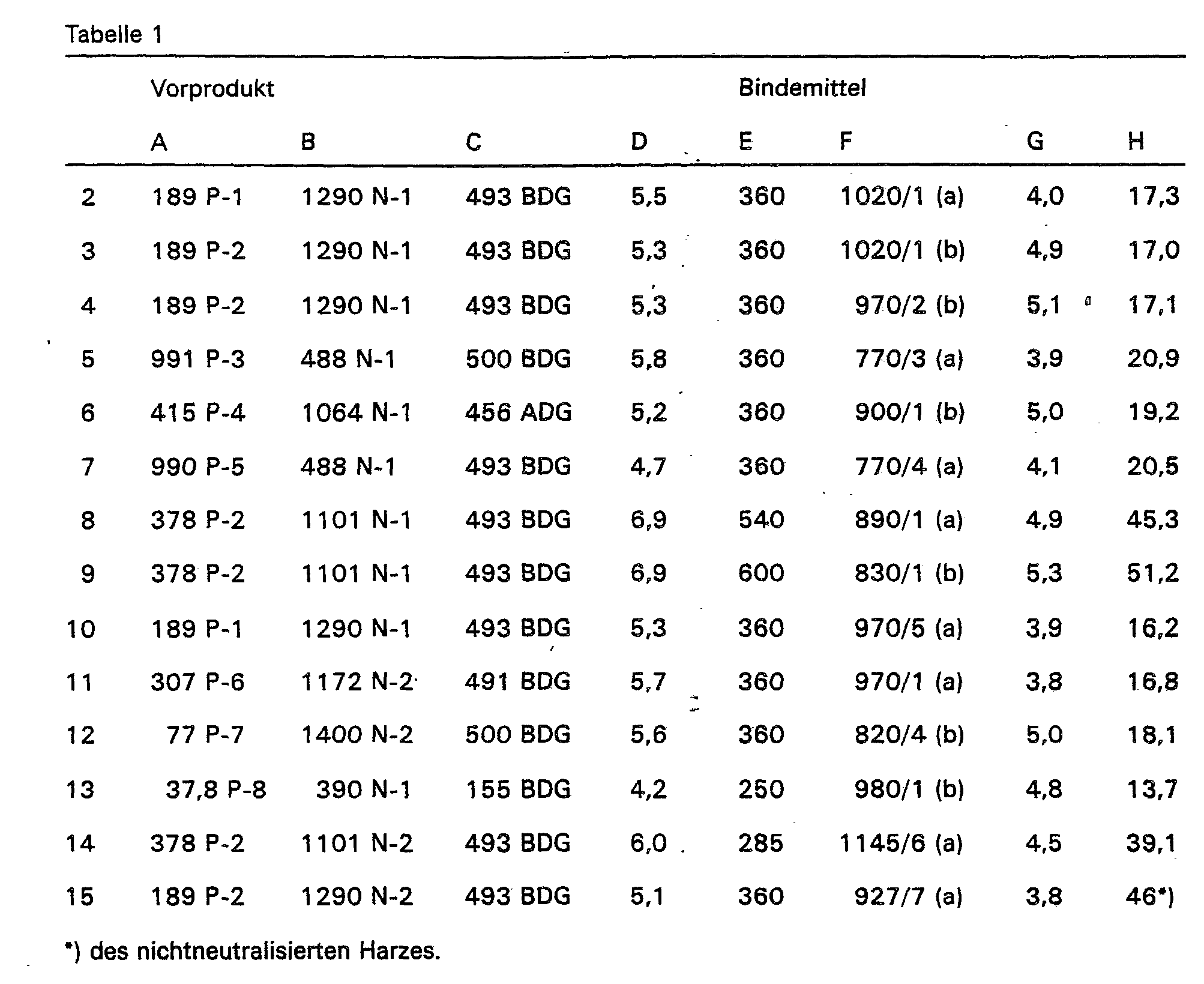
- Die Bindemittel wurden wie in Beispiel 1 beschrieben hergestellt. Die Spalten A-H der Tabelle 1 haben dabei folgende Bedeutung (alle Teilangaben bedeuten Gewichtsteile und beziehen sich auf Festsubstanz):
- A: saures Phosphorsäurederivat (P1-P9)
- B: Amino-Aldehyd-Kondensationsprodukt (N1 - N2)
- C: Lösungsmittel BDG = Diäthylenglykolmonobutyläther, ADG = Diäthylenglykolmonoäthyiäther)
- D: Grenzviskositätszahl, gemessen bei 20° C in Dimethylformamid
- E: Kondensationsprodukt aus A + B in Gew.-Teilen
- F: Hydroxylverbindung (OH1-OH7); (Teile/Type)
- G: Grenzviskositätszahl des Bindemittels, gemessen bei 20° C in Dimethylformamid
- H: Säurezahl (Festharz) mg KOH/g
- (a): E und F bei Raumtemperatur oder mäßig erhöhter Temperatur gemischt.
- (b): E und F bei 50-90°C präkondensiert.
- Aus den Bindemitteln wurden nach dem üblichen Verfahren Lacke mit folgenden Pigmentierungen hergestellt:

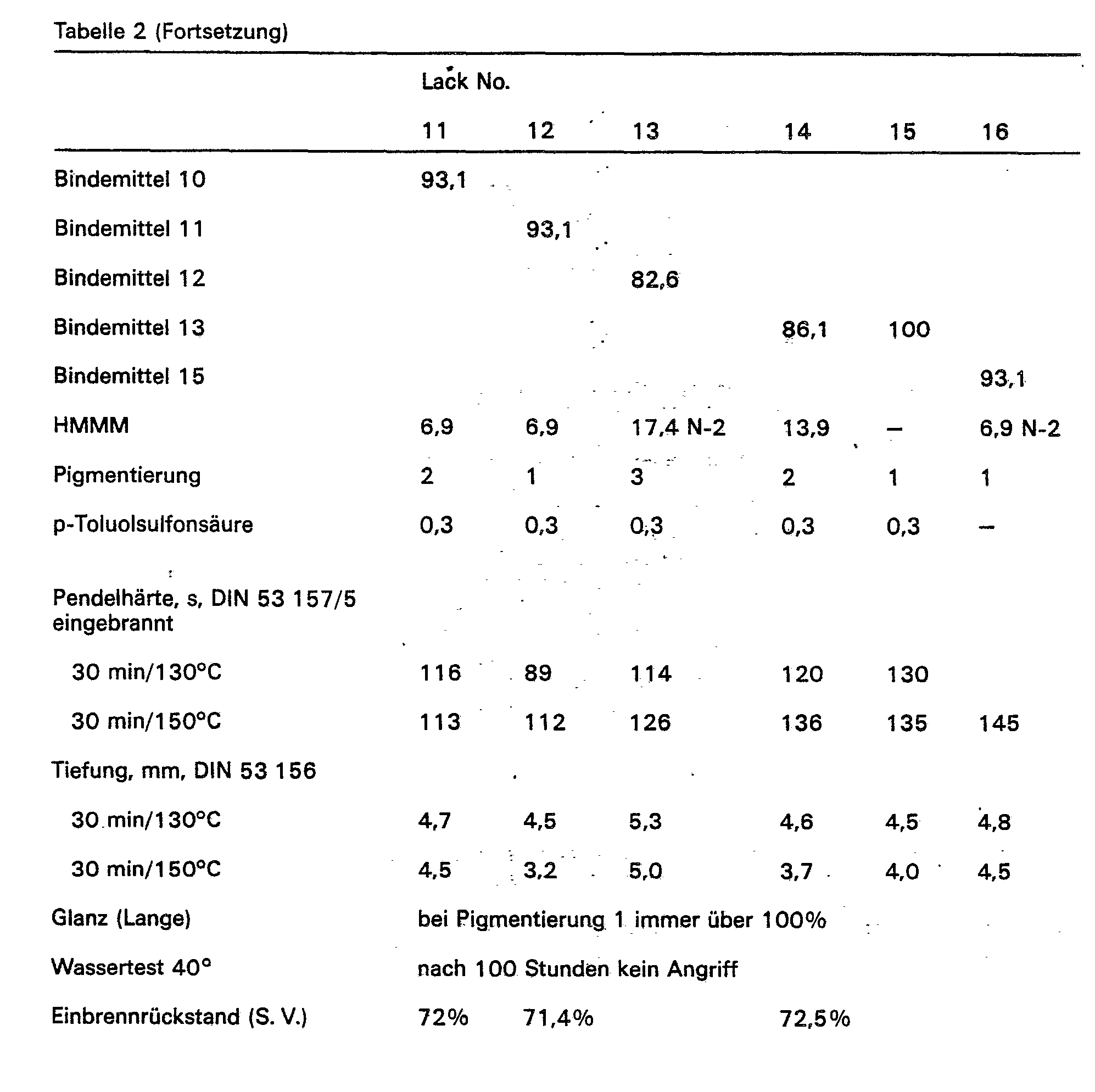
- Die Lacke 1-15 wurden mit einem Lösungsmittelgemisch aus Xylol/Äthylglykolacetat/Butylacetat (5 : 3 : 2) auf 21-23 s DIN 53 211/20°C verdünnt. Vor dem Verdünnen wurden den Lacken 1 % (bezogen auf Gesamtbindemittel) Wasser zugesetzt.
- Lack 16 wurde mit Dimethyläthanolamin auf einen pH-Wert von 8,0 eingestellt und mit deionisiertem Wasser wie oben eingestellt.

- Kombination von Hydroxylgruppen tragenden Verbindungen OH-1 und OH-5 mit den Aminoharzen N-1 und N-2 in den Mischungsverhältnissen 70 : 30 und 80: 20 (bezogen auf die lösungsmittelfreien Komponenten) wurden in der Pigmentierung 1 unter Zugabe von 1% p-Toluoisulfonsäure (bezogen auf die lösungsmittelfreie Harzkombination) in der bei den Lacken 1-15 beschriebenen Weise geprüft. Dabei wurden in bezug auf Filmhärte und Verformbarkeit ähnliche Werte wie bei den Lacken 1 -15 erhalten, im Wassertest bei.40°C trat jedoch schon nach 16 Stunden ein Blasengrad von m 5/g 1 oder stärker auf.
- Zu Lacken auf Basis von OH-1 zbd N-2 (Mischungsverhältnis 75 : 25) in der Pigmentierung 1 wurden vor dem Verdünnen je 100 Teile Bindemittel folgender Zugaben gemacht:

Bisphenol A (Epoxidäquivalent 182-189): 6,6 Teile - Die Phosphorverbindungen enthaltenden Lacke wurden unter Zugabe von p-Toluolsulfonsäure (1% des Festharzanteiles) bei 130°C, ohne Katalysatorzugabe bei 150°C, während 30 Minuten gehärtet. Dabei wurden in allen Fällen matte Lackierungen erhalten. Der phosphorfreie Lack ergab bei Zugabe von p-Toluolsulfonsäure und Härtung bei 160°C eine hochglänzende Lackierung.
eine der Polyäthylenglycolgruppierung oder eine Gruppierung der Formel:

Claims (9)


und in den Derivaten der Polyphosphorsäure der Formel II ferner
bei einer Temperatur von 50 bis 150°C bis zur vollständigen Bindung der Phosphorsäurederivate, bzw. Polyphosphorsäurederivate, umsetzt, und
steht worin
n einen Wert von 1 bis 6 aufweist,
oder eine Gruppe der Formeln:
eine Polyäthylenglycolgruppierung oder eine Gruppierung der Formel:

Applications Claiming Priority (2)
| Application Number | Priority Date | Filing Date | Title |
|---|---|---|---|
| AT812478A AT356782B (de) | 1978-11-14 | 1978-11-14 | Verfahren zur herstellung von chemisch gebundene saure phosphorsaeurederivate enthaltenden bindemitteln fuer einkomponenten- lacke |
| AT8124/78 | 1978-11-14 |
Publications (2)
| Publication Number | Publication Date |
|---|---|
| EP0012205A1 EP0012205A1 (de) | 1980-06-25 |
| EP0012205B1 true EP0012205B1 (de) | 1984-02-01 |
Family
ID=3602767
Family Applications (1)
| Application Number | Title | Priority Date | Filing Date |
|---|---|---|---|
| EP19790104223 Expired EP0012205B1 (de) | 1978-11-14 | 1979-10-31 | Verfahren zur Herstellung von chemisch gebundene saure Phosphorsäurederivate enthaltenden Bindemitteln für Einkomponentenlacke |
Country Status (3)
| Country | Link |
|---|---|
| EP (1) | EP0012205B1 (de) |
| AT (1) | AT356782B (de) |
| DE (1) | DE2966621D1 (de) |
Families Citing this family (4)
| Publication number | Priority date | Publication date | Assignee | Title |
|---|---|---|---|---|
| AT372696B (de) * | 1981-12-18 | 1983-11-10 | Vianova Kunstharz Ag | Verfahren zur stabilisierung von metallpigmenten gegen korrosive medien |
| AT385764B (de) * | 1986-09-01 | 1988-05-10 | Vianova Kunstharz Ag | Verfahren zur herstellung wasserverduennbarer, phosphorsaeuremodifizierter bindemittel und deren verwendung fuer einbrennlacke |
| CA2095839C (en) * | 1991-09-09 | 2002-05-21 | Chemische Fabrik Budenheim Rudolf A. Oetker | Composition with integral intumescence properties |
| JPH0959562A (ja) * | 1995-08-29 | 1997-03-04 | Dainippon Toryo Co Ltd | 塗料組成物 |
Family Cites Families (6)
| Publication number | Priority date | Publication date | Assignee | Title |
|---|---|---|---|---|
| US3440201A (en) * | 1965-08-26 | 1969-04-22 | Sherwin Williams Co | Melamine - formaldehyde phosphate ether polyol resins useful for coating compositions,process for their preparation and coating compositions containing such resins |
| US3423369A (en) * | 1966-01-14 | 1969-01-21 | Ciba Ltd | Phosphorus-containing aminoplasts and process for their preparation |
| DE2144645A1 (de) * | 1971-09-07 | 1973-03-22 | Metallgesellschaft Ag | Verfahren und mittel zur herstellung von organischen ueberzuegen auf metalloberflaechen |
| CA917334A (en) * | 1972-02-02 | 1972-12-19 | C. Juneja Subhash | Urea-base fire-retardant formulation and products |
| DE2241715A1 (de) * | 1972-08-24 | 1974-03-07 | Basf Ag | Verfahren zur verminderung des schwundes und der brennbarkeit von schaummassen aus haertbaren aminoplastkondensaten |
| NL7603497A (en) * | 1976-04-02 | 1977-10-04 | Pieter Voogel | Permanent protection of metal surfaces by two pigmented resin coatings - consisting of primer with phosphoric acid epoxy ester resin and melamine resin and top coat of acrylamide resin and epoxy resin |
-
1978
- 1978-11-14 AT AT812478A patent/AT356782B/de active
-
1979
- 1979-10-31 DE DE7979104223T patent/DE2966621D1/de not_active Expired
- 1979-10-31 EP EP19790104223 patent/EP0012205B1/de not_active Expired
Also Published As
| Publication number | Publication date |
|---|---|
| EP0012205A1 (de) | 1980-06-25 |
| DE2966621D1 (en) | 1984-03-08 |
| ATA812478A (de) | 1979-10-15 |
| AT356782B (de) | 1980-05-27 |
Similar Documents
| Publication | Publication Date | Title |
|---|---|---|
| EP0537226B1 (de) | Lacke und verwendung der lacke zur lackierung von automobilkarosserien | |
| EP0391271B1 (de) | Wässriges hitzehärtbares überzugsmittel auf Polyester- und Acrylbasis, Verfahren zu dessen Herstellung und dessen Verwendung | |
| EP0089497A2 (de) | Verfahren zur Herstellung eines Mehrschichtüberzuges, so überzogenes Substrat und Verwendung eines wasserverdünnbaren überzugsmittels | |
| DE3412534A1 (de) | Durch saeure haertbare ueberzugsmittel und verfahren zu ihrer herstellung | |
| WO2000063265A2 (de) | Polymer | |
| EP2158245A1 (de) | Bindemittel mit hoher oh - zahl und sie enthaltende klarlackzusammensetzungen mit guten optischen eigenschaften und guter kratz- und chemikalienbeständigkeit | |
| EP0295403A2 (de) | Verwendung von wasserlöslichen Alkydharzen als Bindemittel in wasserverdünnbaren Streichlacken | |
| DE102007034866A1 (de) | Ungesättigte Polyester | |
| EP0996692B1 (de) | Verfahren zum Aufbringen eines mehrschichtigen Überzugs auf eine Substratoberfläche | |
| DE19730890C2 (de) | Verfahren zur Herstellung mehrschichtiger Überzüge und mit diesen beschichtete Substrate | |
| EP0362643A2 (de) | Verwendung von Acrylatcopolymerisaten als Additive für wässrige anionische Lacksysteme | |
| EP0772647B1 (de) | Polyacrylatharzlösungen mit verbesserter farbzahl und verwendung in überzugsmitteln | |
| EP0813552B1 (de) | Modifiziertes acrylcopolymerisat | |
| EP0081709B1 (de) | Einbrennlacke mit hohem Feststoffgehalt | |
| EP0012205A1 (de) | Verfahren zur Herstellung von chemisch gebundene saure Phosphorsäurederivate enthaltenden Bindemitteln für Einkomponentenlacke | |
| DE3739332C2 (de) | ||
| DE2439548C3 (de) | Wassermischbare Reaktiwerdünner | |
| EP0301300B1 (de) | Verfahren zur Herstellung eines mehrschichtigen, schützenden und/oder dekorativen Überzugs und wasserverdünnbare Beschichtungszusammensetzungen | |
| DE3832142A1 (de) | Verfahren zur herstellung eines mehrschichtigen, schuetzenden und/oder dekorativen ueberzugs und wasserverduennbare beschichtungszusammensetzungen | |
| DE3933890A1 (de) | Verfahren zur herstellung von modifizierten polyestern und deren verwendung | |
| EP2954012A1 (de) | Alpha,omega-hydroxyfunktionalisierter oligoester als haftungsvermittler in wässrigen basislacken | |
| DE2936623C2 (de) | Verfahren zur Herstellung von Kondensationsprodukten | |
| DE3339424A1 (de) | Waermehaertbare beschichtungsmasse, darin enthaltene prekondensate und deren verwendung | |
| DE1494306C3 (de) | Überzugsmasse, bestehend aus Mischpolymerisaten und Aminoplasten | |
| DD257441A1 (de) | Loesungsmittelreduzierte einbrenn-anstrichstoffe |
Legal Events
| Date | Code | Title | Description |
|---|---|---|---|
| PUAI | Public reference made under article 153(3) epc to a published international application that has entered the european phase |
Free format text: ORIGINAL CODE: 0009012 |
|
| AK | Designated contracting states |
Designated state(s): BE CH DE FR GB IT NL SE |
|
| 17P | Request for examination filed | ||
| ITCL | It: translation for ep claims filed |
Representative=s name: BARZANO' E ZANARDO ROMA S.P.A. |
|
| ITF | It: translation for a ep patent filed | ||
| GRAA | (expected) grant |
Free format text: ORIGINAL CODE: 0009210 |
|
| AK | Designated contracting states |
Designated state(s): BE CH DE FR GB IT NL SE |
|
| REF | Corresponds to: |
Ref document number: 2966621 Country of ref document: DE Date of ref document: 19840308 |
|
| ET | Fr: translation filed | ||
| PGFP | Annual fee paid to national office [announced via postgrant information from national office to epo] |
Ref country code: BE Payment date: 19840930 Year of fee payment: 6 |
|
| PLBE | No opposition filed within time limit |
Free format text: ORIGINAL CODE: 0009261 |
|
| STAA | Information on the status of an ep patent application or granted ep patent |
Free format text: STATUS: NO OPPOSITION FILED WITHIN TIME LIMIT |
|
| 26N | No opposition filed | ||
| PG25 | Lapsed in a contracting state [announced via postgrant information from national office to epo] |
Ref country code: BE Effective date: 19851031 |
|
| BERE | Be: lapsed |
Owner name: VIANOVA KUNSTHARZ A.G. Effective date: 19851031 |
|
| PGFP | Annual fee paid to national office [announced via postgrant information from national office to epo] |
Ref country code: SE Payment date: 19890915 Year of fee payment: 11 Ref country code: CH Payment date: 19890915 Year of fee payment: 11 |
|
| PGFP | Annual fee paid to national office [announced via postgrant information from national office to epo] |
Ref country code: GB Payment date: 19890930 Year of fee payment: 11 |
|
| PGFP | Annual fee paid to national office [announced via postgrant information from national office to epo] |
Ref country code: NL Payment date: 19891031 Year of fee payment: 11 |
|
| PG25 | Lapsed in a contracting state [announced via postgrant information from national office to epo] |
Ref country code: GB Effective date: 19901031 Ref country code: CH Effective date: 19901031 |
|
| PG25 | Lapsed in a contracting state [announced via postgrant information from national office to epo] |
Ref country code: SE Effective date: 19901101 |
|
| PG25 | Lapsed in a contracting state [announced via postgrant information from national office to epo] |
Ref country code: NL Effective date: 19910501 |
|
| NLV4 | Nl: lapsed or anulled due to non-payment of the annual fee | ||
| GBPC | Gb: european patent ceased through non-payment of renewal fee | ||
| REG | Reference to a national code |
Ref country code: CH Ref legal event code: PL |
|
| PGFP | Annual fee paid to national office [announced via postgrant information from national office to epo] |
Ref country code: FR Payment date: 19910911 Year of fee payment: 13 |
|
| ITTA | It: last paid annual fee | ||
| PG25 | Lapsed in a contracting state [announced via postgrant information from national office to epo] |
Ref country code: FR Effective date: 19930630 |
|
| REG | Reference to a national code |
Ref country code: FR Ref legal event code: ST |
|
| PGFP | Annual fee paid to national office [announced via postgrant information from national office to epo] |
Ref country code: DE Payment date: 19930920 Year of fee payment: 15 |
|
| EUG | Se: european patent has lapsed |
Ref document number: 79104223.7 Effective date: 19910705 |
|
| PG25 | Lapsed in a contracting state [announced via postgrant information from national office to epo] |
Ref country code: DE Effective date: 19950701 |