EP0010562B1 - Elektrochemischer Prozess - Google Patents
Elektrochemischer Prozess Download PDFInfo
- Publication number
- EP0010562B1 EP0010562B1 EP78400147A EP78400147A EP0010562B1 EP 0010562 B1 EP0010562 B1 EP 0010562B1 EP 78400147 A EP78400147 A EP 78400147A EP 78400147 A EP78400147 A EP 78400147A EP 0010562 B1 EP0010562 B1 EP 0010562B1
- Authority
- EP
- European Patent Office
- Prior art keywords
- electrolysis
- fixed electrodes
- fact
- electrodes
- per
- Prior art date
- Legal status (The legal status is an assumption and is not a legal conclusion. Google has not performed a legal analysis and makes no representation as to the accuracy of the status listed.)
- Expired
Links
Images
Classifications
-
- C—CHEMISTRY; METALLURGY
- C02—TREATMENT OF WATER, WASTE WATER, SEWAGE, OR SLUDGE
- C02F—TREATMENT OF WATER, WASTE WATER, SEWAGE, OR SLUDGE
- C02F1/00—Treatment of water, waste water, or sewage
- C02F1/46—Treatment of water, waste water, or sewage by electrochemical methods
- C02F1/461—Treatment of water, waste water, or sewage by electrochemical methods by electrolysis
- C02F1/46104—Devices therefor; Their operating or servicing
- C02F1/46109—Electrodes
-
- C—CHEMISTRY; METALLURGY
- C02—TREATMENT OF WATER, WASTE WATER, SEWAGE, OR SLUDGE
- C02F—TREATMENT OF WATER, WASTE WATER, SEWAGE, OR SLUDGE
- C02F1/00—Treatment of water, waste water, or sewage
- C02F1/001—Processes for the treatment of water whereby the filtration technique is of importance
-
- C—CHEMISTRY; METALLURGY
- C02—TREATMENT OF WATER, WASTE WATER, SEWAGE, OR SLUDGE
- C02F—TREATMENT OF WATER, WASTE WATER, SEWAGE, OR SLUDGE
- C02F1/00—Treatment of water, waste water, or sewage
- C02F1/46—Treatment of water, waste water, or sewage by electrochemical methods
- C02F1/461—Treatment of water, waste water, or sewage by electrochemical methods by electrolysis
- C02F1/46104—Devices therefor; Their operating or servicing
- C02F1/46109—Electrodes
- C02F1/46114—Electrodes in particulate form or with conductive and/or non conductive particles between them
-
- C—CHEMISTRY; METALLURGY
- C02—TREATMENT OF WATER, WASTE WATER, SEWAGE, OR SLUDGE
- C02F—TREATMENT OF WATER, WASTE WATER, SEWAGE, OR SLUDGE
- C02F1/00—Treatment of water, waste water, or sewage
- C02F1/46—Treatment of water, waste water, or sewage by electrochemical methods
- C02F1/461—Treatment of water, waste water, or sewage by electrochemical methods by electrolysis
- C02F1/46104—Devices therefor; Their operating or servicing
- C02F1/46109—Electrodes
- C02F2001/46152—Electrodes characterised by the shape or form
Definitions
- the invention relates to electrolytic cells.
- the presence of a separator between the anode and cathode compartments has been made unnecessary. It is highlighted that the porous separator, contrary to what shows the current practice, can be advantageously eliminated, which authorizes the circulation of an electrode dispersed in the whole of the electrolytic cell, and makes it possible to eliminate the disadvantages which result from the presence of a separator.
- the dispersed electrode is formed by a suspension in the electrolyte of conductive particles.
- Various arrangements of all the elements of the cell are proposed and in particular as regards the circulation of the dispersed electrode with respect to the fixed electrodes.
- Such a method can be used for any electrolytic cell, in general for all oxidation or reduction reactions and in particular for synthesis reactions, or of destruction or elimination of toxic or polluting compounds contained in the effluents.
- the invention relates to techniques which use electrochemical reactions. It relates more precisely to the design of a process and an electrolysis cell for the implementation of redox reactions. It is likely to receive applications as varied as are the many uses of electrochemical reactions, in various industries. However, reference will be made more particularly in the following to two preferred types of applications of the assembly according to the invention, which are the electrolysers intended for the transformation of the basic products of an electrochemical synthesis, and those used for the elimination of toxic or polluting compounds contained in effluents.
- the present invention relates to an electrolysis method and device, resulting from the observation made that the reverse reactions occurring at the electrodes of each polarity, often take place at different kinetics, this being generally applicable to all oxidation or reduction reactions and authorizing the removal of compartmentalization of the cell.
- Such a separator has a number of drawbacks; in particular, and by virtue of its mere presence, the separator causes an ohmic drop between the electrodes, all the more important as the electrolyser operates at higher current densities.
- the invention aims to overcome these drawbacks by eliminating the porous diaphragm.
- the removal of the separator allows the use of a dispersed electrode circulating in the whole of the electrolyte and through the fixed electrodes, and which can consequently be in contact with both the cathode and the anode. fixed.
- the polarity of the dispersed electrode is determined by the direction of the reaction with the fastest kinetics.
- the purpose of such a dispersed electrode is to improve the yields of the operation.
- the method of the invention applies to all cases where each of the constituents in solution is characterized by redox properties, such that one of the two reactions, oxidation or reduction, occurs with kinetics faster than l 'other.
- the electrolytic solution can be brought into contact simultaneously with the positive electrodes and the negative electrodes without there being any fear that the reactions which occur at the electrodes of a polarite will be annihilated by those occurring at the reverse polarity electrodes.
- only one reaction is able to occur with appreciable kinetics. This effect could advantageously be amplified, possibly, by the judicious choice of the relative surfaces of the electrodes of opposite polarities.
- Such a process is likely to be used in a particularly advantageous manner, either in the context of electrosynthesis operations, or for the treatment of effluents.
- the present invention allows, in the case of its application to the treatment of effluents, to overcome these drawbacks by installing the device of the invention which it is possible to adapt directly to the circuit for discharging pollutant discharges.
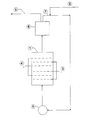
- the single figure proposes a diagram of nonlimiting application of the method of the invention to the treatment of effluents.
- the electrolytic cell is directly supplied by the effluent evacuation circuit at 2.
- the cathodes and anodes 3 and 4 may especially, as in the case of an electrolytic cell intended for electrochemical synthesis operations, including be arranged transversely to the passage of the effluent, in which case the fixed electrodes must be crossed by the suspension; the fixed electrodes can, in this case, present themselves under various aspects and in particular: plates pierced with holes through which the compulsory migration of the suspension takes place; grids crossed in the same way; a network of wires or strips, tubes or plates.
- the purified effluent leaves the device at 5, after passing through a filter 6 which can in particular be a rotary filter, which allows the recovery of the particles of the electrode dispersed at 7 with a view to their reuse; their reintroduction into the circuit is regulated by means of a pump 8.
- a filter 6 which can in particular be a rotary filter, which allows the recovery of the particles of the electrode dispersed at 7 with a view to their reuse; their reintroduction into the circuit is regulated by means of a pump 8.
- the invention is not limited to the particular embodiments which have been described by way of example. In particular, it extends to the application of any other method making it possible to carry out an electrolysis reaction in the absence of a separator between the anode and cathode compartments.
- the invention is not limited to the examples which have just been given, but embraces all the variants thereof.
Landscapes
- Chemical & Material Sciences (AREA)
- Chemical Kinetics & Catalysis (AREA)
- Electrochemistry (AREA)
- General Chemical & Material Sciences (AREA)
- Life Sciences & Earth Sciences (AREA)
- Hydrology & Water Resources (AREA)
- Engineering & Computer Science (AREA)
- Environmental & Geological Engineering (AREA)
- Water Supply & Treatment (AREA)
- Organic Chemistry (AREA)
- Electrolytic Production Of Non-Metals, Compounds, Apparatuses Therefor (AREA)
- Water Treatment By Electricity Or Magnetism (AREA)
Claims (10)
Priority Applications (2)
| Application Number | Priority Date | Filing Date | Title |
|---|---|---|---|
| EP78400147A EP0010562B1 (de) | 1978-10-25 | 1978-10-25 | Elektrochemischer Prozess |
| DE7878400147T DE2862460D1 (en) | 1978-10-25 | 1978-10-25 | Electrochemical process |
Applications Claiming Priority (1)
| Application Number | Priority Date | Filing Date | Title |
|---|---|---|---|
| EP78400147A EP0010562B1 (de) | 1978-10-25 | 1978-10-25 | Elektrochemischer Prozess |
Publications (2)
| Publication Number | Publication Date |
|---|---|
| EP0010562A1 EP0010562A1 (de) | 1980-05-14 |
| EP0010562B1 true EP0010562B1 (de) | 1985-02-13 |
Family
ID=8186044
Family Applications (1)
| Application Number | Title | Priority Date | Filing Date |
|---|---|---|---|
| EP78400147A Expired EP0010562B1 (de) | 1978-10-25 | 1978-10-25 | Elektrochemischer Prozess |
Country Status (2)
| Country | Link |
|---|---|
| EP (1) | EP0010562B1 (de) |
| DE (1) | DE2862460D1 (de) |
Families Citing this family (6)
| Publication number | Priority date | Publication date | Assignee | Title |
|---|---|---|---|---|
| EP0027745B1 (de) * | 1979-10-23 | 1984-08-29 | Creconsult Limited | Verfahren zum elektrochemischen Abbau von schädlichen oder potentiell schädlichen beständigen organischen Verbindungen |
| NL8006412A (nl) * | 1980-11-25 | 1982-06-16 | Tno | Werkwijze voor het detoxificeren van chemische afvalstoffen. |
| US4399020A (en) * | 1981-07-24 | 1983-08-16 | Diamond Shamrock Corporation | Device for waste water treatment |
| EP0322478A1 (de) * | 1987-12-30 | 1989-07-05 | Kay Wilms | Verfahren und Vorrichtung zur Aufbereitung von Wasser, insbesondere zur Herstellung von keimfreiem Trinkwasser, durch anodische Oxidation |
| FR2717459B1 (fr) * | 1994-03-16 | 1996-04-12 | Commissariat Energie Atomique | Procédé et installation de destruction de solutes organiques, en particulier d'agents complexants, présents dans une solution aqueuse telle qu'un effluent radioactif. |
| AU2007200853B1 (en) * | 2006-11-13 | 2007-07-26 | Newtreat Pty Ltd | Electroflocculation |
Family Cites Families (6)
| Publication number | Priority date | Publication date | Assignee | Title |
|---|---|---|---|---|
| US3288692A (en) * | 1962-09-20 | 1966-11-29 | Pullman Inc | Electrochemical process for the production of organic oxides |
| US3616356A (en) * | 1967-09-18 | 1971-10-26 | Clarence H Roy | Electrolysis in a particulate carbon packing |
| US4310406A (en) * | 1968-10-01 | 1982-01-12 | Resource Control, Incorporated | Apparatus for removing metal ions and other pollutants from aqueous solutions and moist gaseous streams |
| US4004994A (en) * | 1972-07-12 | 1977-01-25 | Stauffer Chemical Company | Electrochemical removal of contaminants |
| DE2460754C2 (de) * | 1974-12-21 | 1982-07-15 | Hoechst Ag, 6000 Frankfurt | Verfahren zur Herstellung von p-Benzochinondiketalen |
| FR2375351A1 (en) * | 1976-12-21 | 1978-07-21 | Inst Neorganicheskoi Khim | Electrolysis system for oxidation reactions - using extended surface electrode formed by conducting particles in cell |
-
1978
- 1978-10-25 EP EP78400147A patent/EP0010562B1/de not_active Expired
- 1978-10-25 DE DE7878400147T patent/DE2862460D1/de not_active Expired
Also Published As
| Publication number | Publication date |
|---|---|
| DE2862460D1 (en) | 1985-03-28 |
| EP0010562A1 (de) | 1980-05-14 |
Similar Documents
| Publication | Publication Date | Title |
|---|---|---|
| EP0031267B1 (de) | Kohlenstoff oder Graphit modifizierte faserige durchseihende poröse Elektrode und ihre Anwendung in elektrochemischen Verfahren | |
| CN106660837A (zh) | 用于进行电芬顿反应以分解有机化合物的装置 | |
| FR2555913A1 (fr) | Procede de desionisation electrochimique de solutions aqueuses | |
| CN110240221A (zh) | 一种光电催化体系及降解有机污染物同时回收贵金属银的方法 | |
| EP4039655B1 (de) | Reaktor, der die kontinuierliche filtration einer durch einen filter fliessenden flüssigkeit ermöglicht und eine elektrochemische regeneration des filters in situ umfasst | |
| EP0672623A1 (de) | Verfahren und Vorrichtung zur Entsorgung gelöster organischer Stoffe, insbesondere Komplexbildern, aus einer wässerigen Lösung, z.B. radioaktiver Abwässer | |
| FR2755789A1 (fr) | Procede et appareil de traitement d'une solution de dechets radioactifs | |
| RU145009U1 (ru) | Микробный топливный элемент и схема сборки таких элементов | |
| CN114538572B (zh) | 利用电化学水处理装置处理反渗透浓水的方法 | |
| CN108658177A (zh) | 一种适用于水中难降解有机物去除的电化学活性炭纤维毡膜反应器 | |
| EP0141780A1 (de) | Verfahren zur elektrochemischen Reinigung von Wasser | |
| CN112321034A (zh) | 一种同步电解/膜分离/高级氧化协同处理含硫酸铵废水及有机废水的装置和方法 | |
| EP0010562A1 (de) | Elektrochemischer Prozess | |
| JP5812874B2 (ja) | 微生物燃料電池システム | |
| Liu et al. | Electrified carbon nanotube membrane technology for water treatment | |
| EP0449735B1 (de) | Reaktor zur elektrolytischen Reinigung | |
| FR2993902A1 (fr) | Cellule d'electrolyse | |
| EP0756582A1 (de) | Zerstörung von cyanometallischen komplexen mittels einer kombination von chemischer oxydation und elektrolyse | |
| FR2573221A1 (fr) | Procede et dispositif pour la recuperation de l'argent des bains de fixage | |
| EP0534029A1 (de) | Elektrochemische Anlage und Verfahren für die Behandlung von ein schweres Metall enthaltendem Abwasser | |
| FR2579998A1 (en) | Device for removing silver from baths containing silver | |
| FR2927326A1 (fr) | Procede et equipement pour l'oxydation de matieres organiques | |
| FR2681079A1 (fr) | Dispositif et procede d'electrolyse a electrode poreuse et agitee. | |
| EP1031633A1 (de) | Elektrolysezelle der Filterpressenbauart zum Auslaugen von Wertmetalle enthaltenden Schlämmen | |
| WO1996014273A1 (fr) | Dispositif electrolytique pour la recuperation des metaux et l'oxydation des substances organiques dissoutes en milieu basique |
Legal Events
| Date | Code | Title | Description |
|---|---|---|---|
| PUAI | Public reference made under article 153(3) epc to a published international application that has entered the european phase |
Free format text: ORIGINAL CODE: 0009012 |
|
| AK | Designated contracting states |
Designated state(s): BE CH DE GB |
|
| 17P | Request for examination filed |
Effective date: 19810728 |
|
| RAP1 | Party data changed (applicant data changed or rights of an application transferred) |
Owner name: SORAPEC SOCIETE DE RECHERCHES ET D'APPLICATIONS EL |
|
| GRAA | (expected) grant |
Free format text: ORIGINAL CODE: 0009210 |
|
| AK | Designated contracting states |
Designated state(s): BE CH DE GB |
|
| REF | Corresponds to: |
Ref document number: 2862460 Country of ref document: DE Date of ref document: 19850328 |
|
| PLBE | No opposition filed within time limit |
Free format text: ORIGINAL CODE: 0009261 |
|
| STAA | Information on the status of an ep patent application or granted ep patent |
Free format text: STATUS: NO OPPOSITION FILED WITHIN TIME LIMIT |
|
| 26N | No opposition filed | ||
| PGFP | Annual fee paid to national office [announced via postgrant information from national office to epo] |
Ref country code: BE Payment date: 19931006 Year of fee payment: 16 |
|
| PGFP | Annual fee paid to national office [announced via postgrant information from national office to epo] |
Ref country code: GB Payment date: 19931019 Year of fee payment: 16 |
|
| PGFP | Annual fee paid to national office [announced via postgrant information from national office to epo] |
Ref country code: CH Payment date: 19931028 Year of fee payment: 16 |
|
| PGFP | Annual fee paid to national office [announced via postgrant information from national office to epo] |
Ref country code: DE Payment date: 19931210 Year of fee payment: 16 |
|
| PG25 | Lapsed in a contracting state [announced via postgrant information from national office to epo] |
Ref country code: GB Effective date: 19941025 |
|
| PG25 | Lapsed in a contracting state [announced via postgrant information from national office to epo] |
Ref country code: CH Effective date: 19941031 Ref country code: BE Effective date: 19941031 |
|
| BERE | Be: lapsed |
Owner name: SORAPEC SOC. DE RECHERCHERS ET D'APPLICATION ELEC Effective date: 19941031 |
|
| GBPC | Gb: european patent ceased through non-payment of renewal fee |
Effective date: 19941025 |
|
| REG | Reference to a national code |
Ref country code: CH Ref legal event code: PL |
|
| PG25 | Lapsed in a contracting state [announced via postgrant information from national office to epo] |
Ref country code: DE Effective date: 19950701 |