EP0005782A1 - Pflanzenwachstum regulierende Verbindungen, deren Verwendung und Herstellung sowie diese Verbindungen enthaltende Mittel, deren Verwendung und Herstellung - Google Patents
Pflanzenwachstum regulierende Verbindungen, deren Verwendung und Herstellung sowie diese Verbindungen enthaltende Mittel, deren Verwendung und Herstellung Download PDFInfo
- Publication number
- EP0005782A1 EP0005782A1 EP79101540A EP79101540A EP0005782A1 EP 0005782 A1 EP0005782 A1 EP 0005782A1 EP 79101540 A EP79101540 A EP 79101540A EP 79101540 A EP79101540 A EP 79101540A EP 0005782 A1 EP0005782 A1 EP 0005782A1
- Authority
- EP
- European Patent Office
- Prior art keywords
- formula
- acid derivatives
- amino
- stands
- alkyl
- Prior art date
- Legal status (The legal status is an assumption and is not a legal conclusion. Google has not performed a legal analysis and makes no representation as to the accuracy of the status listed.)
- Granted
Links
- 230000008635 plant growth Effects 0.000 title claims abstract description 11
- 238000002360 preparation method Methods 0.000 title claims description 26
- 239000000203 mixture Substances 0.000 title description 28
- -1 aralkoxy Chemical group 0.000 claims abstract description 57
- 239000002253 acid Substances 0.000 claims abstract description 50
- 238000000034 method Methods 0.000 claims abstract description 47
- 150000001875 compounds Chemical class 0.000 claims abstract description 46
- 230000008569 process Effects 0.000 claims abstract description 41
- 125000000217 alkyl group Chemical group 0.000 claims abstract description 28
- 125000002924 primary amino group Chemical group [H]N([H])* 0.000 claims abstract description 27
- 125000004663 dialkyl amino group Chemical group 0.000 claims abstract description 21
- 125000003282 alkyl amino group Chemical group 0.000 claims abstract description 20
- QGZKDVFQNNGYKY-UHFFFAOYSA-O Ammonium Chemical compound [NH4+] QGZKDVFQNNGYKY-UHFFFAOYSA-O 0.000 claims abstract description 19
- 125000003545 alkoxy group Chemical group 0.000 claims abstract description 18
- 125000005208 trialkylammonium group Chemical group 0.000 claims abstract description 17
- 125000005131 dialkylammonium group Chemical group 0.000 claims abstract description 16
- 125000001301 ethoxy group Chemical group [H]C([H])([H])C([H])([H])O* 0.000 claims abstract description 16
- 239000001257 hydrogen Substances 0.000 claims abstract description 16
- 229910052739 hydrogen Inorganic materials 0.000 claims abstract description 16
- 125000005210 alkyl ammonium group Chemical group 0.000 claims abstract description 15
- UFHFLCQGNIYNRP-UHFFFAOYSA-N Hydrogen Chemical compound [H][H] UFHFLCQGNIYNRP-UHFFFAOYSA-N 0.000 claims abstract description 14
- 229910001413 alkali metal ion Inorganic materials 0.000 claims abstract description 13
- CPELXLSAUQHCOX-UHFFFAOYSA-M Bromide Chemical compound [Br-] CPELXLSAUQHCOX-UHFFFAOYSA-M 0.000 claims abstract description 11
- VEXZGXHMUGYJMC-UHFFFAOYSA-M Chloride anion Chemical compound [Cl-] VEXZGXHMUGYJMC-UHFFFAOYSA-M 0.000 claims abstract description 11
- 125000003118 aryl group Chemical group 0.000 claims abstract description 11
- 229910001420 alkaline earth metal ion Inorganic materials 0.000 claims abstract description 9
- 150000002431 hydrogen Chemical group 0.000 claims abstract description 9
- 230000001105 regulatory effect Effects 0.000 claims abstract description 9
- 150000001340 alkali metals Chemical class 0.000 claims abstract description 8
- XMBWDFGMSWQBCA-UHFFFAOYSA-N hydrogen iodide Chemical compound I XMBWDFGMSWQBCA-UHFFFAOYSA-N 0.000 claims abstract description 8
- 125000002887 hydroxy group Chemical group [H]O* 0.000 claims abstract description 8
- 125000000956 methoxy group Chemical group [H]C([H])([H])O* 0.000 claims abstract description 6
- VEXZGXHMUGYJMC-UHFFFAOYSA-N Hydrochloric acid Chemical compound Cl VEXZGXHMUGYJMC-UHFFFAOYSA-N 0.000 claims description 34
- XLYOFNOQVPJJNP-UHFFFAOYSA-N water Substances O XLYOFNOQVPJJNP-UHFFFAOYSA-N 0.000 claims description 25
- LFQSCWFLJHTTHZ-UHFFFAOYSA-N Ethanol Chemical compound CCO LFQSCWFLJHTTHZ-UHFFFAOYSA-N 0.000 claims description 24
- 239000003085 diluting agent Substances 0.000 claims description 19
- 125000005207 tetraalkylammonium group Chemical group 0.000 claims description 10
- 239000000460 chlorine Substances 0.000 claims description 9
- 239000003795 chemical substances by application Substances 0.000 claims description 8
- 125000002496 methyl group Chemical group [H]C([H])([H])* 0.000 claims description 8
- 238000009835 boiling Methods 0.000 claims description 6
- XEEYBQQBJWHFJM-UHFFFAOYSA-N Iron Chemical compound [Fe] XEEYBQQBJWHFJM-UHFFFAOYSA-N 0.000 claims description 5
- 239000011230 binding agent Substances 0.000 claims description 5
- 150000003839 salts Chemical class 0.000 claims description 5
- 239000004606 Fillers/Extenders Substances 0.000 claims description 4
- 150000008044 alkali metal hydroxides Chemical class 0.000 claims description 4
- 239000003054 catalyst Substances 0.000 claims description 4
- 125000001495 ethyl group Chemical group [H]C([H])([H])C([H])([H])* 0.000 claims description 4
- NGNBDVOYPDDBFK-UHFFFAOYSA-N 2-[2,4-di(pentan-2-yl)phenoxy]acetyl chloride Chemical compound CCCC(C)C1=CC=C(OCC(Cl)=O)C(C(C)CCC)=C1 NGNBDVOYPDDBFK-UHFFFAOYSA-N 0.000 claims description 3
- ZAMOUSCENKQFHK-UHFFFAOYSA-N Chlorine atom Chemical compound [Cl] ZAMOUSCENKQFHK-UHFFFAOYSA-N 0.000 claims description 3
- 241001024304 Mino Species 0.000 claims description 3
- 125000003710 aryl alkyl group Chemical group 0.000 claims description 3
- 229910052801 chlorine Inorganic materials 0.000 claims description 3
- 150000001735 carboxylic acids Chemical class 0.000 claims description 2
- 239000004094 surface-active agent Substances 0.000 claims description 2
- 229910052783 alkali metal Inorganic materials 0.000 abstract 1
- 229910052784 alkaline earth metal Inorganic materials 0.000 abstract 1
- 150000001342 alkaline earth metals Chemical class 0.000 abstract 1
- 241000196324 Embryophyta Species 0.000 description 45
- 125000004432 carbon atom Chemical group C* 0.000 description 26
- 239000003630 growth substance Substances 0.000 description 23
- 230000012010 growth Effects 0.000 description 22
- 239000002904 solvent Substances 0.000 description 20
- 239000004480 active ingredient Substances 0.000 description 18
- YMWUJEATGCHHMB-UHFFFAOYSA-N Dichloromethane Chemical compound ClCCl YMWUJEATGCHHMB-UHFFFAOYSA-N 0.000 description 17
- RTZKZFJDLAIYFH-UHFFFAOYSA-N Diethyl ether Chemical compound CCOCC RTZKZFJDLAIYFH-UHFFFAOYSA-N 0.000 description 17
- 238000006243 chemical reaction Methods 0.000 description 14
- 235000013399 edible fruits Nutrition 0.000 description 13
- 150000003254 radicals Chemical class 0.000 description 13
- 239000000843 powder Substances 0.000 description 11
- 239000000243 solution Substances 0.000 description 11
- 239000013543 active substance Substances 0.000 description 10
- 239000000126 substance Substances 0.000 description 10
- OKKJLVBELUTLKV-UHFFFAOYSA-N Methanol Chemical compound OC OKKJLVBELUTLKV-UHFFFAOYSA-N 0.000 description 9
- KWYUFKZDYYNOTN-UHFFFAOYSA-M Potassium hydroxide Chemical compound [OH-].[K+] KWYUFKZDYYNOTN-UHFFFAOYSA-M 0.000 description 9
- QGZKDVFQNNGYKY-UHFFFAOYSA-N Ammonia Chemical compound N QGZKDVFQNNGYKY-UHFFFAOYSA-N 0.000 description 8
- 239000003995 emulsifying agent Substances 0.000 description 8
- 239000000047 product Substances 0.000 description 8
- 238000003756 stirring Methods 0.000 description 8
- DGAQECJNVWCQMB-PUAWFVPOSA-M Ilexoside XXIX Chemical compound C[C@@H]1CC[C@@]2(CC[C@@]3(C(=CC[C@H]4[C@]3(CC[C@@H]5[C@@]4(CC[C@@H](C5(C)C)OS(=O)(=O)[O-])C)C)[C@@H]2[C@]1(C)O)C)C(=O)O[C@H]6[C@@H]([C@H]([C@@H]([C@H](O6)CO)O)O)O.[Na+] DGAQECJNVWCQMB-PUAWFVPOSA-M 0.000 description 7
- 238000009472 formulation Methods 0.000 description 7
- 238000003306 harvesting Methods 0.000 description 7
- 239000011541 reaction mixture Substances 0.000 description 7
- ZWEHNKRNPOVVGH-UHFFFAOYSA-N 2-Butanone Chemical compound CCC(C)=O ZWEHNKRNPOVVGH-UHFFFAOYSA-N 0.000 description 6
- CSCPPACGZOOCGX-UHFFFAOYSA-N Acetone Chemical compound CC(C)=O CSCPPACGZOOCGX-UHFFFAOYSA-N 0.000 description 6
- ROSDSFDQCJNGOL-UHFFFAOYSA-N Dimethylamine Chemical compound CNC ROSDSFDQCJNGOL-UHFFFAOYSA-N 0.000 description 6
- VGGSQFUCUMXWEO-UHFFFAOYSA-N Ethene Chemical compound C=C VGGSQFUCUMXWEO-UHFFFAOYSA-N 0.000 description 6
- 239000005977 Ethylene Substances 0.000 description 6
- FYYHWMGAXLPEAU-UHFFFAOYSA-N Magnesium Chemical compound [Mg] FYYHWMGAXLPEAU-UHFFFAOYSA-N 0.000 description 6
- ZMXDDKWLCZADIW-UHFFFAOYSA-N N,N-Dimethylformamide Chemical compound CN(C)C=O ZMXDDKWLCZADIW-UHFFFAOYSA-N 0.000 description 6
- 244000061176 Nicotiana tabacum Species 0.000 description 6
- 235000002637 Nicotiana tabacum Nutrition 0.000 description 6
- 239000008187 granular material Substances 0.000 description 6
- 238000002844 melting Methods 0.000 description 6
- 230000008018 melting Effects 0.000 description 6
- 239000011734 sodium Substances 0.000 description 6
- HEMHJVSKTPXQMS-UHFFFAOYSA-M Sodium hydroxide Chemical compound [OH-].[Na+] HEMHJVSKTPXQMS-UHFFFAOYSA-M 0.000 description 5
- 230000000694 effects Effects 0.000 description 5
- 239000007788 liquid Substances 0.000 description 5
- 239000011777 magnesium Substances 0.000 description 5
- 125000001997 phenyl group Chemical group [H]C1=C([H])C([H])=C(*)C([H])=C1[H] 0.000 description 5
- XAEFZNCEHLXOMS-UHFFFAOYSA-M potassium benzoate Chemical compound [K+].[O-]C(=O)C1=CC=CC=C1 XAEFZNCEHLXOMS-UHFFFAOYSA-M 0.000 description 5
- 239000007858 starting material Substances 0.000 description 5
- 230000009105 vegetative growth Effects 0.000 description 5
- BHPQYMZQTOCNFJ-UHFFFAOYSA-N Calcium cation Chemical compound [Ca+2] BHPQYMZQTOCNFJ-UHFFFAOYSA-N 0.000 description 4
- 244000068988 Glycine max Species 0.000 description 4
- CSNNHWWHGAXBCP-UHFFFAOYSA-L Magnesium sulfate Chemical compound [Mg+2].[O-][S+2]([O-])([O-])[O-] CSNNHWWHGAXBCP-UHFFFAOYSA-L 0.000 description 4
- NPYPAHLBTDXSSS-UHFFFAOYSA-N Potassium ion Chemical compound [K+] NPYPAHLBTDXSSS-UHFFFAOYSA-N 0.000 description 4
- WYURNTSHIVDZCO-UHFFFAOYSA-N Tetrahydrofuran Chemical compound C1CCOC1 WYURNTSHIVDZCO-UHFFFAOYSA-N 0.000 description 4
- 239000000370 acceptor Substances 0.000 description 4
- 230000015572 biosynthetic process Effects 0.000 description 4
- 229910001424 calcium ion Inorganic materials 0.000 description 4
- 235000013339 cereals Nutrition 0.000 description 4
- 238000011161 development Methods 0.000 description 4
- 230000018109 developmental process Effects 0.000 description 4
- 230000009036 growth inhibition Effects 0.000 description 4
- 229910001425 magnesium ion Inorganic materials 0.000 description 4
- 229910000069 nitrogen hydride Inorganic materials 0.000 description 4
- 239000003960 organic solvent Substances 0.000 description 4
- 229910001414 potassium ion Inorganic materials 0.000 description 4
- VYPSYNLAJGMNEJ-UHFFFAOYSA-N silicon dioxide Inorganic materials O=[Si]=O VYPSYNLAJGMNEJ-UHFFFAOYSA-N 0.000 description 4
- 239000002689 soil Substances 0.000 description 4
- 239000007787 solid Substances 0.000 description 4
- 239000000725 suspension Substances 0.000 description 4
- PAJPWUMXBYXFCZ-UHFFFAOYSA-N 1-aminocyclopropanecarboxylic acid Chemical compound OC(=O)C1(N)CC1 PAJPWUMXBYXFCZ-UHFFFAOYSA-N 0.000 description 3
- WFDIJRYMOXRFFG-UHFFFAOYSA-N Acetic anhydride Chemical compound CC(=O)OC(C)=O WFDIJRYMOXRFFG-UHFFFAOYSA-N 0.000 description 3
- WEVYAHXRMPXWCK-UHFFFAOYSA-N Acetonitrile Chemical compound CC#N WEVYAHXRMPXWCK-UHFFFAOYSA-N 0.000 description 3
- 235000010469 Glycine max Nutrition 0.000 description 3
- 235000007688 Lycopersicon esculentum Nutrition 0.000 description 3
- 240000003768 Solanum lycopersicum Species 0.000 description 3
- YXFVVABEGXRONW-UHFFFAOYSA-N Toluene Chemical compound CC1=CC=CC=C1 YXFVVABEGXRONW-UHFFFAOYSA-N 0.000 description 3
- 230000001476 alcoholic effect Effects 0.000 description 3
- 150000001298 alcohols Chemical class 0.000 description 3
- PASDCCFISLVPSO-UHFFFAOYSA-N benzoyl chloride Chemical compound ClC(=O)C1=CC=CC=C1 PASDCCFISLVPSO-UHFFFAOYSA-N 0.000 description 3
- 150000001732 carboxylic acid derivatives Chemical class 0.000 description 3
- 239000000969 carrier Substances 0.000 description 3
- 238000001035 drying Methods 0.000 description 3
- 239000000839 emulsion Substances 0.000 description 3
- 230000005764 inhibitory process Effects 0.000 description 3
- 229920000126 latex Polymers 0.000 description 3
- 238000004519 manufacturing process Methods 0.000 description 3
- 230000017066 negative regulation of growth Effects 0.000 description 3
- 238000010992 reflux Methods 0.000 description 3
- 230000005070 ripening Effects 0.000 description 3
- 239000011435 rock Substances 0.000 description 3
- 229910052708 sodium Inorganic materials 0.000 description 3
- 229910001415 sodium ion Inorganic materials 0.000 description 3
- 230000000638 stimulation Effects 0.000 description 3
- 238000012360 testing method Methods 0.000 description 3
- UDPGUMQDCGORJQ-UHFFFAOYSA-N (2-chloroethyl)phosphonic acid Chemical compound OP(O)(=O)CCCl UDPGUMQDCGORJQ-UHFFFAOYSA-N 0.000 description 2
- RYHBNJHYFVUHQT-UHFFFAOYSA-N 1,4-Dioxane Chemical compound C1COCCO1 RYHBNJHYFVUHQT-UHFFFAOYSA-N 0.000 description 2
- SYBYTAAJFKOIEJ-UHFFFAOYSA-N 3-Methylbutan-2-one Chemical compound CC(C)C(C)=O SYBYTAAJFKOIEJ-UHFFFAOYSA-N 0.000 description 2
- 244000099147 Ananas comosus Species 0.000 description 2
- 235000007119 Ananas comosus Nutrition 0.000 description 2
- LLVUVAFIZLGBRB-UHFFFAOYSA-N C(CCCCCCCCCCC)O.C(CCCCCCCCC)O.C(CCCCCCC)O.C(CCCCC)O Chemical compound C(CCCCCCCCCCC)O.C(CCCCCCCCC)O.C(CCCCCCC)O.C(CCCCC)O LLVUVAFIZLGBRB-UHFFFAOYSA-N 0.000 description 2
- OYPRJOBELJOOCE-UHFFFAOYSA-N Calcium Chemical compound [Ca] OYPRJOBELJOOCE-UHFFFAOYSA-N 0.000 description 2
- 244000025254 Cannabis sativa Species 0.000 description 2
- CURLTUGMZLYLDI-UHFFFAOYSA-N Carbon dioxide Chemical compound O=C=O CURLTUGMZLYLDI-UHFFFAOYSA-N 0.000 description 2
- IAZDPXIOMUYVGZ-UHFFFAOYSA-N Dimethylsulphoxide Chemical compound CS(C)=O IAZDPXIOMUYVGZ-UHFFFAOYSA-N 0.000 description 2
- LYCAIKOWRPUZTN-UHFFFAOYSA-N Ethylene glycol Chemical compound OCCO LYCAIKOWRPUZTN-UHFFFAOYSA-N 0.000 description 2
- 244000043261 Hevea brasiliensis Species 0.000 description 2
- 240000005979 Hordeum vulgare Species 0.000 description 2
- UQSXHKLRYXJYBZ-UHFFFAOYSA-N Iron oxide Chemical compound [Fe]=O UQSXHKLRYXJYBZ-UHFFFAOYSA-N 0.000 description 2
- 238000005684 Liebig rearrangement reaction Methods 0.000 description 2
- NTIZESTWPVYFNL-UHFFFAOYSA-N Methyl isobutyl ketone Chemical compound CC(C)CC(C)=O NTIZESTWPVYFNL-UHFFFAOYSA-N 0.000 description 2
- UIHCLUNTQKBZGK-UHFFFAOYSA-N Methyl isobutyl ketone Natural products CCC(C)C(C)=O UIHCLUNTQKBZGK-UHFFFAOYSA-N 0.000 description 2
- BAVYZALUXZFZLV-UHFFFAOYSA-N Methylamine Chemical compound NC BAVYZALUXZFZLV-UHFFFAOYSA-N 0.000 description 2
- LRHPLDYGYMQRHN-UHFFFAOYSA-N N-Butanol Chemical compound CCCCO LRHPLDYGYMQRHN-UHFFFAOYSA-N 0.000 description 2
- 229920003171 Poly (ethylene oxide) Polymers 0.000 description 2
- ZLMJMSJWJFRBEC-UHFFFAOYSA-N Potassium Chemical compound [K] ZLMJMSJWJFRBEC-UHFFFAOYSA-N 0.000 description 2
- ATUOYWHBWRKTHZ-UHFFFAOYSA-N Propane Chemical compound CCC ATUOYWHBWRKTHZ-UHFFFAOYSA-N 0.000 description 2
- CDBYLPFSWZWCQE-UHFFFAOYSA-L Sodium Carbonate Chemical compound [Na+].[Na+].[O-]C([O-])=O CDBYLPFSWZWCQE-UHFFFAOYSA-L 0.000 description 2
- UIIMBOGNXHQVGW-UHFFFAOYSA-M Sodium bicarbonate Chemical compound [Na+].OC([O-])=O UIIMBOGNXHQVGW-UHFFFAOYSA-M 0.000 description 2
- 241000209140 Triticum Species 0.000 description 2
- 150000007513 acids Chemical class 0.000 description 2
- 230000009471 action Effects 0.000 description 2
- 150000001338 aliphatic hydrocarbons Chemical class 0.000 description 2
- 229910021529 ammonia Inorganic materials 0.000 description 2
- 230000008901 benefit Effects 0.000 description 2
- 125000001797 benzyl group Chemical group [H]C1=C([H])C([H])=C(C([H])=C1[H])C([H])([H])* 0.000 description 2
- AXCZMVOFGPJBDE-UHFFFAOYSA-L calcium dihydroxide Chemical compound [OH-].[OH-].[Ca+2] AXCZMVOFGPJBDE-UHFFFAOYSA-L 0.000 description 2
- 229910052799 carbon Inorganic materials 0.000 description 2
- 150000001805 chlorine compounds Chemical class 0.000 description 2
- UHZZMRAGKVHANO-UHFFFAOYSA-M chlormequat chloride Chemical compound [Cl-].C[N+](C)(C)CCCl UHZZMRAGKVHANO-UHFFFAOYSA-M 0.000 description 2
- 239000012141 concentrate Substances 0.000 description 2
- 238000001816 cooling Methods 0.000 description 2
- 239000012043 crude product Substances 0.000 description 2
- 239000013078 crystal Substances 0.000 description 2
- JHIVVAPYMSGYDF-UHFFFAOYSA-N cyclohexanone Chemical compound O=C1CCCCC1 JHIVVAPYMSGYDF-UHFFFAOYSA-N 0.000 description 2
- 230000035613 defoliation Effects 0.000 description 2
- YWEUIGNSBFLMFL-UHFFFAOYSA-N diphosphonate Chemical compound O=P(=O)OP(=O)=O YWEUIGNSBFLMFL-UHFFFAOYSA-N 0.000 description 2
- 239000002270 dispersing agent Substances 0.000 description 2
- 239000000975 dye Substances 0.000 description 2
- 150000002148 esters Chemical class 0.000 description 2
- 150000002170 ethers Chemical class 0.000 description 2
- 238000001914 filtration Methods 0.000 description 2
- 239000006260 foam Substances 0.000 description 2
- 150000002576 ketones Chemical class 0.000 description 2
- 239000004816 latex Substances 0.000 description 2
- 229910052943 magnesium sulfate Inorganic materials 0.000 description 2
- 235000019341 magnesium sulphate Nutrition 0.000 description 2
- 230000004060 metabolic process Effects 0.000 description 2
- 150000004702 methyl esters Chemical class 0.000 description 2
- 235000015097 nutrients Nutrition 0.000 description 2
- 239000012074 organic phase Substances 0.000 description 2
- DLYUQMMRRRQYAE-UHFFFAOYSA-N phosphorus pentoxide Inorganic materials O1P(O2)(=O)OP3(=O)OP1(=O)OP2(=O)O3 DLYUQMMRRRQYAE-UHFFFAOYSA-N 0.000 description 2
- 239000005648 plant growth regulator Substances 0.000 description 2
- 239000011591 potassium Substances 0.000 description 2
- 229910052700 potassium Inorganic materials 0.000 description 2
- 238000001953 recrystallisation Methods 0.000 description 2
- 230000007226 seed germination Effects 0.000 description 2
- 238000003860 storage Methods 0.000 description 2
- 238000000967 suction filtration Methods 0.000 description 2
- YLQBMQCUIZJEEH-UHFFFAOYSA-N tetrahydrofuran Natural products C=1C=COC=1 YLQBMQCUIZJEEH-UHFFFAOYSA-N 0.000 description 2
- FYSNRJHAOHDILO-UHFFFAOYSA-N thionyl chloride Chemical compound ClS(Cl)=O FYSNRJHAOHDILO-UHFFFAOYSA-N 0.000 description 2
- GETQZCLCWQTVFV-UHFFFAOYSA-N trimethylamine Chemical compound CN(C)C GETQZCLCWQTVFV-UHFFFAOYSA-N 0.000 description 2
- 230000017260 vegetative to reproductive phase transition of meristem Effects 0.000 description 2
- DURPTKYDGMDSBL-UHFFFAOYSA-N 1-butoxybutane Chemical compound CCCCOCCCC DURPTKYDGMDSBL-UHFFFAOYSA-N 0.000 description 1
- JLLYLQLDYORLBB-UHFFFAOYSA-N 5-bromo-n-methylthiophene-2-sulfonamide Chemical compound CNS(=O)(=O)C1=CC=C(Br)S1 JLLYLQLDYORLBB-UHFFFAOYSA-N 0.000 description 1
- 244000215068 Acacia senegal Species 0.000 description 1
- RGCKGOZRHPZPFP-UHFFFAOYSA-N Alizarin Natural products C1=CC=C2C(=O)C3=C(O)C(O)=CC=C3C(=O)C2=C1 RGCKGOZRHPZPFP-UHFFFAOYSA-N 0.000 description 1
- IJGRMHOSHXDMSA-UHFFFAOYSA-N Atomic nitrogen Chemical compound N#N IJGRMHOSHXDMSA-UHFFFAOYSA-N 0.000 description 1
- 241000219310 Beta vulgaris subsp. vulgaris Species 0.000 description 1
- BVKZGUZCCUSVTD-UHFFFAOYSA-M Bicarbonate Chemical class OC([O-])=O BVKZGUZCCUSVTD-UHFFFAOYSA-M 0.000 description 1
- ZOXJGFHDIHLPTG-UHFFFAOYSA-N Boron Chemical compound [B] ZOXJGFHDIHLPTG-UHFFFAOYSA-N 0.000 description 1
- CWGBCHAQRCYMQP-UHFFFAOYSA-N CC1(CC1)NO Chemical compound CC1(CC1)NO CWGBCHAQRCYMQP-UHFFFAOYSA-N 0.000 description 1
- 0 CCC(C1)C1C(C)(C(N=O)=O)N* Chemical compound CCC(C1)C1C(C)(C(N=O)=O)N* 0.000 description 1
- 229910021532 Calcite Inorganic materials 0.000 description 1
- 229920002134 Carboxymethyl cellulose Polymers 0.000 description 1
- 244000060011 Cocos nucifera Species 0.000 description 1
- 235000013162 Cocos nucifera Nutrition 0.000 description 1
- 240000007154 Coffea arabica Species 0.000 description 1
- RYGMFSIKBFXOCR-UHFFFAOYSA-N Copper Chemical compound [Cu] RYGMFSIKBFXOCR-UHFFFAOYSA-N 0.000 description 1
- 229920000742 Cotton Polymers 0.000 description 1
- XDTMQSROBMDMFD-UHFFFAOYSA-N Cyclohexane Chemical compound C1CCCCC1 XDTMQSROBMDMFD-UHFFFAOYSA-N 0.000 description 1
- 229920000084 Gum arabic Polymers 0.000 description 1
- 235000007340 Hordeum vulgare Nutrition 0.000 description 1
- 239000005909 Kieselgur Substances 0.000 description 1
- BAVYZALUXZFZLV-UHFFFAOYSA-O Methylammonium ion Chemical compound [NH3+]C BAVYZALUXZFZLV-UHFFFAOYSA-O 0.000 description 1
- ZOKXTWBITQBERF-UHFFFAOYSA-N Molybdenum Chemical compound [Mo] ZOKXTWBITQBERF-UHFFFAOYSA-N 0.000 description 1
- CTQNGGLPUBDAKN-UHFFFAOYSA-N O-Xylene Chemical compound CC1=CC=CC=C1C CTQNGGLPUBDAKN-UHFFFAOYSA-N 0.000 description 1
- 241000209504 Poaceae Species 0.000 description 1
- 229920001213 Polysorbate 20 Polymers 0.000 description 1
- 239000004372 Polyvinyl alcohol Substances 0.000 description 1
- QOSMNYMQXIVWKY-UHFFFAOYSA-N Propyl levulinate Chemical compound CCCOC(=O)CCC(C)=O QOSMNYMQXIVWKY-UHFFFAOYSA-N 0.000 description 1
- 240000000111 Saccharum officinarum Species 0.000 description 1
- 235000007201 Saccharum officinarum Nutrition 0.000 description 1
- FAPWRFPIFSIZLT-UHFFFAOYSA-M Sodium chloride Chemical compound [Na+].[Cl-] FAPWRFPIFSIZLT-UHFFFAOYSA-M 0.000 description 1
- 235000021536 Sugar beet Nutrition 0.000 description 1
- LSNNMFCWUKXFEE-UHFFFAOYSA-N Sulfurous acid Chemical compound OS(O)=O LSNNMFCWUKXFEE-UHFFFAOYSA-N 0.000 description 1
- GWEVSGVZZGPLCZ-UHFFFAOYSA-N Titan oxide Chemical compound O=[Ti]=O GWEVSGVZZGPLCZ-UHFFFAOYSA-N 0.000 description 1
- 235000021307 Triticum Nutrition 0.000 description 1
- BZHJMEDXRYGGRV-UHFFFAOYSA-N Vinyl chloride Chemical group ClC=C BZHJMEDXRYGGRV-UHFFFAOYSA-N 0.000 description 1
- 240000008042 Zea mays Species 0.000 description 1
- 235000005824 Zea mays ssp. parviglumis Nutrition 0.000 description 1
- 235000002017 Zea mays subsp mays Nutrition 0.000 description 1
- HCHKCACWOHOZIP-UHFFFAOYSA-N Zinc Chemical compound [Zn] HCHKCACWOHOZIP-UHFFFAOYSA-N 0.000 description 1
- 239000000205 acacia gum Substances 0.000 description 1
- 235000010489 acacia gum Nutrition 0.000 description 1
- 230000000895 acaricidal effect Effects 0.000 description 1
- 239000000642 acaricide Substances 0.000 description 1
- WETWJCDKMRHUPV-UHFFFAOYSA-N acetyl chloride Chemical compound CC(Cl)=O WETWJCDKMRHUPV-UHFFFAOYSA-N 0.000 description 1
- 239000012346 acetyl chloride Substances 0.000 description 1
- 238000007171 acid catalysis Methods 0.000 description 1
- 239000000853 adhesive Substances 0.000 description 1
- 230000001070 adhesive effect Effects 0.000 description 1
- 239000000443 aerosol Substances 0.000 description 1
- HFVAFDPGUJEFBQ-UHFFFAOYSA-M alizarin red S Chemical compound [Na+].O=C1C2=CC=CC=C2C(=O)C2=C1C=C(S([O-])(=O)=O)C(O)=C2O HFVAFDPGUJEFBQ-UHFFFAOYSA-M 0.000 description 1
- 229910000288 alkali metal carbonate Inorganic materials 0.000 description 1
- 150000008041 alkali metal carbonates Chemical class 0.000 description 1
- 150000008055 alkyl aryl sulfonates Chemical class 0.000 description 1
- 150000008051 alkyl sulfates Chemical class 0.000 description 1
- 229940045714 alkyl sulfonate alkylating agent Drugs 0.000 description 1
- 150000008052 alkyl sulfonates Chemical class 0.000 description 1
- 235000012211 aluminium silicate Nutrition 0.000 description 1
- 150000001408 amides Chemical class 0.000 description 1
- 150000001412 amines Chemical class 0.000 description 1
- 125000000129 anionic group Chemical group 0.000 description 1
- 239000007864 aqueous solution Substances 0.000 description 1
- 229960000892 attapulgite Drugs 0.000 description 1
- 239000002585 base Substances 0.000 description 1
- 229910052796 boron Inorganic materials 0.000 description 1
- 239000001273 butane Substances 0.000 description 1
- 239000011575 calcium Substances 0.000 description 1
- 229910052791 calcium Inorganic materials 0.000 description 1
- 239000000920 calcium hydroxide Substances 0.000 description 1
- 229910001861 calcium hydroxide Inorganic materials 0.000 description 1
- 239000001569 carbon dioxide Substances 0.000 description 1
- 229910002092 carbon dioxide Inorganic materials 0.000 description 1
- 239000001768 carboxy methyl cellulose Substances 0.000 description 1
- 235000010948 carboxy methyl cellulose Nutrition 0.000 description 1
- 239000008112 carboxymethyl-cellulose Substances 0.000 description 1
- 239000012876 carrier material Substances 0.000 description 1
- 230000034303 cell budding Effects 0.000 description 1
- 230000008859 change Effects 0.000 description 1
- 239000007795 chemical reaction product Substances 0.000 description 1
- 125000001309 chloro group Chemical group Cl* 0.000 description 1
- 150000008422 chlorobenzenes Chemical class 0.000 description 1
- 229920003211 cis-1,4-polyisoprene Polymers 0.000 description 1
- 235000020971 citrus fruits Nutrition 0.000 description 1
- 238000004140 cleaning Methods 0.000 description 1
- 239000008199 coating composition Substances 0.000 description 1
- 239000010941 cobalt Substances 0.000 description 1
- 229910017052 cobalt Inorganic materials 0.000 description 1
- GUTLYIVDDKVIGB-UHFFFAOYSA-N cobalt atom Chemical compound [Co] GUTLYIVDDKVIGB-UHFFFAOYSA-N 0.000 description 1
- 235000016213 coffee Nutrition 0.000 description 1
- 235000013353 coffee beverage Nutrition 0.000 description 1
- 229910052802 copper Inorganic materials 0.000 description 1
- 239000010949 copper Substances 0.000 description 1
- 235000005822 corn Nutrition 0.000 description 1
- 244000038559 crop plants Species 0.000 description 1
- 238000005520 cutting process Methods 0.000 description 1
- TXWOGHSRPAYOML-UHFFFAOYSA-N cyclobutanecarboxylic acid Chemical compound OC(=O)C1CCC1 TXWOGHSRPAYOML-UHFFFAOYSA-N 0.000 description 1
- 238000001514 detection method Methods 0.000 description 1
- GUJOJGAPFQRJSV-UHFFFAOYSA-N dialuminum;dioxosilane;oxygen(2-);hydrate Chemical compound O.[O-2].[O-2].[O-2].[Al+3].[Al+3].O=[Si]=O.O=[Si]=O.O=[Si]=O.O=[Si]=O GUJOJGAPFQRJSV-UHFFFAOYSA-N 0.000 description 1
- 235000014113 dietary fatty acids Nutrition 0.000 description 1
- HPNMFZURTQLUMO-UHFFFAOYSA-N diethylamine Chemical compound CCNCC HPNMFZURTQLUMO-UHFFFAOYSA-N 0.000 description 1
- HPNMFZURTQLUMO-UHFFFAOYSA-O diethylammonium Chemical compound CC[NH2+]CC HPNMFZURTQLUMO-UHFFFAOYSA-O 0.000 description 1
- UZBQIPPOMKBLAS-UHFFFAOYSA-N diethylazanide Chemical compound CC[N-]CC UZBQIPPOMKBLAS-UHFFFAOYSA-N 0.000 description 1
- QKIUAMUSENSFQQ-UHFFFAOYSA-N dimethylazanide Chemical compound C[N-]C QKIUAMUSENSFQQ-UHFFFAOYSA-N 0.000 description 1
- 238000004821 distillation Methods 0.000 description 1
- 239000010459 dolomite Substances 0.000 description 1
- 229910000514 dolomite Inorganic materials 0.000 description 1
- 239000003814 drug Substances 0.000 description 1
- 229940079593 drug Drugs 0.000 description 1
- 238000010410 dusting Methods 0.000 description 1
- 239000004495 emulsifiable concentrate Substances 0.000 description 1
- 230000001804 emulsifying effect Effects 0.000 description 1
- 238000005538 encapsulation Methods 0.000 description 1
- 238000005516 engineering process Methods 0.000 description 1
- 125000004494 ethyl ester group Chemical group 0.000 description 1
- QUSNBJAOOMFDIB-UHFFFAOYSA-O ethylaminium Chemical compound CC[NH3+] QUSNBJAOOMFDIB-UHFFFAOYSA-O 0.000 description 1
- 238000002474 experimental method Methods 0.000 description 1
- 238000000605 extraction Methods 0.000 description 1
- 239000004744 fabric Substances 0.000 description 1
- 239000000194 fatty acid Substances 0.000 description 1
- 229930195729 fatty acid Natural products 0.000 description 1
- 150000002191 fatty alcohols Chemical class 0.000 description 1
- 239000003337 fertilizer Substances 0.000 description 1
- 239000000706 filtrate Substances 0.000 description 1
- 235000013312 flour Nutrition 0.000 description 1
- 238000005187 foaming Methods 0.000 description 1
- 239000000417 fungicide Substances 0.000 description 1
- 239000007789 gas Substances 0.000 description 1
- 239000003966 growth inhibitor Substances 0.000 description 1
- 150000008282 halocarbons Chemical class 0.000 description 1
- 239000004009 herbicide Substances 0.000 description 1
- XLYOFNOQVPJJNP-UHFFFAOYSA-M hydroxide Chemical compound [OH-] XLYOFNOQVPJJNP-UHFFFAOYSA-M 0.000 description 1
- WGCNASOHLSPBMP-UHFFFAOYSA-N hydroxyacetaldehyde Natural products OCC=O WGCNASOHLSPBMP-UHFFFAOYSA-N 0.000 description 1
- 230000006698 induction Effects 0.000 description 1
- 230000002401 inhibitory effect Effects 0.000 description 1
- 239000001023 inorganic pigment Substances 0.000 description 1
- 239000002917 insecticide Substances 0.000 description 1
- 239000000543 intermediate Substances 0.000 description 1
- 239000011020 iolite Substances 0.000 description 1
- 229910052742 iron Inorganic materials 0.000 description 1
- 230000002015 leaf growth Effects 0.000 description 1
- 229920005610 lignin Polymers 0.000 description 1
- 229910052749 magnesium Inorganic materials 0.000 description 1
- WPBNNNQJVZRUHP-UHFFFAOYSA-L manganese(2+);methyl n-[[2-(methoxycarbonylcarbamothioylamino)phenyl]carbamothioyl]carbamate;n-[2-(sulfidocarbothioylamino)ethyl]carbamodithioate Chemical class [Mn+2].[S-]C(=S)NCCNC([S-])=S.COC(=O)NC(=S)NC1=CC=CC=C1NC(=S)NC(=O)OC WPBNNNQJVZRUHP-UHFFFAOYSA-L 0.000 description 1
- 239000004579 marble Substances 0.000 description 1
- 230000007246 mechanism Effects 0.000 description 1
- 229910052751 metal Inorganic materials 0.000 description 1
- 239000002184 metal Substances 0.000 description 1
- 229920000609 methyl cellulose Polymers 0.000 description 1
- MGJXBDMLVWIYOQ-UHFFFAOYSA-N methylazanide Chemical compound [NH-]C MGJXBDMLVWIYOQ-UHFFFAOYSA-N 0.000 description 1
- 239000001923 methylcellulose Substances 0.000 description 1
- 235000010981 methylcellulose Nutrition 0.000 description 1
- 239000003595 mist Substances 0.000 description 1
- 238000002156 mixing Methods 0.000 description 1
- 229910052750 molybdenum Inorganic materials 0.000 description 1
- 239000011733 molybdenum Substances 0.000 description 1
- 229910052901 montmorillonite Inorganic materials 0.000 description 1
- IJDNQMDRQITEOD-UHFFFAOYSA-N n-butane Chemical compound CCCC IJDNQMDRQITEOD-UHFFFAOYSA-N 0.000 description 1
- OFBQJSOFQDEBGM-UHFFFAOYSA-N n-pentane Natural products CCCCC OFBQJSOFQDEBGM-UHFFFAOYSA-N 0.000 description 1
- 229920005615 natural polymer Polymers 0.000 description 1
- 150000002825 nitriles Chemical class 0.000 description 1
- 229910052757 nitrogen Inorganic materials 0.000 description 1
- JCXJVPUVTGWSNB-UHFFFAOYSA-N nitrogen dioxide Inorganic materials O=[N]=O JCXJVPUVTGWSNB-UHFFFAOYSA-N 0.000 description 1
- 238000005580 one pot reaction Methods 0.000 description 1
- 239000011368 organic material Substances 0.000 description 1
- TWNQGVIAIRXVLR-UHFFFAOYSA-N oxo(oxoalumanyloxy)alumane Chemical compound O=[Al]O[Al]=O TWNQGVIAIRXVLR-UHFFFAOYSA-N 0.000 description 1
- 229910052625 palygorskite Inorganic materials 0.000 description 1
- 239000000575 pesticide Substances 0.000 description 1
- 239000003208 petroleum Substances 0.000 description 1
- 239000012071 phase Substances 0.000 description 1
- 239000001007 phthalocyanine dye Substances 0.000 description 1
- 235000017807 phytochemicals Nutrition 0.000 description 1
- 239000003375 plant hormone Substances 0.000 description 1
- 229930000223 plant secondary metabolite Natural products 0.000 description 1
- 239000002798 polar solvent Substances 0.000 description 1
- 239000000256 polyoxyethylene sorbitan monolaurate Substances 0.000 description 1
- 235000010486 polyoxyethylene sorbitan monolaurate Nutrition 0.000 description 1
- 239000011118 polyvinyl acetate Substances 0.000 description 1
- 229920002689 polyvinyl acetate Polymers 0.000 description 1
- 229920002451 polyvinyl alcohol Polymers 0.000 description 1
- 230000002028 premature Effects 0.000 description 1
- 238000012545 processing Methods 0.000 description 1
- 230000002035 prolonged effect Effects 0.000 description 1
- BDERNNFJNOPAEC-UHFFFAOYSA-N propan-1-ol Chemical compound CCCO BDERNNFJNOPAEC-UHFFFAOYSA-N 0.000 description 1
- 239000001294 propane Substances 0.000 description 1
- RZWZRACFZGVKFM-UHFFFAOYSA-N propanoyl chloride Chemical compound CCC(Cl)=O RZWZRACFZGVKFM-UHFFFAOYSA-N 0.000 description 1
- 239000003380 propellant Substances 0.000 description 1
- WYVAMUWZEOHJOQ-UHFFFAOYSA-N propionic anhydride Chemical compound CCC(=O)OC(=O)CC WYVAMUWZEOHJOQ-UHFFFAOYSA-N 0.000 description 1
- FVSKHRXBFJPNKK-UHFFFAOYSA-N propionitrile Chemical compound CCC#N FVSKHRXBFJPNKK-UHFFFAOYSA-N 0.000 description 1
- 239000003531 protein hydrolysate Substances 0.000 description 1
- 239000008262 pumice Substances 0.000 description 1
- 239000010453 quartz Substances 0.000 description 1
- 239000000376 reactant Substances 0.000 description 1
- 239000012429 reaction media Substances 0.000 description 1
- 230000002787 reinforcement Effects 0.000 description 1
- 230000033764 rhythmic process Effects 0.000 description 1
- 238000004904 shortening Methods 0.000 description 1
- 150000004760 silicates Chemical class 0.000 description 1
- 239000000377 silicon dioxide Substances 0.000 description 1
- 229910000030 sodium bicarbonate Inorganic materials 0.000 description 1
- 235000017557 sodium bicarbonate Nutrition 0.000 description 1
- 229910000029 sodium carbonate Inorganic materials 0.000 description 1
- 239000011780 sodium chloride Substances 0.000 description 1
- 238000005507 spraying Methods 0.000 description 1
- 238000003786 synthesis reaction Methods 0.000 description 1
- 229920001059 synthetic polymer Polymers 0.000 description 1
- 239000000454 talc Substances 0.000 description 1
- 229910052623 talc Inorganic materials 0.000 description 1
- CBXCPBUEXACCNR-UHFFFAOYSA-N tetraethylammonium Chemical class CC[N+](CC)(CC)CC CBXCPBUEXACCNR-UHFFFAOYSA-N 0.000 description 1
- QEMXHQIAXOOASZ-UHFFFAOYSA-N tetramethylammonium Chemical compound C[N+](C)(C)C QEMXHQIAXOOASZ-UHFFFAOYSA-N 0.000 description 1
- OGIDPMRJRNCKJF-UHFFFAOYSA-N titanium oxide Inorganic materials [Ti]=O OGIDPMRJRNCKJF-UHFFFAOYSA-N 0.000 description 1
- 238000012549 training Methods 0.000 description 1
- ZMANZCXQSJIPKH-UHFFFAOYSA-O triethylammonium ion Chemical compound CC[NH+](CC)CC ZMANZCXQSJIPKH-UHFFFAOYSA-O 0.000 description 1
- 238000005406 washing Methods 0.000 description 1
- 239000002699 waste material Substances 0.000 description 1
- 239000008096 xylene Substances 0.000 description 1
- 239000011701 zinc Substances 0.000 description 1
- 229910052725 zinc Inorganic materials 0.000 description 1
Classifications
-
- A—HUMAN NECESSITIES
- A01—AGRICULTURE; FORESTRY; ANIMAL HUSBANDRY; HUNTING; TRAPPING; FISHING
- A01N—PRESERVATION OF BODIES OF HUMANS OR ANIMALS OR PLANTS OR PARTS THEREOF; BIOCIDES, e.g. AS DISINFECTANTS, AS PESTICIDES OR AS HERBICIDES; PEST REPELLANTS OR ATTRACTANTS; PLANT GROWTH REGULATORS
- A01N53/00—Biocides, pest repellants or attractants, or plant growth regulators containing cyclopropane carboxylic acids or derivatives thereof
-
- A—HUMAN NECESSITIES
- A01—AGRICULTURE; FORESTRY; ANIMAL HUSBANDRY; HUNTING; TRAPPING; FISHING
- A01N—PRESERVATION OF BODIES OF HUMANS OR ANIMALS OR PLANTS OR PARTS THEREOF; BIOCIDES, e.g. AS DISINFECTANTS, AS PESTICIDES OR AS HERBICIDES; PEST REPELLANTS OR ATTRACTANTS; PLANT GROWTH REGULATORS
- A01N37/00—Biocides, pest repellants or attractants, or plant growth regulators containing organic compounds containing a carbon atom having three bonds to hetero atoms with at the most two bonds to halogen, e.g. carboxylic acids
- A01N37/44—Biocides, pest repellants or attractants, or plant growth regulators containing organic compounds containing a carbon atom having three bonds to hetero atoms with at the most two bonds to halogen, e.g. carboxylic acids containing at least one carboxylic group or a thio analogue, or a derivative thereof, and a nitrogen atom attached to the same carbon skeleton by a single or double bond, this nitrogen atom not being a member of a derivative or of a thio analogue of a carboxylic group, e.g. amino-carboxylic acids
-
- A—HUMAN NECESSITIES
- A01—AGRICULTURE; FORESTRY; ANIMAL HUSBANDRY; HUNTING; TRAPPING; FISHING
- A01N—PRESERVATION OF BODIES OF HUMANS OR ANIMALS OR PLANTS OR PARTS THEREOF; BIOCIDES, e.g. AS DISINFECTANTS, AS PESTICIDES OR AS HERBICIDES; PEST REPELLANTS OR ATTRACTANTS; PLANT GROWTH REGULATORS
- A01N37/00—Biocides, pest repellants or attractants, or plant growth regulators containing organic compounds containing a carbon atom having three bonds to hetero atoms with at the most two bonds to halogen, e.g. carboxylic acids
- A01N37/44—Biocides, pest repellants or attractants, or plant growth regulators containing organic compounds containing a carbon atom having three bonds to hetero atoms with at the most two bonds to halogen, e.g. carboxylic acids containing at least one carboxylic group or a thio analogue, or a derivative thereof, and a nitrogen atom attached to the same carbon skeleton by a single or double bond, this nitrogen atom not being a member of a derivative or of a thio analogue of a carboxylic group, e.g. amino-carboxylic acids
- A01N37/46—N-acyl derivatives
Definitions
- the present invention relates to the use of partially known cycloalkane-carboxylic acid derivatives as active ingredients for regulating plant growth.
- (2-chloroethyl) trimethylammonium chloride has plant growth-regulating properties (cf. US Pat. No. 3,156,554).
- the effectiveness of this substance is not always entirely satisfactory, especially when the application rates are low.
- the cycloalkane carboxylic acid derivatives of the formula (I) used according to the invention have a significantly higher plant growth-regulating effect than the substances known from the prior art (2-chloroethyl) trimethylammonium chloride, off-shoot-T (R) and 2-chloroethylphosphonic acid, which are highly active substances of the same type of action.
- the substances that can be used according to the invention thus represent a valuable addition to the technology.
- process (a) ⁇ -isocyanocyclopropanecarboxylic acid methyl ester and aqueous alcoholic hydrochloric acid
- process (b) ⁇ -isocyanocyclopropanecarboxylic acid methyl ester and sodium hydroxide in ethanol
- process (c) in the first stage, ⁇ -formylamino-cyclopropanecarboxylic acid -Sodium salt and concentrated hydrochloric acid and in the second stage an aqueous alcoholic calcium hydroxide solution
- process (d) ⁇ -isocyano-cyclopropanecarboxylic acid sodium salt and concentrated ammonia in combination with concentrated hydrochloric acid
- process (e) ⁇ -formylamino-cyclopropanecarboxylic acid methyl ester and diluted Hydrochloric acid
- R 6 preferably represents alkoxy with 1 or with 3 to 20, in particular 3-10, carbon atoms, benzyloxy, amino, alkylamino with 1 to 4, in particular 1 or 2, carbon atoms, dialkylamino with 1 to 4, in particular 1 or 2 carbon atoms per alkyl radical, or for the radical O ⁇ M ⁇ , where M is a sodium or
- R in the formula (III) is preferably alkyl having 1 to 13 carbon atoms, in particular methyl or ethyl.
- n each preferably represents or 2.
- ⁇ -isocyano-cycloalkanecarboxylic acid derivatives of the formulas (II) and (III) are already known or can be prepared by processes which are known in principle (cf. DT-OS 2 063 502; Angew. Chem. 83, (1971), 357 -358; Chem. Ber. 108 (1975), 1580-1592 and Liebigs Ann. Chem. 1973, 611-618).
- the compounds to be used as reaction components in processes (c) to (g) according to the invention are generally defined by the formulas (V), (VI), (VII), (VIII) and (X).
- M preferably represents those radicals which, in connection with the description of the ⁇ -isocyano-cycloalkanecarboxylic acid derivatives of the formula (II), have preferably been mentioned for M, but not for sodium and potassium.
- R 9 and R 10 independently of one another are preferably hydrogen and alkyl having 1 to 4, in particular 1 or 2, carbon atoms.
- X is preferably chlorine.
- R 12 is preferably Hydrogen, alkyl having 1 to 4 carbon atoms or phenyl
- R 3 preferably represents those radicals which are already together Hang with the description of the compound of formula (Ia) according to the invention were preferably mentioned for R. -
- the compounds of the formulas (V), (VI), (VII), (VIII) and (X) are already known.
- the formula (le) provides a general definition of the ⁇ -amino-cycloalkanecarboxylic acid derivatives to be used as starting materials in process (f) according to the invention.
- R 3 preferably represents those radicals which have already been mentioned for R 3 in connection with the description of the compounds of the formula (Ia) according to the invention.
- the compounds of the formula (Ie) can be prepared by process (g) according to the invention.
- Formula (IX) defines the ⁇ -amino-cycloalkanecarboxylic acid chlorides to be used as starting materials in process (g) according to the invention.
- the compounds of the formula (IX) are hitherto unknown, but they can be prepared by converting the corresponding acids into the acid chlorides by customary methods, for example using thionyl chloride.
- the required ⁇ -amino-cycloalkanecarboxylic acids on which the compounds of the formula (IX) are based are known or can be prepared by known methods (cf. J. Org. Chem. 29 (1964), 2764-2766; Synthesis 1978, 46 ; J. Chem. Soc. 1960, 2119-2132 and 1962, 3977-3980).
- Manufacturing process (a) is generally carried out in aqueous solution or in a diluent containing water and an organic solvent, e.g. Alcohol, dioxane or tetrahydrofuran.
- the reaction can be carried out using acid catalysis, for example using hydrochloric acid as a catalyst.
- the reaction temperature can be varied within a wide range. In general, temperatures between 0 and 100 ° C, preferably when using a catalyst at lo to 40 ° C, otherwise preferably at 60 to 90 ° C.
- Process (b) is generally carried out using one or more organic solvents.
- organic solvents such as diethyl ether, dibutyl ether, tetrahydrofuran and dioxane, ketones such as acetone, methyl ethyl ketone, methyl isopropyl ketone and methyl isobutyl ketone, nitriles such as acetonitrile and propionitrile and alcohols such as methanol, ethanol and propanol.
- the reaction is generally at temperatures between o and loo o C, in the first reak tion step preferably carried out at 5 to 25 ° C, in the second stage preferably at 25 to 90 ° C.
- the process can be carried out in two isolated reaction steps or as a "one-pot process".
- the .alpha.-isocyano-cycloalkanecarboxylic acid derivative to be used as the starting material is dipergized in one of the specified solvents and mixed with an alcoholic alkali metal hydroxide solution which contains 1 to 1.2 moles of hydroxide per mole of carboxylic acid derivative.
- the ⁇ -isocyano-cycloalkane carboxylic acid salts initially formed generally crystallize out with prolonged stirring and can be isolated by suction.
- the further conversion of these intermediates is generally carried out by boiling with aqueous alcohol which contains 1 to 1.2 moles of water per mole of ⁇ -isocyano-cycloalkanecarboxylic acid salt.
- aqueous alcohol which contains 1 to 1.2 moles of water per mole of ⁇ -isocyano-cycloalkanecarboxylic acid salt.
- the mixture is worked up, for example, by adding ether to the cooled reaction mixture and suctioning off the ⁇ -formylamino-cycloalkanecarboxylic acid salt which has crystallized out in the process.
- process (c) generally the ⁇ -formylamino-cycloalkane-carboxylic acid salts to be used are dissolved in water and the equimolar amounts of concentrated hydrochloric acid are added. The reaction is carried out at temperatures between 0 and 30 ° C. The products which crystallize after the reaction mixtures have been left for a long time can be isolated by suction.
- my alcohols, especially methanol and ethanol, used as a solvent 1 mol of a base of the formula (V) is used per 1 mol of ⁇ -formylamino-cycloalkanecarboxylic acid.
- the reaction takes place at temperatures between 10 and 40 ° C. After briefly stirring the reaction mixture, the solvent is distilled off in vacuo, the residue is triturated with ether, suction filtered and dried.
- Up to 3 moles of ammonia or amine of the formula (VI) and 1 mole of hydrochloric acid per mole of ⁇ -isocyano-cycloalkanecarboxylic acid derivative are generally used to carry out process (d).
- the reaction is generally carried out using water as solvent at temperatures between 0 and 40 0 C. After the reaction mixture has been stirred for several hours, volatile components and solvents are distilled off in vacuo. The remaining crude product is worked up by customary methods, for example by extraction with methylene chloride, drying, filtration and concentration of the filtrate.
- Process (e) is usually carried out using aqueous hydrochloric acid as the reaction medium.
- aqueous hydrochloric acid as the reaction medium.
- the oC-formylamino-cycloalkanecarboxylic acid derivatives to be used as starting materials are stirred for a few days at room temperature or heated to boiling under reflux for several hours. The mixture is then evaporated to dryness in vacuo 5 and the remaining crystalline products are dried over phosphorus pentoxide in a desiccator.
- water is generally used as the solvent.
- 1 to 1.2 mol of acylating agent and 2 to 2.5 mol of acid acceptor are used per 1 mol of cC-amino-cycloalkane-carboxylic acid derivative.
- the following are preferably used as acylating agents: acetic anhydride, acetyl chloride, propionic anhydride, propionyl chloride and benzoyl chloride.
- alkali metal hydroxides such as sodium and potassium hydroxide or alkali metal carbonates and bicarbonates such as sodium carbonate and sodium bicarbonate.
- reaction according to process (f) is carried out at temperatures between 10 and 40 ° C. After briefly stirring the reaction mixture, a strong acid, e.g. Hydrochloric acid, pH 1 adjusted.
- a strong acid e.g. Hydrochloric acid, pH 1 adjusted.
- the products obtained in crystalline form can be isolated by suction and purified by recrystallization.
- component (X) used in excess can also act as a diluent.
- Suitable acid binders in process (g) according to the invention are all customary acid acceptors.
- the reaction component of the formula (X) used in excess advantageously acts as an acid binder.
- reaction temperatures can be varied within a substantial range in the process according to the invention. In general, temperatures between 0 ° C and 40 ° C, preferably between 10 ° C and 25 ° C.
- the active substances which can be used according to the invention intervene in the metabolism of the plants and can therefore be used as growth regulators.
- the principle of action of plant growth regulators is that an active ingredient can have one or more different effects on plants.
- the effects of the substances essentially depend on the time of use, based on the development stage of the seed or the plant, on the amounts of active ingredient applied to the plants or their surroundings and on the type of application. In any case, growth regulators should have a positive influence on the crop plants in the desired manner.
- Plant growth regulating substances can be used, for example, to inhibit vegetative plant growth.
- Such an inhibition of growth is of economic interest, among other things, for grasses, because by dampening grass growth, e.g. the frequency of grass cuts in ornamental gardens, parks and sports facilities or on the side of the road can be reduced. It is also important to inhibit the growth of herbaceous and woody plants on the side of the road and in the vicinity of overland lines or in general in areas where heavy growth is undesirable.
- growth regulators it is also important to use growth regulators to inhibit the growth in length of cereals, because shortening the stalk reduces or completely eliminates the risk of the plants twisting ("storing") before harvesting.
- growth regulators in cereals can cause stalk reinforcement, which also counteracts storage.
- Inhibiting vegetative growth allows many crops to be planted more densely so that additional yield can be achieved based on the soil area.
- Another mechanism of increasing yield with growth inhibitors is based on the fact that the nutrients benefit more from the flowering and fruiting, while the vegetative growth is restricted.
- Growth regulators can often also be used to promote vegetative growth. This is of great benefit when the vegetative parts of the plant are harvested. A promotion of vegetative growth can also lead to a promotion of generative growth, so that e.g. more or bigger fruits come to training.
- increases in yield can also be achieved by intervening in plant metabolism without any changes in vegetative growth being noticeable.
- Growth regulators can also cause a change in the composition of the plants; in order to bring about a better quality of the harvested products. For example, it is possible to increase the sugar content in sugar beet, sugar cane, pineapple and citrus fruits or to increase the protein content in soybeans or cereals.
- Parthenocarpic fruits can develop under the influence of growth regulators.
- the gender of the flowers can also be influenced.
- Growth regulators can also have a positive impact on the production or outflow of phytochemicals.
- One example is the stimulation of latex flow in rubber trees.
- growth regulators can also be used to increase the lateral branching by chemically breaking the apical dominance. There is) interest, for example, in the propagation of cuttings from plants.
- it is also possible to inhibit the growth of the side shoots eg to prevent the formation of side shoots in tobacco plants after decapitation and thus to promote leaf growth.
- the amount of leaves in plants can be controlled in such a way that defoliation of the plants is achieved at a desired point in time.
- Such defoliation is of interest in order to achieve mechanical harvesting, for example in the case of wine or cotton, to facilitate or to reduce perspiration at a time when the plant is to be transplanted.
- growth regulators can prevent premature fruiting. However, it is also possible to promote fruit dropping, for example in the case of fruit, by chemical thinning to a certain extent. Growth regulators can also be used to reduce the force required to detach the fruit from crops at the time of harvesting, so that mechanical harvesting of the plants is made possible or manual harvesting is facilitated.
- growth regulators it is also possible to accelerate or delay the ripening of the crop before or after the harvest. This is particularly advantageous because it can be optimally adapted to the needs of the market. Furthermore, growth regulators can improve fruit coloration in some cases. In addition, growth regulators can also be used to concentrate the maturity over time. This creates the conditions for e.g. for tobacco, tomatoes or coffee, a complete mechanical or manual harvesting can be carried out in just one operation. 1
- growth regulators can also influence the rest of the seeds or buds of the plants, i.e. the endogenous annual rhythm, so that the plants, e.g. Pineapples or ornamental plants in nurseries, germinate, sprout or bloom at a time when they are usually not ready to do so.
- Growth regulators can also be used to delay bud budding or seed germination, e.g. to avoid damage from late frosts in areas at risk of frost.
- Growth regulators can also produce halophilia in crops. This creates the conditions for cultivating plants on saline soils.
- the active ingredients can be converted into the customary formulations, such as solutions, emulsions, wettable powders, suspensions, powders, dusts, foams, pastes, soluble powders, granules, aerosols, suspension emulsion concentrates, seed powders, active ingredient-impregnated natural and synthetic substances and very fine encapsulations in polymeric substances and in coating compositions for seeds, as well as ULV cold and warm mist formulations.
- customary formulations such as solutions, emulsions, wettable powders, suspensions, powders, dusts, foams, pastes, soluble powders, granules, aerosols, suspension emulsion concentrates, seed powders, active ingredient-impregnated natural and synthetic substances and very fine encapsulations in polymeric substances and in coating compositions for seeds, as well as ULV cold and warm mist formulations.
- formulations are prepared in a known manner, for example by mixing the active ingredients with extenders, that is to say liquid solvents, pressurized liquefied gases and / or solid carriers, optionally using surface-active agents, that is to say emulsifiers and / or dispersants and / or foam-generating agents. If water is used as an extender, organic solvents can, for example, also be used as auxiliary solvents.
- extenders that is to say liquid solvents, pressurized liquefied gases and / or solid carriers, optionally using surface-active agents, that is to say emulsifiers and / or dispersants and / or foam-generating agents.
- surface-active agents that is to say emulsifiers and / or dispersants and / or foam-generating agents.
- organic solvents can, for example, also be used as auxiliary solvents.
- liquid solvents aromatics, such as xylene, toluene, or alkylnaphthalenes, chlorinated aromatics or chlorinated aliphatic hydrocarbons, such as chlorobenzenes, chloroethylene or methylene chloride, aliphatic hydrocarbons, such as cyclohexane or paraffins, for example petroleum fractions, alcohols, such as butanol or glycol as well as their ethers and esters, ketones, such as acetone, methyl ethyl ketone, methyl isobutyl ketone or cyclohexanone, strongly polar solvents such as dimethylformamide and dimethyl sulfoxide, and water;
- Liquefied gaseous extenders or carriers mean those liquids which are gaseous at normal temperature and under normal pressure, for example aerosol propellant such as halogenated hydrocarbons and butane, propane and nitrogen and carbon dioxide;
- Solid carrier materials are suitable: for example natural rock powders such as hal
- emulsifying and / or foam-generating agents are: for example nonionic and anionic emulsifiers, such as polyoxyethylene fatty acid esters, polyoxyethylene fatty alcohol ethers, for example alkylarylpolyglycol ether, alkyl sulfonates, alkyl sulfates, aryl sulfonates and protein hydrolyzates;
- suitable emulsifying and / or foam-generating agents are: for example nonionic and anionic emulsifiers, such as polyoxyethylene fatty acid esters, polyoxyethylene fatty alcohol ethers, for example alkylarylpolyglycol ether, alkyl sulfonates, alkyl sulfates, aryl sulfonates and protein hydrolyzates;
- dispersants for example lignin sulfite waste liquor and methyl cellulose.
- Adhesives such as carboxymethyl cellulose and natural and synthetic polymers in the form of powders, granules or latices, such as gum arabic, polyvinyl alcohol and polyvinyl acetate, can be used in the formulations.
- Dyes such as inorganic pigments, e.g. Iron oxide, titanium oxide, ferrocyan blue and organic dyes such as alizarin, azole-metal phthalocyanine dyes and trace nutrients such as salts of iron, manganese, boron, copper, cobalt, molybdenum and zinc can be used.
- the formulations generally contain between 0.1 and 95 percent by weight of active compound, preferably between 0.5 and 90%.
- the active compounds according to the invention can be present in the formulations in a mixture with other known active compounds, such as fungicides, insecticides; Acaricides and herbicides, as well as in mixtures with fertilizers and other growth regulators.
- the active compounds can be used as such, in the form of their formulations or the use forms prepared therefrom, such as ready-to-use solutions, emulsifiable concentrates, emulsions, foams, suspensions, wettable powders, pastes, soluble powders, dusts and granules. They are used in the usual way, e.g. by watering, spraying, atomizing, scattering, dusting, foaming, gassing, etc. It is also possible to apply the active ingredients according to the ultra-low-volume process, to coat plants or parts of plants with the active ingredient preparation or the active ingredient itself, or the active ingredient preparation or inject the active ingredient into the soil yourself. The seeds of the plant can also be treated.
- the drug concentrations can be varied over a wide range. In general, 0.01 to 50 kg, preferably 0.05 to 10 kg, of active ingredient are used per hectare of soil.
- the growth regulators are used in a preferred period, the exact delimitation of which depends on the climatic and vegetative conditions.
- Solvent 30 parts by weight of dimethylformamide 1 part by weight of polyoxyethylene sorbitan monolaurate
- active compound 1 part by weight of active compound is mixed with the stated amounts of solvent and emulsifier and the mixture is made up to the desired concentration with water.
- Tobacco plants are grown in the greenhouse until the 7th leaf unfolds. At this stage, the apical vegetation tip of the plants is removed and the plants are sprayed with the active compound preparations until they drip. After 3 weeks, the side shoots of the plants are broken out and weighed. The weight of the side shoots of the treated plants is compared to that of the control plants. 100% inhibition means the absence of side shoots and O% growth of the side shoots according to that of the control plants.
- Barley plants are grown in the greenhouse up to the 2-leaf stage. At this stage, the plants are sprayed dripping wet with the active ingredient preparations. After 3 weeks, the growth of all plants is measured and the growth inhibition is calculated in% of the growth of the control plants. 100% means that growth has stopped and 0% means growth corresponding to that of the control plants.
- active compound 1 part by weight of active compound is mixed with the stated amounts of solvent and emulsifier and the mixture is made up to the desired concentration with water.
- Wheat plants are grown to the 2-leaf stage in the greenhouse. At this stage, the plants are sprayed dripping wet with the active ingredient preparations. After 3 weeks, the growth of all plants is measured and the growth inhibition is calculated in% of the growth of the control plants. 100% means that growth has stopped and 0% means growth corresponding to that of the control plants.
- active compound 1 part by weight of active compound is mixed with the stated amounts of solvent and emulsifier and the mixture is made up to the desired concentration with water.
- Soybean plants are grown in the greenhouse until the first subsequent leaf is fully developed. At this stage, the plants are sprayed dripping wet with the active ingredient preparations. After 3 weeks, the growth of all plants is measured and the growth inhibition is calculated in% of the growth of the control plants. 10% means that growth has stopped and 0% means growth corresponding to that of the control plants.
- active compound 1 part by weight of active compound is mixed with the stated amounts of solvent and emulsifier and the mixture is made up to the desired concentration with water.
- Tomatoes are grown in the greenhouse in the usual way until about 30% of the fruit is ripe. At this stage, the plants are sprayed with the active compound preparations until they drip. After various time intervals, the number of ripe fruits in the individual test members is determined and calculated as a percentage of the total number of fruits in the test member concerned. So 100% means that all fruits are ripe.
- active compound 1 part by weight of active compound is mixed with the stated amounts of solvent and emulsifier and the mixture is made up to the desired concentration with water.
- Pieces of the same size are punched from soybean leaves. A constant number of leaf pieces are incubated for 1 hour in petri dishes filled with 10 ml of the active ingredient preparations or corresponding control solutions without active ingredients. The sheet pieces are then placed together with 1 ml of the respective active ingredient preparation or control solution in airtight containers. After 24 hours, the ethylene that has accumulated in the vessels is determined using standard detection methods. The ethylene development of the leaf pieces treated with the preparation of active compound is compared with the ethylene development of the controls.
- This test is particularly suitable for clarifying the growth-regulating properties of the compounds according to the invention.
- the plant hormone ethylene interferes with numerous processes in the development of plants.
- a solution of 7 g (0, 0 5 mole) of ⁇ -isocyano-cyclopropanecarboxylic acid ethyl ester in loo ml of ether is added dropwise at 5 ° C with a solution of 3.1 g (o, 55 mole) of potassium hydroxide in 5o ml of ethanol. The mixture is stirred for 12 hours at 20 ° C. After suction filtration and washing with ether, 6.4 g (86% of theory) of ⁇ -isocyano-cyclopropanecarboxylic acid potassium salt are obtained as white powder. Melting point: 225 ° C.
- a suspension of 9 g (0, 0 6 mol) of ⁇ -isocyano-cyclopropane-carboxylic acid potassium salt in 50 ml of ethanol is treated with 1.18 g (0, 0 66 mol) of water.
- the mixture is heated to boiling under reflux for 12 hours and, after cooling at 20 ° C., 50 ml of ether are added. After vacuuming you get 7 g (70% of theory) of ⁇ -formylaminocyclopropanecarboxylic acid potassium salt in the form of white crystals.
- Refractive index 1.4350.
- a mixture of 2.5 g (0, 0 2 mol) ⁇ -Formylaminocyclopropancarbonklare and 4o ml of ethanol is added with stirring at 25 ° C with o, 74 g (o, ol mole) of calcium hydroxide are added and then is allowed 12 hours at room stir temperature. The solution is then evaporated in vacuo and the residue is triturated with ether. After suction and drying, 2.6 g (97% of theory) of ⁇ -formylamino-cyclopropanecarboxylic acid calcium salt are obtained in the form of a white powder. Melting point: 29o ° C.
- a mixture of 19.4 g (0.15 mol) of ⁇ -formylaminocyclopropane-carboxylic acid and 200 ml of 18% hydrochloric acid is heated to boiling under reflux for 3 hours. The mixture is then evaporated to dryness in a vacuum and the solid which remains is dried over phosphorus pentoxide in a vacuum desiccator.
Landscapes
- Life Sciences & Earth Sciences (AREA)
- Agronomy & Crop Science (AREA)
- Pest Control & Pesticides (AREA)
- Plant Pathology (AREA)
- Health & Medical Sciences (AREA)
- Engineering & Computer Science (AREA)
- Dentistry (AREA)
- General Health & Medical Sciences (AREA)
- Wood Science & Technology (AREA)
- Zoology (AREA)
- Environmental Sciences (AREA)
- Agricultural Chemicals And Associated Chemicals (AREA)
- Organic Low-Molecular-Weight Compounds And Preparation Thereof (AREA)
Abstract
Description
- Die vorliegende Erfindung betrifft die Verwendung von teilweise bekannten Cycloalkan-carbonsäure-Derivaten als Wirkstoffe zur Regulierung des Pflanzenwachstums.
- Es ist bereits bekannt geworden, daß (2-Chloräthyl)-trimethylammonium-chlorid pflanzenwuchsregulierende Eigenschaften aufweist (vgl. US-Patentschrift 3 156 554). Die Wirksamkeit dieses Stoffes ist jedoch, - vor allem bei niedrigen Aufwandmengen -, nicht immer ganz befriedigend.
- Weiterhin ist bekannt geworden, daß ein unter-der Bezeichnung "Off-Shoot-T"(R) im Handel befindliche Produkt auf Basis von Fettalkoholen mit 6, 8, 10 und 12 Kohlenstoffatomen zur Regulierung des Pflanzenwachstums, insbesondere zur Unterdrückung des Seitentriebwachstums bei Tabak eingesetzt werden kann (vgl. Farm. Chem. Handbook 1975, Meister Püblishing Co., Willoughby, Ohio, 1975,Pesticide Dictionary D 147). In manchen Fällen, vor allem bei niedrigen Aufwandmengen, läßt allerdings auch die Wirksamkeit dieses Produktes zu wünschen übrig.
- Ebenso ist bereits bekannt, daß 2-Chloräthylphosphonsäure als Pflanzenwachstumsregulator verwendet werden kann (vgl. Deutsche Offenlegungsschrift 2,050 245). Auch ihre Wirkung ist jedoch bei niedrigen Aufwandmengen nicht immer ganz befriedigend.
- Es wurde nun gefunden, daß die teilweise bekannten Cycloalkancarbonsäure-Derivate der Formel

- R für Hydroxy, Alkoxy,Aralkoxy, Amino, Alkylamino, Dialkylamino oder für den Rest

- R1 für Amino, oder für den Rest

- n für 1 bis 5 steht,
- Überraschenderweise zeigen die erfindungsgemäß verwendeten Cycloalkancarbonsäure-Derivate der Formel (I) eine wesentlich höhere pflanzenwuchsregulierende Wirkung als die aus dem Stand der Technik bekannten Stoffe (2-Chloräthyl)-trimethylammonium-chlorid, Off-Shoot-T(R) und 2-Chloräthylphosphonsäure, welches hochaktive Wirkstoffe gleicher Wirkungsart sind. Die erfindungsgemäß verwendbaren Stoffe stellen somit eine wertvolle Bereicherung der Technik dar.
- Die erfindungsgemäß verwendbaren Cycloalkancarbonsäure-Derivate sind durch die Formel (I) allgemein definiert. Vorzugsweise stehen in der Formel (I)
- R für Hydroxy, Alkoxy mit 1 bis 20 Kohlenstoffatomen, Benzyloxy, Amino, Alkylamino mit 1 bis 4 Kohlenstoffatomen, Dialkylamino mit 1 bis 4 Kohlenstoffatomen je Alkylrest oder für den Rest

- R1 für Amino oder den Rest - NH - CO - R 2, worin R 2 für Wasserstoff, Alkyl mit 1 bis 4 Kohlenstoffatomen oder Phenyl steht,
oder für den Rest -H3 Cl und
- n für 1 oder 2.
- Ganz besonders bevorzugt sind solche Verbindungen der Formel (I), in denen
- R für Hydroxy, Alkoxy mit 1 bis 10 Kohlenstoffatomen, Benzyloxy, Amino, Alkylamino mit 1 oder 2 Kohlenstoffatomen, Dialkylamino mit 1 oder 2 Kohlenstoffatomen je Alkylrest oder für den Rest
O⊖M⊕ steht,
wobei M für ein Natrium- oder Kaliumion, ein Magnesium-oder Calciumionenäquivalent, Ammonium, Alkylammonium mit 1 oder 2 Kohlenstoffatomen, Dialkylammonium, Trialkylammonium oder Tetraalkylammonium mit jeweils 1 oder 2 Kohlenstoffatomen je Alkylrest steht, - R für Amino, Formylamino, Acetylamino, Propionylamino, Benzoylamino oder für NH3⊕Cl⊖ steht und
- n für 1 oder 2 steht.
- Als Beispiele für die Verbindungen der Formel (I) seien genannt:
- α-Amino-, α-Formylamino-, α-Acetylamino-, α-Benzoylaminocyclopropancarbonsäure und -cyclobutancarbonsäure, deren
- Natrium-, Kalium-, Magnesium-, Calcium-, Ammonium-, Methylammonium-, Äthylammonium-, Dimethylammonium-, Diäthylammonium-, Trimethylammonium-, Triäthylammonium-, Tetramethylammonium- und Tetraäthylammonium-salz, ferner deren
- Methyl-, Äthyl- und Benzylester sowie deren Amid, Methylamid, Äthylamid, Dimethylamid und Diäthylamid; außerdem
- α-Amino-cyclopropan- und α-Amino-cyclobutancarbonsäuremethylester-, -äthylester-, -propylester-, -butylaster-, -pentylaster-, hexylester-, -octylester-, -benzylesterhydrochlorid und α-Amino-cyclopropan- und α-minocyclobutan-carbonsäure-hydrochlorid.
- Die Verbindungen der Formel 1 sind teilweise bekannt (vergleiche Liebigs Ann. Chem. 1973, 611-618; Chem. Ber.108 (1975), 158o-1592; J. Chem. Soc. 1960, 2119-2132 und 1962, 3977-3980).
- Einzelne der erfindungsgemäß verwendbaren Verbindungen sind neu. Diese neuen Verbindungen sind charakterisiert durch die Formel

- R 3 für Alkoxy, Aralkoxy, Amino, Alkylamino, Dialkylamino oder für den Rest

- R4 für Amino oder den Rest

worin- R 5 für Wasserstoff steht, wenn R3 nicht für Ethoxy steht, ferner für Alkyl steht, sofern R3 nicht für Methoxy steht, und außerdem für Aryl steht, oder
- R4 für den Rest -NH3 X⊖ steht, worin
- X⊖ für Jodid,Bromid und, - sofern R 3 nicht für Ethoxy steht -, auch für Chlorid steht,
und - n für 1 bis 5 steht.
- Die neuen Stoffe lassen sich nach mehreren Verfahren herstellen. So erhält man
- a) diejenigen Cycloalkancarbonsäure-Derivate der Formel (Ia), in denen R für Formylamino steht, indem man α-Isocyanocycloalkancarbonsäure-Derivate der Formel

- R6 für Alkoxy, -ausgenommen Ethoxy-, Aralkoxy, Amino, Alkylamino, Dialkylamino oder für den Rest O⊖M⊕ steht, worin
- M⊕ für ein Alkali- oder Erdalkalimetallionen- äquivalent oder für ein-Ammonium-, Alkyl- ammonium-, Dialkylammonium-, Trialkylammonium-oder Tetraalkylammonium-ion steht,
und - n die oben angegebene Bedeutung hat,
gegebenenfalls in Gegenwart eines Katalysators und gegebenenfalls in Gegenwart eines zusätzlichen Verdünnungsmittels mit Wasser hydrolysiert, - ) diejenigen Cycloalkancarbonsäure-Derivate der Formel (Ia), in denen R4 für Formylamino steht und R3 für OM steht, wobei M für ein Alkalimetallion steht, indem man α-Isacyano-cycloalkancarbonsäure-Derivate der Formel
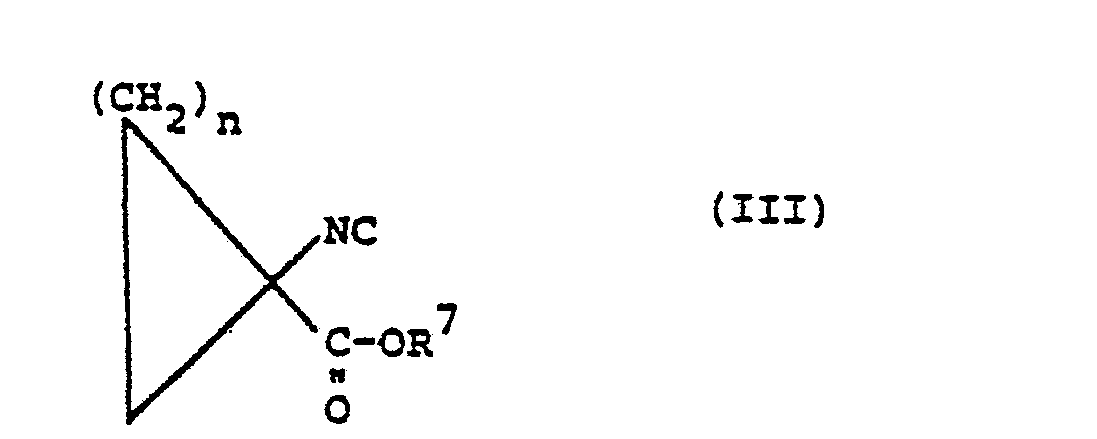
- R7 für Alkyl steht und
- n die oben angegebene Bedeutung hat,
unter schonenden Bedingungen, gegebenenfalls in Gegenwart eines zusätzlichen Verdünnungsmittels, mit Alkalihydroxiden umsetzt und die dabei entstehenden α-Isocyano-carbonsäure-Salze der Formel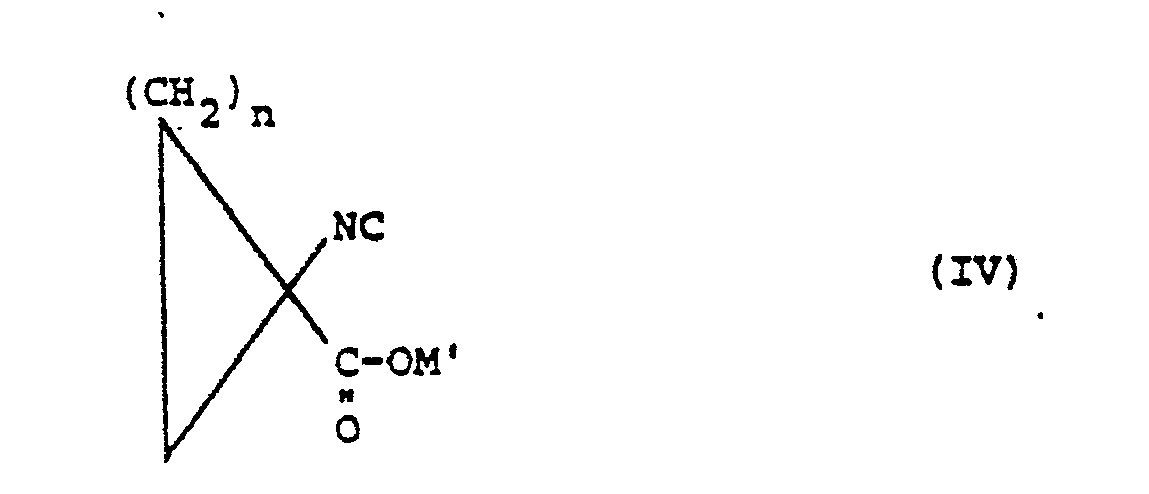
- M' für ein Alkalimetallion steht und
- n die oben angegebene Bedeutung hat,
durch Kochen mit wäßrigem Alkohol hydrolysiert,
diejenigen Cycloalkancarbonsäure-Derivate der Formel (Ia), in denen R für Formylamino steht und R 3 für OM steht, worin M für die angegebenen Reste, jedoch nicht für ein Alkalimetallion steht, indem man gemäß Verfahren (b) herstellbare dC-Formylamino-cycloalkancarbonsäure-Salze der Formel
M' und n die oben angegebene Bedeutung haben,
gegebenenfalls in Gegenwart eines Verdünnungsmittels mit einer äquivalenten Menge einer starken Säure behandelt und die dabei entstehenden α-Formylaminocycloalkancarbonsäuren der Formel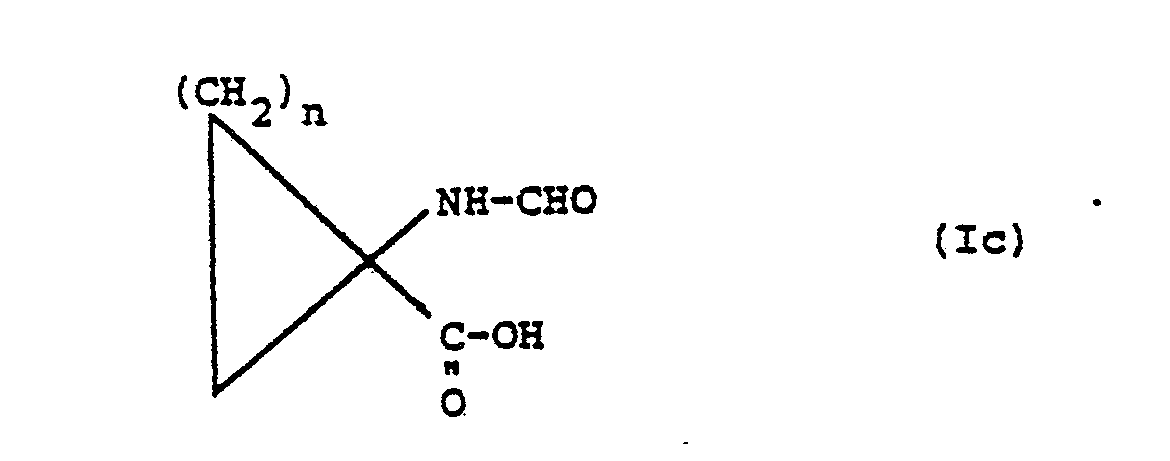
n die oben angegebene Bedeutung hat,
mit Verbindungen der Formel
M" für ein Äquivalent eines Erdalkalimetall-Ions, für Ammonium, Mono-, Di-, Tri- oder Tetra-alkyl-ammonium steht und
R8 für Wasserstoff, Methyl oder Äthyl steht,
gegebenenfalls in Gegenwart eines Verdünnungsmittels umsetzt, - d) diejenigen Cycloalkancarbonsäure-Derivate der Formel (la), in denen R4 für Formylamino steht und R3 für Amino, Alkylamino oder Dialkylamino steht, indem man gemäß Verfahren (b) herstellbare α-Isocyano-casbonsäure-Salze der Formel

M' und n die oben angegebene Bedeutung haben,
mit Verbindungen der Formel
R9 und R10 gleich oder verschieden sind und für Wasserstoff oder Alkyl stehen,
in Gegenwart von Salzsäure sowie gegebenenfalls in Gegenwart eines Verdünnungsmittels umsetzt, - e) diejenigen Verbindungen der Formel (Ia), in denen R3 für Alkoxy oder Aralkoxy steht und R4 für den Rest -H3X⊖ steht, wobei X⊖ für Jodid, Bromid und, - sofern R 3 nicht für Ethoxy steht -, auch für Chlorid steht, indem man gemäß Verfahren (a) herstellbare α-Formylaminocycloalkancarbonsäure-Derivate der Formel

R11 für Alkyl oder Aralkyl steht und
n die oben angegebene Bedeutung hat,
mit Verbindungen der Formel
X⊖ die oben angegebene Bedeutung hat,
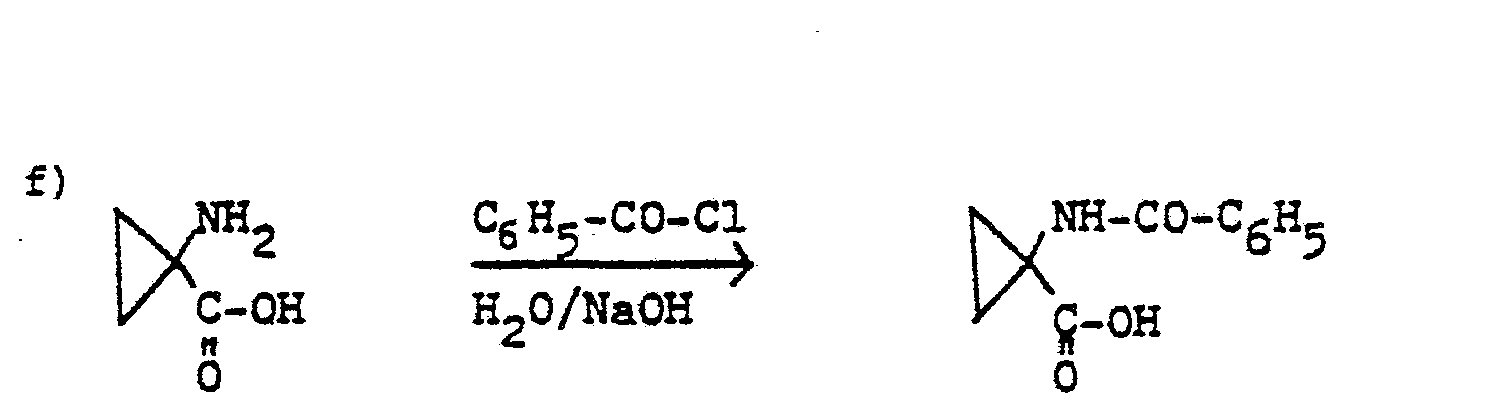
gegebenenfalls in Gegenwart eines Verdünnungsmittels umsetzt, - f) diejenigen Cycloalkancarbonsäure-Derivate der Formel (Ia), in denen R4 für den Rest -NH-CO-R5 steht, indem man α-Aminocycloalkancarbonsäure-Derivate der Formel
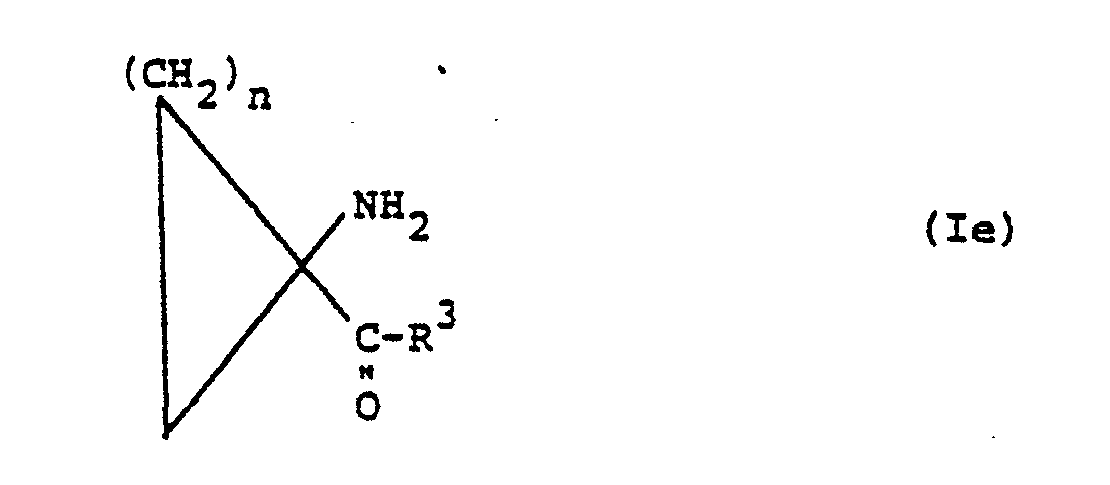
R 3 und n die oben angegebene Bedeutung haben,
mit Acylierungsmitteln der Formel
R12 für Wasserstoff, Alkyl oder Aryl steht und
Y für Chlor oder für den Rest -C-CO-R12 steht, in welchem R12 die vorgenannte Bedeutung hat,
in Gegenwart eines Säureakzeptors sowie gegebenenfalls in Gegenwart eines Verdünnungsmittels umsetzt, - g) diejenigen Cycloalkancarbonsäure-Derivate der Formel (Ia), in denen R4 für Amino steht, indem man α-Aminocycloalkancarbonsäure-chloride der Formel

n die oben angegebene Bedeutung hat,
mit Verbindungen der Formel
R3 die oben angegebene Bedeutung hat,
gegebenenfalls in Gegenwart eines Säurebindemittels sowie gegebenenfalls in Gegenwart eines Verdünnungsmittels umsetzt. - Bevorzugte neue Cycloalkancarbonsäure-Derivate sind solche Verbindungen der Formel (Ia), in denen
- R3 für Alkoxy mit 1 bis 20, insbesondere 1 bis 10 Kohlenstoffatomen im Alkylrest, Benzyloxy, Amino, . Alkylamino mit 1 bis 4, insbesondere 1 oder 2 Kohlenstoffatomen, Dialkylamino mit 1 bis 4, insbesondere 1 oder 2 Kohlenstoffatomen je Alkylrest oder für den Rest

- R 4 für Amino oder den Rest

und - R 4 weiterhin für -NH3 Cl⊖ steht, sofern R3 nicht für Ethoxy steht.
- Verwendet man beispielsweise bei Verfahren (a) α-Isocyanocyclopropancarbonsäure-methylester und wäßrig-alkoholische Salzsäure, bei Verfahren (b) α-Isocyano-cyclopropancarbonsäure-methylester und Natriumhydroxid in Äthanol, bei Verfahren (c) in der ersten Stufe α-Formylamino-cyclopropancarbonsäure-Natriumsalz und konzentrierte Salzsäure und in der zweiten Stufe eine wäßrig alkoholische Calciumhydroxid-Lösung, bei Verfahren (d) α-Isocyano-cyclopropancarbonsäure-Natriumsalz und konzentrierten Ammoniak in Kombination mit konzentrierter Salzsäure, bei Verfahren (e) α-Formylamino-cyclopropancarbonsäure-methylester und verdünnte Salzsäure, bei Verfahren (f) of-Amino-cyclopropancarbonsäure und Benzoylchlorid und bei Verfahren (g) α-Aminocyclopropancarbonsäure-chlorid und Diethylamin als Reaktionspartner, so können die Umsetzungen nach den Verfahren (a) bis (g) durch die folgenden Formelschemata wiedergegeben werden:



- Die bei den erfindungsgemäßen Verfahren (a) und (b) als Ausgangsstoffe zu verwendenden α-Isocyano-cycloalkan- carbonsäure-Derivate sind durch die Formeln (II) und (III) allgemein definiert. In der Formel (II) steht R 6 vorzugsweise für Alkoxy mit 1 bzw. mit 3 bis 20 insbesondere 3-10 Kohlenstoffatomen, Benzyloxy, Amino, Alkylamino mit 1 bis 4, insbesondere 1 oder 2 Kohlenstoffatomen, Dialkylamino mit 1 bis 4, insbesondere 1 oder 2 Kohlenstoffatomen je Alkylrest, oder für den Rest O⊖M⊕, wobei M für ein Natrium-oder
- Kaliumion, ein Magnesium- oder Calciumionenäquivalent, Ammonium, Alkylammonium mit 1 bis 4, insbesondere 1 oder 2 Kohlenstoffatomen, Dialkylammonium, Trialkylammonium oder Tetraalkylammonium mit jeweils 1 bis 4, insbesondere 1 oder 2 Kohlenstoffatomen je Alkylrest steht. R steht in der Formel (III) vorzugsweise für Alkyl mit 1 bis 13 Kohlenstoffatomen, insbesondere für Methyl oder Äthyl. In den Formeln (II) und (III) steht n jeweils vorzugsweise für oder 2.
- Die α-Isocyano-cycloalkancarbonsäure-Derivate der Formeln (II) und (III) sind bereits bekannt oder lassen sich nach im Prinzip bekannten Verfahren herstellen (vgl. DT-OS 2 063 502; Angew. Chem. 83, (1971), 357-358; Chem. Ber. 108 (1975), 1580-1592 und Liebigs Ann. Chem. 1973, 611-618).
- Die bei den erfindungsgemäßen Verfahren (c) bis (g) als Reaktionskomponenten zu verwendenden Verbindungen sind durch die Formeln (V), (VI), (VII), (VIII) und (X) allgemein definiert. In der Formel (V) steht M" vorzugsweise für diejenigen Reste, die bereits im Zusammenhang mit der Beschreibung der α-Isocyano-cycloalkancarbonsäure-Derivate der Formel (II) vorzugsweise für M genannt wurden, jedoch nicht für Natrium und Kalium. In der Formel (VI) stehen R9 und R10 unabhängig voneinander vorzugsweise für Wasserstoff und Alkyl mit 1 bis 4, insbesondere 1 oder 2 Kohenstoffatomen. In der Formel (VII) steht X vorzugsweise für Chlor. In der Formel (VIII) steht R12 vorzugsweise für Wasserstoff, Alkyl mit 1 bis 4 Kohlenstoffatomen oder für Phenyl. In der Formel (X) steht R3 vorzugsweise für diejenigen Reste, die bereits im Zusammen
hang mit der Beschreibung der erfindungsgemäßen Verbindung der Formel (Ia) vorzugsweise für R genannt wurden. - Die Verbindungen der Formeln (V), (VI), (VII), (VIII) und (X) sind bereits bekannt. - Die bei dem erfindungsgemäßen Verfahren (f) als Ausgangsstoffe zu verwendenden α-Amino-cycloalkancarbonsäure-Derivate sind durch die Formel (le) allgemein definiert. In dieser Formel steht R3 vorzugsweise für diejenigen Reste, die bereits im Zusammenhang mit der Beschreibung der erfindungsgemäßen Verbindungen der Formel (Ia) vorzugsweise für R3 genannt wurden. Die Verbindungen der Formel (le) lassen sich nach dem erfindungsgemäßen Verfahren (g) herstellen.
- Die bei dem erfindungsgemäßen Verfahren (g) als Ausgangsstoffe zu verwendenden α-Amino-cycloalkancarbonsäurechloride sind durch die Formel (IX) definiert. Die Verbindungen der Formel (IX) sind bislang noch nicht bekannt, sie lassen sich jedoch herstellen, indem man die entsprechenden Säuren nach üblichen Methoden, z.B. mit Thionylchlorid, in die Säurechloride überführt. Die benötigten α-Amino-cycloalkancarbonsäuren, die den Verbindungen der Formel (IX) zugrunde liegen, sind bekannt oder lassen sich nach bekannten Methoden herstellen (vgl. J. Org. Chem. 29 (1964), 2764-2766; Synthesis 1978, 46; J. Chem. Soc. 1960, 2119-2132 und 1962, 3977-3980).
- Beim Herstellungsverfahren (a) arbeitet man im allgemeinen in wässriger Lösung, oder in einem Verdünnungsmittel, welches Wasser und ein organisches Lösungsmittel enthält, wie z.B. Alkohol, Dioxan oder Tetrahydrofuran. Die Reaktion kann unter Säurekatalyse, beispielsweise mit Salzsäure als Katalysator durchgeführt werden. Die Reaktionstemperatur kann innerhalb eines größeren Bereichs variiert werden. Im allgemeinen arbeitet man bei Temperaturen zwischen 0 und loo°C, bei Verwendung eines Katalysators vorzugsweise bei lo bis 40°C, sonst bevorzugt bei 6o bis 9o°C.
- Die Isolierung der Reaktionsprodukte erfolgt beim Verfahren (a) nach üblichen Methoden:
- Man extrahiert mit einem mit Wasser nicht mischbaren Lösungsmittel, z.B. mit Methylenchlorid, trocknet die organische Phase, filtriert und destilliert das Lösungsmittel im Vakuum ab. Die zurückbleibenden Rohprodukte können durch Destillation oder gegebenenfalls durch Umkristallisation gereinigt werden.
- Verfahren (b) wird im allgemeinen unter Verwendung eines oder mehrerer organischer Lösungsmittel durchgeführt. Als solche kommen insbesondere in Betracht: Äther wie Ditähyläther, Dibutyläther, Tetrahydrofuran und Dioxan, Ketone wie Aceton, Methyläthylketon, Methylisopropylketon und Methylisobutylketon, Nitrile wie Acetonitril und Propionitril und Alkohole wie Methanol, Äthanol und Propanol. Die Umsetzung wird im allgemeinen bei Temperaturen zwischen o und loooC, in ersten Reaktionsschritt vorzugsweise bei 5 bis 25°C, in der zweiten Stufe vorzugsweise bei 25 bis 9o°C durchgeführt.
- Das Verfahren kann in zwei isolierten Reaktionsschritten oder als ein "Ein-Topf-Verfahren" durchgeführt werden. Im allgemeinen wird das als Ausgangsstoff einzusetzende α-Isocyano-cycloalkancarbonsäure-derivat in einem der angegebenen Lösungsmittel dipergiert und mit alkoholischer Alkalihydroxidlösung, welche 1 bis 1,2 Mol Hydroxid je Mol Carbonsäurederivat enthält, versetzt. Die zunächst entstehenden α-Isocyano-cycloalkancarbonsaure-salze kristallisieren im allgemeinen bei längerem Rühren aus und können durch Absaugen isoliert werden. Die weitere Umwandlung dieser Intermediate erfolgt im allgemeinen durch Kochen mit wässrigem Alkohol, welcher 1 bis 1,2 Mol Wasser je Mol α-Isocyano-cycloalkancarbonsäure-salz enthält. Die Aufarbeitung erfolgt beispielsweise durch Versetzen der abgekühlten Reaktionsmischung mit Äther und Absaugen des dabei auskristallisierten α-Formylamino-cycloalkancarbansäure-salzes.
- Zur Durchführung von Verfahren (c) werden-im allgemeinen die einzusetzenden α-Formylamino-cycloalkan- carbonsäure-salze in Wasser gelöst und mit der äquimolaren Mengen konzentrierter Salzsäure versetzt. Die Umsetzung wird bei Temperaturen zwischen 0 und 30°C durchgeführt. Die Produkte, welche nach längerem Stehen der Reaktionsgemische auskristallisieren, können durch Absaugen isoliert werden. -Bei der Durchführung der zweiten Stufe des Verfahrens (c) werden im allgemeinen Alkohole, insbesondere Methanol und Äthanol, als Lösungsmittel verwendet. Auf 1 Mol α-Formylamino-cycloalkancarbonsäure setzt man 1 Mol einer Base der Formel (V) ein. Die Umsetzung erfolgt bei Temperaturen zwischen 10 und 40°C. Nach kurzem Rühren der Reaktionsmischung wird das Lösungsmittel im Vakuum abdestilliert, der Rückstand mit Äther verrieben, abgesaugt und getrocknet.
- Zur Durchführung von Verfahren (d) werden im allgemeinen bis zu 3 Mol Ammoniak oder Amin der Formel (VI) und 1 Mol Salzsäure je Mol α-Isocyano-cycloalkancarbonsäurederivat eingesetzt. Die Umsetzung wird im allgemeinen unter Verwendung von Wasser als Lösungsmittel bei Temperaturen zwischen 0 und 400C durchgeführt. Nach mehrstündigem Rühren des Reaktionsgemisches werden flüchtige Komponenten und Lösungsmittel im Vakuum abdestilliert. Das zurückbleibende Rohprodukt arbeitet man nach üblichen Methoden auf, z.B. durch Extraktion mit Methylenchlorid, Trocknen, Filtration und Einengen des Filtrats.
- Verfahren (e) wird gewöhnlich unter Verwendung von wäßriger Salzsäure als Reaktionsmedium durchgeführt. Im allgemeinen werden darin die als Ausgangsstoffe einzusetzenden oC-Formylamino-cycloalkancarbonsäure-derivate einige Tage bei Raumtemperatur gerührt oder mehrere Stunden unter Rückfluß zum Sieden erhitzt. Dann wird im Vakuum zur Trockne eingedampft 5 und die zurückbleibenden kristallinen Produkte werden über Phosphorpentoxid im Exsikkator getrocknet.
- Bei Verfahren (f) wird im allgemeinen Wasser als Lösungsmittel verwendet. Auf 1 Mol cC-Amino-cycloalkan- carbonsäure-derivat werden 1 bis 1,2 Mol Acylierungsmittel und 2 bis 2,5 Mol Säureakzeptor eingesetzt. Als Acylierungsmittel werden vorzugsweise verwendet: Acetanhydrid, Acetylchlorid, Propionsäureanhydrid, Propionylchlorid und Benzoylchlorid.
- Als Säureakzeptoren werden vorzugsweise verwendet: Alkalihydroxide wie Natrium- und Kaliumhydroxid oder Alkalicarbonate und -hydrogencarbonate wie Natriumcarbonat und Natriumhydrogencarbonat.
- Die Umsetzung nach Verfahren (f) wird bei Temperaturen zwischen 10 und 40°C durchgeführt. Nach kurzem Rühren der Reaktionsmischung wird mit einer starken Säure, wie z.B. Salzsäure, pH 1 eingestellt. Die dabei kristallin anfallenden Produkte können durch Absaugen isoliert und durch Umkristallisation gereinigt werden.
- Bei dem erfindungsgemäßen Verfahren (g) kommen als Verdünnungsmittel Wasser und inerte organische Lösungsmittel
- in Betracht. In vielen Fällen kann jedoch auch im Überschuß eingesetzte Komponente (X) als Verdünnungsmittel fungieren.
- Als Säurebindemittel kommen bei dem erfindungsgemäßen Verfahren (g) alle üblichen Säureakzeptoren in Betracht. Zweckmäßigerweise fungiert die im Überschuß eingesetzte Reaktionskomponente der Formel (X) jedoch als Säurebindemittel.
- Die Reaktionstemperaturen können bei dem erfindungsgemäßen Verfahren innerhalb eines größeren Bereiches variiert werden. Im allgemeinen arbeitet man bei Temperaturen zwischen 0°C und 40 °C, vorzugsweise zwischen 10 °C und 25 °C.
- Bei der Durchführung des erfindungsgemäßen Verfahrens (g) setzt man auf 1 Mol an α-Amino-cycloalkancarbonsäurechlorid der Formel (IX) etwa 1 bis 2 Mol einer Verbindung der Formel (X) sowie gegebenenfalls 1 Mol Säurebindemittel ein. Die Aufarbeitung erfolgt nach üblichen Methoden.
- Die erfindungsgemäß verwendbaren Wirkstoffe greifen in den Metabolismus der Pflanzen ein und können deshalb, als Wachstumsregulatoren eingesetzt werden.
- Für die Wirkungsweise von Pflanzenwachstumsregulatoren gilt nach der bisherigen Erfahrung, daß ein Wirkstoff eine oder auch mehrere verschiedenartige Wirkungen auf Pflanzen ausüben kann. Die Wirkungen der Stoffe hängen im wesentlichen ab von dem Zeitpunkt der Anwendung, bezogen auf das Entwicklungsstadium des Samens oder der Pflanze sowie von den auf die Pflanzen oder ihre Umgebung ausgebrachten Wirkstoffmengen und von der Art der Applikation. In jedem Fall sollen Wachstumsregulatoren die Kulturpflanzen in gewünschter Weise positiv beeinflussen.
- Pflanzenwuchsregulierende Stoffe können zum Beispiel zur Hemmung des vegetativen Pflanzenwachstums eingesetzt werden. Eine derartige Wuchshemmung ist unter anderem bei Gräsern von wirtschaftlichem Interesse, denn durch eine Dämpfung des Graswachstums kann z.B. die Häufigkeit der Grasschnitte in Ziergärten, Park-und Sportanlagen oder an Straßenrändern reduziert werden. Von Bedeutung ist auch die Hemmung des Wuchses von krautigen und holzigen Pflanzen an Straßenrändern und in der Nähe von Uberlandleitungen oder ganz allgemein in Bereichen, in denen ein starker Bewuchs unerwünscht ist.
- Wichtig ist auch die Anwendung von Wachstumsregulatoren zur Hemmung des Längenwachstums bei Getreide, denn durch eine Halmverkürzung wird die Gefahr des Umknickens ("Lagerns") der Pflanzen vor der Ernte verringert oder vollkommen beseitigt. Außerdem können Wachstumsregulatoren bei Getreide eine Halmverstärkung hervorrufen, die ebenfalls dem Lagern entgegenwirkt.
- Eine Hemmung des vegetativen Wachstums erlaubt bei vielen Kulturpflanzen eine dichtere Anpflanzung der Kultur, so daß Mehrertrag bezogen auf die Bodenfläche erzielt werden kann.
- Ein weiterer Mechanismus der Ertragssteigerung mit Wuchshemmern beruht darauf, daß die Nährstoffe in stärkerem Maße der Blüten-und Fruchtbildung zugute kommen, während das vegetative Wachstum eingeschränkt wird.
- Mit Wachstumsregulatoren läßt sich häufig auch eine Förderung des vegetativen Wachstums erzielen. Dies ist von großem Nutzen, wenn die vegetativen Pflanzenteile geerntet werden. Eine Förderung des vegetativen Wachstums kann aber auch gleichzeitig zu einer Förderung des generativen Wachstums führen, so daß z.B. mehr oder größere Früchte zur Ausbildung kommen.
- Ertragssteigerungen können in manchen Fällen auch durch einen Eingriff in den pflanzlichen Stoffwechsel erreicht werden, ohne daß sich Änderungen des vegetativen Wachstums bemerkbar machen. Wachstumsregulatoren können ferner eine Veränderung der Zusammensetzung der Pflanzen bewirken; um so eine bessere Qualität der Ernteprodukte herbeizuführen. So ist es beispielsweise möglich, den Gehalt an Zucker in Zuckerrüben, Zuckerrohr, Ananas sowie Zitrusfrüchten zu erhöhen oder den Proteingehalt in Soja oder Getreide zu steigern.
- Unter dem Einfluß von Wachstumsregulatoren kann es zur Ausbildung parthenokarper Früchte kommen. Ferner kann das Geschlecht der Blüten beeinflußt werden.
- Mit Wachstumsregulatoren läßt sich auch die Produktion oder der Abfluß von sekundären Pflanzenstoffen positiv beeinflussen. Als Beispiel sei die Stimulierung des Latexflusses bei Gummibäumen genannt.
- Während des Wachstums der Pflanze kann durch Einsatz von Wachstumsregulatoren auch die seitliche Verzweigung durch eine chemische Brechung der Apikaldominanz vermehrt werden. Daran besteht ) z.B. Interesse bei der Stecklingsvermehrung von Pflanzen. Es ist jedoch auch möglich, das Wachstum der Seitentriebe zu hemmen, z.B. um bei Tabakpflanzen nach der Dekapitierung die Ausbildung von Seitentrieben zu verhindern und damit das Blattwachstum zu fördern.
- (Inter dem Einfluß von Wachstumsregulatoren kann der Blattbestand von Pflanzen so gesteuert werden, daß ein Entblättern der.Pflanzen zu einem gewünschten Zeitpunkt erreicht wird. Eine derartige Entlaubung ist von Interesse, um eine mechanische Beerntung, z..B. bei Wein oder Baumwolle, zu erleichtern oder um die Transpiration zu einem Zeitpunkt herabzusetzen, an dem die Pflanze verpflanzt werden soll.
- Durch Einsatz von Wachstumsregulatoren läßt sich der vorzeitige Fruchtfall verhindern. Es ist jedoch auch möglich, den Fruchtfall, - zum Beispiel bei Obst -, im Sinne einer chemischen Ausdünnung bis zu einem bestimmten Ausmaß zu fördern. Wachstumsregulatoren können auch dazu dienen, um bei Kulturpflanzen zum Zeitpunkt der Ernte die zum Ablösen der Früchte erforderliche Kraft zu vermindern, so daß eine mechanische Beerntung der Pflanzen ermöglicht beziehungsweise eine manuelle Beerntung erleichtert wird.
- Mit Wachstumsregulatoren läßt sich ferner eine Beschleunigung oder auch eine Verzögerung der Reife des Erntegutes vor oder nach der Ernte erreichen. Dieses ist von besonderem Vorteil, weil sich dadurch eine optimale Anpassung an die Bedürfnisse des Marktes herbeiführen läßt. Weiterhin können Wachstumsregulatoren in manchen Fällen die Fruchtausfärbung verbessern. Darüberhinaus kann mit Hilfe von Wachstumsregulatoren auch eine zeitliche Konzentrierung der Reife erzielt werden. Damit werden die Voraussetzungen dafür geschaffen, daß z.B. bei Tabak, Tomaten oder Kaffee, eine vollständige mechanische oder manuelle Beerntung in nur einem Arbeitsgang vorgenommen werden kann. 1
- Durch Anwendung von Wachstumsregulatoren kann auch die Samen-oder Knospenruhe der Pflanzen, also die endogene Jahresrhythmik, beeinflußt werden, so daß die Pflanzen, wie z.B. Ananas oder Zierpflanzen in Gärtnereien, zu einem Zeitpunkt keimen, austreiben oder blühen, an dem sie normalerweise hierzu keine Bereitschaft zeigen.
- Mit Wachstumsregulatoren kann auch erreicht werden, daß der Austrieb von Knospen oder die Keimung von Samen verzögert wird, z.B. um in frostgefährdeten Gebieten eine Schädigung durch Spätfröste zu vermeiden.
- Wachstumsregulatoren können auch eine Halophilie bei Kulturpflanzen erzeugen. Damit werden die Voraussetzungen dafür geschaffen, daß eine Kultivierung von Pflanzen auf salzhaltigen Böden durchgeführt werden kann.
- Mit Wachstumsregulatoren kann auch eine Frost- und Trockenresistenz bei Pflanzen induziert werden.
- Die Wirkstoffe können in die üblichen Formulierungen übergeführt werden, wie Lösungen, Emulsionen, Spritzpulver, Suspensionen, Pulver, Stäubemittel, Schäume, Pasten, lösliche Pulver, Granulate, Aerosole, Suspensions-Emulsionskonzentrate, Saatgutpuder, Wirkstoff-imprägnierte Natur- und synthetische Stoffe und Feinstverkapselungen in polymeren Stoffen und in Hüllmassen für Saatgut, sowie ULV-Kalt-und Warmnebel-Formulierungen.
- Diese Formulierungen werden in bekannter Weise hergestellt, z.B. durch Vermischen der Wirkstoffe mit Streckmitteln, also flüssigen Lösungsmitteln, unter Druck stehenden verflüssigten Gasen und/oder festen Trägerstoffen, gegebenenfalls unter Verwendung von oberflächenaktiven Mitteln, also Emulgiermitteln und/oder Dispergiermitteln und/oder schaumerzeugenden Mitteln. Im Falle der Benutzung von Wasser als Streckmittel können z.B. auch organische Lösungsmittel als Hilfslösungsmittel verwendet werden. Als flüssige Lösungsmittel kommen im wesentlichen in Frage: Aromaten, wie Xylol, Toluol, oder Alkylnaphthaline, chlorierte Aromaten oder chlorierte aliphatische Kohlenwasserstoffe, wie Chlorbenzole, Chloräthylene oder Methylenchlorid, aliphatische Kohlenwasserstoffe, wie Cyclohexan oder Paraffine, z.B. Erdölfraktionen, Alkohole, wie Butanol oder Glycol sowie deren Äther und Ester, Ketone, wie Aceton, Methyläthylketon, Methylisobutylketon oder Cyclohexanon, stark polare Lösungsmittel, wie Dimethylformamid und Dimethylsulfoxid, sowie Wasser; mit verflüssigten gasförmigen Streckmitteln oder Trägerstoffen sind solche Flüssigkeiten gemeint, welche bei normaler Temperatur und unter Normaldruck gasförmig sind, z.B. Aerosol-Treibgas, wie Halogenkohlenwasserstoffe sowie Butan, Propan., Stickstoff und Kohlendioxid; als feste Trägerstoffe kommen in Frage: z.B. natürliche Gesteinsmehle, wie Kaoline, Tonerden, Talkum, Kreide, Quarz, Attapulgit, Montmorillonit oder Diatomeenerde und synthetische Gesteinsmehle, wie hochdisperse Kieselsäure, Aluminiumoxid und Silikate; als feste Trägerstoffe für Granulate kommen in Frage: z.B. gebrochene und fraktionierte natürliche Gesteine wie.Calcit, Marmor, Bims, Sep.iolith, Dolomit sowie synthetische Granulate aus anorganischen und organischen Mehlen sowie Granulate aus organischem Material wie Sägemehl, Kokosnußschalen, Maiskolben und Tabakstengel; als Emulgier- und/oder schaumerzeugende Mittel kommen in Frage: z.B. nichtionogene und anionische Emulgatoren, wie Polyoxyäthylen-FettsäureEster, Polyoxyäthylen-Fettalkohol-Äther, z.B. Alkylarylpolyglykol-äther, Alkylsulfonate, Alkylsulfate, Arylsulfonate sowie Eiweißhydrolysate; als Dispergiermittel kommen in Frage: z.B. Lignin-Sulfitablaugen und Methylcellulose.
- Es können in den Formulierungen Haftmittel wie Carboxymethylcellulose, natürliche und synthetische pulverige, körnige oder latexförmige Polymere verwendet werden, wie Gummiarabicum, Polyvinylalkohol, Polyvinylacetat.
- Es können Farbstoffe wie anorganische Pigmente, z.B. Eisenoxid, Titanoxid, Ferrocyanblau und organische Farbstoffe, wie Alizarin-, Azol-Metallphthalocyaninfarbstoffe und Spurennährstoffe wie Salze von Eisen, Mangan, Bor, Kupfer, Kobalt, Molybdän und Zink verwendet werden.
- Die Formulierungen enthalten im allgemeinen zwischen 0,1 und 95 Gewichtsprozent Wirkstoff, vorzugsweise zwischen 0,5 und 90 %.
- Die erfindungsgemäßen Wirkstoffe können in den Formulierungen in Mischung mit anderen bekannten Wirkstoffen vorliegen, wie Fungizide, Insektizide; Akarizide und Herbizide, sowie in Mischungen mit Düngemitteln und anderen Wachstumsregulatoren.
- Die Wirkstoffe können als solche, in Form ihrer Formulierungen oder der daraus bereiteten Anwendungsformen, wie gebrauchsfertige Lösungen, emulgierbare Konzentrate, Emulsionen, Schäume, Suspensionen, Spritzpulver, Pasten, lösliche Pulver, Stäubemittel und Granulate, angewendet werden. Die Anwendung geschieht in üblicher Weise, z.B. durch Gießen, Verspritzen, Versprühen, Verstreuen, Verstäuben, Verschäumen, Begasen usw. Es ist ferner möglich, die Wirkstoffe nach dem Ultra-Low-Volume-Verfahren auszubringen, Pflanzen oder Pflanzenteile mit der wirkstoffzubereitung oder dem Wirkstoff selbst zu bestreichen oder die Wirkstoffzubereitung oder den Wirkstoff selbst in den Boden zu injizieren. Es kann auch das Saatgut der Pflanze behandelt werden.
- Die Wirkstoffkonzentrationen können in einem größeren Bereich variiert werden. Im allgemeinen verwendet man pro Hektar Bodenfläche 0,01 bis 50 kg, bevorzugt 0,05 bis 10 kg an Wirkstoff.
- Für die Anwendungszeit gilt, daß die Anwendung der Wachstumsregulatoren in einem bevorzugten Zeitraum vorgenommen wird, dessen genaue Abgrenzung sich nach dem klimatischen und vegetativen Gegebenheiten richtet.
- In den nachfolgenden Beispielen wird die Aktivität der erfindungsgemäßen Stoffe als Wachstumsregulatoren dargestellt, ohne damit die Möglichkeit weiterer Anwendungen als Wachstumsregulatoren auszuschließen.
- Lösungsmittel: 30 Gewichtsteile Dimethylformamid 1 Gewichtsteil Polyoxyäthylensorbitan-Monolaurat
- Zur Herstellung einer zweckmäßigen Wirkstoffzubereitung vermischt man 1 Gewichsteil Wirkstoff mit den angegebenen Mengen Lösungsmittel und Emulgator und füllt mit Wasser auf die gewünschte Konzentration auf.
- Tabakpflanzen werden im Gewächshaus bis zur Entfaltung des 7. Laubblattes angezogen. In diesem Stadium wird die apikale Vegetationsspitze der Pflanzen entfernt und die Pflanzen werden bis zum Abtropfen mit den Wirkstoffzubereitungen besprüht. Nach 3 Wochen werden die Seitentriebe der Pflanzen herausgebrochen und gewogen. Das Gewicht der Seitentriebe der behandelten Pflanzen wird mit dem der Kontrollpflanzen verglichen. 100 % Hemmung bedeutet das Fehlen von Seitentrieben und O % ein Wachstum der Seitentriebe entsprechend dem der Kontrollpflanzen.
- Wirkstoffe, Wirkstoffkonzentrationen und Resultate gehen aus der nachfolgenden Tabelle hervor.
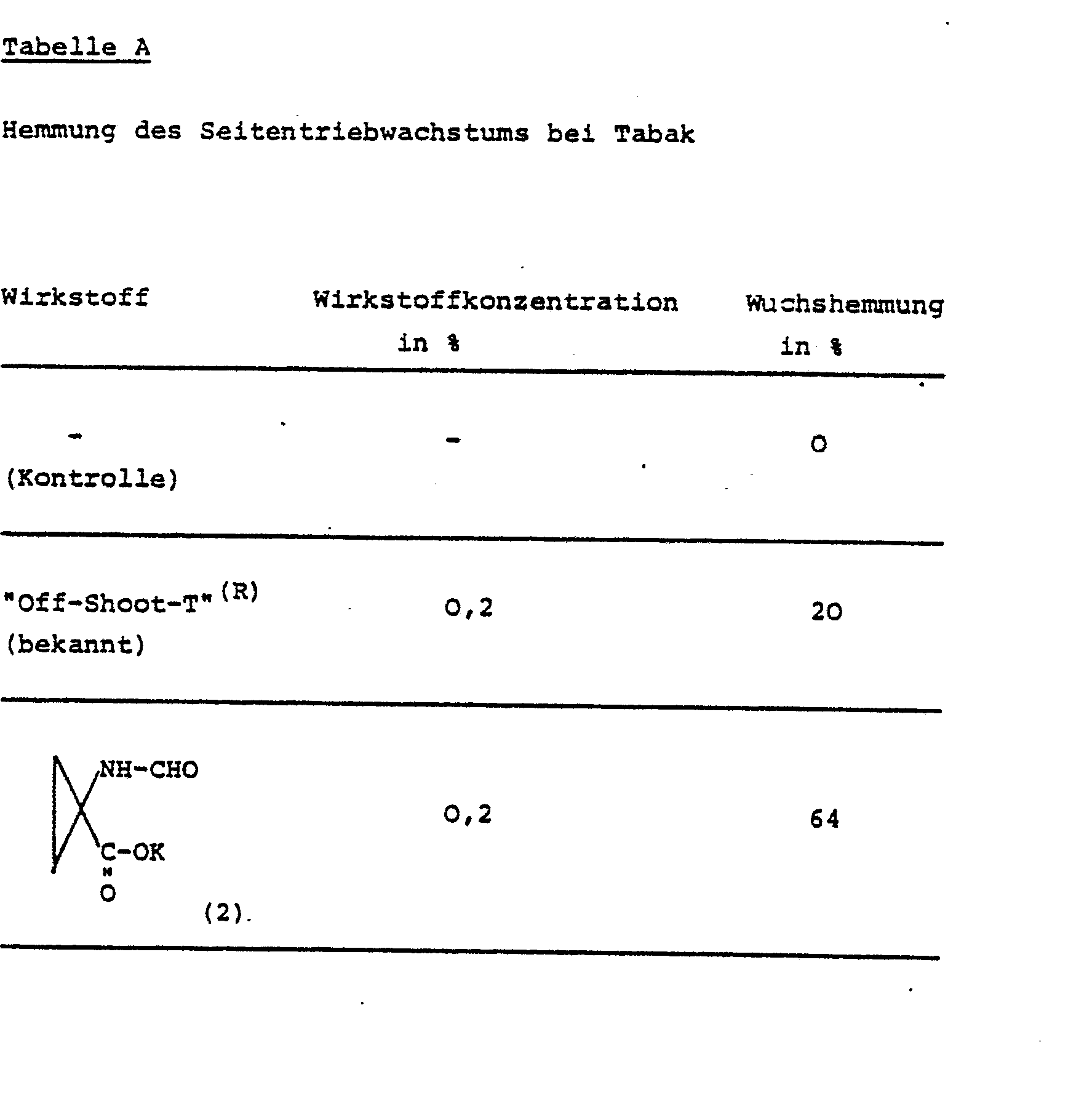
-

- Gerstepflanzen werden im Gewächshaus bis zum 2-BlattStadium angezogen. In diesem Stadium werden die Pflanzen tropfnaß mit den Wirkstoffzubereitungen besprüht. Nach 3 Wochen wird bei allen Pflanzen der Zuwachs gemessen und die Wuchshemmung in % des Zuwachses der Kontrollpflanzen berechnet. Es bedeuten 100 % den Stillstand des Wachstums und 0 % ein Wachstum entsprechend dem der Kontrollpflanzen.
- Wirkstoffe, Wirkstoffkonzentrationen und Resultate gehen aus der nachfolgenden Tabelle hervor.
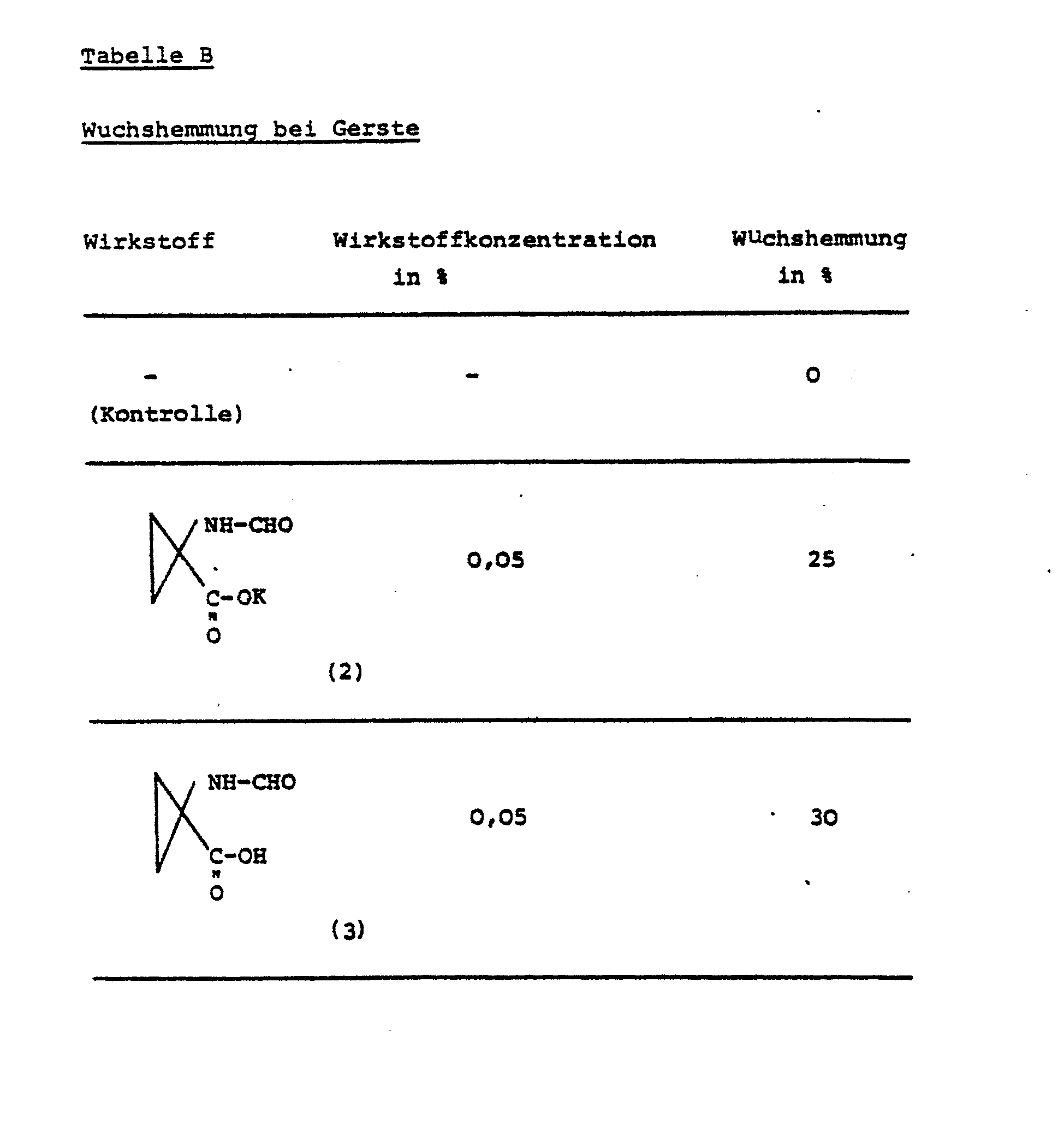
-

- Weizenpflanzen werden im Gewächshaus bis zum 2-BlattStadium angezogen. In diesem Stadium werden die Pflanzen tropfnaß mit den Wirkstoffzubereitungen besprüht. Nach 3 Wochen wird bei allen Pflanzen der Zuwachs gemessen und die Wuchshemmung in % des Zuwachses der Kontrollpflanzen berechnet. Es bedeuten 100 % den Stillstand des Wachstums und 0 % ein Wachstum entsprechend dem der Kontrollpflanzen.
- Wirkstoffe, Wirkstoffkonzentrationen und Resultate gehen aus der nachfolgenden Tabelle hervor.

-

- Sojabohnenpflanzen werden im Gewächshaus bis zur vollen Entfaltung des ersten Folgeblattes angezogen. In diesem Stadium werden die Pflanzen tropfnaß mit den Wirkstoffzubereitungen besprüht. Nach 3 Wochen wird bei allen Pflanzen der Zuwachs gemessen und die Wuchshemmung in % des Zuwachses der Kontrollpflanzen berechnet. Es bedeuten 10 % den Stillstand des Wachstums und O % ein Wachstum entsprechend dem der Kontrollpflanzen.
- Wirkstoffe, Wirkstoffkonzentrationen und Resultate gehen aus der nachfolgenden Tabelle hervor.

-

- Tomaten werden im Gewächshaus in üblicher Weise angezogen, bis etwa 30 % der Früchte reif sind. In diesem Stadium werden die Pflanzen bis zum Abtropfen mit den Wirkstoffzubereitungen besprüht. Nach verschiedenen Zeitintervallen wird die Anzahl der reifen Früchte bei den einzelnen Versuchsgliedern ermittelt und in Prozent der Gesamtzahl der Früchte des betreffenden Versuchsgliedes berechnet. Somit bedeutet 100 %, daß alle Früchte reif sind.
- Aus der nachfolgenden Tabelle gehen die Resultate dieses Versuches hervor.

-

- Aus Sojabohnenblättern werden Blattstücke gleicher Größe gestanzt. In Petrischalen, die mit 10 ml der Wirkstoffzubereitungen bzw. entsprechender Kontroll-lösungen ohne Wirkstoffe gefüllt sind, wird jeweils eine konstante Zahl Blattstücke 1 Stunde lang inkubiert. Anschließend werden die Blattstücke zusammen mit 1 ml der jeweiligen Wirkstoffzubereitung bzw. Kontrollösung in luftdicht abgeschlossene Gefäße gegeben. Nach 24 Stunden wird das Äthylen, das sich in den Gefäßen angesammelt hat, mit üblichen Nachweismethoden bestimmt. Die Äthylenentwicklung der mit Wirkstoffzubereitung behandelten Blattstücke wird mit der Äthylenentwicklung der Kontrollen verglichen.
- In der nachfolgenden Tabelle bedeuten:

- Dieser Test ist in besonderem Maße geeignet, die wachstumsregulierenden Eigenschaften der erfindungsgemäßen Verbindungen zu verdeutlichen.
- Das Pflanzenhormon Äthylen greift in zahlreiche Prozesse bei der Entwicklung der Pflanzen ein. Eine Erhöhung der Äthylenbiosynthese, wie sie mit den erfindungsgemäßen Substanzen erzielt werden kann, erlaubt es, diese Prozesse zu steuern. Als Beispiele, für die ein besonderes kommerzielles Interesse besteht, seien hier genannt: Fruchtablösung, Reifebeschleunigung von Früchten und Blättern, Blühinduktion, Samenkeimung, Fruchtausdünnung, Stimulation des Latexflusses z.B. bei Hevea, Geschlechtsbeeinflußung und Wuchshemmung z.B. auch um das Lagern von Getreide zu verhindern.
- Die Wirkstoffe und die Resultate gehen aus der nachfolgenden Tabelle hervor.


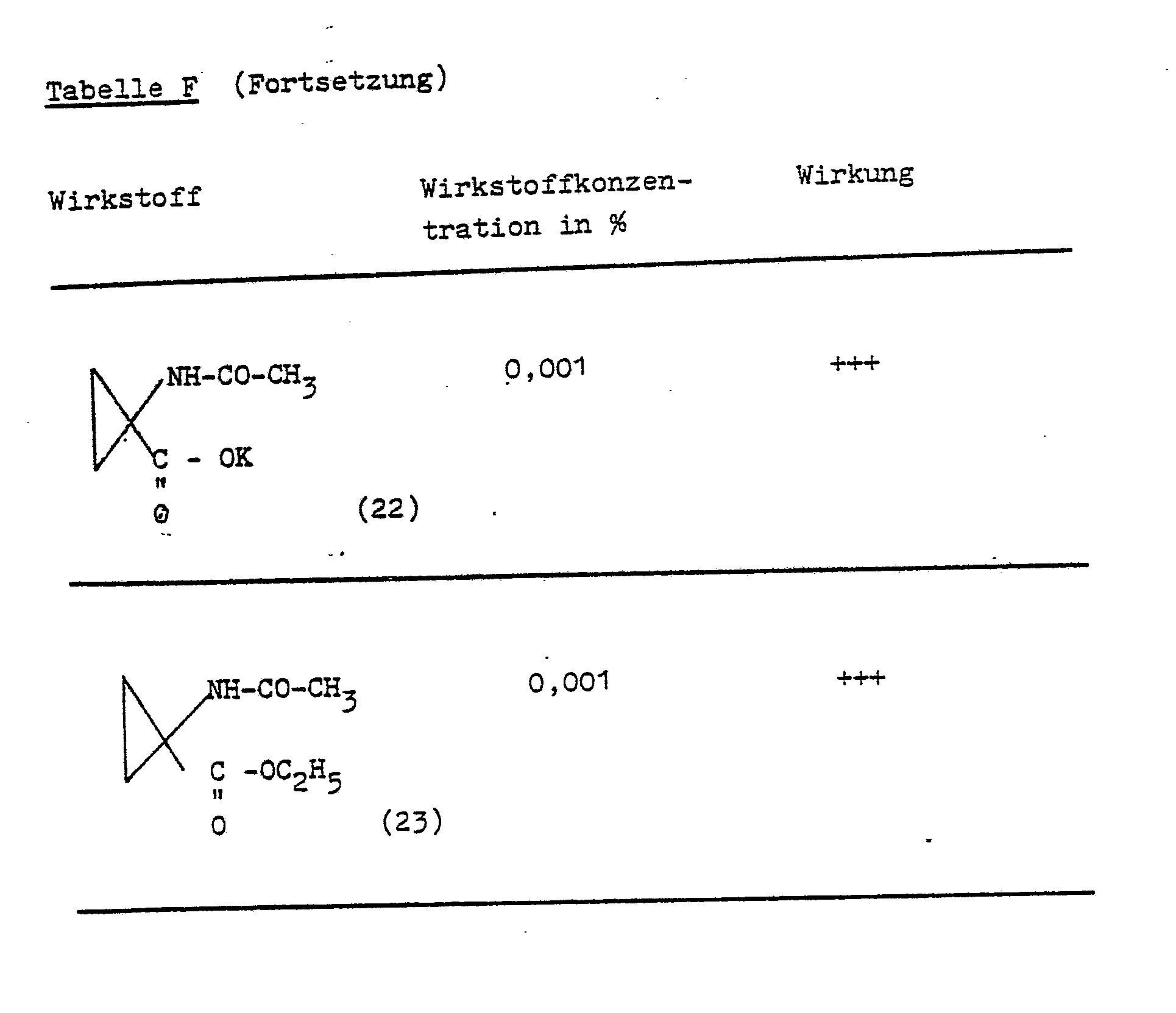
-

- Zu 4o ml Wasser werden bei 20°C nacheinander o,3 ml konzentrierte Salzsäure und eine Lösung von 5 g (o,o4 Mol) α-Isocyano-cyclopropancarbonsäure-methylester in lo ml Methanol gegeben. Die Reaktionsmischung wird 6 Stunden gerührt. Dann extrahiert man zweimal mit je 5o ml Methylenchlorid, trocknet die organische Phase Uber Magnesiumsulfat, filtriert dund destilliert das Lösungsmittel im Vakuum ab. Als Rückstand verbleiben in Form einer farblosen Flüssigkeit 4 g (7o% der Theorie) α-Formylamino-cyclopropancarbonsäure-methylester.
- Brechungsindex:


Schmelzpunkt: 225°C. - Eine Suspension von 9 g (0,06 Mol) α-Isocyano-cyclopropan-carbonsäure-Kaliumsalz in 50 ml Äthanol wird mit 1,18 g (0,066 Mol) Wasser versetzt. Die Mischung wird 12 Stunden unter Rückfluß zum Sieden erhitzt und nach dem Abkühlen bei 20°C mit 5o ml Äther versetzt. Nach Absaugen erhält man
7 g (70 % der Theorie) α-Formylaminocyclopropancarbonsäure-Kaliumsalz in Form weißer Kristalle. Schmelzpunkt: 186°C
Schmelzpunkt: 189°C.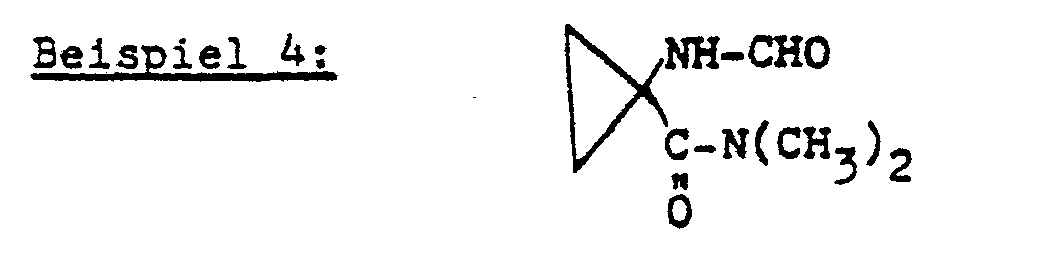
- Brechungsindex:


- Eine Mischung aus 19,4 g (0,15 Mol) α-Formylaminocyclopropan-carbonsäure und 200 ml 18%iger Salzsäure wird 3 Stunden unter Rückfluß zum Sieden erhitzt. Anschließend wird im Vakuum zur Trockne eingedampft und der zurückbleibende Feststoff über Phosphorpentoxid im Vakuumexsikkator getrocknet.
- Ausbeute: 18 g (92 % der Theorie)α-Amino-cyclopropancarbonsäure-hydrochlorid.
Schmelzpunkt: 232°C.
- Eine Mischung aus 2 g (0,02 Mol) α-Amino-cyclopropancarbonsäure, 25 ml Wasser und 2,55 g (o,o44 Mol) Kaliumhydroxid wird unter Rühren bei 20°C mit 3,1 g (o,o22 Mol) Benzoylchlorid versetzt. Nach 3ominütigem Rühren wird mit konzentrierter Salzsäure auf pH 1 angesäuert und abgesaugt. Zur Reinigung wird das Produkt mit 3o ml Wasser ausgekocht.
- Ausbeute: 2,1 g (51 % der Theorie) α-Benzoylaminocyclopropancarbonsäure.
- Schmelzpunkt 2o9°C.
- Analog einem der Beispiele 1 bis 7 können die in der nachstehenden Tabelle aufgeführten Verbindungen der Formel I


sehr gut zur Regulierung des Pflanzenwachstums geeignet sind.
Claims (6)

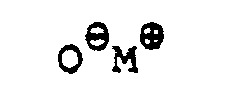


oder
und

R 6 für Alkoxy, - ausgenommen Ethoxy -, Aralkoxy, Amino, Alkylamino, Dialkylamino oder für den Rest

M⊕ für ein Alkali- oder Erdalkalimetallionen- äquivalent oder für ein Ammonium-, Alkylammonium-Dialkylammonium, Trialkylammonium- oder Tetraalkylammonium-ion steht,
und
n die oben angegebene Bedeutung hat,
gegebenenfalls in Gegenwart eines Katalysators und gegebenenfalls in Gegenwart eines zusätzlichen Verdünnungsmittels mit Wasser hydrolysiert,
α-Isocyano-cycloalkancarbonsäure-Derivate der Formel

R7 für Alkyl steht und
n die oben angegebene Bedeutung hat,
unter schonenden Bedingungen, gegebenenfalls in Gegenwart eines zusätzlichen Verdünnungsmittels, mit Alkalihydroxiden umsetzt und die dabei entstehenden α-Isocyano-carbonsäure-Salze der Formel

M' für ein Alkalimetallion steht und
n die oben angegebene Bedeutung hat,
durch Kochen mit wäßrigem Alkohol hydrolysiert,
gemäß Verfahren (b) herstellbare α-Formylamino-cycloalkancarbonsäure-Salze der Formel

M' und n die oben angegebene Bedeutung haben,
gegebenenfalls in Gegenwart eines Verdünnungsmittels mit einer äquivalenten Menge einer starken Säure behandelt und die dabei entstehenden α-Formylaminocycloalkancarbonsäuren der Formel

n die oben angegebene Bedeutung hat,
mit Verbindungen der Formel

M" für ein Äquivalent eines Erdalkalimetall-Ions, für Ammonium, Mono-, Di-, Tri- oder Tetra-alkyl-ammmonium steht und
R8 für Wasserstoff, Methyl oder Äthyl steht,
gegebenenfalls in Gegenwart eines Verdünnungsmittels umsetzt,
gemäß Verfahren (b) herstellbare α-Isocyano-carbonsäure-Salze der Formel

Mund n die oben angegebene Bedeutung haben, mit Verbindung der Formel

R9 und R10 gleich oder verschieden sind und für Wasserstoff oder Alkyl stehen,
in Gegenwart von Salzsäure sowie gegebenenfalls in Gegenwart eines Verdünnungsmittels umsetzt,
gemäß Verfahren (a) herstellbare α-Formylamino-cycloalkancarbonsäure-Derivate der Formel

R11 für Alkyl oder Aralkyl steht und
n die oben angegebene Bedeutung hat,
mit Verbindungen der Formel

X⊖ die oben angegebene Bedeutung hat,
gegebenenfalls in Gegenwart eines Verdünnungsmittels umsetzt, .
α-Aminocycloalkancarbonsäure-Derivate der Formel
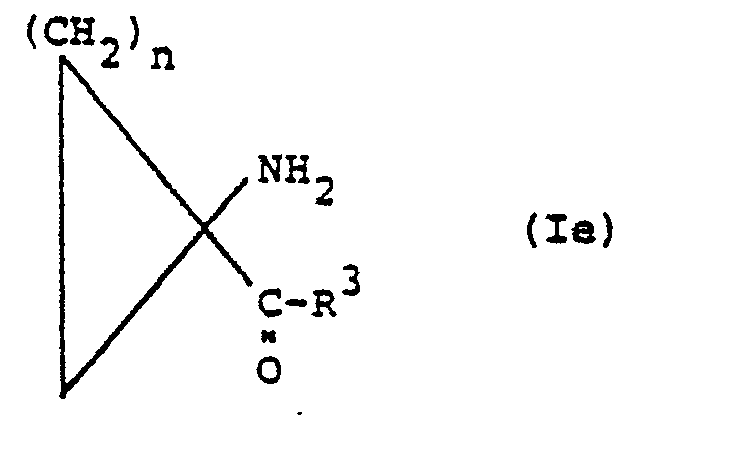
R3 und n die oben angegebene Bedeutung haben,
mit Acylierungsmitteln der Formel

R12 für Wasserstoff, Alkyl oder Aryl steht und
Y für Chlor oder für den Rest -O-CO-R12 steht, in welchem R12 die vorgenannte Bedeutung hat,
in Gegenwart eines Säureakzeptors sowie gegebenenfalls in Gegenwart eines Verdünnungsmittels umsetzt,
α-Amino-cycloalkancarbonsäure-chloride der Formel

n die oben angegebene Bedeutung hat,
mit Verbindungen der Formel

R die oben angegebene Bedeutung hat,
gegebenenfalls in Gegenwart eines Säurebindemittels sowie gegebenenfalls in Gegenwart eines Verdünnungsmittels umsetzt.
Priority Applications (1)
| Application Number | Priority Date | Filing Date | Title |
|---|---|---|---|
| AT79101540T ATE714T1 (de) | 1978-06-03 | 1979-05-21 | Pflanzenwachstum regulierende verbindungen, deren verwendung und herstellung sowie diese verbindungen enthaltende mittel, deren verwendung und herstellung. |
Applications Claiming Priority (4)
| Application Number | Priority Date | Filing Date | Title |
|---|---|---|---|
| DE19782824517 DE2824517A1 (de) | 1978-06-03 | 1978-06-03 | Mittel zur regulierung des pflanzenwachstums |
| DE2824517 | 1978-06-03 | ||
| DE19792906507 DE2906507A1 (de) | 1979-02-20 | 1979-02-20 | Mittel zur regulierung des pflanzenwachstums |
| DE2906507 | 1979-02-20 |
Publications (2)
| Publication Number | Publication Date |
|---|---|
| EP0005782A1 true EP0005782A1 (de) | 1979-12-12 |
| EP0005782B1 EP0005782B1 (de) | 1982-02-24 |
Family
ID=25774629
Family Applications (1)
| Application Number | Title | Priority Date | Filing Date |
|---|---|---|---|
| EP79101540A Expired EP0005782B1 (de) | 1978-06-03 | 1979-05-21 | Pflanzenwachstum regulierende Verbindungen, deren Verwendung und Herstellung sowie diese Verbindungen enthaltende Mittel, deren Verwendung und Herstellung |
Country Status (19)
| Country | Link |
|---|---|
| US (2) | US4554017A (de) |
| EP (1) | EP0005782B1 (de) |
| AR (1) | AR218981A1 (de) |
| AU (1) | AU528678B2 (de) |
| BG (1) | BG29280A3 (de) |
| BR (1) | BR7903462A (de) |
| CA (1) | CA1162559A (de) |
| DD (1) | DD150424A5 (de) |
| DE (1) | DE2962179D1 (de) |
| DK (1) | DK233679A (de) |
| EG (1) | EG13698A (de) |
| GR (1) | GR74408B (de) |
| HU (1) | HU185361B (de) |
| IL (1) | IL57452A (de) |
| NZ (1) | NZ190614A (de) |
| PH (1) | PH15773A (de) |
| PL (1) | PL117249B1 (de) |
| PT (1) | PT69646A (de) |
| TR (1) | TR20669A (de) |
Cited By (6)
| Publication number | Priority date | Publication date | Assignee | Title |
|---|---|---|---|---|
| EP0051884A1 (de) * | 1980-11-05 | 1982-05-19 | Shell Internationale Researchmaatschappij B.V. | Aminocyclopropylcarboxylsäure-Derivate zum Lösen von Früchten und/oder Blättern von Pflanzen |
| EP0066760A3 (de) * | 1981-06-04 | 1983-02-09 | Bayer Ag | 1-Amino-cyclopropancarbonsäure-Derivate, Verfahren zu deren Herstellung und deren Verwendung als Pflanzenwuchsregulatoren |
| EP0073391A1 (de) * | 1981-08-27 | 1983-03-09 | Bayer Ag | 1-Amino-cyclopropancarbonsäure-Metallkomplexverbindungen, Verfahren zu deren Herstellung und deren Verwendung als Pflanzenwachstumsregulatoren |
| US4452625A (en) * | 1981-01-27 | 1984-06-05 | Bayer Aktiengesellschaft | Synergistic compositions for inhibiting plant growth |
| EP0136615A3 (de) * | 1983-09-30 | 1985-05-15 | Bayer Ag | |
| EP0482410A3 (en) * | 1990-10-20 | 1992-09-09 | Bayer Ag | Anti-microbial compounds, including substituted 2-cyclohexyl-amine derivatives and their preparation |
Families Citing this family (14)
| Publication number | Priority date | Publication date | Assignee | Title |
|---|---|---|---|---|
| US4694184A (en) * | 1980-11-14 | 1987-09-15 | Diffracto Ltd. | Coordinate measuring method and device using a contact member |
| US5292937A (en) * | 1986-03-31 | 1994-03-08 | Rhone-Poulenc Inc. | Use of malonic acid derivative compounds for retarding plant growth |
| US5123951A (en) * | 1986-03-31 | 1992-06-23 | Rhone-Poulenc Nederland B.V. | Synergistic plant growth regulator compositions |
| US4851035A (en) * | 1986-05-01 | 1989-07-25 | The Board Of Trustees Of The Leland Stanford Junior University, Stanford University | Composition for inhibition of ethylene production in plants |
| DE3820528A1 (de) * | 1988-06-16 | 1989-12-21 | Bayer Ag | Mittel zur insekten- und milbenabwehr |
| DE3915756A1 (de) * | 1989-05-13 | 1990-11-29 | Bayer Ag | Cyclopropanoylaminosaeureamid-derivate |
| US6017957A (en) * | 1989-08-08 | 2000-01-25 | The United States Of America As Represented By The Department Of Health And Human Services | Partial agonists of the strychnine insensitive glycine modulatory site of the N-methyl-D-aspartate receptor complex as neuropsychopharmacological agents |
| WO1993007746A1 (en) * | 1991-10-18 | 1993-04-29 | Abbott Laboratories | Method of accelerating and prolonging flowering in plants |
| US5428069A (en) * | 1993-01-11 | 1995-06-27 | The United States Of America As Represented By The Department Of Health & Human Services | Treating cognition with, aminocyclopropanecarboxylic derivatives |
| US5631401A (en) * | 1994-02-09 | 1997-05-20 | Abbott Laboratories | Inhibitors of protein farnesyltransferase and squalene synthase |
| NZ545985A (en) * | 2003-08-27 | 2009-09-25 | Boehringer Ingelheim Int | Cycloalkylaminoacid compounds, processes for making and uses thereof |
| CA2822296A1 (en) | 2010-12-21 | 2012-06-28 | Bayer Cropscience Lp | Sandpaper mutants of bacillus and methods of their use to enhance plant growth, promote plant health and control diseases and pests |
| BR112014005654A2 (pt) | 2011-09-12 | 2017-03-28 | Bayer Cropscience Lp | métodos para melhorar a saúde e promover o crescimento de uma planta e/ou de melhorar o amadurecimento da fruta |
| CN102391147B (zh) * | 2011-09-27 | 2014-03-26 | 中国农业大学 | 芳甲酰氨基环丙酸的制备和活性 |
Citations (5)
| Publication number | Priority date | Publication date | Assignee | Title |
|---|---|---|---|---|
| US2213260A (en) * | 1938-01-18 | 1940-09-03 | John Powell & Co Inc | Plant stimulant |
| GB1026509A (en) * | 1963-08-13 | 1966-04-20 | Novalis Lab | New derivatives of n-substituted ª-amino acids and processes for their production |
| GB1047135A (en) * | 1962-07-05 | 1966-11-02 | Benger Lab Ltd | Cyclopentane carboxylic acid derivatives |
| US3846112A (en) * | 1970-04-02 | 1974-11-05 | Stauffer Chemical Co | Plant growth regulators |
| US3956386A (en) * | 1971-05-26 | 1976-05-11 | Monsanto Company | Cis-N,N,N',N'-tetramethylcyclopropane-1,2-dicarboxamide and use thereof |
Family Cites Families (5)
| Publication number | Priority date | Publication date | Assignee | Title |
|---|---|---|---|---|
| GB1038722A (en) * | 1962-12-12 | 1966-08-10 | Ici Ltd | A new composition of matter |
| US3673837A (en) * | 1970-06-15 | 1972-07-04 | Renault | Methods and tools for finishing gear teeth by rolling |
| JPS5220473B1 (de) * | 1970-06-29 | 1977-06-03 | ||
| US3923491A (en) * | 1973-08-09 | 1975-12-02 | Allied Chem | Growth regulants for plants |
| US4102672A (en) * | 1973-10-19 | 1978-07-25 | Ajinomoto Co. Inc. | Herbicidal composition of amino acid higher alkyl ester type and method for controlling weeds |
-
1979
- 1979-05-11 US US06/038,153 patent/US4554017A/en not_active Expired - Lifetime
- 1979-05-21 DE DE7979101540T patent/DE2962179D1/de not_active Expired
- 1979-05-21 EP EP79101540A patent/EP0005782B1/de not_active Expired
- 1979-05-22 PT PT69646A patent/PT69646A/pt unknown
- 1979-05-28 BG BG043731A patent/BG29280A3/xx unknown
- 1979-05-29 DD DD79213235A patent/DD150424A5/de unknown
- 1979-05-30 AU AU47605/79A patent/AU528678B2/en not_active Ceased
- 1979-05-31 NZ NZ190614A patent/NZ190614A/xx unknown
- 1979-05-31 IL IL57452A patent/IL57452A/xx unknown
- 1979-05-31 TR TR20669A patent/TR20669A/xx unknown
- 1979-06-01 PL PL1979216029A patent/PL117249B1/pl unknown
- 1979-06-01 PH PH22605A patent/PH15773A/en unknown
- 1979-06-01 AR AR276779A patent/AR218981A1/es active
- 1979-06-01 GR GR59245A patent/GR74408B/el unknown
- 1979-06-01 DK DK233679A patent/DK233679A/da not_active Application Discontinuation
- 1979-06-01 BR BR7903462A patent/BR7903462A/pt unknown
- 1979-06-01 HU HU79BA3788A patent/HU185361B/hu unknown
- 1979-06-01 CA CA000328930A patent/CA1162559A/en not_active Expired
- 1979-06-03 EG EG339/79A patent/EG13698A/xx active
-
1981
- 1981-12-15 US US06/330,915 patent/US4570014A/en not_active Expired - Fee Related
Patent Citations (5)
| Publication number | Priority date | Publication date | Assignee | Title |
|---|---|---|---|---|
| US2213260A (en) * | 1938-01-18 | 1940-09-03 | John Powell & Co Inc | Plant stimulant |
| GB1047135A (en) * | 1962-07-05 | 1966-11-02 | Benger Lab Ltd | Cyclopentane carboxylic acid derivatives |
| GB1026509A (en) * | 1963-08-13 | 1966-04-20 | Novalis Lab | New derivatives of n-substituted ª-amino acids and processes for their production |
| US3846112A (en) * | 1970-04-02 | 1974-11-05 | Stauffer Chemical Co | Plant growth regulators |
| US3956386A (en) * | 1971-05-26 | 1976-05-11 | Monsanto Company | Cis-N,N,N',N'-tetramethylcyclopropane-1,2-dicarboxamide and use thereof |
Non-Patent Citations (2)
| Title |
|---|
| JOURNAL OF THE CHEMICAL SOCIETY, 1960 London GB T.A. CONNORS: "Some Derivatives of 1-Aminocyclopentane carboxylic Acid and Related Compounds" * Seiten 2119-2132, Seite 2123 * * |
| LIEBIGS ANNALEN DER CHEMIE, 1973 Weinheim DE U. SCHOELLKOPF: "1-Amino-cyclopropancarbonsauren uber 1-Isocyancyclopropancarbonsaure-athyl-ester". * Seiten 611-618 * * |
Cited By (9)
| Publication number | Priority date | Publication date | Assignee | Title |
|---|---|---|---|---|
| EP0051884A1 (de) * | 1980-11-05 | 1982-05-19 | Shell Internationale Researchmaatschappij B.V. | Aminocyclopropylcarboxylsäure-Derivate zum Lösen von Früchten und/oder Blättern von Pflanzen |
| US4452625A (en) * | 1981-01-27 | 1984-06-05 | Bayer Aktiengesellschaft | Synergistic compositions for inhibiting plant growth |
| EP0066760A3 (de) * | 1981-06-04 | 1983-02-09 | Bayer Ag | 1-Amino-cyclopropancarbonsäure-Derivate, Verfahren zu deren Herstellung und deren Verwendung als Pflanzenwuchsregulatoren |
| EP0073391A1 (de) * | 1981-08-27 | 1983-03-09 | Bayer Ag | 1-Amino-cyclopropancarbonsäure-Metallkomplexverbindungen, Verfahren zu deren Herstellung und deren Verwendung als Pflanzenwachstumsregulatoren |
| US4457870A (en) * | 1981-08-27 | 1984-07-03 | Bayer Aktiengesellschaft | Regulating plant growth with novel 1-amino-cyclopropanecarboxylic acid metal complexes |
| EP0136615A3 (de) * | 1983-09-30 | 1985-05-15 | Bayer Ag | |
| US5041612A (en) * | 1983-09-30 | 1991-08-20 | Bayer Aktiengesellschaft | 1-methylamino-cyclopropane-1-carboxylic acid derivatives |
| EP0482410A3 (en) * | 1990-10-20 | 1992-09-09 | Bayer Ag | Anti-microbial compounds, including substituted 2-cyclohexyl-amine derivatives and their preparation |
| US5428073A (en) * | 1990-10-20 | 1995-06-27 | Bayer Aktiengesellschaft | Antimicrobial agents which are substituted 2-cyclohexan-1-yl-amine compounds. |
Also Published As
| Publication number | Publication date |
|---|---|
| PL117249B1 (en) | 1981-07-31 |
| DD150424A5 (de) | 1981-09-02 |
| PL216029A1 (de) | 1980-03-24 |
| GR74408B (de) | 1984-06-28 |
| TR20669A (tr) | 1982-04-21 |
| AU4760579A (en) | 1979-12-13 |
| BG29280A3 (en) | 1980-10-15 |
| US4570014A (en) | 1986-02-11 |
| AR218981A1 (es) | 1980-07-15 |
| DK233679A (da) | 1979-12-04 |
| DE2962179D1 (en) | 1982-03-25 |
| US4554017A (en) | 1985-11-19 |
| IL57452A0 (en) | 1979-09-30 |
| CA1162559A (en) | 1984-02-21 |
| PT69646A (en) | 1979-06-01 |
| EG13698A (en) | 1982-03-31 |
| NZ190614A (en) | 1980-10-24 |
| BR7903462A (pt) | 1980-01-15 |
| IL57452A (en) | 1982-12-31 |
| HU185361B (en) | 1985-01-28 |
| EP0005782B1 (de) | 1982-02-24 |
| PH15773A (en) | 1983-03-24 |
| AU528678B2 (en) | 1983-05-12 |
Similar Documents
| Publication | Publication Date | Title |
|---|---|---|
| EP0136615B1 (de) | 1-Methylamino-cyclopropan-1-carbonsäure-Derivate | |
| DE2906507A1 (de) | Mittel zur regulierung des pflanzenwachstums | |
| EP0005782B1 (de) | Pflanzenwachstum regulierende Verbindungen, deren Verwendung und Herstellung sowie diese Verbindungen enthaltende Mittel, deren Verwendung und Herstellung | |
| EP0030287A1 (de) | 1-Amino-cyclopropancarbonsäure-Derivate, Verfahren zu ihrer Herstellung, ihre Verwendung als Pflanzenwachstumsregulatoren und solche Derivate enthaltende Mittel | |
| EP0004931A2 (de) | Verwendung von Furan- und Thiophenderivaten zur Regulierung des Pflanzenwachstums | |
| EP0025141B1 (de) | Verfahren zur Herstellung von 1-Amino-cyclopropan-carbonsäure und deren Derivaten | |
| EP0073391B1 (de) | 1-Amino-cyclopropancarbonsäure-Metallkomplexverbindungen, Verfahren zu deren Herstellung und deren Verwendung als Pflanzenwachstumsregulatoren | |
| EP0058347B1 (de) | Benzyl-pyrimidinylalkyl-ether, Verfahren zu ihrer Herstellung, ihre Verwendung als Pflanzenwachstumsregulatoren und Fungizide sowie Zwischenprodukte und deren Herstellung | |
| EP0002014B1 (de) | Alpha-isocyanocarbonsäure-Salze, Verfahren zu ihrer Herstellung und ihre Verwendung als Pflanzenwachstumsregulatoren | |
| EP0080102A1 (de) | Cycloalkyl-(alpha-triazolyl-beta-hydroxy)-ketone, Verfahren zu ihrer Herstellung sowie ihre Verwendung als Fungizide und Pflanzenwachstumsregulatoren | |
| EP0002013B1 (de) | Mittel zur Regulierung des Pflanzenwachstums, deren Herstellung sowie die Verwendung von alpha-Isocyanocarbonsäurederivaten zur Regulierung des Pflanzenwachstums | |
| DE2824517A1 (de) | Mittel zur regulierung des pflanzenwachstums | |
| EP0009710B1 (de) | Alpha-Isocyano-cyclopropan-carbonsäureamide, Verfahren zu ihrer Herstellung und ihre Verwendung als Pflanzenwachstumsregulatoren | |
| EP0119457A1 (de) | Mittel zur Regulierung des Pflanzenwachstums | |
| EP0002455B1 (de) | Acyloxyamide, Verfahren zu ihrer Herstellung sowie ihre Verwendung als Pflanzenwachstumsregulatoren | |
| EP0010250A2 (de) | Verwendung von Sulfonaniliden zur Hemmung des Pflanzenwachstums | |
| EP0297393A2 (de) | 1-Phenoxy-3-triazolyl-1-hexen-Derivate | |
| EP0011792B1 (de) | Phenoxyacylurethane, Verfahren zu ihrer Herstellung und ihre Verwendung als Pflanzenwachstumsregulatoren | |
| DE2428672C3 (de) | Mittel zur Regulierung des Pflanzenwachstums | |
| EP0315007A1 (de) | Azolyl-Spiroverbindungen | |
| EP0066760A2 (de) | 1-Amino-cyclopropancarbonsäure-Derivate, Verfahren zu deren Herstellung und deren Verwendung als Pflanzenwuchsregulatoren | |
| EP0005204A2 (de) | 2-Thiazolon-5-carbonsäure-Derivate enthaltende Mittel zur Regulierung des Pflanzenwachstums, Verfahren zu deren Herstellung sowie deren Verwendung | |
| EP0100478A2 (de) | Substituierte Benzylammonium-Salze | |
| DE2619841A1 (de) | Mittel zur regulierung des pflanzenwachstums | |
| EP0007568A2 (de) | Halogenäthyl-thiosulfonsäureester enthaltende Mittel zur Regulierung des Pflanzenwachstums und ihre Verwendung |
Legal Events
| Date | Code | Title | Description |
|---|---|---|---|
| PUAI | Public reference made under article 153(3) epc to a published international application that has entered the european phase |
Free format text: ORIGINAL CODE: 0009012 |
|
| 17P | Request for examination filed | ||
| AK | Designated contracting states |
Designated state(s): AT BE CH DE FR GB IT NL |
|
| ITF | It: translation for a ep patent filed | ||
| GRAA | (expected) grant |
Free format text: ORIGINAL CODE: 0009210 |
|
| AK | Designated contracting states |
Designated state(s): AT BE CH DE FR GB IT NL |
|
| REF | Corresponds to: |
Ref document number: 714 Country of ref document: AT Date of ref document: 19820315 Kind code of ref document: T |
|
| REF | Corresponds to: |
Ref document number: 2962179 Country of ref document: DE Date of ref document: 19820325 |
|
| KL | Correction list |
Free format text: 82/05 NEUDRUCK |
|
| PGFP | Annual fee paid to national office [announced via postgrant information from national office to epo] |
Ref country code: DE Payment date: 19840425 Year of fee payment: 6 |
|
| PGFP | Annual fee paid to national office [announced via postgrant information from national office to epo] |
Ref country code: FR Payment date: 19840518 Year of fee payment: 6 |
|
| PGFP | Annual fee paid to national office [announced via postgrant information from national office to epo] |
Ref country code: BE Payment date: 19840630 Year of fee payment: 6 |
|
| PGFP | Annual fee paid to national office [announced via postgrant information from national office to epo] |
Ref country code: CH Payment date: 19840711 Year of fee payment: 6 |
|
| PGFP | Annual fee paid to national office [announced via postgrant information from national office to epo] |
Ref country code: AT Payment date: 19860513 Year of fee payment: 8 |
|
| PGFP | Annual fee paid to national office [announced via postgrant information from national office to epo] |
Ref country code: NL Payment date: 19870531 Year of fee payment: 9 |
|
| PG25 | Lapsed in a contracting state [announced via postgrant information from national office to epo] |
Ref country code: GB Effective date: 19880521 Ref country code: AT Effective date: 19880521 |
|
| PG25 | Lapsed in a contracting state [announced via postgrant information from national office to epo] |
Ref country code: CH Effective date: 19880531 |
|
| BERE | Be: lapsed |
Owner name: BAYER A.G. Effective date: 19880531 |
|
| PG25 | Lapsed in a contracting state [announced via postgrant information from national office to epo] |
Ref country code: NL Effective date: 19881201 |
|
| NLV4 | Nl: lapsed or anulled due to non-payment of the annual fee | ||
| PG25 | Lapsed in a contracting state [announced via postgrant information from national office to epo] |
Ref country code: FR Free format text: LAPSE BECAUSE OF NON-PAYMENT OF DUE FEES Effective date: 19890131 |
|
| REG | Reference to a national code |
Ref country code: CH Ref legal event code: PL |
|
| GBPC | Gb: european patent ceased through non-payment of renewal fee | ||
| PG25 | Lapsed in a contracting state [announced via postgrant information from national office to epo] |
Ref country code: DE Effective date: 19890201 |
|
| REG | Reference to a national code |
Ref country code: FR Ref legal event code: ST |
|
| PG25 | Lapsed in a contracting state [announced via postgrant information from national office to epo] |
Ref country code: BE Effective date: 19890531 |
|
| PLBE | No opposition filed within time limit |
Free format text: ORIGINAL CODE: 0009261 |
|
| STAA | Information on the status of an ep patent application or granted ep patent |
Free format text: STATUS: NO OPPOSITION FILED WITHIN TIME LIMIT |