EP0002960B1 - Manufacture of zeolite a crystals of uniformly small particle size - Google Patents
Manufacture of zeolite a crystals of uniformly small particle size Download PDFInfo
- Publication number
- EP0002960B1 EP0002960B1 EP78300905A EP78300905A EP0002960B1 EP 0002960 B1 EP0002960 B1 EP 0002960B1 EP 78300905 A EP78300905 A EP 78300905A EP 78300905 A EP78300905 A EP 78300905A EP 0002960 B1 EP0002960 B1 EP 0002960B1
- Authority
- EP
- European Patent Office
- Prior art keywords
- zeolite
- crystals
- gel
- mole percent
- seed
- Prior art date
- Legal status (The legal status is an assumption and is not a legal conclusion. Google has not performed a legal analysis and makes no representation as to the accuracy of the status listed.)
- Expired
Links
- 239000013078 crystal Substances 0.000 title claims description 97
- 239000010457 zeolite Substances 0.000 title claims description 96
- HNPSIPDUKPIQMN-UHFFFAOYSA-N dioxosilane;oxo(oxoalumanyloxy)alumane Chemical compound O=[Si]=O.O=[Al]O[Al]=O HNPSIPDUKPIQMN-UHFFFAOYSA-N 0.000 title claims description 93
- 229910021536 Zeolite Inorganic materials 0.000 title claims description 91
- 239000002245 particle Substances 0.000 title claims description 37
- 238000004519 manufacturing process Methods 0.000 title claims description 7
- 239000000203 mixture Substances 0.000 claims description 26
- VYPSYNLAJGMNEJ-UHFFFAOYSA-N Silicium dioxide Chemical compound O=[Si]=O VYPSYNLAJGMNEJ-UHFFFAOYSA-N 0.000 claims description 20
- 238000010899 nucleation Methods 0.000 claims description 18
- XLYOFNOQVPJJNP-UHFFFAOYSA-N water Substances O XLYOFNOQVPJJNP-UHFFFAOYSA-N 0.000 claims description 18
- 238000002425 crystallisation Methods 0.000 claims description 16
- 230000008025 crystallization Effects 0.000 claims description 16
- DNEHKUCSURWDGO-UHFFFAOYSA-N aluminum sodium Chemical compound [Na].[Al] DNEHKUCSURWDGO-UHFFFAOYSA-N 0.000 claims description 15
- 238000000034 method Methods 0.000 claims description 14
- KKCBUQHMOMHUOY-UHFFFAOYSA-N sodium oxide Chemical compound [O-2].[Na+].[Na+] KKCBUQHMOMHUOY-UHFFFAOYSA-N 0.000 claims description 9
- 239000000377 silicon dioxide Substances 0.000 claims description 8
- 230000006911 nucleation Effects 0.000 claims description 6
- 235000012239 silicon dioxide Nutrition 0.000 claims description 6
- 229910001948 sodium oxide Inorganic materials 0.000 claims description 5
- PNEYBMLMFCGWSK-UHFFFAOYSA-N aluminium oxide Inorganic materials [O-2].[O-2].[O-2].[Al+3].[Al+3] PNEYBMLMFCGWSK-UHFFFAOYSA-N 0.000 claims description 4
- TWNQGVIAIRXVLR-UHFFFAOYSA-N oxo(oxoalumanyloxy)alumane Chemical compound O=[Al]O[Al]=O TWNQGVIAIRXVLR-UHFFFAOYSA-N 0.000 claims description 4
- 229910052681 coesite Inorganic materials 0.000 claims description 3
- 229910052906 cristobalite Inorganic materials 0.000 claims description 3
- 229910052682 stishovite Inorganic materials 0.000 claims description 3
- 229910052905 tridymite Inorganic materials 0.000 claims description 3
- 239000011541 reaction mixture Substances 0.000 claims 1
- 239000000499 gel Substances 0.000 description 43
- 239000000047 product Substances 0.000 description 19
- HEMHJVSKTPXQMS-UHFFFAOYSA-M Sodium hydroxide Chemical compound [OH-].[Na+] HEMHJVSKTPXQMS-UHFFFAOYSA-M 0.000 description 18
- 239000000243 solution Substances 0.000 description 17
- 239000002002 slurry Substances 0.000 description 10
- 238000009826 distribution Methods 0.000 description 7
- 239000007787 solid Substances 0.000 description 7
- 150000004645 aluminates Chemical class 0.000 description 6
- 230000015572 biosynthetic process Effects 0.000 description 6
- 235000011121 sodium hydroxide Nutrition 0.000 description 6
- 239000002243 precursor Substances 0.000 description 5
- 238000002360 preparation method Methods 0.000 description 5
- 239000011550 stock solution Substances 0.000 description 5
- BHPQYMZQTOCNFJ-UHFFFAOYSA-N Calcium cation Chemical compound [Ca+2] BHPQYMZQTOCNFJ-UHFFFAOYSA-N 0.000 description 4
- CDBYLPFSWZWCQE-UHFFFAOYSA-L Sodium Carbonate Chemical compound [Na+].[Na+].[O-]C([O-])=O CDBYLPFSWZWCQE-UHFFFAOYSA-L 0.000 description 4
- 239000003513 alkali Substances 0.000 description 4
- 229910001424 calcium ion Inorganic materials 0.000 description 4
- 230000000694 effects Effects 0.000 description 4
- 238000003801 milling Methods 0.000 description 4
- BPQQTUXANYXVAA-UHFFFAOYSA-N Orthosilicate Chemical compound [O-][Si]([O-])([O-])[O-] BPQQTUXANYXVAA-UHFFFAOYSA-N 0.000 description 3
- 229910019142 PO4 Inorganic materials 0.000 description 3
- 238000009835 boiling Methods 0.000 description 3
- 238000004364 calculation method Methods 0.000 description 3
- 230000001276 controlling effect Effects 0.000 description 3
- 239000012153 distilled water Substances 0.000 description 3
- 238000009837 dry grinding Methods 0.000 description 3
- 239000010419 fine particle Substances 0.000 description 3
- 238000009472 formulation Methods 0.000 description 3
- 238000010438 heat treatment Methods 0.000 description 3
- 235000021317 phosphate Nutrition 0.000 description 3
- 150000003013 phosphoric acid derivatives Chemical class 0.000 description 3
- 238000003756 stirring Methods 0.000 description 3
- 239000000126 substance Substances 0.000 description 3
- 241000201976 Polycarpon Species 0.000 description 2
- 239000004115 Sodium Silicate Substances 0.000 description 2
- 238000000498 ball milling Methods 0.000 description 2
- 229910052593 corundum Inorganic materials 0.000 description 2
- 239000012013 faujasite Substances 0.000 description 2
- 238000001914 filtration Methods 0.000 description 2
- 239000008233 hard water Substances 0.000 description 2
- 239000012535 impurity Substances 0.000 description 2
- KJFMBFZCATUALV-UHFFFAOYSA-N phenolphthalein Chemical compound C1=CC(O)=CC=C1C1(C=2C=CC(O)=CC=2)C2=CC=CC=C2C(=O)O1 KJFMBFZCATUALV-UHFFFAOYSA-N 0.000 description 2
- 238000010935 polish filtration Methods 0.000 description 2
- 239000000843 powder Substances 0.000 description 2
- 230000000063 preceeding effect Effects 0.000 description 2
- 238000004513 sizing Methods 0.000 description 2
- 229910000029 sodium carbonate Inorganic materials 0.000 description 2
- NTHWMYGWWRZVTN-UHFFFAOYSA-N sodium silicate Chemical compound [Na+].[Na+].[O-][Si]([O-])=O NTHWMYGWWRZVTN-UHFFFAOYSA-N 0.000 description 2
- 229910052911 sodium silicate Inorganic materials 0.000 description 2
- 239000000725 suspension Substances 0.000 description 2
- 238000004448 titration Methods 0.000 description 2
- 229910001845 yogo sapphire Inorganic materials 0.000 description 2
- 239000012690 zeolite precursor Substances 0.000 description 2
- OYPRJOBELJOOCE-UHFFFAOYSA-N Calcium Chemical group [Ca] OYPRJOBELJOOCE-UHFFFAOYSA-N 0.000 description 1
- KCXVZYZYPLLWCC-UHFFFAOYSA-N EDTA Chemical compound OC(=O)CN(CC(O)=O)CCN(CC(O)=O)CC(O)=O KCXVZYZYPLLWCC-UHFFFAOYSA-N 0.000 description 1
- 239000005909 Kieselgur Substances 0.000 description 1
- 238000002441 X-ray diffraction Methods 0.000 description 1
- 229910000323 aluminium silicate Inorganic materials 0.000 description 1
- 238000004458 analytical method Methods 0.000 description 1
- 239000002585 base Substances 0.000 description 1
- 230000009286 beneficial effect Effects 0.000 description 1
- 239000011575 calcium Substances 0.000 description 1
- 229910052791 calcium Inorganic materials 0.000 description 1
- 229910000019 calcium carbonate Inorganic materials 0.000 description 1
- 238000012824 chemical production Methods 0.000 description 1
- 230000003111 delayed effect Effects 0.000 description 1
- 230000008021 deposition Effects 0.000 description 1
- JYIMWRSJCRRYNK-UHFFFAOYSA-N dialuminum;disodium;oxygen(2-);silicon(4+);hydrate Chemical compound O.[O-2].[O-2].[O-2].[O-2].[O-2].[O-2].[Na+].[Na+].[Al+3].[Al+3].[Si+4] JYIMWRSJCRRYNK-UHFFFAOYSA-N 0.000 description 1
- 238000004090 dissolution Methods 0.000 description 1
- 229960001484 edetic acid Drugs 0.000 description 1
- 230000008030 elimination Effects 0.000 description 1
- 238000003379 elimination reaction Methods 0.000 description 1
- 239000012065 filter cake Substances 0.000 description 1
- 239000012530 fluid Substances 0.000 description 1
- 239000012634 fragment Substances 0.000 description 1
- 238000003621 hammer milling Methods 0.000 description 1
- 230000000977 initiatory effect Effects 0.000 description 1
- 238000005342 ion exchange Methods 0.000 description 1
- 238000005304 joining Methods 0.000 description 1
- 238000004900 laundering Methods 0.000 description 1
- 239000007788 liquid Substances 0.000 description 1
- 238000005259 measurement Methods 0.000 description 1
- STZCRXQWRGQSJD-GEEYTBSJSA-M methyl orange Chemical compound [Na+].C1=CC(N(C)C)=CC=C1\N=N\C1=CC=C(S([O-])(=O)=O)C=C1 STZCRXQWRGQSJD-GEEYTBSJSA-M 0.000 description 1
- 229940012189 methyl orange Drugs 0.000 description 1
- 238000002156 mixing Methods 0.000 description 1
- 239000002808 molecular sieve Substances 0.000 description 1
- 230000035699 permeability Effects 0.000 description 1
- 238000010587 phase diagram Methods 0.000 description 1
- 230000002265 prevention Effects 0.000 description 1
- 239000010453 quartz Substances 0.000 description 1
- 239000002994 raw material Substances 0.000 description 1
- 230000001105 regulatory effect Effects 0.000 description 1
- 150000004760 silicates Chemical class 0.000 description 1
- URGAHOPLAPQHLN-UHFFFAOYSA-N sodium aluminosilicate Chemical compound [Na+].[Al+3].[O-][Si]([O-])=O.[O-][Si]([O-])=O URGAHOPLAPQHLN-UHFFFAOYSA-N 0.000 description 1
- 229910001415 sodium ion Inorganic materials 0.000 description 1
- 238000005406 washing Methods 0.000 description 1
- 238000001238 wet grinding Methods 0.000 description 1
Images

Classifications
-
- C—CHEMISTRY; METALLURGY
- C01—INORGANIC CHEMISTRY
- C01B—NON-METALLIC ELEMENTS; COMPOUNDS THEREOF; METALLOIDS OR COMPOUNDS THEREOF NOT COVERED BY SUBCLASS C01C
- C01B33/00—Silicon; Compounds thereof
- C01B33/20—Silicates
- C01B33/26—Aluminium-containing silicates, i.e. silico-aluminates
- C01B33/28—Base exchange silicates, e.g. zeolites
- C01B33/2807—Zeolitic silicoaluminates with a tridimensional crystalline structure possessing molecular sieve properties; Isomorphous compounds wherein a part of the aluminium ore of the silicon present may be replaced by other elements such as gallium, germanium, phosphorus; Preparation of zeolitic molecular sieves from molecular sieves of another type or from preformed reacting mixtures
- C01B33/2815—Zeolitic silicoaluminates with a tridimensional crystalline structure possessing molecular sieve properties; Isomorphous compounds wherein a part of the aluminium ore of the silicon present may be replaced by other elements such as gallium, germanium, phosphorus; Preparation of zeolitic molecular sieves from molecular sieves of another type or from preformed reacting mixtures of type A (UNION CARBIDE trade name; corresponds to GRACE's types Z-12 or Z-12L)
- C01B33/2823—Zeolitic silicoaluminates with a tridimensional crystalline structure possessing molecular sieve properties; Isomorphous compounds wherein a part of the aluminium ore of the silicon present may be replaced by other elements such as gallium, germanium, phosphorus; Preparation of zeolitic molecular sieves from molecular sieves of another type or from preformed reacting mixtures of type A (UNION CARBIDE trade name; corresponds to GRACE's types Z-12 or Z-12L) from aqueous solutions of an alkali metal aluminate and an alkali metal silicate excluding any other source of alumina or silica
-
- Y—GENERAL TAGGING OF NEW TECHNOLOGICAL DEVELOPMENTS; GENERAL TAGGING OF CROSS-SECTIONAL TECHNOLOGIES SPANNING OVER SEVERAL SECTIONS OF THE IPC; TECHNICAL SUBJECTS COVERED BY FORMER USPC CROSS-REFERENCE ART COLLECTIONS [XRACs] AND DIGESTS
- Y10—TECHNICAL SUBJECTS COVERED BY FORMER USPC
- Y10S—TECHNICAL SUBJECTS COVERED BY FORMER USPC CROSS-REFERENCE ART COLLECTIONS [XRACs] AND DIGESTS
- Y10S423/00—Chemistry of inorganic compounds
- Y10S423/24—LTA, e.g. A, alpha, ZK-4, ZK-21, ZK-22
Definitions
- the present invention concerns a method for the manufacture of zeolite A crystals of uniformly small particles of a size less than 10 ⁇ m, preferably within the range of about 2 pm to about 6 ⁇ m, and a crystallite size distribution of ⁇ 1 ⁇ m.
- Zeolites have long been utilized for their ion exchange properties and many commercial water softeners operate on the principle that in passing hard water through a zeolite bed, the calcium ions that are present in the hard water are replaced with sodium ions. More recently, consideration has been given to including zeolites in household washing powder mixtures as a partial replacement for the phosphates normally present in such compositions which have come under ever increasing criticism because of alleged effects that such phosphates have on the ecology. The addition of zeolites to home laundering formulations as a partial replacement for the phosphates employed in the past is evident from examination of such formulations from the market place.
- zeolite products may vary in particle size over a wide range as dictated by use requirements. Some applications require large aggregates of crystallites while others require individually-dispersed crystallites. Even with individually-dispersed crystallites it may be desirable to control the crystallite size within an exceptionally narrow range.
- Such a uniform crystallite zeolite A product having a uniform particle size under about 10 pm as well as the method of manufacturing such small but uniformly sized zeolite crystals form the subject matter of this invention.
- Seeding per se is well known in the chemical art for increasing the growth rate of crystals and the prevention of supersaturation. Seeding normally occurs in zeolite production indirectly through autogeneously formed seeds as discussed by Donald W. Breck at page 338 of "Zeolite Molecular Sieves", published by John Wiley and Sons, Inc. (1974).
- Amorphous nucleation centers having a particle size of 0.005 to 0.05 ,um are disclosed as initiating crystallization of zeolitic alumino- metallo silicates in United States Patent No. 3,769,386.
- United States Patents Nos. 3,574,538 and 3,808,326 suggest the addition from about 0.1 to about 10 weight percent of type X zeolite seed particles having a particle size between 0.01 and 0.05 ⁇ m to promote the crystallization of faujasite.
- United States Patent No. 3,310,373 teaches that the growth rate of aluminosilicate crystals can be increased under conditions of attrition.
- the crystalline particles, as they are formed, are continuously comminuted to a finely divided size less than 5 pm, preferably less than 1 micron.
- the procedure to be described differs from the foregoing in that a specific number of crystals of a predetermined size are uniformly dispersed throughout a zeolite precursor gel. The result is that each individual seed crystal feeds upon the gel and grows in size independently. Equilibrium conditions between crystals and dissolved solids in solution is reached, depending upon the temperature in about 0.3 to about 1.0 hours. Within that period ot time, additional crystals, formed by auto- nucleation, are not produced. In this latter procedure, the number of crystals present under equilibrium conditions is the same as the number of seed crystals added.
- the process of this invention comprises treating a sodium aluminum silicate gel, the chemical composition of which is such that zeolite A crystals will form on crystallization to remove all particles that would serve as nucleation sites for crystallization and then uniformly distributing throughout the sodium aluminum silicate gel, a predetermined amount of zeolite A seed crystals having a number average particle size less than 0.5 ⁇ m.
- the seed crystals are preferably added to the gel as an aqueous slurry. The effect of this critical seeding is that each added seed crystal grows as an isolated identity so the number of final crystallites is always the same as the total number of seed crystals and the size of the final crystal is related to the humber of seeds feeding from a limited supply of gel.
- the zeolite A crystals grow from isolated nuclei at a rate that depends primarily upon temperature.
- a suitable crystallization temperature for zeolite A is above 70°C, preferably in the range of about 70°-100°C. In the absence of suitable nuclei, crystallization is delayed and even inhibited. In the presence of uniformly-sized nuclei, however, growth is exceptionally uniform, resulting in a product of narrow crystallite size distribution.
- Figure 1 is a three phase diagram from which one may determine the sodium aluminum silicate compositions that are precursors to zeolite A formation;
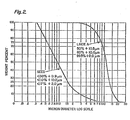
- Figure 2 is a reproduction of a particle size distribution curve of a commercially available (LINDE ATM) zeolite A and ball-milled zeolite A seed crystals made from it.
- LINDE ATM commercially available
- Measurements of the size distribution of zeolite A seed crystals added to a sodium aluminum silicate gel batch are difficult to make with the preferred seeds which have a number average particle size less than 0.5 ⁇ m, because the Coulter counter (which is used to determine the size distribution) has a lower limit of 0.3 ⁇ m. Since a large number of seeds are under 0.3 ⁇ m in size, it is easier to determine the quantity of seeds to be added by their effect.
- a stock batch of zeolite A seed crystals may be made by ball-milling a water slurry of zeolite A in water until the weight average seed size, as determined with a Coulter counter, is less than about 0.9 ⁇ m. The number average seed size of this ball-milled product is less than 0.5 pm. Then different amounts of this seed stock are added to separate standard batches of a precursor zeolite A gel until the desired crystal size (less than 10 ⁇ m) is obtained. Once established, the quantity of zeolite A seed crystals added is constant for a given zeolite A seed crystal stock and get batch size.
- Gel compositions that are within the area bounded by the lines joining points J, K, and L of Figure 1 can crystallize to form zeolite A crystals and encompass (on an anhydrous basis) from about 26 to 62 mole percent sodium oxide, from 10 to 37 mole percent aluminum oxide and from 24 to 50 mole percent of silicon dioxide.
- Such gel compositions contain from about 88 to 96 mole percent of water.
- the gel composition may contain higher amounts of water up to 98 mole percent to ensure the most beneficial effects of seeding, particularly for compositions richer in sodium oxide or silicon dioxide than the composition indicated at point B of Figure 1.
- Preferred gel compositions for the practice of this invention are those which on a dry basis range from 36 to 48 mole percent sodium oxide, from 16 to 24 mole percent aluminum oxide and from 35 to 42 percent silicon dioxide.
- the gel composition defined by point B in Figure 1 One variable which influences crystal growth is alkali content.
- the gel composition indicated at point A in Figure 1 (a higher alkali composition) appears to nucleate more rapidly than those at point B. Therefore, point A formulations are more difficult to control by seeding. Nuclei appear to form autogeneously more rapidly than at point B and the mixture of added seed and autogeneous seed leads to over-seeding and small crystallite development.
- pretreatment of the raw material is important.
- polish filtration may be necessary to remove objectional fine particles which act as seed or nucleation sites.
- Undissolved silica quartz is particularly objectionable and can be removed by polish filtration or dissolution in excess sodium hydroxide through heating.
- Filter aids such as diatomaceous earth can also be used to aid removal of fine particles from silicate or aluminate solutions.
- zeolite A may vary in size from about 3 ⁇ m to about 22 pm with a weight average particle size of 10.5 ⁇ m.
- 80 weight percent of the zeolite A seed crystals formed are under 2 microns in size and 90 weight percent under 3 microns in size as shown by the weight average distribution curve of Figure 2.
- the number average particle size of these zeolite A seed crystals is less than 0.5 ⁇ m.
- milling may be used for seed preparation. Most effective is long time ball-milling of a wet slurry. Dry milling, including fluid energy milling, is less effective for several reasons. First, milling to sizes preferably below 0.5 pm requires high energy input and most industrial dry mills do not reduce the particle size below 100 ⁇ m. Second, the finest particles are often lost during dry milling. Third, when dry dielectric particles reach the 1 pm'size range, they respond to electrostatic forces so as to behave as if wet and will plug lines, elbows, bends, feeders, etc. Wet milling, on the other hand, retains the fine particles, often suspends them out of the working area and yields a uniform, easily usable slurry.
- Milling can be extended in time or by multiple passes until the desired sizing is attained. As with dry milling, energy requirements are high to reach submicron particles. Vibratory or tumbling ball mills are also effective but the balls or cylinders must be heavy enough to crush the crystallites and to move in the thick suspension.
- crystal growth must proceed for 60 minutes at which time all of the gel should be consumed (which terminates growth). Since 4 ⁇ m cubes have eight times the volume of 2 ⁇ m cubes, and as the total volume of solids remains the same after the crystallization step, only 1/8th as many seed nuclei are needed or 1.25 ml of the diluted seed stock in 200 ml of gel to produce uniform crystals 4 ⁇ m in size.
- Seeding a sodium aluminum silicate gel with a commercial unmilled zeolite will increase the crystallization rate but produce a much wider range of particle sizes than will seeding the same gel with milled zeolite crystals. Because any large seeds that are added grow at the same rate of surface deposition as the small seeds present, an 11 ⁇ m added seed will grow to 15 ⁇ m in the same time a 0.1 ⁇ m seed has grown to 4.1 pm. If zeolite crystal clusters, even though loose aggregates, are added as seed, a hard welded mass is attained larger than 10 gm in size and too strong to be broken by simple hammer milling.
- Zeolite C is the major impurity in zeolite A preparations and has a lower exchange capacity than zeolite A. Although complete elimination of zeolite C has not been achieved, its formation can be minimized by seeding with zeolite A crystals under 0.5 ,um in particle size.
- An aluminate solution is prepared by dissolving 115 parts of alumina hydrate in 77 parts of water and 77 parts sodium hydroxide at the boiling point. Two hundred parts of water is cautiously added to the aluminate solution at the boiling point with stirring and the solution filtered immediately.
- Example 2 Two hundred parts by volume of a sodium aluminum silicate gel prepared as described above in Example 2 is seeded with 1.25 parts by volume of the diluted zeolite A seed crystal stock solution described above in Example 1 (containing 0.148 g of zeolite A seed crystals in 10 ml of solution). The temperature of the sodium aluminum silicate gel is then raised to 100°C and maintained at that temperature for 1 hour at which time crystallization appears to be complete. The slurry is then filtered, washed with distilled water, repulped with 600 parts by volume distilled water, refiltered and again washed with water. The filter cake is dryed at 100°C, brushed through a 30 and then an 80 mesh screen and finally is put through a Wiley mill with an 80 mesh screen. (The screen has 80 openings per linear inch, i.e. per 2.54 cms).
- the product analyzed 99% zeolite A, 1% zeolite C, and 0% gel by X-ray diffraction.
- the moisture content, both free and bound, of this zeolite product is determined by heating the sample for one hour at a temperature of 800°C. Under these conditions, volatilization of all moisture is complete.
- the product contains 18.4% water.
- the mean individual crystal size of this zeolite product is determined with a Fisher sub-sieve sizer (Fisher CAT-No. 14-311). This device uses an air permeability principle to measure mean particle size in the 0.2 to 50,um range. A carefully regulated dry air flow passes through a uniformly packed sample. The flow rate, indicated by the liquid level in a manometer, is a function of the particle size of the sample. The mean particle size is read directly from the appropriate curve on a chart supplied as part of the sub-sieve sizer. The mean individual crystal size of the product of this Example is 4.7 ⁇ m.
- the particle size limit of this zeolite product is determined by a microscope technique where the base powder is suspended in water, placed on a microscope stage, equipped with a calibrated eye piece reticle, and individually examined for a mass average particle size estimation and observation of the maximum particle size present. Since type A zeolite is a cubic crystal form, only one dimension is of concern.
- the zeolite particles prepared as described above in this Example are all under 10 ⁇ m in size.
- the zeolite product of this Example has a calcium exchange capacity of 277 milligrams CaC0 3 per anhydrous gram of zeolite A determined by reacting the sample with an excess of calcium ion, separating the solids and determining the excess calcium ion remaining.
- the excess calcium ion is determined after filtration of the calcium-zeolite exchange slurry by titration with standard ethylene diamine tetraacetic acid.
- the free alkali of this zeolite product is determined by titration with standard 0.1 normal HCI to two indicator ena-points.
- the first end-point, phenolphthalein, is a measure of a caustic soda (NaOH) and one-half of the sodium carbonate.
- the second end-point, methyl orange, is a measure of the other one-half of the sodium carbonate.
- This zeolite product contains 0.63% free alkali (calculated as Na 2 0).
- a sodium aluminum silicate gel having the anhydrous composition 50% Na 2 O, 19% Al 2 O 3 , and 31% SiO 2 (designated by point A in Figure 1) and containing 93 mole percent water is prepared as described in Example 2 above.
- a 50% solution of sodium hydroxide (123.7 g) is heated almost to the boiling point and 56.3 g of Al 2 O 3 ⁇ 3H 2 O is added with stirring. Heating is continued until all solids are dissolved.
- To the aluminate solution so obtained is than added 253.3 ml of distilled water at 99°C. This diluted solution is poured into a preheated Waring Blender. The blender is turned on and 123.3 g of N Grade Sodium silicate solution (37.6%) is quickly added.
- a gel is formed immediately upon mixing and is blended for about 2 minutes.
Landscapes
- Chemical & Material Sciences (AREA)
- Organic Chemistry (AREA)
- Life Sciences & Earth Sciences (AREA)
- General Life Sciences & Earth Sciences (AREA)
- Geology (AREA)
- Inorganic Chemistry (AREA)
- Silicates, Zeolites, And Molecular Sieves (AREA)
Applications Claiming Priority (2)
| Application Number | Priority Date | Filing Date | Title |
|---|---|---|---|
| US05/866,302 US4173622A (en) | 1978-01-03 | 1978-01-03 | Zeolite A crystals of uniformly small particle size and the manufacture thereof |
| US866302 | 1978-01-03 |
Publications (2)
| Publication Number | Publication Date |
|---|---|
| EP0002960A1 EP0002960A1 (en) | 1979-07-11 |
| EP0002960B1 true EP0002960B1 (en) | 1982-02-10 |
Family
ID=25347322
Family Applications (1)
| Application Number | Title | Priority Date | Filing Date |
|---|---|---|---|
| EP78300905A Expired EP0002960B1 (en) | 1978-01-03 | 1978-12-27 | Manufacture of zeolite a crystals of uniformly small particle size |
Country Status (8)
| Country | Link |
|---|---|
| US (1) | US4173622A (it) |
| EP (1) | EP0002960B1 (it) |
| JP (1) | JPS54101000A (it) |
| CA (1) | CA1101826A (it) |
| DE (1) | DE2861628D1 (it) |
| ES (1) | ES476488A1 (it) |
| IT (1) | IT1109904B (it) |
| MX (1) | MX150836A (it) |
Families Citing this family (29)
| Publication number | Priority date | Publication date | Assignee | Title |
|---|---|---|---|---|
| DE2907108A1 (de) * | 1979-02-23 | 1980-09-04 | Basf Ag | Verfahren zur herstellung lagerstabiler, pumpbarer und fliessfaehiger alumosilikat-suspensionen durch nassvermahlung |
| DE3021370A1 (de) * | 1980-06-06 | 1981-12-24 | Degussa Ag, 6000 Frankfurt | Verfahren zur verringerung der teilchengroesse zeolithischer natriumaluminiumsilikate |
| DK164097C (da) * | 1982-09-20 | 1992-10-05 | Tosoh Corp | Fremgangsmaade til fremstilling af zeoliter |
| US4935215A (en) * | 1987-05-26 | 1990-06-19 | Mobil Oil Corporation | Measurement and control of zeolite synthesis |
| US5211930A (en) * | 1987-06-01 | 1993-05-18 | Hoechst Aktiengesellschaft | Process for the preparation of crystalline sodium silicates having a sheet structure |
| DE3822151A1 (de) * | 1988-06-30 | 1990-01-04 | Degussa | Verfahren zur herstellung von zeolith naa |
| DE4206553A1 (de) * | 1992-03-02 | 1993-09-09 | Merck Patent Gmbh | Clathrasil vom strukturtypen dodekasil 1 h mit kleiner mittlerer kristallgroesse |
| DE4206579A1 (de) * | 1992-03-02 | 1993-09-09 | Merck Patent Gmbh | Templatarmes clathrasil |
| CN1058681C (zh) * | 1996-03-21 | 2000-11-22 | 中国石油化工总公司石油化工科学研究院 | 细晶粒a型沸石的制备方法 |
| CN1078179C (zh) * | 1997-09-17 | 2002-01-23 | 中国石油化工集团公司 | 一种细晶粒a型沸石的制备方法 |
| JP3257509B2 (ja) * | 1997-11-27 | 2002-02-18 | 東ソー株式会社 | 低シリカフォージャサイト型ゼオライトおよびその製造方法 |
| WO2000006494A1 (en) | 1998-07-29 | 2000-02-10 | Exxon Chemical Patents, Inc. | Crystalline molecular sieves |
| GB9816508D0 (en) * | 1998-07-29 | 1998-09-23 | Exxon Chemical Patents Inc | Molecular sieves and processes for their manufacture |
| US6143057A (en) * | 1999-04-23 | 2000-11-07 | The Boc Group, Inc. | Adsorbents and adsorptive separation process |
| AU3164899A (en) * | 1999-04-26 | 2000-11-10 | Tihomir Lelas | Device for micronizing materials |
| US6096820A (en) * | 1999-07-29 | 2000-08-01 | Pq Corporation | Aluminosilicate stabilized halogenated polymers |
| KR100381261B1 (ko) * | 1999-12-20 | 2003-04-23 | 주식회사 코오롱 | 필름 제조용 폴리에스테르 조성물 |
| AU2001243638A1 (en) * | 2000-03-17 | 2001-10-03 | Pq Holding, Inc. | Process for manufacture of zeolites and zeolite mixtures having enhanced cation exchange properties, products produced thereby, and detergent compositions formulated therewith |
| US6596256B1 (en) | 2000-08-28 | 2003-07-22 | The Boc Group, Inc. | Synthesis of low silicon sodium X zeolite |
| US6432171B1 (en) | 2000-08-28 | 2002-08-13 | The Boc Group, Inc. | Thermal swing adsorption process |
| US6409800B1 (en) | 2000-08-28 | 2002-06-25 | The Boc Group, Inc. | Temperature swing adsorption process |
| US6416569B1 (en) | 2000-08-28 | 2002-07-09 | The Boc Group, Inc. | Temperature swing adsorption process |
| US7014837B2 (en) * | 2003-09-16 | 2006-03-21 | E. I. Dupont De Nemours And Company | Process for the production of nan-sized zeolite A |
| CA2642504A1 (en) * | 2006-03-14 | 2007-09-20 | Brian K. Johnson | Processes and apparatuses for the production of crystalline organic microparticle compositions by micro-milling and crystallization on micro-seed and their use |
| KR100996794B1 (ko) * | 2008-05-15 | 2010-11-25 | 테크노세미켐 주식회사 | 결정성 제올라이트의 제조방법 |
| US7846994B2 (en) * | 2008-12-23 | 2010-12-07 | Potters Industries, Inc. | Inorganic microspheres |
| JP5616125B2 (ja) * | 2010-05-24 | 2014-10-29 | 国立大学法人横浜国立大学 | 微細ゼオライトの製法 |
| JP5805470B2 (ja) * | 2011-08-31 | 2015-11-04 | 国立大学法人横浜国立大学 | 微細ゼオライトの製法 |
| CN103318913B (zh) * | 2013-04-09 | 2015-05-06 | 洛阳市建龙化工有限公司 | 一种小晶粒a型分子筛原粉的制备方法 |
Family Cites Families (21)
| Publication number | Priority date | Publication date | Assignee | Title |
|---|---|---|---|---|
| US2882243A (en) * | 1953-12-24 | 1959-04-14 | Union Carbide Corp | Molecular sieve adsorbents |
| US3071434A (en) * | 1960-01-20 | 1963-01-01 | Socony Mobil Oil Co Inc | Process for makling crystalline zeolites |
| NL302055A (it) * | 1962-12-27 | |||
| US3310373A (en) * | 1963-04-03 | 1967-03-21 | Mobil Oil Corp | Method for producing crystalline aluminosilicates |
| FR1449662A (fr) * | 1965-04-27 | 1966-05-06 | Pechiney Saint Gobain | Agglomérats de zéolites synthétiques |
| US3510258A (en) * | 1966-07-19 | 1970-05-05 | Engelhard Ind Inc | Process for the manufacture of faujasite-type crystalline aluminosilicates |
| US3574538A (en) * | 1968-10-17 | 1971-04-13 | Grace W R & Co | Process for preparing high silica faujasite |
| DE2017807A1 (de) * | 1969-05-01 | 1970-11-12 | W.R. Grace & Co., New York, N.Y. (V.St.A.) | Synthetischer Alumosilikatzeolith und Verfahren zu dessen Herstellung |
| US3692475A (en) * | 1970-11-16 | 1972-09-19 | Nalco Chemical Co | Method for making crystalline zeolite y |
| GB1329316A (en) * | 1970-12-08 | 1973-09-05 | Kerr Mc Gee Chem Corp | Process for automatic control of crystal size distribution |
| US3808326A (en) * | 1971-03-19 | 1974-04-30 | Grace W R & Co | Preparation of zeolites |
| US3949059A (en) * | 1971-05-04 | 1976-04-06 | W. R. Grace & Co. | Process for producing faujasitic-type crystalline zeolites |
| JPS4913720A (it) * | 1972-05-18 | 1974-02-06 | ||
| US3947482A (en) * | 1974-03-20 | 1976-03-30 | W. R. Grace & Co. | Method for producing open framework zeolites |
| US3890426A (en) * | 1974-03-21 | 1975-06-17 | Southwire Co | Method of treating alunite ore |
| US3890425A (en) * | 1974-03-21 | 1975-06-17 | Southwire Co | Redox treatment of alunite ore |
| DE2437914A1 (de) * | 1974-08-07 | 1976-02-19 | Bayer Ag | Verfahren zur herstellung von synthetischem zeolith mit faujasitstruktur |
| DE2447206B2 (de) * | 1974-10-03 | 1976-08-19 | Kacirek, Hartmut, Dipl.-Chem. Dr., 2000 Norderstedt; Lechert, Hans, Dipl.-Chem. Dr., 2000 Hamburg | Verfahren zur herstellung von zeolithen in faujasitstruktur |
| JPS5146760A (it) * | 1974-10-14 | 1976-04-21 | Oil States Rubber Co | |
| US3966883A (en) * | 1974-10-16 | 1976-06-29 | W. R. Grace & Co. | Synthetic ferrierite synthesis |
| DE2517218B2 (de) * | 1975-04-18 | 1977-05-05 | Henkel & Cie GmbH, 4000 Düsseldorf; Deutsche Gold- und Silber-Scheideanstalt vormals Roessler, 6000 Frankfurt | Kristallines zeolithpulver des typs a |
-
1978
- 1978-01-03 US US05/866,302 patent/US4173622A/en not_active Expired - Lifetime
- 1978-12-19 CA CA318,196A patent/CA1101826A/en not_active Expired
- 1978-12-27 DE DE7878300905T patent/DE2861628D1/de not_active Expired
- 1978-12-27 EP EP78300905A patent/EP0002960B1/en not_active Expired
- 1978-12-28 JP JP16128278A patent/JPS54101000A/ja active Granted
- 1978-12-29 ES ES476488A patent/ES476488A1/es not_active Expired
-
1979
- 1979-01-02 IT IT19019/79A patent/IT1109904B/it active
- 1979-01-03 MX MX176105A patent/MX150836A/es unknown
Also Published As
| Publication number | Publication date |
|---|---|
| JPS5715049B2 (it) | 1982-03-27 |
| DE2861628D1 (en) | 1982-03-18 |
| US4173622A (en) | 1979-11-06 |
| JPS54101000A (en) | 1979-08-09 |
| IT1109904B (it) | 1985-12-23 |
| ES476488A1 (es) | 1979-04-16 |
| MX150836A (es) | 1984-07-30 |
| IT7919019A0 (it) | 1979-01-02 |
| CA1101826A (en) | 1981-05-26 |
| EP0002960A1 (en) | 1979-07-11 |
Similar Documents
| Publication | Publication Date | Title |
|---|---|---|
| US4173622A (en) | Zeolite A crystals of uniformly small particle size and the manufacture thereof | |
| EP0609270B1 (en) | Process for preparing uniform mfi-type zeolite crystals | |
| JP3417944B2 (ja) | ナノメーターサイズのモレキュラーシーブ結晶または凝集物及びそれらの製造方法 | |
| US3574538A (en) | Process for preparing high silica faujasite | |
| US4929431A (en) | Process for producing amorphous aluminosilicates | |
| CA1213872A (en) | Process for preparation of zeolites | |
| CA1057272A (en) | Process for producing grit-free zeolitic molecular sieves | |
| US4213874A (en) | Synthetic amorphous sodium aluminosilicate base exchange materials | |
| KR100421598B1 (ko) | 작은입자크기의p형지올라이트 | |
| US4406822A (en) | Method of making zeolites | |
| EP0109729B1 (en) | Process for preparation of mordenite type zeolite | |
| CN100402425C (zh) | 生产硼酸钙的方法 | |
| US4150100A (en) | Preparing zeolite NaA | |
| Palčić et al. | New insights on the autocatalytic nucleation in zeolite A synthesis | |
| US2958579A (en) | Process for manufacture of molecular sieve adsorbents | |
| EP0614853B1 (en) | Method of producing zeolite beta | |
| US4278649A (en) | Continuous process for the production of amorphous sodium aluminosilicate in an elongated reaction zone | |
| JPH0353252B2 (it) | ||
| JPH05270821A (ja) | 立方体状炭酸カルシウムの製造方法 | |
| US3674426A (en) | Process for producing crystalline zeolite a | |
| RU2038303C1 (ru) | Способ получения гидроксида алюминия | |
| JPH09315814A (ja) | 大きな粒子径を有するゼオライトの製造方法 | |
| JPS5917048B2 (ja) | A型ゼオライトの製造法 | |
| KR920001514B1 (ko) | 제올라이트 NaA의 제조방법 | |
| JPH024528B2 (it) |
Legal Events
| Date | Code | Title | Description |
|---|---|---|---|
| PUAI | Public reference made under article 153(3) epc to a published international application that has entered the european phase |
Free format text: ORIGINAL CODE: 0009012 |
|
| AK | Designated contracting states |
Designated state(s): BE DE FR GB NL |
|
| 17P | Request for examination filed | ||
| GRAA | (expected) grant |
Free format text: ORIGINAL CODE: 0009210 |
|
| AK | Designated contracting states |
Designated state(s): BE DE FR GB NL |
|
| REF | Corresponds to: |
Ref document number: 2861628 Country of ref document: DE Date of ref document: 19820318 |
|
| PLBI | Opposition filed |
Free format text: ORIGINAL CODE: 0009260 |
|
| 26 | Opposition filed |
Opponent name: DEGUSSA AG, FRANKFURT - ZWEIGNIEDERLASSUNG WOLFGAN Effective date: 19821106 |
|
| PGFP | Annual fee paid to national office [announced via postgrant information from national office to epo] |
Ref country code: NL Payment date: 19831115 Year of fee payment: 6 |
|
| PGFP | Annual fee paid to national office [announced via postgrant information from national office to epo] |
Ref country code: DE Payment date: 19831121 Year of fee payment: 6 |
|
| PLBN | Opposition rejected |
Free format text: ORIGINAL CODE: 0009273 |
|
| STAA | Information on the status of an ep patent application or granted ep patent |
Free format text: STATUS: OPPOSITION REJECTED |
|
| 27O | Opposition rejected |
Effective date: 19840218 |
|
| PGFP | Annual fee paid to national office [announced via postgrant information from national office to epo] |
Ref country code: FR Payment date: 19841102 Year of fee payment: 7 |
|
| PGFP | Annual fee paid to national office [announced via postgrant information from national office to epo] |
Ref country code: BE Payment date: 19841231 Year of fee payment: 7 |
|
| PG25 | Lapsed in a contracting state [announced via postgrant information from national office to epo] |
Ref country code: NL Effective date: 19850701 |
|
| GBPC | Gb: european patent ceased through non-payment of renewal fee | ||
| NLV4 | Nl: lapsed or anulled due to non-payment of the annual fee | ||
| PG25 | Lapsed in a contracting state [announced via postgrant information from national office to epo] |
Ref country code: DE Effective date: 19850903 |
|
| PG25 | Lapsed in a contracting state [announced via postgrant information from national office to epo] |
Ref country code: BE Effective date: 19851231 |
|
| BERE | Be: lapsed |
Owner name: FMC CORP. Effective date: 19851231 |
|
| PG25 | Lapsed in a contracting state [announced via postgrant information from national office to epo] |
Ref country code: FR Free format text: LAPSE BECAUSE OF NON-PAYMENT OF DUE FEES Effective date: 19860829 |
|
| REG | Reference to a national code |
Ref country code: FR Ref legal event code: ST |
|
| PG25 | Lapsed in a contracting state [announced via postgrant information from national office to epo] |
Ref country code: GB Effective date: 19881117 |