EP0002498B1 - Verfahren zur Herstellung von Hydroxycitronellol - Google Patents
Verfahren zur Herstellung von Hydroxycitronellol Download PDFInfo
- Publication number
- EP0002498B1 EP0002498B1 EP78101591A EP78101591A EP0002498B1 EP 0002498 B1 EP0002498 B1 EP 0002498B1 EP 78101591 A EP78101591 A EP 78101591A EP 78101591 A EP78101591 A EP 78101591A EP 0002498 B1 EP0002498 B1 EP 0002498B1
- Authority
- EP
- European Patent Office
- Prior art keywords
- water
- citronellol
- hydroxycitronellol
- reaction
- lewatit
- Prior art date
- Legal status (The legal status is an assumption and is not a legal conclusion. Google has not performed a legal analysis and makes no representation as to the accuracy of the status listed.)
- Expired
Links
- FPCCDPXRNNVUOM-UHFFFAOYSA-N Hydroxycitronellol Chemical compound OCCC(C)CCCC(C)(C)O FPCCDPXRNNVUOM-UHFFFAOYSA-N 0.000 title description 20
- 238000004519 manufacturing process Methods 0.000 title description 3
- QMVPMAAFGQKVCJ-UHFFFAOYSA-N citronellol Chemical compound OCCC(C)CCC=C(C)C QMVPMAAFGQKVCJ-UHFFFAOYSA-N 0.000 claims description 32
- XLYOFNOQVPJJNP-UHFFFAOYSA-N water Substances O XLYOFNOQVPJJNP-UHFFFAOYSA-N 0.000 claims description 20
- 150000001768 cations Chemical class 0.000 claims description 16
- 235000000484 citronellol Nutrition 0.000 claims description 16
- QMVPMAAFGQKVCJ-SNVBAGLBSA-N (R)-(+)-citronellol Natural products OCC[C@H](C)CCC=C(C)C QMVPMAAFGQKVCJ-SNVBAGLBSA-N 0.000 claims description 15
- JGQFVRIQXUFPAH-UHFFFAOYSA-N beta-citronellol Natural products OCCC(C)CCCC(C)=C JGQFVRIQXUFPAH-UHFFFAOYSA-N 0.000 claims description 15
- 238000000034 method Methods 0.000 claims description 10
- 238000004821 distillation Methods 0.000 claims description 5
- 239000011541 reaction mixture Substances 0.000 claims description 5
- 238000002360 preparation method Methods 0.000 claims description 4
- 239000012456 homogeneous solution Substances 0.000 claims description 2
- 239000002253 acid Substances 0.000 claims 1
- 238000007259 addition reaction Methods 0.000 claims 1
- 238000006243 chemical reaction Methods 0.000 description 12
- KFZMGEQAYNKOFK-UHFFFAOYSA-N Isopropanol Chemical compound CC(C)O KFZMGEQAYNKOFK-UHFFFAOYSA-N 0.000 description 7
- 230000002378 acidificating effect Effects 0.000 description 7
- 229920005989 resin Polymers 0.000 description 7
- 239000011347 resin Substances 0.000 description 7
- 239000000243 solution Substances 0.000 description 7
- ZXEKIIBDNHEJCQ-UHFFFAOYSA-N isobutanol Chemical compound CC(C)CO ZXEKIIBDNHEJCQ-UHFFFAOYSA-N 0.000 description 6
- 239000000203 mixture Substances 0.000 description 6
- 150000002500 ions Chemical class 0.000 description 5
- WPFVBOQKRVRMJB-UHFFFAOYSA-N hydroxycitronellal Chemical compound O=CCC(C)CCCC(C)(C)O WPFVBOQKRVRMJB-UHFFFAOYSA-N 0.000 description 4
- QTBSBXVTEAMEQO-UHFFFAOYSA-N Acetic acid Chemical compound CC(O)=O QTBSBXVTEAMEQO-UHFFFAOYSA-N 0.000 description 3
- 229920002125 Sokalan® Polymers 0.000 description 3
- 238000002156 mixing Methods 0.000 description 3
- 230000035484 reaction time Effects 0.000 description 3
- 150000001336 alkenes Chemical class 0.000 description 2
- 150000001733 carboxylic acid esters Chemical class 0.000 description 2
- 150000001735 carboxylic acids Chemical class 0.000 description 2
- 229920001429 chelating resin Polymers 0.000 description 2
- 239000003205 fragrance Substances 0.000 description 2
- 239000002904 solvent Substances 0.000 description 2
- 239000007858 starting material Substances 0.000 description 2
- WHOZNOZYMBRCBL-OUKQBFOZSA-N (2E)-2-Tetradecenal Chemical compound CCCCCCCCCCC\C=C\C=O WHOZNOZYMBRCBL-OUKQBFOZSA-N 0.000 description 1
- HTSGKJQDMSTCGS-UHFFFAOYSA-N 1,4-bis(4-chlorophenyl)-2-(4-methylphenyl)sulfonylbutane-1,4-dione Chemical compound C1=CC(C)=CC=C1S(=O)(=O)C(C(=O)C=1C=CC(Cl)=CC=1)CC(=O)C1=CC=C(Cl)C=C1 HTSGKJQDMSTCGS-UHFFFAOYSA-N 0.000 description 1
- YZUPZGFPHUVJKC-UHFFFAOYSA-N 1-bromo-2-methoxyethane Chemical compound COCCBr YZUPZGFPHUVJKC-UHFFFAOYSA-N 0.000 description 1
- HPJMGUYYTCSKPC-UHFFFAOYSA-N 2-methylpropan-1-ol hydrate Chemical compound O.CC(C)CO HPJMGUYYTCSKPC-UHFFFAOYSA-N 0.000 description 1
- ALRXDIKPRCRYAU-UHFFFAOYSA-N 2-methylpropan-2-ol Chemical compound CC(C)(C)O.CC(C)(C)O ALRXDIKPRCRYAU-UHFFFAOYSA-N 0.000 description 1
- OKTJSMMVPCPJKN-UHFFFAOYSA-N Carbon Chemical group [C] OKTJSMMVPCPJKN-UHFFFAOYSA-N 0.000 description 1
- LFQSCWFLJHTTHZ-UHFFFAOYSA-N Ethanol Chemical compound CCO LFQSCWFLJHTTHZ-UHFFFAOYSA-N 0.000 description 1
- 230000001476 alcoholic effect Effects 0.000 description 1
- 150000001298 alcohols Chemical class 0.000 description 1
- 239000007864 aqueous solution Substances 0.000 description 1
- 239000006227 byproduct Substances 0.000 description 1
- 238000005341 cation exchange Methods 0.000 description 1
- 239000007795 chemical reaction product Substances 0.000 description 1
- 230000000694 effects Effects 0.000 description 1
- 238000006266 etherification reaction Methods 0.000 description 1
- 230000002349 favourable effect Effects 0.000 description 1
- 239000010419 fine particle Substances 0.000 description 1
- 125000000524 functional group Chemical group 0.000 description 1
- 230000004927 fusion Effects 0.000 description 1
- 238000004817 gas chromatography Methods 0.000 description 1
- 230000036571 hydration Effects 0.000 description 1
- 238000006703 hydration reaction Methods 0.000 description 1
- 125000002887 hydroxy group Chemical group [H]O* 0.000 description 1
- 238000002955 isolation Methods 0.000 description 1
- 239000007788 liquid Substances 0.000 description 1
- 239000006193 liquid solution Substances 0.000 description 1
- 239000011159 matrix material Substances 0.000 description 1
- 239000002245 particle Substances 0.000 description 1
- 229940044654 phenolsulfonic acid Drugs 0.000 description 1
- 229920001467 poly(styrenesulfonates) Polymers 0.000 description 1
- 229920000172 poly(styrenesulfonic acid) Polymers 0.000 description 1
- 229940005642 polystyrene sulfonic acid Drugs 0.000 description 1
- 239000011148 porous material Substances 0.000 description 1
- 239000000047 product Substances 0.000 description 1
- XTUSEBKMEQERQV-UHFFFAOYSA-N propan-2-ol;hydrate Chemical compound O.CC(C)O XTUSEBKMEQERQV-UHFFFAOYSA-N 0.000 description 1
- 238000007127 saponification reaction Methods 0.000 description 1
- 238000007086 side reaction Methods 0.000 description 1
- 238000010626 work up procedure Methods 0.000 description 1
Classifications
-
- C—CHEMISTRY; METALLURGY
- C11—ANIMAL OR VEGETABLE OILS, FATS, FATTY SUBSTANCES OR WAXES; FATTY ACIDS THEREFROM; DETERGENTS; CANDLES
- C11B—PRODUCING, e.g. BY PRESSING RAW MATERIALS OR BY EXTRACTION FROM WASTE MATERIALS, REFINING OR PRESERVING FATS, FATTY SUBSTANCES, e.g. LANOLIN, FATTY OILS OR WAXES; ESSENTIAL OILS; PERFUMES
- C11B9/00—Essential oils; Perfumes
- C11B9/0007—Aliphatic compounds
- C11B9/0015—Aliphatic compounds containing oxygen as the only heteroatom
-
- C—CHEMISTRY; METALLURGY
- C07—ORGANIC CHEMISTRY
- C07C—ACYCLIC OR CARBOCYCLIC COMPOUNDS
- C07C31/00—Saturated compounds having hydroxy or O-metal groups bound to acyclic carbon atoms
- C07C31/18—Polyhydroxylic acyclic alcohols
- C07C31/20—Dihydroxylic alcohols
Definitions
- the present invention relates to an improved process for the preparation of hydroxycitronellol (I; 3,7-dimethyl-octane-1,7-diol) by adding water to citronellol (II; 3,7-dimethyl-oct-6-en-1-ol) ) in the presence of a cation exchanger.
- the invention was therefore based on the object of producing the production of hydroxycitronellol while avoiding the disadvantages described in a simple and therefore inexpensive manner.
- hydroxycitronellol (I) can be obtained by adding water to citronellol (II) in an economical and technically simple manner if a homogeneous solution containing 0.1 to 10 liters, preferably 1 to 5, per kg II Liters of water and an a-methyl-branched primary, secondary or tertiary Cg ⁇ C-alkanol at 40 to 120 ° C treated with a strongly acidic cation exchanger and then worked up the reaction mixture as usual by distillation to the desired process product.
- the starting compound II is commercially available as natural or synthetic citronellol.
- alkanols by definition are propan-2-ol, 2-methyl-propanol (isobutanol), 2-methyl-propan-2-ol (tert-butanol) and butanol- (2).
- alkanols are expediently such that the mixture of II and water dissolves homogeneously in them at room temperature.
- amount of water used about 5 to 20 liters of alkanol per kilogram II are required. Larger amounts, approximately up to twice the amount, do no harm, but generally offer no advantage.
- the amount of water has a wide influence on the reaction rate according to known laws. Within the range given above, particularly good results are achieved when using 1 to 5 liters of water per kilogram 11. Larger amounts than 10 liters of water per kilogram II are not useful for economic reasons, since they require an excessive volume of liquid.
- synthetic ion exchangers as highly acidic cation exchangers, ie highly polymeric spatial networks of carbon chains (matrix) in a gel structure, which contain ⁇ SO ⁇ 3 groups or ⁇ SO ⁇ 3 and ⁇ O ⁇ groups as charge-bearing groups (fusions).
- cation exchangers in which the number of active centers per surface unit is particularly large.
- these include, for example, the particularly fine-particle cation exchangers, such as Lewatit SPC 108, Le watit SP 1080 and Lewatit SPC 118 as well as the so-called large-pore ion exchangers such as Amberlyst 15.
- the cation exchanger is used in the commercially available water-containing form, but is washed with about 5 to 10 times the volume of the corresponding alcohol-water mixture before the reaction.
- these resins are expediently used in amounts of 1 to 5 l per kilogram 11. If the reaction is carried out continuously, for example by passing the aqueous-alcoholic solution of II through exchange columns, it is expediently set up in such a way that 1 kg II per hour are passed over 5 to 10 I of the resin.
- the exchange resins are expediently washed with an aqueous solution of the alkanol, the composition of which corresponds approximately to the water / alkanol ratio in the liquid solutions.
- the preferred reaction temperatures are between 50 and 90 ° C. Since it is an equilibrium reaction, one does not achieve complete conversions, but, depending on the temperature and the amount of water, maximal conversions between 40 and 70%. The economically optimal sales are around 50 to 65% of the equilibrium concentration, because with higher sales the reaction slows down too much in relation to the sales increase.These sales require reaction times of around 1 to 20 hours depending on the amount of cation exchangers.
- the degree of implementation can be followed by gas chromatography.
- the solution is separated from the cation exchanger and, as usual, worked up by distillation.
- the unreacted starting compound, the alkanol and the water are advantageously returned to the reaction stage.
- the cation exchange maintains its activity unchanged over long operating times and therefore only needs to be regenerated occasionally as usual.
- the hydroxycitronellol obtainable by the process according to the invention can be used as a fragrance and is of importance as an intermediate for the preparation of the wished hydroxycitronellal.
- Hydroxycitronellal is obtained in a technically simple and inexpensive manner by the process according to the invention.
- a solution of 50 g of citronellol, 200 ml of water and 300 ml of isopropanol was for 17 hours at 80 ° C with 100 ml of the strongly acidic cation exchanger Lewatit S100 (particle size: 0.3-1 mm), which was previously 5 times the volume an isopropanol-water mixture (mixing ratio 3: 2) had been washed out, stirred. After 17 hours, about 61% of citronellol had been converted and the equilibrium had been reached.
- a solution of 50 g citronellol, 50 ml water and 300 ml isobutanol was treated for 10 hours at 80 ° C with 100 ml of the strongly acidic cation exchanger Lewatit SC 102, which had previously been mixed with 5 times the volume of an isobutanol-water mixture (mixing ratio 6 : 1) was washed out, stirred. Approx. 45% citronellol was converted and the equilibrium reached.
Landscapes
- Chemical & Material Sciences (AREA)
- Organic Chemistry (AREA)
- Life Sciences & Earth Sciences (AREA)
- Engineering & Computer Science (AREA)
- Chemical Kinetics & Catalysis (AREA)
- Oil, Petroleum & Natural Gas (AREA)
- Wood Science & Technology (AREA)
- Organic Low-Molecular-Weight Compounds And Preparation Thereof (AREA)
- Low-Molecular Organic Synthesis Reactions Using Catalysts (AREA)
Description
- Die vorliegende Erfindung betrifft ein verbessertes Verfahren zur Herstellung von Hydroxycitronellol (I; 3,7-Dimethyl-octan-1 ,7-diol) durch Wasseranlagerung an Citronellol (II; 3,7-Dimethyl-oct-6-en-1-ol)

- Aus "Yuki Gosei Kagaku Kyokai" Shi 31 (1973) 11, 924 - 27 ist es bekannt, das als Duftstoff und insbesondere als Zwischenprodukt für die Herstellung des als Duftstoff sehr begehrten Hydroxycitronellals benötigte Hydroxycitronellol I herzustellen, indem man an Citronellol eine niedere Carbonsäure wie Essigsäure in Gegenwart eines Kationenaustauschers anlagert und das Reaktionsprodukt anschließend verseift. Dieses Verfahren hat jedoch den Nachteil, daß einerseits nur geringe Umsätze erzielt werden und andereseits nicht Hydroxycitronellol selbst, sondern dessen Carbonsäurester gebildet werden, die nach ihrer Isolierung erst verseift werden müssen, eine Verfahrensweise, die technisch in hohem Maße unwirtschaftlich ist.
- "Ferner ist es aus den US-Patentschriften 3 257 469 und 3 285 977 bekannt, Olefine in Gegenwart von sauren Ionenaustauschern und Lösungsvermittlern wie Isopropanol durch Hydratisierung in Alkohole zu überführen. Da Olefine jedoch keine weiteren funktionellen Gruppen tragen sind unerwünschte Nebenreaktionen wie Veretherungen primärer Hydroxylgruppen mit dem alkoholischen Lösungsvermittler in diesen Fällen nicht zu befürchten. Überdies sind die Ausbeuten des nach diesen Verfahren hergestellten Alkohols so unbefriedigend, daß man aus den Lehren dieser US-Patentschriften keine allgemeinen Prinzipien für technisch brauchbare Verfahren ableiten kann."
- Der Erfindung lag daher die Aufgabe zugrund, die Herstellung von Hydroxycitronellol unter Vermeidung der geschilderten Nachteile auf möglichst einfache und daher billige Weise herzustellen.
- Es wurde nun überraschenderweise gefunden, daß man Hydroxycitronellol (I) durch Anlagerung vcn Wasser an Citronellol (II) auf wirtschaftliche und technisch einfache Weise erhält, wenn man eine homogen Lösung, enthaltend pro Kilogramm II 0,1 bis 10 Liter, vorzugsweise 1 bis 5 Liter Wasser sowie ein a-methylverzweigtes primäres, sekundäres oder tertiäres Cg―C-Alkanol bei 40 bis 120°C mit einem stark sauren Kationenaustauscher behandelt und das Reaktionsgemisch danach wie üblich destillativ auf das gewünschte Verfahrensprodukt aufarbeitet.
- Bei dem erfindungsgemäßen Verfahren kann also überraschenderweise auf die Mitverwendung der relativ teuren niederen Carbonsäuren sowie auf die spätere aufwendige Verseifung der gebildeten Carbonsäureester verzichtet werden.
- Die Ausgangsverbindung II ist als natürliches oder synthetisches Citronellol handelsüblich.
- Als definitionsgemäße Alkanole eignen sich vor allem Propan-2-ol, 2-Methyl-propanol (Isobutanol), 2-Methyl-propan-2-ol (tert. Butanol) und Butanol-(2).
- Die Menge dieser Alkanole wird zweckmäßigerweise so bemessen, daß sich das Gemisch aus II und Wasser bei Raumtemperatur gerade homogen in ihnen löst. Je nach Art des Alkanols und der Menge des verwendeten Wassers sind hierzu etwa 5 bis 20 Liter Alkanol pro Kilogramm II erforderlich. Größere Menge, etwa bis zur doppelten Menge, schaden nicht, bieten aber im allgemeinen auch keinen Vorteil.
- Die Menge des Wassers hat nach bekannten Gesetzmäßigkeiten breiten Einfluß auf die Reaktionsgeschwindigkeit. Innerhalb des oben angegebenen Bereiches erzielt man besonders gute Ergebnisse bei Verwendung von 1 bis 5 Liter Wasser pro Kilogramm 11. Größere Mengen als 10 Liter Wasser pro Kilogramm II sind aus wirtschaftlichen Gründen nicht sinnvoll, da sie ein zu großes Flüssigkeitsvolumen bedingen.
- Als stark saure Kationenaustauscher verstehen wir erfindungsgemäß Kunstharz-lonenaustauscher, d.h. hochpolymere räumliche Netzwerke aus Kohlenstoffketten (Matrix) in Gelstruktur, die als ladungstragende Gruppen (Festionen) ―SO⊖3-Gruppen oder ―SO⊖3- und ―O⊖-Gruppen enthalten. Es handelt sich hierbei im wesentlichen um handelsübliche Kationenaustauscher auf der Basis von Polystyrolsulfonsäureharzen oder Phenolsulfonsäureharzen, die z.B. unter folgenden Handelsnamen bekannt sind: Lewatit S100, Lewatit S 115, Lewatit SP 1080, Lewatit SC 102, Lewatit SPC 118, Amberlite IR 120, Amberlite IR 200, Aberlyst 15, Dowex 50, Permutit RS, Wofatit KPS 200, Duolite C-3, Duolite C-1 0, Duolite C-25, Wofatit F, Wofatit D, Wofatit P, Zeoxex (Keokarb H), Nalcite HCR, Nalcite HGR, Nalcite HDR, Permutit Q und Permutit RS.
- Besonders günstige Ergebnisse bezüglich Umsatz und Reaktionszeit wurden mit solchen Kationenaustauscher erzielt, bei denen die Zahl der aktiven Zentren pro Oberflächeneinheit besonders groß ist. Hierzu zählen z.B. die besonders feinteiligen Kationenaustauscher, wie Lewatit SPC 108, Lewatit SP 1080 und Lewatit SPC 118 sowie die sogenannten großporigen Ionenaustauscher wie Amberlyst 15.
- Der Kationenaustauscher wird in der handelsüblichen wasserhaltigen Form eingesetzt, jedoch vor der Umsetzung mit etwa 5- bis 10-fachem Volumen des entsprechenden Alkohol-Wasser-Gemischs gewaschen.
- Bezüglich näherer Einzelheiten über Herstellung, Eigenschaften und Verwendung der sauren Kationenaustauscher verweisen wir auf Ullmanns Encyclopädie der technischen Chemie, 3. Auflage, Band 8, 1957, Seite 787 ff, insbesondere Seite 806-811 und 814-822.
- Für die diskontinuierliche Arbeitsweise verwendet man diese Harze zweckmäßigerweise in Mengen von 1 bis 5 I pro Kilogramm 11. Nimmt man die Umsetzung kontinuierlich vor, indem man etwa die wäßrig-alkoholische Lösung von II durch Austauschersäulen leitet, so richtet man es zweckmäßigerweise so ein, daß 1 kg II pro Stunde über 5 bis 10 I des Harzes geleitet werden. Vor erstmaligem Gebrauch wäscht man die Austauscherharze zweckmäßigerweise mit einer wäßrigen Lösung des Alkanols, deren Zusammensetzung etwa dem Wasser/Alkanol-Verhältnis in den li-Lösungen entspricht.
- Die bevorzugten Reaktionstemperaturen liegen zwischen 50 und 90°C. Da es sich um eine Gleichgewichtsreaktion handelt, erzielt man keine vollständigen Umsätze, sondern, je nach Temperatur und Wassermenge maximal Umsätze zwischen 40 und 70%. Die wirtschaftlich optimalen Umsätze liegen bei etwa 50 bis 65% der Gleichgewichtskonzentration, denn bei höheren Umsätzen verlangsamt sich die Reaktion in Relation zur Umsatzerhöhung zu sehr, Diese Umsätze erfordern je nach der Menge der Kationenaustauscher Reaktionszeiten von etwa 1 bis 20 Stunden. Der Grad der Umsetzung kann gaschromatographisch verfolgt werden.
- Nach Erreichen des gewünschten Umsatzes trennt man die Lösung vom Kationenaustauscher ab und arbeitet sie wie üblich destillativ auf. Die nicht umgesetzte Ausgangsverbindung, das Alkanol und das Wasser werden zweckmäßigerweise in die Reaktionsstufe zurückgeführt. Der Kationenaustausch behält über lange Betriebszeiten seine Aktivität unverändert bei und braucht deshalb nur gelegentlich wie üblich regeneriert zu werden.
- Das nach dem erfindungsgemäßen Verfahren erhältlich Hydroxycitronellol ist als Duftstoff verwendbar und hat als Zwischenprodukt für die Herstellung des begehrten Hydroxycitronellals Bedeutung.
- Hydroxycitronellal wird nach dem erfindungsgemäßen Verfahren auf technisch einfache und billige Weise erhalten.
- Eine Lösung aus 50 g Citronellol, 200 ml Wasser und 300 ml Isopropanol wurde 17 Stunden lang bei 80°C mit 100 ml des stark sauren Kationenaustauschers Lewatit S100 (Teilchengröße: 0,3-1 mm), der zuvor mit dem 5-fachen Volumen eines Isopropanol-Wasser-Gemisches (Mischungsverhältnis 3:2) ausgewaschen worden war, gerührt. Nach 17 Stunden waren ca. 61% Citronellol umgesetzt und die Gleichgewichtseinstellung erreicht.
- Die nach Abtrennung des Austauscherharzes übliche destillative Aufarbeitung der Lösung ergab 19 g unumgesetztes Citronellol und 32 g Hydroxycitronellol, was einer Ausbeute von 94%, bezogen auf umgesetztes Citronellol, entspricht. Kp bei 0,03 mbar = 99 - 101 °C; nD 25 = 1,4579.
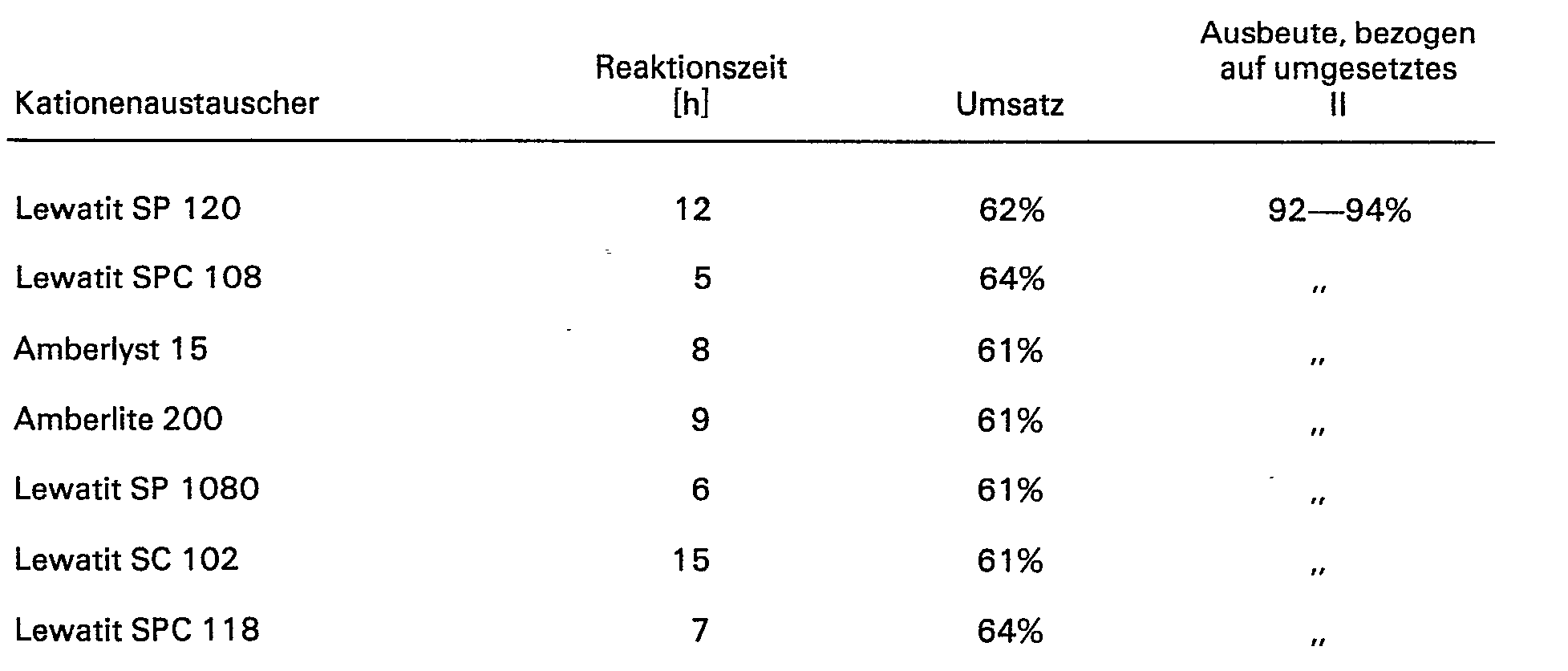
- Eine Lösung aus jeweils 50 g Citronellol, 200 ml Wasser und 300 ml Isopropanol wurde in der aus der Tabelle ersichtlichen Reaktionszeit bei 80°C mit dem aus der Tabelle ersichtlichen Kationenaustauscher, der analog Beispiel 1 vorbehandelt war, gerührt und das vom Austauscherharz abgetrennte Reaktionsgemisch destillativ aufgearbeitet. Die erzielten Ergebnisse wurden in der folgenden Tabelle dargestellt:
- Eine Lösung aus 50 g Citronellol, 50 ml Wasser und 300 ml Isobutanol wurde 10 Stunden lang bei 80°C mit 100 ml des stark sauren Kationenaustauschers Lewatit SC 102, der zuvor mit dem 5-fachen Volumen eines Isobutanol-Wasser-Gemisches (Mischungsverhältnis 6:1) ausgewaschen worden war, gerührt. Es waren ca. 45% Citronellol umgesetzt und die Gleichgewichtseinstellung erreicht.
- Als Nebenprodukt waren ca. 4% 3,7-Dimethyl-7-iso-butoxy-octanol-1 nachzuweisen. Aus dem vom Ionenaustauscher abgetrennten Reaktionsgemisch wurden Hydroxycitronellol in 84 prozentiger Ausbeute, bezogen auf umgesetztes Citroneliol, destillativ abgetrennt.
- Eine Lösung aus 50 g Citronellol, 200 ml Wasser und 600 ml Butanol-(2) wurde 12 Stunden lang bei 80°C mit 100 ml des stark sauren Kationenaustauschers Lewatit SPC 108, der zuvor mit dem 5- fachen Volumen eines Butanoi-(2)-Wasser-Gemisches (Mischungsverhältnis 3:2) ausgewaschen worden war, gerührt. Danach waren ca. 47% Citronellol umgesetzt und die Gleichgewichtseinstellung erreicht.
- Aus dem vom lonenaustauscher abgetrennten Reaktionsgemisch wurden destillativ 32 g Hydroxycitronellol erhalten, was einer Ausbeute von 90%, bezogen auf umgesetztes Citronellol, entspricht.
Claims (1)
Applications Claiming Priority (2)
| Application Number | Priority Date | Filing Date | Title |
|---|---|---|---|
| DE2755945 | 1977-12-15 | ||
| DE19772755945 DE2755945A1 (de) | 1977-12-15 | 1977-12-15 | Verfahren zur herstellung von hydroxycitronellol |
Publications (2)
| Publication Number | Publication Date |
|---|---|
| EP0002498A1 EP0002498A1 (de) | 1979-06-27 |
| EP0002498B1 true EP0002498B1 (de) | 1981-09-09 |
Family
ID=6026224
Family Applications (1)
| Application Number | Title | Priority Date | Filing Date |
|---|---|---|---|
| EP78101591A Expired EP0002498B1 (de) | 1977-12-15 | 1978-12-07 | Verfahren zur Herstellung von Hydroxycitronellol |
Country Status (4)
| Country | Link |
|---|---|
| US (1) | US4200766A (de) |
| EP (1) | EP0002498B1 (de) |
| JP (1) | JPS5484509A (de) |
| DE (2) | DE2755945A1 (de) |
Families Citing this family (4)
| Publication number | Priority date | Publication date | Assignee | Title |
|---|---|---|---|---|
| DE3200990A1 (de) * | 1982-01-15 | 1983-07-28 | Basf Ag, 6700 Ludwigshafen | Verfahren zur herstellung von ungesaettigten alkoholen und/oder deren estern |
| US4482765A (en) * | 1983-06-24 | 1984-11-13 | Union Camp Corporation | Preparation of hydroxycitronellol |
| CN112125792B (zh) * | 2020-09-24 | 2022-07-12 | 万华化学集团股份有限公司 | 一种联产羟基香茅醛和羟基香茅醇的方法 |
| CN115124413B (zh) * | 2022-02-18 | 2023-11-28 | 山东新和成药业有限公司 | 一种羟基香茅醇制备羟基香茅醛的方法 |
Family Cites Families (6)
| Publication number | Priority date | Publication date | Assignee | Title |
|---|---|---|---|---|
| CA675355A (en) * | 1963-12-03 | The Givaudan Corporation | Process for making citronellol | |
| GB886763A (en) * | 1957-05-13 | 1962-01-10 | Glidden Co | Process for preparing organoleptic materials from 7,8-epoxy-2,6-dimethyl-octane-2-olor its ethers or esters |
| US3257469A (en) * | 1962-04-02 | 1966-06-21 | Sinclair Research Inc | Alcohols by selective hydrolysis of olefins |
| US3285977A (en) * | 1962-04-12 | 1966-11-15 | Gulf Research Development Co | Hydration of olefins in the presence of a solvent |
| CH478909A (de) * | 1966-08-03 | 1969-09-30 | Givaudan & Cie Sa | Riechstoffkompositionen |
| JPS5858327B2 (ja) * | 1975-08-22 | 1983-12-24 | 帝人株式会社 | グリコ−ルルイノ セイゾウホウ |
-
1977
- 1977-12-15 DE DE19772755945 patent/DE2755945A1/de not_active Withdrawn
-
1978
- 1978-11-17 US US05/961,705 patent/US4200766A/en not_active Expired - Lifetime
- 1978-12-07 EP EP78101591A patent/EP0002498B1/de not_active Expired
- 1978-12-07 DE DE7878101591T patent/DE2861063D1/de not_active Expired
- 1978-12-08 JP JP15120678A patent/JPS5484509A/ja active Pending
Also Published As
| Publication number | Publication date |
|---|---|
| DE2755945A1 (de) | 1979-06-21 |
| JPS5484509A (en) | 1979-07-05 |
| DE2861063D1 (en) | 1981-11-26 |
| EP0002498A1 (de) | 1979-06-27 |
| US4200766A (en) | 1980-04-29 |
Similar Documents
| Publication | Publication Date | Title |
|---|---|---|
| EP0544118B1 (de) | Verfahren zur Herstellung von 3-Hydroxyalkanalen | |
| DE69207978T2 (de) | Verfahren zur Herstellung von 1,3-Propandiol | |
| EP0304696B1 (de) | Verfahren zur Herstellung von 1,4-Butandiol und/oder Tetrahydrofuran | |
| DE69218309T3 (de) | Herstellung von Neopentylglykol (IV) | |
| EP0082401B1 (de) | Verfahren zur Herstellung von überwiegend das Z-Isomere enthaltendem Rosenoxid | |
| DE69214026T2 (de) | Herstellung von Neopentylglykol (III) | |
| DE1944120A1 (de) | Verfahren zur Herstellung von Glycerin | |
| EP0002498A1 (de) | Verfahren zur Herstellung von Hydroxycitronellol | |
| EP0382050A1 (de) | Verfahren zur Herstellung von Alkanolen | |
| EP0524638A2 (de) | Verfahren zur Herstellung von primären und sekundären fluorhaltigen Alkoholen | |
| DE1816386C3 (de) | Verfahren zur Herstellung von Vanadiumoxitri alkoholaten | |
| EP0084133B1 (de) | Verfahren zur Herstellung von ungesättigten Alkoholen und/oder deren Estern | |
| DE2709440A1 (de) | Verfahren zur herstellung von propylenoxid | |
| EP0052295A2 (de) | Verfahren zur Herstellung von Polyolen mit mindestens einem Oxacyclopentanring | |
| DE2107084B2 (de) | Verfahren zur Herstellung von Glycidylestem | |
| DE2721766C2 (de) | ||
| DE1901089B2 (de) | Verfahren zur herstellung von hexantriol-1,2,6 | |
| DE2524039A1 (de) | Verfahren zum hydrolysieren und hydrieren von acetalaldehyden | |
| EP0009159B1 (de) | Verfahren zur Herstellung von Carbonsäureestern des Beta-Formyl-Crotylalkohols mittels einer Allylumlagerung | |
| DE2344386A1 (de) | Verfahren zur herstellung von hydrochinon | |
| DE19711826A1 (de) | Verbessertes Verfahren zur Herstellung von Trifluormethyloxiran | |
| EP0794166B1 (de) | Verfahren zur Herstellung von Hydroxymethylcyclopropan | |
| EP0325932A2 (de) | Verfahren zur Herstellung von tertiären C4-C5-Alkoholen | |
| DE1154083B (de) | Verfahren zur Herstellung von ª-Alkoxypropionsaeurealkylestern | |
| EP0602573B1 (de) | Verfahren zur Herstellung von Acetalen |
Legal Events
| Date | Code | Title | Description |
|---|---|---|---|
| PUAI | Public reference made under article 153(3) epc to a published international application that has entered the european phase |
Free format text: ORIGINAL CODE: 0009012 |
|
| AK | Designated contracting states |
Designated state(s): CH DE FR GB NL |
|
| 17P | Request for examination filed | ||
| GRAA | (expected) grant |
Free format text: ORIGINAL CODE: 0009210 |
|
| AK | Designated contracting states |
Designated state(s): CH DE FR GB NL |
|
| REF | Corresponds to: |
Ref document number: 2861063 Country of ref document: DE Date of ref document: 19811126 |
|
| PGFP | Annual fee paid to national office [announced via postgrant information from national office to epo] |
Ref country code: FR Payment date: 19941124 Year of fee payment: 17 |
|
| PGFP | Annual fee paid to national office [announced via postgrant information from national office to epo] |
Ref country code: CH Payment date: 19941125 Year of fee payment: 17 |
|
| PGFP | Annual fee paid to national office [announced via postgrant information from national office to epo] |
Ref country code: GB Payment date: 19941201 Year of fee payment: 17 |
|
| PGFP | Annual fee paid to national office [announced via postgrant information from national office to epo] |
Ref country code: DE Payment date: 19941227 Year of fee payment: 17 |
|
| PGFP | Annual fee paid to national office [announced via postgrant information from national office to epo] |
Ref country code: NL Payment date: 19941231 Year of fee payment: 17 |
|
| PG25 | Lapsed in a contracting state [announced via postgrant information from national office to epo] |
Ref country code: GB Effective date: 19951207 |
|
| PG25 | Lapsed in a contracting state [announced via postgrant information from national office to epo] |
Ref country code: DE Effective date: 19951218 |
|
| PG25 | Lapsed in a contracting state [announced via postgrant information from national office to epo] |
Ref country code: CH Effective date: 19951231 |
|
| PG25 | Lapsed in a contracting state [announced via postgrant information from national office to epo] |
Ref country code: NL Effective date: 19960701 |
|
| GBPC | Gb: european patent ceased through non-payment of renewal fee |
Effective date: 19951207 |
|
| REG | Reference to a national code |
Ref country code: CH Ref legal event code: PL |
|
| PG25 | Lapsed in a contracting state [announced via postgrant information from national office to epo] |
Ref country code: FR Effective date: 19960830 |
|
| NLV4 | Nl: lapsed or anulled due to non-payment of the annual fee |
Effective date: 19960701 |
|
| REG | Reference to a national code |
Ref country code: FR Ref legal event code: ST |
|
| PLBE | No opposition filed within time limit |
Free format text: ORIGINAL CODE: 0009261 |
|
| STAA | Information on the status of an ep patent application or granted ep patent |
Free format text: STATUS: NO OPPOSITION FILED WITHIN TIME LIMIT |